Banco BTG Pactual: The Billionaire Partnership That Broke the Brazilian Banking Oligopoly
I. The 6:00 AM Arrest and the Run on the Fortress
On the morning of November 25, 2015, Brazil's Federal Police came for the most celebrated banker in the country. André Esteves, the chief executive, chairman and controlling shareholder of Banco BTG Pactual, was detained in the sprawling Lava Jato (Car Wash) investigation into kickbacks around Petrobras.1 Prosecutors accused him of working with a sitting senator, Delcídio do Amaral, to interfere with the plea-bargain testimony of a former Petrobras executive.2 Esteves denied it through his lawyer. Within hours he was on his way to the Bangu prison complex in Rio de Janeiro's western suburbs, where he would spend roughly three weeks.3
Most stories about a banker's arrest are stories about a banker. This one was about a balance sheet. BTG Pactual was not a sleepy deposit-taking bank with millions of retail savers who would never notice the news. It was a wholesale institution funded largely by corporate treasurers, fund managers and institutional investors, the most rational and least sentimental creditors there are. They do not wait to find out whether a founder is guilty. They take their money first and read the indictment later.
They did exactly that. In the two days after the arrest, clients pulled about R$4.2 billion out of some of the bank's most liquid fixed-income funds, roughly a third of what those ten funds had held the day before.1 The units fell 26% in two trading sessions.4 Moody's and Fitch put the bank on review, and by December 1 Moody's had cut it two notches, from Baa3 to Ba2, stripping away its investment-grade rating at the precise moment it needed wholesale lenders to believe in it.5 Bank deposit certificates, the short-term paper that funded daily operations, started to run off as they matured.4
What followed was a weekend that partners still talk about the way soldiers talk about a siege. Esteves resigned as chairman and CEO. On December 2, he gave up control altogether, swapping all of his voting shares for non-voting preferred stock, receiving no cash, and handing command to the seven other senior partners, who agreed that management decisions would need at least four of their votes.5 The same day, the bank sold its roughly 12% stake in hospital chain Rede D'Or São Luiz to Singapore's GIC for about R$2.38 billion, the first of a string of disposals designed to turn illiquid trophies into cash.5 Two days later the Fundo Garantidor de Créditos (FGC), the industry-funded deposit guarantor, opened a secured credit line of up to R$6 billion, after the Central Bank of Brazil confirmed that BTG's failure could pose systemic risk. The line was collateralized at 120% by a slice of BTG's loan book and personally guaranteed by the seven partners now in control.4
That last detail is the hinge of this whole story. When the lifeline came, it did not come only against the bank's assets. It came against the personal fortunes of the men who ran it. BTG drew R$5 billion by year-end, and by October 19, 2016, it had repaid every real.4
The scale of the retreat shows up starkly in the accounts. Total assets, measured in dollars, fell from about $75.6 billion at the end of 2015 to about $31.8 billion a year later, a contraction of more than half.6 Some of that came from selling and deconsolidating foreign businesses rather than from depositors walking out, but the direction was unmistakable: to survive, BTG shrank itself to a size its remaining funding could carry. Then, in July 2018, a federal judge in Brasília acquitted Esteves of the obstruction charge, finding no valid proof for a conviction; prosecutors themselves had asked for acquittal the previous year.3
The bank that emerged from that ordeal looks nothing like the one that entered it. A decade later, BTG Pactual is Brazil's dominant investment bank and one of its largest money managers, with about R$2.7 trillion of client assets under management and in its wealth platform, and it earned an annualized adjusted return on equity of 26.7% in the second quarter of 2026.7 Net profit has compounded at about 36% a year in local currency over the decade from the crisis year, though that figure is flattered by how low the 2015 base was; over the cleaner five-year window it was still about 32% a year.6 And the man taken to Bangu is back. In April 2022, shareholders made André Esteves chairman of the board again.89
That return is where the hard questions begin. Was the survival proof that BTG is an institution rather than one man's trading book, or did control simply wait out the storm and come home? Can a bank built on elite corporate dealmaking keep earning returns in the mid-20s as it pushes into payroll loans and car finance for working-class Brazilians? Is the partnership a meritocracy that aligns everyone, or a fortress that outside shareholders cannot enter? Does Brazil's sub-investment-grade sovereign rating put a permanent lid on how global this bank can become? And will an old tax fight over the goodwill from its own buyback one day land on the income statement? To answer any of them, the story has to start where the culture was forged: on a trading floor in Rio during hyperinflation.
 Subscribe on LinkedIn
II. The Pactual Machine: Trading Floor Meritocracy (1983–2006)
In 1989, a 21-year-old student of mathematics and computer science at the Federal University of Rio de Janeiro answered a newspaper advertisement recruiting young talent for an investment bank.10 André Esteves was hired by Banco Pactual as a systems analyst, a back-office technologist in a firm that worshipped traders.9 Luiz Cezar Fernandes, the bank's founder, later said he had hired the boy as a computer technician.11 Four years later, Esteves was a partner.9
To understand why a programmer could become a partner in four years, it helps to understand what Pactual was. It began in 1983 in Rio as a distribuidora, a securities dealer, founded by Fernandes alongside the economist Paulo Guedes and the trader André Jakurski.10 One founder was a self-taught banker with boundless confidence, another a gifted trader, the third an academically trained economist who would much later become Brazil's finance minister.10 They borrowed openly from the Goldman Sachs of that era: a private partnership in which the people who generated the profits owned the firm, and in which ownership was something you earned rather than inherited.
Brazil in the 1980s and early 1990s was the perfect laboratory for that kind of firm. Inflation ran at rates that made prices on a supermarket shelf change between the morning and the afternoon. For an ordinary company, that was chaos. For a fixed-income desk that could price government paper faster and more accurately than the bureaucratic giants, it was an enormous, recurring opportunity. Every day the yield curve moved violently; every day someone mispriced it. A trader who understood indexation, overnight rates and the government's financing needs could make money out of the very instability that paralyzed everyone else. A programmer who could make the bank's pricing models run better was, in that world, closer to the profit engine than any branch manager.
The culture that grew around this was brutal by design. Journalist Ariane Abdallah, who interviewed more than a hundred people for her history of the firm, describes a strict meritocracy from the beginning, with rigorous performance reviews that gave top performers a path to partnership, and a recruiting question that captured the bargain: you have had a good life so far, do you really want to work yourself to death?10 Those who said yes were offered something no salaried banker at Bradesco or Itaú could get: the chance to own a piece of the machine.
The mechanics of that ownership became the bank's signature. As it was described in 2012, more than 160 partners were invited each year to buy additional shares at book value, while weaker performers were required to sell part of their holdings back.11 Think of it as a continuous auction for the right to own the firm, where the currency is performance rather than cash. Equity flows toward those producing the returns and away from those who are not. Because the price is book value, not market value, the partner who buys is paying for the capital the firm already has, and is betting his own future earnings that he can make it grow. The partner forced to sell gets book value back, not a premium, which removes any incentive to coast on accumulated stock.
That structure produced two consequences that still define BTG. The first is alignment. A partner whose wealth sits in the firm's equity is subordinated to every depositor and bondholder; if the bank fails, he loses first. The second is concentration. Because ownership circulates inside the partnership, the circle at the top never really opens. That tension, between alignment that protects creditors and concentration that sidelines outside shareholders, runs through the entire story.
Pactual's own founding generation was the first to feel the knife. In the late 1990s, LatinPart, Fernandes's personal investment company, collapsed with losses of more than $140 million, and to cover the hole he came under pressure to sell his Pactual stake to his partners, Esteves among them.12 By Exame's account, the partners required him in 1998 to hand over his shares in exchange for loans; he accepted, and by 1999 he was fully out.1112 The founder who had dreamed of a broad distribution bank was gone, and the young traders now ran the firm. Fernandes would later say, with a mix of pride and rue, that Esteves went on to run the distribution bank he had wanted to build.12 Years later, when Fernandes faced another financial squeeze and the possible auction of his country estate in Petrópolis, he asked Esteves for help, and Esteves stepped in.10 It is a fitting parable for the place: loyalty mattered, but control went to whoever was producing.
What the partners built over the next seven years was a domestic champion in fixed income, asset management and advisory, a firm that a 2009 report would call Brazil's largest investment bank.13 Pactual did not publish the kind of long-run return history that would let an outsider audit its legend, and the claims of extraordinary returns through the hyperinflation years rest on the partners' own telling. What is verifiable is that it became attractive enough to sell. By 2006 the global banks were circling Brazil, and the partners faced a decision that tests every partnership eventually: cash out, or keep compounding. They chose to cash out, and that decision is where the most audacious trade in the firm's history began.
III. The UBS Interregnum and the Birth of BTG (2006–2009)
In 2006, Switzerland's UBS agreed to buy Banco Pactual. The price was widely reported at about $2.6 billion, and Exame later put the total UBS paid the partners at about $3.1 billion.1311 For the partners, it was a liquidity event of a kind no Brazilian financial firm had produced before. For UBS, it was a ticket into one of the fastest-growing emerging markets, bought at the top of a global credit boom that made almost every emerging-market franchise look cheap.
The marriage was unhappy almost from the start. The Swiss bank brought formality, rigid processes and a management style the Rio traders found suffocating, and the integration was turbulent.10 Esteves rose anyway, becoming UBS's global head of fixed income in London in 2008, just as the subprime crisis was eating through UBS, one of Europe's hardest-hit banks.1011 From that seat he could see the whole wreck at close range: the European banking system frozen, his own employer bleeding from mortgage losses, and Brazil, by contrast, relatively untouched. According to Exame, Esteves proposed to UBS's board in 2008 that he inject capital in exchange for a controlling stake. The board refused, and he left.11
He did not leave to retire. In mid-2008 he founded a new firm, BTG, whose initials were later explained as standing for "back to the game."1013 Its first big move was buying Lehman Brothers' Brazilian operations after Lehman's collapse, and it recruited talent shaken loose by the crisis at Lehman, UBS and elsewhere.13 Persio Arida, the economist who had helped design Brazil's Real Plan, joined Esteves that year.11 BTG was, in effect, a war chest and a team waiting for the right asset to come up for sale. The asset they wanted was the one they had just sold.
UBS, meanwhile, was bleeding. It reported a loss of about $1.7 billion in the first quarter of 2009 and was selling businesses to rebuild capital.13 On the evening of April 19, 2009, Esteves and his partners signed a contract in New York to buy Pactual back.13 The price was not formally disclosed at the time, but Esteves and his former partners had offered $2.5 billion, and UBS accepted.11 Set that against the $2.6 billion UBS had paid three years earlier, plus the dividends and payouts the partners had collected in between, and the trade looks almost unfair. The partners sold a domestic franchise at the top of a cycle to a foreign buyer, then bought it back at the bottom from a seller under duress, having in the meantime watched the buyer's global machinery from the inside. If there is a single deal that explains why BTG's partners think of themselves as traders first and bankers second, this is it.
There is a myth that the buyback was a pure bargain. The record suggests something more complicated, because the partners did not only buy a bank; they built a tax structure around it, and that structure has followed them ever since. Both the 2006 UBS acquisition and the 2009 repurchase created goodwill, or ágio in Brazilian tax language: the excess of price paid over the book value of what was acquired. Under Brazilian rules of that era, goodwill backed by expected future profits could be amortized and deducted from corporate income tax (IRPJ) and the social contribution on net profit (CSLL), but only if it arose in a genuine transaction between independent parties. BTG used two holding companies as vehicles in these operations, and amortized the goodwill against its taxes from 2007 to 2012.14
The Receita Federal, Brazil's federal tax authority, challenged those deductions year by year. The first major test came before the Administrative Council of Tax Appeals (CARF), the administrative court where Brazilian tax disputes are fought before they reach the judiciary. In January 2019 a CARF panel unanimously upheld an assessment of about R$1.94 billion covering the 2010 and 2011 tax years. The rapporteur accepted that one vehicle company had a legitimate business purpose, but found that the second was created so that a reverse merger could channel the goodwill into deductions, and that part of the structure failed.14 It was a clear administrative loss, and the decision could still be appealed.14
The next round went better for the bank. In March 2024, CARF's Superior Chamber annulled most of a separate assessment of about R$993 million for the 2012 tax year, allowing the amortization of two of three disputed goodwill items: one from the UBS purchase, one from the 2009 buyback, and a third, known as "ágio Copa," from the entry of eleven foreign investors who bought a 16% stake above book value. The tax authority's appeal on the third item remained open.15 So the honest summary of the scorecard is mixed: one large loss, one large partial win, and further rounds still to come in the administrative system and in the federal courts.
How does BTG account for all this? The bank classifies its probability of loss on the remaining goodwill disputes as "possible" rather than "probable," based on its lawyers' opinions, and under Brazilian and international accounting rules a "possible" loss is disclosed but not provisioned.16 Its auditor, EY, has issued clean opinions while flagging the tax litigation among its key audit matters.16 The amounts involved, in the range of R$1.5 billion to R$2 billion, are material in absolute terms but small against a bank that now earns more than R$5 billion in a single quarter.177 That changes the nature of the risk. In 2009 a multi-billion-real tax bill could have threatened BTG's capital; in 2026 it would be a bad quarter, not a crisis. The goodwill fight matters less as a solvency threat than as a window into the partnership's character: these are people who structure aggressively, accept the litigation that follows, and back their own reading of the rules.
That character was about to be tested on a far larger stage. With Pactual back in Brazilian hands and the world's banks still licking their wounds, Esteves and his partners set out to turn BTG into something bigger than Brazil's best investment bank: an emerging-market merchant empire, financed by public shareholders.
IV. The IPO, Merchant Banking Hubris, and the Near-Death Crash (2010–2018)
In April 2012, BTG Pactual rang the bell on the São Paulo exchange. The offering sold units at R$31.25 each and raised about R$3.65 billion, a landmark listing for a Brazilian investment bank.18 The structure was as revealing as the price. Investors bought units, bundles of one voting common share and two non-voting preferred shares, which meant the public could buy a share of the profits without buying a meaningful share of the control.1817 Alongside the listed bank sat a sister vehicle, BTG Pactual Participations, listed in Amsterdam, which held the group's merchant-banking investments.18 Outside money came in; the partnership kept the steering wheel.
The capital went to work on a vision far bigger than advisory and trading. Esteves wanted BTG to be an emerging-markets powerhouse, and he wanted it to own things: offshore drilling rigs, hospitals, parking-garage operators, a commodities-trading affiliate.1916 Merchant banking, investing the firm's own capital in companies alongside or instead of clients, was the most aggressive expression of that ambition. It can be wonderfully profitable, as BTG's stake in hospital chain Rede D'Or would later prove, but it ties up capital in assets that cannot be sold in a hurry, which is precisely what a wholesale-funded bank cannot afford in a panic.
Sete Brasil was the cautionary tale in waiting. The company was created to build and lease offshore drilling rigs to Petrobras, and BTG put about R$1 billion into it alongside state pension funds and other banks.19 By late 2014 Sete was in trouble, behind on payments to shipyards and named in the Car Wash investigation, after testimony linked it to bribes; its state development-bank financing had been suspended.19 On a call with investors in February 2015, Esteves made a promise that captured the era's confidence: even if Sete "turned to dust," BTG was prepared to deliver investors the same 20% return through its other private-equity holdings.19 It was a bold statement about a bank's earning power. It was also a reminder that BTG's fortunes had become entangled with the very corporate-political web that prosecutors were unpicking.
The other big bet went in the opposite direction, toward Switzerland. In July 2014, BTG agreed to buy BSI, a Lugano private bank owned by the Italian insurer Generali, and the deal closed on September 15, 2015, for about CHF 1.25 billion, most of it in cash and the rest in BTG units.20 BSI managed about CHF 82 billion of client assets.20 The logic was elegant on paper: BTG would gain a global private-banking platform to serve wealthy Latin Americans and Asians, and Esteves would finally own the kind of Swiss franchise that had once owned him. The timing was catastrophic. Ten weeks after closing, Esteves was in a cell.
The crisis that followed was not caused by losses. BTG's books were not riddled with bad loans; the bank itself was not charged. It was caused by a loss of confidence in a funding model that depended on confidence. That distinction matters for investors because it explains both why BTG nearly died and why it recovered so quickly. A bank that dies from bad assets has to rebuild its capital; a bank that nearly dies from a run has to rebuild trust and liquidity, and trust can come back faster.
The partners' defense had three parts. The first was to turn assets into cash at speed, whatever the price. Rede D'Or went to GIC on December 2.5 BSI, barely digested, was next: on February 21, 2016, BTG agreed to sell it to EFG International for about CHF 1.33 billion, roughly CHF 975 million in cash plus EFG shares that would leave BTG holding a large minority of the combined Swiss group.21 Measured purely in Swiss francs, BTG got out at about what it had paid. Measured in strategy, the loss was total: the global private bank was gone within six months of being bought. Three months later, Switzerland's regulator, FINMA, ordered BSI dissolved once EFG completed the takeover, citing serious breaches of anti-money-laundering rules, while Swiss prosecutors investigated the bank over links to Malaysia's 1MDB scandal and Brazil's Petrobras affair.22 BTG had escaped the bill, but the episode is hard to read as anything other than a failure of diligence on a trophy acquisition.
The second part of the defense was the FGC line, drawn and repaid within a year.4 The third was leadership. Persio Arida, who had joined Esteves in 2008, stepped in as interim chief executive and public face of the bank, insisting in the first days that BTG was not under investigation and that its financial position was solid.1 Behind him stood the seven partners who now held control, among them Roberto Sallouti, the operator who would later take over as chief executive and still holds the job.58
The cleanup that followed was structural, not cosmetic. In August 2017, BTG unbundled its joint listing with the Amsterdam-listed participations vehicle, later renamed PPLA Participations, so that the regulated bank traded under BPAC11 alone and the leftover private-equity assets lived outside it.17 The loan book was reshaped too. Credit exposure to the ten largest borrowers fell from about 53% of the portfolio in December 2016 to about 16% in recent disclosures.23 That number is the most important single statistic of the retrenchment, because concentration is what turns one bad borrower into an existential event. A bank where the top ten names are more than half the book is a bank whose fate depends on a handful of phone calls; a bank where they are a sixth has diversified away that fragility.
Then came vindication for the founder, who was acquitted in July 2018.3 He had already returned to the firm in 2016 as a senior partner without executive title, and in December 2021 regulators approved his return to the G7, the small group of partners that controls the bank.89
So did merchant-banking hubris nearly destroy BTG? The record supports a narrower verdict. The bets on Sete Brasil and BSI did not by themselves sink the bank, and the hospital stake was a winner that helped pay for the escape. What nearly destroyed BTG was the combination of a wholesale funding base, a highly concentrated loan book and illiquid principal investments, all exposed at once to a key-man event. The partners learned that lesson in the most expensive possible way. What they built next was designed so that it could not happen again, and it started with a question about where the bank's revenue actually came from.
V. The Great Transformation: Wealth, Tech, and the Retail Flank (2019–2024)
By early 2019, the bank had survived, but its partners could see the problem that survival had not solved. Investment banking and trading are feast-or-famine businesses. When Brazil's capital markets are open, advisory fees and trading profits pour in; when a recession or political crisis closes them, revenue can fall off a cliff while the bankers' salaries keep running. A bank whose earnings depend on the mood of the market is a bank whose valuation will always carry a discount, and whose funding will always be the first to flee in a panic. BTG had just lived through the extreme version of that.
At the same time, a different kind of disruption was visible from the bank's windows on Avenida Brigadeiro Faria Lima. XP Investimentos, an independent brokerage, had shown that Brazilian savers, long captive to the high-fee funds of the giant incumbent banks, would move their money to a platform offering more choice and lower costs. The four big banks of the old oligopoly, Itaú Unibanco, Bradesco, Santander Brasil and state-controlled Banco do Brasil, held most of the country's deposits and wealth, and they had been comfortably charging for it. If XP could pry those assets loose, so could a bank with BTG's research, products and balance sheet.
The plan the partners chose was expensive and unglamorous: build a digital retail bank and investment platform from scratch, aggregate independent financial advisors around the country, and grow the asset-management and wealth franchises until their recurring fees outweighed the cyclical businesses. To pay for it, BTG went back to the equity market three times in quick succession, raising about R$2.6 billion in June 2019, R$2.65 billion in June 2020 and R$2.98 billion in January 2021, roughly R$8.2 billion in all.17 That is worth pausing on, because the bank's later reputation for funding growth internally began with a clear decision to use outside capital at a moment when its shares were richly valued. Selling stock at a premium to book to build a franchise that earns high returns on that book can be accretive rather than dilutive; whether it was depends on what the money built.
The most important thing it built was a consumer flank. In April 2021, BTG agreed to pay Caixa Econômica Federal about R$3.7 billion, or R$11.42 per share, for Caixa's voting shares in Banco Pan, a lender to lower-income Brazilians in payroll-deducted loans, car finance and credit cards.2425 The price was about 2.4 times Pan's book value, and it took BTG to 100% of the voting capital and about 72% of the total, ending more than a decade of shared control with the state bank.24 Pan had a loan book of about R$29 billion and more than seven million customers, and its pace of new account openings was being compared with Brazil's celebrated digital banks.24 BTG did not stop there: by 2026 it had acquired the remaining minority of Pan as well, fully consolidating it.7
Strategically, Pan gave BTG something money and talent alone could not quickly buy: a mass-market credit origination machine, with millions of customers, a payroll-loan franchise and a dealer network. It also gave BTG something it had never had, which is exposure to the credit behavior of working-class Brazilian households through an interest-rate cycle. That is a different risk from lending to a blue-chip utility. When the central bank tightens, household budgets crack first.
The test of the bank's new discipline came from the other end of the credit spectrum. In January 2023, the retailer Americanas filed for judicial recovery after disclosing accounting "inconsistencies" of roughly R$20 billion, one of the largest corporate frauds in Brazilian history.26 BTG had about R$1.9 billion of exposure. Rather than writing it all off immediately as Itaú and Bradesco had done, BTG set aside an extra R$1.12 billion in its fourth-quarter 2022 results, roughly 60% of the exposure, and chief executive Roberto Sallouti argued that because this was a fraud the bank might recover more than it had provisioned.26 Sallouti also acknowledged something revealing: Americanas was the only large client for which BTG had assessed credit risk partly on the strength of its famous controlling shareholders, Jorge Paulo Lemann, Marcel Telles and Carlos Alberto Sicupira, rather than on the company alone.26 BTG went to court aggressively, arguing it had been a victim of fraud.26
The episode cuts both ways. The bank absorbed a fraud-sized loss and still reported net profit growth of about 27% in 2023.6 But a bank that prides itself on risk management also admitted it had underwritten a borrower on the reputation of its owners, the same relationship-driven judgment that once made a single arrested founder an existential risk. The lesson was absorbed in a quarter, not a crisis, which is itself evidence of the more diversified institution BTG had become.
Pan was the largest purchase of the period, but not the only one. The bank's own list of goodwill sources reads like a shopping list for the wealth strategy: the investment platform Órama, Julius Baer's Brazilian business, JGP's wealth-management arm, the payments firm Justa and the foreign-trade services firm Sertrading.7 Each was small enough to digest, domestic, and bought to fill a specific gap in distribution or product. Set that list beside BSI, and the change in capital-allocation style is plain. The Esteves-era trophy was a foreign bank with its own regulator, its own culture and its own hidden liabilities, bought in one bite; the post-crisis deals are bolt-ons that plug into a platform BTG already controls. The record of the newer approach is not yet tested by a downturn, and goodwill amortization from these deals now runs to more than R$400 million a quarter, but the pattern is a direct answer to the mistake of 2014.7
The transformation shows up most clearly in the asset base. On the eve of the 2015 crisis, BTG managed about R$156 billion of client assets.1 Combined assets under management and in wealth management reached about R$2.7 trillion by June 2026, with R$59 billion of net new money in that quarter alone.7 Efficiency improved as the platforms scaled: the adjusted cost-to-income ratio, the share of revenue consumed by operating expenses, fell to 37.1% in the second quarter of 2026, from 38.5% a year earlier.7 For comparison, a ratio below 40% is the kind of number usually associated with the most efficient large banks anywhere.
Yet the cleanest test of whether a mix shift is "permanent" is what happens when markets turn, and the second quarter of 2026 provided one. Investment-banking revenue fell 46% from a year earlier as debt issuance dried up, and trading revenue slipped about 3%, yet total revenue still rose about 16% and net income rose about 23%, carried by record corporate lending and a 74% jump in consumer finance.7 That is precisely the resilience the 2019 pivot was meant to buy. It is also a reminder that the shock absorber is now credit, which earns more but carries the risk that a lending boom carries in every country. The next question is how that machine actually makes its money, and why its accounts look so strange to anyone who reads them like an industrial company's.
VI. The Engine Room: Six Revenue Streams and the Economics of Scale
Every quarter, BTG's management presents two sets of numbers that seem to describe different companies. The statutory cash-flow statement for 2025 shows operating cash flow of about minus $4.4 billion.6 The same year, the bank reported record adjusted net income of about R$15.9 billion, up roughly 35%.9 A newcomer might conclude that BTG was burning cash while claiming record profits. The reconciliation is the first thing anyone needs to understand about bank accounts.
For an industrial company, operating cash flow tells you whether profits turn into money. For a bank, cash is the raw material, not the output. When a bank lends more, the loans flow out as negative operating cash; when clients deposit more, it flows back in. When the central bank changes reserve requirements, or the treasury desk shifts between government bonds and reverse repos, operating cash swings by billions without any change in underlying profitability. That is why BTG's operating cash flow has zig-zagged from about plus $4.2 billion in 2022 to minus $3.7 billion in 2023, plus $0.5 billion in 2024 and minus $4.4 billion in 2025.6 Those swings describe the bank's growth and liquidity management, not its earning power. The same goes for conventional receivables metrics, which make sense for a company selling on credit to customers but turn into noise when applied to a bank's settlement accounts.
The honest test of a bank's earnings quality is different: does equity grow in line with reported profits, after dividends, without new capital from outside? On that test, BTG passes with an important caveat. Shareholders' equity rose from about $6.9 billion at the end of 2021 to about $12.5 billion at the end of 2025, and adjusted shareholders' equity reached R$79.6 billion by June 2026, up about 25% in a year.67 The bank paid out only about a quarter of its profits as dividends, between roughly 25% and 29% each year from 2021 to 2025, retaining the rest to fund growth.6 No primary follow-on offering has been launched since January 2021.17 The caveat is that the unit count still crept up about 1.4% over the year to June 2026, the period in which BTG took Banco Pan to full ownership.7 Organic capital generation is real, but acquisitions paid partly in paper still leak a little dilution into the story.
So where does the money come from? In the second quarter of 2026, BTG reported revenue of about R$10.4 billion across seven lines.7 Corporate lending and business banking, the net interest and fees earned on loans to companies from blue chips to mid-sized firms, was the largest, at a record R$2.5 billion. Sales and trading, the market-making and client facilitation in bonds, currencies, commodities and equities, contributed about R$1.86 billion, a level it has held in a narrow band through 2025 and 2026. Consumer finance and banking, essentially Banco Pan plus newer digital lending, brought in about R$1.55 billion. Wealth management and personal banking, the fees on R$1.3 trillion of client wealth, contributed about R$1.45 billion. Asset management, the fees on about R$1.4 trillion of funds, added about R$0.8 billion. Investment banking, the M&A advisory and underwriting business that made BTG famous, contributed only about R$0.4 billion in a weak quarter. The final line, interest and other, about R$1.8 billion, is largely the return on the bank's own equity capital.7
That mix tells the story of the transformation in one sentence: the businesses that depend on steady balances, meaning lending, asset management, wealth and consumer finance, now produce about three-fifths of revenue, while the transaction-driven investment bank produces about one-twentieth. The old merchant-banking "participations" line, once a showcase of the Esteves era, no longer appears as a separate business in the bank's reporting.7
There is a fair challenge to the word "recurring," though. Wealth management revenue grew about 17% over the year to June 2026 while client wealth grew about 24%, because a more uncertain market lowered trading activity and pushed the revenue yield on those assets down to about 45 basis points.7 Asset-based fees are stickier than advisory fees, but they are not immune to markets, and they compress as clients drift toward lower-fee products. The recurring engine is real; it is not a bond coupon.
The cost structure explains why scale matters. In the same quarter, total operating expenses were about R$4.3 billion, of which bonuses were about R$1.0 billion, calculated under the profit-sharing program as a percentage of operating revenue net of costs.7 That is the partnership culture written into the income statement: a large slice of pay floats with results, so when revenue falls, costs fall with it. The compensation ratio was about 19.5% of revenue.7 A further R$0.44 billion was goodwill amortization from acquisitions such as Banco Pan, Órama, Julius Baer's Brazilian business, JGP's wealth arm and Justa, which management adds back to arrive at "adjusted" earnings.7 Investors should notice that adjustment. Adding back amortization of acquired goodwill is common practice, and the gap between accounting and adjusted net income was about 5% in the quarter, but it does mean the headline return flatters the economics of a bank that has bought a good deal of its growth.7
Credit quality is where the real risk lives, and BTG reports it under the Central Bank's new Resolution CMN 4,966, which, like the international IFRS 9 standard, sorts loans into three stages: performing, showing significant deterioration, and impaired.277 Of a broader credit portfolio of about R$406.8 billion in June 2026, about 93% sat in Stage 1, about 3% in Stage 2 and about 3.7% in Stage 3.7 That broader figure includes loans, credit-bearing securities such as debentures and real-estate notes, and credit funds, which is why it is larger than the R$367 billion headline loan book.7 The Stage 3 share is not alarming for a bank that now includes a consumer lender, but it is also not the near-spotless picture of a pure corporate bank, and it is the number to watch as consumer lending grows.
One more line of the engine room deserves attention, because it is where 2015 still echoes. Total unsecured funding reached about R$405 billion in June 2026, up about 32% in a year, and the growth came mainly from time deposits and securities issued in local markets.7 That is a far broader and more granular base than the institutional money that fled in November 2015, spread across retail investors on the bank's own platform, corporate treasurers and bondholders. But it is still overwhelmingly term funding bought from investors at market rates, not the cheap, sleepy checking-account balances that anchor the incumbents' deposit franchises; demand deposits are a sliver of the total.7 BTG pays more for its money than Itaú or Bradesco, and its funding remains, in the last resort, confidence-sensitive. The liquidity cushion exists precisely because the partners know that better than anyone.
Two final figures complete the engine-room tour. The bank's Basel capital ratio was 16.0% at June 2026, with common equity Tier 1, the highest-quality capital, at 11.6%.7 Its liquidity coverage ratio, which compares high-quality liquid assets with the cash a bank would lose in a regulator-defined month of stress, was about 160%, well above the 100% minimum.7 Put together, the picture is of a bank earning returns in the mid-20s on a capital base that is solid but not lavish, with returns that depend increasingly on the quality of a fast-growing loan book. Whether competitors can take those returns away is the question that comes next.
VII. The Moat Analysis: 7 Powers and Porter’s 5 Forces
Picture a contested mandate in São Paulo: a Brazilian family-controlled company weighing the sale of a division to a foreign buyer. A Wall Street bank arrives with a polished team flown in from New York and a global rolodex of acquirers. BTG arrives with partners who have covered the family for years, who can underwrite the bridge loan on their own balance sheet, place the equity with domestic funds the following week, and offer the family's next generation a wealth-management relationship once the cheque clears. The global firm is selling a transaction. BTG is selling a relationship that spans the client's company and the client's fortune. That difference is the core of the moat question, and it has held up for a long time: in the second quarter of 2026 BTG again ranked first in Brazil and Latin America by number and volume of M&A transactions, and first by number of equity offerings.7 It even acted as the sole Latin American underwriter on SpaceX's IPO, which the bank described as the largest equity offering in history.7
Hamilton Helmer's 7 Powers framework asks a simple question about any advantage: what is the benefit, and what stops rivals from copying it? Applied to BTG, four powers deserve serious examination, and the evidence supports some much more than others.
The first is what Helmer calls a cornered resource, something valuable that a company controls on preferential terms. BTG's candidate is its partnership. Top bankers and traders in Brazil can earn salaries anywhere; only at BTG can they earn the right to buy equity in a bank compounding at mid-20s returns, at book value. Since the bank trades at multiples of book, that right is worth a great deal more than its price, and it vests over years, which makes leaving expensive. The best evidence that this resource is real is the 2015 test: the partners did not scatter when the founder was jailed and the share price collapsed. They put their personal guarantees behind the FGC line.4 A talent pool held together by golden handcuffs alone would have frayed. The limit is that the resource is people, and people can be hired away one at a time, especially by rivals offering equity of their own. The power is strong but not exclusive.
The second is process power, embedded organizational know-how that rivals cannot easily replicate. BTG's claim is its risk management and execution through repeated Brazilian crises. Average daily value-at-risk, a measure of how much the trading book could lose on a bad day, was about 0.22% of equity in the second quarter of 2026.7 That is a conservative posture for a bank whose identity was forged on trading desks. The counterevidence is also in the bank's own record: Americanas was underwritten partly on its owners' reputations, and Sete Brasil and BSI were waved through due diligence.261922 Process power is visible in markets risk; it is less proven in credit and acquisitions.
The third is switching costs, which are clearest in wealth management. A wealthy family that has consolidated its onshore and offshore accounts, its credit lines and its estate planning with one bank does not move lightly. BTG's evidence is its inflows: R$59 billion of net new money in a single quarter of 2026, and R$332 billion over the previous twelve months.7 The test of switching costs, though, is what happens under stress. In 2015 clients pulled billions within days, which shows that switching costs evaporate when trust does.1 They rebuilt, but that is evidence of franchise recovery, not of a lock-in that held.
The fourth is scale economies, and here the evidence is good. Running a digital platform, a research department and a risk system costs roughly the same whether it serves R$1 trillion or R$2.7 trillion, so each additional real of client assets is cheaper to service. The decline in the cost-to-income ratio toward 37% is the scale effect in action.7
Porter's five forces round out the picture. The threat of new entrants into full-service banking is low: banking licences, capital rules and, above all, the reputation needed to hold other people's money are slow to build. The threat at the edges is higher, as fintechs such as Nubank and platforms such as XP have shown that specific products can be unbundled. Buyer power varies by business. Large corporate borrowers can play banks against each other and squeeze loan spreads; wealthy clients pay more for integrated service. Substitutes are real: corporate clients can raise money directly in the debt markets, and savers can buy funds anywhere. BTG's answer has been to own those substitutes, underwriting the debt and running the platforms. Rivalry is intense, chiefly with Itaú BBA, the investment-banking arm of Brazil's largest private bank, in corporate finance, and with XP in retail investments. Supplier power, in a bank, means the power of funders and of talent. Talent is the cornered resource already discussed. Funders have shown, in 2015, that they can be the most dangerous force of all.
Does the record falsify the moat? Two tests matter. The first is whether the 2015 run destroyed the franchise. It did not: the bank repaid its emergency borrowing within a year, client assets came back, and BTG went on to compound profits at a pace no incumbent matched.46 The second is whether fintech unbundling eroded the economics. Here the answer is more nuanced than the bull case allows. BTG's returns have risen, not fallen, through the fintech boom, and its adjusted return on equity of 26.7% in the second quarter of 2026 compared with 24.2% at Itaú, the incumbent most often held up as Brazil's best-run bank.728 But the operating margin as reported in the statutory accounts fell from the 50s and 60s in percentage terms to about 17% in 2025.6 That decline is mostly an artifact of how statutory revenue is defined when a bank consolidates a consumer lender with large gross interest income, not evidence of collapsing profitability, but it is a caution against reading any single margin line as proof of a widening moat.
The verdict: BTG's moat is real and narrower than its legend. It is strongest in the combination of investment banking, corporate lending and wealth management for Brazil's corporate and wealthy elite, where relationships, balance sheet and distribution reinforce each other. It is weakest exactly where the bank is now growing fastest, in consumer finance, where Banco Pan competes with every incumbent and fintech for the same payroll borrower and has no obvious structural edge beyond BTG's cheaper funding. The KPI that will tell investors whether the moat travels into that new territory is credit quality in the consumer book. Before turning to the investment case, it is worth pausing on what this story teaches beyond Brazil.
VIII. Playbook: Business & Investing Lessons
In the years after his acquittal, André Esteves did not reclaim the chief executive's office. He came back first as a senior partner without executive title, then rejoined the controlling group, and only in 2022 returned as chairman, with Roberto Sallouti still running the bank.8 Whatever one thinks of the governance, the choreography carried a message: the institution would be run by the partnership, and the founder would serve inside it rather than above it. From that arc come five lessons that belong to BTG and no other bank.
The first lesson is that partnership is risk-management software. When the FGC extended its lifeline in December 2015, it demanded something no rulebook required: the personal guarantees of the seven partners in control.4 Those partners already held most of their wealth in the bank's equity, subordinate to every depositor. A banker whose fortune is the first loss has every reason to think like a bondholder in a boom and like a buyer in a panic. Most banks try to reproduce that alignment with deferred bonuses and clawbacks; BTG's partners carry it in their net worth. The quotable version: at BTG, the people who take the risk own the downside first, and that is the cheapest risk control a bank can buy.
The second lesson is that in banking, liquidity is oxygen and capital is merely food. BTG did not nearly die because it lost money; it nearly died because it ran short of cash for a few weeks. A bank can survive a long time on thin capital and only a few days without liquidity. That is why today's liquidity coverage ratio of about 160% matters more to a long-term investor than any single quarter's profit.7 Lehman Brothers had capital on paper the week it failed. BTG survived its run because it could sell a hospital stake and a Swiss bank in a hurry, and because the guarantee fund trusted the people behind it.
The third lesson is to move from transactions to annuities before the cycle forces you to. The 2019 decision to raise equity and build wealth, asset-management and consumer franchises looked like a costly diversion for a bank that dominated dealmaking. Seven years later, in a quarter when investment-banking revenue nearly halved, BTG still posted record results.7 The time to build a recurring revenue base is when the transactional business is booming and can pay for it.
The fourth lesson is that a crisis is the cheapest restructuring a company will ever get. In 2016 BTG sold BSI, separated its private-equity vehicle and cut its exposure to its ten largest borrowers from more than half of its loans to, eventually, about a sixth.211723 None of that would have been easy to do in good times, when every asset has a constituency defending it. The crisis gave the partners permission to amputate, and the leaner domestic bank that resulted earned higher returns than the sprawling emerging-markets conglomerate it replaced.
The fifth lesson is that organic compounding beats serial dilution, but only if you are honest about the exceptions. Retaining roughly three-quarters of profits at returns above 20% has let BTG grow equity by about a fifth a year over five years without a primary equity offering since 2021.617 Yet the bank sold about R$8 billion of new stock in 2019 to 2021 to build that machine, and it still issues units for acquisitions.177 The lesson for investors is not that BTG never dilutes; it is that dilution at a premium to book, deployed into high-return franchises, can create value, and that the best protection against it becoming a habit is a partnership that owns most of the shares being diluted. That alignment sounds reassuring. Whether the market price already discounts all of it is a different question.
IX. Analysis: Bull vs. Bear Case
In São Paulo's investment community, two caricatures of BTG compete. Foreign investors tend to see Latin America's answer to Goldman Sachs and Morgan Stanley rolled together, a bank with an unrivalled local franchise and Wall Street returns, priced at a discount to global wealth managers only because it is Brazilian. Local skeptics see a bank that has outgrown its old risks and acquired new ones: a consumer lender inside an investment bank, a tax dispute still on appeal, and a controlling partnership that outside shareholders cannot influence.
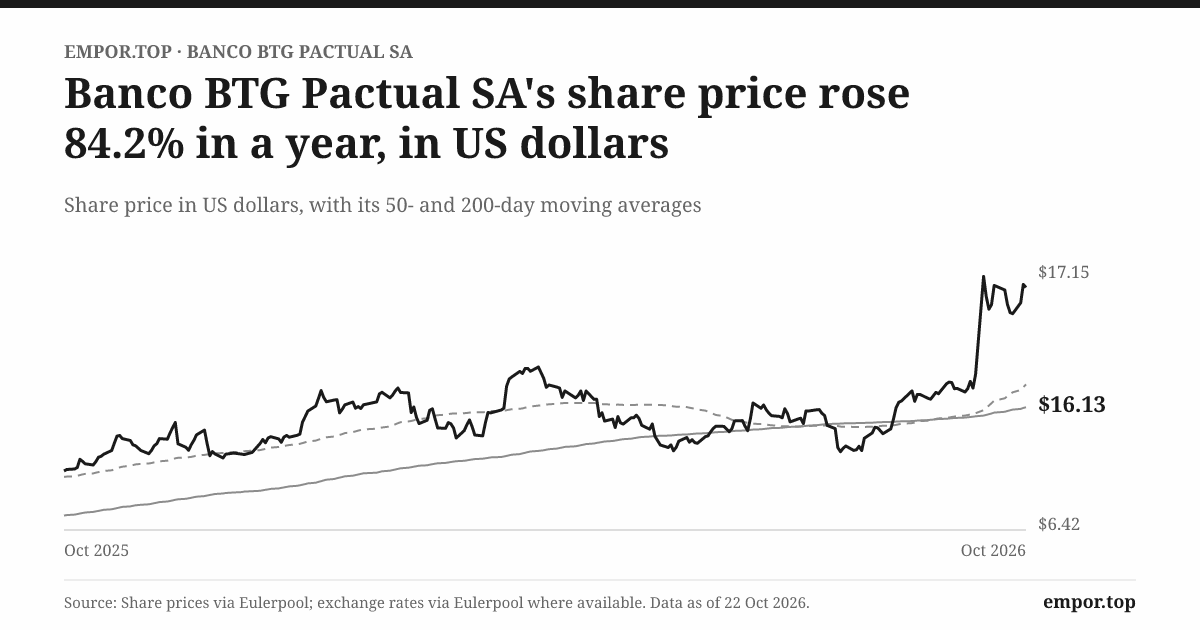
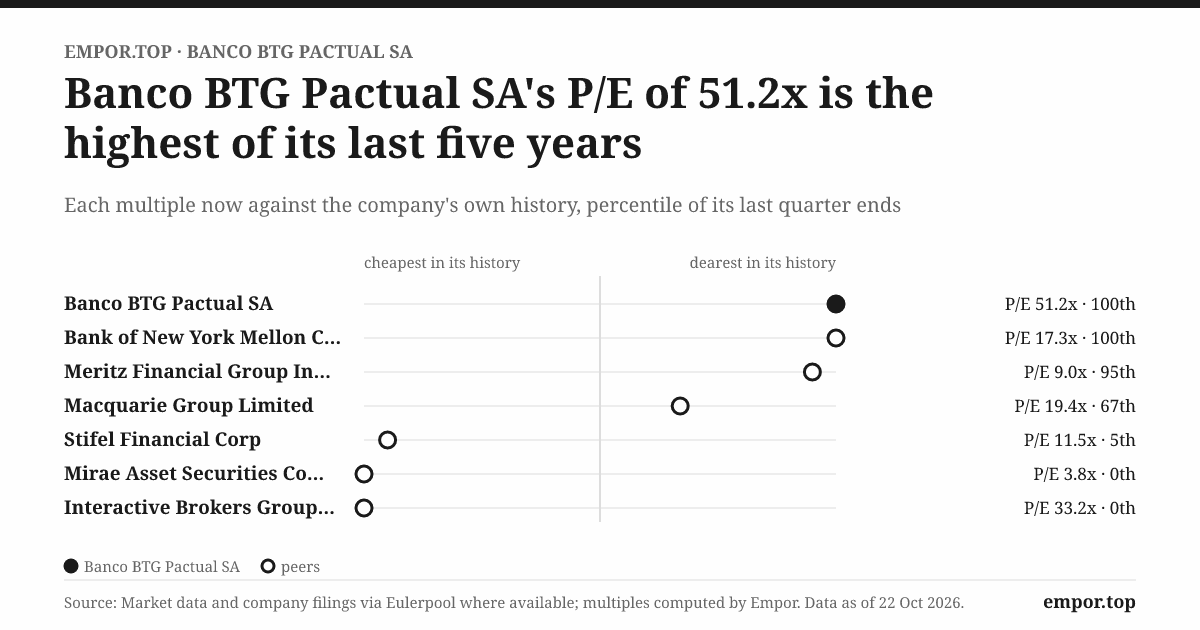
Start with the price, because the headline numbers are misleading. Data screens that multiply the price of a BPAC11 unit by the count of individual shares, rather than by the count of units, produce a market value near R$930 billion and nonsense multiples, such as a trailing P/E above 50 against a five-year median below 8. On the bank's own count of about 3.86 billion units and a unit price of about R$81, the market value in late October 2026 is roughly R$313 billion, or about $62 billion.7 Against book value of about R$20.6 per unit, that is nearly 4 times book.7 Against trailing adjusted earnings, roughly R$18 billion over the twelve months to June 2026, it is about 17 times.97 The market is not pricing BTG like a traditional bank. It is pricing a growth company that happens to hold a banking licence.
The bull case begins with returns. A bank that earns about 26% on adjusted equity, retains three-quarters of it and grows its balance sheet in the mid-20s is compounding book value at a rate that, sustained for a decade, would justify a premium multiple.76 Second, the asset-gathering engine continues: client assets rose about 25% in a year, and wealth is still migrating from the incumbents' branch networks to platforms.7 Third, operating leverage: costs rose far more slowly than revenue as platforms scaled, and the cost-to-income ratio fell to 37.1%.7 Fourth, diversification: corporate lending set a record and consumer finance grew 74% in a quarter when the investment bank shrank.7 And fifth, a free option on Brazil. Fitch rates BTG at BB+ and S&P at BB on global scales, and Moody's rates its deposits at Ba1, with every agency pointing to the sovereign ceiling rather than BTG's standalone strength as the binding constraint; on national scales it carries the top AAA ratings.292330 If Brazil regains investment grade, BTG's global ratings would likely follow, lowering its foreign funding costs.
The bear case starts with the same numbers seen from the other side. Returns this high in a lending business usually come with a cost, and the cost here is consumer credit. The consumer book reached about R$78 billion by June 2026, up about 35% in a year, driven mainly by private payroll loans.7 Payroll lending to private-sector employees is less protected than lending to civil servants or pensioners, because a borrower who loses his job loses the payroll deduction. Banco Pan's customers are lower-income Brazilians, the first to suffer when the Selic policy rate stays high. Fast loan growth also flatters credit metrics in the short run, since new loans have not yet had time to go bad. A bear would argue that BTG is growing consumer credit fastest at the point in the cycle when it is hardest to judge.
Governance is the second pillar. The partnership, acting through BTG Pactual Holding and the G7 holding company, owns about 65% to 68% of total capital and more than 80% of the voting shares; the public float holds about 30%, mostly through units carrying two non-voting preferred shares for every voting share.1731 Shareholder meetings pass proposals routinely with overwhelming support, because the partnership votes as a block.17 An activist could own a large stake and change nothing. Esteves's return as chairman re-concentrated strategic authority in the founder whose arrest nearly destroyed the bank.8 The bull answer is that the partners own most of the economic downside and have every incentive to protect it. The bear answer is that alignment of incentives is not the same as accountability, and that the public shareholder has no remedy if the partnership's judgment turns, as it did with BSI.
A skeptical long-short investor would push further, into the plumbing. Why does the headline return exclude goodwill amortization when acquisitions are a deliberate and recurring part of the strategy? Why does a bank with surplus profitability pay out only about a quarter of earnings, leaving public holders dependent on the partnership's reinvestment judgment? What flows between the listed bank and the partners' holding companies? On that last question, the bank's filings are reassuring as far as they go: related-party dealings, including those with the controlling holding company, consolidated subsidiaries such as Banco Pan and affiliates such as the commodities firm Engelhart, are disclosed and described as conducted on market terms, and Brazilian banking rules prohibit uncollateralized lending to controlling shareholders.1617 The holding companies that manage partner equity sit outside the listed bank, so partner distributions do not pass through its income statement.17 None of this amounts to evidence of abuse. It amounts to a structure in which outsiders depend on the insiders' good conduct, with the law and the regulator as their main protection.
The third pillar is the tax dispute. The administrative scorecard is mixed: a R$1.94 billion assessment upheld by CARF in 2019, most of a R$993 million assessment annulled in 2024, and further rounds pending.1415 The bank provisions none of the remaining amount, classifying the risk as possible.16 The bear's point is not that this would sink the bank; at a few billion reais it would cost less than half of a single strong quarter's earnings. The point is that a premium multiple assumes no surprises, and this is a known one.
The fourth pillar is the sovereign ceiling itself. As long as Brazil sits below investment grade, BTG's dollar funding costs more than that of global rivals, and its ambitions in cross-border M&A and global wealth management compete against banks with cheaper money. The option on an upgrade is real, but it is an option on Brazilian fiscal policy, not on anything BTG controls.
Weighing the two cases, the history narrows rather than rejects the bull claim. BTG has proven it can sustain returns above 20% through a fraud-sized credit loss and an investment-banking drought, which rejects the bear contention that its profitability was a cyclical accident. But it has not yet proven that the consumer-credit expansion can earn those returns through a full downturn; that remains unproven rather than disproven. Three KPIs will decide which story the market tells. The first is the adjusted return on average equity, which stood at 26.7% in the second quarter of 2026, slightly below the 27.2% of a year earlier; the threshold that matters is staying above the low 20s as consumer lending grows.7 The second is the adjusted cost-to-income ratio, at 37.1% and falling, which tells investors whether scale is still working.7 The third is the share of the credit portfolio in Stage 3, about 3.7% at June 2026, read together with the pace of consumer-loan growth; if impaired loans rise faster than the book, the consumer bet is turning.7 How those numbers move over the next few quarters is the next chapter of the story.
X. Epilogue
On Avenida Brigadeiro Faria Lima, the avenue of glass towers that has become São Paulo's answer to Wall Street, BTG's leadership is no longer planning a survival. It is planning an expansion. On July 10, 2026, the bank completed the acquisition of HSBC's operations in Uruguay, its entry into yet another Latin American market alongside its businesses in Chile, Colombia, Mexico and beyond.716 In the same quarter, BTG Pactual Europe raised a €210 million syndicated loan from banks in Asia and Europe to fund the growth of its European platform, and the bank closed a partnership with the digital lender MeuTudo to accelerate consumer-credit origination.7 Total assets reached about R$925 billion in June 2026, up more than 40% in a year, and the first half of 2026 was the best in the bank's history, with adjusted net income of about R$10 billion.7
The ambition is visible in the deals as well as the branches. In the second quarter of 2026, BTG acted as the sole Latin American underwriter on SpaceX's IPO, a mandate the bank presented as proof that it has become the region's default partner for global transactions.7 It is a striking symbol for a firm that, in 2015, could not persuade foreign lenders to roll over its paper. It is also, for now, a symbol rather than an economic driver: investment-banking revenue in that same quarter was the smallest of the bank's business lines.7 Prestige mandates open doors; the money still comes from lending and managing Brazilian wealth.
That is a remarkable place for an institution that, a decade ago, was selling its trophies to make it to the next Monday. It is also a place with its own risks, because growth of that speed is precisely when the most important questions in this story come due. Three moments ahead will do most of the deciding.
The first is the endgame of the goodwill tax fight. The administrative skirmishes have produced one large defeat and one large partial victory, and the tax authority's appeal on the remaining "ágio Copa" item, along with whatever the bank takes to the federal courts, will eventually produce final answers.141532 If BTG wins, an overhang that has followed the partnership since the 2009 buyback disappears. If it loses, the bank books a one-time charge in the low billions of reais, absorbable, but a reminder that the partners' appetite for aggressive structuring has a price. Either way, the result will say more about the bank's judgment than about its solvency.
The second is the first full credit cycle for the consumer book. BTG is growing payroll and consumer lending fastest just as Brazilian households carry the weight of high interest rates. Over the next several quarters, the Stage 3 share of the portfolio and the cost of risk in consumer finance will show whether Banco Pan and MeuTudo are extending BTG's model into a new market or importing a different kind of bank into its balance sheet.7 If impaired loans stay contained while the consumer book grows, the bull case's central claim, that BTG can earn mid-20s returns on a broader and riskier balance sheet, will have passed its hardest test. If they rise faster than the book, the bank's returns will drift toward those of the incumbents it set out to beat.
The third is beyond the bank's control entirely: Brazil's sovereign rating. S&P, Moody's and Fitch each cap BTG's global ratings at or near the sovereign's level, which they set below investment grade.292330 An upgrade of Brazil to investment grade would lift that ceiling, cut BTG's dollar funding costs and strengthen its hand in global wealth management and cross-border dealmaking. A fiscal slide in the other direction would do the opposite. BTG can be the strongest bank in Brazil, but it cannot be stronger, in the eyes of global bond markets, than Brazil itself.
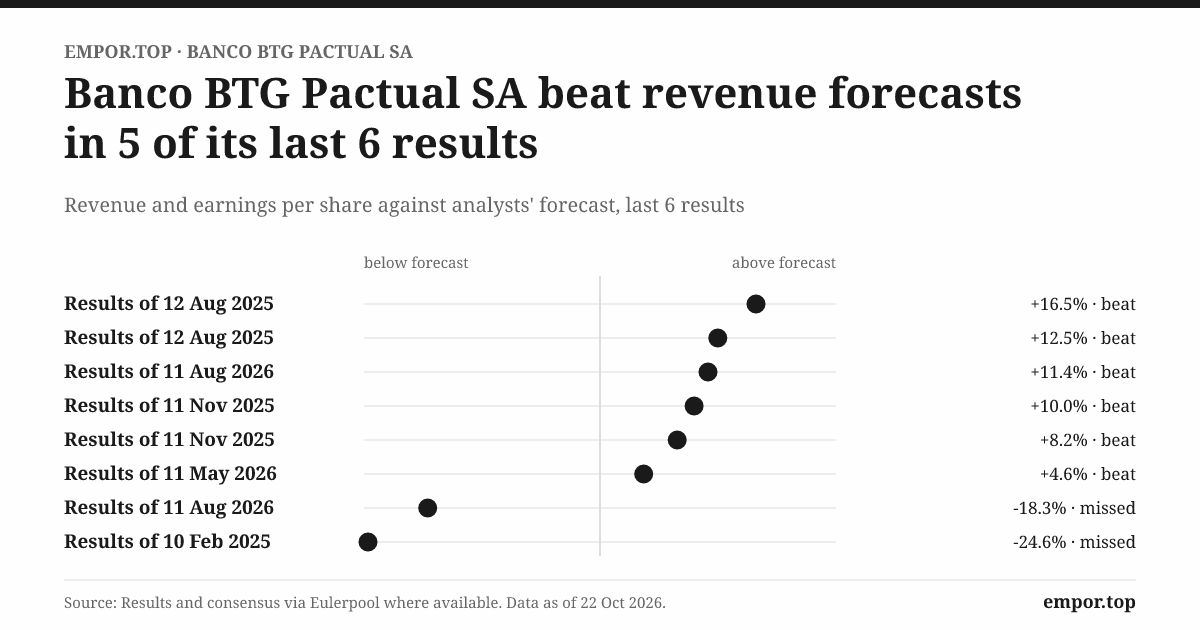
Investors weighing those moments will also be weighing management's word, and the record there is good but worth reading closely. In February 2023, with the Americanas loss fresh, the bank projected a return on equity above 22% for the year, a target one Itaú BBA analyst called "ambitious."26 On the statutory measure, return on equity came in at about 20% in 2023; on the adjusted measure the bank prefers, which adds back goodwill amortization, returns ran higher.67 Since then, the statutory figure has climbed to about 23% for the twelve months to June 2026, and the adjusted figure to nearly 27% for the quarter.67 The pattern is of a management team that sets demanding targets, mostly meets them on its own preferred yardstick, and leaves a gap of a point or two between the number it headlines and the number in the audited accounts. That gap is not deception; it is disclosure that rewards the reader who checks.
Each outcome speaks to a different central question. The tax ruling tests the partnership's judgment. The consumer cycle tests whether high returns survive diversification. The sovereign rating tests how far the franchise can travel. And looming over all three is the question this story began with: whether an institution that survived the loss of its founder has truly outgrown him, when the founder has returned to its chair and remains its largest individual shareholder, with a fortune Forbes Brasil estimated in 2026 at about R$66 billion.9 The paradox of BTG is that it moves with Wall Street speed, has Swiss private-banking ambitions and keeps the survival instincts of a firm born in Brazilian hyperinflation, and every one of those traits is both its edge and its exposure.
XI. Outro
The image BTG's partners like to project is a trading floor rather than an executive suite: partners among the traders, watching the same risk screens. It is a fitting image for a bank whose defining moment was not a deal but a morning arrest, when a group of partners had to decide whether to scatter or to sign personal guarantees for a bank that the market had already given up on. They signed.
In 2016, the bank that survived had about $32 billion of assets.6 Ten years later it holds more than R$900 billion, earns more in a single quarter than it earned in the whole of 2018, and its founder is back in the chair.7 Whether that last fact is the triumph of the story or its unresolved risk is the question every investor in BPAC11 units ends up answering for themselves.
What is clear is what makes BTG Pactual unlike any other financial company on earth: it is the bank that traded its way through hyperinflation, sold itself to the Swiss at the top and bought itself back at the bottom, survived a run that began with its founder in a prison cell, and turned Wall Street's old partnership model into Latin America's most formidable financial machine.
References
-
BTG sees $1.1b in fund withdrawals after arrest of controlling shareholder — Gulf News (Reuters), 2015-11 ↩↩↩↩↩
-
André Esteves Detained in Petrobras Probe — Financial Times, 2015-11-25 ↩
-
Brazil Federal Court Acquits BTG Founder André Esteves — Bloomberg, 2018-07-12 ↩↩↩
-
Brazil: Banco BTG Pactual Emergency Liquidity Program, 2015 — Journal of Financial Crises, Yale Program on Financial Stability, 2025 ↩↩↩↩↩↩↩↩
-
Brazil's BTG Pactual works to restructure after André Esteves gives up control — Reuters via Empiricus, 2015-12-02 ↩↩↩↩↩
-
Investor Relations Portal: Financial Statements and Results — Banco BTG Pactual S.A. ↩↩↩↩↩↩↩↩↩↩↩↩↩↩
-
Earnings Release Second Quarter 2026 — Banco BTG Pactual S.A., 2026-08-11 ↩↩↩↩↩↩↩↩↩↩↩↩↩↩↩↩↩↩↩↩↩↩↩↩↩↩↩↩↩↩↩↩↩↩↩↩↩↩↩↩↩↩↩↩↩↩↩↩↩↩↩↩↩↩
-
BTG quer Esteves à frente do conselho seis anos após crise de reputação — Bloomberg Línea, 2022-02-16 ↩↩↩↩↩
-
André Esteves: fortuna e resultados do BTG Pactual — Forbes Brasil, 2026-09-10 ↩↩↩↩↩↩↩
-
De volta ao jogo: a trajetória do BTG Pactual contada em livro — Eu Quero Investir, 2025-11-06 ↩↩↩↩↩↩↩↩
-
Esteves faz de BTG uma potência e um dos 50 mais influentes — Exame, 2012-09-11 ↩↩↩↩↩↩↩↩
-
Luiz Cezar Fernandes and the Decalogue Behind a Financial Legend — Brazil Stock Guide (Brasil 247), 2025-11-19 ↩↩↩
-
André Esteves recompra o Banco Pactual — Olhar Direto (O Estado de S. Paulo), 2009-04-20 ↩↩↩↩↩↩
-
Carf mantém multa de R$ 1,94 bilhão ao banco BTG Pactual — Consultor Jurídico, 2019-01-23 ↩↩↩↩↩
-
Carf anula parte de autuação sobre ágio na formação do BTG Pactual — BP Money, 2024-03-06 ↩↩↩
-
Demonstrações Financeiras Padronizadas (DFP) — Banco BTG Pactual S.A., 2024-12-31 ↩↩↩↩↩↩
-
Formulário de Referência (FCA) — Banco BTG Pactual S.A., 2025-05-30 ↩↩↩↩↩↩↩↩↩↩↩↩
-
Prospecto Definitivo de Distribuição Primária e Secundária de Units — Banco BTG Pactual S.A., 2012-04-25 ↩↩↩
-
BTG garante retorno mesmo que a Sete vire pó — Exame, 2015-02-27 ↩↩↩↩↩
-
Generali completes the disposal of BSI to BTG Pactual — Assicurazioni Generali, 2015-09-15 ↩↩
-
EFG to acquire BSI from Brazilian group BTG Pactual — Private Banker International, 2016-02-22 ↩↩
-
Banques: le scandale du fonds malaisien 1MDB fatal pour une banque tessinoise — Swissinfo, 2016-05-25 ↩↩
-
Rating Report: Banco BTG Pactual S.A. — Moody's Local Brasil, 2024-06-15 ↩↩↩↩
-
BTG paga R$ 3,7 bi para controlar o Pan sozinho — Brazil Journal, 2021-04-06 ↩↩↩
-
Fato Relevante: Aquisição de Participação no Banco Pan — Banco BTG Pactual S.A., 2021-04-06 ↩
-
BTG Pactual provisiona 60% da exposição à Americanas e prevê recuperação — Forbes Brasil, 2023-02-13 ↩↩↩↩↩↩
-
Central Bank of Brazil (BACEN) Prudential Regulations & Resolution CMN 4,966 ↩
-
BTG Pactual (BPAC11) lucra R$ 5,1 bilhões no 2T26, supera expectativas e mantém ROE acima do Itaú — Seu Dinheiro, 2026-08-11 ↩
-
Rating Report: Banco BTG Pactual S.A. — Fitch Ratings, 2023-09-27 ↩↩
-
Corporate Governance & Partnership Structure — Banco BTG Pactual S.A. ↩
-
Conselho Administrativo de Recursos Fiscais (CARF) Jurisprudência e Decisões de Ágio ↩
 LinkedIn
 WhatsApp
 Reddit
 Hacker News
 Email
 Kindle
 RSS Feed
 Spotify
 Apple Podcasts
 Amazon Music
 Audible
 YouTube