BrightSpring Health Services: The PE Playbook and the Billion-Dollar Specialty Pharmacy Pivot
I. Introduction & The $14 Billion Deleveraging Masterclass
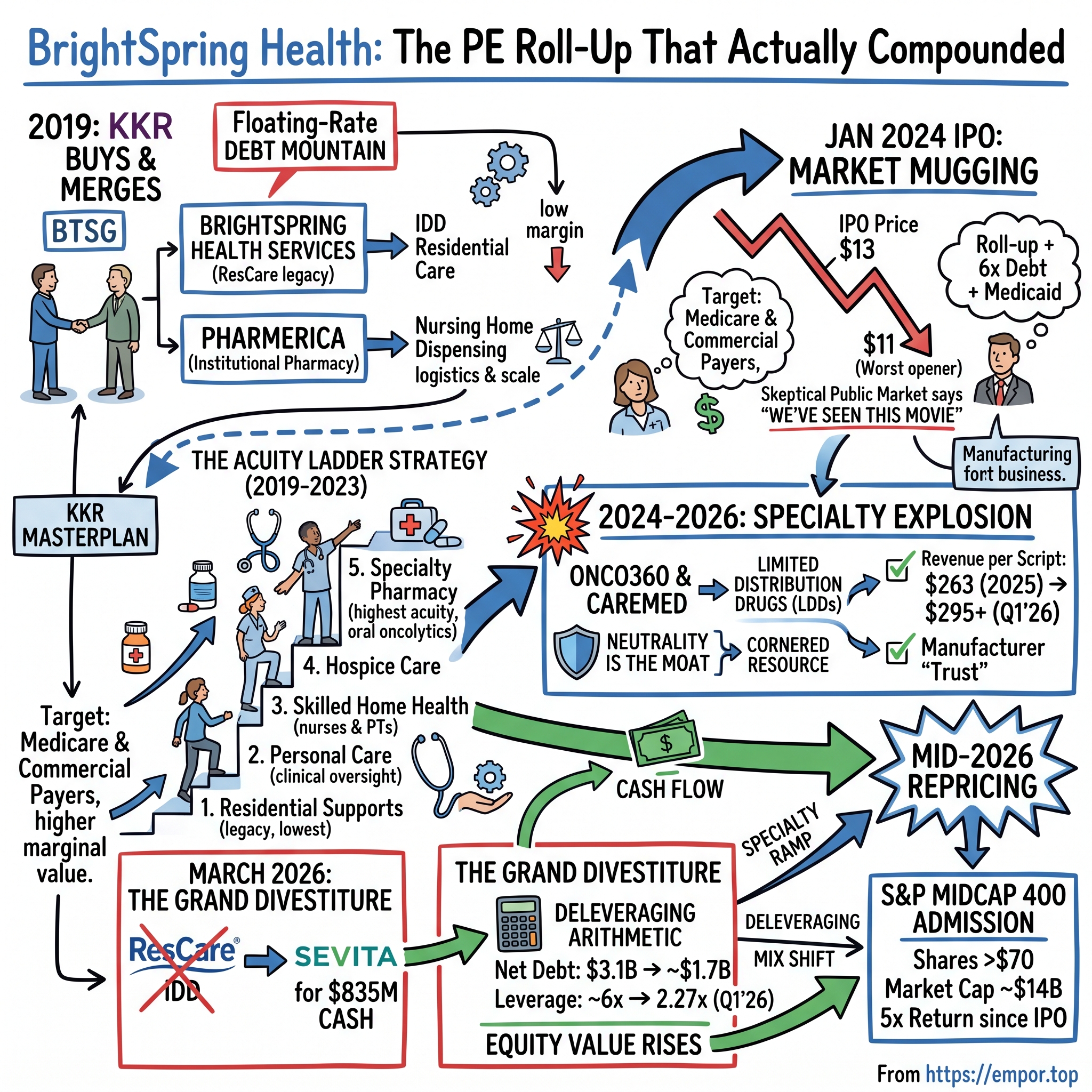
On the morning of January 26, 2024, the traders on the floor of the Nasdaq had a name to price that nobody on Wall Street was excited about. BrightSpring Health Services, a Louisville-based home-care-and-pharmacy conglomerate owned by the private equity firm KKR, had spent the prior week marketing its shares to institutional investors at $15 to $18 apiece. The book did not come together. When the deal finally cleared, the price was $13.00 — a discount to the bottom of the range — and the company raised roughly $633 million, meaningfully less than it had hoped.[^1]7 The IPO valued the equity at only a little over $2 billion. For a business generating more than $8 billion in annual revenue, that was not a vote of confidence. It was a shrug.
The reason for the shrug was written all over the prospectus: debt. BrightSpring carried billions of dollars of borrowings assembled over more than a decade of private-equity ownership, and it was trying to go public at the exact moment the Federal Reserve had pushed interest rates to their highest level in two decades. Every incremental point of rate cost real cash flow. The market looked at BrightSpring and saw a textbook "PE debt trap" — a leveraged roll-up of thin-margin pharmacies and labor-starved home-health agencies, dressed up for an exit.
Fast forward to the middle of 2026. The same stock that could barely clear $13 traded north of $70, and the equity value had swelled past $14 billion. That is not a bounce. That is a re-rating — a wholesale change in how the market classifies a company. Investors stopped pricing BrightSpring as a levered Medicaid contractor and started pricing it as something closer to an elite specialty-pharmacy and clinical-care compounder. The question this story tries to answer honestly, without cheerleading, is whether that new label is deserved — and what could still knock it off.
The narrative arc is genuinely improbable. This is a company that began in 1974 as a government-funded operator of residential homes and job-training centers for disadvantaged youth and people with intellectual and developmental disabilities. Fifty-two years later, its economic engine was oral oncology drugs, home infusion of biologics, and institutional pharmacy for nursing homes. How a business travels from group homes to cancer medications is a story about private equity — specifically about how KKR bought, merged, pruned, levered, and eventually deleveraged its way to a re-rating.
The roadmap for this episode: the slow-growth ResCare years and the private-equity carousel that passed the company from owner to owner; the pivotal 2019 merger with PharMerica that quietly imported the crown jewels; the debt-overhang drama of the 2024 IPO; the masterstroke 2026 sale of the founding business to Sevita; and the reason specialty pharmacy — not the legacy home-care brand — became the hidden economic engine of the entire investment case. Throughout, the discipline is the same one a skeptical investor would apply: separate what management asserts from what the filings actually prove.
 Subscribe on LinkedIn
II. The Origins: From ResCare to the Private Equity Carousel (1974–2018)
Picture Louisville, Kentucky in the mid-1970s. A former Job Corps center director named James R. Fornear had an idea that was equal parts mission and business plan: the federal government was willing to pay private contractors to run its training centers for at-risk youth, and Fornear knew how to run them. In 1974 he founded what became ResCare, and by 1976 the company had won its first contract to operate the Whitney Young Job Corps Center in Shelby County, Kentucky.11 From that toehold, Fornear expanded into a second, adjacent line of work that would define the company for four decades: residential and support services for people with intellectual and developmental disabilities, often called the IDD population.
It was a noble business, and a structurally difficult one. Understand how it made money and you understand why every subsequent owner eventually wanted out. ResCare was paid, overwhelmingly, by government — state Medicaid programs for the IDD homes, the federal Department of Labor for Job Corps. That meant the company's revenue growth was capped not by demand (which was effectively infinite; there are always more people who need care) but by state budgets. When a legislature tightened Medicaid reimbursement, ResCare's revenue per client froze regardless of how good its care was. And the cost side was brutal: this is a business of caregivers, aides, and direct-support professionals, where labor is the product. When wages rose, margins compressed, and there was no pricing lever to pull because the payer was the state.
This is the crucial insight for the rest of the story. The IDD residential business is labor-intensive, Medicaid-dependent, low-margin, and heavily regulated — four adjectives that translate, in financial terms, to a permanent ceiling on returns. It is an honorable, hard, unglamorous business. It is also exactly the kind of asset that private equity buys to fix, and eventually sells to somebody who wants steady cash flow rather than a re-rating.
Which brings in the financiers. In late 2010, the Canadian private-equity firm Onex Corporation took ResCare private. Contrary to a widely repeated figure of "$120 per share," the actual terms were far more modest: Onex, which had already held a minority stake since 2004, paid roughly $13.25 per share in cash to acquire the rest, valuing the company at about $390 million.[^19] Onex spent the following years trying to solve the structural ceiling the only way you can — by diversifying away from it. It bolted on home-health and hospice businesses, chasing the insight that clinical services carry better reimbursement dynamics and higher margins than custodial residential care. The strategic logic was sound; the execution was gradual.
By 2018, Onex was ready to exit, and it did something telling first: it rebranded. The old "ResCare" name — inseparable from group homes and Job Corps — was retired in favor of "BrightSpring Health Services," language deliberately chosen to signal clinical healthcare, senior care, and pharmacy rather than residential IDD services.12 A rebrand is a marketing act, but it was also a tell about positioning for sale. Onex was dressing the asset for a buyer who wanted a healthcare platform, not a Medicaid contractor. That buyer would turn out to be KKR, and the deal it structured would change the company's DNA.
III. The KKR Playbook: The Merger of BrightSpring and PharMerica
Here is where the story turns from a slow, decades-long grind into a piece of financial chess. In late 2018, KKR agreed to buy BrightSpring from Onex, and the deal closed in early 2019 at an enterprise value of roughly $1.32 billion, with Walgreens Boots Alliance coming along as a minority investor.[^4]3 On its own, that was an ordinary secondary buyout — one PE firm selling to another. What made it a masterstroke was what KKR already owned and what it did the day the ink dried.
KKR had taken PharMerica private in 2017. PharMerica was an institutional pharmacy — the business of packaging, dispensing, and delivering medications to skilled-nursing and assisted-living facilities, the number-two national player in a market where scale is everything. The instant KKR closed on BrightSpring, it merged the two companies into a single platform, creating a combined enterprise with roughly $4.5 billion of revenue serving hundreds of thousands of patients across dozens of states.2 BrightSpring brought clinical home care, hospice, and rehabilitation; PharMerica brought the pharmacy backbone. On paper it was vertical integration: own the care and own the drugs the care requires.
But the real prize was buried inside PharMerica, and it is the single most important fact in this entire narrative. PharMerica was famous for boring, steady long-term-care institutional pharmacy. What it also quietly owned were two of the fastest-growing, highest-acuity pharmacy franchises in American healthcare. The first was Onco360, an oncology specialty pharmacy that dispenses the complex oral and injectable cancer drugs coming out of the biotech pipeline. The second was Amerita, a home-infusion business that delivers IV therapies — immunoglobulins, antibiotics, biologics — into patients' homes instead of hospital outpatient suites. Institutional LTC pharmacy was the ballast; Onco360 and Amerita were the growth engine. KKR paid for a pharmacy company and got a specialty-pharmacy option embedded inside it.
Did KKR overpay? The critics of the era had a point worth taking seriously. Both PharMerica and BrightSpring were acquired at roughly 10–11x adjusted EBITDA, full multiples for businesses whose legacy segments grew in the low single digits. A skeptical investor in 2019 could reasonably have said KKR was paying growth multiples for GDP-growth assets. What that critique missed — and what only became visible years later — was the mix shift. As Onco360 and Amerita compounded at double-digit rates and the low-margin legacy shrank in relative terms, the blended economics of the combined enterprise migrated upward. The entry multiple looked expensive against 2019's earnings; it looked cheap against 2026's. That is the whole game in a mix-shift roll-up, and it is the reason the re-rating eventually happened. The question of whether KKR was prescient or merely lucky is one a fair analyst should leave open — but the structure it built was the vehicle that made the later story possible.
There was also a wrinkle worth flagging: this is an industry the antitrust authorities watch closely. PharMerica itself had once been the target of a hostile takeover attempt by its larger rival Omnicare, a bid the Federal Trade Commission moved to block in 2012 on the grounds that combining the number-one and number-two institutional pharmacies would harm competition.[^12] That history matters, because it tells you the government treats institutional pharmacy as a concentrated market where scale confers power — a double-edged fact that shows up again later, both as a moat and as a regulatory risk.
IV. The S-1 Disruption: Facing the Debt Wall at the 2024 IPO
By late 2023, KKR had owned the combined platform for nearly five years — a long hold by buyout standards — and it wanted out through the public markets. BrightSpring filed its S-1 registration statement, and when the numbers hit the tape, they told two very different stories depending on which line you read. The top line was formidable: more than $8 billion in revenue, a genuinely large healthcare enterprise. The balance sheet was the problem: the company carried roughly $3.5 billion of debt, a legacy of years of leveraged buyouts and bolt-on acquisitions.10
Timing could not have been worse. BrightSpring was trying to sell a highly levered equity story at the precise moment when the cost of that leverage had spiked. With interest rates at multi-decade highs, floating-rate debt was a cash-flow vacuum — every dollar of interest was a dollar that could not go to deleveraging, reinvestment, or equity holders. Investors reading the S-1 did the math and arrived at the "PE debt-trap" conclusion: a roll-up of low-margin pharmacies and labor-constrained home-health agencies, carrying a balance sheet built for a low-rate world that no longer existed.
So the deal priced where the demand was, not where the bankers wanted it. On January 25, 2024, BrightSpring priced at $13.00, below the $15–$18 range, and the syndicate — led by Goldman Sachs, KKR's own capital-markets arm, Jefferies, and a deep bench of other banks — had to work to defend the book.[^1] The stock did not rocket out of the gate; it traded sluggishly, and for months the bears looked correct. Their central number was leverage, which the company itself reported at roughly 4.16x net debt to adjusted EBITDA at the end of 2024 — a level high enough that a single bad year of reimbursement cuts or margin compression could have become a genuine problem.9 The bear case was not stupid. It was a coherent, evidence-based reading of a real balance sheet.
Then came a quiet, consequential move that told you how KKR thought about control. In September 2024, Walgreens Boots Alliance — the minority partner from the 2019 deal — wanted out. Rather than let 11.6 million shares dribble into the public float and depress the price, KKR agreed to buy the entire block directly from Walgreens.[^7] The transaction did two things at once. It removed a large, motivated seller from the market, stabilizing the stock. And it cemented KKR's grip: the firm that had architected the platform now held an even more dominant stake, with the freedom to time future sales on its own schedule. For a public shareholder, that is a double-edged sword — it aligned KKR's interest in a higher price with everyone else's, but it also concentrated enormous supply in one holder's hands, an overhang that never fully went away. That tension between sponsor alignment and sponsor overhang is a thread worth holding onto through the rest of the story.
V. The Strategic Pivot: Divesting the Legacy and Doubling Down on Complexity (2025–2026)
Every great turnaround has a moment where management does the thing that looks sentimental to refuse and obvious in hindsight. For BrightSpring, that moment arrived in January 2025, when CEO Jon Rousseau announced a definitive agreement to sell the company's ResCare Community Living business — the IDD residential operation, the literal descendant of James Fornear's 1974 company — to Sevita for $835 million.8 BrightSpring was selling the business it was born as.
The logic was unsentimental and, frankly, correct. Recall the structural ceiling on IDD residential care: roughly 10% EBITDA margins, relentless labor intensity, and near-total dependence on state Medicaid budgets. It was BrightSpring's single largest exposure to caregiver wage inflation and its lowest-return segment. Selling it did two things simultaneously — it removed the company's worst labor bottleneck and its most Medicaid-sensitive revenue stream, and it generated a large slug of cash to attack the debt that the market so hated. Rousseau framed the decision on the record as one not made lightly, guided by continuity of care for clients,1 but strip away the diplomatic language and the strategic message was clear: the company was choosing complexity and margin over heritage and scale.
The deal did not sail through unopposed, which is itself a useful reality check on the "clean divestiture" narrative. The Federal Trade Commission scrutinized the transaction because Sevita was already a large IDD provider, and combining the two raised local-market concentration concerns. To win clearance, the parties agreed to divest 128 intermediate-care facilities across several metros in Indiana, Texas, and Louisiana to a third operator, the Dungarvin group, with the FTC finalizing its consent order in mid-2026.6 It is a small detail, but it reinforces the theme from the PharMerica history: in this industry, scale and antitrust are permanently entangled.
The transaction closed on March 31, 2026, and this is where the financial engineering paid off in a single, legible number.1 The sale generated roughly $811 million in net cash proceeds, which management applied directly to paying down high-interest debt.4 The effect on leverage was dramatic. Net leverage, which the bears had pilloried at north of 4x, fell to 2.27x as of March 31, 2026 — the sale alone drove the ratio down from a pro-forma 2.60x at year-end 2025, and the trajectory over the prior year was a near-halving.[^2]4 Deleveraging of that magnitude does something specific to an equity: it transfers enterprise value from creditors to shareholders without the business having to do anything heroic operationally. Less debt means less interest, more free cash flow to equity, and — critically — the removal of the exact risk the market had been discounting.
And so the re-rating happened. Freed of both the debt overhang and the low-margin legacy segment that dragged its blended economics, BrightSpring's stock ran from the low teens toward and past $70 by mid-2026. The market had reclassified the company from a levered Medicaid roll-up into a high-acuity specialty-pharmacy and clinical-care compounder. A neutral observer should note that the re-rating was as much about what BrightSpring stopped being as about what it became — it shed its ugliest characteristics, and the multiple followed. Whether the remaining business justifies the new multiple is the question the next section exists to test.
VI. Inside the Core Business: Pharmacy Solutions vs. Provider Services
Strip BrightSpring down to its post-divestiture skeleton and you find a company with two legs of wildly different character. One is enormous and low-margin; the other is small and high-margin. Understanding why is the key to understanding the whole investment case, so it is worth going slowly.
The Revenue Engine — Pharmacy Solutions. This is the giant. For fiscal 2026, management guided the Pharmacy Solutions segment to roughly $12.85 billion to $13.30 billion of revenue — the overwhelming majority of the company's total.[^2] But here is the counterintuitive part: it is the lower-margin segment, running an adjusted EBITDA margin in the mid-single digits. The reason is simple once you see it. When a pharmacy dispenses a $15,000 oral cancer drug, that $15,000 flows across its income statement as revenue, but the drug itself cost the pharmacy nearly $15,000 to acquire. Pharmacy is a pass-through business: enormous revenue, thin spread. The margin is a sliver on a very large number. Investors who anchor on the low percentage margin and conclude the business is low-quality are making a category error — the right frame is dollars of gross profit per prescription and the growth rate of high-value scripts, not the headline margin.
Inside Pharmacy Solutions live several distinct businesses. PharMerica is the institutional pharmacy — the number-two national player serving skilled-nursing and assisted-living facilities, in a market it effectively splits with CVS-owned Omnicare at the top. Scale here is not vanity; it is the whole point. A national footprint lets PharMerica negotiate drug purchasing and reimbursement terms that a regional pharmacy simply cannot match. Onco360, together with the CareMed specialty operation, is the oncology and rare-disease specialty pharmacy — the high-growth, high-value franchise riding the wave of new oral oncology approvals. And Amerita is home infusion, delivering complex IV therapies into the home. Each of these is a different animal, but they share a common thread: they are clinical, hard to replicate, and increasingly the way the American healthcare system prefers to deliver expensive drugs to complex patients outside the hospital.
The Margin Engine — Provider Services. Now the other leg. For fiscal 2026, management guided Provider Services to roughly $1.88 billion to $1.93 billion of revenue — barely more than a tenth of the pharmacy segment's size.[^2] But it earns a far richer margin, with segment adjusted EBITDA running around 13–15% versus the low-single-digit percentage in pharmacy.[^2] This segment is clinical services delivered to people, not molecules dispensed to them. It includes home health and hospice — Medicare-reimbursed skilled nursing and therapeutic care in the home — and NeuroRestorative, a post-acute rehabilitation business for people recovering from brain and spinal-cord injuries. NeuroRestorative is a quietly excellent business: highly specialized, backed substantially by commercial insurance and private pay rather than thin government rates, with the kind of customer stickiness that comes from being one of the few providers capable of doing the work at all.
Why keep both legs together? Management's answer is the synergy thesis, and it deserves scrutiny rather than applause. The argument runs like this: when a hospice or home-health patient needs complex medications, having PharMerica or Onco360 deliver those drugs directly to the bedside keeps the patient out of the hospital, which is exactly the outcome that value-based payers reward. Care and pharmacy, delivered together, allegedly reduce costly readmissions. It is a plausible story, and BrightSpring points to its integrated model as evidence. But an honest reader should note that cross-segment synergy in healthcare is asserted far more often than it is proven, and the company has not published the kind of hard, audited data that would let an outsider verify how much readmission reduction the integration actually delivers. The synergy may well be real; it is not yet demonstrated to the standard a skeptic would demand.
VII. The Playbook: Hamilton Helmer's 7 Powers & Porter's 5 Forces
Every re-rating story eventually has to answer a blunt question: what, exactly, protects these profits from competition? Frameworks help discipline the answer, so consider BrightSpring through Hamilton Helmer's 7 Powers and Michael Porter's 5 Forces — not as a scorecard, but as a way to separate durable advantage from wishful thinking.
Cornered Resource — the LDD portfolio. The strongest power in the BrightSpring stack sits inside Onco360, and it hinges on a piece of pharmaceutical plumbing most investors have never heard of: the Limited Distribution Drug. When a manufacturer launches a complex specialty medication — a new oral oncology agent, say — it frequently does not sell it through every pharmacy in America. Instead, it designates a small handful of specialty pharmacies with the clinical infrastructure to handle patient monitoring, adverse-event reporting, and the data feedback the manufacturer needs. Those are LDDs, and access to them is granted, not bought. Onco360 has spent years earning designation across a large and growing roster of therapies — the company has publicized launching more than 160 specialty treatments over its history.5 This is a genuine cornered resource: a rival cannot simply decide to dispense these drugs, because the manufacturer controls the gate, and the manufacturer awards the gate to pharmacies that already have scale and clinical depth. It is self-reinforcing — more LDD designations bring more patients and data, which make Onco360 a more attractive partner for the next launch. Of the powers on offer, this is the one most worth believing.
Scale Economies — procurement and distribution. PharMerica's national footprint is the classic scale-economies story. Buying drugs by the billions and running dense distribution routes to thousands of facilities lets it operate at a unit cost regional competitors cannot touch. This is real, but it is worth being precise about its limits: scale economies in institutional pharmacy protect the number-one and number-two players from smaller entrants, but they do not protect PharMerica from Omnicare, its equally scaled rival. It is a moat against the small, not against the peer.
Switching Costs — eMAR integration. The subtlest power lives in software. PharMerica integrates its systems, including electronic Medication Administration Records (eMAR), directly into the clinical workflow of the nursing homes it serves. Once a facility's nursing staff has been trained on that system and built its daily medication-passing routine around it, switching pharmacies means retraining staff and risking clinical disruption in a setting where errors can be fatal. That friction is a genuine switching cost — not insurmountable, but real enough to make customer relationships stickier than a pure commodity-pricing model would suggest.
Porter's 5 Forces rounds out the picture, and it is not uniformly flattering. The bargaining power of buyers is high: the true buyers of pharmacy economics are the giant pharmacy-benefit managers — Express Scripts, CVS Caremark, OptumRx — who sit between pharmacies and payers and relentlessly squeeze reimbursement. This is the structural governor on pharmacy margins and the single most important reason the segment earns thin spreads. Competitive rivalry is high but consolidated: locally fragmented in home health, but a national duopoly in institutional pharmacy. And the threat of new entrants is very low: the regulatory compliance burden, the capital to build pharmacy hubs, and — above all — the manufacturer trust required to secure LDDs make greenfield entry into high-acuity specialty pharmacy nearly impossible. The net read: BrightSpring's moats are real but asymmetric. They are strong against new and small competitors and weak against the concentrated PBMs who hold the pricing whip. An investor should size the moat accordingly.
VIII. Financial Blueprint & Current Risk Radar
Set the strategy aside for a moment and look at the raw financial blueprint management laid out for fiscal 2026, because the guidance is the clearest statement of where the company thinks it is going. Total revenue was guided to a range of roughly $14.725 billion to $15.225 billion, with total adjusted EBITDA of $795 million to $825 million.[^2] The first-quarter print supported the trajectory: revenue of about $3.6 billion, up roughly 26% year over year, and adjusted EBITDA of $190 million, up nearly 45% — growth rates that, if sustained, are the kind that justify a compounder multiple rather than a value one.[^2] Underneath the total, the mix tells the story the whole article has been building toward: the small Provider segment was guided to grow revenue faster (up roughly 28–31%) than the giant Pharmacy segment (up roughly 12–16%), and adjusted EBITDA was guided to grow far faster than revenue overall — the mathematical fingerprint of a company shifting its mix toward higher-margin, higher-acuity work.[^2] And anchoring it all is the deleveraged balance sheet at 2.27x, which does more than reduce risk; it hands management the dry powder to pursue accretive bolt-on acquisitions in specialty pharmacy and rehab without frightening the equity market.
Management under the microscope. The person who executed this is CEO Jon Rousseau, and his résumé is unusually well-suited to this exact playbook. His background blends private equity (Friedman Fleischer & Lowe) and investment banking (Morgan Stanley) with operating roles across healthcare (Kindred Healthcare, Mylan, Medtronic).[^11] That combination matters: the Sevita divestiture and the debt-paydown re-rating were as much capital-markets maneuvers as operating decisions, and Rousseau speaks the native language of both KKR and Wall Street. His credibility ran high in 2026 — he was named an Ernst & Young Entrepreneur of the Year regional honoree that June, on the back of the successful divestiture execution.[^11] His compensation is heavily weighted toward EBITDA performance and long-term equity, which aligns his net worth with the share price. A fair-minded investor should register both sides of that alignment: it motivates value creation, and it also motivates the kind of aggressive adjusted-EBITDA framing and financial engineering that can flatter a story. The record so far — guide, execute, deleverage, repeat — is genuinely good. It is also short. Two years of public execution is evidence, not proof.
The current risk radar. Three risks are material and mechanism-specific, and they deserve naming rather than hand-waving. First, the Inflation Reduction Act's redesign of Medicare Part D. The IRA restructured how catastrophic drug costs are shared, shifting more liability onto plans and, potentially, onto the specialty pharmacies that dispense the most expensive medications. For a business like Onco360 whose economics rest on high-cost oncology drugs, changes to who pays for the tail of drug spending are a structural, not cyclical, margin risk. Second, the PBM reimbursement squeeze — the direct-and-indirect-remuneration fees and retroactive clawbacks that the pharmacy-benefit managers impose can compress pharmacy margins with little warning and little recourse, a direct consequence of the high buyer power identified earlier. Third, clinical labor inflation — selling the IDD business removed the worst of the caregiver-wage exposure, but the Provider Services segment still depends on nurses and therapists in a chronically tight labor market. None of these is a thesis-killer on its own. Together they define the terrain on which the bull and bear cases are fought.
IX. The Investment-Story Spine: Bull vs. Bear Case
Every investment reduces, eventually, to a wager on which of two stories comes true. Here they are, stated as fairly as the evidence allows.
The Bull Case — the compounder thesis. Start with demography, the most reliable tailwind in healthcare: America's over-65 population is growing relentlessly, and high-acuity patients increasingly prefer to receive care — and expensive infused drugs — at home rather than in hospitals. That structural shift points demand directly at BrightSpring's highest-margin franchises. Layer on the balance sheet: with net leverage down to 2.27x, the company finally has the financial flexibility to run the bolt-on acquisition playbook in specialty pharmacy and neurorehabilitation, buying small, integrating, and compounding — the same roll-up mechanics that built it, now funded from a position of strength rather than distress.[^2]4 And layer on the moat: every new LDD designation Onco360 wins deepens the cornered resource that standard retail pharmacies cannot replicate.5 The bull says this is early innings of a durable compounder whose worst characteristics have already been surgically removed.
The Bear Case — the structural headwinds. The bear does not dispute the demography; it disputes who captures the value. First, reimbursement vulnerability: a company this exposed to Medicare and Medicaid rates lives at the mercy of government policy, and home-health and hospice reimbursement has been a perennial target for cuts. A single adverse rate cycle can erase a year of operating progress. Second, supplier and buyer concentration: BrightSpring depends on a handful of drug manufacturers for its most valuable oncology products on one side, and faces a handful of all-powerful PBMs setting reimbursement on the other — squeezed, in Porter's terms, from both directions at once. Third, and most specific to this company, the PE-legacy overhang: KKR still owns a very large stake, and the market knows it. Every secondary offering the sponsor executes to monetize its position adds supply and caps the stock, and the memory of the discounted IPO and the direct Walgreens block purchase is a reminder that the float is, in a sense, still owned by one motivated seller.[^7] The bear's sharpest point is not operational — it is that a wonderful business can be a mediocre stock if the sponsor's exit hangs over it for years.
An activist or skeptical long-short investor would press three questions on top of that. Is the adjusted EBITDA the company guides to a fair representation of cash economics, or does it lean heavily on add-backs? How much of the vaunted pharmacy-provider synergy is real and how much is a slide in an investor deck? And what is the plan when — not if — a reimbursement shock hits a segment? The honest answer to all three today is: the early evidence is encouraging and incomplete. That is not a dodge; it is the actual state of the record two years into public life.
X. Epilogue & Core Investing Lessons
Stand back from the tick-by-tick and two lessons crystallize, one for operators and one for investors.
For founders and operators, BrightSpring is a case study in the courage of "highest and best use." The company's entire identity for half a century was rooted in the IDD residential business James Fornear built in 1974. Sentiment, inertia, and the sheer weight of history all argued for keeping it. Management sold it anyway — not because the business was bad, but because the capital and management attention tied up in a 10%-margin, Medicaid-dependent, labor-bottlenecked operation could earn far more redeployed into wide-moat specialty pharmacy and clinical care. The lesson is not "abandon your roots." It is that a great operator must be willing to divest even the founding business when the arithmetic of returns demands it, and must have the stomach to weather the criticism that comes with selling heritage.
For investors, the lesson is subtler and more valuable: do not let a scary balance sheet blind you to the quality of the underlying asset. The $13.00 IPO looked, in hindsight, like a generational entry point — but only because the market in early 2024 was pricing BrightSpring on a temporary condition (leverage in a high-rate world) rather than a structural one (the power of its specialty-pharmacy franchise). The two are constantly confused. A company drowning in debt because its business is broken is a value trap; a good business temporarily over-levered is an opportunity, provided management has both the assets and the will to fix the balance sheet. Distinguishing the two is most of the job. BrightSpring, so far, has proven to be the second kind — though "so far" is carrying real weight in that sentence.
For anyone tracking the company from here, the analytical work reduces to a small number of things worth watching rather than the entire kitchen sink. Watch specialty pharmacy growth and gross profit per script at Onco360 — that is the true economic engine, and dollars of profit matter far more than the headline margin percentage. Watch net leverage, because the entire re-rating was a deleveraging story, and any re-leveraging for acquisitions must be judged against the returns it buys. And watch KKR's ownership stake, because the pace and pricing of the sponsor's exit will shape the stock's supply-demand balance for years. Everything else is detail. The final surprise of the BrightSpring story is how ordinary its ingredients were — a roll-up, a merger, a debt paydown, a divestiture — and how uncommonly well they were sequenced. Whether the sequence continues is the open question a neutral observer should keep asking, quarter by quarter, rather than assume.
References
-
BrightSpring Health Services Completes Sale of ResCare Community Living to Sevita — GlobeNewswire / BrightSpring IR, 2026-03-31 ↩↩
-
BrightSpring, PharMerica Merge in $1.32 Billion Deal — Home Health Care News, 2019-03 ↩
-
Onex Closes US $1.32B Sale of BrightSpring Health Services to KKR — Private Capital Journal, 2019 ↩
-
BrightSpring Health Services (BTSG) Q1 2026 Earnings Call Transcript — Seeking Alpha, 2026-05-01 ↩↩↩
-
BrightSpring Health Services' Specialty Pharmacy Onco360 Celebrates Patient Care and Preferred Pharmacy Status — BrightSpring IR ↩↩
-
FTC Finalizes Consent Order in Sevita, BrightSpring Acquisition — Federal Trade Commission, 2026-06 ↩
-
KKR-Backed BrightSpring Prices IPO Below Range to Raise $633 Million — U.S. News / Reuters, 2024-01-25 ↩
-
BrightSpring Finalizes $835M Community Living Divestiture to Sevita — Home Health Care News, 2026-03 ↩
-
BrightSpring Health Services Form 10-K for the Fiscal Year Ended December 31, 2025 — SEC EDGAR ↩
-
BrightSpring Health Services SEC Form S-1/A IPO Prospectus — SEC EDGAR, 2024-01-25 ↩
-
Kentucky-Based ResCare Is Now BrightSpring Health Services — BrightSpring Health Services, 2018 ↩
 LinkedIn
 WhatsApp
 Reddit
 Hacker News
 Email
Email Kindle
 RSS Feed
 Spotify
 Apple Podcasts
 Amazon Music
 Audible
 YouTube