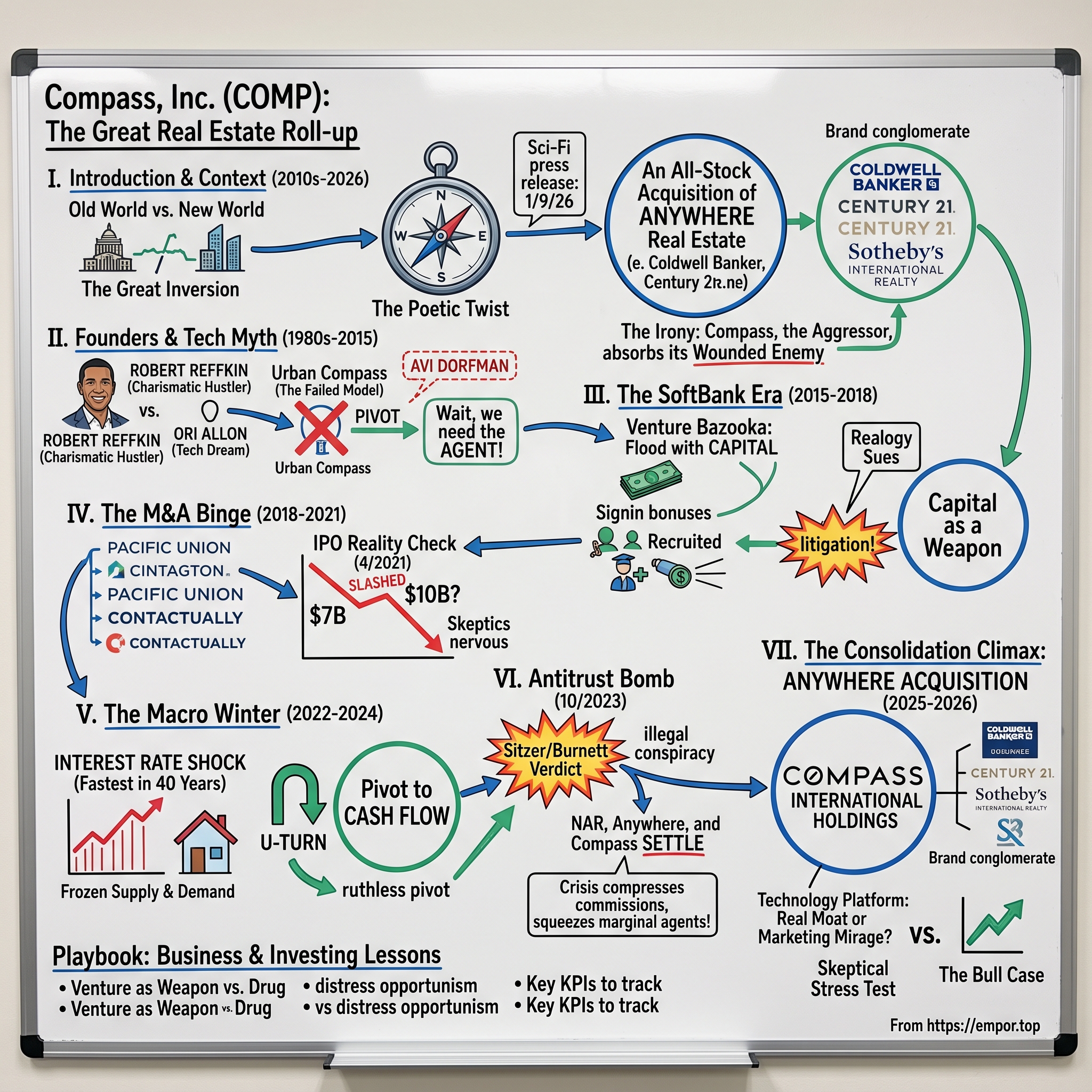
Compass, Inc.: The Great Real Estate Roll-up
I. Introduction & The Poetic Twist
On the morning of January 9, 2026, a press release crossed the wire that would have read as science fiction a decade earlier. Compass, Inc., the New York brokerage that public markets had spent years mocking as "a traditional real estate business wearing a hoodie," announced that it had completed its all-stock acquisition of Anywhere Real Estate — the company formerly known as Realogy, the corporate parent of Coldwell Banker, Century 21, Sotheby's International Realty, Corcoran, ERA, and Better Homes and Gardens Real Estate.
The deal was valued at roughly $1.6 billion in equity and created a combined enterprise worth about $10 billion once you folded in the debt Compass agreed to shoulder.[^1]1
Sit with the irony for a moment, because it is almost too neat. A decade earlier, Compass had used Masayoshi Son's SoftBank money as a battering ram against exactly this company. It walked into the offices of Coldwell Banker and Sotheby's, dangled six-figure signing bonuses in front of their top producers, and walked them out the door with their client lists.
Realogy was furious enough to sue, alleging predatory recruiting, interference with contracts, and schemes to raid its confidential data.7 The upstart was the aggressor; the incumbent was the wounded giant.
By 2026, the roles had inverted. A multi-year freeze in U.S. home transactions — the worst resale environment in a generation — combined with an antitrust earthquake over how commissions are set had left the legacy giant financially exhausted and carrying billions in debt from its private-equity past.
Compass, having survived its own near-death experience, used its stock as currency to absorb its old enemy. Robert Reffkin, the founder who had once been the industry's most disliked disruptor, ended up running the whole thing. Anywhere shareholders were handed roughly 22% of the combined company; Compass holders kept about 78%.1
So which is it? That is the question this story exists to answer. Is the new parent — organized under a holding entity, Compass International Holdings — a genuinely high-margin, technology-driven platform that makes real estate agents dramatically more productive and therefore stickier?
Or is it, stripped of the narrative, a debt-laden consolidator of a low-margin, brutally cyclical service business, one that just voluntarily strapped roughly $2.6 billion of assumed legacy liabilities onto its own balance sheet?2
Those are not rhetorical alternatives. They are two different companies wearing the same ticker. The tech-platform version deserves a software multiple and can eventually earn returns on capital that compound. The consolidator version is a bet on interest rates and housing turnover dressed up in Silicon Valley vocabulary. The evidence for each lives in the same set of filings, and reasonable investors read those filings and reach opposite conclusions.
Consider the whiplash of the numbers alone. Compass came public in 2021 valued near $7 billion, then watched roughly ninety percent of that value evaporate as the housing market froze. It ground its way back to positive cash flow in the teeth of the worst resale environment in three decades, and then, from that recovered footing, turned around and swallowed a company with a longer history, more brands, and more revenue than itself.
There are very few examples in modern business of a company that was left for dead by public markets, clawed its way back through austerity, and then used the recovery to consolidate the very incumbent that had once tried to sue it into submission. The plot is almost implausibly cinematic — which is exactly why it demands a cold, evidence-first reading rather than a fan's one.
There is also a genuinely important societal question sitting underneath the financial one. Housing is the single largest asset most American families will ever own or transact, and the fee to move that asset — historically five to six percent of the sale price — is one of the largest frictional costs in the entire economy. A company that ends up brokering something like one in five American home sales is not just an investment; it is a quasi-utility for how the middle class builds and transfers wealth.
When we ask whether Compass has pricing power, we are also asking whether American home sellers are about to face a more concentrated counterparty at the exact moment a landmark antitrust verdict was supposed to make the industry more competitive. Hold that tension; it runs through everything that follows.
To get there, we have to walk the whole arc: the charismatic hustle of Robert Reffkin and the founding-team fight that shadowed the company to its IPO; the SoftBank-funded recruiting wars that made Compass rich and hated in equal measure; the humiliating public-market debut; the near-fatal cash burn of 2022 and the ruthless pivot to free cash flow that followed; the Sitzer/Burnett commission verdict that broke the industry's economic model; and finally the 2026 merger mechanics and the tech-licensing playbook that management now insists will justify the whole adventure.
Let's start with the man who talked his way into all of it.
 Subscribe on LinkedIn
II. The Charismatic Hustler and the Tech Dream (1980s–2015)
Every founding myth needs a protagonist who seems engineered for the role, and Robert Reffkin is uncomfortably close to central casting. He grew up in Berkeley, California, raised by a single mother — she was Jewish, his father African-American and largely absent — in circumstances that were neither poor nor comfortable. What Reffkin absorbed from that childhood was a near-pathological relationship with striving.
By his mid-twenties he had made vice president at Goldman Sachs, an ascent that in investment banking normally takes closer to a decade. He served as a White House Fellow. He ran, and kept running, marathons in all fifty states to raise money for nonprofits he founded. If you were designing a person whose entire comparative advantage was the ability to walk into a room of powerful people and leave with their money and their belief, you would build Robert Reffkin.
That skill matters enormously to this story, because Compass's single most durable asset in its early years was not technology. It was Reffkin's fundraising gravity. He could get meetings, and in those meetings he could sell a vision of real estate reinvented. The problem — and the seed of a decade of litigation — is that a compelling story usually has more than one author, and the question of who really authored Compass's would haunt the company all the way to the public markets.
It is worth lingering on what forged that temperament, because it explains a great deal about how Compass was later run. Reffkin has spoken often about growing up watching his mother work as a real estate agent, and about the sting of being an outsider — biracial, from a single-parent household — in rooms that were neither.
The response he built was relentless self-optimization: the Goldman Sachs analyst who arrived early and left late, the young man who collected mentors the way others collect contacts, the executive who would later publish a book of the "letters" he wished his absent father had written him.
Whatever one makes of that as a personal brand, it produced a founder with an almost supernatural tolerance for rejection and an instinct for turning narrative into capital. In a business as capital-hungry as a venture-funded roll-up, that instinct was not a soft skill; it was the whole engine.
The founders and the disputed origin. The tech credibility came from Ori Allon, an Israeli-born serial founder with a genuinely impressive résumé. Allon had built a search algorithm called Orion that he sold to Google, and later founded a company acquired by Twitter. His presence let Compass claim it had authentic engineering DNA rather than merely a sales operation with a website. Reffkin supplied the charisma and the capital access; Allon supplied the story that this was a technology company.
But there was a third name that Compass spent years trying not to say out loud: Avi Dorfman. Dorfman had run a rental-technology startup and, in 2012, worked closely with Reffkin on the concepts and the initial business plan that became Compass — then found himself cut out of the founding equity and the founding narrative. He sued.
The litigation dragged on for roughly seven years, a slow-burning liability that sat inside the company as it raised hundreds of millions of dollars on the premise that it was a clean, visionary startup. On the eve of a jury trial in late 2021 — after Compass had already gone public — the company settled, and, tellingly, publicly acknowledged Dorfman as a "founding team member," a phrase that had been conspicuously absent from years of official history.3
Why does a founder dispute matter to an investor a decade later? Because it is the earliest data point in a pattern worth tracking: a company whose story about itself has sometimes run ahead of the verifiable facts. The gap between narrative and documentation is precisely the thing a skeptical reader should keep testing through every later chapter.
A company that will spend years and, ultimately, a reported multi-million-dollar settlement to control the official version of its own origin is a company that understands, at a cellular level, that narrative is an asset worth fighting for. That is not necessarily damning — every great company sells a story — but it should calibrate how much of the later "operating system" narrative an investor accepts on management's word versus demands to see proven in the numbers.
The Ori Allon question deserves the same scrutiny. His pedigree — the founder who sold technology to Google and Twitter — was invaluable precisely because it let Compass borrow credibility it had not yet earned in real estate. A serial technologist as co-founder signaled to investors that this was a Silicon Valley company that happened to operate in real estate, rather than a real estate company that happened to have a website.
Whether the engineering reality ever fully matched the signaling is exactly the debate that would rage through the IPO and beyond. Pedigree is a wonderful fundraising asset; it is not the same thing as a defensible product, and the two should never be confused on a term sheet.
Urban Compass and the model that failed. When the company launched in 2012, it was called Urban Compass, and its original idea was genuinely radical — and genuinely wrong. Rather than work with commissioned agents, Urban Compass would hire salaried "neighborhood specialists" who would guide renters and buyers through New York City's opaque market. The implicit thesis was that the agent could be disintermediated, replaced by a salaried employee plus better software.
Real estate agents, it turns out, are among the most entrepreneurial workers in the American economy. The best of them are effectively small businesses — their book of clients is their equity, and they will not trade unlimited commission upside for a flat paycheck.
There is a deeper structural reason the salary model was doomed: in residential real estate, the customer relationship belongs to the agent, not the firm. A homeowner who wants to sell chooses a person they trust to handle the most valuable transaction of their life, and that trust does not transfer to whatever brand happens to be on the agent's business card.
Try to convert that person into a salaried, interchangeable employee and you have destroyed the very asset — the relationship — that made them worth hiring. The model collapsed under this reality within its first couple of years.
The lesson Reffkin drew was the pivot that made Compass: if you cannot replace the agent, recruit the agent, and build tools that make the agent more productive so they never want to leave. Note how much of a concession this was. The original premise had been that technology would disrupt the agent; the new premise was that technology would serve the agent. It is the difference between Uber replacing taxi medallions and Uber becoming a dispatcher that takes a cut from drivers it cannot control.
That single strategic reversal — from disintermediation to arming the very people it had planned to disintermediate — is where the real Compass begins, and it is where the money came in. Because the moment you decide to recruit the best agents rather than replace them, you need one thing above all others: cash to outbid everyone else for their loyalty.
III. The Pivot to Reality & The SoftBank Venture Bazooka (2015–2018)
Picture the pitch as it must have sounded in a SoftBank conference room in 2017. Reffkin, by now practiced at this, is not selling a brokerage. Brokerages are unglamorous, low-margin, cyclical, and about as far from a venture darling as a business can be.
He is selling an "operating system for real estate" — a software platform that will make elite agents so much more efficient that they will flock to Compass, bringing their clients and their transaction volume with them. Recruit the best agents, give them the best tools, capture a growing share of a multi-trillion-dollar asset class. It is a story about technology and network scale, and it landed.
SoftBank's Vision Fund led a roughly $450 million round in December 2017, and the machine that would define Compass's next phase switched on. A subsequent $400 million round in late 2018, with SoftBank again anchoring alongside the Qatar Investment Authority, pushed the valuation to about $4.4 billion — a staggering number for a business that, in accounting reality, was a commission-splitting brokerage.4
Compass had raised, in total, well over a billion dollars of mostly SoftBank-flavored capital. And here is the crucial part: it did not sit on that money. It weaponized it.
To understand the fuel, you have to understand Masayoshi Son and the Vision Fund era. Son had raised a nearly $100 billion fund — the largest technology investment vehicle in history — and his stated strategy was to identify the likely category winner in each large market and then flood it with so much capital that competitors simply could not keep up. He did it with ride-hailing, with co-working, with dog-walking apps.
The thesis was that in a world of near-zero interest rates, capital itself could be a moat: if you could outspend everyone, you could buy the market before economics reasserted themselves.
Compass fit the template perfectly — a fragmented, trillion-dollar market with no dominant national player and an incumbent set too profit-constrained to fight back. Son was not really underwriting Compass's software; he was underwriting the idea that whoever consolidated American real estate first would win it permanently. That same playbook produced WeWork's spectacular implosion a year later, which is worth remembering, because the line between "capital as a moat" and "capital as a subsidy for a bad business" is only visible in hindsight.
Capital as an offensive weapon. The core move was brutally simple and, for a while, devastatingly effective. Traditional brokerages could not match Compass's recruiting offers because traditional brokerages had to be profitable. Compass did not.
Funded by patient venture money that valued growth over earnings, it offered elite, high-producing agents enormous inducements to switch: signing bonuses that could range from the low six figures into the hundreds of thousands of dollars in cash, pre-IPO equity grants, and unusually generous commission splits — in some cases letting a marquee agent keep close to all of their commission for an initial period.
To a top producer generating millions in annual gross commission income, this was found money for doing the job they already did.
The economics of this were upside-down by design. Compass was, in effect, buying revenue at a loss, subsidizing the difference with SoftBank's balance sheet, and betting that the market share and the eventual software attach would justify it.
The competitive damage was very real. Legacy brokerages — Coldwell Banker and Sotheby's among them, both housed inside Realogy — watched their most productive agents, the top decile who generate a wildly disproportionate share of any brokerage's revenue, walk out the door and take their client relationships with them.
Realogy sues. By 2019, Realogy had had enough and took Compass to court, alleging predatory recruiting, tortious interference, and schemes to obtain confidential listing and pricing data through the agents it had poached.7
The specifics of the complaints painted an ugly picture: allegations that Compass used poached managers to harvest access to competitors' internal listing databases, that it made misrepresentations to lure agents, and that its below-market economics amounted to unfair competition.
Compass, for its part, cast the suits as the flailing of dinosaurs threatened by a superior model. Both sides had an incentive to exaggerate. What matters for the analysis is not who was legally right but what the litigation revealed about the underlying commercial reality.
The litigation is the tell. Incumbents do not sue upstarts they consider harmless. Realogy sued because the bleeding was material, and because it could not respond in kind without torching its own profitability — the classic bind of the incumbent whose margins are the very thing an unprofitable attacker is exploiting. Every dollar Realogy spent matching a Compass bonus came straight out of earnings it had to report to public shareholders; every dollar Compass spent came out of a venture balance sheet that rewarded growth.
That asymmetry — a well-capitalized attacker versus profit-constrained defenders — is the engine of everything that happened next. But raiding agents one at a time, however aggressively, was too slow to justify a $4.4 billion valuation. To feed the growth story, Compass needed to buy market share in bulk.
IV. The M&A Binge & West Coast Expansion (2018–2021)
If the recruiting wars were a series of knife fights, the next phase was Compass reaching for a wallet the size of a car. Organic poaching, agent by agent, could not move the needle fast enough to sustain a valuation predicated on hypergrowth.
So Compass began doing what roll-ups do: it bought its competitors whole. Between 2018 and its IPO, the company spent hundreds of millions of dollars acquiring regional brokerages, absorbing their agents, their listings, and their local brand equity in single transactions.5
The Pacific Union statement deal. The signature acquisition came in 2018, when Compass acquired Pacific Union International, then one of the largest brokerages in the country and a dominant luxury player in the San Francisco Bay Area, with something on the order of $14 billion in annual sales volume. According to figures later disclosed around the IPO, the deal consideration ran to roughly $83 million, a mix of upfront cash, Class A stock, and contingent earn-out payments.5
Whatever the precise structure, the strategic effect was unambiguous: overnight, Compass owned the luxury West Coast.
Here is where the discipline question surfaces. Publicly traded traditional brokerages historically changed hands at low multiples of earnings — this is a thin-margin, cyclical business, and the market prices it that way. Compass, critics argued, was paying premium multiples for these boutiques, overpaying because it could, funded by capital that did not demand a normal return.
The bull rebuttal was that Compass was not buying earnings; it was buying agents, density, and a luxury brand halo it could not build organically fast enough. Both were true. The West Coast luxury dominance was real and valuable; the price paid for it reflected SoftBank's money, not a hard-nosed calculation of cash-on-cash return. That tension — strategic value bought at financially indefensible prices — is the through-line of the entire roll-up.
Buying the software backbone. Compass also bought technology outright. In early 2019 it acquired Contactually, a customer-relationship-management software firm, for roughly $24.5 million in cash — a deal meant to serve as the structural spine of the "operating system" Compass kept promising agents.5
It is worth pausing on what this reveals: a company whose entire pitch was proprietary, native technology was, in practice, assembling much of that technology by acquisition. That is not disqualifying — plenty of great platforms are built by acquiring pieces — but it complicates the clean story of homegrown engineering genius.
Myth versus reality on the roll-up. The consensus narrative during these years, encouraged by the company, was that Compass was a technology platform whose agent growth was a natural consequence of a superior product. The reality visible in the deal history is closer to the reverse: agent growth was substantially purchased — through bonuses, through generous splits, and through acquiring whole brokerages — and the technology was partly assembled to justify and retain what the checkbook had bought.
This distinction is not merely semantic. A platform that attracts agents organically because the product is irresistible is a fundamentally better business than one that must keep spending to acquire and retain them, because only the former compounds without continuous capital.
Which of those two Compass actually is remains the central unresolved question, and the years 2018 through 2021 are the period in which the "we grow because we're great" story and the "we grow because we spend" reality were hardest to tell apart — right up until the market took the money away and forced the truth into the open.
The IPO reality check. In April 2021, the moment of truth arrived, and the public markets delivered their verdict with almost cruel clarity. The timing should have been perfect: it was the height of the pandemic-era everything-rally, when SPACs were minting fortunes and unprofitable growth companies were going public to euphoric receptions. If ever there was a market willing to believe a real estate company was secretly a software company, it was the spring of 2021.
Compass had targeted an IPO price of $23 to $26 per share, a range that valued it around $10 billion and implicitly asked investors to treat it as something more than a brokerage.
Investors declined. In the days before the debut, Compass slashed both the size of the offering and the price, ultimately pricing at $18 — roughly 30% below the midpoint of the original range — raising about $450 million and valuing the company near $7 billion.6
Cutting the price on the eve of an IPO, in a raging bull market, is a rare and telling humiliation; it means the institutional buyers who kick the tires walked away unconvinced. The market's message was blunt: we will not pay a software multiple for a business that splits commissions with independent contractors.
The valuation Compass could not get from public markets in the best IPO window in a decade is the same valuation gap the company has been trying to close ever since — first through cost discipline, and eventually through the sheer scale of the Anywhere merger.
And under the hood, the S-1 explained why the skeptics were nervous. The filing revealed heavy cash burn, deep reliance on stock-based compensation to pay both agents and employees, and no clear path to GAAP profitability.7
It also exposed the structural margin problem that no amount of technology talk could paper over: the vast majority of every commission dollar flowed straight through Compass to the agent who earned it.
A brokerage keeps only the thin spread between the gross commission and the agent's split, and Compass — having recruited its agents with unusually generous splits — kept a thinner spread than most. That is the arithmetic reason a brokerage is not a software company, no matter how good its CRM is: the cost of goods sold is the agent, and the agent has the leverage.
Compass had built enormous scale and genuine brand strength, but it had done so by spending money it did not earn. That worked beautifully in a world of zero interest rates and infinite venture patience — a world in which growth was rewarded and losses were forgiven. That world was about to end, and it would end not gradually but with the violence of the fastest interest-rate shock in forty years.
V. The Macro Winter & The Great Pivot to Cash Flow (2022–2024)
The mood in 2022 turned from champagne to survival with startling speed, and the cause was not company-specific. It was the Federal Reserve. To fight the worst inflation in forty years, the Fed raised its benchmark rate from effectively zero to a range above 5% in roughly eighteen months — the fastest tightening cycle in a generation.
For the housing market, this was not a headwind; it was a wall. Mortgage rates roughly doubled, would-be sellers who had locked in sub-3% mortgages refused to move and give them up, and the volume of existing-home sales collapsed toward multi-decade lows.
For a brokerage, transaction volume is oxygen. Compass earns money only when homes change hands, and homes had stopped changing hands. The mechanism deserves a plain-English explanation, because it is the master variable for this entire business.
When mortgage rates jump from roughly 3% to nearly 7%, the monthly payment on the same house rises by hundreds or thousands of dollars, pricing marginal buyers out entirely. Simultaneously, existing owners who financed at 3% face a "lock-in" effect: selling means giving up their cheap mortgage and re-borrowing at 7%, so they simply stay put. Supply and demand freeze at the same time. The result was existing-home sales collapsing to their lowest level in nearly three decades — not a dip, a generational trough.
A company built to grow through a spending war now faced a market that was shrinking beneath it. The cash-burn model that public markets had already disliked became an existential threat. The stock, which had debuted at $18, cratered into low single digits — touching lows around $1.80 — a roughly 90% destruction of value that turned Reffkin's paper fortune, and his agents' equity grants, into a fraction of what they had been.
For the agents who had joined Compass partly for pre-IPO stock, this was a bitter lesson: the equity that had helped lure them was now worth a fraction of the cash they had left behind. The company that had weaponized capital was suddenly, and dangerously, short of it, and the runway that had once looked infinite now had a visible end.
The U-turn. What Reffkin did next is the most genuinely impressive chapter of the operating story, and it is worth crediting on the evidence. The founder who had built the entire recruiting machine on cash bonuses and equity sweeteners killed that machine, fast.
Mid-2022 saw Compass stop offering cash signing bonuses and equity to new agents almost overnight. It launched an aggressive cost-reduction program that ultimately took hundreds of millions of dollars of annualized expense out of the business — laying off a large share of its software engineering workforce, shuttering and consolidating office space, and freezing the growth-at-all-costs spending that had defined the prior five years.
This is the kind of reversal that reveals a management team's true character. Founders are notoriously bad at killing the strategy that made them; it feels like admitting the whole thing was a mistake. Reffkin did it anyway, and he did it before the market forced him into a restructuring on someone else's terms. Whether you view him as a visionary or an over-promiser, the 2022 pivot was a real act of operational discipline, and it is the single strongest piece of evidence in the bull case for management credibility.
The human cost of that discipline should not be sanded away. The layoffs fell heavily on the engineering organization — the very people who had been building the "operating system" that was supposedly Compass's reason to exist. There is an uncomfortable irony there: a company that justified its valuation on proprietary technology proved, when cash got tight, that it could cut a large share of its technologists and keep functioning.
A cynic reads that as evidence the tech was never as load-bearing as claimed. A more charitable reading is that the platform had already been built and now needed maintenance rather than a standing army of developers. Both interpretations are live, and which one is correct is something the post-merger licensing ambition will eventually test.
"Join for the tech, not the cash." The pivot forced a new recruiting pitch, because the old one — money — was gone. Reffkin's argument became that Compass's technology platform was itself the retention tool: the CRM, the marketing automation, the transaction management, all integrated into one place that, by the company's telling, saved agents meaningful time every day and let them survive a brutal down market by being more productive than the competition.
This is a testable claim, and investors should treat it as one. If the platform is genuinely sticky, agent retention should hold up even without bonuses — and if it doesn't, the "operating system" story is marketing.
Delivering the number. The proof management pointed to was cash. In full-year 2024 — a year in which U.S. existing-home sales hit their lowest level in nearly three decades — Compass generated $105.8 million of free cash flow and roughly $121.5 million of operating cash flow, and it did so while being free-cash-flow positive in every quarter of the year.8
For a company that markets had left for dead, generating real cash in the worst transaction environment in a generation was a legitimate accomplishment and a direct answer to the S-1's cash-burn critique.
The caveat, which management is less eager to volunteer, is that GAAP profitability remained elusive and stock-based compensation continued to flatter the cash figures. Still, the survival was real. And then, just as Compass had stabilized, the industry's entire economic model detonated.
VI. Sitzer/Burnett and the Antitrust Bomb (2023–2024)
On October 31, 2023, in a federal courtroom in Kansas City, Missouri, a jury took less than three hours to decide that the way American real estate had priced itself for a century was an illegal conspiracy.
In the case known as Sitzer/Burnett, a class of home sellers argued that the National Association of Realtors and several large brokerages had colluded, through NAR's rules, to keep commissions artificially high — specifically by requiring that a seller's listing agent offer compensation to the buyer's agent through the Multiple Listing Service, effectively forcing sellers to pay both sides of a transaction.
The jury agreed and awarded $1.78 billion in damages, an amount that, under antitrust law's treble-damages provision, could balloon toward $5.36 billion.9
To understand why this landed like a bomb, you have to understand the mechanism it attacked. For decades, the standard American residential transaction bundled a 5–6% commission, paid by the seller, and split between the listing agent and the buyer's agent. The buyer, in practice, never saw or negotiated the fee paid to their own agent — it was baked into the system and posted on the MLS.
Sitzer/Burnett called this an unlawful restraint that inflated the total commission and stripped buyers of any incentive to negotiate. Blow up that bundling, the theory went, and price competition would finally arrive in an industry that had resisted it for a century.
Why did this arrangement persist for so long? Because it was self-reinforcing in a way that looked, from the inside, entirely normal. A buyer's agent deciding which homes to show a client could — consciously or not — steer away from listings offering skimpy buyer-side commissions. That soft threat of "steering" pressured every listing agent to advise their seller to offer the customary 2.5–3% to the buyer's side, which kept the total near 5–6%, which kept the whole edifice standing.
No individual conspired at a smoke-filled table; the rules of the MLS did the coordinating. That is precisely why antitrust law was the weapon: the plaintiffs did not need to prove a secret meeting, only that an industry-wide rule produced a supra-competitive price. For an American home seller, this was not an abstraction. On the median home, the commission ran into the tens of thousands of dollars — often the single largest line item of the sale, larger than years of property taxes combined.
The capitulation. The verdict triggered a cascade of settlements as every defendant raced to cap its exposure. NAR itself agreed to a landmark settlement — roughly $418 million plus sweeping rule changes that ended the practice of posting buyer-broker commission offers on the MLS.[^14]
Anywhere, the future merger partner and one of the most financially stretched defendants, moved first and settled early to remove the risk of a catastrophic judgment. That timing is not incidental to our story: Anywhere's decision to settle rather than fight was itself a symptom of the balance-sheet fragility that would, less than two years later, make it acquirable. A company confident in its financial staying power litigates; a company worried about a going-concern shock pays to make the risk disappear.
Compass, meanwhile, had grown large enough that its transaction volume exceeded the threshold that would have let it shelter under NAR's umbrella settlement. Carved out, it negotiated its own deal, agreeing in early 2024 to pay $57.5 million to settle the commission claims.[^15]
There is a grim symmetry in the fact that Compass's very success — the scale it had spent billions to build — is what disqualified it from the cheap protection smaller firms enjoyed. Scale, it turns out, cuts both ways: it confers market power and it invites a bigger target on your back, a duality that would define the antitrust scrutiny of the Anywhere merger as well.
Who does the wreckage favor? Here is the counterintuitive investment point, and it matters for the merger to come. A crisis that compresses commissions sounds unambiguously bad for a company that lives on commissions.
But compression does not fall evenly. Under the new rules, buyers must now sign representation agreements and, at least in theory, negotiate what they pay their own agent — a change that squeezes the marginal, low-value agent hardest. The solo operator with thin differentiation has little to justify their fee. A luxury agent at a strong brand, armed with tools, data, and a premium client base, has a far easier time defending their economics.
In other words, a shock that threatens the whole industry disproportionately threatens the fragmented bottom of it — and hands a relative advantage to scale, brand, and technology. That logic is exactly the strategic rationale Compass would use to justify swallowing its largest rival.
VII. The Consolidated Climax: The Anywhere Acquisition (2025–2026)
Deals of this magnitude usually leak, but the strategic logic of this one had been hiding in plain sight for two years. On September 22, 2025, Compass and Anywhere Real Estate jointly announced that Compass would acquire Anywhere in an all-stock transaction. Each Anywhere share would convert into 1.436 Compass Class A shares, valuing Anywhere equity at roughly $1.6 billion, with the combined enterprise value — debt included — landing near $10 billion.
Compass shareholders would own about 78% of the new company; Anywhere holders, about 22%.1 After a shareholder vote and regulatory clearance, the merger closed on January 9, 2026, reorganized under the parent Compass International Holdings.[^1]
The brand conglomerate. What Compass bought was not primarily technology or agents — it was a portfolio of the most recognizable names in American real estate. Coldwell Banker, Century 21, Sotheby's International Realty, Corcoran, ERA, and Better Homes and Gardens Real Estate all came under one roof, spanning owned brokerages and vast franchise networks.
The combined organization supports on the order of 340,000 real estate professionals across more than 120 countries, with roughly 84,000 principal agents inside Compass's owned U.S. brokerage.1014
By some estimates the combined entity touches around a fifth of the U.S. residential market by volume — a concentration without precedent in an industry defined for a century by fragmentation.
The structure here is worth decoding, because it reframes what kind of company Compass now is. Anywhere was really two businesses stitched together: a set of company-owned brokerages, and a franchise operation that licenses those famous brands to thousands of independently owned offices in exchange for a royalty on their commissions. The franchise model is the higher-margin, more capital-light half — Anywhere collected fees without carrying the agents on its own books.
Fold that into Compass and the combined entity is no longer a pure brokerage; it is part brokerage, part franchisor, part relocation and title services company.
That diversity is a strength in the sense that royalty streams are more resilient than owned-brokerage economics, and a complication in the sense that Compass management now has to run several quite different businesses at once — precisely the kind of conglomerate sprawl that activists tend to scrutinize. The prize Compass clearly covets is that franchise base, because those hundreds of thousands of franchise agents are the audience for the technology-licensing dream that justifies the entire adventure.
The financials of the combined machine. The first reported quarter as a combined company, Q1 2026, showed the sheer scale change. Revenue jumped 99% year over year to $2.70 billion, essentially doubling as Anywhere's results folded in; on a pro forma basis — comparing like-for-like — revenue was up a more modest 7%.10
More striking, the company reported GAAP net income of $22 million, versus a net loss a year earlier. But the composition of that profit demands scrutiny, and this is where an independent reading diverges from the headline.
The $22 million included a non-cash tax benefit of roughly $401 million, offset by about $183 million of merger and integration expense, $163 million of depreciation and amortization, and $47 million of stock-based compensation.10 Strip out the one-time tax benefit and the "profit" inverts. Adjusted EBITDA of $61 million and management's targeting of $225 million-plus in annual cost synergies are the more meaningful signals of the underlying trajectory.1014
Management guided second-quarter 2026 revenue toward roughly $4.0–$4.2 billion, reflecting the seasonally stronger spring market plus a full quarter of the combined footprint.10 On the Q1 call, Reffkin leaned hard on synergy realization and integration speed as proof the deal was already working.11
The regulatory shadow. Not everyone accepted the "scale is good for consumers" framing. In February 2026, a group of nineteen members of Congress — led by Senators Elizabeth Warren and Ron Wyden — sent a pointed letter to the Attorney General demanding to know how a deal creating a company with more than 20% of the national residential market, and far higher concentration in specific luxury markets, had cleared antitrust review.
Their letter went further than routine oversight: it raised the possibility that political appointees had overridden career antitrust staff, and asked, in effect, whether the clearance had been improperly influenced.[^4] The context that gave the letter its charge was press reporting — including from the Wall Street Journal — suggesting that DOJ leadership had halted a review that career staff had wanted to pursue. Whether or not that allegation is ever substantiated, it establishes an ongoing regulatory overhang.
Think about what that overhang means in practical terms. Antitrust exposure does not end when a deal closes; a merger cleared under one administration can be revisited, and a company can be compelled to divest assets or accept behavioral remedies years later.
For an entity that just took on billions in debt to complete the transaction, a forced divestiture of a crown-jewel brand or a consent decree constraining how it operates in concentrated luxury markets would be genuinely damaging.
The merger closed, but the questions about how it closed did not, and a hostile inquiry remains a live tail risk on an asset the company can no longer un-buy. Which brings us to the central contested question: is the thing Compass built with all this scale an actual moat, or an expensively assembled pile of brands with a technology story stapled to the front?
VIII. The Technology Platform: Real Moat or Marketing Mirage?
Every real estate technology story eventually collides with the same stubborn fact: this is a local, relationship-driven business in which the person, not the platform, owns the customer.
So the honest way to evaluate Compass's "operating system" is not to accept or reject the marketing, but to run it through the frameworks investors use to separate durable advantage from expensive branding — Hamilton Helmer's 7 Powers and Michael Porter's Five Forces — and see what actually survives.
Scale economies — real, and newly credible. Compass spent well over a billion dollars over the years building and buying its technology stack. Fixed costs like that are a curse when spread across too few users and a genuine advantage when spread across many. Before the merger, Compass amortized its platform cost across tens of thousands of agents.
After the merger, that same fixed cost can, in principle, be spread across roughly 84,000 owned agents plus a franchise network numbering in the hundreds of thousands — driving technology cost per transaction below what any standalone competitor can match. This is the strongest of Compass's claimed powers, and the merger materially strengthened it. The caveat: a fixed cost only becomes an advantage if the product built with it is something agents actually value and rivals cannot cheaply replicate.
Switching costs — plausible but overstated. The stickiness argument is that once an agent loads their entire client history, transaction pipeline, marketing templates, and prospecting workflow into Compass's system, leaving becomes operationally painful — they risk losing the analytics and history that make them efficient. There is something to this; workflow lock-in is real in any CRM-centric business.
But it should not be oversold. Agents are entrepreneurs who guard their independence, data-portability norms are tightening, and the history of the industry is that top producers move when the incentive is large enough — Compass itself was built by convincing exactly such agents to switch. Switching costs raise the price of leaving; they do not make leaving impossible, as the recruiting wars proved in both directions.
Brand — genuinely strong at the top. In the luxury tier — homes priced above $1 million — the Compass and Sotheby's International Realty names carry real premium signaling value, the kind that helps win listings and justify fees even under commission pressure. This is a legitimate power, and it is concentrated exactly where the post-Sitzer economics are most defensible.
Network effects — weak, and it's important to say so. Management and boosters sometimes imply a network effect, but real estate resists one. A buyer in Miami gains almost nothing from Compass having more agents in Seattle. There is a modest national referral network, but it does not compound the way a true two-sided network does. Calling this a network-effects business is where the marketing outruns the mechanism, and an honest analysis grades it weak.
Counter-positioning — moderate. Compass did position itself against incumbents by building proprietary tools rather than stitching together third-party vendors, a stance legacy franchises structurally struggle to copy quickly. That is real but bounded; it is a head start, not an unbridgeable moat.
Porter's Five Forces — the industry is hostile. Now widen the lens to the industry itself, and the picture is sobering regardless of Compass's individual position. Supplier power is extreme, because the agents are the suppliers, and top agents capture the overwhelming majority of gross commission income — the brokerage keeps a thin slice. Buyer and seller power has jumped post-Sitzer, with sellers openly challenging the 5–6% norm and buyers now negotiating their own agent's fee.
The threat of substitutes — iBuyers, flat-fee and discount brokerages, for-sale-by-owner portals — is moderate; these models have nibbled at the mainstream but repeatedly failed to crack the luxury and complex-transaction tiers where relationships dominate.
The threat of new entrants at national scale is genuinely low, and the merger raised that barrier further, since no newcomer can cheaply assemble comparable density. But competitive rivalry is intense: eXp Realty has amassed a vast agent base through a low-cost, cloud-based, revenue-share model that undercuts Compass's cost structure, and luxury specialists like Douglas Elliman fight for the same high-end listings.
The eXp counterexample. The single most instructive competitor to study is eXp Realty, because it attacks Compass's model from the opposite direction and thereby exposes what Compass's moat is and is not. Where Compass spent over a billion dollars building offices, brand, and proprietary software, eXp built almost none of that. It has no physical offices; its agents meet in a cloud-based virtual campus.
It spends little on proprietary technology, instead offering agents a low-cost, high-split arrangement sweetened with revenue sharing and stock — agents earn a piece of the commissions generated by the agents they recruit, turning the entire salesforce into a recruiting engine at almost no fixed cost to the company.
The result is an agent base numbering in the hundreds of thousands assembled at a fraction of Compass's cost per agent.
The existence of eXp is a direct challenge to the premise that expensive, proprietary technology is what agents actually want. If agents flock to a company that offers cheaper economics and no fancy platform, then Compass's billion-dollar stack is a cost disadvantage, not a moat.
Compass's counter is that eXp competes for a different, more price-sensitive, lower-productivity agent, while Compass wins the high-GCI luxury producer for whom tools, brand, and support justify a lower split. That is a plausible segmentation, and the post-Sitzer environment may reinforce it — but it is a hypothesis to monitor in the agent-count data, not a settled fact. If Compass ever starts losing top producers to eXp's model, the entire "arm the agent" thesis is in question.
Net it out honestly and Compass has a few real powers — scale economics, luxury brand, moderate switching costs — operating inside a structurally unattractive industry with all-powerful suppliers, rising customer pushback, and a well-funded low-cost insurgent proving that much of the "technology moat" may be optional. That is a more nuanced verdict than either the bull or the bear wants, and it sets up the actual investment debate.
IX. The Skeptical Stress Test & Bull vs. Bear Case
Imagine an activist investor building a short thesis in a conference room, and then the long who takes the other side. This is not an academic exercise; both cases are legible in the same filings, and the honest answer is that which one wins depends heavily on variables Compass does not control.
The bear / activist stress test. The short starts with the balance sheet. In acquiring Anywhere, Compass assumed roughly $2.6 billion of legacy debt — much of it inherited from Anywhere's private-equity-era leverage — and partially addressed it by issuing about $1 billion of convertible senior notes at a low coupon due 2031.2 Convertibles are cheap on the coupon precisely because they hand upside to noteholders and dilute existing shareholders if the stock rises.
If interest rates stay higher-for-longer and housing volume stays depressed, servicing that debt while simultaneously funding a massive integration is a real strain on a business with thin margins.
S&P's decision to assign the combined company a B+ issuer credit rating — solidly in speculative, non-investment-grade territory — is an independent third party's way of saying the leverage matters.12
The short's second point is the quality of earnings. The much-celebrated return to GAAP profitability in Q1 2026 leaned on a ~$401 million non-cash tax benefit; the underlying operations did not generate that profit.10
And the gap between GAAP results and the "adjusted" figures management prefers is filled substantially by stock-based compensation — a real economic cost that dilutes shareholders even as it is added back to reach a flattering non-GAAP number. Stock-based compensation ran to roughly $47 million in that single quarter.10
The activist's framing is pointed: a company that spent 2022 promising financial discipline is still, years later, paying itself and its agents partly in shareholders' equity and then asking investors to look past that cost by focusing on "adjusted" EBITDA. When a management team consistently steers the conversation toward the metric that flatters it most, a skeptical investor treats the choice of metric as information in itself.
There is a governance angle here too. Reffkin holds a dual-class-adjacent grip on the company through his influence and equity, and founder-controlled companies with heavy stock-comp cultures give shareholders limited leverage to object.
The compensation structure aligns the founder with the share price over the long run, which is good — but it also means dilution is a permanent feature, not a bug, and that outside holders are along for whatever ride the founder chooses. In a business already facing supplier power from agents and buyer power from clients, adding a third power imbalance between the founder and outside shareholders is exactly the kind of thing an activist catalogues.
The third point is integration risk, which is not hypothetical. Merging Anywhere's sprawling legacy franchise and corporate systems — decades-old brands each with their own technology, contracts, and culture — onto Compass's proprietary stack is one of the hardest operational tasks in the industry.
Roll-ups fail at exactly this step more often than they fail at the deal math. Every dollar of the promised $225 million in synergies has to be extracted from real people, offices, and systems that will resist.
The bull case. The long's rebuttal is fundamentally about operating leverage and optionality. Compass has now built a fixed-cost platform and a national footprint during the worst housing market in three decades. If rates fall and transaction volume merely reverts toward its long-run historical average, an enormous amount of incremental commission revenue drops onto a largely fixed cost base — the definition of operating leverage — and free cash flow could inflect sharply upward.
You are, in this reading, buying a cyclical option at the bottom of the cycle.
The bull's second pillar is ancillary attachment: the high-margin services bolted onto each transaction. Compass has been building mortgage joint ventures — OriginPoint, launched with Guaranteed Rate in 2021, alongside its interest in Guaranteed Rate Affinity — plus title and escrow.13
The logic is powerful and worth spelling out. Once Compass already controls the transaction — the agent, the client, the moment of sale — selling that same customer a mortgage and a title policy costs almost nothing incremental in customer acquisition, because the customer is already in the room.
These attached services carry structurally higher margins than the brokerage split, and a larger agent network simply means more transactions into which to attach them. This is the closest thing Compass has to a genuinely capital-light, high-margin growth vector, and it is the part of the bull case least dependent on the interest-rate cycle turning.
The third pillar is the most ambitious: licensing the Compass technology platform to Anywhere's hundreds of thousands of franchise agents, transforming a slice of the business from low-margin brokerage into high-margin software royalties. This is the holy grail, because software royalties are exactly the kind of recurring, high-margin revenue that would finally earn Compass the multiple it has chased since the 2021 IPO.
If Compass can charge franchise agents a per-seat or per-transaction technology fee, it converts the merger from a brokerage roll-up into a distribution deal for its software.
If that works, it partially validates the decade-old "we are a tech company" claim in a way the brokerage economics never could. If. The entire thesis hinges on franchise agents actually wanting, and paying for, a platform they have survived without — the same platform, recall, that Compass proved it could largely stop developing when cash got tight.
Management credibility, weighed on behavior. The record is genuinely mixed and should be read as such. On the debit side: an origin story that required litigation to correct, an early strategy of buying revenue at a loss, and a persistent habit of steering investors toward adjusted metrics.
On the credit side: the 2022 pivot to cost discipline was decisive and delivered real cash in 2024, and the Anywhere deal was executed opportunistically, using an appreciated stock to buy a larger, distressed rival at a cyclical low — precisely the counter-cyclical capital allocation good operators are supposed to attempt. Reffkin has, at minimum, earned the right to be taken seriously; he has not earned the benefit of the doubt.
The KPIs that actually matter. An investor cannot track everything, so focus on the three metrics that most directly test the thesis. First, principal agent count and retention — the clearest read on whether the platform genuinely retains talent now that the cash bonuses are gone; if agents stay without being paid to, the moat is real, and if they drift to eXp's cheaper model, it isn't.
Second, the ancillary attach rate in mortgage, title, and escrow — the proof of whether Compass can monetize each transaction beyond the thin brokerage split. Third, the combination of realized cost-synergy run-rate against the debt-leverage ratio — the single best gauge of whether integration is outrunning the balance-sheet risk. Watch those three, and you are watching the whole story.
X. Playbook: Business & Investing Lessons
Step back from the ticker and Compass becomes a case study with lessons that outlast any single quarter — the kind of pattern recognition that transfers to other companies and other cycles.
Venture capital as a weapon and as a drug. SoftBank's billions let Compass do something no disciplined competitor could: bypass the normal organic constraints of a low-margin business and buy market share, agents, and brands outright. That is the weapon. But the same capital masked deep operational inefficiency and postponed the financial discipline the business eventually needed to survive — that is the drug.
The lesson for investors is to look hard at any hypergrowth story and ask which of the two it is, because from the outside, in a bull market, they look identical. The distinction only reveals itself when the money stops, and by then the position is already taken.
The art of the cyclical pivot. Reffkin's 2022 reversal — from a cash-and-equity growth engine to a ruthless cost-cutting operator, executed before the market forced his hand — is a genuine masterclass in founder agility.
The instinct of most founders is to defend the strategy that made them, right up until it destroys them. The willingness to publicly abandon your own signature playbook when the environment changes is rare, and it is one of the more reliable markers of management worth backing. It is also, notably, the strongest single fact in Compass's favor.
The deeper lesson for investors is about how to read management credibility: not through the polish of the narrative in good times, but through behavior when the environment turns hostile. A team that cuts fast and honestly when it must has told you something more valuable than any investor-day slide.
The danger of the metric you're handed. A quieter lesson runs through the whole Compass story: be suspicious of the number a company most wants you to watch. In the growth years it was gross transaction value and agent count — numbers that go up when you spend.
In the survival years it became free cash flow and adjusted EBITDA — numbers that can be managed through add-backs. The discipline is to keep asking what the preferred metric conveniently leaves out. For Compass, across every era, the omitted number has been the same: how much of the apparent success depended on paying people in stock and buying growth with capital, rather than earning it.
An investor who anchors on GAAP results and the cash cost of stock compensation sees a different, more sober company than the one in the press release — and that gap is the single most useful thing to keep measuring.
The distress-opportunism playbook. The final lesson is about timing and currency. Compass used the stability it had painfully rebuilt — positive cash flow, a recovered stock, a functioning platform — as ammunition to acquire its larger, more indebted, historically dominant rival at a fraction of that rival's former valuation, at the bottom of a brutal cycle. Buying a bigger competitor when it is on its knees, using your own equity as the currency, is how consolidators are built.
Whether it creates lasting value or merely lasting debt depends entirely on execution from here — but the move itself is a textbook example of turning a downturn into a landgrab.
XI. Epilogue & Outro
So where does the combined empire go from here? Two questions will define the next chapter, and both are open. The first is regulatory: the DOJ inquiry pressed by Warren, Wyden, and their colleagues has not gone away, and a company controlling roughly a fifth of the national market — with far higher concentration in specific luxury zip codes — will remain a standing target for antitrust scrutiny in a political environment increasingly hostile to consolidation.[^4]
The second is operational and quieter but arguably more consequential: whether Compass can actually migrate the legacy Century 21, Coldwell Banker, and Sotheby's offices onto its technology stack, extract the synergies it promised, and prove that the "operating system" is a product worth licensing rather than a slogan worth repeating.
It is worth naming, plainly, what would confirm each side of the case over the next several years. The bull thesis is validated if agent count and retention hold or grow without the return of cash bonuses, if ancillary attach rates in mortgage and title climb as a share of revenue, if the promised cost synergies show up in the margin line, and if — the real prize — a meaningful number of franchise agents begin paying to use the Compass platform.
The bear thesis is confirmed if top producers drift toward eXp's cheaper economics, if integration costs and debt service consume the synergy savings, if GAAP losses persist once one-time tax benefits fade, or if the DOJ reopens the merger and forces divestitures.
Crucially, both scenarios are consistent with the recent headlines; the merger's early "profit" and revenue doubling prove neither case, because a roll-up always looks larger the morning after it closes. The proof is in the years of grinding integration that follow, and that proof has barely begun.
The larger story is the one worth holding in mind. American residential real estate spent a century as perhaps the most fragmented major industry in the country — millions of transactions brokered by hundreds of thousands of independent agents under thousands of local shingles, with no one at true national scale.
Compass, born as a would-be disruptor that failed at disruption and succeeded at consolidation, has now assembled the closest thing the industry has ever had to a national platform.
Whether that platform becomes a durable, high-return franchise or simply a very large, very leveraged brokerage waiting on the next rate cycle is not yet knowable. What is knowable is that the era of pure local fragmentation is ending, and the experiment now running under the banner of Compass International Holdings is the one that will tell us what replaces it.
References
-
Compass Announces Combination with Anywhere Real Estate in All-Stock Transaction — PRNewswire, 2025-09-22 ↩↩↩
-
Compass lines up $1 billion in financing tied to Anywhere deal — Real Estate News, 2026-01-08 ↩↩
-
Compass Settles Longstanding Founder Lawsuit with Avi Dorfman — The Real Deal, 2021-11-18 ↩
-
Compass raises $400M from SoftBank, QIA; brokerage now valued at $4.4B — The Real Deal, 2018-09-27 ↩
-
How Much Compass Spent Buying Brokerages Since 2018 — The Real Deal, 2021-03-02 ↩↩↩
-
Compass Announces Pricing of Initial Public Offering — Compass, Inc., 2021-03-31 ↩
-
Compass, Inc. IPO Registration Statement Form S-1 — SEC EDGAR, 2021-03-01 ↩↩↩
-
Compass, Inc. Reports Fourth Quarter and Full-Year 2024 Results — Compass Investor Relations, 2025-02-18 ↩
-
Missouri jury finds NAR, brokerages guilty of conspiring to inflate commissions — HousingWire, 2023-10-31 ↩
-
Compass, Inc. Reports First Quarter 2026 Results — PRNewswire, 2026-05-05 ↩↩↩↩↩↩↩
-
Compass (COMP) Q1 2026 Earnings Call Transcript — The Motley Fool, 2026-05-06 ↩
-
Compass Inc. Assigned 'B+' Issuer Credit Rating — S&P Global Ratings, 2026-01-12 ↩
-
Compass and Guaranteed Rate Launch Joint Venture Mortgage Operation, OriginPoint — PRNewswire, 2021-07-13 ↩
-
Compass and Anywhere Real Estate Begin a New Chapter as One Company Built for Real Estate Professionals — PRNewswire, 2026-01-09 ↩↩
 LinkedIn
 WhatsApp
 Reddit
 Hacker News
 Email
Email Kindle
 RSS Feed
 Spotify
 Apple Podcasts
 Amazon Music
 Audible
 YouTube