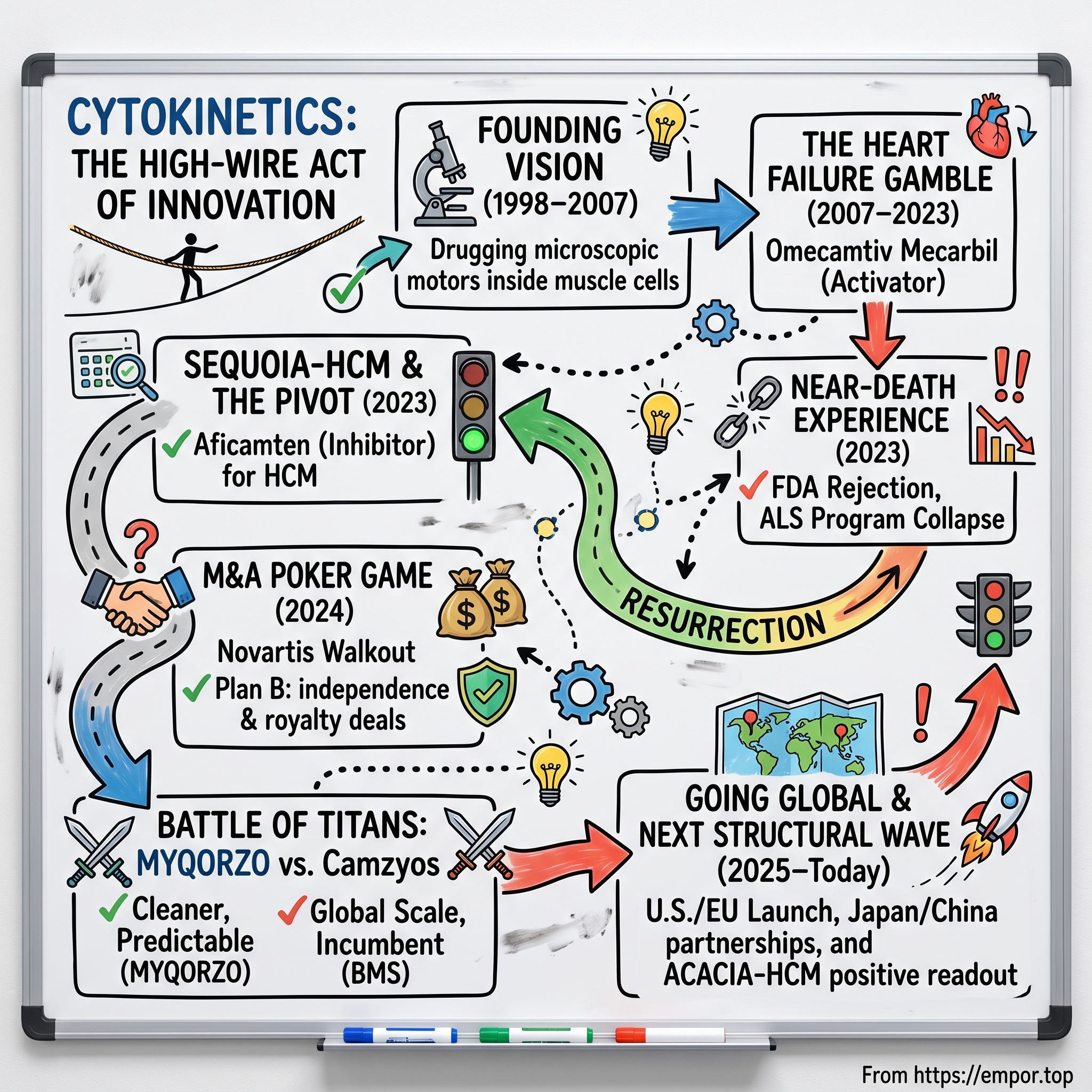
Cytokinetics: The High-Wire Act of Cardiovascular Innovation
I. Introduction & Episode Roadmap
Picture a boardroom in Basel in the closing days of 2023. Novartis executives are staring at a set of clinical numbers that look almost too clean to be real — a small California biotech has just shown that its heart drug can meaningfully improve how far a patient with a thickened, obstructed heart can walk, hit every single secondary goal it set, and do it without the safety scares that usually haunt this class of medicine. Within weeks, the two companies are deep in acquisition talks. And then, just as suddenly, Novartis stands up and walks out of the room. The stock of the little biotech drops like a stone. Most companies never recover from a jilting like that. This one used it to become something the pharmaceutical industry almost never produces: an independent, self-commercializing cardiovascular company built from a first-principles bet on the physics of muscle.
That company is Cytokinetics, and this is the story of how it got there — through a near-death experience, a scientific pivot, a spurned buyout, and a launch that pits it directly against one of the most powerful drug companies on Earth.
To understand the stakes, rewind to November 2020. Bristol Myers Squibb paid $13.1 billion in cash — about $225 per share — to acquire a company called MyoKardia, whose single most valuable asset was a first-in-class cardiac myosin inhibitor called mavacamten.[^2] BMS turned that molecule into Camzyos, a drug for obstructive hypertrophic cardiomyopathy that crossed a billion dollars in annual sales in 2025.8 Cytokinetics, valued in mid-2026 in the neighborhood of $11 billion, is now attacking that franchise head-on with its own newly approved cardiac myosin inhibitor, aficamten, sold under the brand name MYQORZO — cleared by the FDA on December 19, 2025.1
Here is the twist that makes this a genuine story rather than a press release: less than three years before that approval, Cytokinetics looked finished. In February 2023 the FDA rejected its lead heart failure drug.3 One month later, in March 2023, its ALS program collapsed.[^6] The stock fell into the low $30s and the market wrote the company off as an expensive science project that could never cross the chasm into commercial reality. What happened next — a Christmas readout, a botched buyout, a non-dilutive financing that doubled as a takeover shield, and a two-front commercial war — is the substance of this episode.
Three threads run through everything that follows. The first is molecular kinetics: the idea that you can build a durable business by drugging the microscopic motors inside muscle cells. The second is the M&A poker game — how Cytokinetics played, and arguably survived, a high-stakes negotiation with the world's largest drugmakers. The third is Plan A versus Plan B: the deliberate choice to stay independent and finance a launch with royalty deals rather than sell out or dilute shareholders into oblivion. Whether that choice proves brave or reckless is precisely the question a sophisticated investor should be asking, and it is the question this piece keeps returning to. Let's start where every good origin myth starts — with a handful of scientists and an idea that sounded impossible.
 Subscribe on LinkedIn
II. Molecular Motors: The Founding Vision (1998–2007)
Every muscle you have ever flexed — your bicep, your diaphragm, the walls of your heart — runs on a machine so small you need an electron microscope to see it. Deep inside each muscle cell sits a repeating structure called the sarcomere, and inside the sarcomere, two proteins do a kind of molecular hand-over-hand climb: myosin, the motor, ratchets itself along actin, the track, and that ratcheting is what makes tissue contract. It is one of the most fundamental processes in biology, and in the late 1990s a small group of scientists asked a heretical question. What if you could design small-molecule drugs that reach into that machinery and turn the motor up or down, like a dimmer switch for muscle itself?
That was the founding thesis of Cytokinetics, established in 1998 out of the Bay Area's academic ferment. Its intellectual parents were a murderers' row of cytoskeleton biology: James Spudich and Ronald Vale — both of whom would go on to win the Lasker Award for their work on molecular motors — along with geneticist Lawrence Goldstein and James Sabry, who became the company's first head of research. These were not entrepreneurs chasing a hot market. They were basic scientists who had spent careers understanding how motor proteins work, and who believed, correctly as it turned out, that this knowledge could be translated into medicine.
It helps to sit with the analogy for a moment, because it is the intellectual root of everything the company later became. Think of a rowing crew: myosin heads are the rowers, actin filaments are the water, and each stroke pulls the boat — the muscle fiber — a little shorter. A normal heart is a crew rowing in smooth, coordinated strokes. A failing heart is a tired crew whose strokes have gone weak; a hypertrophied heart is a crew rowing so hard and so out of control that the boat thrashes and stalls. Traditional cardiology drugs mostly work on the water and the weather around the boat — lowering the resistance, calming the current. Cytokinetics wanted to reach in and change how hard the rowers themselves pull. No one had built a commercial drug that did that to the human heart, and the founders were proposing to do it with the precision of turning a single dial.
The scientific ambition was enormous, but so was the risk, and the founders knew it. Drugging a motor protein is nothing like the pharmaceutical industry's bread and butter of blocking a receptor. You are trying to modulate a mechanical process — to make a contraction stronger, or weaker, or faster to relax — with exquisite selectivity, so that you tune the heart without poisoning skeletal muscle, or tune skeletal muscle without touching the heart. There was no playbook. Cytokinetics essentially had to build one, mapping the biophysics of contraction assay by assay, molecule by molecule.
That kind of work is patient capital in its purest form, and it demanded a particular business model. In its early years Cytokinetics ran less like a product company and more like a discovery factory — an R&D engine that generated novel muscle-targeting compounds and then sold slices of them to deep-pocketed partners who could fund the expensive science. GlaxoSmithKline and later Amgen signed multi-year, multi-million-dollar collaborations that validated the platform and paid the bills. The trade was straightforward: Cytokinetics kept the lights on and retained a scientific identity, and Big Pharma got early options on a genuinely differentiated class of assets. But that model quietly imposed a tax that would shape the company for decades. Every collaboration that funded the science also handed a partner a claim on the eventual upside — a royalty here, a regional right there, a co-promotion clause somewhere else. Those early deals were rational, even necessary, for a company that could not otherwise afford its own research. Yet they meant that by the time Cytokinetics finally produced a winner, it had already promised slices of that winner away in a dozen directions. The later, dramatic maneuvers of the aficamten era — keeping the U.S. and Europe while licensing Japan and China, selling royalties to fund a launch — were not a break from the founding model so much as its logical endpoint: a company that had always financed itself by monetizing pieces of the future, now doing it on a much larger stage.
The cost of that model, though, was time — and a peculiar kind of institutional patience that would define the company for two decades. Turning a beautiful cellular insight into a molecule that survives a human clinical trial can take fifteen years and hundreds of millions of dollars, with a very high chance of failure at every stage. Cytokinetics was signing up for exactly that marathon, in some of the hardest diseases in medicine: heart failure, ALS, and other devastating disorders of striated muscle. For a long-term investor, the founding chapter carries a clear lesson. A differentiated scientific platform is a real asset, but it is not the same thing as a business. The value only crystallizes if, someday, one of those elegant molecules actually reaches patients and generates cash — and for its first quarter-century, Cytokinetics kept betting that the someday would arrive. The first serious attempt to prove it centered on the heart.
III. The Heart Failure Gamble: The Rise and Fall of Omecamtiv Mecarbil (2007–2023)
Heart failure is one of medicine's great unsolved problems: roughly half of patients diagnosed with the reduced-ejection-fraction form die within five years, and for decades the drugs that help — beta blockers, ACE inhibitors, and their successors — worked mostly by taking load off a failing pump, not by fixing the pump itself. Cytokinetics thought it had something better. If myosin is the heart's motor, why not build a molecule that makes the motor work harder — a cardiac myosin activator that increases the force of each heartbeat without demanding more oxygen, the way older stimulants like digoxin did? That molecule was omecamtiv mecarbil, and for the better part of fifteen years it was the company's crown jewel and its central identity.
The scientific pitch was genuinely elegant. A failing heart is a weak pump; omecamtiv was designed to lengthen the time myosin spends engaged with actin during each contraction, squeezing out more blood per beat without the dangerous surge in oxygen consumption that makes traditional inotropes so risky. It was, in theory, the holy grail — more contraction, no extra cost. Amgen certainly believed in it, backing the program for years as the deep-pocketed partner. But belief in biotech is expensive, and as the required Phase 3 trial ballooned in size and cost, Amgen began to do the math on the risk. In one of the more telling strategic tells of the saga, Amgen ultimately retreated, handing all development rights back to Cytokinetics — a partner with the resources to run the trial choosing instead to walk away from it.
There is a lesson buried in Amgen's exit that investors of that era largely missed. When a partner with essentially unlimited resources — Amgen was among the largest biotechs in the world — chooses to hand a Phase 3-ready cardiovascular asset back rather than finish the trial itself, it is telling you something about how that partner reads the risk-reward. Amgen was not walking away from the science; it was walking away from the probability-weighted commercial return on a drug that would need a gigantic, expensive outcomes trial to prove it saved lives. Cytokinetics, with far less capital and far more to prove, picked up a burden its wealthier partner had put down. That is either conviction or desperation, and for a long time it was impossible to tell which.
The trial in question was GALACTIC-HF, and it was a monster: roughly 8,000 patients, one of the largest heart failure studies ever conducted. When the results came, they landed in an agonizing gray zone. Omecamtiv hit its primary composite endpoint — the combination of heart failure events and cardiovascular death reached statistical significance. But dig one layer down and the picture dimmed: the drug produced essentially no improvement in cardiovascular mortality on its own. It reduced heart failure events modestly, but it did not clearly help patients live longer. In a field where regulators and cardiologists have grown deeply skeptical of drugs that move surrogate numbers without saving lives, that distinction was everything.
The FDA agreed, and it did not mince words. On February 28, 2023, the agency issued a Complete Response Letter, stating flatly that GALACTIC-HF alone did not establish substantial evidence of effectiveness and that another Phase 3 trial would be required.3 For a company that had spent a decade and a half and enormous sums on this single asset, it was a devastating verdict: not "no," exactly, but "prove it again, at a cost of years and hundreds of millions more." The market understood immediately what that meant for a company without product revenue.
Then came the second blow, and it fell fast. On March 31, 2023 — barely a month later — the independent monitoring committee for COURAGE-ALS, the Phase 3 trial of reldesemtiv in amyotrophic lateral sclerosis, reviewed the unblinded data and recommended stopping the study for futility. There was simply no evidence that the drug, a fast skeletal muscle troponin activator, was helping ALS patients relative to placebo, and development was terminated outright.[^6] In the span of a few weeks, Cytokinetics had lost its lead cardiac program to a regulator and its lead neuromuscular program to the data itself.
To appreciate how dangerous this moment was, remember what Cytokinetics was in early 2023: a company with no approved products, no product revenue, a large recurring R&D cash burn, and a business model that had always depended on either partners or the capital markets to keep the lights on. A biotech in that position lives and dies by investor confidence, because its only source of funding is its ability to sell stock or strike deals — and both of those depend on a credible story. Two Phase 3 failures in five weeks did not just erase two programs; they threatened the narrative that justified the company's existence. When a pre-revenue biotech loses the market's belief, the death spiral is mechanical: the stock falls, raising capital becomes ruinously dilutive, the runway shortens, and the pressure to accept a fire-sale acquisition mounts. That is the abyss Cytokinetics was staring into.
The stock collapsed into the low $30s, and the bear thesis wrote itself. Here, critics said, was the ultimate expensive discovery engine — twenty-five years old, brilliant at the science, and apparently incapable of getting a single product across the commercial finish line. The activators, the very concept of turning muscle up, appeared to be a dead end. What almost no one appreciated in the gloom of early 2023 was that the company's salvation was already deep in a Phase 3 trial, and it worked in exactly the opposite direction. To understand why, you have to understand that some hearts don't need a stronger motor. They need a weaker one.
IV. The Resurrection: SEQUOIA-HCM and the Shift to Inhibition (2023)
For years, cardiac myosin activation had been Cytokinetics' whole identity — make the failing heart squeeze harder. But the same platform that could turn the motor up could, in principle, turn it down. And it turned out there was a disease crying out for exactly that: a heart that contracts too forcefully, too thickly, choking off its own blood supply. If you can build an activator for the weak heart, you can build an inhibitor for the overpowered one. That mirror-image insight is what saved the company.
The disease is hypertrophic cardiomyopathy, or HCM, and it is genuinely frightening. In its most common obstructive form, a genetic defect causes the heart muscle — particularly the wall between the ventricles — to thicken abnormally. The overgrown muscle physically obstructs blood flowing out of the heart, producing breathlessness, chest pain, fainting, dangerous arrhythmias, and, in the worst cases, sudden cardiac death in otherwise young, active people. For decades the only options were old, nonspecific drugs and, ultimately, open-heart surgery or a catheter procedure to carve away the excess muscle. The underlying problem — a sarcomere that is, in effect, too strong — went untreated.
It is worth pausing on who these patients are, because it shapes the entire commercial story that follows. HCM is the most common inherited heart disease, and it does not spare the young or the fit — it is a leading cause of sudden cardiac death in athletes, and many patients are diagnosed in their thirties and forties after episodes of breathlessness or near-fainting during exertion. These are not frail, elderly patients on a dozen medications; many are working adults who want to climb stairs, chase their children, and stay off an operating table. That profile matters because it makes the disease a "specialist" market — managed at a relatively small number of dedicated HCM centers by cardiologists who know these drugs intimately — rather than a mass primary-care market. A challenger with a superior product and a focused salesforce can, in principle, reach almost every relevant prescriber. That structural fact is the hidden foundation of Cytokinetics' entire "Plan A."
A cardiac myosin inhibitor attacks that problem at its root. By reducing the number of myosin motors engaging with actin, the drug dials down the excessive contraction, relieves the obstruction, and lets the heart relax and fill properly again. MyoKardia had proven the concept first with mavacamten, which became BMS's Camzyos. Cytokinetics' entry, originally the unglamorously named CK-3773274 and later christened aficamten, was designed as a next-generation follower — engineered from the outset to be cleaner, more predictable, and faster to work with than the first-mover. Whether that engineering would translate into a clinical advantage was the entire question, and the answer would come from a single trial: SEQUOIA-HCM.
SEQUOIA-HCM was, in the truest sense, a bet-the-company event. After the twin failures of early 2023, Cytokinetics no longer had the luxury of a deep bench of late-stage assets; aficamten was the recovery story, and this pivotal Phase 3 trial would either validate the pivot or confirm the market's obituary. Everything — the stock, the platform's credibility, the company's independence — rode on a readout expected around year-end.
It arrived on December 27, 2023, and it was close to flawless. Aficamten met its primary endpoint, improving patients' peak oxygen uptake — a rigorous, objective measure of exercise capacity — by a statistically overwhelming margin, and it hit all ten prespecified secondary endpoints as well.2 Just as important for a drug in this class, the safety profile was pristine: the feared complication of these medicines is pushing the heart's squeeze too low, and here the incidence of severe left ventricular dysfunction requiring treatment interruption was essentially a non-event. For a company whose previous lead drug had been rejected for a muddy, ambiguous dataset, SEQUOIA-HCM was the mirror opposite — unambiguous on efficacy and clean on safety.
The market's reaction was violent in the best possible way. The stock surged roughly 80% in a single session, catapulting Cytokinetics past an $8 billion valuation and, in one day, transforming it from a distressed turnaround into one of the most coveted mid-cap assets in biotech. That surge did more than restore a share price. It changed the company's strategic destiny — because a clean Phase 3 in a multibillion-dollar cardiology market is exactly the kind of thing that makes the world's largest pharmaceutical companies pick up the phone. And pick it up they did.
V. The M&A Circus and the "Plan A" Pivot (2024)
Nothing draws Big Pharma like a de-risked cardiovascular asset in a market it already understands. Within days of the SEQUOIA-HCM readout, Cytokinetics went from turnaround story to takeover target, and the financial press lit up with speculation about a bidding war. Novartis, AstraZeneca, and Johnson & Johnson were all floated as potential suitors, and the whispered numbers were staggering — a checkout price rumored north of $10 billion for a company that, a year earlier, had been left for dead. For a few weeks in early 2024, the question was not whether Cytokinetics would be acquired but by whom, and for how much.
Novartis got closest. Reports had the Swiss giant in advanced talks, and — as Cytokinetics itself later confirmed in a securities filing — the company's board was prepared to move forward on terms it expected to be mutually agreeable. And then, in mid-January 2024, Novartis simply walked away.4 The stated reasons were never fully disclosed, but the contours were familiar to anyone who has watched large pharma diligence a deal: disagreements on price, concerns about competitive and antitrust dynamics in a market where Novartis had its own cardiovascular interests, and the tangle of pre-existing regional licensing arrangements that Cytokinetics had signed years earlier to fund itself. Whatever the precise cause, the effect was brutal. The stock tumbled roughly 20% as the market repriced the company from "about to be acquired at a premium" back to "must go it alone."
This is the hinge of the entire story, and it is where CEO Robert Blum made the defining call of his tenure. Rather than shop the company harder or wait for another suitor, Blum planted a flag: Cytokinetics would pursue "Plan A" — remaining independent and building a standalone, vertically integrated cardiovascular company that discovered, developed, and commercialized its own medicines. It was an audacious posture for a company with no commercial infrastructure and a history of clinical failures, and it invited an obvious skeptical question. Was "Plan A" a genuine strategy, or was it the rhetoric of management protecting its own seats after a buyout fell through? That tension would hang over the company for the next two years.
To make independence credible, though, Blum needed money — a lot of it — without either selling the company or flooding the market with new shares at a depressed price. The answer, announced on May 22, 2024, was a restructured and expanded strategic funding collaboration with Royalty Pharma totaling up to $575 million.5 It is worth understanding the structure, because it is the financial heart of the whole independence bet. Cytokinetics took $250 million in cash at closing — $50 million upfront, another $50 million via a stock purchase, plus $100 million tied to the omecamtiv program — and secured the right to draw a further $175 million within a year of aficamten's approval, repayable over a decade at a 1.9x multiple.5 In exchange, Royalty Pharma's cut of future aficamten sales was restructured: it would collect 4.5% on annual net sales up to $5 billion and 1% above that, expanding a royalty interest it had first bought into in 2022, when the tiers were 4.5% up to $1 billion and 3.5% above.5
The genius — and the controversy — of the deal was that it was non-dilutive. Cytokinetics kept full U.S. and European commercial rights to aficamten and fortified its balance sheet, all without issuing a wave of new equity at a low price. But it was not free money, and the market knew it. Selling a slice of your best drug's future revenue is a bet that the drug will be so large that the royalty is a rounding error you can happily afford. Some investors read the move exactly the way management hoped — as a shield that made a low-ball, opportunistic takeover far less likely, because a would-be acquirer now had to buy a company that had already promised away part of its upside.6 Others read it as a tell that the buyout was truly dead and that Cytokinetics was mortgaging its crown jewel to fund a launch it had never before attempted. It is telling that some investors reacted to the Royalty Pharma financing not with relief but with visible frustration. To a shareholder who had bought Cytokinetics on the thesis that Novartis or another giant would swoop in at a premium, the deal read as management deliberately closing the exit — bolting the door against a takeover in order to pursue an unproven "Plan A" that happened to keep the executive team employed. That is a legitimate governance tension, and it is the single sharpest lens through which to judge Robert Blum's stewardship: did he forgo a lucrative sale of the company because he genuinely believed independence would create more value for shareholders, or because independence created more value for management? The financing structure does not answer that question; only the launch curve will. What can be said neutrally is that Blum put the company's fate squarely on the outcome of a commercial fight it had never before attempted — and then made that fight nearly impossible to avoid by selling off the pieces a rescuer might have wanted.
Both readings were defensible, and which one proves right depends entirely on the size of the prize. That prize is a head-to-head war with Bristol Myers Squibb.
VI. The Battle of the Titans: MYQORZO vs. Camzyos
Here is the commercial setup, stripped to its essence. There is one attractive, underserved market — symptomatic obstructive hypertrophic cardiomyopathy, worth well over $3 billion at maturity — and, for the first time, two branded cardiac myosin inhibitors fighting over it. In one corner stands Bristol Myers Squibb's Camzyos, the first mover, with a multi-year head start, a global salesforce, and the momentum of a drug that grew from $602 million in 2024 revenue to roughly $1.1 billion in 2025.78 In the other stands Cytokinetics' MYQORZO, the challenger, armed with a later approval, a clean trial, and a product profile deliberately engineered to be easier to use. This is a genuine war-game, and the outcome is far from decided.
Cytokinetics' entire commercial thesis rests on a single word that most patients have never heard: pharmacokinetics — the study of how a drug moves through the body, how long it lingers, and how predictably it behaves. On paper, this is where MYQORZO makes its case, and the argument has three prongs. The first is half-life, which is simply how long the drug takes to clear. Camzyos is a slow-clearing molecule, with a half-life measured in days that can stretch dramatically — up to weeks — in patients whose bodies metabolize it poorly, which raises the specter of the drug accumulating to unsafe levels. MYQORZO clears far faster; if a patient's heart function starts to dip, the drug washes out in days rather than lingering, giving cardiologists a faster off-ramp from trouble. In a class whose central danger is over-suppressing the heartbeat, a shorter, more predictable washout is a real clinical comfort.
The second prong is titration — the delicate process of dialing a patient up to the right dose. Because Camzyos accumulates slowly and can drive the heart's squeeze too low, prescribers must adjust it cautiously, waiting weeks between dose changes and monitoring closely with echocardiograms. MYQORZO's faster, more predictable clearance allows dose adjustments on a roughly two-week cadence, getting patients to an effective dose in a fraction of the time. For a busy cardiology practice, that is not a trivial convenience; it is fewer visits, faster symptom relief, and less time in the anxious limbo of an under-dosed patient.
The third prong may be the most quietly powerful: genotyping. Camzyos is metabolized heavily through a single liver enzyme, CYP2C19, and because patients vary genetically in how much of that enzyme they produce, its label steers prescribers toward considering a patient's metabolizer status and creates a thicket of drug-drug interaction warnings. MYQORZO is cleared through multiple pathways, which its proponents argue removes the need to think about genetic testing at all. For a cardiologist who does not run a genetics lab, eliminating that administrative and cognitive hurdle is exactly the kind of friction reduction that changes prescribing behavior.
Those three prongs are, for now, mostly a paper argument — a comparison of label language and pharmacology rather than a head-to-head clinical fight. But Cytokinetics has one piece of evidence that goes beyond paper, and it is worth dwelling on because it is unusually bold. In a trial called MAPLE-HCM, the company pitted aficamten directly against metoprolol — a generic beta blocker that has been the reflexive first-line treatment for obstructive HCM for decades — as a monotherapy. On May 13, 2025, Cytokinetics reported that aficamten won: it produced a statistically significant improvement in peak oxygen uptake versus metoprolol, with a favorable safety and tolerability profile, and the results were later presented at the European Society of Cardiology Congress and published in The New England Journal of Medicine in August 2025.[^22] The strategic significance is larger than it first appears. Most new drugs are tested against placebo; running a superiority trial against the entrenched standard of care is a gamble that only a company confident in its molecule takes. If aficamten is genuinely better than the cheap generic that cardiologists reach for first, it strengthens the case not just against Camzyos but for using a myosin inhibitor earlier in the treatment journey — a potentially much larger commercial opportunity than a second-line, post-beta-blocker positioning.
There is one battlefield the outline glosses over that a hard-nosed investor should not: price and payers. Both Camzyos and MYQORZO are premium branded specialty drugs carrying list prices in the range of roughly $200,000-plus per patient per year, which means the real gatekeeper is often not the cardiologist but the insurer's pharmacy benefit manager. In a market with two clinically credible options, payers gain leverage to demand rebates and to steer patients toward whichever drug offers the better net price — a dynamic that can quietly erode the "superior product wins" thesis regardless of pharmacology. Cytokinetics enters that negotiation as the smaller player without an existing rebate relationship across a broad drug portfolio, which is precisely the kind of structural disadvantage that BMS's scale confers. The commercial war, in other words, will be fought as much in formulary committees as in cath labs.
But — and this is where a neutral analysis has to push back on the bull narrative — the two drugs are not competing on a wide-open field. Both carry a strict Risk Evaluation and Mitigation Strategy, or REMS: a mandatory, FDA-enforced program requiring prescribers and pharmacies to register, and patients to undergo regular echocardiograms, precisely because both drugs can push the heart into failure if mishandled. The REMS is an equalizer. It means that no matter how elegant MYQORZO's pharmacokinetics look on a slide, every prescription still runs through the same bureaucratic gate, and much of the commercial battle collapses into an administrative race — who can register more specialty cardiologists, train them, and make the monitoring workflow feel effortless. A superior molecular profile is a genuine advantage, but it is a reason to switch, not a force that switches for you.
It helps to run the competitive dynamics through the two frameworks investors reach for. In Hamilton Helmer's 7 Powers language, aficamten's patent estate is a cornered resource — a legally protected molecule no one else can copy for years. Once a cardiology clinic has wired a specific drug's REMS workflow into its daily practice, there is a real switching cost to adopting a rival, because re-registering, re-training, and re-monitoring is a hassle nobody undertakes lightly — which, importantly, cuts both ways and helps the incumbent Camzyos as much as it protects MYQORZO. On Helmer's scale economies and Porter's classic "power of the incumbent," BMS holds the clear edge: a sprawling commercial footprint and the ability to blanket both cardiologists and, increasingly, the primary-care doctors who see these patients first. Cytokinetics counters not with scale but with focus — a smaller, specialty-targeted launch aimed squarely at the high-volume HCM centers where the sickest patients cluster.
War-gaming the incumbent's response is instructive, because BMS is not going to stand still and watch its billion-dollar franchise erode. Its most powerful lever is not the science but the commercial infrastructure: contracts with payers that can be structured to reward volume and loyalty, patient-support and copay programs that reduce out-of-pocket friction, and a salesforce large enough to reach the community cardiologists that a lean challenger cannot economically cover. BMS can also press its own clinical expansion — it has pursued additional indications and patient populations for Camzyos, and every new approved use widens the moat of familiarity. The counter that Cytokinetics is betting on is that in a specialist disease, physician preference driven by a genuinely better use profile eventually overrides distribution muscle, because the doctors writing these prescriptions are a small, expert, evidence-driven group who read the same journals and attend the same conferences where MAPLE-HCM and SEQUOIA-HCM were presented. Which force wins — distribution scale or product-led physician preference — is the central empirical question of this entire episode, and it will be settled not by argument but by prescription data accumulating month after month.
Netting it out for an investor: MYQORZO appears to have a real, differentiated product profile, and in a physician-driven specialty market a better-behaved drug can genuinely win share. But "better on paper" has to survive contact with a well-funded incumbent, entrenched prescribing habits, and a shared regulatory chokepoint. The proof will not be in the pharmacology; it will be in the prescription data. And that data began accumulating the moment the FDA said yes.
VII. Going Global: Commercial Launch & Strategic Partnerships (2025–Today)
The starting gun fired on December 19, 2025, when the FDA approved aficamten under the brand name MYQORZO for adults with symptomatic obstructive HCM.1 For a company founded in 1998, it was the first time in its history it owned an approved, marketable product — the moment a discovery engine finally became a commercial enterprise. The drug reached the U.S. market roughly five weeks later, becoming available to patients around January 27, 2026, and the direct clash with Camzyos began in earnest.9
Europe followed close behind, with the European Commission approving MYQORZO for symptomatic obstructive HCM in early 2026, opening the second of the two markets Cytokinetics chose to keep for itself.14 Behind these approvals sits an enormous, mostly invisible build-out: hiring and deploying a specialty salesforce, standing up a REMS-compliant distribution and monitoring system, negotiating payer coverage, and educating cardiologists — the unglamorous machinery of turning a molecule into a business. For a company that had spent twenty-seven years as a laboratory, this was arguably a harder transformation than the science itself, because commercial execution is a muscle Cytokinetics had never developed. The single most important thing to understand about the 2025–2026 period is that the company is being tested on a competency it has no track record in.
What is striking about Cytokinetics' global strategy is that "Plan A" independence applies only where it matters most. The company kept the United States and Europe — the richest, highest-margin markets — for itself, and then systematically sold off the rest of the world to partners who could bring local muscle and non-dilutive cash. This is the same instinct that produced the Royalty Pharma deal, applied geographically: keep the crown jewels, monetize the periphery, and let someone else carry the cost and risk of markets you cannot efficiently serve alone.
Japan went to Bayer. In November 2024, Cytokinetics licensed aficamten's Japanese rights to the German pharma giant for €50 million upfront, up to €90 million in development and launch milestones — €20 million of it near-term — and as much as €490 million in commercial milestones, plus tiered royalties.[^12] Greater China took a more circuitous path. Cytokinetics had licensed the region years earlier to a local partner, Ji Xing, which rebranded as CORXEL; then, on December 17, 2024, CORXEL assigned those rights to Sanofi, bringing a global pharma heavyweight into MYQORZO's Asian rollout. That reshuffle earned Cytokinetics a $15 million non-refundable payment, kept it eligible for up to $150 million in further milestones, and preserved royalties in the low-to-high teens on Chinese sales.[^13] Aficamten was subsequently approved in China as well, extending the brand into the world's largest HCM patient population.15
Then came the first real report card. On May 5, 2026, Cytokinetics reported its first quarter as a commercial company, and the numbers offered the first hard evidence of the launch trajectory.[^3] Total revenue was $19.4 million — a figure that sounds respectable until you unpack it, because most of it was not product sales. MYQORZO net product revenue was just $4.8 million, reflecting only about nine weeks of U.S. selling; the balance came from $2.6 million of collaboration revenue and roughly $11.9 million of other items.[^3] The launch metrics underneath the revenue were arguably more telling than the dollars: more than 275 healthcare providers had written a MYQORZO prescription, reaching an estimated 680 patients in the quarter.[^3] And the balance sheet remained formidable — roughly $1.1 billion in cash, cash equivalents, and investments, the runway that makes "Plan A" possible in the first place.[^3]
How should an investor read a $4.8 million debut? With patience and skepticism in equal measure. Nine weeks is far too short a window to judge a specialty launch — REMS registration, payer coverage, and physician familiarity all take quarters to build, and 275 prescribers writing for 680 patients is a plausible early-adopter base rather than a verdict. On the Q1 call, management framed the quarter as a foundation-laying period, emphasizing prescriber breadth and access-building over raw revenue.10 That is a reasonable story. But it is also exactly what management would say regardless of how the launch is truly going, which is why the honest answer is that one quarter tells us almost nothing about the slope of the curve. The most useful benchmark is Camzyos's own launch. When BMS first brought mavacamten to market, uptake was deliberately gradual — the REMS requirements, the echocardiogram monitoring, and cardiologists' natural caution with a novel mechanism meant the drug built slowly before compounding into a billion-dollar franchise over roughly three years. That history cuts both ways for Cytokinetics. On one hand, it proves the market is real and that patient, methodical launches in this category can end in blockbuster territory. On the other, it warns that even a superior drug should not be expected to sprint out of the gate, and that a soft first year tells you far less than the bears will claim. The genuinely informative signal will be the shape of the curve across 2026 and into 2027: whether prescriber counts compound quarter over quarter, whether patients started on MYQORZO stay on it, and whether Cytokinetics is winning treatment-naïve patients or merely switching a trickle from Camzyos. Those are the questions the reported dollars cannot yet answer.
The next several quarters will tell us a great deal. The person ultimately accountable for that slope has been in the building since day one.
VIII. The Management Scorecard & Activist Pressure
Robert Blum is, in a sense, the last person standing from the founding vision. He joined Cytokinetics in 1998, the year it was formed, and has served as its chief executive since 2007 — meaning he personally presided over the entire arc of this story: the discovery-engine years, the long omecamtiv marathon, the twin failures of 2023, the SEQUOIA resurrection, the Novartis rejection, and the launch. That tenure is a genuine asset in scientific continuity and institutional memory. It is also, for a skeptic, a liability: Blum is the executive who steered enormous R&D spending into two late-stage programs that ultimately failed, and who is now asking shareholders to trust him with the far more expensive challenge of building a commercial organization from scratch — a skill set no one in the building has ever had to demonstrate at scale.
The credibility question, then, is whether Blum's behavior over time supports the trust. The bull view is that he did the hardest thing a biotech CEO can do — he killed his darling. Abandoning omecamtiv as the company's identity after the CRL, and redirecting scarce capital and talent into aficamten, was a decisive, unsentimental pivot that arguably saved the company. The bear view is that the pivot was less strategic foresight than survival instinct after the market forced his hand, and that a CEO who champions "independence" immediately after a lucrative buyout collapses has an obvious personal incentive to prefer independence. Both can be true at once.
On incentive alignment, the picture is reasonably reassuring on paper. Blum directly held roughly 377,830 shares of Cytokinetics as of mid-2026 — a stake worth on the order of $30 million and enough to tie a meaningful portion of his net worth to the stock's fate — and his 2024 total compensation of about $14.4 million was overwhelmingly equity, heavily weighted toward performance-linked stock rather than cash.12 That structure means Blum wins big only if shareholders do, which is the alignment investors want to see. The counterpoint is that large equity packages also create pressure to keep the company independent and the stock elevated, which is not always the same thing as maximizing value for outside holders — a nuance that matters enormously when a takeover premium is on the table.
On the question of narrative consistency — the truest test of management credibility — Blum earns reasonably good marks. Across the failures of 2023, the SEQUOIA triumph, the Novartis collapse, and the launch, the through-line of his public communication has been unusually steady: a stated intent to build an independent, fully integrated cardiovascular company rather than to flip the asset. He did not, in the aftermath of the CRL, pretend omecamtiv was still a priority, nor did he spin the ALS failure as anything other than a termination. That willingness to name a miss plainly, rather than bury it in optimistic hedging, is a positive signal in a sector notorious for spin. The fair critique is the mirror image of the virtue: a leader this committed to a single strategic vision can become anchored to it, and "independence at all costs" is exactly the kind of conviction that can lead a board to wave off a value-maximizing offer. Consistency and stubbornness look identical from the outside until the outcome reveals which one it was. Investors evaluating Blum should watch not what he says on the next earnings call — the message will be steady — but what he does the next time a credible acquirer appears.
Which brings us to the sentinel on the register: Sarissa Capital Management, the activist healthcare fund run by Alex Denner, a veteran of Carl Icahn's operation known for pushing biotech boards toward sales and sharper capital discipline. Sarissa has been a notable Cytokinetics holder, and Denner's presence on any share register is a signal in itself — it means someone with a track record of forcing outcomes is watching management's capital allocation closely. It is worth being precise rather than breathless here: Sarissa's disclosed 13F filings through 2025 actually showed the fund trimming, not building, its Cytokinetics position, so the notion of an ever-growing activist war chest should be treated with caution.11 The threat is real but should not be overstated from public filings alone.
What, concretely, would a skeptical activist challenge? Three things stand out. First, capital allocation: the decision to build an expensive, standalone global commercial organization rather than sell the company or partner the U.S. rights, at a moment when a credible acquirer was reportedly at the table. Second, the cumulative record of R&D spending: a quarter-century of burn that produced two late-stage failures before the first commercial success, which a hard-nosed investor would read as a pattern of a science-first culture that struggled with capital discipline. Third, the layering of the balance sheet: between the Royalty Pharma streams, the Bayer and Sanofi licenses, and the debt-like repayment obligations embedded in the funding deals, Cytokinetics has a genuinely complex capital structure whose true cost only becomes visible if aficamten becomes very large. None of these are smoking guns. But together they form exactly the brief an activist would assemble to argue that the board should either sell the company or bring in operators with a proven commercial track record. The counter-argument — that Blum's continuity preserved the scientific engine that produced aficamten in the first place — is real, but it is a bet on the past predicting the future.
The strategic logic of that threat, however, is clear regardless of the exact share count. "Plan A" independence runs on a clock. If MYQORZO's commercial trajectory convincingly outruns Camzyos, management's decision to stay independent looks vindicated and the activist has little to push against. But if the launch stalls — if the $1.1 billion cash pile starts draining into an expensive standalone salesforce without commensurate revenue — or if a fresh, high-premium buyout offer appears and management waves it away, then the conditions for a proxy fight over capital allocation and board control fall neatly into place. Denner does not need a majority stake to make that case; he needs a stumble. The management scorecard, in other words, will be graded quarter by quarter, in public, against a very well-funded competitor. That is the reality that makes the strategic lessons of this company worth studying.
IX. The Strategic Playbook & Investing Lessons
Step back from the quarter-to-quarter noise and Cytokinetics offers three distinct strategic lessons, each of which generalizes well beyond biotech. The first is the fast-follower playbook. There is a romantic assumption in business that being first is everything, but in regulated, specialist markets the second mover often holds the better hand. Camzyos did the brutal, expensive work of proving that cardiac myosin inhibition works, of educating cardiologists, of building the disease awareness and the REMS infrastructure that a whole category now runs on. MYQORZO arrived into a market that BMS had already cultivated, carrying a product profile refined precisely to fix the first mover's rough edges — the slow titration, the accumulation risk, the genotyping overhang. Entering second with a demonstrably cleaner product can be more capital-efficient than entering first and bearing the cost of educating the market. The catch, and it is a real one, is that the fast follower has to actually convert its theoretical advantages into switched prescriptions before the incumbent's scale and habit-formation lock the market shut.
The second lesson is the use of royalty monetization as a sovereign shield. Cytokinetics turned a financing tool into a defensive strategy. By selling future royalty streams to Royalty Pharma and licensing away Japan and Greater China, it raised capital without diluting shareholders and, crucially, made itself a less clean acquisition target — because a buyer would inherit a company that had already promised away pieces of its upside. This is financial engineering in service of strategic autonomy, and it let Cytokinetics survive a moment when the capital markets and the M&A market both turned against it. The risk is symmetrical: every stream you sell is upside you forfeit if the drug becomes the mega-blockbuster the bull case requires. Royalty deals are insurance, and insurance always has a premium.
The third lesson is the discipline of knowing when to kill your darlings. Omecamtiv mecarbil was Cytokinetics' identity for fifteen years, the embodiment of the founding activator thesis. After the FDA's rejection, the value-destroying move would have been to keep pouring capital into a costly confirmatory trial out of institutional pride. Instead, the company redirected its scarce human and financial capital toward aficamten, the higher-probability, higher-value asset. In a research-driven business, the willingness to abandon a beloved program the moment the evidence turns against it is one of the most important and least celebrated forms of capital discipline. Whether this was clear-eyed strategy or forced necessity, the outcome was the right one — and for investors, the process matters as much as the result, because a management team that can let go of a darling once is more likely to do it again when the next program disappoints.
There is a meta-lesson threaded through all three, and it is the one most relevant to anyone allocating capital to a company like this. A great scientific platform and a great business are related but distinct things, and the gap between them is where most biotech value is won or lost. Cytokinetics spent twenty-five years proving it had the platform — a genuinely novel, defensible way of manipulating the heart's molecular machinery. It is only now, in the commercial arena, discovering whether it can convert that platform into a durable, cash-generating enterprise, or whether it will remain what the market long feared: a brilliant discovery engine that repeatedly hands the economic value to partners, acquirers, and royalty buyers while its own shareholders absorb the risk. The company's entire post-2023 strategy — the spurned buyout, the royalty shield, the standalone launch — is best understood as a single, high-conviction wager that this time the platform and the business will finally become one thing. Those lessons set up the central question every holder must answer: from here, does this company win?
X. The Bull vs. Bear Case & Key KPIs
The bull case is clean and, on its own terms, compelling. MYQORZO's superior safety margin and faster titration make it the default choice for cardiologists weighing a new HCM patient, and a specialty-focused salesforce steadily peels share away from Camzyos until aficamten captures a large minority — bulls talk about 45% or more — of the obstructive HCM market. Layer on the international royalty streams from Bayer and Sanofi, the already-positive readout in non-obstructive HCM, and the early-stage optionality in heart failure, and independence proves not just viable but value-maximizing. In that scenario Cytokinetics either compounds into a genuine standalone cardiovascular company or becomes an irresistible acquisition target at a valuation well north of where it trades today. The whole edifice rests on one testable proposition: that a better product wins share in a physician-driven market.
The bear case attacks exactly that proposition, and it is not weak. Bristol Myers Squibb is not a passive incumbent; it has a billion-dollar franchise to defend, a vastly larger commercial organization, deep payer relationships, and the ability to reach patients through primary care, not just specialty cardiology. In the bear scenario, BMS's scale simply crowds Cytokinetics out — MYQORZO's pharmacokinetic advantages prove to be a slide-deck story that does not overcome switching inertia and REMS friction — while the cost of building and running a global specialty commercial operation burns through the $1.1 billion cash cushion faster than product revenue can refill it. That is the path to the outcome shareholders fear most: a dilutive equity raise at a low price, the exact fate the Royalty Pharma deal was designed to avoid, now forced by a launch that under-delivered.
Run the two cases through the strategic frameworks and the picture sharpens. On Porter's five forces, the threat of rivalry is the dominant force here — a direct, well-capitalized duel between two branded drugs — and it is intense. Buyer power is real but diffuse: cardiologists and payers choose between two options, and payers will happily let them compete on price and rebates. The threat of new entrants is low in the near term, because the patent estate and the sheer difficulty of drugging myosin form a barrier — the cornered resource in Helmer's framework — but other myosin modulators are in development industry-wide, so it is not zero over a longer horizon. Supplier power and substitutes (surgery, older drugs) are comparatively minor. The honest synthesis is that Cytokinetics has genuine powers — a protected molecule, switching costs, a differentiated profile — but faces a rival whose scale economies are larger than its own, in a market where the incumbent got there first. The edge is real but contested, which is precisely why this is a story and not a foregone conclusion.
Two risks on the radar deserve explicit mention because they operate on the business through specific mechanisms rather than as vague macro worries. The first is financing risk. Cytokinetics' $1.1 billion cash position is a genuine cushion, but a standalone global commercial launch is expensive, and the company is still loss-making at the corporate level. If the revenue ramp disappoints while operating costs run at launch scale, the runway compresses, and the ugly scenario is a capital raise forced from a position of weakness — dilution at a low share price, the precise outcome the royalty deal was built to prevent. The second is competitive-technology risk over the longer horizon. Cardiac myosin modulation is now a validated, attractive target, which means other companies are working on next-generation inhibitors and adjacent approaches; today's differentiated profile could itself be leapfrogged by a third entrant in the 2030s, and gene-based therapies aimed at the underlying mutations of HCM, though early, hover as a more distant disruptive threat. Neither risk is acute in 2026, but both bear directly on how much of aficamten's future value actually accrues to Cytokinetics' shareholders rather than to competitors or capital providers.
It is worth fact-checking the most seductive line in the bull narrative — the confident claim that a superior second entrant "rapidly captures 45%+" of the market. History in specialty pharmaceuticals is more ambiguous than that slogan suggests. Sometimes the better second molecule does take the majority of new patients; often it settles into a durable co-existence, splitting the market with the incumbent as physicians develop comfort with both and payers play them against each other on price. And occasionally the first mover's head start in prescriber habit and payer contracts proves nearly insurmountable, relegating the challenger to a stubborn minority share despite a cleaner profile. Aficamten's MAPLE-HCM and SEQUOIA data give it a genuinely strong hand, and its pharmacokinetic story is the kind cardiologists actually care about. But "better drug, therefore dominant share" is a hypothesis, not a law, and the honest position in mid-2026 is that the market-share outcome is genuinely unknown. Anyone quoting a precise capture rate is guessing.
For an investor who wants to cut through the noise, three key performance indicators matter more than anything else, and none of them require guessing at the science. The first is quarterly MYQORZO net product revenue — the single cleanest measure of the launch curve's actual slope, and the number that will either validate or falsify the entire "better product wins" thesis over the next several quarters. The second is the count of active REMS-certified prescribers writing MYQORZO — the leading indicator of whether cardiologists are genuinely adopting and, critically, switching, since prescriber breadth precedes revenue. The third is the net cash burn rate measured against that revenue growth — the metric that determines how long "Plan A" can run before the company faces the dilutive raise the bears are counting on. Watch those three, in that order, and you will understand this company's trajectory long before the headlines do. And beyond the current battlefield, there is a next act already taking shape.
XI. Epilogue: The Next Structural Wave
The most revealing thing about Cytokinetics in mid-2026 is that it is no longer betting everything on a single readout — the trait that nearly killed it. On May 5, 2026, alongside its first commercial earnings report, the company announced that ACACIA-HCM, the pivotal Phase 3 trial of aficamten in non-obstructive hypertrophic cardiomyopathy, had met both of its dual primary endpoints, improving patients' symptoms and exercise capacity against placebo.[^18] That result opens a door no one has walked through: non-obstructive HCM has no approved targeted therapy at all, which means that if aficamten reaches that market, it competes not against Camzyos but against nothing. It would extend the franchise into genuinely white space and materially widen the drug's addressable population.
Further back in the pipeline sits the optionality that keeps the founding thesis alive. CK-586, also called ulacamten, is another cardiac myosin inhibitor, now in the Phase 2 AMBER-HFpEF trial for a subset of patients with heart failure and preserved ejection fraction — the vast, stubborn, largely untreated half of heart failure — whose hearts show the hypercontractility and thickening that myosin inhibition is designed to address.13 It is early, and HFpEF is a graveyard of failed drug programs, so a sober investor should assign it optionality value rather than certainty. But it is a reminder that the platform Spudich, Vale, and their colleagues sketched out in 1998 — the idea of tuning muscle's molecular motors up and down at will — is still generating shots on goal nearly three decades later.
The strategic significance of that pipeline breadth is easy to underrate. The company that nearly died in 2023 did so partly because it was too concentrated — a business whose survival hinged on single binary readouts. The Cytokinetics of 2026 is deliberately less fragile: a launched U.S. and European product, a positive readout in a second and uncontested indication, international partners carrying Japan and China, and an earlier-stage program probing the vast HFpEF market. That diversification does not guarantee success, and it does not neutralize the central risk that a well-funded incumbent out-executes it commercially. But it does mean the company's fate no longer rests on a single throw of the dice — a meaningful maturation for a business that spent most of its life betting everything on one molecule at a time. For an investor, the practical implication is that the range of outcomes has widened at both ends: more ways to build durable value, and more places for capital to leak to partners and royalty holders before it reaches common shareholders.
That is the note this story ends on: three forces colliding at once. There is the science — a genuinely novel way of drugging the heart that took twenty-five years and two devastating failures to finally pay off. There is the capital structure — a deliberate architecture of royalty sales and regional licenses engineered to buy independence and repel a takeover. And there is the raw question of corporate survival — whether a company that has never sold a drug at scale can out-execute one of the largest pharmaceutical enterprises in the world in a market that company got to first. Cytokinetics has survived the part of the story where most biotechs die. Whether it thrives now depends not on another miraculous Christmas readout, but on the far more mundane and merciless test of the commercial launch curve — measured one quarter, one prescriber, and one dollar of net product revenue at a time.
References
-
Cytokinetics Announces FDA Approval of MYQORZO (aficamten) for Symptomatic Obstructive Hypertrophic Cardiomyopathy — Cytokinetics, Incorporated, 2025-12-19 ↩↩
-
Cytokinetics Announces Positive Results From SEQUOIA-HCM, the Pivotal Phase 3 Clinical Trial of Aficamten in Patients With Obstructive Hypertrophic Cardiomyopathy — Cytokinetics, Incorporated, 2023-12-27 ↩
-
Cytokinetics Receives Complete Response Letter From FDA for New Drug Application for Omecamtiv Mecarbil — Cytokinetics, Incorporated, 2023-02-28 ↩↩
-
Novartis reportedly backs out of Cytokinetics deal, denting biotech's stock — Fierce Biotech, 2024-01-11 ↩
-
Royalty Pharma and Cytokinetics Announce Expanded Strategic Funding Collaboration Totaling Up to $575 Million — Royalty Pharma, 2024-05-22 ↩↩↩
-
Cytokinetics sells Royalty Pharma a share of its heart drug for up to $575 million, lowering hopes of a buyout — STAT News, 2024-05-22 ↩
-
Bristol Myers Squibb Reports Fourth Quarter and Full-Year Financial Results for 2024 — Bristol Myers Squibb, 2025-02-06 ↩
-
Bristol Myers Squibb Reports Fourth Quarter and Full-Year Financial Results for 2025 — Bristol Myers Squibb, 2026-02-05 ↩↩
-
Cytokinetics Announces MYQORZO (aficamten) Now Available in the U.S. — Cytokinetics, Incorporated, 2026-01-27 ↩
-
Earnings call transcript: Cytokinetics Q1 2026 results — Investing.com, 2026-05-05 ↩
-
Sarissa Capital Management — Alex Denner 13F Holdings — Insider Monkey, 2025 ↩
-
Robert I. Blum — Executive Compensation and Stock Holdings, CYTOKINETICS INC — Salary.com, 2026 ↩
-
Cytokinetics Announces Start of AMBER-HFpEF, a Phase 2 Clinical Trial of CK-586 in Patients With Symptomatic Heart Failure With Preserved Ejection Fraction — Cytokinetics, Incorporated (BioSpace), 2025 ↩
-
Cytokinetics, Incorporated — Form 10-K for Fiscal Year 2025 — U.S. Securities and Exchange Commission, 2026 ↩
-
Cytokinetics Announces NMPA Approval of MYQORZO (aficamten) in China for Patients with Obstructive Hypertrophic Cardiomyopathy — Cytokinetics, Incorporated, 2025 ↩
 LinkedIn
 WhatsApp
 Reddit
 Hacker News
 Email
Email Kindle
 RSS Feed
 Spotify
 Apple Podcasts
 Amazon Music
 Audible
 YouTube