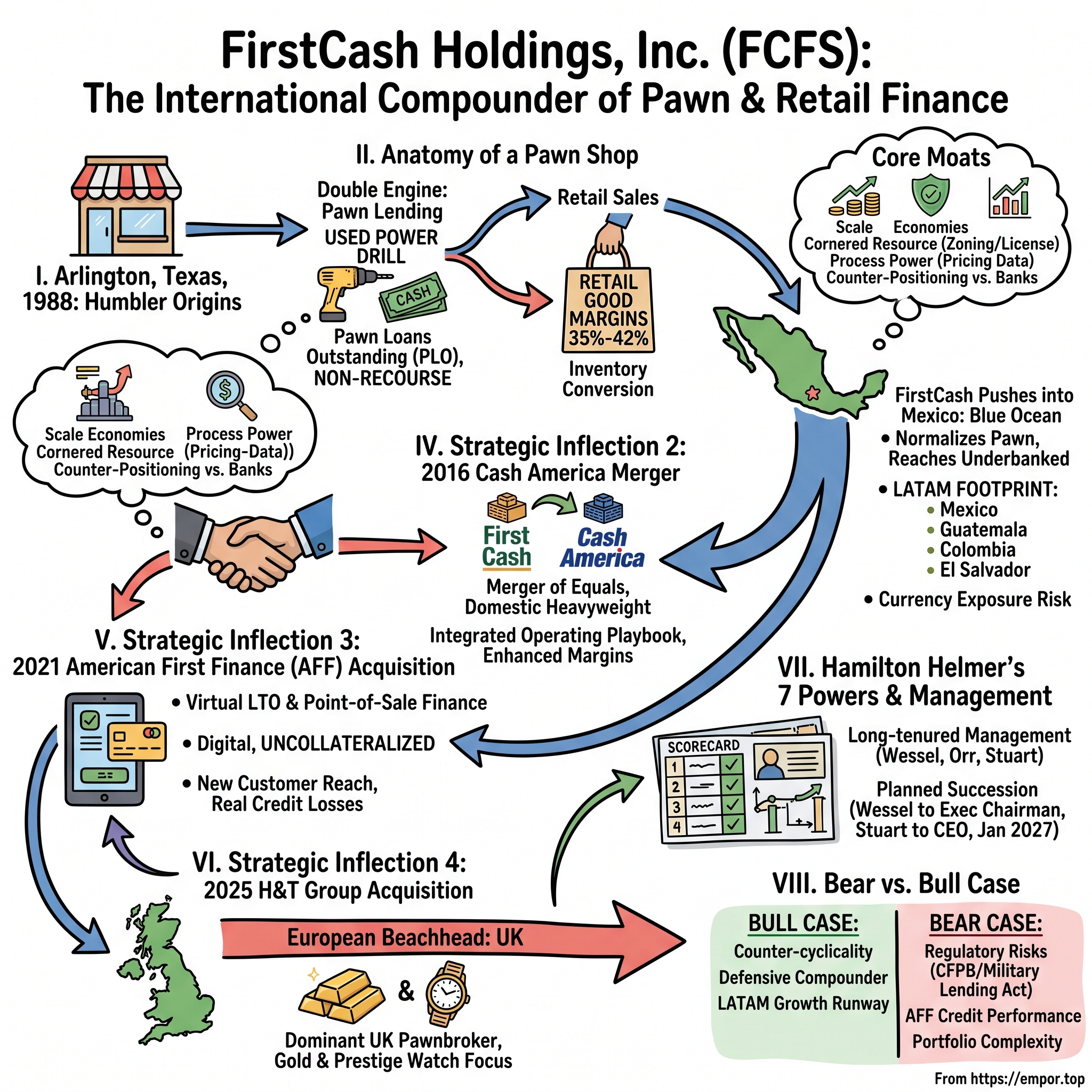
FirstCash Holdings, Inc.: The International Compounder of Pawn & Retail Finance
I. Introduction & Episode Roadmap
Walk into a FirstCash store in San Antonio, Guadalajara, or now Birmingham, England, and the first thing you notice is how unremarkable it feels. Bright fluorescent lighting. Glass display cases of pre-owned iPhones, cordless drills, wedding rings, and the occasional prestige watch. A clerk behind bulletproof glass, cheerfully appraising a used PlayStation with the practiced eye of a jeweler. There is no drama, no velvet rope, no fintech app promising to reinvent your relationship with money. And yet this quiet, almost boring retail floor is the atomic unit of one of the most durable compounding machines that public markets have produced over the last three decades.
Here is the puzzle worth sitting with. How did a single storefront founded in Arlington, Texas, in 1988 grow into a multi-billion-dollar business operating in three continents, throwing off cash through recessions, currency crises, a global pandemic, and a subprime credit reset — all while occupying an industry that most polite investors would rather not discuss at a dinner party?
The modern scale answers part of the question. In fiscal year 2025, FirstCash Holdings reported consolidated revenue of roughly $3.66 billion and GAAP net income of about $330.4 million.[^1] It closed the year operating over 3,300 retail pawn locations across the United States, Latin America, and, for the first time, the United Kingdom.[^1] The business runs on a double engine: collateral-backed pawn lending on one side, and the high-margin retail recycling of secondhand goods on the other — now supercharged by American First Finance (AFF), a technology-driven, point-of-sale lease-to-own (LTO) platform that reaches customers far beyond the four walls of any store.
The core paradox is the reason this story is interesting rather than merely profitable. Pawn carries a cultural stigma in the American imagination — the reality-TV caricature, the association with desperation and the last resort. FirstCash's entire corporate life has been an exercise in taking that stigmatized, fragmented, mom-and-pop trade and institutionalizing it: standardized pricing systems, compliance departments, public-market disclosure, and clean showrooms that look more like a Best Buy than a back-alley shop. Whether that transformation constitutes a genuine, defensible moat — or simply a well-run rollup of a declining cottage industry — is exactly the question a serious investor has to answer.
This article traces that arc through six movements. First, the mechanics of the pawn engine itself: how a $150 loan against a used drill produces two independent streams of profit with essentially zero credit risk. Second, the first inflection — the audacious 1999 bet on Mexico that most U.S. competitors were too busy fighting each other to make. Third, the 2016 merger of equals with Cash America that turned FirstCash into the domestic heavyweight. Fourth, the 2021 acquisition of AFF, a deliberate leap off the physical store grid and into digital, uncollateralized consumer finance. Fifth, the August 2025 acquisition of the U.K.'s H&T Group, a European beachhead. And finally, the analytical spine: Hamilton Helmer's 7 Powers, the credibility of a long-tenured management team now in the middle of a planned succession, and the honest bull-versus-bear debate. Let us begin where the money is actually made — inside the store.
 Subscribe on LinkedIn
II. The Anatomy of a Pawn Shop: Mechanics, Margins, and Moats
Picture a customer who needs $150 by Friday. A bank cannot help her — the loan is too small, the underwriting too expensive, and her credit file too thin. A payday lender might, at a punishing effective rate and with a claim on her next paycheck. But she owns a used power drill worth maybe $400 at retail. She walks into a FirstCash store, hands over the drill, and walks out with cash and a ticket. That single, deeply human transaction contains the entire business model, and it is worth dismantling slowly because almost everything else in this story is a variation on it.
A pawn transaction is not really a loan in the way a mortgage is. It is closer to a rental of money against a physical hostage. The customer pledges the drill as collateral; FirstCash advances a fraction of its resale value; and the customer pays a monthly fee to keep the loan alive and eventually reclaim her property. Crucially, the loan is non-recourse. If she never comes back, FirstCash does not send a collections agency, does not ding her credit score, and does not chase her. It simply keeps the drill. That structural fact — the collateral is already in the vault — is the source of the model's most prized characteristic.
The foundational metric analysts watch is pawn loans outstanding (PLO) — the aggregate dollar value of collateralized loans on the books at a given moment. Individual loans are small and short, averaging on the order of $150 to $200 in the U.S. and secured by everything from jewelry to electronics to tools. PLO is the seed corn: it determines both the fee income the loan book will generate and the future flow of forfeited merchandise into the retail channel.
That leads to what makes pawn genuinely unusual — the double-sided margin loop.
The first side is the pawn loan fee. Monthly service charges are steep, often in the range of 10% to 20% per month, which annualizes into triple-digit percentages that look usurious on a spreadsheet. But these rates exist as deliberate statutory carve-outs from ordinary usury caps precisely because pawn is not unsecured personal credit — it is fully collateralized, small-dollar, and short-duration. The regulatory logic is that the cost of originating, storing, insuring, and reselling a physical item cannot be recovered at a 20% annual rate on a $150 loan. Whether that logic holds up politically is a live risk we will return to, but for now it explains why the headline rates are both real and legal.
The second side is retail. When a borrower forfeits — which happens for a meaningful minority of loans — the pledged item becomes inventory. And here is the quiet magic: because FirstCash typically lends only 30% to 50% of an item's estimated resale value, the effective cost of that inventory is the small loan principal it already advanced. When the drill sells in a clean, well-lit showroom, the gross margin is extraordinary. In FY2025 the company reported retail merchandise gross margins of roughly 42% in the U.S. and 35% in Latin America.[^1] A default, in other words, is not a loss event. It is a conversion event — a loan that failed to be repaid becomes a piece of inventory acquired at a deep discount to what it will fetch.
This is why the business is often described as having zero credit risk on the pawn book. There are no charge-offs in the banking sense, no provisioning for expected losses, no collections infrastructure. The worst case for any single pawn loan is that FirstCash ends up owning a profitable used good. That asymmetry — heads the customer repays and pays a fee, tails FirstCash keeps discounted inventory — is the beating heart of why pawn has survived every downturn since the Medici.
The final piece is the moat around the storefront itself, and this is where Hamilton Helmer's language of the "cornered resource" becomes useful. Opening a pawn shop is not like leasing a coffee kiosk. Municipalities impose strict zoning rules and distance covenants — new shops frequently cannot operate within a set radius of schools, churches, residential zones, or, in some jurisdictions, other pawn shops. Licenses often require police background checks, fingerprinting, and integration with law-enforcement databases designed to intercept stolen goods. The effect is to convert each existing, licensed, grandfathered location into something close to a local micro-monopoly: a permission slip that a new entrant cannot simply buy at market price. That regulatory friction is a double-edged sword — the same rulebook that protects incumbents is written by legislators who could tighten it — but as a barrier to new physical competition, it is very real. With the mechanics established, the question becomes how a small Texas operator learned to exploit them at scale, and the answer starts with a border crossing.
III. Early Years & Strategic Inflection 1: Crossing the Rio Grande (1988–2015)
The origin is almost aggressively humble. In 1988, First Cash was founded in Arlington, Texas, as a small operator in the pawn trade, a business then dominated by independents and family shops.[^2] There was no grand thesis in the founding, no venture backing, no manifesto about financial inclusion — just a storefront in a mid-size Texas city and the unglamorous discipline of appraising other people's belongings for a living. For a decade it was one of many. What changed the trajectory was not a product but a decision about geography, and behind that decision was a manager willing to look where his competitors would not.
By the late 1990s the U.S. pawn industry had become a knife fight. Cash America, EZCORP, and First Cash were all clawing for the same American strip-mall customer, and the domestic market showed the classic signs of maturity: saturated, competitive, and slow-growing. The consensus move was to keep consolidating at home. First Cash made the non-consensus one. Beginning in 1999 it pushed south of the border into Mexico, opening casas de empeño — literally, houses of pawn — in a market that the American giants had largely ignored.[^2]
Why Mexico, and why then? Three structural facts made it, in the language of strategy, a blue ocean. First, a very large share of the Mexican population operated outside the formal banking system, lacking bank accounts and access to conventional consumer credit — which meant collateral lending was not a niche but a mainstream tool of household cash management. Second, and just as important, pawn in Latin America does not carry the same stigma it does in the United States. It is a normalized, even respectable, way to bridge a short-term cash gap, culturally closer to a routine errand than a confession of distress. Third, the competitive field was soft: the market was dominated by undercapitalized local shops and venerable non-profit institutions like the Monte de Piedad, the historic charitable pawn houses. A disciplined, well-capitalized operator with standardized systems could enter and win.
The execution matched the insight. First Cash rolled out company-operated stores and, over time, expanded its Latin American footprint through both greenfield openings and acquisitions of regional chains operating under brands such as Prenda Fácil. It deployed proprietary point-of-sale and pricing systems so that a clerk in a Guadalajara store could appraise and price collateral with the same consistency as one in Fort Worth — turning appraisal from an art dependent on a veteran's gut into a repeatable process. And the unit economics were, frankly, better than at home. Latin American stores cost meaningfully less to build and staff than U.S. locations, so each peso of invested capital opened more square footage and generated high cash-on-cash returns. The model was capital-efficient in exactly the way that compounds: cash from mature stores funded new stores, which threw off more cash.
There was one persistent thorn, and it is one the company still lives with: currency. Revenues and profits earned in Mexican pesos must be translated back into U.S. dollars for reporting, and the peso is volatile. A strong operational year in Mexico can be partially masked — or flattered — by exchange-rate swings entirely outside management's control. This is the unavoidable tax on the Latin American growth engine, and a recurring source of noise in the reported numbers. Over time the Latin American business expanded beyond Mexico into Guatemala, Colombia, and El Salvador, building a store base that would eventually outnumber the U.S. footprint. By the mid-2010s, First Cash had quietly become two businesses stapled together: a mature domestic operation and a high-growth Latin American one. What it did not yet have was domestic scale. That was about to arrive in a single, transformative stroke.
IV. Strategic Inflection 2: The 2016 Cash America Merger of Equals
For most of their corporate lives, the two largest names in Texas pawn had circled each other like heavyweight boxers who trained at the same gym. First Cash Financial Services, based in Arlington and led by Rick Wessel, had the Latin American growth story and a reputation for ruthless cost discipline. Cash America International, based across town in Fort Worth, had something First Cash coveted: a dense, sprawling network of U.S. stores built up over decades. They were complements more than rivals — one strong where the other was thin — and in 2016 they stopped circling and shook hands.
On September 1, 2016, the two companies closed an all-stock merger of equals, combining into a single entity renamed FirstCash, Inc.1 Cash America shareholders received 0.840 shares of the combined company for each of their shares, and when the dust settled legacy First Cash holders owned roughly 58% of the new company and Cash America holders about 42%.1 The stock, already trading under the ticker FCFS, would later move to the NASDAQ Global Select Market. On paper it was a merger of equals; in practice it was a First Cash operating team taking the wheel of a much larger combined fleet.
The strategic logic was almost textbook. Footprints barely overlapped in the way that matters: Cash America contributed the massive, mature U.S. density that First Cash lacked, while First Cash brought the Latin American growth engine and a cost culture honed by years of squeezing returns out of low-ticket peso stores. Put differently, each company handed the other the thing it could not easily build on its own. Cash America could not manufacture a decade of Mexican expansion experience; First Cash could not cheaply replicate a thousand-plus U.S. locations.
But the more revealing part of the story is what happened after the papers were signed — because mergers of equals have a notorious habit of destroying value through cultural stalemate and diluted accountability. This one did not, and the reason was governance clarity. Rick Wessel took the combined CEO role; Brent Stuart, who had led Cash America, became President and Chief Operating Officer, taking charge of operational integration.1 There was no co-CEO fudge, no split headquarters power-sharing arrangement of the kind that has sunk other "equal" combinations.
Wessel then did the unglamorous work that actually creates merger value: he pointed First Cash's proprietary pawn point-of-sale systems and cost discipline at the legacy Cash America stores. Standardized pricing, tighter labor management, and a relentless focus on the pawn unit economics were applied to a store base that had been run to a different standard. The payoff showed up where it should — in margins. By FY2025, the U.S. pawn segment was generating pre-tax operating income of roughly $452.6 million on its revenue base, an operating margin in the neighborhood of 26%.[^1] That kind of margin on a mature retail-and-lending network is the signature of an operator that treats cost control as a core competency rather than an afterthought.
The analytical takeaway for an investor is subtle but important. The 2016 merger did not work because two companies simply got bigger; scale alone rarely justifies a deal. It worked because one management culture — the cost-disciplined, systems-driven First Cash approach — was imposed cleanly on a larger asset base, and because the acquirer had a specific, proven operating playbook to apply rather than vague "synergy" projections. That is the difference between a rollup that compounds and one that merely accumulates. Yet even a dominant, well-run physical network has a ceiling: it can only serve customers who walk through a door. The next inflection was an attempt to escape geography entirely.
V. Strategic Inflection 3: The 2021 American First Finance (AFF) Acquisition
Every physical retailer eventually confronts the same wall. You can open more stores, buy more competitors, and squeeze more margin, but your total addressable market is fundamentally capped by how many customers live within driving distance of a storefront. For a business built on serving the cash-constrained consumer, that was a real strategic frustration: the same customer who pawns a drill on Tuesday might buy a mattress on Saturday and finance a set of tires the following month — but FirstCash only captured the first of those transactions. In late 2021, it made an expensive, and controversial, bid to capture the rest.
The company announced in October 2021 that it would acquire American First Finance, describing it as a technology-driven, virtual lease-to-own and retail finance platform for underserved customers, and closed the deal in December 2021.[^4][^5] The upfront consideration was roughly $916 million in a mix of cash and stock, with an additional earnout of up to $300 million tied to AFF hitting adjusted-EBITDA targets, plus a separate contingent payment of up to $75 million linked to FirstCash's own share performance.[^5] For a company whose entire identity was built on collateralized, zero-credit-risk lending, it was a striking check to write for a business built on precisely the opposite.
What does AFF actually do? Strip away the fintech vocabulary and it is a point-of-sale financing engine for people who cannot get a conventional credit card. AFF partners with thousands of third-party merchants — furniture stores, tire shops, electronics retailers, jewelers — and sits invisibly at the checkout. When a shopper with thin or damaged credit wants a $1,200 sofa they cannot pay for outright, AFF offers a lease-to-own arrangement or an installment plan on the spot, "no credit required." The customer takes the sofa home and pays over time; AFF collects; the merchant gets a sale it would otherwise have lost. It is, in effect, a way to extend FirstCash's underbanked-consumer franchise into any retail store in America without FirstCash owning a single square foot of it.
By FY2025 the segment had become a genuine third pillar. AFF contributed about $870.2 million in revenue and roughly $169.1 million in segment pre-tax operating income — a material slice of the consolidated whole and a meaningful chunk of total segment operating profit.[^1] On the numbers alone, the acquisition scaled quickly and delivered real earnings. The strategic prize management pointed to was the customer crossover: the same demographic, reached through two very different channels, with the theoretical option to cross-sell over time.
But here is where an independent analyst has to slow down and separate the pitch from the physics. AFF is not the pawn business, and it is important not to let the FirstCash halo obscure that. AFF's receivables are uncollateralized. When a customer stops paying for a used mattress or a set of tires, no one repossesses the mattress — it is worthless and gone. That means AFF carries genuine credit losses, the very risk that pawn was celebrated for eliminating. Its combined average monthly net charge-off rate ran around 5.6% in early 2026.2 Charge-offs are a permanent, structural feature of this segment, not an aberration, and they introduce earnings volatility into a company that investors historically prized for its defensive, loss-free profile.
At the time of the deal, skeptics raised a second objection worth taking seriously: valuation. Pure-play lease-to-own competitors such as PROG Holdings and Aaron's traded at more modest multiples, and critics argued FirstCash had paid a premium for a subprime consumer-finance business dressed in fintech clothing. Management's defense rested on the synergistic customer overlap and AFF's rapid digital growth rather than on comparable multiples — which is to say the price was justified by a strategic narrative, not by peer benchmarking. Whether that narrative proves out depends entirely on whether AFF's charge-offs stay within a manageable band through a genuine consumer downturn, a test the segment had not yet faced at full severity. Having stretched across the credit-risk frontier at home, FirstCash's next move went in a more familiar direction — back to the reassuring simplicity of collateralized pawn, but on a new continent.
VI. Strategic Inflection 4: Crossing the Atlantic (The 2025 H&T Group Acquisition)
If AFF was FirstCash stepping outside its comfort zone, the summer of 2025 was FirstCash stepping right back into it — just in a country where they drive on the left. On August 14, 2025, the company completed its acquisition of H&T Group plc, the leading pawnbroker in the United Kingdom, establishing an entirely new European platform in a single transaction.3 For a management team that had spent thirty-seven years mastering the art of lending against physical objects, buying the U.K.'s dominant pawnbroker was a return to home turf on foreign soil.
The terms were straightforward and disciplined. H&T shareholders received 650 pence per share in cash, valuing the equity at approximately £289 million, or about $383 million; including assumed net debt, the total transaction value came to roughly $468 million.3 The deal brought 286 U.K. locations into the fold and pushed FirstCash's global footprint to over 3,300 retail pawn stores across the United States, Latin America, and now the United Kingdom.3 Rather than paying a strategic premium of the sort that made AFF contentious, FirstCash used its balance-sheet strength to acquire the clear market leader in a consolidated national market — a cleaner, more familiar kind of transaction.
The strategic elegance lies in how different the U.K. pawn market is from the American one, and why that difference is a feature rather than a bug. American pawn is a business of electronics, tools, and general merchandise — a churn of consumer goods with the depreciation risk that implies. U.K. pawn, by contrast, is overwhelmingly a business of gold jewelry, prestige watches, and gold purchasing and scrapping. That orientation gives it a distinct and unusually stable margin profile: gold is a globally liquid, non-perishable commodity whose value does not obsolesce the way a three-year-old smartphone does. In effect, FirstCash added a pawn business whose collateral base behaves more like a hard-asset vault than a used-goods showroom — a diversifying complement to its existing merchandise mix.
The early financial contribution, reflecting only a partial year of ownership after the August close, was immediately positive. In FY2025 the U.K. pawn segment generated about $150.7 million in revenue and roughly $52.5 million in pre-tax operating income.[^1] Even accounting for the fact that gold-heavy pawn ran through an unusually strong precious-metals environment, that is an accretive first contribution from a business bought at what management characterized as an attractive multiple of earnings.
For investors, H&T matters less for its immediate dollars than for what it signals about the compounding engine. It establishes a beachhead in a mature, English-speaking, well-regulated European market — a platform from which further consolidation is at least conceivable — and it does so in the collateralized, low-credit-risk discipline where FirstCash has always been strongest. It is the reassuring bookend to the AFF gamble: proof that management can still deploy capital in its core competency rather than only in adventurous adjacencies. With four inflections now on the table, the deeper question is whether the sum of them constitutes a durable competitive advantage or merely a well-executed sequence of deals. That requires a framework.
VII. The Playbook: Hamilton Helmer's 7 Powers & Strategic Moats
It is one thing to narrate four decades of clever moves; it is another to ask whether those moves have built anything a competitor cannot copy. This is where it pays to run FirstCash through Hamilton Helmer's 7 Powers — not as a checklist to flatter the company, but as a stress test to separate genuine, structural advantage from the ordinary benefits of being well-run. Four of the seven powers are worth examining seriously here; the others are weak or absent, and saying so is part of an honest appraisal.
Scale economies. With over 3,300 stores, FirstCash operates a network several times larger than its nearest publicly traded pure-play pawn peer, EZCORP, which ended its fiscal 2025 with roughly 1,360 locations.[^1]4 That scale gap is not vanity. Compliance, legal, licensing, and software-development costs are largely fixed, and spreading them across a far larger store base lowers per-store overhead in a way a smaller operator cannot match. It also powers a repeatable acquisition machine: FirstCash buys mom-and-pop pawn operators at modest multiples and instantly improves their economics by dropping them onto its systems and cost structure. The scale advantage is real, but it has a limit worth naming — pawn is intensely local, and a store in one city gains little operating leverage from a store two states away beyond shared back-office cost. This is scale in overhead and procurement, not the winner-take-all network scale of a platform business.
Cornered resource. The regulatory and zoning barriers described earlier — the grandfathered licenses, the distance covenants, the fingerprinting and police-database requirements — function as a cornered resource that protects existing locations from new physical entrants. It is among the more durable of FirstCash's advantages precisely because it is external and legally enforced. The catch, again, is that what regulation grants, regulation can revoke or tighten; the moat is only as stable as the political consensus that maintains it.
Counter-positioning. This is arguably FirstCash's most elegant power. A traditional bank is structurally, not just temporarily, unable to profitably underwrite a $150 loan for thirty days against a used drill — the fixed cost of underwriting, compliance, and servicing dwarfs the interest such a loan could ever bear, and no bank's cost structure or risk model can bend to accommodate it. FirstCash's collateralized, appraisal-driven, cash-in-hand model is counter-positioned against the credit-score-driven banking system in a way incumbents cannot copy without abandoning their own economics. Banks do not fail to serve this customer because they are lazy; they fail because the math forbids it.
Process power. Decades of transaction data — the resale values of millions of laptops, rings, tools, and watches across geographies and time — let a FirstCash clerk price collateral quickly and accurately, minimizing the cardinal sin of pawn: over-lending against an item worth less than you think. This accumulated pricing intelligence is hard to replicate quickly because it is built from proprietary history, not purchased off a shelf. It is a genuine, if quiet, advantage — though one an AFF-style data operation or a large enough competitor could partially erode over time.
Notably absent from this list are branding power and network effects in the classic sense. Customers are not loyal to the FirstCash brand the way they are to a consumer franchise; they are loyal to the nearest licensed, fair-dealing store. That absence matters, and an honest 7 Powers reading acknowledges the company wins on cost, regulation, counter-positioning, and data — not on brand love.
All of this feeds a capital-allocation flywheel that is the real engine of shareholder compounding. In FY2025 the company generated roughly $586 million in operating cash flow.[^1] That cash is deployed in a consistent priority order: low-capex de novo store openings in Latin America, where build-out costs are low and cash-on-cash yields are high; bolt-on pawn acquisitions in the U.S. and now Europe; and returns to shareholders. In FY2025 FirstCash returned about $186 million to shareholders — roughly $115 million in buybacks and $71 million in dividends, the latter at a $1.68 annualized rate.[^1] The discipline of that sequence — organic growth first, accretive M&A second, capital return third — is the mechanism by which a boring pawn business becomes a compounder. But a flywheel is only as trustworthy as the people spinning it, and that brings us to management.
VIII. Management, Governance, and the CFPB Stress Test
Continuity is the rarest commodity in public-company leadership, and by that measure FirstCash is an outlier. The people running the company have been running it, or its predecessor, for a very long time — long enough that the "strategy" is really just the accumulated instinct of a small group of executives who have made the same kind of decision thousands of times. That continuity is a genuine asset. It is also, as of two days before this writing, entering its most significant transition in twenty years.
Rick Wessel is the central figure. A director since the early 1990s and President from 1998, he became chief executive in 2006 and has steered the company through the Mexican expansion, the Cash America merger, the AFF acquisition, and the H&T deal.5 His ownership stake — roughly 1.9% of the shares outstanding per the 2026 proxy — is substantial enough to align him meaningfully with outside shareholders rather than merely with his salary.6 Doug Orr, chief financial officer since 2003, has managed the balance sheet and the guidance cadence for over two decades, a tenure that lends unusual consistency to the company's financial communication.6 And Brent Stuart, the former Cash America chief who became President and COO in the 2016 merger, has run operations and integration ever since.1
That leadership structure is now changing on a defined timeline. On July 22, 2026, FirstCash announced a planned succession: Brent Stuart is to become chief executive effective January 1, 2027, with Rick Wessel transitioning to Executive Chairman.7 The move is being made from a position of stability rather than crisis, and the choice of Stuart — an operator who already runs the day-to-day business — signals continuity over rupture. For investors, a leadership transition is always a moment to watch: the test will be whether the disciplined capital-allocation cadence and cost culture survive the handoff intact, or whether a new CEO reaches for a bolder, less proven agenda.
The governance story is not uniformly clean, and the honest version includes a genuine regulatory bruise. In November 2021 the Consumer Financial Protection Bureau sued FirstCash, alleging violations of the Military Lending Act — specifically, that it had charged pawn interest rates exceeding the 36% APR cap that federal law imposes on loans to active-duty servicemembers and their dependents.8 For a company whose entire pitch rests on operating a legal, institutionalized version of a stigmatized trade, an allegation that it had overcharged soldiers cut directly at its credibility.
The matter resolved on July 11, 2025, when FirstCash settled with the CFPB, agreeing to a $9 million package consisting of a $4 million civil penalty paid into the bureau's victims relief fund and $5 million in consumer redress.8[^13] Management's operational response was to build automated military-status screening into the check-in process, cross-referencing customers against the relevant databases so that covered servicemembers cannot receive non-compliant loans. The settlement retired a multi-year legal overhang for a manageable sum, and the fix appears structural rather than cosmetic. But a skeptical investor should file it as evidence, not dismiss it: the episode is a reminder that a business whose margins depend on usury carve-outs lives permanently one regulatory reinterpretation away from friction.
That tension surfaces regularly on earnings calls, where the choreography is revealing. Prepared remarks tend to dwell on the defensive strength of the pawn franchise and record consolidated results, while analyst Q&A repeatedly circles back to AFF's credit provisioning and charge-off trends — the roughly 5.6% monthly net charge-off rate that reintroduces the credit volatility pawn was supposed to have banished.2 Management's consistent answer is that AFF is a high-margin, cash-generative platform whose customer-acquisition optionality justifies its risk profile. Whether that framing holds through a severe consumer downturn is the unresolved question that hangs over the entire investment case — which is exactly where the bull and bear must be weighed against each other.
IX. Analysis & Bear vs. Bull Case (The Stress Test)
Every durable business eventually invites the same two-sided argument, and FirstCash's is unusually well-defined because the company is really two businesses — one defensively brilliant, one genuinely risky — bolted onto a global store network. Let us game it out from both sides, then situate it in the competitive landscape.
The bull case starts with counter-cyclicality, the trait that makes pawn almost unique among consumer-finance models. In a downturn, mainstream credit contracts precisely when cash-strapped households need it most, and demand for pawn loans rises; in an upturn, discretionary spending lifts secondhand retail margins as forfeited inventory sells briskly. The business, in theory, has a tailwind in both weather systems. Layer on a long Latin American growth runway — Colombia, Guatemala, and El Salvador still offer low-cost de novo store development at high cash-on-cash returns — and a disciplined capital-return program, and you have the profile of a defensive compounder that can grow the store count, expand margins, and shrink the share base simultaneously. The FY2025 results, with record revenue and robust operating cash flow, are consistent with that thesis rather than against it.[^1]
The bear case — the activist-style stress test — is equally coherent and deserves to be stated without softening. First, regulatory risk is not hypothetical; it is the water the company swims in. State or federal caps on pawn APRs, or a CFPB decision to scrutinize the lease-to-own structure AFF depends on, could impair the economics of an entire segment overnight. The Military Lending Act settlement is a preview, not a conclusion. Second, AFF asset-quality decay is the sharpest tail risk. In a severe subprime slowdown, uncollateralized charge-offs could spike well beyond the historical band, driving material earnings misses and potentially forcing a writedown of the goodwill created in the $916 million acquisition. The very feature that made AFF strategically attractive — reach beyond collateral — is the feature that makes it fragile. Third, currency: the large Mexican-peso exposure means that even flawless local execution can be obscured, or occasionally flattered, by translation swings no manager controls. A skeptic would add a fourth point about portfolio complexity — a company that was once a clean, understandable pawn operator now spans collateralized lending, uncollateralized fintech, and cross-border retail, which makes the consolidated numbers harder to underwrite and easier for problems in one segment to hide inside strength in another.
Run it through Porter's Five Forces and the picture sharpens. The threat of new physical entrants is low, throttled by the licensing and zoning barriers already described. Supplier power is essentially nil — the "suppliers" are the customers pledging goods, a fragmented base with no leverage. Buyer power is similarly weak; a customer needing $150 by Friday is not price-shopping across town. The threat of substitutes is the live risk, and it is meaningful: payday lenders, buy-now-pay-later apps, and digital fintechs all court the same underbanked customer, and technology could in principle disintermediate the physical pawn transaction over time. Competitive rivalry among incumbents is real but rational, dominated in the U.S. by FirstCash and EZCORP operating a comfortable duopoly-of-scale over a long tail of independents.4 On balance, the industry structure is favorable — the pressure comes from substitutes and regulation, not from customers or suppliers.
The 7 Powers framing from the prior section reinforces the same conclusion: FirstCash's advantages are concentrated in cost scale, cornered regulatory resource, counter-positioning against banks, and proprietary pricing data — durable in the pawn core, thinner in the AFF adjacency where none of those powers cleanly apply. The investment debate, stripped to its essence, is whether the defensive brilliance of the pawn franchise adequately compensates for the credit and regulatory risk that AFF deliberately imported.
For an investor actually tracking the company quarter to quarter, three KPIs cut through the noise. Same-store PLO growth measures the underlying health of pawn-loan demand and is the truest read on the core engine. Retail merchandise margin — the market watches for the U.S. figure to hold above roughly 40% and Latin America above roughly 35% — reveals whether the inventory-conversion loop is functioning and whether gold and merchandise pricing are cooperating.[^1] And AFF's monthly net charge-off rate is the single most important early warning on the riskiest segment; as long as it stays within its historical band of roughly 5% to 6%, the AFF thesis holds, and the moment it breaks decisively above that range, the bear case is being validated in real time.2 Those three numbers, watched together, tell you almost everything about whether this compounder is still compounding.
X. Epilogue & Conclusion
Step back from the segment data and the 7 Powers scaffolding, and what remains is a study in the compounding power of unglamorous discipline. FirstCash has spent nearly four decades operating in a corner of finance that most capital allocators find distasteful and most banks find impossible — and that combination of stigma and structural difficulty is precisely what kept the competition thin and the returns durable. The company did not win by inventing something; it won by industrializing something ancient, applying standardized systems and relentless cost control to a trade that had always been run on gut and handshake.
The honest conclusion resists both caricatures. This is neither the invincible defensive fortress its bulls describe nor the subprime accident waiting to happen its bears warn of. It is a genuinely advantaged pawn franchise — protected by regulation, counter-positioned against banks, and armored with proprietary pricing data — that has, in the last five years, deliberately taken on new and unproven risks in AFF's uncollateralized credit and in cross-border expansion. Whether those bets deepen the moat or dilute it will be settled by the KPIs, by how AFF behaves in the next real recession, and by whether an incoming chief executive keeps faith with the capital discipline that built the record in the first place.
The surprise takeaway, and the reason the story endures, is that serving the cash-constrained and underbanked consumer has proven not merely lucrative but remarkably durable — a business that compounds through recessions, tech bubbles, currency crises, and financial panics alike, precisely because human beings will always occasionally need $150 by Friday, and will always own something worth pledging to get it.
References
-
FirstCash Announces Successful Completion of Merger of Equals Combining First Cash Financial Services, Inc. and Cash America International, Inc. — GlobeNewswire, 2016-09-02 ↩↩↩↩
-
FirstCash Holdings, Inc. Form 10-Q for the Quarter Ended March 31, 2026 — SEC ↩↩↩
-
FirstCash Completes Acquisition of H&T Group; Now Operates over 3,300 Retail Pawn Locations — GlobeNewswire, 2025-08-14 ↩↩↩
-
EZCORP, Inc. Annual Report on Form 10-K for the Fiscal Year Ended September 30, 2025 — SEC ↩↩
-
Rick Wessel — Chief Executive Officer, FirstCash Investor Relations ↩
-
FirstCash Holdings, Inc. Definitive Proxy Statement (DEF 14A) — SEC, 2026 ↩↩
-
FirstCash Announces Planned Leadership Succession — GlobeNewswire, 2026-07-22 ↩
-
CFPB Reaches Settlement with FirstCash, Inc. and Its Subsidiaries for Military Lending Act Violations — Consumer Financial Protection Bureau, 2025-07-11 ↩↩
 LinkedIn
 WhatsApp
 Reddit
 Hacker News
 Email
Email Kindle
 RSS Feed
 Spotify
 Apple Podcasts
 Amazon Music
 Audible
 YouTube