Glaukos Corporation: The Pioneer of Micro-Invasive Ophthalmic Therapies
I. Introduction & Episode Roadmap (10 Minutes)
Picture an operating room in a suburban ambulatory surgery center. A cataract surgeon has just finished the most routine operation in modern medicine — phacoemulsification, roughly ten minutes, several million times a year worldwide. The incision in the cornea is already made. The patient is awake, mildly sedated, staring at a light. And instead of closing, the surgeon rotates the microscope, tilts the patient's head, drops a gonioscopy lens onto the eye, and goes hunting for a structure most people have never heard of: the trabecular meshwork, a spongy ring of tissue at the angle where the iris meets the cornea, no thicker than a few sheets of paper.
Into that ring the surgeon pushes a piece of heparin-coated titanium so small it cannot be meaningfully described without a microscope. Glaukos has, for two decades, called it the smallest implantable medical device in the history of medicine — a claim that sounds like marketing until you learn the thing was engineered at Caltech to tolerances of three to five microns, after more than two hundred prototypes.1
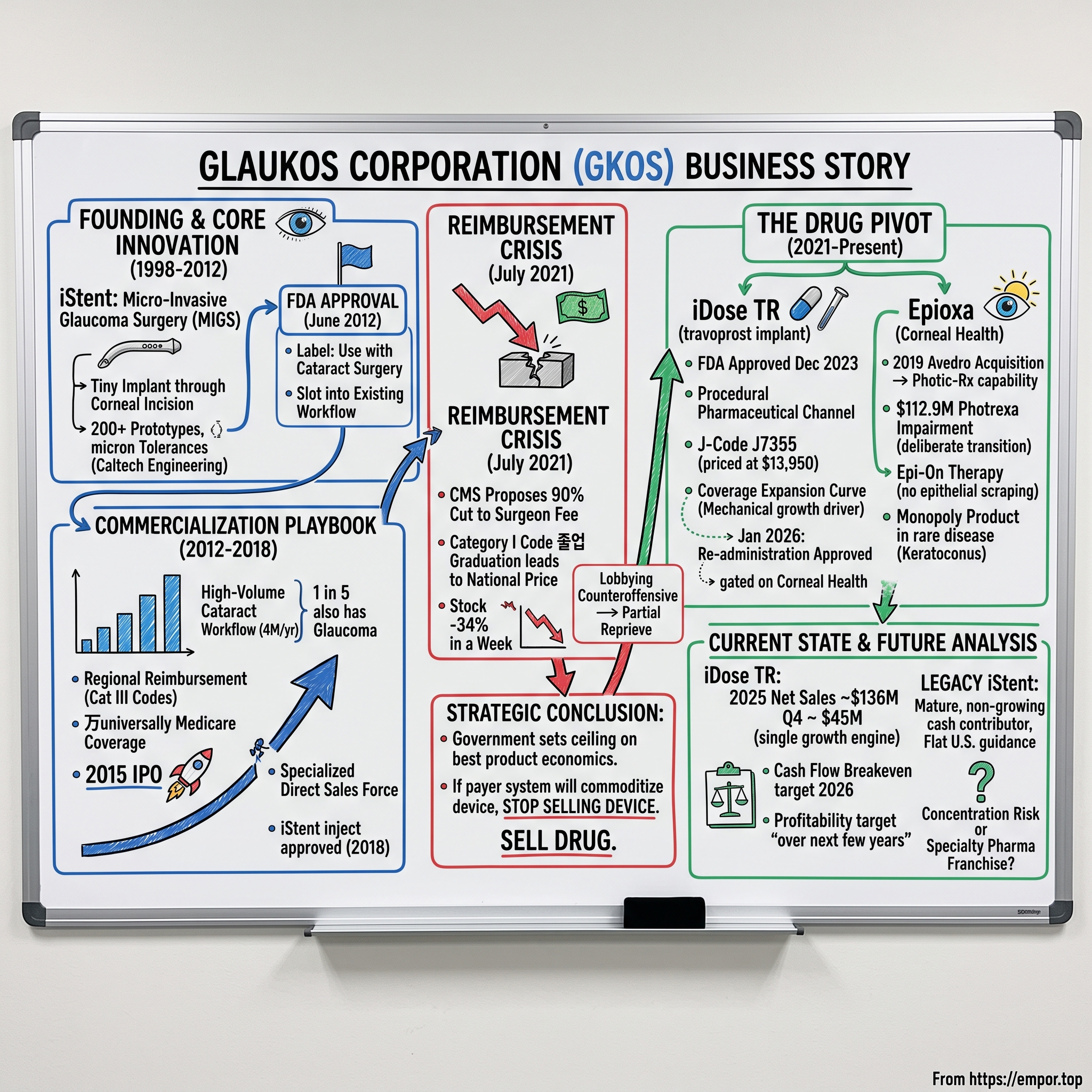
That object — the iStent — is the origin of everything that follows. It created a surgical category that did not exist before 2012. It made Glaukos Corporation (NYSE: GKOS) a public company. It also nearly destroyed the company in the summer of 2021, when a single line item in a Medicare rulemaking document proposed cutting the surgeon's incremental fee for placing it by roughly ninety percent, and the stock fell about 34% in a week.2
The interesting question about Glaukos is not "did the tiny stent work." It did. The interesting question is what a company does when it discovers that the government, not the market, sets the ceiling on its best product's economics — and that the ceiling can drop overnight.
The answer Glaukos arrived at is the spine of this story. If the payer system will commoditize a mechanical device, stop selling a mechanical device. Sell a drug. Specifically: take the same micro-implant form factor, the same surgical workflow, the same sales force, the same anatomical target — and load it with a pharmaceutical. Reimbursement then flows not through a surgeon's procedure fee, squeezed annually by the Physician Fee Schedule, but through the specialty-pharmaceutical channel, where a product-specific J-code and a wholesale acquisition cost set by the manufacturer govern the economics. Glaukos calls this a "procedural pharmaceutical." It is, in plain terms, regulatory arbitrage dressed as innovation — and it has worked spectacularly well so far.
Here is the roadmap.
We start with the disease itself, and with the single most important fact in glaucoma: that the standard of care for a century has been a daily eye drop, and that patients do not take it. We then trace the founding of Glaukos in the late 1990s by an Orange County ophthalmologist and a Norwegian venture investor, the arrival in 2002 of Thomas W. Burns — still the CEO today, twenty-four years later — and the long grind to FDA approval in June 2012.
From there: the commercialization playbook of the 2010s, in which Glaukos deliberately parasitized the cataract workflow rather than building a standalone glaucoma surgery; the 2015 IPO; the competitive war with Alcon and Sight Sciences; the 2019 all-stock acquisition of Avedro, which bought Glaukos a second disease and a second franchise, and which the company partially wrote off six years later.
Then the crisis. The CMS proposal of July 2021, the collapse in the share price, the lobbying counteroffensive, the partial reprieve in November, and the strategic conclusion management drew from it — which turned out to matter far more than the number CMS eventually settled on.
Then the payoff: iDose TR, approved by the FDA in December 2023, priced at a level that stunned Wall Street, and now the single engine driving essentially all of the company's growth. And Epioxa, approved in October 2025 and launched in March 2026, which rebuilt the corneal franchise Glaukos had bought from Avedro — while forcing the company to impair the asset it replaced.
And finally the analysis: the financial engine and what its shape actually reveals, management's credibility measured against what it promised on prior calls, and an honest stress test of the bull and bear cases. Glaukos is still not profitable. Its legacy MIGS business is, by management's own guidance, flat. Almost every dollar of incremental growth now comes from two products launched in the last thirty months, both of which depend on reimbursement decisions the company does not control. That is either the setup for a durable specialty-pharma franchise or a concentration risk wearing a growth costume, and the evidence for each is worth laying out carefully.
Start with why any of this was necessary.
 Subscribe on LinkedIn
II. Glaucoma Physiology & The Founding Context (1998–2012) (20 Minutes)
The eye is a pressurized vessel. It has to be — the cornea and sclera hold their shape the way a football does, through internal pressure. That pressure comes from aqueous humor, a clear fluid continuously produced behind the iris, which circulates forward and then drains out through a filter at the angle of the eye. The filter is the trabecular meshwork, and behind it sits Schlemm's canal, a circular drainage vessel that carries the fluid back into the bloodstream.
Think of it as a sink with the tap permanently running. Production is constant. Drainage is what varies. When the meshwork clogs — and in open-angle glaucoma, it slowly does — the water level rises. Intraocular pressure climbs. And the pressure does its damage not at the front of the eye, where you might feel it, but at the back, where the optic nerve fibers exit. They die quietly, from the periphery inward, painlessly, over years. The patient notices nothing until a meaningful fraction of the visual field is already gone, and none of it comes back. Glaucoma is the leading cause of irreversible blindness in the world, and its cruelty is that it is both silent and, in principle, entirely manageable.
Manageable, because we have known for decades that lowering intraocular pressure slows the disease. The pharmacology is good. Prostaglandin analogs — travoprost, latanoprost, bimatoprost — increase outflow and reduce pressure reliably. They are cheap, generic, and effective.
They are also a daily eye drop, and this is where medicine collides with human nature.
Consider what a prostaglandin regimen actually asks of a patient. It is typically an elderly person, often with arthritis or a tremor, required to tilt their head back every single evening, aim a bottle at their own eyeball, squeeze exactly one drop into the correct place without touching the cornea, and do this every day for the rest of their life — for a disease that produces no symptoms and for which they will never feel a benefit. The drops sting. They redden the eye. Over time they darken the iris and thin the orbital fat, giving a sunken-eye appearance. Compliance studies in glaucoma have consistently found that a large majority of patients fall off therapy within the first year, whether from forgetfulness, dexterity, cost, or side effects.
So the field had a strange problem: an effective treatment that failed in the real world for reasons that had nothing to do with the treatment. And the surgical alternative was brutal. A trabeculectomy — the classic glaucoma operation — involves cutting a flap in the sclera to create an entirely artificial drainage channel, with a bleb of fluid sitting under the eyelid afterward. It works, and it carries real risks of infection, hypotony, and vision loss. Surgeons reserved it for advanced disease. Between "a drop the patient won't take" and "an operation the surgeon doesn't want to do" sat an enormous therapeutic vacuum.
Into that vacuum walked Richard Hill, MD, an Orange County ophthalmologist. Hill's insight was a plumbing insight: if the problem is resistance at the level of the trabecular meshwork, then don't build a new drain into the wall of the eye — bypass the clogged filter and let fluid reach Schlemm's canal, which is usually still perfectly functional. Put a tiny tube through the meshwork and let physiology take it from there.1
The idea was elegant. Manufacturing it was not. A stent that sits inside the angle of the eye must be small enough not to touch the corneal endothelium — the single layer of cells that keeps the cornea clear, and which does not regenerate. Hill found financing from Olav Bergheim, a Norwegian venture investor whom Hill described in a 2012 recollection as "a modern-day Viking who has chosen to make war on glaucoma," and Glaukos was incorporated in 1998. The engineering muscle came from Caltech, where Professor Morteza Gharib and aeronautics professor Hans W. Liepmann worked on the fluid dynamics and micro-machining problem, and from David Haffner inside Glaukos, who ran the company through more than two hundred prototypes.1
This is worth pausing on, because it explains a lot about the company's later cost structure. Glaukos did not build a drug company or a distribution company first. It built a micro-manufacturing company. Producing titanium components at micron tolerances, sterile, at scale, with the reliability an implant demands, is genuinely hard — and once you have solved it, the marginal cost of the object itself is close to trivial. That combination of high engineering barrier and near-zero unit cost is the foundation of the gross margins we will get to in Section VIII. It is also the reason the same manufacturing platform could later be repurposed to carry a drug.
In March 2002, the board brought in Thomas W. Burns as president and chief executive officer — a role he has held continuously ever since.3 Burns came from ophthalmic management rather than from engineering or from the operating room, and his defining decision in the first decade was one of restraint: he chose to pursue a full FDA premarket approval pathway with randomized pivotal data, rather than chasing a faster, weaker clearance and hoping surgeons would adopt on enthusiasm alone. In a sector where "get to market, then generate evidence" is a common and often rational strategy, Glaukos spent the 2000s doing the opposite.
That patience cost the company most of a decade. Glaukos filed, revised, and waited. The FDA had never approved an ab interno glaucoma implant — a device placed from inside the eye, through the existing corneal incision — and there was no regulatory precedent to lean on. The company was, in effect, asking the agency to bless not just a product but a category.
Approval finally came on June 25, 2012.4 Fourteen years from founding to first product. For a company with one asset and no revenue, that is an extraordinarily long time to hold a syndicate of investors together, and it is the single clearest early evidence about this management team: they are willing to fund a very long clinical runway, and they have consistently found capital to do it. Whether that patience is a virtue or an expensive habit is a question that recurs throughout this story — most pointedly in 2025, when the company posted its ninth consecutive year of losses.
The approval, though, changed the industry. The label mattered as much as the device: iStent was indicated for use in conjunction with cataract surgery. That single phrase determined the shape of the next decade.
III. Creating the MIGS Market & Going Public (2012–2018) (20 Minutes)
Every new medical device faces the same brutal arithmetic. A surgeon's time and attention are the scarcest resources in healthcare. To adopt something new, a physician must learn a technique, accept early-case inefficiency, absorb the risk of a complication in a patient who might have done fine without it, and schedule the procedure into a calendar that is already full. Most new devices die not because they fail clinically but because they never clear that adoption threshold.
Glaukos's commercial masterstroke was to refuse to fight that battle at all.
Cataract surgery is the highest-volume operation in medicine. Somewhere around four million procedures happen annually in the United States. The workflow is standardized to the point of industrialization: surgeons run rooms in sequence, ten minutes a case, in ambulatory surgery centers built specifically for throughput. And roughly one in five cataract patients also has glaucoma, because both are diseases of aging.
The iStent was designed to slot into that existing workflow like a plugin. The corneal incision is already made for the cataract. The microscope is already positioned. The patient is already anesthetized and already being billed for a procedure. Adding the stent required a gonioscopy lens, a head tilt, and a few extra minutes. No new operating room, no new patient consent conversation about "glaucoma surgery," no new scheduling burden.
This is a specific and underappreciated form of go-to-market design: rather than asking for a new behavior, attach to an existing one that already runs at industrial scale. The device did not have to be better than a trabeculectomy. It had to be worth three extra minutes in a slot the surgeon was already paid for.
But "worth three extra minutes" is not a clinical question. It is a reimbursement question — and reimbursement is where the real Glaukos playbook lived.
New medical procedures in the United States enter the coding system through Category III CPT codes, a temporary designation for emerging technology. Category III codes carry no national payment rate. Instead, pricing is set regionally by Medicare Administrative Contractors — the private companies that process Medicare claims for defined geographies. For a company with a genuinely novel procedure and good clinical data, this is close to ideal: you negotiate contractor by contractor, you can achieve favorable rates in receptive regions, and there is no single national number for anyone to attack. Glaukos worked code 0191T for trabecular stent insertion through exactly this system, and by 2013 the procedure had achieved effectively universal Medicare coverage.5
The economics that emerged were, for a surgeon, compelling: several hundred dollars of incremental professional fee for a few minutes of additional work on a case they were already performing, with a facility fee for the ASC on top. Adoption followed the money, as it generally does.
By 2015, Glaukos had a growing revenue base, an approved product, and a category with its own acronym — MIGS, micro-invasive glaucoma surgery, a term the field had coined in 2009 and which Glaukos effectively owned. On June 25, 2015, exactly three years after the FDA approval, the company priced its initial public offering at $18.00 per share, above an upwardly revised range of $16 to $17.6 The offering closed on June 30, with Glaukos selling 6.9 million newly issued shares for net proceeds of $113.7 million after underwriting commissions of roughly $8.7 million and other expenses of about $1.8 million.7 The stock roughly doubled in its opening days.
The IPO proceeds went where a company with one product and one geography should send them: into clinical pipelines and a specialized direct sales force. Glaukos did not sell through distributors in the United States. It built its own team of representatives who stood in operating rooms, trained surgeons case by case, and — critically — helped practices navigate coding and billing. That last function is easy to dismiss as administrative overhead. It is not. In a system where a procedure's profitability depends on correctly using a temporary code with regionally variable rates, the sales representative who knows the local contractor's policy is doing something a competitor cannot easily replicate. It is the beginning of a real switching cost, and it explains a chunk of the SG&A line that Glaukos still carries today.
Success attracted competitors, and the mid-decade MIGS war produced one of the more instructive episodes in modern medtech.
Alcon entered in 2016 with CyPass, a supraciliary microstent that drained fluid into a different anatomical space. It was approved on the strength of a two-year study showing significant pressure reduction. Then the five-year safety extension read out. Patients who had received CyPass had lost substantially more corneal endothelial cells than patients who had cataract surgery alone — roughly 20.5% versus 10.1% at sixty months. On August 29, 2018, Alcon voluntarily withdrew the device from the global market, and the FDA later classified it as a Class 1 recall.8
CyPass is the cautionary tale that sits underneath the entire MIGS category. The corneal endothelium is a non-regenerating cell layer; lose enough of it and the cornea clouds. Any device placed permanently inside the anterior chamber carries this risk, and it can take five years to detect. Glaukos benefited enormously from a competitor's failure — Alcon's exit left the market largely to iStent for several years — but the same physiological risk applies to Glaukos's own implants, and, as we will see, it shapes the FDA's language around iDose TR to this day.
Glaukos's own product iteration arrived in the same window. In June 2018 the FDA approved iStent inject, which preloaded two stents into a single auto-injection system, allowing a surgeon to place both through one corneal entry point and create bidirectional flow into Schlemm's canal. The approval rested on a randomized, controlled, multicenter trial of 505 mild-to-moderate open-angle glaucoma patients across 41 sites.[^9] Two stents instead of one, less handling, faster placement — and, not incidentally, a higher price per procedure.
The competitive field did not stay empty. Ivantis had won FDA approval for the Hydrus Microstent in August 2018, a curved scaffold that props open a section of Schlemm's canal rather than merely bypassing the meshwork. Hydrus accumulated strong long-term data, including evidence of reduced visual field loss versus cataract surgery alone. In November 2021, Alcon agreed to acquire Ivantis for $475 million upfront plus milestone payments, closing in January 2022 — a second, better-considered attempt at the category by the largest eye-care company in the world.9 Separately, Sight Sciences built a franchise around OMNI, an implant-free catheter system that performs canaloplasty and goniotomy in one pass, and which has now been used in more than 300,000 procedures.10
By the end of 2018, then, Glaukos looked like a category-defining winner: a proprietary implant, an owned surgical workflow, a direct sales force, real competitive scars, and a single dominant revenue stream tied to a single procedure in a single country. That last sentence contains the vulnerability, and management knew it.
IV. The Avedro Diversification & M&A Strategy (2019) (15 Minutes)
There is a specific kind of anxiety that afflicts the CEO of a successful single-product company. The product is working. The numbers are good. And every strategic conversation eventually arrives at the same question: what happens if someone — a competitor, a regulator, a payer — takes this away?
By 2019, Glaukos was overwhelmingly a U.S. iStent business. Analysts at the time estimated that nearly 80% of the company's sales came from glaucoma surgical devices.11 The revenue was real and growing, but it rested on one anatomical target, one procedure, one reimbursement pathway, and one national payer's willingness to keep paying for it. Burns and his team went looking for a second leg to stand on.
They found it in an unusual place: not another glaucoma device, and not a bolt-on to the cataract workflow, but a completely different eye disease with a completely different economic model.
Keratoconus is a degenerative disorder in which the cornea — normally a rigid, evenly curved dome — progressively thins and bulges outward into a cone. The optics degrade unpredictably. Glasses stop working. Patients cycle through increasingly exotic contact lenses, and in advanced cases end up requiring a corneal transplant. It typically presents in adolescence and young adulthood, which means a patient diagnosed at seventeen faces sixty years of consequences.
Avedro, Inc. had built the only FDA-approved therapy that stops the progression: corneal cross-linking. The mechanism is genuinely clever and worth explaining in plain terms. Riboflavin — vitamin B2 — is applied to the cornea, where it soaks into the collagen. Ultraviolet light is then shone onto the eye. The riboflavin acts as a photosensitizer, and the UV energy drives the formation of new chemical bonds between adjacent collagen fibrils. The cornea, in effect, gets cross-linked into a stiffer structure, halting the bulge. Avedro's system combined a drug — Photrexa, the riboflavin formulation — with a device, the iLink UV illumination system. A drug-device combination, in ophthalmology, sold to corneal specialists.
On August 7, 2019, Glaukos announced a definitive agreement to acquire Avedro in an all-stock transaction. Avedro shareholders received 0.365 Glaukos shares for each Avedro share, a roughly 42% premium to a company then carrying a market capitalization near $291 million, leaving legacy Glaukos holders with about 85% of the combined entity and Avedro holders with roughly 15%.12 The deal closed in late November 2019.13
The strategic logic had three layers, and they are worth separating because they aged very differently.
The first layer was diversification, and it was straightforward: a second disease, a second customer group, a second reimbursement channel. If Medicare crushed the glaucoma procedure fee, the keratoconus business would be unaffected. This proved prescient within twenty months.
The second layer was channel logic. Avedro brought Glaukos something it did not have — experience selling a pharmaceutical through the buy-and-bill and specialty-pharmacy channels, where reimbursement runs on J-codes and wholesale acquisition cost rather than on a physician's procedure fee. Glaukos was a device company acquiring a drug company's commercial muscle. In 2019, this looked like a nice-to-have. In hindsight it was arguably the most valuable thing in the transaction, because it built the internal capability that iDose TR would later require. Whether management saw that connection at the time or discovered it afterward is not disclosed; the public rationale in 2019 emphasized diversification and platform breadth rather than channel learning.
The third layer was currency. This was an all-stock deal, executed when Glaukos shares were richly valued. Management paid with paper rather than with the balance sheet, which preserved cash for R&D. That is disciplined in one sense and expensive in another — Glaukos permanently gave away roughly 15% of the company, and the dilution is forever regardless of how the asset performs.
So did they overpay? The honest answer is that it depends entirely on which asset you think they bought.
The critique at the time was that a 42% premium was steep for a technology with slow uptake. Cross-linking required practitioner training, a capital device in the office, and prior authorization battles with payers for a diagnosis many of them treated as elective. Photrexa volumes grew, but they grew like a specialty procedure rather than like a platform.
The verdict arrived in 2025, and it was blunt. Glaukos recorded a one-time, non-cash impairment charge of $112.9 million within cost of sales against the Photrexa developed-technology intangible asset acquired from Avedro — an accounting acknowledgment that the asset's remaining economic life was materially shorter than originally modeled.14 The reason was not that cross-linking failed. It was that Glaukos itself was about to obsolete Photrexa with its own next-generation product.
This deserves a clear-eyed reading rather than a charitable one. An impairment of that size is a statement that the purchase accounting was too optimistic. Management's framing — that the write-down reflects a deliberate transition to a superior successor product — is defensible and, in this case, factually correct: the company did approve and launch a next-generation therapy, and it is now selling it. But the impairment also means that the specific intangible Glaukos paid for in 2019 did not earn its modeled returns before being replaced. Investors evaluating this deal should separate two things that are easy to conflate: the platform — the drug-device franchise, the corneal-specialist sales channel, the pharmaceutical reimbursement capability, and the regulatory pathway — retained its value and arguably compounded it. The specific product asset did not.
That distinction matters because it is the recurring pattern in how this company creates value: the durable asset is usually the platform and the channel, not the individual SKU. Which is exactly the lesson Glaukos was about to be taught, far more painfully, on the glaucoma side of the house.
V. The 2021 Reimbursement Cliff & Regulatory Resiliency (20 Minutes)
Every July, the Centers for Medicare & Medicaid Services publishes a proposed rule for the following year's Physician Fee Schedule. It is a document of extraordinary length and near-total obscurity, read closely by perhaps a few thousand people in the country. For most of American healthcare, it is background noise.
On July 13, 2021, it was a detonation.
The context is a piece of coding machinery we flagged earlier. Category III CPT codes are temporary by design. Once a procedure has accumulated enough volume and evidence, it graduates to a Category I code — permanent, standardized, and, crucially, nationally priced. Graduation sounds like validation. For Glaukos, it was the opposite. Regional negotiation had been the company's friend; a single national number meant a single point of failure. And when CMS priced the new Category I codes for trabecular stent insertion performed with cataract surgery, it did the arithmetic that device companies dread: it compared the total payment for the combined procedure against the payment for cataract surgery alone, and asked what the stent was actually worth on the margin.
Its proposed answer was $34.26.15
That is not a typo. Under the proposed rule, a surgeon who added a trabecular micro-bypass stent to a cataract case would receive roughly thirty-four dollars more than for the cataract alone — against a historical blended reimbursement that analysts had pegged in the range of $850 to $900 for the combined procedure. William Blair's Brian Weinstein calculated the implied reduction at approximately 90%.2
Glaukos issued a statement on July 14 saying it was "extremely disappointed" with the proposed fees.16 The market's reaction was less measured. Shares fell more than 20% in a single session on July 14, kept falling as analysts downgraded — Wells Fargo's Larry Biegelsen cut the stock to underweight, and both William Blair and Oppenheimer moved to neutral-equivalent ratings — and were down roughly 34% over the week.217 More than a billion dollars of market capitalization evaporated over a fee schedule line item.
The market's logic was sound, and it is worth spelling out because it explains everything Glaukos did afterward. MIGS adoption had never been driven by clinical urgency. It was driven by a favorable trade: a few extra minutes of surgeon time for a few hundred extra dollars. Remove the dollars and the trade collapses. Surgeons would not stop caring about glaucoma; they would simply do a different glaucoma procedure — goniotomy, canaloplasty, anything paid better — or none at all. Glaukos's core franchise was not protected by patents or by switching costs at that moment. It was protected by a payment rate, and the payment rate was being set by an agency with no obligation to preserve anyone's business model.
What followed was a masterclass in industry lobbying, and it is genuinely to the credit of Burns and his team that they ran it well. The comment period ran sixty days, closing on September 13, 2021.16 Glaukos mobilized alongside the American Academy of Ophthalmology and the American Society of Cataract and Refractive Surgery. Thousands of surgeons filed comments. The core argument was methodological: CMS had undervalued the physician work and practice expense involved in gonioscopic stent placement, treating it as a trivial add-on rather than as a distinct technical skill performed in a different anatomical plane with a different instrument set.
CMS partially relented. In the final rule, the incremental payment for trabecular meshwork stent placement rose to $134.73 — nearly a fourfold increase from the proposal.18
And here is where the story gets more interesting than the usual "company fights regulator, company wins" narrative, because Glaukos did not really win.
$134.73 was still a devastating cut from historical economics. More damaging, it left stent placement as the lowest-reimbursed MIGS procedure available. Contemporary analysis in the trade press worked through the practical consequence: goniotomy generated roughly $415 more in professional fees than trabecular stent placement — about $1,078 versus $664 for the combined procedure — which for a surgeon doing ten combined cases a month translated to roughly $50,000 a year in foregone income.18 Glaukos had spent a decade building a franchise on the principle that reimbursement drives surgeon behavior. That principle did not stop being true when it pointed the other way.
The strategic conclusion management drew was the correct one, and it was more radical than the lobbying campaign suggested. Mechanical MIGS tied to cataract surgery had reached the ceiling of its pricing power, permanently. There was no version of the future in which CMS would restore the old economics; the annual rulemaking cycle only ratchets in one direction for mature procedures. Any strategy premised on defending the iStent price was a strategy of managed decline.
So Glaukos accelerated the two clinical programs designed to escape the Physician Fee Schedule entirely.
The first was iDose TR — take the implant, make it a drug delivery vehicle, and get paid through the pharmaceutical channel where the manufacturer sets the price. The second was the next-generation corneal cross-linking product that would eventually become Epioxa — a drug, sold on a J-code, into a disease with no cataract dependency at all.
Both had been in development before 2021. What changed was urgency and capital allocation. And there is a useful test of whether this was genuine strategy or retrospective narrative: watch where the money went. R&D spending kept climbing through the loss-making years, and the company continued funding two late-stage programs simultaneously while its core business was being repriced downward. That is consistent with the story management tells.
There is also a less flattering reading available, and it should be stated. Glaukos did not out-innovate a regulator; it found a channel where the regulator's price-setting power is weaker. The Physician Fee Schedule squeezes procedure fees relentlessly. The J-code and specialty-pharmacy channel, by contrast, largely accepts a manufacturer-set wholesale acquisition cost, with payers pushing back through coverage policy rather than through price. Moving from one to the other is a real and clever piece of strategy, but it relocates the risk rather than eliminating it. Instead of "will CMS cut the fee," the question becomes "will payers restrict coverage." Glaukos has swapped a price risk for an access risk.
For now, the swap has paid off beyond almost anyone's expectations — starting with the price.
VI. The Pivot to Dropless: iDose TR & Procedural Pharmaceuticals (30 Minutes)
Before the approval, sell-side analysts modeling the launch of Glaukos's drug-eluting glaucoma implant were working with an assumption. They knew roughly what MIGS devices cost. They knew the eventual product would need to be priced against generic prostaglandin drops that cost a patient perhaps a few dollars a month. Most landed on something in the range of $3,000 to $5,000 per implant — expensive for a device, defensible against years of drops.
Glaukos set the wholesale acquisition cost at $13,950 per implant.19
That number is the single most important fact about the modern company, and it is worth sitting with. It represents roughly three to four times what a well-informed market expected. It repriced the entire opportunity. And it was possible only because the product had stopped being a device.
Start with what iDose TR actually is, in plain language. It is a titanium reservoir — again, microscopic — filled with a proprietary formulation of travoprost, the same prostaglandin analog found in generic eye drops. A membrane governs the elution rate. The implant is anchored into the trabecular meshwork through the same corneal incision and the same gonioscopic approach the surgeon already uses for an iStent. Once seated, it releases therapeutic levels of drug continuously inside the eye, twenty-four hours a day, for years.
The elegance is that it solves the compliance problem by making compliance structurally impossible to fail. The patient cannot forget. The patient cannot fumble the bottle. There is no bottle. And because the drug is delivered directly into the anterior chamber rather than onto the ocular surface, the surface side effects that drive so many patients off drops — the stinging, the redness, the chronic irritation — are substantially avoided. The FDA approval on December 14, 2023 rested on two prospective, randomized, multicenter, double-masked Phase 3 pivotal trials, GC-010 and GC-012, which compared a single administration of iDose TR against topical timolol 0.5% dosed twice daily in patients with open-angle glaucoma or ocular hypertension.20
Read that comparator carefully, because it is where the clinical story is more nuanced than the commercial one. The trials were designed against timolol — a beta blocker, and a reasonable active control — and demonstrated comparable pressure reduction with a favorable safety profile. What the pivotal program did not do was demonstrate superiority over a well-managed patient on a modern prostaglandin drop. The value proposition of iDose TR is not "it lowers pressure better than drops." It is "it lowers pressure about as well as drops, in a patient who will actually receive the drug." That is a real and important benefit. It is also a benefit whose magnitude depends on an assumption about patient behavior rather than on a head-to-head endpoint, which gives payers a legitimate line of attack.
Now the commercial architecture, which is where Glaukos did its most sophisticated work.
A drug administered in a physician's office or surgery center is reimbursed under Medicare Part B through the HCPCS system. Products without a dedicated code fall into miscellaneous buckets — unpriced, subject to manual review, denied frequently, and effectively unsellable at scale. A permanent product-specific J-code changes everything: it makes the product a line item that adjudicates automatically, reimbursable at a formula based on the manufacturer's published price, across commercial and Medicare networks alike.
Glaukos received J7355 for iDose TR, effective July 1, 2024.21 Separately, CMS had already assigned CPT codes 0660T and 0661T covering the procedural component of implantation to ambulatory payment classification 5492 under the Hospital Outpatient Prospective Payment System, effective April 1, 2024.21 Read together, these two decisions completed the escape from the Physician Fee Schedule trap: the drug is paid for as a drug, at the manufacturer's price, and the procedure is paid for separately as a procedure. The surgeon's incremental fee is no longer the constraint on the company's revenue per patient, because the company's revenue no longer comes from the surgeon's fee.
Distribution runs through both buy-and-bill — where the practice purchases the implant and bills the payer — and specialty pharmacy, where a pharmacy partner ships the product for a specific patient and handles the benefit investigation. Glaukos built a reimbursement support infrastructure around this, branded iDoseCareConnect, handling prior authorizations, benefit verification, and appeals. This is unglamorous plumbing, and it is precisely the kind of asset the Avedro acquisition seeded.
The commercial results have been striking. iDose TR generated approximately $136 million in net sales in 2025, its first full year of commercialization, with roughly $45 million of that in the fourth quarter alone.22 In the first quarter of 2026, iDose TR contributed approximately $54 million, helping drive U.S. glaucoma net sales of $93.5 million — up 58% year over year.2324
But the number that best explains the growth is not a sales figure. It is a coverage statistic that management disclosed on the first-quarter 2026 call: two Medicare Administrative Contractors, Noridian and Novitas, had accounted for 78% of regional iDose volumes, and by the first quarter of 2026 that share had fallen to 7%, as growth accelerated in the NGS and Palmetto regions where professional fee arrangements were newly established.24
That single data point reframes the entire growth story. iDose TR's expansion has not primarily been a story of surgeons discovering the product. It has been a story of geographic reimbursement unlock — the sequential establishment of physician payment arrangements across the Medicare contractor map, with volume following in each region as it opens. On the fourth-quarter 2025 call, President and COO Joseph Gilliam walked through the same mechanic, listing Novitas, Meridian, First Coast and NGS as contractors where professional fees had been secured and describing the company as "closest with Palmetto."25
This is genuinely useful for an investor, in both directions. On the bull side, it means the growth has a visible, mechanical driver that has not yet exhausted itself, and that it is not dependent on a fragile hypothesis about physician enthusiasm. On the bear side, it means the growth is fundamentally a coverage-expansion curve, and coverage-expansion curves terminate. Once the map is fully lit, growth must come from deeper penetration within regions, from commercial and Medicare Advantage lives, and from repeat administration — all of which are harder than lighting up a new contractor.
Management is aware of this, which brings us to the most consequential regulatory event of the current cycle. On January 28, 2026, the FDA approved an NDA labeling supplement permitting re-administration of iDose TR using a repeat treatment protocol, supported by data from an exchange trial demonstrating the safety and tolerability of implanting a second device and removing the original.26
The economic significance is obvious: a one-time procedure becomes a recurring one, and a patient's lifetime value multiplies. Glaukos described itself as the first company to achieve regulatory recognition of repeatability for sustained ophthalmic drug delivery.26
The clinical caveat in the label is equally significant and gets less attention. Re-administration is permitted in patients whose corneal endothelial cell density parameters demonstrate a healthy cornea.26 That is the CyPass shadow, written directly into the regulatory language. Every implant placed in the anterior chamber carries cumulative endothelial risk, and the FDA has conditioned repeat dosing on documented corneal health. In practice this means the recurring-revenue thesis is not automatic — it is gated on a measurement, patient by patient, and the multi-cycle safety data simply does not exist yet because the product is barely three years old commercially.
Management's own commentary has been notably restrained here, which is a point in its favor on credibility. On the fourth-quarter 2025 call, executives said re-administration "was not a material consideration" in 2026 guidance and would matter from 2027 forward.25 By the first quarter of 2026, Gilliam reported that "we've now seen numerous successful readministration procedures as some of those earliest patients are getting out several years."24 That is a company describing a real but early phenomenon rather than pre-selling it — a meaningful contrast with the sell-side habit of modeling recurring revenue the moment a label permits it.
One more shift is worth flagging from the first-quarter call, because it is subtle and matters for the long-run economics. Gilliam noted that while "the majority of patients last year still saw a stand-alone iDose procedure," the mix is shifting toward combination with cataract surgery or with other procedures.24 Standalone administration is the strategically important version — it proves the product can generate its own patient flow rather than depending on the cataract calendar, which was the original constraint on the iStent franchise. A drift back toward combination cases would be a quiet erosion of that independence, worth watching in disclosure over the next several quarters.
Step back and the shape of the thing is clear. Glaukos took a mechanical franchise being repriced downward by a government fee schedule, and rebuilt it as a specialty pharmaceutical franchise priced by the manufacturer. Same anatomy, same surgeons, same operating rooms, same sales force — roughly twenty to thirty times the revenue per patient. That is not a product improvement. It is a business model transplant, and it is the most impressive thing this management team has done.
Whether the price holds is the open question, and we will return to it. First, the second half of the transformation.
VII. The Corneal Health Renewal: Epioxa & Epi-On (15 Minutes)
Ask a corneal surgeon why more keratoconus patients don't get cross-linked, and the answer usually isn't about efficacy. It's about the epithelium.
The standard cross-linking procedure — the one Photrexa enabled, and the one still called "epi-off" — begins by scraping away the corneal epithelium, the outermost cell layer, across a wide central zone. This is done for a straightforward pharmacological reason: the epithelium is a barrier, and riboflavin is a large, water-soluble molecule that does not readily cross it. To saturate the corneal stroma with riboflavin, you have to remove the door.
The consequence is that the patient leaves the office with what amounts to a large corneal abrasion — one of the more painful injuries in medicine, roughly comparable to a severe corneal scratch, sustained deliberately, in both eyes over the course of treatment. Recovery takes one to two weeks of epithelial healing, during which vision is blurred and the eye is vulnerable to infection and scarring.
Now consider who the patient is: frequently a teenager or a young adult, in school or working, often with mild symptoms at the time of diagnosis, being told to accept a week of significant pain and disability in each eye to prevent a problem they cannot yet feel. It is not difficult to see why uptake was slower than the disease burden would suggest, and why a meaningful population went undiagnosed or untreated entirely.
Epioxa is Glaukos's answer: an "epi-on" therapy that leaves the epithelium intact. The technical challenge is exactly the one described above — getting enough riboflavin through an intact barrier to achieve adequate cross-linking. Glaukos's approach combines a proprietary riboflavin formulation with supplemental oxygen delivery and a modified UV protocol, addressing both the permeability problem and the oxygen dependence of the cross-linking reaction itself. The commercial name for the delivery hardware, which surgeons install in the office, is the O2n system.25
The FDA approved Epioxa on October 20, 2025, making it the first and only epithelium-on corneal cross-linking therapy approved in the United States.27 The pivotal evidence was published in Ophthalmology and Therapy: in the Phase 3 confirmatory trial, the difference in maximum keratometry — Kmax, the standard measure of corneal steepening and therefore of disease progression — reached statistical superiority versus control at −1.0 diopter.28
Commercial launch followed in March 2026.24 And the launch playbook is, revealingly, the iDose TR playbook run again — which is the strongest available evidence that Glaukos has built a repeatable capability rather than gotten lucky once.
Consider the sequence. Deploy the capital equipment first: management reported on the fourth-quarter 2025 call that O2n systems were installed at sites covering nearly 50% of the U.S. population, with a pipeline toward 90%.25 By the first-quarter 2026 call, the site-of-care network reached roughly 65% of the U.S. population, targeting 95%.24 Secure payer access in parallel: coverage established for more than 100 million commercially insured lives, including four of the five largest payers.24 And then wait for the code. CMS assigned Epioxa a permanent product-specific J-code, J2789, effective July 1, 2026 — announced in April 2026, roughly two weeks after commercial launch began.29
Between the March launch and the July 1 code effectiveness, Epioxa was reimbursed under a miscellaneous technology code — the unpriced, manually reviewed limbo described earlier. Management was unusually candid about the operational consequence. On the fourth-quarter call they warned of patient "warehousing" during the transition, with practices deferring cases and absorbing technical denials until the permanent code took effect, and guided explicitly to a "fairly material dip in Q2" in corneal health revenue.25 The first-quarter call reiterated the same shape: high single-digit growth for the full year, with volatility in the second and third quarters as the Photrexa-to-Epioxa transition works through.24
Flagging a self-inflicted revenue dip three quarters in advance, twice, in consistent language, is the kind of disclosure behavior that builds credibility. It is also, in fairness, a dip management created by choosing to launch before the code was live rather than waiting for July — a defensible call if it buys first-mover positioning with prescribers, but a choice with a cost.
The financial context helps size the opportunity. Corneal Health generated approximately $86 million in net sales in 2025 — a business built almost entirely on epi-off Photrexa, before Epioxa existed.22 In the first quarter of 2026, with Epioxa only weeks into launch, the segment contributed $21.3 million, up 15% year over year.24
The critical question is whether epi-on expands the market or merely converts it. Management's view, articulated by Gilliam on the first-quarter call in response to an analyst asking whether Epioxa could reach historical Photrexa peak volumes of 18,000 to 19,000 eyes annually, is that the addressable population is far larger: on the order of 50,000 to 100,000 keratoconic eyes per year that should be diagnosed and treated, unlocked through expanded awareness.24
That is a management estimate, not a measured market, and it should be treated as such. But the underlying logic is at least coherent, and it is the same logic that powers iDose TR: the binding constraint on treatment was never efficacy, it was the burden imposed on the patient. Remove the burden — no daily drop, no scraped cornea — and previously untreated populations become treatable. Whether that translates into a three-to-five-fold volume expansion depends on things Glaukos does not control: referral patterns from optometrists, screening rates in adolescents, and payer willingness to authorize treatment in patients with early, mildly symptomatic disease.
There is also a structural asymmetry worth naming. Epioxa is a genuine monopoly product — the only approved epi-on therapy — in a rare disease, with no obvious near-term competitor in the U.S. That is a stronger competitive position than iDose TR enjoys. But it is a smaller pool, and one where the practical ceiling is set by diagnosis rates rather than by share. Corneal Health is unlikely to become the larger half of Glaukos. What it provides is the thing the Avedro deal was bought for in the first place: a business that is completely uncorrelated with whatever CMS decides to do to glaucoma surgery next.
With both engines now running, it is worth examining what the combined machine actually looks like financially — because the growth headline and the profitability picture tell noticeably different stories.
VIII. Financial Engine, Segment Split, & Unit Economics (15 Minutes)
Glaukos closed 2025 with total net sales of $507.4 million, up 32% year over year.30 Beneath that headline, the company disclosed a segment breakdown that repays close reading: U.S. Glaucoma at approximately $299 million, International Glaucoma at $122.5 million, and Corneal Health at approximately $86 million.2230
The single most informative fact in that mix is what happens when you subtract iDose TR's roughly $136 million from U.S. Glaucoma. What remains — the legacy iStent franchise that was the entire company five years ago — is around $163 million, and management has guided that this non-iDose U.S. business will be roughly flat year over year in 2026 until, in their words, the trend stabilization is proven.24
That is the real state of the business, and it is not what the 32% growth headline suggests. The mechanical MIGS franchise, post-2021, is a mature, non-growing cash contributor operating in a market where Alcon's Hydrus and Sight Sciences' OMNI compete hard and where the reimbursement math actively favors non-implant alternatives. Every dollar of net new growth at Glaukos now comes from two products approved in the last thirty months. The concentration risk did not disappear when Glaukos diversified away from iStent; it migrated to iDose TR.
International Glaucoma grew 18.1% in 2025.30 But the fourth-quarter constant-currency figure was 13%, and management expects competitive headwinds to persist through 2026, guiding to high single-digit growth for the remainder of the year with the iStent infinite European launch providing partial offset.2524 International is a real business and a genuine option on eventually taking iDose TR abroad, but on current guidance it is not the growth engine either.
Now the margin structure, which is where the business model becomes visible.
Non-GAAP gross margin was 84% for 2025, up from 82% in 2024, and reached 84% in the first quarter of 2026 — up 120 basis points — against full-year guidance of 84% to 86%.3024 Those are software-adjacent margins in a company that manufactures physical objects, and the reason is exactly what Section II described: a micro-machined titanium implant costs very little to produce once the process is solved, and a small quantity of a generic prostaglandin costs almost nothing at all. The product sells for $13,950 because of what it does and how it is reimbursed, not because of what it costs to make.
GAAP gross margin tells a different story: 56% for 2025 versus 75% in 2024.30 The entire gap is the $112.9 million Photrexa impairment, which was booked within cost of sales.14 By the first quarter of 2026, with the charge behind it, GAAP gross margin recovered to 78%.23 The remaining spread between 78% GAAP and 84% non-GAAP is ordinary intangible amortization and stock-based compensation — real economic costs, particularly the equity compensation, which is a genuine transfer of value from shareholders regardless of how it is presented.
So where does an 84% gross margin go? Straight into the income statement below it.
In 2025, Glaukos spent $331.7 million on selling, general and administrative expenses and $150.6 million on research and development.30 SG&A alone consumed roughly 65% of total net sales. Combined operating expenses exceeded revenue. This is the defining characteristic of the current Glaukos: it is not a high-margin business in the sense of being a profitable one. It is a high-gross-margin business deliberately spending its entire gross profit, and then some, on simultaneously launching two products and funding a pipeline.
The bottom line follows arithmetically. GAAP net loss for 2025 was $187.7 million, or $3.28 per share, versus $146.4 million in 2024.30 Non-GAAP net loss narrowed meaningfully, to $51.7 million from $98.3 million — a real improvement reflecting genuine operating leverage as iDose revenue scaled against a largely fixed commercial infrastructure.30 The first quarter of 2026 produced a net loss of $19.8 million, or $0.34 per diluted share, on record sales of $150.6 million.23
Management's stated near-term financial objective is cash flow breakeven, not profitability. CFO Alex Thurman guided on the fourth-quarter call to mid-teens operating expense growth of roughly $555 million to $560 million for 2026 while targeting cash-flow breakeven in the year.25 On the first-quarter call, Thurman acknowledged that operating expenses would run modestly above original projections to fund accelerated commercial investment, while maintaining the same destination: "we'll continue to manage the business towards that cash flow breakeven."24 The pathway to actual profitability was described as spanning the next few years.
That is a candid framing, and investors should hold it against the arithmetic. At $620 million to $635 million of 2026 revenue and roughly $555 million to $560 million of operating expenses against an 84%-to-86% gross margin, gross profit lands somewhere near $530 million against opex near $558 million — an operating loss, with cash-flow breakeven achieved through the non-cash addbacks, chiefly stock-based compensation.2425 Cash-flow breakeven is a meaningful milestone for a company that has never generated cash. It is not the same as earning a return, and the distinction matters when the addback in question is dilution.
The balance sheet is genuinely strong. Glaukos ended 2025 with $282.6 million in cash, cash equivalents, short-term investments and restricted cash, and no debt.30 The first quarter of 2026 closed at $280.5 million, still debt-free.23
But the phrase "zero debt" deserves an asterisk, because of how it was achieved. Glaukos had issued $250 million of 2.75% convertible senior notes due 2027 in June 2020. In June 2024, the company entered privately negotiated exchange agreements to repurchase $230 million principal amount of those notes for consideration consisting primarily of common stock.31 In October 2024, it issued a redemption notice for the remaining $57.5 million, anticipating conversion into common stock ahead of the December 16, 2024 redemption date.32 The debt did not get paid down with operating cash. It got converted into equity, at a share price the company presumably found attractive, and existing shareholders absorbed the dilution.
That was a defensible capital-allocation decision — it removed refinancing risk from a pre-profitability company and eliminated future cash interest — but it belongs in the "financed by shareholders" column rather than the "generated by the business" column. Combined with the 15% permanently issued for Avedro and ongoing equity compensation, the pattern is consistent: Glaukos has repeatedly used its stock as currency, and the share count reflects it.
The honest summary of the financial engine, then, is this: the unit economics are excellent and improving, the revenue growth is real and accelerating, the growth is narrowly sourced, the operating cost base is enormous relative to revenue by design, and the company has never funded itself from operations. Each of those is true simultaneously, and a view on Glaukos requires holding all five.
Which raises the question of whether this management team has earned the benefit of the doubt on the ones that are still unproven.
IX. Management, Capital Allocation, & Credibility (15 Minutes)
Thomas W. Burns has been chief executive officer of Glaukos since March 2002.3 To calibrate what that means: he took the job when the company had no product, no revenue, and no approved regulatory pathway for the category it was inventing. He was still in the chair for the FDA approval a decade later, for the IPO three years after that, for the Avedro acquisition, for the 2021 collapse, for the iDose launch, and for the Epioxa launch. Twenty-four years is roughly four times the tenure of a typical public medtech CEO, and it spans a complete arc from science project to half-billion-dollar revenue base.
Long tenure is not automatically a virtue — it can equally mean an entrenched founder-adjacent executive whom the board cannot replace. The way to test it is behavioral: what did this team say it would do, and what did it then do?
On that test, the record is reasonably strong, with specific caveats.
Start with the clearest one. In 2021, after the CMS shock, management's public thesis was that the future of the company lay in bypassing the cataract-linked procedure fee through iDose TR and next-generation corneal therapy. Both products were subsequently approved and launched — iDose TR in December 2023 and Epioxa in October 2025 — and both are now generating material revenue.2027 Companies routinely announce pipeline pivots after a shock; comparatively few deliver two approvals in the promised programs within four years. That is execution against a stated plan, and it is the single most credible thing in the file.
Second, guidance discipline. The company entered 2026 guiding to $600 million to $620 million of net sales, reaffirmed that range in mid-January on preliminary results and again on the February call, and then raised it to $620 million to $635 million after a first quarter that came in at $150.6 million.222524 Reaffirm, then beat, then raise is the conservative sequence. It is not proof of anything on its own — a single year of it is a small sample — but it is the opposite of the pattern that destroys credibility.
Third, and most usefully, management has been willing to guide down on specific lines when the facts warranted it. The explicit warning of a "fairly material dip" in second-quarter corneal health revenue during the Photrexa-to-Epioxa J-code transition was flagged on the February call and repeated in April, in consistent language, with a specific mechanism attached — patient warehousing and technical denials under the miscellaneous code.2524 Similarly, the guidance that non-iDose U.S. glaucoma will be flat is an unflattering disclosure about the legacy franchise that management could have buried inside a consolidated growth number.24 Companies that pre-announce their own bad quarters with named causes generally do so because they intend to be believed later.
Fourth, the handling of the impairment. The $112.9 million Photrexa write-down was taken in the same year that the company raised its forward outlook, and it was explained as a consequence of the deliberate transition to Epioxa.14 The explanation is factually accurate. It is also, unavoidably, an admission that the 2019 purchase accounting was optimistic. The appropriate posture here is neither to credit management for candor nor to condemn them for the write-down, but to note that the disclosure was clear and the underlying strategic logic was consistent with what they had said for years.
Now the caveats, and there are several worth stating plainly.
On alignment, Burns has substantial equity exposure. The 2026 proxy statement disclosed his beneficial ownership across a set of family vehicles: 1,141,593 shares held by the Burns Family Trust, 238,107 by the Burns Annuity Trust, 120,000 by the Burns Charitable Remainder Trust, and 100,000 each in two irrevocable trusts, alongside directly held shares and options exercisable within sixty days of the April 2, 2026 record date.33 Against a share count in the high fifty millions, that is a low-single-digit percentage stake — meaningful in dollar terms and genuinely aligning, though the structure is notable: a substantial portion sits in annuity, charitable-remainder, and irrevocable trusts, which are estate-planning vehicles that typically reflect diversification and wealth transfer rather than concentrated conviction.
On compensation, the proxy emphasizes that most named-executive pay is variable rather than fixed, and that 2026 performance-based equity grants key off year-over-year revenue growth tied to specific products over a multi-year performance period.33 Shareholders endorsed the program with 97.7% support at the 2025 meeting.33
That metric choice deserves an activist's eye. Revenue growth as the primary long-term performance metric, in a company that has never been profitable and whose stated near-term goal is cash-flow breakeven, incentivizes exactly the behavior the financial statements display: spend aggressively to drive the top line. It is not an unreasonable metric for a company in launch mode — margin or earnings targets would be perverse when the strategic imperative is to capture a new market — but it does mean the compensation structure and the profitability timeline are pulling in different directions. An investor who wants to see operating discipline should note that management is not primarily paid for it.
The other governance items a skeptical investor would raise are largely absent, which is itself informative. There is no leverage to stress — the balance sheet carries no debt.30 There is no sprawling portfolio to break up; Glaukos runs two reportable franchises in adjacent ophthalmic markets, and the pipeline extension into Demodex blepharitis with GLK-321, whose Phase 2 completed enrollment of 275 patients on June 25, 2026, is genuinely adjacent rather than diversification for its own sake.34 Ernst & Young serves as auditor with ratification proposed in the ordinary course, and no going-concern or restatement issues have been disclosed.33 There are no related-party arrangements of note in the public filings.
The legitimate activist critique of Glaukos is therefore not about governance hygiene. It is about the pace of spending and the accountability attached to it. SG&A of $331.7 million against $507.4 million of sales is a bet that the current commercial build-out will produce a much larger business.30 If iDose TR growth decelerates as the Medicare contractor map fills in, or if payer coverage tightens, that cost base becomes very difficult to unwind quickly, and the losses that currently look like investment start looking structural. Management has committed to cash-flow breakeven in 2026 and to profitability "over the next few years."24 Those are the promises against which this team should be judged next, and the first checkpoint arrives with second-quarter results, scheduled for after the market close on July 29, 2026.35
Before turning to the competitive stress test, it is worth extracting what this two-decade sequence actually teaches.
X. Playbook: Deep Business & Investing Lessons (10 Minutes)
1. The Category III code is a honeymoon, and Category I is the bill.
The temporary code that lets an emerging procedure find its price regionally is a genuine gift to an innovator — flexible, negotiable, and free of a single national number for anyone to attack. But it is temporary by design, and graduation to a permanent code is not a promotion. It is the moment the payer system asks, for the first time, what the innovation is worth on the margin relative to what it is bolted onto. For any device whose value proposition is "adds a few minutes to an existing procedure," the answer will tend toward not much, because the fee schedule's methodology is built to measure incremental physician work rather than clinical benefit. The generalizable lesson: when a medtech company's economics depend on a Category III code, an investor should model the Category I transition as a scheduled, high-probability repricing event, not as a tail risk. Glaukos's shareholders learned this in a week.
2. Defensive M&A is judged on the platform, not the product — and the product will often be written off.
The Avedro transaction has now produced both a $112.9 million impairment and the second growth engine of the company. Both statements are true, and they are true about different things. The specific intangible — Photrexa's developed technology — did not earn its modeled economics before being obsoleted. The platform it came attached to — a corneal-specialist sales channel, a drug-device regulatory pathway, and, most valuably, institutional competence in selling a physician-administered pharmaceutical through J-codes and specialty pharmacy — became load-bearing for everything Glaukos has done since. When evaluating diversifying acquisitions, the durable question is what capability transfers, because individual assets get replaced. The corollary is uncomfortable for acquirers: a company doing its job well will often be the one that obsoletes the asset it paid for, and the write-down is the price of doing so rather than evidence of failure. Investors should still count the dilution.
3. The "procedural pharmaceutical" is a reimbursement-channel arbitrage before it is a product category.
The essential insight behind iDose TR is not that a device can carry a drug — that idea is decades old. It is that the same physical object, in the same anatomy, placed by the same surgeon generates radically different economics depending on which payment system it flows through. A trabecular implant paid as a device under the Physician Fee Schedule earns the surgeon $134.73 incrementally and the manufacturer a device price. A trabecular implant paid as a drug under a permanent J-code earns the manufacturer a wholesale acquisition cost the manufacturer sets. Nothing about the surgery changed. Everything about the revenue changed. The broader lesson for investors in regulated industries is to look for where the pricing authority sits, because that, not the technology, determines who captures the value created. The risk that comes with it: pricing authority granted by a coding decision can be attacked through a coverage decision, and the arbitrage lasts exactly as long as payers tolerate it.
4. Very high gross margins buy time, not safety.
Glaukos's 84% non-GAAP gross margin is the reason the company survived a 90% proposed cut to its core procedure fee without existential damage: there was enough gross profit to keep funding two late-stage programs through the storm.30 That is the genuine, underappreciated function of gross margin in a research-intensive business — it is a shock absorber and a self-funding mechanism for R&D. But the same company has never been profitable, spends more on SG&A than most of its gross profit, and has funded itself repeatedly with equity. High gross margin tells you the ceiling on what a business could earn. It tells you nothing about whether management will spend below that ceiling. The two questions are separate, and conflating them is one of the most common errors in analyzing growth-stage medtech and software alike.
5. Compliance is a market, and removing burden expands demand more reliably than improving efficacy.
Both of Glaukos's growth products win on the same axis, and it is not the efficacy axis. iDose TR does not lower pressure better than a well-taken prostaglandin drop; it removes the drop. Epioxa does not cross-link better than epi-off; it removes the scraped cornea and the week of pain. In chronic and asymptomatic disease, the binding constraint on treatment is almost never the drug's potency — it is what the treatment costs the patient in daily friction. Companies that attack friction can address populations that were never reachable on efficacy grounds. The investing caution attached to this lesson: the size of the resulting market expansion is an assumption, not a measurement, until the volumes actually arrive, and management estimates of untapped populations should be treated as hypotheses to be tested against reported units.
XI. Analysis & Bear vs. Bull Case (Activist / Skeptical Investor Stress Test) (10 Minutes)
Run Glaukos through Hamilton Helmer's 7 Powers and a clear picture emerges of which advantages are real, which are eroding, and which are mostly narrative.
Switching costs are real but narrower than they appear. The surgeon-level switching cost is genuine: gonioscopic implantation is a learned skill with a real proficiency curve, and a surgeon fluent in the Glaukos delivery system does not casually retrain on a competitor's. But the more durable lock-in sits in the back office. A practice that has integrated iDose TR has connected its billing workflow to J7355, established buy-and-bill or specialty-pharmacy logistics, and built prior-authorization muscle memory through the company's reimbursement support infrastructure. Ripping that out to adopt a competitor's product means rebuilding an administrative apparatus that took months to stabilize. That is a meaningful moat around iDose TR specifically. It is a much weaker moat around the legacy iStent franchise, where the competing options — Hydrus, OMNI — use the same billing codes the practice already runs. Which is precisely why the legacy business is flat and the new one is not.
Cornered resource is strongest in cornea. Epioxa is the only FDA-approved epi-on cross-linking therapy in the United States, protected by formulation and delivery patents and by the clinical and regulatory investment required to replicate a Phase 3 program in a rare disease.27 That is close to a textbook cornered resource, and it explains why management is willing to endure a self-inflicted revenue dip during the code transition — there is no competitor to lose share to. On the glaucoma side, the position is weaker: the micro-machining know-how and stent patents were sufficient to hold off Alcon for years, but Alcon now owns Hydrus outright, and Sight Sciences competes with an implant-free approach that sidesteps Glaukos's implant patents entirely.
Counter-positioning is the sharpest power here, and it has a shelf life. iDose TR is structurally awkward for the large ophthalmic pharma incumbents to answer. AbbVie, Novartis and their peers are organized to manufacture, distribute and detail millions of sterile eye-drop bottles through retail pharmacy — a machine optimized for a completely different physical product, a different call point, and a different reimbursement channel. Building a sterile intracameral implant, a surgical delivery system, and an ASC-facing surgical sales force is not a line extension for them; it is a different company. That asymmetry is real and is the classic counter-positioning setup, where the incumbent's rational response is to do nothing until it is too late. But counter-positioning erodes when the disruptor becomes large enough to be worth copying or acquiring, and a franchise generating well over $200 million annualized in a high-margin channel is now firmly in that zone. Notably, one incumbent has already demonstrated a willingness to buy rather than build in this exact market — Alcon paid $475 million for Ivantis.9
Scale economies and network effects are essentially absent. There is no network here; one surgeon's adoption does not increase another's benefit. Manufacturing scale matters little when gross margin is already 84%. Brand carries some weight with surgeons but does not price the product. Process power — the accumulated micro-manufacturing and reimbursement-navigation competence — is probably the honest label for what remains, and it is real but hard to quantify.
Porter's Five Forces, applied carefully rather than mechanically:
Threat of new entrants is genuinely low. A competing intracameral drug implant requires multi-year randomized pivotal trials against an active comparator, a manufacturing capability at micron tolerances, and then a J-code and a payer campaign. That is a five-to-ten-year, nine-figure undertaking. This is the strongest of the five forces in Glaukos's favor.
Bargaining power of buyers is moderate but rising, and the buyer that matters is not the surgeon. Surgeons are loyal and, at current economics, well served. The real buyer is the payer, and payers have exactly one lever against a $13,950 product with a permanent code: coverage policy. A Local Coverage Determination restricting iDose TR to specific patient populations, or a commercial payer imposing step therapy requiring documented failure on drops first, would hit revenue immediately without touching the price. Management has addressed this directly, with Gilliam saying on the first-quarter call that a glaucoma LCD remains low-probability and that "we continue to believe it would be premature at this stage of the clinical adoption curve."24 That is a reasoned view. It is also a management prediction about an agency decision, and investors should weight it accordingly.
Bargaining power of suppliers is low — manufacturing is in-house and the active pharmaceutical ingredient is a generic prostaglandin.
Threat of substitutes is moderate and structurally permanent. Generic latanoprost costs a few dollars a month. Selective laser trabeculoplasty is an office procedure with a modest fee and reasonable durability. Neither is going away, and both anchor the payer's mental model of what glaucoma treatment should cost. iDose TR is not competing against nothing; it is competing against something almost free, on a compliance argument.
Competitive rivalry is high in mechanical MIGS and low in the two new franchises — which is exactly the shape the revenue mix now shows.
The bull case, stated at its strongest: iDose TR is early in a coverage-expansion curve that has visible runway, with the two contractors that once carried 78% of volume now at 7% and newer regions accelerating.24 The January 2026 re-administration label converts a one-time procedure into a repeating one from 2027 forward, multiplying lifetime value per patient in a way that is not yet in the guidance.2625 Epioxa is a monopoly product in a rare disease with a permanent J-code now live and a payer footprint above 100 million commercial lives, addressing a population management believes is several times larger than historical treated volumes.2429 Gross margin at 84% and rising, against a commercial infrastructure that is largely built, produces steep incremental operating leverage — visible already in the non-GAAP loss narrowing from $98.3 million to $51.7 million on 32% revenue growth.30 The balance sheet carries no debt and $280 million of liquidity.23 International remains a largely untapped option on both new products. On that path, cash-flow breakeven in 2026 gives way to genuine profitability as the two launches mature.
The bear case, stated with equal force: the entire growth story rests on a price that no payer has yet seriously contested. $13,950 for a product whose pivotal trials demonstrated comparability to twice-daily generic timolol is a wide gap to defend in a coverage negotiation, and the defense rests on a compliance argument rather than a superiority endpoint.2019 Coverage restriction — an LCD, step therapy, or prior-authorization tightening — would compress revenue without any change in clinical performance, and management's assurance that this is unlikely is a forecast, not a fact. Meanwhile the legacy franchise that funded the company for a decade is flat by management's own guidance, with Alcon and Sight Sciences competing hard and the reimbursement math favoring non-implant procedures.2418 The coverage-expansion driver of iDose growth is by definition finite. Re-administration is gated on documented corneal endothelial health, and the multi-cycle safety data for repeated intracameral implants simply does not exist yet — the CyPass withdrawal is a five-year-latency reminder of what that category of risk looks like when it materializes.268 Epioxa's market-expansion thesis is an unvalidated management estimate. And underneath all of it, the company spends $331.7 million on SG&A against $507.4 million of revenue, has never generated cash from operations, has funded itself through equity issuance including the conversion of $287.5 million of notes into stock, and pays its executives primarily on revenue growth rather than on returns.30313233 If growth decelerates, the cost base does not come down quickly.
The risk radar items that are actually material here are narrow and specific, which is itself worth noting. This is not a company exposed to consumer demand cycles, AI disruption, or meaningful input-cost inflation. It has no refinancing risk. Its supply chain is largely internal. The genuine exposures are three: regulatory and payer risk, which is existential and annual — CMS issued the CY2027 Physician Fee Schedule proposed rule on July 14, 2026, with comments due September 14, and the same rulemaking machinery that produced the 2021 shock runs every summer;36 long-term clinical safety risk in permanently implanted intracameral devices; and execution risk in a cost structure built for a much larger company than currently exists.
The KPIs that matter. Three, and only three, are worth tracking closely.
First, iDose TR unit volumes and the pace of account activation under J7355. This is the single number that determines whether Glaukos is a growth company. Watch it in conjunction with the geographic disclosure — specifically, how much growth is coming from newly covered Medicare contractor regions versus deepening penetration in already-open ones. Growth that increasingly comes from the latter is the durable kind. Growth that still depends on the former has a visible expiry date.
Second, Epioxa's conversion and expansion rate, measured in treated eyes rather than dollars. Dollars in 2026 will be distorted by the J-code transition and the Photrexa wind-down. Eyes treated is the clean signal, and the specific question is whether the number climbs past the historical Photrexa peak of roughly 18,000 to 19,000 annually.24 Clearing that level would validate the market-expansion thesis. Hovering near it would mean Glaukos successfully replaced a product and did not grow a market.
Third, core MIGS average selling price and volume stability in the U.S. The legacy iStent business is the ballast. Management has guided it to flat. If it turns negative — through further contractor-level reimbursement pressure, or through share loss to Hydrus and OMNI — the consolidated growth rate compresses and the operating leverage story gets pushed out. A cash cow that starts shrinking while the company is still spending like a launch-stage business is the specific mechanism by which this story would go wrong.
Glaukos has done something genuinely rare: it invented a surgical category, watched a regulator dismantle that category's economics, and then rebuilt itself around a payment channel where it, rather than the government, sets the price. That is a real accomplishment by a management team that has largely done what it said it would do. Whether it becomes a durable, profitable franchise depends on questions that have not yet been answered — whether payers accept the price, whether the implants prove safe across repeated cycles over a decade, and whether a company that has never earned a profit can hold its spending discipline once the coverage map is fully lit. The second quarter of 2026 reports on July 29, and each of those questions will get a little more evidence.35
References
-
Sidebar: Inventor's Perspective — Glaucoma Today, 2012-11 ↩↩↩
-
What's Next For Glaukos After A Large 35% Drop In A Week? — Forbes, 2021-07-22 ↩↩↩
-
Q&A With Glaukos CEO Thomas Burns — Glaucoma Today, 2015-09 ↩↩
-
A Decade of MIGS: reimbursement milestones — Ophthalmology Management, 2023 ↩
-
High-growth device maker Glaukos prices IPO at $18, above the upwardly revised range — Renaissance Capital, 2015-06-25 ↩
-
Glaukos Corp Form 10-Q for the quarterly period ended June 30, 2015 — SEC EDGAR, 2015 ↩
-
Alcon Announces Voluntary Global Market Withdrawal of CyPass Micro-Stent for Surgical Glaucoma — U.S. FDA, 2018-08-29 ↩↩
-
Alcon Completes Acquisition of Ivantis, Inc., Bringing Hydrus Microstent into Its Global Surgical Portfolio — Alcon, 2022-01 ↩↩
-
Sight Sciences to Debut OMNI Edge Surgical System at the 2025 ASCRS Annual Meeting — Sight Sciences, 2025-04 ↩
-
Why Glaukos Stock Is Tanking Today — The Motley Fool, 2021-07-14 ↩
-
Glaukos and Avedro Announce Definitive Acquisition Agreement — Glaukos Investor Relations, 2019-08-07 ↩
-
Glaukos Corporation Annual Report for Fiscal Year Ending December 31, 2025 (Form 10-K) — MarketScreener/SEC, 2026-02 ↩↩↩
-
What to Expect for MIGS Reimbursement in 2022 — Glaucoma Physician, 2021-12 ↩
-
Glaukos Comments on the Centers for Medicare and Medicaid Services 2022 Proposed Physician Fee Schedule — BioSpace, 2021-07-14 ↩↩
-
Why Glaukos Stock Sank Today — The Motley Fool, 2021-07-20 ↩
-
What to Expect for MIGS Reimbursement in 2022: final rule payment rates — Glaucoma Physician, 2021-12 ↩↩↩
-
Glaukos wins FDA approval for drug-releasing eye implant to treat glaucoma — MedTech Dive, 2023-12 ↩↩
-
Glaukos Announces FDA Approval of iDose TR (travoprost intracameral implant) — Glaukos Investor Relations, 2023-12-14 ↩↩↩
-
Permanent J-code Now Effective for Glaukos iDose TR — Ophthalmology Management, 2024-07 ↩↩
-
Glaukos Announces Preliminary, Unaudited Fourth Quarter and Full Year 2025 Net Sales and Reaffirms 2026 Revenue Guidance — Glaukos Investor Relations, 2026-01-13 ↩↩↩↩
-
Glaukos Announces First Quarter 2026 Financial Results — BioSpace, 2026-04-29 ↩↩↩↩↩
-
Glaukos (GKOS) Q1 2026 Earnings Call Transcript — The Motley Fool, 2026-04-29 ↩↩↩↩↩↩↩↩↩↩↩↩↩↩↩↩↩↩↩↩↩↩↩↩
-
Glaukos (GKOS) Q4 2025 Earnings Call Transcript — The Motley Fool, 2026-02-17 ↩↩↩↩↩↩↩↩↩↩↩
-
Glaukos Announces US FDA Approval of NDA Supplement Allowing for Re-Administration of iDose TR — Business Wire, 2026-01-28 ↩↩↩↩↩
-
Glaukos Announces FDA Approval of Epioxa — Glaukos Investor Relations, 2025-10-20 ↩↩↩
-
Epioxa phase 3 pivotal trial supports early intervention for keratoconus management — Eyes On Eyecare, 2026-04-30 ↩
-
Glaukos Receives Permanent J-code for Epioxa — Business Wire, 2026-04-15 ↩↩
-
Glaukos Announces Fourth Quarter and Full Year 2025 Financial Results — Glaukos Investor Relations, 2026-02-18 ↩↩↩↩↩↩↩↩↩↩↩↩↩↩
-
Glaukos Announces Agreements to Exchange $230 Million in Principal Amount of Its 2.75% Convertible Senior Notes Due 2027 for Common Stock — Business Wire, 2024-06-14 ↩↩
-
Glaukos Corporation Definitive Proxy Statement (Form DEF 14A) — SEC EDGAR, 2026-04-15 ↩↩↩↩↩
-
Glaukos Announces Completion of Patient Enrollment in Phase 2 Study of GLK-321 for Demodex Blepharitis — BioSpace, 2026-06-25 ↩
-
Glaukos to Release Second Quarter 2026 Financial Results after Market Close on July 29 — BioSpace, 2026-07 ↩↩
-
CMS issues CY 2027 physician fee schedule proposed rule — American Hospital Association, 2026-07-14 ↩
 LinkedIn
 WhatsApp
 Reddit
 Hacker News
 Email
Email Kindle
 RSS Feed
 Spotify
 Apple Podcasts
 Amazon Music
 Audible
 YouTube