Goldman Sachs: The Machine, The Moat, and The Modern Pivot
I. Introduction & Episode Roadmap
On July 14, 2026, Goldman Sachs reported a second quarter that recalled the boom years before the 2008 financial crisis. Net revenues reached $20.34 billion, up 39% from a year earlier, while net earnings rose to $6.63 billion. Diluted earnings per share came in at $20.98, nearly double the prior year, translating to an annualized return on common equity of 23.5%.1 Equities trading alone generated a record $7.42 billion, and investment banking fees rose 55%.1 For a firm that spent much of the 2010s facing skepticism that its trading-heavy model was structurally impaired, the results mounted a formidable counterargument.
Yet public markets continue to assign Goldman a lower valuation multiple than its closest rival. As of September 24, 2026, Goldman trades at about 2.77 times tangible book value.2 Morgan Stanley, which pivoted decisively toward fee-based wealth management after 2008, trades at about 3.69 times.3 A year earlier, the spread was almost identical: roughly 2.07 times for Goldman against 3.01 times for Morgan Stanley in mid-2025.4 While both stocks have re-rated substantially, that valuation gap has not closed.
That spread illustrates the central paradox facing the firm. Goldman Sachs oversees more than $4 trillion in assets under supervision.1 It ranks, by its own tally, as the top mergers-and-acquisitions adviser globally, having advised on $1.2 trillion of announced deal volume in the first half of 2026.5 Over its history, the institution has survived the collapse of its Depression-era investment trust, a railroad default that threatened its capital base, the 2008 crash, the 1MDB sovereign wealth fund scandal, and a costly multi-billion-dollar detour into consumer lending. Yet investors continue to price the franchise with an eye toward cyclicality, discounting profits that could compress during a market downturn.
Two questions frame this investigation. First, how did an itinerant Bavarian peddler who began buying promissory notes in a one-room shop on Pine Street in 1869 build Wall Street's premier investment bank? Second, why did that institution—despite its capital, pedigree, and analytical talent—spend seven years and billions of dollars attempting to become a mainstream consumer bank, only to retreat to its core constituency of corporations, institutions, and ultra-high-net-worth clients?
The narrative unfolds in five acts. The first, covering the partnership from 1869 to 1999, traces the rise of commercial paper, the landmark Sears IPO, Sidney Weinberg's four-decade restoration, Gus Levy's pioneering of block trading, and the near-fatal Penn Central crisis. The second, from 1999 to 2008, follows the initial public offering, the ascendance of the fixed-income trading desk, the mortgage short, and the emergency weekend conversion to a bank holding company. The third spans 2009 to 2018, encompassing Dodd-Frank, the ban on proprietary trading, post-crisis public scrutiny, and the 1MDB scandal. The fourth, from 2018 to 2025, examines David Solomon's tenure and the consumer banking push through Marcus, the Apple Card, GreenSky, and the subsequent retreat. The fifth evaluates the modern franchise: its segment economics, capital allocation strategy, and competitive standing.
Several core themes run across these eras. The first is institutional muscle memory: Goldman consistently performs best when operating close to its historical competencies. The second is the partnership ethos that continues to influence a publicly traded corporation. The third is the persistent structural tension between advisory trust and trading risk—the delicate balance between acting as a client's trusted counselor and serving as its counterparty. Finally, there is the discipline of knowing which businesses not to pursue.
Throughout, this analysis evaluates the core assumptions underpinning the bullish investment thesis: that Goldman's risk management culture is peerless, that its compliance controls set an industry standard, that its brand is universally portable across financial services, and that its expanding alternative asset management business will eventually command a recurring-fee multiple. Some of these assertions hold up under historical scrutiny; others survive only in qualified form, and at least one is contradicted by the record. Examining them requires returning to where the firm's commercial instincts took shape: in the credit underwriting of a single immigrant merchant who evaluated risks one counterparty at a time.
 Subscribe on LinkedIn
II. The Immigrant Hustle to Institutional Titan (1869–1999)
The peddler and the promissory note
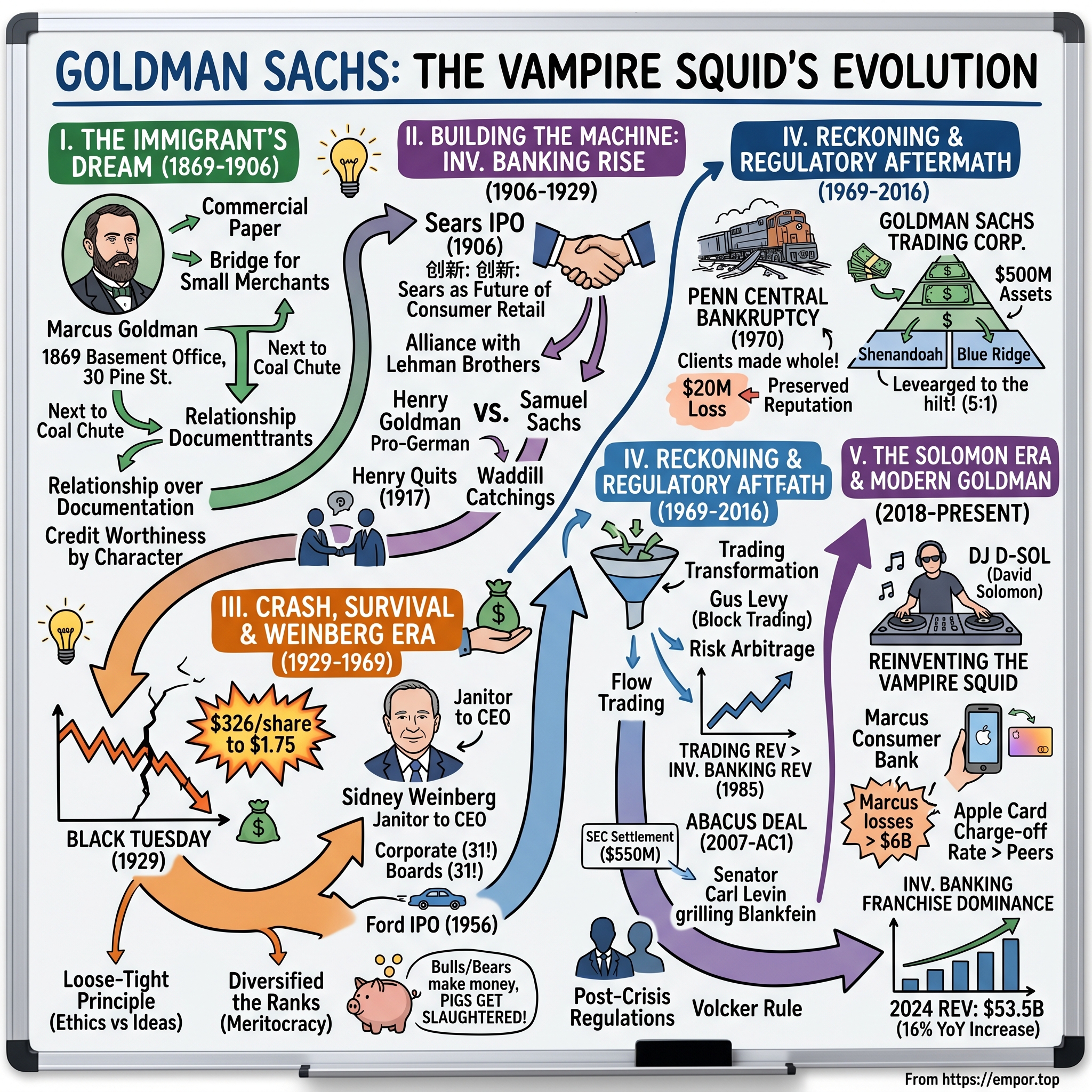
Marcus Goldman was born in Bavaria in 1821 to a Jewish family headed by a peasant cattle drover. Sailing to America amid the wave of emigration that followed the European revolutions of 1848 and rising antisemitism in Germany, he began work as an itinerant peddler in Philadelphia.6 In 1869, he moved his family to New York, opened a one-room shop on Pine Street, and began buying and selling promissory notes.6
The mechanics were straightforward: jewelers on Maiden Lane and leather tanners along Beekman Street needed cash flow before their customers settled their accounts. Goldman bought their short-term paper at a discount and resold the notes to commercial banks and institutional investors.6 In effect, he operated as an early, one-man credit-rating agency, with his entire commercial value hinging on his appraisal of who would honor their debts. During his first year, Goldman handled more than $5 million in commercial paper; by 1890, annual turnover had expanded to $30 million.6 In 1882, a credit reporter from R. G. Dun & Co. appraised him as "a very close conservative man, not at all speculative."7
That assessment captures the institution's foundational dynamic. The firm's initial product was not risk capital, but underwriting credibility priced one note at a time. More than 150 years later, that legacy endures: Goldman's primary commercial asset remains the market conviction among corporate boards and institutional investors that its financial judgment commands a premium.
In 1882, Goldman brought in his son-in-law, Samuel Sachs, as a junior partner, renaming the enterprise M. Goldman & Sachs before adopting Goldman, Sachs & Co. in 1888.7 Sachs was methodical, risk-averse, and internationally oriented. In 1897, he sailed to London to establish a correspondent relationship with merchant bank Kleinwort, Sons & Co., laying the groundwork for the firm's cross-border financing network.7
Sears and the invention of earnings-based underwriting
The firm's first major structural breakthrough was engineered by Marcus's son, Henry Goldman. In 1906, Sears, Roebuck and Co., then the world's dominant mail-order merchant, required expansion capital. Sears leader Julius Rosenwald turned to Henry Goldman, and Goldman Sachs underwrote the company's landmark $40 million initial public offering—structured as $10 million in preferred shares and $30 million in common stock.8
The transaction broke precedent through its valuation methodology. Conventional underwriting at the turn of the century priced securities against tangible collateral—physical plant, real estate, and rail trackage. Sears possessed few hard assets by comparison. Instead, Henry Goldman capitalized the company based on its earning power and sales trajectory, which had nearly doubled between 1902 and 1906—refining an approach he had applied earlier that year to United Cigar Stores.8 While modern markets treat earnings-multiple valuations as standard, in 1906 this innovation unlocked the public equity markets for an emerging class of asset-light consumer and retail enterprises.
1929: the trust that nearly killed the firm
Every durable financial institution experiences a defining crisis that reshapes its internal controls. Goldman's first existential shock arrived on the eve of the Great Depression. In December 1928, Waddill Catchings, an ambitious corporate lawyer who held the partnership's largest equity stake, spearheaded the launch of the Goldman Sachs Trading Corporation (GSTC), a closed-end investment trust issued at $104 per share.9 Speculative fervor quickly drove the shares above $200. Catchings compounded the exposure by constructing a tiered pyramid of leveraged investment trusts, launching Shenandoah Corporation and Blue Ridge Corporation in an interlocking corporate structure.9
When the market broke in October 1929, the leverage unraveled catastrophically. By mid-1932, split-adjusted GSTC shares had collapsed to $1.75—erasing roughly 98% of their initial value.9 The implosion nearly caused the firm's demise, devastated its client relationships, and forced Catchings out of the partnership in 1930.9 The episode delivered a searing institutional lesson: financial leverage marketed under the firm's brand can quickly jeopardize the franchise itself—a vulnerability that would resurface in altered forms during the 2008 subprime crisis and the 1MDB sovereign wealth fund scandal.
Sidney Weinberg: from spittoons to "Mr. Wall Street"
The leader who engineered Goldman's recovery began his career at the firm's lowest rung. Sidney Weinberg entered Goldman Sachs at 16 as a janitor's assistant, brushing partners' coats and polishing brass spittoons.10 He earned a partnership in 1926 and assumed the role of senior partner in 1930, taking charge when the firm's solvency was actively in question.10 Weinberg rebuilt the franchise on personal trust and boardroom counsel. Over a four-decade tenure, he served on 35 major corporate boards—including General Electric, Ford Motor Company, and Sears—becoming such an influential corporate confidant that the financial press dubbed him "Mr. Wall Street."10
Weinberg's crowning advisory mandate materialized in January 1956. Acting as an intimate counselor to Henry Ford II, Weinberg orchestrated the complex transaction that took Ford Motor Company public. Raising $657.9 million, it was the largest common equity offering completed in the market up to that time.11 The Ford flotation marked Goldman's full institutional rehabilitation, pivoting the firm away from the wreckage of speculative trusts and establishing it as the premier financial counselor to America's industrial dynasties.
This client-centric advisory philosophy was formalized near the end of the partnership era. In 1979, co-senior partner John Whitehead drafted on a yellow legal pad what became Goldman's 14 Business Principles, anchoring the list with the rule that clients' interests must always come first.12
Gus Levy and the invention of block trading
If Weinberg restored Goldman's prestige as a corporate counselor, Gustave "Gus" Levy established its willingness to commit principal capital. Levy joined the firm in 1933 as a foreign bond arbitrageur and rose to senior partner in 1969.13 He pioneered institutional block trading: when mutual funds and pension plans needed to liquidate massive equity positions without crashing secondary markets, Goldman stepped in to purchase the blocks with its own balance sheet at a discount, subsequently distributing the shares to secondary buyers. Between 1971 and 1976, the firm handled an average of more than 100 million shares annually in institutional trades of 10,000 shares or more on the New York Stock Exchange.13 Levy orchestrated the desk from a glass-walled office overlooking the trading floor, monitoring the ticker tape.13 He also coined the firm's enduring operational philosophy: to be "long-term greedy"—accepting short-term trading losses or concessions if they preserved client relationships and built lasting institutional franchise value.13
Block trading introduced the structural friction that defines Goldman's modern history. By committing principal, the firm transitioned from a pure agent advising clients to a counterparty trading against them. The model functioned because institutional clients believed Goldman's market-making provided fair execution, but balancing fiduciary advisory relationships with aggressive principal risk-taking would test the firm for decades.
Penn Central: the second near-death
That counterparty exposure threatened the firm's existence on June 21, 1970, when the Penn Central Transportation Company—the nation's largest railroad and sixth-largest industrial enterprise—filed for bankruptcy.14 As Wall Street's leading commercial paper dealer, Goldman had placed $87 million of Penn Central short-term notes that defaulted. The ensuing liquidity shock threatened Goldman's roster of nearly 300 other commercial paper issuers as skittish investors rushed to redeem paper across the market.14 The firm's internal historical accounts candidly acknowledge that potential liabilities exceeded total partnership capital, forcing partners to commit personal wealth through a decade of litigation and civil settlements.14 The crisis reinforced a foundational credit maxim: an underwriter that distributes paper under its brand retains full reputational exposure, regardless of statutory disclaimers.
J. Aron: the trojan horse of traders
The transaction that incubated modern Goldman appeared modest when signed in 1981. J. Aron & Company, a commodities trading merchant founded in New Orleans in 1898 as a coffee merchant, retained Goldman to find an acquirer. Assessing the strategic opening, Goldman bought the firm itself.15 Although a commodities slump made initial integration difficult, J. Aron equipped Goldman with foreign exchange and commodities trading capabilities, quantitative risk systems, and a new cohort of aggressive leadership.15 Among them was a Harvard-educated tax attorney from the Bronx who joined J. Aron in 1982 as a precious-metals salesman: Lloyd Blankfein.16 The commodities house was formally integrated into the Fixed Income, Currency, and Commodities (FICC) division in 1997.15
J. Aron also provided Goldman's signature technological advantage. Securities DataBase, or SecDB, launched on November 24, 1992, originated as a pricing and risk-management engine for J. Aron's foreign currency desk. The system allowed traders to stress-test exposures dynamically and gave firm leadership an aggregated view of risk across disparate desks and geographic operations.17
By the late 1990s, the partnership's internal power dynamics had shifted. The relationship bankers who had burnished Goldman's institutional reputation were now matched—and increasingly funded—by the trading desks driving net revenue. Trading operations, however, required something advisory banking did not: an expansive, permanent capital base that private partnership equity could no longer sustain. The partnership era illustrates that Goldman's historical moat rested on two complementary pillars: advisory trust and principal risk capacity. Every major crisis in the firm's history stemmed from overextending one of those pillars. Resolving that capital constraint set the stage for the next phase: taking the partnership public.
III. Going Public & The Mortgages Supercycle (1999–2008)
The last partnership falls
Goldman Sachs debated whether to abandon its private partnership structure for three decades. Sidney Weinberg first floated the idea in the late 1960s. In 1971, the Management Committee went so far as to print new corporate business cards before retreating. In 1986, a formal proposal advanced by Steve Friedman and Bob Rubin provoked "heated emotional conversations" and ended without a vote.18 By 1998, Goldman stood as the last major private investment banking partnership in the United States, and its partners finally voted to go public.18
The offering prospectus cited three structural rationales: "to secure permanent capital to grow; to share ownership broadly among our employees... and to permit us to use publicly traded securities to finance strategic acquisitions."18 On May 4, 1999, Goldman sold 69 million shares—a 15% interest—priced at $53 each, raising $3.657 billion. The stock closed its first trading session at $70.375, gaining 33%.18
The cultural realignment reached deeper than the capital raised. Under the partnership model, leaders had their personal fortunes on the line with every commitment, bearing unlimited liability throughout much of the firm's history. As executives running a publicly held corporation, they held shares and stock options, reported quarterly results, and were evaluated on return on equity. The shift altered even the firm's formal canon: in 1998, Business Principle #3 was amended to begin, "Our goal is to provide superior returns to our shareholders."12 For an enterprise built on fiduciary client relationships, it was a subtle modification with far-reaching consequences.
The trader's golden age
With permanent capital on the balance sheet, trading operations moved to the center of the firm. Lloyd Blankfein, who had joined as a J. Aron metals salesman, advanced through leadership roles in Fixed Income, Currency, and Commodities (FICC) and Equities before becoming president in 2003. When Hank Paulson departed in 2006 to serve as U.S. Treasury Secretary, Blankfein succeeded him as chairman and chief executive officer.16 The firm's biographical profile noted that Blankfein was "intensely risk aware and deeply skeptical of the ability of even the most sophisticated quantitative models."16
The trading-led expansion culminated in historic financial results. For fiscal 2007, Goldman posted net revenues of $45.99 billion, net earnings of $11.60 billion, and a return on common equity of 32.7%.19 FICC alone generated $16.17 billion, setting a firm record.19 In effect, the bank earned nearly a third of its book equity in a single year. Generating returns of that magnitude required deploying significant leverage through an expanding balance sheet in buoyant markets—yet that leverage carried an inherent warning, as it operated just as forcefully in reverse.
The big short
The defining trade of that era unfolded in late 2006 and early 2007, when Goldman's mortgage desk and risk managers detected deteriorating credit quality in subprime loans and systematically shifted the firm's position from net long to net short. When the Senate Permanent Subcommittee on Investigations later examined Goldman as an inquiry case study, it found that the firm had built a substantial net short position in residential mortgages during 2007, and that at times those proprietary short hedges stood directly against securities Goldman had structured and sold to clients.20 In its 2007 earnings report, Goldman noted that while conditions in the mortgage market "experienced significant deterioration," FICC still produced higher mortgage-related revenues.19 While competitors such as Merrill Lynch and Citigroup suffered tens of billions of dollars in write-downs, Goldman generated profits from the subprime collapse.
That same trade inflicted the firm's most damaging reputational wound. In July 2010, Goldman agreed to pay $550 million—at the time the largest penalty the Securities and Exchange Commission had ever assessed against a Wall Street firm—to settle civil fraud charges involving ABACUS 2007-AC1, a synthetic collateralized debt obligation tied to subprime home loans.21 Goldman acknowledged that its marketing disclosures were "incomplete" and conceded it had erred by failing to disclose that hedge fund Paulson & Co. had helped select the reference portfolio while betting against it.21 The episode exposed the structural tension first introduced during Gus Levy's block-trading era: the friction between serving as an advisory fiduciary to clients and acting as an aggressive market-making principal against them.
Myth vs reality: "The omniscient risk culture"
The claim: Goldman's risk management was so superior to that of its competitors that the firm navigated the 2008 crash largely unaffected by systemic insolvency.
The disconfirming evidence: In September 2008, holding a profitable short position on subprime debt could not shield Goldman from a run on wholesale funding. Lehman Brothers filed for bankruptcy on September 15. Six days later, on September 21, Goldman announced it would convert to a bank holding company subject to Federal Reserve regulation, a transformation approved by the Fed during an emergency Sunday night meeting.22 That regulatory charter provided Goldman direct access to the Federal Reserve's discount window, the emergency liquidity facility reserved for commercial banks.22 Two days later, Warren Buffett's Berkshire Hathaway committed $5 billion to purchase perpetual preferred stock paying a 10% dividend, accompanied by warrants to acquire an additional $5 billion in common shares.23 Goldman also accepted $10 billion through the U.S. Treasury's Troubled Asset Relief Program (TARP), which it repaid in June 2009 along with $318 million in preferred dividends and $1.1 billion to redeem the government's warrants.24 The federal rescue of American International Group also proved vital: Goldman received approximately $12.9 billion in cash settlements and collateral through AIG after the government intervened, according to reporting on the findings of the Financial Crisis Inquiry Commission.25 Regardless of how the bank's hedges were structured, that capital flow demonstrated how directly Goldman's survival depended on state support for the wider financial system.
The conclusion: Historical evidence narrows the premise of risk omniscience. Goldman's tactical disciplines—demanding daily mark-to-market valuations, stress-testing exposures across businesses with SecDB, and enforcing the institutional willingness to reverse major trading positions—were genuine strengths that outperformed peer standards. However, a broker-dealer funded through short-term repo and overnight wholesale markets cannot hedge away a liquidity run across the entire financial system. The enduring lesson of 2008 was that Goldman's risk advantage functioned at the position level, not at the structural funding level. Today, the benchmark that addresses that vulnerability is not trading Value at Risk, but liquidity: the average $555 billion in global core liquid assets Goldman maintained in the second quarter of 2026 stands as the institutional defense erected against the liquidity squeeze of September 2008.1
For equity investors, the mortgage boom and bust established the foundation for Goldman's long-term valuation discount. The market recognized that the firm's most profitable fiscal year and its closest brush with insolvency occurred only twelve months apart. The following decade would test whether Goldman could generate attractive returns once post-crisis regulations curtailed the balance-sheet leverage and principal risk-taking that had propelled its growth.
IV. Post-Crisis Reckoning & The 1MDB Trauma (2009–2018)
The squid and God's work
In July 2009, Rolling Stone published Matt Taibbi's enduring description of Goldman Sachs as "a great vampire squid wrapped around the face of humanity."26 That autumn, Blankfein told London's Sunday Times that he was merely a banker "doing God's work."26 Few corporate reputations have been defined so vividly—or from such starkly opposing vantage points—in the span of a single year.
The public fury quickly brought severe legal and political scrutiny. On April 27, 2010, Blankfein, Chief Financial Officer David Viniar, and several mortgage traders testified before the Senate Permanent Subcommittee on Investigations in an adversarial, day-long hearing examining the firm's role in the mortgage market.20 The deferred financial toll followed years later: in 2016, Goldman agreed to a $5.06 billion settlement with the Department of Justice and other regulatory agencies over its packaging and sale of residential mortgage-backed securities leading up to the financial crisis.[^27] Those legal settlements represented the true cost of the mortgage boom, offsetting a significant share of the trading gains Goldman had booked during the crash.
The regulatory box
Yet the most profound post-crisis shift was structural. As a bank holding company under Federal Reserve oversight, Goldman fell under the Dodd-Frank Wall Street Reform and Consumer Protection Act of 2010 and international Basel III capital standards. The Volcker Rule barred proprietary trading, prohibiting the bank from deploying its own balance sheet to trade purely for principal profit, while sharply restricting its investments in private equity and hedge funds. At the same time, the Federal Reserve's annual stress tests took control over how much capital the firm could return to shareholders through dividends and buybacks.
The impact on profitability was immediate. In 2007, operating with aggressive balance-sheet leverage, Goldman generated a 32.7% return on equity.19 By 2011, return on equity had collapsed to 3.7%, on net revenues of $28.81 billion.27 While cyclical market headwinds played a role, the compression was predominantly structural: regulators mandated substantially more equity capital against every dollar of trading risk, while several of the firm's most lucrative proprietary strategies were legally eliminated.
For Goldman's internal culture, the Volcker Rule went far beyond a regulatory adjustment. For generations, the partnership's most celebrated stars had minted profits by committing the firm's own capital. With that avenue foreclosed, many senior risk-takers departed for hedge funds and private equity shops where principal risk-taking remained unrestricted. Goldman had to reshape its business around client intermediation: making markets, extending structured financing, and managing external client capital. The key pillars of the firm's 2026 operating model—including prime brokerage, market financing, and third-party alternatives—trace their origin to that regulatory realignment.
This new regime also underscored a critical competitive asymmetry. Rivals such as JPMorgan Chase and Bank of America could finance their trading and lending operations with trillions of dollars in low-cost, sticky consumer deposits. Goldman, lacking a retail branch network, remained reliant on wholesale borrowing and repo markets that were inherently more expensive and susceptible to sudden withdrawal during periods of market stress. That chronic funding gap formed the strategic rationale for the consumer banking push that followed: Marcus was, at its foundation, a bid to secure a stable, low-cost deposit base.
The 1MDB disaster
The most damaging scandal of the post-crisis period unfolded far from Wall Street. Between 2012 and 2013, Goldman underwrote about $6.5 billion in sovereign bonds across three separate offerings for 1Malaysia Development Berhad (1MDB), a state investment fund.[^29] Goldman collected approximately $600 million in underwriting fees across the three transactions, an amount that independent market analyses noted was far above typical fees for such sovereign debt issuances.28 The Securities and Exchange Commission later ordered disgorgement of $606.3 million in ill-gotten gains.29
The proceeds were plundered on an unprecedented scale. Federal prosecutors determined that more than two-thirds of the $6.5 billion raised was systematically siphoned off, redirected into luxury assets and used to pay extensive bribes and kickbacks to foreign officials.30 The scheme's central orchestrator was Jho Low, a Malaysian financier who held no formal title at the fund. Tim Leissner, Goldman's Southeast Asia chairman, pleaded guilty in 2018 to conspiracy to violate the Foreign Corrupt Practices Act and money laundering, subsequently serving as a key cooperating witness for the U.S. government.30 Roger Ng, the firm's former head of investment banking in Malaysia, was convicted by a federal jury in Brooklyn in April 2022 and sentenced to 10 years in prison in March 2023.30
On October 22, 2020, Goldman reached coordinated criminal and civil settlements exceeding $2.9 billion with regulatory and law-enforcement authorities in the United States, the United Kingdom, Singapore, and other jurisdictions. As part of the resolution, the parent company entered into a deferred prosecution agreement, while its Malaysian subsidiary pleaded guilty to conspiring to violate the Foreign Corrupt Practices Act.[^29] Goldman also concluded a separate $3.9 billion settlement with the government of Malaysia.30 In response, the board clawed back or withheld $174 million in executive compensation: $76 million from Leissner, Ng, and former senior executive Andrea Vella; $67 million from former senior leaders, including Blankfein, Viniar, and Gary Cohn; and $31 million from then-current leaders including David Solomon, John Waldron, and then-CFO Stephen Scherr.31
Myth vs reality: "The Goldman standard of compliance"
The claim: Goldman's risk and compliance committees consistently stop rogue dealmakers before they can compromise the institutional brand.
The disconfirming evidence: Internal control functions did, in fact, identify the danger. Goldman's compliance and business intelligence groups repeatedly rejected attempts to onboard Jho Low as a private wealth management client due to his unexplained sources of wealth, flagging him on multiple occasions.28 Yet Low remained deeply embedded in the bond transactions. Blankfein even met with him at Goldman's New York headquarters in December 2012, long after compliance had raised objections. Ultimately, five separate firm-wide oversight committees reviewed and approved the bond offerings.28 As the SEC pointedly observed in its enforcement order, corruption risk "can be posed by those at all levels of a company, including in the senior ranks."29
The conclusion: The historical record undermines the premise that Goldman possesses an inherently superior institutional compliance culture. The breakdown was not an analytical failure to identify Jho Low; compliance flagged the risk, and the revenue-generating side of the bank circumvented those warnings when the fee pool proved sufficiently lucrative. The narrower claim that withstands scrutiny is that Goldman's controls operate effectively across routine business, but remain vulnerable when an exceptionally profitable mandate enjoys sponsorship from senior dealmakers. For investors evaluating governance risk, regulatory enforcement actions and ongoing litigation provisions remain the critical indicators of whether that cultural vulnerability has been genuinely resolved.
For equity markets, the decade between 2009 and 2018 left Goldman with a balance sheet constrained by regulation, a damaged public brand, and single-digit returns on equity in subdued market environments. The firm's incoming leadership drew the obvious strategic conclusion: with the pre-crisis trading engine permanently bounded, Goldman needed to build an entirely new growth engine.
V. The Solomon Era & The Consumer Banking Odyssey (2018–2023)
The banker who DJs
David Solomon did not fit the traditional Goldman Sachs archetype. Born in 1962 and raised in the suburbs north of New York City, he studied political science at Hamilton College before working at Irving Trust, Drexel Burnham Lambert, and Bear Stearns. He joined Goldman as a partner in 1999 to co-head high-yield and leveraged lending.32 Solomon spent a decade as co-head of the Investment Banking Division, was named president and co-chief operating officer in January 2017, and became sole COO in March 2018.32 The internal succession contest effectively concluded on March 12, 2018, when Harvey Schwartz, the other co-COO and a former chief financial officer, announced his retirement, leaving Solomon as sole president.33 Solomon formally succeeded Lloyd Blankfein as CEO in October 2018 and assumed the chairmanship in January 2019.32 John Waldron was appointed president and chief operating officer.31
As a corporate relationship banker rather than a trading-floor risk-taker, Solomon sought to project a modern, culturally adaptive image for the firm. He relaxed Goldman's storied corporate dress code and moonlighted as an electronic dance music disc jockey under the stage name "D-Sol," performing at an Amazon corporate gathering in 2019 and Chicago's Lollapalooza festival in 2022.34 In October 2023, a firm spokesperson confirmed that Solomon had stepped away from public DJ performances more than a year earlier "because of the outside attention to it."34 The extracurricular hobby had drawn unwelcome publicity, notably after a crowded Hamptons charity event during the COVID-19 pandemic stirred up controversy.34 In isolation, an executive's musical hobby amounted to minor corporate color. Its significance lay in its timing: the performances became a visible target for internal dissent and external critique precisely as the firm's costly push into consumer lending began to stumble. In an elite partnership culture that prizes discretion, leadership rarely excuses a chief executive who becomes the headline.
The 2020 thesis: embrace the bank model
On January 29, 2020, Goldman hosted its first-ever Investor Day, outlining a strategic overhaul aimed at smoothing volatile earnings with predictable, fee-based revenues to earn a higher equity valuation multiple. Chief Financial Officer Stephen Scherr summarized the strategic shift: "We are embracing the bank model."35 Solomon established clear benchmarks, targeting a return on tangible common equity above 14% within three years and "mid-teens or higher" within five, while pledging to lower the firm's efficiency ratio from 68% to below 60%.35
The expansion into retail banking served as the operational centerpiece of that strategy. Marcus, built on the chassis of GE Capital Bank's U.S. online deposit platform acquired in 2016,22 was slated for aggressive growth: management projected retail deposits would more than double from $60 billion to $125 billion by 2025, while consumer loans and credit card balances would nearly triple from $7 billion to $20 billion.35 Checking accounts were scheduled for a 2021 rollout. The consumer and transaction banking units were budgeted to absorb roughly $1 billion in pre-tax losses in 2020 before reaching $1 billion in annual revenue within five years.35 Research analysts greeted the plan with reservations, with one characterizing the presentation as delivering "no wow factor."35
The underlying rationale was coherent on paper. Sticky consumer deposits offered low-cost financing—the structural buffer against wholesale market runs that Goldman had lacked in September 2008. In addition, credit cards and installment loans provided dependable net interest margins. Partnering with Apple, which selected Goldman in 2019 to issue the Apple Card, appeared to grant the bank instant access to one of the world's most affluent and commercially active consumer ecosystems.
Buying the ecosystem
To accelerate its retail timeline, Goldman pursued programmatic acquisitions. On May 16, 2019, the firm agreed to buy United Capital, a registered investment adviser managing $25 billion in assets across 22,000 clients, for $750 million in cash. Rebranded as Personal Financial Management, the transaction was structured to extend Goldman's wealth management advisory franchise to mass-affluent households.36 Then, on September 15, 2021—near the crest of fintech market valuations—Goldman agreed to acquire GreenSky, an Atlanta-based point-of-sale platform financing home improvement loans through more than 10,000 retail merchants. The all-stock transaction was valued at approximately $2.24 billion.37 Solomon framed the acquisition as accelerating the firm's "aspiration for Marcus to become the consumer banking platform of the future."37
The collapse
The financial toll mounted swiftly. In January 2023, when Goldman first disclosed segmented figures for its retail banking division, the Platform Solutions unit revealed pre-tax losses of $783 million in 2020, $1.05 billion in 2021, and $1.2 billion through the first nine months of 2022—cumulatively erasing roughly $3 billion in under three years.38 Part of the drag stemmed from accounting conventions under U.S. Current Expected Credit Losses (CECL) rules, which require lenders to front-load lifetime loss provisions the moment a new card account is opened. Yet the franchise also suffered from fundamental operational and credit headwinds. The Apple Card portfolio carried a higher proportion of subprime and lower-credit borrowers than a traditional retail lender such as JPMorgan Chase typically onboarded, largely because Apple prioritized maximizing iPhone user approvals.39 The arrangement exposed a structural risk in white-label corporate lending: the technology partner held the commercial leverage to shape credit criteria, leaving Goldman's balance sheet to absorb the resulting default losses.
By the February 28, 2023 Investor Day, Solomon had pivoted from ambitious expansion to damage control, resetting Platform Solutions' objective to showing "progress toward breakeven" in 2023 and reaching pre-tax breakeven by 2025.40 By mid-2023, reports confirmed that Goldman was actively evaluating an exit from the Apple partnership.41
A series of divestitures followed. On August 28, 2023, Goldman agreed to sell Personal Financial Management to Creative Planning. The firm noted that the transaction would "result in a gain," avoiding an outright write-down, though it did not disclose the net return relative to the original $750 million purchase price.42 The GreenSky exit proved far more punitive. Goldman took roughly $1.4 billion in impairment charges on the business in the second quarter of 2023, followed by an additional $506 million write-down in the third quarter after agreeing on October 11, 2023, to sell the platform to an investor consortium led by Sixth Street.43[^46] The transaction closed in March 2024,[^47] with total write-downs essentially wiping out the full $2.24 billion valuation assigned to the acquisition two years earlier.
During the third-quarter 2023 earnings call, Solomon offered a candid assessment: "I'm happy that we pivoted. With hindsight, you will do certain things differently."43 The same quarter saw $358 million in balance-sheet impairments on commercial real estate investments, underscoring that balance-sheet exposure extended beyond consumer credit.43
The orderly dissolution of the consumer footprint extended into 2026. In October 2024, Barclays agreed to replace Goldman as the credit card issuer for General Motors.44 That same month, the Consumer Financial Protection Bureau ordered Apple and Goldman to pay more than $89 million in penalties and customer redress over Apple Card operational failures, including mishandled billing disputes and misleading marketing.45 The CFPB formally terminated that consent order in September 2025.45 The final exit arrived on January 7, 2026, when JPMorgan Chase agreed to assume Goldman's roughly $20 billion Apple Card portfolio over an estimated 24-month transition, reportedly acquiring the assets at a discount exceeding $1 billion.4639 "This transaction substantially completes the narrowing of our focus in our consumer business," Solomon observed.39 In its 2025 financial accounts, Goldman took a $2.26 billion markdown on the portfolio, which was more than offset by a $2.48 billion release of previously established loan-loss reserves.47
Myth vs reality: "Brand portability to mass retail"
The claim: Goldman's institutional prestige, deep capital base, and analytical talent could readily be deployed to capture market share across mass-market consumer finance.
The disconfirming evidence: The Goldman brand provided tangible utility in only one specific area: Marcus succeeded in attracting retail deposits, which is why the firm preserved that savings engine. Consumer lending, however, requires entirely different institutional capabilities: automated high-volume credit scoring, high-volume collections, dispute-resolution infrastructure, and low-cost customer acquisition at scale. In each of these disciplines, Goldman operated as a novice competing against established incumbents such as JPMorgan Chase, Capital One, and American Express. The multi-billion-dollar pre-tax losses, the CFPB enforcement action, and the substantial discount required to transfer the Apple Card book to JPMorgan Chase established the true costs of that operational mismatch.384546
The conclusion: The historical record refutes the assumption that an elite investment-banking brand translates into unsecured retail credit underwriting, even as it confirms the viability of a digital deposit-gathering franchise. Elite corporate brand equity proved non-transferable to mass consumer lending. For investors, the remaining variable is the Marcus deposit platform itself: whether it can sustain a stable, low-cost funding base on its own merits once the Apple card and savings relationships fully wind down.
The consumer episode illustrates a management team that identified a genuine structural vulnerability—the firm's reliance on wholesale funding—yet misjudged the operational complexities of retail credit, committed capital at cyclical valuation peaks, and absorbed several years of heavy losses before executing a retreat. Once resolved upon, that exit was decisive. That costly cycle of expansion and retrenchment brings the narrative to the modern era: evaluating the financial health and structural durability of the core institutional businesses to which Goldman returned.
VI. The Core Engine: Segment Economics & Value Drivers Today
Picture the machine
On a typical morning at 200 West Street in mid-2026, the firm's interconnected operating model is on full display. On one side, investment bankers work through what management described as the deepest advisory backlog in five years.5 On another, prime brokerage desks extend record financing volumes to institutional hedge funds.5 Upstairs, the alternative asset management team raises private credit from pension funds—capital that is deployed alongside the same private equity sponsors Goldman's bankers advise. This architecture forms the core of the modern franchise: distinct operating units structured to feed capital, client mandates, and transaction flow to one another.
The 2022 reorganization
In October 2022, Goldman dismantled its four-segment operating structure and consolidated into three divisions: Global Banking & Markets, Asset & Wealth Management, and Platform Solutions, which housed GreenSky and the consumer card partnerships.38 Full-year results for 2025 highlighted the operational balance. Global Banking & Markets generated $41.45 billion in net revenues, representing roughly 71% of the firm's $58.28 billion total, while Asset & Wealth Management contributed $16.68 billion, or about 29%. Platform Solutions produced just $151 million following the markdown on the Apple Card portfolio.47 In the second quarter of 2026, Global Banking & Markets proved even more dominant, accounting for $15.52 billion of the firm's $20.34 billion in net revenues.1
Segment 1: Global Banking & Markets
The division operates across three primary business lines.
Investment banking generates advisory fees and underwriting revenue for equity and debt issuances. In 2025, investment banking fees rose 21% to $9.34 billion.47 In the second quarter of 2026, those fees reached $3.40 billion, of which advisory accounted for $1.38 billion.1 On the fourth-quarter 2025 earnings call, management noted that the firm had held the number one ranking in announced global mergers and acquisitions for 23 consecutive years.48 The primary competitive challenge is not mandate volume, but pricing power. Independent advisory boutiques—including Centerview Partners, Evercore, Lazard, and Moelis & Company—market conflict-free advice unencumbered by trading desks or balance-sheet lending. By competing for the largest corporate transactions, these boutiques place a structural cap on advisory fee realization.
Fixed Income, Currency, and Commodities (FICC) provides market-making across rates, credit, currencies, and commodities, committing capital to provide continuous liquidity to institutional counterparties. The franchise generated $14.52 billion in net revenues in 2025.47 Equities, which encompasses client execution and prime brokerage margin lending, generated a record $16.54 billion in 2025 and a quarterly record of $7.42 billion in the second quarter of 2026.471
Prime brokerage represents one of the most strategically significant businesses within the division. When a hedge fund deploys leverage—for instance, buying $10 billion in equities against $2 billion in equity capital—it requires financing, securities custody, and borrow facilities to execute short positions. The prime broker provides all three services, capturing interest spreads on margin loans and clearing fees in exchange for managing the risk that underlying collateral declines faster than positions can be liquidated. Because migrating complex trading strategies and multi-billion-dollar financing lines between dealers involves substantial operational friction, prime relationships are exceptionally durable. The record prime brokerage balances reported in 20265 therefore reflect more than a buoyant quarter; they represent an expanding base of sticky, recurring financing revenue.
That shift toward financing marks the defining structural evolution inside Global Banking & Markets. On the second-quarter 2026 call, management disclosed that client financing made up 37% of combined FICC and equities revenue.5 Financing provides greater earnings stability than intermediation trading, generating recurring net interest spreads against secured collateral rather than relying on bid-ask spreads or market volatility. For public markets, this transition directly addresses the historical valuation discount: collateralized lending resembles an annuity far more than traditional trading operations.
However, balance-sheet financing consumes substantial regulatory capital. During the second-quarter 2026 call, Autonomous Research analyst Christian Bolu noted that Goldman's supplementary leverage ratio had compressed to 4.3%. Chief Financial Officer Denis Coleman acknowledged the constraint, stating that "ultimately, there will be a limit" to balance-sheet deployment.5 Management further conceded that institutional client demand for financing "outstrips what we think is the appropriate quantum."5 That dynamic reveals an operational reality: the growth of Goldman's market-financing franchise is currently bounded by regulatory capital requirements and leverage thresholds, rather than an absence of client demand.
Segment 2: Asset & Wealth Management
Asset & Wealth Management represents the primary vehicle through which management aims to re-rate the firm's equity valuation multiple. Total assets under supervision stood at $4.04 trillion at the end of June 2026.1 The segment generates three revenue streams: recurring management and advisory fees; net interest income from private banking and client lending; and mark-to-market gains or losses on balance-sheet principal investments.
Revenue quality has steadily improved as volatile principal gains have been subordinated to recurring fee streams. In 2025, management and other fees reached $11.54 billion, while private banking and lending contributed $3.35 billion.47 At its 2023 Investor Day, Goldman committed to generating more than $10 billion in management fees by 2024 and reducing its on-balance-sheet alternative investments below $35 billion over the medium term.40 Management delivered on the fee milestone and continued liquidating principal holdings, which had tied up equity capital and triggered sharp markdowns, such as the commercial real estate impairments absorbed in 2023.
The firm expanded its international footprint through the €1.7 billion acquisition of NN Investment Partners, completed on April 11, 2022. The transaction expanded Goldman's European assets under supervision beyond $600 billion and secured a long-term mandate to manage approximately $180 billion for NN Group.49
Within wealth management, the ultra-high-net-worth franchise represents an attractive relationship business, cross-selling investment advisory, bespoke portfolio lending, estate planning, and allocations to proprietary private funds. On the second-quarter 2026 earnings call, management cited nearly 900 client referrals from investment banking into wealth management since early 2025—illustrating the channel through which founders and corporate executives monetize businesses via Goldman's advisory arm and subsequently entrust the proceeds to its wealth advisers.5
Institutional asset management expanded concurrently. During the second quarter of 2026, Goldman secured outsourced chief investment officer (OCIO) mandates from Verizon and Lockheed Martin, representing approximately $70 billion in aggregate assets.5 In an OCIO arrangement, the firm assumes discretionary management over corporate pension and retirement portfolios. These multi-year mandates provide stable, contractually locked fee revenue with low turnover.
To reinforce accountability, management elevated its financial benchmarks for the segment. On the fourth-quarter 2025 call, leadership raised the pre-tax margin target to 30% and established a 5% annualized growth target for fee-based net inflows in wealth management.48 These clear metrics provide public markets with tangible quarterly checkpoints to measure operating leverage, replacing ambiguous claims of cross-divisional synergy with audited progress.
The fast-growing engine: private credit and alternatives
The rapid expansion of alternative investments represents the single most critical driver of Goldman's long-term valuation re-rating. Alternative assets under supervision reached $459 billion as of June 30, 2026.1 On the fourth-quarter 2025 call, management outlined a target of $750 billion in alternative assets under supervision by 2030, projecting sustainable capital commitments of $75 billion to $100 billion annually.48 In the first half of 2026, the firm raised $85 billion—including $31 billion for private credit during the second quarter alone—prompting management to raise its full-year capital-raising guidance above $125 billion.5
The structural mechanics of direct lending explain its institutional appeal. Rather than syndicating debt through broad public bond markets or commercial bank syndicates, corporate borrowers negotiate financing directly with non-bank private credit funds. In return for illiquidity and custom terms, lenders capture yield premiums, while borrowers gain underwriting speed, execution confidentiality, and tailored covenants. In 2024, Goldman announced plans to expand its private credit portfolio from approximately $130 billion to $300 billion by 2029.50 To integrate deal flow with credit distribution, the firm formed the Capital Solutions Group within Global Banking & Markets in January 2025, uniting leveraged finance origination, private equity sponsor coverage, and direct lending syndication. Solomon characterized the initiative as positioning Goldman "at the fulcrum of one of the most important structural trends taking place in finance."51
The fee economics of third-party private credit fundamentally decouple revenue from balance-sheet exposure. By raising external capital into commingled funds, Goldman collects steady management fees and carried interest without warehouse-funding the underlying debt or absorbing punitive regulatory capital charges. This light-capital structure contrasts sharply with the pre-crisis model of holding illiquid principal loans on balance sheet. Consequently, the 2023 pledge to reduce on-balance-sheet investments and the 2025 formation of the Capital Solutions Group represent two synchronized dimensions of the same capital-light strategy.4051
Goldman's strategic advantage against dedicated alternative asset managers—such as Apollo Global Management, Blackstone, KKR, and Ares Management—rests on its global investment banking origination network. While standalone credit managers must independently source direct lending transactions, Goldman's advisory bankers already maintain active relationships with corporate boards and financial sponsors worldwide. Early execution metrics validate this origination funnel, with capital-raising outpacing management's initial run-rate targets. What remains untested, however, is credit discipline across a protracted economic downturn. Large-scale private credit has expanded during an era of historically benign credit defaults; Goldman's scaled alternatives platform has yet to navigate a severe corporate distress cycle with its current volume of deployed capital.
Transaction banking
Goldman's corporate cash management business was built on cloud-native architecture to handle payments and liquidity operations for mid-sized and large corporations. Originally incubated alongside retail initiatives, the unit was reassigned to Platform Solutions under the 2022 reorganization.38 Its primary strategic utility lies in liability management: corporate operational deposits maintained for payroll and vendor disbursements exhibit high inertia, providing a stable, lower-cost alternative to short-term wholesale borrowing. However, the business remains modest alongside the entrenched global treasury franchises of JPMorgan Chase and Citigroup, whose corporate cash management networks benefit from decades of deep institutional integration. From an investment perspective, transaction banking serves as an advantageous funding adjacency rather than a primary earnings catalyst.
Overall, the operating engine Goldman assembled is broader and structurally sounder than the models that navigated 2011 or 2019. Key operational milestones—including record equities and financing revenues, a 23-year tenure atop global M&A advisory league tables, and alternatives fundraising running well ahead of target—demonstrate durable franchise health.1485 Yet the institution's core valuation vulnerability endures: earnings generation remains heavily tied to market liquidity and transaction velocity. With Global Banking & Markets generating more than three-quarters of total net revenues in the second quarter of 2026,1 public markets continue to apply a cyclical discount to the firm's equity. Whether leadership can sustain this performance and maintain risk discipline during an inevitable market contraction forms the central challenge for the franchise.
VII. Management Credibility, Incentives & Capital Allocation
Promises versus outcomes
The most objective measure of David Solomon's leadership is the spread between management's formal targets and its realized results.
At the 2020 Investor Day, leadership promised consumer deposits of $125 billion, consumer loan and card balances of $20 billion by 2025, and an annual run rate of $1 billion in revenue from consumer and transaction banking within five years.35 Instead, the consumer lending strategy collapsed and was dismantled. At the 2023 Investor Day, management pledged that Platform Solutions would achieve pre-tax breakeven by 2025.40 Instead, the division was dissolved and its marquee asset transferred to JPMorgan Chase at a discount.46 The record across retail banking reflects a clear pattern of overpromising followed by costly retrenchment.
Across the core franchise, however, execution proved considerably stronger. Management's 2023 targets called for exceeding $10 billion in management and advisory fees by 2024; the firm generated $11.54 billion in 2025.4047 Return on equity reached 15.0% in 2025—meeting the 14% to 16% target band—and rose to an annualized 21.7% in the first half of 2026.471 While the efficiency ratio missed its roughly 60% target in 2025 at 64.4%, it improved to 58.8% in the first half of 2026.471 Even the financial resolution of the Apple Card proved orderly: the release of loan-loss reserves exceeded the asset markdown, adding $0.46 to fourth-quarter 2025 diluted earnings per share.4748
The resulting score card is nuanced: management's credibility in launching new ventures suffered significant damage, but its operational execution across the core wholesale businesses remained intact and strengthened through 2025 and 2026. The 2023 strategic pivot represented a genuine admission of managerial error, even if it arrived only after several years of mounting balance-sheet losses.
Incentives and shareholder dissent
Executive compensation has remained a persistent source of friction between leadership and shareholders. In January 2025, the board granted Solomon and Waldron one-time retention awards of $80 million each in restricted stock scheduled to vest after five years. At the April 2025 annual meeting, the advisory say-on-pay resolution garnered just 66% support—down from 86% the prior year and marking the firm's lowest shareholder backing in roughly a decade.52 Proxy advisory firm Glass Lewis recommended against approval, noting that each award totaled roughly double the executive's full-year 2024 compensation, while major institutional investors including Norges Bank Investment Management and the California State Teachers' Retirement System voted against the package.52 The board justified the grants on succession grounds, asserting that Waldron, the designated internal successor, required a retention package to deter outside recruitment.52 At the April 2026 annual meeting, support rebounded modestly to roughly 70%, with approximately 153.7 million shares voting in favor and 64.0 million opposed.53
The awards highlighted an unresolved governance tension. For outside investors, granting substantial retention packages insulated from performance metrics weakened the alignment between executive pay and tangible shareholder returns. With nearly 30% of voting shares still withholding support in 2026, compensation practices remain an active governance vulnerability.
Capital allocation
Buoyed by earnings growth and regulatory relief, Goldman accelerated capital returns to shareholders. In 2025, the firm returned $16.78 billion in capital, anchored by $12.36 billion in share repurchases.47 In the second quarter of 2026, it repurchased an additional $4.0 billion in common stock and increased its quarterly dividend to $5.00 per share,1 up from $3.00 in mid-2025.54
That acceleration followed a significant regulatory windfall. In the Federal Reserve's 2025 stress test, Goldman's stress capital buffer—the supplementary equity cushion mandated to absorb modeled stress losses—fell from 6.1% to 3.4%, lowering its minimum Common Equity Tier 1 requirement from 13.6% to 10.9%.54 On the fourth-quarter 2025 earnings call, management disclosed that the firm retained $32 billion in remaining share repurchase authorization.48 By June 2026, Goldman's CET1 ratio stood at 12.9%, roughly 150 basis points above its regulatory requirement.5
Yet this aggressive capital return warrants analytical scrutiny. Repurchasing equity at roughly 2.6 times tangible book value represents a starkly different capital deployment calculus than buying back stock near or below book value.2 Moreover, the capital now dedicated to buybacks follows roughly $3 billion spent to acquire GreenSky and United Capital, alongside several billion dollars in cumulative operating losses absorbed during the consumer banking experiment.363738 Management's capital allocation has unquestionably improved, but its discipline has operated primarily in an accommodating, capital-generative environment; it remains untested across a full credit contraction.
What the calls reveal
The evolution of Goldman's quarterly earnings calls captures this corporate trajectory. In 2020, presentations focused on building a full-service commercial bank. By February 2023, under pressure from mounting consumer losses, executive messaging turned defensive, setting firm deadlines for Platform Solutions to break even.40 By October 2023, management delivered a concise, unvarnished post-mortem on the consumer retreat. By July 2026, executive commentary had turned demonstrably confident. Yet when Wells Fargo analyst Mike Mayo asked management to quantify the revenue multiplier that advisory banking generates across prime brokerage and asset management, Solomon declined to provide a figure, characterizing the commercial benefit merely as "significant."5 That omission underscores the critical question confronting investors: while management asserts that the modern franchise operates as an interconnected whole, the evidence supporting that synergy remains largely qualitative, pointing directly to the frameworks required to determine whether Goldman's competitive moat is enduring.
VIII. Strategic Frameworks: 7 Powers & Porter's 5 Forces
War-gaming the franchise
Consider a pension fund seeking to liquidate a $5 billion equity stake in a public company overnight. It solicits bids from three Wall Street dealers. The institution that can absorb the entire block onto its balance sheet, price the risk tightly, and distribute the shares to long-term institutional buyers by morning secures the mandate. That single transaction captures Goldman's competitive moat in miniature: balance-sheet scale, distribution reach, quantitative pricing, and institutional nerve. Testing each component through formal strategic frameworks reveals where that moat remains impregnable—and where it has begun to fray.
Hamilton Helmer's 7 Powers
Network effects: strong in markets and prime brokerage. In market-making and prime brokerage, liquidity begets liquidity. The trading desk that processes the deepest institutional order flow captures superior market intelligence, enabling tighter bid-ask pricing that in turn attracts incremental volume. Goldman's record equities revenues and expanding prime brokerage financing balances in 2026 demonstrate this self-reinforcing flywheel.5 Yet this network effect confronts an explicit structural boundary: regulatory capital. As management's discussion of the supplementary leverage ratio made clear, client financing can expand only as far as regulatory leverage thresholds permit.
Cornered resource: potent, but porous. Goldman's talent density and alumni network across corporate executive suites and global ministries remain unmatched on Wall Street. Hank Paulson, for instance, transitioned directly from chief executive to U.S. Treasury Secretary.16 Yet human capital functions as a cornered resource only so long as it remains inside the building. Multi-strategy hedge funds such as Citadel and Millennium Management, along with private equity sponsors, operate outside bank regulatory pay constraints and routinely outbid Wall Street dealers for elite quantitative traders and senior dealmakers. The board's decision to grant $80 million retention awards to its top two executives in 2025 demonstrated that leadership itself views talent retention as an ongoing operational vulnerability.52
Process power: substantial in risk architecture and analytics. SecDB provided Goldman with a unified, firm-wide view of cross-asset exposures from the 1990s onward,17 enabling the desk to detect subprime credit deterioration and exit residential mortgages early. Yet the financial crisis demonstrated the structural limits of analytical systems: process power can hedge position-level exposures, but it cannot insulate a broker-dealer from a wholesale funding run across the financial system.
Brand: commanding in institutional advisory, non-portable in retail credit. In strategic advisory and corporate finance, Goldman's brand serves as institutional insurance. Corporate directors face little fiduciary criticism for selecting Wall Street's perennial top-ranked adviser. However, the multi-billion-dollar losses absorbed during the consumer banking experiment proved that institutional prestige does not translate into competitive advantage within unsecured retail lending.38
Counter-positioning: absent, and challenged by private credit. Dedicated direct lenders such as Ares Management and Blue Owl Capital operate outside bank capital rules, holding corporate debt funded by locked-up institutional capital that would trigger punitive regulatory capital charges on a bank balance sheet. Rather than displacing this model, Goldman has adapted by building third-party private credit funds, effectively embracing the external model rather than counter-positioning against it.
Scale economies and switching costs: bifurcated across divisions. Global regulatory compliance, legal oversight, and enterprise risk infrastructure represent massive fixed costs that favor scaled incumbents. Switching costs, however, diverge sharply by business line: they are exceptionally high in prime brokerage, where moving multi-billion-dollar financing lines, collateral pools, and custodial arrangements creates acute operational disruption, yet low in advisory banking, where corporate boards routinely split mandates and rotate lead advisers on a deal-by-deal basis.
Porter's 5 Forces
Competitive rivalry: intense. JPMorgan Chase challenges Goldman across every wholesale business line backed by a vast consumer deposit base, Morgan Stanley matches its equities franchise and dominates wealth management, and elite advisory boutiques consistently contest landmark M&A mandates.
Bargaining power of buyers: high but asymmetric. Blue-chip corporations and private equity sponsors routinely unbundle advisory, financing, and hedging business among competing dealer syndicates. However, for mega-cap cross-border transactions and complex balance-sheet restructurings, the pool of credible underwriters narrows to a handful of global institutions, preserving advisory pricing power at the pinnacle of the market.
Bargaining power of suppliers: exceptionally high in talent. Compensation represents Goldman's largest operating expenditure. In 2025, compensation and benefits consumed 32.4% of net revenues.47 Every basis point directed toward employee remuneration reduces capital available for distribution to common shareholders, leaving leadership navigating continuous competition for specialized market talent.
Threat of substitutes: elevated across lending and execution. Private credit funds, direct lending consortiums, and electronic trading venues such as Tradeweb and MarketAxess continue to disintermediate traditional syndicated bank loans and voice trading. Goldman's counter-strategy focuses on absorbing these substitutes directly, scaling proprietary algorithmic execution and expanding third-party alternative credit funds.
Threat of new entrants: minimal in wholesale banking, moderate in pure advisory. Stringent Basel capital regimes, annual Federal Reserve stress tests, and extensive technology overhead make the creation of a new global full-service investment bank effectively prohibitive. Conversely, barriers to entry in pure advisory remain low; top dealmakers can readily depart to establish boutique advisory partnerships requiring negligible regulatory capital.
An instructive examination of buyer power emerged from the consumer retrenchment. Although framed as a retail initiative, the Apple Card was fundamentally an institutional B2B partnership. In that arrangement, Apple held the decisive commercial leverage: it controlled the customer interface, governed product design, and shaped credit parameters, leaving Goldman's balance sheet to absorb mounting default provisions before Apple ultimately transitioned the portfolio to JPMorgan Chase.4639 The episode demonstrated that Goldman's pricing power holds only where its execution capabilities are irreplaceable; when negotiating with an enterprise partner possessing asymmetric commercial leverage, the firm was forced to take terms.
Viewed through these frameworks, Goldman's competitive moat is structural and durable within its Global Banking & Markets engine, where balance-sheet scale, regulatory barriers, and liquidity feedback loops insulate the franchise from new entrants. In advisory banking, the moat is enduring but contestable by boutiques; in alternative asset management, it remains under construction against entrenched private-capital incumbents. That hybrid profile explains why equity markets price Goldman at a premium to balance-sheet-heavy commercial lenders yet discount it relative to pure-play asset managers—a valuation spread that frames the strategic agenda for leadership and potential activist scrutiny alike.
IX. The Skeptical Investor Test & Current Risk Radar
The activist's pitch
A skeptical investor presenting to Goldman Sachs's board of directors would begin with a straightforward valuation critique. At Morgan Stanley, wealth and asset management generated more than 55% of net revenues in 2024, earning that franchise a premium price-to-tangible-book multiple from public markets.4 By contrast, Goldman's Asset & Wealth Management division accounted for roughly 29% of net revenues in 2025.47 If equity markets assign a higher, recurring-fee multiple to asset management and a discounted, cyclical multiple to trading and investment banking, the activist's proposed remedy is obvious: spin off Asset & Wealth Management into an independent, pure-play asset manager, leaving the investment banking and trading engine to operate with its own dedicated capital.
Management's counterargument rests on cross-divisional synergy: the thesis that Goldman's wholesale units feed one another transaction flow and client capital. Corporate advisory bankers refer company founders and senior executives to private wealth management, generating nearly 900 client referrals from early 2025 through mid-2026.5 The Capital Solutions Group originates corporate debt tailored for third-party alternative credit funds to purchase.51 Meanwhile, prime brokerage relationships with multi-strategy hedge funds drive both trading execution and fund distribution. In management's view, dismantling the corporate structure would fracture that institutional referral network and strip each standalone entity of operating scale.
Yet management's defense remains largely unquantified. When pressed on the second-quarter 2026 earnings call to calculate the revenue multiplier that advisory banking generates across prime brokerage and asset management, Solomon declined to provide a figure, characterizing the commercial benefit merely as "significant."5 The integration thesis remains conceptually logical but empirically unproven. The decisive test for public markets will be sustained, compounding expansion in Asset & Wealth Management fee streams that demonstrably depend on investment banking relationships, paired with segmented reporting to verify that synergy.
The risk radar
1. Capital and leverage rules. U.S. banking regulators have spent years recalibrating the final Basel III framework, commonly known as the Basel Endgame. Regulatory adjustments that increase the risk-weighting on trading assets would constrain Goldman's ability to expand client financing—the steadiest and fastest-growing revenue stream within Global Banking & Markets. While regulatory momentum recently shifted in Goldman's favor when its stress capital buffer declined from 6.1% to 3.4% in 2025, freeing billions of dollars in surplus equity,54 supervisory relief can be reversed. A future Federal Reserve stress test featuring more punitive market-shock assumptions or stricter leverage constraints could quickly mandate higher capital cushions. Every incremental percentage point of required regulatory capital dilutes return on equity, and the 4.3% supplementary leverage ratio reported in mid-2026 indicates that the balance sheet is already operating near management's capital thresholds.5
2. The talent drain. Dedicated private-equity firms, private credit funds, and multi-strategy hedge funds operate outside bank regulatory pay restrictions, enabling them to offer uncapped compensation to senior traders and dealmakers. Goldman must maintain an attractive compensation ratio to protect its intellectual capital without eroding the operating leverage promised to common shareholders.
3. Private credit risk. The most rapidly expanding component of Goldman's alternative asset platform has grown during an extended period of benign credit conditions and has yet to navigate a protracted corporate distress cycle. A broad wave of defaults or debt restructurings among sponsor-backed borrowers would compress performance fees, slow external fundraising, and impair Goldman's direct balance-sheet co-investments.
4. The M&A and IPO cycle. The 2026 resurgence in capital markets activity reflects cyclical momentum rather than a permanent structural baseline. Investment banking fees surged 55% year over year in the second quarter of 2026,1 and growth rates of that magnitude historically mean-revert as market conditions cool. Furthermore, aggressive antitrust enforcement or cross-border geopolitical friction can delay or derail mega-cap corporate combinations—the specific advisory mandates where Goldman commands its highest fee realization.
5. Concentration in the AI trade. On the second-quarter 2026 earnings call, Evercore ISI analyst Glenn Schorr raised concerns regarding concentration risk across equities trading, while Bank of America analyst Ebrahim Poonawala questioned the durability of artificial intelligence capital expenditures. Solomon characterized the technology buildout as the "early innings" of a "multi-year investment cycle," while cautioning that "things rarely move in a straight line."5 A meaningful portion of 2026 trading liquidity, structured debt financing, and equity underwriting is linked directly or indirectly to corporate investment in AI infrastructure. Should that capital-spending cycle decelerate, multiple desks across Global Banking & Markets would experience a simultaneous contraction in volume.
6. Legacy balance-sheet marks. Although Goldman has methodically reduced its on-balance-sheet alternative investments to transition toward a third-party fee model, illiquid principal exposures remain. The $358 million in balance-sheet real estate impairments absorbed in the third quarter of 2023 demonstrated how abruptly legacy holdings can depress quarterly earnings during a sector downturn.43
7. Legal and regulatory overhangs. While the criminal proceedings associated with 1MDB have been resolved, Goldman remains a globally systemically important bank subject to continuous oversight across international jurisdictions. Any fresh compliance breakdown would test whether the internal control architecture and risk governance reforms instituted over the past decade have successfully taken root.
For equity investors, this risk matrix reveals an institution whose primary vulnerabilities stem from macroeconomic cycles, credit underwriting conditions, and regulatory capital requirements, rather than managerial distraction. That represents a significantly more defensible operational posture than the strategic ambivalence of the retail banking era. Yet it also confirms that the market's valuation discount is not unfounded: Goldman's earnings capacity remains tightly coupled to market liquidity, wholesale funding spreads, and global transaction velocity.
X. Bear vs. Bull Case & Core KPIs
The bull case
The advisory franchise at the crest of a cycle. Goldman has held the top global mergers-and-acquisitions advisory ranking for 23 consecutive years and entered the second half of 2026 with its largest deal backlog in five years.485 If private equity sponsors, holding an accumulated backlog of aging portfolio investments, accelerate corporate sales and initial public offerings, Goldman is strategically positioned to capture a leading share of those advisory and underwriting fee pools.
A progressive valuation re-rating. If Asset & Wealth Management continues to expand recurring fee revenue, reaches its 30% pre-tax margin target, and increases alternative assets toward $750 billion by 2030, the firm's earnings composition will increasingly resemble that of a fee-based asset manager.48 Concurrently, institutional client financing—which rose to 37% of combined FICC and equities net revenues—provides greater revenue stability across the markets franchise.5 Together, these shifts provide equity markets with a structural justification to narrow the valuation discount relative to Morgan Stanley.
Capital return capacity. Having largely wound down its consumer balance-sheet commitments and secured a substantially lower stress capital buffer, Goldman maintains the balance-sheet capacity to sustain substantial capital distributions through share repurchases and regular dividend increases.4854
The bear case
The cyclical multiple trap. Despite years of strategic diversification, Global Banking & Markets generated approximately three-quarters of firm-wide net revenues in the second quarter of 2026.1 If capital markets soften, trading and investment banking revenues will contract sharply, reinforcing market reluctance to assign a premium valuation multiple to a predominantly cyclical earnings stream. The 2025–2026 earnings rebound underscores this inherent volatility: return on common equity jumped from 15.0% for full-year 2025 to 23.5% in the second quarter of 2026.471
Competitive fee compression and balance-sheet asymmetry. Goldman faces simultaneous competitive pressure on two fronts: independent advisory boutiques marketing conflict-free counsel unencumbered by trading desks, and diversified universal lenders such as JPMorgan Chase that can deploy vastly superior balance-sheet capacity and low-cost deposit funding.
Talent retention and governance friction. Advisory say-on-pay votes of 66% in 2025 and 70% in 2026 demonstrated lingering shareholder skepticism regarding whether executive remuneration—particularly large retention grants—is sufficiently tied to tangible operating performance.5253 Furthermore, sustaining Goldman's historical partnership culture remains a persistent operational challenge inside a public corporation competing against unregulated private investment funds for top dealmakers and quantitative traders.
Share repurchases at premium multiples. Repurchasing common equity at roughly 2.6 times tangible book value retires significantly fewer shares per dollar deployed than buybacks executed near or below book value, reducing the accretive impact on per-share metrics.2 For an institution that returned $16.78 billion in capital in 2025,47 continuing large-scale repurchases represents an aggressive strategic commitment that its own stock constitutes the most productive use of surplus capital.
Weighing the case
The operating record from 2025 and 2026 supports a measured version of the bull thesis: Goldman Sachs has eliminated costly retail distractions, strengthened its core wholesale businesses, and positioned its primary franchises near cyclical highs. What the empirical record has yet to confirm is whether the institution has become structurally less cyclical. Validating that transformation will require several years in which Asset & Wealth Management fee streams continue to compound even as trading volumes and corporate advisory transactions decline. Until tested by a prolonged market contraction, both the bull and bear perspectives remain analytically sound.
The three KPIs to watch
1. Return on tangible common equity through the cycle. Management's medium-term target band remains 15% to 17%.40 The critical checkpoint for equity investors is not performance at the peak of a market cycle—where return on tangible common equity reached an annualized 25.5% during an exceptionally buoyant quarter5—but the floor reached during the next downturn. A cycle trough held in the low teens would validate the structural re-rating thesis, whereas a retreat to single-digit returns would confirm the bear thesis of an unhedged cyclical franchise.
2. Asset & Wealth Management management and other fees. This metric provides the cleanest gauge of predictable, recurring revenue, reaching $11.54 billion in 2025.47 To support a durable valuation multiple, this fee stream must compound steadily regardless of broader capital-market volatility, distinguishing itself from volatile balance-sheet principal investments that fluctuate with mark-to-market valuations.
3. The compensation ratio. Standing at 32.4% of net revenues in 2025,47 this metric tracks the ongoing distribution of revenue between personnel and common shareholders. If the compensation ratio expands during periods of flat or declining revenue, it indicates that talent providers are capturing excess economic rent; conversely, if leadership compresses compensation too aggressively and prompts key departures, the firm risks undermining the specialized human capital that sustains its competitive moat.
XI. Epilogue & Durable Investing Lessons
Picture Marcus Goldman on Pine Street in 1869, examining a jeweler's promissory note and deciding whether the merchant who signed it would honor the debt. Now picture a Goldman partner in 2026, deciding whether to commit billions of dollars in structured credit to a private equity sponsor backed by enterprise software cash flows. The scale and financial instruments have evolved, but the fundamental calculation remains identical: appraising whether a counterparty will honor its obligations. Goldman's history demonstrates that the institution prospers when operating close to that underwriting discipline, and falters whenever it strays from it.
The law of capability boundaries. The consumer banking detour provides the clearest modern case study. Capital markets expertise and institutional relationship banking do not automatically confer an advantage in underwriting unsecured retail credit at scale. Institutional B2B excellence and mass-market B2C lending require fundamentally different operational capabilities, risk engines, and customer servicing infrastructure. The firm absorbed that same structural lesson in 1929, when an institution celebrated for commercial paper underwriting marketed leveraged investment trusts to the broader public.9
The price of permanent capital. Going public in 1999 solved the partnership's balance-sheet constraints and enabled Goldman to construct a massive institutional trading and financing franchise.18 Yet permanent equity also introduced quarterly earnings volatility, public scrutiny, compensation friction, and the persistent challenge of satisfying external shareholders who do not share the unwritten assumptions of a private partnership culture.
The partnership ghost is still an asset, and still a cost. Goldman dissolved its private partnership structure in 1999, but that ethos continues to shape the enterprise. The partner title endures, the culture prizes internal discretion, and elite dealmakers still expect to be compensated like equity owners. That cultural legacy explains why Goldman continues to attract and retain premier Wall Street talent, but it also explains why executive compensation packages—such as the 2025 retention grants—trigger intense shareholder dissent. Outside investors own a public corporation that operates, culturally and emotionally, like an elite private club. For shareholders, the structural challenge lies in capturing the franchise value of that collective loyalty without conceding an outsized share of economic rent to personnel.
Advice and trading must be kept in balance. Nearly every crisis in Goldman's modern history, from ABACUS to 1MDB, emerged at the precise intersection where the firm's fiduciary posture as a trusted client adviser collided with its commercial interests as a principal trader or underwriter pursuing an outsized fee pool. Conversely, its most durable triumphs—from Henry Goldman's Sears underwriting and Sidney Weinberg's Ford IPO to Gus Levy's block trading—occurred when advisory trust and capital commitment reinforced each other. The modern private credit and alternatives strategy binds these two functions closer than ever: the same institution advises a corporate board, originates structured debt, and manages the third-party fund that provides the financing. That alignment can operate as a powerful institutional flywheel, or it can incubate acute conflicts of interest. Which path unfolds will ultimately depend on the underwriting discipline and counterparty judgment that Marcus Goldman first monetized in 1869.
The power of self-correction. Goldman's historical advantage has never been an immunity to strategic errors, but rather an institutional capacity to survive them and cut its losses: the 1929 investment trust collapse, the 1970 Penn Central bankruptcy, the 2008 liquidity run, the 1MDB scandal, and the retail banking push. While the consumer retreat was costly and protracted, it was executed decisively once resolved upon. That resilience is a defining organizational strength, but it also serves as a sobering reminder for investors that in a complex global institution committing balance-sheet leverage, the seeds of the next crisis are often planted during the peak of the current cycle.
The broader question is whether Wall Street's premier investment bank can sustain its historical margins in a financial landscape where private credit managers, algorithmic execution venues, and non-bank shadow lenders are disintermediating traditional banking functions. Goldman's strategic response has been to co-opt the transformation: raising third-party private credit funds, expanding prime brokerage financing to multi-strategy funds, and leveraging its global advisory network to originate flow for both. While 2026 operating results validate that pivot, the ultimate verdict remains unwritten. The decisive test for Goldman Sachs will arrive not during market booms, but in the next protracted downturn—when the institution discovers once again which elements of its earnings power are genuinely structural, and which were merely carried along by the tide of the cycle.
References
-
Goldman Sachs Reports 2026 Second Quarter Earnings Results (Form 8-K, Exhibit 99.1) — The Goldman Sachs Group, Inc. / SEC, 2026-07-14 ↩↩↩↩↩↩↩↩↩↩↩↩↩↩↩↩↩
-
Goldman Sachs Group (GS) Statistics & Valuation — Stock Analysis, 2026-09-24 ↩↩↩
-
Morgan Stanley (MS) Statistics & Valuation — Stock Analysis, 2026-09-24 ↩
-
Goldman vs. Morgan Stanley: Which Financial Giant Has More Upside? — Yahoo Finance, 2025-07-09 ↩↩
-
Goldman Sachs (GS) Q2 2026 Earnings Call Transcript — The Motley Fool, 2026-07-21 ↩↩↩↩↩↩↩↩↩↩↩↩↩↩↩↩↩↩↩↩↩
-
Entrepreneurialism and Grit Inspire Marcus Goldman to Launch his Business — Goldman Sachs ↩↩↩↩
-
A New Partner Joins the Family Business (1882) — Goldman Sachs ↩↩↩
-
Landmark IPO Helps an American Retailing Icon Achieve the Next Level of Growth (1906) — Goldman Sachs ↩↩
-
Goldman Sachs Trading Corporation Bears Full Brunt of 1929 Crash — Goldman Sachs ↩↩↩↩↩
-
Sidney Weinberg Leads the Firm for More than Three Decades — Goldman Sachs ↩↩↩
-
The Power of Relationships Fuels Historic Ford Motor Company IPO (1956) — Goldman Sachs ↩
-
Goldman Sachs Introduces 14 Business Principles That Define the Firm (1979) — Goldman Sachs ↩↩
-
Gus Levy Appointed Senior Partner (1969) — Goldman Sachs ↩↩↩↩
-
Penn Central Bankruptcy Sends Shock Waves Through Commercial Paper Market (1970) — Goldman Sachs ↩↩↩
-
Goldman Sachs Adds Strength in Commodities and Foreign Exchange With J. Aron Acquisition (1981) — Goldman Sachs ↩↩↩
-
Lloyd Blankfein Assumes Leadership of Goldman Sachs (2006) — Goldman Sachs ↩↩↩↩
-
With SecDB, a Groundbreaking Risk Management Platform is Born — Goldman Sachs ↩↩
-
In a Paradigm Shift, Goldman Sachs Decides to Go Public (1999) — Goldman Sachs ↩↩↩↩↩
-
Goldman Sachs Reports Full Year and Fourth Quarter 2007 Earnings (Form 8-K, Exhibit 99.1) — SEC, 2007-12-18 ↩↩↩↩
-
Wall Street and the Financial Crisis: The Role of Investment Banks (Hearing, 2010-04-27) — U.S. Senate Permanent Subcommittee on Investigations ↩↩
-
Goldman Sachs to Pay Record $550 Million to Settle SEC Charges Related to Subprime Mortgage CDO — U.S. Securities and Exchange Commission, 2010-07-15 ↩↩
-
Goldman Sachs Announces It Will Become a Bank Holding Company (2008) — Goldman Sachs ↩↩↩
-
Berkshire Hathaway to Invest $5 Billion in Goldman Sachs — Goldman Sachs, 2008-09-23 ↩
-
Goldman Sachs Pays $1.1 Billion to Redeem TARP Warrants — Goldman Sachs, 2009-07-22 ↩
-
Goldman Sachs Got Billions From AIG For Its Own Account, Crisis Panel Finds — HuffPost, 2011 ↩
-
Goldman Sachs vs. SEC: 'Vampire squid' or 'doing God's work'? — The Christian Science Monitor, 2010-04-21 ↩↩
-
Goldman Sachs Reports Earnings Per Common Share of $4.51 for 2011 (Form 8-K, Exhibit 99.1) — SEC, 2012-01-18 ↩
-
Goldman Sachs and the 1MDB Scandal — Harvard Law School Forum on Corporate Governance, 2019-05-14 ↩↩↩
-
SEC Charges Goldman Sachs With FCPA Violations (Press Release 2020-265) — U.S. Securities and Exchange Commission, 2020-10-22 ↩↩
-
Ex-Goldman Sachs banker sentenced to 10 years in prison in 1MDB fraud — PBS NewsHour, 2023-03-09 ↩↩↩↩
-
Goldman claws back $174M from current, former execs in 1MDB case — Banking Dive, 2020-10-22 ↩↩
-
David Solomon Is Appointed CEO and Chairman (2018) — Goldman Sachs ↩↩↩
-
Harvey M. Schwartz to Retire From Goldman Sachs, David M. Solomon to Serve as Sole President and Chief Operating Officer — Goldman Sachs, 2018-03-12 ↩
-
Goldman Sachs CEO stops doing controversial DJ gigs — CNN Business, 2023-10-17 ↩↩↩
-
Goldman Sachs Investor Day: 'Embracing the bank model,' but which bank? — Banking Dive, 2020-01-30 ↩↩↩↩↩↩
-
Goldman Sachs Announces Acquisition of United Capital — Goldman Sachs, 2019-05-16 ↩↩
-
Goldman Sachs to Acquire GreenSky — Goldman Sachs, 2021-09-15 ↩↩↩
-
Goldman Sachs platform solutions business lost $3 billion in nearly three years — Yahoo Finance / Reuters, 2023-01-13 ↩↩↩↩↩↩
-
JPMorgan Chase reaches deal to become Apple Card issuer as Goldman closes chapter on consumer foray — CNBC, 2026-01-07 ↩↩↩↩
-
Goldman Sachs 2023 Investor Day Presentation (Form 8-K, Exhibit 99.1) — SEC, 2023-02-28 ↩↩↩↩↩↩↩
-
Goldman Sachs Explores Exit From Apple Credit Card Partnership — The Wall Street Journal, 2023-06-30 ↩
-
Goldman Sachs and Creative Planning Announce Agreement to Acquire Goldman Sachs Personal Financial Management Business — Goldman Sachs, 2023-08-28 ↩
-
Goldman profit tops estimates as dealmaking cushions hit from GreenSky, real estate — Yahoo Finance / Reuters, 2023-10-17 ↩↩↩↩
-
Barclays replaces Goldman Sachs as GM card issuer — Banking Dive, 2024-10-14 ↩
-
CFPB Orders Apple and Goldman Sachs to Pay Over $89 Million for Apple Card Failures — Consumer Financial Protection Bureau, 2024-10-23 ↩↩↩
-
JPMorgan Chase to take over as Apple Card's issuer — Banking Dive, 2026-01-08 ↩↩↩↩
-
Goldman Sachs Reports 2025 Full Year and Fourth Quarter Earnings Results (Form 8-K, Exhibit 99.1) — SEC, 2026-01-15 ↩↩↩↩↩↩↩↩↩↩↩↩↩↩↩↩↩
-
Goldman Sachs (GS) Q4 2025 Earnings Call Transcript — The Motley Fool, 2026-01-15 ↩↩↩↩↩↩↩↩↩
-
Goldman Sachs Completes Acquisition of NN Investment Partners — Goldman Sachs, 2022-04-11 ↩
-
Goldman aims to grow its private credit portfolio to $300B: report — Yahoo Finance / Banking Dive, 2024-03 ↩
-
Goldman Sachs Announces Creation of Capital Solutions Group — Goldman Sachs, 2025-01-13 ↩↩↩
-
Goldman shareholders back $80M packages for Solomon, Waldron — Banking Dive, 2025-04-24 ↩↩↩↩↩
-
The Goldman Sachs Group, Inc. Form 8-K: Results of 2026 Annual Meeting of Shareholders — SEC, 2026-04-29 ↩↩
-
Goldman Sachs Statement on Stress Capital Buffer — Goldman Sachs, 2025-07-01 ↩↩↩↩
 LinkedIn
 WhatsApp
 Reddit
 Hacker News
 Email
 Kindle
 RSS Feed
 Spotify
 Apple Podcasts
 Amazon Music
 Audible
 YouTube