The Home Depot: The Orange Apron, The Pro Moat, and The $18B Gamble
I. Introduction & Episode Roadmap (8–10 min)
The Hook: Two Fired Executives and a Warehouse Idea
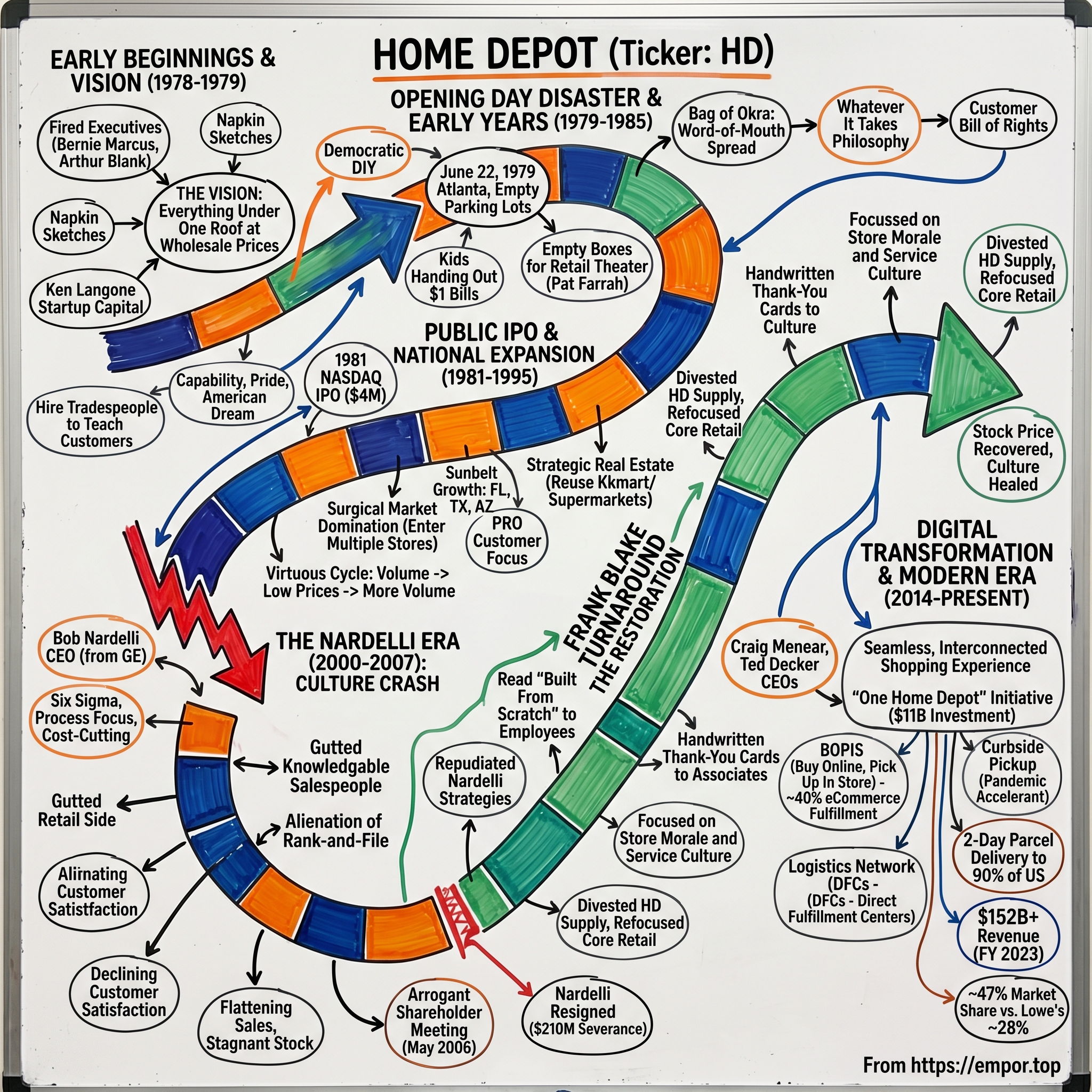
In April 1978, two home-improvement executives cleaned out their desks in Los Angeles. Bernie Marcus had been running Handy Dan Improvement Centers, a regional hardware chain, and Arthur Blank was his chief financial officer. Both were fired, along with merchandising executive Ron Brill, by Sanford Sigoloff, the turnaround specialist leading Handy Dan's parent company, Daylin12. The stated reason was "unauthorized and unacceptable business practices." Years later, Fortune suggested, only half jokingly, that Sigoloff deserved credit as Home Depot's accidental founder3.
Marcus was 49, unemployed, and furious4. According to company lore, he and Blank—partnering with investment banker Ken Langone and merchant Pat Farrah—sketched a retail format that the industry regarded as unfeasible. It would be a warehouse spanning several football fields, offering prices low enough to rival wholesale distributors, staffed by associates paid to teach ordinary homeowners how to tackle projects themselves rather than simply push merchandise5.
The Modern Scale
Nearly five decades later, that concept has evolved into one of the largest retail and distribution networks in the world. In fiscal 2025, The Home Depot, Inc. (NYSE: HD) generated $164.7 billion in sales and $14.2 billion in net earnings6. At the end of its most recent quarter, it operated 2,364 big-box stores across the United States, Canada, and Mexico. Its specialty distribution subsidiaries ran another 1,340 locations, supported by more than 470,000 associates7.
Return on invested capital, or ROIC, tracks how much after-tax operating profit a company generates for each dollar of debt and equity deployed. For most of the past decade, Home Depot's ROIC reached extraordinary heights: 45.4% in fiscal 2019 and 44.6% in fiscal 202289. By fiscal 2025, that metric had dropped to 25.7%10. Understanding that compression is essential to understanding the company's current strategic direction.
The Central Dramatic Question
Home Depot survived the category-killer consolidation that eliminated regional competitors such as Hechinger and Builders Square. It absorbed the rise of e-commerce without turning its stores into showrooms for third-party logistics networks. Over the past decade, it deliberately expanded from a destination for weekend do-it-yourself shoppers into a supply-chain backbone for professional contractors.
Then, in March 2024, the company announced the largest acquisition in its history: an agreement to buy SRS Distribution, a distributor of roofing, landscape, and pool supplies, for roughly $18.25 billion11. The timing carried obvious macro risk. In 2025, Americans purchased just 4.06 million existing homes, the lowest annual total since 199512. Because residential moves represent the primary catalyst for major renovation spending, that demand channel had nearly stalled. Why would a retailer renowned for maximizing returns on existing square footage make a debt-financed, late-cycle push into wholesale distribution—and how durable is that strategic bet?
The Roadmap
This analysis proceeds through eight acts: - The Atlanta origins and the warehouse retail revolution. - The Bob Nardelli era, when an imported industrial culture nearly alienated frontline store operations. - Frank Blake's post-2007 operational reset during the housing crash. - Craig Menear's supply-chain overhaul built for an interconnected retail model. - Ted Decker's navigation of a frozen housing market and the SRS transaction.
The narrative then turns to competitive dynamics: Lowe's, wholesale distributors, Hamilton Helmer's 7 Powers framework, and Porter's Five Forces. A falsification section then stress-tests the prevailing bull cases against Home Depot's operating performance. The study concludes with a management credibility audit, a risk radar, and a balanced valuation debate. The core analytical tension is straightforward: has Home Depot reinforced a structural competitive moat, or has an exceptional operating engine become constrained by housing-turnover headwinds and integration risk?
That inquiry begins inside a pair of repurposed discount department stores on the east side of Atlanta.
 Subscribe on LinkedIn
II. Origins: The Handy Dan Firing & The Atlanta Sandbox (1978–1985) (20–25 min)
The Catalyst
Sanford Sigoloff was a corporate turnaround specialist known for aggressive cost-cutting across distressed conglomerates. Although Handy Dan was generating steady operating profits, its parent company, Daylin, had only recently emerged from Chapter 11 reorganization. From the perspective of Marcus and Blank, Sigoloff viewed Marcus's operational independence as insubordinate and treated the profitable subsidiary as a rival center of authority3. The termination on April 14, 1978 was immediate. Marcus and Blank moved swiftly to build their alternative; on June 29, 1978, the new enterprise was officially incorporated in Delaware1.
The venture carried significant personal exposure. Marcus had spent his career as an operating merchant rather than an equity owner, and Blank was a corporate controller and financial officer who had risen through retail management alongside him. Neither executive possessed the personal capital required to self-finance a capital-intensive store rollout.
The Brain Trust
Ken Langone, a Wall Street investment banker with deep retail syndication experience, organized the initial private investor group. Pat Farrah contributed the operational merchandising model; his earlier Los Angeles home center, National Hardgoods, had demonstrated to Marcus how an expansive, high-volume hardware warehouse could operate54. The founding team chose Atlanta for their initial test market. The metropolitan area was expanding rapidly, had an abundant base of single-family housing, and sat well outside the territory of the West Coast retail chains the founders knew best.
The Radical Warehouse Thesis
The store model targeted two long-standing structural inefficiencies in retail home improvement.
The first was inventory economics. Neighborhood hardware shops and regional lumberyards carried limited product assortments at elevated gross margins, depending on high markups because low inventory turnover forced every item to generate substantial gross profit per unit. Marcus and Blank inverted that formula. By stocking tens of thousands of stock-keeping units on industrial racking stacked to the ceiling, Home Depot discounted merchandise aggressively to drive inventory turnover and maximize cash generation per square foot. The warehouse presentation was an intentional cost signal: bare concrete floors, exposed steel racks, and active forklifts communicated to consumers that overhead was minimal and prices were close to wholesale.
The second was store-level technical expertise. DIY home renovation carries steep friction for inexperienced consumers. Rather than hiring transactional clerks, Home Depot recruited licensed tradespeople and seasoned craftspeople, issued them orange aprons, and instructed them to teach customers how to execute home projects rather than simply sell supplies2. In modern commercial terms, this approached retail through customer lifetime value: an amateur homeowner taught to sweat a copper pipe or install a light switch became a loyal repeat customer across decades of residential maintenance.
The Atlanta Launch
On June 22, 1979, Home Depot opened its first two stores on Memorial Drive and Buford Highway in suburban Atlanta1. Both units occupied roughly 60,000 square feet leased from Treasure Island, a discontinued discount-department-store banner owned by J.C. Penney113.
Initial customer traffic lagged expectations. With cavernous floor plans to populate and limited vendor credit, store associates stacked empty cardboard boxes on upper racking to give the appearance of fully stocked shelves. In one widely shared opening-week maneuver to draw foot traffic, the founders' children stood at the entrance handing out one-dollar bills to encourage shoppers to walk the aisles14. Customer reception gained traction through word of mouth, and by the end of 1979, the company was operating three Atlanta locations1.
The 1981 IPO
On September 22, 1981, Home Depot completed an initial public offering on the NASDAQ under the ticker HOMD, pricing shares at $12 and raising roughly $4.1 million1. While modest by modern standards, the equity issuance provided crucial working capital and reduced reliance on commercial lenders that remained wary of the large-format warehouse model. The company subsequently moved its listing to the New York Stock Exchange.
The early operating structure was intentionally decentralized. Store managers operated as autonomous merchant-proprietors, selecting local merchandise assortments, setting staffing levels, and placing purchase orders directly with manufacturers. That operational latitude fostered high entrepreneurial initiative and rapid local adaptation, but it also sowed the seeds of supply-chain fragmentation and administrative inconsistency that would eventually require structural intervention.
For investors, Home Depot's formative period provides the fundamental blueprint for its retail moat. The twin principles established in Atlanta—scale-driven price leadership and skilled, frontline customer engagement—remain central to the company's operating identity. In its annual regulatory filings, the company still formally articulates an "Inverted Pyramid" organizational structure, positioning customers and frontline associates at the top and corporate leadership at the base10. Across subsequent decades, every major operational crisis at Home Depot originated when management attempted to optimize financial metrics by weakening one of those two founding commitments.
The immediate task, however, was proving that the Atlanta warehouse formula could scale across the United States.
III. Category Killer Domination & Growing Pains (1985–2000) (20–25 min)
The Blitzscaling of America
By the early 1990s, the Saturday morning scene across Sunbelt suburbs had become standard. The parking lot outside a new orange big-box store filled by 8 a.m., with pickup trucks and minivans parked side by side. Inside, professional contractors loaded lumber carts while weekend DIYers consulted aproned associates on plumbing or tile projects. Meanwhile, multi-generational neighborhood hardware stores saw foot traffic evaporate.
That pattern repeated across the United States over the next two decades as the company expanded at breakneck speed. Home Depot marked its 1,000th store opening at the New York Stock Exchange opening bell on July 10, 200015. By the end of fiscal 2000, the footprint had reached 1,134 locations generating $45.7 billion in annual sales16—a remarkable expansion from its three-store Atlanta footprint just twenty years earlier. The rollout moved through Florida, Texas, California, and the Northeast. In high-density markets, management deliberately opened stores close enough together to cannibalize existing locations, calculating that preemptive market saturation outweighed the short-term margin drag of overlapping trade areas.
Wiping Out Independent Retail
The "category killer" moniker was literal. Local lumberyards and neighborhood hardware retailers could not compete with Home Depot's simultaneous advantages in pricing power and product breadth. Regional competitors that attempted to clone the warehouse format with thinner balance sheets and weaker merchandising—including Hechinger and Builders Square—gradually liquidated or were absorbed. Independent hardware operators survived primarily by banding together in dealer-owned purchasing cooperatives such as Ace Hardware and True Value, sacrificing operational autonomy to gain shared buying scale.
The failure of direct copycats highlighted that the warehouse was not merely a real-estate format, but an operating system. Competitors could lease large industrial footprints and stack pallets to the ceiling, but they struggled to replicate the dual mechanism driving Home Depot's unit economics: massive purchasing scale that lowered unit costs, paired with knowledgeable store associates who lifted transaction conversion. Low prices without technical assistance attracted transient discount shoppers with zero store loyalty, while knowledgeable staff without low prices could not drive the inventory turnover needed to support a 100,000-square-foot box.
Home Depot's early competitive advantage did not rely on proprietary technology or exclusive supply agreements. Instead, it was an interconnected flywheel: volume buying lowered procurement costs, aggressive pricing drove inventory velocity, and knowledgeable service converted casual foot traffic into repeat home-renovation spenders—an operational loop that rivals could copy in fragments, but rarely in its entirety.
Culture as a Scalable System
Maintaining that operational loop across hundreds of new stores required scaling the organizational culture as rapidly as store square footage. Marcus and Blank operationalized their inverted pyramid philosophy through constant, visible reinforcement. Both founders routinely conducted unannounced store walks, quizzed floor staff on inventory and merchandising, and empowered associates to resolve customer problems on the spot without management sign-off. The organizational ethos signaled that store personnel reported to the customer rather than corporate headquarters.
The system also served a critical economic function. In high-volume, low-margin retail, staffing stores with skilled trade specialists is typically cost-prohibitive. Home Depot bridged that gap by offering frontline workers operational autonomy, peer recognition, and equity participation through employee stock purchase plans. As the stock compounded throughout the 1980s and 1990s, equity-based compensation turned thousands of store associates into millionaires, fostering fierce frontline loyalty and aligning employee incentives with store-level performance.
The First Signs of Operational Bloat
Yet by the late 1990s, that extreme decentralization was showing severe operational strain. Individual store managers still placed purchase orders directly with thousands of independent vendors. Unscheduled delivery trucks arrived at loading docks throughout the trading day, forcing customer-facing associates to spend prime selling hours unloading freight rather than helping shoppers. Inventory tracking and store information systems lagged far behind the company's physical scale. While 20% annual top-line growth masked these structural inefficiencies, any deceleration in comp-store sales threatened to compress operating margins.
Arthur Blank assumed the chief executive role in 1997, succeeding Marcus1. Blank initiated foundational investments in enterprise information systems and centralized logistics, but board members and institutional investors pressed for faster structural transformation. With prime domestic real estate for new big boxes becoming scarcer, Wall Street demanded evidence that the company could sustain its historical compounding rate without sacrificing return on capital. Up to that point, Home Depot had never been run by an outsider unsteeped in its founding culture.
By the close of 2000, Home Depot stood as the undisputed heavyweight of American home improvement, yet its underlying administrative and logistical infrastructure remained that of an overgrown regional chain. This widening divide between physical scale and operational sophistication provided the board with the rationale to seek a radically different style of executive leadership. The organization was about to test what happens when an entrepreneurial retail culture is subjected to rigid industrial engineering.
IV. The Six Sigma Rupture: Bob Nardelli & The Corporate Mutiny (2000–2007) (25–30 min)
The GE Transplant
In late 2000, Jack Welch selected Jeff Immelt as his successor to lead General Electric, concluding a high-profile, three-way corporate race. Bob Nardelli, who led GE Power Systems, lost that contest. Within days, Home Depot named him president and chief executive officer; regulatory filings date his appointment to December 5, 20001718. He added the chairman title on January 1, 200217. A former college football player known as a demanding, relentless operator, Nardelli was an industrial and manufacturing executive who had never worked in retail.
The board's rationale was straightforward. Home Depot had expanded into a sprawling retail giant burdened by decentralized purchasing and strained logistics, while General Electric was widely regarded as corporate America's premier operational training ground. Nardelli imported the classic GE playbook: Six Sigma process controls, centralized procurement, standardized performance dashboards, and rigorous workforce ranking.
The Centralization Shock
Some of the structural modernizations were long overdue. Centralizing purchasing gave Home Depot far greater bargaining leverage over vendor pricing, and upgrading store information technology and inventory tracking resolved critical supply-chain bottlenecks.
Yet the operational restructuring extended far beyond software and back-office systems. Seeking rapid margin expansion, Nardelli's leadership team replaced large numbers of knowledgeable, full-time store associates with lower-wage, part-time workers19—eroding the deep bench of licensed tradespeople and craft veterans that Marcus and Blank had cultivated. Store managers accustomed to entrepreneurial autonomy found their decisions governed by rigid corporate metrics and algorithmic scorecards. Veteran store leaders departed or were pushed out, and customer service deteriorated rapidly. In the 2005 American Customer Satisfaction Index, Home Depot ranked last among major U.S. retailers19.
The strategic miscalculation was fundamental. In an industrial manufacturing plant, floor labor represents a direct variable cost to be minimized through efficiency gains. At Home Depot, knowledgeable, customer-facing floor staff functioned as the company's primary customer-acquisition and retention engine. A specialty merchant that built its brand equity by pairing merchandise with technical project advice could not strip out frontline expertise without fundamentally altering its value proposition.
The First B2B Empire: Assembling HD Supply
Nardelli correctly recognized that domestic big-box expansion was approaching geographic saturation and searched for a second growth engine to sustain top-line compounding. His solution was wholesale distribution to professional builders, utility operators, and municipal contractors. Through a series of acquisitions, Home Depot assembled a commercial distribution arm branded as HD Supply, folding in specialized distributors such as White Cap. The cornerstone transaction was the acquisition of Florida-based distributor Hughes Supply, announced on January 10, 2006, at $46.50 per share—valuing the business at approximately $3.51 billion including net debt—which closed on March 31, 200620.
Strategically, Nardelli's wholesale pivot anticipated Home Depot's modern commercial contractor focus by nearly two decades. Financially, however, the wholesale network was assembled near the cyclical peak of a debt-fueled housing expansion, leaving the company heavily exposed to cyclical construction-linked end markets just as residential building began to roll over.
The Shareholder Revolt and Exit
The operating results presented a stark divergence between headline expansion and shareholder returns. Annual sales grew from $45.7 billion in fiscal 2000 to $81.5 billion in fiscal 2005 as the store base surpassed 2,000 locations21. Yet equity value stagnated. Over Nardelli's six-year tenure, Home Depot's stock declined roughly 6%, whereas shares of primary rival Lowe's surged more than 200%19. Wall Street delivered an unmistakable verdict: top-line revenue growth achieved by degrading store service and deploying capital into low-margin wholesale distributors was destroying economic value.
Governance tensions culminated at the company's annual shareholder meeting on May 25, 2006, in Wilmington, Delaware. In an extraordinary display of executive insularity, Nardelli stood as the sole board member in attendance, installed a digital countdown clock that restricted shareholder questions to one minute each, and adjourned the meeting after roughly 30 minutes without answering substantive operational inquiries22. Shareholder frustration intensified over Nardelli's outsized compensation packages, which reached hundreds of millions of dollars despite flat share performance.
Facing an impending proxy fight from activist investment firm Relational Investors, Home Depot's board intervened. On January 3, 2007, Nardelli resigned with a severance package valued at approximately $210 million1823. Weeks later, under a formal letter agreement, Relational principal David Batchelder joined Home Depot's board of directors, and the activist fund dropped its proxy contest24.
The Nardelli tenure remains the definitive internal counterexample in Home Depot's corporate history. It demonstrated that the retailer's economic returns were anchored in qualitative advantages—frontline product knowledge, associate engagement, and customer goodwill—that could not be captured on an industrial dashboard. It also showed that a board could select the wrong executive for justifiable reasons. Ironically, the leader appointed to dismantle the Six Sigma apparatus and restore the orange-apron culture was another former General Electric executive.
V. The Restoration: Frank Blake Rebuilds The Orange Apron (2007–2014) (25–30 min)
The Cultural Cleansing
Frank Blake did not fit the conventional profile of a retail savior. A corporate lawyer who had spent years at General Electric, Blake served as deputy U.S. secretary of energy from June 2001 to March 2002 before joining Home Depot under Nardelli to oversee business development25. When the board elevated him to chairman and CEO in January 200725, he brought a deliberate, self-deprecating leadership style that contrasted sharply with the imperial posture of his predecessor.
His initial measures were symbolic yet calculated to shift internal morale. Blake re-established ties with Marcus and Blank, formally restored the inverted pyramid organizational model, and spent substantial time on the retail floor observing store operations. His operating diagnosis was straightforward: Home Depot did not require a radical strategic pivot so much as a return to its foundational strengths. Store associates needed to see that direct customer service, rather than headquarters dashboard compliance, remained the primary measure of operational success.
Pruning the Empire: The HD Supply Sale
Blake's first major portfolio decision was unwinding Nardelli's wholesale distribution experiment. In June 2007, Home Depot agreed to divest HD Supply to a private-equity consortium comprising Bain Capital, The Carlyle Group, and Clayton, Dubilier & Rice for approximately $10.3 billion2627.
Before the transaction could close, however, credit markets began to seize up in the early tremors of the subprime crisis. With syndicated debt financing for leveraged buyouts rapidly evaporating, the private-equity buyers demanded a price concession. On August 28, 2007, Home Depot agreed to a renegotiated transaction valued at $8.5 billion2829. To finalize the sale, Home Depot reinvested $325 million to retain a 12.5% equity stake in the newly independent entity and guaranteed a $1 billion senior secured loan, yielding net cash proceeds of roughly $7.9 billion28. In fiscal 2008, as the residential construction collapse deepened, Home Depot recorded a $163 million pretax impairment charge on that retained equity stake30.
The divestiture underscored the financial reality of unwinding late-cycle acquisitions. While Blake prioritized retail focus over distribution scale and accepted a lower valuation to exit, the mandatory price reduction, the retained equity interest, and the loan guarantee illustrated how much balance-sheet liability remained tethered to assets assembled at the peak of the housing bubble.
Navigating the Great Financial Crisis
The broader housing collapse struck at the core of Home Depot's business model as residential turnover plummeted and home construction ground to a halt. Blake responded with strict capital discipline rather than aggressive expansion. In May 2008, the company announced it would close 15 underperforming locations and remove roughly 50 planned stores from its development pipeline, incurring a $543 million charge31. For an enterprise whose growth identity had been defined for three decades by relentless physical store openings, freezing net square-footage expansion marked a profound strategic inflection point.
Instead of pouring capital into opening new big boxes, management rechanneled discretionary cash flow into the existing store footprint, upgrading internal inventory information systems and overhauling store-level productivity.
Supply Chain Modernization
The most consequential operational initiative of Blake's tenure was the development of the Rapid Deployment Center, or RDC network, with the first facility opening in 20071. Under the legacy operating structure, thousands of independent vendors dispatched less-than-truckload shipments directly to individual stores. Because deliveries arrived erratically, store associates spent valuable selling hours off the sales floor manually unloading freight on loading docks.
The RDC architecture adopted a hub-and-spoke distribution model similar to commercial airline networks. Vendors delivered full truckloads to centralized regional distribution facilities, where inbound merchandise was immediately sorted and cross-docked—transferred directly from incoming trailers to store-bound outbound trailers without entering warehouse storage. Consolidated shipments then arrived at local stores on predictable schedules. This systemic shift lowered per-unit freight costs, boosted store-level in-stock rates, and allowed floor associates to return to customer-facing merchandising.
Blake's leadership also laid early structural groundwork for professional trade customers, expanding dedicated Pro service desks and introducing commercial loyalty programs that evolved into the modern Pro Xtra ecosystem the company still promotes10.
Ultimately, the Blake era proved that Home Depot's frontline culture was recoverable and demonstrated that disciplined capital allocation during a severe downturn could serve as an effective competitive weapon. Yet the turnaround carried a notable nuance: the costly divestiture of HD Supply represented an operational retreat from a poorly timed conglomerate strategy rather than an indictment of wholesale distribution itself—a capability Home Depot would eventually reacquire. Before revisiting that space, however, the company required executive leadership capable of constructing the digital and interconnected logistics infrastructure that the emerging e-commerce era demanded.
VI. The Omnichannel Moat: Craig Menear & "One Home Depot" (2014–2022) (30–35 min)
Executive Succession
Craig Menear had served as Home Depot's chief merchant, a retail veteran regarded internally as a methodical systems strategist rather than a public-facing promoter. The board appointed him chief executive on August 21, 2014, effective November 1, while Blake remained chairman32. His mandate differed fundamentally from that of his predecessor. With frontline store culture stabilized and supply-chain basics restored, the company faced a new structural threat: an emerging generation of homeowners researching and purchasing online, and the prospect that Amazon might turn home improvement into another commoditized parcel-delivery category.
The "One Home Depot" Investment Plan
At its investor conference on December 6, 2017, Home Depot outlined an integrated operating strategy alongside a $15 billion share repurchase authorization33. Subsequent regulatory filings detailed the program as an investment of approximately $11 billion over a multi-year period across retail stores, digital systems, and fulfillment infrastructure34. A primary operational target was extending same-day or next-day delivery capabilities to 90% of the U.S. population34. At that same conference, management unveiled a five-year, roughly $1.2 billion logistics plan that included approximately 40 flatbed distribution centers35.
This strategy inverted the standard retail playbook for countering e-commerce. Rather than closing physical locations, Home Depot repurposed its stores as local fulfillment hubs. Initiatives such as buy-online-pickup-in-store lockers, curbside pickup, and ship-from-store operations transformed expensive retail square footage into regional distribution nodes.
The flatbed distribution network addressed a distinct physical bottleneck. A contractor framing a residential project requires dozens of 16-foot timbers, bags of concrete, and structural fasteners delivered directly to a jobsite by early morning. Traditional parcel carriers cannot transport bulky, heavy freight, and standard retail sales floors lack the staging capacity to assemble commercial-scale loads efficiently. Flatbed distribution centers stock oversized building materials and dispatch dedicated flatbed trucks straight to worksites, turning an inconvenient store run into a scheduled commercial delivery.
That logistical reality explains why pure-play digital retailers struggled to disrupt home improvement as they had books, apparel, and consumer electronics. The first barrier was product physics: a sheet of drywall weighs more than 50 pounds, framing lumber extends up to 16 feet, and architectural paint requires custom in-store tinting. Moving heavy, low-value-to-weight goods through standard parcel networks generates prohibitive unit shipping costs, and trade professionals often need materials on the same day. By integrating online search with real-time local store inventory, Home Depot captured customer demand before pure-play rivals could establish viable delivery economics, using more than 2,000 existing stores as ready-made distribution infrastructure.
The Pro vs. DIY Bifurcation
Alongside omnichannel fulfillment, Menear's leadership sharpened focus on customer segmentation. While professional trade customers represent a small percentage of overall store foot traffic, they account for an outsized portion of total spending; today, Pros generate roughly half of Home Depot's revenue36.
To reach commercial contractors and facility operators who rarely browse retail aisles, Home Depot acquired Interline Brands, a national distributor of maintenance, repair, and operations (MRO) supplies serving multifamily housing, institutional facilities, and property managers. Announced on July 22, 2015, the all-cash transaction was valued at $1.625 billion37.
Five years later, management completed a full strategic circle. On November 16, 2020, Home Depot agreed to reacquire HD Supply—by then an MRO-focused public company—for $56 per share, representing an enterprise value of approximately $8 billion38. The transaction closed on December 24, 202039. Thirteen years after divesting a broader, construction-heavy HD Supply at the onset of the subprime crisis, Home Depot repurchased the higher-margin, less-cyclical facilities maintenance division. Whether that round trip reflected patient capital redeployment or an expensive strategic reversal depends on assumptions about what the business could have earned had it remained in-house—a baseline management has not disclosed.
The Pandemic Super-Cycle
The COVID-19 pandemic served as an unprecedented stress test for the One Home Depot infrastructure. Operating as an essential retailer while millions of households redirected discretionary spending into residential renovation, the company experienced historic demand. Annual sales expanded from $110.2 billion in fiscal 20198 to $132.1 billion in fiscal 2020, $151.2 billion in fiscal 2021, and $157.4 billion in fiscal 20229—adding nearly $50 billion in annual revenue over three years without meaningful physical store expansion. Return on invested capital peaked at 44.7% in fiscal 20219.
The pre-pandemic investments in digital ordering, localized staging, and flexible delivery enabled the store network to absorb the surge in transaction volume, validating the central capabilities envisioned in the One Home Depot blueprint.
However, that performance carried two critical financial caveats. First, the demand surge represented an exogenous pull-forward rather than a structural increase in long-term home renovation activity. Every dollar of accelerated spending set up more demanding revenue comparisons for subsequent fiscal years. Second, Home Depot's elevated ROIC figures were mechanically magnified by its balance-sheet structure. Aggressive, debt-financed share repurchases had driven stockholders' equity into negative territory: a deficit of $1.9 billion at the end of fiscal 2018 and $3.1 billion at the end of fiscal 20198, followed by another $1.7 billion deficit at the end of fiscal 20219. While negative equity signaled management's confidence in predictable cash flow, it also artificially inflated return ratios by shrinking the equity denominator.
When macroeconomic conditions normalized and residential turnover slowed, the leadership team that helped build this fulfillment machine had to manage the resulting cyclical contraction.
VII. The Modern Battlefield: Ted Decker, The Housing Hangover, & The $18B SRS Bet (2022–Present) (35–40 min)
Current Leadership Profile
In August 2026, Home Depot's second-quarter earnings call opened with an unusual development. Ted Decker, the company's chair, president, and chief executive, was absent. Days earlier, Home Depot had announced that Decker was taking a temporary medical leave. Senior Executive Vice President Ann-Marie Campbell stepped in to oversee day-to-day operations, Chief Financial Officer Richard McPhail assumed responsibility for finance and the commercial Pro distribution subsidiaries, and independent lead director Greg Brenneman served as interim board chair. The company stated that it expected Decker to return within a few months40. McPhail opened the call by acknowledging the leave and noting that the leadership team looked forward to Decker's return41.
The leadership handover highlighted how centralized strategic direction had become during Decker's tenure. Decker joined Home Depot in 2000, rising through merchandising and operations before the board appointed him CEO on January 27, 2022, effective March 142. He added the chairman role on October 1, 202243. As chief executive, Decker served as the principal architect of Home Depot's expanded supply chain and commercial contractor strategy.
His operational lieutenants brought decades of internal experience. McPhail joined the company in 2005 and became CFO on September 1, 201944, acting as the primary steward of the balance sheet, leverage boundaries, and capital-allocation targets. Campbell joined Home Depot in 1985 as an hourly cashier in South Florida45, advancing through store operations to embody the frontline promotion ladder established under Frank Blake.
The corporate incentive framework offers critical context for the capital deployment choices that followed. Performance share units, which accounted for half of the executive equity compensation mix in fiscal 2025, vest against two equally weighted three-year targets: average ROIC and average operating profit46. This structure creates an inherent analytical tension. Large debt-financed acquisitions mechanically add operating profit dollars, but they dilute ROIC by expanding the invested-capital base. When organic retail growth stalls, compensation plans weighted heavily toward absolute operating profit can make wholesale acquisitions financially appealing to management. While the ROIC metric is designed to curb that incentive, Home Depot's ROIC dropped from 31.3% to 25.7% in fiscal 202510—a sharp compression that tests how effectively that governance check functions.
The Macro Freeze: The "Deferred Mindset"
The post-pandemic macroeconomic landscape proved punishing for residential remodeling. As mortgage rates climbed, homeowners holding low fixed-rate loans chose not to sell, causing residential turnover to contract sharply. On the February 2024 earnings call, Decker observed that the industry was navigating a market "literally at a 40-year low in turnover"47. That stagnation continued: in 2025, existing home sales remained at 4.06 million units—the lowest annual level since 1995—even as mortgage rates eased from roughly 7% toward 6% by year-end12.
Home Depot's operating performance reflected that cyclical pressure. On the same February 2024 call, Decker characterized fiscal 2023 as "a year of moderation," with sales falling 3% to $152.7 billion and comparable sales contracting 3.2%47. Comparable-store sales—measuring revenue from locations open longer than one year—provide the clearest indicator of underlying organic customer demand. That softening persisted into subsequent periods: comparable sales fell 1.8% in fiscal 2024, followed by a modest 0.3% rebound in fiscal 202510. Across all three fiscal years, customer transaction counts steadily declined, leaving higher average ticket sizes to carry top-line results10.
Management attributed this softness to project deferral, arguing that consumers continued essential home maintenance while postponing discretionary, large-scale remodels until interest rates dropped. Yet the figures also support a less favorable interpretation: foot traffic across a mature store base was shrinking, with headline revenue insulated primarily by accumulated price inflation rather than unit growth.
The Pivot to the "Complex Pro"
Management's operational response to sluggish retail foot traffic was an aggressive campaign to capture more spending from professional trade contractors. That effort focused on the "complex Pro"—roofers, general contractors, remodelers, and specialty tradespeople who purchase in bulk, require materials staged and delivered directly to jobsites, depend on commercial trade credit, and work with dedicated account representatives. These trade specialists rarely shop retail aisles. Home Depot estimated that this market expansion increased its total addressable opportunity to roughly $1.2 trillion, with commercial Pros representing approximately $700 billion of that total48.
The Landmark Megadeal: SRS Distribution
To accelerate that wholesale pivot, Home Depot announced an agreement on March 28, 2024, to acquire McKinney, Texas-based SRS Distribution for an enterprise value of approximately $18.25 billion, including net debt11. Founded in 2008 and backed by private-equity sponsors Leonard Green & Partners and Berkshire Partners49, SRS had built a distribution network of more than 760 branches across 47 states, supported by an outside sales force of over 2,500 representatives and a fleet of more than 4,000 trucks11. Home Depot stated that the transaction expanded its addressable market by roughly $50 billion, bringing it to approximately $1 trillion at the time11. The acquisition closed on June 18, 202450.
The strategic reach came at an elevated purchase multiple. Home Depot's investor presentation valued the transaction at approximately 16.1 times SRS's estimated 2023 adjusted EBITDA, based on roughly $10 billion in revenue and $1.1 billion in adjusted EBITDA51. Because EBITDA—earnings before interest, taxes, depreciation, and amortization—serves as a rough proxy for operating cash generation, paying an enterprise multiple above 16 times required substantial subsequent growth and operational synergies to generate returns above the company's cost of capital.
Funding the acquisition altered Home Depot's capital structure. In June 2024, the company issued $10 billion in senior notes across nine tranches, attracting roughly $47 billion in total investor orders52. Management reiterated its intention to maintain its investment-grade credit ratings11, but paused share repurchases in March 2024 to conserve cash ahead of the closing53. In its acquisition presentation, leadership projected pro forma leverage of approximately 2.5 times adjusted debt to EBITDAR at closing, committing to work back toward its 2.0-times leverage target over roughly 24 months51. Because EBITDAR incorporates rent expense alongside debt, it treats store lease commitments as debt-like obligations.
That 24-month deleveraging schedule steadily lengthened. On the August 2024 earnings call, McPhail reported that leverage stood at 2.6 times and projected that share repurchases would likely restart "into the year 2026"54. By the February 2026 call, the timeline had shifted further: McPhail indicated that the company expected to return to excess cash generation during the first half of 2027, with share buybacks resuming thereafter55. As of August 2, 2026, the repurchase pause remained in place, with approximately $11.7 billion remaining under the existing board authorization56.
The delay occurred partly because Home Depot continued to pursue debt-funded acquisitions through SRS. On June 30, 2025, SRS agreed to acquire GMS, a distributor of drywall, ceiling systems, and steel framing, for $110 per share—valuing the business at approximately $4.3 billion in equity and $5.5 billion in enterprise value, financed with cash and debt57. That transaction closed on September 4, 202558, expanding the combined specialty footprint beyond 1,200 branch locations and 8,000 delivery vehicles57. In March 2026, SRS expanded into mechanical equipment distribution by agreeing to acquire Mingledorff's, an HVAC distributor operating 42 locations across five southeastern states. Home Depot noted that the transaction brought its addressable market to $1.2 trillion59, and the deal closed on May 11, 202660.
Management framed these acquisitions as building a comprehensive commercial platform for trade professionals. To skeptical market analysts, the sequence looked like a wholesale roll-up running alongside a repeatedly deferred debt-reduction program.
Hidden High-Margin Growth: Orange Apron Media and Services
Alongside commercial distribution, management cultivated higher-margin auxiliary revenue streams. In April 2024, Home Depot rebranded its retail media network, originally launched in 2018, as Orange Apron Media. The platform monetizes first-party shopper data by selling targeted advertising placements to vendor brands across its digital properties, counting roughly 2,000 active advertisers at the time of the rebrand61. Retail media networks typically generate attractive operating margins because the underlying website traffic is already established. However, because Home Depot does not disclose Orange Apron Media's revenue or operating income, its broader financial contribution remains opaque.
The company also expanded specialized service offerings for smaller commercial trades. Tool rental facilities and fulfillment upgrades—such as the three-hour express delivery rolled out nationwide in August 2026 across more than 2,000 stores—deepened the company's service infrastructure for contractors needing urgent, jobsite-ready supplies62.
The SRS acquisition and subsequent bolt-on transactions have created an enterprise with greater wholesale distribution scale and heavier commercial Pro exposure. Yet on a per-dollar-of-capital basis, that expanded structure has not yet delivered higher financial returns. The key analytical question is how this larger, balance-sheet-heavy Home Depot compares with its primary rival, Lowe's—the competitor that has shadowed its strategic evolution for four decades.
VIII. Core Business & Industry Structure: The Duopoly Dynamics (25–30 min)
Market Structure & Relative Scale
Across American suburban retail corridors, Home Depot and Lowe's frequently face each other across divided highways—orange signage on one side, blue signage on the other. They stock identical lumber grades, overlapping power-tool assortments, and comparable major appliance lines. Yet beneath that physical symmetry lies a dramatic disparity in commercial scale: one enterprise generates nearly twice the annual revenue of the other.
In fiscal 2025, Home Depot generated $164.7 billion in sales6, while Lowe's reported $86.3 billion from 1,759 store locations63. Home Depot's retail big boxes averaged roughly 104,000 square feet, complemented at the close of fiscal 2025 by more than 1,250 SRS branch locations10. On profitability, Home Depot recorded a 12.7% operating margin for fiscal 20256, compared to just under 12% for Lowe's63. That modest spread between their margins is telling: while Lowe's has not overcome its competitor's sheer size advantage, its operational restructuring has largely closed the historical operating-efficiency deficit.
Beyond this retail duopoly lies an expansive, fragmented market tail. It encompasses regional warehouse chains such as Menards, retailer-owned purchasing cooperatives like Ace Hardware and Do it Best, and thousands of independent specialty distributors across roofing, plumbing, HVAC, landscaping, and pool supplies. The financial fragility of that fragmented tail became apparent when wholesale hardware distributor True Value filed for Chapter 11 bankruptcy on October 14, 2024, selling its assets to rival cooperative Do it Best for approximately $153 million64. That transaction closed on November 22, 202465.
The "Marvin Ellison" Dynamic
Lowe's modern competitive strategy was engineered, in part, by a Home Depot alumnus. Marvin Ellison spent more than a decade rising through Home Depot's ranks, including leading its U.S. stores from 2008 to 2014 under Frank Blake. Following a tenure leading J.C. Penney, Lowe's appointed Ellison as its chief executive officer on May 22, 2018, effective July 2, 201866. Ellison imported a familiar operational playbook to Mooresville: instilling disciplined store-level execution, overhauling supply-chain logistics, and launching a concerted drive to capture professional trade accounts.
Lowe's then mirrored Home Depot's wholesale distribution strategy. In 2025, the company acquired Artisan Design Group, a provider of design, distribution, and installation services for home builders, for $1.325 billion67. It followed that move with a larger wholesale transaction, acquiring Foundation Building Materials (FBM)—an interior building products distributor with roughly $6.5 billion in 2024 revenue—for $8.8 billion68. The FBM acquisition closed on October 9, 202569. Absorbing that leverage required Lowe's to curtail its share repurchases, buying back just $30 million of common stock in fiscal 2025 compared to $3.5 billion in the prior fiscal year63.
This strategic pivot alters the competitive balance. Home Depot's SRS acquisition no longer represents an uncontested counter-position. Its chief competitor is pursuing the identical thesis, forcing both retailers to compete for the same specialty distributors, regional talent, and commercial contractor relationships. While Home Depot maintains an overall revenue lead, Lowe's is aggressively copying the wholesale model rather than conceding the Pro market.
Supplier Dynamics and Private Brands
Home Depot's purchasing scale provides significant negotiating leverage across its vendor base. For manufacturers of power tools, architectural coatings, major appliances, and structural lumber, Home Depot typically represents one of their largest single distribution channels, though customer concentration figures are rarely disclosed in regulatory filings. The company balances vendor offerings with an extensive portfolio of proprietary private brands, including Husky hand and pneumatic tools, HDX hardware, Hampton Bay lighting and ceiling fans, Glacier Bay plumbing fixtures, Vigoro lawn care, Everbilt fasteners, and Lifeproof flooring10. These private brands serve a dual economic purpose: they capture higher gross margins by eliminating vendor markups, and they insulate the retailer from direct digital price comparison.
Long-standing distribution partnerships add a further protective layer. Exclusive retail arrangements for Behr architectural paint and Ryobi cordless power tools provide Home Depot with destination brands that shoppers cannot purchase at Lowe's or through general e-commerce platforms. Yet exclusive distribution agreements carry inherent strategic limits: they rest on contractual covenants rather than asset ownership. As tool and chemical manufacturers develop direct-to-consumer digital channels and maintain relationships with multiple retail partners, preserving exclusivity requires continuous volume commitments and commercial concessions.
The Pro Ecosystem as a Competitive Weapon
In commercial contracting, the decisive competitive battle takes place in the back office rather than on the sales floor. In its regulatory filings, Home Depot describes its Pro offering as an integrated platform combining Pro-focused merchandise assortments, jobsite delivery logistics, the Pro Xtra loyalty program, and expanded commercial trade credit10. In March 2026, the company expanded a no-fee digital workspace for Pro Xtra members, bundling project planning tools, an artificial intelligence tool that translates job descriptions into itemized material lists, real-time tracking for bulk shipments such as drywall and lumber, and multi-location order scheduling70. While each individual software feature is replicable, the aggregated platform aims to embed Home Depot directly into the contractor's procurement workflow, making it a primary operating system rather than merely a transaction counter.
The central strategic question is whether an integrated digital platform can overcome the localized relationships that underpin specialty distribution. Commercial trade has long relied on personal trust between trade professionals and local branch managers who extend flexible credit terms and ensure urgent jobsite fulfillment. SRS expanded historically by acquiring local branches and retaining their operating personnel. Home Depot is wagering that combining localized branch relationships with big-box scale and proprietary logistics software creates an advantage that neither independent distributors nor Lowe's can match. Lowe's, through its acquisitions of FBM and Artisan, is making that same calculation.
While the industry structure favors Home Depot's absolute scale, the competitive landscape has evolved into an intensive duopoly arms race rather than an uncontested monopoly. Evaluating the durability of that position requires testing which elements of Home Depot's competitive moat are genuinely structural—and which are vulnerable to imitation.
IX. Strategic Analysis: Hamilton Helmer's 7 Powers & Porter's 5 Forces (20–25 min)
A Moat Inspection
Walking the aisles of a Home Depot at six in the morning reveals the operational machinery behind its retail moat. Contractors are already queuing at the Pro desk. A flatbed truck rumbles out of the lumber yard, bound for an active jobsite. Near the entrance, a digital display loops promotions for commercial-grade power tools. Which of these operational advantages can a well-funded competitor replicate—and which remain genuinely structural?
Hamilton Helmer's 7 Powers
Scale economies (strong). Home Depot's distribution network—comprising rapid deployment centers, flatbed distribution hubs, and retail stores functioning as local fulfillment nodes—represents a massive fixed-cost investment spread across more than $160 billion in annual sales. A smaller rival attempting to build an equivalent logistics footprint incurs significantly higher freight and handling costs per unit shipped, an advantage reflected in Home Depot's historical operating margin premium over Lowe's. However, wholesale distribution exhibits local rather than national scale economies: route efficiency, delivery density, and operating profitability are determined branch by branch within individual metropolitan markets. As a result, owning a national distribution footprint does not automatically guarantee superior operating margins for every local branch.
Cornered resource (moderate to strong). Home Depot owns roughly 90% of its store square footage10, much of it situated in established suburban retail corridors assembled over four decades. Securing equivalent 10-to-15-acre parcels in densely populated trade areas today faces prohibitive real-estate costs and restrictive municipal zoning. Yet this physical asset falls short of a true cornered resource: Lowe's operates an overlapping suburban footprint, and commercial fulfillment is increasingly shifting away from the retail sales floor toward specialized off-site distribution facilities.
Switching costs (low for DIY, moderate for Pros). For retail DIY consumers, switching costs are negligible; a homeowner can easily cross a divided highway to shop at Lowe's. For trade professionals, switching carries greater operational friction. A contractor embedded in the Pro Xtra loyalty program, relying on commercial trade credit, utilizing direct jobsite delivery scheduling, and working with dedicated account representatives faces meaningful disruption when shifting suppliers. Nevertheless, commercial contractors routinely maintain active accounts across multiple specialty distributors to compare bids and guarantee material availability. While these workflows introduce real friction, they stop well short of contractual or technological lock-in.
Counter-positioning (historic, now fading). In 1979, Home Depot executed a classic counter-positioning strategy against traditional hardware retailers and lumberyards, whose high gross margins and low inventory turnover prevented them from matching warehouse pricing without destroying their business models. Management intended the SRS transaction to establish a modern counter-position by marrying national big-box purchasing power with specialized, direct-to-jobsite wholesale distribution. However, that advantage has quickly eroded: Lowe's parallel acquisitions of Foundation Building Materials and Artisan Design Group demonstrated that a well-capitalized incumbent could mirror the playbook rather than concede the wholesale channel.
Brand (moderate). The Orange Apron brand conveys operational ubiquity, inventory depth, and project reliability, driving consistent foot traffic and consumer trust. However, Home Depot operates as an everyday low-price retailer rather than a prestige merchant. The brand lowers customer-acquisition costs and reinforces customer loyalty, but it cannot command an independent price premium over identical products sold by competitors.
Network effects (limited). Retail media provides the company's only visible two-sided platform dynamic: higher digital customer traffic attracts more third-party brand advertising through Orange Apron Media, which in turn monetizes first-party shopper data. Because Home Depot does not break out the division's revenue or operating margins, the scale and financial durability of this network effect remain unproven.
Process power (moderate). Decades of supply-chain optimization, localized cross-docking algorithms, and frontline trade customer service represent complex organizational routines that are difficult for competitors to replicate rapidly. However, process power requires continuous organizational discipline. As the Bob Nardelli era demonstrated, attempts to optimize frontline labor costs or impose top-down industrial metrics can rapidly degrade the customer experience and undermine those operational routines from within.
Porter's Five Forces
Threat of new entrants (low). Replicating a national big-box home-improvement footprint would require tens of billions of dollars in real estate and inventory, along with decades of vendor relationships and dedicated logistics infrastructure. New competitive entrants emerge not as full-line retail clones, but as targeted specialists: regional wholesale distributors, digital retailers competing in lightweight hardware categories, and private-equity-backed platforms rolling up fragmented trade channels.
Bargaining power of suppliers (low to moderate). Leading manufacturers of tools, building materials, and appliances depend on Home Depot and Lowe's as their primary distribution channels, granting the big boxes substantial procurement leverage. In commodity categories like structural lumber, cost fluctuations are largely passed through to retail pricing. Trade policy represents a notable source of vendor cost pressure: on the February 2026 earnings call, executive vice president of merchandising Billy Bastek noted that import tariffs had lifted product-level prices by roughly 3%55.
Bargaining power of buyers (moderate). Retail DIY consumers enjoy complete price transparency via mobile devices, limiting pricing power on branded goods. Commercial Pros exert even greater leverage by negotiating volume discounts, payment terms, and jobsite delivery concessions across competing suppliers. In wholesale distribution, price sensitivity is particularly acute: on the February 2026 call, McPhail acknowledged that SRS had implemented price reductions to defend market share, which would weigh on margins55.
Threat of substitutes (low but not zero). Pure-play e-commerce platforms compete effectively in parcel-sized, high-value-to-weight categories such as smart home electronics and small hand tools. However, they face prohibitive freight economics when transporting heavy, bulky products like dimensional lumber, drywall, and bagged concrete directly to active jobsites. Home Depot's nationwide expansion of three-hour express delivery demonstrates that the company is deploying its physical store footprint to match digital competitors on fulfillment speed while retaining its physical distribution advantage62.
Competitive rivalry (moderate, disciplined). The core duopoly between Home Depot and Lowe's has historically functioned as a disciplined rivalry focused on merchandising, fulfillment speed, and service quality rather than destructive retail price wars. However, their simultaneous expansion into wholesale distribution introduces a new competitive dynamic. Both chains are now competing directly for regional distributor acquisitions, commercial trade talent, and contractor wallet share, raising the risk of bidding wars and margin compression across the wholesale channel.
Taken together, Helmer's 7 Powers and Porter's Five Forces depict a formidable enterprise whose core competitive advantages—procurement scale, physical real estate, and sophisticated fulfillment processes—remain structurally intact. Yet its newest growth pillar, the complex Pro platform, remains far more contestable. Assessing whether these strategic moats can withstand cyclical downturns and integration risks requires stress-testing prevailing investment theses against the company's historical operating record.
X. Historical Falsification Layer: Testing Core Theses Against Long-Term Failures (25–30 min)
Myth vs. Reality
Bullish investment theses on Home Depot generally rest on three foundational claims: the warehouse retail model is exportable globally, management allocates capital with exceptional discipline, and the professional contractor moat insulates the business from cyclical downturns. Each thesis can be stress-tested against the company's long-term operating record.
Thesis 1: "The Orange Apron model is exportable globally."
The claim. If the warehouse-plus-expertise formula is a universal retail engine, it should translate to overseas markets where housing density and consumer wealth are expanding.
The evidence. Home Depot entered China in December 2006 by acquiring Home Way, a retail chain of 12 stores across six cities, for an undisclosed price25. The big-box format struggled to gain traction. In September 2012, Home Depot closed its final seven big-box stores in China, eliminating roughly 850 positions and incurring an after-tax charge of approximately $160 million[^71]71. An analysis in the Harvard Business Review pointed to a fundamental cultural mismatch: the majority of Chinese urban homeowners lived in high-rise apartments and relied on inexpensive local labor for home improvements, fostering a "do-it-for-me" economy rather than an American-style do-it-yourself ethos[^73].
South America demonstrated a similar dynamic. Home Depot sold its five Chilean stores to Falabella in October 2001 and completed its exit from Argentina in February 200217.
The verdict. The historical record invalidates the premise of global portability. Home Depot's warehouse economics rely on structural conditions specific to North America: detached single-family houses, suburban garages, pickup-truck ownership, and elevated skilled-labor costs that make DIY renovation economically compelling. Outside the United States, Home Depot operates 324 stores across Canada and Mexico10, with no presence across Europe, Asia, or South America. While geographic focus is not inherently a strategic flaw, it restricts the company's long-term retail addressable market to North American residential real estate. A genuine falsification would require a successful, scaled expansion into an overseas market with structurally different housing dynamics—an outcome with no precedent in the company's history.
Thesis 2: "Home Depot is a disciplined capital allocator."
The claim. Management consistently highlights its historically elevated return on invested capital and multi-decade track record of returning cash to shareholders through growing dividends and share repurchases.
The evidence. While Home Depot's capital stewardship across its retail footprint has been exceptionally strong, its history with large-scale acquisitions presents a far more conflicted record. The multi-decade saga of HD Supply illustrates the risk. Assembled near the peak of the 2000s housing expansion, the business was divested under severe market distress in 2007 at a steep valuation discount, obligating Home Depot to retain an equity stake and provide a $1 billion loan guarantee, with that retained stake subsequently written down during the housing crash2830. Thirteen years later, Home Depot spent $8 billion to repurchase a portion of that same business38.
The company's balance-sheet trajectory underscores this cyclical tension. For years leading up to the SRS transaction, Home Depot funded aggressive share repurchases using debt, allowing cumulative treasury stock—the historical cost of repurchased shares held off the market—to reach roughly $96 billion by the close of fiscal 202510. While utilizing cheap debt to retire equity drove ROIC to record highs in a low-rate environment, it also pushed stockholders' equity into negative territory and left minimal financial cushion when management opted to pursue an expansive wholesale acquisition.
When Home Depot acquired SRS Distribution at an enterprise multiple exceeding 16 times EBITDA, the post-deal deleveraging timeline lengthened repeatedly, pushing the resumption of share buybacks well past management's initial projections5155. Debt-funded bolt-on deals for GMS and Mingledorff's soon followed. In fiscal 2025, the "Other" reporting segment, which houses SRS and GMS, generated $12.7 billion in sales but yielded just $316 million in operating income10. That modest 2.5% operating margin was weighed down by non-cash amortization of acquired intangible assets, which obscures underlying cash generation; nonetheless, it contrasted sharply with the core retail business, which generated $20.6 billion in operating profit on $152.0 billion in sales, an operating margin of 13.5%10. Operating profitability improved somewhat into fiscal 2026, with the Other segment delivering $247 million in operating income on $5.1 billion in sales in the second quarter, representing roughly a 4.9% margin56.
The verdict. The historical record qualifies management's capital-allocation reputation. Home Depot has demonstrated disciplined execution in funding organic store operations, supply-chain modernization, and core retail productivity. Its record with large, debt-financed wholesale acquisitions at late stages of the housing cycle is far more questionable, reflecting a recurring willingness to pay premium multiples for distribution assets when organic retail comp growth decelerates. Confirming this strategy as disciplined capital allocation will require SRS, GMS, and Mingledorff's to generate returns on invested capital well above Home Depot's cost of capital, evidenced by expanding margins in the wholesale segment and a sustained recovery in consolidated ROIC toward pre-acquisition levels.
Thesis 3: "The Pro moat protects Home Depot from downturns."
The claim. Because trade professionals rely on building supplies to earn their livelihood, their demand should remain resilient even when retail consumers pull back on discretionary home improvement.
The evidence. Professional contractors did outpace do-it-yourself shoppers throughout the recent housing slowdown. That relative outperformance held in the second quarter of 2024, even as comparable sales for both customer groups contracted54, and the dynamic persisted through the second quarter of fiscal 202641. Yet commercial contractors remain tethered to residential end markets. When homeowners postpone major discretionary renovations, contractor order pipelines inevitably soften. In February 2024, merchandising head Billy Bastek acknowledged that Pro project backlogs were lower than in the prior year47. By November 2025, Decker observed that contractor backlogs had begun to "diminish a little bit"72. Furthermore, wholesale specialty distribution proved equally susceptible to cyclical headwinds. In the fourth quarter of fiscal 2025, nationwide industry shipments of asphalt roofing shingles plummeted 28%, contributing to low-single-digit comparable-sales declines at SRS and forcing the distributor to trim product pricing to defend market share55.
The verdict. The evidence supports a nuanced conclusion: professional contractors provide relative resilience, not cyclical immunity. Trade customers generate higher annual ticket sizes, visit stores far more frequently, and incur real operational friction when switching suppliers. However, when high interest rates freeze housing turnover and depress residential remodeling, contractor spending compresses alongside consumer budgets. The true test of the Pro moat is not whether wholesale demand remains positive through an industry freeze, but whether Home Depot's integrated commercial platform can capture incremental market share while defending operating margins during severe housing contractions.
These three empirical tests set the stage for an audit of executive communication: how consistently have management's public disclosures matched the underlying operating realities?
XI. Earnings Calls, Transcripts & Management Credibility Audit (20–25 min)
The Record, Call by Call
Quarterly earnings calls grant sell-side analysts roughly an hour to probe corporate strategy, while providing executive leadership an orchestrated platform to shape the narrative. Reviewing Home Depot’s conference calls in sequence from early 2024 reveals both management’s operational candor and the persistent vulnerabilities in its macroeconomic forecasting.
February 2024, fourth-quarter fiscal 2023. Management established an initial baseline by guiding for a comparable-store sales decline of roughly 1% in fiscal 2024, with a 53rd calendar week contributing approximately $2.3 billion in sales. CFO McPhail framed the operating plan around "a year of continued moderation"47. When questioned about residential turnover, McPhail noted that leadership was "essentially neutral on housing short term"47.
March 2024, the SRS announcement. While a public transcript of the acquisition call was not made freely available, the investor presentation outlined the central balance-sheet commitment: post-deal leverage of roughly 2.5 times adjusted debt to EBITDAR at closing, with a plan to return to the company's 2.0-times leverage target over approximately 24 months by pausing share repurchases51.
August 2024, second-quarter fiscal 2024. The first significant guidance reduction arrived. Decker lowered the full-year comparable sales outlook to a contraction between 3% and 4%. Management cited elevated interest rates, broader macroeconomic caution, and unseasonable spring weather, explaining that prospective customers were deferring major discretionary projects in anticipation of lower borrowing costs54. SRS contributed $1.3 billion in revenue during the roughly six weeks following the transaction's close54. Reflecting consumer hesitation on financing large-scale renovations, big-ticket transactions—purchases over $1,000—fell 5.8%54.
November 2024, third-quarter fiscal 2024. Comparable sales fell 1.3%. McPhail reported that emergency preparation and cleanup tied to hurricanes Helene and Milton contributed roughly $200 million in net sales, while SRS delivered $2.9 billion in volume during the quarter7374. However, wholesale distribution carries narrower gross markups than retail store merchandise, and that product mix compressed consolidated gross margin by approximately 80 basis points73. Fiscal 2024 ultimately closed with comparable sales down 1.8%10—an improvement over the lowered August projection, but a clear step backward from the initial February budget.
November 2025, third-quarter fiscal 2025. Leadership delivered a second formal forecast reduction. Decker acknowledged that third-quarter performance "missed our expectations, primarily due to the lack of storms in the third quarter"72. Management trimmed its full-year outlook to "slightly positive" comparable sales and projected an adjusted diluted earnings-per-share decline of roughly 5%7572. During the question-and-answer session, sell-side analysts—including Morgan Stanley’s Simeon Gutman and UBS’s Michael Lasser—pressed leadership on gross margin erosion and questioned whether underlying demand could rebound without exogenous relief from lower mortgage rates or housing activity72. Within weeks, several shareholder litigation practices announced preliminary inquiries into potential disclosure violations76. In its fiscal 2025 annual report, Home Depot stated that it was not party to any pending legal proceeding that management anticipated would exert a material adverse effect on consolidated operations10.
December 2025 investor day. Management established a preliminary baseline for fiscal 2026, projecting comparable sales between flat and 2% growth. Alongside this core forecast, executives presented an alternate "market recovery case" forecasting 4% to 5% comparable growth should broader housing turnover normalize77.
August 2026, second-quarter fiscal 2026. With Decker on medical leave, McPhail and Campbell co-led the quarterly presentation. Consolidated sales rose 5.7% to $47.9 billion, comparable sales improved 1.7%, and leadership reaffirmed full-year financial guidance7. Yet organic underlying momentum remained subdued: while average ticket grew 2.8%, store transaction counts contracted 1.0%56. In his prepared remarks, McPhail pointed to persistent "frozen housing conditions" and observed "no sign of an inflection point"41. During the analyst exchange, Goldman Sachs analyst Kate McShane observed that comparable sales expansion remained entirely dependent on ticket size rather than customer traffic41.
The quarter also featured an exceptional balance-sheet item. Home Depot secured $730 million in tariff refunds originally assessed under the International Emergency Economic Powers Act, applying $685 million as a direct reduction to cost of goods sold41. In its updated financial outlook, management incorporated these refunds to offset elevated fuel and domestic energy expenses7. For investors analyzing recurring earnings quality, the refund represented a discrete one-time recovery. When UBS analyst Lasser questioned gross margin performance excluding this tariff credit, management acknowledged roughly 120 basis points of underlying margin contraction41.
Prepared Remarks vs. Q&A
Across this sequence of quarterly transcripts, a consistent structural divergence emerges between prepared commentary and the subsequent analyst questioning. Executive opening remarks consistently emphasize secular tailwinds: an aging national housing stock requiring maintenance, an expanding total addressable market, and incremental market-share gains across professional contractors. By contrast, sell-side inquiries repeatedly center on operational friction: persistent declines in store transaction counts, gross margin dilution from wholesale distribution, earnings reliance on extreme weather events, and repeated delays in resuming share buybacks. Home Depot’s executive team deserves credit for delivering direct, highly quantified responses rather than evasive rhetoric. Nonetheless, management’s underlying macroeconomic models have repeatedly proven too optimistic regarding the pace of housing turnover recovery.
Management Credibility Scorecard
Positives. Executive leadership has candidly acknowledged structural sluggishness across residential real estate rather than masking demand headwinds. Management resisted the temptation to chase short-term sales volume through destructive retail discounting, preserving price discipline across core merchandise categories. Furthermore, when closing the debt-financed SRS acquisition, the company promptly halted share repurchases to safeguard its investment-grade credit profile, while sustaining foundational capital reinvestment across its existing store network and supply-chain logistics.
Concerns. Foremost among investor concerns is forecasting reliability: management reduced full-year guidance twice across a two-year stretch, and the cyclical housing rebound anticipated in early 2024 failed to materialize. The deleveraging roadmap slipped repeatedly, drifting from an initial 24-month horizon toward a three-year timeline. Concurrently, leadership continued to deploy debt-funded capital into secondary wholesale acquisitions—such as GMS and Mingledorff's—while extending the moratorium on equity buybacks. Governance structures also present key-person risks: Decker combines the roles of board chair and chief executive, and during his temporary medical leave, operational governance had to be divided across two senior operating executives and an independent lead director40.
Executive credibility is fundamentally measured by the alignment between corporate commitments and operational outcomes. Home Depot's management team explains quarterly deviations with detail and precision, but it has persistently misjudged the duration and depth of the residential housing freeze. The structural, operational, and financial exposures left in the wake of that prolonged slowdown form the basis of the risk radar in the following section.
XII. Current Risk Radar & Skeptical Investor Stress Test (15–20 min)
1. Structural Housing Turnover Paralysis
Consider a homeowner in suburban Atlanta with a 3% fixed-rate mortgage and a growing household. Upgrading to a larger home would require exchanging that favorable financing for a mortgage rate near 6%. Rather than moving, the family remains in place, and the comprehensive kitchen renovation that would have accompanied a change of address never materializes.
Multiplied across millions of households, that calculation outlines the core macroeconomic constraint facing Home Depot. In 2025, U.S. existing home sales stalled at 4.06 million units—the lowest annual total since 199512. Residential mobility serves as the primary catalyst for both pre-sale repairs and post-purchase remodeling projects. As long as residential turnover remains paralyzed, comparable-store sales must rely primarily on urgent maintenance, smaller do-it-yourself repairs, and ticket-level price increases rather than major renovation spending. Management's alternate "market recovery case" explicitly assumes that broader housing activity normalizes77; its baseline operating plan assumes that the freeze persists.
2. Margin Dilution & Wholesale Integration Friction
Wholesale distribution inherently operates on narrower operating margins than retail store merchandising. The Other reporting segment, which houses SRS and GMS, generated single-digit operating margins, even before accounting for the purchase price of the underlying acquisitions1056. Incorporating more wholesale volume into the product mix mechanically compresses consolidated profitability: Home Depot's fiscal 2026 operating margin guidance of 12.4% to 12.6%7 sits well below the roughly 15% operating margin achieved in fiscal 2022, when operating income reached $24.0 billion on $157.4 billion in sales9.
Integration also presents cultural and structural frictions. While retail stores depend on centralized inventory systems and high customer foot traffic, SRS relies on outside sales representatives, localized branch managers, and extended trade credit. In July 2026, the company established an "Office of Pro Acceleration" under CFO Richard McPhail to coordinate SRS, HD Supply, Home Depot Pro, and a Pro business called Construction Resources48. While this restructuring indicates that leadership recognizes the operational coordination challenge, it also confirms that integration remains an active process more than two years after the initial transaction was announced. Sell-side analysts have pressed management on an estimated cross-selling target of roughly $400 million41—a modest contribution relative to the $18.25 billion purchase price for SRS alone.
3. Debt Overhang & Shareholder Return Pause
Home Depot's total debt burden, including operating lease liabilities, stood at approximately $62.6 billion at the end of the second quarter of fiscal 202656. To conserve cash and defend its credit profile, the company has executed no share repurchases since March 202456. During fiscal 2025, Home Depot returned $9.2 billion to shareholders entirely through dividends, allocating nothing to buybacks10. Management expects to resume share repurchases only after reaching an excess cash position in the first half of 202755.
Until that deleveraging threshold is met, growth in earnings per share must be driven entirely by net operating profit rather than equity retirement. An additional debt-financed acquisition or another year of stagnant housing turnover would extend that pause even further.
4. Aggressive Pushback from Lowe's & Independent Distributors
Home Depot is not pursuing commercial contractors in an uncontested market. Lowe's has aggressively assembled its own commercial Pro distribution network through the acquisitions of Foundation Building Materials (FBM) and Artisan Design Group (ADG)6867. For fiscal 2026, Lowe's projected net sales of $92 billion to $94 billion, representing 7% to 9% growth driven largely by those wholesale additions63.
Concurrently, entrenched private distributors—such as ABC Supply in roofing—continue to defend their established contractor accounts. The price reductions implemented by SRS in late 2025 to defend its roofing market share demonstrated that wholesale pricing pressure is intense and immediate55.
Tariffs and Input Costs
Trade policy and input cost volatility represent a persistent secondary risk. On the February 2026 earnings call, executive vice president of merchandising Billy Bastek noted that tariff exposure affected a mid-single-digit percentage of the product assortment, driving average item-level price increases of roughly 3%55. While product-level inflation temporarily supports reported comparable-store sales—partly explaining why average ticket size expanded while transaction counts contracted—elevated shelf prices risk prompting price-sensitive DIY consumers to postpone discretionary repairs.
Conversely, the $730 million in tariff refunds recovered under the International Emergency Economic Powers Act in the second quarter of fiscal 2026 demonstrated that trade policy shifts can move quarterly margins by tens of basis points in either direction41.
5. Leadership and Execution Risk
The temporary medical leave of CEO Ted Decker, announced in August 2026, introduced governance uncertainty during a complex operational integration. While the company stated that it expected Decker to return within a few months40, and the interim arrangement relies on seasoned executives, managing a multi-billion-dollar distribution roll-up alongside a strict debt-reduction plan requires steady strategic coordination. An extended absence would inevitably test the depth of the company's executive succession planning.
The Activist's Checklist
From the perspective of a skeptical shareholder, Home Depot's recent strategic choices raise several pointed questions: Why continue pursuing debt-financed wholesale distributors while share repurchases remain paused? Why has return on invested capital contracted by nearly half from its 2022 peak? Should financial results for the Other reporting segment be disclosed with greater operational granularity? And how will management be held accountable if capital returns from the SRS acquisition fail to exceed the corporate cost of capital? To date, executive justifications depend heavily on an anticipated rebound in residential housing turnover that has not yet arrived.
Evaluating operational vulnerabilities, however, captures only half of the institutional equation. The remaining task is assessing what Home Depot's nearly five-decade operating history reveals about building and sustaining a durable competitive advantage.
XIII. Playbook: Durable Business & Investing Lessons (15–20 min)
1. Don't Centralize Away the Frontline Soul
The Bob Nardelli era demonstrated that an executive leadership team can optimize internal efficiency metrics while eroding the frontline engagement that sustains the core business. Customer satisfaction dropped to last among major retailers19, and equity value stagnated while Lowe's compounded rapidly. In service-intensive specialty retail, knowledgeable store associates do not function as a variable labor expense to be minimized; they serve as the company's primary customer-acquisition and retention engine. Modern artificial intelligence deployments, such as the Magic Apron assistant fielding millions of customer questions each month78, represent a contemporary test of that principle. If digital tools assist associates and streamline product discovery, they reinforce the operating model. If leadership uses automation to displace seasoned technical floor staff to cut overhead, retail history warrants caution.
2. Physical Retail as a Distributed Logistics Network
The most durable defense against pure-play e-commerce was not competing on price alone, but converting retail stores into localized fulfillment nodes positioned close to end consumers. The supply-chain investments executed under Craig Menear enabled Home Depot's physical network to absorb the pandemic demand surge and support expedited fulfillment services, including three-hour delivery across more than 2,000 stores62. For retail investors, this evolution establishes a clear analytical framework: evaluating commercial real estate requires assessing whether physical square footage represents a fixed liability that digital commerce renders obsolete, or an interconnected logistics grid that gives omnichannel operators a decisive speed advantage.
3. The Power Law of B2B Pro Economics
In home improvement, commercial trade customers follow an outsized power law: a concentrated minority of professional contractors generates roughly half of total revenue. Serving those trade specialists sustainably requires specialized infrastructure distinct from retail store aisles—commercial trade credit, scheduled jobsite deliveries, dedicated account representatives, and staged bulk materials. Home Depot recognized this economic asymmetry early and built its Pro Xtra platform to capture repeat commercial volume. Yet that power law carries a structural ceiling: serving larger, complex contractors eventually requires entering wholesale distribution. Wholesale distribution operates on narrower gross margins, relies on localized branch relationships, and faces entrenched regional competition, making it a fundamentally different business model than high-return retail merchandising.
4. Know Your Cultural and Geographic Boundaries
The closure of Home Depot's big-box network in China[^71] serves as an instructive reminder of operational boundaries: a retail format optimized for suburban North American homeownership does not translate automatically into foreign markets. The warehouse model relies on specific demographic and structural conditions—detached single-family houses, private vehicle ownership, suburban garages, and elevated skilled-labor costs that make do-it-yourself renovation financially compelling. Before underwriting international retail expansion, investors must examine whether the underlying housing stock and consumer habits that support the core engine actually exist in the target market.
5. ROIC Discipline Is Easier in the Core Than at the Edge
Home Depot generated its highest historical returns on capital by driving productivity gains across its existing physical footprint: lifting inventory turnover, modernizing cross-dock distribution, and optimizing sales per square foot. Conversely, its most conflicted capital allocations have occurred at the perimeter of the enterprise—undertaking debt-financed wholesale distribution acquisitions near cyclical peaks when organic retail growth decelerated. For institutional investors, the central takeaway is to evaluate capital allocation along two distinct tracks: measuring operational discipline across the mature core business separately from large, late-cycle capital bets deployed in adjacent wholesale channels.
These operational lessons lead directly into the final analytical inquiry: what do these dynamics mean for Home Depot's long-term valuation and prospective investment returns?
XIV. Bull vs. Bear Case & Epilogue (15–20 min)
The Bull Case
Picture a 1970s ranch house in Ohio. The roof is thirty years old, the HVAC unit is struggling, and the plumbing is original. That house is not an outlier. The median owner-occupied home in the United States was 42 years old in 2024, up from 31 years in 2005, and nearly half of all homes were built before 198079. Aging structures require ongoing maintenance, repair, and component replacement regardless of whether their owners move.
The bull thesis argues that this structural aging, combined with a multi-year backlog of deferred remodeling, creates substantial pent-up demand. When mortgage rates ease or residential turnover recovers, Home Depot’s alternate "market recovery case" models 4% to 5% comparable sales growth, with operating profit expanding faster than sales77. The acquisitions of SRS Distribution, GMS, and Mingledorff's position the enterprise across roofing, drywall, landscaping, pool supplies, and HVAC—the precise specialty trade categories that aging housing stock demands. Once balance-sheet leverage returns to management's 2.0-times target, share repurchases will resume, reviving per-share earnings compounding. Supported by procurement scale, prime suburban real estate, and a dedicated flatbed logistics network, Home Depot stands best positioned to capture commercial Pro market share from fragmented regional distributors.
The Bear Case
The bear thesis counters that the residential housing freeze could persist for years rather than quarters. Store transaction counts have steadily contracted, leaving recent comp-store sales gains reliant almost entirely on higher average ticket sizes and tariff-related price increases56. Moreover, wholesale distribution inherently generates narrower operating margins than retail merchandising and remains deeply cyclical itself, as the 2025 roofing downturn demonstrated55. Consolidated return on invested capital has compressed from mid-40% highs to roughly 25%56. Concurrently, the pause on share buybacks has already stretched well past management's original 24-month horizon. And because Lowe’s has adopted the identical wholesale distribution playbook through its acquisitions of FBM and Artisan Design Group, the commercial Pro market may be split rather than captured.
Weighing the Frameworks
Viewed through Hamilton Helmer's 7 Powers, Home Depot’s scale economies and process power remain its most formidable defenses, validated by decades of operating margin leadership over Lowe’s. By contrast, its commercial Pro advantages rely on switching costs and counter-positioning that remain actively contested by a well-capitalized rival. Through Porter’s Five Forces lens, the threat of new entrants and pure-play digital substitutes remains low, but competitive rivalry is intensifying across wholesale distribution, where professional contractors wield far greater bargaining leverage than retail DIY consumers.
The core conclusion is that Home Depot remains an exceptional enterprise whose mature retail engine continues to generate substantial operating cash flow. Yet the broader investment case now hinges on two unproven premises: that residential turnover will eventually normalize, and that the roughly $24 billion in enterprise value deployed into SRS and GMS alone can generate returns commensurate with the company's cost of capital.
The Three KPIs to Track
- Comparable customer transactions in the core retail business. Because recent comparable-store sales have been sustained by ticket inflation while transaction counts have contracted, a sustained return to positive customer traffic represents the clearest indicator that volume demand, rather than price increases, is driving retail growth.
- Operating margin of the "Other" segment (SRS and GMS) versus the core Primary segment. This segment-level disclosure provides the direct test of whether wholesale distribution is building economic value or permanently diluting consolidated profitability.
- Leverage and the restart of share repurchases. Management has tied the resumption of buybacks to reaching an excess cash position, projected for the first half of 202755. Whether that milestone holds serves as a definitive audit of both balance-sheet discipline and executive credibility.
Epilogue
In 1979, two fired retail executives wagered that suburban homeowners would walk into an industrial warehouse to learn how to repair their own homes. They were right, and the business they built grew into one of the world's preeminent retail enterprises. It weathered an executive crisis that strained its frontline culture, a housing crash that halted its physical expansion, and the rise of digital e-commerce. Each time, it restored its compounding trajectory by recommitting to its founding principles: massive purchasing scale, everyday low prices, and knowledgeable store-level service.
The current chapter represents a fundamentally different strategic wager. Home Depot is betting that its next era of compounding lies beyond the orange apron—in the contractor’s truck, the specialty trade branch, and the scheduled jobsite delivery. That pivot may prove as transformative as the warehouse retail model was nearly fifty years ago. Or it may echo the first iteration of HD Supply: a sound strategic vision acquired at an elevated multiple near the peak of a cycle. The verdict will not emerge from executive conference calls. It will be recorded in store transactions, wholesale operating margins, and the calendar date when share repurchases finally resume.
References
-
History of The Home Depot (timeline) — The Home Depot, Inc. ↩↩↩↩↩↩↩↩
-
Home Depot: Sigoloff's unsung legacy — Fortune, 2011-02-25 ↩↩
-
The Home Depot Announces Fourth Quarter and Fiscal 2025 Results; Provides Fiscal 2026 Guidance — The Home Depot via PR Newswire, 2026-02-24 ↩↩↩
-
The Home Depot Announces Second Quarter Fiscal 2026 Results; Reaffirms Fiscal 2026 Guidance — The Home Depot via PR Newswire, 2026-08-18 ↩↩↩↩
-
The Home Depot Fiscal 2019 Form 10-K — SEC EDGAR, 2020-03-25 ↩↩↩
-
The Home Depot Fiscal 2022 Form 10-K — SEC EDGAR, 2023-03-15 ↩↩↩↩↩
-
The Home Depot Fiscal 2025 Form 10-K — SEC EDGAR, 2026-03-18 ↩↩↩↩↩↩↩↩↩↩↩↩↩↩↩↩↩↩
-
The Home Depot Announces Agreement to Acquire SRS Distribution for $18.25 Billion — The Home Depot, Inc., 2024-03-28 ↩↩↩↩↩
-
Existing Home Sales Climb to Near 3-Year High in December — Eye On Housing (NAHB), 2026-01 ↩↩↩
-
Treasure Island Discount Store: An Iconic Mid-Century Roof — DeKalb History Center ↩
-
Home Depot history in Atlanta — The Atlanta Journal-Constitution ↩
-
The Home Depot Fiscal 2000 Results (Form 8-K Exhibit 99.1) — SEC EDGAR, 2001-02-20 ↩
-
Home Depot CEO Nardelli quits amid criticism — Associated Press via NBC News, 2007-01-03 ↩↩
-
The Home Depot to Acquire Hughes Supply (Form 8-K Exhibit 99.1) — SEC EDGAR, 2006-01-10 ↩
-
Home Depot shareholders still seething — Associated Press via NBC News, 2006-06-09 ↩
-
Home Depot CEO Bob Nardelli Resigns Amid Shareholder Discord — The Wall Street Journal, 2007-01-04 ↩
-
Letter Agreement between The Home Depot and Relational Investors (Form 8-K Exhibit 99.1) — SEC EDGAR, 2007-02 ↩
-
Bain Capital, The Carlyle Group and Clayton, Dubilier & Rice Agree to Acquire HD Supply — The Carlyle Group, 2007-06 ↩
-
The Home Depot Second Quarter 2007 Results (Form 8-K Exhibit 99.1) — SEC EDGAR, 2007-08-14 ↩
-
The Home Depot Announces Revised Agreement for Sale of HD Supply (Form 8-K Exhibit 99.1) — SEC EDGAR, 2007-08-28 ↩↩↩
-
Home Depot Sells HD Supply Unit for $8.5 Billion to Private Equity Firms — The New York Times, 2007-08-28 ↩
-
The Home Depot First Quarter 2008 Results (Form 8-K Exhibit 99.1) — SEC EDGAR, 2008-05-20 ↩
-
The Home Depot Names Craig Menear CEO — The Home Depot, Inc., 2014-08-21 ↩
-
The Home Depot Hosts 2017 Investor and Analyst Conference — The Home Depot, Inc., 2017-12-06 ↩
-
The Home Depot Fiscal 2018 Form 10-K — SEC EDGAR, 2019-03-28 ↩↩
-
2017 Investor and Analyst Conference Transcript — The Home Depot, Inc., 2017-12-06 ↩
-
Home Depot's B2B Business Nears 50% of Revenue Amid DIY Slowdown — PYMNTS, 2026-02-24 ↩
-
The Home Depot to Acquire Interline Brands — The Home Depot, Inc., 2015-07-22 ↩
-
The Home Depot Announces Agreement to Acquire HD Supply for $8.0 Billion — The Home Depot, Inc., 2020-11-16 ↩↩
-
The Home Depot Completes Acquisition of HD Supply Holdings, Inc. — The Home Depot, Inc., 2020-12-24 ↩
-
The Home Depot Announces Interim Management Plans While CEO Takes Temporary Medical Leave — The Home Depot via PR Newswire, 2026-08-12 ↩↩↩
-
The Home Depot Q2 2026 Earnings Call Transcript — The Home Depot, Inc., 2026-08-18 ↩↩↩↩↩↩↩↩
-
The Home Depot Names Ted Decker CEO — The Home Depot, Inc., 2022-01-27 ↩
-
The Home Depot Names Ted Decker Chair of the Board — The Home Depot, Inc., 2022-08-18 ↩
-
The Home Depot Announces Retirement Plans of Carol Tomé and Names Richard McPhail CFO — The Home Depot, Inc., 2019-04-30 ↩
-
Ann-Marie Campbell, Senior Executive Vice President — The Home Depot, Inc. ↩
-
The Home Depot 2026 Proxy Statement — SEC EDGAR, 2026-04-07 ↩
-
Home Depot (HD) Q4 2023 Earnings Call Transcript — The Motley Fool, 2024-02-20 ↩↩↩↩↩
-
The Home Depot Announces Organizational Realignment — The Home Depot via PR Newswire, 2026-07-30 ↩↩
-
Leonard Green & Partners Wins PE Hub's Overall Deal of the Year for $18.25bn Sale of SRS to The Home Depot — Leonard Green & Partners ↩
-
The Home Depot Completes Acquisition of SRS Distribution — The Home Depot, Inc., 2024-06-18 ↩
-
SRS Acquisition Investor Presentation — The Home Depot, Inc., 2024-03-28 ↩↩↩↩
-
Home Depot Kicks Off Jumbo Bond Sale to Finance SRS Acquisition — Bloomberg Law, 2024-06 ↩
-
The Home Depot Form 10-Q for the Quarter Ended July 28, 2024 — SEC EDGAR, 2024-08-20 ↩
-
Home Depot (HD) Q2 2024 Earnings Call Transcript — The Motley Fool, 2024-08-13 ↩↩↩↩↩
-
The Home Depot Q4 2025 Earnings Call Transcript — The Home Depot, Inc., 2026-02-24 ↩↩↩↩↩↩↩↩↩↩
-
The Home Depot Form 10-Q for the Quarter Ended August 2, 2026 — SEC EDGAR, 2026-08-25 ↩↩↩↩↩↩↩↩
-
The Home Depot Enters Into Agreement for SRS Distribution to Acquire GMS — The Home Depot via PR Newswire, 2025-06-30 ↩↩
-
The Home Depot and its Subsidiary SRS Distribution Complete Acquisition of GMS — The Home Depot via PR Newswire, 2025-09-04 ↩
-
The Home Depot Subsidiary SRS Distribution Enters into Agreement to Acquire Wholesale HVAC Distributor Mingledorff's — The Home Depot via PR Newswire, 2026-03-24 ↩
-
SRS Distribution Completes Acquisition of HVAC Distributor Mingledorff's — The Home Depot via PR Newswire, 2026-05-11 ↩
-
The Home Depot rebrands its retail media network — Marketing Brew, 2024-04-02 ↩
-
The Home Depot Expands Fastest Fulfillment in Home Improvement with Nationwide Express Delivery — The Home Depot via PR Newswire, 2026-08-18 ↩↩↩
-
Lowe's Reports Fourth Quarter 2025 Sales and Earnings Results — Lowe's Companies, Inc., 2026-02-25 ↩↩↩↩
-
True Value hardware stores files for bankruptcy, sells to Do it Best — WBEZ / Chicago Sun-Times, 2024-10-16 ↩
-
Do it Best Successfully Completes Purchase of True Value — GlobeNewswire, 2024-11-22 ↩
-
Lowe's Names Marvin Ellison President and Chief Executive Officer — Lowe's Companies, Inc., 2018-05-22 ↩
-
Lowe's Announces Agreement to Acquire Artisan Design Group — Lowe's Companies, Inc., 2025-04-14 ↩↩
-
Lowe's Announces Agreement to Acquire Foundation Building Materials — Lowe's Companies, Inc., 2025-08-20 ↩↩
-
Lowe's Completes Acquisition of Foundation Building Materials — Lowe's Companies, Inc., 2025-10-09 ↩
-
The Home Depot Expands Pro Digital Experience with Latest Project Management and AI Tools — The Home Depot via PR Newswire, 2026-03-18 ↩
-
Home Depot Shuts All Big-Box Stores in China to Rethink Strategy — Reuters, 2012-09-14 ↩
-
The Home Depot Q3 2025 Earnings Call Transcript (FactSet) — The Home Depot, Inc., 2025-11-18 ↩↩↩↩
-
Home Depot (HD) Q3 2024 Earnings Call Transcript — The Motley Fool, 2024-11-12 ↩↩
-
The Home Depot Announces Third Quarter Fiscal 2024 Results and Updates Guidance — The Home Depot, Inc., 2024-11-12 ↩
-
The Home Depot Announces Third Quarter Fiscal 2025 Results; Updates Fiscal 2025 Guidance — The Home Depot via PR Newswire, 2025-11-18 ↩
-
HD Investors Have Opportunity to Join The Home Depot, Inc. Fraud Investigation with the Schall Law Firm — GlobeNewswire, 2025-12-17 ↩
-
The Home Depot Provides a Strategic Update; Establishes a Preliminary Fiscal 2026 Outlook and a Market Recovery Case — The Home Depot via PR Newswire, 2025-12-09 ↩↩↩
-
The Home Depot Expands Magic Apron to Deliver Personalized & Localized In-Store Guidance — The Home Depot via PR Newswire, 2026-08-27 ↩
 LinkedIn
 WhatsApp
 Reddit
 Hacker News
 Email
 Kindle
 RSS Feed
 Spotify
 Apple Podcasts
 Amazon Music
 Audible
 YouTube