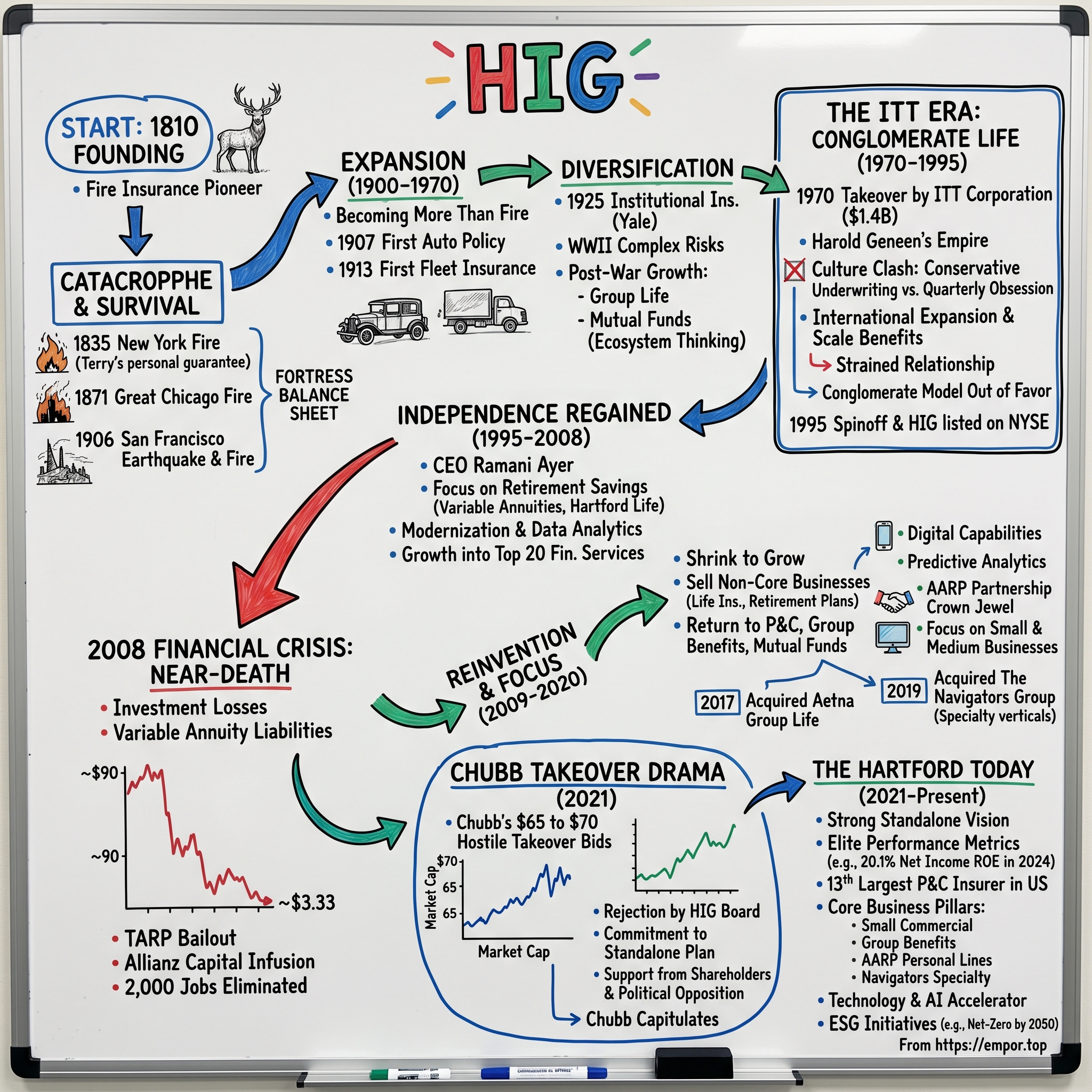
The Hartford: The 215-Year Survival Engine, Conglomerate Captivity, and the $25 Billion Takeover Defense
I. Introduction & Episode Roadmap
On March 11, 2021, an unsolicited acquisition proposal arrived on Christopher Swift's desk in Hartford, Connecticut. Evan Greenberg, the chairman and chief executive officer of Chubb Limited, offered to acquire The Hartford for $65 a share, primarily in cash—a 26% premium over the stock's 20-day volume-weighted average of $51.70.1 When the approach became public a week later, Hartford shares rose 19% in a single trading session, establishing an implied valuation of roughly $23 billion for one of the oldest institutions in American finance.2
The Hartford's board rejected the offer on March 23.3 Greenberg returned on March 30 with a revised proposal "in excess of $67." On April 14, he raised the offer to $70 a share—characterizing it as "the top end of our range"—structured as roughly 60% cash and 40% Chubb common stock, with two or three Hartford directors invited to join Chubb's board.4 Based on the initial $23 billion figure at $65, that final proposal valued the company at approximately $25 billion. On April 22, The Hartford's board unanimously rejected both revised bids, reaffirmed its confidence in the company's standalone strategic plan, and concurrently expanded its share repurchase authorization to $2.5 billion.5 Six days later, Greenberg informed analysts that "the chapter with the Hartford is closed."6
The strategic question confronting investors at the time was straightforward: Could a mid-sized, domestic commercial insurer generate stronger risk-adjusted returns independently than within Chubb's global underwriting platform? Five years later, the operating track record provides an answer. In 2025, The Hartford generated $3.8 billion in net income on $28.4 billion of revenue, delivering a core return on equity of 19.4%.7 On September 25, 2026, the stock closed around $124.68. That price represents a gain of roughly 78% over Chubb's final $70 proposal, excluding dividends, though it trades below its 52-week high of $146.07.8 Evaluating that performance requires two caveats examined throughout this account: the broader commercial property and casualty industry benefited from a protracted hard pricing cycle over that period, and Chubb's bid included a 40% equity component that also appreciated significantly.
The historical puzzle is how The Hartford survived to fight that takeover battle at all. Founded in 1810 by Connecticut merchants who contributed an initial capital pool of just $15,000,9 the firm survived the Great New York Fire of 1835, the Chicago Fire of 1871, the 1906 San Francisco earthquake, a quarter-century as a subsidiary within Harold Geneen's ITT conglomerate, an existential solvency crisis driven by variable annuity guarantees during the 2008 financial crash, and a subsequent campaign by an activist hedge fund demanding its breakup. Most peer underwriting franchises that encountered even one of those shocks did not endure.
The central thesis of this analysis is that modern The Hartford represents a deliberate case study in unbundling a financial supermarket to master underwriting. The restructured company centers on two operating engines:
- Small-business underwriting. The Hartford writes roughly $6 billion annually in small-commercial premiums, focusing on business owner's policies and workers' compensation, distributed through independent agency networks via automated quoting and pricing platforms.10
- Scale in employee benefits. Its 2017 acquisition of Aetna's group life and disability franchise established The Hartford as the second-largest group benefits underwriter in the United States.11
The analysis traces this strategic evolution across eight acts:
- Act I: Tavern capital, catastrophe-driven trust, and Lincoln's policy (1810–1900).
- Act II: Captivity inside ITT, and independence in 1995.
- Act III: The financial-supermarket trap and the 2008 crash.
- Act IV: John Paulson's campaign and the great dismantling.
- Act V: Swift's two big acquisitions, Aetna Group Benefits and Navigators.
- Act VI: The Chubb siege.
- Act VII: The modern business, the moat frameworks, and a formal attempt to falsify the bull case.
- Act VIII: The playbook, the scorecard, and what a new CEO might do.
The narrative begins with an 1810 tavern meeting and an early test by fire.
 Subscribe on LinkedIn
II. Founding & The Catastrophe Playbook: 1810 to 1900
A Sleigh Ride Through the Frozen Dark
On the night of December 16, 1835, lower Manhattan was so cold—by some accounts reaching 17 degrees below zero—that firefighters' water froze in their hoses and in the East River.9 A warehouse fire spread rapidly through the merchant district. By morning, between 500 and 700 buildings had burned, and damage exceeded $20 million, an unimaginable sum for the era.9 New York's local fire insurers had underwritten most of that risk, and 23 of the city's 26 insurance companies went bankrupt.9
One hundred and ten miles to the northeast, Eliphalet Terry, president of the Hartford Fire Insurance Company, understood that his young firm faced a defining choice. He traveled to New York by sleigh with the company's secretary, James Bolles. Before departing, Terry arranged for the Hartford Bank to honor any checks he wrote, pledging his private fortune as collateral.12 Amid the smoking ruins, he announced that The Hartford would pay every claim in full. The company's own account notes that its "president and directors pledged their personal fortunes to pay for claims."13 The losses came to just under $65,000.12
Terry then converted that emergency response into a commercial engine. On the spot, he began writing new policies at higher rates for merchants who had just watched their prior insurers vanish. In the year after the fire, The Hartford's premium volume tripled.12
That decision revealed the foundational economics of insurance: a policy is merely an intangible promise, and the product is only as credible as the balance sheet behind it. Solvency in a catastrophe is the most powerful marketing an insurer can buy. Insolvent competitors did not just lose that year's revenue; they lost their customers permanently.
Modest Origins
The enterprise backing Terry's sleigh ride was originally modest. It was chartered in 1810 with $150,000 of authorized capital, but its founders, a group of about a dozen local merchants and civic leaders, paid in only $15,000, or 10%, and borrowed the rest.914 Nathaniel Terry served as its first president.13 A popular version of the story sets the founding at Morgan's Coffee House, but that tavern is more reliably associated with the 1819 meetings that created a different Hartford insurer, Aetna.15 The confusion is understandable: Hartford became the "Insurance Capital of the World" because a cluster of merchant-backed risk pools formed in the same small river city, sharing underwriting talent, capital, and a reputation for paying claims.
Lincoln's Stag
In 1861, The Hartford insured the Illinois home of President-elect Abraham Lincoln.13 According to Pentagram, the design firm behind the company's 2025 brand refresh, that policy represents the earliest recorded use of the stag logo. The emblem was likely inspired by the seal of the city of Hartford, which in turn borrowed from the English town of Hertford—a "hart" (a mature stag) crossing a "ford." Since 1875, the company's stag has also drawn on Sir Edwin Landseer's 1851 painting The Monarch of the Glen.1617 In a sector where clients purchase protection they hope never to use, a 160-year-old trademark serves as tangible shorthand for balance-sheet endurance.
The Mega-Catastrophes
The 1835 playbook was tested twice more at far larger scale. After the Great Chicago Fire of 1871, The Hartford was one of just 31 insurers that paid all of their claims. Those claims totaled nearly $2 million, at a time when the company's assets were under $1.7 million.18 It paid out more than its existing asset base. After the 1906 San Francisco earthquake and fire destroyed almost 500 city blocks, The Hartford paid over $11 million in claims.13
Both times, the company absorbed heavy balance-sheet strain rather than discount its promises. And both times, the reward was durable franchise value in regional markets where competitors had defaulted.
The investor lesson from that first century is an operational reality rather than historical romance. The same dynamic governs The Hartford today. Its operating companies carry an A+ financial strength rating from AM Best and AA- from S&P, and both were upgraded in 2025.1920 Independent agents steer small-business customers toward carriers they trust to pay. In practice, the sleigh ride evolved into modern credit ratings.
What the company did next, in the twentieth century, was expand into a national power—and then get swallowed by an industrial conglomerate.
III. Expansion, Diversification, & Conglomerate Captivity: 1900 to 1995
From Fire to Everything
For most of the twentieth century, The Hartford's trajectory was one of relentless expansion across product lines and geography. In 1913, it formed the Hartford Accident and Indemnity Company to underwrite casualty lines: liability, auto, and workers' compensation.13 Its policies backed the defining infrastructure projects of American industrial ambition, helping insure the Hoover Dam in 1931, the Golden Gate Bridge in 1937, and the St. Lawrence Seaway in 1959.13 Crucially, it assembled a nationwide network of independent agents—Main Street brokers who distributed the bulk of its commercial coverage, an underwriting channel that remains central to the business today.
By the late 1960s, The Hartford ranked among the largest property and casualty insurers in the United States. That scale made it irresistible to the most aggressive corporate acquirer of the era.
Geneen's Crown Jewel
Harold Geneen operated International Telephone & Telegraph (ITT) with the precision of an accountant-general. He was famous for marathon review meetings, thick binders of operating metrics, and a conviction that any enterprise could be disciplined through financial controls. Under Geneen, ITT acquired hundreds of diverse businesses, assembling an empire that included Sheraton hotels, Avis rental cars, Levitt homebuilders, and Continental Baking.
Insurance held a unique structural appeal for a conglomerate builder. An insurer collects premiums upfront and pays claims years later. In the interim, it manages a substantial pool of capital—known as "float"—alongside a steady stream of operating earnings. For an acquisition-driven conglomerate, that float represented an internal financing engine.
ITT's pursuit of Hartford Fire prompted an immediate antitrust battle. The Justice Department sued to block the merger on August 1, 1969.21 In 1971, the federal judge presiding over the case approved what he termed "the largest corporate merger in history." The regulatory cost was steep: ITT agreed to divest Avis, Levitt and Sons, Hamilton Life, ITT Life Insurance of New York, the Canteen vending business, and part of its Grinnell fire-protection unit.22 TIME later called it "the biggest merger in American corporate history."23
The settlement then ignited a national political scandal. In early 1972, columnist Jack Anderson published an internal memo written by ITT lobbyist Dita Beard. It linked the favorable antitrust settlement to an alleged $400,000 ITT pledge toward the 1972 Republican National Convention in San Diego, concluding with the warning: "please destroy this, huh?"2425 The convention was subsequently moved to Miami. The controversy served as an early prelude to the Watergate era's public reckoning with corporate money in federal politics.
Life in Captivity
What twenty-five years inside ITT actually meant for The Hartford remains more nuanced than popular legend suggests. A persistent industry narrative holds that ITT extracted Hartford's float and earnings to fund unrelated conglomerate expansion, starving the underwriting franchise of investment. While consistent with how mid-century conglomerates operated, specific figures on dividends upstreamed to ITT or balance-sheet starvation are not detailed in disclosed corporate records, making the claim a plausible hypothesis rather than an established fact.
What the public record does verify is that the insurer continued to expand within the holding company. By mid-1995, "ITT Hartford" held more than $86 billion of assets and $4.8 billion of equity. It ranked as the eighth-largest U.S. property and casualty insurer and the twelfth-largest life insurer, with approximately 20,000 employees.26
One decision from the ITT era still anchors the company's income statement. In 1984, The Hartford became the exclusive provider of auto and home insurance for members of AARP, the massive affinity organization for Americans over 50.13 The partnership has been renewed repeatedly; a 2020 agreement extended it to January 1, 2033.27 For more than four decades, it has formed the backbone of The Hartford's personal lines business—a direct-to-consumer channel built on an external brand. Whether that arrangement serves as a durable moat or a captive dependency remains one of the central strategic questions in the company's modern valuation.
The Breakup
By the mid-1990s, the conglomerate model had fallen out of favor on Wall Street, and investors consistently valued ITT at a steep discount to the sum of its operating parts. In 1995, CEO Rand Araskog proposed splitting the conglomerate into three independent public companies: an insurer, an industrial manufacturer, and a hospitality and gaming business built around Sheraton hotels and casinos.2628 On December 19, 1995, ITT distributed the shares of the insurance company to its stockholders. The next day, The Hartford Financial Services Group began regular trading on the New York Stock Exchange under the ticker HIG.29
The Hartford emerged from captivity with national scale, a recognizable brand, and an aggressive mandate to grow. Its first major choice about how to pursue that growth, however, would nearly destroy it.
IV. The Financial Supermarket Mirage & The 2008 Near-Death Crash
The Seduction
In the late 1990s, the sales pitch in an American financial adviser's office sounded compelling. A retiree wanted equity-market growth but feared a major downturn. The adviser could offer a Hartford variable annuity: the client's principal was allocated to equity mutual funds, while a guaranteed minimum withdrawal benefit rider ensured that, regardless of market performance, the retiree could withdraw a fixed percentage annually for life. The contract promised upside during bull markets alongside a contractual floor during drawdowns. For the customer, it offered capital appreciation with downside protection. For the underwriter, however, it represented an unhedged accumulation of systemic equity risk.
Following its 1995 spinoff from ITT, The Hartford expanded aggressively into this market. In May 1997, it sold an 18.6% stake in its life insurance subsidiary, Hartford Life, through an initial public offering while retaining majority ownership. That year, Hartford Life led the domestic variable annuity market, holding an 11% market share on approximately $9.7 billion in sales.30 In 2000, the parent company reacquired the publicly traded shares through a tender offer at $50.50 per share.31 The transaction aligned with the prevailing era of the "financial supermarket"—popularized by Citigroup—grounded in the theory that a single corporate parent could cross-sell auto insurance, life coverage, mutual funds, and retirement income across a single customer base.
The Hartford exported that same framework overseas, distributing variable annuities through Japanese commercial banks. By year-end 2007, variable annuity account values in Japan had expanded to $35.8 billion.32
Selling Insurance on the Stock Market
The underlying structural flaw was straightforward: a guaranteed withdrawal benefit functions economically as a long-dated put option on the broader equity market. The Hartford had effectively underwritten insurance against a market crash. Unlike property and casualty insurance, however, systemic financial shocks offer no geographic diversification. A hurricane that devastates South Florida leaves the Pacific Northwest untouched, but a 40% equity market decline hits every policyholder's contract simultaneously.
Compounding that exposure, the insurer's liabilities expanded at the exact moment its underlying asset portfolio contracted. While The Hartford maintained an equity hedging program, the derivative overlays proved inadequate for the velocity and depth of the 2008 downturn. By year-end 2008, the insurer carried $38.1 billion in domestic variable annuity account values backed by guaranteed withdrawal riders. In Japan, roughly 97% of in-force "3 Win" policies—representing $3.1 billion of account value—triggered their guaranteed income benefits in the fourth quarter of 2008 alone.32
October 2008
When Lehman Brothers failed in September 2008, The Hartford absorbed simultaneous shocks across both sides of its balance sheet: guaranteed liabilities moved deep into the money while asset valuations plunged. On October 29, 2008, the company reported a third-quarter net loss of $2.6 billion, or $8.74 per share. That deficit included $2.2 billion in after-tax realized investment losses, driven by $2.0 billion of other-than-temporary impairments on securities whose market value had collapsed.33
The equity market reflected the immediate solvency threat. After trading at a high of $105.54 in May 2007, Hartford shares fell to an intraday low of $3.62 on March 6, 2009.34 An underwriting institution with nearly two centuries of operating history was suddenly priced as a distressed credit risk.
The Lifelines
The Hartford's initial capital relief arrived from Munich. On October 6, 2008, German insurer Allianz agreed to inject $2.5 billion, with terms that reflected The Hartford's constrained bargaining position:35
- $750 million of preferred stock convertible into common shares at $31.
- $1.75 billion of junior subordinated debentures paying a 10% annual coupon.
- Warrants to purchase an additional $1.75 billion of common stock at $25.32 per share.
The Hartford simultaneously lowered its quarterly dividend to $0.32 per share. Chief Executive Ramani Ayer, who had led the company since 1997, told investors: "We are taking decisive action to ensure that The Hartford remains well capitalized for long-term success."35
The private injection was insufficient to stabilize the balance sheet against ongoing market volatility. To access the federal Troubled Asset Relief Program (TARP), which was restricted to depository institutions, The Hartford paid $10 million to acquire Federal Trust Corporation, a small Florida thrift, enabling the insurer to qualify as a savings and loan holding company.36 In June 2009, the U.S. Treasury disbursed $3.4 billion from TARP, taking preferred equity alongside warrants to purchase common shares at an exercise price of $9.79.37 The Hartford repaid the Treasury in full on March 31, 2010,38 and in 2011 agreed to sell the Florida thrift it had acquired as a regulatory gateway, absorbing a $70 million charge on the divestiture.39
Ayer stepped down as chief executive on October 1, 2009.40 The financial-supermarket strategy had concluded in near-insolvency, leaving incoming management with a fundamental mandate: define what The Hartford should be when stripped of speculative capital commitments.
The lesson of the 2008 crisis was clear. The Hartford had not faced ruin from property catastrophes, industrial fires, or underwriting deficiencies in its commercial lines. It had nearly collapsed because it sold guarantees whose liabilities were perfectly correlated with the destruction of its own capital base. Eliminating that balance-sheet exposure became the organizing principle for the company's strategic overhaul over the next fifteen years.
V. The Paulson Showdown & The Great Dismantling: 2012 to 2016
The Banker and the Billionaire
On October 1, 2009, Liam McGee became chairman and CEO. He was a 55-year-old retail banker who had led consumer and small-business banking at Bank of America following an earlier career at Wells Fargo.40 As an outsider to property and casualty underwriting, McGee brought an appeal to the board grounded in detachment: he had no institutional loyalty to the financial-supermarket strategy. In early 2010, he recruited Christopher Swift as chief financial officer. Swift had previously served as head of finance for American International Group, giving him firsthand experience inside an insurance giant navigating a solvency crisis.34
By early 2012, The Hartford's balance sheet had stabilized, but its equity valuation lagged. Shares traded at a persistent discount to book value. While investors recognized the underwriting profitability of the core commercial and personal lines franchises, they remained unwilling to pay full price while those earnings were tethered to tens of billions of dollars in variable annuity guarantees exposed to another financial shock.
Then came John Paulson, the hedge fund manager who had earned billions betting against subprime credit. On a management call on February 8, 2012, Paulson urged The Hartford to "do something drastic."41 On February 14, Paulson & Co. filed a Schedule 13D disclosing an 8.4% ownership stake, accompanied by an open letter to McGee and a formal presentation.42 Paulson demanded a tax-free spinoff of the property and casualty operations to establish "two pure play insurance companies – one in life and one in P&C." He argued that a complete structural separation would lift the stock by "40 – 60%+" and asserted that shareholders "are entitled to expect the management and the Board to show leadership."4243 On a March 9 call, he publicly told analysts that McGee had "no excuse" for delay.41
Dismantling From Within
McGee and Swift responded on March 21, 2012, with a restructuring plan that delivered Paulson's strategic objective through internal liquidation rather than a corporate split.44 Instead of creating two independent public companies, The Hartford decided to systematically divest or run off its retail financial-services operations. The enterprise would refocus entirely on three core pillars: property and casualty underwriting, group benefits, and mutual funds. New annuity sales ceased on April 27, 2012.44 Paulson characterized the shift as "a first step."41 A succession of divestitures followed:
- Retirement plans: Sold to MassMutual in September 2012 for $400 million, transferring $54.9 billion in assets under management.45
- Woodbury Financial: The retail broker-dealer network, comprising roughly 1,400 advisers, went to an AIG affiliate.46
- Individual life insurance: Approximately 700,000 policies were acquired by Prudential for $615 million, with the transaction closing in January 2013.4734
- Japan annuities: The Japanese annuity block, placed in runoff in 2009, was sold to ORIX Life in 2014 for $895 million, with The Hartford recording an expected GAAP net loss of approximately $675 million on the sale.48
- Talcott Resolution: The domestic annuity runoff business was the largest and most complex component. In December 2017, The Hartford agreed to sell the unit to an investor consortium that included Cornell Capital, Atlas Merchant Capital, TRB Advisors, Global Atlantic, Pine Brook, and J. Safra Group.49 The transaction carried a headline enterprise value of $2.05 billion, which incorporated a $300 million pre-closing dividend and a retained 9.7% equity interest, while generating an expected GAAP net loss of roughly $3.2 billion. The transaction closed on May 31, 2018.50
The economics of the unwind demonstrated the true carrying cost of the financial-supermarket era. These legacy annuity liabilities were not liquidated at premiums; they were transferred at steep accounting losses to institutional buyers who demanded compensation to warehouse long-dated market guarantees. Value creation came not from cash proceeds, but from excising systemic tail risk from the balance sheet.
A Cleaner Balance Sheet, Asbestos Included
The same balance-sheet decontamination addressed an older, chronic problem. Asbestos and environmental liabilities, stemming from commercial casualty policies written decades earlier, had generated periodic reserve deficiencies for years. Effective December 31, 2016, The Hartford paid Berkshire Hathaway's National Indemnity a $650 million reinsurance premium for up to $1.5 billion of adverse development coverage in excess of its existing $1.7 billion in net reserves.51 Beth Bombara, then chief financial officer, noted that the legacy liabilities had created persistent "uncertainty for investors."51 (The risk was insulated rather than eliminated entirely: in the fourth quarter of 2025, The Hartford still added $122 million to asbestos reserves and $43 million to environmental reserves.7)
The Handoff
McGee executed this restructuring while undergoing treatment for illness. In June 2014, the company announced he would step down to concentrate on his health, stating that with the "strategic transformation largely complete, it is the right time." Swift succeeded him as chief executive officer on July 1, 2014, while Bombara, who had overseen Talcott Resolution, became CFO.52 McGee died of cancer on February 13, 2015, at age 60.53
Swift inherited a streamlined, unbundled institution with a straightforward operational mandate: underwrite commercial risks with discipline, control operating expenses, and return excess capital to shareholders. The strategic question was whether management would maintain that singular focus—or use its restored balance sheet to pursue large acquisitions.
VI. Calibrated M&A: Aetna Group Benefits & Navigators
Buying What the Other Guy Didn't Want
In the autumn of 2017, Aetna treated its group life and disability unit as a non-core operation within a health-insurance business focused on broader corporate priorities. For Swift, the asset aligned directly with The Hartford's restructured underwriting identity: short-duration, employer-sponsored coverage that renews annually and carries none of the capital-market guarantees that precipitated the 2008 crisis.
On October 23, 2017, The Hartford agreed to acquire the business for $1.45 billion in cash. The transaction brought in approximately $2 billion in annual premiums and was projected to expand the combined group benefits franchise to roughly $5 billion in premium in 2018.11 About 1,800 Aetna employees transferred with the unit, elevating The Hartford to the second-largest group life and disability underwriter in the United States, with coverage extending to more than 20 million individuals.11 Funded entirely from existing cash without new debt or equity issuance, the transaction closed on November 1, 2017. Structurally, it operated as a reinsurance transaction, ceding Aetna's policy book directly onto The Hartford's balance sheet rather than transferring contracts individually.1154
The strategic rationale addressed an apparent contradiction: why acquire life and disability liabilities after spending five years dismantling an individual life franchise? The distinction lay in liability duration. An individual life policy or variable annuity contract can bind an insurer for decades, compounding exposure to unpredictable interest-rate regimes and equity market crashes. In contrast, group life and disability contracts are typically repriced every one to two years with corporate employers. If claim frequencies rise or loss trends deteriorate, the underwriter can reset premium rates at renewal. While underwriting risk remains, it is risk management can continuously reprice.
The second-order operational benefit centered on absence management. Corporate employers increasingly outsource the administration of medical leave, statutory paid family leave, and short-term disability claims—an administrative burden that intensified as individual U.S. states enacted disparate paid-leave mandates. Once an underwriter integrates its administrative software directly into a corporate client's payroll and human resources infrastructure, replacing the carrier becomes an operationally disruptive and costly undertaking. That dynamic underpins a classic switching-cost advantage, examined more critically in Section IX.
Navigators: Buying a Passport
The company's next major transaction pursued a different strategic dimension: international expansion and specialty wholesale lines. On August 22, 2018, The Hartford agreed to acquire The Navigators Group for $70 per share in cash, representing an equity value of roughly $2.1 billion, while assuming $265 million of Navigators debt.55 The valuation represented 1.7 times Navigators' book value and an 8.9% premium over the prior day's closing share price.55 Navigators had written approximately $1.7 billion in gross written premiums in 2017 and operated Lloyd's of London Syndicate 1221, a specialty marine underwriter established in 1980.55
The transaction's rationale was both geographic and product-driven. Historically, The Hartford had operated as a domestic underwriter distributing standard commercial lines primarily through regional retail agents. Navigators introduced established relationships with wholesale brokers, specialized expertise in marine, energy, and financial lines, and an international underwriting presence through London and Continental Europe. When the acquisition closed on May 23, 2019, more than 800 employees joined the organization, forming the foundation of a newly established operating segment named Global Specialty.56 At the time of the announcement, management projected the transaction would add between $30 million and $75 million to 2020 net income.55
The Scorecard
The subsequent operating performance of the two transactions diverged sharply. The integration of Aetna's group benefits business proceeded smoothly and delivered consistent returns. By 2025, the renamed Employee Benefits segment generated a core earnings margin of 8.2% on roughly $6.4 billion of fully insured premium.7 While that margin reflected strong underwriting discipline, Section VIII demonstrates that it also sat above management's own long-term target range.
The Navigators acquisition proved far more challenging. In property and casualty insurance, underwriting profitability is tracked by the combined ratio, which measures incurred losses and operating expenses as a percentage of earned premiums; a ratio above 100 indicates an underwriting loss. Global Specialty posted combined ratios of 103.6% in 2019 and 102.6% in 2020, before recovering to 94.1% in 2021.5758 Furthermore, legacy Navigators casualty reserves deteriorated substantially. To cushion against latent balance-sheet deficiencies in the acquired book, The Hartford had secured a $300 million adverse development reinsurance cover from Berkshire Hathaway's National Indemnity—and cumulative reserve additions exhausted that protection entirely by the end of 2021.5859 By 2023, The Hartford dismantled part of the acquired footprint, selling Navigators' United Kingdom and European run-off business to Marco Capital to complete its exit from Continental Europe.60
In retrospect, The Hartford acquired Navigators near the cyclical peak of a soft commercial pricing market, absorbing three years of underwriting deficits alongside the total depletion of its reinsurance reserve cushion. Global Specialty's subsequent turnaround benefited significantly from the multi-year industry hard market that followed. In the second quarter of 2026, the division generated an underlying combined ratio of 85.8%, reflecting favorable pricing and loss trends.61 Whether that margin indicates sustainable specialty underwriting advantage or simply the crest of a hard pricing cycle remains a test that only the next soft market will settle.
Together, the Aetna and Navigators transactions redefined The Hartford's operational footprint, pairing a high-volume small-commercial business with national scale in employee benefits and an expanded specialty underwriting arm. By early 2021, that newly fortified balance sheet and cash-flow profile also made the company an acquisition target.
VII. The $25 Billion Takeover Drama: Rejecting Chubb (2021)
Two Men, One Industry
Evan Greenberg was insurance royalty—the son of Maurice "Hank" Greenberg, who had built American International Group into an underwriting powerhouse—and had assembled Chubb into a global giant through exacting risk selection and serial acquisition. Christopher Swift brought an entirely different temperament: an accountant and corporate finance executive who had spent a decade methodically dismantling The Hartford's financial supermarket to run a focused underwriting company.
On Wednesday, March 17, 2021, The Hartford's stock closed at $57.41.2 By Friday, after Bloomberg reported Chubb's takeover interest, shares closed at $68.15. The market's verdict was swift: public shareholders welcomed the prospect of a buyout premium.2
The Sequence
The takeover drama unfolded over six weeks in public view:
- March 23: The Hartford's board rejected Chubb's initial $65 cash proposal, concluding that discussions "would not be in the best interests of the company and its shareholders."3
- March 29: Chubb stated that it was "disappointed" and described itself as "a disciplined acquiror"—a public signal that it would not bid against itself indefinitely.62
- March 30: Greenberg raised his offer to "in excess of $67." Swift replied that the board's position remained unchanged.5
- April 14: Greenberg submitted his final proposal of $70 per share, targeting a definitive agreement by May 19.4
- April 22: The board unanimously rejected both revised proposals.635
Chubb stopped short of going hostile, declining to launch an unsolicited tender offer directly to shareholders or mount a proxy fight. On April 28, Greenberg told Wall Street analysts that "the money is not burning a hole in our pocket." Hartford shares fell 4.7% that afternoon to close at $66.23.6
What the Board Was Betting On
The Hartford's public defense leaned on a straightforward premise: conviction in its standalone strategic plan. The financial commitments underpinning that stance became clear the day the board formally said no. Management established a core return on equity target of 13% to 14% for 2022 and 2023 and expanded its share repurchase authorization to $2.5 billion—betting that the company could generate more value independently than Chubb was offering.5
That standalone commitment carried tangible operational and balance-sheet risks. On April 16, 2021, six days before the board's final rejection, The Hartford agreed to pay $650 million to settle sexual-abuse claims involving the Boy Scouts of America, liabilities tied to commercial liability policies written mostly during the 1970s.64 By September, that settlement figure rose to $787 million.65 Concurrently, the company was executing "Hartford Next," an internal restructuring program launched in July 2020 that originally targeted $500 million in annual pre-tax cost reductions by 2022.66 Saying no while absorbing a major historical liability and navigating an unfinished cost program represented a calculated corporate risk rather than an easy refusal.
A secondary strategic consideration also influenced the board's stance. The Hartford's core small-business franchise relies on thousands of independent retail agents who decide which carrier to quote first. Absorbing that platform into Chubb risked altering underwriting appetite, servicing standards, and commission arrangements in ways agents might resist. While target boards routinely cite culture to defend their independence, Chubb's timing was undeniably opportunistic. The bid was priced against The Hartford's 2020 earnings, which were depressed by pandemic-related costs, including $278 million in property and casualty losses and $239 million in excess group-life mortality claims.67 Acquirers routinely seek to buy underwriting franchises at cyclical lows; target boards exist precisely to resist when they believe that weakness is transient.
Did It Work?
The outcome can be evaluated first against management's explicit operational commitments. After targeting a 13% to 14% core ROE for 2022 and 2023, The Hartford generated 15.8% in 2023, 16.7% in 2024, and 19.4% in 2025.687 Meanwhile, the Hartford Next program surpassed its targets, producing approximately $636 million in cumulative pre-tax savings by 2023 compared with 2019.69 Measured against the benchmarks published during the takeover defense, the board over-delivered.
The second test is capital allocation and equity value. Rather than hoarding surplus capital, The Hartford channeled underwriting cash flows into substantial share repurchases: $1.7 billion in 2021, $1.55 billion in 2022, $1.4 billion in 2023, and $1.5 billion in 2024.596970 Those repurchases reduced diluted common shares outstanding from 358.5 million at the start of 2021 to 287.6 million by year-end 2024—a reduction of nearly 20%.70 Trading around $124.68 in late September 2026, the stock sits well above Chubb's $70 headline proposal.8
Myth vs. Reality: "Swift Proved Greenberg Wrong"
The popular narrative frames the defense as an unambiguous triumph of managerial conviction over an opportunistic suitor. A closer look reveals a more nuanced reality:
First, the 2021–2025 period coincided with one of the strongest commercial insurance pricing cycles in decades, alongside a sharp rise in benchmark interest rates that lifted fixed-income investment yields across the industry. A significant portion of The Hartford's earnings improvement reflected broader macro and industry tailwinds rather than company-specific execution alone.
Second, because 40% of Chubb's $70 bid was payable in common stock, Hartford shareholders who accepted the offer would have shared in Chubb's equity appreciation over the same period. Comparing The Hartford's standalone share price directly against a static $70 cash figure overstates the valuation gap.
Third, Chubb's shareholders avoided subsequent integration friction and the cash settlement of the Boy Scouts liabilities. Walking away preserved Chubb's underwriting capital, meaning Greenberg did not necessarily come out behind.
What the empirical record does establish is narrower but meaningful: The Hartford's board set measurable operational targets to justify walking away from a $25 billion buyout, surpassed those targets, and consistently returned surplus capital to shareholders. That track record demonstrates disciplined target-setting and capital stewardship, even if the counterfactual of a combined commercial underwriting giant remains untestable.
With the takeover threat resolved, the analysis turns to the operational mechanics of the modern enterprise—and how its core underwriting engine functions in practice.
VIII. Segment Breakdown & Modern Business Mechanics
A Morning at a Small-Business Agency
Picture an independent insurance agent in suburban Ohio on a Monday morning. A client who owns a bakery needs coverage for a second commercial location: property protection, general liability, and workers' compensation for six new employees. The agent inputs a few dozen operational metrics into a multi-carrier rating portal. Within minutes, automated underwriting engines return competitive quotes. Whichever carrier pairs a fair rate with an intuitive submission process and a reputation for fair claims settlement typically secures a policyholder who will renew for a decade. Multiplied across hundreds of thousands of Main Street enterprises, that routine transaction forms the core economic engine of The Hartford.
The Big Picture
In 2025, The Hartford generated core earnings of $13.42 per share, up 25%, alongside its $3.8 billion in net income.7 Book value per share excluding accumulated other comprehensive income—the accounting metric that isolates balance-sheet growth by stripping out unrealized bond-portfolio swings—rose 13.3% to $73.62.7 In February 2025, the parent company adopted The Hartford Insurance Group, Inc. as its formal corporate name and organized its operations into three primary underwriting segments: Business Insurance, Personal Insurance, and Employee Benefits.71
In analyzing those underwriting segments, the key metric is the combined ratio, which measures claims and expenses as a percentage of earned premiums; a result below 100 indicates an underwriting profit. Industry analysts focus particularly on the "underlying" combined ratio, which excludes volatile catastrophe losses and prior-year reserve adjustments to evaluate whether policies underwritten in the current period were priced accurately.
Business Insurance: The Engine
Business Insurance generated $14.5 billion of written premium in 2025, an 8% increase, while delivering an overall combined ratio of 88.3.7 The segment operates across three divisions:
Small Business is the franchise anchor. The unit wrote approximately $6 billion of premium in 2025 at an underlying combined ratio of 88.9.10 On the fourth-quarter 2024 earnings call, Swift highlighted "a decade long trend of annual sub-90 underlying combined ratios" in small commercial, accompanied by $1.1 billion of organic new business written in 2024 alone.72 Producing sub-90 underlying combined ratios across ten consecutive years through both soft and hard market conditions provides compelling evidence of underwriting advantage. While industry observers frequently attribute that consistency to automated quoting and digital straight-through processing, The Hartford does not publicly report its automated clearance rates, leaving the exact proportion of touchless underwriting undisclosed.
Middle & Large Business provides commercial property and casualty coverage to mid-sized manufacturers, regional contractors, and commercial institutions. Operating in a more fragmented and competitive marketplace, its underwriting results display greater cyclical volatility. In the second quarter of 2026, the division's underlying combined ratio deteriorated to 95.3, driven by elevated large fire losses.61 On that quarter's investor call, President Mo Tooker acknowledged "increasing pressure in the second quarter… especially on GL and workers' compensation," and noted that the carrier had pruned its shared-and-layered large property portfolio to below $25 million.73 That operational disclosure illustrates where commercial pricing power is eroding. Swift reinforced the point on the fourth-quarter 2025 call, remarking that commercial renewal rate increases outside workers' compensation were tracking "within a couple tenths of loss cost trends."10 When renewal pricing merely matches claims inflation, underwriting margins plateau; if rate gains decelerate below loss trends, margins compress.
Global Specialty, built around the Navigators platform, has matured into a profitable underwriting division, as detailed in Section VI.
Employee Benefits: Steady, But Near a Peak
Employee Benefits delivered an 8.2% core earnings margin in 2025 on roughly $6.4 billion of fully insured premium.7 While that performance underscored the success of the Aetna integration, executive commentary suggests those margins may be difficult to sustain. In the second quarter of 2026, the segment's disability loss ratio rose 6.3 percentage points to 74.8, compressing the core margin to 7.4%, as Swift reaffirmed that his normalized long-term margin expectation remains "6 percent to 7 percent."6173 In short, leadership acknowledged that recent underwriting profitability sat above mid-cycle norms. In August 2026, The Hartford moved to expand its scale by agreeing to acquire Equitable's employee benefits business—representing roughly $500 million in annual premium targeting small and mid-sized employers—for an undisclosed sum.74
Personal Insurance: The Problem Child in Recovery
Personal Insurance, distributed largely through the exclusive AARP affinity agreement, experienced prolonged underwriting distress during the post-pandemic inflationary spike. Driven by soaring replacement parts costs, elevated used-vehicle values, and worsening physical-damage and bodily injury severities, the division's combined ratio reached 107.5 in 2023, representing an acute underwriting deficit.75 Management responded with severe price corrections, pushing through a 21.9% written renewal rate increase in personal auto in the fourth quarter of 2023 alone.75 Those rate actions took hold over the following twenty-four months: the combined ratio improved to 99.1 in 2024 and 91.9 in 2025, prompting Swift to declare that the personal auto portfolio had "achieved targeted profitability."687
Restoring underwriting margins, however, came at the expense of policyholder retention. In the second quarter of 2026, Personal Insurance written premiums dropped 7% year-over-year, with auto premiums contracting 10%.61 On the first-quarter 2026 call, Swift defended that policy attrition, emphasizing that the company was "really loath to give back any pricing or cut rates just to grow."76 While prioritizing underwriting discipline over volume protects capital, it cements the segment as a shrinking line. To cultivate an alternative distribution pipeline, The Hartford introduced Prevail, an agency-distributed digital personal-lines product that had expanded into 23 states by mid-2026 in an initial effort to lessen structural dependence on the AARP partnership.73
The Catastrophe Line
As with all property underwriters, reported earnings remain vulnerable to volatile natural peril losses: severe convective storms, hurricanes, wildfires, and winter freezes. Pre-tax catastrophe losses totaled $768 million in 2024 and $748 million in 2025.687 A single extreme event can distort quarterly comparisons: the January 2025 Los Angeles wildfires generated an initial net loss estimate of $325 million after reinsurance recoveries, elevating Personal Insurance's combined ratio to 106.1 in the first quarter of 2025.7778 Conversely, when catastrophe losses fell to $230 million in the first quarter of 2026, Personal Insurance posted a combined ratio of 87.7.78 That cyclical variance illustrates why underlying ratios provide a cleaner assessment of pure underwriting selection, even though reported results dictate net cash flow and distributable capital.
Hartford Funds: Monetised
Hartford Funds, the asset management arm retained as a core pillar during the 2012 restructuring, managed $154.2 billion in assets under management at year-end 2025.7 In June 2026, The Hartford agreed to sell the business to its primary sub-adviser, Wellington Management. The transaction carried an estimated net-present-value consideration of $1.9 billion, comprising $300 million in upfront cash at closing alongside structured earnouts over seven years, with completion slated for the first quarter of 2027.79 The divestiture carried clear strategic symbolism: by monetizing its remaining asset manager, The Hartford liquidated the final remnant of its financial-supermarket era to operate strictly as an underwriting pure-play.
Operational performance across these divisions illustrates strong current profitability, but it raises the broader analytical question of whether The Hartford's earnings power reflects sustainable structural moats or transient hard-market tailwinds. That question requires a formal competitive evaluation.
IX. The Moat Analysis: 7 Powers & Porter's Five Forces
The War Game
Imagine a rival executive at Travelers or Chubb tasked with capturing market share from The Hartford in small commercial. Where would the attack begin? Underpricing policies might win accounts in the short term, but because casualty losses take years to emerge, buying market share with inadequate rates is a proven path to balance-sheet distress. Introducing superior quoting software is plausible, yet every major competitor is building comparable digital portals. In practice, a challenger would require decades of granular loss history, ingrained distribution habits among independent agents, and multi-year underwriting patience. That competitive reality illustrates why Hamilton Helmer's 7 Powers framework provides an instructive lens.
Helmer's 7 Powers
Process Power (Small Business underwriting). This represents the company's most credible claim to a structural moat. Helmer defines process power as embedded, organization-wide operational capabilities that competitors struggle to replicate because they require years of iterative refinement. A decade-long record of annual sub-90 underlying combined ratios in Small Business aligns directly with that definition.72 The limitation, however, is that well-capitalized peers such as Travelers operate similarly sophisticated small-commercial platforms. The empirical record indicates a durable underwriting edge within a competitive marketplace, rather than an unassailable monopoly.
Switching Costs (Employee Benefits). The underlying economic logic is clear: migrating corporate disability and leave administration across thousands of workers creates substantial operational friction for corporate human resources departments. Yet executive management's own long-term core margin target of 6% to 7% demonstrates that carrier competition enforces pricing discipline despite that administrative friction.73 In practice, switching costs protect account retention rather than pricing power.
Cornered Resource (AARP). Exclusive distribution access to AARP's vast membership base presents the outward appearance of a cornered resource. Crucially, however, that affinity arrangement is a contractual license rather than an owned proprietary asset, with the current renewal term extending through January 1, 2033.27 It operates as a commercial partnership whose economic terms remain subject to periodic renegotiation—a structural vulnerability evaluated directly in Section X.
Scale Economies. The Hartford possesses sufficient operational scale to amortize technological investments and claims-handling infrastructure across a multi-billion-dollar premium base, yet it lacks an asymmetric cost advantage over larger multi-line rivals. On the fourth-quarter 2025 earnings call, UBS analyst Brian Meredith pressed executive leadership regarding an expense ratio running "a couple of 100 basis points higher than your big peers."10 That cost structure confirms that scale operates as a competitive parity requirement rather than an independent source of power.
A peer perspective clarifies the competitive dynamics. In group benefits, The Hartford competes against MetLife, Unum, and Lincoln Financial for employer contracts, primarily through commercial benefits brokers. Because those intermediaries conduct regular competitive tenders at renewal, brokers constrain the margin any single carrier can extract from switching friction. Similarly, in small commercial, Travelers and Chubb distribute products through the exact same independent retail agencies. The Hartford's advantage, therefore, stems from executing repeatable, incremental underwriting workflows with superior consistency, rather than from locking customers into captive ecosystems.
The remaining powers in Helmer's framework—counter-positioning, network economies, and branding power—are largely absent from the company's competitive profile. The stag emblem remains a widely recognized commercial trademark, but commercial insurance buyers and commission-compensated independent brokers rarely pay premium prices for a legacy logo.
Porter's Five Forces
- Threat of new entrants: low. Stringent statutory capital requirements, comprehensive state-level regulatory licensing, and the prerequisite of multi-decade actuarial loss histories create steep barriers to entry. The persistent struggles of well-funded insurtech startups over the past decade to produce sustainable underwriting profits demonstrate that software design cannot readily substitute for seasoned loss data and balance-sheet discipline.
- Buyer power: split. Small commercial policyholders purchase policies through local independent agents and prioritize seamless quoting and policy servicing; their fragmented individual bargaining leverage is minimal. In contrast, mid-sized and large corporations retain global brokers who conduct formal competitive bidding, which explains why commercial pricing power erodes first in Middle & Large Business.
- Supplier power (reinsurers): cyclical. Reinsurance markets operate through sharp pricing cycles. In hardened reinsurance environments, primary carriers must either absorb elevated risk retentions or pay higher ceded premiums to protect their balance sheets. The Hartford's property catastrophe treaty structure illustrates that reliance: for example, its wildfire reinsurance program attached at $200 million and exhausted at $1.2 billion, as disclosed on the fourth-quarter 2024 earnings call.72
- Threat of substitutes: very low. Core commercial casualty protections, including workers' compensation and commercial auto liability, remain statutory legal mandates, while commercial property insurance is an obligatory covenant for commercial real estate lenders.
- Rivalry among existing competitors: high. Established peers such as Travelers, Chubb, Liberty Mutual, and CNA compete aggressively across standard commercial lines, while Progressive leads commercial auto and MetLife and Unum compete in group benefits. Management's disclosures on the second-quarter 2026 call regarding emerging pricing pressure in general liability and workers' compensation demonstrate that competitive rivalry intensifies as broader industry hard-market pricing conditions begin to moderate.73
Together, these analytical frameworks delineate a disciplined, highly capable underwriter operating inside a structurally competitive industry, anchored by a single standout underwriting engine. The subsequent section subjects that operating foundation to a formal attempt at falsification.
X. Mandatory Historical Falsification Layer: Testing the Core Theses
Claim 1: The AARP Partnership Protects Personal Lines
The claim: Exclusive access to AARP members provides The Hartford with a durable underwriting advantage in personal auto and home insurance.
The strongest disconfirming evidence: In 2023, with the AARP partnership fully operational, Personal Lines posted an underlying combined ratio of 107.5—representing an acute underwriting deficit that required more than two years of aggressive, double-digit rate increases to repair.7568 When management pushed through those price hikes to restore margins, the policy book contracted: written premiums fell 7% year-over-year in the second quarter of 2026.61 If the affinity partnership functioned as a genuine pricing shield, the company could have raised premiums without shedding policyholders or compressing underwriting margin. It could not.
Verdict: Narrowed. The AARP agreement provides an efficient, low-acquisition-cost distribution funnel, but it offers no insulation against severe claims inflation or regulatory delays in securing state rate approvals. The thesis survives only in this diminished form. The defining milestone to watch is the contract's renewal ahead of its January 2033 expiration: an extension on comparable terms would corroborate the narrowed thesis, whereas any loss of exclusivity or diminished commission economics would falsify it entirely.27
Claim 2: The Hartford Is a Disciplined Acquirer
The claim: Executive management allocates capital with consistent discipline across mergers and acquisitions.
The disconfirming evidence: The Hartford acquired Navigators at 1.7 times book value, absorbed underwriting deficits in 2019 and 2020, and fully exhausted its $300 million adverse development reinsurance cover by the end of 2021.555759 Looking further back into corporate history, the 1997–2008 variable annuity expansion orchestrated under earlier leadership culminated in near-insolvency and forced divestitures at severe accounting losses, including an expected $3.2 billion net GAAP loss on Talcott Resolution.49
Weighing it: The current leadership regime under Christopher Swift, who took over as chief executive in 2014, is accountable for Aetna and Navigators rather than the earlier annuity era. The Aetna transaction proved an unambiguous operational and financial success, whereas Navigators imposed several years of balance-sheet drag before recovering amid a prolonged industry hard market.
Verdict: Qualified. The M&A track record under Swift is respectable rather than flawless, and its ultimate success has relied meaningfully on cyclical macro tailwinds. The next operational test centers on the integration of Equitable's employee benefits business: underwriting margins across that acquired portfolio over 2027 and 2028 will demonstrate whether transaction discipline holds without the support of a hardening pricing cycle.74
Claim 3: Diversification Across Financial Services Creates Value
The claim: A respected financial brand can unlock superior shareholder value by cross-selling life insurance, annuities, asset management, and property and casualty coverage across a unified customer base.
The disconfirming evidence: The company's modern history provides the starkest available refutation: the 2008 solvency crisis, emergency capital infusions secured on punitive terms, federal rescue funds, and the systematic dismantling of virtually every retail financial-services division between 2012 and 2018.333544 The June 2026 agreement to divest Hartford Funds completes that multi-year strategic retreat.79
Verdict: Rejected. In The Hartford's corporate experience, expanding into equity-sensitive financial products magnified balance-sheet fragility rather than diversifying risk.
Claim 4: Reserves Are Clean
The claim: Following the Berkshire Hathaway retroactive asbestos treaty and the Navigators adverse development cover, legacy casualty reserve deficiencies have been resolved.
The disconfirming evidence: The company strengthened general liability reserves by $130 million in the fourth quarter of 2024—driven by construction defect claims originating in the 2015 to 2018 accident years—and added another $46 million in the second quarter of 2026 following elevated large-loss frequency.7273 In the fourth quarter of 2025, it recorded an additional $165 million in legacy asbestos and environmental reserve additions.7 Tempering those charges, total prior-year reserve development across the enterprise remained net favorable by $360 million for full-year 2025.7
Verdict: Intact but unproven. Aggregate balance-sheet reserves appear solid, but commercial casualty lines continue to produce periodic, localized reserve strengthening. The critical indicator to monitor is prior-year reserve development across general liability and commercial auto; a succession of larger casualty reserve additions would decisively falsify the claim.
Myth vs. Reality: "The Hartford Is a Pure P&C Company"
Common investment shorthand describes The Hartford strictly as a commercial property and casualty underwriter. The reality is that Employee Benefits remains a core pillar, generating roughly $6.4 billion in annual premium and expanding further through the Equitable transaction.774 That structural distinction matters because group disability underwriting hinges on national employment levels, wage growth, and medical recovery durations rather than severe weather events or legal tort inflation. This product mix provides genuine non-correlated diversification, but it also demonstrates that The Hartford is not the pure-play property-casualty insurer many investors assume. When disability claims deteriorate—as evidenced by the 6.3-percentage-point increase in the segment's loss ratio in the second quarter of 2026—group earnings can compress independently of the commercial property and casualty cycle.61
These empirical tests establish the baseline for evaluating executive leadership and the operating performance that followed.
XI. Management, Governance, & Capital Allocation Scorecard
The Partnership
Christopher Swift has served as chief executive officer since 2014 and also serves as chairman of the board.80 Chief Financial Officer Beth Costello was appointed in 2014 under the surname Bombara, having previously overseen the Talcott Resolution annuity runoff.52 Together, they have spent more than a decade executing a consistent corporate playbook: simplify the enterprise, underwrite for margin, and return excess capital to shareholders. In February 2025, Mo Tooker became president, overseeing all property and casualty underwriting operations.80 That appointment established Tooker as the most visible operating executive below Swift, though the board has announced no formal executive succession plan.
Promises vs. Outcomes
Evaluating executive credibility centers on performance against explicit operating targets. The 13% to 14% core return on equity target established during the 2021 Chubb defense was exceeded in every subsequent year.57 The Hartford Next restructuring program similarly surpassed its operational efficiency goals.69 In personal auto, Swift pledged on the fourth-quarter 2024 earnings call to return the book to targeted profitability by mid-2025, a turnaround management declared complete by year-end.727
Prior-year reserve development provides a more demanding test of managerial candor. When general liability reserves required a $130 million addition in the fourth quarter of 2024, Costello linked the charge directly to construction defect claims from the 2015 through 2018 accident years rather than citing broad industry trends.72 When second-quarter 2026 results required another $46 million reserve addition, she identified the driver as "elevated large loss activity" and disclosed that the underlying casualty reserve base stood at "a little bit under $6.5 billion."73 Granular disclosures do not erase reserve deficits, but they allow investors to assess whether claims inflation remains ring-fenced. Still, repeated localized additions across casualty lines remain an area where underwriting discipline warrants continuous scrutiny.
Executive communication has also grown more guarded as the commercial pricing cycle matured. On the fourth-quarter 2025 earnings call, Swift announced that the company would "refrain from any specific numbers or ranges" for 2026 financial guidance.10 Market participants can interpret that reticence either as prudent caution at a cyclical turning point or as diminished forward transparency.
Capital Return
Capital management remains the central pillar of executive capital allocation. In 2025, The Hartford returned $2.2 billion to shareholders, deploying $1.6 billion into share repurchases alongside $592 million in common dividends.7 In October 2025, the board raised the quarterly dividend by 15% to $0.60 per share.81 That capital return pace expanded further in July 2026, when the company authorized a new $4.2 billion share repurchase program running through 2028, increasing repurchases to approximately $475 million per quarter.61 On the fourth-quarter 2025 earnings call, when analyst Elyse Greenspan asked why buyback volume was increasing modestly relative to record earnings, Costello emphasized that leadership prioritized "a goal of being consistent."10
Credit rating agencies have recognized that sustained balance-sheet discipline. AM Best upgraded the holding company's credit ratings in July 2025, and S&P Global Ratings raised the financial strength rating of the operating subsidiaries to AA- in August 2025.1920
The Activist Stress Test
A rigorous assessment of the company requires identifying where a skeptical investor or activist would focus today. Three operational vulnerabilities stand out:
First, operating cost efficiency. Wall Street analysts on the fourth-quarter 2025 earnings call highlighted an underwriting expense ratio running roughly two hundred basis points higher than larger multi-line peers.10 In standard commercial lines where coverage is competitively quoted, an expense gap limits structural operating leverage.
Second, the capital efficiency of share buybacks at premium valuations. At a second-quarter 2026 book value per share of $70.28, the equity traded at roughly 1.8 times book value, meaning each dollar deployed retired substantially less balance-sheet equity than repurchases executed during the 2021 takeover defense.618
Third, operational and cybersecurity exposure in automated distribution. In October 2025, The Hartford paid $815,000 to resolve an enforcement action with the New York Attorney General regarding credential-stuffing attacks on its online quoting tools that exposed personal data belonging to approximately 30,000 New York residents.82 For an underwriter whose small-commercial advantage relies on automated submission portals and straight-through processing, digital security represents an essential operational dependency.
While none of these issues threatens solvency, together they delineate where board governance and executive accountability will face their next test as commercial market conditions soften. The question that follows is what broader lessons this twelve-year corporate turnaround provides.
XII. Playbook: Business & Investing Lessons
Lesson 1: Beware the Float Machine
The ITT era is frequently remembered as a cautionary tale of a conglomerate siphoning insurance float to finance unrelated industrial expansion. Yet the documented historical lesson centers on operating focus: The Hartford emerged from ITT in 1995 with national scale but remained burdened by the complexity of a multi-line financial conglomerate.26 Because empirical records detailing how much capital ITT upstreamed remain thin, the takeaway serves as an operating principle rather than a quantified indictment: insurance capital generates durable value only when tethered directly to disciplined underwriting risk.
Lesson 2: Shrinking Can Create Value
The Hartford's most value-accretive era followed its decision to downsize. Systematically shedding its individual life, retirement plan, broker-dealer, Japanese annuity, and mutual fund operations left a focused enterprise that public markets could cleanly evaluate. For investors, conglomerate complexity imposes a persistent valuation discount—particularly when a single volatile division harbors existential solvency risk for the entire balance sheet.
A nuanced dynamic emerges regarding John Paulson. The hedge fund manager lost the tactical battle over mechanics: The Hartford rejected the tax-free spinoff he demanded. Yet he arguably won the strategic debate over corporate direction, as the resulting franchise closely mirrors the property and casualty pure-play envisioned in his 2012 letter, complemented by group benefits.42 Activist campaigns are routinely graded on whether boards adopt their specific structural blueprints. A more rigorous standard evaluates whether an enterprise ultimately migrates toward the underlying pools of value the activist identified—and against that benchmark, Paulson's strategic thesis proved durable.
Execution friction carries its own lesson. Divesting businesses individually—frequently absorbing substantial GAAP net losses—spanned six years from the initial March 2012 restructuring announcement to the final closing of the Talcott Resolution transaction in 2018.4450 While a corporate spinoff might have achieved separation faster, it risked stranding an independent annuity entity with legacy guarantees that could fail during a subsequent market downturn without parent support. A deliberate, capital-absorptive unwind proved to be the more resilient path.
Lesson 3: When Saying No Is Defensible
The Hartford's rejection of Chubb's $25 billion acquisition approach provides an instructive blueprint for corporate boards facing unsolicited bids. Takeover defenses routinely lean on vague assertions of intrinsic value or corporate culture, which often mask managerial entrenchment. The Hartford's board took a different approach: it anchored its defense to explicit, verifiable operational commitments—most notably a 13% to 14% core return on equity target—paired with immediate capital return via share repurchases. A takeover defense without quantitative benchmarks is mere resistance; anchored to audited performance metrics, it becomes an accountability test that shareholders can objectively score.
Lesson 4: In Small Commercial, Consistency Is the Moat
A decade of annual sub-90 underlying combined ratios in Small Business demonstrates that competitive advantage in commercial underwriting stems from operational repetition. Quoting speed and intuitive agency interfaces facilitate distribution, but the foundational moat lies in iterative pricing discipline powered by cumulative loss data.
Consider an industrial analogy: a small-commercial underwriter operates like a commercial bakery producing the same loaf millions of times each year. An individual loaf offers little incremental insight, but aggregating data across millions of bakes reveals precisely how flour grade, oven temperature, and humidity interact. Similarly, an insurer underwriting hundreds of thousands of Main Street risks—plumbers, dry cleaners, and medical clinics—identifies actuarial cost trends and loss frequencies far more rapidly than a regional peer underwriting a few thousand accounts. That continuous data feedback loop creates an underwriting moat that capital alone cannot quickly purchase. It also shields small commercial from the severe pricing cycles that institutional brokers impose during competitive tenders for large corporate accounts. The critical caveat is that well-capitalized peers, including Travelers, operate comparable underwriting platforms at similar scale, ensuring that process power provides a relative advantage rather than an impregnable monopoly.
Lesson 5: Match Liabilities to Assets
The Hartford's near-insolvency during the 2008 financial crash originated in an existential asset-liability mismatch: issuing long-dated variable annuity guarantees tied to equity markets while holding investment assets vulnerable to the same macroeconomic decline. Modern The Hartford, by contrast, underwrites primarily short-tail commercial and personal liabilities backed by a high-grade fixed-income portfolio. That restructuring allowed the insurer to capture the full benefit of rising interest rates, as net investment income expanded 13% in 2025 to $2.9 billion, and rose 22% in the second quarter of 2026 as higher reinvestment yields filtered through the portfolio.761 Macroeconomic tailwinds create genuine shareholder value only when the underlying balance sheet is unencumbered by correlated equity guarantees.
These structural lessons establish the analytical foundation for the concluding evaluation: the forward-looking operating risks, key indicators to monitor, and the strategic choices awaiting the next generation of leadership.
XIII. Valuation, Bull vs. Bear Case, & The 3 Critical KPIs
Where the Stock Sits
At about $124.68 on September 25, 2026, The Hartford carries an equity valuation of roughly $33.8 billion, trading at approximately 8.7 times trailing earnings with a dividend yield near 1.9%.8 The stock trades closer to its 52-week low than its peak of $146.07, indicating that public markets are pricing in a decelerating commercial insurance cycle.8
That market caution follows a clear underwriting rationale: property and casualty earnings typically crest at the tail end of a hard pricing market, immediately before premium rate increases level off. A single-digit price-to-earnings multiple on peak earnings is not necessarily a bargain; it often reflects Wall Street's expectation that underwriting returns will drift back toward mid-cycle levels. Results from the second quarter of 2026 illustrated that dynamic: while headline net income rose 31%, core operating earnings grew by just 1%, with net income bolstered by a $251 million tax benefit associated with the Hartford Funds divestiture.61 Investors watching only the headline figure would have missed that organic earnings growth was slowing.
For long-term investors, the defining question is not whether the next few years can match the record earnings of 2025. They almost certainly will not. The real test is how much of that recent margin expansion proves durable through an industry downturn. If Small Business can sustain an underlying combined ratio below 90 through a softer pricing environment—as it did during the last cycle—the franchise will validate its structural underwriting advantage. If it cannot, much of the post-2021 financial outperformance will be revealed as cyclical hard-market lift.
The 3 KPIs That Matter Most
- Business Insurance underlying combined ratio (especially Small Business). This metric provides the clearest signal of whether the core commercial franchise maintains pricing discipline as industry rate gains moderate. In the second quarter of 2026, Small Business posted an underlying combined ratio of 86.5, while Business Insurance overall stood at 89.3.61
- Net investment income. Quarterly investment earnings expanded to $800 million in the second quarter of 2026, with Costello pointing to continued portfolio yield growth as older fixed-income securities roll over into higher-yielding paper.6110 While this provides a reliable earnings cushion, the trajectory remains tied to broader macroeconomic interest rates that the company does not control.
- Core return on equity. Running at 18.7% on a trailing twelve-month basis as of the second quarter of 2026, core ROE synthesizes underwriting discipline, portfolio yield, and share repurchases into a single benchmark for overall capital efficiency.61
The Bull Case
- Small Business compounding. A decade of consistent annual sub-90 underlying combined ratios in a large, fragmented commercial marketplace provides a durable, cash-generative earnings foundation.72
- Fixed-income reinvestment tailwinds. Higher prevailing interest rates continue to lift net investment income as maturing legacy bonds are reinvested at higher current yields.61
- Predictable capital return. A $4.2 billion share repurchase authorization through 2028, paired with a growing dividend, supports per-share earnings growth even if underwriting margins plateau.61
- Operational focus. The divestiture of Hartford Funds and the acquisition of Equitable's employee benefits business eliminate remaining non-core distractions and further concentrate capital on pure underwriting operations.7974
The Bear Case
- A softening commercial pricing cycle. Management has acknowledged emerging rate pressure in general liability and workers' compensation, with Swift noting that commercial property rate increases "will continue to soften."7310 A decade of strong results was achieved partly with the wind of a hard market at the company's back; an extended soft market will provide the genuine test.
- Social inflation and casualty reserves. Rising litigation costs and elevated jury verdicts continue to pressure casualty lines, prompting localized reserve additions; Costello noted "more attorney involvement in accidents" within commercial auto.73
- Catastrophe exposure. Volatile natural perils remain an ongoing drag on reported earnings; the January 2025 Los Angeles wildfires caused an estimated $325 million net loss after reinsurance, while annual catastrophe losses across the company have hovered around $750 million.777
- Personal lines policy attrition. Prioritizing underwriting margin over volume has resulted in sustained policy contraction, while direct-to-consumer distribution remains contractually tethered to an AARP agreement that expires in January 2033.6127
- Employee Benefits margin normalization. With the segment's core earnings margin reaching 8.2% in 2025, management's long-term target of 6% to 7% indicates that underwriting margins will compress toward historical norms as disability loss trends normalize.73
How management navigates the balance between these two cases will determine whether The Hartford sustains its valuation premium or watches its peak-cycle returns recede with the broader market.
XIV. Epilogue: If We Were CEO & The Third Century of The Stag
The Next Moves
If an incoming chief executive stepped into Swift's chair tomorrow, five strategic questions would dominate the corporate agenda.
Fix or reshape Personal Insurance. The segment has returned to profitability, but premium volume is contracting and distribution remains contractually tethered to a single affinity partner. The defining decision point is the AARP renewal ahead of 2033. Strategic alternatives range from renewing the partnership while investing in Prevail as an independent agency channel, to divesting the personal-lines book to a specialist underwriter and focusing entirely on commercial property, casualty, and employee benefits. Either strategy can be defended; operational drift cannot.
Test Global Specialty through a soft market. Global Specialty has delivered attractive underwriting margins during a prolonged hard pricing cycle. The true test of underwriting discipline is whether management will accept premium contraction as commercial pricing moderates, rather than chasing volume into softer lines simply because the Lloyd's platform provides the licensing capacity to write them.
Use automation to close the peer expense gap. On the fourth-quarter 2025 earnings call, Swift described "reimagining our processes and workflows with an AI-first mindset," citing early operational gains in claims—including automated medical-record summarization—and in commercial underwriting.10 The quantitative test of that technology investment will be whether it narrows the persistent expense-ratio gap against larger multi-line rivals. If efficiency gains do not translate into lower underwriting expense ratios, the initiative will have produced rhetoric rather than structural operating leverage.
Deploy the Hartford Funds proceeds deliberately. The Wellington transaction delivers $300 million in upfront cash alongside structured earnouts over seven years.79 While uncommitted capital often tempts leadership teams into pursuing transformative acquisitions, The Hartford's corporate history argues for disciplined restraint: its most accretive transaction, Aetna Group Benefits, scaled an existing core capability, whereas its costliest misstep, Navigators, represented an expansion into unfamiliar specialty lines at the top of a pricing cycle. Smaller, targeted additions—such as the Equitable employee benefits acquisition—paired with consistent share repurchases, align far better with management's demonstrated operating strengths.
Establish visible executive succession. Swift has led the organization since 2014. While Tooker's appointment as president represents a meaningful step toward executive clarity, a transparent succession roadmap is essential for an enterprise whose turnaround has been so closely identified with a single leadership team.80 The addition of new directors in 2026, including former Fannie Mae chief executive Priscilla Almodovar, signals ongoing governance renewal, even as formal succession timing remains unannounced.83
The Third Century
In 1835, Eliphalet Terry demonstrated that an insurer's true product is solvency—the credible promise to pay when competitors fail. For much of the late twentieth century, The Hartford strayed from that principle, chasing financial-supermarket scale and nearly collapsing under the weight of equity guarantees it could not hedge. The enterprise entering its third century is smaller, more focused, and consistently profitable, led by an executive team that has surpassed its operating targets. Whether that competitive advantage proves structural will be determined in the softening commercial market ahead, when underwriting results finally reveal whether the stag's discipline is an ingrained institutional capability or the temporary harvest of a hard-market cycle.
References
-
Chubb Confirms Submission of Preliminary Proposal for Strategic Business Combination to The Hartford — Chubb Limited, 2021-03-18 ↩
-
Chubb Proposes $23 Billion Deal for The Hartford — Insurance Journal, 2021-03-19 ↩↩↩
-
The Hartford Rejects Chubb's $23 Billion Takeover Offer — Insurance Journal, 2021-03-23 ↩↩
-
Proposal Letter from Chubb Limited to The Hartford (Exhibit 99.5 to Form 8-K) — U.S. Securities and Exchange Commission, 2021-04-22 ↩↩
-
The Hartford First Quarter 2021 Financial Results and Board Rejection of Chubb Proposals (Exhibit 99.1 to Form 8-K) — U.S. Securities and Exchange Commission, 2021-04-22 ↩↩↩↩↩
-
Chubb CEO Says Hartford Chapter Is Closed — Claims Journal (Reuters), 2021-04-29 ↩↩
-
The Hartford Reports Outstanding Fourth Quarter Earnings Of $1.1 Billion And Full Year 2025 Earnings Of $3.8 Billion — The Hartford, 2026-01-29 ↩↩↩↩↩↩↩↩↩↩↩↩↩↩↩↩↩↩↩
-
The Hartford Insurance Group (HIG) Stock Overview — Stock Analysis, 2026-09-25 ↩↩↩↩↩
-
The Hartford Insurance Story: One Man, One Bold Stroke, One Insurance Capital — New England Historical Society ↩↩↩↩↩
-
The Hartford Fourth Quarter 2025 Earnings Call Transcript — The Hartford Investor Relations, 2026-01-30 ↩↩↩↩↩↩↩↩↩↩
-
The Hartford Signs Agreement To Acquire Aetna's U.S. Group Life And Disability Business — The Hartford, 2017-10-23 ↩↩↩↩
-
Insurance and the New York Fire of 1835 — The Tontine Coffee-House, 2023-09-25 ↩↩↩
-
Hartford Fire Insurance Company Advertisement, Signal of Liberty — Ann Arbor District Library, 1845-03-24 ↩
-
Aetna Helps Make Hartford 'The Insurance Capital of the World' — Connecticut History ↩
-
The Hartford Unveils Refreshed Brand With Modernized Stag Logo — The Hartford, 2025-02-06 ↩
-
The Great Chicago Fire and the Great Merlin Law Group Chicago Office — Merlin Law Group, 2017-12-14 ↩
-
AM Best Upgrades Issuer Credit Ratings of The Hartford Insurance Group, Inc. and Its Subsidiaries — AM Best, 2025-07-03 ↩↩
-
S&P Upgrades The Hartford and Its Subsidiaries to AA- on Strengthened Capital and Steady Results — Reinsurance News, 2025-08-26 ↩↩
-
U.S. v. International Telephone and Telegraph Corporation and Hartford Fire Insurance Company — U.S. Department of Justice Antitrust Division ↩
-
Politics, Policy, and Antitrust: Revisiting the ITT Affair — George Mason Law Review Forum ↩
-
The I.T.T. Affair and Why Public Financing Matters for Political Conventions — Brennan Center for Justice, 2014-03-19 ↩
-
ITT Corporation Proxy Statement on the Proposed Distribution — U.S. Securities and Exchange Commission, 1995-08-11 ↩↩↩
-
The Hartford And AARP Agree To Extend Auto And Home Insurance Program For AARP Members — The Hartford, 2020-06-02 ↩↩↩↩
-
The Dismantling of Harold Geneen's ITT — Fortune, 2011-05-19 ↩
-
The Hartford Financial Services Group Form 10-K for Fiscal Year 1997 — U.S. Securities and Exchange Commission, 1998 ↩
-
Hartford Life, Inc. Form 10-K for Fiscal Year 1997 — U.S. Securities and Exchange Commission, 1998 ↩
-
Hartford Life, Inc. Form 8-K on Tender Offer by Hartford Fire Insurance Company — U.S. Securities and Exchange Commission, 2000-05-18 ↩
-
The Hartford Financial Services Group Form 10-K for Fiscal Year 2008 — U.S. Securities and Exchange Commission, 2009 ↩↩
-
The Hartford Third Quarter 2008 Results (Exhibit 99.1 to Form 8-K) — U.S. Securities and Exchange Commission, 2008-10-29 ↩↩
-
How The Hartford Was Saved from the Brink — CFO.com, 2013-10-09 ↩↩↩
-
The Hartford Announces $2.5 Billion Capital Investment by Allianz (Exhibit 99.1 to Form 8-K) — U.S. Securities and Exchange Commission, 2008-10-06 ↩↩↩
-
The Hartford Closes Deal to Buy Federal Trust Corp. — InvestmentNews, 2009-06-25 ↩
-
The Hartford Receives $3.4 Billion in TARP Funds — Insurance Journal, 2009-06-29 ↩
-
The Hartford Completes Repurchase of Treasury's CPP Investment (Exhibit to Form 8-K) — U.S. Securities and Exchange Commission, 2010-03-31 ↩
-
The Hartford to Sell Federal Trust Bank to CenterState — Insurance Journal, 2011-05-23 ↩
-
The Hartford Names Liam E. McGee Chairman and CEO (Exhibit to Form 8-K) — U.S. Securities and Exchange Commission, 2009-09-30 ↩↩
-
Hartford Rises as CEO Responds to Paulson's Breakup Push — Bloomberg via Wink Inc., 2012-03 ↩↩↩
-
Paulson & Co. Schedule 13D on The Hartford Financial Services Group — U.S. Securities and Exchange Commission, 2012-02-14 ↩↩↩
-
Hedge Fund Titan John Paulson Urges The Hartford to Split Up — Reuters, 2012-02-15 ↩
-
The Hartford Announces New Strategic Direction (Exhibit 99.1 to Form 8-K) — U.S. Securities and Exchange Commission, 2012-03-21 ↩↩↩↩
-
The Hartford Agrees to Sell Retirement Plans Business to MassMutual (Exhibit to Form 8-K) — U.S. Securities and Exchange Commission, 2012-09-04 ↩
-
The Hartford Sells Woodbury Financial to AIG Unit — Insurance Journal, 2012-08-01 ↩
-
Prudential Financial to Acquire The Hartford's Individual Life Insurance Business (Exhibit 99.1 to Form 8-K) — U.S. Securities and Exchange Commission, 2012-09-27 ↩
-
Hartford Deal Sells Off Japanese Annuity Business to ORIX — Business Insurance, 2014-04-28 ↩
-
The Hartford Announces Sale of Life and Annuity Run-off Business (Exhibit 99.1 to Form 8-K) — U.S. Securities and Exchange Commission, 2017-12-04 ↩↩
-
The Hartford Completes Sale of Talcott Resolution (Form 8-K) — U.S. Securities and Exchange Commission, 2018-05-31 ↩↩
-
Hartford Transfers Asbestos, Environmental Exposure to Berkshire's National Indemnity — Insurance Journal, 2017-01-03 ↩↩
-
Hartford CEO McGee to Step Down; Swift Named Successor — Insurance Journal, 2014-06-09 ↩↩
-
Former Hartford CEO Liam McGee Dies at 60 — Insurance Journal, 2015-02-16 ↩
-
The Hartford Financial Services Group Form 10-K for Fiscal Year 2017 — U.S. Securities and Exchange Commission, 2018-02-23 ↩
-
The Hartford to Acquire Navigators — Investor Presentation — The Hartford, 2018-08-22 ↩↩↩↩↩
-
The Hartford Closes Acquisition Of Navigators (Exhibit 99.1 to Form 8-K) — U.S. Securities and Exchange Commission, 2019-05-23 ↩
-
The Hartford Investor Financial Supplement, Fourth Quarter 2020 — U.S. Securities and Exchange Commission, 2021 ↩↩
-
The Hartford Investor Financial Supplement, Fourth Quarter 2021 — U.S. Securities and Exchange Commission, 2022 ↩↩
-
The Hartford Financial Services Group Form 10-K for Fiscal Year 2021 — U.S. Securities and Exchange Commission, 2022 ↩↩↩
-
Marco Capital Completes the Acquisition of Navigators International Insurance Company from The Hartford — Marco Capital, 2023-06-09 ↩
-
The Hartford Reports Strong Second Quarter 2026 Financial Results (Exhibit 99.1 to Form 8-K) — U.S. Securities and Exchange Commission, 2026-07-23 ↩↩↩↩↩↩↩↩↩↩↩↩↩↩↩↩
-
Chubb 'Disappointed' by The Hartford's Rejection — Insurance Journal, 2021-03-29 ↩
-
Response from The Hartford to Chubb Limited (Exhibit 99.6 to Form 8-K) — U.S. Securities and Exchange Commission, 2021-04-22 ↩
-
The Hartford Announces Settlement Agreement with Boy Scouts of America (Exhibit 99.1 to Form 8-K) — U.S. Securities and Exchange Commission, 2021-04-16 ↩
-
The Hartford Form 8-K on Revised Boy Scouts of America Settlement — U.S. Securities and Exchange Commission, 2021-09-14 ↩
-
The Hartford Second Quarter 2020 Financial Results (Exhibit 99.1 to Form 8-K) — U.S. Securities and Exchange Commission, 2020-07-30 ↩
-
The Hartford Fourth Quarter and Full Year 2020 Financial Results (Exhibit 99.1 to Form 8-K) — U.S. Securities and Exchange Commission, 2021-02-04 ↩
-
The Hartford Announces Outstanding Results For The Fourth Quarter and Full Year 2024 — The Hartford, 2025-01-30 ↩↩↩↩
-
The Hartford Financial Services Group Form 10-K for Fiscal Year 2023 — U.S. Securities and Exchange Commission, 2024 ↩↩↩
-
The Hartford Financial Services Group Form 10-K for Fiscal Year 2024 — U.S. Securities and Exchange Commission, 2025 ↩↩
-
The Hartford Announces Name and Brand Changes (Form 8-K) — U.S. Securities and Exchange Commission, 2025-02-06 ↩
-
The Hartford Fourth Quarter 2024 Earnings Call Transcript — The Hartford Investor Relations, 2025-01-31 ↩↩↩↩↩↩↩
-
The Hartford Second Quarter 2026 Earnings Call Transcript — The Hartford Investor Relations, 2026-07-24 ↩↩↩↩↩↩↩↩↩↩
-
The Hartford To Acquire Equitable's Employee Benefits Business — The Hartford, 2026-08-04 ↩↩↩↩
-
The Hartford Announces Outstanding Fourth Quarter And Full Year 2023 Financial Results (Exhibit 99.1 to Form 8-K) — U.S. Securities and Exchange Commission, 2024 ↩↩↩
-
The Hartford First Quarter 2026 Earnings Call Transcript — The Hartford Investor Relations, 2026-04-24 ↩
-
The Hartford Q1 2025 Results Include California Wildfire Losses — Insurance Journal, 2025-04-25 ↩↩
-
The Hartford Reports First Quarter 2026 Financial Results (Exhibit 99.1 to Form 8-K) — U.S. Securities and Exchange Commission, 2026-04-23 ↩↩
-
Wellington Management to Acquire Hartford Funds — Wellington Management, 2026-06-03 ↩↩↩↩
-
The Hartford Announces Appointment Of A. Morris (Mo) Tooker As Company President — The Hartford, 2025-01-09 ↩↩↩
-
The Hartford Announces Record Third Quarter Earnings — The Hartford, 2025-10-27 ↩
-
Attorney General James Secures $14.2 Million from Car Insurance Companies over Data Breaches — New York State Attorney General, 2025-10-14 ↩
-
The Hartford Appoints Priscilla Almodovar To Its Board of Directors — Business Wire, 2026-08-11 ↩
 LinkedIn
 WhatsApp
 Reddit
 Hacker News
 Email
 Kindle
 RSS Feed
 Spotify
 Apple Podcasts
 Amazon Music
 Audible
 YouTube