Honeywell International: The Anatomy, Triumph, and Unwinding of America's Industrial Conglomerate
I. Introduction & Episode Roadmap
On the morning of June 29, 2026, a new ticker debuted on Nasdaq: HONA. For every two Honeywell shares they held, shareholders received one share of an independent Honeywell Aerospace.1 The company that had built autopilots for World War II bombers, cockpits for modern jetliners, and control systems for global oil refineries was no longer a single enterprise. It had split into three.
The ticker HON did not disappear. It remains with Honeywell Technologies, a pure-play automation provider with approximately $20 billion in expected 2026 sales, headquartered in Charlotte, North Carolina.12 Eight months earlier, on October 30, 2025, another division had already separated: Solstice Advanced Materials, the refrigerants and specialty chemicals business, began trading under the ticker SOLS with roughly $3.8 billion in 2024 net sales.3
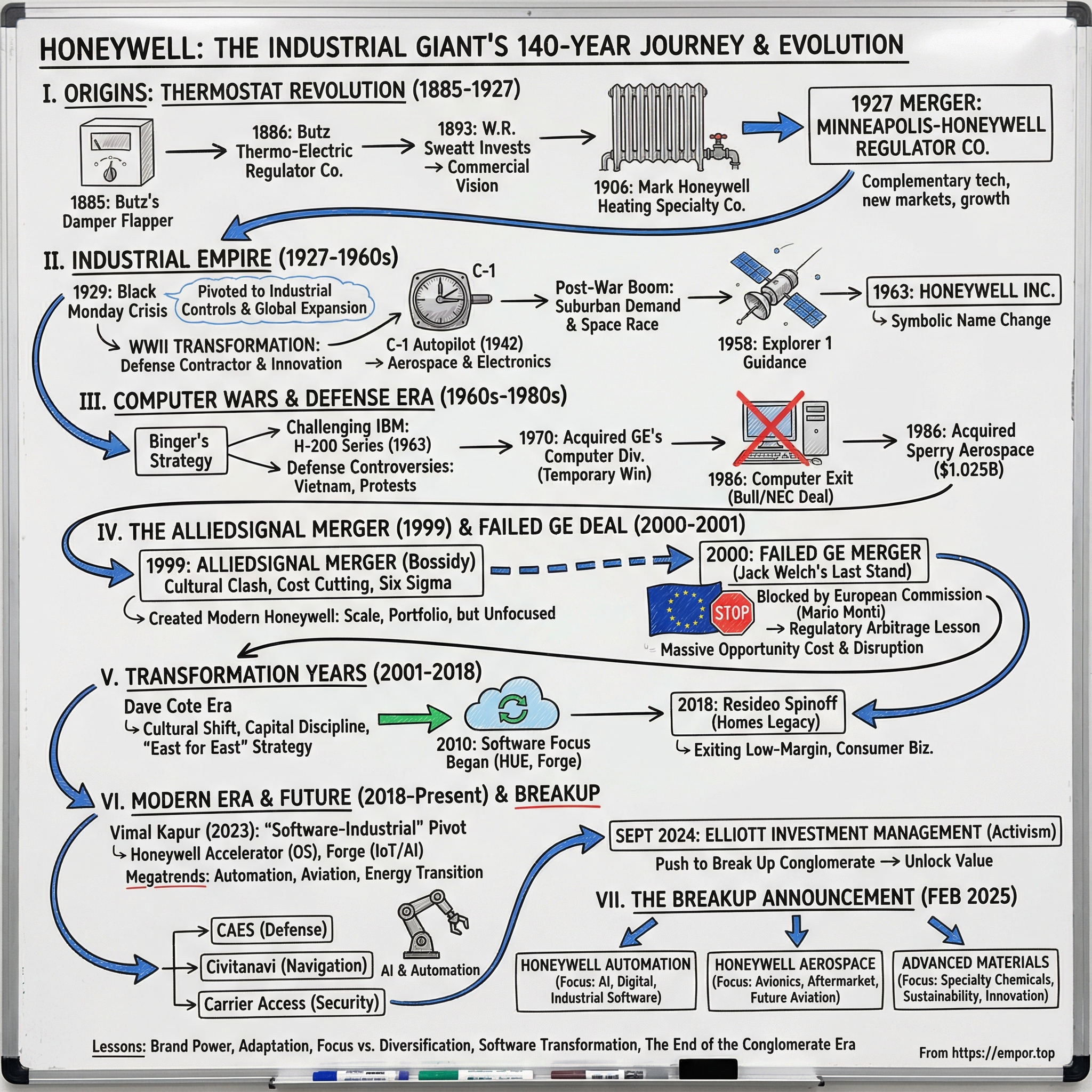
This is the account of how that unwinding took place. The narrative originates with a mechanical damper-flapper designed to regulate a coal furnace in 1880s Minnesota. It moves through production surges in the Second World War, an unsuccessful challenge to IBM in mainframe computing, a merger in which the acquired company retained its brand, and one of the most consequential antitrust vetoes in industrial history. It encompasses an operational turnaround so heralded that its architect authored a bestselling management manual, followed by a protracted loss of momentum that culminated in an activist investor's intervention.
The last full year as one company
Prior to the separation, the conglomerate operated at massive scale. In 2024, Honeywell reported $38.5 billion in total sales, though organic growth reached only 3%.4 Segment profit totaled $8.7 billion, representing a 22.6% segment margin, while the order backlog climbed 11% to a record $35.3 billion.4
The four operating divisions functioned largely as distinct businesses grouped under a single corporate umbrella. Aerospace Technologies generated $15.5 billion in sales at a 25.8% margin and expanded 11% organically.4 Industrial Automation generated $10.1 billion at a 19.5% margin, but contracted 7% organically.4 Building Automation delivered $6.5 billion at a 25.7% margin, while Energy & Sustainability Solutions contributed $6.4 billion at a 23.7% margin.4
Those segment results capture the fundamental dilemma of the corporate structure. One division expanded at double-digit rates, another contracted significantly, and the remaining two posted modest gains. Grouped under one parent balance sheet, investors received a financial blend governed by the companywide average—and that average failed to generate strong momentum.
The climax
In November 2024, Elliott Investment Management disclosed an investment exceeding $5 billion and called for Honeywell to separate Aerospace from Automation.5 The activist firm argued that the conglomerate structure had become "unwieldy, arguably uninvestable," asserting that a split could unlock 51% to 75% in shareholder value over two years.5 Honeywell had announced plans to spin off Advanced Materials a month earlier.6 In February 2025, management went further, formally committing to a complete three-way separation.4
The question at the heart of this story
Honeywell leadership long maintained that a unified operating framework could optimize any industrial asset. First formalized as the Honeywell Operating System and later adapted as Honeywell Accelerator, the underlying philosophy held that lean manufacturing principles, consolidated purchasing power, and rigorous capital allocation could generate outperformance across jet engines, warehouse sorting systems, and petrochemical catalysts alike.
The corporate breakup represents public markets testing that premise. Standalone operations must now demonstrate whether their businesses are worth more independent of centralized corporate costs, a shared investment-grade balance sheet, and cross-divisional earnings buffers. Initial execution has proven challenging. Within weeks of its trading debut, Honeywell Aerospace trimmed its 2026 organic growth guidance from a range of 7%–9% down to 4%–5%, citing severe supply-chain constraints.7
For long-term investors, the restructuring fundamentally alters the analytical equation. Legacy Honeywell required shareholders to underwrite the corporate center: the chief executive, the centralized business system, and capital allocation orchestrated from Charlotte. The post-split entities require investors to assess each franchise strictly on standalone operational execution. That structure provides direct accountability, but eliminates corporate diversification: operational disruption in aerospace can no longer be offset by resilience in building controls, and integration missteps can no longer be absorbed within a $38 billion revenue base. The history that follows examines which operational practices represented intrinsic competitive advantages—and which were merely the benefits of conglomerate scale.
Understanding why a 140-year-old enterprise ultimately chose to dismantle itself begins in a cold basement in 1880s Minnesota.
 Subscribe on LinkedIn
II. Foundations: Thermostats, Controls, and the Sweatt Dynasty (1885–1960s)
In Minneapolis during the 1880s, heating a home meant burning coal in a basement furnace. Someone had to walk downstairs before dawn to open the damper and feed air to the fire, then return later to close it before the building overheated. Albert Butz, a Swiss immigrant, looked at that chore and designed a mechanical solution.
His "damper flapper" linked a thermostat directly to the furnace damper.8 When indoor temperatures dropped, the mechanism opened the draft so the fire burned hotter; once the living space reached the target temperature, it closed the vent. It was an early feedback loop engineered in iron and wire: sense an environmental condition, compare it against a set point, and actuate a control without human intervention. Nearly every business Honeywell operated over the following century, from aircraft autopilots to refinery control systems, represented an evolution of that basic closed loop.
The operator who built the company
Butz was an inventor rather than a corporate operator, and his tenure with the venture was brief. The enduring enterprise was built by William R. Sweatt, a Minneapolis businessman who joined in 1891 and assumed control in 1898.8 Sweatt's central insight was commercial: a clever device held little economic value unless heating contractors agreed to sell it and homeowners could afford it. That realization—that installer distribution channels matter as much as hardware engineering—runs directly through the company's operating history. The Building Automation business, a core growth engine of Honeywell Technologies, still depends on the contractors, integrators, and installers who decide which controls to specify. Sweatt established early that commercial success belonged to the manufacturer the trade trusted most. His son Harold joined the leadership as vice president in 1913, and the Sweatt family would guide the enterprise for decades.8
The rival across the state line
Meanwhile, in Wabash, Indiana, Mark Honeywell was building a competing heating-equipment business. In 1927, the two firms merged to form the Minneapolis-Honeywell Regulator Company, with Mark Honeywell serving as president.8 The consolidation provided crucial manufacturing and distribution scale in temperature controls just as oil was replacing coal in residential heating. It also established the brand name that, seven decades later, a much larger acquirer would decide was too valuable to abandon.
War changes the product
The Second World War transformed the regional thermostat maker into a high-precision defense electronics contractor. Beginning around 1941, Minneapolis-Honeywell developed automatic pilot systems for military bombers.8 The operational logic mirrored the damper flapper on a far more demanding scale: sense the aircraft's attitude, compare it against the intended flight path, and move the control surfaces to correct aerodynamic errors. In wartime flight, an error meant a lost crew rather than an uncomfortable room.
That technological shift proved more consequential than any single military contract. It provided Minneapolis-Honeywell with deep engineering expertise in precision, safety-critical systems and established a relationship with the U.S. government that persisted for generations. The company later stated that its equipment was involved in every manned U.S. space flight.8
The computer detour
In 1955, Minneapolis-Honeywell partnered with Raytheon to form Datamatic Corporation, entering the nascent commercial computer industry.8 Shareholders approved shortening the corporate name to Honeywell Inc. in 1964, and in 1970 the company acquired General Electric's large computer business to establish Honeywell Information Systems.8 For a period, Honeywell stood as one of the few serious challengers to IBM in mainframe computing.
The position proved unsustainable. Mainframes demanded massive, recurring capital investment in software and hardware architectures where IBM dictated industry standards. In 1986, Honeywell divested most of its computer operations to France's Groupe Bull and Japan's NEC.8 That same year, the company acquired Sperry Aerospace Group for approximately $1 billion.8
That strategic pivot underscored Honeywell's capital allocation principles. Unable to generate attractive returns in a capital-intensive platform war against an entrenched market leader, management exited the sector. Capital was redeployed into regulated markets where certification requirements, large installed bases, and extended product lifecycles protected operating margins. That portfolio discipline foreshadowed strategic decisions decades later, including the 2026 divestiture of warehouse automation assets alongside the retention of high-margin cockpit avionics.
By the late 1980s, Honeywell had consolidated its position as a respected controls and aerospace supplier rooted in Midwestern corporate culture. It lacked, however, the balance-sheet scale required to maintain independence. Its next chapter began when a much larger, more aggressive industrial conglomerate from New Jersey came calling.
III. The M&A Machine: AlliedSignal, Sperry, and Jack Welch's Last Stand (1986–2001)
The avionics anchor
The 1986 acquisition of Sperry Aerospace Group established the technical core of Honeywell's modern aviation franchise. Sperry had pioneered aeronautical instruments, designing gyroscopes and autopilots dating to the early decades of powered flight. When Honeywell paid roughly $1 billion for the group,8 it secured entry into one of the industrial sector's most durable product categories: flight decks and navigation systems.
Avionics systems feature exceptionally high switching costs. Once an avionics suite is certified on an aircraft platform, it typically remains installed across the entire production lifecycle of that airframe. That installed base yields decades of high-margin aftermarket spares, software upgrades, and maintenance contracts. Much of the standalone enterprise value that Honeywell Aerospace carried into its 2026 public listing originated with that purchase.
The reverse takeover
On June 7, 1999, AlliedSignal agreed to acquire Honeywell in an all-stock transaction valued at about $14 billion.[^9] Although AlliedSignal was the legal acquirer—with Honeywell shareholders receiving 1.875 AlliedSignal shares for each of their shares[^9]—the combined company adopted the Honeywell name, while moving corporate headquarters to AlliedSignal's home in Morristown, New Jersey.[^9]
The architect of the transaction was Larry Bossidy, AlliedSignal's chairman and chief executive, a former General Electric executive known for rigorous operating reviews. Under the transaction structure, Bossidy became chairman while Honeywell's Michael Bonsignore assumed the role of CEO.[^9] Management promised $500 million of annual cost savings, 4,500 job cuts and 15% annual EPS growth, on combined revenue of about $25 billion.[^9]
Retaining the Honeywell name preserved valuable brand equity built across millions of residential thermostats and commercial control installations. Yet the transaction also brought in AlliedSignal's historical liabilities. Most significant was Bendix, an automotive supplier whose legacy brake linings contained asbestos, generating personal-injury claims that would follow Honeywell for more than a quarter-century.9
Forty-five minutes
In October 2000, GE chairman Jack Welch was visiting the New York Stock Exchange when he learned that United Technologies was about to agree to buy Honeywell.10 Within 45 minutes, working the phone from his car, Welch had lined up his board behind a counter-offer.10 On October 20 he called Bonsignore in the middle of a Honeywell board meeting that was considering the UTC deal.10
Two days later GE reached a definitive agreement. The $42 billion deal would have been the largest industrial acquisition ever, and Welch delayed his retirement to see it through.11 The U.S. Justice Department approved it.11
Brussels says no
European antitrust regulators reached a fundamentally different conclusion. Mario Monti, the European Commission's competition commissioner, argued that a combined GE-Honeywell could bundle its commercial jet engines with Honeywell's avionics and auxiliary power units, offering airlines package discounts that competitors selling one product could not match.11 The Commission also scrutinized GE Capital Aviation Services, GE's commercial aircraft leasing unit, warning that its extensive fleet purchasing power could steer airlines and airframers toward GE-Honeywell equipment.11
GE offered to divest businesses, eventually up to about $2.2 billion, and proposed ring-fencing GECAS.10 Monti wanted more, including the sale of a stake in GECAS, which Welch refused.10 On July 3, 2001, the Commission prohibited the merger, concluding that it would have "severely reduced competition in the aerospace industry and resulted ultimately in higher prices for customers, particularly airlines."1211
The regulatory decision hinged on the theory of "portfolio effects." The European Commission argued that an industrial conglomerate with market-leading positions across adjacent aviation components could structure discounts and financing terms that specialized rivals could not withstand, even without technological superiority. While critics contended that bundling generally lowers prices for buyers and argued that regulators should wait for tangible market harm before intervening, the Commission chose to prevent the competitive risk in advance.
Twenty-five years later, market dynamics inverted that regulatory logic. The combination that European regulators blocked on grounds that it would prove insurmountable was ultimately dismantled because public markets concluded that conglomerate scale diluted focus and depressed operating performance. Honeywell Aerospace operates as an independent business, competing against a GE Aerospace that became a standalone pure-play following GE's own multi-step breakup.
The 2001 veto represented a watershed moment in cross-border antitrust oversight, demonstrating that American and European enforcers could reach diametrically opposed verdicts on the same industrial transaction. For Honeywell, the consequences were immediate.
The aftermath
Bonsignore lost his job, and Larry Bossidy came back to run the company, with a mandate to fix it or sell it.10 Honeywell had spent most of a year in limbo, planning for integration into GE. Executive focus had fractured, commercial strategy was frozen, and asbestos claims were mounting. Analysts at Wharton later concluded that Honeywell suffered more short-term harm from the failed deal than GE did.11
For investors, the era demonstrated how thoroughly transaction activity had governed Honeywell's evolution. Acquisitions had assembled its core aerospace franchise, while a failed megamerger had stalled its operations. Portfolio restructuring had become an organizational habit, but acquisitions and sales could not substitute for execution. The company did not need another transaction; it needed an operating framework that could make its existing businesses perform.
IV. The Cote Turnaround: HOS, Asbestos Trusts, and Industrial Discipline (2002–2017)
Dave Cote did not arrive as an obvious choice. He had spent the bulk of his career at General Electric and lost out in the race to succeed Jack Welch. He then led TRW before Honeywell recruited him in 2002.13 Market observers questioned whether an executive passed over in GE's succession contest was equipped to stabilize a wounded competitor. Cote later observed that the operational reality inside was worse than it had appeared from the outside.13
When he took over, Honeywell's market valuation stood at roughly $20 billion.13 The company had barely emerged from the aborted GE merger. It carried persistent asbestos liabilities, an uncoordinated collection of operating units that rarely communicated, and a management culture accustomed to explaining away missed financial targets.
The man and the method
Cote's operating style was pragmatic and demanding. In his book, Winning Now, Winning Later, he argued that corporate leaders must deliver near-term financial commitments while simultaneously funding long-term investments, rather than trading one off against the other. He campaigned against what he termed "intellectual laziness" and insisted on conservative accounting.13 He also pressed business units to expand organic sales rather than relying solely on cost reduction.
The engine of the operational turnaround was the Honeywell Operating System, or HOS. Drawing from Toyota's lean production methods and Six Sigma quality techniques, HOS established a unified framework across every plant for measuring waste, solving production bottlenecks, and improving material flow. Management paired that factory-floor discipline with a centralized consolidation of purchasing and corporate back-office functions. In practice, the initiative mirrored taking dozens of independent kitchens—each with its own suppliers and recipes—and training them to operate to a single standard. Material costs fell, defect rates stabilized, and headquarters could benchmark one facility directly against another.
The system had a structural limitation that became fully apparent only in later years. HOS proved exceptionally effective at taking costs out of factories that already had robust order backlogs. It was far less capable of generating new demand when end markets weakened. A kitchen can be engineered to run with near-zero waste, but operational efficiency cannot manufacture diners when tables sit empty. That tension between optimizing supply and generating demand became the defining vulnerability in Honeywell's corporate structure.
Pruning and planting
Cote also reshaped the portfolio through substantial capital deployment. In July 2015, Honeywell agreed to acquire Elster, a manufacturer of gas, electricity, and water meters, from Melrose Industries for $5.1 billion.14 A year later, it purchased Intelligrated, a Mason, Ohio–based warehouse automation provider, for $1.5 billion, absorbing a business generating roughly $900 million in revenue.15 Honeywell's then-CEO of its automation and control business framed the rationale around e-commerce, pointing out that online fulfillment was expanding "at an unprecedented rate."15
That Intelligrated transaction would resurface a decade later as central evidence in the debate over whether Honeywell's centralized operating system could succeed across every industrial vertical.
The asbestos question
Cote's tenure is often credited with resolving Honeywell's legacy asbestos exposure, but historical disclosures show the problem was stabilized rather than eliminated. Bendix personal-injury claims remained on Honeywell's balance sheet long after his departure. In 2018, his successor attempted to transfer the bulk of those indemnification liabilities onto corporate spin-offs. Honeywell did not fully exit its Bendix asbestos liabilities until October 2025, when it transferred the remaining obligations to a liability-acquisition platform called Delticus.16 Characterizing the Cote era as the period when asbestos was definitively solved overstates the outcome; management contained ongoing cash outflows, leaving final resolution to subsequent leadership teams.
The scorecard
Measured by equity performance, the turnaround delivered substantial shareholder returns. Honeywell's market valuation expanded from roughly $20 billion to approximately $120 billion, generating a total shareholder return of about 800%—roughly two and a half times that of the S&P 500.13 Over the same span, General Electric, the suitor that had attempted to absorb Honeywell at the turn of the century, entered a protracted operational and financial decline.
The Adamczyk interlude
Cote stepped down as chief executive in 2017, handing operational leadership to Darius Adamczyk. Adamczyk had become chief operating officer in 2016, CEO in 2017, and chairman in 2018.17 His style differed notably from Cote's: more understated, deeply interested in software architecture, and intent on repositioning Honeywell as an industrial software company. His primary early strategic decision was the 2018 spin-off of transportation systems unit Garrett Motion and home-comfort business Resideo. His most symbolic gesture was transferring Honeywell's primary stock listing to Nasdaq in May 2021.18 Both moves aimed to present Honeywell as a high-margin technology enterprise. The spin-offs, however, triggered indemnity disputes and litigation that dragged on until 2021, while the exchange transfer did not alter the company's conglomerate valuation discount, as Elliott's later analysis showed.5
Adamczyk navigated Honeywell through the severe disruptions of the COVID-19 pandemic, when commercial aviation ground to an abrupt halt, preserving the core aerospace franchise through the downturn. Yet the operational momentum of the Cote era steadily waned. By the time leadership transitioned to Vimal Kapur in 2023, high-growth divisions and cyclical units remained grouped within the same parent balance sheet—with the cyclical businesses increasingly setting the company's financial tone.
The operating framework built under Cote was designed for a singular purpose: to make a diversified industrial conglomerate perform like a portfolio of focused pure-plays. During his tenure, disciplined execution made that structure appear durable. The subsequent decade tested whether that outperformance belonged to the corporate model itself or to the executive who ran it. To see where the operational strains emerged, the mechanics of each underlying business require closer inspection.
V. The Segment Engine Room: How Honeywell Actually Makes Money Today
Inside an airline maintenance hangar, Honeywell hardware sits in the tail cone of commercial jetliners: the auxiliary power unit, a compact turbine that supplies electrical power and air conditioning while an aircraft idles at the gate. In the control room of an oil refinery, Honeywell distributed control software monitors critical processes across operator consoles. In a modern office tower, the fire panels, badge-access readers, and environmental controls frequently bear the Honeywell brand. Those three facilities reflect the operating breadth of the legacy conglomerate—and post-separation, each represents a distinct economic model.
1. Aerospace Technologies: the value titan
Aerospace served as the conglomerate's financial anchor. The division generated $15.5 billion in sales in 2024, expanding to $17.5 billion in 2025 on 12% organic growth and a 26.1% adjusted margin.419 Its commercial revenue flows from three primary categories: original equipment (OE) installed on newly built aircraft, aftermarket spare parts and maintenance services that follow over decades of operation, and specialized systems engineered for defense and space programs.
The economic durability of that portfolio stems from regulatory certification. Before a commercial aircraft can enter passenger service, aviation authorities must certify its airworthiness down to individual subcomponents, including the auxiliary power unit, avionics flight deck, and navigation architecture selected by the airframer. Replacing an incumbent supplier's certified system on an active airframe is economically prohibitive, requiring extensive recertification engineering and regulatory reviews that customers rarely justify. Consequently, the commercial award is determined at the inception of an aircraft program, establishing a captive supplier relationship that persists throughout the airframe's operational lifecycle—frequently extending thirty years or longer.
That lifecycle dynamic makes the aftermarket the division's primary profit engine. The business operates on a razor-and-blade model: initial OE shipments place hardware onto aircraft at narrow margins or occasional upfront discounts, establishing an installed base that subsequently commands high-margin, regulatory-mandated parts replacements and overhauls. The mechanics were evident in the second quarter of 2026, the first period reported by the standalone company: commercial aftermarket sales reached $2.0 billion, up 8%, whereas commercial OE contributed $679 million, up 6%, and defense and space generated $1.8 billion, up 3%.7 Total order backlog stood at $18.2 billion, an increase of 9%.7
The product catalog spans auxiliary power units, propulsion engines for business aviation such as the HTF7000, integrated flight decks, navigation systems, mechanical actuation, and aircraft wheels and brakes. The competitive landscape features scale rivals, including RTX's Collins Aerospace, GE Aerospace, Safran, and specialized component manufacturers. Honeywell's competitive advantage derives not from an exclusive monopoly over any individual component, but from the cumulative breadth of its certified installed base across commercial and military platforms.
As an independent public enterprise, the company reports through three operating segments: Electronic Solutions, Engines & Power Systems, and Control Systems.7 Standalone executive leadership is headed by chief executive Jim Currier, board chairman Craig Arnold—the former chief executive of Eaton—and chief financial officer Josh Jepsen.19
2. Industrial Automation: the cash cow under stress
Industrial Automation represented the conglomerate's primary operational drag. The segment generated $10.1 billion in sales in 2024, contracting 7% organically,4 before sales declined to $9.4 billion in 2025 with zero organic growth.19 Historically, the division bundled structurally divergent assets: mission-critical process automation for refineries and chemical facilities, industrial gas detection and personal protective equipment, mobile scanning devices, and the Intelligrated warehouse automation business.
The core process-solutions franchise operates under an entirely different economic logic than logistics hardware. A distributed control system functions as a chemical plant or refinery's central nervous system, linking thousands of field sensors and control valves to supervisory software that maintains pressures, temperatures, and fluid flows within tight safety parameters continuous hours a day. Industrial operators retain these systems for decades because replacing an operational control architecture risks catastrophic unplanned downtime. That installed base yields exceptionally resilient software, maintenance, and upgrade revenue. By contrast, supplying automated conveyors and sorting systems to e-commerce fulfillment centers proved heavily cyclical and exposed to capital-spending retrenchment, a divergence that eventually showed up in operating results.
Management responded by dismantling the conglomerate blend. Honeywell agreed to sell its Productivity Solutions and Services unit—which manufactures handheld mobile computers, barcode scanners, and enterprise printers—to Brady Corporation for $1.4 billion in cash.20 It then completed the divestiture of the warehouse automation business, operating under the Intelligrated and Transnorm brands, to American Industrial Partners on July 27, 2026, for an undisclosed sum.21 Within Honeywell Technologies, process control now operates within a dedicated Process Automation & Technology segment. The streamlined Industrial Automation division posted $1.5 billion in second-quarter 2026 sales, up 4% organically, with a 17.2% operating margin.2
3. Building Automation: the quiet compounder
Building Automation emerged as the conglomerate's most dependable compounder. The unit delivered $6.5 billion in revenue in 2024, rising to $7.4 billion in 2025 behind 8% organic expansion and a 26.5% segment margin.419 Its product lines comprise environmental controls, commercial fire alarm systems, and physical security and access infrastructure. In mid-2024, Honeywell expanded the business by acquiring Carrier's Global Access Solutions unit, anchored by the LenelS2 access-control platform, for $4.95 billion.[^23]
The division has established itself as the operational standout within Honeywell Technologies. In the second quarter of 2026, Building Automation generated $2.0 billion in sales, expanding 9% organically at a 27.1% margin.2 During the second-quarter earnings call, Deutsche Bank analyst Nicole DeBlase questioned whether high-single-digit growth could sustain through 2027. Chief executive Vimal Kapur answered that there was "no real logic" arguing against durability, citing structural project demand across hyperscale data centers, institutional healthcare, and hospitality.22 While two consecutive years of acceleration support management's confidence, relying heavily on data-center construction introduces cyclical exposure—a risk familiar to an enterprise previously caught by downturns in warehouse automation.
4. Energy & Sustainability Solutions: the chemist and the licensor
Energy & Sustainability Solutions generated $6.4 billion in sales in 2024,4 dividing into two contrasting business models. The UOP franchise licenses proprietary refining and petrochemical process technologies and sells the specialized catalysts and molecular adsorbents required to operate them. Advanced Materials manufactured fluorochemical refrigerants, industrial blowing agents, and high-performance fibers—the portfolio now operating independently as Solstice. Following that separation, the remaining ESS operations generated $3.1 billion in 2025 sales, declining 1% organically.19
UOP's economic model mirrors commercial aerospace: once an engineering firm specifies proprietary process technology for a multi-billion-dollar refinery or petrochemical unit, the operator remains tethered to the licensor for recurring catalyst reloads and technical services over decades. Honeywell reinforced that installed-base strategy through targeted acquisitions, purchasing Air Products' liquefied natural gas process technology and equipment business for $1.81 billion in 2024,[^25] Sundyne's specialized pumps and compressors for $2.16 billion in 2025,23 and Johnson Matthey's Catalyst Technologies unit for £1.325 billion in a transaction completed on July 17, 2026.24 In the second quarter of 2026, the newly configured Process Automation & Technology segment produced $1.7 billion in sales at a 22.1% operating margin, though organic sales contracted 1%.2
The one that already left: Solstice
Solstice Advanced Materials was the first corporate entity to separate from the parent conglomerate. The business produces fluorinated refrigerants—specifically low-global-warming-potential molecules mandated by environmental phase-down regulations across North America and Europe—alongside electronic materials and high-purity chemicals for semiconductor manufacturing. The standalone firm commenced operations with roughly 4,000 employees under chief executive David Sewell, a corporate veteran of WestRock, Sherwin-Williams, and GE Plastics.3
Within the broader restructuring, Solstice is significant less for its revenue contribution than for its structural role. The specialty materials portfolio provided legacy Honeywell with an insulated, regulation-mandated transition cycle. With Solstice operating as an independent entity, that regulatory buffer no longer cushions the remaining companies: Honeywell Aerospace and Honeywell Technologies must deliver organic expansion purely through aerospace execution and automation demand.
5. The dark horse: Quantinuum
Quantinuum, Honeywell's quantum-computing enterprise, was established in 2021 by merging Honeywell's trapped-ion hardware division with Cambridge Quantum Computing. In January 2024, the business raised $300 million at a $5.0 billion pre-money valuation.25 On June 4, 2026, the company completed an initial public offering on Nasdaq under the ticker QNT, raising $1.68 billion at $60 per share and achieving an implied market valuation of approximately $14 billion to $15 billion.26 Following the offering, Honeywell retained approximately 48.1% of the voting power.26
The valuation expansion stands in stark contrast to the underlying commercial fundamentals. Quantinuum generated $30.9 million in 2025 revenue while recording a net loss of $192.6 million. In the first quarter of 2026, revenue dropped to $5.2 million from $19.1 million in the prior-year period, while the net loss expanded to $136.6 million.27 Technical milestones in quantum error correction demonstrate scientific progress, but commercial adoption remains distant. The public offering effectively converted an early-stage research venture into a marked-to-market balance sheet asset. Accounting deconsolidation generated an outsized non-cash gain that elevated Honeywell's second-quarter 2026 GAAP earnings per share to $16.65, compared with adjusted earnings per share of $1.95.2 For investors, that earnings spike represented an accounting adjustment rather than an indicator of underlying operating performance.
Each operating franchise operates across distinct end-market cycles, distinct customer bases, and distinct competitive dynamics. That divergence sets up the fundamental question behind the breakup: did Honeywell's centralized operating system genuinely enhance all of them, or did it obscure their standalone realities?
VI. Historical Falsification Layer: Testing the Core Conglomerate Claims
Every conglomerate presents investors with a foundational thesis: that central coordination makes the whole worth more than the sum of its parts. Honeywell’s investment case rested on four core claims. Evaluating their validity does not require abstract debate; the company’s operating record provides specific moments where each premise faced its most rigorous test.
Claim 1: The operating system makes any business better
The primary test case was Intelligrated. Honeywell acquired the warehouse automation provider in 2016 for $1.5 billion, betting on secular expansion in e-commerce fulfillment.15 During the pandemic, warehouse construction surged. When major retailers and logistics carriers subsequently realized they had overbuilt fulfillment capacity, equipment orders collapsed. By the third quarter of 2024, Industrial Automation sales fell 5% organically, with management citing persistent "volume softness" in warehouse and workflow solutions.28 That same quarter, leadership reduced its full-year organic growth guidance from a range of 5%–6% down to 3%–4%.28 The Industrial Automation division concluded 2024 down 7% organically.4
The resolution arrived across 2025 and 2026. Honeywell classified the warehouse automation unit as held for sale, booking a $288 million goodwill impairment in Industrial Automation alongside a $235 million impairment on assets held for sale.19 Management then divested the business to private equity firm American Industrial Partners for an undisclosed sum.21 Chief executive Vimal Kapur stated that the divestiture "further sharpens Honeywell Technologies as a pure-play automation company."21
The structural breakdown stemmed from the business model itself. A warehouse automation engagement functions more like an engineering and construction project than a high-margin product sale. A customer commissions a sprawling fulfillment hub, Honeywell designs and installs the equipment over months, and follow-on orders may not materialize for years. While the hardware generates modest maintenance revenue, it produces nothing resembling the decades-long, captive aftermarket parts stream of an aircraft component or a refinery control system. When customer capital expenditures freeze, revenues plummet, and factory-floor efficiencies cannot replace absent demand. Moreover, Honeywell competed against specialized robotics firms focused entirely on warehouse logistics. Its traditional competitive moats—regulatory certification and deep customer switching costs—did not transfer.
Verdict: The historical record refutes the generalized claim. The Honeywell Operating System could streamline manufacturing facilities, but it could not insulate a project-driven, cyclical asset from severe downturns, nor could it endow warehouse sorting conveyors with the structural switching costs of process control software. The narrower proposition—that centralized operating discipline enhances efficiency within businesses already protected by resilient end-market demand—remains intact. The forward test is whether Honeywell Technologies can achieve its targeted 4%–6% organic growth rate without another volatile business depressing the corporate average.29
Claim 2: Honeywell is a software company in disguise
Under Darius Adamczyk, Honeywell promoted Honeywell Forge as its enterprise industrial software suite and transferred its primary equity listing from the New York Stock Exchange to Nasdaq in May 2021. Adamczyk argued that Nasdaq’s heritage of listing "category-defining technology companies" aligned with Honeywell’s profile.18 Forge continues to feature prominently in investor-day presentations for Honeywell Technologies and in the Johnson Matthey transaction materials.2924
Disclosed financial results and market multiples challenge this narrative. Elliott Investment Management’s 2024 analysis highlighted that Honeywell traded at the lowest valuation multiple among its industrial and aerospace peer group, rather than commanding a software premium.5 Furthermore, Honeywell has consistently declined to disclose Forge’s standalone revenues, organic growth rates, or net retention metrics. A management team confident that software represents an independent valuation engine would typically provide those disclosures.
Verdict: The thesis requires significant qualification. Honeywell’s software capabilities provide substantial economic value, but primarily because they are embedded within mission-critical hardware—such as avionics suites and refinery distributed control systems—where customer switching costs are exceptionally high. Software functions as an indispensable attribute of an entrenched installed base rather than as an independently valued Software-as-a-Service franchise. Confirming the claim would require management to disclose standalone recurring software revenues and customer retention rates that consistently outgrow core hardware.
Claim 3: Management deals with liabilities cleanly
In October 2018, Honeywell spun off its Garrett Motion turbocharger business and its Resideo home-products unit, structuring both entities to indemnify the parent for legacy liabilities. Garrett’s indemnification agreement covered the bulk of Honeywell’s Bendix asbestos claims, with obligations subsequently estimated at roughly $1.5 billion.9 Garrett itself had never manufactured a brake lining.9 The spin-off sued Honeywell over the indemnification terms in December 2019, and on September 20, 2020, Garrett filed for Chapter 11 bankruptcy carrying $1.4 billion of senior secured debt.9 Honeywell’s legal counsel characterized the restructuring filing as "entirely of Garrett's making."9
The eventual restructuring terms demonstrated the weakness of the indemnification architecture. Garrett’s reorganization plan eliminated the legacy indemnity in exchange for a $375 million cash payment at emergence, together with Series B preferred stock that paid Honeywell $35 million in 2022 and $100 million annually from 2023 through 2030.30[^34] While Honeywell recovered value, the total receipts fell well short of the multi-decade income stream originally structured. Resideo subsequently paid $1.59 billion in 2025 to extinguish its own indemnification obligation, which had permitted annual claims of up to $140 million through 2043.31 In October 2025, Honeywell transferred its remaining Bendix asbestos liabilities to Delticus, absorbing a one-time after-tax loss of approximately $115 million.16
Verdict: The history narrows the claim considerably. Honeywell ultimately extracted cash and exited these legacy obligations, but saddling newly public spin-offs with indemnification liabilities created balance-sheet distress that culminated in Chapter 11 proceedings and discounted settlements. The strategy also damaged institutional investor trust in Honeywell’s corporate engineering. The prospective test of whether leadership absorbed these lessons lies in the standalone capital structures: Honeywell Aerospace debuted with $15.8 billion in long-term debt,7 largely raised to fund pre-separation distributions. Any operational strain that impairs its debt-service capacity would indicate that legacy leverage risks remain unresolved.
Claim 4: Aerospace has unassailable pricing power
In December 2024, Honeywell entered into a comprehensive agreement with Bombardier spanning avionics, propulsion engines, and satellite communications. Management projected the contract could yield up to $17 billion in lifetime revenue while resolving all pending litigation between the parties.32 Securing the extension, however, required immediate concessions: the agreement reduced 2024 sales by approximately $400 million, adjusted earnings per share by $0.47, and free cash flow by $500 million.32 A component supplier possessing unassailable pricing leverage rarely surrenders that scale of near-term value to retain a core airframer.
The commercial aftermarket experienced similar customer friction. Fractional jet operator Flexjet filed suit against Honeywell over engine maintenance contracts, leading to a January 2026 settlement that cost Honeywell approximately $470 million while extending the maintenance agreement through 2035.33 Supply-chain realities compounded the pressure. In the second quarter of 2026, operating profit in Engines & Power Systems fell 32% as "unfavorable mix and higher costs more than offset price."7
Verdict: The evidence qualifies the claim rather than disproving it. Honeywell commands substantial pricing power in certified aerospace components and specialized repairs, as demonstrated by an 8% expansion in commercial aftermarket sales during the second quarter of 2026.7 Yet that leverage is neither limitless nor unilateral. Major fleet operators possess legal and commercial leverage to force concessions, contractual performance disputes carry multi-hundred-million-dollar penalties, and manufacturing cost inflation can erode top-line price gains. The operational metric that would confirm durable pricing power is sustained commercial aftermarket growth accompanied by expanding operating margins, rather than top-line expansion diluted by rising input costs.
Myth vs. reality
Myth: The breakup was forced on a reluctant management by Elliott. Reality: Honeywell announced its intention to spin off Advanced Materials on October 8, 2024, a full month before Elliott disclosed its activist campaign.6 While Elliott expanded the scope and accelerated the timetable of the restructuring, the strategic shift toward separation was already underway.
Myth: Honeywell solved asbestos in the 2000s. Reality: Legacy Bendix personal-injury liabilities remained with Honeywell, through the contested Garrett spin-off, until the Delticus transfer in October 2025.16 Resolving the exposure required more than two decades, multiple corporate restructurings, and significant balance-sheet losses.
Myth: Aerospace is a straight-line growth story. Reality: Honeywell Aerospace lowered its full-year 2026 organic growth guidance within two months of its public debut.7 Underlying airframe demand is robust, but delivery volumes remain constrained by external aerospace supply chains beyond Honeywell’s direct control.
Myth: Quantinuum is a hidden revenue engine. Reality: Quantinuum represents a valuable equity holding characterized by minimal, volatile commercial revenue and substantial operating losses.27 Its current contribution to Honeywell is as a marked-to-market financial asset rather than an earnings generator.
The pattern across all four tests is consistent. Businesses insulated by genuine regulatory certification barriers and captive installed bases withstood scrutiny. The broader claims that the conglomerate structure itself generated proprietary value did not. That structural realization set the stage for an aggressive portfolio pivot under new leadership.
VII. The 2023–2024 Capital Allocation Blitz: Vimal Kapur's M&A Surge
Vimal Kapur is an engineer by training, educated in electronics and instrumentation at the Thapar Institute of Engineering and Technology in Patiala, India.17 He spent more than three decades inside Honeywell, beginning his career in the industrial control systems that trace back to the company's early heating regulators. By the time the board selected him to succeed Darius Adamczyk as chief executive on June 1, 2023, he was a 34-year company veteran.17
His operating background spanned the conglomerate's industrial breadth. He led Honeywell Process Solutions, where company disclosures credit him with expanding sales by 6% and lifting operating margins by more than 400 basis points through a severe oil-and-gas downturn.17 He later directed Building Technologies, then a $6 billion division, before taking charge of Performance Materials and Technologies, an $11 billion business.17 Along the way, he spearheaded an initiative to build an outcome-based industrial software practice.17 Kapur was an insider who understood the corporate machinery precisely because he had operated most of its constituent parts.
Elevating an operational veteran carries clear advantages: intimate familiarity with product lines, technical credibility with engineering teams and enterprise customers, and no executive onboarding delay. It also introduces a distinct strategic risk. An executive who has spent an entire career navigating a conglomerate's operating system may be the last person inclined to dismantle it. Kapur's first eighteen months at the helm indicated that he believed Honeywell could outperform by reallocating capital around targeted secular growth themes. It was a coherent portfolio strategy—and one designed to keep the conglomerate intact.
The spending spree
Kapur acted aggressively. Between December 2023 and mid-2025, Honeywell announced approximately $13.5 billion in corporate acquisitions.23 In 2024 alone, the company deployed a record $14.6 billion in capital, including $8.9 billion dedicated to M&A.4
The centerpiece was the acquisition of Carrier's Global Access Solutions business for $4.95 billion, bringing in commercial security brands LenelS2, Onity, and Supra.[^23] The transaction aligned directly with Building Automation. Access control encompasses physical keycards, electronic locking hardware, and the underlying facility-management software—a dependable business generating recurring service and subscription revenue that now anchors Honeywell Technologies' highest-performing segment.
Management next directed capital into aerospace electronics, acquiring CAES Systems for $1.9 billion.[^38] The business manufactures radio-frequency microelectronics utilized in defense radar, electronic warfare, and satellite communications, expanding Honeywell's presence in prime defense electronics programs. CAES now operates within Honeywell Aerospace.
The third major transaction was the acquisition of Air Products' liquefied natural gas process technology and equipment business for $1.81 billion.[^25] The strategic rationale paired Air Products' proprietary coil-wound heat exchangers—the mechanical heart of LNG export terminals—with Honeywell's refining process licensing and control architectures. Honeywell also acquired Civitanavi Systems, an Italian manufacturer of inertial navigation sensors.23
Kapur followed those transactions by acquiring pump and compressor manufacturer Sundyne for $2.16 billion,23 alongside Johnson Matthey's catalyst technologies division. During the second-quarter 2026 earnings call, RBC Capital Markets analyst Deane Dray questioned the renegotiated, reduced purchase price for the Johnson Matthey transaction. Kapur defended the financial terms, stating that the asset was acquired at "about 13x EBITDA with cost synergies, no sales synergies."22
What the spree says about discipline
A strategic rationale supports these purchases. Each transaction added an established installed base accompanied by long-cycle aftermarket demand and specialized engineering services—the operational profile where Honeywell's commercial execution has historically proven strongest. Kapur paired those purchases with divestitures of non-core assets, shedding the personal protective equipment business,23 the enterprise mobility scanner unit, and the warehouse automation division.
Yet the blitz also drew skepticism from institutional investors. The spending surge unfolded precisely as public markets were losing patience with Honeywell's corporate structure, expanding balance-sheet scale and organizational complexity just months before leadership committed to a three-way split. The last time Honeywell deployed large-scale capital to ride a secular trend, it acquired Intelligrated for warehouse logistics—an investment that ultimately concluded in asset impairments and an unheralded sale to private equity. Standalone financial returns on the 2024 and 2025 acquisitions have not yet matured. While the transactions appeared strategically cohesive on paper, determining whether the capital deployment represented genuine discipline will depend on whether returns on invested capital exceed Honeywell's cost of capital over the subsequent three years. Honeywell has not disclosed deal-by-deal return metrics in public materials.
Kapur's acquisition blitz signaled management's conviction that the conglomerate structure could continue to compound value by assembling industrial scale. An activist investor with more than $5 billion at stake was about to present the opposite case.
VIII. The Activist Reckoning: Elliott Management & The Great Unwinding (2024–2026)
Elliott Investment Management's letter arrived on November 12, 2024. Polite in tone, it was devastating in substance. Disclosing an investment of more than $5 billion that established the firm as one of Honeywell's largest active shareholders,5 Elliott opened by praising the Cote era as a period of industry-leading earnings growth and outsized shareholder returns.5 Then it methodically argued that the subsequent decade had been a protracted operational slide.
The indictment
Elliott's indictment was grounded in comparative metrics. The activist noted that Honeywell's five-year earnings-per-share growth since 2019 ranked near the bottom of its peer group, and that the stock had dropped following each of its six most recent quarterly earnings reports. Consequently, Honeywell traded at more than a 25% discount to pure-play aerospace peers and carried the lowest valuation multiple of any diversified industrial or aerospace supplier.5 Across nearly every trailing period over the prior decade, Elliott observed, the conglomerate had lagged its benchmark indices.5
The core of the critique focused on corporate architecture. Elliott diagnosed a structural "least common denominator" dynamic in which underperforming, cyclical units depressed the valuation multiple of the entire enterprise.5 The activist's prescribed remedy was a comprehensive separation of Aerospace from Automation, projecting that a breakup could unlock 51% to 75% in shareholder upside over a two-year horizon.5
The sum-of-the-parts logic
The sum-of-the-parts logic behind the activist campaign rested on shareholder alignment. Consider an analogy: a premier restaurant coupled with a commercial car wash under a single corporate roof. Diners and car-wash patrons represent entirely different customer bases, and investors evaluating each business demand fundamentally different financial characteristics. An investor seeking cash flows from high-end dining is forced to underwrite the car wash as well, and inevitably applies a conglomerate discount to both. Unbundle them, and each asset attracts its natural shareholder base. Pure-play commercial aerospace franchises command premium valuation multiples because equity investors prize long-cycle visibility and high-margin aftermarket cash flows. Elliott reasoned that an unbundled Honeywell Aerospace would re-rate toward those pure-play multiples, while the remaining automation businesses could be evaluated directly against specialized industrial peers rather than dragged down by a blended corporate discount.
Management's response
Honeywell's leadership had already initiated portfolio changes prior to the activist campaign. On October 8, 2024—a month before Elliott published its letter—the company announced plans to spin off Advanced Materials.6 On February 6, 2025, the board went decisively further, formally committing to a complete structural separation of Automation and Aerospace into three standalone public entities, targeting completion in the second half of 2026.4 Kapur framed the decision as a natural evolution, stating that the separation built on "the powerful foundation we have created."4
Whether the restructuring represented corporate capitulation or operational acceleration is an essential distinction. In reality, it was both. Management had already begun streamlining the portfolio before Elliott disclosed its stake, as evidenced by the earlier materials announcement. Yet the comprehensive three-way unwinding followed the activist's public campaign and extended far beyond management's initial scope. Elliott's involvement undeniably accelerated the executive timetable and forced a total unbundling.
The execution
Execution unfolded through a sequence of capital-structure and portfolio maneuvers designed to clear the parent balance sheet. Management addressed legacy liabilities first: Resideo delivered a $1.59 billion cash payment to terminate its indemnification agreement,31 and Honeywell transferred its remaining Bendix asbestos liabilities to Delticus.16 Solstice Advanced Materials became the first unit to depart, completing its spin-off on October 30, 2025, under chief executive David Sewell.3 Honeywell Aerospace then established its independent balance sheet through a major debt issuance and hosted its inaugural investor day in Phoenix on June 3, 2026.7 The board approved the spin-off on June 15, and Honeywell Aerospace began standalone trading on June 29.1 Those milestone transactions were accompanied by the Quantinuum public offering,26 the divestiture of the enterprise scanner business to Brady Corporation,20 and the sale of the warehouse automation assets to American Industrial Partners.21
The calls: where analysts pushed
Earnings call exchanges illustrate how Wall Street's skepticism shifted across the transition. On the October 2024 call, scrutiny centered on guidance reductions: Honeywell lowered full-year organic growth expectations from a range of 5%–6% down to 3%–4%, weighed down by persistent softness in warehouse automation and short-cycle industrial products.28 Kapur defended the quarter by maintaining that the company had "executed through a challenging environment," highlighting that segment margins and adjusted earnings per share exceeded guidance even as top-line sales fell short.28
By July 2026, post-separation questions focused on standalone segment mechanics. Wolfe Research analyst Nigel Coe pressed management on why Process Automation & Technology organic sales contracted 1% despite healthy order intake. Chief financial officer Mike Stepniak explained that while systems project revenue rose 5%, high-margin aftermarket sales dropped 6% against a difficult prior-year comparison.22 Addressing stranded corporate costs—the residual overhead left behind after unbundling—Stepniak reported that Honeywell Technologies would enter 2027 with approximately $60 million to $65 million in residual overhead to eliminate early in the year, an outcome roughly $20 million better than initial estimates.22
That stranded-cost containment is notable. Relative to a standalone automation enterprise generating roughly $20 billion in annual revenue, the figure indicates that corporate unbundling has been managed with disciplined administrative efficiency. The more severe execution test emerged on the aerospace side. Standalone financial targets established at the June 3 investor day were trimmed on August 5, barely two months after they were issued.7 Newly listed public companies rarely get a second chance to establish a credible forecasting track record, and Honeywell Aerospace strained its market goodwill almost immediately.
The financial engineering of a clean exit
A less visible element of the separation lies in how the split was capitalized. Corporate spin-offs represent a redistribution of debt as much as an allocation of operating assets. Typically, the emerging standalone entity issues new debt and distributes the proceeds back to the parent, enabling the legacy company to de-lever its balance sheet or fund share repurchases. Honeywell Aerospace began standalone life carrying $15.8 billion in long-term debt.7 That represents a substantial debt load, even for an enterprise with Aerospace's structural cash generation. Consequently, the newly public company must navigate competing capital priorities: servicing long-term debt, co-investing in stressed supplier capacity, and satisfying public equity holders expecting an immediate valuation re-rating.
Here, the precedent of the Garrett Motion spin-off offers useful analytical context. The central criticism of Garrett was that Honeywell saddled an emerging public entity with obligations that optimized the parent's balance sheet. Honeywell Aerospace is an incomparably stronger franchise than Garrett, and its obligations consist of conventional, fixed-income debt rather than uncapped indemnification liabilities. The parallel is not one of solvency, but of corporate incentives. When an incumbent parent architects a spin-off's inaugural capital structure, legacy shareholders frequently capture the advantageous terms. For investors evaluating standalone Honeywell Aerospace, monitoring net leverage ratios and credit-rating stability over the next two years will be essential.
Where the two companies stand today
As standalone operations, the two successor enterprises enter their post-separation eras facing divergent operational realities. Honeywell Technologies raised its operational outlook, projecting 2026 sales between $19.8 billion and $20.0 billion, organic growth of 3% to 4%, and adjusted earnings per share of $8.05 to $8.35—representing an increase of 25% to 29%—alongside approximately $2.0 billion in free cash flow.2 Commercial momentum appeared solid: orders expanded 16% in the second quarter of 2026, lifting order backlog to approximately $20 billion.2 Management's three-year financial architecture targets 4% to 6% annual organic growth, more than 60 basis points of annual operating margin expansion, double-digit earnings growth, and greater than 90% free cash flow conversion.29
Honeywell Aerospace confronts an inverse operational challenge: abundant customer demand paired with constrained delivery capacity. Standalone 2026 guidance projects 4% to 5% organic expansion with adjusted operating earnings of $4.35 billion to $4.45 billion, reduced from initial expectations of $4.65 billion to $4.75 billion.7 Second-quarter adjusted earnings per share declined 32% to $1.87, reflecting both margin compression and transaction-related separation friction.7 To unblock delivery bottlenecks, leadership is qualifying more than 50 secondary component suppliers and doubling its capital commitments to supplier tooling between 2025 and 2027.7 Chief executive Jim Currier acknowledged the bottleneck directly, noting that "supply constraints limited output growth in the quarter."7
The grand unwinding is complete. Whether it ultimately unlocks the equity value Elliott projected will depend on how effectively each standalone entity executes in isolation—and competitive dynamics operate under fundamentally different rules in each respective domain.
IX. Competitive Strategy: 7 Powers & Porter's Five Forces
Consider the strategic calculation confronting a rival aerospace supplier seeking to capture market share from Honeywell. An attack would not target the cockpit of a Boeing 787 in the middle of its production run; replacing an incumbent flight deck mid-program would demand years of recertification engineering, extensive flight testing, and regulatory reviews that airframers and airlines would reject. Instead, a competitor targets the next clean-sheet aircraft program before engineering specifications freeze. Alternatively, a rival targets the aftermarket by offering certified replacement parts and independent maintenance, or exploits delivery delays to present airframers with alternative sourcing options.
That strategic reality frames the broader competitive landscape. Honeywell's structural advantages are formidable, but they are concentrated heavily where hardware is already certified and installed, and prove far more vulnerable where customers make fresh procurement decisions.
Hamilton Helmer's 7 Powers
Switching costs represent the core power. In commercial aerospace, avionics, auxiliary power units, and propulsion engines are inextricably tied to an aircraft's type certificate—the regulatory approval governing airframe design. Modifying a certified subsystem requires costly redesigns and exhaustive recertification, making mid-program supplier switches economically prohibitive for airframers. In process automation, distributed control systems govern continuous refinery and chemical operations for decades, where a failed software migration risks catastrophic unplanned downtime. These steep switching costs underpin aftermarket pricing power and generate long, high-margin revenue tails from every original equipment installation. Among Helmer's seven powers, switching costs find the strongest empirical support in Honeywell's operating results: commercial aerospace aftermarket revenues expanded even while supply-chain bottlenecks constrained factory output.7
Cornered resources are narrower than historical patent portfolios suggest. Honeywell has long maintained valuable intellectual property, spanning proprietary fluorochemical formulations and UOP's process technology licenses. However, the fluorochemical refrigerant franchise departed the parent balance sheet with the spin-off of Solstice.3 While UOP's process licenses and catalysts provide durable commercial advantages, patents inevitably expire and rival licensors compete aggressively. Honeywell paid approximately 13 times EBITDA to acquire Johnson Matthey's catalyst business22 precisely because proprietary catalyst formulations confer tangible pricing power—yet they do not confer an unassailable commercial monopoly.
Scale economies provide operational parity rather than a decisive moat. Substantial research-and-development programs, such as architecting an integrated flight deck, require similar baseline capital commitments whether units are delivered to two airframers or five. While Honeywell's cross-platform presence allows it to amortize these fixed engineering costs across commercial, defense, and business aviation programs, scale rivals such as RTX and GE Aerospace operate with equal or greater balance-sheet resources. Divisional scale allows Honeywell to keep pace with industry development cycles, but does not grant it structural cost insulation from peer competition.
Counter-positioning is largely absent. Honeywell operates as an incumbent defender rather than an industry disruptor. In warehouse automation, the enterprise encountered specialized robotics and fulfillment competitors whose business models were engineered specifically for dynamic logistics hubs, a competitive mismatch that culminated in the divestiture of the business.21 Similarly, the enterprise software initiative anchored by Honeywell Forge has yielded no disclosed standalone SaaS franchise that challenges conventional enterprise software platforms. Honeywell's competitive victories stem from defending installed bases through incremental improvements rather than pioneering business models that incumbent competitors cannot replicate without cannibalization.
Process power represents the legacy operating-system premise. The operational discipline instilled by the Honeywell Operating System generated genuine manufacturing efficiencies and margin containment, yet the divestiture of Intelligrated demonstrated that factory-floor optimization cannot manufacture market demand. Furthermore, the decision by Honeywell Aerospace to qualify more than 50 secondary suppliers7 underscores the structural limits of internal lean manufacturing: process discipline within company-owned facilities cannot resolve tier-two and tier-three component shortages across external aerospace supply chains.
Porter's Five Forces
Threat of new entrants: Low in aerospace and process control, moderate in building infrastructure. Stringent regulatory certification requirements, proven safety track records, and multi-decade installed bases create nearly insurmountable barriers for potential greenfield competitors in aviation and petrochemical refining. Conversely, building controls and commercial security present lower entry hurdles, where modular IoT platforms and software-first vendors compete for enterprise contracts.
Bargaining power of buyers: Structurally bifurcated. Major airframers such as Boeing, Airbus, and Bombardier exert formidable leverage during original equipment procurement contests, dictating pricing terms and demanding commercial concessions. The comprehensive Bombardier agreement, which reduced Honeywell's 2024 sales by approximately $400 million, illustrates that leverage.32 In contrast, commercial airlines and business aviation operators purchasing replacement parts possess limited bargaining power over safety-critical spares. Even in the aftermarket, however, concentrated fleet operators can challenge contractual terms, as evidenced by Flexjet's engine maintenance litigation and its roughly $470 million settlement.33
Bargaining power of suppliers: Elevated and constraining. Sub-tier suppliers across the aerospace industrial base face specialized casting shortages, precision-machining constraints, and skilled-labor deficits. Honeywell Aerospace's downward revision of full-year 2026 organic growth guidance stemmed directly from supplier delivery limits rather than softening customer demand.7 When component suppliers cannot deliver contracted volumes, their operational bottlenecks effectively dictate shipment pacing and compress margins for prime integrators.
Threat of substitutes: Negligible in flight-critical systems, elevated in commercial devices. Aircraft operators cannot substitute uncertified components for proprietary auxiliary power units or flight management systems without compromising airworthiness certifications. In contrast, standardized logistics hardware, barcode scanners, and generic industrial sensors face constant functional substitution from lower-cost electronic manufacturers—a commoditization pressure that prompted Honeywell to divest those product lines.
Rivalry among existing competitors: Intense across commercial buildings and process solutions. In Building Automation, Honeywell competes against entrenched multi-industrial peers, including Johnson Controls, Siemens, Schneider Electric, and a fragmented network of independent system integrators. In process automation, Emerson, ABB, Siemens, and Yokogawa present sophisticated alternative control architectures. Second-quarter 2026 organic growth of 9% indicates that Honeywell is defending its position effectively in Building Automation,2 but sustained performance requires continuous product investment across competitive bid cycles.
The war-game in buildings
A similar competitive logic governs Building Automation. A rival seeking to capture market share would not attempt to rip out existing commercial fire panels or building management systems, which are deeply integrated into local municipal safety codes and recurring facility inspection regimens. Instead, an aggressive competitor targets new commercial construction—most notably hyperscale data centers—where facility operators make fresh specification decisions across environmental controls, physical security, and life-safety systems.
In those competitive bidding contests, rivals differentiate through unified software platforms that bridge HVAC, power distribution, and building access into a single pane of glass. Competitors also focus heavily on courting mechanical contractors and independent system integrators—the crucial distribution gatekeepers who, as the Sweatt family recognized a century earlier, ultimately decide which brand of hardware gets specified on the wall.
Honeywell's primary line of defense remains its expansive installed base across existing commercial real estate, which generates dependable streams of service contracts, software upgrades, and replacement parts, bolstered by the LenelS2 access-control platform acquired from Carrier. The primary vulnerability lies in greenfield construction, where rival industrial conglomerates contest every major project award. Building Automation's recent acceleration demonstrates that Honeywell is capturing share during an exceptional construction cycle for mission-critical infrastructure, but whether that commercial traction represents an enduring competitive moat or cyclical tailwinds will become clear only when commercial building starts slow.
Peer check: who has the better hand?
Compared with direct aerospace rivals, Honeywell Aerospace possesses one of the broadest installed bases in commercial aviation, spanning business jets, commercial airliners, military rotorcraft, and defense platforms. Its structural disadvantage lies in relative scale: it remains smaller than RTX and GE Aerospace, which control the large commercial turbofan programs that anchor long-term airline relationships. Honeywell is also more exposed to business aviation, where a concentrated group of airframe manufacturers and fleet operators hold significant bargaining power.
Honeywell Technologies occupies a divergent competitive position. In commercial buildings, its second-quarter 2026 operating margin of 27.1% demonstrated strong pricing execution relative to segment history.2 In process automation, it remains one of a select group of global control-system providers supported by a sticky, entrenched installed base. However, Industrial Automation, at a 17.2% operating margin, remains the conglomerate's least profitable operational unit.2 Kapur's stated capital allocation priorities, which include targeted acquisitions to bolster sensing technologies within Industrial Automation, suggest management recognizes that vulnerability.22
The competitive verdict
Synthesized across strategic frameworks, the competitive analysis reinforces the conclusions of the historical record: Honeywell's most durable economic moat is an installed base protected by regulatory certification and high switching costs. That advantage is most pronounced in Honeywell Aerospace and within the Process Automation & Technology franchise. It is moderately defensible in building management systems, and proved weakest in the commoditized industrial and logistics businesses the parent company has recently divested.
The three-way corporate separation concentrates each standalone enterprise around its core competitive advantages. That operational focus eliminates the conglomerate discount that long frustrated institutional investors. Yet unbundling also eliminates the corporate diversification that historically absorbed segment-level shocks. With cross-divisional earnings buffers gone, the investment thesis for each successor company depends entirely on whether standalone focus enhances operational execution—or simply exposes individual business vulnerabilities to public markets.
X. The Bull vs. Bear Case
The competing investment cases across the post-split Honeywell entities do not turn on whether the underlying franchises possess durable economic value. Consensus across industrial analysts and institutional investors acknowledges that certified aerospace components, building management systems, and refinery process controls represent structurally attractive businesses. The debate centers on valuation, operational execution, and whether unbundling corporate assets genuinely cures operating inertia or merely reorganizes reporting lines.
The bull case
Elimination of the conglomerate discount. Elliott's core thesis held that the parent conglomerate structure depressed the intrinsic valuation of the underlying businesses.5 With Honeywell Aerospace, Honeywell Technologies, and Solstice Advanced Materials trading as independent public entities, equity markets can evaluate each franchise directly against specialized pure-play peers. If Honeywell Aerospace demonstrates consistent commercial aftermarket execution, its multiple could re-rate toward specialized aviation suppliers. Similarly, if Honeywell Technologies achieves its three-year financial architecture—combining organic acceleration with operating margin expansion—its valuation could converge toward premium automation peers.29
Durable underlying aerospace demand. Commercial aftermarket revenue expanded 8% in the second quarter of 2026, lifting total division backlog 9% to $18.2 billion, while leadership noted that customer order intake continued to outpace what component suppliers could deliver.7 For equity investors, an operational bottleneck driven by supply constraints represents a fundamentally more manageable dilemma than a collapse in end-market appetite. Once supply-chain friction eases, suppressed delivery schedules can convert into an extended cycle of catch-up deliveries.
Expanding defense tailwinds. The acquisition of CAES Systems reinforced the aerospace franchise's exposure to high-priority defense electronics, including radar, electronic warfare, and satellite communications,[^38] contributing to a defense and space business that generated $1.8 billion in quarterly revenue.7 Elevated defense spending across NATO members and allied nations provides durable budgetary visibility that cushions cyclical fluctuations in civil aviation.
Operational momentum inside Honeywell Technologies. Standalone commercial momentum showed tangible acceleration: total orders expanded 16% in the second quarter of 2026, Building Automation delivered 9% organic growth, and management raised full-year guidance across sales and earnings.2 During the earnings call, chief financial officer Mike Stepniak highlighted that the preliminary setup for 2027 appeared "incrementally" stronger.22 The streamlined enterprise enters its post-separation phase stripped of the volatile warehouse automation and handheld scanning units that accounted for the parent company's most damaging operational misses.
Marked-to-market monetization of Quantinuum. Retaining an approximate 48.1% voting stake in a quantum-computing enterprise valued between $14 billion and $15 billion at its initial public offering establishes a substantial, liquid balance-sheet asset for Honeywell Technologies.26 The public listing converted an opaque, capital-intensive research-and-development initiative into an independently priced security that public markets can evaluate and value directly.
Direct accountability and unbundled governance. Independent corporate listings establish direct alignment between executive compensation, equity performance, and divisional operational metrics. Standalone governance eliminates a pervasive conglomerate moral hazard, where underperforming units could mask operational deficits inside consolidated parent results. Operating missteps are immediately visible to public markets and corporate boards, enforcing operational discipline that diversified holding companies rarely sustain.
The bear case
Immediate operational execution stumble at Aerospace. Honeywell Aerospace strained market confidence almost immediately, trimming its inaugural full-year 2026 organic growth guidance within weeks of its public debut.7 Profitability also contracted sharply, as operating income in Engines & Power Systems dropped 32% in the second quarter as manufacturing cost inflation outpaced contractual price adjustments.7 Furthermore, the spin-off launched carrying $15.8 billion in long-term debt,7 creating a rigid capital structure that constrains operational flexibility if supplier bottlenecks prove protracted.
Commercial pushback and customer concentration. Long-term agreements with Bombardier and the subsequent litigation settlement with Flexjet demonstrated that Honeywell Aerospace's commercial pricing power faces defined legal and economic boundaries.3233 Commercial airframers command substantial bargaining leverage during initial equipment negotiations, while concentrated fleet operators possess both the resources and legal willingness to contest service-contract margins in court.
Unresolved cyclicality in process automation. Organic sales in Process Automation & Technology contracted 1% in the second quarter of 2026, weighed down by a 6% decline in high-margin aftermarket revenue.22 Simultaneously, management's aggressive acquisition campaign—absorbing Air Products' LNG assets, Sundyne's industrial pumps, and Johnson Matthey's catalyst franchise—substantially increases Honeywell Technologies' exposure to global energy and petrochemical capital-spending cycles, exposing cash flows to commodity downturns.
Unproven returns on invested capital from the M&A blitz. The parent company deployed $8.9 billion toward acquisitions in 2024 alone,4 following a capital-deployment pattern that historically produced mixed results—most visibly in the 2016 purchase of Intelligrated, which ultimately culminated in major asset write-downs and a private equity exit.19 Institutional investors await tangible evidence that recent acquisitions can deliver returns on invested capital that comfortably exceed corporate hurdle rates over a full cycle.
Quantinuum's lack of operating cash generation. The market valuation of Quantinuum does not translate into near-term operating cash flows: commercial revenue dropped in the first quarter of 2026 while operating losses widened substantially.27 The equity holding functions as a volatile, marked-to-market financial security that generates no distributable cash flow for Honeywell Technologies, leaving reported balance-sheet gains exposed to equity market fluctuations.
Persistent tail-risk from industrial liabilities. While negotiated cash settlements with Garrett and Resideo and the Delticus portfolio transfer largely extinguished legacy Bendix asbestos obligations,303116 an enterprise encompassing over a century of specialty chemical synthesis and heavy manufacturing remains exposed to environmental remediation claims. The indemnification structures and liability apportionments established in the Solstice separation agreements warrant ongoing scrutiny from risk-sensitive investors.
The risk radar
A targeted set of operational and structural risks warrants explicit evaluation because their transmission mechanisms are immediate rather than theoretical.
Aerospace supply-chain friction. For Honeywell Aerospace, sub-tier supplier dislocation represents an active operational headwind rather than a theoretical risk. The downward revision to full-year guidance occurred specifically because casting and precision-machining vendors failed to deliver contracted hardware volumes.7 While management's remediation plan—qualifying more than 50 secondary suppliers and doubling tooling capital expenditures—addresses root causes, aerospace regulatory certification is deliberately rigorous and slow, delaying the operational payoff.
Geopolitical and energy-market exposure. Honeywell Technologies' process licensing and catalyst businesses depend heavily on capital investments in downstream refining, petrochemical complexes, and LNG export terminals, notably across the Middle East. During the second-quarter 2026 earnings call, RBC Capital Markets analyst Deane Dray questioned whether regional geopolitical friction was creating accounts-receivable collection risks. Kapur acknowledged "collection issues in pockets," while characterizing them as "modest" and "not material."22 While manageable in the near term, the exchange highlighted that international process automation carries sovereign and geopolitical exposure alongside standard industrial cycle risk.
Pervasive accounting noise. Reported 2026 financial statements across both successor enterprises reflect heavy accounting adjustments, encompassing transaction-related separation expenses, non-cash gains from the Quantinuum deconsolidation, asset impairments, and litigation settlements.2719 Because non-GAAP adjusted earnings systematically strip out these charges, investors must evaluate underlying free cash flow conversion, which provides a far more rigorous measure of standalone earnings quality.
The activist's stress test
For institutional investors evaluating the unbundled enterprise, the fundamental validity of the restructuring rests on four unresolved questions.
First, why did Honeywell Aerospace's forecasting apparatus misjudge supply-chain constraints so severely that management lowered full-year guidance barely two months after establishing standalone targets at its inaugural investor day?7
Second, will the multi-billion-dollar acquisition blitz executed by Honeywell Technologies generate returns on invested capital above its cost of capital, or will it mirror the capital-allocation trajectory of the Intelligrated acquisition?
Third, can Honeywell Aerospace comfortably service and amortize its $15.8 billion debt burden while simultaneously funding aggressive capital investments to stabilize its external supplier base?
Fourth, will Honeywell Technologies monetize its Quantinuum equity to return capital directly to shareholders, or will leadership redeploy proceeds into further corporate acquisitions?
Standalone trading has commenced, but none of these questions has been definitively answered. Their resolution will ultimately determine whether the great unwinding unlocks the substantial shareholder value Elliott projected—or simply redistributes corporate vulnerabilities across separate balance sheets.
XI. Epilogue & Playbook Lessons
Somewhere in Minnesota, a Honeywell round thermostat is likely still clicking on a living-room wall. It is a modest mechanical object, but it embodies the closed-loop engineering at the center of the company's century-long trajectory: sense an environmental condition, compare it against a set point, and actuate a control response. For decades, Honeywell applied that principle across furnaces, military bombers, refinery consoles, commercial office towers, and modern jetliners. For a time, management demonstrated that centralized operational discipline could hold those divergent businesses together under a single corporate umbrella. The ultimate unbundling established that it could not.
Lesson 1: A great operating system is not a strategy
Under Dave Cote, the Honeywell Operating System generated substantial economic value, underpinning a total shareholder return of roughly 800% over his tenure.13 Yet factory-floor discipline could not shield the Intelligrated warehouse automation acquisition from a severe boom-and-bust cycle,2819 nor could it prevent Honeywell's valuation multiple from sliding below its peer group.5 Operational rigor optimizes productive capacity and eliminates factory waste. It cannot manufacture customer demand during a cyclical retrenchment, nor can it make unrelated industrial assets worth more together simply by grouping them on a shared balance sheet.
Lesson 2: The aftermarket is the moat, but it has limits
The most durable competitive advantage across Honeywell's history remains its certified aftermarket: regulatory-mandated spare parts, maintenance services, and software upgrades that commercial operators must purchase over multi-decade airframe lifecycles. That franchise has continued to expand.7 Yet commercial friction in the Bombardier agreement and the Flexjet engine maintenance litigation showed that even entrenched aftermarket positions face pricing pressure and contractual pushback.3233 An installed-base moat provides substantial pricing power, but that leverage is bounded when major fleet operators challenge service contracts.
Lesson 3: Pushing liabilities onto spin-offs can backfire
The Garrett Motion spin-off saddled an emerging public entity with a large share of Honeywell's legacy asbestos obligations, culminating in Chapter 11 bankruptcy and a discounted settlement.930 Honeywell ultimately resolved those legacy liabilities through a negotiated settlement with Resideo and a portfolio sale to a specialist buyer, Delticus.3116 For multi-industrial enterprises navigating legacy liabilities, engineering indemnity agreements across leveraged spin-offs creates institutional friction and restructuring risk that clean balance-sheet transfers avoid.
Lesson 4: Hardware moats do not automatically become software moats
Honeywell's software capabilities generate immense economic value, but primarily because they are embedded within mission-critical flight decks and refinery distributed control architectures where customer switching costs are exceptionally high. Management never established software as an independently disclosed, fast-growing software-as-a-service franchise commanding standalone valuation multiples. The strategic takeaway for diversified industrials is that enterprise customers procure software to monitor and optimize specific, capital-intensive physical assets—they rarely purchase a generalized industrial software platform simply because an equipment manufacturer packages one.
Lesson 5: Activists often accelerate what management already suspects
Corporate records confirm that Honeywell had already initiated portfolio streamlining by announcing the separation of Advanced Materials a month before Elliott Investment Management disclosed its activist campaign. What Elliott provided was public urgency, analytical leverage, and an expanded scope that pushed leadership from a partial carve-out into a comprehensive three-way unbundling. That dynamic reflects a recurring pattern across large industrial restructurings: corporate boards frequently acknowledge internal structural friction, but take decisive structural action only when outside scrutiny makes maintaining the conglomerate status quo untenable. For public market investors, the corporate trajectory demonstrates that a conglomerate valuation discount can endure for years until external pressure forces an unbundling.
The KPIs that matter now
Following the three-way unbundling, three primary operational metrics will indicate whether standalone focus is translating into financial outperformance.
1. Honeywell Aerospace's commercial aftermarket organic growth. Commercial aftermarket parts and maintenance services represent the core profit engine of the aerospace company and the clearest indicator of whether its switching-cost moat is converting into expansion. Sales grew 8% organically in the second quarter of 2026.7 The key test is whether that growth accelerates as component supply improves, or whether sub-tier bottlenecks persist.
2. Honeywell Technologies' organic growth against its 4%–6% target. This metric evaluates whether a streamlined automation enterprise can sustain compound growth once stripped of its most volatile cyclical units. Institutional focus will center on Process Automation & Technology, where organic sales contracted in the second quarter of 2026.229
3. Free cash flow conversion at both companies. Honeywell Technologies has targeted free cash flow conversion exceeding 90%,29 while Honeywell Aerospace requires robust cash generation to service its debt and fund investments in supplier tooling.7 Cash conversion is the definitive discipline where separation friction, supply constraints, and acquisition integration ultimately appear.
The Sweatt family built an enduring enterprise on the insight that a mechanism could monitor an operational system and correct deviations before failure occurred. The three standalone entities that emerged from Honeywell will now be evaluated under that same continuous scrutiny by public equity markets. Operating independently, there is no longer a conglomerate average to hide behind.
References
-
Honeywell Board of Directors Approves Spin-Off of Honeywell Aerospace — Honeywell, 2026-06-15 ↩↩↩
-
Honeywell Technologies Reports Second Quarter Results — Honeywell International (SEC Form 8-K Exhibit 99), 2026-07-23 ↩↩↩↩↩↩↩↩↩↩↩↩↩
-
Honeywell completes spinoff of Solstice Advanced Materials — Manufacturing Dive, 2025-10-30 ↩↩↩↩
-
Honeywell Reports Fourth Quarter and Full-Year 2024 Results; Announces Plan to Separate Automation and Aerospace — Honeywell International (SEC Form 8-K Exhibit 99.1), 2025-02-06 ↩↩↩↩↩↩↩↩↩↩↩↩↩↩↩
-
Elliott Sends Letter to the Board of Directors of Honeywell International Inc. — PR Newswire / Elliott Investment Management, 2024-11-12 ↩↩↩↩↩↩↩↩↩↩↩↩
-
Honeywell Plans to Spin Off Advanced Materials Business as Independent Public Company — Honeywell Investor Relations, 2024-10-08 ↩↩↩
-
Honeywell Aerospace Reports Second Quarter Results; Updates 2026 Outlook — Honeywell Aerospace (SEC Form 8-K Exhibit 99.1), 2026-08-05 ↩↩↩↩↩↩↩↩↩↩↩↩↩↩↩↩↩↩↩↩↩↩↩↩↩↩↩↩↩
-
Honeywell Inc. — Encyclopedia.com (International Directory of Company Histories) ↩↩↩↩↩↩↩↩↩↩↩
-
Asbestos Liability Fight Brewing in Garrett Motion Ch. 11 — Law360, 2020-09 ↩↩↩↩↩↩
-
The Anatomy of the GE-Honeywell Disaster — TIME, 2001 ↩↩↩↩↩↩
-
Lessons from the GE-Honeywell Non-Merger — Knowledge at Wharton, 2001 ↩↩↩↩↩↩
-
The European Commission Prohibits GE's Acquisition of Honeywell (Case COMP/M.2220) — European Commission Press Corner, 2001-07-03 ↩
-
Growing Honeywell from $20 Billion to $120 Billion with David Cote — Jess Larsen Podcast, Episode 407 ↩↩↩↩↩↩
-
Honeywell to Acquire Elster for $5.1 Billion — Microgrid Knowledge, 2015-07-28 ↩
-
Honeywell Acquires Intelligrated for $1.5 Billion — DC Velocity, 2016-06-30 ↩↩↩
-
Honeywell Announces Transaction to Divest Legacy Asbestos Liabilities — Honeywell International (SEC Form 8-K Exhibit 99.1), 2025-10-01 ↩↩↩↩↩↩
-
Honeywell Names 34-Year Honeywell Veteran Vimal Kapur to Succeed Darius Adamczyk as CEO on June 1, 2023 — Honeywell, 2023-03-14 ↩↩↩↩↩↩
-
Honeywell Announces Transfer of Stock Exchange Listing to Nasdaq — PR Newswire, 2021-04-30 ↩↩
-
Honeywell Reports Fourth Quarter and Full-Year 2025 Results — Honeywell International (SEC Form 8-K Exhibit 99.1), 2026-01-29 ↩↩↩↩↩↩↩↩↩
-
Honeywell to Sell Productivity Solutions and Services Business to Brady for $1.4 Billion — Logistics Viewpoints, 2026-05-27 ↩↩
-
Honeywell Technologies Completes Sale of Warehouse and Workflow Solutions Business to American Industrial Partners — Honeywell, 2026-07-27 ↩↩↩↩↩
-
Honeywell International (HON) Q2 2026 Earnings Call Transcript — StockAnalysis, 2026-07-23 ↩↩↩↩↩↩↩↩↩
-
Honeywell Completes Acquisition of Sundyne to Expand Process Industry Capabilities — Honeywell, 2025-06-09 ↩↩↩↩↩
-
Honeywell Technologies Completes Acquisition of Johnson Matthey's Catalyst Technologies Business — Honeywell, 2026-07-17 ↩↩
-
Quantinuum Announces $300 Million Equity Financing at $5.0 Billion Valuation — Quantinuum Newsroom, 2024-01-16 ↩
-
Quantinuum to Debut on Nasdaq After Raising $1.68 Billion in IPO — The Quantum Insider, 2026-06-04 ↩↩↩↩
-
Quantinuum Filed for an IPO Worth 20 Billion Dollars — The Next Web, 2026-05 ↩↩↩
-
Honeywell Reports Third Quarter 2024 Results — Honeywell International (SEC Form 8-K Exhibit 99), 2024-10-24 ↩↩↩↩↩
-
Honeywell Technologies Hosts 2026 Investor Day; Provides New Three-Year Financial Framework — Honeywell, 2026-06-11 ↩↩↩↩↩↩
-
Garrett Motion Inc. Annual Report on Form 10-K for Fiscal Year 2020 — U.S. Securities and Exchange Commission, 2021 ↩↩↩
-
Resideo Agrees to Terminate Indemnification Agreement with Honeywell — Security Systems News, 2025-07-31 ↩↩↩↩
-
Honeywell and Bombardier Sign Landmark Agreement to Deliver the Next Generation of Aviation Technology; Honeywell Updates 2024 Outlook — Honeywell, 2024-12-02 ↩↩↩↩↩
-
Honeywell Settles Flexjet Engine Maintenance Dispute After Warning of $470m Hit — FlightGlobal, 2026-01-22 ↩↩↩↩
 LinkedIn
 WhatsApp
 Reddit
 Hacker News
 Email
 Kindle
 RSS Feed
 Spotify
 Apple Podcasts
 Amazon Music
 Audible
 YouTube