HP Inc.: The Original Silicon Valley Story and Hardware's Ultimate Cash Machine
I. Introduction & The Hardware Paradox: Silicon Valley's Cradle Meets the Razor-and-Blade Trap
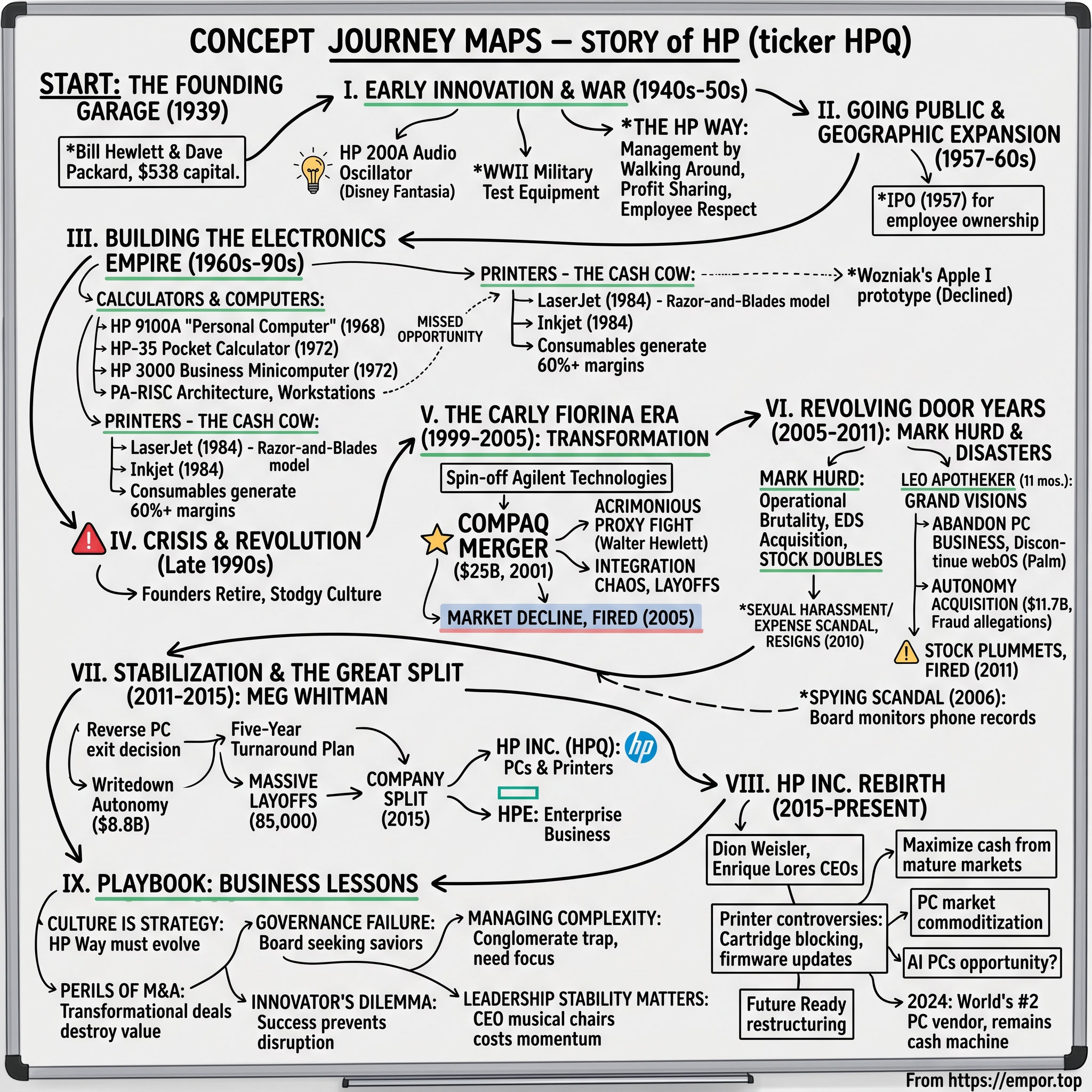
Behind a modest house at 367 Addison Avenue in Palo Alto sits a one-car garage that appears entirely unremarkable. Narrow, wood-sided, and utilitarian, it resembles the kind of suburban shed designed to store lawnmowers and paint cans. Yet the State of California designated it a historical landmark, and in 1989 officially dedicated the site as "the birthplace of Silicon Valley."1 On January 1, 1939, two Stanford engineering graduates named Bill Hewlett and Dave Packard formalized their partnership there with just $538 in working capital.1
Eighty-seven years later, the direct legal descendant of that partnership is HP Inc., trading under the ticker HPQ on the New York Stock Exchange. It is no longer an innovation darling. In fiscal 2025, the company generated $55.3 billion of revenue,2 shipping tens of millions of commercial and consumer personal computers alongside a smaller, far more lucrative portfolio of printers, ink, and toner. While it remains one of the largest hardware vendors in the world, it also trades at a persistent valuation discount to the broader market.
That discount reflects the paradox at the heart of the business. The enterprise that pioneered Silicon Valley's decentralized engineering culture and open-door management now relies on an economic engine borrowed from King Gillette. In fiscal 2025, HP's Personal Systems division generated $38.5 billion in revenue and roughly $2.1 billion in operating profit, while its Printing segment generated just $16.7 billion in revenue but delivered about $3.1 billion in operating profit.3 In short, printing accounts for less than a third of total company sales, yet provides nearly sixty percent of its operating earnings. Within Printing, the critical profit engine is supplies—the recurring sales of ink and toner cartridges—which generated $10.9 billion in fiscal 2025 and has experienced ongoing secular contraction.3
That structural asymmetry defines the central investment debate. HP operates as a high-volume assembly engine bolted to an annuity-like cash machine. The PC volume engine is vast, cyclical, and structurally low-margin, primarily because component and software suppliers—Microsoft, Intel, AMD, Qualcomm, and the major memory fabricators—capture the bulk of economic surplus across the device stack. The printing cash engine generates rich returns because customers repeatedly purchase high-margin consumables after the initial hardware purchase, yet it faces an enduring battle against digital workflows and the paperless office.
The contemporary corporate structure dates to November 1, 2015, when Hewlett-Packard Company split itself into two publicly traded entities.4 Hewlett Packard Enterprise assumed the corporate servers, storage, networking, and technology services operations. HP Inc. retained the personal computers and printing assets, serving as the formal legal successor to the original 1939 enterprise and retaining the historical HPQ ticker while HPE began trading as an independent company.4 That corporate lineage is significant: HP Inc. inherited not only the brand name and the Palo Alto heritage, but also the institutional memory of pioneering engineering breakthroughs alongside billions of dollars in dilutive corporate acquisitions.
That operational history encompasses several distinct eras. It spans Hewlett and Packard's early precision instruments and the managerial ethos of the "HP Way," the fortuitous commercialization of the LaserJet that created the modern printing franchise, and the contentious acquisitions under Carly Fiorina, Mark Hurd, and Léo Apotheker that culminated in massive subsequent write-downs. It includes Meg Whitman's balance-sheet restructuring and the 2015 separation, Xerox's hostile takeover bid across 2019 and 2020, and the aggressive share-repurchase commitments HP executed to protect its independence.
It also frames the contemporary business: the economics of dynamic printer security, firmware conflicts surrounding third-party ink cartridges, the post-pandemic PC replacement cycle, commercial AI PC adoption, the 2022 acquisition of Poly, and Berkshire Hathaway's rapid accumulation and subsequent liquidation of its equity stake. The operating environment continues to shift. In February 2026, long-time Chief Executive Enrique Lores, a 36-year HP veteran, resigned to take the helm at PayPal, prompting the board to appoint director Bruce Broussard as interim CEO.5 Meanwhile, an acute global memory shortage inflated average PC selling prices while weighing heavily on device shipment volumes throughout fiscal 2026, even as reported revenue expanded.6
For long-term investors, the fundamental question is not whether HP can survive; the company has weathered multiple technological shifts over nearly nine decades. The question is whether its underlying cash flows remain sufficiently resilient, and capital allocation sufficiently disciplined, to reward shareholders while its two primary businesses confront commoditization on one side and digital substitution on the other. Evaluating that durability begins where the modern technology industry originated: inside the Addison Avenue garage.
 Subscribe on LinkedIn
II. The Palo Alto Garage & The Golden Age: Bill, Dave, and the Invention of Tech Culture (1939–1984)
In the late 1930s, as the Great Depression lingered, California's top electrical engineering graduates faced a predictable path: board an eastbound train to join General Electric in Schenectady or Westinghouse in Pittsburgh. Stanford professor Frederick Terman sought to halt that regional talent drain. Determined to see his students build commercial enterprises locally, he actively encouraged two of them, Bill Hewlett and Dave Packard, to launch their own venture.1
The two founders brought complementary strengths. Hewlett was an inventive circuit designer, while Packard was a disciplined organizer and pragmatic operator who grew into one of the era's prominent corporate leaders. They held their first formal planning meeting in August 1937 and established their workshop in the Addison Avenue garage in 1938.7 A coin toss reportedly decided the name order, giving Hewlett the lead over "Packard-Hewlett."7
Their initial commercial product, patented in July 1939, was the Model 200A audio oscillator, an instrument designed to generate precise frequencies for testing sound equipment.7 Hewlett stabilized the circuit using an inexpensive incandescent light bulb, producing a design that was both simpler and substantially less costly than rival systems. An early milestone arrived when Walt Disney's studio purchased eight units to test sound systems during the production of Fantasia.1 The order underscored an enduring contrast: HP's first marquee customer was a Hollywood entertainment studio, but the product itself was specialized, precision industrial test equipment.
Early expansion remained steady rather than sudden. Annual sales reached $34,396 in 1940; by 1948, the company employed 128 people and generated $2.2 million in revenue.8 Test and measurement gear, marketed to engineering professionals who prioritized technical accuracy over price, formed the foundation of the business for decades.
The HP Way
Beyond hardware design, HP's primary legacy took shape through its operational model. In June 1957, during an offsite meeting in Sonoma, Hewlett and Packard codified a set of core corporate principles that became known as "the HP Way."7 The company completed its initial public offering that November at $16 per share.8 The HP Way emphasized mutual trust with workers, formal profit-sharing, decentralized product divisions granted operational autonomy, management by objective, and informal, direct executive engagement popularized as "management by walking around."
In an era defined by rigid corporate hierarchies on the East Coast, this decentralized structure broke with standard industrial practice. Operating units were kept deliberately small so general managers could stay close to personnel and product development. Broad employee equity participation, open-plan workspaces, and delegated operational authority—hallmarks of later Silicon Valley enterprise culture—first took root in these practices.
For public-market investors, this management framework created a demanding historical standard against which future chief executives would be measured. Decades later, contentious debates over the Compaq acquisition, large-scale workforce reductions, and aggressive printer cartridge security controls were framed not merely as financial decisions, but as departures from that institutional heritage.
From instruments to computers
HP's engineering focus carried the company into adjacent computing markets. In 1966, it introduced its first computer, the 2116A, developed primarily to automate and control its own test instruments.7 In March 1968, the company unveiled the HP 9100A, a programmable desktop calculator that was among the earliest commercial devices marketed under the term "personal computer."7 In January 1972, HP launched the HP-35, a handheld scientific calculator that rapidly displaced the traditional engineer's slide rule.7 Later that year, it shipped the HP 3000 minicomputer, competing directly against Digital Equipment Corporation and IBM in corporate computing environments.7
This early diversification highlighted a persistent corporate tension. HP proved exceptionally capable at building precision hardware for technical buyers who paid premium prices for performance. It struggled far more in high-volume commercial markets where unit costs, consumer branding, and retail distribution mattered more than engineering perfection. That operational divide would shape the company's next four decades—beginning with a compact desktop prototype developed in Boise, Idaho.
III. The Laser Revolution & The Birth of the Twin Engines (1984–1999)
In April 1983, engineers from Japan's Canon visited HP with a technology demonstration that would fundamentally reshape the American hardware maker. Canon had developed a compact laser printing engine, the CX, which solved a primary engineering obstacle that had plagued early commercial laser printers: all wearable components, including the toner, drum, and cleaning mechanisms, were integrated into a single replaceable cartridge.9 Canon informed HP that the mechanism would be ready for mass production by February 1984. HP's Boise division, which had spent months lobbying skeptical corporate executives to take desktop laser printing seriously, committed to meeting that production timeline.9
The two companies divided the architecture cleanly. Canon manufactured the physical print engine; HP's Boise team engineered the formatter—the electronic controller converting computer instructions into a printable page—and developed Printer Command Language (PCL) to standardize communication between software and the printer.9 HP unveiled the original LaserJet at the COMDEX computer exposition in May 1984, priced at $3,495 and printing eight pages per minute at 300 dots per inch.9
Commercial adoption was immediate. HP logged roughly 1,500 orders upon launch in May 1984, expanding to nearly 8,000 units per month by December; cumulative volume surpassed one million units by 1988, and cumulative shipments reached 100 million units by 2006.9 The LaserJet became the most successful single product line in HP's history.7 Concurrently, HP's Corvallis, Oregon laboratory commercialized thermal inkjet technology—a mechanism that propels microscopic ink droplets using localized thermal pulses—which subsequently powered the DeskJet family across home and small-office markets.
Discovering the razor-and-blade machine
The commercial ascent of desktop printing revealed a structural economic opportunity that transformed HP's financial architecture. A printer was an initial, one-time hardware transaction. However, every page printed consumed proprietary toner or ink that customers had to replace on an ongoing basis. As HP's cumulative hardware shipments scaled, the company established an expanding installed base of equipment generating recurring consumables demand for years after the initial sale.
The unit economics altered corporate incentives. Hardware could be priced aggressively—often near cost or at thin gross margins—to accelerate device placements, because the subsequent high-margin consumable annuity generated outsized profitability across the device's operational lifespan.
That dynamic established the profit foundation that continues to support the enterprise decades later. It also created an enduring strategic priority: insulating that high-margin supplies annuity from third-party cartridge remanufacturers, laying the groundwork for subsequent legal challenges and firmware security protocols.
The PC struggle and the workstation detour
Building an equally profitable personal computer operation proved far more difficult. During the x86 clone expansion of the late 1980s and 1990s, industry leadership consolidated around specialized operating models: Compaq out-engineered IBM on standard compatibles, while Dell pioneered a direct-to-consumer build-to-order distribution system that eliminated channel markups and inventory overhead. HP remained a reliable but mid-tier participant in desktop PCs, directing greater strategic focus toward higher-margin Unix workstations and corporate servers—strengthened through its 1989 acquisition of Apollo Computer—to counter Sun Microsystems.
The PC market's underlying economics conflicted with HP's traditional engineering heritage. As desktop computing standardized around Microsoft operating systems and Intel microprocessors, those platform providers captured the lion's share of economic profit across the hardware stack. For PC assemblers, competitive advantage required strict supply-chain execution, minimal operating overhead, and low component costs rather than proprietary bench engineering—a commodity reality that fit uncomfortably within HP's culture of premium laboratory design.
The 1999 split: Agilent
By the close of the 1990s, HP comprised two fundamentally divergent enterprises. One was the heritage test-and-measurement franchise: steady, technically demanding, and high-margin. The other was a high-volume personal computer and imaging vendor operating in fiercely competitive, fast-moving consumer and enterprise hardware channels. Executive leadership concluded that the two operations required distinct operating cultures, capital allocation priorities, and shareholder bases.
In March 1999, HP announced the spinoff of its test and measurement business as Agilent Technologies.7 Agilent's initial public offering closed on November 18, 1999, with HP initially retaining an 84% stake before distributing the remaining shares to its investors.8 The post-separation business emerged as a dedicated computer and printing enterprise.
The Agilent divestiture established a recurring structural theme in HP's corporate history. Over subsequent decades, the company's most value-accretive structural reorganizations proved to be corporate separations, while its largest combinations frequently introduced severe integration challenges and capital destruction. That dynamic was tested almost immediately under new executive leadership at the turn of the century.
IV. The Lost Decade & The M&A Trap: Fiorina, Hurd, Apotheker, and the Cost of Empire (1999–2011)
On March 19, 2002, HP shareholders gathered for one of the most contentious proxy votes in modern corporate history. On one side stood Chief Executive Carly Fiorina, the former Lucent executive who had taken the helm in 1999 and staked her tenure on acquiring personal computer rival Compaq. On the other stood Walter Hewlett, the co-founder's son and a dissident HP director, who had mounted an aggressive, months-long proxy campaign against the transaction. The preliminary tally showed Fiorina prevailing by approximately 45 million votes, a razor-thin margin given the billions of shares outstanding.10 Walter Hewlett filed suit, alleging HP had improperly pressured Deutsche Bank's asset management arm to switch its votes, but the Delaware Court of Chancery ruled against him in April 2002.10
Carly Fiorina and the Compaq collision
The acquisition was massive in scale: announced in September 2001 at approximately $25 billion.7 When it closed in May 2002, the merger triggered roughly 26,000 layoffs, according to Fortune's later tally.11 The combined entity adopted the New York Stock Exchange ticker HPQ, retiring HP's long-standing symbol HWP.
Fiorina's thesis centered on defensive scale. Combining HP and Compaq was meant to create a personal computer manufacturer large enough to rival Dell on procurement and manufacturing costs, alongside an enterprise computing business broad enough to take on IBM. Walter Hewlett's counter-thesis argued that HP was diluting its most profitable franchise, printing, by tethering it to a low-margin commodity hardware business, and that the cultural damage would be severe.
Subsequent financial performance largely validated Hewlett's critique on capital returns, even if Fiorina's volume thesis materialized. HP did eventually become the world's largest PC maker for an extended stretch, and the PC business it built still operates at vast scale today. Yet the merger delivered years of painful integration without demonstrating that the combined PC operations earned attractive returns on invested capital. When the board forced Fiorina out in February 2005, HP's share price jumped 6.9% that day,11 a sharp market reaction that reflected investor relief following years of contentious expansion.
Mark Hurd's efficiency machine and the governance meltdown
Mark Hurd, an exacting operator from NCR, succeeded Fiorina in 2005. While Fiorina focused on sweeping strategic vision, Hurd operated as a disciplined cost-cutter. He eliminated redundant administrative layers, consolidated data centers and procurement, and squeezed research budgets. Operating margins and the stock price improved markedly during his tenure.
Behind that operational efficiency, however, corporate governance descended into turmoil. In 2006, HP admitted it had hired private investigators who spied on board members and journalists to identify the source of press leaks, a deceptive practice involving illicit phone-record impersonation known as pretexting.12 The scandal cost Chair Patricia Dunn her job along with several other senior staff, though criminal charges were ultimately dropped.12
Hurd then pursued his own transformative transaction. On August 26, 2008, HP bought Electronic Data Systems, the IT outsourcing company founded by Ross Perot, for $13.9 billion.11 The strategic logic was to mimic IBM's migration toward higher-margin services. The result was an $8 billion write-off in 2012, when it became clear that EDS's legacy outsourcing contracts were worth far less than HP had paid.11
In April 2010, HP also agreed to buy smartphone pioneer Palm for roughly $1 billion to get its webOS operating system.11 Four months later, in August 2010, Hurd resigned after a board investigation into a sexual harassment complaint found inaccurate expense reports connected to his relationship with a marketing contractor.12
Leo Apotheker's eleven months
The board's next choice was Léo Apotheker, the former CEO of German software giant SAP, who took over in the fall of 2010.13 His plan was to pivot HP toward enterprise software, and in August 2011 he unveiled that strategic shift all at once. HP announced it was exploring a spin-off of its PC business, would discontinue its webOS devices including the TouchPad tablet, and would acquire British enterprise-search company Autonomy.12
The Autonomy purchase price, at $42.11 per share, was roughly a 60% premium to Autonomy's market price.13 Including assumed items, the deal was reported at about $11.1 billion.11 The market's reaction to the combined announcements was brutal, and within weeks the board fired Apotheker, replacing him in September 2011 with former eBay CEO Meg Whitman.13
The sequel became one of the most value-destructive M&A disasters in corporate history. In November 2012, HP recorded an $8.8 billion impairment on Autonomy, attributing more than $5 billion of it to what it called "serious accounting improprieties, misrepresentation, and disclosure failures" at Autonomy before the deal.13 The litigation ran for more than a decade across multiple jurisdictions. In January 2022, the UK High Court found that Autonomy founder Mike Lynch had fraudulently inflated the company's value.13 In June 2024, a U.S. jury acquitted Lynch of criminal fraud charges, and weeks later, in August 2024, he died when his yacht sank off Sicily.13 In July 2025, the UK court set damages at roughly $940 million, far below the at-least-$4.55 billion HP had sought.13
What the lost decade says about HP's capital allocation
That decade-long record bears directly on how much trust investors should extend to HP's strategic deal-making today. Compaq, EDS, Palm, and Autonomy together absorbed tens of billions of dollars of capital. Two of them, EDS and Autonomy, produced write-downs of $8 billion and $8.8 billion respectively.11 Palm's hardware was shut down within about 16 months of the purchase. Compaq's legacy is at best mixed.
The historical record therefore rejects any claim that HP has a natural gift for large, transformative acquisitions. The more defensible reality is narrower: HP has sometimes executed smaller, adjacent deals competently, but its multi-billion-dollar bets on strategic reinvention carry a poor base rate. That context matters when evaluating later moves like Poly. It also explains why the next era was defined not by acquisitions but by amputation.
V. The Surgical Split: Meg Whitman, Enrique Lores, and the Genesis of HP Inc. (2011–2019)
When Meg Whitman stepped into HP's Palo Alto headquarters in September 2011, she inherited an organization in operational and strategic disarray. The company had dismissed two chief executives in barely a year, committed to a contentious multibillion-dollar software acquisition it would soon repudiate, and publicly floated abandoning its core personal computer business. Employees were unsure whether the enterprise was fundamentally a hardware maker, an IT services consultancy, or a software house. Commercial clients and distribution partners openly questioned whether HP would remain committed to the PC ecosystem at all.
Whitman, who had scaled eBay from an online auction startup into a global e-commerce marketplace, took immediate steps to stabilize operations. She swiftly reversed Apotheker's plan to spin off the PC division, maintaining that its collective procurement volume with key component suppliers such as Intel and Microsoft provided crucial pricing leverage across the broader hardware portfolio. She then cleared the balance sheet of legacy acquisition premiums: the massive EDS and Autonomy write-downs both landed in 2012.11 Substantial cost restructuring followed; in May 2012, HP announced approximately 27,000 workforce reductions, with additional rounds of job cuts continuing in subsequent years.14
Why split at all?
In October 2014, HP formally announced plans to separate into two independent, publicly traded corporations.7 The corporate logic reflected the fundamentally incompatible operating models of its two primary divisions.
The personal computer and printing operation functioned as a high-velocity physical manufacturing business selling through commercial distributors, consumer retailers, and corporate reseller channels. It depended on rapid inventory turnover, disciplined working-capital management, and supply-chain efficiency to preserve operating margins against volatile component costs. In contrast, the enterprise technology business sold servers, storage architectures, networking hardware, and multi-year technology services directly to corporate IT departments—a capital-intensive operation requiring extended sales cycles, substantial research-and-development commitments, and specialized consulting personnel. The two divisions served distinct customer bases, confronted different competitive dynamics, and required contrasting balance-sheet profiles. Housing them under a single corporate roof meant capital allocation was frequently compromised to balance the competing strategic demands of each side.
Executing the corporate separation required an enormous operational overhaul. HP's board of directors granted formal approval on October 1, 2015, and the distribution took effect on November 1, 2015, with HP shareholders receiving one share of Hewlett Packard Enterprise for every HP share held.4 HP Inc. retained the original corporate entity and the HPQ ticker.4 The intricate disentanglement of global supply chains, real estate assets, and enterprise IT infrastructure was overseen in large part by Enrique Lores, a Spanish engineer and veteran company insider who had spent decades inside HP's printing operations and would later ascend to the chief executive role. Following the separation, each independent enterprise emerged with approximately $50 billion in annual revenue.12
The Dion Weisler years
HP Inc.'s inaugural chief executive was Dion Weisler, an Australian operating executive who had previously led the company's printing and personal systems division. His operating playbook was pragmatic: insulate high-margin printing supplies, shift personal computing toward higher-value commercial, gaming, and premium notebooks, and pursue disciplined expansion in adjacent niches such as commercial 3D printing and production graphics.
Weisler's primary strategic transaction was the acquisition of the printer business of 삼성전자 Samsung Electronics, completed in November 2017 for $1.05 billion.15 The acquisition was designed not to expand HP's modest consumer desktop footprint, but rather to secure Samsung's proprietary A3 multifunction laser printing technology alongside an intellectual property portfolio spanning more than 6,500 printing patents—assets HP intended to deploy against the profitable office copier market historically dominated by Xerox, リコー Ricoh, and Canon itself.15
Whether that investment fulfilled its strategic ambitions remains questionable. In fiscal 2025, HP's Commercial Printing revenue totaled roughly $4.6 billion, marking a 4% decline from the prior year.3 Rather than catalyzing significant market-share gains in corporate copy rooms, the acquired A3 product line ran headlong into secular post-pandemic shifts: depressed office occupancy rates and an accelerated enterprise migration toward digital, paperless workflows. The Samsung acquisition represented a targeted, adjacently focused bet whose operational contribution was largely overshadowed by the broader decline in office document volumes.
The corporate breakup ultimately achieved its foundational goal: establishing HP Inc. as a focused, cash-generative hardware enterprise supported by an entrenched printing cash engine and a top-two global volume position in personal computers. Yet by stripping away the enterprise IT services and infrastructure operations, the split also left the standalone hardware maker substantially smaller, modestly valued, and—in the view of an opportunistic industry rival—exceptionally vulnerable to an unsolicited takeover.
VI. The Barbarians at the Gate: Carl Icahn, Xerox's Hostile Raid, and the $16-Billion Defense (2019–2020)
In early November 2019, HP's board received an acquisition proposal that seemed commercially counterintuitive. Xerox, a legacy competitor roughly a third of HP's size and struggling with multi-year revenue contraction, proposed to buy HP outright. Xerox's annual revenue had fallen from $10.3 billion in 2017 to about $9.1 billion in 2019.16 HP, by comparison, was generating nearly $59 billion annually.17 Across Wall Street, the maneuver was widely described as a minnow attempting to swallow a whale.
Behind the aggressive bid stood veteran activist investor Carl Icahn, who held substantial equity stakes in both companies and argued that merging their overlapping print operations would unlock massive operational synergies. Xerox's opening proposal offered $22 per HP share, valuing the company at roughly $33.5 billion.16
Lores takes the helm
The timing created an immediate trial by fire for executive leadership. Enrique Lores had taken over as HP's chief executive on November 1, 2019—barely days before the unsolicited bid landed on his desk.
HP's board, led by Chairman Chip Bergh, the former Levi Strauss chief executive, swiftly rejected the approach on financial grounds. Xerox proposed to fund the transaction primarily with debt alongside Xerox equity, meaning HP shareholders would trade an investment-grade balance sheet for minority ownership in a heavily leveraged, shrinking enterprise. Bergh warned that the combined entity would be "burdened with an irresponsible level of debt."16
Xerox escalated the pressure. In February 2020, it raised its offer to $24 per share—structured as $18.40 in cash plus 0.149 Xerox shares—valuing HP at approximately $36.5 billion, while nominating an 11-member dissident slate to replace HP's entire board of directors.16 HP responded by adopting a shareholder rights plan, or poison pill, to block Xerox and Icahn from orchestrating a creeping accumulation of its outstanding stock.16
The capital-return counterpunch
On February 24, 2020, HP mounted its decisive counter-strategy. Rather than simply rejecting the bid, management presented shareholders with an equally aggressive capital-return alternative. The board authorized a program to return roughly $16 billion of capital to shareholders across fiscal 2020 through 2022—an amount representing approximately half of HP's total market capitalization at the time.18 Under this framework, HP expanded its share-repurchase authorization to $15 billion, pledged to execute at least $8 billion in buybacks within twelve months of its annual shareholder meeting, and committed to maintaining gross debt between 1.5 and 2.0 times EBITDA while defending its investment-grade credit rating.18 To support those capital returns, management also pledged $1.2 billion in structural cost reductions by fiscal 2022.18
This was a classic takeover defense: when an activist raider claims an enterprise is undervalued and under-leveraged, leadership pre-empts the assault by executing the financial engineering itself. The maneuver effectively neutralized Xerox's appeal, but it also pledged HP's future cash flows to sustained share buybacks regardless of subsequent operating conditions.
The pandemic intervention
Before Xerox could force a proxy vote, external events intervened. As global financial markets seized up amid the onset of COVID-19 in March 2020, Xerox withdrew its tender offer on March 31, citing macroeconomic disruption.19 HP remained independent.
In retrospect, the episode carried two distinct implications for investors. First, HP's board was almost certainly justified in rejecting the transaction; entering the pandemic burdened with billions in incremental leverage from a declining merger partner could have crippled the business. Second, the defense imposed lasting balance-sheet commitments. The $16 billion capital-return pledge locked HP into heavy share repurchases just as personal computer demand was about to experience an unprecedented pandemic-driven boom followed by a severe cyclical hangover. Whether those repurchases created enduring value depended entirely on the prices at which management bought back the stock—a topic explored in the capital allocation analysis. First, however, evaluating HP requires examining the high-margin foundation management fought so fiercely to protect: the printing cash engine.
VII. The Cash Cow Engine: Printing Economics and the Razor-Blade Warzone
In January 2024, Enrique Lores, then HP's chief executive, appeared on CNBC to explain why the company's printers were rejecting lower-cost third-party ink cartridges. The interview drew widespread scrutiny for its unusually transparent description of HP's underlying commercial model. "Every time a customer buys a printer, it's an investment for us," Lores explained. "If that customer doesn't print enough or doesn't use our supplies, it's a bad investment."20 He contended that non-HP cartridges could pose cybersecurity risks, claiming they could be used to "embed viruses" that travel "through the cartridge… to the printer, from the printer… to the network."20 While independent security researchers widely dismissed that viral threat vector, Lores's initial remark offered an unvarnished summary of the razor-and-blade economics that fund HP Inc.
The anatomy of the segment
HP's Printing operations divide into three distinct revenue streams. In fiscal 2025, Commercial Printing hardware—encompassing office printers and multifunction devices—generated approximately $4.6 billion. Consumer Printing hardware brought in about $1.2 billion. The core economic engine remained supplies—the recurring sales of ink and toner cartridges—which generated roughly $10.9 billion, representing nearly two-thirds of the segment.3 Across all three streams, the division produced approximately $3.1 billion of operating profit on $16.7 billion of revenue, delivering an operating margin near 19%.3
In fiscal 2024, by comparison, Printing earned about $3.3 billion of operating profit on $17.3 billion of revenue, with supplies contributing $11.3 billion.3 Total segment revenue fell roughly 3%, and operating earnings contracted alongside it. That performance highlights the defining financial characteristic of the franchise today: exceptionally high operating margins harvested from a gradually shrinking revenue base.
While HP does not disclose separate profit margins for hardware and supplies, the segment's structural asymmetry is clear from management's disclosures. Lores acknowledged on CNBC that HP routinely incurs upfront losses on hardware to drive placements and make up the margin on subsequent supplies, adding that the company's "long-term objective is to make printing a subscription."20 The hardware functions as the subsidized razor; the supplies provide the high-margin blades.
The substitution problem
The primary threat to this economic engine is not a competing manufacturer engineering a better printer. It is the steady disappearance of the reason to print at all. Corporate contracts are executed through digital signatures, collaborative documents reside in cloud workspaces, boarding passes sit on smartphones, and hybrid work arrangements mean fewer professionals stand beside an office printer.
Reported figures illustrate that secular erosion. Supplies revenue fell 3% in fiscal 2025.3 In the first quarter of fiscal 2026, supplies fell 1% (2% in constant currency); in the third quarter, supplies fell 3% (4% in constant currency).216 Printing segment revenue across fiscal 2025 was about $16.7 billion, versus roughly $17.3 billion a year earlier.3
Behind these incremental percentage declines sits a fundamental operating reality. HP's supplies profitability depends directly on total pages printed across its installed base, and page volumes remain in secular decline. While HP can selectively raise cartridge prices, reduce operating costs, and push subscriptions, those levers cannot halt the broader migration toward paperless workflows.
Dynamic Security: defending the moat with firmware
To protect its lucrative supplies franchise from cheaper aftermarket cartridges, HP turned to technological lock-in. The company equips its printers with Dynamic Security, proprietary firmware that authenticates the security chip on each cartridge and blocks those using non-HP chips. Because network-connected printers routinely receive over-the-air firmware updates, HP can alter cartridge compatibility protocols long after the hardware has been deployed in a customer's office or home.
Public pushback escalated significantly in 2016, when a firmware update caused thousands of HP printers worldwide to reject third-party cartridges overnight. The Electronic Frontier Foundation called HP's behavior "unforgivable" and demanded a fix.[^22] Class actions followed, including In re HP Printer Firmware Update Litigation in federal court in Northern California.22 Regulatory scrutiny intensified in 2021 when the Federal Trade Commission published its "Nixing the Fix" report, finding little justification for many manufacturer-imposed repair and parts restrictions.[^24]
To date, the direct legal consequences have remained manageable for the company. In a 2025 settlement over toner lockouts, HP paid nothing to the broad class, admitted no wrongdoing, and agreed to keep disclosing Dynamic Security and let owners of covered printers decline firmware updates that include it.23 That settlement followed a similar one in 2022.23
For investors, the analytical takeaway is balanced. The litigation has not dismantled the economic model, and HP has kept its supplies profits largely intact. Yet each successive legal compromise narrows HP's flexibility to lock out aftermarket competitors, while the friction inflicts lasting reputational cost. When a chief executive publicly characterizes customers who buy cheaper ink as a "bad investment," it reinforces consumer skepticism and validates longstanding criticisms of vendor lock-in.
The pivot to subscriptions and ink tanks
HP's strategic response has been to alter the shape of the commercial relationship. Instant Ink, its subscription service, charges users a monthly fee based on page volume and automatically dispatches replacement cartridges whenever the printer signals low supply levels. For HP, a subscriber represents a customer who cannot defect to a third-party cartridge without deliberately canceling the service. Former CFO Marie Myers once said subscriptions create "a 20 percent uplift on the value of that customer because you're locking that person" into a longer relationship.20
At the opposite end of the product spectrum, HP markets refillable ink tank printers, which feature built-in reservoirs replenished from inexpensive bottled ink. Here, the traditional unit economics invert: HP earns a higher margin on the hardware up front while capturing lower recurring supplies revenue later. The ink tank format was pioneered across emerging markets by Japanese rivals like セイコーエプソン Epson and ブラザー工業 Brother, forcing HP to compete. In the third quarter of fiscal 2026, HP's tank printer units grew 42% and management said it gained 4 points of share.24 That represents genuine commercial execution, but it expands HP's footprint in a category that structurally produces less recurring supplies annuity per deployed unit.
Historical falsification: is the printing moat intact?
The traditional bull case maintains that HP's supplies franchise is a durable annuity protected by patents, security chips, and a sticky installed base. The historical record supports a far more qualified view. The competitive moat has not been breached in the conventional sense of a rival manufacturer seizing market share; operating margins near 19% show that the franchise still generates exceptional profits. Instead, digital substitution is doing what hardware competitors could not: shrinking the total volume of pages the moat was built to protect. Supplies fell again in fiscal 2025 and in each reported quarter of fiscal 2026, even with price increases, subscriptions and tank-printer share gains.36
The verdict is that the printing moat is narrowing rather than collapsing. Future printing profits depend less on consumer hardware lock-in and more on contractual subscriptions and managed print services, where HP oversees corporate fleets under multi-year enterprise agreements. The single metric that will tell investors whether the deterioration is accelerating is constant-currency supplies revenue growth. Annual declines between 1% and 3% represent the baseline pattern of recent years; a sustained contraction worse than 3% would signal that digital substitution is gathering speed. That is the cash engine. The volume engine is a very different animal.
VIII. The Volume Engine: Personal Systems, Commoditization, and the AI PC Inflection
In the spring of 2020, HP's factories and supply chain confronted a dynamic the personal computer industry had not witnessed in a decade: an acute surplus of demand. Virtually overnight, hundreds of millions of corporate employees and students were forced into remote work and distance learning. Enterprises rushed to outfit dispersed workforces with commercial notebooks, while households snapped up budget laptops and Chromebooks to keep children in virtual classrooms. By fiscal 2021, HP's top line jumped 12.1% to reach $63.5 billion.25 For an ephemeral stretch, the mature PC business looked like a secular growth industry again.
That illusion faded quickly. Across 2022 and 2023, the industry paid the price for pulling forward years of future upgrade cycles. Device shipments tumbled, distribution channels backed up with unsold inventory, and widespread discounting squeezed gross margins across the sector. HP's total revenue dropped from $63.0 billion in fiscal 2022 to $53.6 billion in fiscal 2024, a contraction of roughly 15%.2627 That violent round-trip from post-lockdown boom to inventory bust offers a concise primer on the underlying reality of the PC market: it remains a cyclical, capital-light assembly operation whose volume trajectory is dictated by hardware replacement schedules.
The shape of the business
In fiscal 2025, HP's Personal Systems division generated $38.5 billion in revenue, divided into $27.4 billion from commercial enterprise clients and $11.1 billion from individual consumers.3 From that substantial top-line base, the segment produced approximately $2.1 billion of operating profit, translating to a modest operating margin of roughly 5.5%.3 A year earlier, in fiscal 2024, the division had generated roughly $2.3 billion of operating profit on $36.2 billion of sales.3 Even as reported revenue expanded, total operating earnings retreated.
The structural cause behind those thin operating margins lies in the division of economic rents across the hardware stack. Inside a standard notebook, the central microprocessor originates with Intel, AMD, or Qualcomm—semiconductor designers that command significant pricing power. The operating system belongs to Microsoft. Dynamic random-access memory and flash storage are sourced from an oligopoly of memory fabricators, while display panels come from specialized Asian glass manufacturers. Physical assembly is outsourced to Taiwanese contract manufacturing giants such as 廣達 Quanta, 仁寶 Compal, and 鴻海 Foxconn. While HP designs, brands, markets, distributes, and supports the finished chassis, the overwhelming majority of the device's intellectual property value and economic surplus is captured by upstream component suppliers and software platform providers.
Market position
HP ranks as the world's second-largest personal computer vendor. During the second quarter of calendar 2026, industry tracker IDC calculated that 联想集团 Lenovo led the worldwide market with a 24.4% shipment share, followed by HP at 19.1%, Dell at 13.6%, Apple at 9.9%, and 華碩 ASUS at 7.4%.28 Notably, HP's unit shipments contracted 9% year over year in that three-month period, compared with a 2% decline for Lenovo, a 5% drop for Dell, and a 10% shipment expansion for Apple.28 As industry demand softened, HP surrendered market share to competitors.
HP's primary competitive fortress resides in the commercial enterprise fleet. Corporate procurement managers purchase fleets of EliteBooks, ProBooks, and Z-series workstations under multi-year enterprise agreements bundled with custom configurations and specialized endpoint software like HP Wolf Security. Corporate clients prioritize device reliability, enterprise manageability, and worldwide field support over minor price differences. That enterprise focus insulates HP with more stable pricing than the consumer retail market, where shoppers navigate retail shelves with minimal brand loyalty and compare raw hardware specifications purely on price.
The Windows 10 deadline and the AI PC pitch
Two major catalysts emerged to drive corporate upgrade discussions starting in 2024. The first was Microsoft's formal retirement of support for Windows 10 on October 14, 2025, after which the legacy operating system ceased receiving standard security patches and technical updates.29 Enterprise IT organizations, barred by corporate governance and cybersecurity mandates from running unsupported operating systems, were forced to refresh aging fleets or migrate to Windows 11. By its third-quarter fiscal 2026 earnings review, HP management reported that the enterprise Windows 11 hardware migration was roughly 70% complete.24
The second catalyst is the marketing push behind the "AI PC"—a personal computer outfitted with an integrated neural processing unit designed to execute machine learning algorithms and generative AI models locally rather than routing queries through remote cloud servers. HP restructured its consumer portfolio, retiring legacy product lines to consolidate under the "OmniBook" banner, and banked on on-device AI capabilities commanding retail price premiums. By the third quarter of fiscal 2026, AI-capable configurations accounted for 46% of HP's total PC shipments, with executive leadership projecting that proportion would reach 50% by the end of the fiscal year and between 60% and 70% in 2027.24
The memory shock of 2026
Those unit-price expectations ran into an unforeseen macroeconomic headwind. A severe worldwide shortage of DRAM memory chips, catalyzed by massive capital expenditure allocations toward high-bandwidth memory for AI data centers, triggered sharp price spikes across standard computing memory. Because system memory constitutes one of the largest single bills of materials for any computer assembler, the supply crunch delivered an immediate blow to unit profitability.
The financial fallout was visible across HP's reported results. In the first quarter of fiscal 2026, Personal Systems revenue grew 11% alongside a 12% rise in unit shipments, delivering a 5.0% operating margin.21 By the third quarter, reported segment revenue surged 18% to $11.8 billion, yet total device unit shipments plunged 16% while the operating margin compressed to 4.6%.6 In short, HP was selling significantly fewer machines at substantially elevated average selling prices, yet capturing lower operating profits on each dollar of top-line revenue. On the third-quarter earnings call, Chief Financial Officer Karen Parkhill warned that she expected "input costs to rise, putting near-term pressure on our operating margins, particularly in Personal Systems," while management projected broader PC industry shipments to decline in the high teens through the second half of the year.24 Management identified the fourth quarter as the probable trough for operating profitability, anticipating margin recovery in fiscal 2027 as hardware redesigns and product re-pricing work their way through the channel.24
Industry forecasters at IDC projected that the global memory supply imbalance would persist into early 2028.28 That extended timeline indicates that input-cost friction represents an enduring operational condition rather than a temporary quarterly anomaly.
Historical falsification: will AI PCs expand margins?
The bull case for the volume engine asserts that AI PCs will structurally expand personal computer operating margins by inducing commercial and consumer buyers to pay a durable premium for on-device neural processing. That thesis can be evaluated against both historical precedent and current financial disclosures.
The historical precedent is not encouraging. Previous waves of marketed PC innovations—from integrated Wi-Fi adapters and high-definition screens to ultralight chassis designs—regularly commanded fleeting price premiums before industry-wide competitive parity commoditized the hardware into a standard feature. Current operating disclosures point to an even more sobering conclusion. As AI PC configurations scaled to 46% of HP's total shipments by the third quarter of fiscal 2026, the division's operating margin moved downward, slipping from 5.0% in the first quarter to 4.6% in the third.216 While higher DRAM spot prices account for much of that margin compression rather than the AI hardware itself, the structural takeaway remains identical: when component costs rise, the pricing gains pass directly upstream to semiconductor vendors rather than enriching PC assemblers.
The empirical evidence significantly narrows the AI PC narrative. The Windows 10 end-of-life deadline and local AI capabilities accelerated corporate fleet replacements and lifted average invoice figures, but they have produced no demonstrable evidence of breaking HP's PC margins out of their traditional mid-single-digit corridor. The key metric for investors tracking this debate is Personal Systems operating margin. If the segment returns to and maintains the 5% to 7% operating corridor management historically targeted after memory input costs abate, the baseline hardware model remains stable; if operating profitability remains pinned near or below 5%, the economic rents of on-device AI will have been captured entirely by upstream silicon providers. Regardless of where margins settle, however, the manner in which HP allocated the capital generated across its twin hardware engines has proved just as consequential for equity holders as the operating mechanics of the engines themselves.
IX. Capital Allocation, M&A Discipline, and The Berkshire Hathaway Incursion (2020–2026)
On April 7, 2022, HP's stock jumped after Berkshire Hathaway disclosed an equity stake of roughly 121 million shares, then valued at approximately $4.2 billion.30 For an enterprise public markets had long priced at a persistent discount, an endorsement from Warren Buffett's conglomerate provided an immediate vote of confidence. The investment logic appeared straightforward: HP traded at a low price-to-earnings multiple, generated dependable cash flow, and was aggressively retiring its outstanding shares.
Barely two years later, Berkshire had exited the position entirely. The firm began paring its holdings in September 2023,31 and liquidated its final 22.9 million shares by the first quarter of 2024.32 Understanding that rapid departure requires examining the capital allocation decisions HP executed across that window.
The buyback surge
Following its defense against Xerox, HP fulfilled its capital-return commitments through aggressive share repurchases. In fiscal 2021, the company repurchased approximately 224 million shares for $6.2 billion.25 In fiscal 2022, it bought back another 126 million shares for $4.3 billion.26 Yet those massive repurchases coincided precisely with the cyclical peak of the pandemic PC boom, when device demand and operating earnings were temporarily inflated.
As that demand surge unwound, free cash flow contracted. HP had generated $4.2 billion in free cash flow in fiscal 2021 and $3.9 billion in fiscal 2022.2526 By fiscal 2025, annual free cash flow had receded to $2.9 billion.2 Share repurchases slowed in tandem, dropping to $850 million in fiscal 2025.3 By October 31, 2025, HP carried approximately $9.7 billion in total debt against $3.7 billion in cash, leaving the company with a stockholders' deficit of $346 million as cumulative share repurchases and dividend distributions exceeded total book equity.3
Operating with negative book equity is not uncommon among mature companies with stable cash generation, but it reduces balance-sheet flexibility when operating conditions deteriorate. More critically, those repurchases were concentrated at valuations supported by peak cyclical earnings. Retiring nearly a quarter of outstanding equity when cash flows were temporarily elevated inverted the fundamental discipline of share repurchases, which requires buying at discounts to intrinsic value rather than near the top of an ephemeral demand cycle.
Poly and HyperX: the M&A test
Alongside share repurchases, HP resumed external acquisitions. In 2021, the company agreed to acquire gaming peripherals brand HyperX from Kingston Technology for $425 million.33 In March 2022, management announced an agreement to acquire Poly, the former Plantronics and manufacturer of enterprise audio headsets and video collaboration hardware, for $40 per share in cash—a transaction valued at approximately $3.3 billion including assumed debt.34 The acquisition closed in August 2022.35
The strategic rationale for Poly rested on hybrid work: as organizations adapted to distributed work arrangements, enterprise clients would equip offices and home workstations with integrated conference-room hardware, headsets, and personal computers, allowing HP to cross-sell hardware bundles. However, the commercial timing proved challenging. The transaction closed just as enterprise IT budgets tightened and the post-lockdown hardware hangover took hold. Because HP absorbed Poly into its broader segment reporting rather than disclosing separate performance metrics, its standalone financial trajectory cannot be audited directly.
Compared with the multibillion-dollar write-downs that followed the EDS and Autonomy acquisitions, Poly was far more modest in scale and has avoided catastrophic impairment charges. Yet it was purchased near the cyclical peak of enterprise remote-work spending, and public filings offer no clear evidence that the transaction has generated returns exceeding its cost of capital.
Future Ready and the next round of cuts
To protect operating profitability amid softening hardware sales, HP initiated its "Future Ready" restructuring plan in November 2022, targeting at least $1.4 billion in annualized gross run-rate savings by the end of fiscal 2025, accompanied by between 4,000 and 6,000 workforce reductions and roughly $1.0 billion in restructuring charges.26 Three years later, in November 2025, leadership introduced an additional restructuring initiative: targeting approximately $1 billion in gross run-rate savings by the end of fiscal 2028, $650 million in restructuring charges, and another 4,000 to 6,000 job cuts, this time framed around artificial-intelligence-enabled productivity gains.2
For investors, the symmetry between the two programs is telling. Successive restructuring programs featuring nearly identical workforce targets indicate that periodic cost cutting has functioned as an ongoing operational mechanism rather than an isolated, one-time adjustment. While continuous cost takeout is common across mature hardware industries, that regularity complicates management's classification of restructuring charges as non-recurring adjustments to core earnings.
Why Buffett left
Berkshire Hathaway never commented publicly on why it dismantled its position, leaving market participants to infer its reasoning from operating data. The observable sequence is straightforward: shortly after Berkshire established its stake, HP's PC revenue receded from pandemic highs, free cash flow declined, and share repurchases dropped sharply. In fiscal 2023, HP repurchased only about $100 million of its own shares.32 The primary financial pillars that had made HP compelling in early 2022—an outsized shareholder yield paired with rapid share count reduction—eroded quickly. The most direct conclusion is that the investment thesis rested on capital return velocity that post-pandemic cash flows could no longer sustain.
The current posture
Since August 2024, HP's balance sheet has been overseen by Chief Financial Officer Karen Parkhill, who joined from Medtronic after serving as its finance chief since 2016.36 Under her tenure, capital allocation has pivoted toward a more measured pace of returns. Across the first three quarters of fiscal 2026, HP returned roughly $1.5 billion to shareholders through dividends and repurchases, including $300 million in share buybacks during the third quarter.246 Management also raised its fiscal 2026 free cash flow guidance to a range between $3.0 billion and $3.2 billion.6 That revised framework reflects a more conservative capital structure that better aligns with normalized hardware cash generation. Yet with Enrique Lores departed and Bruce Broussard serving as interim chief executive, the long-term stewardship of that capital remains an open question.
X. Current Management, Corporate Governance, and Executive Credibility
On February 3, 2026, HP announced that Enrique Lores had stepped down as president and chief executive "to pursue another professional opportunity."5 That opportunity was the chief executive role at PayPal, effective March 1, 2026.17 After thirty-six years at HP, including more than six years leading the company as CEO, the quintessential company insider had departed.5
The Lores scorecard
Lores had spent his entire career at HP, rising through the inkjet division, leading the operational separation of Hewlett-Packard Company in 2015, directing the printing business, and ascending to the chief executive role in November 2019. He left behind a complex operational record that equity markets evaluate on realized financial outcomes rather than strategic intent.
On operational defense, his accomplishments were tangible. He rebuffed Xerox's debt-heavy hostile raid—a decision thoroughly vindicated in hindsight—while keeping the enterprise profitable and cash-generative through the severe cyclical whipsaw of the pandemic. He also steered the printing division toward contractual subscriptions and refillable ink tanks to mitigate the secular decline of desktop document printing.
Yet the broader financial ledger also reflects structural contraction and poorly timed capital allocation. Company-wide revenue contracted during his tenure, declining from roughly $58.8 billion when he took office to approximately $55.3 billion in fiscal 2025.17 HP concentrated its largest share repurchases across 2021 and 2022 at peak cyclical earnings, deployed $3.3 billion to acquire Poly at the crest of the enterprise remote-work boom, and inflicted self-inflicted reputational damage through public defenses of cartridge lockouts and firmware restrictions. Furthermore, his departure arrived midway through a newly launched multi-year restructuring initiative and immediately before an acute global memory shortage squeezed personal computing margins, leaving unresolved operating challenges to his successors.
An interim leader from outside tech
The board appointed Bruce Broussard as interim chief executive effective immediately.5 Broussard, who joined HP's board in 2021, had led health insurer Humana for more than a decade and previously held executive leadership roles at US Oncology.5 While he brought seasoned experience managing large public corporations, he was not a hardware or technology operator by background. To identify a permanent successor, the board formed a search committee and retained an executive search firm.5 During the August 2026 earnings call, Broussard noted that the search was "proceeding well" but gave no timeline for an appointment.24
Under the interim leadership team, reported quarterly results initially surpassed management's targets. In the third quarter of fiscal 2026, non-GAAP diluted earnings per share reached $0.83, exceeding the outlook range, although that figure included an eleven-cent benefit from tariff refunds.6 Management subsequently raised its full-year non-GAAP earnings per share guidance to between $3.19 and $3.29, incorporating a nineteen-cent net benefit from tariffs.6 Stripping out those regulatory windfalls reveals that underlying operating improvements were far more incremental.
Guidance credibility
That distinction matters because HP's broader forecasting track record has been inconsistent. At the end of fiscal 2024, HP guided to fiscal 2025 non-GAAP earnings per share of $3.45 to $3.75 and free cash flow of $3.2 billion to $3.6 billion.27 Actual results came in at $3.12 and $2.9 billion, falling below the low end of both ranges.2 While unanticipated trade tariffs imposed during the fiscal year contributed to that shortfall, the variance highlighted the company's sensitivity to external friction. In fiscal 2026, the pattern shifted: full-year non-GAAP earnings guidance was initially set between $2.90 and $3.20,5 with management warning early in the year that results might settle near the bottom of that band because of surging memory costs,21 before raising the outlook after the third quarter on the back of tariff recoveries.6
Governance stress test
An activist investor evaluating HP's corporate governance would likely focus on four structural vulnerabilities. First is executive continuity: the enterprise is led by an interim chief executive who lacks a hardware background, navigating an acute memory-cost supply crisis while an external search drags on. Second is capital discipline: management retired sizable blocks of equity at cyclically elevated valuations across 2021 and 2022, only to dramatically pare buybacks once the share price retreated. Third is chronic restructuring: launching two consecutive multi-year cost reduction programs featuring nearly identical workforce-reduction targets suggests that periodic overhead cutting has become a structural operational crutch rather than a one-time efficiency gain. Fourth is portfolio clarity: whether tethering a high-margin, secularly contracting printing annuity to a low-margin, cyclical PC assembly operation continues to serve shareholder interests, or whether separating the two assets would unlock a higher valuation multiple for the imaging cash engine.
None of these vulnerabilities represents an existential governance breakdown. Taken together, however, they portray an enterprise whose operational execution has regularly outpaced its capital allocation discipline. The board's selection of a permanent chief executive will signal whether directors prioritize supply-chain stewardship or structural portfolio reform. Evaluating how much strategic latitude that future leader will inherit requires assessing HP's competitive moat across the broader enterprise landscape.
XI. Hamilton Helmer's 7 Powers & Porter's Five Forces Analysis
Consider a corporate procurement officer running a request for proposal to refresh 20,000 corporate laptops. The invitees are familiar: HP, Dell, and Lenovo. Each vendor submits configurations powered by identical Intel or AMD processors, running the same Windows 11 operating system, accompanied by comparable display panels and standard multi-year service warranties. The bids routinely land within a few percentage points of one another. The contract ultimately goes to whichever vendor bids lowest while satisfying baseline security and field-support requirements. That routine transaction, replicated across thousands of enterprises worldwide, captures the reality of HP's competitive standing far more vividly than any corporate presentation.
A. Hamilton Helmer's 7 Powers
Hamilton Helmer's strategy framework identifies the structural conditions that enable an enterprise to earn persistent, above-average economic returns. When applied to HP Inc., the framework reveals a sharp dichotomy between the company's two operational engines.
1. Scale economies: moderate in PCs, meaningful in printing. In personal computers, HP's vast procurement volume yields modest purchasing discounts with contract assemblers and component vendors while spreading fixed research-and-development overhead across tens of millions of devices. Yet that volume scale provides little insulation against broader market dislocations: during the acute 2026 memory shortage, HP's unit shipments contracted 9% in the second calendar quarter while market leader Lenovo's declined just 2%.28 In printing, scale confers a more defensible advantage by amortizing the steep engineering, precision tooling, and specialized chemical costs of proprietary printhead technology across a global installed base.
2. Network effects: none. Personal computers and desktop printers are standalone endpoint devices. A professional adopting an HP laptop or office printer creates zero incremental utility or direct value for any other user.
3. Counter-positioning: weak. HP's Instant Ink subscription model re-engineers how consumables are billed and delivered, but it imposes no structural barrier to imitation. Competing hardware manufacturers can—and do—introduce subscription replenishment models of their own without cannibalizing an incompatible legacy asset, meaning HP's model does not leave rivals at a strategic disadvantage if they mirror it.
4. Switching costs: high in commercial, low in consumer. Enterprise clients operating thousands of corporate notebooks standardized on HP Wolf Security, enterprise device management images, and multi-year managed print services face meaningful organizational friction, IT retraining costs, and contract penalties if they switch providers. By contrast, a retail consumer purchasing an individual laptop or desktop printer incurs virtually zero friction in defecting to a competing brand.
5. Branding: moderate. The HP name commands institutional trust among enterprise procurement officers, and the LaserJet trademark retains enduring commercial authority in corporate imaging. In consumer computing, however, the brand exercises minimal pricing power against rival Windows vendors, and Apple's gains in 2026 show that the premium consumer segment belongs to a different company.28
6. Cornered resource: moderate in printing. Decades of proprietary microfluidics research, extensive thermal inkjet patents, and a durable four-decade engineering partnership with Canon on laser print engines remain difficult for newcomers to replicate.9 However, foundational patents eventually expire, and third-party remanufacturers continually engineer workarounds to cartridge authentication protocols—compelling HP to protect its supplies cash flow through recurring firmware updates and aggressive courtroom defense.
7. Process power: moderate. HP operates a sophisticated global supply-chain and distribution network capable of configuring, building, and delivering bespoke commercial hardware fleets across dozens of jurisdictions. While this operational capability represents a demanding logistical achievement, it does not constitute a unique structural advantage: rivals Lenovo and Dell deploy comparable logistics infrastructure and global channel reach.
The overall conclusion from Helmer's lens is that HP's durable economic powers are concentrated almost exclusively in its printing operations, where installed-base scale, cornered intellectual property, and enterprise switching costs converge. In personal systems, HP's advantages are largely operational, equipping the business to participate at scale but leaving it unable to extract sustained, above-average economic rents.
B. Porter's Five Forces
1. Threat of substitutes: extreme in printing, low in personal computing. The primary threat to printing stems not from rival hardware manufacturers, but from the relentless enterprise migration toward digital workflows, cloud document collaboration, and electronic signatures. Conversely, while smartphones and tablets absorb casual consumer computing tasks, traditional personal computers remain indispensable productivity endpoints for commercial enterprises, engineering workflows, and knowledge workers.
2. Supplier power: high. Personal computer assemblers operate at the mercy of an upstream semiconductor and software oligopoly. Microsoft controls the dominant commercial operating system, while Intel, AMD, and Qualcomm govern core processing architectures. Crucially, as the memory crisis illustrated, concentrated DRAM and flash fabricators can swiftly compress PC assembly margins whenever supply tightens. In laser printing, HP remains structurally dependent on Canon for foundational print-engine mechanisms.
3. Buyer power: high. Enterprise procurement departments routinely pit HP against Dell and Lenovo in structured bidding contests, exercising considerable pricing leverage over hardware specifications. In the consumer channel, shoppers browse transparent e-commerce marketplaces with minimal brand affinity, readily trading off brands for marginal price discounts.
4. Threat of new entrants: low. Replicating HP's worldwide manufacturing partnerships, commercial reseller channels, regional distributor agreements, and global enterprise field-support infrastructure demands billions of dollars in capital expenditure. Moreover, the structurally thin operating margins characteristic of personal computer assembly serve as an effective barrier, deterring potential greenfield competitors from entering the market.
5. Competitive rivalry: ferocious. Personal computing features entrenched global competitors contesting narrow margins: Lenovo leverages extensive manufacturing scale and domestic supply-chain advantages in China, Dell deploys a formidable direct enterprise sales force and bundles client hardware with data-center infrastructure, and Apple commands the high-margin premium consumer segment. In printing, Japanese rivals including Canon, Epson, and Brother compete fiercely across both enterprise copiers and consumer hardware, particularly in the rapidly growing refillable ink-tank category.
Taken together, these competitive frameworks illuminate HP's financial architecture. The printing business occupies an economically attractive, defensible position within a secularly shrinking addressable market. The personal computer business occupies a structurally commoditized, low-margin position within a vast, cyclical market. HP's valuation and investment debate reside entirely in the unresolved tension between those two economic engines—framing the diverging bull and bear cases for the stock.
XII. Bull vs. Bear Case, Valuation Framing, & Crucial KPIs
Consider two investors reading the same third-quarter fiscal 2026 financial report. The first focuses on top-line expansion: revenue reached $15.7 billion, up 12.5%, management raised full-year earnings guidance, and the quarter delivered $1.6 billion of free cash flow.6 The second focuses on underlying operational strain: PC unit shipments fell 16%, Personal Systems operating margins compressed to 4.6%, supplies revenue declined once more, and leadership remains in the hands of an interim chief executive.6 Both interpretations reflect reported numbers. The central investment debate hinges on which set of forces proves more durable over the next cycle.
The bull case
The enterprise fleet refresh provides cyclical support. Corporate IT departments faced a mandatory replacement deadline with the end of Windows 10 support, and HP's commercial PC revenue expanded 22% in the third quarter of fiscal 2026.6 Proponents argue that HP's entrenched relationships across commercial enterprise fleets position it to capture recurring corporate upgrade waves, while on-device AI capabilities give enterprise clients another reason to upgrade aging hardware.
Memory cost inflation is cyclical rather than permanent. Component spot prices have historically followed defined boom-and-bust cycles. Once data-center demand stabilizes and fabricator capacity rebalances, bulls contend that Personal Systems operating margins should recover, particularly because management identified the fourth quarter of fiscal 2026 as the operational trough.24
Printing remains a managed retreat rather than a collapse. Low single-digit declines in consumables demand remain manageable as long as the division sustains operating margins near 19%. Proponents point out that contractual subscriptions, expanding market share in refillable ink-tank printers, and industrial printing—which recorded its twelfth consecutive quarter of growth—provide meaningful operational offsets to volume contraction in traditional office environments.24
Shareholder cash returns remain substantial. With management guiding full-year fiscal 2026 free cash flow to between $3.0 billion and $3.2 billion and maintaining a quarterly dividend of $0.30 per share, HP continues to return meaningful cash to equity holders.6
The bear case
Secular printing decline threatens to outpace cost reductions. If corporate digital substitution and paperless workflows accelerate, the revenue base of HP's most profitable franchise will contract faster than restructuring programs can offset. Because Printing generates more than half of HP's total operating profit, even modest acceleration in supplies attrition exerts an outsized drag on consolidated earnings.
Regulatory and legal scrutiny poses an ongoing threat to supplies margins. Right-to-repair legislative momentum, heightened scrutiny from the Federal Trade Commission, and persistent consumer litigation could progressively limit HP's ability to exclude third-party supplies through Dynamic Security firmware updates.[^24]23 While past legal settlements have imposed manageable financial penalties, the regulatory environment creates a one-way ratchet that steadily constrains vendor lock-in.
PC commoditization and supplier pricing power squeeze margins. The 2026 memory shock demonstrated that HP's personal computing profitability can compress even during double-digit revenue expansion. If system memory spot prices remain elevated into 2028, as IDC projections suggest, Personal Systems operating margins may remain pinned near cyclical lows.28
Prolonged executive leadership uncertainty. More than half a year after Enrique Lores's departure, the board has yet to announce a permanent chief executive. A newly appointed outsider might reset medium-term financial targets, record restructuring charges, or alter current capital-return commitments.
The institutional exit by Berkshire Hathaway. Berkshire Hathaway initiated its position as a disciplined cash-return investment, only to liquidate its entire holding within two years.3032 While a single institution's exit is not definitive, it demonstrates that one of the market's prominent value-oriented investors concluded the cash-generation thesis no longer justified the capital commitment.
Valuation framing
HP has long traded at a low multiple of earnings, reflecting public market skepticism toward both of its operating engines. The stock's valuation essentially represents a composite wager on two variables: the durability of the printing supplies annuity and the cyclical recovery of personal computer operating margins. If supplies contraction remains modest and PC margins recover toward management's historical target range, the current cash-generation profile offers an attractive yield. Conversely, if secular digital substitution accelerates or component costs keep PC profitability depressed, that valuation discount will prove entirely warranted. Market pricing ultimately reflects those competing structural forces rather than a consensus on which trajectory will prevail.
The three KPIs that matter
1. Constant-currency Supplies revenue growth. This metric serves as the vital sign of HP's primary profit generator. Contractions between 1% and 3% have represented the baseline pattern of recent years; a sustained decline exceeding 3% would signal that digital substitution is gathering speed.
2. Personal Systems operating margin. This figure reveals whether HP can defend its unit economics against component inflation and whether commercial AI PCs deliver genuine, durable pricing power. Investors should monitor whether segment profitability recovers into the mid-single digits as memory costs ease or remains pinned near 4% to 5%.
3. Free cash flow generation and leverage. This measure determines HP's capacity to maintain its capital-return commitments. The key benchmark is whether normalized annual free cash flow holds near the $3 billion threshold while gross debt remains disciplined within the company's leverage targets.
Tracking those three indicators will clarify quarter by quarter whether the mature hardware engine continues to generate resilient cash flows, or whether secular pressures are gradually overtaking its structural defenses.
XIII. Epilogue: The Soul of an Old Machine
A visitor walking down Addison Avenue in Palo Alto will find the garage still standing, restored to its 1930s appearance after HP purchased the property in 2000 and spent years refurbishing the site.1 Tourists regularly pause to photograph the landmark, though few likely connect the birthplace of Silicon Valley to the modern economics of replacement ink cartridges.
The technology sector has rarely been kind to hardware pioneers. Digital Equipment Corporation, Wang Laboratories, Commodore, Compaq, Sun Microsystems, and Gateway were all industry leaders in their prime, and all were eventually absorbed or dismantled. HP has survived for nearly nine decades not by avoiding strategic missteps, but by repeatedly restructuring its footprint—frequently by shedding substantial portions of itself. It spun off Agilent in 1999, separated Hewlett Packard Enterprise in 2015, and absorbed a series of costly corporate acquisitions that might have crippled a less resilient enterprise.
The founding ethos of Bill Hewlett and Dave Packard bears little resemblance to HP's contemporary operating model; the HP Way envisioned open-door engineering rather than firmware lockouts and cartridge subscriptions. What persists instead is an unglamorous operational durability: the capacity to harvest billions of dollars in dependable cash flow from markets characterized by secular contraction and hardware commoditization.
The open question for investors is whether that operational resilience remains sufficient. HP's next permanent chief executive will inherit a printing franchise facing steady digital substitution, a personal computer assembly operation pressured by upstream component fabricators, and a shareholder base accustomed to regular capital returns. Silicon Valley mythology suggests HP's defining strength was breakthrough technical invention. The reality of the past quarter-century indicates its survival has depended far more on operational and balance-sheet discipline. Navigating the next era will demand both—because even as the broader technology landscape migrates toward artificial intelligence and paperless workflows, someone still has to manufacture the physical endpoints, and do so profitably.
References
-
HP Inc. Reports Fiscal 2025 Full Year and Fourth Quarter Results — HP Inc., 2025-11-25 ↩↩↩↩
-
HP Inc. Form 8-K Exhibit 99.1, Fiscal 2025 Fourth Quarter and Full Year Results with Segment Information — U.S. Securities and Exchange Commission, 2025-11-25 ↩↩↩↩↩↩↩↩↩↩↩↩↩↩
-
HP Board of Directors Approves Separation — HP Investor Relations, 2015-10-01 ↩↩↩↩
-
HP Inc. Announces Leadership Transition — HP Inc., 2026-02-03 ↩↩↩↩↩↩↩
-
HP Inc. Reports Fiscal 2026 Third Quarter Results — HP Inc., 2026-08-26 ↩↩↩↩↩↩↩↩↩↩↩↩↩↩
-
Hewlett-Packard Company Timeline — Hewlett-Packard History ↩↩↩↩↩↩↩↩↩↩↩↩
-
HP LaserJet – The Early History, by Jim Hall — HP Memory Project ↩↩↩↩↩↩
-
Hewlett v. Hewlett-Packard Co., Opinion — Delaware Court of Chancery, 2002-04-30 ↩↩
-
HP Is Now Two Companies. How Did It Get Here? — Computerworld, 2015-11 ↩↩↩↩↩
-
The HP-Autonomy Lawsuit: Timeline of an M&A Disaster — CIO ↩↩↩↩↩↩↩
-
HP's Missteps Culminate in Loss of 27,000 Jobs — Phys.org, 2012-05 ↩
-
HP Completes Acquisition of Samsung Electronics Co., Ltd. Printer Business — HP Press Center, 2017-11-01 ↩↩
-
HP Inc Rejects Xerox's $36.5bn Buyout Plan as Takeover Saga Drags On — The Register, 2020-03-05 ↩↩↩↩↩
-
HP CEO Prints Final Page After Six Years, Moves to PayPal — The Register, 2026-02-03 ↩↩↩
-
HP Announces Strategic and Financial Value Creation Plan — HP Inc., 2020-02-24 ↩↩↩
-
Xerox Drops $35 Billion Hostile Bid for HP as Coronavirus Spreads — Reuters, 2020-03-31 ↩
-
HP CEO: You're 'Bad Investment' If You Don't Buy HP Supplies — The Register, 2024-01-19 ↩↩↩↩
-
HP Inc. Reports Fiscal 2026 First Quarter Results — HP Inc., 2026 ↩↩↩↩
-
In re HP Printer Firmware Update Litigation, Case No. 5:16-cv-05820 — CourtListener / U.S. District Court for the Northern District of California ↩
-
HP Inc Settles Printer Toner Lockout Lawsuit With a Promise to Make Firmware Updates Optional — The Register, 2025-03-19 ↩↩↩
-
HP (HPQ) Q3 2026 Earnings Call Transcript — The Motley Fool, 2026-08-31 ↩↩↩↩↩↩↩↩↩
-
HP Inc. Reports Fiscal 2021 Full Year and Fourth Quarter Results — HP Inc., 2021-11 ↩↩↩
-
HP Inc. Reports Fiscal 2022 Full Year and Fourth Quarter Results — HP Inc., 2022-11 ↩↩↩↩
-
HP Inc. Reports Fiscal 2024 Full Year and Fourth Quarter Results — HP Inc., 2024-11-26 ↩↩
-
Worldwide PC Shipments Fell 4.9% YoY in Q2 2026 to 68.2 Million Units: IDC — The Tech Outlook, 2026-07 ↩↩↩↩↩↩
-
Windows 10 Support Has Ended on October 14, 2025 — Microsoft Support ↩
-
Buffett's Berkshire Hathaway Discloses $4.2 Billion Stake in HP — Reuters, 2022-04-07 ↩↩
-
Warren Buffett's Berkshire Sells Down HP Stake — Bloomberg, 2023-09-14 ↩
-
Here Are All 6 Stocks Warren Buffett Is Selling — The Motley Fool, 2024-05-31 ↩↩↩
-
HP to Acquire HyperX, Leading Gaming Peripherals Brand — HP Press Center, 2021-02-24 ↩
-
HP Buys Video-Conferencing Firm Poly for $1.7 Billion — Reuters, 2022-03-28 ↩
-
HP Completes Acquisition of Poly to Accelerate Strategy in Hybrid Work Solutions — HP Press Center, 2022-08-29 ↩
-
HP Inc. Appoints Karen Parkhill as Chief Financial Officer — HP Inc., 2024-06-26 ↩
 LinkedIn
 WhatsApp
 Reddit
 Hacker News
 Email
 Kindle
 RSS Feed
 Spotify
 Apple Podcasts
 Amazon Music
 Audible
 YouTube