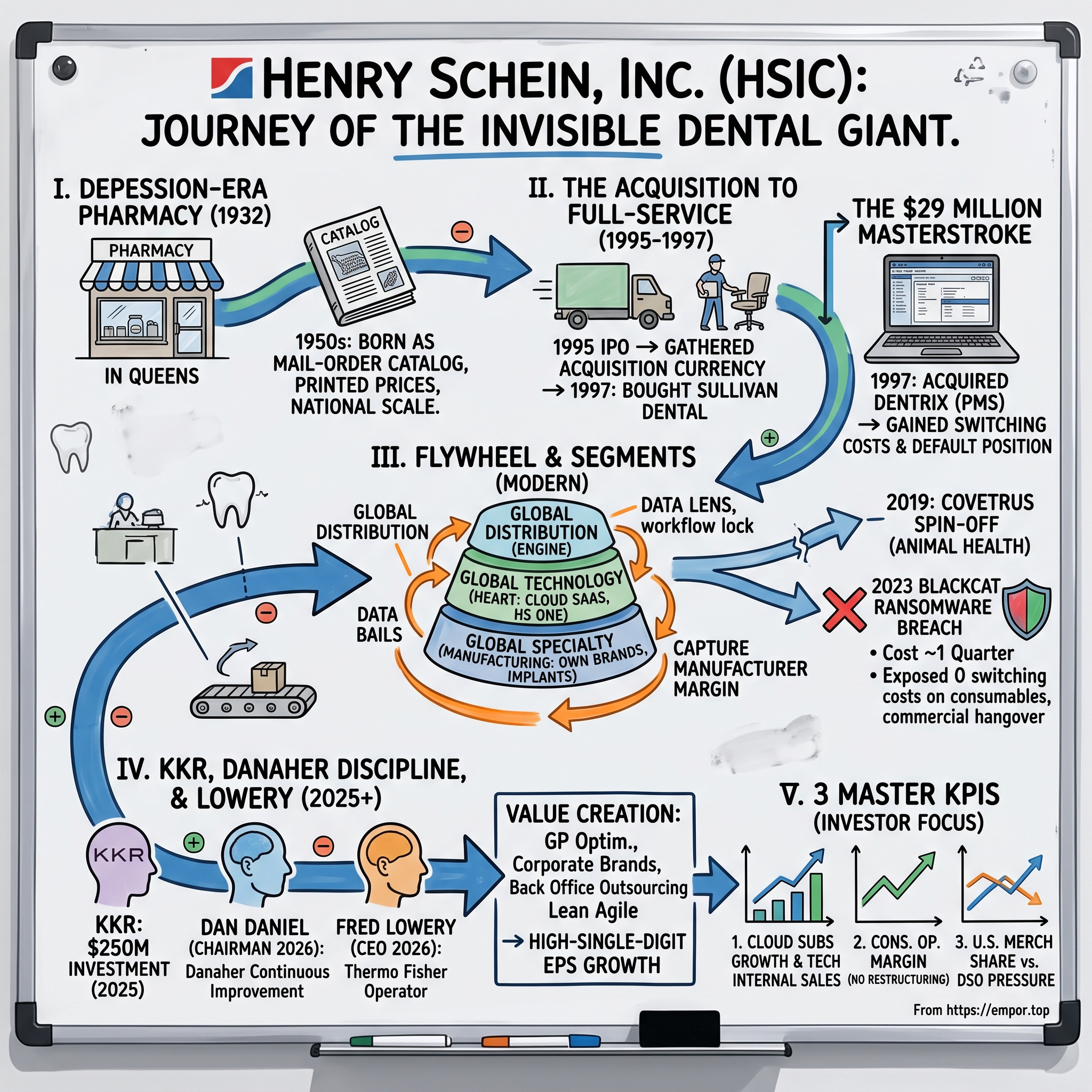
Henry Schein, Inc.: The Invisible Giant of the Dental Chair
I. Introduction & Episode Roadmap
Sit down in a dentist's chair anywhere in America and look around. The chair itself, the overhead light, the swiveling tray, the little paper bib clipped around your neck, the nitrile gloves snapping onto the hygienist's hands, the anesthetic cartridge, the suction tip, the intraoral scanner wand that has quietly replaced the goopy impression tray, the screen on the wall showing your molars in three dimensions, and the computer at the front desk where someone is checking whether your insurance will actually cover the crown. Statistically, most of that came from one company. And most patients have never heard its name.
Henry Schein, Inc. counts roughly 90% of U.S. dental practices as active customers, along with about 80% of dental laboratories in North America, 65% of European dental practices, 80% of practices in Australia and New Zealand, and 60% in Brazil.1 It estimates its own share of dental distribution in the United States at 35% to 40%.1 It is a genuinely enormous business hiding inside an invisible one: $13.18 billion of net sales in fiscal 2025, moving 300,000 unique stocking SKUs out of 36 distribution centers, with roughly 90% of worldwide customers served next day.21
And yet the company is not, by any reasonable reading of its numbers, a compounding machine at the moment. That is the tension worth sitting with. Non-GAAP operating margin in 2024 was 7.49%, versus 3.14% at the 1995 IPO — a genuine three-decade improvement.1 But non-GAAP diluted earnings per share peaked at $5.38 in 2022 and came in at $4.97 in fiscal 2025, three years later and still below the high-water mark.12 The five-year compound annual growth rate of non-GAAP operating income through 2024 was 2.5%.1 A business with 90% penetration of its core market has been running very hard to stay roughly in place.
Which is why the past eighteen months have been the most consequential in the company's modern history. In January 2025, KKR agreed to invest $250 million for roughly 12% of the common stock, immediately becoming the largest non-index shareholder, with the right to build to 14.9% — a ceiling the board later lifted to 19.9%.34 In January 2026, the board named Frederick M. Lowery, a two-decade Thermo Fisher Scientific executive, as chief executive, effective March 2, 2026.5 And on May 21, 2026, Stanley M. Bergman — who ran the company for 35 years and sat on its board for 44 — retired from the board entirely and was named Chairman Emeritus, replaced as Independent Chairman by William K. "Dan" Daniel, a fourteen-year Danaher Corporation veteran.6 A company that had been governed by one man's judgment for a generation now has a professional operator in the CEO chair, a Danaher alumnus in the chairman's chair, and a private equity firm with a large economic stake and two board seats.
The central puzzle of Henry Schein is this: how does a company that fundamentally moves cardboard boxes of gloves and anesthetic to small businesses — a low-margin, working-capital-heavy, route-density business — persuade anyone that it has a durable competitive moat? The answer management has given for nearly thirty years is software and specialties: own the practice management system on the front-desk computer, own the implant that goes into the patient's jaw, and use the physical distribution relationship as the trust-building, weekly-touchpoint delivery vehicle for both. That answer is not obviously wrong. It is also not obviously working as fast as it needs to. Testing it is the work of this piece.
Here is the road ahead. First, the origin: a Queens drugstore in the Depression, and the mail-order catalog that turned a pharmacy into a national distributor. Then the 1995 IPO and the acquisition that mattered most — a $29 million software company almost nobody noticed. Then the economics of the modern three-segment business, and what the segment structure actually reveals about where profit lives. Then the animal-health separation, and a myth about who forced it. Then the October 2023 ransomware attack that took the physical business offline and cost most of a quarter. Then KKR, Danaher discipline, and the Lowery mandate. Then a formal competitive analysis using Hamilton Helmer's 7 Powers and Porter's Five Forces. Then the bull and bear cases, the activist stress test, and the two or three numbers actually worth tracking. Throughout, the posture is skeptical rather than adversarial: management's claims are treated as claims, and the evidence is asked to do the work.
 Subscribe on LinkedIn
II. From a Queens Pharmacy to the Catalog King (1932–1980s)
The Great Depression was not an obvious moment to open a retail business. In 1932, with roughly a quarter of the American workforce out of a job, Henry Schein, a pharmacist, and his wife Esther opened a corner drugstore in Woodside, Queens — a working-class New York neighborhood of two-family houses and elevated subway tracks.7 It was a small, unremarkable operation of the kind that opened and closed by the hundreds in interwar New York. The survival strategy was the one available to every corner druggist: high volume, thin margin, know your customers, extend credit when you have to.
What made the Scheins different was an observation about their neighbors. Among the customers walking through the door were local physicians and dentists — professionals running one- and two-person businesses who bought their own supplies, negotiated their own prices, and had no purchasing leverage whatsoever. They were, in economic terms, the most fragmented customer base imaginable: thousands of independent proprietors, each buying small quantities, each dependent on whichever local supply house happened to call on them, each paying whatever markup that supplier chose to charge.
By the 1950s, the Scheins had begun mailing a printed catalog to those practitioners.7 It is difficult, from the far side of the internet, to appreciate how radical this was. A dentist in Ohio had essentially no way to know whether the price quoted by the regional dental supply salesman was fair. There was no reference price, no second quote, no way to compare. The salesman knew this, and priced accordingly.
The catalog changed that. It put a printed, comparable, national price in front of the buyer, and it let that buyer order by mail or telephone without ever seeing a salesman. It was the Sears, Roebuck insight applied to a professional market: aggregate national demand, buy in volume, print the price, ship the box.
What made it work commercially was that the buyer had no institutional loyalty to defend. A dentist was not buying from the local supply house out of affection; the dentist was buying because there was no alternative. Remove that constraint and a meaningful share of demand moves on price alone. Henry Schein did not have to be better at anything except being cheaper and reliably in stock.
The economics that flowed from this were the economics of every great distribution business. As the catalog reached more practitioners, order volume rose; as volume rose, purchasing power with manufacturers improved; as purchasing improved, prices could fall or margins could widen; and lower prices brought more practitioners.
The physical footprint followed the flywheel. The company outgrew Woodside, moving to a larger location in Flushing in 1962, and by 1979 had relocated its headquarters to a 100,000-square-foot facility in Port Washington, on Long Island — the beginning of a genuine warehouse-and-logistics operation rather than a store with a mailing list.7
The 1970s brought both expansion and a lesson. Henry Schein bought a Connecticut pill producer in 1970 and moved into generic drug manufacturing.7 It was a plausible piece of vertical integration — if you distribute pharmaceuticals, why not make some of them? — and it would be quietly unwound two decades later when the pharmaceutical division was spun off in 1992.7 The pattern is worth noting early, because it recurs: this is a company with a persistent appetite for adjacency, and a mixed record of knowing which adjacencies are actually core.
Then came the succession that shaped everything, and it arrived through a sequence of deaths rather than a plan.
In 1980, a South African–born accountant named Stanley M. Bergman joined the company. That same year, Henry's son Jacob Schein came in from a Wall Street law practice and began the automation of distribution.7 Henry Schein died in 1987; Jacob Schein died of cancer in 1989, and Bergman became chief executive.7 Esther Schein died in 1992.7
Within five years, the founding family had effectively exited the operating business, and a professional manager who had joined as a finance executive found himself running a family mail-order company with no family left to run it. It is worth pausing on how unusual the resulting tenure was. Bergman would hold the chief executive role for 35 years and sit on the board for 44 — a span during which the company went public, entered dozens of countries, made more than a hundred acquisitions, and grew revenue more than twentyfold. Very few public companies of this scale have been shaped so completely by a single person's judgment, and almost none in a low-margin distribution industry.
Bergman's initial read on the situation was clear-eyed and, in retrospect, correct. The catalog model had a ceiling. It could win price-sensitive customers on consumables, but a dentist buying a $40,000 chair or a digital imaging system did not want a catalog; that dentist wanted someone to show up, demonstrate the equipment, finance it, install it, and fix it when it broke on a Tuesday afternoon with a waiting room full of patients.
That gap mattered because equipment is where the relationship is forged. A practice buys gloves fifty times a year and a chair once a decade, but the chair purchase is the one that determines who the practice trusts. A pure mail-order company could never own that moment.
Meanwhile the U.S. and European dental supply markets were littered with hundreds of small regional full-service distributors, each with a local sales force and local relationships, and each too small to negotiate seriously with manufacturers. Bergman's plan was to become a full-service distributor at national scale by buying those regional players one at a time — acquiring their salespeople and service technicians, and running their volume through his logistics network. That required acquisition currency, which meant it required a stock. Getting one would be the next chapter.
III. Going Public and The Great Digital Land Grab (1990s)
In November 1995, Henry Schein listed on NASDAQ at $16 per share, raising $72.5 million.7 The scale of the business at that moment is worth holding in mind for the rest of this story: net sales of $584 million and non-GAAP operating income of $18 million, for an operating margin of 3.14%.1 This was a company that kept about three cents of every dollar it moved. It was, in the most literal sense, a middleman.
The market liked it. By July 1996 the company was back with a secondary offering at $35 per share, raising a further $124.1 million — the stock had more than doubled in eight months.7 Bergman now had exactly what he had gone public for: acquisition currency. He spent it immediately and aggressively. In 1997 alone, Henry Schein acquired Sullivan Dental Products for $318 million in stock, a transaction that made it the world's largest distributor of dental equipment and, critically, grafted a full-service field sales and equipment-service organization onto the catalog company's logistics spine.7
That was the deal the market noticed. The deal that mattered more closed a few weeks earlier and cost about a tenth as much.
The $29 Million Masterstroke
On February 28, 1997, Henry Schein completed the acquisition of Dentrix Dental Systems in a merger accounted for as a pooling of interests, issuing approximately 1,070,000 shares with an aggregate market value of roughly $29.4 million.8 Dentrix was a maker of clinically-based dental practice management software with 1996 net sales of approximately $10.2 million.8 A $584-million-revenue box-mover had just bought a ten-million-dollar software company, and in doing so had bought the most valuable real estate in the dental industry.
Why? Start with what practice management software actually is, because the phrase does no work for a non-specialist.
A dental practice is a small business with an unusually complicated operating system. It has to schedule patients across multiple operatories and providers, each with different chair-time requirements. It has to produce and store clinical charts and radiographic images, under medical record retention rules. It has to generate treatment plans and — this is the commercial heart of a practice — get patients to actually accept them. It has to submit insurance claims to dozens of payers, each with its own codes, rules, and rejection quirks. It has to chase the portion the patient owes. And it has to manage recall: the reminders that bring people back every six months, which is where a large share of practice revenue actually originates.
Practice management software, or PMS, is the single application that does all of that. It is the practice's general ledger, calendar, medical record, and billing department, fused into one screen that the front-desk staff stares at for eight hours a day.
The switching costs are therefore not primarily financial. They are operational and human. Migrating a practice from one PMS to another means converting years of charts and images into a new data format, retraining every staff member, re-establishing electronic connections with every insurance payer, and accepting a period during which claims go out late and cash flow suffers.
For a practice where the owner is also the person drilling teeth all day — and where the office manager who actually knows the system may have been there fifteen years — that is not a project anyone volunteers for. This is Hamilton Helmer's Switching Costs power in a nearly textbook form: the incumbent's advantage comes not from being better but from the customer's cost of leaving.
Bergman's strategic insight was to recognize that this position, sitting inside a workflow that competitors could not easily reach, was the antidote to the structural weakness of distribution. Physical distribution is prone to price wars because the product is identical no matter who ships it; a glove is a glove. Software that the office manager touches every hour is not identical, and it creates a channel that a rival sales rep cannot walk into. When inventory runs low, the reorder prompt appears in a system Henry Schein owns.
It is worth being precise about the limits of that mechanism, because it is easy to over-claim.
Owning the PMS does not force a practice to buy supplies from Henry Schein. Dentists have always been free to price-shop, and many do. What ownership buys is default position and data. It buys the reorder button being pre-wired. It buys visibility into what a practice actually consumes and when.
Management has been explicit that this data feeds back into commercial strategy. On the fourth-quarter 2025 call, Bergman noted that Henry Schein One's electronic-claims activity gives the company a real-time read on patient traffic and procedure volumes across the U.S. dental market — an information advantage over competitors who see only their own order flow.9 Knowing whether procedure volumes are rising before your competitors do is genuinely valuable in a business where inventory and promotional spending have to be committed in advance. That is a real edge. It is a nudge and a lens, not a lock.
The 1990s land grab, then, established the two-layer architecture that still defines the company. Layer one: buy physical scale, sales coverage, and service technicians, and grind out cost-to-serve advantages. Layer two: own the software the customer cannot live without, and use it to make layer one stickier and to open the door for higher-margin products.
The next thirty years were an elaboration of that idea — and a long argument about whether layer two was ever built at sufficient scale to matter.
IV. The Flywheel of Modern Healthcare Distribution
Walk through one of the 36 distribution centers and the abstraction disappears fast. This is a business of conveyor belts, pick-and-pack stations, and route trucks; of 300,000 unique stocking SKUs, of which about 22,000 are the company's own private-brand products; of a promise that 90% of customers worldwide receive next-day service.1 Behind it sit 15 manufacturing facilities, because Henry Schein no longer only distributes — it makes things.1
The company reports in three segments, and the split is genuinely informative about where the business is heading.
Global Distribution and Value-Added Services is the engine room: $11.14 billion of fiscal 2025 net sales, up 3.5% year over year, of which 2.2% was local internal growth.2 This is dental merchandise (the consumables — gloves, anesthetic, composites, impression materials, infection control), dental equipment (chairs, lights, imaging systems, intraoral scanners, 3D printers), medical distribution into non-acute settings, and a growing basket of services: financing, practice-transition brokerage, consulting, outsourced billing. Within it, global dental was $6.87 billion and global medical $4.27 billion in fiscal 2025.2
Global Specialty Products is the manufacturing arm: $1.54 billion of fiscal 2025 sales, up 6.7% as reported and 3.3% on a local internal basis.2 Here Henry Schein owns brands rather than shelf space — BioHorizons and Camlog in dental implants, S.I.N. in Brazil, Biotech Dental in France, Medentis in Germany, Edge Endo and Brasseler in endodontics, TriMed in orthopedics.1 The company estimates its share at roughly 10% of the implant and biomaterials market and about 15% of endodontics.1
Global Technology is the smallest and the most interesting: $675 million of fiscal 2025 sales, up 7.1% as reported and 6.7% in local internal terms — the fastest-growing segment.2 This is Henry Schein One, and about three-quarters of its revenue is recurring: cloud subscriptions, support, revenue cycle management, analytics.1 It serves roughly 100,000 technology customers worldwide, reaches an estimated 55% of U.S. dental practices, and supports more than 90% of North American dental schools — a quiet but potent form of habit formation, since dentists learn on the software they will later buy.1
What the Segments Actually Tell You
Here is the number that reframes the story. High-growth, high-margin businesses — specialty products, technology, value-added services, and the corporate-brand portfolio — represented roughly 25% of sales, about $3 billion, but approximately 40% of operating income, with another roughly 10% contributed by private-brand products.1
Put differently: a quarter of the revenue generates something close to half the profit. The remaining three-quarters — the pure pass-through distribution of other manufacturers' branded goods — is a thin-margin scale business that exists largely to fund and enable everything else.
That is the flywheel management describes, and stated plainly it runs like this. Physical distribution buys the relationship: the weekly delivery, the equipment installed, the technician who shows up when the chair breaks, the roughly 2,800 dedicated dental field sales consultants who know the practice by name.1 The relationship enables the software sale. The software embeds itself in the workflow and generates recurring revenue and consumption data. And the combination of relationship plus data plus workflow position opens the door to selling the company's own implants, endodontic files, and private-brand consumables — products where Henry Schein captures the manufacturer's margin instead of the distributor's.
On the first-quarter 2026 call, chief financial officer Ron South put the mechanism in plainer terms than any strategy deck: own-brand products grow faster than the rest of the portfolio and carry better margins, so mix alone lifts gross margin, and the company is getting better at "value pricing."10 Gross margin improved about 25 basis points year over year in that quarter and about 86 basis points versus the fourth quarter, while non-GAAP operating margin reached 7.53%, up 28 basis points.10
So the machine is real and it is, at the margin, working. Now the skepticism — four qualifications, in ascending order of importance.
First, the flywheel is spinning slowly. Local internal sales growth — the cleanest measure of underlying demand, stripping out currency and acquisitions — was 2.6% for fiscal 2025 and 2.5% in the first quarter of 2026.210 That is roughly the growth rate of the end market, in a business that already touches nine in ten American dental practices.
Management repeatedly claims share gains, and the volume data it cites is consistent with modest gains. But a company converting a dominant position into low-single-digit organic growth is not compounding at a rate that would excite anyone, and it raises the obvious question of where incremental growth is supposed to come from when you already serve almost everybody.
Second, the high-margin businesses are still small in absolute terms. Technology is 5% of sales. Specialty is 12%. Even growing at 7%, technology adds roughly $45 million of revenue a year to a $13 billion company.
Mix shift is a real and durable margin lever, but it is a slow one. The arithmetic says it will take years before the software and specialty businesses are large enough to set the consolidated growth rate rather than merely nudge it. Investors expecting the "software company" narrative to show up in the consolidated growth line should be prepared to wait.
Third — and this is the most important qualification to the entire moat thesis — the software lock-in is thinner than the narrative implies. Henry Schein One has roughly 100,000 technology customers, but as of the first quarter of 2026 it had "more than 13,000" combined subscribers to its cloud-native products, Dentrix Ascend and Dentally, growing about 25% year over year.101
That means roughly 13% of the technology customer base sits on the modern, high-retention, recurring-revenue cloud platform. The other 87% are on legacy on-premise Dentrix and comparable products — software that is sticky in the sense that it is annoying to leave, but that generates support-and-maintenance revenue rather than a genuine SaaS annuity.
That legacy majority is precisely the population a cloud-native competitor would target, because the moment a practice contemplates moving to the cloud is the one moment when the incumbent's advantage collapses to near zero. The customer has already accepted the data conversion and the retraining; the only remaining question is whose cloud. The migration is real, it is accelerating, and it is nowhere near complete. Anyone underwriting Henry Schein as a software company should underwrite the migration, not the installed base.
Fourth, there is an accounting judgment worth flagging. The company builds its specialty portfolio partly by taking minority stakes in implant and technology businesses and later stepping up to control. When it does, GAAP requires it to remeasure the previously held stake to fair value, producing a non-cash gain.
In the first quarter of 2026, taking control of S.I.N. 360 — the U.S. distributor of its Brazilian subsidiary's value implant systems — produced an $11 million remeasurement gain, roughly $0.07 of diluted EPS.10 These gains flow into both reported and non-GAAP earnings.
On the fourth-quarter 2025 call, UBS analyst Kevin Caliendo pressed management on how much of 2025's earnings this represented and what was assumed for 2026; South acknowledged a range was embedded in guidance and that 2026 gains were expected to be lower, but declined to size it.9 Related to this structure, redeemable noncontrolling interests stood at $895 million on the fiscal 2025 balance sheet — a reminder of how much of the specialty portfolio is held through partial ownership.2
None of this is improper, and stepping up to full control of businesses you know well is often good capital allocation. It does mean that a portion of reported earnings growth in recent years came from revaluing assets the company already owned rather than from selling more goods, and an investor comparing 2025 to 2026 should adjust for it.
The honest summary of the segment picture is therefore two-sided. The mix shift toward owned brands, specialty products, and recurring software is a genuine, evidence-backed improvement in business quality, visible in gross margin and in the profit-versus-revenue split. But it is happening on top of a very large, very slow-growing base, and the crown jewel — cloud software — is early enough in its transition that calling it a completed moat would be premature. Which raises an obvious question that public-market investors asked loudly, and repeatedly: if the good business is only a quarter of the company, why is the rest of it still attached?
V. Restructuring and Activist Pressures: The Covetrus Spin-Off
For most of the 2010s, Henry Schein was three businesses in one holding company: human dental, human medical, and animal health. The animal health division distributed pharmaceuticals and supplies to veterinary practices, and it was very large — by the time it left, it was a multi-billion-dollar operation in its own right. It also had almost nothing to do with the rest of the company beyond a shared instinct for distributing things to small professional practices.
On April 23, 2018, Henry Schein announced it would separate the animal health business and merge it with Vets First Choice, a technology-enabled veterinary prescription management start-up.11 The structure was a Reverse Morris Trust — an arrangement in which a parent spins off a subsidiary to its own shareholders and immediately merges it with a third party, in a manner designed to be tax-free to the parent and its holders, provided the parent's shareholders end up owning more than half of the combined entity. Henry Schein shareholders received approximately 63% of the new company; Vets First Choice holders got roughly 37%.11 Henry Schein expected to receive between $1.0 billion and $1.25 billion in tax-free cash proceeds as part of the transaction.11 The spin-off and merger were consummated on February 7, 2019, and the new company, Covetrus, began trading on NASDAQ the following day.11
The financial engineering was elegant. A conventional sale of the animal health business would have triggered a large corporate tax bill on the gain. The Reverse Morris Trust delivered separation, a strategic partner, and roughly a billion dollars of cash to the parent — cash that went toward deleveraging and repurchasing stock — without that tax leakage.
A Myth Worth Correcting
The version of this story that circulates in investor conversation usually credits an activist hedge fund with forcing the separation, and the name most often attached is Jana Partners. That attribution does not hold up. There is no disclosed record of a Jana Partners campaign at Henry Schein in 2018, and the company's own contemporaneous filings and announcements frame the transaction as a strategically-initiated portfolio decision rather than a response to activist pressure.11 The documented activist intervention at Henry Schein came six years later, from a different and much smaller firm, and is properly part of the story in the next section.
This matters beyond pedantry, because the two readings imply different things about management. If an activist forced the separation, the lesson is that the board needed external pressure to see the obvious. If management did it on its own initiative, the lesson is that Bergman was capable of decisive portfolio surgery when he judged the case clear — which makes the subsequent six years of not doing similar surgery on the medical business a choice rather than an oversight. The evidence supports the second reading.
It is also worth being honest about the outcome for the asset that left. Covetrus struggled as a public company, and in May 2022 it agreed to be taken private by Clayton, Dubilier & Rice and TPG at an enterprise valuation of approximately $4 billion.12 For Henry Schein shareholders who held their spin shares, the experience was not a triumph. What the separation unambiguously achieved was simplification of the parent: after February 2019, Henry Schein was a human-health company, and the conglomerate discount argument lost one of its two legs.
The Other 2018 Move: Consolidating the Software
The animal health separation dominated the headlines, but the more strategically consequential 2018 transaction was smaller and quieter. On April 3, 2018, Henry Schein and Internet Brands announced a joint venture combining their respective dental technology portfolios, and the completion followed on July 2, 2018 under the name Henry Schein One.1314 Henry Schein took majority ownership; Internet Brands held a minority stake; senior management from both companies sat on the board.13 The combined entity had pro-forma 2017 sales of approximately $400 million and targeted $20 million to $30 million of annual synergies by the end of year three.13 Financial terms were not disclosed.13
The logic was consolidation of a fragmented software stack. Henry Schein had Dentrix and a collection of practice management products; Internet Brands had Demandforce, Officite, and Sesame Communications — the patient-communication, online-presence, and demand-generation layer. Separately, each was a point solution a dentist bought and forgot. Combined, they became something closer to a platform: find the patient, book the patient, chart the patient, bill the patient, get paid. Every additional module a practice adopts raises the cost of leaving, and raises revenue per account — a figure the company puts at roughly $500 per month today against a stated opportunity of several thousand across all modules.1
There is a governance footnote here that becomes important later. Internet Brands was, and is, a KKR-backed business. The Henry Schein One joint venture therefore made KKR a partner in the company's most strategically important asset seven years before KKR bought a stake in the parent.13 When KKR later showed up on the shareholder register, it was not a stranger arriving with a spreadsheet. It was a counterparty that had spent the better part of a decade inside the crown jewel, with a working view of how well it was — or was not — being run.
By 2019, then, the portfolio was cleaner and the software was consolidated. What neither of those moves fixed was the operating margin of the core distribution business, or the pace of earnings growth. And in October 2023, an entirely different kind of problem arrived — one that revealed how much of this physical empire actually depends on a network connection.
VI. The BlackCat Breach: Disruption on the Digital Wire
The irony is almost too neat. A company whose entire strategic thesis rests on being digitally embedded in its customers' workflow discovered, in the autumn of 2023, that digital embeddedness runs both ways.
On approximately October 15, 2023, Henry Schein's network was breached in an attack that disrupted manufacturing and distribution operations.15 The ALPHV/BlackCat ransomware syndicate claimed responsibility and asserted it had exfiltrated a very large volume of data.15 The company took systems offline, including the e-commerce portals through which customers place orders, and began restoration.
Then came the part that turned an incident into a crisis. Negotiations with the attackers did not produce a resolution, and on approximately November 22, 2023 — after Henry Schein had begun bringing restored systems back online — the same group struck again, re-encrypting systems and forcing the company to pull its ordering platforms down a second time.15 The company ultimately disclosed that the personal information of more than 160,000 individuals had been compromised.15
To understand why this was so damaging, understand what a dental practice's order actually is.
A practice does not carry deep inventory. Storage space is expensive and much of the product has expiry dates, so a single operatory runs on par levels of consumables that get replenished continuously — think of it as just-in-time manufacturing, run by a receptionist. When the ordering portal goes dark, the practice cannot check stock, cannot confirm pricing, cannot place the order, and cannot know when the box arrives.
And it has patients booked tomorrow. So it calls Patterson. Or Benco. Or Burkhart.
The switching cost for a single week's glove order is essentially zero. That is precisely the vulnerability that all the software talk is meant to paper over, and the outage exposed it in the most literal way possible: ninety percent market penetration provides no protection whatsoever if the customer cannot place an order today.
The financial damage was severe and specific. Henry Schein estimated that the cybersecurity incident reduced fourth-quarter 2023 net sales by $350 million to $400 million, roughly 10% to 12% of the quarter, with the operating income impact estimated at $120 million to $130 million.161 The earnings-per-share impact for fiscal 2023 was estimated at $0.70 to $0.75.1
Insurance softened but did not solve it. The company carried $60 million of cyber coverage above a $5 million retention, and recognized $40 million of proceeds during 2024 and a further $20 million in the first quarter of 2025 — a real buffer, but one that recovered less than half the operating income lost.216
Trace the damage through the reported numbers and it is unmistakable. Non-GAAP operating income fell from $1,038 million in 2022 to $890 million in 2023, and non-GAAP diluted EPS from $5.38 to $4.50.1 Recovery to $949 million and $4.74 in 2024 still left the company below its 2022 peak.1 A single quarter's disruption knocked the earnings trajectory off course for years.
What the Recovery Revealed
The more revealing part of the story is not the outage but the aftermath, because it took far longer than the systems did. Bergman was unusually candid about this on the fourth-quarter 2025 call — more than two years after the attack — when he explained the source of the company's improving momentum: "We were hunkered down a little bit a lot actually on the cyber recovery. Our people were internally focused with customers and not going out aggressively."9 The sales organization, in other words, spent the better part of two years apologizing rather than selling. He added that the company was "back to where we were before October of '23," and, with evident feeling, "I hope not to use the word cybersecurity. I hope our team doesn't use that again, because that is way behind us."9
Read as an investor rather than as a listener, that admission is the most important thing management said about the incident. The direct cost was one quarter of sales. The indirect cost was a multi-year loss of commercial offense — a period in which the field force was defending accounts instead of winning them, and in which competitors had an open field. The company's own explanation for why growth accelerated through the second half of 2025 is, in large part, that it finally stopped being distracted.
Three structural conclusions follow.
First, the moat is thinner than the market-share statistics suggest on any timescale shorter than a year. Ninety percent penetration of U.S. practices did not prevent a double-digit percentage of a quarter's revenue from walking out the door within weeks.
Second, cybersecurity for this company is not an IT line item but a core operational risk on par with warehouse fire or supplier failure. The company's competitive position is inseparable from the availability of its ordering systems, which means the security budget is a defense of revenue rather than of data. It belongs in the risk assessment on those terms.
Third — and this cuts the other way — the fact that customers came back, and that management believes it has since gained share, is meaningful evidence that the relationship is genuine rather than merely habitual. Practices that defected in November 2023 had six months to discover whether Patterson or Benco served them better. Most returned. The business proved fragile to interruption and resilient to defection. Both are true, and the second is arguably the more durable finding.
By the end of 2023, then, Henry Schein was a company with a good competitive position, a damaged earnings trajectory, a stock that had de-rated, and a chief executive entering his mid-seventies with no publicly named successor. That combination is, in the language of activist investing, a setup.
VII. The KKR Partnership & The Dawn of the Lowery Era (2025–Today)
The pressure arrived on November 18, 2024. Ananym Capital Management — a new firm managing roughly $250 million, which had only begun deploying capital that September — disclosed that it had been in talks with Henry Schein and was escalating.17 Its demands were specific: refresh a board it argued had directors who had served too long and lacked relevant industry experience; cut costs it characterized as having spiraled; address succession, including replacing Bergman after 35 years; and consider selling the medical distribution business.17 Ananym's arithmetic was that a medical divestiture could lift the share price by roughly 20%, and that disciplined spending could raise earnings per share by something like 35%.17 It said it had recruited director candidates.
The size mismatch was almost comic — a fund with a quarter of a billion dollars in capital challenging a company with more than twelve billion in revenue. But the critique landed because it was substantially accurate. The board was long-tenured. Earnings had not compounded. And the succession question was unanswerable in any satisfying way, because the answer had been "Stanley" for three and a half decades.
The KKR Alliance
Ten weeks later, on January 29, 2025, Henry Schein announced its response — and it was not a settlement with Ananym. KKR agreed to invest $250 million in Henry Schein common stock, taking approximately 12% and becoming the largest non-index shareholder, with the ability to buy additional shares in the open market up to 14.9%.3 Three new independent directors joined: Max Lin, the KKR partner who leads the firm's Americas health care team; William K. "Dan" Daniel, a former Danaher executive vice president; and Robert J. Hombach, the former chief financial officer and chief operating officer of Baxalta.3 The board expanded to sixteen directors before shrinking to fourteen after the 2025 annual meeting.3 The investment closed on May 16, 2025, with Lin having joined the board on May 2 and Daniel on completion.4 Later in 2025, the board amended the arrangement to permit KKR to increase its ownership to 19.9%.18
Strip away the press-release language and the structure is legible.
Faced with an activist demanding board refresh, cost discipline, and succession, the board brought in a large, sophisticated, long-duration shareholder who would demand approximately the same things — but as a partner with a board seat, a nine-figure economic stake, and a decade of prior familiarity through the Henry Schein One joint venture, rather than as an adversary in a proxy contest.
This is a defensible way to run a defense, and it is meaningfully more shareholder-friendly than the alternatives available to a cornered board: a poison pill, a token settlement with a single director appointment, or a large buyback announced in lieu of actual change. KKR paid cash at market for its position, which aligns it with other holders in a way a settlement agreement does not.
It is also, unmistakably, a concession that the critique had merit. Companies that believe they are executing well do not sell 12% of themselves to a private equity firm and hand over two board seats.
Why Dan Daniel Is the Tell
Of the three new directors, Daniel is the one that signals intent. He spent fourteen years as an executive vice president at Danaher Corporation, where his responsibilities included Danaher's dental portfolio — the businesses later separated as Envista.6
Danaher's significance in this context is not its end markets but its management system. The Danaher Business System is a continuous-improvement operating discipline, derived from Japanese lean manufacturing practice. It is built around standardized problem-solving, relentless waste elimination, rigorous performance metrics, and — crucially for a serial acquirer — a disciplined framework for evaluating acquisitions against return thresholds and integrating them against a repeatable playbook.
The reputation Danaher built was not primarily as a picker of great businesses. It was as an operator that made ordinary acquired businesses measurably better, year after year, through process rather than inspiration. That distinction matters enormously here, because Henry Schein does not have a business-selection problem.
Bringing that DNA onto the board of a company whose distribution segment runs at a mid-single-digit operating margin, and which has completed dozens of acquisitions of varying quality over three decades, is therefore a specific bet: that Henry Schein's problem is not its market position but its operating rigor.
In May 2026 that bet was extended. Bergman retired from the board after 44 years as a director and was named Chairman Emeritus, and Daniel was elected Independent Chairman effective May 21, 2026.6 The company had also announced in April 2026 that it would further reduce the size of the board following the annual meeting.19 A former Danaher operator now chairs the company, and the founder-era chairman holds an honorary title.
Lowery Takes the Chair
Frederick M. Lowery was named chief executive on January 15, 2026, effective March 2, 2026.5 His background is instructive in what it is not: he is not a dental industry lifer. Most recently he was executive vice president and president of Laboratory Products and BioProduction at Thermo Fisher Scientific, where he spent about two decades scaling businesses through both acquisition and organic growth, running national and owned-brand products through Thermo Fisher's distribution channels.59 Before Thermo Fisher he worked at Maytag and General Motors; he holds a bachelor's degree in mechanical engineering from Tennessee Technological University and a master's in manufacturing management from Kettering University.5
That résumé is the point. Lowery is an operator and an engineer from a company that is, itself, one of the great mixed distribution-and-owned-brand platforms in life sciences — a business model almost exactly analogous to what Henry Schein is trying to become. The board did not hire a dental person. It hired someone who has already run the machine Henry Schein wants to build.
His first public appearance as CEO, on the May 5, 2026 first-quarter call, was notable for what he chose to emphasize. He described a hundred-day listening tour and reported three consistent pieces of employee feedback: they love the company and its culture; they hate to see Bergman go; and "we know that we need to change in order to be better."10 He said he intended to "sharpen our operational execution, build a stronger performance culture and create a leaner, more agile Henry Schein."10 He was complimentary about the asset base and pointedly not complimentary about its exploitation: the ecosystem is "incredibly important to customers," he said, but "I don't think it has been exploited to the extent that we can."10
The commitments attached to that language are concrete and therefore falsifiable, which is the useful thing about them.
Management has targeted more than $200 million of annual operating income improvement over the next few years, with a run rate exceeding $125 million by the end of 2026, and states that this should support high-single-digit to low-double-digit earnings growth.910
The programs named are specific rather than aspirational: gross profit optimization through value pricing and accelerated corporate-brand growth; an appointed outsourcing partner for centralized back-office functions; process automation and AI tools; indirect procurement savings from scale; and buying out minority partners in specialty joint ventures to capture integration efficiencies.10 Each of those has an observable outcome, which is more than can be said for most transformation programs.
For 2026 the company guided to 3% to 5% sales growth and non-GAAP diluted EPS of $5.23 to $5.37 against 2025's $4.97, and reaffirmed that guidance at the first quarter.910 It also targets high-growth, high-margin businesses exceeding 50% of operating income by the end of the 2025–2027 planning cycle, and said they were approaching 50% in the first quarter of 2026.10
Testing Management's Credibility
Here the analysis has to get uncomfortable, because the strongest challenge to this plan came from an analyst, not a critic. On the first-quarter call, Baird's Jeffrey Johnson asked Lowery how Henry Schein gets back to stronger earnings growth "in the absence of these one-off kind of restructurings we've been seeing every couple of few years out of the company," and how it builds the muscle memory to sustain results "without having to go through kind of these bigger programs every couple few years."10
That question has teeth, and the record supports it. The company recorded restructuring expenses of approximately $105 million pre-tax in fiscal 2025 and $110 million in fiscal 2024 under a program announced in August 2024, plus a further $12 million in the first quarter of 2026 under the newer value creation initiatives.210 It also incurred $36 million in 2025 of costs "associated with shareholder advisory matters and select value creation consulting costs."2 More than $250 million of restructuring and advisory expense across roughly two years, at a company generating around $1.1 billion of adjusted EBITDA, is not a rounding error — and non-GAAP earnings exclude all of it.2
Lowery's answer was reasonable rather than evasive. He argued that the gross profit and corporate-brand programs build permanent capability rather than one-time savings, and committed to "developing a continuous improvement process here where we don't have an episodic approach to taking cost out."10 That is precisely the Danaher answer, and it is the right one. It is also a promise, and promises of this kind have been made at this company before.
The balanced read on management credibility has entries on both sides of the ledger.
On the positive side: guidance was raised at the third quarter of 2025 and the fourth quarter exceeded it, delivering the highest sales growth in fifteen quarters. The narrative across the fourth-quarter and first-quarter calls has been consistent rather than shifting — an underrated signal, since the CEO changed between them and the story did not.
Management also explained its first-quarter medical shortfall specifically and mechanically: a light flu season depressed point-of-care respiratory diagnostics, a category representing roughly 15% to 20% of the medical business, without which growth would have been mid-single-digit.910 That is a checkable explanation with a named cause and a sized impact, rather than a gesture at macro conditions. Companies that explain misses this way are generally easier to trust on the quarters they do not miss.
On the negative side: capital allocation has been aggressive at precisely the moment the message is discipline. The company repurchased approximately $850 million of stock in fiscal 2025 — more than double 2024's $385 million and its largest annual repurchase in at least eight years — while long-term debt rose from $1.83 billion to $2.31 billion and it issued $489 million of new debt.21
Operating cash flow simultaneously fell, from $848 million to $712 million, even as net income rose.2 Share count declined from 124.2 million to 115.8 million, so the buyback did real work on per-share figures.2
Buying back stock at a $71.10 average in the fourth quarter and $77.64 in the first quarter of 2026 may well prove sensible if the value creation plan lands.910 But levering the balance sheet to accelerate repurchases while operating cash conversion deteriorates is exactly the pattern a skeptical investor should watch. It flatters near-term earnings per share, it reduces the margin for error if the improvement program underdelivers, and it sits awkwardly beside the language of restraint.
VIII. Playbook: Helmer's 7 Powers & Porter's 5 Forces
Strip the story of narrative and the question is simple: what, mechanically, prevents a competitor from taking Henry Schein's customers? Two frameworks help — Hamilton Helmer's 7 Powers, which asks what creates persistent differential returns, and Michael Porter's Five Forces, which asks how industry structure distributes profit. Neither is a scoring exercise. The point is to find where the evidence is strong and where it is thin.
Helmer's 7 Powers
Scale Economies — strong, and the most underrated of the company's advantages. The relevant economies here are not purchasing power, which is easy to overstate; a large regional distributor can buy gloves nearly as well as a national one. They are route and network density. Serving a solo dental practice profitably requires delivering a small box, frequently, cheaply. That is achievable only if the truck passing the office is already full of boxes for eleven other practices on the same street. Henry Schein's density — 36 distribution centers, 90% next-day coverage globally, and 300,000 SKUs deep enough that a practice can consolidate its ordering rather than split it across suppliers — creates a cost-to-serve position that a subscale entrant cannot replicate without absorbing years of losses.1 The 15 manufacturing facilities and 22,000 private-brand SKUs extend this: owning the product removes the manufacturer's margin entirely on a growing slice of volume.1 The evidence is in the mix data — a quarter of sales producing roughly 40% of operating income, plus another 10% from private brands.1
Switching Costs — real but narrower than advertised. The mechanism was established earlier and does not need restating. What deserves emphasis here is the segmentation of it. For the cloud-native cohort — the 13,000-plus Dentrix Ascend and Dentally subscribers — switching costs are high and the revenue is recurring and integrated across practice management, revenue cycle management, imaging, and patient experience in a single subscription.910 For the legacy on-premise majority, switching costs are meaningful but decaying, because the natural moment to change systems is when you have to change systems anyway, and cloud migration is exactly such a moment. For consumables, switching costs are close to zero, as the 2023 outage demonstrated with brutal clarity. Anyone describing Henry Schein as having "massive" switching costs across the business is describing 5% of revenue and applying it to 100%.
Cornered Resource — modest. The company holds exclusive and preferred arrangements with equipment and product manufacturers, and it uses them actively: management attributed part of the strong 2025 and early-2026 equipment growth to "exclusive supplier initiated opportunities," and cited exclusive U.S. and U.K. distribution of Vvardis's Curodont caries product and an exclusive agreement with CytoChip for a cartridge-based blood count analyzer.910 These are valuable, but they are contracts, not property. They can be renegotiated or lost, and their existence depends on Henry Schein remaining the manufacturer's best route to market — which is a scale advantage restated, not a separate power.
Branding — limited on the distribution side, growing on the product side. No dentist chooses a distributor for its logo. But the Henry Schein private brand has become a genuine consumer-facing asset within the practice: Bergman described it as "simply another brand, but is a high-quality brand" that attracts customers on the whole value proposition, and management consistently reports private-brand growth outpacing branded merchandise.9 The specialty brands — BioHorizons, Camlog, Edge Endo, Brasseler — carry real clinical reputation, which is why the company can host a global implant symposium drawing more than 1,100 clinicians and 40 speakers.10 Clinical brand equity in implants is durable, because a surgeon who has placed ten thousand of one system does not casually switch.
Network Economies, Counter-Positioning, and Process Power — largely absent. There is no meaningful network effect: a dentist's software is not more valuable because other dentists use it, though the dental-school penetration creates something adjacent through habit formation.1 There is no counter-positioning, since Henry Schein is the incumbent, not the insurgent. Process power is the one to watch: it is precisely what the Danaher-influenced value creation program is attempting to build, and by definition it does not yet exist. If it did, the company would not need a $200 million improvement program.
Porter's Five Forces
Competitive rivalry — intense, and structurally interesting. U.S. full-service dental distribution is dominated by Henry Schein, Patterson Companies, and Benco Dental, with Burkhart a meaningful fourth.[^20] Concentration this high in a market of fragmented, price-sensitive buyers has attracted exactly the regulatory attention one would predict.
Which brings up a second consensus narrative worth correcting. On February 12, 2018, the Federal Trade Commission filed an administrative complaint alleging that the three largest distributors conspired to refuse discounts to buying groups formed by solo and small-group dental practices.20[^22] The case is frequently cited as proof of a cartel. The actual outcome was more nuanced: after an administrative trial running from October 2018 to February 2019, involving 65 witnesses and more than 5,000 exhibits, the Administrative Law Judge ruled in October 2019 that Benco and Patterson had participated in the conspiracy — and dismissed the complaint against Henry Schein.21 Separately, on September 28, 2018, Henry Schein, Patterson, and Benco signed an agreement resolving the private direct-purchaser class action known as In re Dental Supplies Antitrust Litigation for $80 million in total; Henry Schein's portion was $38.5 million, settled without admission of liability.2223 The accurate statement is that the sector has a documented antitrust history, that two of the three were found liable administratively, and that Henry Schein was not. The oligopoly is real; the finding of Henry Schein's participation is not.
Bargaining power of buyers — high and rising, and the most important force to watch. Dental Support Organizations — corporate groups that own or manage large numbers of practices — are consolidating what was historically the most fragmented buyer base in American healthcare. Management confirms both the trend and its consequence: on the first-quarter 2026 call Lowery noted Henry Schein is "the primary distributor for most national DSOs" and that DSOs are gaining share of the overall dental market, while South acknowledged that "DSO customers do get a slightly better margin" — a careful way of saying they pay less — offset by lower cost to serve.10
This is the genuine long-run tension in the business, and it deserves to be stated without euphemism. Henry Schein's entire cost-to-serve advantage is built on the economics of serving many small, unsophisticated, high-touch buyers. A DSO with 800 locations is a large, sophisticated, low-touch buyer with a procurement department, and its natural strategy is to extract distributor margin or eventually to disintermediate. Henry Schein's counter is to sell the DSO things that are not commodities — software that improves their profitability, exclusive products, national service coverage — and Lowery's account of DSO conversations tracks exactly this, emphasizing efficiency, technology, and exclusives rather than price.10 Whether that counter holds as DSO share rises is the single most important unresolved question about the company's long-term margin structure.
Bargaining power of suppliers — moderate, and mutually dependent. Manufacturers such as Dentsply Sirona, Envista, and 3M hold brand leverage with clinicians, but they need access to hundreds of thousands of fragmented practices that they cannot economically call on themselves. Lowery reported that suppliers "see Henry Schein as a great place for them to grow their business."10 The balance is genuinely two-sided — and it shifts in Henry Schein's favor every time private-brand penetration rises, because the credible threat to substitute a supplier's product with your own is the strongest negotiating position a distributor can hold.
Threat of substitutes — low for the physical product, non-trivial for the services. Dentistry is irreducibly physical; no software replaces an anesthetic cartridge. But parts of the value-added services stack are substitutable, and technology is the vector. Intraoral scanners are displacing physical impression materials — a substitution Henry Schein participates in on both sides, which is why management is relaxed about it. AI is a more genuinely double-edged development: Henry Schein is deploying it offensively, having integrated generative AI with Amazon Web Services into Dentrix Ascend, Dentrix, and Dentally, launching a documentation assistant, voice-activated charting, an image-quality tool called Image Verify, and an eligibility-checking module, with a next-generation AI clinical workflow launched at its Thrive Live event.910 But AI also lowers the cost of building competing practice management software, and a well-funded cloud-native entrant attacking the 87% of technology customers still on legacy systems is the most plausible path by which the software moat erodes.
Threat of new entrants — low for full-service distribution, moderate for narrow attacks. Nobody is going to build 36 distribution centers and a 2,800-person dental field force from scratch. But entrants do not need to. Low-cost online sellers can attack the commodity consumable tail; and in equipment, management has repeatedly flagged a live example — new market entrants in intraoral scanners driving average selling prices down, leaving digital equipment sales roughly flat in the first quarter of 2026 despite higher unit volume.10 South's framing of this was notably sanguine: cheaper scanners bring more practices into digital dentistry, and a digital practice becomes a customer for more digital equipment later.10 That is a reasonable argument. It is also the argument a distributor makes when it cannot stop the price from falling.
IX. The Investment-Story Spine: Bull vs. Bear
Everything above resolves into a single question: does Henry Schein win from here, and what would falsify that? Both cases are stronger than the consensus caricature of "boring distributor."
Why It Wins
The mix shift is real, mechanical, and already visible in the numbers. This is the strongest leg of the bull case because it does not require heroic assumptions — only continuation. Technology grew 7.1% and specialty 6.7% in fiscal 2025 against 3.5% for distribution, and the smaller, faster segments carry disproportionate profit.21 Every year that persists, consolidated margin rises without anything dramatic happening. Management's target of high-growth, high-margin businesses exceeding 50% of operating income by the end of 2027 is a specific, checkable version of this.10
The cloud migration is early, which is a risk and an opportunity in the same fact. Roughly 13,000 cloud subscribers against roughly 100,000 technology customers means the conversion is largely ahead rather than behind.101 Cloud subscribers grew about 25% year over year, primarily from new accounts, and Ascend subscriptions now bundle practice management, revenue cycle management, imaging, and patient experience — raising revenue per account against a stated opportunity substantially above the current ~$500 per month.9101 If the migration executes, Henry Schein converts a maintenance-revenue installed base into a genuine software annuity.
The operating improvement program is specific and newly credible. The $200 million-plus target with a $125 million run rate by end-2026 is not a slogan; it names its sources — value pricing, corporate brands, outsourced back office, indirect procurement, JV integration — and it now has a Danaher-trained chairman and a Thermo Fisher operator accountable for it, plus a 12%-plus shareholder on the board.103 Early evidence is supportive rather than conclusive: gross margin and non-GAAP operating margin both expanded in the first quarter, and management reaffirmed full-year guidance.10
The end markets are stable and demographically supported. Dental demand is tied to an aging population retaining more natural teeth, and procedures continue shifting from hospitals to non-acute settings — the exact settings Henry Schein serves.110 Management's proprietary e-claims data showed modest procedure growth and stable-to-positive patient traffic through late 2025 and early 2026.910
What Could Break It
DSO margin compression is the structural bear case, and it is not hypothetical. The buyer base is consolidating, DSOs are growing faster than the market, and management has confirmed they receive better pricing.10 The bull rebuttal — that DSOs are cheaper to serve and buy more technology — is plausible and partly evidenced, but it is a bet that Henry Schein can replace commodity margin with software and specialty margin faster than the commodity margin erodes. That race has no guaranteed winner.
Earnings have not compounded, and the burden of proof sits there. Non-GAAP EPS was $5.38 in 2022 and $4.97 in fiscal 2025.12 The five-year operating income CAGR through 2024 was 2.5% and the five-year EPS CAGR was 3.6%.1 Set that against the 12.4% EPS CAGR since the 1995 IPO and the picture is of a compounding machine that stopped compounding somewhere around 2022.1 Some of that is the cyber incident and its two-year commercial hangover. Some of it is not.
Repeated restructuring is a governance flag, not just an accounting one. More than $250 million of restructuring and shareholder-advisory costs across 2024 and 2025, all excluded from non-GAAP earnings, at a company that is now announcing another improvement program, is the pattern Baird's Johnson challenged directly.210 If value creation initiatives become a standing line item, non-GAAP earnings systematically overstate economic earnings.
Earnings quality deserves scrutiny. Remeasurement gains from consolidating previously-held minority JV stakes are non-cash, discretionary in timing, and flow into non-GAAP EPS; management has signalled more may come in the second half of 2026 while declining to size them.109 Combined with $895 million of redeemable noncontrolling interests, the JV-heavy structure adds real complexity to comparing reported earnings across periods.2
Capital allocation is running ahead of the discipline narrative. Repurchasing $850 million of stock in a year when operating cash flow fell to $712 million and long-term debt rose by roughly $480 million is a leveraged bet on the company's own turnaround.2 It may be a good bet. It is not a conservative one, and it reduces the margin for error if the value creation program underdelivers.
Cybersecurity is now a permanently repriced risk. The 2023 incident established that a network outage translates almost immediately into lost revenue, because the switching cost on a week's consumable order is nil. It also produced litigation the company was still settling in 2025.2
Execution risk in the transition is genuine. A new CEO, a new chairman, a substantially reconstituted board, an outsourcing program for back-office functions, a global e-commerce replatforming, and a cost program — running simultaneously, at a company whose stated competitive advantage is relationship quality and a distinctive "Team Schein" culture built over 35 years. Lowery's own framing of employee sentiment ("we love Stan, and we hate to see Stan go") is a fair description of the cultural risk.10 Leaner and more agile is the goal; disruption to the field relationships that constitute the moat is the way it goes wrong.
The KPIs That Actually Matter
Three numbers. Not more.
1. Cloud subscriber count and Global Technology internal growth. This is the master KPI, because it is the only place where Henry Schein is building an asset that is structurally different from distribution. Track the absolute count of Dentrix Ascend and Dentally subscribers against the roughly 100,000 technology customer base, and track Global Technology local internal sales growth. If subscribers keep compounding at 20%-plus and technology internal growth stays mid-to-high single digits, the software thesis is being validated in the only way that counts. If subscriber growth decelerates while the legacy base shrinks, the moat is eroding in real time.
2. Consolidated non-GAAP operating margin, and whether it holds without restructuring add-backs. Management has committed to a $125 million run-rate improvement by end-2026 and more than $200 million thereafter, and to high-growth, high-margin businesses exceeding 50% of operating income.10 The honest test is not whether non-GAAP margin rises — it should, given the program — but whether GAAP operating margin converges toward it as restructuring rolls off. Persistent divergence means the improvement is being purchased annually rather than earned.
3. U.S. dental merchandise local internal growth versus the market. This is the share-gain scoreboard for the core business, and it is where DSO pricing pressure will show up first. Consumables are the most price-transparent, most switchable category the company sells; if Henry Schein is genuinely gaining share there, the relationship advantage is intact. Watch it alongside gross margin — growth achieved by giving up gross margin is not the same achievement as growth achieved while expanding it.
X. Epilogue & Outro
There is a version of business history that only celebrates the companies that invented something.
Henry Schein invented almost nothing. It sold other people's products, made in other people's factories, to customers who could have bought elsewhere — and it did that for ninety-four years, starting from a drugstore counter in Queens during the worst economic collapse in modern history.
The lesson it offers is unglamorous and durable. In a market of thousands of small, fragmented, unsophisticated buyers, the company that solves distribution economics first can build a position that lasts generations. And if it is smart, it uses the profits and the relationships from that position to buy its way onto higher ground before the commodity layer finishes commoditizing.
The higher ground here was bought for $29.4 million in 1997. The fact that Henry Schein saw the front-desk computer as strategic real estate a decade before "workflow software" was a recognized category is the single best decision in the company's history — a small check written against a threat that had not yet arrived.
But a good decision in 1997 does not automatically produce a good business in 2026. The uncomfortable truth in the numbers is that the software and specialty businesses, three decades on, still constitute only about a quarter of revenue, and that earnings have gone sideways for four years. The moat was correctly identified. It was simply not built fast enough or wide enough to insulate the whole enterprise.
That is the inheritance Frederick Lowery received on March 2, 2026, and it explains why the board went looking for the profile it hired rather than another dental executive.
The transition now underway is not really about a change of chief executive. It is about whether a company built on relationships — on the field sales consultant who has known the practice for fifteen years, on the equipment technician who shows up the same day, on a culture that four decades of one leader made unusually cohesive — can add a second operating system on top of the first.
That second system is the standardized, metric-driven, continuous-improvement discipline a Danaher-trained chairman and a KKR-backed board are there to install. And the two are not naturally compatible. Relationship businesses resist standardization, because the thing that makes them valuable is the part that cannot be put in a process document. Standardization, meanwhile, is how you actually find $200 million in a $13 billion cost base. Running both at once is the whole job.
So that is the thing to watch — not the quarterly beat or miss, and not the guidance range.
Watch whether the cloud subscriber count keeps compounding. Watch whether the margin improvement survives the disappearance of restructuring add-backs. And watch whether the core U.S. consumables business keeps gaining share while the DSOs it increasingly serves keep demanding more.
If all three hold, Henry Schein will have completed a transformation it has been attempting, in fits and starts, since 1997 — and the invisible giant will finally look like the business its market position implies. If they do not, the company will still be there, ninety-four years old, moving the boxes. It has done that through a depression, a pandemic, and a ransomware attack that took its ordering systems down twice in five weeks.
It is very good at moving the boxes. The open question has always been whether it can be more than that.
References
-
Henry Schein Corporate Presentation, Q3 2025 — Henry Schein Investor Relations, 2025-11-04 ↩↩↩↩↩↩↩↩↩↩↩↩↩↩↩↩↩↩↩↩↩↩↩↩↩↩↩↩↩↩↩↩↩
-
Henry Schein Reports Fourth Quarter and Full Year 2025 Financial Results and Introduces 2026 Financial Guidance — Henry Schein, Inc., 2026-02-24 ↩↩↩↩↩↩↩↩↩↩↩↩↩↩↩↩↩↩↩↩↩
-
Henry Schein Announces Strategic Investment by KKR, Board Changes and Provides Preliminary Unaudited Financial Results and 2025 Financial Guidance — Henry Schein, Inc., 2025-01-29 ↩↩↩↩↩
-
Henry Schein Announces Completion of Strategic Investment by KKR and Appointment of Dan Daniel to Board of Directors — Henry Schein, Inc., 2025-05-16 ↩↩
-
Henry Schein Names Frederick M. Lowery as Chief Executive Officer — Henry Schein, Inc., 2026-01-15 ↩↩↩↩
-
Henry Schein Announces the Election of William K. "Dan" Daniel as Independent Chairman of the Board — Business Wire, 2026-05-21 ↩↩↩
-
Henry Schein, Inc. — Company History — International Directory of Company Histories / Reference for Business ↩↩↩↩↩↩↩↩↩↩↩
-
Henry Schein, Inc. Form 8-K/A — Acquisition of Dentrix Dental Systems, Inc. — U.S. Securities and Exchange Commission, 1998 ↩↩
-
Henry Schein, Inc. Fourth Quarter 2025 Earnings Conference Call Transcript — Henry Schein Investor Relations, 2026-02-24 ↩↩↩↩↩↩↩↩↩↩↩↩↩↩↩↩
-
Henry Schein, Inc. First Quarter 2026 Earnings Conference Call Transcript — Henry Schein Investor Relations, 2026-05-05 ↩↩↩↩↩↩↩↩↩↩↩↩↩↩↩↩↩↩↩↩↩↩↩↩↩↩↩↩↩↩↩↩↩↩↩↩↩↩
-
Henry Schein Spins Off Animal Health Business to Merge with Vets First Choice — Cleary Gottlieb Steen & Hamilton LLP ↩↩↩↩↩
-
Covetrus to Be Acquired by Clayton, Dubilier & Rice and TPG at an Enterprise Valuation of Approximately $4 Billion — Business Wire, 2022-05-25 ↩
-
Henry Schein and Internet Brands Form Joint Venture To Deliver Integrated Technology To Enhance Dental Practice Management — Henry Schein, Inc., 2018-04-03 ↩↩↩↩↩
-
Henry Schein And Internet Brands Announce Completion Of Joint Venture To Form Henry Schein One — Henry Schein, Inc., 2018-07-02 ↩
-
Henry Schein discloses data breach a year after ransomware attack — BleepingComputer, 2024 ↩↩↩↩
-
Henry Schein confirms data breach, details financial impact of cyberattack — MassDevice ↩↩
-
Activist Ananym has a list of suggestions for Henry Schein. How the firm can help improve profits — CNBC, 2024-11-23 ↩↩↩
-
Henry Schein Reports Record Third Quarter 2025 Financial Results and Raises Full Year Non-GAAP EPS Guidance — Henry Schein, Inc., 2025-11-04 ↩
-
Henry Schein to Reduce Size of the Board of Directors following 2026 Annual Meeting of Stockholders — Business Wire, 2026-04-07 ↩
-
FTC Sues Dental Products Distributors for Alleged Conspiracy Not to Provide Discounts to a Customer Segment — Federal Trade Commission, 2018-02-12 ↩
-
Administrative Law Judge Partially Rules in Favor of FTC's Complaint that Dental Products Distributors Conspired Not to Provide Discounts to Buying Groups — Federal Trade Commission, 2019-10 ↩
-
If you purchased dental supplies or equipment directly from Henry Schein, Patterson, Benco, or Burkhart, an $80 million class action settlement may affect you — PR Newswire ↩
-
Henry Schein, Inc. Form 8-K — Settlement of In re Dental Supplies Antitrust Litigation — U.S. Securities and Exchange Commission, 2018-09-28 ↩
 LinkedIn
 WhatsApp
 Reddit
 Hacker News
 Email
Email Kindle
 RSS Feed
 Spotify
 Apple Podcasts
 Amazon Music
 Audible
 YouTube