Howmet Aerospace: The Castings Monopoly Riding the Jet Engine and AI Power Supercycle
I. Introduction & Episode Roadmap (8 min)
Picture the inside of a jet engine at takeoff. Just behind the combustor, a ring of turbine blades, each small enough to hold in one hand, spins thousands of times a minute in gas hotter than the melting point of the metal the blades are made of. They survive because of a trick of metallurgy. Each blade is grown as a single continuous crystal of nickel superalloy, with no grain boundaries where cracks can start, and it is threaded with tiny cooling passages and coated in ceramic. If one of those blades fails, the engine fails. So the industry trusts only a handful of foundries to make them, and one company, Howmet Aerospace, makes more of them than anyone else.
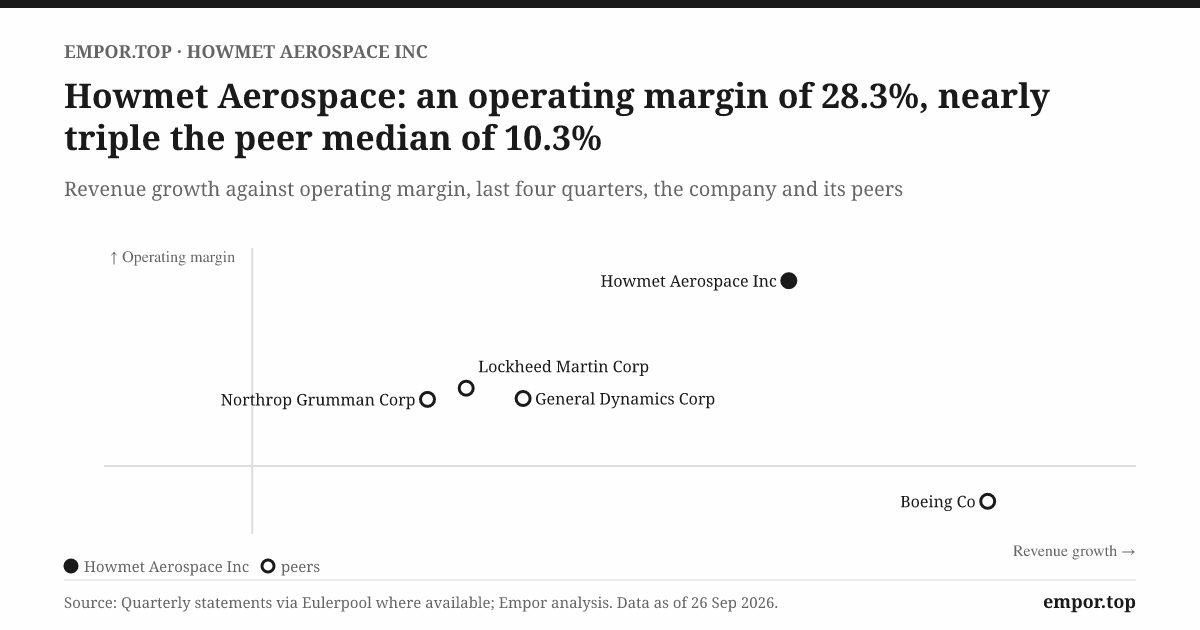
Howmet is a Pittsburgh company that most people outside aerospace have never heard of. In fiscal 2025 it generated $8.3 billion of revenue, up 11% from the year before, across four segments: Engine Products, Fastening Systems, Engineered Structures and Forged Wheels.1 Engine Products alone brought in $4.3 billion at a 33.3% segment adjusted EBITDA margin.1 Those are margins you expect from a software company, earned in a business that pours molten metal into ceramic molds.
The timing of this story is unusually sharp. On September 8, 2026, less than three weeks before this article was written, GE Aerospace, one of Howmet's two largest customers, agreed to buy Consolidated Precision Products (CPP), a Cleveland-based castings maker with about 6,600 employees and more than 20 plants, for $11.75 billion.2 GE said it was buying CPP to secure "mission-critical casting capacity." In practice, Howmet's biggest customer is bringing a large independent castings competitor in-house.2
Meanwhile, a second demand wave has arrived from a direction few aerospace investors were watching. AI data centers need electricity, and much of the fastest new supply is coming from natural gas turbines, which run on the same kind of single-crystal blades. Howmet's gas turbine revenue rose 38% year over year in the second quarter of 2026, to $341 million, and CEO John Plant told analysts that demand in that market was "extraordinary."3
This story is built around three questions. First, how did nearly a century of casting know-how, which began with dentures, become one of the most defensible positions in industrial manufacturing? Second, why has the market come to value this former aluminum-conglomerate orphan at a multiple usually reserved for elite compounders? Third, does GE's purchase of CPP change the answer to either question?
The story starts with the origin myth, compressed. Next comes the two decades Howmet spent buried inside Alcoa and Arconic, including the governance failures that ended that arrangement. Then it covers the John Plant turnaround, the four segments, M&A and capital allocation, and pay and succession. It closes with a competitive war-game, a risk radar, a bull and bear debate, and the few numbers worth watching from here. The first stop is a dental lab.
 Subscribe on LinkedIn
II. Origins, Compressed: From Dental Castings to Forged Wheels (1926–2000) (15 min)
The most important aerospace process of the 20th century began in a dental laboratory. The "lost wax" method is ancient: sculpt the shape in wax, coat it in ceramic, melt the wax out, and pour metal into the cavity it leaves behind. Sculptors used it for bronze statues for thousands of years. In the early 20th century, Austenal Laboratories adapted it to cast dentures from a cobalt-chrome alloy sold as Vitallium.4 Dentures have to be exact and have to survive a hostile chemical environment for years, which is not a bad training ground for jet engines.
The pivot came through General Electric. In the years before and during World War II, GE was building turbosuperchargers for piston aircraft engines. Superchargers use exhaust gas to spin a turbine, and the turbine blades kept failing. Forging them from the toughest available alloys was slow, and some of the best alloys were too hard to forge at all. Austenal's answer was a modified lost-wax process for a nickel-chrome-molybdenum alloy called Stellite 21. From late 1941, that alloy became the standard material for turbine blades in both turbochargers and early jet engines.4 A dental-alloy lab had solved one of the defining metallurgy problems of the war.
Two more strands of the modern company were forming around the same time. In 1948, Alcoa invented the first forged aluminum truck wheel, swapping heavy steel for a lighter alloy first developed for aircraft.6 That product line, still sold under the Alcoa Wheels brand, is today's Forged Wheels segment. In 1952, a small foundry called MISCO opened in Whitehall, Michigan, a lakeshore town north of Muskegon, to make investment castings.5 MISCO started with roughly two dozen employees making "turbine blades and hot-section parts that aircraft engines live and die by."7 It went on to perfect a way of building the ceramic mold as one solid shell, which made precise, repeatable castings practical at production volume.
Over the following decades, these businesses were bought and renamed repeatedly. The Whitehall operation, in one history's words, "passed through Howmet, then Alcoa, then Arconic, before settling into its current form."7 Along the way, the industry learned to cast blades with metal grains lined up in one direction (directional solidification) and then to grow each blade as a single crystal. The analogy is a plank of wood: a plank cut along the grain is far stronger than one full of knots and cross-grain joints. A single-crystal blade has no joints at all, so it can run hotter, and a hotter engine burns less fuel.
Why does a century-old origin story matter to an investor in 2026? Because the moat in this business is accumulated process knowledge, and it cannot be bought off the shelf. The recipes for pouring, cooling, coating and inspecting a single-crystal blade were refined over generations of engine programs. Whitehall today makes parts from titanium, superalloys and aluminum for jet and gas turbine engines, along with ingots and protective coatings.5 It is still one of the largest employers in Muskegon County.7 Plant told analysts in August 2026 that Howmet had "just completed the last available space in our Whitehall facility" for coating capacity.3 The origin story is still in production.
But having a crown jewel is different from being run like one. For the next two decades, Howmet's foundries were a line item inside an aluminum giant, and that is where the story turns.
III. Buried Inside a Conglomerate: The Alcoa/Arconic Identity Crisis (2000–2020) (25 min)
Imagine an Alcoa board meeting in the late 2000s. On one side of the table sit aluminum smelters: huge, power-hungry plants whose profits rise and fall with the London Metal Exchange aluminum price and the cost of electricity. On the other side sit the Whitehall foundries, making turbine blades under multi-year contracts at margins the smelters could never match. Both compete for the same capital budget, the same management attention and the same valuation multiple. For most of two decades, the multiple went to the smelters.
This was a classic conglomerate discount. Investors who wanted exposure to aerospace castings had to own aluminum price risk too, and investors who wanted aluminum had to own a portfolio of engineered products they did not understand. Neither group paid full price. The high-margin aerospace businesses effectively subsidized a commodity operation that absorbed capital in downturns.
The First Split
The first attempt to fix this came on November 1, 2016, when Alcoa Inc. split in two. The upstream mining, refining and smelting business became Alcoa Corporation. The aerospace, engineered products and rolled-aluminum businesses stayed in the renamed Arconic Inc.8 The logic was sound, but the execution was not. Arconic still combined a jet-engine castings franchise with rolled aluminum sheet, extrusions and building products. It had cut the conglomerate in half without making it coherent.
Arconic's first chief executive was Klaus Kleinfeld, the former Siemens CEO who had led Alcoa since 2008. Activist Elliott Management, which held an economic interest of about 13% in Arconic, launched a proxy fight in early 2017 arguing that the stock had underperformed for years under his leadership. The fight ended unexpectedly. On April 17, 2017, Arconic announced that Kleinfeld had stepped down "by mutual agreement" after the board learned he had sent a letter directly to a senior officer of Elliott without the board's knowledge. The board concluded that the letter "showed poor judgment."9 Board member David Hess, a former Pratt & Whitney chief, became interim CEO, and lead director Patricia Russo became interim chair.9 The company's own release noted that seven of its twelve directors had joined since the start of 2016, which says a lot about how unstable the governance was.9
A point for the record: some accounts tie Kleinfeld's exit to the Grenfell Tower fire. The sequence does not support that. Kleinfeld resigned in April 2017, and the fire happened two months later.
Grenfell
On the night of June 13–14, 2017, fire tore through Grenfell Tower, a 24-story public housing block in west London. Seventy-two people died.[^10] Part of the cladding system on the building's exterior was Reynobond PE, an aluminum composite panel with a polyethylene core. Arconic's French subsidiary, Arconic Architectural Products SAS, had supplied the panels to a fabricator.[^10] 8 Arconic said it had played no role in designing or installing the cladding system.8 On June 26, 2017, it announced it would no longer sell Reynobond PE for any high-rise use, "regardless of local codes and regulations."10
The public inquiry's final report, published on September 4, 2024, was damning. It concluded that Arconic had "deliberately concealed from the market the true extent of the danger" of its panels. It found that the company knew by 2011 that the cassette form of Reynobond PE used on Grenfell was "considerably more dangerous" than other versions, and that it had exploited weak regulatory regimes to keep selling it.[^10] Arconic disputed those findings and said it had not concealed information.[^10]
The Grenfell episode belongs in the main story of how Howmet was created, not in a footnote of legacy liabilities. It is the clearest example in this corporate history of what happens when a sprawling industrial group runs a product line far from its core expertise without adequate safety oversight. It also shaped how the eventual breakup was structured. Under the separation agreement dated March 31, 2020, Arconic Corporation, the spun-off aluminum and building-products company, agreed to indemnify Howmet for all potential liabilities associated with the Grenfell Tower fire.11 According to Howmet's filings, the personal injury claims on behalf of survivors and the estates of those who died have since been settled under confidential agreements.11 Howmet's legal exposure was contractually passed to Arconic Corporation. The governance failure happened in the corporate entity Howmet grew out of.
The Architect Arrives
Arconic spent 2017 and 2018 searching for a strategy. Chip Blankenship, a former GE Aviation executive, served as CEO for about a year. On February 6, 2019, the board named its chairman, John Plant, as Chairman and CEO, effective immediately.12 Plant had joined the board in 2016 and had run TRW Automotive from 2003 to 2015.12 The announcement said he was expected to serve as CEO for "approximately one year."12 Seven years later he is still in the job, a detail that matters in Section VIII.
Two days later, on February 8, 2019, Arconic announced the decision that created modern Howmet: another split.8 The engineered products and forgings businesses would stay in the existing company and take the Howmet Aerospace name. The rolled products, extrusions and building-and-construction businesses would be spun off as Arconic Corporation.8 The split took effect on April 1, 2020, and Howmet began trading under the ticker HWM.8 13
It could hardly have launched at a worse moment. Within weeks, global air travel had nearly stopped. Howmet's 2020 revenue fell 26% to $5.3 billion, fourth-quarter commercial aerospace revenue fell 51%, and the company ended the year with more than $5 billion of total debt.14 It had finally separated its aerospace businesses from the rest of the group, and it entered the steepest aviation downturn of the jet age as a standalone company. The next four years would show whether a focused company could be run better than the conglomerate that preceded it.
IV. The Plant Turnaround: Building Modern Howmet (2020–2024) (30 min)
John Plant does not fit the image of a patient aerospace engineer. He is a British-born executive who spent twelve years running an auto-parts supplier, an industry where customers negotiate for price cuts every year and a supplier's survival depends on cost discipline. At TRW, his task was extracting margin from customers far larger than the company. He brought that attitude to Howmet, and it shows in the way he runs earnings calls: he is dry and specific, and he is quick to challenge a customer's production forecast.
His operating model rested on three rules. First, keep the four businesses that earn the best returns and resist any temptation to rebuild a conglomerate. Second, price for the value of the part rather than chasing volume, because a flight-critical casting is a small fraction of an engine's cost and a very large fraction of its risk. Third, plan around what customers will actually build, not what they announce.
The Receipts
The results are clear. Revenue fell 5% to $5.0 billion in 2021, as the pandemic hangover lingered and Boeing's 737 MAX production stayed depressed.15 Plant used that trough to cut costs and debt: in 2021 alone Howmet paid down $845 million of debt, which cut annual interest costs by about $70 million.15 Revenue then climbed to $7.4 billion in 2024, up 12% that year, and to $8.3 billion in 2025.16 1 Management has now guided to about $10.05 billion for 2026.3
Margins matter more than revenue here, and they tell a more striking story. Howmet's adjusted EBITDA margin was 23.0% in 2021.15 It reached 25.8% in 2024 and 29.3% in 2025.16 1 In the second quarter of 2026 it hit 32.1%, with 46% of each incremental revenue dollar flowing through to EBITDA.3 In plain terms, each extra dollar of sales has been far more profitable than the average dollar. That happens when a business has fixed costs to spread and when prices rise faster than costs. Both have been true.
Guidance as a Track Record
One way to judge a management team is to compare what it said with what happened, year after year. Howmet's record here is good, though not perfect.
Going into 2021, Howmet guided to revenue of $5.05–5.25 billion and adjusted EBITDA of $1.07–1.15 billion.14 Revenue came in at $5.0 billion, just below the low end, because the aerospace recovery was slower than expected. Adjusted EBITDA came in at $1.30 billion, well above the top of the range.15 That pattern says a lot about Plant's Howmet. The top line depended on customers, and management's forecast was slightly too optimistic. Costs were under management's control, and it beat its own targets by a wide margin. Cost reduction in 2020 showed the same thing: $197 million of savings against an outlook of $185 million.14
The pattern repeated as the recovery gathered pace. For 2025, Howmet's baseline guidance called for revenue of about $8.03 billion with a 26.5% adjusted EBITDA margin.16 Actual results were $8.3 billion and 29.3%.1 For 2026, the initial guidance of $9.0–9.2 billion in revenue was raised to about $10.05 billion by August, and adjusted EBITDA guidance was raised to $3.23 billion.1 3 Part of that increase comes from acquired revenue at CAM and is not organic outperformance, and a careful reader should keep the two separate. Still, the direction of revisions has mostly been upward, which is the reverse of what investors usually see from aerospace suppliers in a recovery.
The disconfirming evidence is small but real. The 2021 revenue miss and, more clearly, the Forged Wheels recovery timing covered in Section VI show that management's forecasts on end markets it does not control are ordinary. Its edge is in cost and pricing execution, not in predicting demand.
Here is the analytical conclusion, stated carefully. The margin expansion is real, sustained and broad-based, which is evidence of strong pricing and operating discipline. But it happened entirely during a period when aerospace demand was recovering and supply was short. Howmet's pricing power has never been tested in a market where castings capacity was plentiful. The record proves execution in a favorable market. It does not yet prove the margin structure would survive a capacity glut.
The Boeing Discipline Test
The best management case study of this period is Boeing. In January 2024, a door plug blew off an Alaska Airlines 737 MAX in flight. The FAA capped 737 production at 38 aircraft per month while inspectors reviewed Boeing's factories.17 Boeing's rate plans slipped repeatedly, and suppliers that had hired and bought materials to meet the public targets were left holding costs.
Howmet planned below the targets. Its guidance for 2025 assumed Boeing would build approximately 25 737 MAX aircraft per month on average, a deliberately modest figure compared with the rate cap and Boeing's own ambitions.16 The FAA let Boeing raise the cap to 42 per month on October 17–18, 2025.17 On May 27, 2026, it cleared a further increase to 47 per month, after which Boeing CEO Kelly Ortberg said "we're off and rolling."18 By the Q3 2025 call, Howmet's planning assumption for 2026 had moved to a 737 rate "in the forties."19
Why does this matter? A supplier that builds to a customer's hopes ends up with too much inventory and too many workers when those hopes slip. A supplier that builds to realistic numbers protects its margins and can raise guidance later instead of cutting it. Howmet has followed the second pattern for most of the recovery. The evidence supports a narrower claim: on the most-watched production variable in commercial aerospace, management has tended to under-promise. It does not mean management's forecasts are always right. Section VI covers the Forged Wheels outlook, where management's timing was wrong.
Deleveraging and the Setup
The balance sheet was rebuilt at the same time. Total debt was about $5.1 billion at the end of 2020.14 Howmet then repaid $845 million in 2021, $365 million in 2024 and $265 million in 2025, and by the end of 2025 its net leverage was about 1x EBITDA.15 16 1 A company that came through the pandemic under heavy debt now has one of the more conservative balance sheets in the aerospace supply chain.
This covers the turnaround. The next step is to look inside the business that produces most of the profit.
V. Engine Products: The Crown Jewel and the AI Power Trade (45 min)
Walk into a Howmet casting plant and the first thing you notice is how slow and careful the work is. Wax patterns are assembled into trees by hand, then dipped again and again into ceramic slurry until the shell is thick enough. The molds are baked, filled with molten superalloy in a vacuum furnace, then withdrawn from the heat at a carefully controlled rate so that one crystal grows through the whole part. Then comes a long inspection process: X-ray, fluorescent penetrant, dimensional checks. Some parts are rejected, and the yield on each part number is one of the most closely guarded figures in the business. It is closer to a pastry kitchen that can never burn a batch than to a factory floor.
Why Hotter Means Richer
It is worth spending a moment on why this matters so much. A jet engine's efficiency depends heavily on how hot the gas entering the turbine can be. Every increase in turbine inlet temperature cuts fuel burn per seat-mile, and for an airline fuel is often the largest single operating cost. The limit is the blade. Engine designers therefore push blade technology forward in three ways at once: better alloys, single-crystal structure that removes weak grain boundaries, and ever more intricate internal cooling passages formed by ceramic cores placed inside the mold before the metal is poured.
Those ceramic cores are an underrated part of the moat. A modern high-pressure turbine blade is hollow, with a maze of passages that pull cooler air through the blade and bleed it out through tiny holes to form a protective film over the surface. The core that forms that maze is fragile, has to stay exactly in place while molten superalloy flows around it at more than 1,400°C, and then has to be dissolved out without damaging the part. Getting that right at scale is a craft learned through decades of scrapped parts. It is why engine makers pay for proven suppliers and do not treat castings as a commodity.
The Numbers That Matter
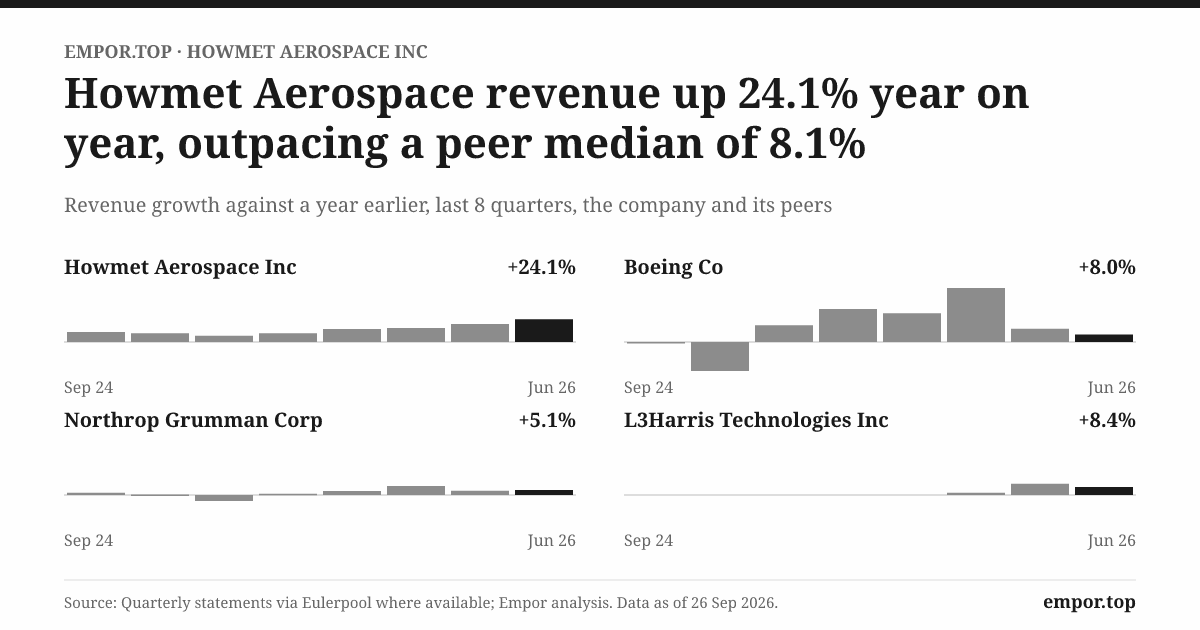
Engine Products is the reason to study Howmet. In 2025 it generated $4.3 billion of revenue, up 16%, about 52% of the company total, at a 33.3% segment adjusted EBITDA margin, up 250 basis points.1 That works out to roughly $1.4 billion of segment EBITDA, more than the other three segments combined. The pace then accelerated. In the second quarter of 2026, Engine Products revenue rose 32% to $1.37 billion, with a 37.7% margin.3
Industry Structure: Selling Picks and Shovels to an Oligopoly
The large jet-engine makers form a tight group: GE Aerospace, RTX's Pratt & Whitney, Safran (partnered with GE in the CFM joint venture) and Rolls-Royce. Howmet does not compete with them. It supplies all of them. That position gives it leverage, since every engine program needs hot-section castings, and it also creates concentration risk. Howmet's 10-K identifies GE Aerospace and RTX as customers that each account for more than 10% of sales, concentrated in Engine Products.20
The Moat, Tested Against the Evidence
The case for a moat rests on qualification. Before an engine maker will fly a new casting, the supplier's process has to be qualified for that specific part, often part by part. That can take years of test pours, metallurgical analysis, engine testing and regulatory paperwork. Once qualified, a supplier is rarely replaced mid-program, because requalifying a new source costs time and money and adds risk that no engine chief wants to take on. It works less like a brand and more like a building permit that expires only when the program ends.
The affirmative evidence is strong. Segment margins rose every year even as input costs increased, and Plant told analysts in August 2026 that Howmet holds "market share in excess of 50% globally for turbine blades in the IGT market."3 Customers keep adding to their demand outlooks rather than seeking price concessions.3
The strongest disconfirming evidence is the timing. Howmet's margin expansion lines up almost exactly with an industry-wide shortage of castings capacity. The shortage has several causes: underinvestment during the pandemic, a sharp rebound in air travel, and an aging engine fleet that needs spare parts sooner than planned. Management's own description of the market points the same way. In Q3 2025 it said customer destocking was "essentially finished," with only some residual titanium inventory left.19 In other words, part of the recent volume surge came from customers restocking after years of drawing down inventory, and restocking does not continue indefinitely.
The verdict: the history leaves the moat claim intact at the level of qualification-based switching costs, which have held for decades. It narrows the claim about pricing power. Howmet's recent pricing reflects both a durable moat and a cyclical shortage, and the filings do not let an outsider separate the two. The test to watch is whether segment margins hold once new castings capacity, including Howmet's own capex and CPP's expansion under GE, starts to catch up with demand.
Spares: The Annuity Inside the Engine
One structural tailwind stands apart from new aircraft production. When airlines fly engines harder and longer, hot-section parts wear out and must be replaced. Spares carry higher prices than original-equipment parts because the buyer is an airline with a grounded plane. In Q2 2026, Howmet's total spares revenue rose 37% to $460 million, 22% of company revenue.3 In Q3 2025, management said it expects spares growth to continue through the decade, especially for large installed engine families such as the CFM56, V2500 and the Pratt & Whitney geared turbofan.19 A high spares mix is part of why Howmet's margins look less like a manufacturer's and more like an aftermarket business.
The Gas Turbine Trade, Sized Honestly
The newest part of the story is power generation. Industrial gas turbines (IGTs), the large ground-based cousins of jet engines, use similar single-crystal blades. Hyperscalers building AI data centers have been signing for gas-fired power, and turbine makers have order books years long. In Q3 2025, Howmet's IGT revenue grew 23%, and management credited "growth in both large and mid-sized turbine markets" driven by data-center electricity demand.19 In Q2 2026, gas turbine revenue grew 38% to $341 million.3 That quarterly figure implies an annual run rate above $1.3 billion, meaning gas turbines now account for roughly a quarter of Engine Products revenue.
Size the expectations carefully. Some sell-side and outline materials have described management's view as the IGT business "doubling" over three to five years. On the Q2 2026 call, Plant did not give that number. He said Howmet would "see growth throughout the next 4 or 5 years," with major customer capacity coming online in 2028, 2029 and into 2030.3 Howmet is backing that view with capital: a new plant in Japan, a major European expansion and a buildout in Virginia, with 2026 capex expected to exceed $500 million and rise again in 2027.3
The capex pattern shows where management expects the returns. In Q3 2025, it said roughly 70% of year-to-date capital spending had gone to the engines business, including a new aero-engine facility in Michigan, and that capex would "remain at high levels into 2026 and 2027."19 For a company that spent the early 2020s cutting debt and costs, that is a notable change: Howmet is now investing ahead of demand rather than only harvesting it. That change deserves to be watched as closely as any revenue figure, because heavy capacity additions late in a cycle are how excellent manufacturers turn into ordinary ones.
A skeptical reading is warranted. Power-generation equipment has had severe boom-and-bust cycles before. Gas turbine makers overbuilt in the early 2000s and spent years in a trough afterward. The data-center power buildout is a real demand signal, visible in customer order books. But a turbine blade plant takes years to build, and if AI capital spending slows before Howmet's new capacity is filled, it will be left with expensive fixed assets. The gas turbine business is a proven, fast-growing revenue stream. It is not yet proven through a downturn.
The GE/CPP Shockwave
Now for the most important new fact. GE Aerospace agreed to pay $11.75 billion for CPP, buying it from private equity owners Warburg Pincus and Berkshire Partners. The price was about 18 times CPP's expected 2027 EBITDA including synergies, and about 26 times without them.2 GE will fund the deal with $7 billion of cash and new debt, and it expects the deal to close in the second half of 2027, subject to regulatory approval.2 CPP makes highly engineered castings in superalloys, titanium, aluminum, magnesium and steel for commercial engines, defense and IGTs, which puts it directly in Howmet's markets.2 CEO Larry Culp said that "investing in mission-critical casting capacity is needed to support strong demand across commercial engines."2 CNBC described the deal as GE bringing a key castings supplier in-house.21
There are two plausible readings.
The bull reading is that the deal takes a large independent castings supplier off the open market. Pratt & Whitney, Rolls-Royce, Safran and the IGT makers now have one fewer neutral supplier to use as leverage against Howmet. If GE directs CPP's capacity toward its own engines, the rest of the market could become even more dependent on Howmet. The price also sets a high reference value for the asset class.
The bear reading is that the customer most exposed to Howmet has decided it would rather own castings capacity than rent it. Over time GE may move work that Howmet does today onto CPP's lines, first on new engine programs where qualification decisions are still open, and later perhaps on spares. The high price may also attract new capital into castings. That would take years because of qualification, but it could erode the shortage that currently supports Howmet's pricing.
Which reading is right cannot be known yet, and anyone who claims otherwise is guessing. The deal will not close until late 2027, and qualification cycles mean any shift in sourcing would appear in 2028 and after. The best indicator to watch is GE-attributable revenue within Engine Products, along with any disclosure of Howmet wins or losses on new engine programs. Plant did not address GE or insourcing on the Q2 2026 call, which came before the announcement, so the Q3 2026 call will be the first chance to hear management's response.3
The Named Rivals
The competitive field is small. Precision Castparts, owned by Berkshire Hathaway, has long been the largest rival and has historically competed more on volume. CPP is headed into GE's ownership. ATI competes in specialty materials and forgings. Russia's VSMPO-AVISMA is a titanium giant, covered in the next section. In turbine blades specifically, Plant's claim of more than 50% global IGT share suggests Howmet is the clear leader, but that figure comes from management and not from independent measurement.3
Engine Products is where Howmet's value sits, but the rest of the company adds scale, and some of its most instructive lessons.
VI. The Other Three-Quarters: Fastening Systems, Engineered Structures, Forged Wheels (30 min)
A single Boeing 787 contains hundreds of thousands of fasteners, and each one is specified by part number on an engineering drawing. Using a substitute is not an option. If a drawing calls out a particular titanium lockbolt from a qualified supplier, that bolt goes into every aircraft built for as long as the program runs. It is one of the least glamorous businesses in aerospace, and one of the most durable.
Fastening Systems: Monopoly by Drawing Number
Fastening Systems had 2025 revenue of $1.7 billion, up 11%, with a 30.4% segment adjusted EBITDA margin, up a remarkable 460 basis points.1 Growth then jumped with an acquisition. In Q2 2026, segment revenue rose 37% to $589 million, including the newly acquired Consolidated Aerospace Manufacturing (CAM) and a smaller acquisition, Brunner.3 Named competitors include France's Lisi Aerospace and a handful of specialist suppliers.
The moat mechanism here is strong, but most of it was inherited. Being specified on a drawing is a switching cost that current management did not create. It was earned over decades as legacy Alcoa and acquired fastener businesses were designed into airframes. What Plant's team did deliver was margin: the 460-basis-point expansion in 2025 reflects pricing and operational discipline on a position that had long underearned. The accurate description is that management took an inherited moat and started earning a proper return on it.
Engineered Structures: The Titanium Hedge in Progress
Engineered Structures had 2025 revenue of about $1.1 billion, up 8%, with a margin of 21.2%, up 560 basis points, the fastest improvement of any segment, though from the lowest base.1 The segment makes titanium ingots and mill products as well as aluminum and nickel forgings for airframes and engines.
This is where geopolitics comes in. Russia's state-linked VSMPO-AVISMA (ВСМПО-АВИСМА) supplied more than 45% of the world's aerospace titanium parts at the time of the 2022 invasion of Ukraine, according to the Air Current, and titanium escaped direct Western sanctions because both Boeing and Airbus relied on it for engine components and landing-gear forgings.22 Part of the logic of Engineered Structures is Western titanium melting and forging capacity for OEMs trying to reduce reliance on Russia.
How much this position is worth depends on how far that decoupling has progressed, and the evidence says it is incomplete. As of the Air Current's reporting, sanctions left enough "work-arounds and loopholes that it can't be by accident."22 Howmet does not disclose titanium share or the Russian-origin exposure of its customers, and Q3 2025 commentary noted residual titanium inventory still working through the supply chain.19 The claim that Howmet's Western titanium position is a strategic moat should be narrowed. It is a hedge that is still being built. It will pay off most if sanctions tighten, and it will be exposed if Russian supply stays cheap and available.
Forged Wheels: The Guidance Miss Worth Naming
Forged Wheels, the Alcoa Wheels business, is the smallest and most cyclical segment, with 2025 revenue of $1.0 billion, flat year over year.1 It sells to the Class 8 heavy-truck market, which has nothing to do with aerospace and swings with freight volumes and fleet replacement cycles.
The segment offers the clearest example of management getting a forecast wrong. In February 2025, Howmet said commercial transportation would be "soft until the second half of 2025."16 That recovery did not come on schedule. In Q3 2025, commercial transportation revenue fell 3% and wheel volumes fell 16%.19 For the full year, revenue was flat after an 8% decline in 2024.16 1 The recovery arrived later. In Q2 2026, Forged Wheels revenue rose 14%, with volumes up 7% sequentially.3
What rescued the segment was cost control. Even with lower volumes, Forged Wheels' 2025 margin expanded 130 basis points to 28.5%, helped in Q3 by favorable aluminum costs, tariffs and currency.1 19 Those tailwinds are now reversing. In Q2 2026, management warned that passing through higher aluminum costs would dilute segment margins by about 360 basis points for two more quarters.3 The takeaway is that Howmet's cost discipline is real even in the business where its forecasting has been weakest, and that the aerospace segments should not be judged by the standards of this one, or the reverse.
Organic growth is only part of how a company is built. The next section looks at acquisitions and capital returns, where the comparison with GE's CPP deal is most revealing.
VII. M&A and Capital Allocation: The Plant Playbook vs. What GE Just Paid (25 min)
Every capital allocator eventually faces the same test: a large amount of cash, an attractive target and a board that likes growth. Conglomerates are built one reasonable-sounding deal at a time, and Howmet exists largely because Alcoa and Arconic assembled too many of them. The question for Plant's Howmet is whether it has avoided repeating that pattern.
The CAM Deal
For most of the Plant era, Howmet made very few acquisitions. That changed on December 22, 2025, when Howmet agreed to buy Consolidated Aerospace Manufacturing from Stanley Black & Decker for about $1.8 billion in cash.23 CAM makes precision fasteners, fluid fittings and engineered components for aerospace and defense. It was expected to generate $485–495 million of revenue in 2026 at an adjusted EBITDA margin above 20% before synergies.23 Howmet put the price at about 13 times 2026 adjusted EBITDA, including synergies and tax benefits from the deal structure.23 Plant called it "a major step in our strategy to build out our differentiated fastener portfolio."23 The deal closed on April 6, 2026.24 Stanley said it would use the roughly $1.57 billion of net proceeds to reduce debt.24
The Benchmark
Three months after CAM closed, GE agreed to pay about 18 times synergized EBITDA, and about 26 times unsynergized, for CPP.2 Howmet paid roughly half that multiple.
It is tempting to read the gap as simple proof of Howmet's discipline, but the comparison is not like for like. CAM is mainly a fastener and fittings business with margins just above 20%, while CPP is a castings supplier directly exposed to the tightest bottleneck in engine supply. The assets differ in quality, growth and scarcity. GE was also buying something Howmet did not need: control over its own supply. Strategic buyers routinely pay extra for that.
A fairer conclusion is this. Howmet chose a bolt-on inside a segment it already understands, at a price that does not depend on heroic synergies, and paid cash while keeping leverage low. That is consistent with discipline. It does not prove Howmet would win a bidding war for a scarce asset, because it has not been in one. The test to watch is whether CAM delivers its synergies. Management has called 2027 "a focus year" for supply-chain and distribution synergies.3
Buybacks: Programmatic, Not Heroic
Buybacks are the clearest test of discipline, and here the record is strong, although rising share prices have helped. In 2021, Howmet repurchased $430 million of stock at an average of $32.07 per share.15 In 2024 it bought back $500 million.16 In 2025 it repurchased $700 million, or 4.4 million shares, at an average of $160.52.1 In the first half of 2026 it bought $800 million at an average of $248.29.3
Two things stand out. First, the 2021 buybacks, made in the depths of the aviation downturn while debt was also being paid down, have returned several times their cost. Second, Howmet keeps buying at much higher prices. The 2026 average price is more than seven times the 2021 average. A programmatic buyer keeps buying as the multiple rises, and the returns on each new dollar fall. A skeptic would argue that buybacks at around 47 times guided 2026 adjusted EPS ($5.27) are a much weaker use of capital than buybacks at trough prices.3 That is a fair challenge, and so far Howmet has answered it only through its capex plans.
Dividends and Debt
The dividend has risen quickly from a low base. Howmet paid $0.44 per share in 2025 and raised the quarterly dividend 17% to $0.14 in mid-2026.1 3 Free cash flow gives room for both dividends and buybacks: $1.4 billion in 2025, with 2026 guidance of about $1.9 billion.1 3
Debt reduction has made the balance sheet an asset rather than a constraint. The company that carried more than $5 billion of debt through the pandemic funded an $1.8 billion acquisition in 2026 with cash and still raised its free cash flow guidance.14 3 Such flexibility is valuable in a cyclical industry. It also creates temptation, and that brings the story to the person who decides how to use it.
VIII. Management, Incentives & Governance: Is $45 Million Too Much? (20 min)
In June 2025, Howmet's compensation committee faced a problem. Its chief executive was in his seventies and widely credited with the company's transformation. The stock had multiplied, and there was no obvious successor. The committee's answer was to pay him to stay.
The Retention Award
On June 23, 2025, the board approved a special retention award of restricted stock units worth $45 million for John Plant. It was granted on July 1, 2025 and vests on July 1, 2028 if he remains in the job.25 The award vests in full if Howmet terminates him without cause or he leaves for good reason, and pro rata if he dies or becomes disabled before 2028.25 It comes on top of his regular pay: a $1.8 million base salary, a target bonus of 175% of salary, and annual equity grants.25 Plant was 72 at the time of the 2026 proxy.26
Defenders of the award have a real argument. Plant's tenure has produced some of the largest value creation in the industrial sector, and $45 million is a tiny share of that. A misstep in succession could cost shareholders far more than the award.
Critics have a real argument too. A retention award essentially admits that the board has no successor ready. The market noticed. In a January 2026 director vote at Jabil, where Plant sits on the board, he received only about 16% support, the most-rejected director of the proxy season in Boardroom Alpha's tally. Boardroom Alpha tied the outcome partly to concerns about his workload and pointed to the Howmet retention grant made six months earlier.27 That vote was at a different company, but it is the most concrete evidence of investor pushback against Plant.
The Plant Style
To understand why a board would pay this much, it helps to hear how Plant runs the company in public. His earnings calls are short on vision statements and long on specifics: build rates by aircraft type, basis points of margin, and the cash conversion of net income. In Q3 2025, he gave analysts specific planning assumptions for 2026 by airframe: the 737 "in the forties," the A320 in the "early sixties," the 787 around "seven and a half," and the A350 around "six and a half, could be seven."19 Many aerospace suppliers avoid that level of detail because it makes them accountable. Plant's willingness to give it, and then mostly meet it, is a large part of his credibility with investors.
His style has limits too. The calls rarely address competitive threats by name. On the Q2 2026 call, for example, he did not name specific competitors, and the transcript contains no discussion of succession.3 A CEO who is precise about operations and quiet about strategic threats and succession leaves investors to fill in those blanks themselves, and at a premium multiple, investors tend to fill them in optimistically.
The Succession Question, Stated Plainly
Look at the record. When Plant became CEO in February 2019, the expectation was that he would serve for "approximately one year."12 He then served as co-CEO alongside Tolga Oal after the 2020 split, and became sole CEO in 2021 when Oal left. The CFO role changed hands in December 2025, when longtime CFO Ken Giacobbe retired after 21 years and Patrick Winterlich, who had been CFO of composites maker Hexcel since 2017, took over.28
Taken together, the market is paying a premium partly for execution by one specific person, with little public information about what comes after July 2028. This does not disqualify the investment case, but it is a key-man risk that a 72-year-old CEO, a retention award and no named successor make impossible to ignore.
The Quiet Activist
Elliott Management's influence did not end with the 2017 proxy fight. Elliott partner David Miller has been a director since 2017.29 That makes Elliott an embedded, long-term board presence rather than an active campaigner, very different from the public breakup campaign Elliott waged at Honeywell in 2024. It can be read as governance strength, since a sophisticated owner is in the boardroom, or as one reason the board has been willing to pay generously for continuity. Both readings are reasonable.
Credibility Through Behavior
On the evidence available, management's record on capital allocation holds up well: buybacks made far below today's price, one bolt-on acquisition at a reasonable multiple, significant debt reduction and conservative Boeing assumptions. The record also includes a missed recovery call in Forged Wheels and a CEO tenure that has run about seven times longer than first announced. The confidence the record supports is specific. This management team has been disciplined in a favorable market. Whether its successors will be is not yet known.
A disciplined management team matters most when rivals are strong. The next section examines the competition.
IX. Competitive Landscape & the Moat Stress Test (25 min)
Consider how a rival would try to take share from Howmet in turbine blades. Money would be the easy part; private equity funded CPP, and GE just showed how much a strategic buyer will pay. The hard part is time. The rival would need vacuum furnaces, ceramic-core capability, coating lines and, above all, years of qualification on each engine program. By the time it was qualified, the programs it targeted might be halfway through their production lives. That is why this contest is decided over decades.
Porter's Five Forces
Supplier power is moderate and growing in places. Howmet relies on nickel superalloys, rhenium-bearing alloys and titanium sponge, where a few melters and VSMPO have leverage. So far, Howmet has passed cost increases through to customers.
Buyer power is the most serious force. Four engine makers buy most of the high-value output, and GE and RTX each exceed 10% of sales.20 Those buyers are sophisticated and well funded, and as of September 2026 one of them is buying a rival.2 Buyer power is also held in check by the fact that each buyer depends on Howmet for qualified parts it cannot replace quickly.
The threat of substitutes is low. No commercially available manufacturing process replaces single-crystal casting for flight-critical hot-section blades. Additive manufacturing is advancing for some components, but it is not a near-term substitute for turbine blades.
The threat of new entrants is low because of qualification timelines, capital intensity and process know-how. The GE-CPP deal is the exception that proves the rule: the fastest way to add qualified capacity was to buy an existing player.
Rivalry is moderate among a small group: Precision Castparts, CPP under GE, ATI, VSMPO in titanium, Lisi in fasteners, and specialists such as Doncasters. When capacity is short, rivals compete on delivery rather than price, and that describes the market today.
Hamilton Helmer's 7 Powers
Two of Helmer's seven powers fit Howmet well. The first is process power: decades of refined metallurgical know-how embedded in people and procedures that competitors cannot easily copy, even with money. The second is switching costs: qualification ties each part to each program. Scale economies play a supporting role, since Howmet's share lets it spread R&D and coating investment across more volume. Network effects, brand power and counter-positioning do not apply. The cornered resource does not really apply either. Howmet does not own scarce inputs; it owns the ability to process them.
This mix of powers is durable but has limits. Process power can be copied slowly, or bought, as GE has just done. Switching costs hold within a program but reset when a new engine is designed. The GE-CPP deal shows that a customer large enough to buy its own capacity can partially erode these powers. The moat is real, but it is not absolute.
War-Gaming the Next Five Years
Three scenarios help frame the competitive outlook.
In the first, scarcity persists. Engine makers keep raising rates, the installed base keeps aging, gas turbine demand keeps growing, and new capacity, both Howmet's and CPP's, is absorbed as fast as it arrives. Howmet's pricing holds, GE's ownership of CPP changes little because GE still needs every qualified blade it can get, and the margin debate stays unresolved because it is never tested.
In the second, capacity catches up. By 2028 or 2029, new plants in Japan, Europe, Virginia and Michigan, along with CPP's expansion under GE and PCC's own investment, bring supply closer to demand. Customers regain leverage in contract renewals, and Howmet's growth shifts from price toward volume. In this scenario the moat still works, since qualified positions are not lost, but margins revert toward the levels of the mid-2020s.
In the third, the customer moves. GE uses CPP not just to add capacity but to take share, qualifying CPP on new programs and eventually on spares for engines Howmet supplies today. This is the scenario the bear case worries about, and it would take years to become visible because of qualification timelines.
The evidence available today cannot say which scenario will play out. It does say what to watch: margin trends in contract renewals, Howmet's disclosed wins on new engine programs, and changes in GE's share of Howmet's sales.
Myth vs. Reality
Myth: Howmet has a monopoly. In reality, Howmet leads in turbine blades, with a management-claimed share above 50% in IGT blades, but PCC is a large rival and CPP is now in a customer's hands.3 "Dominant supplier in a tight oligopoly" is more accurate than "monopoly."
Myth: Margins are purely structural. In reality, margins have risen during a supply shortage and a restocking cycle.19 Part of the margin is structural, from spares mix and qualification lock-in, and part is cyclical. The split has not been tested.
Myth: AI power demand is an option on the side. In reality, gas turbine revenue now runs above $1.3 billion a year and is growing faster than commercial aerospace.3 It is a core business, with a boom-and-bust history of its own.
The Valuation Stress Test
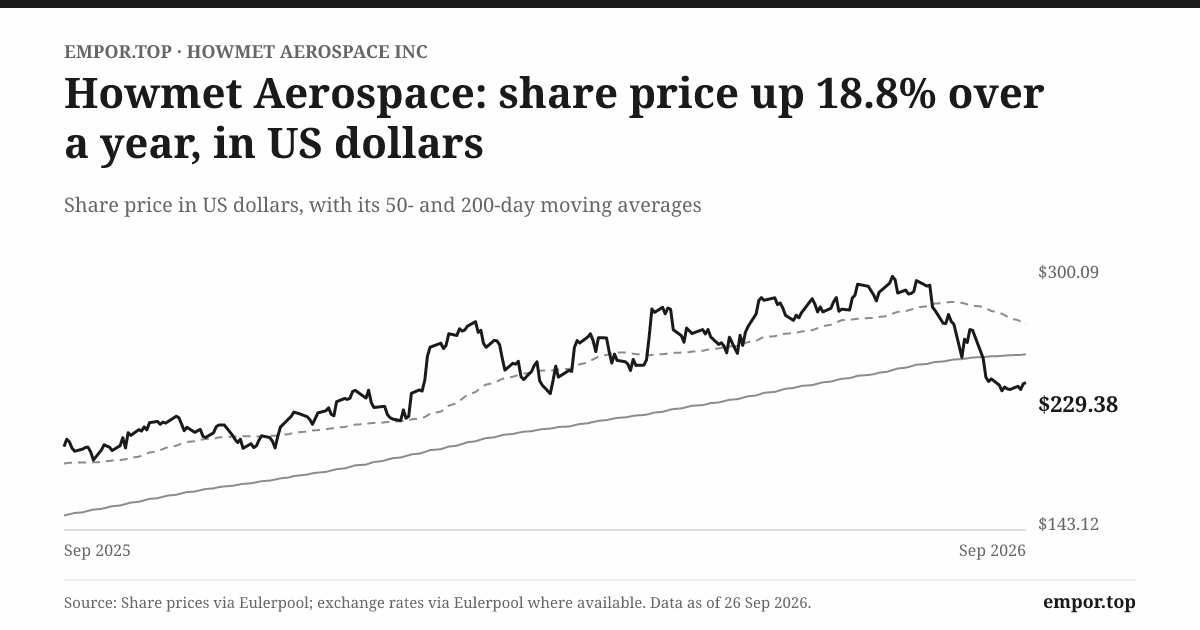
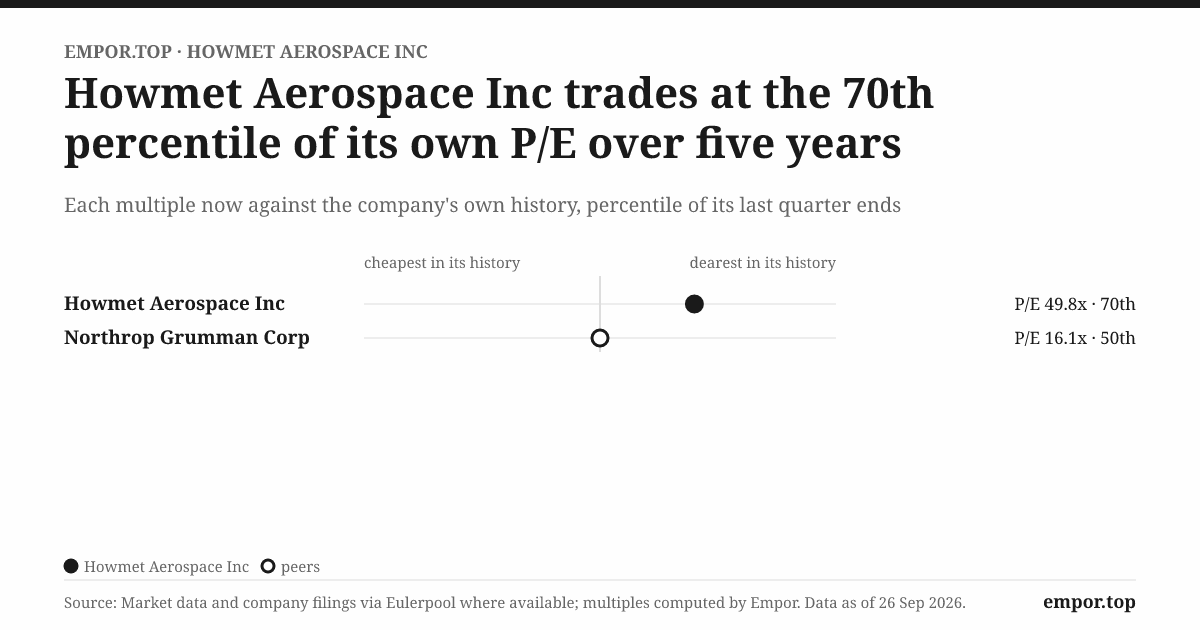
The market has re-rated Howmet dramatically. Its own buyback prices show it: an average of $32 in 2021, $161 in 2025 and $248 in the first half of 2026.15 1 3 Earnings grew a lot over that period, but the share price grew much faster, so the multiple expanded. At the 2026 buyback average, the shares traded near 47 times the company's raised adjusted EPS guidance, a valuation above most aerospace peers, including high-quality aftermarket compounders such as TransDigm.3
The question for anyone paying that price is how much of Howmet's current earnings power is structural (spares mix, qualification lock-in, a multi-year gas turbine buildout) and how much is cyclical (restocking, capacity shortage, a Boeing recovery from a very low base). If the cyclical part fades before the structural part grows, earnings may keep rising while the multiple falls. The risk radar makes that case explicit.
X. Risk Radar (20 min)
Every aerospace supply chain crisis follows the same pattern: a problem at one weak link spreads across the system. A grounding, a strike, a sanctions decision or a missed delivery by one supplier can stall a customer's production line. Howmet's risks are best understood as links in that chain.
Customer concentration and the GE-CPP overhang. GE and RTX each account for more than 10% of sales.20 GE's CPP deal is a structural risk that plays out over 2027–2030, not a near-term threat to earnings. It works through new program awards and gradual reallocation of work, not through canceled contracts. The first real evidence will come in Howmet's disclosures after the deal closes.
Boeing and OEM production rates. This risk has shifted from a problem to a tailwind as the FAA approved higher rates, first 42 and then 47 per month.17 18 It is not gone. Another quality problem at Boeing could bring the cap back. Plant has also flagged Middle East conflict, jet-fuel volatility and near-term air traffic as live concerns.3
Titanium and geopolitical supply. VSMPO's large share and the still-incomplete Western decoupling mean that further sanctions would tighten titanium supply for the whole industry.22 That would raise input costs while making Howmet's Western titanium capacity more valuable, so the effect cuts both ways.
Valuation and cost of capital. At a premium multiple, even a modest slowdown in commercial aerospace or gas turbine growth could compress the multiple faster than earnings could grow. Plant has noted that higher interest rates have reduced the prospect of near-term rate cuts.3 Rising discount rates hurt long-duration growth stocks most.
Key-man and governance risk. Howmet has a 72-year-old CEO, a $45 million award that runs to 2028 and no named successor.25 26
Forged Wheels cyclicality. Recovery has begun, but aluminum pass-through will weigh on margins for two more quarters.3
Tariffs and trade policy. Howmet's 10-K flags tariffs and trade policy as a risk to pricing and supply chains, given its manufacturing footprint in Mexico, Europe, Japan, China and Canada.20 So far the effect has been small: management said the net tariff drag was below $5 million for 2025.19
Legacy legal overhang. Grenfell liabilities belong to Arconic Corporation under the separation agreement.11 Howmet's exposure is therefore mainly counterparty risk, meaning the risk that the indemnifying party cannot pay, not direct liability. It is a low-probability item worth keeping in mind.
These risks are not the whole story. They are the counterweights the bull case has to overcome, and the next section sets out both sides.
XI. Bull vs. Bear Case (20 min)
Picture two portfolio managers at the same table, each with the same 10-K and the same Q2 2026 transcript. One sees the best industrial franchise in the market. The other sees a great company priced as if nothing could go wrong. Both are reading the same facts.
The Bull Case
A structurally advantaged position in the tightest part of the supply chain. Process power and qualification-based switching costs give Howmet a long-lasting advantage in the part of an engine that is hardest to make. Engine Products margins reached 37.7% in Q2 2026, which shows how valuable that position is while demand exceeds supply.3
A rising share of aftermarket revenue. Spares reached 22% of revenue in Q2 2026 and grew 37%.3 A large, aging installed base of CFM56, V2500 and GTF engines supports demand for replacement parts regardless of new aircraft production rates.19
A second secular engine. Gas turbine revenue is growing 30–40% a year on data-center power demand, backed by customer demand outlooks that keep rising and capacity coming online through 2030.3 It diversifies Howmet's end markets without leaving its core expertise.
A capital allocation record. Howmet bought back shares at trough prices, paid a reasonable price for a bolt-on acquisition, cut debt from more than $5 billion to about 1x EBITDA and raised the dividend quickly.15 23 1 3
A recovering Boeing. Boeing's move from 38 to 47 aircraft per month is now a tailwind rather than a risk.18
The Bear Case
The valuation. At multiples far above Howmet's own history, the stock already reflects much of the good news. Multiple compression is a real risk, even if the business keeps performing.
The customer is becoming a competitor. GE's $11.75 billion purchase of CPP is the clearest sign yet that the engine makers see castings as too important to leave to suppliers.2 If one customer has done this, others might follow.
Margins untested in a normal market. All of Howmet's margin expansion happened during restocking and scarcity.19 New capacity, some of it Howmet's own, will come online over the next three years.
Governance friction. The $45 million award, the Jabil vote and the absence of a named successor point to a board paying for continuity instead of planning for succession.25 27
Cyclical and geopolitical tails. Forged Wheels is still tied to the truck cycle. Titanium still depends on how Russia policy evolves.22
An Activist's Stress Test
A skeptical activist would focus on three questions. First, why buy back stock at close to 50 times earnings rather than speed up capacity investment in turbine blades, where management says demand is extraordinary? Second, what is the concrete succession plan, and why hasn't the board disclosed one ahead of a vesting date less than two years away? Third, how much of Engine Products revenue is exposed to GE programs where CPP could win future sourcing decisions? Fuller answers to any of these would strengthen confidence in the company. Evasive answers would support the bear case.
The Framework Verdict
Porter and Helmer point to the same conclusion. Howmet's position is strongest in the qualification of flight-critical parts and weakest in buyer power, which the GE-CPP deal has made more visible. The competitive advantage looks real and durable. The question for investors is whether today's valuation assumes that advantage is absolute.
XII. Playbook: Business & Investing Lessons (15 min)
Stepping back from the details, the Howmet story offers several lessons that apply well beyond aerospace.
Un-diversifying can create more value than diversifying. Howmet's re-rating came after aluminum smelting, rolled sheet and building products were removed, not after new businesses were added. The Alcoa and Arconic years show what the conglomerate structure cost, both financially and, with Grenfell, in human terms. A focused company is easier to understand, easier to manage and easier to value.
Aftermarket economics are the long-term margin engine. In any business with a large installed base of long-lived equipment, replacement parts earn higher margins than original equipment and are less exposed to new-production cycles. Howmet's rising spares mix is its version of this pattern.
Qualification barriers are durable, but not permanent. Years of testing and regulatory paperwork keep new entrants out. They do not stop a large customer from buying an existing player. Investors should watch for vertical integration by customers as the main way this kind of moat gets tested.
Programmatic buybacks can work, but returns fall as the price rises. Howmet's steady buybacks since 2021 have been strongly accretive, especially the ones made at trough prices. The same program at today's multiples earns much less per dollar, and a disciplined allocator should be willing to change the mix.
Compare what strategic and financial buyers pay. The gap between GE's 18–26 times for CPP and Howmet's 13 times for CAM is one of the few observable measures of capital allocation quality, as long as the reader also accounts for differences in the quality and scarcity of the assets.
XIII. What to Watch: KPIs & Forward Catalysts (10 min)
Most of Howmet's story shows up in three numbers.
First, Engine Products segment margin. This is the best single measure of whether pricing power is structural or cyclical. If margins hold near current levels as new castings capacity arrives, including CPP's expansion under GE, the moat is stronger than the skeptics think. If margins fall back toward 2024 levels, the cyclical explanation was right.
Second, spares revenue as a share of total revenue. At 22% in Q2 2026, this is the clearest indicator of how much of Howmet's revenue base comes from the installed fleet and not from new production.3
Third, gas turbine revenue growth. Management has pointed to growth through 2030. Quarterly growth rates, compared against the $341 million Q2 2026 base, will show whether the data-center power boom is being converted into revenue on schedule.3
Beyond these three numbers, several events will matter. The first is Howmet's first public comments on the GE-CPP deal, likely on the Q3 2026 call. Next come regulatory reviews and the closing of that deal, expected in the second half of 2027.2 Boeing's progress toward 47 aircraft per month and beyond will drive volumes in both Engine Products and Fastening Systems.18 CAM synergy delivery in 2027 will test Howmet's acquisition discipline.3 Finally, any disclosure on CEO succession before the July 1, 2028 vesting date will show whether the board has planned for Howmet after Plant.25
References
-
Howmet Aerospace Reports Fourth Quarter and Full Year 2025 Results — Howmet, 2026-02-12 ↩↩↩↩↩↩↩↩↩↩↩↩↩↩↩↩↩↩
-
GE Aerospace to Acquire Consolidated Precision Products (CPP), Expanding Mission-Critical Castings Capacity — GE Aerospace, 2026-09 ↩↩↩↩↩↩↩↩↩↩
-
Howmet Aerospace (HWM) Q2 2026 Earnings Call Transcript — The Motley Fool, 2026-08-13 ↩↩↩↩↩↩↩↩↩↩↩↩↩↩↩↩↩↩↩↩↩↩↩↩↩↩↩↩↩↩↩↩↩↩↩↩↩↩
-
Supercharger Development in the U.S. During the Inter-War Period — Aircraft Engine Historical Society ↩↩
-
About Us — Alcoa Wheels, a product brand of Howmet Aerospace ↩
-
How a 26-person shop in Whitehall ended up in jet engines — Michigan Porch ↩↩↩
-
Arconic Corporation Information Statement (Form 10 exhibit) — Arconic Inc./Howmet, 2020-02-13 ↩↩↩↩↩↩
-
Arconic Inc. Form 8-K Exhibit 99.1: Leadership transition (Klaus Kleinfeld) — SEC, 2017-04-17 ↩↩↩
-
Arconic Issues Statement on Reynobond PE — Howmet (Arconic), 2017-06-26 ↩
-
Howmet Aerospace Inc. — Form 10-K, FY2024 — SEC, 2025-02-14 ↩↩↩
-
Arconic Inc. Form 8-K Exhibit 99.1: John C. Plant named Chairman and CEO — SEC, 2019-02-06 ↩↩↩↩
-
Howmet Aerospace Reports Fourth Quarter 2020 and Full Year 2020 Results — Howmet, 2021-02-03 ↩↩↩↩↩
-
Howmet Aerospace Reports Fourth Quarter 2021 and Full Year 2021 Results — Howmet, 2022-02-02 ↩↩↩↩↩↩↩↩
-
Howmet Aerospace Reports Fourth Quarter and Full Year 2024 Results — Howmet, 2025-02-13 ↩↩↩↩↩↩↩↩
-
FAA allows Boeing to increase 737 Max production — Spectrum News, 2025-10-18 ↩↩↩
-
FAA approves Boeing 737 MAX production increase to 47 aircraft monthly — Lynnwood Times, 2026-05-31 ↩↩↩↩
-
Howmet (HWM) Q3 2025 Earnings Call Transcript — The Motley Fool, 2025-10-30 ↩↩↩↩↩↩↩↩↩↩↩↩↩
-
Howmet Aerospace Inc. — Form 10-K, FY2025 — SEC, 2026-02-12 ↩↩↩↩
-
GE Aerospace to spend nearly $12 billion to bring key castings supplier in-house — CNBC, 2026-09-08 ↩
-
Russian titanium avoids the crossfire between east and west — The Air Current, 2022-04-10 ↩↩↩↩
-
Howmet Aerospace to Acquire Consolidated Aerospace Manufacturing from Stanley Black & Decker for approximately $1.8 Billion — Howmet, 2025-12-22 ↩↩↩↩↩
-
Stanley Black & Decker Completes Sale of Consolidated Aerospace Manufacturing Business to Howmet Aerospace — Stanley Black & Decker IR, 2026-04-06 ↩↩
-
Howmet Aerospace Inc. — Form 8-K, CEO $45M retention award amendment — SEC, 2025 ↩↩↩↩↩↩
-
Howmet Aerospace Inc. — 2026 DEF 14A Proxy Statement — SEC, 2026 ↩↩
-
2026 Proxy Season Scorecard: Six Say-on-Pay Failures — Boardroom Alpha, 2026 ↩↩
-
Howmet Aerospace Announces Executive Leadership Changes — Howmet, 2025-10-22 ↩
-
Howmet Aerospace Inc. — 2022 DEF 14A Proxy Statement — SEC, 2022 ↩
 LinkedIn
 WhatsApp
 Reddit
 Hacker News
 Email
 Kindle
 RSS Feed
 Spotify
 Apple Podcasts
 Amazon Music
 Audible
 YouTube