International Flavors & Fragrances: From Scent Empire to Scaled-Back Bet on Science
I. Introduction & Episode Roadmap
Open a bottle of detergent, a can of soda, a jar of face cream, or a tub of yogurt, and there is a decent chance that somewhere in the ingredient list, hidden behind the words "fragrance," "natural flavors," or "cultures," sits the work of a company almost nobody outside the consumer-goods industry can name. International Flavors & Fragrances does not sell to shoppers. It sells to the Unilevers, Procter & Gambles, and Coca-Colas of the world, and its product is often a few drops of a formula so closely guarded that the customer itself does not know exactly what is in it.
For most of its history, that invisibility was a feature. IFF was a quiet compounder: chemists and perfumers in lab coats, long customer relationships, steady margins. Then, over roughly six years, the company transformed itself into something much larger and much louder. It bought the Israeli naturals specialist Frutarom for $7.1 billion in 2018[^1], and then merged with DuPont's Nutrition & Biosciences business in a deal valuing that unit at $26.2 billion, completed in February 20211. Revenue that had sat at a few billion dollars swelled past $11 billion. By 2024, IFF reported sales of $11.48 billion2.
And then the story reversed. In 2025, IFF posted a net loss of $374 million on sales of $10.89 billion, dragged down by a $1.15 billion goodwill write-down on its Food Ingredients business3. In May 2026, it agreed to sell that business, its single largest cluster of revenue from the DuPont era, to private equity firm CVC Capital Partners at roughly 10 times EBITDA4. For 2026, management now guides continuing-operations sales of just $7.4–7.6 billion5. Once the Food Ingredients deal closes, IFF will be roughly three-fifths the size it was at its post-DuPont peak.
That arc is the hook for this story. Why did a company built for twenty years on buying things spend 2024 through 2027 selling them? The new chief executive, J. Erik Fyrwald, offered his own blunt diagnosis weeks into the job: "Synergy became the goal instead of a tool"6.
The roadmap runs like this. It begins with two rival 19th- and early 20th-century flavor houses, one Dutch and one American, whose founders had a messy falling-out before their companies merged in 1958. It moves through four decades of science-driven, largely organic compounding. Then comes the bolt-on era, when IFF learned to buy growth in small, digestible bites. Then the two giant bets: Frutarom and DuPont. Then the reckoning: activist pressure, a CEO change, a halved dividend. Finally, the unwind, with the Pharma Solutions business sold to Roquette and Food Ingredients headed to CVC.
The framing question sits over all of it. Is this disciplined portfolio surgery by a management team that has correctly diagnosed its predecessors' mistakes? Or is it a decade-late confession that IFF overpaid for scale it never learned to operate, with shareholders absorbing the bill? The honest answer, as the evidence will show, is partly both, and the part that matters most for investors is still unproven.
To understand why IFF's instincts ran toward secrecy and science in the first place, the story has to begin in a small Dutch town on the IJssel river.
 Subscribe on LinkedIn
II. Origins: Two Rivals, One Formula for Secrecy (1889–1958)
In 1889, in Zutphen, a medieval Hanseatic town in the eastern Netherlands, a man named Leopold Schwarz, who had a fascination with spices, flavors, and scents, went into business with his brother-in-law Joseph Polak. Their firm, Polak & Schwarz, began producing essences for the food and fragrance trades and expanded rapidly across Europe and beyond7. The Dutch were natural traders in exotic materials, and P&S rode that heritage, building a particular strength in flavors.
The more cinematic character in this origin story is Arnold Louis van Ameringen. P&S hired him to open its American office in 1917. It did not last. Van Ameringen lost the job, and rather than go home he stayed in New York and started his own essential-oils business. In 1920 he merged it into a company called Morana, and in 1929 he combined with William T. Haebler's operation to form van Ameringen-Haebler7.
Here is the twist that makes van Ameringen one of the unsung inventors of modern consumer marketing. In the mid-1920s, he went to American soap and detergent manufacturers with a proposition that sounds obvious today and was novel then: put fragrance in your product. Soap, in his pitch, did not have to merely clean. It could smell like something, and that smell could become part of the brand. The manufacturers who tried it saw sales rise, and van Ameringen's business grew with them7. In effect, he helped invent the idea that scent is a product feature, the seed of a personal-care fragrance category that is now a core profit pool for the entire industry.
The two companies grew up with complementary shapes. P&S was strongest in flavors; van Ameringen-Haebler built its reputation in fragrance. In 1958, the firm that had fired van Ameringen and the firm he founded merged to become International Flavors & Fragrances. Van Ameringen-Haebler brought sales of $28.4 million to the combination7. The man P&S had let go four decades earlier ended up at the head of the table.
Why a few drops can command a premium
Before going further, it helps to understand the peculiar economics van Ameringen stumbled into. A fragrance or flavor is usually a tiny fraction of the cost of the finished product, a few cents in a bottle of shampoo or a can of soda. Yet it is often the single attribute that consumers notice most, and the one that makes a brand recognizable with eyes closed. That combination, low cost share and high consequence, is the classic setup for supplier pricing power. A detergent maker will haggle hard over packaging and surfactants. It is far more reluctant to risk its signature scent to save a fraction of a cent per unit.
This is the economic engine that sits underneath every later chapter of IFF's story. When the company stayed close to it, returns were strong. When it drifted toward ingredients where cost share was higher and consumer consequence lower, the engine weakened.
Secrecy as a business model
What outlasted the founders was a culture. In a business where the product is a recipe, the recipe is everything. That instinct surfaced dramatically in 1963, when IFF president Henry Walter sued Cott Beverage Corporation, alleging that Cott had appropriated IFF's formulas for ginger ale and other sodas after hiring a former IFF employee as its research director7. A lawsuit over ginger ale may sound quaint, but it captures the economic logic of the whole industry: a flavor house's value lives in its formulas, and its customers' dependence lives in not knowing exactly what those formulas contain.
That logic is still the heart of IFF's pitch. When a detergent maker or beverage company buys a fragrance or flavor system from IFF, it is typically buying a proprietary blend, not a list of commodity chemicals. Switching suppliers means reformulating, re-testing with consumers, and in many cases re-clearing regulatory hurdles. Secrecy, in other words, is not just a corporate habit. It is the mechanism that turns a chemistry supplier into something closer to a sticky service provider.
For investors, the origin story matters for one reason. IFF's oldest and best-evidenced advantage is in the creation of scents and tastes, the business van Ameringen and Polak & Schwarz actually built. Every later chapter tests whether the company's attempts to extend that advantage into adjacent, less proprietary businesses worked. To see what the advantage looked like when it was working, the story moves to the decades after the merger.
III. The Merger, the Listing, and the Science Bet (1958–1990s)
Henry Walter was not a scientist. He was a lawyer by background, known inside and outside the company for an eccentric, curious personality7. He succeeded van Ameringen as president in 1961, the same year IFF shares began trading publicly over the counter7. Under Walter, IFF became something unusual in a trade that had long run on artisanal secrecy: a company that treated the senses themselves as a field of scientific inquiry.
The globalization came first and fast. By the end of 1965, 51% of IFF's sales already came from outside the United States7. That was striking for an American company of its era and reflected the Dutch half of the merger: P&S's international network gave IFF a presence in markets where American consumer-goods companies were only beginning to expand. Sales grew from $34.2 million in 1960 to $102.7 million in 1970, $448.3 million in 1980, and $962.8 million in 19907, roughly a thirtyfold increase in three decades, almost entirely organic.
The science bet had a clear landmark. In 1968, the Monell Chemical Senses Center was founded in Philadelphia as an independent academic institute dedicated to taste and smell. Walter was instrumental in its creation and served as a founding board member until his death in 2000. He later described his motivation: he had "looked in vain for an independent academic center whose basic research might explain how these two senses operate"8. For a flavor-and-fragrance company, that was a long-duration investment in the basic science of its own product category.
The more directly commercial breakthrough came from IFF's own labs. In the 1980s, chemists including Braja Mookherjee developed "headspace" techniques to capture the aroma of living flowers. The concept is easier than it sounds. Put a flower, still growing on its stem, inside a sealed glass dome. The scent molecules it releases collect in the air above it, the "headspace." Draw that air through a trap, analyze the molecules, and perfumers get a chemical fingerprint of the living bloom, which often smells quite different from a picked flower or a distilled oil. IFF branded and patented this as "Living Flower" technology, and Mookherjee published on the chemistry of "live vs. dead" flowers in 19909.
Why does that matter to an investor in 2026? Because it is a clean example of a technical first becoming durable revenue. Headspace analysis did not stay a laboratory curiosity. It became part of the perfumer's everyday toolkit, feeding directly into the formulas IFF sold to its customers. The technology was embedded in the core workflow of fragrance creation, which is exactly where IFF already had pricing power and customer intimacy.
That pattern is worth holding onto as a test. IFF's technical moat is oldest and best-documented in fragrance and flavor creation, where science became billable intellectual property because it sat inside the product customers were already buying. The question the later chapters pose is whether that conversion rate survived once IFF started buying capabilities rather than building them.
Long tenures, steady compounding
Leadership continuity was part of the formula. Walter ran the company from 1961 until 1985, and his successor, Eugene Grisanti, had spent 24 years at IFF before taking over and led it until 19997. Over those decades, the international footprint deepened further: by 1999, roughly 70% of revenue came from outside the United States, including 39% from Europe, Africa and the Middle East, 16% from Latin America, and 13% from Asia-Pacific7. That global spread was a genuine structural asset. Consumer-goods giants wanted suppliers who could adapt a fragrance or flavor for local tastes in dozens of markets, and few suppliers could.
The stall
The limitation should be named too. By the late 1990s, the organic engine was sputtering. Sales were $1.44 billion in 1995 and still $1.44 billion in 19997. Four years of zero growth under chief executive Eugene Grisanti, a Harvard-trained lawyer and long-time IFF insider, set up the next chapter. In 2000, the board brought in an outsider, Unilever veteran Richard Goldstein, as chairman and CEO7. A consumer-goods executive who had spent 25 years on the customer side of the table arrived with a different instinct: if growth would not come from the lab fast enough, it could be bought.
IV. The Bolt-On Era: Learning to Buy Growth (2000–2017)
In September 2000, only months into Goldstein's tenure, IFF agreed to acquire Bush Boake Allen, a British-heritage flavor and fragrance house, for approximately $965 million. The deal closed in November 20007. Bush Boake Allen brought 1999 sales of $499 million, and the combination made IFF the number one flavor company in the world while strengthening its fragrance position7.
In today's terms, that deal looks almost modest, but it established a template. IFF paid a clear price for a business that did roughly what IFF did, in the same categories, with overlapping customers. The integration logic was simple: combine sales forces, consolidate plants, absorb capacity. Whatever the exact multiple, the strategic risk was low because IFF was buying more of what it already knew how to run.
The next decade was mostly about digesting and operating. Then, in 2015 and 2016, IFF went shopping again, this time in smaller, targeted bites. In the second quarter of 2015 it bought Ottens Flavors, a Philadelphia-area flavor maker, for $198.9 million. In the third quarter of 2015 it acquired Lucas Meyer Cosmetics, a cosmetic active-ingredients business, for about $312 million in total consideration. In October 2016 it closed the purchase of David Michael & Company for approximately $242 million, explicitly "to strengthen the North American flavors business"10. All three were funded from existing resources, and none was individually material to IFF's financial statements10.
The strategic idea behind Ottens and David Michael was sensible and specific. The global consumer giants already had IFF on speed dial. But thousands of mid-sized and regional food and beverage makers could not afford the bespoke, perfumer-and-flavorist-intensive service IFF offered its largest accounts. These acquisitions gave IFF a way to reach that middle of the market with a lighter-touch service model, which it grouped under the Tastepoint name.
Lucas Meyer was a slightly different bet: a move into cosmetic active ingredients, adjacent to fragrance and sold to many of the same beauty customers. It was a stretch, but a short one.
Myth vs. reality: "IFF was always a serial acquirer"
A common shorthand treats IFF as a company that simply grew by buying rivals. The record does not support that framing. For roughly four decades after the 1958 merger, growth was overwhelmingly organic (Section III). Between 2000 and 2017, the company made one sizable deal and a handful of small ones, each well under a third of a billion dollars in the 2015–2016 wave10. The truly aggressive dealmaking was concentrated in a four-year burst from 2018 to 2021. That distinction matters for investors, because it means the post-2024 retreat is less a break with IFF's identity than a return to it. The open question is whether the organization still has the organic muscle it had before the burst.
The pattern to hold
Here is the pattern to hold for the rest of the story. These deals shared three features. They were small relative to IFF's balance sheet. They were in or immediately next to IFF's core categories. And they could be integrated without reorganizing the company around them. If any one of them disappointed, the damage would be contained.
That framework is the benchmark against which what came next should be judged. In 2018, IFF did not buy another Ottens. It bought a company that had itself done 39 acquisitions in five years, at a price that would define the next decade.
V. The Frutarom Gamble: The First Overpay (2018–2021)
On May 7, 2018, IFF announced it would acquire Frutarom Industries, an Israeli flavors and specialty-ingredients company, in a cash-and-stock deal valued at approximately $7.1 billion including assumed debt[^1]. Frutarom shareholders would receive $71.19 in cash plus 0.249 of an IFF share for each Frutarom share, a total of $106.25 per share11. It was, at the time, the second-largest acquisition of an Israeli company ever11.
Frutarom's story was one of relentless velocity. Under its long-time president and CEO Ori Yehudai, it had made 39 acquisitions in the five years before the IFF deal, including 12 in 2017 alone, and reported record 2017 sales of $1.36 billion11. Yehudai described "a fascinating journey of accelerated growth, far above our industry benchmarks"11. IFF chairman and CEO Andreas Fibig said IFF had "long admired Frutarom"11.
The strategic pitch had three prongs. Frutarom was strong in natural ingredients at a moment when consumers were demanding clean labels. It served small and mid-sized food companies that IFF's own sales force struggled to reach efficiently. And it offered exposure to health and wellness ingredients. On paper, it extended the Tastepoint logic from Section IV to global scale.
The price was the tell
The numbers deserve plain translation. IFF paid about 20.3 times Frutarom's expected 2018 EBITDA. Management argued that once full cost synergies were counted, the effective multiple fell to 14.3 times[^1]. In other words, IFF was paying for a business as if it could earn that price back only if integration went well. Even the synergy-adjusted number was rich for an ingredients company. The headline multiple priced Frutarom like a premium growth asset, not a roll-up of mid-market flavor houses.
Contrast that with the Section IV template. Bush Boake Allen was a mature, same-category business bought to add share. Frutarom was a fast-assembled collection of dozens of recently acquired companies, many of them small and operating under different systems, in categories where IFF had less experience. Buying a serial acquirer means inheriting its unintegrated acquisitions, its accounting, and its controls, all at once.
An analogy helps. Buying Bush Boake Allen was like buying the house next door and knocking down the fence. Buying Frutarom was like buying a whole neighborhood that another developer had assembled in a hurry, lot by lot, without a single set of building codes. The purchase price assumed IFF could quickly bring every house up to its own standard and sell more through each of them. That assumption is where synergy math quietly becomes synergy hope.
There was also a strategic tension that only became obvious later. Frutarom's appeal was that it served smaller customers with a leaner, faster, lower-touch model. IFF's historic strength was the opposite: deep, bespoke work for the largest multinational brands. Integrating the two meant either imposing IFF's heavier cost structure on Frutarom's customers or diluting IFF's premium model. Neither is easy, and the later sale of Frutarom-linked assets suggests the fit was never fully solved.
Then the scandal
The deal closed in October 201812. Less than a year later, on August 5, 2019, IFF disclosed that preliminary investigations had found that Frutarom businesses operating principally in Russia and Ukraine had made improper payments to representatives of customers, and that key members of Frutarom's senior management at the time were aware of them12. IFF said the affected sales represented less than 1% of the combined companies' 2018 net sales and that the payments had stopped. IFF shares fell about 16% on the disclosure12.
A securities class action followed within a week12. It is important to be precise about how that litigation ended, because it is disconfirming evidence against the most sensational version of the story. On March 30, 2021, Judge Naomi Reice Buchwald of the Southern District of New York dismissed the complaint entirely, finding that plaintiffs had failed to plead actionable misstatements or a strong inference that IFF or its officers knew about the payments before the acquisition. The judge called the plaintiffs' theory of scienter "incredible in every sense of the word"13. IFF's shareholders, in short, did not win a legal case that IFF misled them.
But the legal outcome is not the investment outcome. The scandal was a symptom of a deeper diligence problem: IFF bought a company whose rapid roll-up had outrun its controls, and discovered that only after paying a premium price. Even setting the payments aside, the growth thesis Frutarom was bought for never showed up clearly in IFF's reported numbers. Six years later, Fyrwald would say IFF's flavors and fragrances businesses had delivered "lower margins and lower growth rates over the last five years"6, a window that covers essentially the entire Frutarom integration.
The final coda came in 2026. On IFF's second-quarter 2026 call, management announced an agreement to sell a portfolio of botanical extracts, vitamins and minerals, and food-enhancement products, about $170 million of annual sales at a mid-single-digit EBITDA margin, for roughly $75 million. Fyrwald said "much of this business was related to IFF's previous Frutarom acquisition"14. A slice of the 2018 purchase was being sold for less than half of one year's revenue.
The verdict to carry forward: the price, not the scandal, was the tell. The deal was expensive by any sector benchmark before anything went wrong, and the growth it was meant to buy did not materialize. Yet before the market could render judgment on Frutarom, IFF's board had already moved on to something roughly four times larger.
VI. The DuPont Reverse Morris Trust: Betting the Company (2019–2021)
Picture the IFF boardroom in late 2019. The Frutarom integration is barely a year old. The Russia-Ukraine payments disclosure has just knocked the stock down. And across the table sits a proposal to merge with a business nearly three times IFF's size: DuPont's Nutrition & Biosciences unit, the ingredients arm DuPont was shedding as it broke itself apart after the Dow merger.
Chairman and CEO Andreas Fibig said yes. The transaction valued N&B at $26.2 billion1, and it was structured as a Reverse Morris Trust, a tax-efficient technique worth a brief explanation. In a Reverse Morris Trust, a parent company (DuPont) spins off a division to its own shareholders, and that division immediately merges with a smaller public company (IFF). If the parent's shareholders end up owning more than half of the combined company, the separation can be done largely tax-free. The catch for the smaller partner is right there in the requirement: its own shareholders must become the minority. When the deal completed, DuPont shareholders owned about 55.4% of the combined IFF[^16]. IFF's historic owners were, in effect, diluted into a minority of their own company.
What was bought
The rationale was scale and adjacency. N&B brought leadership positions in enzymes, probiotics, cultures, soy proteins, texturants and emulsifiers, and pharmaceutical excipients. The combined company had more than $11 billion of 2020 pro forma revenue and roughly $2.5 billion of EBITDA before synergies1. The idea was that a customer building a new yogurt, plant-based burger, or energy drink could get taste, texture, nutrition, and cultures from a single partner.
Some of those product lines deserve a plain-English translation, because they explain both the appeal and the later split. Enzymes are proteins that act like tiny, highly specific scissors or glue: they break down starch in a brewery, keep bread soft for longer, or help laundry detergent dissolve stains at low temperatures. Cultures are the live bacteria that turn milk into yogurt or cheese. Probiotics are strains of bacteria sold for their health benefits. These are science-heavy, patent-rich, and often embedded in a customer's manufacturing process, which gives them some of the same stickiness as a fragrance formula. Texturants, emulsifiers, and soy proteins, by contrast, are closer to high-quality commodities: essential, but easier to source from multiple suppliers and more exposed to price competition. The DuPont deal bought both kinds of business in one bundle, which is precisely why IFF would later keep one half and sell the other.
It was also a concrete, falsifiable promise. IFF targeted roughly $300 million of run-rate cost synergies and around $400 million of revenue synergies[^16], with the revenue target framed for 20241. The deal closed on February 1, 20211.
One consultant quoted by Food Dive at the time captured the skeptical view with uncomfortable precision: companies pursue these combinations because "they're growing through acquisition, which is much easier to do than doing it through innovation"1.
What happened
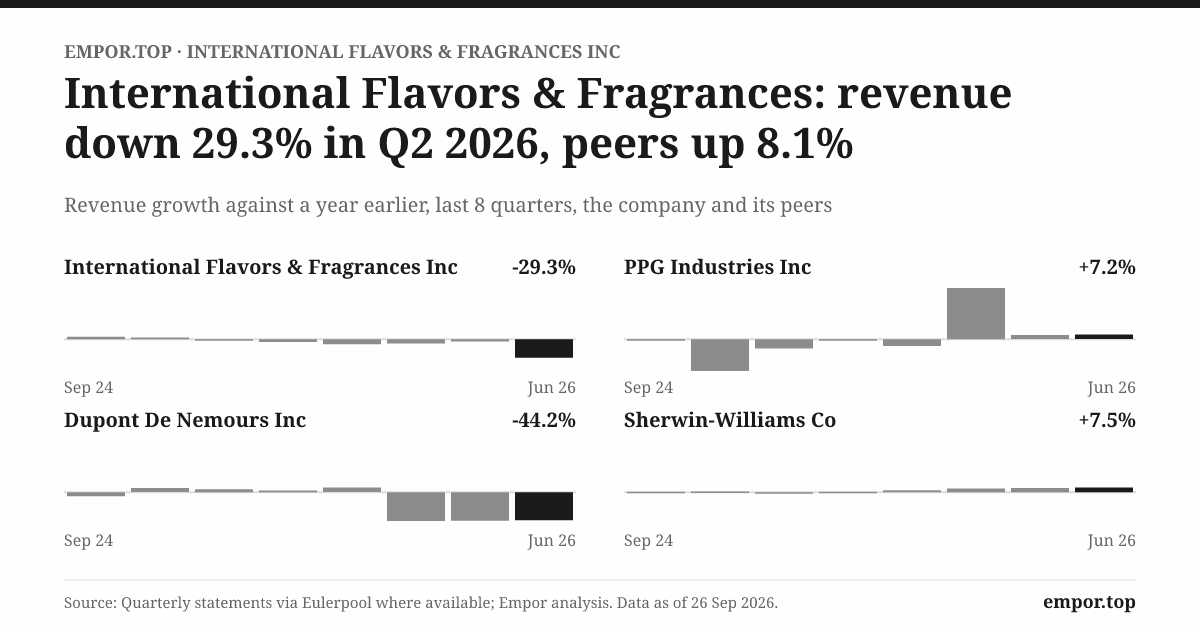
Integration collided almost immediately with the pandemic-era supply chain crisis, a surge in raw material and energy costs, and then, in 2023, a brutal destocking cycle as consumer-goods customers worked down inventories they had over-ordered. The financial damage became visible in 2023. IFF's sales fell 8% to $11.5 billion, and it recorded a $2.6 billion goodwill impairment on its Nourish segment, producing a net loss of about $2.6 billion15. Net debt stood at 4.5 times credit-adjusted EBITDA15, far above what a company with IFF's dividend commitments could comfortably carry.
A goodwill impairment is an accountant's admission that the company paid more for an acquired business than it is now worth. It is non-cash, but it is not meaningless: it is the balance sheet catching up with the deal math. The $2.6 billion hit in 2023 and the further $1.15 billion charge in 20253 are, together, a formal statement that a meaningful share of the price paid for the Nourish-side assets was not recoverable.
For shareholders, the verdict is written in IFF's own proxy. The pay-versus-performance disclosure in the 2025 proxy statement showed IFF's total shareholder return lagging its peer group substantially across 2020–202416. This is the single clearest piece of disconfirming evidence against any claim that the transformational merger created value for the people who owned IFF before it.
Myth vs. reality: "COVID broke the merger"
The most convenient explanation for the DuPont disappointment is bad timing: a pandemic, an inflation spike, and a destocking cycle that no one could have forecast. There is truth in it. But the timing defense explains why results were volatile, not why the portfolio was later dismantled. Givaudan and Symrise faced the same pandemic, the same inflation, and the same destocking, and both reported strong growth and expanding margins in 2024 (Section IX). IFF's own new CEO, rather than blaming macro, blamed the synergy-driven operating model (Section VII). The weight of evidence therefore narrows the macro excuse to a contributing factor. The larger cause was the deal's structure: too much leverage, too many unrelated businesses, and a promise that required everything to go right.
What was worth keeping
Was the DuPont deal destined to fail? Not necessarily. Some of what came with N&B, notably the enzymes, cultures, and probiotics now in Health & Biosciences, remains a business IFF chose to keep and that reported a 29.6% adjusted EBITDA margin in 20242. The honest conclusion is narrower: the deal bought a mix of genuinely differentiated bioscience and commodity-adjacent food ingredients, priced the whole bundle as if the synergies would arrive on schedule, and loaded the balance sheet in a way that left no room for the macro shocks that followed. This is the biggest capital allocation decision in IFF's history, and the evidence rejects the claim that it created value on the terms it was sold.
By 2022, the market had noticed, and so had some of the most famous activists on Wall Street.
VII. The Reckoning: Icahn, a CEO Change, and a 50% Dividend Cut (2021–2024)
In January 2022, news broke that Carl Icahn owned roughly a 4% stake in IFF17. Icahn's presence on a shareholder register is rarely a compliment to management; it usually means he sees a gap between what a company's assets are worth and what its leadership is extracting from them. On February 1, 2023, IFF entered into a cooperation agreement with the Icahn Group18, which placed an Icahn designee, Vincent Intrieri, on the board18. That arrangement has persisted: in October 2025, Brett Icahn replaced Intrieri as the Icahn designee and joined the board's Audit and Transaction committees18.
The executive suite churned in parallel. Andreas Fibig handed over to Frank Clyburn in 2022, and Clyburn's tenure lasted about two years. When Fyrwald arrived, Fortune noted he was IFF's third CEO since 202219. Clyburn's exit terms included two times salary plus target bonus, 24 months of benefits continuation, and a $1 million consulting fee through the end of 202420, a reminder that even rushed leadership changes carry a price.
The new man
On January 11, 2024, IFF named J. Erik Fyrwald as CEO effective February 6, 202420. Fyrwald, then 64, was an industrial operator by temperament, a veteran of large chemical and agricultural businesses. His defining job was at Syngenta Group, the Swiss-headquartered agrochemical and seed giant, which he led as CEO from June 2016 to December 2023, a period during which, IFF said, the business roughly doubled[^23]. He also sat on the board of Eli Lilly20.
That résumé mattered. Syngenta under Fyrwald was a company run through a complicated ownership change, with an emphasis on operating discipline and innovation pipelines rather than deal-making for its own sake. IFF's board was hiring an operator, not a dealmaker.
Candor as strategy
Within weeks, Fyrwald did something unusual for a new CEO: he criticized his predecessors' capital-allocation logic on the record. "Synergy became the goal instead of a tool," he told FoodNavigator. "And when synergy becomes the goal, you bring in a lot of consultants." People, he said, "started chasing their tail around trying to figure out how to get those rather than continuing to focus in flavors and fragrances"6. He framed IFF's competitive task bluntly: "How do we beat Givaudan?" And he acknowledged that both flavors and fragrances had delivered "lower margins and lower growth rates over the last five years"6.
This is the strongest disconfirming evidence in the entire IFF record, and it comes from IFF itself. The company's own new CEO confirmed that the Frutarom-and-DuPont era did not merely suffer bad macro luck. It distracted the organization from the core craft that had built the company. That candor also earned Fyrwald something useful: a clean baseline against which his own promises can be judged.
The same week the full-year 2023 results came out, IFF cut its quarterly dividend roughly in half, to $0.40 per share, saying it was "right-sizing the dividend to enable faster deleveraging of the balance sheet"15. For a company whose shareholder base had long valued the payout, that was a real cost. It was also framed honestly: not as a response to a temporary macro shock but as balance-sheet triage made necessary by the leverage the prior mergers had created. Management owned the problem rather than blaming the environment, which is itself a credibility signal worth recording.
Year one: the first scorecard
Fyrwald's first full year gave an early read on whether the reset was working. IFF reported 2024 sales of $11.48 billion, flat on a reported basis, but up 6% on a comparable currency-neutral basis, with adjusted operating EBITDA up 16% to $2.21 billion and a double-digit performance in Scent2. Net income returned to positive territory at $243 million, and leverage fell to 3.8 times2. The recovery was helped by the end of customer destocking, so not all of it can be credited to new management. Still, it established that the underlying businesses could grow volumes once the inventory cycle turned. The market's reaction was more guarded: IFF's shares fell about 7% after the results, as 2025 guidance flagged sizable currency headwinds19.
Incentives and skin in the game
Fyrwald's employment terms, disclosed in January 2024, set a $1 million base salary, a target annual bonus of 200% of salary, and a $10 million target long-term incentive split 60% performance units and 40% restricted stock units. He also received inducement grants of 68,750 performance share units and 56,250 restricted stock units20. IFF's share-retention policy requires the CEO to hold stock worth six times base salary21.
The design ties a large share of pay to multi-year performance, which is sensible for a turnaround. But the structure is overwhelmingly company-granted equity rather than personal capital at risk. That is common for hired CEOs and is not disqualifying, especially early in a tenure. It does mean that investors should judge Fyrwald by what the portfolio delivers after the divestitures, not by the fact that his pay moves with the stock.
The diagnosis had been made, the dividend cut, the board refreshed. What remained was the hard part: taking apart the company the previous decade had assembled.
VIII. Un-Merging the Merger: The Portfolio Surgery (2024–2027)
On March 19, 2024, barely six weeks into Fyrwald's tenure, IFF signed an agreement to sell its Pharma Solutions business to Roquette, the French family-owned plant-based ingredients company[^25]. The unit, a maker of pharmaceutical excipients (the inactive ingredients that bind, coat, and deliver the active drug in a pill), had come to IFF through the DuPont merger. The deal valued it at up to $2.85 billion, about 13 times EBITDA[^25]. It closed on May 1, 202522.
Pharma Solutions was not a bad business. In 2024 it earned a 21.7% adjusted EBITDA margin on $961 million of sales2. It was simply not IFF's business: its customers, regulators, and competitive dynamics had little to do with taste or scent. Selling it at 13 times EBITDA was a reasonable clearing price and a clear signal that "adjacency" was no longer a sufficient reason to own something.
The bigger move
Food Ingredients was the harder decision. In 2025, IFF split its old Nourish segment into Taste, the high-value flavor business, and Food Ingredients, which bundled texturants, emulsifiers, plant-based proteins, and specialty ingredients4. Food Ingredients was large, generating nearly $3.1 billion of 2025 sales and about $430 million of EBITDA4, but its sales declined 3% on a comparable basis in 2025 even as its EBITDA grew3. IFF placed it under strategic review in August 2025, launched a sale process, and took the $1.15 billion goodwill write-down that produced the 2025 net loss23.
The 2025 segment numbers explain the decision better than any strategy slide. On a comparable currency-neutral basis, Taste grew sales 4% and adjusted EBITDA 10%; Health & Biosciences grew sales 3% and EBITDA 7%; Scent grew sales 3% and EBITDA 2%; Food Ingredients' sales fell 3% even as its EBITDA rose 10%3. In other words, Food Ingredients' profit improvement came from cost-cutting and mix rather than demand. That is the profile of a business better suited to an owner whose playbook is operational efficiency and leverage, which is exactly what a private equity buyer brings. For the full company, 2025 adjusted operating EBITDA was $2.09 billion at a 19.2% margin, with free cash flow of just $256 million3, a thin cash conversion that the portfolio reshaping is meant to fix.
On May 29, 2026, IFF agreed to sell Food Ingredients to funds advised by CVC Capital Partners in a transaction valuing the business at about $4.3 billion, roughly 10 times EBITDA. IFF will retain about a 10% stake worth roughly $200 million and expects net cash proceeds of about $3.8 billion after carve-out costs and taxes. The deal is expected to close by the end of the second quarter of 20274. Fyrwald called it "an important strategic milestone"24.
The arithmetic, stated plainly
Here is the part management's framing tends to skip. IFF committed more than $33 billion of value to Frutarom and DuPont's N&B between 2018 and 2021. It has since recorded $3.75 billion of goodwill impairments across 2023 and 2025, and it is selling major pieces of what it bought at 10 to 13 times EBITDA, well below the roughly 20 times it paid for Frutarom. Some of the Frutarom-related botanicals went for less than half of annual sales (Section V).
None of this proves the current sale prices are wrong. CVC and Roquette paid real-world clearing prices, and a 10-times multiple for a slow-growing, commodity-exposed ingredients business is not obviously cheap. But it is direct, mark-to-market evidence that the prior acquisition regime destroyed value. Management's current language, "a simpler, higher-growth, higher-margin company"5, describes where IFF is heading. It does not describe how much it cost to get there, and investors should hold both facts in the same frame.
The balance-sheet payoff
The deleveraging is real and checkable. Net debt to credit-adjusted EBITDA fell from 4.5 times at the end of 202315 to 3.8 times at the end of 20242, 2.6 times at the end of 20253, and 2.5 times at mid-20265. Gross debt fell by more than $3 billion year over year as of the second quarter of 202614.
On August 4, 2026, IFF laid out how it would use the CVC proceeds. More than $1 billion will go to debt reduction, targeting net leverage of 2.0 to 2.5 times by the end of 2027. The board authorized a $2.5 billion share repurchase program, including about $400 million remaining under a prior authorization, with a $500 million accelerated repurchase slated for the second half of 2026 and the remaining $2 billion to follow the deal's close, targeted for completion by the end of 20275.
That is a genuine change in behavior compared with 2018–2021: cash is being directed to the balance sheet and to shareholders rather than to another transformational deal. Two caveats belong next to it. First, management itself said the pre-close buyback "may result in a modest temporary increase" in leverage14, so the company is choosing to return capital before the cash arrives. Second, there are about $100 million of stranded costs, corporate overhead previously allocated to Food Ingredients that stays with IFF. Management plans to eliminate about two-thirds in the first 12 months after close and the rest in the second year14. On the call, a Barclays analyst noted the Street had expected all of it to go in year one14; the slower timeline is a small but real walk-back.
The forward test is simple to state and hard to pass: can the Taste, Scent, and Health & Biosciences core actually deliver the higher organic growth and margins these sales were justified by? That depends on what the remaining business really is, and how it stacks up against rivals who never went on IFF's detour.
IX. The Business That's Left: Industry Structure, Competitors, and the Moat Test
Walk into a fine-fragrance creation studio at any of the big houses and the scene is surprisingly old-fashioned: perfumers at organ-like benches of small brown bottles, dipping paper blotters, sniffing, adjusting a formula by fractions of a percent. The modern layer, including molecular analysis, delivery-system chemistry, AI-assisted formulation tools, and regulatory databases, sits behind that craft rather than replacing it. This is the business IFF was built on, and it is now, once again, the center of gravity.
What remains
After the divestitures, IFF will consist of three segments. In the second quarter of 2026, Taste generated $688 million of sales at an 18.0% segment EBITDA margin, Scent $665 million at 20.2%, and Health & Biosciences $601 million at 25.0%5. For reference, in 2024, before the restructuring, Nourish (the predecessor of Taste plus Food Ingredients) generated $5.87 billion of sales at a 14.0% margin, Scent $2.44 billion at 21.2%, and Health & Biosciences $2.21 billion at 29.6%2. The current segment margins are temporarily depressed by the stranded costs described in Section VIII.
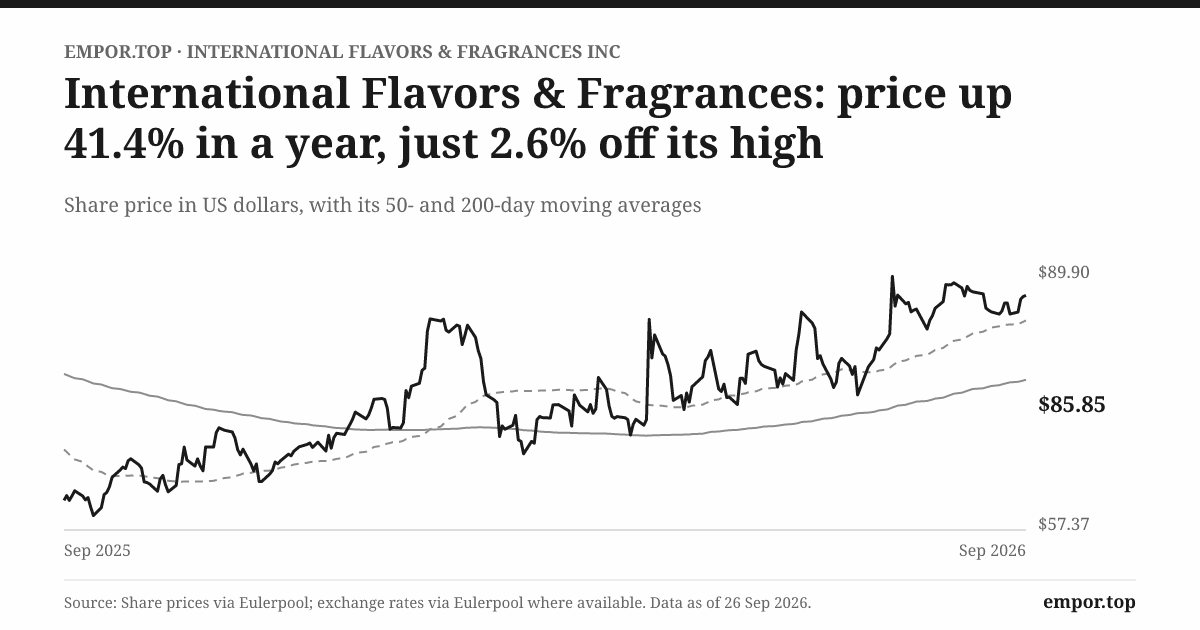
Taste is the flavor business: the systems that make a zero-sugar soda taste like the full-sugar version, a protein bar taste less chalky, or a plant-based sausage taste more like meat. In the second quarter of 2026 it grew in every region, led by double-digit growth in Asia, driven by new wins and volume on existing business14. Asked about GLP-1 weight-loss drugs and scrutiny of ultra-processed food, Fyrwald argued that IFF had treated these trends as opportunities, helping customers build high-protein and clean-label products that still taste good, and claimed its flavors and food biosciences businesses had been growing "ahead of the market"14. That is a management claim; the market-share data needed to verify it is not disclosed.
Health & Biosciences is the DuPont-era science business IFF chose to keep: enzymes, cultures, probiotics, and animal-nutrition ingredients. In the second quarter of 2026, management highlighted growth in grain processing, food biosciences, and animal nutrition14. Probiotics are the soft spot. Fyrwald described "continued market challenges in the U.S." for the health business even as international demand grew14. H&B carries the highest margins in the portfolio, but it also has the heaviest capital needs: DeVeau noted it runs at a higher capital-spending rate than the F&F businesses14.
Scent deserves disproportionate attention because it is both the founding business and the segment most exposed to true craft competition. It has three parts. Fine Fragrance creates perfumes for luxury houses. Consumer Fragrance scents shampoos, detergents, and household products. Fragrance Ingredients manufactures the aroma molecules themselves, which IFF both uses internally and sells to others. In the second quarter of 2026, Scent grew 8%, but management was candid that Fragrance Ingredients' growth of more than 20% was partly a rebound from a decline of 10% or more a year earlier and partly opportunistic sales of synthetic molecules during supply disruptions. CFO Michael DeVeau said he expected it to "normalize"14.
The more revealing admission came from Fyrwald himself, answering a question about Scent: "the R&D pipeline, I've got to say 2.5 years ago was not what it should have been. We were falling behind"14. He said R&D spending for the remaining businesses had risen from about 7% of sales to about 9%14. That is encouraging evidence of reinvestment. It is also an acknowledgment that the core craft advantage described in Section III had eroded during the merger years and is being rebuilt, not merely defended.
The competitive field
IFF competes in a tight oligopoly. When antitrust authorities raided the industry's four leaders in March 2023, trade press reported that Givaudan, Firmenich, Symrise, and IFF together controlled about 60% of the global market25.
Givaudan is the benchmark everyone, including IFF's CEO, measures against. In 2024 it reported sales of CHF 7.4 billion, 12.3% like-for-like growth, and a 23.8% EBITDA margin26. Symrise, the German challenger, reported 2024 sales of €4,999 million, 8.7% organic growth, and a 20.7% EBITDA margin27. IFF, for its part, reported 6% comparable currency-neutral growth in 20242.
The structurally interesting rival is dsm-firmenich, formed on May 9, 2023 when Dutch nutrition and bioscience group DSM merged with Swiss fragrance house Firmenich, creating a company with more than €12 billion of combined revenue28. That combination is essentially the same thesis IFF pursued with DuPont: pair flavor and fragrance creation with fermentation and bioscience. IFF is no longer alone in making the "taste plus bioscience" pitch, which weakens any claim that its portfolio is uniquely positioned.
Porter's lens: a supplier oligopoly facing a buyer oligopoly
Porter's Five Forces clarify why this industry earns decent returns and why those returns are contested. On the supply side, the industry is highly concentrated, which limits price wars. On the buyer side, IFF's customers are also concentrated and extremely sophisticated: global consumer-goods companies run formal supplier panels, periodically re-bid "core lists," and can shift new-product briefs between houses. That is the central tension. Suppliers have pricing power on any individual formula once it is embedded, but buyers control which supplier gets the next brief.
Substitutes are limited for true creation work but real for commodity ingredients, which is precisely why Food Ingredients was hard to defend. Threat of new entrants is low at the global level because of regulatory and formulation know-how, but rising at the regional level. On the second-quarter 2026 call, a Jefferies analyst asked directly about "investor concerns around Chinese competition," and Fyrwald answered that IFF would "never underestimate Chinese competitors"14. Supplier power over IFF matters through natural raw materials, crude-oil-linked synthetic inputs, and energy, where management acknowledged a lag in passing cost increases through, especially in Scent14.
Helmer's 7 Powers: which ones are real?
Of Hamilton Helmer's seven powers, two are defensible for IFF.
Switching costs are the strongest. Once IFF's fragrance is inside a detergent or its flavor inside a soft drink, switching means reformulation, consumer re-testing, and often regulatory and safety re-documentation. A consumer-goods company rarely risks changing how a best-selling product smells or tastes to save a few basis points of cost of goods. The limitation: switching costs protect existing business, not new briefs. Share is won or lost at the brief stage, which is exactly where Fyrwald's "falling behind" comment applies.
Scale economies in regulatory and compliance infrastructure are the second. Maintaining safety dossiers, meeting evolving fragrance-ingredient standards, and supporting customers across dozens of regulatory regimes is a fixed cost that favors the largest houses.
The weaker claim is cornered resource: patents, proprietary molecules, and branded technologies. The historical record in Section III shows IFF's science paid off when it was embedded in the core creation workflow. Standalone credentials do not reliably convert into revenue on their own, and the $33 billion detour shows that buying capabilities is not the same as owning a cornered resource.
The moat test
Has IFF lost share or discounted to hold volume? The strongest evidence is its own behavior. IFF chose to sell Food Ingredients rather than defend it, after the unit's sales declined in 20253. That is a tacit admission that the company could not win there on cost or differentiation. In the kept businesses, the evidence is mixed but improving: all three grew volumes in the second quarter of 2026, with pricing close to zero14. Volume-led growth with flat pricing suggests IFF is winning briefs rather than pushing prices. It also means pricing power, in the near term, is not what is driving the numbers.
Myth vs. reality is useful here. The myth is that IFF is the industry's largest and most powerful creator. The reality is that, after the divestitures, IFF is a strong number-two-to-four player in creation, behind Givaudan on growth and margin, with a moat that is real at the level of individual embedded formulas and unproven at the level of winning share. The claim that survives is narrower: IFF has durable switching costs on its installed base and a rebuilt, but not yet proven, innovation engine.
That makes the next question, how IFF intends to deploy capital from here, central to the case.
X. The M&A Playbook, Revised
In February 2025, on the call following IFF's 2024 results, an analyst asked whether acquisitions were back on the table. Fyrwald's answer was unusually specific: "I can assure you, we will not do anything like another Frutarom." He said IFF was "looking at bolt-on acquisitions specifically in Health & Biosciences," but "will only do bolt-ons that make absolute sense, that have good returns"19.
That is a falsifiable commitment, aimed directly at the failure mode described in Section V. And so far, behavior has matched words. Since early 2024, IFF has announced no large acquisitions. It has agreed to three divestitures, Pharma Solutions, Food Ingredients, and the Frutarom-linked botanicals portfolio, and it has chosen a $2.5 billion buyback over a large deal. On the second-quarter 2026 call, Fyrwald said IFF was "exactly where we want to be with our portfolio with no significant divestitures left to do," adding that "now it's all about scaling organically and through bolt-ons"14.
Two cautions belong next to that record. First, the sample is short, roughly two and a half years, and it overlaps a period when IFF simply could not afford a large deal. Leverage above 4 times in early 2024 enforced discipline as much as management chose it. The real test comes once leverage sits comfortably in the 2.0–2.5 times target range and the balance sheet can support a sizable acquisition again.
Second, the phrase "bolt-on" is elastic. Frutarom itself was framed as an extension of a sensible mid-market strategy. The meaningful discipline is not the word used but the size, the category, and the multiple.
IFF's own history supplies the scoring rubric. The 2000–2016 deals, Bush Boake Allen, Ottens, Lucas Meyer, and David Michael, were in or adjacent to IFF's core, small relative to the company, and integrated without reorganizing IFF around them. The two "bet the company" deals of 2018–2021 were none of those things. The forward test is therefore not whether IFF does more M&A. It is whether any future deal returns to that bolt-on template, especially in Health & Biosciences, where the temptation to buy growth in probiotics and enzymes is strongest.
What the divestitures reveal about judgment
There is a subtler signal in how IFF has sold, not just that it has sold. Pharma Solutions went to a strategic buyer at about 13 times EBITDA; Food Ingredients went to a financial buyer at about 10 times; the Frutarom-linked botanicals went at roughly 10 times a thin, mid-single-digit-margin EBITDA14. The pattern suggests management has been willing to accept market-clearing prices rather than holding out for valuations that would flatter the original purchase decisions. That is a mark of realism. It is also, necessarily, the moment when losses on past deals are locked in. A management team that can accept that trade-off when selling may be more likely to respect price discipline when buying, though that remains an inference rather than a demonstrated fact.
The activist lens
An activist-style reading would add one more question: with an Icahn designee on the board and a $2.5 billion buyback authorized, is IFF optimizing for the next few years of per-share metrics at the expense of reinvestment? The rise in R&D intensity to around 9% of sales argues against that reading for now14, but it is worth watching whether capital expenditure and R&D hold up once the buyback is complete.
With the playbook laid out, the investment debate comes down to whether the smaller IFF can earn its way back.
XI. Bull vs. Bear: The Investment Case
Two investors could look at the same IFF in September 2026 and see two different companies. One sees a newly focused specialty-ingredients leader with a clean balance sheet and a CEO who told the truth about the past. The other sees a company that has destroyed a great deal of capital, is still smaller and slower than its best competitor, and is asking to be trusted one more time.
The bull case
The deleveraging is real, measurable, and ahead of schedule: net leverage has fallen from 4.5 times to 2.5 times in about two and a half years (Section VIII). Capital allocation has visibly changed from buying to returning cash.
The remaining mix is better. On a continuing-operations basis, second-quarter 2026 sales grew 6% on a comparable currency-neutral basis, with growth in all three segments, and adjusted operating EBITDA margin reached 20.9%5. In the first half of 2026, continuing operations grew sales 4% and EBITDA 8%, and free cash flow rose by $284 million year over year to $378 million14. Management guides full-year 2026 comparable sales growth of 2–4% and EBITDA growth of 4–8%5, and describes a long-term algorithm of mid-single-digit sales growth and high-single-digit EBITDA growth4. Removing roughly $100 million of stranded costs would provide an identifiable, largely self-help margin lever.
The underlying craft advantage, switching costs on embedded formulas, has the longest and best-evidenced track record in the company's history (Sections II and III), and it predates the M&A era entirely.
The bear case
The value destruction was large and is only now being partially repaired. IFF's shareholder returns lagged its peers substantially across 2020–202416, and the divestitures crystallize losses rather than reverse them (Section VIII).
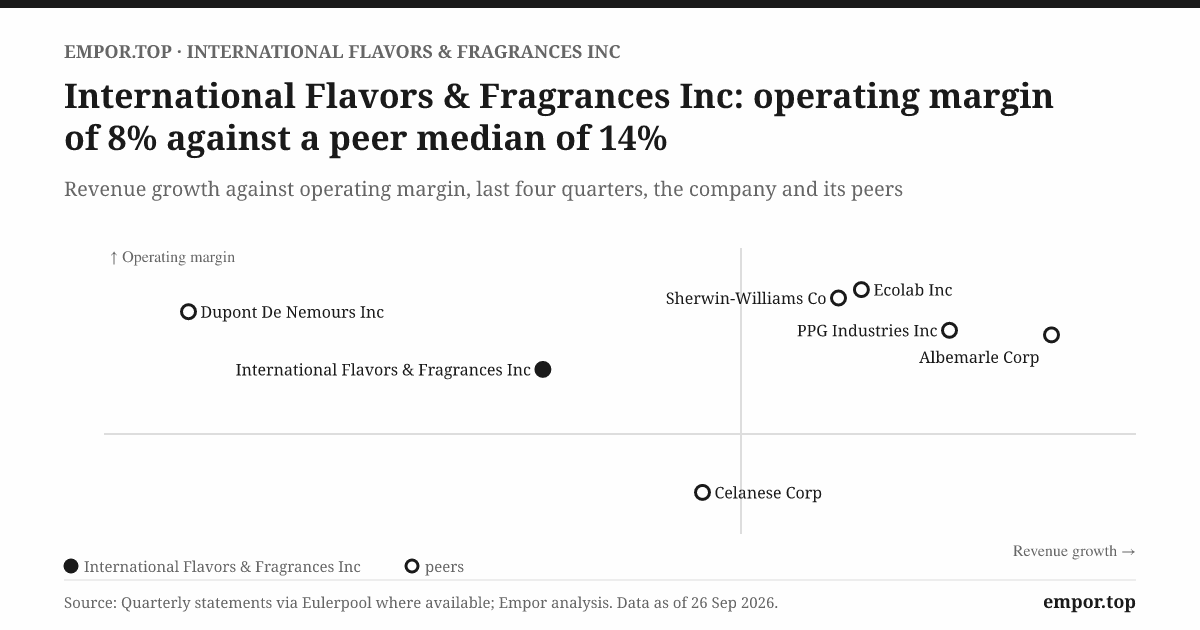
The remaining business is still second-tier on the metrics that matter. Givaudan grew 12.3% like-for-like in 2024 at a 23.8% EBITDA margin26, while IFF's continuing-ops margin of around 21% in the second quarter of 2026 includes temporary benefits such as U.S. tariff refunds14. Management's own guidance implies second-half 2026 sales growth of 0–4%14, a meaningful deceleration from the second quarter.
The CEO is still in year three of an unproven turnaround, his own words confirm that the innovation pipeline had fallen behind, and his personal capital at risk is modest relative to company-granted equity. And the structural thesis of "flavor plus bioscience" is no longer unique, given dsm-firmenich.
The activist stress test
A skeptical long/short investor would press on four points. First, disclosure: continuing-operations reporting, a new segment structure, and a 2025 comparable base adjusted for all portfolio changes (about $7.2 billion of sales and $1.44 billion of EBITDA, per management14) make multi-year comparisons harder, which can flatter a turnaround narrative. Second, capital sequencing: buying back $500 million of stock before the CVC cash arrives is a bet on the deal closing on time. Third, accountability: the executives who architected Frutarom and the DuPont merger have left, so the lesson has been absorbed mainly through executive turnover and the arrival of an activist designee, and investors have to take on faith that the board's own decision-making process for large deals has changed. Fourth, the 10% retained stake in Food Ingredients keeps a small, illiquid minority position in a leveraged private-equity-owned business, a modest but real complexity in a story whose selling point is simplicity.
None of these points breaks the case. Together, they explain why investors may reasonably demand evidence before paying for the "sharper IFF" story.
The synthesis
Put through Porter and Helmer (Section IX), the picture is consistent: IFF operates in an attractive oligopoly with real switching costs, but it has lost ground in the competition for new briefs, which is where long-term share is decided. The bull case is therefore not about moat existence; the moat exists. It is about whether a refocused IFF can close the growth and margin gap with Givaudan. The historical record narrows the bull claim rather than rejecting it: the evidence supports "a solid, deleveraged number-three creator with self-help margin upside" more than "a re-emerging category leader."
The KPIs that will settle it
Three numbers will tell investors most of what they need to know.
Comparable currency-neutral sales growth of the Taste, Scent, and Health & Biosciences core, and specifically whether it is volume-led and sustained at or above the mid-single-digit long-term target through normal comparisons, rather than boosted by easy comps.
Adjusted operating EBITDA margin for continuing operations, tracked as stranded costs are removed after the CVC close, compared against Givaudan's and Symrise's margins.
Net debt to credit-adjusted EBITDA, to confirm that the buyback and any bolt-ons keep leverage inside the 2.0–2.5 times target.
The debate will also be informed by two events: the actual closing terms and timing of the CVC deal, due by mid-2027, and two to three quarters of clean standalone results after close. Until then, several risks can still move the numbers.
XII. Current Risk Radar
Every carve-out looks tidy on the announcement slide. The reality inside the company is thousands of shared systems, contracts, plants, and people that need to be pulled apart without dropping a customer order. IFF is now doing that for the second time in two years.
Execution risk in a second consecutive carve-out
The Food Ingredients separation requires standing up a separate business, unwinding shared services, and working through transition services agreements. CFO DeVeau warned of second-half 2026 working capital headwinds, including the unwinding of receivables-factoring arrangements and inventory builds ahead of separation, which he sized at "a couple of hundred million dollars"14. The stranded-cost plan (Section VIII) must be executed without disrupting growth in the businesses IFF is keeping. This is the DuPont integration's failure mode running in reverse: organizational distraction during a structural change.
Demand cyclicality
The 2023 destocking cycle (Section VI) showed how inventory swings at large customers can hit volumes quickly. The remaining portfolio is less commodity-exposed, but it is not immune. Fine Fragrance, for example, was affected by conflict in the Middle East in 2026, and management said it expected a softer third quarter14. Fyrwald described consumer demand as "resilient so far," while acknowledging "we know there are risks"14.
Input costs and pricing lag
Management expected input costs, especially energy and logistics, to rise modestly in the second half of 2026, with Scent most affected and pricing recovery lagging into 202714. Second-quarter growth was almost entirely volume, with pricing described as "a rounding decimal"14. If costs rise faster than customers accept surcharges, margins will absorb the gap for several quarters.
Shifts in consumption and competition
Two slower-moving forces deserve a place on the radar. The first is changing food consumption, including GLP-1 weight-loss drugs and the backlash against ultra-processed food. Management argues these are opportunities for reformulation work (Section IX), and flavor houses do tend to benefit when customers must reinvent recipes. But if consumers simply eat less packaged food, fewer products need flavoring, and the reformulation tailwind would not offset a volume decline. The second is lower-cost regional competition, particularly from China, where analysts have begun questioning whether IFF is spending enough on R&D to stay ahead14. Neither risk has shown up in reported numbers yet; both would appear first as slower Taste and Scent volume growth.
Leverage and refinancing
Leverage is much improved, but the pre-close buyback will temporarily push it up, and full deleveraging depends on the CVC proceeds. If regulatory approvals slipped or the deal were renegotiated, IFF would be carrying a larger buyback commitment against a smaller cushion. The dividend cut and asset sales were necessary precisely because leverage became too high after DuPont; a demand shock before mid-2027 would test that buffer again.
Legal and regulatory overhang
In March 2023, antitrust authorities in the European Union, the United States, the United Kingdom, and Switzerland raided the four largest fragrance houses, including IFF, over suspected coordination of pricing, customer allocation, and production limits25. IFF settled a U.S. class action brought by direct purchasers of its fragrance products from January 2018 through December 2023 for $26 million in October 2025, and the U.S. Department of Justice closed its investigation into the sector in early 2026, while investigations by other authorities remained open29. The European outcome is the material unresolved item: an adverse EU finding could bring fines and follow-on claims, though IFF has not disclosed an estimate. Investors should treat it as an open legal overhang, not a closed chapter.
Beyond litigation, fragrance and flavor ingredient regulation continues to tighten globally. That raises reformulation costs for every supplier, but it burdens smaller competitors disproportionately and reinforces the compliance scale advantage described in Section IX. It is a real, if hard-to-quantify, support for the moat.
With the risks mapped, the final question is what kind of company IFF is becoming.
XIII. Epilogue & "What Would We Do?"
There is an unusual symmetry in IFF's history. A. L. van Ameringen was fired by Polak & Schwarz in 1917 and eventually merged with the company that let him go. A century later, IFF bought a Dutch-American-Israeli-DuPont conglomerate's worth of businesses and then spent two and a half years sending much of it back into the world.
The arc is rare in public markets. Companies seldom reverse their own central strategic thesis in real time, and even more rarely do their CEOs say out loud why the old thesis failed. Fyrwald's candor, the dividend cut, the Roquette and CVC sales, and the shift to buybacks form a consistent pattern of behavior, not just a change in language. That consistency is the strongest evidence in management's favor.
But reversal is not the same as recovery. IFF's shareholders absorbed more than $3.7 billion of goodwill impairments, a halved dividend, and years of underperformance to arrive at a smaller company with a better balance sheet. Whether that company earns more per share over the next decade than the pre-2018 IFF would have is still unknown.
The open question for long-term holders is whether "simpler, higher-growth, higher-margin" is the end state or merely the calm interval between two rounds of dealmaking. A skeptic could be persuaded by two things: two years of clean standalone data showing the core growing at or above its target with margins closing the gap to Givaudan, and no third "transformational" deal when the balance sheet next has room for one. A believer could be dissuaded by the opposite: growth that fades once easy comparisons end, stranded costs that linger, or an acquisition that is described as a bolt-on but priced like Frutarom.
What a patient owner would watch
A patient, long-term owner would likely spend less time on the next quarter's headline and more on three quieter questions. Is the new-win rate in Scent and Taste improving, as management claims the rebuilt R&D pipeline should deliver? Are stranded costs actually leaving the income statement on the timetable promised on the second-quarter 2026 call? And when the balance sheet next has room, does the board choose bolt-ons, buybacks, or something bigger? None of those questions can be answered in September 2026. All of them will be answerable within roughly two years.
There is also a quieter lesson for anyone studying capital allocation. IFF's worst decisions were not made by careless people. They were made by experienced executives, approved by a sophisticated board, and blessed at the time by many analysts, on the logic that scale and adjacency would compound. The logic failed because it underestimated how much management attention a craft business requires. That is a lesson about organizational bandwidth as much as about price.
Back to the formula
The formula for IFF's first century was secrecy, science, and patience. The next few years will show whether the company can return to that formula after its costly detour.
XIV. Recent News
Second-quarter 2026 results (August 4, 2026). IFF reported continuing-operations sales of $1.95 billion, 6% comparable currency-neutral growth, and adjusted operating EBITDA of $408 million, a 20.9% margin. It raised the low end of its full-year growth ranges, now guiding continuing-operations sales of $7.4–7.6 billion and adjusted operating EBITDA of $1.53–1.60 billion5.
Use of proceeds and buyback (August 4, 2026). The board authorized a $2.5 billion share repurchase program, including a $500 million accelerated repurchase for the second half of 2026, alongside plans to cut debt by more than $1 billion from the Food Ingredients proceeds5.
Botanicals divestiture (July 2026). IFF agreed to sell its botanical extracts, vitamins and minerals, and food-enhancement portfolio, about $170 million of annual sales, for roughly $75 million, with closing expected in the fourth quarter of 202614.
Food Ingredients sale to CVC (May 29, 2026). The agreement values the business at about $4.3 billion, roughly 10 times EBITDA, with IFF retaining a 10% stake; closing is expected by the end of the second quarter of 20274.
Antitrust developments (late 2025 to early 2026). IFF settled a U.S. direct-purchaser antitrust class action for $26 million, and the U.S. DOJ closed its fragrance investigation, while other authorities' probes continued29.
Board refresh (October 2025). Brett Icahn joined the board as the Icahn designee, replacing Vincent Intrieri, and Harvard geneticist Richard Mulligan joined as an independent director18.
XV. Links & Resources
- IFF second-quarter 2026 results and use-of-proceeds plan5
- IFF second-quarter 2026 earnings call transcript14
- IFF fourth-quarter and full-year 2025 results3
- IFF fourth-quarter and full-year 2024 results2
- IFF agreement to sell Food Ingredients to CVC4
- IFF sale of Pharma Solutions to Roquette[^25]
- IFF 2026 proxy statement21
- Fyrwald on "Synergy became the goal instead of a tool"6
- Fyrwald on "no more Frutaroms"19
- Givaudan 2024 full-year results26
- Symrise 2024 full-year results27
References
-
IFF and DuPont Nutrition & Biosciences have merged. What's next? — Food Dive, 2021 ↩↩↩↩↩↩
-
IFF Reports Fourth Quarter and Full Year 2024 Results — IFF / SEC EDGAR, 2025-02-18 ↩↩↩↩↩↩↩↩↩
-
IFF Reports Fourth Quarter and Full Year 2025 Results — IFF / SEC EDGAR, 2026-02-11 ↩↩↩↩↩↩↩↩
-
IFF Enters Into Agreement to Sell Its Food Ingredients Business to CVC (Exhibit 99.1, Form 8-K) — IFF / SEC EDGAR, 2026-05-29 ↩↩↩↩↩↩↩
-
IFF Reports Second Quarter 2026 Results; Announces Use of Proceeds Plan for Food Ingredients Divestiture — IFF / SEC EDGAR, 2026-08-04 ↩↩↩↩↩↩↩↩↩↩
-
IFF's new CEO on rightsizing business: "Synergy became the goal instead of a tool" — FoodNavigator, 2024-02-26 ↩↩↩↩↩
-
History of International Flavors & Fragrances Inc. — FundingUniverse ↩↩↩↩↩↩↩↩↩↩↩↩↩↩↩
-
IFF Form 10-Q for the quarter ended September 30, 2016 — SEC EDGAR, 2016 ↩↩↩
-
In 2nd largest ever deal for Israeli firm, IFF to buy Frutarom for $7 billion — The Times of Israel, 2018-05-07 ↩↩↩↩↩
-
Company Hit with Bribery-Related Securities Suit Based on Acquired Company's Pre-Merger Activities — The D&O Diary, 2019-08 ↩↩↩↩
-
IFF and Frutarom Secure Dismissal of Securities Fraud Class Action — Cleary Gottlieb, 2021 ↩
-
IFF (IFF) Q2 2026 Earnings Call Transcript — The Motley Fool, 2026-08-11 ↩↩↩↩↩↩↩↩↩↩↩↩↩↩↩↩↩↩↩↩↩↩↩↩↩↩↩↩↩↩↩
-
IFF Fourth Quarter 2023 Press Release (Form 8-K Exhibit 99.1) — IFF / SEC EDGAR, 2024-02-20 ↩↩↩↩
-
Carl Icahn owns 4% stake in International Flavors & Fragrances, sources say — CNBC, 2022-01-20 ↩
-
IFF Form 8-K: Appointment of Brett Icahn and Richard Mulligan to the Board — SEC EDGAR, 2025-10 ↩↩↩↩
-
IFF eyeing acquisitions again as it sells off pharma unit—but no more 'Frutaroms' — Fortune, 2025-02-21 ↩↩↩↩
-
IFF Form 8-K: Appointment of J. Erik Fyrwald as Chief Executive Officer — SEC EDGAR, 2024-01-11 ↩↩↩↩
-
Roquette completes acquisition of IFF Pharma Solutions — Roquette, 2025-05-01 ↩
-
IFF posts full-year net loss as US$1.15B write-down sets stage for Food Ingredients sale — FoodIngredientsFirst, 2026 ↩
-
IFF to sell food ingredients business for $4.3B — Food Dive, 2026-05-29 ↩
-
Fragrance firms face coordinated cartel probe — Chemistry World, 2023-03 ↩↩
-
Symrise achieves significant sales growth in 2024 with a strong increase in profitability — Symrise, 2025-01-30 ↩↩
-
DSM and Firmenich complete dsm-firmenich merger — FoodNavigator, 2023-05-09 ↩
-
US government drops fragrance cartel case – Symrise — Personal Care Magazine, 2026-02 ↩↩
 LinkedIn
 WhatsApp
 Reddit
 Hacker News
 Email
 Kindle
 RSS Feed
 Spotify
 Apple Podcasts
 Amazon Music
 Audible
 YouTube