Insmed Incorporated (NASDAQ: INSM): From Perpetual Cash Burn to the Fastest Launch in Specialty Respiratory
I. Introduction — The Company That Spent 25 Years Losing Money on Purpose (6–8 min)
On February 19, 2026, Insmed told investors it had lost $1.28 billion in 2025. That was more than twice what the company had collected in revenue all year, and $328.5 million of the loss landed in the fourth quarter alone.1 For most companies, a line like that ends careers. For Insmed, it was the sound of a machine being built.
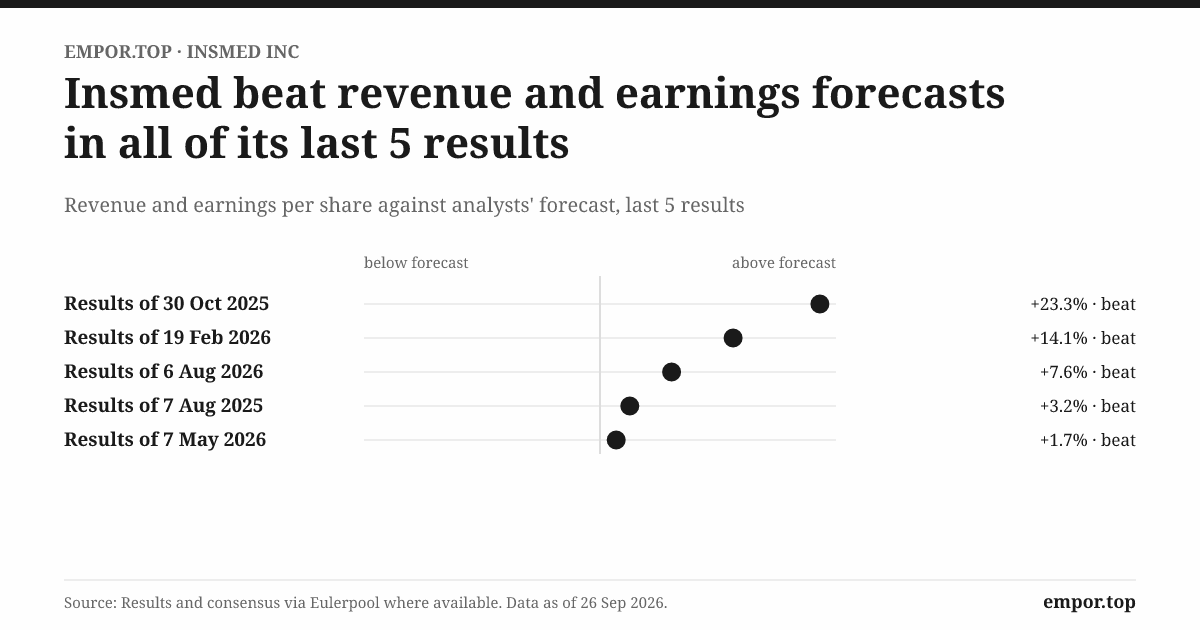
Two quarters later, on August 6, 2026, the same company reported a second-quarter net loss of just $13.2 million on revenue of $425.5 million, or six cents a share.2 In the space of half a year, a quarterly loss of roughly a third of a billion dollars had shrunk to rounding-error territory. Nothing about Insmed's cost base had gotten smaller. The revenue had simply caught up.
That swing is the hinge of this story. Insmed spent the better part of a quarter-century as a textbook "burn" biotech: founded in 1988, public since 2000, repeatedly reinvented, and almost always losing money.3 Its long-run strategy, articulated most clearly under current CEO Will Lewis, was to chase lung diseases so small, so obscure, or so commercially unattractive that larger drug companies did not bother. The idea was that a company willing to be patient in neglected corners could own them.
For years that looked like a rationalization for losing money. Then, on August 12, 2025, the U.S. Food and Drug Administration approved BRINSUPRI (brensocatib), the first and only therapy for non-cystic fibrosis bronchiectasis, a chronic lung disease that affects roughly 500,000 diagnosed Americans.4 Within its first full year on the market, BRINSUPRI's revenue guidance climbed to $1.25–1.4 billion for 2026, and management began describing a launch that, by its own count, is outrunning the best specialty respiratory launches at the same stage.25
Insmed is now a two-drug company. The older drug, ARIKAYCE, is an inhaled antibiotic for a mycobacterial lung infection most physicians rarely see; it produced $433.8 million in 2025.6 The newer drug, BRINSUPRI, is the reason the stock traded above $200 at its 52-week peak, and the reason it still carries a market value of roughly $25.7 billion even after falling back to around $118.7
That gap between the peak and today is the other half of the story. Between December 2025 and April 2026, two attempts to extend brensocatib into new diseases failed outright.89 The first-quarter 2026 report, with strong numbers, still sent the stock sharply lower. A competitor from Boehringer Ingelheim is enrolling a Phase 3 trial in the same disease with the same mechanism. And the company's third big bet, an inhaled drug for pulmonary hypertension called TPIP, carries a management peak-sales estimate of more than $6 billion without a single dollar of revenue yet booked.5
This article traces how a failed diabetes company became a rare-lung-disease company, why the $30 million license behind BRINSUPRI may be one of the best deals in recent biotech memory, what the launch data actually says about durable demand, why the "platform" narrative took two real hits, and what a $25 billion price tag demands from here. The question running underneath all of it is simple: Insmed proved a contrarian thesis can work. Can it defend what it built once the diseases stop being too small for anyone else to bother with?
To answer that, the story has to start with a company that, for two decades, had almost nothing to show for its science.
 Subscribe on LinkedIn
II. Origins, Compressed: The Long Road to One Good Idea (1988–2013) (12–15 min)
Charlottesville, Virginia, in 1988 was a university town, not a biotech hub. That is where Dr. Joseph Larner, a University of Virginia pharmacologist, founded Insmed as a private company to develop medicines for diabetes.3 The science revolved around insulin signaling and growth factors, and like a great deal of 1980s metabolic biology, it was more elegant in the lab than in the clinic.
Insmed became a public company around 2000 by acquiring Celtrix Pharmaceuticals, a California growth-factor company, in what the company itself describes as a reverse merger.3 Celtrix brought an IGF-I program, a protein combination aimed at growth disorders, and that program became Insmed's identity for most of the next decade. It eventually produced IPLEX, a drug for children with a rare growth-hormone deficiency, but the product never became a commercial engine.
By early 2009, the company's situation had become dire. Insmed ended 2008 with just $2.4 million in cash and was burning roughly $1.2 million a month.10 That is the corporate equivalent of a household with two months of rent in the bank. Management's solution was to sell the crown jewels: in March 2009 Insmed closed the sale of its follow-on biologics platform, including its Boulder, Colorado manufacturing facility, to Merck for $130 million in gross proceeds.10 Then-CEO Geoffrey Allan described it as "substantial financial flexibility in a market where cash, especially for small biotech companies, is scarce."10
It was survival, not strategy. Insmed now had money but almost nothing to spend it on.
The Transave reverse takeover
Enter Transave, a privately held New Jersey company founded in 1997 by Dr. Frank Pilkiewicz to build inhaled medicines for serious lung infections.3 Transave had a clever technology and a late-stage candidate called ARIKACE: the old antibiotic amikacin, wrapped in tiny fat bubbles called liposomes and inhaled directly into the lungs.11 What Transave lacked was capital.
The two companies closed a business combination on December 1, 2010. Insmed paid off Transave's $7.8 million of debt and issued about 25.9 million common shares, about 91.7 million shares of conditional convertible preferred stock, and just $561,280 in cash for the whole company.11 On a fully diluted basis, Transave's shareholders ended up owning about 46.7% of the combined company.11
Read those terms again and the character of the deal becomes obvious. This was not a confident acquirer buying a target. It was two struggling companies combining what each had: Insmed had cash from Merck and a public listing; Transave had a drug and a platform. The leadership line-up made the power balance explicit. Transave's chairman, Donald Hayden, became chairman of the combined company, and Transave's CEO, Timothy Whitten, became CEO, while Insmed's CFO and chief scientist stayed on.11 In substance, Transave took over Insmed.
Why this compressed history still matters
The 1990s diabetes science is irrelevant to today's investor. The 2010 deal is not. For almost no cash, Insmed acquired the inhaled liposomal technology and the non-tuberculous mycobacterial (NTM) lung disease program that became ARIKAYCE. That franchise went on to produce hundreds of millions of dollars a year in revenue, built the company's pulmonology relationships, and served as the commercial beachhead for everything that followed.
It also established a pattern that runs through the whole Insmed story: the company's best assets arrived when the seller had lost conviction or leverage. That pattern would repeat six years later with AstraZeneca.
In 2012, the company hired Will Lewis, a co-founder of Aegerion Pharmaceuticals, as President and CEO.12 His arrival marked the moment Insmed stopped being a survivor and started being a strategy. The first test of that strategy was whether a drug for a disease almost nobody had heard of could become a real business.
III. ARIKAYCE: Proving the Niche-Disease Model Actually Works (2013–2024) (22–28 min)
Picture a woman in her late sixties, thin, with a cough that will not go away. She has been told she has "bronchitis" several times. Her CT scan shows scarred, widened airways and small nodules. Eventually, a sputum culture grows Mycobacterium avium complex, a cousin of the bacterium that causes tuberculosis, but one that lives in soil, water, and household plumbing. She is placed on a grinding regimen of three oral antibiotics for a year or more. Months later, the cultures are still positive.
That patient is ARIKAYCE's original market. NTM lung disease caused by MAC is not contagious, is chronically underdiagnosed, and was, for decades, commercially unappealing. The patient pool was small, diagnosis was slow, and the standard of care was an off-label cocktail of old generic antibiotics. Insmed's 10-K estimates between 95,000 and 115,000 diagnosed MAC lung disease patients in the U.S., but only 12,000 to 17,000 of them are "refractory," meaning they fail standard therapy.13
The regulatory unlock
The technology idea behind ARIKAYCE is intuitive once explained. Amikacin is a powerful antibiotic, but given intravenously it can damage the kidneys and hearing. Wrapping it in liposomes and inhaling it puts the drug where the bacteria live, inside the lungs and even inside the immune cells that harbor mycobacteria, while limiting how much reaches the rest of the body. Think of it as delivering the medicine by courier to the right apartment, rather than flooding the whole building.
On September 28, 2018, the FDA approved ARIKAYCE for adults with refractory MAC lung disease who had limited or no alternative options.14 It was the first drug approved under the Limited Population Pathway for Antibacterial and Antifungal Drugs (LPAD), created by the 21st Century Cures Act, and it also carried Accelerated Approval, Breakthrough Therapy, Qualified Infectious Disease Product, and Orphan Drug designations.14
The approval came with real caveats. It was conditional, requiring a confirmatory study, and the label carried a Boxed Warning for respiratory risks including hypersensitivity pneumonitis, bronchospasm, and hemoptysis.14 In the pivotal study, 29% of ARIKAYCE patients reached three consecutive negative sputum cultures by month six, versus 9% in the control group.14 Meaningful, but hardly a cure for most patients.
The launch and the 2019 stumble
The early launch looked promising. By December 31, 2018, more than 500 patients had started treatment and about 600 physicians had written at least one prescription, generating roughly $9.8 million in fourth-quarter net sales.15 Lewis described himself as "very pleased with the U.S. launch progress."15
Then came the episode that belongs in Insmed's management-credibility ledger. With its second-quarter 2019 results, Insmed raised full-year ARIKAYCE guidance to $110–120 million, up from $90–105 million.16 It was, on paper, a raise. But second-quarter U.S. revenue had been about $29 million, and the new range implied only $58–68 million for the entire second half, not much above the existing run rate.16 Investors read the "raise" as a deceleration, and the stock fell 13% in a day.16
The lesson is subtle. Management did not miss a number. It delivered a forecast that was internally inconsistent with the story it was telling. A company claiming accelerating adoption had given a number implying flattening adoption. That tension, between strong operating data and guidance that fails to reassure, would resurface almost exactly on schedule in 2026.
The slow grind
What followed was not a hockey stick. ARIKAYCE won approval in Europe in October 2020 and in Japan in March 2021, the latter becoming an important market given Japan's unusually high MAC prevalence.13 Japan alone accounts for an estimated 125,000–145,000 diagnosed MAC patients, more than the U.S.13 Revenue grew steadily, reaching $363.7 million in 2024 and $433.8 million in 2025, a 19% gain.6
The next frontier was moving ARIKAYCE from last-line to first-line use. The Phase 3b ARISE study, reported in September 2023, validated a patient-reported quality-of-life questionnaire as an endpoint, and showed 78.8% culture conversion by month seven for ARIKAYCE patients versus 47.1% in the comparator arm.17 ARISE set up ENCORE, the confirmatory study that met its primary and secondary endpoints in early 2026.18 In July 2026, Insmed submitted a supplemental application to the FDA seeking approval in newly diagnosed MAC patients.2
If approved, that label expansion would open ARIKAYCE to a U.S. population several times larger than the refractory segment it serves today. That is a genuine growth vector, but a bounded one: management guides ARIKAYCE to $450–470 million in 2026 and has said its peak revenue opportunity exceeds $1 billion.2
There is also a patent clock to track. Insmed's 10-K lists ARIKAYCE's U.S. patents as expiring between December 5, 2026 and May 15, 2035.13 The earliest expiries are near, the latest are nearly a decade out, and the practical difficulty of copying a liposomal inhaled product is itself a barrier. Still, investors should not treat ARIKAYCE as an annuity without an end date.
What ARIKAYCE proved, and what it did not
ARIKAYCE proved three things. First, a rare, underdiagnosed lung disease can support a durable commercial franchise approaching half a billion dollars a year. Second, Insmed could build a specialty pulmonology sales force and a relationship network with the handful of physicians who treat these patients. Third, and most important, many of those physicians also treat bronchiectasis, because NTM infection and bronchiectasis often coexist in the same scarred lungs.
What ARIKAYCE did not prove was that Insmed could execute a fast, large-scale launch. Seven years after approval, it was still a sub-$500 million product with a Boxed Warning and a narrow label. The real test of the company would arrive with a molecule that AstraZeneca had decided it did not need.
IV. The $30 Million Deal That Became a $7 Billion Franchise: Brensocatib's Origin (2016–2025) (28–32 min)
In the fall of 2016, AstraZeneca was cleaning house. Like every large pharmaceutical company, it periodically reviews its portfolio and out-licenses programs that no longer fit its priorities. One of them was AZD7986, an oral pill that blocked an enzyme called dipeptidyl peptidase 1, or DPP1. It had finished early-stage testing, and AstraZeneca did not plan to push it forward itself.
On October 6, 2016, Insmed announced a worldwide license for the molecule, renamed INS1007 and later brensocatib.19 The terms were modest by any standard: $30 million upfront, up to $120 million in clinical, regulatory and sales milestones, and tiered royalties from high single digits to the mid-teens.19 AstraZeneca retained a right to negotiate future commercialization rights for COPD or asthma.19
Lewis's rationale was revealing: "Because NTM lung disease and bronchiectasis often co-exist, we can readily leverage our existing relationships with physician experts around the world."19 Insmed was not buying a random drug. It was buying a drug for the patients its sales force was already walking past.
The deal in hindsight
Fast-forward a decade. On the second-quarter 2026 call, management raised its BRINSUPRI peak revenue estimate to more than $7 billion, up from more than $5 billion.5 Set that projection against the $30 million upfront, and the licensing deal looks like one of the most lopsided in recent biopharma history.
The appropriate discipline here is to separate what is proven from what is projected. What is proven: brensocatib is approved in the U.S., EU and U.K., is guided to at least $1.25 billion in 2026 revenue, and cost Insmed a small fraction of that upfront. What is projected: the $7 billion peak, which depends on adoption, pricing, geography, and competition that has not happened yet. Even on proven numbers alone, the deal was excellent. But it was excellent partly because Insmed then spent close to a decade and billions of dollars of shareholder capital running trials, which is part of the true cost of the asset and is covered in Section VIII.
How the drug works, in plain English
Bronchiectasis is a condition in which the airways become permanently widened and scarred. Mucus pools, bacteria colonize it, and the body's immune system responds by sending waves of neutrophils, the white blood cells that act as the immune system's first responders. The problem is that neutrophils carry destructive enzymes, called neutrophil serine proteases, which they release to kill bacteria. In chronically inflamed lungs, those enzymes also damage the airway itself. The damage invites more infection, which invites more neutrophils. Patients experience this vicious cycle as "exacerbations," flare-ups of coughing, sputum, breathlessness and fatigue that often require antibiotics and sometimes hospitalization.
DPP1 is the enzyme that "arms" those proteases while neutrophils are still being made in the bone marrow. Blocking DPP1 is like removing the firing pins from the weapons before the soldiers leave the barracks. The neutrophils still show up, but they do less collateral damage.
Before brensocatib, there was no approved drug in the U.S. or Europe that addressed this cycle directly. Physicians relied on airway clearance, off-label long-term antibiotics and inhaled drugs borrowed from other diseases.
WILLOW and ASPEN
Brensocatib's Phase 2 WILLOW study was followed by ASPEN, a global Phase 3 study that enrolled 1,680 adults and 41 adolescents at 391 active sites across 35 countries, an unusually large trial for a disease that had never had an approved drug.20 On May 28, 2024, Insmed announced that both doses had succeeded: the 10 mg dose reduced the annualized rate of pulmonary exacerbations by 21.1% versus placebo, and the 25 mg dose by 19.4%.20 Both studies were subsequently published in the New England Journal of Medicine.4
It is worth pausing on the size of that effect. A roughly 20% reduction in flare-ups is meaningful for patients who may have several a year, but it is not a dramatic cure. What made the result transformative was context: there was nothing else. In a disease with zero approved therapies, a safe oral pill that reduces flares by a fifth is a new standard of care.
The market understood. The ASPEN readout was followed within days by a common-stock offering priced at $51.50 per share, raising about $650 million gross.21 That sequence, positive data followed immediately by a stock sale, is a pattern Insmed has used repeatedly, and it will matter when this article turns to capital allocation.
Approval and the first-mover position
The FDA approved BRINSUPRI on August 12, 2025, in 10 mg and 25 mg once-daily tablets for patients 12 and older.4 The European Commission followed on November 18, 2025, under accelerated assessment, for patients with two or more exacerbations in the prior year,22 and the U.K. regulator approved it in February 2026.18
Not a green field
The "first and only" label is accurate today. It will not stay accurate forever, because the biology that made brensocatib work is not proprietary to Insmed.
Boehringer Ingelheim is developing its own DPP1 inhibitor, verducatib (BI 1291583), which in its Phase 2 AIRLEAF program showed reduced exacerbation risk in bronchiectasis. Boehringer presented final pooled Phase 2 data at the American Thoracic Society meeting in 2026 and is now running the Phase 3 AIRTIVITY trial with the 2.5 mg dose.2324 AIRTIVITY is still recruiting, and no efficacy data or approval exists.24
In China, 海思科医药 Haisco Pharmaceutical Group is developing HSK31858, another DPP1 inhibitor. Its Phase 2 SAVE-BE trial, published in The Lancet Respiratory Medicine in March 2025, reported a 48% reduction in exacerbations at 20 mg and a 60% reduction at 40 mg over 24 weeks in Chinese patients.25 Those figures are numerically larger than ASPEN's, but cross-trial comparisons between a 24-week Chinese Phase 2 and a 52-week global Phase 3 are treacherous. Placebo rates, patient severity and trial length all differ.
On the first-quarter 2026 call, Insmed's management dismissed Boehringer's Phase 2 data as "not particularly compelling" and argued that Boehringer had over-indexed Asian patients, at around 30% of enrollment, relative to their share of the U.S. population.26 That is a competitor's argument, not a neutral finding. The honest framing is that brensocatib's advantage today rests on a head start of several years, an approved label, and prescriber familiarity. It is a real lead, but not yet proof of a structural moat. The first real test of how long that lead lasts will be the launch itself.
V. BRINSUPRI's Launch: Inside the Fastest Ramp in Specialty Respiratory (2025–2026) (28–32 min)
In the weeks after approval, pulmonologists across the U.S. faced a peculiar situation. Many had patients who had been waiting years for anything approved in bronchiectasis, and some had been following the ASPEN data closely. Insmed's own term for this group was the "ready and waiting" cohort: patients whose physicians were prepared to prescribe on day one.
That backlog explains the shape of the early launch. BRINSUPRI generated about $28 million in its partial third quarter of 2025 and $144.6 million in the fourth quarter, for $172.7 million in 2025.16 Roughly 9,000 patients started therapy in the fourth quarter alone, and around 4,000 prescribers had written for it by year-end.6
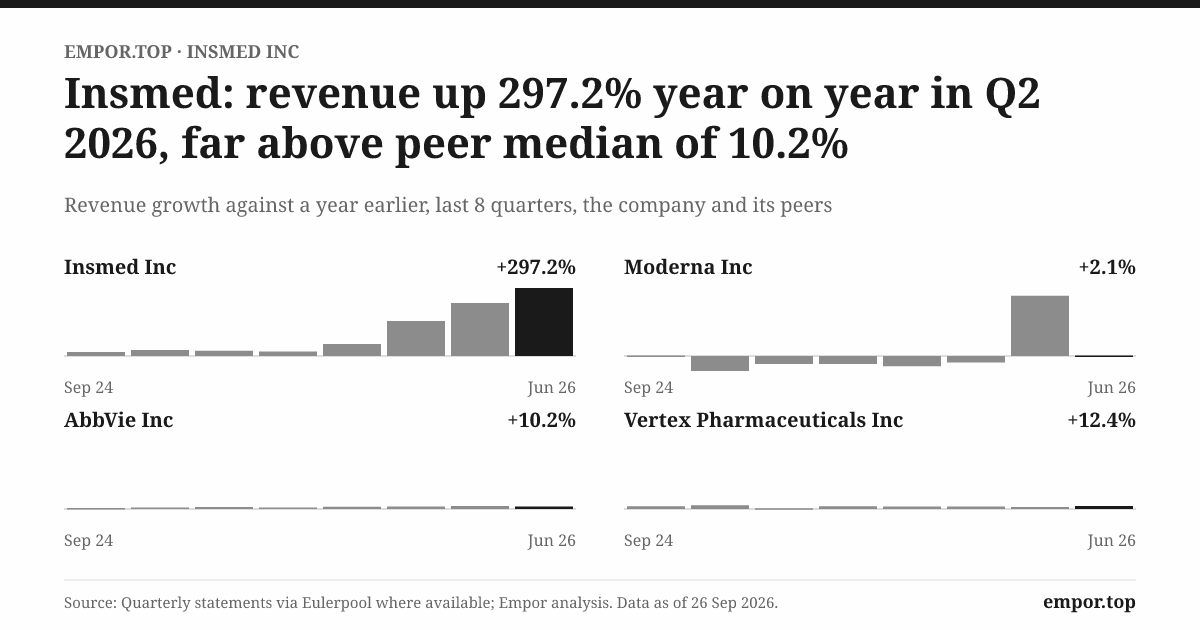
Then it kept going. First-quarter 2026 revenue reached $207.9 million, up 44% from the fourth quarter, despite the first quarter normally being the weakest of the year for specialty drugs as insurance deductibles reset.1826 Second-quarter revenue reached $309.2 million, up another 49% sequentially.2 Management raised full-year guidance from "at least $1 billion" to $1.25–1.4 billion and described the launch as tracking well ahead of other specialty respiratory launches at the same stage.25
Reading the patient-start data carefully
Here is where it pays to look past the headline. New patient starts were about 9,000 in the fourth quarter of 2025, about 7,800 in the first quarter of 2026, and about 7,000 in the second quarter.6265 Revenue rose while new starts declined, because each new cohort stacks on top of the patients already taking the drug.
Management's explanation matters. On the first-quarter call, it estimated that about 1,500 of the 7,800 new starts came from the "ready and waiting" backlog.26 On the second-quarter call, Lewis said all 7,000 starts were "organic demand," with no remaining backlog.5 So the underlying organic run-rate appears to have risen from roughly 6,300 to 7,000 per quarter. That is healthy, but it is also a warning: from here, growth depends entirely on new diagnoses and new prescribers, not on pent-up demand.
Depth, not breadth
The metric management emphasizes most is prescriber depth. Cumulative prescribers rose from more than 5,000 in the first quarter, which management described as about 25% of U.S. pulmonologists, to about 6,300 by the second quarter.265 More telling, the share of prescribers who have written BRINSUPRI for five or more patients rose from just over 20% to about 30%.265
Why does that matter? A doctor who has tried a drug on one patient is running an experiment. A doctor who has put five or more patients on it has made it a habit. The bull case for BRINSUPRI is that it becomes the default for any bronchiectasis patient with recurrent exacerbations, not a niche option for the sickest few. The share of five-plus writers is the clearest public window into whether that is happening.
Early persistence data is encouraging. Management said on the first-quarter call that refills arrive "nearly every 30 days," that continuation tracks slightly above generic statins at roughly 70% at six months, and that payer approval rates were near 90%.26 Those are company-reported figures without independent audit, but they are the right things to be measuring.
Pricing and gross-to-net
On the second-quarter call, management tightened its BRINSUPRI gross-to-net guidance to the mid-to-high 20s percent.5 Gross-to-net is the gap between the list price and what the company actually collects after rebates, discounts and program costs. A discount in the mid-to-high 20s is modest for a specialty drug, and it suggests payers are not yet forcing deep concessions. The reason is not mysterious: there is no approved alternative to prefer. That pricing leverage is real today, but it is precisely the leverage a second DPP1 inhibitor would erode.
Great quarter, insufficient reassurance
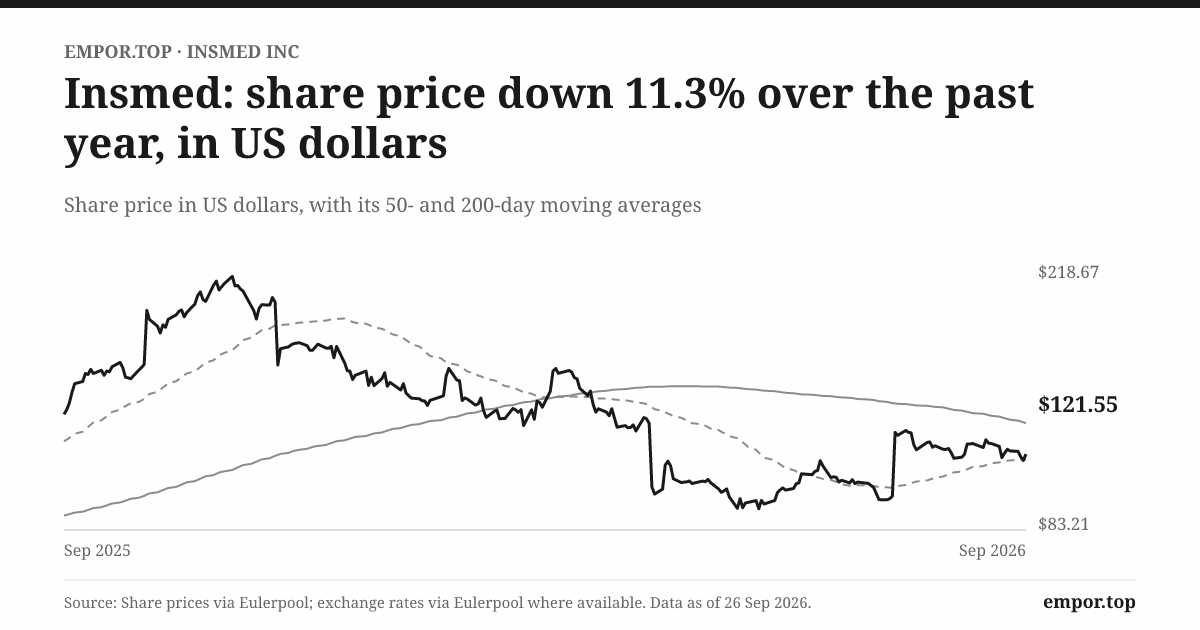
The stock's reaction to all this was anything but a victory lap. Insmed's shares reached a 52-week high of $212.75 and a low of $90.39, and traded around $118 in late September 2026.7
Three forces pulled the stock down from its highs. The first was the pipeline, covered in Section VI. The second was the first-quarter 2026 report on May 7. Revenue beat consensus and BRINSUPRI grew 44%, but management only reaffirmed "at least $1 billion" for the year, even though the implied rest-of-year run rate made that number look conservative.18 The stock fell 16.8% in the week that followed.27 Asked why it did not raise guidance, Lewis said, in effect, that Insmed is "a cautious company" with only two quarters of data.26
The third force was analyst repricing. On May 13, 2026, Truist cut its price target from $205 to $185 while keeping a Buy rating, citing competitive developments that it incorporated into its probability-of-success estimates for TPIP.28
The parallel with 2019 is hard to miss. In both cases, strong operating data met guidance that the market read as unconvincing. The difference is the direction of the error. In 2019, management gave a number too low to match its story. In 2026, management gave a number so conservative that it looked like a signal of hidden weakness, and then raised it one quarter later. Conservatism is defensible, and an under-promise is better than an over-promise. But a company whose valuation hinges on the trajectory of one drug pays a price when its guidance does not match its own operating commentary.
International: approvals are not launches
The international picture is less straightforward than the approvals suggest. Insmed secured European and U.K. approvals, and earlier guided to European launches in the first half of 2026.6 But on the first-quarter call, management said U.S. "most favored nation" drug-pricing policies had forced it to pause European launches: Lewis said the company would not accept lower international prices that could then be used to set U.S. prices, and would rather have limited sales abroad than erode domestic margins.26 On the second-quarter call he pointed to a "lack of willingness or interest on the part of most European countries because of budget constraints," and prioritized Japan, where a regulatory decision is expected in the second half of 2026.52
That is a real strategic choice with real implications. It protects U.S. pricing, where most of the value sits, but it means the "global launch" framing of 2025 has become a mostly American launch in 2026. Japan, with an estimated 150,000 bronchiectasis patients, is the next meaningful market, but reimbursement timelines make significant Japanese revenue a 2027 question at the earliest.13
The launch, then, is exceptional in speed and still unproven in durability. The next question is whether the mechanism behind it could carry the company into other diseases. Insmed tested that twice in six months.
VI. Platform Ambitions Meet Biology: Two Failed Expansions (2025–2026) (14–18 min)
On the morning of December 17, 2025, Insmed was near the top of the biotech world. Its market value had surged past $40 billion that year.29 BRINSUPRI was ramping. The company had strung together a series of wins: ASPEN, the TPIP Phase 2b, approvals in the U.S. and Europe. The narrative had shifted from "a bronchiectasis company" to "a DPP1 platform company," with brensocatib potentially useful in a range of diseases where neutrophils cause damage.
That morning, the company announced that its Phase 2b BiRCh trial of brensocatib in chronic rhinosinusitis without nasal polyps had failed both primary and secondary endpoints at both the 10 mg and 40 mg doses.8 On the primary measure, a sinus symptom score, the placebo group actually improved slightly more than either brensocatib group.8 Insmed discontinued the program immediately. Chief Medical Officer Martina Flammer said, "While we are disappointed in the results, they provided us with a clear answer."8 The shares fell about 17% the next day, to roughly $165.29
On the same day, Insmed announced it had acquired INS1148, an antibody targeting a form of stem cell factor, from the private company Opsidio, with plans for Phase 2 studies in interstitial lung disease and asthma.829 Pairing a failure announcement with a new acquisition is a common biotech communication tactic. It is not necessarily wrong, but it is worth noticing.
CEDAR: the second swing
Four months later, on April 7, 2026, came CEDAR, a 214-patient Phase 2b trial of brensocatib in hidradenitis suppurativa, a painful chronic skin disease marked by abscesses and nodules.30 Again, both doses failed to beat placebo. After 16 weeks, abscess and inflammatory nodule counts fell 45.5% on 10 mg and 40.3% on 40 mg, versus 57.1% on placebo.9 No new safety signals emerged, and the program was discontinued.9
The defenses were immediate and partly fair. Leerink Partners analyst Joseph Schwartz noted that "placebo responses are notoriously difficult dynamics in HS studies," and that his firm had already excluded the indication from its valuation.30 High placebo responses are a genuine problem in dermatology trials.
But the high placebo response does not rescue the result. In both trials, placebo beat or matched the drug. That is not a "narrowly missed" outcome; it is a clean absence of signal.
What two misses actually mean
Test the platform claim directly. The claim was that because DPP1 inhibition works in bronchiectasis, a neutrophil-driven disease, it could plausibly work in other neutrophil-driven inflammatory diseases. Two of those diseases were tested in randomized, placebo-controlled Phase 2b trials within about four months, and neither showed benefit.
The history does not kill the claim entirely, but it narrows it substantially. The more defensible version is this: DPP1 inhibition is validated in one airway disease in which neutrophil proteases directly damage tissue. It is not validated as a general-purpose anti-inflammatory mechanism. Any future indication beyond bronchiectasis deserves to be treated as a genuine long shot until Phase 2 data says otherwise, and indications like COPD or asthma, which AstraZeneca retained negotiating rights to, carry the same caveat.19
The discipline question
The forward test is behavioral. Does management pull back from opportunistic expansion, or keep swinging?
The early evidence is mixed. Insmed has not announced new brensocatib indications since CEDAR. But the second-quarter 2026 update disclosed FDA clearance of an investigational new drug application for INS1033, a next-generation DPP1 inhibitor, with a Phase 1 study in rheumatoid arthritis planned for the third quarter of 2026.2 Rheumatoid arthritis is another inflammatory disease outside the lungs. A new molecule with different properties may justify a new test, and early-stage programs are cheap relative to the company's size. Insmed also says pre-clinical research will stay below 20% of total spending.1 Still, investors watching for discipline should note that the DPP1 platform thesis has been rebranded, not retired.
The watch item over the next 12 to 18 months is simple: whether new DPP1 indications arrive with a clear biological rationale and modest spending, or whether the pattern of trying and discontinuing continues. With the brensocatib platform story reduced to its core, the company's second big optionality bet now carries more of the long-term narrative.
VII. TPIP: Real Optionality, Zero Revenue So Far (2020s–present) (20–24 min)
Pulmonary arterial hypertension is a disease of pressure. The small blood vessels in the lungs narrow and stiffen, forcing the right side of the heart to push harder and harder until, eventually, it fails. Patients describe it as breathlessness that climbing a single flight of stairs can trigger. Without treatment, the disease is often fatal within a few years of diagnosis.
One of the oldest drug families for PAH is the prostacyclins, which dilate blood vessels. Treprostinil, the best-known of them, works well but is short-lived in the body. Patients either receive it by continuous infusion through a pump or inhale it several times a day. Each inhalation delivers a peak, followed by a trough when the drug wears off, and side effects such as cough, headache and flushing tend to track the peaks.
The chemistry trick
Insmed's approach, developed entirely in-house, was to attach treprostinil to a 16-carbon fatty chain through an ester bond, creating a "prodrug" called treprostinil palmitil.31 Inhaled as a dry powder from a capsule-based device, the modified molecule sits in the lungs and releases active treprostinil slowly as enzymes clip off the fatty tail. The analogy is a time-release capsule, but for the lungs. The goal is once-daily dosing with steadier drug levels and fewer peak-related side effects.
TPIP is notable for another reason: unlike ARIKAYCE (acquired) and brensocatib (licensed), it is Insmed's own invention. If it works, it is the first proof that the company can create, not just recognize, valuable assets.
The evidence so far
On June 10, 2025, Insmed reported that its 102-patient Phase 2b trial of TPIP in PAH had met its primary endpoint and all secondary efficacy endpoints.31 Pulmonary vascular resistance, a measure of how hard the heart must push, fell 35% versus placebo; six-minute walk distance improved by 35.5 meters; and NT-proBNP, a blood marker of heart strain, fell 60%.31 Those effects persisted roughly 24 hours after dosing, supporting the once-daily claim, and 75% of patients reached the maximum 640 µg dose.31
In July 2026, 12-month open-label extension data from over 90 patients showed a 55.7-meter improvement in walking distance among continuing patients and roughly 60% reductions in NT-proBNP.32 Management said 65% of patients reached a refined low-risk status, and that 91% were still on treatment.5 Lewis described TPIP as "potentially differentiated versus other prostanoids with comparable efficacy to sotatercept," Merck's newer PAH drug.5
The Phase 3 PALM-ILD trial in pulmonary hypertension associated with interstitial lung disease started in the fourth quarter of 2025, and the Phase 3 PALM-PAH trial began in April 2026.618 Insmed plans to start Phase 3 trials in progressive pulmonary fibrosis in the second half of 2026 and in idiopathic pulmonary fibrosis in the first half of 2027.2 Management's peak-sales estimate for TPIP across these four indications has risen from more than $2 billion to more than $6 billion.5
Myth vs reality: the $6 billion number
The myth is that TPIP is a de-risked second blockbuster. The reality is more modest.
Start with what open-label data cannot show. Open-label extensions have no placebo arm, and patients who drop out are not in the final numbers. The 12-month data supports durability and tolerability, but it is not a controlled efficacy result. Truist raised a pointed concern: only 21% of patients in the extension exceeded 640 µg, and only seven reached the maximum 1,280 µg.32 If patients cannot tolerate higher doses, the drug's efficacy may have a ceiling.
Then there is the incumbent. United Therapeutics already owns inhaled treprostinil through Tyvaso and Tyvaso DPI, and it has shown it will litigate hard to defend that position. In 2023 it won a Federal Circuit ruling that Liquidia's inhaled treprostinil product, Yutrepia, infringed one of its patents, which blocked final FDA approval of Yutrepia until that patent expired.33 TPIP is a different molecule, but it will compete in the same prescribing habits, the same payer negotiations, and potentially the same legal arena.
Finally, there is Insmed's own conversion record. Over nearly four decades, the company has turned two late-stage assets, ARIKAYCE and BRINSUPRI, into meaningful commercial products (its earlier growth-factor drug, IPLEX, never became one), and in the past nine months it has watched two Phase 2b trials of an already-approved drug fail outright. None of that predicts TPIP will fail. It does argue for treating the $6 billion figure as a management projection built on Phase 2 data, not a forecast of booked revenue. The revised claim is this: TPIP is real, meaningful optionality with an encouraging Phase 2 profile, and it will remain optionality until PALM-PAH reads out.
That brings the story to the people making these bets, and to how they have funded them.
VIII. Current Management: Incentives, Ownership, and the Capital Allocation Record (22–26 min)
Will Lewis's career began in an unusual place for a biotech CEO: in U.S. government service. He then spent more than a decade in investment banking in the U.S. and Europe, before co-founding Aegerion Pharmaceuticals in 2005 and serving as its President and CFO.1234 Aegerion, like Insmed later, built its business around rare diseases, so Lewis arrived with a playbook rather than a blank sheet.
He joined Insmed as President and CEO in 2012 and became Chair in November 2018.12 His current tenure, 14 years and counting, is unusually long for a biotech chief executive, and it spans the company's entire transformation. He holds degrees from Oberlin College and Case Western Reserve University, chairs the board of NewAmsterdam Pharma, and sits on the board of the Biotechnology Innovation Organization.12
Lewis's style, visible across earnings calls, is that of a former banker who knows how investors think. He speaks in peak-sales numbers, frames risk in terms of probabilities, and is willing to push back on rivals by name, as with his dismissal of Boehringer's Phase 2 data.26 He is also, by his own description, "cautious" on guidance.26 Those two traits sit in tension: a CEO who readily projects multi-billion-dollar peak sales but hesitates to raise a near-term forecast.
The team built for commercial execution
The surrounding team reflects a deliberate shift from research to selling. CFO Sara Bonstein joined in January 2020 after CFO roles at several public biotech companies and earlier work at Eli Lilly.34 COO Roger Adsett, promoted from Chief Commercial Officer in November 2019, brings more than 30 years of experience from Shire and AstraZeneca.34 Chief Medical Officer Martina Flammer has been the public face of the clinical readouts, good and bad. In June 2026, Insmed also appointed Samuele Butera as Senior Vice President and General Manager of a new Global Respiratory unit.2 The line-up is consistent with the stated priority of executing launches, which is a modest but real signal of strategic coherence.
Pay and governance
Lewis received $14.47 million in total compensation for 2025, including a salary of $854,550, a bonus of about $1.5 million, and roughly $12 million in stock and option awards.35 According to the 2026 proxy, about 94% of his target direct compensation is "at-risk" variable pay, and the board raised executive stock ownership guidelines in 2025.34 Lewis holds both the Chair and CEO titles, balanced by a Lead Independent Director, David Brennan, a former AstraZeneca CEO.34 A combined chair-CEO role is common in U.S. biotech, but it concentrates authority in one person during a period when capital allocation decisions are getting bigger.
Skin in the game
Here the picture is thinner than the narrative sometimes suggests. The proxy lists Lewis's beneficial ownership at 1,647,582 shares, of which 1,265,098 are exercisable options, for less than 1% of the company.34 Directly held shares are therefore roughly 380,000, against about 218 million shares outstanding.36
Insiders have also been steady sellers. Form 4 filings show Lewis selling shares in multiple transactions in June and July 2026 at prices from roughly $102 to $118, including a July 23 sale.37 On August 10, 2026, Adsett sold shares at a weighted average of $133.27, for about $32 million, retaining 98,744 shares afterward.38 Such sales are normal for executives paid mostly in equity, and many are made under pre-scheduled trading plans. But the takeaway is that management's alignment rests on unvested equity and reputation, not on large personal holdings bought with their own money.
The capital allocation record, weighed
Put the two defining deals side by side. The 2010 Transave combination cost almost no cash and delivered ARIKAYCE.11 The 2016 AstraZeneca license cost $30 million upfront and delivered BRINSUPRI.19 On sourcing, the record is excellent: both assets arrived when the counterparty had lost leverage or interest.
Now set the other side of the ledger in the same paragraph, because it belongs there. Turning those assets into products required enormous amounts of outside capital, much of it raised by issuing shares. In May 2024, right after ASPEN, Insmed priced 12.6 million shares at $51.50 for about $650 million, with an option for underwriters to buy roughly 1.9 million more.21 In April 2025, it called its $569.5 million of 0.75% convertible notes due 2028 for redemption; with the stock far above the $32.50 conversion price, nearly all holders converted, adding roughly 17.9 million shares.39 Two months later, in June 2025, it priced a further $750 million stock offering at $96 per share.40 Insmed also took on a senior secured term loan from Pharmakon and a royalty financing with OrbiMed.13
The result is a share count of about 218 million today.36 Each financing was defensible in isolation: raising money after positive data, when the stock is strong, minimizes dilution per dollar raised. But in aggregate, a large portion of the value created by cheap deal-sourcing was shared with new investors. The honest verdict is this: Insmed has been an excellent finder of assets and an expensive developer of them. Both facts describe the same management team.
Management now says it expects sustainable positive cash flow in 2027 without needing additional capital.26 That is a specific, falsifiable promise, and it deserves to be tracked. Which leads directly to the numbers.
IX. The Money Story: From Perpetual Cash Burn to the Edge of Profitability (16–20 min)
A biotech income statement during a launch looks like a race between two runners. One is revenue, starting from zero and accelerating. The other is expenses, which start high and keep rising as the company hires sales representatives, runs Phase 3 trials, and builds manufacturing. For most of Insmed's history, expenses won easily. In 2026, revenue finally started catching up.
The inflection
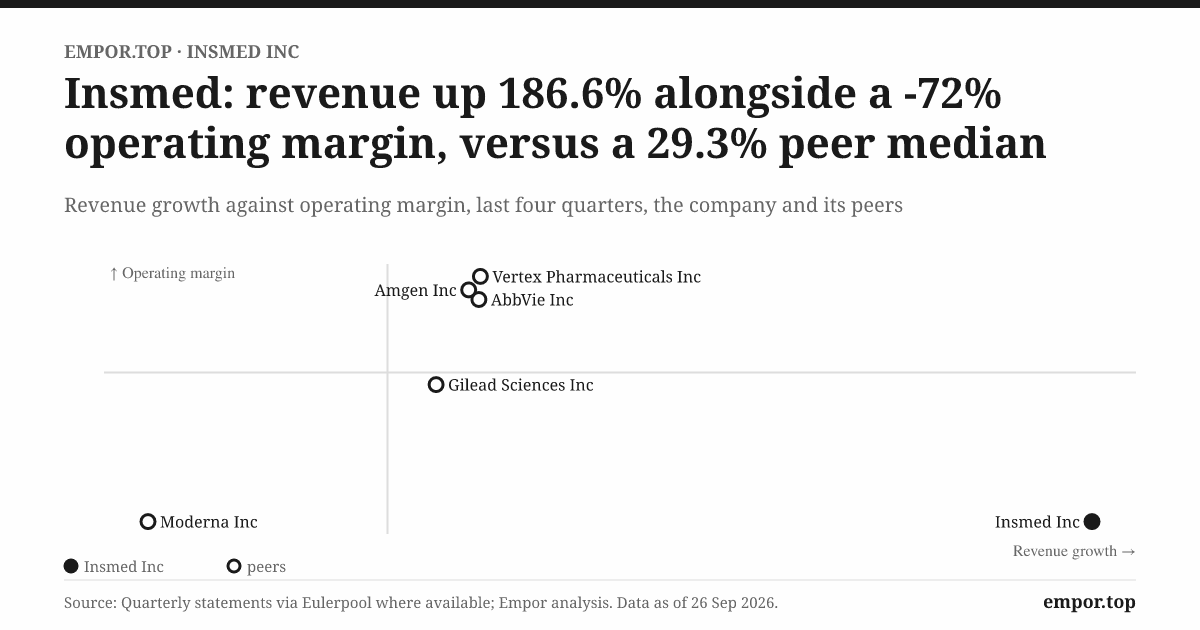
In 2025, Insmed's total revenue was $606.4 million, up 67%.6 Expenses were much larger. Research and development spending rose to $771.1 million from $598.4 million, and selling, general and administrative costs rose to $701.2 million from $461.1 million.1 The result was the $1.28 billion net loss noted earlier.1
The losses then shrank at remarkable speed: $328.5 million in the fourth quarter of 2025, $163.6 million in the first quarter of 2026, and $13.2 million in the second quarter.1182 A year earlier, the second-quarter 2025 loss had been $321.7 million.2
It is important to understand why. Costs did not fall. In the second quarter of 2026, R&D spending was $210.0 million, up from $177.2 million a year earlier, and SG&A was $247.5 million, up from $154.8 million.2 What changed is that BRINSUPRI revenue rose from zero to more than $300 million a quarter on top of a cost base that was already built for it. That is operating leverage in its purest form: once the sales force and trials are paid for, each additional prescription drops mostly to the bottom line.
The changing of the guard
The revenue mix is flipping inside a single year. In 2025, ARIKAYCE was about 72% of revenue. For 2026, management guides BRINSUPRI to $1.25–1.4 billion and ARIKAYCE to $450–470 million, putting the newer drug at roughly three times the older one.2 In the second quarter alone, BRINSUPRI's $309.2 million was more than two and a half times ARIKAYCE's $116.3 million.2
That shift has a clear implication: Insmed is now, financially, a BRINSUPRI company. ARIKAYCE's growth of 6–8% per quarter year-over-year matters, and the potential first-line label could reaccelerate it, but the company's value will rise or fall with one product for the next several years.218
The balance sheet
The balance sheet is sturdier than at any point in Insmed's history, but it looks different than older descriptions suggest. At June 30, 2026, cash, equivalents and marketable securities totaled about $1.16 billion.36 The convertible notes that once dominated the debt stack are gone, converted to equity in 2025.39 What remains is the Pharmakon term loan, with $500 million of principal, or about $547 million including interest paid in kind, and a royalty financing liability of about $160 million.36
Cash, in other words, comfortably exceeds interest-bearing debt. That does not make Insmed rich relative to its ambitions: it is funding three Phase 3 programs for TPIP, the ARIKAYCE label expansion, and a launch. But combined with near-breakeven operations, it means the company is no longer forced to raise money on the market's timetable.
The open question: will spending decelerate?
Now that BiRCh and CEDAR are closed, and the U.S. commercial infrastructure is largely in place, the key question is whether expense growth slows while revenue keeps compounding. Management has not given explicit operating expense guidance, so investors will learn the answer quarter by quarter. The counter-pressure is that TPIP's Phase 3 program is expanding into four indications, and each Phase 3 trial is expensive.
What the valuation implies
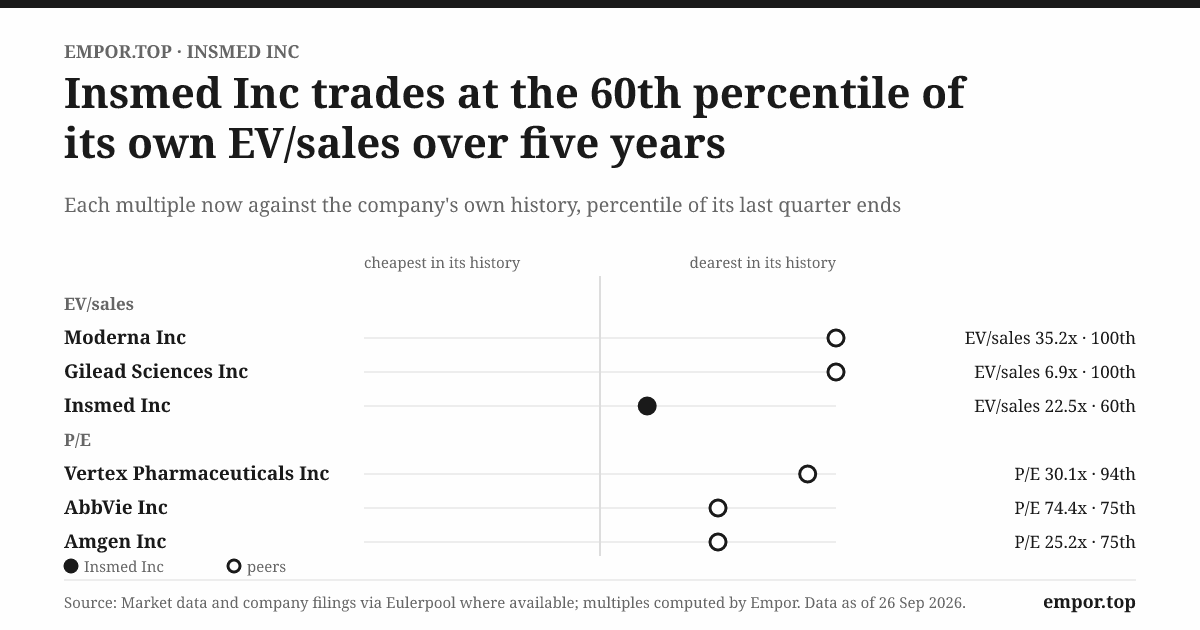
At about $118 a share, Insmed's market value is roughly $25.7 billion.7 Against 2026 guided product revenue of about $1.7–1.9 billion, the market is paying a double-digit multiple of current sales. That price is not a bet on today's business. It is a bet that BRINSUPRI heads toward management's multi-billion-dollar peak, that pricing holds as competitors arrive, and that TPIP adds a second leg. Put simply, the valuation is already an investment thesis, and the next section tests it.
X. Industry Structure and Why This Company Wins (or Doesn't) (20–24 min)
Imagine a strategy war room at Boehringer Ingelheim. On the whiteboard is a single question: how do you displace a first-to-market drug in a disease where it is the only option? The answer is rarely "be a little better." It is usually some combination of a cleaner safety profile, a more convenient dose, a better-designed trial, a deeper sales force, and a willingness to discount. That is the game Insmed must win.
Porter's five forces, applied
Threat of new entrants depends on which level of the market one looks at. At the level of diagnosis and physician relationships, entry is hard. Bronchiectasis and MAC lung disease are managed by a relatively concentrated group of pulmonologists, and building trust with them took Insmed years. At the level of mechanism, entry is getting easier. ASPEN proved DPP1 inhibition works in bronchiectasis, which de-risks the path for followers. Boehringer's verducatib is in Phase 3, and Haisco's HSK31858 has shown positive Phase 2 results in China.2425 Validation by the leader lowers the barrier for the next entrant.
Supplier power is low. Brensocatib is a small-molecule oral pill, which is typically simpler and cheaper to manufacture than biologics or complex inhaled products.
Buyer power is concentrated in payers, but constrained. Insurers negotiate hard on rebates, yet with no alternative approved therapy for bronchiectasis, they cannot easily steer patients elsewhere. The mid-to-high-20s gross-to-net guidance is the evidence that payers have not yet squeezed hard.5 That constraint will loosen the moment a second DPP1 inhibitor is approved, because payers can then play one product against another.
Threat of substitutes is moderate. Off-label antibiotics, airway clearance and inhaled drugs remain part of care, and future drugs using other mechanisms could reduce reliance on DPP1 inhibition.
Rivalry is currently low and expected to rise.
Hamilton Helmer's 7 Powers
Under Helmer's framework, a durable advantage needs both a benefit and a barrier that stops rivals from copying it. Test each candidate.
Cornered resource: brensocatib's approval and the ASPEN dataset are currently unique. But this is a time-limited resource. Once verducatib reads out, the "only approved drug" status could disappear.
Switching costs: modest. A patient stable on BRINSUPRI with fewer flare-ups is unlikely to switch without reason, and physicians tend to stick with what works. That gives Insmed some inertia advantage within its installed base, but none over new patients.
Counter-positioning: Insmed's historical edge was a willingness to pursue diseases large companies ignored. That edge has now eroded by design: Insmed's own success turned bronchiectasis into a large enough market that big pharma has arrived.
Scale economies, network effects and brand are weak or absent. Process power, in the form of deep know-how in inhaled liposomal and powder delivery, is plausible for ARIKAYCE and TPIP, but it is hard to measure from outside.
The calibrated conclusion: Insmed's power in bronchiectasis today is a head start, not a moat. The history of first-in-class drugs suggests that a strong first mover often keeps a leading share even after competitors arrive, but it usually concedes pricing. What would confirm a more durable advantage is the five-plus-prescriber share continuing to rise and persistence holding up. What would falsify it is a positive AIRTIVITY readout with a cleaner or more convenient profile.
Why Insmed could win
The case for Insmed rests on concrete evidence. It has an approved label, years of real-world use before a competitor can launch, and a U.S. commercial organization that has now run two launches. The early persistence and payer-approval figures, if they hold, suggest patients stay on the drug.26 ARIKAYCE is a second, independent franchise with its own growth lever in the first-line MAC filing.2 And the company's balance sheet and near-breakeven operations mean it can defend its position without a gun to its head.
Why it might not
The counter-case is equally concrete. Two platform-extension trials failed in the span of four months, demonstrating that DPP1 inhibition is not a universal key.89 A named competitor, backed by one of the world's largest private drug companies, is in Phase 3 in the core indication.24 Insmed's history is one of heavy dilution to fund development, and TPIP's expanding Phase 3 program is the kind of effort that has historically required fresh capital. And the company's guidance communication has twice, in 2019 and 2026, failed to match its own operating narrative.1627
The skeptic's stress test
A skeptical long-short investor would ask pointed questions. Why does a $25.7 billion valuation assume that a drug with a 20% reduction in exacerbations holds pricing once a second entrant arrives? Why did management guide so conservatively in May, only to raise sharply in August, and what does that say about how it will communicate if the ramp slows? Why are executives selling tens of millions of dollars of stock while describing the company's value as vastly underappreciated? And if European launches are paused to protect U.S. prices, how much of the $7 billion peak estimate depends on markets the company is choosing not to enter yet?
None of these questions has surfaced as a public activist campaign in the filings and coverage reviewed for this article. The stress test is analytical, not a live fight. But these are exactly the questions that will matter when the next big dataset arrives, which is where the risks become concrete.
XI. Risk Radar: What Could Actually Break the Thesis (16–20 min)
Every biotech investment eventually comes down to a date on a calendar: a trial readout, a regulatory decision, a patent expiry. For Insmed, several of those dates sit within the next few years, and any one of them could reprice the company.
Competitive risk: the mechanism, not the brand
The single most important external event for the BRINSUPRI thesis is the readout of Boehringer's AIRTIVITY trial. The study is enrolling patients on a 2.5 mg daily dose of verducatib versus placebo, with a treatment duration of at least 52 weeks.2423 Until results exist, the threat is theoretical. But a positive result with a differentiated safety profile would directly challenge BRINSUPRI's "first and only" position and, more practically, its pricing. Haisco's program adds a longer-dated risk, especially in Asian markets.25
Concentration risk
Insmed has two commercial products, and BRINSUPRI is rapidly becoming the dominant one. Any unexpected safety signal emerging from real-world use, reimbursement pushback, or a competitive entrant affects most of the company's revenue at once. There is no diversified segment to absorb a shock.
Execution risk
ARIKAYCE took roughly seven years to grow into a business of more than $400 million. BRINSUPRI is attempting something far faster, while the same organization also prepares for Japan, pursues the ARIKAYCE label expansion, and runs multiple Phase 3 trials for TPIP. The pause of European launches reduces the near-term strain but also narrows the growth base.26 Japan is the next execution test, with an approval decision expected in the second half of 2026 and meaningful revenue likely not before 2027.2
Financing and dilution risk
Management says Insmed will be cash-flow positive in 2027 without new capital.26 If that holds, the long era of dilution ends. If TPIP's program expands faster than BRINSUPRI's cash flow, or if the ramp slows, the company's own history suggests it would reach first for the equity market, typically after good news.2140 Investors should treat the 2027 cash-flow promise as the key test of whether that pattern has truly ended.
Guidance-credibility risk
The 2019 and 2026 episodes are the same failure mode: guidance that did not align with management's own operating commentary.1627 The question worth asking management directly is how it thinks about setting expectations after two instances of "good numbers, bad reaction." A clear framework, such as guiding to a range based on explicit patient-start assumptions, would reduce this risk. Continued ad hoc caution followed by large raises would not.
Regulatory and pricing risk
Drug-pricing policy cuts both ways. The most immediate effect is already visible: U.S. "most favored nation" pricing pressure led Insmed to pause European launches rather than accept lower international reference prices.26 That protects U.S. revenue but limits international growth. Longer term, Medicare price negotiation under the Inflation Reduction Act can eventually reach successful small-molecule drugs, and BRINSUPRI's growing Medicare-age patient base makes it a plausible candidate years from now. ARIKAYCE's orphan-focused label may give it more insulation. Neither exposure is near-term, but both belong in a long-horizon model.
Intellectual property
ARIKAYCE's U.S. patents begin expiring in December 2026, though its latest patents run to 2035 and its complex formulation creates practical barriers to generic copies.13 Brensocatib's full patent schedule is not detailed in the sources reviewed here; investors should verify it in the company's filings.
What is not a first-order risk
Macroeconomic cycles, artificial intelligence disruption, cybersecurity and input-cost inflation are not the variables that will determine Insmed's value. This is a story driven by demand, trial data and competition. Padding the risk list with generic macro concerns would obscure the handful of events that genuinely matter.
Those risks are specific to Insmed, but the lessons behind them apply more broadly to anyone building in rare disease.
XII. Playbook: What Insmed Teaches About Rare-Disease Biotech Strategy (14–18 min)
Every successful company eventually becomes a case study, and the lessons are rarely the ones management would write itself. Insmed's playbook has four chapters, and two of them are cautionary.
Lesson one: buy when the seller has lost conviction
The two best capital decisions in Insmed's history share one feature. In 2010, Transave needed capital and Insmed needed a pipeline, and the deal was struck at a price that reflected desperation on both sides.11 In 2016, AstraZeneca had deprioritized a molecule that it considered non-core, and Insmed licensed it for $30 million upfront.19 In both cases, the acquirer had a specific reason to value the asset more than the seller did: Insmed's existing pulmonology relationships. The broader lesson is that value in biotech licensing often comes from fit, not from finding something others missed scientifically.
Lesson two: patience compounds in orphan disease, but the market does not always reward it
It took Insmed almost a decade after ARIKAYCE's approval to become a company with a fully de-risked commercial engine. During that period, the market frequently punished it, most memorably in 2019.16 Rare-disease strategies work on long timelines, and investors in them need to separate short-term signals, like a guidance range, from long-term signals, like prescriber depth and persistence.
Lesson three: a validated mechanism is not a validated platform
This is the lesson Insmed taught with its own data. BiRCh and CEDAR showed that a mechanism that clearly works in one disease can fail cleanly in others that share a superficial biological feature.89 The "platform" framing is attractive to investors because it multiplies the value of a single discovery, but each new disease is a new experiment. The appropriate response is to price each additional indication as a separate, uncertain bet.
Lesson four: dilution is a tool, not a free lunch
Issuing stock at high prices after good data is rational, and it allowed Insmed to fund an enormous clinical program without taking on crippling debt. But the share count roughly reflects how much of the value created by cheap deals was shared with new investors.36 Anyone underwriting the next phase of the company should assume management will again use equity if it needs capital, unless its 2027 cash-flow target is met.26
Taken together, the playbook is not "be contrarian and win." It is "be contrarian, be patient, and accept that success invites competition and requires capital." Which brings the story to what to watch.
XIII. Epilogue: What to Watch Next (8–12 min)
In the early 2010s, Insmed's scientists and sales representatives spent their days explaining an obscure lung infection to physicians who rarely saw it. In 2026, the company is ramping one of the most closely watched drug launches in respiratory medicine, with a new competitor enrolling patients in a Phase 3 trial and a third drug moving through late-stage development. The context has changed completely. The core question has not: does the evidence support the story?
The three KPIs that matter
First, the share of BRINSUPRI prescribers writing for five or more patients. It rose from just over 20% to about 30% between the first and second quarters of 2026.265 It is the clearest public signal of whether BRINSUPRI is becoming a default therapy rather than a specialist's tool. If that share keeps rising while new patient starts stabilize or grow, the durability case strengthens. If it stalls, the launch is plateauing.
Second, the path to sustained GAAP profitability and positive cash flow. The second quarter of 2026 came close to breakeven, and management has promised sustainable cash-flow positivity in 2027 without additional capital.226 Whether that promise holds is the test of whether Insmed's era of dilution is truly over.
Third, the AIRTIVITY timeline. Boehringer's Phase 3 readout is the clock on brensocatib's competitive window. Until it reads out, BRINSUPRI's pricing power is effectively protected; after it, the terms of competition change.
The binary events ahead
TPIP's PALM-PAH and PALM-ILD Phase 3 trials will either validate or puncture the "more than $6 billion" peak-sales framing. The FDA's decision on ARIKAYCE's first-line MAC filing will determine whether the older franchise reaccelerates. Japan's regulatory decision on brensocatib, expected in the second half of 2026, will set the pace of the first major market outside the U.S.2
And there is the discipline question. After two consecutive Phase 2 failures, the way management chooses its next DPP1 indications, starting with INS1033 in rheumatoid arthritis, will say a great deal about whether the platform narrative is being rebuilt on evidence or on hope.2
Closing frame
For most of its life, Insmed's advantage was that nobody else wanted what it was building. Transave was distressed; AstraZeneca was cleaning house; bronchiectasis had no approved therapies and little commercial interest. That neglect was the moat.
BRINSUPRI's success has ended the neglect. Bronchiectasis is now a market that Boehringer Ingelheim and Chinese drugmakers are pursuing, payers are watching, and investors are pricing in the tens of billions. Insmed spent 25 years proving that a contrarian rare-disease thesis could work at all. The next few years will test something harder: whether it can defend what it built once the diseases are no longer too small for anyone else to bother with.
References
-
Insmed Reports Fourth-Quarter and Full-Year 2025 Financial Results and Provides Business Update — Insmed IR, 2026-02-19 ↩↩↩↩↩↩
-
Insmed Reports Second-Quarter 2026 Financial Results and Provides Business Update — Insmed IR, 2026-08-06 ↩↩↩↩↩↩↩↩↩↩↩↩↩↩↩↩↩↩↩↩↩
-
FDA Approves BRINSUPRI (brensocatib) as the First and Only Treatment for Non-Cystic Fibrosis Bronchiectasis — Insmed IR, 2025-08-12 ↩↩↩
-
Insmed (INSM) Q2 2026 Earnings Call Transcript — The Motley Fool, 2026-08-13 ↩↩↩↩↩↩↩↩↩↩↩↩↩↩↩
-
Insmed Provides Business Update at 44th Annual J.P. Morgan Healthcare Conference — Insmed IR, 2026-01-09 ↩↩↩↩↩↩↩↩
-
Insmed Provides Clinical and Business Update — Insmed IR, 2025-12-17 ↩↩↩↩↩↩↩
-
Insmed Provides Clinical Update on Phase 2b CEDAR Study — Insmed IR, 2026-04-07 ↩↩↩↩↩
-
Insmed Sells Follow-on Biologics Platform to Merck & Co., Inc. for Gross Proceeds of $130 Million — Insmed IR, 2009-02-12 ↩↩↩
-
Insmed Incorporated and Transave, Inc. Announce Business Combination — Insmed IR, 2010-12-02 ↩↩↩↩↩↩
-
FDA Approves a New Antibacterial Drug to Treat a Serious Lung Disease Using a Novel Pathway to Spur Innovation — PR Newswire, 2018-09-28 ↩↩↩↩
-
Insmed Provides Update on ARIKAYCE U.S. Launch and Outlines Strategic Priorities for 2019 — Insmed IR, 2019-01-04 ↩↩
-
Here's Why Insmed Fell Hard Today — The Motley Fool, 2019-08-01 ↩↩↩↩↩↩
-
Insmed Announces Positive Topline Results from Phase 3 ARISE Study of ARIKAYCE — Insmed IR, 2023-09-05 ↩
-
Insmed Reports First-Quarter 2026 Financial Results and Provides Business Update — PR Newswire, 2026-05-07 ↩↩↩↩↩↩↩
-
Insmed Announces Worldwide License Agreement with AstraZeneca for Oral DPP1 Inhibitor — Insmed IR, 2016-10-06 ↩↩↩↩↩↩↩
-
Insmed Announces Positive Topline Results from Landmark ASPEN Study of Brensocatib in Patients with Bronchiectasis — Insmed IR, 2024-05-28 ↩↩
-
Insmed Announces Pricing of $650 Million Public Offering of Common Stock — PR Newswire, 2024-05 ↩↩↩
-
European Commission Approves BRINSUPRI (brensocatib) as the First and Only Treatment to Date Approved for Non-Cystic Fibrosis Bronchiectasis in the European Union — PR Newswire, 2025-11-18 ↩
-
ATS 2026: DPP1 Inhibitors Reinforced with Phase II Final Pooled Data from Verducatib — Clinical Trials Arena, 2026 ↩↩
-
Breakthrough of DPP-1 Inhibitor in Decreasing the Exacerbation Frequency of Bronchiectasis (Lancet Respir Med) — EurekAlert!, 2025-03-29 ↩↩↩
-
Insmed (INSM) Q1 2026 Earnings Transcript — The Globe and Mail, 2026-05 ↩↩↩↩↩↩↩↩↩↩↩↩↩↩↩↩↩↩↩
-
Insmed (INSM) Is Down 16.8% After Reaffirming 2026 BRINSUPRI and ARIKAYCE Revenue Guidance — Simply Wall St, 2026-05-13 ↩↩↩
-
Truist Cuts Insmed Stock Price Target to $185 on Competitive Risks — Investing.com, 2026-05-13 ↩
-
Insmed's 'Win Streak' Ends as Top Drug Fails Study in Chronic Nasal Condition — BioPharma Dive, 2025-12-17 ↩↩↩
-
Trial Failure in the Skin Does Not Dent Insmed Drug's Potential in the Lungs — MedCity News, 2026-04 ↩↩
-
Insmed Announces Positive Topline Results from Phase 2b Study of TPIP as Once-Daily Therapy in Patients with Pulmonary Arterial Hypertension — Insmed IR, 2025-06-10 ↩↩↩↩
-
Insmed Moves Closer to $6B Opportunity as PAH Drug Shows Long-Term Durability — BioSpace, 2026 ↩↩
-
United Therapeutics Wins Appeal in Dry Powder Inhaler Patent Litigation — United Therapeutics IR, 2023-07-24 ↩
-
INSMED Inc — Form DEF 14A, 2026 Proxy Statement — SEC, 2026-04-01 ↩↩↩↩↩↩
-
INSMED Inc CEO William H. Lewis's Pay Package for 2025 — Salary.com ↩
-
INSMED Inc — Form 10-Q for the Quarter Ended June 30, 2026 — SEC, 2026 ↩↩↩↩↩
-
Form 4 — William H. Lewis, Insmed Insider Transactions — SEC EDGAR, 2026-07-24 ↩
-
Insmed Chief Operating Officer Sold Shares Worth Over $31M — TradingView News, 2026-08 ↩
-
Insmed Announces Redemption of All $569.5 Million of Remaining Outstanding 0.75% Convertible Senior Notes Due 2028 — GuruFocus, 2025-04-24 ↩↩
-
Insmed Announces Pricing of $750 Million Public Offering of Common Stock — PR Newswire, 2025-06-11 ↩↩
 LinkedIn
 WhatsApp
 Reddit
 Hacker News
 Email
 Kindle
 RSS Feed
 Spotify
 Apple Podcasts
 Amazon Music
 Audible
 YouTube