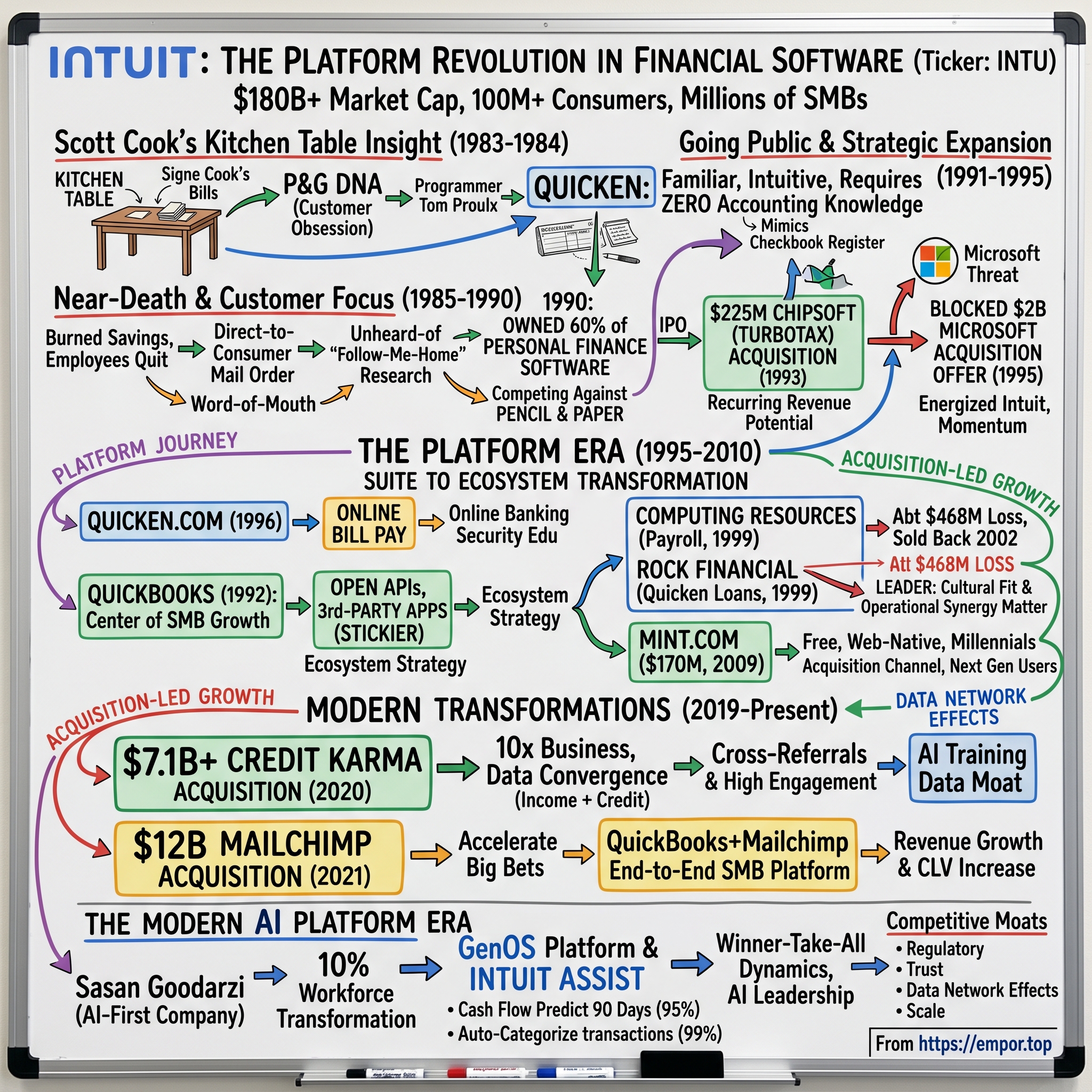
Intuit: The Free-Filing Fortune That Forgot How to Price
I. Introduction & Episode Roadmap
On Friday, September 25, 2026, Intuit's stock closed at $275.79.1 Twelve months earlier it had traded as high as $703.96, and at its lowest point this year it touched $252.84.1 That works out to a market value of roughly $74 billion, down about 62%, for a company that once looked like the most reliable compounder in American software.1
Now look at the income statement for the same period. In the fiscal year that ended July 31, 2026, Intuit's revenue grew 14% to $21.4 billion. GAAP and non-GAAP earnings per share both grew 20%, and the company bought back $5.5 billion of its own stock, nearly double the year before.2 A business that grows revenue in the teens, earns more every year, and returns billions to shareholders does not usually lose more than half its value in under a year.
That gap between the fundamentals and the stock price is what this story is about. Two explanations compete, and they lead to different conclusions.
The first is outside-in. Agentic AI, meaning software that does the work of filling in a tax return or reconciling a ledger rather than just helping a human do it, could make tax prep and bookkeeping cheap enough that nobody pays Intuit's prices anymore. In late September, coverage of the selloff said so directly: the stock "crashed over agentic AI fears," and investors worried that autonomous agents would perform the services Intuit charges for.3 On this view, the problem is the category, and no amount of execution fixes it.
The second is inside-out. Here the damage comes from Intuit's own record. A $12 billion acquisition, Mailchimp, is now guided to shrink. Management admitted in plain words, "We lost on price," in its largest consumer franchise. And FY2027 guidance calls for total revenue growth of only 9-10%, with TurboTax, the crown jewel, expected to grow just 2-3%.2 On this view, the problem is fixable because Intuit caused it, but it also tells investors something about how the company has been run.
The honest answer is probably both. The more useful question is which one explains more of the damage and which one Intuit can actually control. Getting there takes some history.
The story first covers the kitchen-table origin and the acquisition habit it produced, then scores that habit deal by deal. It then puts the two acquisitions that define today's bull and bear cases side by side: Credit Karma, which worked after a detour, and Mailchimp, which has not. From there it turns to the 2026 stumble, the regulatory reversals that changed TurboTax's threat landscape, the CEO and his AI bet, the competitive map, and finally the investment case as it stands in September 2026, not as it looked at the peak.
One thread runs through all of it. Intuit has always called itself a company built on "customer obsession." In 2026, its customers told it the price was too high, and many of them left. That is where the story begins and ends.
 Subscribe on LinkedIn
II. The Kitchen Table Insight & the Near-Death Years (1983-1993)
A checkbook, a kitchen, and a hunch
The founding scene is modest, and Intuit has retold it for four decades. Scott Cook watched his wife struggle to balance the family checkbook and wondered whether the new personal computer could make that chore disappear.4 In 1983 he and Tom Proulx, a Stanford student who wrote the first version of the program in his dorm room, started a company around the idea.5 They named it Intuit, short for "intuitive." The first product, Quicken, shipped in 1984.5
Cook's background explains why the company worked differently from its peers. He came from Procter & Gamble brand management, the discipline of studying how ordinary people use soap and toothpaste, not from engineering. Most software companies of that era sold features to experts. Cook set out to sell relief to people who had no interest in computers at all. Intuit's origins page still states the operating rule that came out of this: fall in love with the customer's problem, never with your own solution.4
The near-death stretch
Then the money ran out. By 1985, according to a detailed company history, Cook and Proulx could no longer pay salaries. Three employees left, and the other four kept working for six months without pay.5 Cook ran up more than $300,000 in personal debt, and every one of the 30-plus venture firms the founders approached in the mid-1980s turned them down.5
The rescue was a marketing gamble. In 1986 Intuit stopped relying on banks to distribute Quicken and went directly to consumers with advertising. It spent $125,000 on ads while it had only $95,000 in the bank, and Cook wrote the copy himself, focusing on what the product did for the buyer rather than how it worked.5 It paid off. Sales reached $55 million by 1991, up from $20 million in 1988.5
That near-failure is the source of Intuit's founding myth, and the lesson it taught was specific: win the customer directly, on value, and the distribution problem goes away. That sentence matters later, because in 2026 Intuit lost part of its most important customer base on exactly that value calculation.
IPO, TurboTax, and the bid that proved the moat
The early 1990s went quickly. QuickBooks, a small-business accounting product built on Quicken's approach, launched in 1992. The company went public in 1993 and that same year bought ChipSoft, maker of TurboTax, for $243 million.5 In 1994 Bill Campbell, the former football coach who later became Silicon Valley's best-known executive mentor, took over as CEO.5
Then Microsoft came calling. In October 1994 it agreed to buy Intuit in an all-stock deal worth about $2 billion. The Justice Department sued to block it in April 1995, and on May 20, 1995, both companies abandoned the merger.6 Assistant Attorney General Anne Bingaman said the department "felt strongly that the proposed merger would lead to higher prices and less innovation."6
Consider what that implies. The most powerful software company in the world concluded it would rather pay billions for Quicken than keep trying to beat it with Microsoft Money, and the government concluded that letting the two combine would hurt consumers. Intuit's moat was validated by both its largest rival and its regulator before the company was 12 years old.
The moat that earned that validation rested on customers who found the product easier and worth its price. That is the premise to keep in mind for what follows, because the next 25 years show how Intuit tried to extend that franchise by buying other companies.
III. Platform Building and the First M&A Scorecard (1994-2019)
The land-grab years
After the Microsoft episode, Intuit had two franchises with real staying power: TurboTax for consumers and QuickBooks for small businesses. For the next quarter-century the company ran a consistent play. It used organic product work to deepen those two franchises and used acquisitions to "buy time to market" in adjacent categories. The logic was sensible. If a startup has already solved a problem Intuit's customers have, buying it can be faster and cheaper than building from scratch.
The adjacent bets are where the record gets mixed, and Intuit's own history is clear enough to score them. What follows is not a complete list of every deal. It covers the acquisitions large or strategic enough to test the claim Intuit makes most often about itself: that it is a disciplined buyer.
The scorecard
Rock Financial / Quicken Loans (bought 1999, sold 2002). In December 1999 Intuit bought Detroit mortgage lender Rock Financial and renamed it Quicken Loans. On July 31, 2002, it sold the business to a group led by founder Dan Gilbert for $33 million plus a $23.3 million promissory note, keeping a 12.5% nonvoting stake.7 Under Gilbert, that lender grew into Rocket Companies, one of the largest mortgage originators in the country. Intuit bought early and sold early.
Digital Insight (bought 2006, sold 2013). Intuit paid $1.35 billion for this online-banking software provider in a deal announced in 2006.8 In July 2013 it agreed to sell the unit to Thoma Bravo for about $1.025 billion in cash.9 That is a nominal loss of roughly a quarter of the purchase price after about six years, before counting the time value of the money.
Mint.com (bought 2009, shut down 2024). In September 2009 Intuit agreed to buy Mint, the free online budgeting app founded by Aaron Patzer, for about $170 million in cash. Mint had more than 1.5 million users at the time.10 For more than a decade it looked like the clean win in the portfolio. Then, on November 1, 2023, Intuit announced it would shut Mint down and move users to Credit Karma. The app closed in March 2024, even though Credit Karma, by the company's own admission, did not offer Mint's monthly and category budgeting features.11 Mint's technology and users lived on in another product, which is a common outcome for acquired software. But the brand Intuit paid for is gone.
Demandforce (bought 2012, sold 2016). Intuit paid $424 million in 2012 for this marketing and customer-communication tool for local businesses. On January 15, 2016, it agreed to sell it to Internet Brands, a few months after announcing its intent to divest.12 The price was not disclosed.12
Quicken itself (sold 2016). In the same portfolio clean-up, Intuit sold the product the company was founded on. Private equity firm H.I.G. Capital agreed to buy Quicken on March 4, 2016, as Intuit refocused on small business and "doing the nation's taxes."13
What the record says
Taken together, Intuit's M&A history is not the clean "buy and compound" story its later confidence might suggest. Among its major adjacent acquisitions before 2020, Intuit sold or shut down more than it kept as independent franchises. Digital Insight lost money. Quicken Loans was sold cheaply just before it became an enormous business. Demandforce lasted four years. Mint was eventually folded in and closed.
The core deal, TurboTax via ChipSoft, was exceptional. The adjacent deals were ordinary at best. That pattern matters because it is the baseline against which to judge Intuit's two big bets of the 2020s. The divestitures also show something to management's credit: when an acquisition was not working, Intuit was willing to walk away rather than keep funding it. Whether it still has that willingness is the Mailchimp question in Section V.
The claim this history narrows is "Intuit is a disciplined serial acquirer." A more accurate version: Intuit is disciplined about exiting deals that don't fit, but its record of picking adjacent deals that compound is weak, with one enormous exception in its core. With that baseline set, Intuit's next move was its biggest yet: $7.1 billion for a free credit-score app.
IV. Credit Karma: The $7.1B Bet That Actually Worked (2020-2026)
The bet
In February 2020, just before the pandemic shut the economy down, Intuit announced it would buy Credit Karma for about $7.1 billion in cash and stock.14 Ken Lin had founded the company in 2007 around one idea that sounded like a bad business: give consumers their credit scores for free. Credit Karma made its money on the other side of the transaction. By knowing a member's credit profile, it could show them credit cards, personal loans, and insurance they were likely to be approved for, and it collected a referral fee from the lender or insurer when the member signed up.
In plain terms, Credit Karma is a matchmaker. It knows the borrower better than any single bank does, and banks pay for introductions. At the time of the announcement, the company had more than 100 million members and 37 million monthly active users, and it had generated nearly $1 billion of unaudited revenue in 2019, up 20% from the year before.14 The deal closed on December 3, 2020, by which point the member count had passed 110 million.15
Sasan Goodarzi described the goal as a "personal financial assistant" that would help consumers "find the right financial products, put more money in their pockets."15 The strategic logic was a flywheel. TurboTax sees a consumer's full financial picture once a year. Credit Karma sees them all year. Put the two together and Intuit has more data and more moments to earn revenue from the same person.
The detour nobody priced in
The recurring-revenue logic ran into interest rates. A matchmaker whose fees come from lenders is only as healthy as lenders' appetite to lend. When the Federal Reserve raised rates sharply in 2022 and 2023, lenders pulled back, particularly on unsecured personal loans. Credit Karma's revenue fell 9% in fiscal 2023 to $1.6 billion, and Intuit named the causes: "macroeconomic headwinds in personal loans, auto insurance, home loans and auto loans."16
That decline directly tested the thesis. Credit Karma had been sold as a platform business that would compound steadily. Fiscal 2023 showed it was also a cyclical lead-generation business whose revenue moves with credit conditions. A platform that shrinks when lenders get nervous is exposed to the credit cycle, not insulated from it.
The recovery
Then the cycle turned, and Credit Karma turned with it. Revenue reached $2.3 billion in fiscal 2025, up 32%.17 In fiscal 2026 it grew another 20% to $2.6 billion, making Credit Karma Intuit's fastest-growing large segment.2
The FY2026 result is especially notable measured against management's own guidance. A year earlier, Intuit had guided Credit Karma to grow 10-13%.17 It delivered 20%. Whatever else went wrong at Intuit in 2026, this segment beat the plan by a wide margin.
On the Q4 FY2026 call, Goodarzi added a share claim: roughly one in nine U.S. credit card and personal loan originations now comes through Intuit's platform, and over two years its share rose about three points in credit cards and four points in personal loans.18 Those are management's numbers, not audited market-share data, and competitors such as Bankrate, NerdWallet, and LendingTree compete for the same lender marketing budgets. Still, they are specific claims that can be checked against future results.
The flywheel also shows up in the data. Intuit says customers who use both TurboTax and Credit Karma generate about twice the average revenue per customer of single-product users, and that Credit Karma members filing through TurboTax grew more than 50% this year.18
The deliberate deceleration
For FY2027, Intuit guided Credit Karma to 11-13% growth, or $2.92-2.97 billion.19 CFO Sandeep Aujla described this as "a prudent stance on the pace at which we expect to continue gaining share of partner demand following the strong growth in FY26."18
Read that carefully. Management is telling investors that the sharp rebound phase, driven by lenders coming back into the market and Credit Karma taking share of their budgets, is expected to slow. That is a reasonable call after two years of 20%-plus growth. It is also a reminder that the segment's growth depends on lender demand Intuit does not control.
The verdict
Credit Karma is now the strongest evidence in Intuit's portfolio that buying time to market can work. It went from a nearly $1 billion business at announcement to $2.6 billion five and a half years later, and it feeds the TurboTax relationship in both directions.
But the thesis survives in a narrower form than it was sold. Credit Karma is a cyclical credit marketplace with a strong data advantage, not a steady recurring-revenue platform, and fiscal 2023 proved it can shrink when credit tightens. The KPI to watch is whether Credit Karma lands inside its $2.92-2.97 billion FY2027 range. The event that would falsify the stronger version of the claim is another credit-driven contraction, which would show that nothing structural has changed since 2023.
If Credit Karma is the proof that Intuit's acquisition playbook can work, the next deal is the test of whether it works reliably. Nine months after closing Credit Karma, Intuit bet nearly twice as much on a company with a monkey for a logo.
V. Mailchimp: The $12B Deal That Is Now Shrinking (2021-2026)
The courtship
Mailchimp was an unlikely candidate for a $12 billion sale. Ben Chestnut and Dan Kurzius founded it in Atlanta in 2001 and never raised outside capital. It grew by giving small businesses a friendly, cheeky way to send marketing email, with a winking chimp mascot and a free tier that brought millions of shopkeepers, bakers, and bands onto the platform.
On September 13, 2021, Intuit announced it would buy Mailchimp for about $12 billion, paid roughly half in cash and half in Intuit stock valued at $562.61 per share.20 It was the largest deal in Intuit's history. At announcement, Mailchimp had 13 million users, 2.4 million monthly active users, and 800,000 paying customers, about half of them outside the United States.20 Its revenue the year before was roughly $800 million, according to later analysis.21 Intuit paid about 15 times that.
The strategic pitch was elegant. QuickBooks knows a small business's money: invoices, payments, payroll. Mailchimp knows its customers: who opened the newsletter, who clicked the offer. Goodarzi said the combination would help small and mid-market businesses with "their biggest barriers to growth, getting and retaining customers."20 Put the two together, and Intuit would own both ends of a small business's growth problem.
Four quarters, four different stories
This is the central case study of the story. The best evidence is not any single number. It is how management's language about Mailchimp changed across four consecutive public appearances.
August 2025, Q4 FY2025 call. Aujla described Mailchimp as a near-term drag on growth and said performance should improve by the end of the year.21 The problem was acknowledged, but framed as temporary.
February 2026, Q2 FY2026. The expected return to growth was pushed out beyond fiscal 2026.21 The recovery story was still intact, but the date had slipped.
May 2026, Q3 FY2026. The growth language was gone. Aujla reported that Mailchimp revenue was "down slightly versus a year ago" and said that, as part of the workforce changes announced the same day, "we are rightsizing our investment in Mailchimp."22 Intuit cut its full-time workforce by about 17%, roughly 3,000 people, with Mailchimp named explicitly as part of the restructuring.23
August-September 2026, Q4 FY2026 and Investor Day. Intuit said Mailchimp would become a separate reportable segment starting in fiscal 2027, guided to revenue growth of "flat to down 1 percent," with "higher effective prices expected to offset the increased churn." Management said its focus is now "maximizing its value and delivering strong profitability."18 The Investor Day guidance put the segment at $1.256-1.266 billion for the year.19
Read in order, that sequence shows a recovery story losing credibility one quarter at a time: a temporary drag, then a later recovery, then a cost cut, then a standalone segment whose stated goal is profitability. The last line is the most revealing. Offsetting churn with higher prices is a harvest strategy. It means earning more from the customers who remain rather than winning new ones.
What went wrong
Independent analysis from SaaStr, which tracks software businesses closely, puts Mailchimp's current user base around 11 million, mostly on the free tier, with no growth over roughly 18 months.21 That compares with the 13 million users Intuit cited at the deal.20 Over the same stretch, Klaviyo, the e-commerce-focused rival, reported 28% revenue growth in early 2026, and newer tools such as Brevo, Kit, and beehiiv gained share in specific niches.21 The user figures come from a secondary source and should be read as directional. Still, they are consistent with Intuit's own guidance of flat-to-negative revenue.
SaaStr's diagnosis has three parts.21 First, Mailchimp added features for years until the product lost the simplicity that made it popular. Second, repeated cuts to the free tier protected short-term revenue at the expense of future paying customers. Third, the business was structurally slow to adapt to new buyers, including developers and AI agents that want to operate email tools through code rather than a point-and-click interface.
In short, Mailchimp was attacked from both ends. Specialists offered better products at the top of the market, and cheaper tools were good enough at the bottom.
The accounting question
Here is a detail skeptical investors should notice. In its FY2026 10-K, Intuit said it performed its annual goodwill impairment test in the fourth quarter and concluded that the estimated fair values of all its reporting units "substantially exceeded their carrying values."24 No goodwill impairment was recorded in fiscal 2024, 2025, or 2026.24
That can be technically correct. Intuit tests goodwill at the reporting-unit level, and in fiscal 2026 Mailchimp sat inside the larger Global Business Solutions group, where fast-growing QuickBooks results can cushion a weak component. Now Mailchimp is its own segment, guided to shrink slightly. How Intuit applies its impairment test to a standalone Mailchimp in fiscal 2027 is a judgment call worth watching. An impairment would not change cash flow, but it would be the company's formal acknowledgment of what the operating numbers already suggest.
The verdict
Mailchimp is the counter-example to Intuit's capital-allocation reputation, and it belongs in the main story rather than a footnote. Intuit paid about $12 billion for a business that is now guided to generate roughly $1.26 billion of revenue with no growth.19 Five years after the announcement, the "center of small business growth" thesis has been replaced by a profitability mandate.
History does not reject the whole acquisition strategy, since Credit Karma worked. But it does reject the idea that Intuit's M&A judgment is consistently reliable. The Mailchimp record fits the pre-2020 pattern: the adjacent bet disappointed while the core franchises carried the company.
The KPI to watch is Mailchimp segment revenue growth against the flat-to-down-1% guide, and specifically whether FY2028 guidance shows stabilization or further decline. An asset sale would be the clearest admission, and given the pre-2020 record, it would not be out of character.
Mailchimp's slide happened gradually over five years. What happened to Intuit's credibility in 2026 happened in one afternoon.
VI. The Broken Streak: FY2026 and "We Lost on Price"
The afternoon of May 20
On paper, May 20, 2026, should have been a routine quarter. Intuit reported fiscal third-quarter revenue of $8.6 billion, up 10%, and non-GAAP EPS of $12.80. It even raised its full-year revenue guidance to $21.34-21.37 billion.25 Tax season is Intuit's most important stretch, and the reported numbers beat expectations.
The stock fell about 20% anyway.[^26] The reason was not in the headline numbers. It was in the tone of the prepared remarks.
Goodarzi started with the good news. Assisted tax, the money portfolio, and the mid-market business were each growing more than 30%. Then he turned to do-it-yourself TurboTax, the franchise that built the company's modern profits. "I am constructively dissatisfied with our performance," he said. "We faced pressure among the most price-sensitive DIY filers earning less than $50,000 annually. We lost on price."22
Aujla then gave the plainest version: "We did not have the overall tax season we expected."22 The same afternoon, Intuit announced it would reduce its full-time workforce by 17% to "simplify its organizational structure," with estimated charges of $300-340 million.25
Parsing the admission
It is worth being precise about what broke, because the story is easy to exaggerate. Total company guidance was not cut. It was raised. What broke was TurboTax's standing as a franchise with guaranteed pricing power.
Intuit's original FY2026 plan, issued in August 2025, called for TurboTax revenue growth of 8%.17 TurboTax actually grew 7%.2 At the segment level, that is a narrow miss. Underneath it, though, the franchise changed shape. TurboTax Live, the service where a human expert prepares or reviews the return, grew revenue 37% for the year.18 Meanwhile the unit count fell. Total U.S. TurboTax units dropped 2% to 39.0 million, online units fell 2% to 34.9 million, and desktop units fell 7%.2
In plain terms, TurboTax earned more from the customers it kept, largely by moving them into higher-priced assisted service, while losing customers at the low end. That pattern can hold for a while. It cannot hold indefinitely, because each lost DIY filer is one fewer person who can later be upgraded to Live.
Management offered one external explanation: total IRS filers were expected to decline by about 30 basis points, or roughly 2 million returns below expectations, the sharpest contraction since the post-COVID season.22 That was a real headwind. But it did not stop there. It said directly that Intuit lost customers on price, and it paired that admission with a specific cost response.
August and September made it worse
If May was the admission, the August 25 fourth-quarter call was the bill.
Goodarzi explained that TurboTax's DIY model had "optimized for tax revenue and ARPC through pricing and upgrading customers into higher-value offerings over time. That model worked for many years, but the market has changed." Then came the most important sentence Intuit has said about its consumer business in years: "Price is now the number one reason customers leave TurboTax."18
The response is a real change in strategy. Intuit said it is "deliberately accepting lower initial DIY tax ARPC to acquire and retain more quality customers," making its entry products "more competitive and clear on price," and expanding distribution, including through "leading LLM experiences" and payroll-provider partnerships.18 In other words, TurboTax is cutting effective prices to win back filers and trying to reach them inside AI chat tools where they may increasingly start.
The same logic now applies to QuickBooks. Total online paying customers grew only 3% to 8.9 million in fiscal 2026, about two points slower than the prior year.18 Intuit launched QuickBooks Free and QuickBooks Lite as low-cost entry points to "widen the front door."18
Then came the guidance. For FY2027, Intuit guided total revenue growth of 9-10%, down from 14%, with TurboTax at 2-3%, the consumer segment at 4-6%, and Global Business Solutions at 13-14%.2 Aujla said the TurboTax guidance "reflects the deliberate actions we are taking to improve the price-to-value equation in DIY," which will "result in lower tax ARPC in fiscal 2027."18 Even TurboTax Live, the growth engine, is expected to slow to mid-teens because the pool of existing DIY customers ready to upgrade is shrinking.18 At the September 17 Investor Day, Intuit reaffirmed all of it.19
The credibility test
How should investors weigh this?
Start with credit where it is due. The admission was specific, recent, made by the current CEO, and tied to costed actions: a lower price structure, a 17% workforce reduction, and slower guided growth. Management did not blame the macro environment or the IRS alone. It named its own pricing as the problem. On the Q4 call, Goodarzi said, "We understand the gaps, we have a clear plan to address them," and "we will hold ourselves accountable for the progress."18 That is more candid than most companies are after a disappointment.
There is also a timing problem. In August 2025, the same management team set a TurboTax plan of 8% growth.17 Nine months later, it said price was driving customers away. Either the pricing pressure built up faster than management's customer data showed, or the data showed it and the plan did not reflect it. Neither explanation is flattering to a company that describes itself as customer-obsessed.
The evidence narrows two of Intuit's central claims without rejecting them. On pricing power, Intuit still raised effective prices successfully in QuickBooks Online, where accounting revenue grew 23% for the year partly on "higher effective prices."18 Its pricing power is intact where switching costs are high and weak where they are low. On customer obsession, the company that nearly failed in 1985 and survived by winning customers directly on value spent the early 2020s raising prices on its most price-sensitive customers until they left.
The KPI that will confirm or falsify the turnaround is TurboTax's unit count and share of total IRS e-filers in the 2027 season. If units grow at lower prices, the strategy is working. If units stay flat while prices fall, the company will have given up revenue without regaining customers.
The litigation thread
One more consequence remains unresolved. On July 10 and August 17, 2026, two shareholder class actions were filed in the Northern District of California against Intuit and certain members of management. They allege violations of Sections 10(b) and 20(a) of the Exchange Act, claiming that "defendants made materially false and misleading statements in 2025 and 2026 that impacted the price of the Company's stock."24 Law firms had begun soliciting plaintiffs in early June, after the May drop, focusing on TurboTax pricing competitiveness.[^26] As of the 10-K filing, no lead plaintiff had been appointed, and Intuit says it has "strong defenses" and cannot estimate a range of loss.24 These are allegations, not findings. For now the suits are an overhang, not a verdict.
The pricing miss is even more notable because, a year earlier, it looked as though TurboTax's biggest threat would come from Washington. Instead, the government's threat disappeared, and Intuit lost share to private competitors anyway.
VII. The FTC Case and the IRS Direct File Reversal
"Free, free, free"
For years, TurboTax advertising leaned on one word. Commercials repeated "free" over and over, sometimes as the entire script, while many filers who clicked through learned their tax situations did not qualify for the free version.
The legal consequences came in two parts. On May 4, 2022, Intuit settled with the attorneys general of all 50 states and the District of Columbia, led by New York, paying $141 million to consumers who had been steered to paid products, without admitting wrongdoing.2624 Separately, the FTC pursued the company through its in-house administrative process. In September 2023 an FTC administrative law judge ruled that Intuit's advertising was deceptive.27 On January 19, 2024, the full Commission affirmed and issued a final order governing Intuit's marketing practices, with no monetary penalty.24
The procedural win
Intuit appealed to the Fifth Circuit. On March 20, 2026, the court vacated the FTC's order and sent the case back to the agency.2824 The ruling attacked the FTC's in-house adjudication process itself, following the Supreme Court's 2024 SEC v. Jarkesy decision, which limited agencies' ability to decide certain cases internally rather than in federal court. It did not find that the "free" ads were truthful.
That distinction matters. It was a procedural victory, not a finding on the merits. According to the 10-K, the FTC's deadline to appeal has passed. On August 31, 2026, Intuit asked the Northern District of California to dismiss the FTC's remaining lawsuit as moot, and the FTC agreed not to oppose.24 The federal case appears to be ending. The facts underlying the states' $141 million settlement do not change. Separately, a Canadian class action over similar marketing was certified by an Ontario court on July 24, 2026, and Intuit says it expects to appeal.24
The bigger reversal: Direct File
The more consequential story involves a government product, not a lawsuit.
IRS Direct File was a pilot that let taxpayers with simple returns file directly with the government for free, with no software company in between. It was exactly the kind of threat that could have broken TurboTax's DIY franchise. It expanded to 25 states and earned user-satisfaction ratings above 90%. Then the Trump administration shut it down during 2025. On November 3, 2025, the IRS told states in writing that Direct File "will not be available in Filing Season 2026."29
A threat that looked existential in 2024 disappeared by 2026. It disappeared through a policy decision, not because Intuit won the argument on the merits, and advocacy groups have said a future administration could revive it. The policy risk is dormant, not gone.
The irony
This is the central irony of Intuit's year. The free government option, the competitor Intuit spent years fighting, disappeared before the 2026 season. That same season, TurboTax lost price-sensitive filers anyway. It lost them not to the IRS but to private, lower-cost providers such as FreeTaxUSA and H&R Block's free tier.
That undercuts a long-running bull argument that TurboTax's main vulnerability was regulatory. The 2026 season suggests the real vulnerability is commercial: at the low end, filers compare prices, and Intuit's prices lost. Removing Direct File was a real gain for Intuit. It was not enough to protect a pricing structure that customers were already rejecting.
Regulation can remove a competitor. It cannot restore pricing power. That job belongs to management, which brings the story to the executive in charge of all of it.
VIII. Sasan Goodarzi, the AI Platform Bet, and Capital Allocation Under Pressure
The operator
Sasan Goodarzi does not fit the typical profile of a Silicon Valley software CEO. He studied electrical engineering at the University of Central Florida and earned an MBA at Northwestern's Kellogg School. Before Intuit, he co-founded a small tech startup, Lazer Cables, and spent years in industrial automation, holding senior roles at Honeywell and serving as global president of the products group at Invensys.30 That is a background of factory-floor control systems, not consumer apps.
He joined Intuit in 2004 and worked through much of the company: chief information officer, head of the ProTax professional-tax business, head of the consumer tax group, and, from 2016, head of the small-business and self-employed group, where QuickBooks Online's transition to the cloud accelerated.30 He became CEO on January 1, 2019, succeeding Brad Smith.30 Both big bets in this story, Credit Karma and Mailchimp, were made under his leadership. So were the 2026 pricing miss and the recovery plan.
His style is systematic. Intuit under Goodarzi organizes strategy around a small set of named "Big Bets" and repeats them until employees and investors can recite them. On calls he explains priorities with an engineer's structure, and in the May 2026 miss he took responsibility himself with the phrase "constructively dissatisfied."22
Governance: one chair, one CEO
On January 22, 2026, Goodarzi added the board chair role. Independent chair Suzanne Nora Johnson did not stand for reelection, and director Ryan Roslansky, LinkedIn's CEO, also left the board. Vasant Prabhu, the former Visa CFO, became Lead Independent Director.3132
Combining the chair and CEO roles is common in U.S. companies and is not a red flag on its own. The timing is worth one sentence. Intuit gave up an independent chair shortly before the most difficult execution year of Goodarzi's tenure, when an independent check on management would have been most useful. The board also added two prominent outsiders, Bill McDermott of ServiceNow and Adena Friedman of Nasdaq, whose appointments took effect August 1, 2026.31 Their enterprise-software and capital-markets experience is valuable. Their true independence will be shown by how the board handles Mailchimp.
Pay: aligned on paper
The pay design is investor-friendly. About 96% of Goodarzi's fiscal 2025 target compensation was performance-based. Half the value of executive equity grants comes as PSUs that require above-median relative total shareholder return (60th percentile) to earn a target payout, and the CEO's RSUs and PSUs carry a mandatory one-year holding period after vesting.32 The board also used discretion to hold his fiscal 2025 bonus at 100% of target when the formula would have paid 117.8%.32
The relative-TSR design matters now. After a roughly 60% share-price decline, the PSU program should pay out poorly unless peers fell just as far. That is how the system is supposed to work, and the next proxy will show whether the board lets it.
Capital allocation: the record, not the rhetoric
On the Q4 call, management said, "Disciplined capital allocation has long been core to how we run the company."18 The buyback record makes that claim testable quarter by quarter, and the result is more nuanced than either bulls or bears usually allow.
The expensive part first. In the quarter ended July 2025, Intuit repurchased shares at an average price of $739.03.33 In the next quarter, the first of fiscal 2026, it paid an average of $684.11.34 In the December-January quarter, it paid $607.49.35 Against today's price, those shares cost more than twice what they are now worth. Intuit bought meaningfully near the top.
Then the pace changed. As the stock fell, Intuit bought far more shares. In the February-April 2026 quarter, it repurchased about 3.7 million shares at an average of $413.13.36 In the May-July quarter, after the tax-season disappointment, it repurchased about 6.8 million shares at an average of $304.31.24 That last quarter alone retired more than five times as many shares as the $739 quarter a year earlier. Fiscal 2026 buybacks totaled $5.5 billion, up 96%, and the diluted share count fell 2%.18
What does that show? It weakens the simple bear claim that Intuit only buys at the top. Once the stock fell, it did lean in, repurchasing far more shares at lower prices. It also weakens the claim of rare timing skill, because hundreds of millions of dollars went into shares at more than twice the current price. The more accurate description is that Intuit buys steadily and increases volume when prices fall. That is a reasonable policy, not a brilliant one.
One diligence note belongs here. Some of that accelerated buying was matched by more borrowing. At fiscal year-end, Intuit had $7.2 billion of cash and investments against $7.7 billion of debt, after issuing $1.75 billion of senior notes in June.18 At the end of Q3, debt had been $6.2 billion.22 Intuit's balance sheet is not stressed, but it is no longer net-cash. Borrowing to buy back stock while the core consumer franchise is resetting its prices is a choice investors should see clearly.
The board also raised the quarterly dividend 15% to $1.38 a share, payable October 16, 2026.18 That is a vote of confidence and a small commitment relative to cash flow. It does not by itself prove discipline.
Management also made one clearly shareholder-friendly change. Beginning in fiscal 2027, Intuit will stop excluding stock-based compensation from its non-GAAP figures. Aujla called SBC "a recurring component of our compensation program."18 SBC was $2.056 billion in fiscal 2026, and the new FY2027 non-GAAP EPS guidance absorbs a $5.81 per-share hit from it.218 Many software companies still flatter their adjusted earnings by leaving out that expense. Intuit chose not to, which improves the quality of its reported numbers.
Insider sales
Goodarzi and other executives have sold stock regularly through prearranged 10b5-1 trading plans, as disclosed in their Form 4 filings. On the available evidence, the pattern looks like routine option exercises and diversification, not a separate warning sign. The broader observation still applies: insiders were selling near the peak while the company was buying at the same prices.
The AI bet, sized to what is disclosed
Intuit's strategic identity is now "an AI-driven expert platform." Goodarzi describes a "financial system of intelligence" in which "consumers, businesses and accountants are simply approving financial decisions" while AI agents and human experts do the work.18
To make that concrete, think of Intuit's AI in three layers. The base layer is GenOS, Intuit's internal generative-AI operating system, a shared set of models and tools that product teams build on. In June 2025 Intuit said it would power "done-for-you" agentic experiences for about 100 million consumers and businesses.37 The middle layer is the set of agents built on it: an accounting agent that categorizes transactions and keeps books current, a tax agent that finds deductions, and a payments agent that chases invoices. The top layer is the human expert, such as the CPA who signs a TurboTax Live return, whom the AI makes more productive.
The disclosed proof points are real but early. Intuit Enterprise Suite, the mid-market product sold to larger businesses, passed $145 million in annualized revenue in Q4, about four times the prior year. More than 75% of IES customers use Intuit's AI agents every month.18 Across the platform, Intuit says AI-native experiences help customers get paid four days faster and reduce manual work by 30%.18 TurboTax Live, which pairs AI with human experts, grew customers 38% in fiscal 2026.18
Now apply the rule that product adoption is not the same as revenue. Intuit does not disclose a separate AI revenue line. IES at $145 million annualized is less than 1% of a $21 billion company. Management has said AI's economic value shows up as higher ARPC and efficiency rather than as a separately priced product. That may be true, but it means the AI thesis cannot be verified directly from the reported numbers.
The market's fear is the reverse of Intuit's pitch. Intuit argues that AI makes its data and its human experts more valuable. The bear case argues that general-purpose AI tools, from model providers or AI-native startups, could complete a simple tax return or categorize a small business's transactions at close to zero cost, compressing exactly the self-serve tier where TurboTax just lost on price. Intuit's decision to distribute TurboTax "through leading LLM experiences" is both sensible and revealing: it is placing its product inside platforms that could one day compete with it.18
Two layoff rounds as a scorecard
In July 2024 Intuit cut 1,800 jobs, about 10% of the workforce. Goodarzi called the decision "extremely painful" but said it was not about cost-cutting. The plan was to reallocate resources and hire about 1,800 people into AI, engineering, and customer-facing roles, with headcount growing again in fiscal 2025.38 That promise was kept at the time.
The May 2026 cut was larger, about 3,000 roles or 17%, and was framed differently. Aujla spoke of "an even stronger commitment to profitability," and Goodarzi described the goal as a "focused organization, flatter organization, faster organization."23 The 10-K puts the plan's total cost at about $315 million and says it will be substantially complete in the first quarter of fiscal 2027, with roughly 18,600 employees at fiscal year-end.24
The second round weakens the first round's framing. A company reallocating toward AI does not usually need a larger second cut two years later that is explicitly about profitability and a failing acquisition. Taken together, the two rounds suggest Intuit is doing both: reallocating toward AI and also cutting costs because growth slowed.
So the AI bet is real, early, and not yet visible as a revenue line. Whether it becomes an advantage depends on the competitive terrain, which varies sharply across Intuit's four businesses.
IX. Competitive Landscape & Segment Economics
The war map
Intuit is not one business. It is four businesses with very different competitive positions under one ticker. The useful way to analyze it is segment by segment, as a series of separate contests.
QuickBooks: the fortress
Global Business Solutions, anchored by QuickBooks, generated $12.9 billion in fiscal 2026, up 16%, or 18% excluding Mailchimp.218 QuickBooks Online accounting revenue grew 23% for the year.18 Mid-market revenue, from QuickBooks Online Advanced and Intuit Enterprise Suite, grew 39%, and mid-market customers grew 28%.18 Payment volume including Bill Pay passed $225 billion, up 30%.18
The key to QuickBooks is the accountant network. Intuit says more than 150,000 accountants use its Intuit Accountant Suite platform, and accountants brought in 25% of new Intuit Enterprise Suite contracts.18 That creates a two-sided network. Small businesses use QuickBooks because their accountant knows it, and accountants learn QuickBooks because most of their clients use it. Switching a small business off QuickBooks means changing the accountant's workflow as well, which is disruptive and costly.
In the United States, QuickBooks leads the small-business accounting market against Sage, Xero, and payroll-first providers such as ADP. The advantage is largely domestic. In markets such as the U.K., Australia, and New Zealand, Xero has been the stronger brand for years. The QuickBooks moat is deep, but it is mainly an American one.
The warning sign is customer growth, not pricing. Total online paying customers grew just 3% to 8.9 million, with U.S. QuickBooks Online customers (excluding self-employed) up 6%.18 About three-quarters of mid-market customer additions came from upgrades or migrations from Desktop rather than from new customers.18 QuickBooks has been earning more from existing customers, which works until the pool of upgrade candidates starts to run low. The launch of QuickBooks Free is Intuit's acknowledgment that the entry point has become too expensive.
TurboTax: the contested middle
TurboTax generated $5.3 billion in fiscal 2026 and is guided to grow only 2-3% in FY2027.2 Section VI covered the price problem. The competitive structure explains why it happened.
For a simple filer, TurboTax is easy to shop around. The return has to be done once a year, the inputs are standardized, and the switching cost is low. H&R Block and FreeTaxUSA both offer free or low-cost tiers that cover large groups of simple filers. When a product is used once a year, is easy to compare, and has cheaper alternatives, brand loyalty weakens under price pressure.
TurboTax's defensible position is higher up, in assisted and complex returns, where a human expert signs the return and takes responsibility for it. Goodarzi calls this the "$37 billion assisted category," 88% of TurboTax's addressable market, and argues AI cannot replace "a trusted human expert who reviews, signs and takes accountability for their return."2218 That is Intuit's strongest argument against AI disruption: accountability and liability do not move easily to a chatbot. It is a strong argument for complex filers. It is weaker for the simple filer, and simple filers are TurboTax's customer acquisition funnel.
Credit Karma and Mailchimp
Credit Karma's contest against Bankrate, NerdWallet, and LendingTree was covered in Section IV. It competes on data depth and scale, and it is exposed to the credit cycle. Mailchimp's contest against HubSpot, Klaviyo, Constant Contact, Brevo, and Salesforce was covered in Section V. It is the most clear-cut share-loss story in the portfolio.
Five forces, segment by segment
A Porter's five-forces view shows why the same parent company can have both a strong franchise and a weak one.
Buyer power is low for QuickBooks, because switching is painful and involves the accountant. It is moderate-to-high for TurboTax's simple filers, who switch on price, as 2026 showed. It is high for Mailchimp customers, who can export a contact list in an afternoon.
Threat of substitutes is the AI question. For QuickBooks, a substitute has to replicate the ledger, the payments history, and the accountant relationship, which is a high bar. For simple TurboTax returns, an AI agent working from a W-2 is a credible substitute. For Mailchimp, AI-native marketing tools are already substituting.
Rivalry is moderate in U.S. SMB accounting, intense in low-end tax, and very intense in email marketing.
Supplier power is low throughout, although Intuit's growing reliance on large AI model providers and cloud platforms could create new supplier dependencies over time.
Barriers to entry are high in accounting and in regulated tax filing, where e-file authorization, compliance, and liability favor established players. They are low in email marketing.
The Helmer lens
Hamilton Helmer's 7 Powers asks what gives a company durable pricing power that competitors cannot easily copy.
For QuickBooks, the best fit is switching costs combined with a network economy in the accountant ecosystem. There is also a case for a cornered resource: decades of small-business transaction data that no newcomer can easily replicate.
For TurboTax, brand was the main power, and the 2026 season showed its limits. Brand supports premium pricing in assisted tax, where trust matters. It did not hold at the price-sensitive low end.
For Credit Karma, scale economies in data and lender relationships are the best fit.
For Mailchimp, it is hard to identify any durable power today.
Helmer's framework also shows what is missing: the AI story has not yet demonstrated a power of its own. Intuit claims process power, meaning AI plus human experts delivering better outcomes at lower cost. The disclosed evidence, such as IES adoption and faster payments, is encouraging but not yet a proven advantage. Until it appears in retention rates or margins that competitors cannot match, it remains a claim.
In short, Intuit's strength is concentrated in QuickBooks and, to a lesser extent, Credit Karma and assisted tax. The rest of the portfolio is either contested or losing. That shapes what Intuit's history suggests about the path forward.
X. Playbook: What This Company's Own History Argues
Myth vs. reality
Several popular narratives about Intuit do not hold up well against its own record.
Myth: Intuit is a customer-obsessed company, and that culture protects it. Reality: the culture is real and is built into how Intuit runs product development. But in 2026 the company admitted it had raised DIY prices to the point where "price is now the number one reason customers leave TurboTax."18 Customer obsession is a culture, not a moat. It did not stop a slow drift toward optimizing revenue per customer at the cost of customer count. The company that nearly failed in 1985 was saved by winning customers directly on value. The company that lost the 2026 season had drifted away from that lesson. The tension is real, and investors should not assume it resolves itself.
Myth: Intuit is a disciplined serial acquirer. Reality: the scorecard from Sections III through V is mixed. ChipSoft was a triumph. Credit Karma worked after a rough middle stretch. Digital Insight lost money, Quicken Loans was sold just before becoming a very large business, Demandforce was sold after four years, Mint was shut down, and Mailchimp is guided to shrink. The more accurate claim is that Intuit makes very large bets, wins some of them decisively, and has historically been willing to exit the losers. The next test is whether it applies that willingness to Mailchimp.
Myth: Intuit's moat is regulatory. Reality: the regulatory threat, Direct File, went away, and TurboTax lost share anyway. The durable moats are commercial: the accountant network, transaction data, and liability-backed expert service.
Myth: AI is already a major revenue driver. Reality: it is an adoption story with encouraging product metrics and no disclosed revenue line. Intuit Enterprise Suite at $145 million annualized is a promising start, not proof.18
The platform arc
Intuit's history does show one throughline: it has repeatedly reinvented its product structure. It moved from standalone desktop products to cloud software, then to a suite, then to an ecosystem connecting TurboTax, Credit Karma, and QuickBooks, and now it is attempting an AI platform. It has made at least two platform transitions before, desktop to online for QuickBooks and one-time software to subscription, and both largely worked. That record supports some confidence in execution.
Still, the right way to value AI optionality is by what the company has disclosed, not by the story it is telling. The history of Intuit's adjacent bets suggests discounting new narratives until they appear in segment results.
The capital-allocation lesson
Buybacks made near a cyclical high are a warning for any "returns capital consistently" thesis. Intuit's accelerated buying at lower prices after the drop partly redeems that record. The real test is fiscal 2027. Will Intuit keep buying heavily at today's lower prices while also increasing investment in customer acquisition, which management has explicitly promised, and do it without letting debt keep rising? Those three goals compete for the same cash.
History argues for the core franchises and against the adjacent bets. That tension defines the bull and bear cases.
XI. Bull Case, Bear Case, and Risk Radar
Why Intuit wins from here: the bull case
The QuickBooks fortress is intact and still growing fast. GBS excluding Mailchimp grew 18% in fiscal 2026, QuickBooks Online accounting revenue grew 23%, and management's three-year GBS target is 10-15% annual growth.18 The accountant network and switching costs are real and have been proven over decades. A skeptic should note, though, that this growth has come mainly from higher prices per customer rather than from adding customers.
Credit Karma has proven its recovery. It grew 20% in fiscal 2026 against 10-13% guidance.217 If credit conditions stay healthy, its share gains in cards and personal loans give it room to keep growing.
The government threat is gone for now. With Direct File shut down, TurboTax no longer faces a free, government-backed competitor.29
Management has reset expectations. The FY2027 guide of 9-10% revenue growth, TurboTax at 2-3%, and a deliberately slower Credit Karma sets a lower bar than a year ago.2 The inclusion of stock-based compensation in non-GAAP results shows more willingness to present conservative numbers.18 After a roughly 60% decline, the stock price reflects much lower expectations than it did at the peak.1
The AI bet has real traction. IES is up about fourfold, more than 75% of IES customers use AI agents monthly, and TurboTax Live grew 38%.18 Assisted tax, where a human expert signs the return, may be the part of tax most resistant to automation, and it is where Intuit is growing fastest.
What could break the case: the bear case
The core consumer engine has stalled at the low end. TurboTax units fell 2%, the company admitted it "lost on price," and FY2027 guidance explicitly assumes lower ARPC.222 If price cuts do not bring back filers, Intuit gives up revenue and gains no customers.
The upgrade engine is running out of fuel. More than three-quarters of TurboTax Live additions came from existing DIY customers upgrading, and management expects those upgrades to "moderate."18 In QuickBooks, about three-quarters of mid-market additions came from upgrades or Desktop migrations.18 Both of Intuit's fastest-growing businesses have depended heavily on converting the existing base. A shrinking DIY base means fewer future upgrades.
Mailchimp remains a drag. A roughly $12 billion acquisition is guided to shrink, with a strategy of profitability and price increases to offset churn.18 The goodwill remains unimpaired on the balance sheet despite the guidance.24
Management credibility took a hit. The August 2025 TurboTax plan did not anticipate the pricing problem, the Mailchimp recovery narrative slipped four quarters in a row, and two securities class actions are pending.172124
Capital was deployed at high prices, and leverage has risen. Shares were repurchased at $739 and $684 per share, and debt now exceeds cash.333418
AI substitution is a real, structural risk. General-purpose AI tools could compress self-serve pricing in both tax and bookkeeping faster than Intuit's own AI features produce revenue.3
Governance oversight is weaker. The combined chair and CEO role removes an independent check at the moment credibility needs rebuilding.31
The activist's memo
No activist investor is publicly known to be targeting Intuit. If one were, the memo would probably make four demands. First, sell or spin off Mailchimp rather than harvest it, consistent with Intuit's own history of exiting non-core assets. Second, publish unit and e-filer share targets for TurboTax, not just revenue guidance, so the pricing reset can be judged. Third, justify debt-funded buybacks while the consumer franchise resets its pricing. Fourth, restore an independent board chair until the turnaround has shown results. The absence of an activist removes one outside force that might otherwise push for faster action on Mailchimp.
Risk radar
1. Agentic AI disruption. The mechanism is specific. An AI tool reads a W-2 and bank feeds, fills out a simple return or categorizes transactions, and charges little or nothing. That puts pressure on exactly the self-serve tiers where Intuit showed pricing weakness in 2026. The main defense is the liability-backed human expert in assisted tax and the accountant network in QuickBooks.
2. Mailchimp execution. Separating the segment and pursuing a profitability mandate carries the risk of faster churn, an impairment, or a sale at a price far below cost.
3. Litigation overhang. The securities class actions are at an early stage. The federal FTC matter appears to be closing, but a Canadian class action has been certified and is headed for appeal.24
4. Regulatory reversal. A future administration could restore Direct File, bringing back a free government competitor at the low end of the market.
5. Credit-cycle exposure. Credit Karma's fiscal 2023 decline showed how quickly lender demand can dry up.16
6. Governance and key-person concentration. One person now serves as chair and CEO during a credibility-rebuilding phase.
The KPIs that matter
Three measures will show whether the case is improving or deteriorating.
TurboTax units and share of total IRS e-filers. This is the direct test of whether the pricing reset works. Revenue can be managed through pricing. Units show whether customers are choosing TurboTax.
Total online paying customers. This is the QuickBooks measure of new-customer acquisition. Growth accelerating from 3% would mean the "wider front door" strategy is working. Continued slowdown would mean QuickBooks growth depends on price and mix.
Credit Karma revenue against the $2.92-2.97 billion FY2027 range. This shows whether the one clearly successful acquisition keeps compounding and whether the credit cycle remains supportive.
XII. Epilogue & Reflections
Forty-three years ago, a former Procter & Gamble brand manager watched his wife struggle with a checkbook and built a company around one rule: make people's financial lives easier, and they will reward you. That rule got Intuit through a near-bankruptcy, a Microsoft takeover attempt, the move from floppy disks to the cloud, and the arrival of a free government filing option.
In 2026 the company had to relearn that rule publicly. Scale does not override price sensitivity. Having the most recognized brand in tax did not prevent filers earning under $50,000 from switching to cheaper providers once they concluded they were paying too much. Intuit's response, cutting prices, reducing headcount, and resetting guidance, fits its original philosophy more than the pricing strategy that preceded it did.
The divergence between Credit Karma and Mailchimp is the clearest lesson about acquisitions. The two deals came from the same CEO, the same "Big Bet" framework, and the same claims about platform synergy, and they were made nine months apart. One became Intuit's fastest-growing large segment. The other is being run for profitability. The underlying thesis was similar in both cases. The difference was what customers faced when leaving. Credit Karma's members keep coming back because the product is free and personalized. Mailchimp's customers could switch to Klaviyo or Brevo with little effort, and many did.
That leads to the open question for the next four to six quarters. Will Intuit's AI platform bet become the next Credit Karma, a strategy that looked shaky but compounded once it found its economics, or the next Mailchimp, a well-told platform story that customers decided they did not need to pay for? The answer will show up in TurboTax units next spring, in QuickBooks customer counts, and in whether AI adoption numbers begin to translate into revenue Intuit can disclose.
References
-
Intuit Inc. (INTU) Stock Price & Overview — Stock Analysis, 2026-09-25 ↩↩↩↩
-
Intuit Reports Fourth Quarter and Full Year Fiscal 2026 Results; Sets Fiscal 2027 Guidance — Intuit Investor Relations, 2026-08-25 ↩↩↩↩↩↩↩↩↩↩↩↩
-
Intuit Crashed Over Agentic AI Fears in 2026. One Wall Street Analyst Says Nope, Near 50% Gains On the Way — 24/7 Wall St, 2026-09-23 ↩↩
-
From Kitchen Table to Global Financial Technology Platform: The Intuit Story — Intuit ↩↩
-
Intuit Inc. — Company History — Company-Histories.com ↩↩↩↩↩↩↩↩
-
Justice Department statement on Microsoft and Intuit abandoning merger — U.S. Department of Justice, 1995-05-20 ↩↩
-
Intuit Inc. Form 8-K: Completion of sale of Quicken Loans to BRFC LLC — SEC EDGAR, 2002 ↩
-
Intuit Inc. Form 8-K: Agreement to sell Digital Insight to Thoma Bravo — SEC EDGAR, 2013-07 ↩
-
Intuit to Acquire Mint.com — Intuit Investor Relations, 2009-09-14 ↩
-
Intuit is shutting down Mint, its popular free budget-tracking app — Engadget, 2023-11 ↩
-
Intuit sells Demandforce to Internet Brands, 5 months after revealing divestment plans — VentureBeat, 2016-01 ↩↩
-
Intuit selling Quicken to private equity firm HIG Capital — PCWorld, 2016-03 ↩
-
Intuit to Acquire Credit Karma (Form 8-K Exhibit 99.1) — SEC EDGAR, 2020-02-24 ↩↩
-
Intuit Completes Acquisition of Credit Karma (Form 8-K Exhibit 99.01) — SEC EDGAR, 2020-12-03 ↩↩
-
Intuit Reports Strong Fourth Quarter and Full Year Results; Sets Fiscal 2024 Guidance — Intuit Investor Relations, 2023-08 ↩↩
-
Intuit Reports Strong Fourth Quarter and Full Year Fiscal 2025 Results; Sets Fiscal 2026 Guidance — Intuit Investor Relations, 2025-08-21 ↩↩↩↩↩↩
-
Intuit Fourth-quarter Fiscal 2026 Conference Call Remarks — Intuit Investor Relations, 2026-08-25 ↩↩↩↩↩↩↩↩↩↩↩↩↩↩↩↩↩↩↩↩↩↩↩↩↩↩↩↩↩↩↩↩↩↩↩↩↩↩↩↩↩
-
Intuit Hosts Investor Day, Reaffirms First Quarter and Fiscal 2027 Guidance — Intuit Investor Relations, 2026-09-17 ↩↩↩↩
-
Intuit to Acquire Mailchimp — Intuit Investor Relations, 2021-09-13 ↩↩↩↩
-
How Mailchimp Went From $1B+ ARR and 20% Growth to Shrinking Inside Intuit — SaaStr, 2026 ↩↩↩↩↩↩↩
-
Intuit Third-quarter Fiscal 2026 Earnings Call Script — Intuit Investor Relations, 2026-05-20 ↩↩↩↩↩↩↩↩
-
Intuit Inc. Form 10-K for fiscal year ended July 31, 2026 — SEC EDGAR, 2026-09-09 ↩↩↩↩↩↩↩↩↩↩↩↩↩↩
-
Intuit Q3 Fiscal 2026 earnings press release (Form 8-K) — SEC EDGAR, 2026-05-20 ↩↩
-
Attorney General James Secures $141 Million for Millions of Americans Deceived by TurboTax Owner Intuit — New York Attorney General, 2022-05-04 ↩
-
Administrative Law Judge Issues Initial Decision in FTC's Case Against Intuit Inc. — Federal Trade Commission, 2023-09 ↩
-
Intuit v. FTC, No. 24-60040 (5th Cir. 2026) — Justia, 2026-03-20 ↩
-
IRS Direct File will not be available in 2026, agency tells states — Federal News Network, 2025-11 ↩↩
-
Intuit names Sasan Goodarzi new CEO — Accounting Today, 2018 ↩↩↩
-
Intuit Appoints Enterprise AI Leader Bill McDermott and Financial Technology Innovator Adena Friedman to Board of Directors — Intuit Investor Relations, 2025-11-20 ↩↩↩
-
Intuit Inc. 2026 Proxy Statement (DEF 14A) — SEC EDGAR, 2025-11-26 ↩↩↩
-
Intuit Inc. Form 10-K for fiscal year ended July 31, 2025 — SEC EDGAR, 2025-09-03 ↩↩
-
Intuit Inc. Form 10-Q for quarter ended October 31, 2025 — SEC EDGAR, 2025-11-20 ↩↩
-
Intuit Inc. Form 10-Q for quarter ended January 31, 2026 — SEC EDGAR, 2026-02-26 ↩
-
Intuit Inc. Form 10-Q for quarter ended April 30, 2026 — SEC EDGAR, 2026-05-20 ↩
-
Intuit Supercharges GenOS for Delivery of Done-for-You Agentic AI Experiences to 100 Million Consumers and Businesses — Business Wire, 2025-06-03 ↩
-
Intuit to lay off 1,800 employees, plans to rehire into new AI and customer roles — SiliconANGLE, 2024-07-10 ↩
 LinkedIn
 WhatsApp
 Reddit
 Hacker News
 Email
 Kindle
 RSS Feed
 Spotify
 Apple Podcasts
 Amazon Music
 Audible
 YouTube