International Paper: The Box Maker That Tried to Go Global, Then Chose to Split in Two
I. Cold Open: A Roof in Alabama
On July 9, 2026, a storm moved through Wilcox County, Alabama, and damaged a critical roof at International Paper's containerboard mill in Pine Hill. Management shut the mill "out of an abundance of caution," said it expected to restart in August, and moved on.1 A few weeks later, on the second-quarter call, the company put a number on the damage: about $85 million of lost third-quarter earnings, most of which it expected insurance to cover.2
In the life of a 128-year-old industrial company, one roof is a footnote. But it captures what International Paper has become under Andy Silvernail. This is a company where a single mill outage shows up in guidance, where analysts ask how much of a $70-a-ton price increase will actually stick, and where the gap between "the plan" and "the quarter" has become the main thing investors watch.
The plan is ambitious. In March 2025, Silvernail stood in front of investors in New York and promised about $6 billion of adjusted EBITDA by 2027.3 By the autumn of that year, the target had become $5 billion.4 When the company announced in January 2026 that it would split into two public companies, North America and Europe, he called the separation "the most certain path" to that $5 billion.5 By July 2026, with the 2026 outlook cut twice, he said the company would "hold off from giving detail about future expectations" as the spin-off approached.2
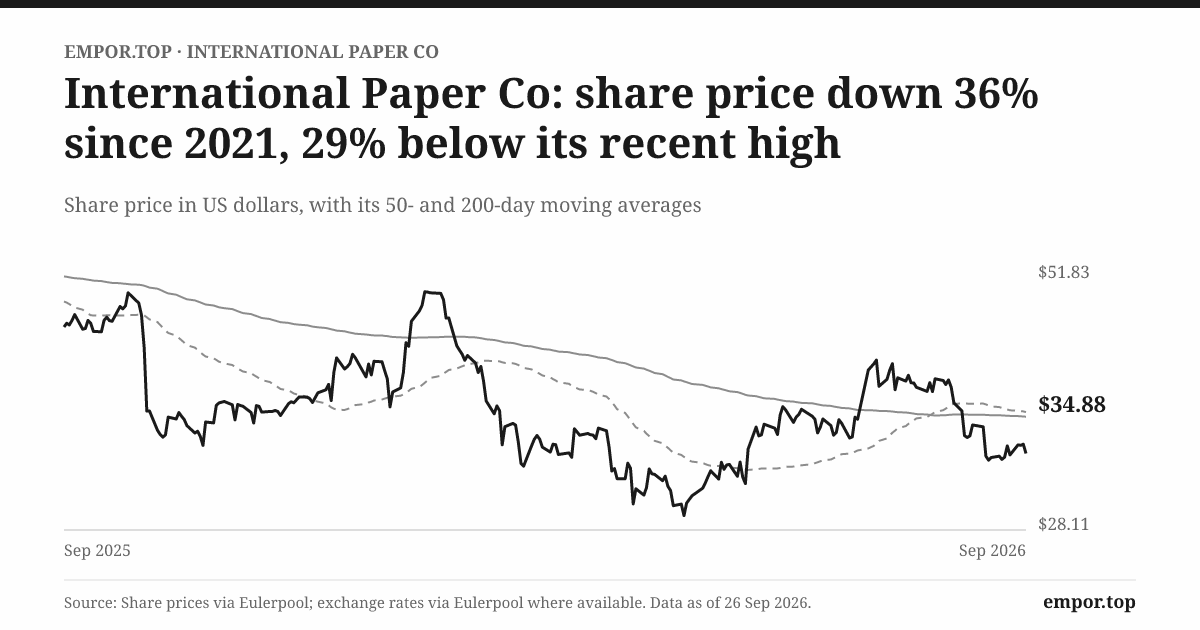
The stock tells the rest. On September 25, 2026, International Paper shares closed at $35.02, a market value of roughly $18.5 billion.6 That is below the $42 per share Brazil's Suzano was reported to have offered in May 2024, an approach Suzano later abandoned, saying IP had not engaged.78 It is also well below the $55.63 share price at which IP valued the stock it issued to buy DS Smith.9
So this is the story of an old American paper company run by an outsider who bet on a very new idea: that industrial management systems honed on pumps and valves could be applied to paper mills and box plants, and that bigger was better, until it wasn't. It is a story about capacity, cost curves, a transatlantic acquisition that is being partly unwound barely two years after it closed, and whether a turnaround can deliver before patient shareholders run out of patience.
The central question for a long-term investor is simple: is International Paper a self-help story whose earnings are delayed rather than denied, or is it a company whose promises keep moving further out of reach? To answer it, one has to start with how IP became a box company at all.
 Subscribe on LinkedIn
II. The Paper Trust: 1898 to the Turn of the Century
On January 31, 1898, fourteen paper companies in the northeastern United States combined and incorporated as International Paper. The new company ran seventeen mills with 101 paper machines and about 1,500 tons of daily output, and it was capitalized at nearly $40 million.10 It was a creature of the trust era, and it behaved like one: at birth, IP supplied about 60% of the newsprint sold in America, then the largest printing-paper market in the world.10
That dominance did not last. By 1913, IP's share of American newsprint had fallen to 26%, and that year the Underwood Act removed duties on Canadian newsprint imports, handing a cost advantage to mills north of the border.10 IP responded by shifting newsprint production into Canada, building mills at Three Rivers in 1922 and Gatineau in 1927 through a subsidiary, Canadian International Paper.10
The lesson from the first chapter is still relevant. Scale in paper is real, but it is not a moat by itself. When a cheaper source of fiber or energy appears, or when trade rules change, a dominant share can erode quickly. Paper is a product in which customers switch mills when prices diverge, and in which the lowest-cost producer tends to set the pace for everyone else.
Over the twentieth century, IP moved south to the pine forests of the American South, into kraft paper and packaging, and became one of the largest forest products companies on earth. It owned land, pulp mills, printing-paper mills, distribution businesses, and box plants. For decades, the corporate strategy was essentially "own every step," from tree to finished product.
For investors today, most of that sprawl is history. What matters is that by the early 2000s, IP had become a collection of businesses with very different economics, and the next twenty years were spent narrowing it down.
The human scale of the company is still large. At the end of 2025, International Paper had about 62,600 employees, roughly 30,400 of them in the United States; of about 20,700 U.S. hourly workers, around 11,500 were represented by unions.11 That matters for everything that follows. Closing a mill in a company like this is not a spreadsheet exercise. It involves union agreements, local communities that have depended on a single employer for generations, and, in Europe, formal consultation processes with works councils.
III. Becoming a Box Company: 2012 to 2021
In February 2012, International Paper closed the purchase of Temple-Inland, a Texas company with seven mills and 59 converting facilities, for $32 a share in cash, a deal worth about $4.5 billion including roughly $700 million of assumed debt.12 Management said the acquisition strengthened its "North American packaging business."12 It was the clearest statement yet of where IP wanted to go: corrugated boxes.
What IP actually makes
A short explanation helps, because the rest of the story depends on it. A corrugated box is made of containerboard, which comes in two main flavors: linerboard, the flat outer walls, and medium, the wavy fluted layer in between. Paper mills turn wood fiber or recycled boxes into rolls of containerboard. Box plants, often called converting plants, then glue, cut, print, and fold those rolls into the boxes that carry everything from Amazon deliveries to chicken breasts to fresh produce.
The economics are like a steel mill feeding a fabrication shop. The mill is expensive, runs continuously, and makes money only when it runs full. The box plant is cheaper, closer to the customer, and wins or loses business on service, design, and delivery reliability. An "integrated" producer like IP owns both, and the profitability of the whole system depends on keeping the mills full while charging box customers a fair price.
There is one more wrinkle worth understanding. Some mills make containerboard from virgin wood fiber, pulped from trees, which produces stronger board and ties the mill to nearby forests. Others use recycled fiber, known in the trade as OCC, short for old corrugated containers, which means yesterday's shipping boxes collected from supermarkets and warehouses. Virgin mills tend to be larger and cost more to build; recycled mills can sit near cities but are exposed to swings in the price of used cardboard. The mix matters because it determines which costs hurt a producer when inflation hits, a point that becomes central in 2026.
Finally, containerboard prices in North America are largely referenced to published industry indices, and many box contracts adjust to those indices with a lag of one or more quarters. Think of it like a mortgage rate that resets every few months rather than daily. When producers announce a price increase, it takes time to show up in the index, and more time to reach invoices. That lag, harmless in a steady market, becomes a source of frustration when costs rise faster than prices can follow.
The pulp detour
Not every move was packaging. On December 1, 2016, IP completed its purchase of Weyerhaeuser's pulp business for $2.2 billion in cash, picking up five pulp mills with about 1.9 million metric tons of capacity, plus two modified-fiber mills.13 Fluff pulp, used in diapers and hygiene products, was pitched as a steadier business than printing paper. It is worth remembering that price, because it comes back later.
Spinning off paper
On October 1, 2021, IP completed the spin-off of its printing-papers business as Sylvamo, distributing one Sylvamo share for every eleven IP shares and keeping 19.9% of the new company.14 International Paper described what remained as "a highly-advantaged, corrugated packaging-focused company."14
The Sylvamo spin is useful context for the current split. IP has done this before: separate a business with different economics, keep a minority stake, and distribute the rest to shareholders. The pattern of retaining a slice of the spun company would reappear in 2026.
By 2021, then, IP had become mostly a North American box company with a pulp business attached. It was big, but big was not the same thing as best. That distinction would define the next chapter.
IV. The Sutton Stall: 2021 to 2023
Mark Sutton joined International Paper in 1984 and worked his way up through the mills, eventually running the company for about a decade.15 He was the archetypal paper-industry lifer, fluent in the language of machines, outages, and fiber costs.
By the time the pandemic box boom faded, IP had a problem that insiders could see in the numbers. Net sales fell 10.6% in 2023 to $18.9 billion.16 Demand hit a trough in March 2023 as customers worked through excess inventory, and while destocking was over by the fourth quarter, restocking had not begun.16
The pandemic had distorted everything. When the world moved its shopping online, boxes became the physical infrastructure of e-commerce. IP noted at the time that e-commerce shipments were up about 30% since 2019.16 The industry had responded to the boom by adding capacity, and when the boom unwound, box demand fell while the capacity stayed. It is the classic commodity trap: capacity decisions are made in good times and paid for in bad ones.
Management's outlook for 2024 anticipated about 3% box demand growth.16 That optimism, a recurring feature of IP's forecasts, is worth noting early, because the gap between expected and actual demand would become one of the defining themes of the Silvernail years as well.
"Value over volume"
Sutton's response, articulated on the fourth-quarter 2023 call, was a strategy called "value over volume": improve margins, participate selectively, and charge appropriately for added service, even if it meant trailing the industry on box volume in the short run.16 He told investors, "We expect our earnings to improve through this process."16
The phrase is worth pausing on. In a commodity industry, "value over volume" can mean two very different things. It can mean the company has a genuine service edge and is finally pricing it. Or it can mean the company is losing share and dressing it up. At the time, IP expected to trail industry unit volume while the reset happened.16 The market had to take the benefit on faith.
The outsider question
In March 2024, the board chose not to promote from within. It named Andrew Silvernail CEO effective May 1, 2024, with Sutton staying on as chairman for the transition.17 One analyst, Michael Roxland, suggested at the time that an outsider could bring fresh operational thinking, as recent leadership changes at competitors had done.15
The board's choice was itself a verdict. After decades of paper-industry insiders, IP was betting that the answer to its problems was not a better papermaker but a better operator. The question for investors has been whether that bet is right.
V. Enter Silvernail: The 80/20 Outsider
Picture a manufacturing executive who has spent his career running businesses that make pumps, flow meters, and engineered components, walking into a Memphis headquarters that has been making paper since before the Wright brothers flew. That was the scene in May 2024.
Who he is
Silvernail came up through Danaher, Newell Rubbermaid, and Rexnord, then ran IDEX Corporation as chairman and CEO from 2011 to 2020.17 IP's announcement highlighted that IDEX's total shareholder return exceeded 500% during his tenure.17 He later ran Madison Industries, one of the largest privately held companies in the world, and was an executive adviser at KKR before joining IP.17 He also sits on the board of Stryker.17
The Danaher lineage matters. Danaher is famous for its "business system," a kind of operating religion built around continuous improvement, and IDEX under Silvernail was known for a discipline called 80/20.
What 80/20 means
The idea is borrowed from the Pareto principle: roughly 80% of a company's profit comes from 20% of its customers and products. The practical version is ruthless. Identify the customers, products, and plants that generate most of the value. Serve them extraordinarily well. Simplify, reprice, or exit the rest.
At the March 2025 investor day, Silvernail explained it this way: "What 80/20 does for us is it gives you a sense of what matters most, where is value, and how you're going to relentlessly drive towards value."3
In a pump company, 80/20 can mean dropping thousands of low-volume product variants. In a paper company, it means something harder: closing mills that are losing money, consolidating box plants, and walking away from customers whose orders fill the machines but destroy returns.
The lighthouse experiment
IP's first proof point was what it called the "lighthouse" model, piloted around Atlanta and Chicago. The idea was to split box plants in a region into "superplants," which run long, standard orders for large customers, and "hybrid plants," which handle complex, shorter runs.3 Management reported that the pilots delivered about $20 million of fixed cost reduction and a 20% productivity improvement.3
That is a genuine operational idea, not just a slogan. Box plants lose efficiency every time they change a job. Grouping similar work together reduces changeovers the way a restaurant runs better when the grill cook is not also making desserts. The limitation is that two pilots do not prove a network. By the investor day, 80/20 had been rolled out to more than 24 plants with a goal of 60 by year-end.3
Early moves and early results
Within months, IP's go-to-market reset was described as "essentially complete."18 In the fourth quarter of 2024, the company closed five box plants and the Georgetown, South Carolina pulp mill, which it said would remove about $110 million of annual cost.18 Silvernail claimed "an entire standard deviation" of improvement in on-time delivery.18
He also announced a greenfield box plant in Waterloo, Iowa, calling it "by far the largest box plant investment we have ever made," with startup expected in mid-2026.18 Hold on to that date, too.
The pruning went beyond plants. By the third quarter of 2025, IP had exited its bags business and outsourced a significant part of its IT functions, and management said its closure decisions avoided a projected $300 million capital call, money that would otherwise have been spent keeping marginal assets alive.4 That last point is the most important and least visible part of 80/20 in a capital-heavy business. A paper mill always needs money: a new recovery boiler, a rebuilt paper machine, environmental upgrades. Every dollar spent sustaining a mill that should close is a dollar not spent on a mill that could win.
The style
Silvernail's public manner is plain-spoken and numbers-first. He talks about "controlling the controllables," a phrase he repeated on the first-quarter 2026 call.19 He is comfortable announcing closures, comfortable telling analysts that inflation ate the gains, and comfortable setting very large targets. That last trait is both his appeal and the source of the credibility questions discussed later. Operators from the Danaher tradition often set stretch goals deliberately, on the theory that organizations rise to ambitious targets. The risk is that public markets treat those goals as forecasts, and punish the gap.
The early Silvernail era showed a CEO who moved fast, closed facilities without sentimentality, and spoke fluently about operating metrics. What it did not yet show was sustained earnings growth. That would require time, and Silvernail was about to make the biggest decision of his tenure before the first results were in.
VI. The DS Smith Bet and the Suzano Gambit
In the spring of 2024, before Silvernail had formally taken over, two deals collided in the same six weeks, one in which IP was the hunter and one in which it was the hunted.
Outbidding Mondi
DS Smith was a London-listed packaging group with a large European box and recycled-paper footprint. In February 2024, Mondi made a £5.1 billion approach for it.20 International Paper countered with an all-share offer, and on April 16, 2024, DS Smith agreed to IP's bid, valuing it at about £5.8 billion.20 DS Smith shareholders would receive 0.1285 IP shares for each of their shares and own about a third of the combined company.20 IP also pledged a secondary listing in London.20
The logic, as presented, was scale. When the deal completed on January 31, 2025, Silvernail declared that the combination would "create the world's leading sustainable packaging company."9 IP issued about 178 million new shares; at the closing price of $55.63, the consideration was worth roughly $9.9 billion.9 Legacy IP shareholders ended up with about 65.9% of the enlarged company.9 The European Commission cleared the deal on January 24, 2025, on the condition that IP divest five European box plants.9 Synergies were initially set at at least $514 million.9
The integration plan was designed to be gentle. DS Smith kept its brand and operated as a subsidiary, its former chief executive Miles Roberts stayed on as a consultant for up to two years, and IP took a secondary listing in London, where it trades under the ticker IPC.9321 DS Smith's North American operations were folded into IP's, while IP's existing European box plants were placed under DS Smith.3 In hindsight, that reshuffling was the first draft of the eventual split: from the start, the combined company was organized as two regional businesses under one roof.
Suzano knocks
Then came the plot twist. In May 2024, Suzano, the world's largest pulp producer, verbally approached IP's board about an all-cash takeover at $42 a share, worth nearly $15 billion.7 The offer was conditional on IP abandoning the DS Smith deal.7 IP shares jumped 12% intraday on the report before closing up 5%.7
On June 26, 2024, Suzano walked away, saying it had reached "the maximum price for the transaction to generate value for Suzano, without engagement from the other party."8
Evaluating the fork in the road
This is one of the most important decisions in the company's modern history, and it deserves an honest scorecard. IP's board chose a paper-for-paper merger, paid in stock, over a cash bid at $42 from a strategic buyer. More than two years later, IP stock trades around $35.6
Hindsight is unfair to boards. A $42 cash bid in 2024 was not necessarily adequate; Suzano itself said it was not willing to go higher, and the board had a duty to weigh the long-term value of an independent IP with DS Smith. The company has also paid dividends in the meantime, $1.85 a share annually.22 Still, the market has so far sided with the path not taken. The DS Smith decision will be judged by whether the separated companies are ultimately worth more than $42 a share plus dividends, and that verdict is not yet in.
A consolidating industry
The competitive context sharpened the pressure. On July 5, 2024, Smurfit Kappa completed its combination with WestRock, creating Smurfit Westrock, a company with more than $32 billion of revenue, 63 paper mills, and about 100,000 employees across 40 countries.23 Its CEO, Tony Smurfit, promised to "conquer the world of sustainable, paper-based packaging."23
IP's DS Smith deal can be read as a defensive response to that transatlantic giant: if Smurfit Westrock could be global, so could IP. The irony, as the next sections show, is that IP would conclude within a year of closing that the two regions had "almost zero overlap."5
VII. Burning the Boats: The North American Turnaround
A paper mill closure has a particular sound. The machines, which normally run twenty-four hours a day, seven days a week, spin down for the last time. In Savannah and Riceboro, Georgia, that happened in September 2025.
The closure program
On August 21, 2025, IP announced the permanent closure of its Savannah containerboard mill and packaging plant, along with its Riceboro containerboard, timber, and lumber mills, affecting about 1,100 jobs.24 Earlier in 2025, it had already announced the closure of the Red River containerboard mill in Louisiana.3 At the same time, IP committed $250 million to convert the No. 16 machine at its Riverdale mill in Selma, Alabama, so that it would produce containerboard.24 The net effect was to cut IP's annual containerboard capacity by about one million tons.24
Across the company, more than 4,500 jobs had been eliminated between October 2024 and the start of 2026.25
Why shrinking can be the right move
Here is the counterintuitive economics. A company that makes a commodity cannot usually raise prices on its own. But if an industry has too many mills, each producer running below capacity pushes prices down for everyone. When IP closes its highest-cost mills, three things happen. Its average cost per ton falls because the worst mills are gone. Its remaining mills run fuller. And the whole industry becomes tighter, which supports prices.
IP was not alone. North American containerboard producers announced closures in 2025 that trade press described as a "historic 10% cut" in production capacity.26 That industry-wide discipline made the 2026 pricing environment possible: producers pushed through multiple rounds of increases, and Fastmarkets RISI recognized a net $100 per ton from the first two rounds through August.26 A third round followed, with Packaging Corporation of America announcing an unprecedented $140 per ton and IP, Smurfit Westrock, and Cascades following with $80 to $110.26
Did it work?
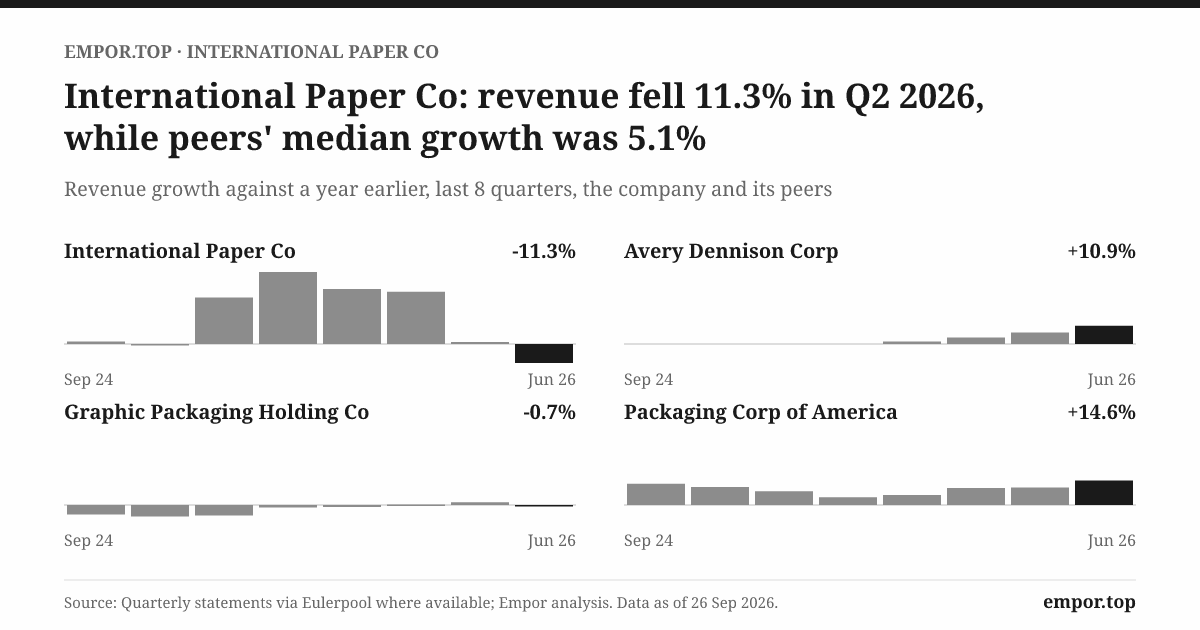
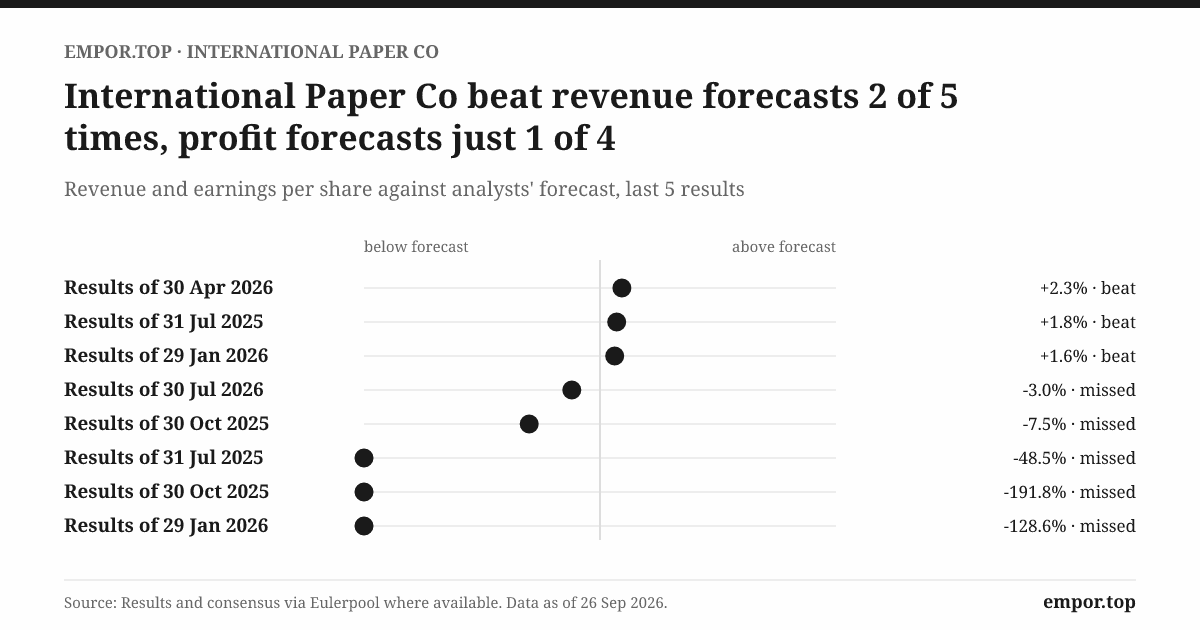
The evidence is mixed but real. On the third-quarter 2025 call, management reported that North American EBITDA was up about 40% year-to-date, with 370 basis points of margin expansion.4 In the first quarter of 2026, North American box volumes grew 2.5% while the industry declined 0.3%.19 In the second quarter, volumes grew 1.7% on a per-day basis, and management said mill performance had improved about 500 basis points year over year.2
For the full year 2025, the North American packaging segment generated $15.2 billion of sales and $572 million of operating profit, and management highlighted a 37% year-over-year improvement in adjusted EBITDA in the second half.27 Operating profit that thin relative to sales shows how much depreciation and restructuring the region was still carrying, but the second-half trajectory was the first hard evidence that the self-help program was reaching the income statement.
Management credits specific commercial moves. On the July 2026 call, it pointed to new business wins supported by its Aurora Innovation Center, a packaging design facility, and to strengthened customer relationships.2 It also disclosed small but telling headwinds, such as contamination problems in West Coast fruit and vegetable markets that dented box demand in that region.2 Protein, produce, and consumer staples are the bread and butter of the North American box market, which is one reason boxes track the grocery cart more closely than the stock market.
Those are meaningful numbers. They suggest the "value over volume" phase, in which IP was losing share, has given way to a phase in which it is winning business again. The Riverdale conversion finished in the second quarter of 2026, ahead of the third-quarter target set a year earlier.224
But the delivery record is uneven. The Waterloo box plant, first slated for mid-2026 startup, is now expected to start in the fourth quarter of 2026 and be fully operational in the second quarter of 2027.182 And the headline profits have not yet followed the operational metrics. North American operating profit was $204 million in the second quarter of 2026, down from $248 million in the first quarter, even as sales grew.28
Why? Silvernail's own answer on the July call was blunt: "Pricing gains are still being absorbed by inflation."2 Recycled fiber, diesel, and freight costs rose, the Middle East conflict pushed energy up, and IP's price increases arrive with a lag because box contracts reprice slowly.2
The first half of 2026 offered a case study in how many things can go wrong at once. A January winter storm cost about $53 million of EBITDA.19 IP announced a $70 per ton containerboard increase for March, but the market recognized only $50 net, which management estimated would add about $175 million in North America for the year, mostly in the second half.29 Silvernail said January had been "really strong" thanks to industry capacity cuts, but that the market flattened afterward.29 Then, in July, Pine Hill's roof failed. The September price increase, management said, would mainly benefit 2027 rather than 2026, following the usual contract lag.2
Each of these is individually explainable. Together, they reveal the business's true nature: a high fixed-cost system in which small changes in price, volume, or cost swing profits dramatically. That operating leverage is what makes the bull case exciting, and it is also what makes guidance fragile.
Capital spending into the teeth of it
Management has not slowed investment. On the July call, it outlined four major deployments it expects to return mid-teens to mid-20s percentages: the NORPAC mill acquisition, the Riverdale conversion, a converting operation in Dover, and the Waterloo box plant.2 NORPAC, the North Pacific Paper mill in Longview, Washington, closed on June 4, 2026, for $368 million, and was designed to expand lightweight packaging capacity and cut West Coast distribution costs.302 IP also committed $225 million to a new Mississippi box plant scheduled to open in the fourth quarter of 2027.29 Capital spending was $533 million in the second quarter alone.2
The return targets are management's estimates, not realized results. The first reading on NORPAC was modest: in its first weeks under IP ownership through June 30, it contributed $36 million of sales and a $5 million loss.30 That is far too short a period to judge, but it is a reminder that a projected return is a claim to be tested, not a fact to be banked.
The peer mirror
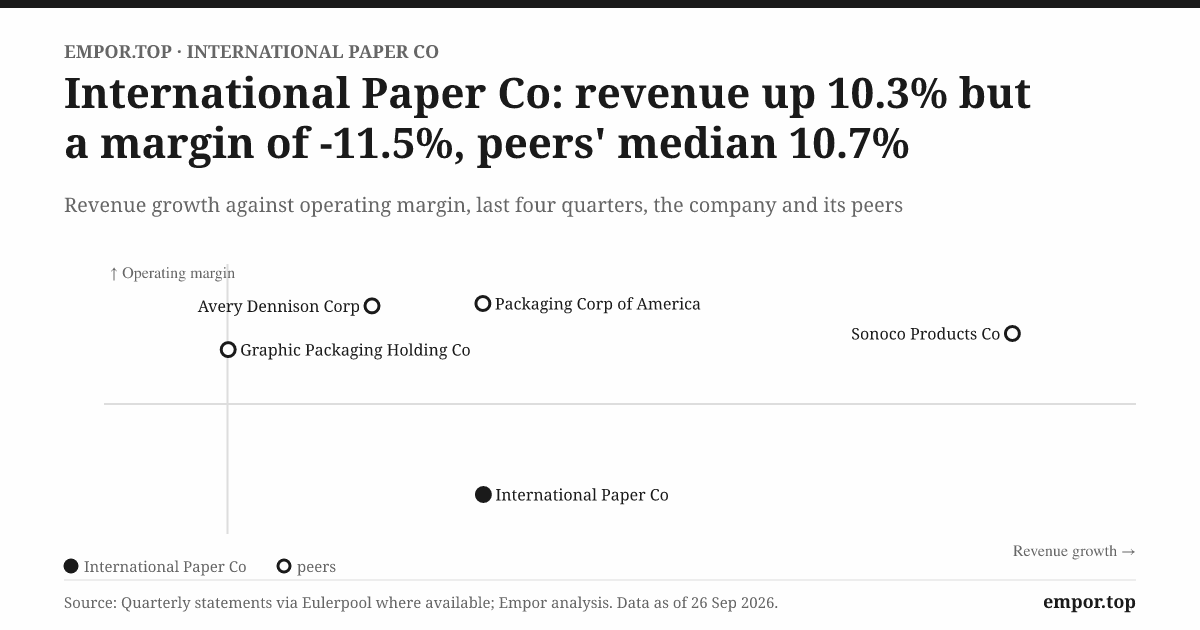
The most useful comparison is Packaging Corporation of America, the industry's margin benchmark. In the second quarter of 2026, PCA generated about $486 million of EBITDA on $2.5 billion of sales.31 IP's whole company generated $587 million of adjusted EBITDA on $6.0 billion.28 Even allowing for IP's loss-making Europe segment, the gap is stark. PCA's CEO described demand as strong, with record quarterly corrugated shipments in its legacy operations.31
The conclusion from the evidence is that IP's North American turnaround is operationally genuine: share is recovering, mills are running better, capacity has been rationalized. The claim that this will translate into peer-level margins is still unproven. The metric that would confirm it is North American EBITDA margin moving toward the high teens as the 2026 price increases flow through in 2027. The metric that would falsify it is another year of "pricing absorbed by inflation."
VIII. Europe Bites Back: DS Smith and the $2.47 Billion Impairment
When International Paper bought DS Smith, it inherited a business headquartered in London, with mills and box plants across Western and Eastern Europe, and a management team led by a finance executive, Tim Nicholls, who became executive vice president and president of the European business in April 2025.3
Almost immediately, Europe turned against it.
Demand and price in reverse
On the third-quarter 2025 call, management described soft European demand and destocking as customers waited for paper prices to fall.4 The EMEA business still produced $209 million of adjusted EBITDA in the quarter, but management said market weakness had cost it about $500 million of profit.4 Analysts pressed on how much of Europe's paper capacity was uneconomic; the discussion referenced 40% to 50% of production.4 The stock fell more than 12% in pre-market trading after the results.4
IP cut its 2025 targets to about $24 billion of sales and $3 billion of adjusted EBITDA.4 Only seven months earlier, at the investor day, management had framed 2025 EBITDA at $3.5 billion to $4 billion.3
Management proposed further closures across Eastern Europe, the Nordic region, and Italy, but noted that consultation processes constrain the timing.4 This is the structural difference between restructuring in Georgia and restructuring in Germany or Italy. In the United States, a company can announce a mill closure in August and shut it in September. In much of Europe, labor law requires formal consultation with employee representatives before closures, a process that can take many months and shape the final outcome. The same 80/20 playbook therefore runs at a slower tempo and at a higher cost per job.
For the full year 2025, the EMEA segment generated $8.45 billion of sales and an operating loss of $236 million.27 Management cited the war in Ukraine and trade tensions among the headwinds.5
The write-down
Then came the accounting reckoning. As part of its annual review and its evaluation of a separation, IP measured the fair value of the European reporting unit and recorded a $2.47 billion pre-tax, non-cash goodwill impairment as of December 31, 2025.27 Combined with $960 million of accelerated depreciation, $630 million of restructuring charges, and a $1.07 billion impairment on the pulp business, IP reported a 2025 loss from continuing operations of $2.84 billion.27
Goodwill is the premium a buyer pays above the value of the assets it acquires. An impairment is an admission, in accounting language, that the premium is not recoverable at current expectations. When a company writes off about a quarter of the roughly $9.9 billion it paid for an acquisition within a year of closing, the plain-English message is that the deal was overpriced relative to what Europe is now expected to earn.279 Management did not describe it as a failure; the numbers make the case for them.
The European restructuring
In January 2026, management said it had closed 20 European sites in 2025, affecting about 1,400 roles, with seven more facilities and 700 positions under discussion, and expected run-rate savings of more than $160 million.525 The response was the same playbook used in the United States, applied as fast as local rules allowed. By the second quarter of 2026, IP had closed or consolidated 31 European facilities, affecting more than 3,000 positions, and reported $210 million of run-rate cost savings.2 It planned to invest about $400 million in Europe in 2026 for footprint changes and 80/20 implementation, including a new containerboard machine at Lucca, Italy, a German consolidation, and a Romanian expansion.52
On the January 2026 call, Nicholls acknowledged, "We are still at an early stage... expect to begin seeing the benefits of these actions in 2026."5 By mid-2026, those benefits were not yet visible in reported profit. The EMEA segment posted an operating loss of $51 million in the first quarter and $80 million in the second, blamed on geopolitical uncertainty, weak consumer sentiment, and heavy maintenance.28 Management cut its 2026 EMEA EBITDA outlook to $900 million to $1 billion from $1 billion to $1.1 billion.29
Why Europe is harder
It helps to understand why the same box can be a better business in Memphis than in Milan. North American containerboard is dominated by a handful of large, integrated producers with big virgin-fiber mills sitting on vast southern pine forests, a structure that lends itself to price discipline. European containerboard relies more heavily on recycled fiber, is spread across many countries with different customers, languages, and labor rules, and includes more independent mills that sell to independent box makers. When demand softens, there are more players with an incentive to cut price to keep their machines running. Management's own description of Europe as having "more localized dynamics at the country level" is a polite way of saying it is a harder market to discipline.5
That structural difference also explains why the 80/20 playbook may deliver less in Europe. Closing a high-cost mill in the United States helps IP and tightens a concentrated market. Closing one in Europe helps IP's costs but may simply hand volume to a nearby independent competitor, with less effect on market pricing.
What the European experience says
Test the original thesis, "the world's leading sustainable packaging company," against the record. The synergy case was raised from $514 million to $600 million to $700 million at the investor day.3 Less than a year later, the company announced that it would separate the businesses, which by definition gives up any synergies that depended on them being together.
The fairest reading is that the DS Smith acquisition was not a single failed transaction but a thesis that changed. The global-scale thesis has been rejected by management's own actions. What remains is a narrower claim: that Europe, run independently and restructured with the same toolkit that is working in North America, can become a respectable business. That is plausible but unproven. The KPI to watch is European EBITDA margin through 2027, not cost-savings announcements, since cost savings have so far been overwhelmed by weak demand.
IX. Pruning to the Core: Selling the Pulp Business
On the same day it announced the Georgia closures, August 21, 2025, International Paper agreed to sell its Global Cellulose Fibers business to American Industrial Partners.24 The business made fluff and specialty pulp for diapers, hygiene products, and industrial uses, generated $2.8 billion of revenue in 2024, and employed about 3,300 people at nine facilities.24 Silvernail called it "a strong business."24
The price of the exit
The deal closed on January 23, 2026, at a headline value of $1.5 billion, including preferred stock with an initial liquidation preference of $190 million.32 In IP's accounting, the consideration was $1.1 billion of cash plus preferred stock valued at $168 million, and the company had already taken a $1.07 billion impairment on the business before the sale.3027
Now recall the 2016 purchase: $2.2 billion for Weyerhaeuser's pulp mills alone.13 IP sold the entire pulp segment, including those mills and its own legacy pulp assets, for less than it paid for the Weyerhaeuser piece a decade earlier, after writing down more than a billion dollars. That is not a Silvernail decision to own; the 2016 acquisition belonged to the prior regime. But it is a useful data point for anyone assessing IP's long-run capital allocation. Two of the largest non-core bets of the last decade, the pulp purchase and the DS Smith premium, have produced large write-downs.
Why sell anyway?
Silvernail's logic is that IP should be a pure box company, and that capital tied up in a pulp business with a different customer base, different cycles, and different competitors was capital not earning its keep. Pulp prices are set globally, often by low-cost South American producers like Suzano, whose eucalyptus plantations grow far faster than American southern pine. Competing against them in fluff pulp was a hard business.
There is also a small residual link. Part of the consideration came as preferred stock in the buyer's vehicle, so IP retains a financial claim on the business it sold.3230 It is modest in the context of IP's balance sheet, but it means the pulp cycle has not entirely left IP's books. The business continues to operate as an independent company headquartered in Memphis, a few miles from its former parent.
Strategically, the sale also marked a philosophical shift. For most of its history, IP believed that owning more of the value chain, from forest to pulp to paper to box, created resilience. Silvernail's IP believes the opposite: that focus beats breadth, and that each business should be owned by whoever can run it best. The pulp sale, the bags exit, and the European spin-off are all expressions of the same conviction.
The sale was defensible on strategy. It was expensive in retrospect. The lesson for investors is that IP's capital allocation record over the long span has more expensive exits than successful diversifications, and that any future acquisition should be judged against that base rate rather than against management's presentation.
X. The Great Unwinding: One Company Becomes Two
On January 29, 2026, International Paper did three things in one press release. It reported a $2.84 billion loss for 2025, issued 2026 guidance, and announced that it would split into two independent public companies.2733
The structure
The remaining International Paper will be the North American business, combining legacy IP and DS Smith assets in the region, with 2025 sales of $15.2 billion.33 The Europe, Middle East, and Africa business, which had 2025 sales of $8.5 billion, will be spun off to shareholders and listed in London and New York.33 IP intends to keep a "meaningful ownership stake," later described as about 20%, which it plans to hold for 12 to 18 months after the split.3329
Silvernail will remain chairman and CEO of IP, with Lance Loeffler as CFO and Tom Hamic running the North American packaging business.33 Tim Nicholls will lead the European company.33 The company set a timeline of 12 to 15 months from the announcement, pending U.S. and U.K. regulatory and board approvals.33
The rationale
Silvernail's argument was that the businesses are "two regional powerhouses that really have very, very, very little overlap."33 On the call, he said, "The value is really in the regions... how those businesses go to market with customers... they're really distinctive markets."5 He described North America as a market with integrated, resilient supply positions and steady demand, and Europe as a market with localized country-level dynamics and a greater emphasis on sustainability.5
Every one of those facts was true when IP bought DS Smith. North American and European box markets did not become different in 2025. What changed was the valuation lens: a combined company that included a struggling, low-margin European business was dragging on the multiple the market would pay for the improving North American business.
Two companies, two different stories
The remaining IP will be, in effect, a return to the company that existed in 2023, minus the pulp business and a million tons of high-cost capacity, plus DS Smith's North American plants, the Riverdale conversion, NORPAC, Waterloo, and a new operating system. On management's January 2026 framing, it was supposed to carry about $3.5 billion of the $5 billion 2027 EBITDA target.5 Its investment case rests almost entirely on North American pricing, volume share, and cost-out.
The European company will be a different animal: a recycled-fiber-heavy, multi-country business led by a former DS Smith finance chief, Tim Nicholls, carrying the restructuring burden of 2025 and 2026 and a much larger share of its value in turnaround expectations.333 Its prospective shareholders, many of them in London, will judge it against European peers rather than against PCA.
One structural detail deserves attention. IP plans to keep roughly a fifth of the European company for 12 to 18 months, which suggests an eventual sale or distribution of that stake.29 Whether that later step will be tax-efficient, and how it will affect IP's leverage, has not been disclosed in detail. Retained stakes can be useful, providing a source of future cash, but they also keep IP's fortunes partially tied to the business it is separating from.
Myth: the split fixes Europe
Separation is not a cure. It removes a distraction from IP's North American management and gives European investors a clearer asset to value, but it does not change the demand, pricing, or cost curve in Europe. Spin-offs can unlock value when a strong business is hidden inside a weak one, as the Sylvamo spin was meant to do in 2021.14 They can also leave shareholders holding a smaller, more leveraged, less diversified business with separation costs to pay. IP booked $43 million of pre-tax separation costs in the second quarter of 2026 alone.28
The dividend question
The most pressing investor question concerns the dividend. IP has paid $0.4625 a quarter since November 2021, or $1.85 a year, a yield above 5% at recent prices.22 In 2025, it generated $1.698 billion of operating cash flow, spent $1.857 billion on capital expenditures, and paid $977 million in dividends.27 Free cash flow was negative $159 million before the dividend.27
On the January call, Silvernail said, "The dividend policy will be maintained through 2026," while acknowledging that the 2026 free cash flow target of $300 million to $500 million might not cover it without further price increases.5 Management put the EBITDA breakeven for dividend coverage at $3.6 billion to $3.7 billion.5 The 2026 guidance, after two cuts, is $3.2 billion to $3.4 billion.2
In other words, on management's own numbers, the dividend is not covered by free cash flow in 2026. It is being funded by the balance sheet, which carried about $8.5 billion of net debt at June 30, 2026.30 How the dividend will be divided between the two companies after the split has not been disclosed.22 An investor who owns IP for income should treat the post-split dividend as an open question rather than a given.
The first half of 2026 showed the pattern in miniature. IP paid $490 million in dividends and repurchased only $31 million of stock over the six months, while second-quarter free cash flow was negative $7 million.3028 First-quarter free cash flow of $94 million was flattered by a one-time $280 million tax refund.19 Management has chosen, in effect, to protect the dividend and the capital program ahead of the balance sheet. That is a defensible choice if the 2027 recovery arrives on schedule. It is an expensive one if it does not.
An accounting aside
Investors reading IP's results need to keep two sets of books in mind. The GAAP numbers, the ones audited under U.S. accounting rules, have been dominated by charges: in the second quarter of 2026, IP reported a $12 million loss from continuing operations, while its adjusted operating earnings were a positive 4 cents a share.28 The difference is mostly restructuring, accelerated depreciation on closed facilities, and separation costs.
Management excludes these items as "special," and for any single quarter that is reasonable. But restructuring at IP has now run continuously since late 2024, and closures, severance, and separation costs will continue into 2027. When "one-time" costs recur for three years, they start to look like a cost of doing business. A careful investor should compare cumulative adjusted earnings with cumulative GAAP earnings over the whole turnaround, not just quarter by quarter.
There is also a residual judgment on goodwill. After the European impairment, IP still carried about $5.3 billion of goodwill at June 30, 2026.30 If European or North American earnings disappoint again, or if the market values the spun-off European company below its carrying value, further impairments are possible. Insurance recoveries for Pine Hill are another judgment call; management expects insurance to offset most of the roughly $85 million impact, but the timing of recovery was still being finalized in July.2
The guidance slide
Here is the full sequence, told in words rather than a table. In March 2025, the company targeted about $6 billion of adjusted EBITDA for 2027.3 By the third-quarter 2025 call, it was referencing $5 billion.4 In January 2026, management reaffirmed the $5 billion, split as roughly $3.5 billion in North America and $1.5 billion in Europe, and guided 2026 to $3.5 billion to $3.7 billion.527 In April 2026, 2026 guidance was cut to $3.2 billion to $3.5 billion, with cuts in both regions.2919 In July, the top end came down again to $3.4 billion, with North America narrowed to $2.35 billion to $2.45 billion.2
On the July call, Silvernail said commercial gains "have been far more than expected" but absorbed by inflation, and predicted that 2027 would deliver "pretty darn near exactly what we said two years ago," while declining to provide detail, citing regulatory caution ahead of the spin.2
These two statements sit uncomfortably together. A management team that expects to hit its target and a management team that declines to repeat it send different signals. The history of the last eighteen months, in which the long-term target fell by about a sixth 2025 guidance was cut once and 2026 guidance twice, argues for treating 2027 targets as aspirations rather than forecasts.
Credibility, weighed
Fairness requires the other column. Management has done what it said on the operational side: closures announced were executed, the $1.2 billion cost-reduction program is "almost all actioned" according to Silvernail, Riverdale finished early, European run-rate savings exceeded $200 million by the first quarter of 2026, and North American box volumes are outgrowing the industry.22919 Execution costs ran slightly higher than planned.2 The misses are overwhelmingly in the things management does not control: demand, input costs, and European pricing.
That leaves the credibility verdict narrower than either bulls or bears would like. Silvernail's team appears credible on execution of self-help. It has been consistently too optimistic about the external environment, and it has built targets that assume a cyclical recovery that has not yet arrived. The KPI that would test the verdict is simple: whether 2027 adjusted EBITDA, as reported by the two companies combined, approaches the $5 billion target, or whether the target quietly disappears in the separation paperwork.
XI. Myth Versus Reality
Several narratives travel with International Paper stock. Each deserves a direct test.
Myth one: "IP is the biggest, so it is the lowest-cost producer."
Reality: IP is among the largest containerboard producers in North America, with 15 packaging mills and 159 converting plants there at year-end 2025.11 Size gives it purchasing power and network density. But size did not produce superior margins. PCA's EBITDA margin in mid-2026 was roughly double IP's companywide level.3128 IP's own strategy of closing mills is an admission that parts of its system were high-cost. The accurate version is that IP is closing the gap to the low-cost leaders, not already leading.
Myth two: "The DS Smith deal created a global champion."
Reality: The combination lasted as a single company for roughly two years before management announced its unwinding.933 The $2.47 billion impairment on the European unit is the accounting measure of how the premium held up.27 The global-scale thesis has been abandoned by the people who proposed it.
Myth three: "Capacity closures guarantee pricing power."
Reality: Capacity discipline across the industry has helped. Fastmarkets recognized $100 per ton of increases through August 2026.26 But IP's own experience shows the limits: in its first-quarter call, the company said a $70 per ton March increase was recognized at only $50 net, and in July Silvernail said pricing gains were being absorbed by inflation.292 Closures give producers a better hand; they do not remove the customer's ability to push back, or cost inflation's ability to consume the gains.
Myth four: "The dividend is safe because IP has paid it for decades."
Reality: The company's own record contradicts the premise. On March 2, 2009, in the depths of the financial crisis, IP's board cut the quarterly dividend from 25 cents to 2.5 cents a share, a 90% reduction, to save about $100 million of cash a quarter for debt reduction and to protect its credit ratings.34 The circumstances then, a collapsing economy and a leveraged balance sheet, were more severe than today's. But the precedent shows that this board has chosen credit ratings over the dividend before. The relevant question is coverage, not history. 2025 free cash flow was negative before the dividend, and management's own 2026 breakeven EBITDA exceeds 2026 guidance.2752 The dividend's safety depends on the pricing recovery and on decisions about the post-split payout that have not been made public.22
Myth five: "Silvernail's IDEX record proves 80/20 will work here."
Reality: IDEX's 500%-plus shareholder return under Silvernail is documented.17 But IDEX made engineered products with high gross margins and fragmented customers, where pricing power comes from specification. IP makes a product where pricing is set by industry supply and demand, and where input costs are volatile. The 80/20 system has produced real operating improvements at IP, from lighthouse productivity to share gains.319 Whether it can deliver IDEX-like returns in a commodity business is a separate, and unproven, claim.
Myth six: "The DS Smith deal was a total loss."
Reality: This overcorrects. The $2.47 billion impairment and the decision to separate show that IP overpaid relative to what Europe is now expected to earn.27 But IP did acquire real assets: DS Smith's North American operations, now part of IP's network, and a European business with more than $8 billion of sales that management is restructuring with the same methods that are working in the United States.273 Shareholders who received IP stock also keep a claim on both companies after the split. The deal's final scorecard depends on what the European company is worth once it trades independently, and on whether its restructuring produces the margin improvement management expects. A write-down is a verdict on price, not necessarily on the underlying assets.
XII. Bull Case, Bear Case, and the Competitive Chessboard
The war game
Before applying frameworks, it helps to think through how competitors actually behave. North American containerboard is effectively an oligopoly of a few large integrated players. When one of them raises prices, the others decide whether to follow. When one closes capacity, the others benefit without paying the closure cost. And when one tries to grab share, the others can retaliate with price.
In 2026, the pattern has been cooperative on price. PCA led the September round with an unprecedented $140 per ton, and IP, Smurfit Westrock, and others followed with $80 to $110.26 That IP followed rather than led, and asked for less than PCA, is worth noting: the price leader in North American containerboard is not the largest producer by revenue but the one with the best margins.
IP's share-gain strategy is where the game gets delicate. If IP wins volume from rivals through better service and reliability, competitors may tolerate it. If they perceive it as winning through price, they may respond in kind, which would undermine the industry-wide price increases that underpin IP's own recovery. Management's claim is that its gains come from service, design capabilities, and reliability, not discounting.2 That claim is plausible, given the improvement in on-time delivery management reported and its above-market volumes while prices were rising.1819 But it can only be verified over time by watching whether IP's volume gains persist while industry pricing holds.
Smurfit Westrock, meanwhile, is the competitor most comparable in scale and structure, with operations on both sides of the Atlantic.23 Its decision to stay combined while IP splits is an interesting natural experiment. If Smurfit Westrock can extract value from being transatlantic while IP concludes there is none, one of the two strategies will look wrong in five years.
Porter's five forces, applied
Rivalry among existing competitors is intense but consolidating. In North America, the major integrated players include IP, Smurfit Westrock, PCA, Georgia-Pacific, and others. Smurfit Westrock's 2024 merger created a global competitor of massive scale.23 PCA's 2026 acquisition of Greif's containerboard operations added further consolidation.31 Consolidation tends to support pricing discipline, but it also means IP competes against larger, better-capitalized rivals.
Threat of new entrants is low for virgin-fiber mills. Silvernail noted on the July call that the replacement cost of mill assets has "skyrocketed," and that return thresholds in the mid-teens to high-teens deter new capacity.2 He also flagged overseas competition and alternative materials as risks.2 Recycled-fiber mills and conversions of existing paper machines, like IP's own Riverdale project, remain a way capacity creeps back.
Buyer power is significant. Large consumer goods companies, retailers, e-commerce players, and protein processors buy boxes at scale and multi-source. Box contracts often reprice with a lag to published indices, which is why price increases take quarters to flow through.2 IP's "value over volume" phase in 2024, in which it deliberately shed customers, shows that customers readily move volume when prices diverge.18
Supplier power matters most through input costs. Old corrugated containers, which recycled mills use as raw material, energy, chemicals, freight, and diesel fluctuate and have eaten pricing gains in 2026.2 IP's integration into wood fiber helps, but it does not insulate it from energy and transport inflation.
Threat of substitutes is moderate. Plastic packaging and reusable containers compete in some applications, but regulatory and customer pressure toward recyclable materials has generally favored paper. In Europe, management noted that customers place greater weight on sustainability.5 That is a tailwind, but not one that has shown up in European profits yet.
Hamilton Helmer's 7 Powers, tested
Scale economies: IP has network density, the ability to serve a national customer from multiple mills and plants. This is real but not unique, since Smurfit Westrock and Georgia-Pacific have comparable reach. Verdict: a parity power, not a differentiating one.
Network economies: None in the classic sense. Boxes do not become more valuable because other customers use the same supplier.
Counter-positioning: Arguably, IP's decision to shrink capacity and prioritize margin over volume counter-positions it against competitors who need to fill mills. But competitors closed capacity too, so this is not a lasting advantage.26
Switching costs: Modest. Box design, print tooling, and supply reliability create some friction, especially for complex packaging, but large customers routinely multi-source. The 2024 volume losses are evidence that switching is feasible.18
Branding: Minimal, since the customer's brand is on the box, not IP's.
Cornered resource: Access to southern U.S. pine fiber is valuable and hard to replicate, but it is shared with other southern mills.
Process power: This is the heart of the Silvernail thesis. If 80/20, the lighthouse model, and mill reliability programs become embedded routines that competitors cannot easily copy, IP could develop a durable cost and service edge. The evidence so far, including 500 basis points of mill performance improvement, above-market box volumes, and 20% productivity in pilots, supports the claim at an early stage.2193 But process power takes years to prove, and PCA has run a disciplined, lean operation for far longer. Verdict: possible, not proven.
The honest summary is that IP has no structural moat in the Helmer sense. Its potential edge is operational, and operational edges are only as durable as the management systems and people that sustain them.
The bull case
The bull case starts with the cycle. North American containerboard capacity fell sharply in 2025, IP cut about a million tons of its own, and producers pushed through three rounds of price increases in 2026, with the third expected to benefit results mainly in the first half of 2027.24262 If demand merely stabilizes, those price increases hit a leaner cost base.
Second, the self-help is real and mostly done. Management says the $1.2 billion cost program is almost fully actioned, with $350 million to $400 million of carryover benefit in North America and $200 million to $250 million in Europe expected in 2027.2 Capital projects, from Riverdale to Waterloo to the $368 million NORPAC acquisition in Washington state and a $225 million Mississippi box plant, are aimed at lowering cost and expanding share in growth markets.3029
Third, the split creates optionality. A pure North American box company with improving margins may command a valuation closer to PCA's, while the European company can pursue its own strategy under a management team fully focused on it. IP's retained stake gives it a way to monetize Europe later.
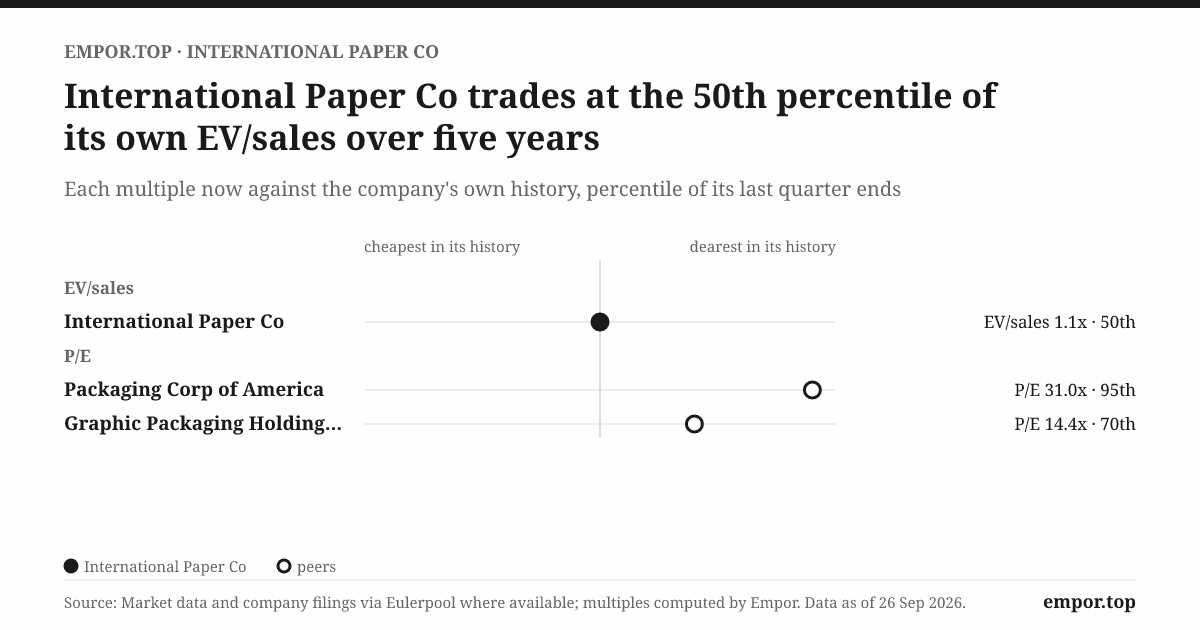
Fourth, the valuation already reflects skepticism. At a market value near $18.5 billion, the stock trades below both Suzano's 2024 offer and the value at which IP issued shares for DS Smith.679
The bear case
The bear case starts with the same cycle. Demand has not cooperated. On the July call, Silvernail acknowledged that the second-half uptick the industry expected had not materialized and cited "affordability issues across the economic spectrum."2 If box demand stays flat, price increases may erode, and the industry's history suggests that closed capacity can return through conversions.
Second, the targets keep moving. The 2027 EBITDA target fell from about $6 billion to $5 billion within months, 2025 guidance was cut in October 2025, and 2026 guidance has been reduced twice.342 Every miss has had an external explanation, but investors pay for results, not explanations.
Third, the balance sheet has less room than it appears. With about $8.5 billion of net debt, free cash flow that did not cover the dividend in 2025 and is guided below dividend coverage in 2026, and separation costs ahead, IP is financing its dividend and capital program partly with debt.30275 Both companies target investment-grade balance sheets, which may constrain the dividend after the split.5
Fourth, Europe may be structurally weak. Management's own discussion of uneconomic European capacity and the $2.47 billion impairment suggest the problem is not just cyclical.427 If the European spin-off trades poorly, IP's 20% retained stake will too.
The activist's memo
A skeptical activist would ask four questions. Why did the board choose a stock-financed acquisition over a $42 cash bid, and what is the accountability for the subsequent impairment? Why is the company maintaining a dividend that its own numbers say is not covered, while spending heavily on capital projects and separation? Why were 2027 targets set so far above what the business has delivered, and will they be formally withdrawn or restated? And after the split, will the North American company commit to margin targets that can be benchmarked against PCA?
These are not accusations of misconduct. They are the natural questions for a company whose operational execution has been solid but whose strategic capital allocation has produced large write-downs.
Risk radar
Only a few macro risks are material here. Consumer demand drives box volume, and a weak consumer hurts it directly. Energy and freight costs, sensitive to geopolitical events including the Middle East conflict management cited, can consume price gains.2 Refinancing risk is modest near term but relevant, with about $1 billion of debt maturing within a year as of June 2026.30 Execution risk in the separation, including systems, governance, and legal infrastructure that management is still building, is the most company-specific risk.2 Weather and single-site disruptions, as Pine Hill showed, can move a quarter.1 Labor relations are a quieter risk: with a heavily unionized U.S. hourly workforce and consultation-driven closures in Europe, the pace and cost of further restructuring are not entirely in management's hands.114
XIII. What to Watch: The Three KPIs That Matter
For a business this complex, it is tempting to track everything. Three measures cut through the noise.
First, North American box shipment growth relative to the industry. This is the clearest test of whether the 80/20 and service investments are working. IP has claimed above-market growth in 2026, and management has spoken of outperforming the market by about 2 percentage points.192 If IP keeps growing faster than the industry while prices rise, it is winning on service rather than price. If it falls back, the operating thesis weakens.
Second, North American adjusted EBITDA margin. Volume growth is only valuable if it comes with profit. The most important question after the split is whether IP's North American business can close the margin gap with PCA as 2026 price increases flow through in 2027. This single number captures pricing, cost-out, mill reliability, and inflation all at once.
Third, free cash flow relative to the dividend. This is the discipline test. The dividend commitment, the capital program, and the balance sheet all meet in this number. Management set a breakeven at $3.6 billion to $3.7 billion of enterprise EBITDA in January 2026.5 Whether the separated companies can fund their dividends from operations, rather than from borrowing, will reveal how much of the turnaround has reached the cash flow statement.
Notice what is not on the list. Run-rate cost savings, facility closure counts, and the number of plants running 80/20 are all inputs, and IP has reported them generously. They matter, but the company's history since 2024 shows that inputs can look excellent while outputs disappoint, because demand and inflation sit between them. The three measures above are outputs. They cannot be improved by announcing another program; they improve only when customers buy more, pay more, or cost less to serve.
It is also worth tracking how management talks about these numbers from call to call. Over the past two years, the tone has shifted from specific multi-year targets to careful caution ahead of the spin.32 If the post-split North American company re-establishes specific margin and cash targets, and then meets them, the credibility discount that has weighed on the stock could narrow. If targets remain vague, investors should assume the discount will persist.
Finally, the European company deserves its own watch list once it lists: its EBITDA margin, its dividend policy, and the fate of IP's retained stake. For IP shareholders, all three will affect the value of what they own on the day the spin is completed.
The next checkpoints are close. IP will report third-quarter 2026 results on October 28, 2026,35 and Silvernail is scheduled to speak at the Baird Global Industrial Conference on November 11.21 The separation is expected in the first half of 2027, which means the story of International Paper as one company is entering its final chapter, and the story of two smaller companies, each asked to prove what the combined company could not, is about to begin.
References
-
International Paper Temporarily Suspends Operations at its Pine Hill, Alabama, Mill — PR Newswire, 2026-07-09 ↩↩
-
Earnings call transcript: International Paper posts Q2 2026 EPS beat, revenue miss — Investing.com, 2026-07-30 ↩↩↩↩↩↩↩↩↩↩↩↩↩↩↩↩↩↩↩↩↩↩↩↩↩↩↩↩↩↩↩↩↩↩↩↩↩
-
International Paper outlines 2027 vision, DS Smith integration plans — Packaging Dive, 2025-03-26 ↩↩↩↩↩↩↩↩↩↩↩↩↩↩↩↩↩↩
-
Earnings call transcript: International Paper misses Q3 2025 forecasts, stock drops — Investing.com, 2025-10-30 ↩↩↩↩↩↩↩↩↩↩↩↩↩
-
International Paper (IP) Q4 2025 Earnings Call Transcript — The Motley Fool, 2026-01-29 ↩↩↩↩↩↩↩↩↩↩↩↩↩↩↩↩↩↩
-
International Paper (IP) stock price and market data — StockAnalysis, 2026-09-25 ↩↩↩
-
Exclusive: Brazil's Suzano readies $15 billion bid for International Paper — Reuters via Yahoo Finance, 2024-05-07 ↩↩↩↩↩
-
Suzano S.A. Form 6-K: End of negotiations with International Paper — SEC, 2024-06-26 ↩↩
-
International Paper completes acquisition of DS Smith — Packaging Dive, 2025-01-31 ↩↩↩↩↩↩↩↩↩↩
-
January 31, 1898: International Paper Incorporated — Forest History Society ↩↩↩↩
-
International Paper Form 10-K for fiscal year 2025 — SEC, 2026 ↩↩↩
-
International Paper Completes Acquisition of Temple-Inland (Form 8-K Exhibit 99.1) — SEC, 2012-02-13 ↩↩
-
Weyerhaeuser completes sale of Cellulose Fibers pulp mills to International Paper — Weyerhaeuser, 2016-12-01 ↩↩
-
International Paper Company Announces Completion of Sylvamo Corporation Spin-Off — PR Newswire, 2021-10-01 ↩↩↩
-
International Paper names Andrew Silvernail as next CEO — Packaging Dive, 2024-03-19 ↩↩
-
International Paper prioritizes 'value over volume' — Packaging Dive, 2024-02-01 ↩↩↩↩↩↩↩
-
Silvernail Elected International Paper Chief Executive Officer — PR Newswire, 2024-03-19 ↩↩↩↩↩↩
-
International Paper details new box plant as part of turnaround strategy — Packaging Dive, 2025 ↩↩↩↩↩↩↩↩
-
International Paper Q1 Earnings Call Highlights — Yahoo Finance, 2026-04 ↩↩↩↩↩↩↩↩↩↩
-
International Paper beats Mondi offer in DS Smith bidding war — City A.M., 2024-04-16 ↩↩↩↩
-
International Paper CEO to Speak at Baird 2026 Global Industrial Conference — PR Newswire, 2026-09-25 ↩↩
-
What Happens to Your IP Dividend When the Split Closes — 24/7 Wall St., 2026-09-23 ↩↩↩↩
-
Smurfit Kappa completes acquisition of WestRock — Packaging Dive, 2024-07 ↩↩↩↩
-
International Paper Announces Strategic Changes — PR Newswire, 2025-08-21 ↩↩↩↩↩↩↩↩
-
International Paper expects at least 7 closures, 700+ layoffs in 2026 — Packaging Dive, 2026-01-29 ↩↩
-
Containerboard pricing holds steady in August — Packaging Dive, 2026-08 ↩↩↩↩↩↩↩
-
International Paper Full-Year and Fourth Quarter 2025 Results (Form 8-K Exhibit 99.1) — SEC, 2026-01-29 ↩↩↩↩↩↩↩↩↩↩↩↩↩↩↩↩
-
International Paper Reports Second Quarter 2026 Results (Form 8-K Exhibit 99.1) — SEC, 2026-07-30 ↩↩↩↩↩↩↩
-
International Paper touts $200M in EMEA cuts ahead of business split — Packaging Dive, 2026-04 ↩↩↩↩↩↩↩↩↩↩
-
International Paper Form 10-Q for the quarter ended June 30, 2026 — SEC, 2026-08 ↩↩↩↩↩↩↩↩↩↩
-
Packaging Corporation of America Reports Second Quarter 2026 Results (Form 8-K Exhibit 99.1) — SEC, 2026-07-22 ↩↩↩↩
-
International Paper Completes Sale of Global Cellulose Fibers Business to AIP (Form 8-K exhibit) — SEC, 2026-01-23 ↩↩
-
International Paper to split into 2 companies — Packaging Dive, 2026-01-29 ↩↩↩↩↩↩↩↩↩↩
-
International Paper announces dividend reduction (Form 8-K Exhibit 99.1) — SEC, 2009-03-02 ↩
-
International Paper to Release Third-Quarter 2026 Earnings on October 28, 2026 — PR Newswire, 2026-09-24 ↩
 LinkedIn
 WhatsApp
 Reddit
 Hacker News
 Email
 Kindle
 RSS Feed
 Spotify
 Apple Podcasts
 Amazon Music
 Audible
 YouTube