Kellanova: The $36 Billion Snacking Demerger and the Mars Endgame
I. Introduction & Episode Roadmap
On August 14, 2024, a privately held company that almost never explains itself to anyone made one of the loudest announcements in the history of packaged food. Mars, Incorporated, the family-owned maker of M&M's, Snickers, Skittles and Twix, said it would buy Kellanova for $83.50 a share in cash, a deal worth about $35.9 billion including debt.[^1] The target had existed under that name for barely ten months. Until October 2023 it was the Kellogg Company, a 117-year-old institution whose name had been on American breakfast tables since Theodore Roosevelt was in the White House. Then it spun off its own American cereal business, renamed itself after a word nobody had heard before, and within a year sold itself to a candy company.
That sequence is the story. It looks like one of the cleanest portfolio transformations in modern consumer goods: buy a global snack brand at a bargain, sell the parts that drag, spin off the founding business, then sell the remainder to the one buyer that would pay a strategic price. It can also be read as something less flattering. On this reading, a mature food company used every tool in the corporate-finance kit to show its best possible face at the peak of post-pandemic pricing power, then handed a long-term problem to a private owner that answers to no stock market.
The central dramatic question is which reading is closer to the truth. Did Mars buy a durable global snacking compounder, or did it give public shareholders a well-timed exit at the top of the packaged-food cycle?
Four questions run through the story.
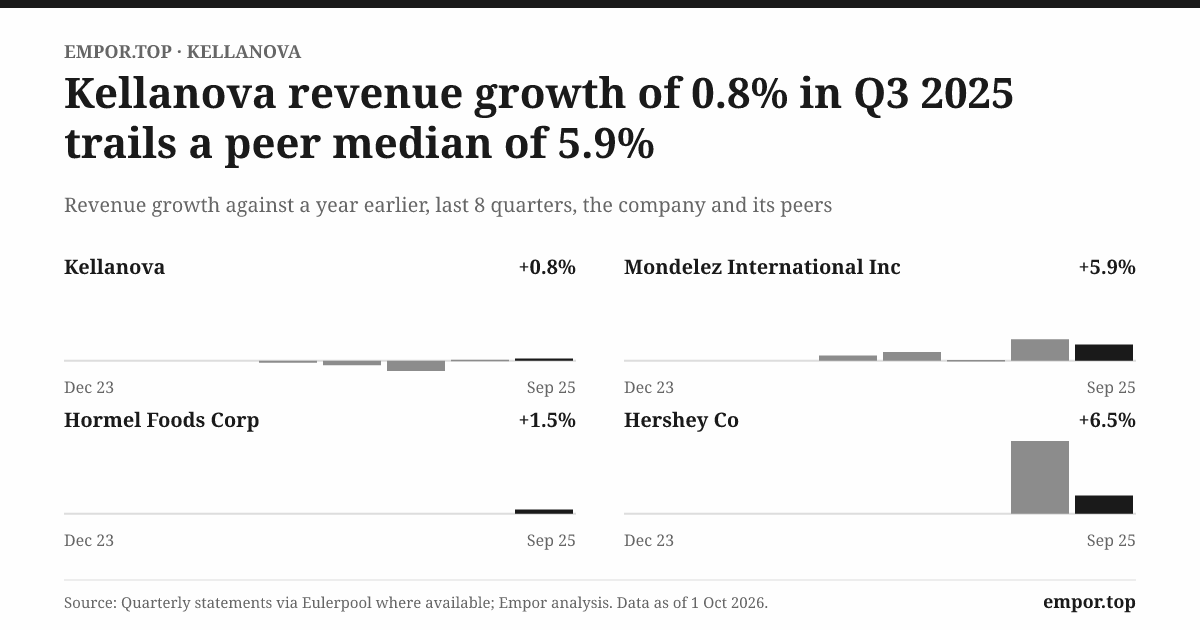
First, peak pricing power. Kellanova's net sales grew only 0.8% from a year earlier in the quarter ended September 27, 2025, the last full quarter it reported as a public company.1 Two years of price increases had carried revenue; volumes were not doing the work. Did Mars buy just as grocery shoppers stopped accepting higher prices?
Second, cash flow quality. Over twelve years Kellanova turned about $13.3 billion of net profit into about $19.7 billion of operating cash, roughly 147 cents of cash for every dollar of reported profit.2 Much of that is ordinary depreciation. But some of it rested on selling customer invoices to banks and paying suppliers slowly. How much of the cash machine was operations, and how much was financial plumbing?
Third, the emerging-market currency trap. Kellanova's bet on Africa, through its Nigerian distributor Multipro and a joint venture with Singapore's Tolaram group, gave it reach into one of the world's youngest consumer markets. It also left about $2.7 billion of accumulated currency translation losses sitting in shareholders' equity.2
Fourth, strategic unlocking versus executive exit. When shareholders voted on the Mars deal, they approved the merger almost unanimously, then rejected the merger-related pay package for the executives by 58% to 42%.3 Was the separation-then-sale an operating necessity, or a trade that rewarded management most of all?
The story moves in five acts. It starts in a Michigan sanitarium and a family feud over a surname. It passes through the long, slow saturation of the breakfast cereal business and the company's two big diversification bets, Keebler and Pringles. It then examines the 2023 split with WK Kellogg Co, the anatomy of the standalone company, and the Mars takeover itself, before closing with frameworks, lessons, the bull and bear cases, and what the private future holds.
The opening is a long way from the snack aisle. It starts with a doctor who wanted Americans to eat less pleasurably.
 Subscribe on LinkedIn
II. The Sanitarium Broth and the Battle Creek Trademark War (1894–1920s)
Picture the Battle Creek Sanitarium in the 1890s: a vast health resort run on the principles of the Seventh-day Adventist church, where wealthy patients came to be cured by fresh air, enemas, exercise and a strictly vegetarian diet. Its presiding genius was Dr. John Harvey Kellogg, a showman-physician who believed that bland grain foods would calm the body and the passions together. His younger brother, Will Keith Kellogg, was not a doctor. He kept the books, ran the errands and, by most accounts, absorbed years of his brother's condescension.
The founding myth, repeated in countless company histories, is that the brothers left a batch of cooked wheat out too long, ran it through rollers anyway and found that it broke into thin, crisp flakes. Toasted, the flakes became a sanitarium staple. Former patients began asking for them by mail. That detail is the hinge of the whole story. John Harvey saw a dietary instrument. W.K. saw a product with repeat customers.
The two men could not share it. W.K. wanted to add sugar to make the flakes taste good to ordinary people; the doctor considered that a betrayal of the health mission. W.K. struck out alone and founded the company in 1906, the year Kellanova has always counted as its beginning.2 He was a marketer before he was a miller. Corn flakes were not hard to copy, and Battle Creek soon filled with imitators. What could not be copied was a trusted name on the box. W.K. put his own signature on the package, a script that remains the Kellogg's logo today, and spent heavily on newspaper and magazine advertising at a time when most food was sold loose from barrels.
The brothers then fought for years over who owned the family name on food. W.K. won. The commercial right to "Kellogg" on cereal stayed with his company, which was incorporated in Delaware in 1922 as the Kellogg Company.2 W.K. later placed much of his fortune into what became the W.K. Kellogg Foundation and its trust, a holder that still owned about 16.6% of the company a century later, when Mars came calling.4
The lesson from this origin is not about food science. The flake was easy to make. The durable asset was the trademark and the habit of consumers to reach for a familiar name. That asset proved strangely portable. When the company split in 2023, the parent kept global ownership of the Kellogg's brand and licensed it, royalty-free, to the spun-off cereal company for North American use only.5 A legal fight between two brothers in the 1910s quietly shaped the structure of a 2023 demerger.
The Foundation Trust matters for a second reason. A single, patient, mission-driven holder with about a sixth of the shares gives a company a stable anchor. It also means that when a buyer arrives, one signature can decide most of the outcome. That is exactly what happened in 2024.
For investors, the founding era leaves one clean takeaway: the business was always a branding and distribution enterprise wrapped around commodity grain. Brands can be moved from one product to another; categories can decline underneath them. The next eighty years proved both points.
III. The Golden Age of Cereal and the Hidden Wall (1930s–2010)
For most of the twentieth century, Kellogg's was breakfast. After the Second World War, the baby boom produced millions of children, and Saturday-morning television gave cereal makers a direct line to them. Tony the Tiger, Toucan Sam and Snap, Crackle and Pop became characters as familiar as cartoon heroes. Frosted Flakes, Froot Loops, Rice Krispies and Pop-Tarts filled suburban pantries, and Eggo frozen waffles joined the family. The company's factories ran around the clock, and the economics were beautiful: cheap grain, a few cents of sugar, a printed box and a mascot turned into a premium-priced branded product with high returns on capital.
But a business that owns a single meal is hostage to how people eat that meal. Starting around the late 1990s, American breakfast changed. Two-income households ate on the move. Protein bars, Greek yogurt, breakfast sandwiches and coffee-shop food competed for the same morning minutes. Sugar became a villain. Per-person cereal consumption in the United States began a long decline, and the industry's answer, raising prices and launching line extensions, kept revenue roughly steady while the number of bowls quietly shrank.
The fact sheet captures the result at its endpoint. Kellogg's reported revenue fell from about $14.6 billion in FY2014 to about $12.7 billion in FY2024, a compound decline of about 1.3% a year.2 Some of that decline is portfolio pruning rather than consumer rejection: the Keebler sale in 2019 and the WK Kellogg Co spin-off in 2023 both removed revenue. But the pruning was itself a response to the same problem. The company sold or spun off the parts of the portfolio that were not growing, and those parts were mostly in the American grocery aisle.
Management saw the wall coming well before the numbers made it obvious. The first answer was the 2001 acquisition of Keebler, the cookie and cracker maker best known for its elves, Cheez-It and Famous Amos. The appeal was twofold. Keebler gave Kellogg a large snacks business at a time when snacking was gaining on sit-down meals. It also brought a direct-store-delivery network, in which the company's own trucks and staff deliver products straight to stores and stock the shelves themselves.
Direct-store-delivery is a powerful system for products that move very fast, like soda, bread or salty chips, where frequent restocking prevents empty shelves and lost sales. It is an expensive system for products that move more slowly, like boxed cookies and crackers, because the trucks, drivers and merchandisers are a fixed cost whether the shelf turns over daily or weekly. Over the following years, Kellogg learned that much of the Keebler portfolio was in the second category.
The cereal era also left a cultural habit inside the company: the instinct to defend shelf space through promotion and price. That habit served Kellogg well when its categories were growing. In a shrinking category, heavy trade spending and annual price increases can disguise volume losses for years, until they can't.
So what did the golden age actually prove? That the company could build iconic brands and print cash from them, but not that those brands would keep growing once consumer habits moved. By the late 2000s, Kellogg needed a growth engine it had not built itself. It found one because another company's deal collapsed.
IV. The $2.7 Billion Pringles Rescue and the Purge of Keebler (2011–2019)
In 2011 Procter & Gamble had agreed to sell Pringles, its curiously engineered stackable crisp, to Diamond Foods, a California snack company best known for walnuts and Kettle chips. Then Diamond's accounting began to unravel. Questions about how it had booked payments to walnut growers turned into a restatement and a management upheaval, and the Pringles deal died on the goal line. P&G was left holding a brand it had decided it no longer wanted.
Kellogg moved quickly. In February 2012 it agreed to buy Pringles for $2.7 billion in cash.6 Overnight, a company associated with American breakfast became one of the largest savory snack makers in the world, with a brand already sold across a large part of the globe.
Pringles is worth pausing on, because it is less a potato chip than a manufacturing invention. Instead of slicing potatoes and frying the slices, the process makes a dough from dried potato and other ingredients, presses it into identical curved shapes and stacks them in a tube. That design solves several problems at once. The chips break less, so less product is wasted. The can protects against moisture and crushing, so the product survives long supply chains and hot climates. And because every chip is identical, the factories can run at very high speed. In plain terms, Pringles is a snack built to travel, which is exactly what a company wanting international growth needs.
Kellogg did not have to build that capability; it inherited dedicated factories and a global distribution footprint. With hindsight, the deal looks like the best capital allocation decision in the company's modern history. It is also the decision that made Kellanova possible: without Pringles, the snacks-led company that Mars bought would have been a mostly North American cracker business with a cereal attachment.
The verdict should be bounded, though. Kellogg bought Pringles from a seller under pressure and with a broken deal behind it, which helped the price. And buying Pringles did not fix the rest of the portfolio. Operating margins fell to about 7% in FY2014 and about 8% in FY2015, depressed by restructuring, pension accounting charges and the weight of the legacy businesses, before recovering in later years.2
The Keebler problem had to be solved separately. In 2017 Kellogg announced that it would exit direct-store-delivery for its snacks and move to warehouse delivery, in which retailers pick up products from distribution centres and stock them themselves. The shift saved money but also meant giving up some shelf control. Steve Cahillane, a former Coca-Cola and AB InBev executive who had run Nature's Bounty, became CEO in October 2017. Cahillane came from beverage companies, businesses that think in terms of global brands, emerging-market distribution and portfolio focus. His instinct was to prune.
In April 2019 Kellogg agreed to sell its Keebler cookies, Famous Amos, fruit snacks and related businesses to Ferrero, the Italian maker of Nutella, for $1.3 billion.7 Kellogg had paid about $4.5 billion for Keebler in 2001, including debt. The comparison is not perfectly apples to apples, because Kellogg kept Cheez-It, the most valuable part of the Keebler portfolio, and had collected eighteen years of cash flows. But the cookie business it sold was worth a fraction of what the whole had once cost.
Read together, the two deals tell a consistent story about the company's capital allocation. The bet that most explicitly bought infrastructure, Keebler's trucks and routes, lost value. The bet that bought a portable brand with unique manufacturing, Pringles, created the platform for everything that followed. By the end of the decade, management had a clear view: the snacks portfolio was growing and earned better margins, while North American cereal was not, and the cereal business was dragging down the market's view of the whole. The obvious move was to separate them. The obvious move turned out to be harder than expected.
V. The Great Split: Carving Out WK Kellogg Co (2021–2023)
On June 21, 2022, Kellogg announced an ambitious plan. It would split into three public companies: a global snacking company, a North American cereal company and a plant-based foods company built around MorningStar Farms. The logic was a familiar one in consumer goods. Investors pay high multiples for growth and focus, and lower multiples for mixed portfolios. Three focused companies might be worth more than one muddled one.
The third leg did not survive. Plant-based meat had been one of the hottest categories of the pandemic years, but demand cooled sharply as shoppers tired of the products and prices. Kellogg dropped the plan to spin off the plant-based business and kept MorningStar Farms. The three-way split became a two-way one. That reversal matters for judging management. The company announced a structure, tested the market, and retreated when the economics changed, rather than floating a weak business at any price. That is defensible. It also shows that the original three-way thesis was partly a valuation exercise that depended on a fashionable category.
The separation closed on October 2, 2023. Shareholders received one share of WK Kellogg Co for every four Kellogg shares they owned, and the parent renamed itself Kellanova, keeping the ticker "K."5 The departing cereal company had about $2.7 billion of net sales in FY2022.5
The headline result for the parent was striking. Operating margin rose from about 9.6% in FY2022 to about 14.7% in FY2024.2 It is tempting to read that as proof that the split unlocked hidden excellence. The more careful reading is that most of the jump is arithmetic. The cereal business had lower margins, so removing it raised the average. The rest came from price increases still flowing through, lower charges and cost savings. The split clarified Kellanova's economics; it did not by itself make Pringles or Cheez-It more profitable.
The plumbing between the two companies tells a more interesting story.
The brand. Kellanova kept ownership of the Kellogg's name and logo worldwide and licensed them royalty-free to WK Kellogg Co for North American cereal.5 The cereal company got a famous brand for free in its home market. Kellanova kept the global asset and the option value that came with it. For WK Kellogg Co, the cost was dependence: a core asset it did not own.
The services. Kellanova kept running much of WK Kellogg Co's back office and supply chain for a fee. In FY2024 those transition services brought in about $157 million in reimbursements.2 That was cost recovery, not profit, but it meant the parent's cost base for the first year still carried shared systems.
The cash. Before the separation, WK Kellogg Co borrowed and paid a cash distribution to its parent of about $663 million.5 This is standard in spin-offs; the parent loads some debt onto the child and keeps the cash. But it is worth naming plainly. The slower-growing business left with new borrowings, and the faster-growing parent left with the proceeds.
After the split, Kellanova's portfolio was dominated by snacks. North America made up about 52% of FY2024 net sales, Europe about 20%, Asia, Middle East and Africa about 19%, and Latin America about 10%.2 Pringles, Cheez-It, Pop-Tarts, Rice Krispies Treats and RXBAR led the list; international cereal, Eggo, MorningStar Farms and the Nigerian noodle business filled out the rest.
Was the split an operating necessity or financial engineering? The fairest answer is that it was both, and that the financial part was intended. It gave investors a cleaner snacks company, moved a declining category and some debt into a separate entity, and kept the most valuable brand rights with the parent. Whether it also made Kellanova a better business is a separate question. The next section examines the standalone company with the cereal business removed.
VI. Anatomy of Standalone Kellanova: Pricing Power, Synthetic Cash Flows, and the Nigerian Sinkhole (FY2023–FY2024)
In early 2025, Kellanova's first full year as a standalone company reached investors' screens, and the headline numbers looked excellent. Net profit rose about 43% to roughly $1.36 billion. Operating margin hit about 14.7%. Return on capital employed reached about 17%, its best level in a decade.2 For a company that had just been through a corporate separation, it was an impressive debut.
Underneath, three different stories were running at once: brands with real strength, a cash flow profile that leaned on financial arrangements, and a currency problem in Africa that shrank the value of the company's emerging-market bet.
The brands that carried the business
Pringles and Cheez-It were the engine. Pringles had the global footprint and the manufacturing economics described earlier. Cheez-It was the American powerhouse, a cracker with a cult-like following that Kellogg had kept when it sold the rest of Keebler. Management spent several years trying to take Cheez-It abroad, including into Europe, on the theory that a brand this strong in America should travel.
The evidence that these brands had pricing power is real but bounded. Through 2022 and 2023, Kellanova raised prices sharply to offset cost inflation, and revenue held up while volumes softened. That is what pricing power looks like. But the evidence that the pricing power had limits appeared just as clearly in 2025: quarterly revenue fell about 4% from a year earlier in the March quarter, then grew only about 0.3% and 0.8% in the next two.1 Price increases stopped being able to carry growth once shoppers began buying less or trading down.
The cash machine, examined
Now the forensic puzzle. Over twelve years Kellanova produced about $19.7 billion of operating cash on about $13.3 billion of net profit.2 On its face, that looks like extraordinary earnings quality. Most of the gap has a boring explanation: depreciation and amortization, the accounting charge for using up factories and acquired intangible assets, which reduces profit but not cash. Over the period it added up to more than $6.5 billion, roughly the whole gap. Pension charges that did not involve cash also played a part.
But two features of Kellanova's working capital deserve closer attention.
The first is receivables monetization. Kellanova sold customer invoices to banks without recourse, meaning the bank, not Kellanova, bore the risk if the customer did not pay. Once sold, the invoices left the balance sheet. At the end of FY2024, about $653 million of receivables had been sold this way and removed from the books, down slightly from about $697 million a year earlier.2
Here is why that matters. Reported debtor days, the average number of days it takes customers to pay, stood at about 44 in FY2024.2 Add the sold invoices back, and the true amount owed by customers rises from about $1.27 billion to about $1.92 billion, which puts the underlying figure closer to 55 days. The program cost Kellanova about $40 million a year in losses on the sale of receivables, booked below operating profit.2 Selling invoices at a small discount to get cash earlier is a legitimate and disclosed financing choice. The point is that the low debtor days were partly purchased, not purely earned.
The second is supplier financing. Kellanova took about 99 days on average to pay suppliers in FY2024, compared with about 60 days a decade earlier, and as many as about 118 days in FY2021.2 It used third-party programs in which suppliers could sell their Kellanova invoices to banks and get paid early, while Kellanova paid the bank later. Large buyers often do this. It is cheap financing for the buyer, paid for in part by the supplier's discount.
Put the two programs together and the shape is clear. Kellanova collected from customers faster than normal by selling their invoices, and paid suppliers slower than normal by having banks bridge the gap. Both programs moved cash forward. Neither is hidden; both are disclosed in the filings. But they are funded by bank appetite, and if they were reversed, a meaningful chunk of cash would flow out. Kellanova's cash conversion was genuine in its largest part and engineered at the margin. A buyer would have to decide whether to keep both programs.
The Nigerian sinkhole
Kellanova's Africa strategy ran through its partnership with Tolaram, the Singapore-based group behind Indomie instant noodles in Nigeria. Kellanova consolidated Multipro, a Nigerian distribution business, and held a 50% stake in Tolaram Africa Foods.2
The strategic logic was attractive. Nigeria is Africa's most populous country, with a young population, and Multipro gave Kellanova a physical distribution network that would have taken decades to build. The financial reality was brutal. Nigeria's naira lost much of its value against the dollar in 2023 and 2024. The carrying value of the Tolaram Africa Foods stake fell from about $173 million to about $83 million in a single year.2 Cumulative currency translation losses in shareholders' equity widened to about $2.7 billion by the end of FY2024.2
A translation loss is what happens when a company converts the value of a foreign business back into dollars at a weaker exchange rate. It does not move cash directly, which is why it sits in equity rather than in profit. But it is a real loss of dollar value. A business that earns in naira and reports in dollars can grow briskly in local terms while shrinking in dollar terms.
There was also an accounting stumble. In 2023, Kellanova recorded an out-of-period adjustment of about $113 million to correct an error in how it had translated the value of its Tolaram investment.8 It was not a restatement and the auditor issued a clean opinion, but it is a reminder that emerging-market accounting is hard even for large, well-audited companies.
The verdict on standalone Kellanova
The standalone company was a real business with real brands, solid margins and cash generation that was mostly genuine. It was not a growth company. Revenue growth had stalled. Some of the working-capital strength came from financing programs. And the emerging-market bet that was supposed to provide long-term growth had, so far, mainly produced currency losses in dollar terms. That was the company a buyer would have to underwrite. The buyer that showed up did not need quarterly growth to make the math work.
VII. The Mars Megadeal: Activist Catalysts, the Buyout, and the Shareholder Revolt (2024–2025)
The announcement on August 14, 2024, landed with unusual force because of who the buyer was. Mars is one of the largest private companies in the world, still controlled by the family that founded it, famously secretive and historically disciplined about acquisitions. Its largest prior deal had been the Wrigley purchase in 2008 and, more recently, a large push into pet care. Now it was offering $83.50 a share in cash for Kellanova, about 33% above the unaffected share price of roughly $62.95 in early August 2024.4 Including debt, the deal was worth about $35.9 billion.[^1]
Why Kellanova sold
Kellanova had been under pressure. Food stocks broadly had been weighed down by fears that GLP-1 weight-loss drugs such as Ozempic and Wegovy would reduce snacking, and by the sense that grocery shoppers had reached their limit on price increases. Kellanova traded at a discount to pure-play snacking companies despite its cleaner portfolio. The split had made the company easier to understand, but it had not made the stock rerate enough to satisfy shareholders.
Management's own logic, as set out in the merger proxy, was that the Mars offer was a full price that public markets were unlikely to match soon.4 That claim is plausible. It is also, by definition, management's view of its own future, and it was made by executives who stood to receive large payments when the deal closed.
Why Mars bought
The strategic fit was clear. Mars's snacking business was overwhelmingly sweet: chocolate, candy, gum. Kellanova was overwhelmingly savory: crisps, crackers, toaster pastries and bars. There was almost no overlap, which meant both that combining them added breadth and that antitrust regulators would have little to object to.[^1] Together, Mars said, the businesses would create a global snacking company with broad reach across categories and geographies.[^1]
Mars also gained Kellanova's international footprint, including its African distribution, and a set of brands that would sit naturally beside its own in convenience stores and supermarkets. For a private company with a long time horizon, paying a high price for durable brands that it could hold for decades is a different calculation from what a public acquirer faces.
The vote, and the rebuke
The W.K. Kellogg Foundation Trust, holding about 16.6% of shares, signed a voting agreement to support the deal.4 Combined with broad institutional support, passage was never in serious doubt.
At the special meeting on November 1, 2024, shareholders approved the merger by an overwhelming margin, about 265.5 million votes in favour to about 1.2 million against.3 The same shareholders then rejected the advisory vote on merger-related executive compensation, with about 154.6 million votes against and about 111.7 million in favour.3
The split vote is the most revealing moment of the deal. Shareholders liked the price. They did not like what executives would receive for agreeing to it. Cahillane's estimated change-in-control payout was about $50.4 million, most of it from accelerated vesting of performance share units.4 Accelerated vesting means that stock awards that would normally pay out only if the company met future targets pay out immediately when it is sold. The logic is that executives should not lose awards because of a sale. The objection is that executives then capture the reward without ever being tested on the targets.
The advisory vote was non-binding, and the payouts proceeded. But a 58% rejection is a rare and pointed signal from public shareholders. It does not prove the deal was a self-serving exit; the price was a substantial premium, and the shareholders who voted against the pay voted for the deal. It does show that investors saw the sale and the pay package as separate questions, and that most of them judged the second one too generous.
Sixteen months to close
The deal took longer than many expected. It was cleared by the U.S. Federal Trade Commission without a formal challenge and required European approval as well. The merger closed on December 11, 2025, when Kellanova became an indirect wholly owned subsidiary of Mars and its common stock was delisted from the New York Stock Exchange.9 The company deregistered its shares later that month.10
The debt story followed. S&P downgraded Mars from A+ to A, reflecting the borrowing needed to fund the purchase.11 Moody's upgraded Kellanova's senior unsecured notes to A2 after Mars cross-guarantees took effect, before withdrawing the ratings.12 Fitch withdrew its ratings in January 2026.13 Kellanova's credit had effectively been absorbed into its new parent: the subsidiary's bonds got safer because a larger, stronger company now stood behind them, while the parent got slightly riskier because of the debt it took on to buy.
The deal was a clean exit for public shareholders. Whether it was a smart purchase for Mars depends on whether Kellanova's brands can grow faster under private ownership than they did as a public company. That question is best approached through the structure of the industry itself.
VIII. Frameworks: Porter's 5 Forces, Hamilton Helmer's 7 Powers & The Snacking Moat
Imagine Kellanova's sales team walking into Walmart's headquarters in Bentonville to negotiate next year's terms. On one side of the table is a company with iconic brands. On the other is a retailer that accounted for about 16% of Kellanova's net sales in FY2024.2 That meeting captures the core tension of the snacking business, and the frameworks below are best read through it.
Porter's Five Forces
Buyer power: high. Walmart alone was about 16% of sales, and the top five customers about 29% of consolidated net sales and about 46% of U.S. net sales.2 Retailers control shelf space and promotions, and they run their own private-label brands. At year-end FY2024, Kellanova carried about $611 million of accrued advertising and promotion liabilities, and its auditor flagged trade promotion estimates as the critical audit matter.2 Trade promotions, the discounts and payments a manufacturer makes to get placement and features in stores, are the price of shelf access. The size of that accrual tells you who has leverage.
Supplier power: low to moderate. Wheat, potatoes, corn, vegetable oil and sugar are commodities with many sellers. Kellanova's ability to stretch payment terms to about 99 days is itself evidence of its leverage over suppliers.2 Commodity prices can still squeeze margins, as 2022 showed, but individual suppliers have little power.
Threat of new entrants: low for scale, moderate for niches. Building global manufacturing, distribution and advertising for a mass snack brand is extremely expensive. But small brands with clean labels, protein claims or bold flavours do break in, especially through online channels and specialty retailers, and the large players often end up buying them. Kellanova's own purchase of RXBAR in 2017 is an example of incumbents paying for what they could not build.
Threat of substitutes: moderate to high. A Pringles can competes not only with Lay's but with pretzels, popcorn, nuts, tortilla chips, crackers, yogurt and anything else that fills a snack moment. GLP-1 drugs add a new kind of substitute: reduced appetite itself.
Rivalry: high. Kellanova competed against PepsiCo's Frito-Lay, Mondelēz, Campbell's Goldfish, General Mills and a large private-label sector. Frito-Lay in particular has scale and a direct-store-delivery network built for fast-moving salty snacks, which gives it shelf presence that Kellanova's warehouse model does not match.
Hamilton Helmer's 7 Powers
Branding: strong but tested. Pringles and Cheez-It command loyalty and price premiums. The test of branding power is whether customers keep buying at higher prices. Through 2022 and 2023 they largely did; by 2025, flat volumes and soft revenue showed the limits. The brand power is real but not unlimited.
Scale economies: strong. Pringles' manufacturing process rewards high, steady volume, and global advertising and procurement give large players a cost advantage. Mars adds more scale to that.
Network effects: none. One person's Cheez-It habit does not make the crackers more valuable to anyone else.
Switching costs: very low. A shopper can pick a different brand next week at no cost. This is the most important limit on the moat.
Cornered resource: weak. The Pringles manufacturing know-how is specialised, but stackable crisps are made by rivals and private-label suppliers. The Kellogg's trademark is a cornered resource in a narrow sense, but it is tied to cereal more than snacks.
Counter-positioning: none. Kellanova was an incumbent, not a disruptor.
Process power: moderate. Decades of supply-chain refinement count for something, but the move from direct-store-delivery to warehouse delivery shows that the company's processes were not uniquely hard to copy.
The moat, weighed
Kellanova's moat is built from brand and scale, with very low switching costs and powerful customers. The history tests it. The brands survived the shift to warehouse delivery and the post-pandemic price increases, which supports the brand claim. The 2025 volume weakness narrows it: the moat protects market share in normal conditions but does not guarantee pricing power once shoppers push back. The claim survives in a smaller form: durable brands that hold share, not brands that can raise prices at will. The KPI that would confirm or falsify the revised claim is volume growth in Pringles and Cheez-It, not reported revenue.
IX. Playbook: Business & Investing Lessons
Every great business story leaves behind a few lessons that outlive the company. Kellanova's are unusually sharp because they come from a single company acting on its own history.
1. "Your founding product is not your identity." Kellogg spent years defending North American cereal while its share price paid for it. In 2023 it spun off the business that bore its founder's name, kept the trademark, and repositioned the remainder as a snacks company. Within a year, that company sold for about $36 billion. The lesson for founders and boards is that sentiment toward a heritage business is an expense, and it compounds. The willingness to cut loose a founding product is often the moment a company finds out what it is actually worth.
2. "Distribution is a moat only when the product moves fast enough to pay for the trucks." Keebler's delivery network looked like a moat in 2001. By 2017 it was a cost center, and by 2019 the cookie business was sold to Ferrero for a fraction of the original price.7 Infrastructure creates advantage only when volume is high enough to absorb its fixed costs. The investor's question about any distribution moat should be: does the product turn over fast enough to justify it?
3. "When cash conversion is spectacular, find the banks." Kellanova's 147% cash conversion was mostly real, but part of it depended on selling about $650 million of customer invoices and paying suppliers in about 99 days. Neither was hidden. Both were financing. The investor's habit should be to add back sold receivables and normalize payment terms before calling a company a cash machine. The cash a bank provides can be taken back.
4. "Local growth is not dollar growth." Multipro gave Kellanova reach into a young, fast-growing market. The naira gave it about $2.7 billion of cumulative currency losses in equity and halved the dollar value of its African joint venture. Emerging-market expansion must be judged in the reporting currency, and over a full cycle, not in local-currency growth rates during good years.
5. "Shareholders can like the deal and dislike the dealmakers." The November 2024 vote, nearly unanimous for the merger and 58% against the executive pay package, is a clean example of investors separating the price from the reward.3 For boards, the lesson is that change-in-control acceleration is visible and remembered. For investors, it is that a great exit does not settle the question of whether executives' incentives were well aligned.
X. Analysis & Bear vs. Bull Case
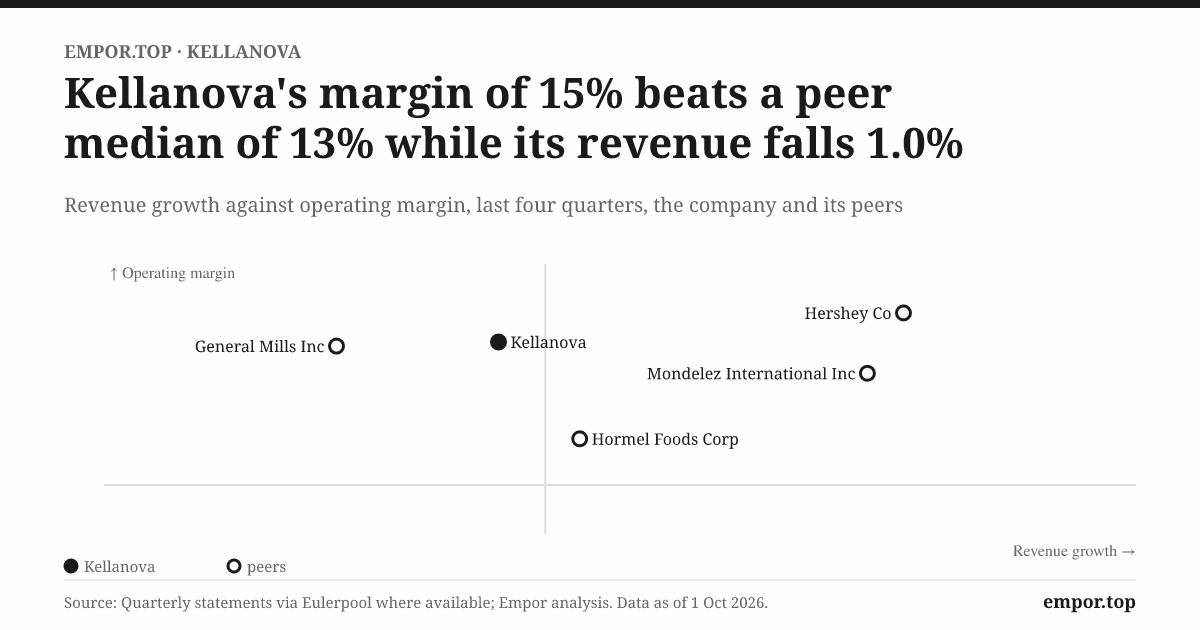
Imagine the integration team at Mars's headquarters in McLean, Virginia, in early 2026. On one screen is the combined business: Mars's confectionery and pet care alongside Kellanova's savory snacks, cereals and frozen foods. On another is the last set of Kellanova numbers before it went private: revenue growth of about 0.8% in the September 2025 quarter and operating margin of about 14%.1 Mars paid about 24 times trailing earnings and about 15 times EBITDA.2 The question is whether that price was a strategic masterstroke or a top-of-cycle purchase.
Valuation as data
At the time of the deal, Mars paid a premium to most packaged-food peers. Companies such as General Mills and Campbell's traded in the mid-teens of earnings or lower; Mondelēz, Hershey and PepsiCo traded higher, roughly around 20 times earnings.2 Mars paid at or above the top of that range. A price like that assumes either faster growth than Kellanova delivered as a public company, cost savings from combining the businesses, or a long time horizon in which those things eventually show up. It does not assume flat volumes forever.
The bull case
A broader snacking company. Mars brought sweet; Kellanova brought savory. Together they cover more snacking occasions than almost any rival except PepsiCo and Mondelēz.[^1] That breadth matters in negotiations with retailers, because a supplier with more must-have brands has more leverage.
International runway. Mars's distribution in convenience stores, emerging markets and impulse channels could help brands like Cheez-It travel faster than Kellanova managed alone.
Patient capital. Mars does not have to report quarterly results to public investors. It can invest through a weak year, absorb commodity swings and avoid cutting marketing to hit a target.
The bear case
Top-of-cycle price. Mars paid a premium multiple for earnings boosted by two years of price increases. If volumes do not recover, earnings growth must come from cost cuts, which have limits.
Volume weakness. Revenue fell about 4% in the March 2025 quarter and grew less than 1% in the following two.1 Shoppers were trading down and buying less. Private-label crackers and crisps are close substitutes.
GLP-1 drugs. If weight-loss drugs become widely used, they directly reduce demand for calorie-dense snacks. The size of the effect is still uncertain, but the direction is not favourable.
Debt. S&P's downgrade of Mars to A reflects the borrowing needed for the deal.11 Mars is still strongly rated, but the purchase used financial capacity.
Weighing it
The history narrows the bull case without rejecting it. Kellanova's brands are durable; the evidence on that is strong. Their ability to grow volume is unproven in the post-pandemic market, and the last public quarters argued against it. The deal works for Mars if it can restart volume growth in Pringles and Cheez-It and capture savings from combining the businesses. It works less well if the 2025 slowdown was the new normal rather than a pause.
Two KPIs matter most. The first is organic volume growth in the core snacks brands, the cleanest test of the brand claim; the last public reading was weak, with reported revenue up only about 0.8%.1 The second is operating margin, which tells whether Mars can turn the combined scale into profit; the last public reading was about 14%, down slightly from a year earlier.1 Because Mars is private, outsiders may see only fragments of either.
XI. Epilogue & The Private Endgame
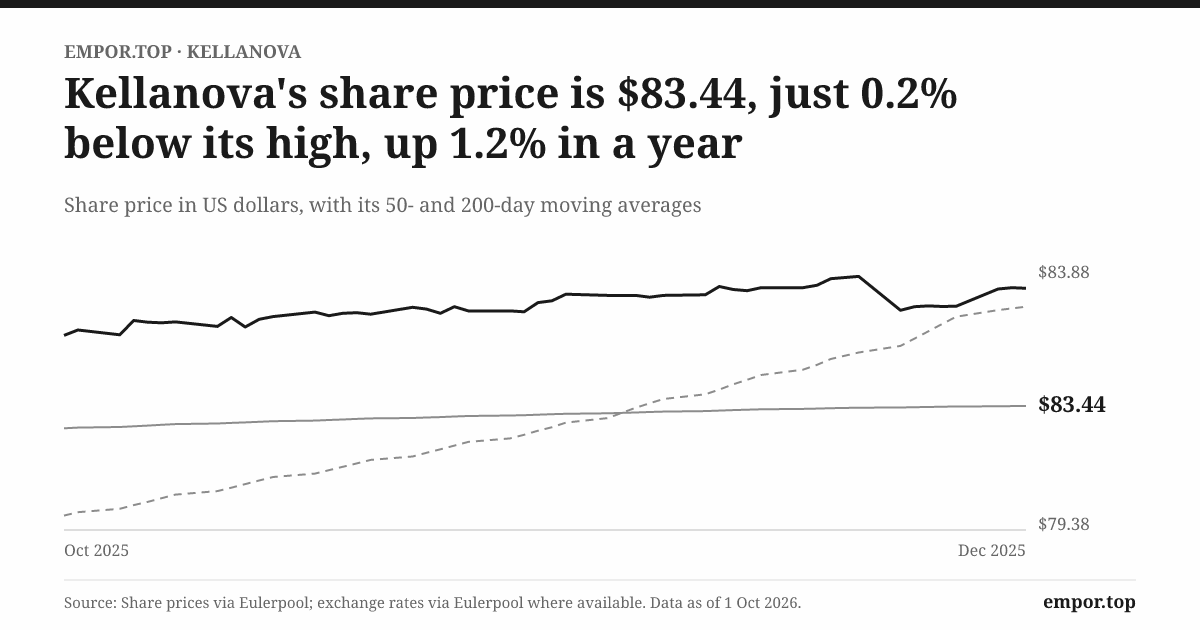
Tonight, October 1, 2026, Kellanova exists as a company inside Mars rather than a stock on the New York Stock Exchange. The ticker "K," on the board for about a century, is retired. The share price that still appears in some data feeds, about $83.44, is a fossil: the last trade before delisting, pinned just below the cash offer.2 A small number of Kellanova's euro-denominated bonds still trade, now backed by Mars.2
The new owner has told the outside world little about its plans, which is how Mars prefers it. That makes the next chapter harder to watch, but the questions it must answer are clear.
The volume test. Over 2026 and 2027, Mars will find out whether Pringles and Cheez-It can return to volume growth without heavy discounting. If they can, the purchase price will look reasonable in hindsight. If they cannot, Mars will have bought a cash-generative but slow-growing business at a growth-company price.
The working-capital question. Mars has to decide whether to keep Kellanova's receivable sales and supplier financing programs, fold them into its own treasury, or unwind them. Unwinding them would cost cash. Keeping them leaves the combined company exposed to bank appetite.
The currency test. Whether Mars can manage emerging-market currency risk better than Kellanova did as a standalone company will determine whether the African and Latin American businesses add value or keep eroding it in dollar terms.
The ownership question. Through the deal, the W.K. Kellogg Foundation Trust turned its long-held stake into cash. Its mission now depends on how it reinvests that money rather than on the fortunes of the company that bears its founder's name.
Each of these will be decided out of public view. That is the final irony of the story: the questions that matter most about Kellanova will be answered by a company that does not have to tell anyone the answers.
XII. Outro
In the 1890s, John Harvey Kellogg wanted to make Americans healthier by feeding them plain grain. His younger brother added sugar, put his signature on the box and built a company from the difference between what doctors prescribed and what people wanted. More than a century later, the company that grew from that box sold its cereal business, kept the signature, and sold itself to a candy maker to sell barbecue crisps and cheddar crackers around the world.
Kellanova's story is not really about cereal or snacks. It is about a company willing to cut away its own origin story when consumers moved on. In packaged goods, nostalgia does not compound. The willingness to let go does.
References
-
Form 10-Q for Quarterly Period Ended September 27, 2025 — U.S. Securities and Exchange Commission, 2025-10-30 ↩↩↩↩↩↩
-
Form 10-K for Fiscal Year Ended December 28, 2024 — U.S. Securities and Exchange Commission, 2025-02-21 ↩↩↩↩↩↩↩↩↩↩↩↩↩↩↩↩↩↩↩↩↩↩↩↩↩↩
-
Form 8-K: Special Meeting Voting Results on Merger Proposal — U.S. Securities and Exchange Commission, 2024-11-04 ↩↩↩↩
-
Schedule 14A Definitive Merger Proxy Statement — U.S. Securities and Exchange Commission, 2024-09-26 ↩↩↩↩↩
-
Form 10 Registration Statement for WK Kellogg Co — U.S. Securities and Exchange Commission, 2023-09-05 ↩↩↩↩↩
-
P&G Sells Pringles to Kellogg for $2.7 Billion — Reuters, 2012-02-15 ↩
-
Ferrero to Acquire Kellogg Company's Cookie and Fruit Snack Businesses for $1.3 Billion — Business Wire, 2019-04-01 ↩↩
-
Form 10-K for Fiscal Year Ended December 30, 2023 — U.S. Securities and Exchange Commission, 2024-02-20 ↩
-
Form 8-K: Completion of Acquisition by Mars, Incorporated — U.S. Securities and Exchange Commission, 2025-12-11 ↩
-
SEC EDGAR Submissions CIK 0000055067 — U.S. Securities and Exchange Commission ↩
-
Research Update: Mars, Inc. Downgraded to 'A' on Debt-Financed Acquisition of Kellanova — S&P Global Ratings, 2025-02-20 ↩↩
-
Rating Action: Moody's Upgrades Kellanova's Senior Unsecured Debt to A2 Following Mars Acquisition — Moody's Investors Service, 2025-12-12 ↩
-
Rating Action: Fitch Withdraws Ratings on Kellanova Following Acquisition by Mars — Fitch Ratings, 2026-01-02 ↩
 LinkedIn
 WhatsApp
 Reddit
 Hacker News
 Email
 Kindle
 RSS Feed
 Spotify
 Apple Podcasts
 Amazon Music
 Audible
 YouTube