The Kraft Heinz Company: The Zero-Based Budgeting Reckoning
I. Introduction & Episode Roadmap
On the evening of February 21, 2019, Kraft Heinz released its fourth-quarter results, and nobody who owned the stock slept well. There were three confessions in one release. The company wrote down about $15.4 billion of goodwill and brand value, mostly on the Kraft and Oscar Mayer names14. It cut its quarterly dividend by roughly 36%14. It also disclosed that the Securities and Exchange Commission had subpoenaed it over its procurement accounting14. The next day the shares fell about 27%, the worst single day in the company's short history14.
It was a remarkable collapse for a company whose owners were close to royalty in American capitalism. On one side was Warren Buffett's Berkshire Hathaway, which still owns 27.45% of the company3. On the other was 3G Capital, the Brazilian partnership of Jorge Paulo Lemann and his partners. 3G had built Ambev, taken over Anheuser-Busch and turned Burger King around, and it had become famous in business schools for one weapon: zero-based budgeting16. Beneath both of them sat two brands that American shoppers had trusted for more than a century, the Heinz ketchup bottle and the blue box of Kraft Macaroni & Cheese.
Here is the question this story tries to answer. Can a company assembled with borrowed money and aggressive cost cutting create lasting economic value once there is nothing left to cut?
The record answers plainly. Since 2018, Kraft Heinz has written off more than $31 billion of goodwill and brand value across three waves of impairments12. After 3G sold out completely, Berkshire was left as the only original partner still holding shares3. On September 30, 2026, the whole company was valued at about $27.8 billion in the stock market1. That is less than half of the $49 billion of book equity the combined company carried in its early years (the peak was about $66 billion in FY2015). The verdict of this piece is simple to state: packaged-food brands cannot be run like industrial commodities. When a budget system starves a brand of advertising, product development and shelf support, the brand's pricing power quietly leaks away to the supermarket's own label on the shelf next to it.
The mystery is more interesting than the verdict. The 3G method worked in beer, where the brewer controls distribution and no bar pours its own house lager. It worked in fast food, where franchisees carry the capital. Why did it run aground in the grocery aisle? And why, seven years after the 2019 write-down, is the company still booking multi-billion-dollar impairments, renegotiating bank covenants and arguing with the IRS?
The story has five acts. The first covers the separate heritage of Henry J. Heinz in Pittsburgh and James L. Kraft in Chicago, and how each built a brand-based moat. The second follows the 3G playbook arriving at Heinz in 2013. The third is the 2015 merger with Kraft and the $143 billion attempt on Unilever that followed. The fourth is the unravelling: an accounting investigation, decaying brands, a burst of inflation that flattered the numbers, and an emergency rewrite of the bank covenants. The fifth is the present era under Carlos Abrams-Rivera. The planned breakup has been paused, a $600 million reinvestment bet has been placed, and shareholders' equity keeps sliding toward a $25 billion covenant floor.
The early chapters matter to an investor today because every figure in the current balance sheet is a fossil of a decision made in them. That starts in a small Pennsylvania town in 1869.
 Subscribe on LinkedIn
II. Two Dynasties and the Chicago-Pittsburgh Playbooks (1869–2012)
Picture Sharpsburg, Pennsylvania, just up the Allegheny River from Pittsburgh, in 1869. A 25-year-old named Henry John Heinz is bottling horseradish18. At the time, grated horseradish was notorious for being bulked out with turnip, sawdust and leaves, and it was usually sold in brown or green glass that hid whatever was inside. Heinz used clear glass so buyers could see the product18. That was his whole pitch: nothing is hidden.
The clear jar was the first moat in this story. Heinz understood before most of his competitors that in food, trust is the product. Buyers could not test purity, so they paid for a name that promised it. In the decades that followed, the company industrialized that promise. It turned out ketchup at scale, secured a place on diner and restaurant tables across the country and built a large overseas business, above all baked beans in Britain18. The "57 Varieties" slogan was never an actual count of products. It was marketing, and it worked extraordinarily well.
Chicago's story began a generation later. James L. Kraft started selling cheese wholesale from a horse-drawn wagon in the early 1900s and then solved the problem that made cheese hard to sell nationally: it spoiled18. Kraft's processed cheese could be shipped long distances and kept on a shelf. It became the base of an empire that grew to include Velveeta, Miracle Whip, Kraft Macaroni & Cheese, Kraft Singles and, later, Oscar Mayer meats18. Kraft also learned early that mass media could make a staple part of daily life. Kraft-sponsored radio and television programmes in the middle of the century put its brand names into American homes every week18.
It helps to notice what the two moats were made of. Heinz's was quality control turned into a promise, carried to customers by near-universal distribution. Kraft's was food-processing technology turned into convenience, carried by national advertising. Both depended on a shopper having no good alternative at the same price. That condition held for most of the twentieth century. It stopped holding once big retailers learned to make their own products.
By the 2000s Kraft Foods had become a sprawling conglomerate. It bought Nabisco in 2000 and Cadbury in 2010, and activist investors kept pressing it to break up. In 2012 it did. The fast-growing global snacks business (Oreo, Cadbury, the chocolate lines) became Mondelēz International. North American grocery stayed behind as Kraft Foods Group5. This is the detail that decides the rest of the story: Kraft Foods Group was built to be mature. It inherited the centre of the store, meaning cheese, cold cuts, powdered drinks, macaroni and condiments. Those categories were large, cash-generating and slowly shrinking, and they were exactly where store brands were improving fastest.
Heinz, meanwhile, was a steady, profitable, somewhat sleepy company with a real global franchise in sauces. It had fat to trim, and that made it the ideal place for a new kind of owner to try out its methods. Two of the richest investors in the world were already watching.
III. The $23 Billion Valentine's Day Raid: 3G Capital & Berkshire Strike (2013–2014)
On Valentine's Day 2013, Berkshire Hathaway and 3G Capital announced they would buy H.J. Heinz for $72.50 a share in cash, about $23 billion in total, or roughly $28 billion including debt5. It was the largest food deal in years, and it paired two investors who looked like opposites. Buffett was famous for leaving managers alone. 3G was famous for arriving with a spreadsheet and firing the managers.
To understand what came next, it helps to know who 3G were. Jorge Paulo Lemann, Marcel Telles and Carlos Alberto Sicupira had built Banco Garantia in Brazil into a meritocratic, partner-owned investment bank. They used its culture to transform the brewer Brahma and then built Ambev, which merged into Interbrew and later took over Anheuser-Busch16. In 2010 they bought Burger King16. Their culture is well documented. Managers were young and paid largely in stock. Offices were open-plan and there were no executive suites. Targets were relentless, and the budget method became their signature16.
Zero-based budgeting is simple to describe and hard to live under. In a normal company, next year's budget starts from this year's spending plus a few percent. Under ZBB, every cost centre starts at zero each year and must justify every line again: every trip, every consultant, every printer. Think of a household that cancels every subscription on January 1 and then argues its way back into each one. The first year uncovers a great deal of waste. By the fifth year, the only things left to cut are the ones that keep the business alive.
The operator 3G sent in was Bernardo Hees, a 3G partner who had run the Brazilian railway operator América Latina Logística and then Burger King16. Hees moved into Pittsburgh and got to work straight away. Heinz cut hundreds of headquarters jobs within months of the deal closing and closed or consolidated factories16. The jet, the perks and the layers of management went too.
Buffett's side of the deal is easy to misread. Berkshire was not simply a co-owner. It put up about $4 billion of common equity alongside 3G and bought $8 billion of preferred stock paying 9% a year5. In practice Buffett was 3G's senior lender with a share of the upside, earning a fixed high coupon while 3G ran the business. He praised his partners warmly in his letters and continued to do so for years10. For Berkshire, which had more cash than it could deploy, the arrangement solved a problem: a large, recurring, bond-like return, with operating risk handled by partners Buffett trusted.
Within two years, Heinz's margins had jumped. Its FY2014 revenue was about $18.2 billion, with operating profit of about $1.9 billion. That figure was depressed by the costs of restructuring, and the owners pointed to much higher adjusted margins as evidence the method worked5. The limit was built into the model, though. Once you have cut costs at one company, you need another company to cut. Heinz could not grow its way into the returns 3G's investors expected, because Americans do not eat much more ketchup each year. The model needed a bigger target, and one was sitting in Chicago.
For investors, the Heinz chapter showed something real: large food companies did carry excess cost. It also left behind two habits that would later cost a great deal. The first was a culture in which being seen to protect the budget mattered more than investing in categories. The second was a capital structure that depended on the next acquisition.
IV. The $50 Billion Consolidation & The Zero-Based Budgeting High-Water Mark (2015–2016)
On March 25, 2015, Kraft Foods Group and H.J. Heinz agreed to merge5. The terms were unusual, and they show the financial engineering clearly. Kraft shareholders would receive shares in the combined company plus a special cash dividend of $16.50 a share5. The cash for that dividend came from Berkshire and 3G, who put in about $10 billion of new equity51. The Heinz owners ended up with about 51% of the new Kraft Heinz Company and Kraft's public shareholders with 49%5. The merged company started trading on NASDAQ in July 2015 as the third-largest food and beverage company in North America and the fifth-largest in the world5.
Look at the balance sheet to see what was actually bought. In FY2014, Heinz alone had total assets of about $23 billion. A year later, Kraft Heinz had about $123 billion of total assets and about $66 billion of shareholders' equity1. Most of that increase was not factories. Property, plant and equipment was only about $6.5 billion1. The rest was goodwill and brand intangibles: accounting entries representing the premium paid for Kraft's names. The company had capitalized a belief in brand pricing power as an asset on its books. Every impairment since then has been the accountants re-marking that belief.
The 3G method was then applied to Kraft. Within weeks of closing, the company announced about 2,500 job cuts in North America and began closing plants16. The synergy target was $1.5 billion, later raised to $1.7 billion5. By headcount, the combined company shrank from about 42,000 employees around the merger to about 38,000 by 20181.
The results arrived quickly. FY2016 revenue was about $26.3 billion, and operating profit rose to about $5.6 billion, a 21.3% margin1. In FY2017 the margin reached 23.2%, the high point for the company1. The share price rose to around $97 in early 2017, and 3G was widely described as having solved the problem of running a large food company.
The fact sheet shows the other side. Revenue did not grow. It rose 0.7% in FY2015 on the old Heinz base and fell 0.9% in FY20171. All of the margin gain came from costs, and the most revealing cost is the one that was never allowed to rise. Kraft Heinz still spends less than 0.7% of sales on research and development, $167 million in FY20251. Global peers such as Nestlé and Unilever typically spend 1.5% to 2% of sales. For a company whose products compete directly against improving store brands, that is a very small budget for new ideas.
The second lever was suppliers. Kraft Heinz's days payable, roughly how long it takes to pay its suppliers, rose from about 42 days in FY2014 to the mid-80s in FY2015 and FY2016, and eventually peaked at about 100 days in FY20211. The company uses supply-chain finance programmes in which banks pay suppliers early and Kraft Heinz repays the banks later. About $755 million was outstanding under these programmes at the end of 2025, and the company's stated standard payment terms run from 0 to 250 days1. The effect is that suppliers fund part of the company's working capital, and the cash conversion cycle went negative in several years1. That cash is real, but it is a one-off. You can only stretch supplier terms once.
For investors, the merger reached its cost targets and set a trap. The company's reported profit now rested on savings that could not be repeated. Its equity rested on goodwill that assumed growth. And its owners needed another deal to keep the model going. In early 2017 they reached for the biggest target they could find.
V. The $143 Billion Ambush on Rotterdam: Peak Hubris and the Unilever Rebuff (2017)
On Friday, February 17, 2017, news broke that Kraft Heinz had approached Unilever, the Anglo-Dutch owner of Dove, Knorr, Hellmann's and Lipton, with an offer worth about $143 billion12. Unilever rejected it the same day, saying the proposal "fundamentally undervalues" the company and that it saw "no merit, either financial or strategic" in the approach12. By Sunday, February 19, Kraft Heinz had withdrawn13. The largest takeover attempt in the history of consumer goods lasted about one weekend.
Why try it at all? Because the ZBB model needed new costs to cut. By then most of the Kraft synergies had been captured, and organic sales were flat. Unilever offered everything Kraft Heinz lacked: exposure to fast-growing emerging markets, personal-care brands with higher margins, and, from 3G's point of view, a large European cost base that had never been through zero-based budgeting.
It also offered a clash of cultures. Paul Polman, Unilever's chief executive, had built his tenure around long-term thinking and the Unilever Sustainable Living Plan. He had abolished quarterly guidance so the company could invest for the long run. To Polman, 3G's approach represented the short-termism he had been arguing against12. Unilever made clear it would not engage, and the prospect of a hostile fight became public immediately.
The fight was over because of Buffett. Berkshire had a long-standing aversion to hostile deals, and Kraft Heinz said it withdrew in order to avoid a hostile contest, expressing "utmost respect" for Unilever13. That part of the story often gets overlooked. 3G's partner in capital was also a constraint on 3G's method. Without Berkshire, 3G could not afford a deal that size. With Berkshire, it could not pursue one aggressively.
The consequences went beyond Kraft Heinz. Unilever spent the months after the approach launching its own cost-cutting and margin programme and buying back shares, adopting part of the 3G playbook to make itself harder to take over. Other big consumer companies did the same. The advantage 3G had counted on, rivals carrying unneeded costs, began to disappear across the industry.
For Kraft Heinz, the lesson was stark. With no larger deal available, it had to run the brands it already owned for organic growth. That was the one thing its cost structure, R&D budget and culture were least equipped to do. It took the income statement about two years to show it.
VI. The $15.4 Billion Confession: SEC Inquiries, Dividend Slashes, and Lost Brand Equity (2018–2019)
The February 2019 release that opened this story turned an accounting argument into a public one. Kraft Heinz reported an operating loss of about $10.2 billion for FY2018 and a diluted loss per share of $8.361. Roughly $15.4 billion of goodwill and brand intangibles were written off, concentrated on the Kraft and Oscar Mayer brands and the U.S. refrigerated and Canadian businesses14. The quarterly dividend was cut from $0.625 to $0.4014. Then came the SEC subpoena over procurement accounting, which moved the story from "struggling brands" to "possibly misstated books"14.
How did cost-cutting become an accounting problem? The link is how people are paid.
Start with the aisle. By 2017 and 2018, American shoppers were spending more at the perimeter of the store, on fresh food, dairy and produce, and less on processed, shelf-stable products in the centre. At the same time, retailers' own brands had become good. Walmart's Great Value, Kroger's lines and the discounters had reached near-parity with branded products in categories like sliced cheese, macaroni, condiments and cold cuts, at a clearly lower price. When Kraft Heinz tried to hold its prices, retailers had an alternative, and it was already on their shelves.
The second mechanism was inside the company. Under 3G, managers were rewarded for hitting aggressive cost targets. In September 2021 the SEC charged that, from 2015 to 2018, Kraft Heinz procurement staff had arranged deals with suppliers that booked savings too early and inflated the cost reductions the company reported6. These included arrangements to pull forward supplier rebates and contract terms whose economics did not match how they were recorded7. The company had already restated its financial results in 20196. It paid a $62 million civil penalty and consented to a cease-and-desist order without admitting or denying the findings6. The SEC also brought actions against its former chief operating officer and its former chief procurement officer6.
The first mechanism, the aisle, eroded brand value slowly. The second, the incentives, hid that erosion from the income statement for a while. When the auditors tested brand values against realistic cash-flow forecasts, the gap had become very large.
Buffett did not hide from it. Three days after the release, he told CNBC that Berkshire had overpaid for Kraft, although he said the business itself was still a wonderful one[^14]. In his letter that month he wrote about Kraft Heinz as a mistake in price rather than in management, and noted that Berkshire had itself written down its investment10. A year later he returned to the subject in his next letter11. For a man who rarely second-guesses a partner in public, it was an unusually frank admission.
One more item from this period still appears in the filings. Shareholders sued in the Delaware Court of Chancery, alleging that the 3G entities were controlling stockholders who sold about $1.2 billion of stock in August 2018, before the bad news was public, and that insiders breached their fiduciary duties1. The company's filings still describe the matter under In re Kraft Heinz Company Derivative Litigation1. It has lost most of its financial weight, but it shows how the partnership looked to outside shareholders by 2019. The operators had sold, and the public owners had absorbed the write-down.
For investors, the verdict on this chapter is the core of the whole story. FY2017's 23% margin was not a stable level of profitability. It was the peak of a period in which the company was using up its brands. The 2018 impairment did not destroy value. It recognized value that had already been lost. The board's response was to hire a marketer.
VII. The Patricio Repair Job, Inflationary Cover, and the Quiet 3G Exit (2019–2023)
In April 2019 the board announced that Bernardo Hees would step down. His successor was Miguel Patricio, a Portuguese executive who had been chief marketing officer of AB InBev1. The choice was telling. 3G was still involved and chose someone from its own circle, but it picked the marketer rather than another operator. Patricio's message to investors was, in effect, that the company needed to stop cutting and start building.
He began by reorganizing the portfolio. Instead of dozens of separate brand profit centres, he grouped the business into a handful of "platforms" defined by the consumer need they served, such as Taste Elevation, Easy Meals and Fast Snacks1. Marketing spending rose, and the company produced creative work that people actually noticed again, including Heinz campaigns that drew wide attention.
He also sold assets. The natural-cheese business, including Breakstone's, Knudsen and Cracker Barrel, went to Lactalis for about $3.2 billion, a sale completed in November 202117. Planters nuts went to Hormel around the same time1. Proceeds were used to pay down debt. Total borrowings fell from about $31 billion in 2018 to about $20 billion by 20231. This was real, unglamorous progress. It kept the company's investment-grade credit rating intact and cut interest costs.
Then two gifts arrived, and it is worth being honest about how much they flattered the picture. The first was the pandemic. In 2020, people stuck at home filled their cupboards with exactly the shelf-stable meals Kraft Heinz makes, and revenue rose about 4.8%1. Cash from operations reached about $4.9 billion that year and about $5.4 billion the next1. The second was inflation. When input costs surged in 2022 and 2023, the company raised prices by double digits and shoppers, at first, paid.
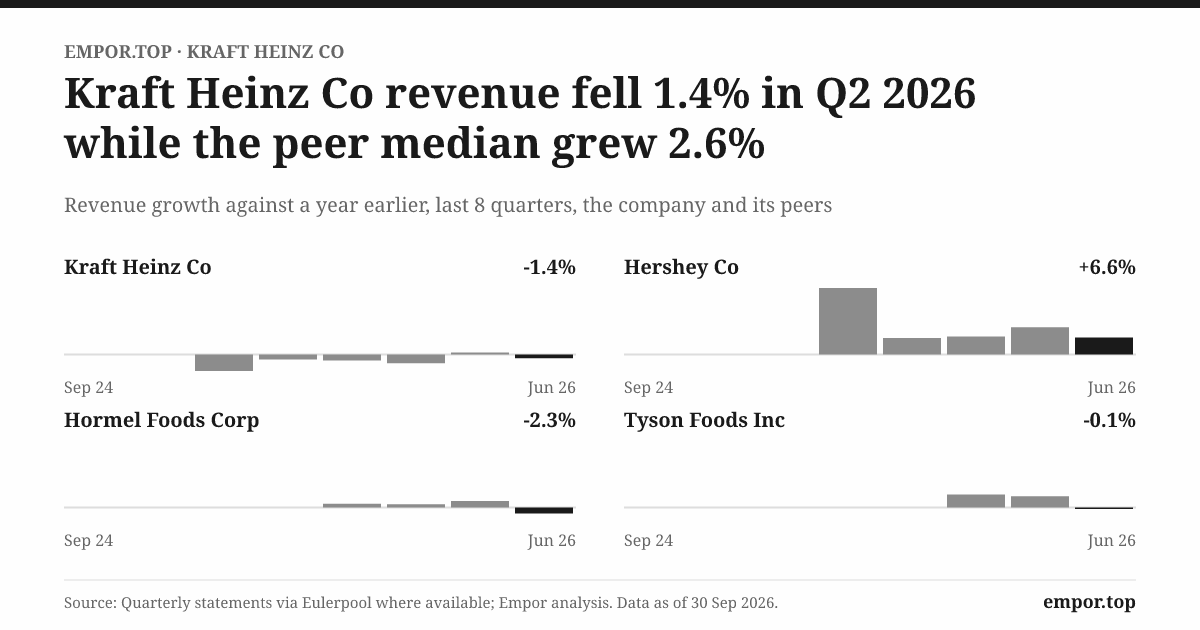
This is where the myth has to be separated from the reality. Myth: the Patricio era returned Kraft Heinz to growth. Revenue did reach about $26.6 billion in FY2023, the highest in the company's history1. Reality: almost all of it came from price. Reported revenue grew less than 2% in FY2022 and less than 1% in FY2023, even with pricing running well ahead of that1. The difference is volume. Kraft Heinz sold less food each year and charged more for each unit. That trade works until prices stop rising. Once they did, in 2024, revenue fell 3% and then another 3.5% in 20251. The sales decline since then is the same volume erosion, no longer hidden by price increases.
While the inflation boom was lifting reported figures, 3G left. The founders gave up their board seats over 2021 and 2022, and 3G sold down its stake until it was completely out by the end of 202313. The departure was quiet, and it was complete. The firm that had designed Kraft Heinz exited at a time when revenue looked healthy and the share price had recovered somewhat, well below where it stood in 2017. Berkshire did not sell a share, and was left holding 325 million shares, or about 27%3.
Patricio's tenure should be judged fairly. He inherited a company whose credibility had collapsed. He stabilized the balance sheet, cleaned up the portfolio, got the accounting under control and changed the tone. He did not fix volume, and the inflation years made it easy to put that problem off. His successor was left to deal with it.
VIII. Abrams-Rivera's Reset, The $600M Reinvestment Pivot, and The Paused Divorce (2024–2026)
In February 2026, Kraft Heinz released its FY2025 results, and they showed a company still paying for its history. It reported a net loss of about $5.8 billion1. Organic net sales fell about 3.5%1. And the company paused the separation that had been the centrepiece of its strategy only a few months earlier, a plan to split into a grocery company and a sauces-and-foodservice company15. In its place, chief executive Carlos Abrams-Rivera committed about $600 million to marketing, pricing and product investment in 2026, aimed at halting share losses in North America15. Both S&P and Fitch moved their outlooks to negative that spring98.
Who is Abrams-Rivera? He is a career packaged-food executive who had run Campbell's snacks business and came to Kraft Heinz to lead North America before becoming chief executive on January 1, 20241. Andre Maciel, a former 3G-era executive, has been chief financial officer since 20221. Miguel Patricio became non-executive chairman in 2024 and left the board at the May 2026 annual meeting. John T. Cahill is now chairman14.
The first test of any management team is how it is paid, and here there is a visible disconnect. Abrams-Rivera's total compensation was about $10.7 million in FY2025, up about 19% from the previous year, in a year the company lost $5.8 billion3. The explanation is in the plan design. Bonuses are tied to adjusted EBITDA, organic net sales and free cash flow, and those measures exclude impairments3. You can defend that: an impairment is a non-cash accounting charge, and executives should not be penalized for the price someone else paid in 2015. But it has a consequence. Under this plan, no one is paid on whether the brands are worth less than the balance sheet says. Shareholders did not object, approving say-on-pay with about 94% support at the May 2026 meeting4.
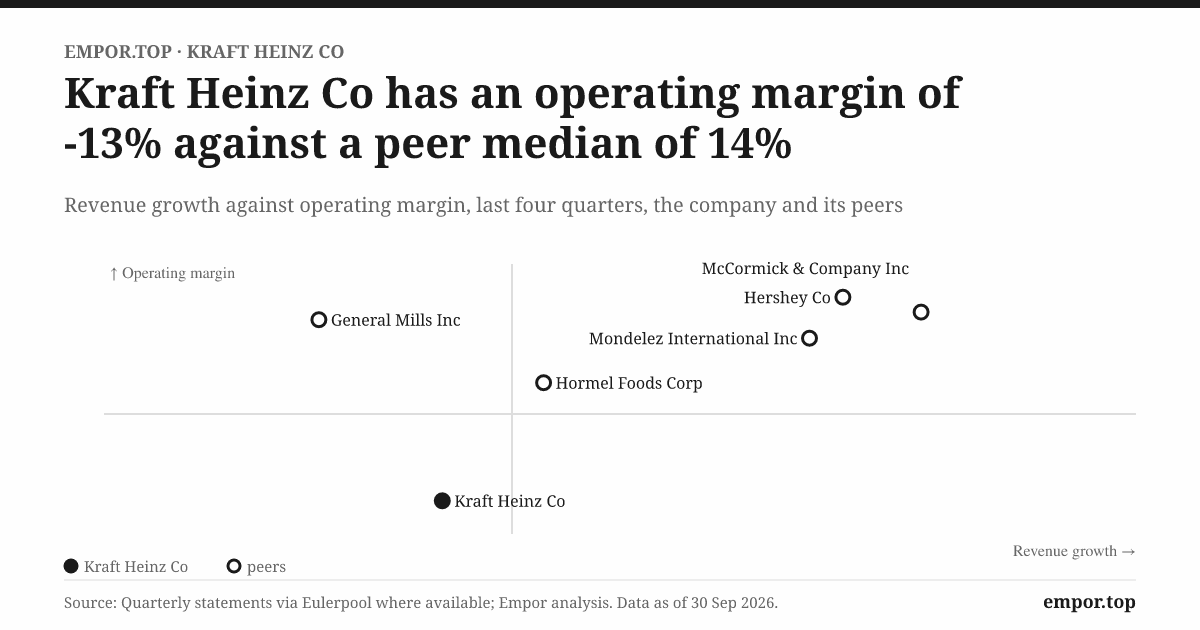
The impairments are the main issue, and they keep coming. In the second quarter of 2025, the company took about $6.7 billion of goodwill impairments and about $2.6 billion of brand impairments, affecting names such as Kraft, Velveeta, Lunchables and Oscar Mayer1. In the second quarter of 2026 came another roughly $7.35 billion, which produced an operating loss of about $6.4 billion for the quarter2. That was an operating margin of about minus 103%, meaning the loss was larger than the quarter's sales2. The auditor, PwC, has listed both goodwill and indefinite-lived brand valuations as critical audit matters, the areas where management judgment most affects the reported numbers1.
Why does a paper write-down matter to someone who only cares about cash? Because of the bank covenant.
Kraft Heinz has a $4 billion revolving credit facility, its emergency line of credit. One covenant requires the company to keep a minimum level of shareholders' equity. On July 8, 2025, shortly after the second-quarter impairments, the company amended the facility. The minimum was cut from $35 billion to $25 billion, and the company was allowed to add back up to $2 billion of impairments each year when calculating compliance1. Book equity was about $41.7 billion at the end of 20251. After the 2026 write-down, it is well below that. It is in the mid-to-high $30 billions2. Each future impairment now uses up the buffer between the company and a covenant breach. The breach is not imminent. But the fact that the company needed to renegotiate after the first wave tells you the lenders are watching the same number.
The paused breakup deserves a hard look. The company spent about $60 million preparing for it in 20251. Management's stated reasons for pausing were the costs of separation, the loss of shared buying and manufacturing, and market conditions15. A sceptic will point out that the separation was announced as the way to unlock value and was abandoned once the grocery business looked too weak to stand on its own. Both explanations can be true. Neither is proven yet.
Capital allocation has shifted into defence. Share buybacks fell from about $435 million in the first half of 2025 to about $27 million in the first half of 20262. Cash and short-term investments were raised to about $3.7 billion at the end of 2025, ahead of about $1.9 billion of debt due in 2026 and about $1.9 billion in 20271.
Then there is the tax dispute. The IRS has issued notices proposing adjustments for tax years 2018 through 2022 related to transfer pricing with foreign subsidiaries. In total it claims about $1.02 billion of tax plus about $425 million of penalties, before interest1. Management disputes the claims and has not reserved for them1. That may well be correct. But it is a contingent liability equal to more than a third of a year's free cash flow, and the company's accounts do not include a cent for it.
The Abrams-Rivera period so far is a company caught in a squeeze. Spending on price and marketing lowers margins. Not spending on them loses volume. And each year's impairment test takes more from the equity cushion. That leads to the question underneath all of this: what, exactly, does Kraft Heinz still own that competitors cannot copy?
IX. Porter's Five Forces, 7 Powers, and the Dissected Moat
Walk into any Walmart in America and do a quick audit. In the condiment aisle, a bottle of Great Value ketchup sits beside Heinz and sells for noticeably less. One aisle over, the Great Value macaroni box sits beside the blue Kraft box at a lower price per ounce. Shoppers see both. Many still pick Heinz. Fewer and fewer pick Kraft. That difference is the whole moat analysis in miniature.
Buyer power is very high. Walmart and its affiliates account for about 21% of Kraft Heinz's net sales, and have for each of the last three years1. No other customer exceeds 10%, but the next tier (Kroger, Costco, Target, Ahold Delhaize) is similarly concentrated. These customers are also competitors. They own store brands and decide where products sit on the shelf. When Kraft Heinz raised prices in 2022 and 2023, some European retailers temporarily stopped ordering rather than accept the increases1. The retailers hold the key to the aisle, and they sell a rival product.
The threat of substitutes is high. A shopper pays nothing to switch from one yellow mustard to another. In cheese slices, bacon, cold cuts and boxed meals, store brands now offer similar quality at a meaningful discount. Kraft Heinz's own volume trend, down every year since 2021, shows shoppers are acting on that.
Supplier power is low to moderate. Tomatoes, dairy, meat and packaging are widely available commodities. Kraft Heinz already uses its size against suppliers, with long payment terms and supply-chain finance1. That lever has already been fully pulled.
The threat of new entrants is moderate. Premium, clean-label brands have taken the growing, high-margin corners of categories: Rao's in pasta sauce, Primal Kitchen and Sir Kensington's in condiments. National distribution and refrigerated logistics are real barriers, but not ones that stop a niche competitor from taking the best customers.
Rivalry is intense. General Mills, Conagra, Campbell's and Nestlé are fighting over the same declining centre-of-store volume, and they all face the same retailers.
Helmer's 7 Powers gives a sharper answer. Look at each power in turn.
Branded Power survives, but only in some categories. Heinz ketchup commands a price premium, holds a leading share in the U.S. and is a fixture on restaurant tables worldwide. Philadelphia cream cheese is similar. Those brands meet the test: shoppers pay more for them than for an equivalent product, and volume holds. In Oscar Mayer, Lunchables, Velveeta and Kraft Singles, the evidence goes the other way. When the company tried to charge a premium, volume fell. The impairment record says the same thing. The largest brand write-downs in 2025 fell on those names, not on Heinz1. The history does not reject the brand moat. It narrows it to a sauces-and-spreads core that accounts for a minority of sales.
Scale Economies are real. Kraft Heinz has one of the largest food manufacturing and distribution networks in North America. But scale reduces costs, not the price a shopper will pay. It has not stopped volume losses, and the plant closures of the 3G years reduced flexibility.
Switching Costs do not exist for consumers. Network Effects, Cornered Resource and Counter-Positioning do not apply to the grocery portfolio. Process Power, the ZBB machine, turned out to be imitable: Unilever and its peers copied it within two years of the failed bid.
The honest conclusion is that Kraft Heinz is really two businesses with different moats in one wrapper. One is a global sauce business with real brand power. The other is a North American grocery business in which the retailer holds most of the power. That is exactly the distinction the paused separation was designed to address. It leads directly to the lessons.
X. Playbook: Business & Investing Lessons
Lesson 1: A brand is a depreciating asset that the income statement doesn't depreciate. The moment: FY2017, when Kraft Heinz reported a 23.2% operating margin while spending less than 0.7% of sales on R&D and cutting marketing1. Every dollar withheld from the brands showed up as profit that year. The cost of withholding it showed up in the impairment tests over the following eight years. Accounting treats brand investment as an expense and treats the loss of brand value as a one-off event, so a company that underinvests looks more profitable until the auditor suddenly makes it look far less profitable. "Zero-based budgeting in consumer goods is not efficiency; it is the liquidation of brand equity, reported as operating profit."
Lesson 2: A playbook's success depends on who owns the shelf. The moment: the same 3G partners who built the world's largest brewer failed with ketchup and cold cuts. In beer, the brewer controls the route to market and the retailer has no house brand of its own to promote. At Burger King, franchisees carry the capital. In grocery, the retailer that sells your product also makes a competing one and decides where both sit. Cost-cutting only creates lasting value where cutting cost does not hand pricing power to someone else. "Bars don't pour their own house lager, but Walmart stocks its own ketchup right next to yours."
Lesson 3: Whatever you pay for, you get more of, including the accounting. The moment: the SEC's finding that procurement staff booked savings that did not yet exist, over several years, while the company was rewarding managers for hitting cost targets6. No elaborate fraud was required. A company that pays people to report lower costs will eventually get lower reported costs, whether or not actual costs fell. The same principle applies today, when bonuses are measured on metrics that exclude impairments3. "When the bonus measures savings and nobody measures the source of the savings, procurement becomes a profit centre in the worst sense."
Lesson 4: Cash flow can be real and still not be free. The moment: over twelve years, Kraft Heinz generated about $39 billion of operating cash flow, more than three times its cumulative net profit1. Almost all of the free cash flow, about 91%, was paid out as dividends1. The company's cash was real. The large gap to net profit came from non-cash write-downs, and part of it came from stretching supplier payments, a source of cash that can only be used once. What remained was a dividend paid on a shrinking asset base, with little left over to rebuild the brands. "A dividend paid while the brands decay is not a return on capital; it is a return of capital, paid in advance of the write-down."
Lesson 5: The price you pay decides the return, even for Buffett. The moment: February 2019, Buffett on CNBC saying Berkshire had overpaid for Kraft[^14]. He did not say the business was bad. He said the price assumed pricing power the products could not sustain. Berkshire's holding has been written down, and it has kept its shares ever since3. "Even the world's best capital allocator cannot rescue a purchase price that assumed the brand would always win at the shelf."
XI. Analysis & Bear vs. Bull Case
On the second-quarter 2026 earnings call, analysts focused on the questions that now drive the stock. How high would leverage go? Would the rating agencies' negative outlooks become downgrades? And could the $1.60 annual dividend survive both the debt maturities and the reinvestment programme28? Management's answer was consistent. The company said its cash generation covers the dividend, that its Taste Elevation and away-from-home businesses are growing, and that the $600 million investment is aimed at stabilizing share in the core grocery business215.
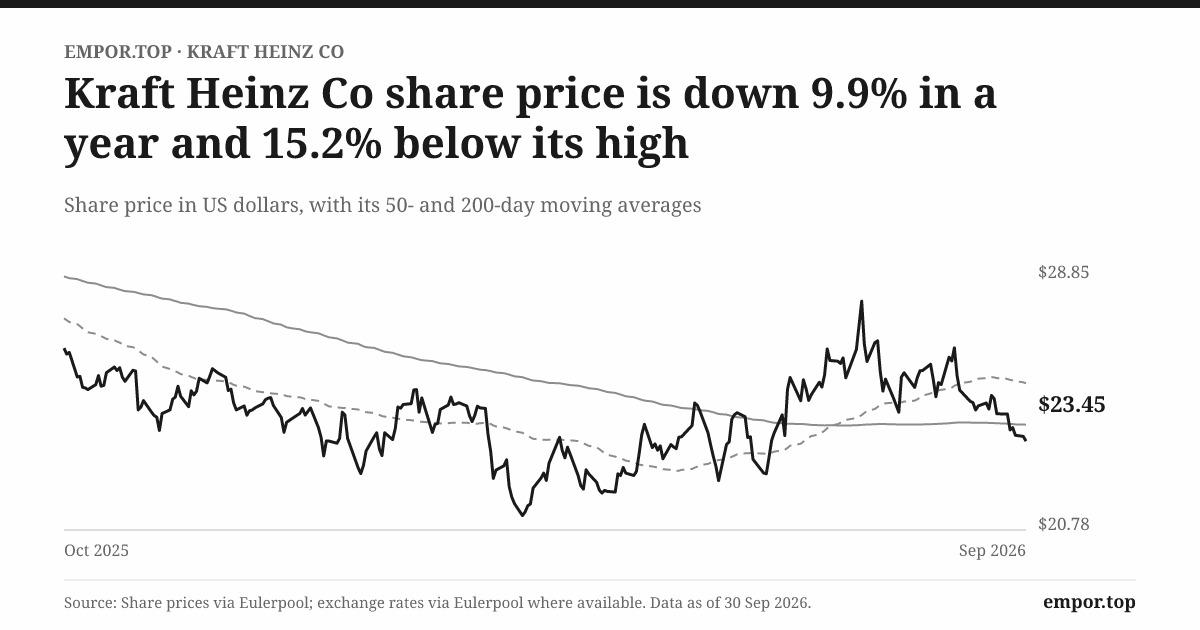
Start with what the market is paying. At $23.45 on September 30, 2026, Kraft Heinz is valued at about $27.8 billion, or roughly $44 billion including net debt1. That is about 0.8 times book value and 1.1 times sales, with a 6.8% dividend yield and a 13.9% free-cash-flow yield1. General Mills trades at a similar multiple of sales, about 1.7 times enterprise value to sales1. The market is not treating Kraft Heinz as uniquely distressed. It is treating it as a shrinking, indebted food company whose book value it does not believe. Price below book is the market's own impairment test, and it has been more pessimistic than the auditors so far.
The bull case. The core of it is cash. Kraft Heinz has produced about $4 billion to $4.5 billion of operating cash flow in each of the last three years, and about $3 billion to $3.7 billion of free cash flow1. A 13.9% free-cash-flow yield means that, if that cash flow held steady, the company would generate its entire market value in cash in about seven years. Heinz and the other sauces are real global brands, with a strong foodservice business. The international business, about a quarter of sales, gives exposure to faster-growing markets1. Debt, at about $21 billion, is much lower than in 20181. The 3G overhang is gone, and the company is now run by a food executive with a mandate to invest rather than cut.
The bear case. Volume keeps falling, with organic sales down in every recent year and further declines in 202612. Center-of-store packaged food also faces a new headwind, the spread of GLP-1 weight-loss drugs, which reduce how much users eat. That is a slow-moving but structural risk for a company selling snacks and convenience meals. Credit is tight. Both S&P and Fitch have Kraft Heinz at BBB with negative outlooks, two notches above junk, and their downgrade triggers include failing to stabilize volume and EBITDA89. About $5.45 billion of debt matures between 2026 and 20281. The covenant floor is closer after every impairment. The $1.45 billion IRS claim is not reserved1. And Berkshire's 27.5% stake sits over the market: if it were ever sold, it would amount to about a quarter of the company3.
The activist's view. A sceptical shareholder would press on three points. First, why is the dividend, about $1.9 billion a year, protected while the brands are underfunded? Second, why is management paid on measures that ignore $9 billion of impairments? Third, if the sauces and grocery businesses have different moats and different futures, why keep them together? The company's answer to the third, dis-synergies, is plausible. It is also what a management team would say about a separation it could no longer execute.
The verdict. Kraft Heinz is not in a solvency crisis. Its cash flow covers its interest, its dividend and a meaningful part of its maturities. But the shareholder is in a long restructuring. The dividend depends on free cash flow holding up while $600 million is reinvested. The balance sheet depends on the next impairment test. And the thesis depends on volume, which has not grown in years.
Three measures matter most:
- North American retail organic volume, excluding price. It has been negative in every recent year and remained negative through the second quarter of 202612. Two consecutive positive quarters would be the first real evidence that the $600 million is working.
- Book equity against the $25 billion covenant. It was about $41.7 billion at the end of 2025 and fell sharply after the second-quarter 2026 write-down12. Each year's impairment test moves it.
- Operating margin excluding impairments while the reinvestment runs. Before impairments it has been running at about 17% to 18% a quarter, down from about 20% in early 202512. If it falls much further without volume improving, the reinvestment is simply buying lower margins.
XII. Epilogue: The Countdown to the $25 Billion Covenant Line
Tonight, Kraft Heinz is a quieter company than the one that bid for Unilever. 3G is gone. Buffett still owns his shares and says very little about them. Abrams-Rivera is running a defensive plan: reinvest in the brands, protect the dividend, pay down debt as it comes due, and wait for volume.
Three moments will decide the next chapter.
The first is the annual impairment test, which the company carries out in the third quarter and discloses in its annual report1. If the fair values of Lunchables, Oscar Mayer and the remaining grocery brands hold, the equity cushion stays where it is and the covenant question fades. If they fall again, each billion written off moves the company closer to $25 billion, and lenders will once again be asked for relief.
The second is the 2027 capital plan. The company has about $1.9 billion of debt due in 20271. The dividend costs about the same each year. Management can pay both from cash flow and reserves as long as free cash flow stays above roughly $3 billion. If the reinvestment programme lowers that figure, the board will have to choose between the dividend, the balance sheet and the brands. It has cut the dividend once before, in 2019.
The third is the Form 10, the registration document that would formally launch a spin-off. The pause may be permanent, or the separation may return if the grocery business stabilizes. Whichever it is, it will reveal what management actually believes about whether the two halves are worth more apart.
All three bear on the same question this story began with. Can a portfolio of twentieth-century centre-aisle brands grow faster than the economy without constantly discounting? For seven years the company has not shown that it can. It has not been proven that it cannot.
XIII. Outro: The Ketchup Bottle That Ran Out of Squeeze
Henry Heinz chose clear glass so the customer could see there was nothing hidden in the jar. For more than a century, that transparency was the product.
A century and a half later, the company that carries his name hid its costs in procurement side deals, carried its brands on the balance sheet at values the market no longer believed, and paid its executives on numbers that excluded both. The owners who tried to squeeze the last margin out of the bottle have left. The shopper has moved across the aisle to the store brand. What remains is a real business with real cash flow, trying to earn back the trust its founder built with a clear jar. Kraft Heinz proved that you can buy scale with leverage and manufacture margin with a spreadsheet, but you cannot budget your way from zero into a shopping cart.
References
-
Form 10-K for Fiscal Year Ended December 27, 2025 — SEC EDGAR, 2026-02-12 ↩↩↩↩↩↩↩↩↩↩↩↩↩↩↩↩↩↩↩↩↩↩↩↩↩↩↩↩↩↩↩↩↩↩↩↩↩↩↩↩↩↩↩↩↩↩↩↩↩↩↩↩↩↩↩↩↩↩↩↩
-
Form 10-Q for Quarterly Period Ended June 27, 2026 — SEC EDGAR, 2026-08-05 ↩↩↩↩↩↩↩↩↩↩↩
-
Notice of 2026 Annual Meeting and Proxy Statement (Schedule 14A) — SEC EDGAR, 2026-04-03 ↩↩↩↩↩↩↩↩↩
-
Form 8-K: Submission of Matters to a Vote of Security Holders — SEC EDGAR, 2026-05-19 ↩↩
-
Registration Statement on Form S-4 (Merger of Kraft and Heinz) — SEC EDGAR, 2015-06-02 ↩↩↩↩↩↩↩↩↩↩
-
SEC Charges The Kraft Heinz Company and Two Former Executives for Engaging in Years-Long Accounting Scheme — U.S. Securities and Exchange Commission, 2021-09-03 ↩↩↩↩↩
-
SEC Accounting and Auditing Enforcement Release No. 4247: In the Matter of The Kraft Heinz Company — SEC, 2021-09-03 ↩
-
Rating Action Commentary: Fitch Affirms Kraft Heinz at 'BBB'; Outlook Negative — Fitch Ratings, 2026-05-11 ↩↩↩
-
Research Update: The Kraft Heinz Co. Outlook Revised To Negative On Strategic Shift — S&P Global Ratings, 2026-02-12 ↩↩
-
Berkshire Hathaway Annual Shareholder Letter (2018) — Berkshire Hathaway Inc., 2019-02-23 ↩↩
-
Berkshire Hathaway Annual Shareholder Letter (2019) — Berkshire Hathaway Inc., 2020-02-22 ↩
-
Unilever Rejects $143bn Takeover Bid from Kraft Heinz — Financial Times, 2017-02-17 ↩↩↩
-
Kraft Heinz Withdraws $143 Billion Bid for Unilever — Reuters, 2017-02-19 ↩↩
-
Kraft Heinz Writes Down $15 Billion in Value of Top Brands — The Wall Street Journal, 2019-02-21 ↩↩↩↩↩↩↩
-
Kraft Heinz Pauses Separation Review to Focus on Growth Reinvestment — Bloomberg News, 2026-02-12 ↩↩↩↩
-
The 3G Capital Way: How the Brazilian Model of Management Shook American Business — Financial Times, 2017-02-24 ↩↩↩↩↩↩↩
-
Kraft Heinz Completes Sale of Natural Cheese Business to Lactalis — Business Wire, 2021-11-29 ↩
-
The Kraft Heinz Company Investor Relations Overview — The Kraft Heinz Company ↩↩↩↩↩↩
 LinkedIn
 WhatsApp
 Reddit
 Hacker News
 Email
 Kindle
 RSS Feed
 Spotify
 Apple Podcasts
 Amazon Music
 Audible
 YouTube