Kimberly-Clark: The Paper Mill That Built an Everyday Empire
I. Introduction & The $50 Billion Household Question
In 1971 a lawyer named Darwin Smith became chief executive of Kimberly-Clark. He was a mild-mannered in-house counsel, not an operator, and the board had picked him almost by default. Within about two months of taking the job, doctors told him he had nose and throat cancer and probably less than a year to live.1 Smith told the board, said he did not plan to die yet, and went back to work. His next big decision was the one that made his name. He would sell the paper mills that had given Kimberly-Clark its identity for a century, and use the money to take on Procter & Gamble in consumer products.1
He lived another 25 years. In Good to Great, Jim Collins used Smith's tenure as his main example of what Collins called "Level 5 leadership": over two decades Kimberly-Clark's cumulative stock returns beat the general market by about 4.1 times, and the company overtook Scott Paper and matched or beat Procter & Gamble in several of the categories it entered.1 It is one of the best-known corporate turnarounds in American business writing.
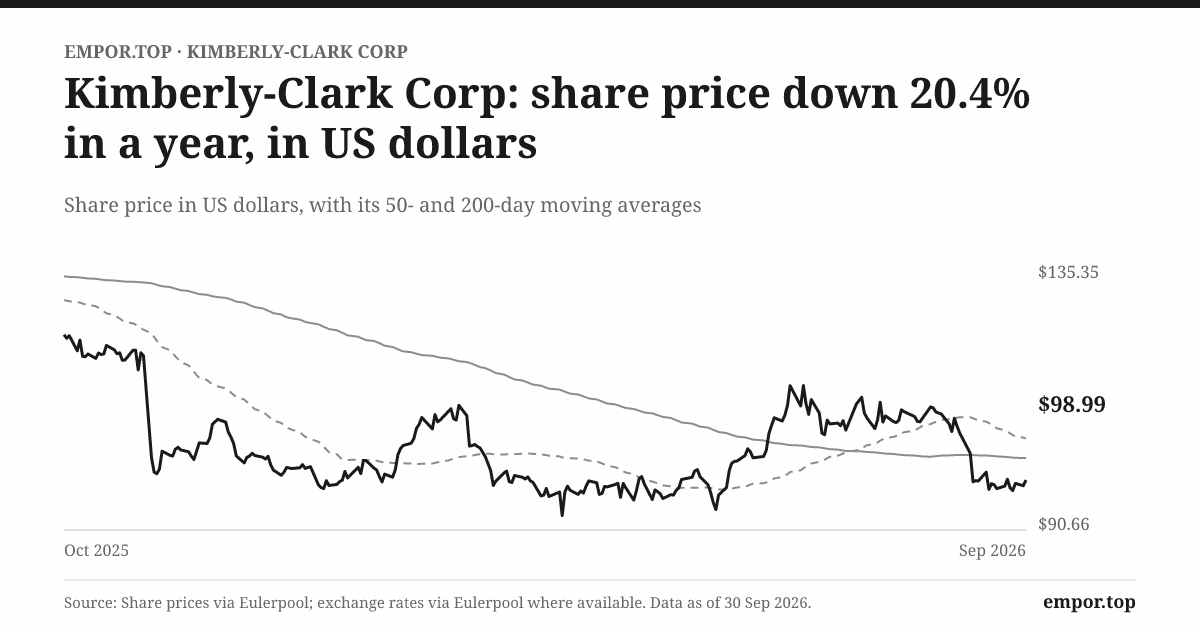
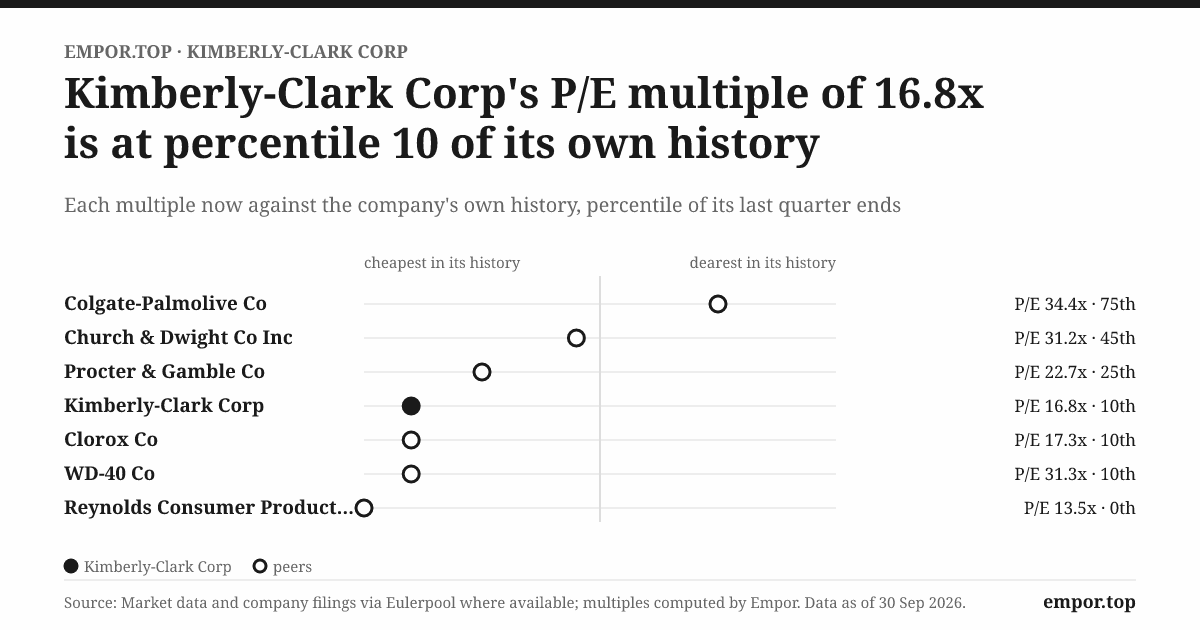
This story is about what happened after that. On September 30, 2026, Kimberly-Clark is a company worth about $32.9 billion. Its shares closed at $98.99, roughly 20% below their 52-week high, and trade at 16.8 times trailing earnings.2 That is well below the stock's own five-year median of about 21.7 times. The dividend yield is 5.2%, and the board has raised the dividend for 52 years in a row, which makes Kimberly-Clark one of the "Dividend Kings."2 Revenue over the last twelve months was about $16.6 billion.24 Some $42,000 of capital, pooled on the Fox River in Neenah, Wisconsin, in 1872, turned into a company whose products are in most American bathrooms, nurseries and medicine cabinets.3
The market, though, is not paying for that past. The stock is cheap because Kimberly-Clark is again betting the company, as Smith did. This time it is buying Kenvue, the consumer-health business Johnson & Johnson spun off, which owns Tylenol, Listerine, Band-Aid and Neutrogena. The deal is paid for with about 280 million new shares and billions of dollars of new debt.6 Pro forma long-term debt rises to about $18.2 billion.6 On September 28, 2026, the company launched exchange offers for up to $7.0 billion of Kenvue's notes.5 A day later, Moody's and S&P both affirmed their ratings (A2 and A) and both put the outlook on negative.78
The argument of this piece is that Kimberly-Clark's history is a series of exits from businesses it built itself, usually made just before those businesses turned into commodities. Smith sold the coated-paper mills. His successors closed the pulp mills. In 2024 Michael Hsu gave majority control of international tissue to a Brazilian pulp company. Each time, the company chose brands over mills and margin over volume. The Kenvue deal is the latest and largest version of that bet, and it is the first one paid for mainly with the company's own shares.
Four questions run through the story:
- Can Kimberly-Clark carry Kenvue's debt and keep its 52-year dividend record? Both rating agencies are on negative outlook, and the dividend bill is about to rise sharply.
- Does moving international tissue into Arbex, the joint venture with Suzano, fix margins for good, or does it leave head-office costs spread over a smaller company?
- Will falling birth rates and store brands erode the pricing power of Huggies and the rest of North American personal care?
- Is 16.8 times earnings a value trap built on dilution, or a mispricing before the Kenvue synergies arrive?
To answer them, the story goes back to a rag-paper mill, a wartime cotton shortage, a dying lawyer's decision, a merger with a company "Chainsaw Al" Dunlap had just stripped down, a working-capital system that funds the dividend, and finally the Kenvue deal. It begins with how a newsprint maker got into consumer products largely by accident.
 Subscribe on LinkedIn
II. The Accidental Consumer Revolution: Cellucotton to Kleenex (1872–1945)
Neenah, Wisconsin, in 1872 was a lumber-and-flour town on the Fox River. Four local businessmen, John A. Kimberly, Havilah Babcock, Charles B. Clark and Franklyn C. Shattuck, put up $42,000 to build a mill that turned cotton and linen rags into newsprint.3 Nothing about it looked like the start of a consumer-brands company. It was an industrial business that sold paper to publishers by the ton, at thin margins, at whatever price the market set.
The early history mostly shows that the company could take a hit and keep going. When its Atlas mill burned in the 1880s, the partners rebuilt it quickly instead of closing.3 That habit of rebuilding fast, and of treating fixed assets as replaceable, turns out to matter. A company that does not get sentimental about a mill is more willing to sell one later.
The German wadding
The turning point came just before World War I. Kimberly-Clark staff came across a creped wadding made from processed wood pulp that absorbed liquid far better than cotton and cost much less to make. The company developed its own version and called it Cellucotton.3 When the United States entered the war and surgical cotton ran short, Cellucotton became bandage and dressing material for Army field hospitals. According to the company's heritage accounts it cost roughly half as much as cotton.
The war ended and the Army stopped buying, leaving the company with capacity and inventory it could no longer sell. What happened next came from users rather than from a research lab. Army nurses had been using Cellucotton pads as sanitary napkins. In 1920 Kimberly-Clark turned that into Kotex, one of the first mass-market disposable sanitary products.3 Pharmacists at first did not want to display it, and many women were embarrassed to ask for it by name. The company set up a separate marketing entity, International Cellucotton Products, and pushed it toward discreet, pre-wrapped packaging and ads that made it acceptable to buy a product nobody talked about in public.
The cold-cream accident
In 1924 the same material became Kleenex, sold as a disposable cloth for removing cold cream.3 Letters from customers showed that many of them were using it to blow their noses. When the company started advertising it as a disposable handkerchief, sales roughly doubled. Its customers had found the product's real use for it.
The pattern from this period repeats later, so it is worth stating plainly. Kimberly-Clark's best products did not start as consumer research. They started as surplus industrial cellulose, with ordinary users telling the company what the material was good for. The company's skill was noticing that feedback and then spending on marketing, such as the licensed "Little Lulu" cartoon ads, until the brand name became the word for the product.
That success also created a problem that shows up in the Playbook section. Once "Kleenex" means any facial tissue, the name tells shoppers what to buy but does not stop them buying something cheaper. A brand that becomes the generic word for a category has won awareness, and that does not guarantee it can charge more.
For investors, the takeaway from these seventy years is that the company's value has consistently come from converting cheap cellulose into branded, higher-margin products. The mills were how it got there. The next CEO understood that and acted on it.
III. Darwin Smith and the Great Paper Mill Purge (1971–1991)
Darwin Smith looked nothing like the "Chainsaw Al" type of turnaround boss. Collins described him as shy and awkward, a farm boy from Indiana who worked his way through Indiana University by working days at International Harvester, where he lost part of a finger in an accident, and who then went to Harvard Law School.1 He had spent his Kimberly-Clark career as an in-house lawyer. When the board named him CEO, one director reportedly worried he lacked some of the qualifications for the job.1
The company he took over was in bad shape. Collins found that in the two decades before Smith, Kimberly-Clark's stock had lagged the general market by about 36%.1 It was a paper company with paper economics: large mills needed constant capital spending, prices moved with the commodity cycle, and there was no premium from branding a sheet of coated paper.
The decision
Smith and his team concluded that the core business was a dead end. Being good at coated paper still meant earning middling returns forever, because nobody chose a magazine for its paper stock. The only businesses where Kimberly-Clark could be best in the world, and earn money for it, were consumer paper products such as Kleenex, Kotex and eventually diapers.
So they sold the mills, including the one in Kimberly, Wisconsin, the town named after the company.1 Collins wrote that the business press called the move stupid and that analysts downgraded the stock.1 Smith went ahead anyway. The proceeds went into consumer brands, which put Kimberly-Clark in direct competition with Procter & Gamble, then one of the most formidable marketing companies anywhere. Collins compared it to a boxer deciding to fight the heavyweight champion.
Beating P&G at its own game
The diaper business is where that decision paid off. P&G had created the modern disposable diaper market with Pampers in the 1960s. Kimberly-Clark launched Huggies in 1978, designed with an hourglass shape and elastic around the legs, which reduced leaks, the thing parents cared about most. Within a few years Huggies became the leading diaper brand in the United States.3
The company followed with new categories. Depend, launched around 1980, made adult incontinence an openly marketed retail category. Pull-Ups, introduced in 1989, created training pants as a separate product for the stage between diapers and underwear.3 Pull-Ups did not take share from an existing product. It created a new, higher-priced step in a child's life and charged for it.
What the purge actually teaches
It is easy to tell this as a simple story of courage rewarded. The more careful version is that Smith was not selling off heritage on principle. He was moving capital from businesses with no pricing power into businesses with some. Paper mills had high capital needs and no brand premium. Diapers and incontinence products had lower capital needs per dollar of profit, recurring demand, and something close to brand loyalty in categories where a product failure is personally painful. Few parents experiment with an unfamiliar diaper brand at 3 a.m.
This approach, selling the low-return commodity asset and putting the cash into the branded product, is the basic model for the rest of the story. It explains why current management was willing to move international tissue into a joint venture. It also raises the question for the Kenvue deal: is buying consumer health a continuation of that model, or does it swap discipline for size?
The model also depends on a condition. It works when the brands actually earn more than the mills they replaced. The next thirty years tested that condition when Kimberly-Clark went back into the mill business in a very large way.
IV. The Scott Paper Clash and the European Trap (1992–2018)
By 1995 Scott Paper had just gone through Al Dunlap. Brought in as CEO in 1994, Dunlap cut roughly a third of the workforce, sold assets, slashed research and costs, and got the stock price up. Then he sold the company. Kimberly-Clark CEO Wayne Sanders agreed to buy Scott in an all-stock deal valued at about $9.4 billion, which produced a consumer-paper company with revenue around $11 billion–$13 billion, second in household products only to P&G.
The rationale was straightforward. Scott gave Kimberly-Clark leadership in bathroom tissue and paper towels, the Andrex brand in Britain, and a much bigger presence in Europe and other markets. Put together, the company would be the world's largest tissue maker.
The price of scale
Antitrust regulators made Kimberly-Clark divest overlapping businesses, including the Scotties facial-tissue brand and a baby-wipes business, before the deal could close. Integration cost roughly $1.4 billion in charges and several thousand jobs. The bigger issue was structural. Smith had spent twenty years getting out of capital-heavy mills. Scott put Kimberly-Clark back into them, now in tissue: large machines, energy-heavy drying, pulp as the main cost, and store brands able to match a roll of toilet paper for much less. Tissue is branded, but it is closer to a commodity than diapers are, and consumers switch more easily.
Twenty years of treading water
The later record reflects that. Thomas Falk, who ran the company from 2002 to 2018, dealt with a portfolio that included a lot of tissue. Between FY2014 and FY2018, revenue stayed between about $18.2 billion and $19.7 billion, with no real growth.2 Margins moved with pulp prices and restructuring charges. Operating margin swung from under 9% in FY2015 to more than 18% in FY2016 and FY2017, then fell back to about 12% in FY2018.2 Falk ended his tenure by launching the 2018 Global Restructuring Program, one of several reorganizations during his time as CEO.2
Falk also shrank the company. In 2014 he spun off the healthcare business, surgical and infection-prevention products, as Halyard Health, later renamed Avanos Medical. The spin-off brought long-running legal problems with it. The dispute over the protective barrier performance of Halyard's MicroCool surgical gowns led to federal qui tam litigation and Justice Department investigations. Kimberly-Clark says it resolved its remaining exposure in 2025, settling the qui tam case and entering a deferred prosecution agreement with the Justice Department, with payments it does not consider material to its liquidity.29 Neither is large now, but the episode shows that a divestiture can leave legal exposure behind for years after the business is gone.
The falsification test
Did Scott create lasting scale advantages? The company's own figures largely say no. Scott bought global tissue leadership and some of the best brands in the category, but for the next two decades Kimberly-Clark did not show organic growth above low single digits, and it kept booking restructuring charges. Ten-year revenue growth to FY2025 was about -0.8% a year, and that includes the recent carve-out.2 Even before the carve-out, the Falk years show a company roughly flat in revenue. The balanced reading is that Scott paid off where Kimberly-Clark had brand strength (Andrex, Cottonelle) and turned into a long drag where it had only capacity. The Scott deal did not break the Smith model. It showed where the model stops working: in categories where scale is necessary but does not by itself protect margins.
That leaves a puzzle. With revenue flat for a decade, how did Kimberly-Clark keep raising its dividend every year? The answer is in the working-capital accounts, not the income statement.
V. The Negative Working Capital Machine: Turning Diapers into Cash (2014–2025)
Think of Kimberly-Clark's treasury as a three-sided negotiation. Retailers such as Walmart pay for pallets of Huggies in about 40 days. Pulp suppliers, resin makers and packaging vendors wait far longer. By the end of FY2025, Kimberly-Clark was paying suppliers in about 112 days.2 The gap between collecting from customers and paying suppliers amounts to an interest-free loan from the company's suppliers, and a large one.
The puzzle
Over the twelve years from FY2014 to FY2025, Kimberly-Clark reported about $23.0 billion of cumulative net profit and about $35.8 billion of cash from operations, or roughly $1.56 of operating cash for every dollar of profit.2 Part of that is normal for a manufacturer: depreciation is a non-cash charge, and the company's mills and converting lines depreciate heavily. In FY2025, depreciation and amortization was about $805 million.2 Depreciation alone does not account for how consistent the gap is, though. The other part is the payables stretch.
The clues
- Customers pay at about the same speed as always. Debtor days were 41 in FY2014 and 40 in FY2025.2 The allowance for doubtful accounts and discounts was about 2.5% of gross customer receivables at year-end 2025.2 Retailers are not paying later, and there is no sign that receivables are being inflated to hit revenue targets.
- Inventory is tighter. Inventory days fell from about 59 in FY2022 to about 49 in FY2025.2 Some of that is supply-chain work and some is simpler: the company is holding less product.
- Suppliers are paid much later. Days payable rose from about 73 in FY2014 to about 112 in FY2025, almost the entire change in the working-capital picture.2
Add those together and the cash conversion cycle, days to collect plus days of inventory minus days to pay, went from about +21 days to about -23 days.2 Kimberly-Clark now gets paid for its products well before it pays for the materials that went into them.
Where the cash went
Free cash flow over the twelve years was about $24.3 billion, and about $17.4 billion of it, around 72%, went to dividends.2 Most of the rest went to buybacks, which were about $1.0 billion in FY2024 and a much smaller $141 million in FY2025 as the company started preserving cash.2 Cash on hand actually fell over the period. The system was built to pay out cash, not to accumulate it.
That changes how Kimberly-Clark should be understood. It is not a growth company that also pays dividends. It is a company that turns an efficient supply chain, strong negotiating position with suppliers and steady consumer demand into a very dependable stream of cash, most of which is sent to shareholders.
The limit
That also shows where the model runs out. Payables cannot keep stretching indefinitely. From 73 to 112 days is a 39-day extension over a decade, and suppliers such as pulp producers and polymer chemical companies eventually either charge more or refuse. Much of the gain from stretching payables has already been taken. Kimberly-Clark showed early signs of strain in FY2025: operating cash flow of about $2.8 billion was the weakest in several years, free cash flow fell to about $1.6 billion as capital spending rose to about 6.6% of sales, and total cash fell by about $320 million during the year.2 Dividends were about $1.7 billion that year, which was more than free cash flow.2
For investors, this system is why the dividend streak has survived flat revenue. It is also the reason to watch the Kenvue financing closely. A company that already pays out almost all its free cash flow has little room for a much larger dividend bill, higher interest costs and integration spending at the same time.
Before that, however, management took one more step in the pattern Smith started, and it may be the most important step of Hsu's time as CEO.
VI. "Powering Care" and the Suzano/Arbex Carve-Out (2024–2026)
At Kimberly-Clark's Investor Day in March 2024, CEO Michael Hsu presented a plan called "Powering Care."10 Hsu joined from Kraft in 2017 and became CEO on January 1, 2019.2 He presented himself as a brand-and-innovation leader, and the plan reflected that. It had three parts: reorganize into three business units centered on innovation, cut costs significantly, and get out of lower-return businesses. The market focused mainly on the third part.
The Suzano deal
Kimberly-Clark agreed to contribute most of its International Family Care and Professional business (tissue, towels and away-from-home products outside North America) to a new joint venture called Arbex. Brazil's Suzano, the world's largest producer of eucalyptus pulp, owns 51% of Arbex and Kimberly-Clark owns 49%.211 The joint venture started operating on July 1, 2026.11 Arbex received long-term licenses to Kleenex, Scott, WypAll and related brands in its territories, and Kimberly-Clark receives royalties and its share of equity earnings.24
The logic follows from Smith's thinking. Tissue's main cost is pulp. Suzano makes pulp from Brazilian eucalyptus that grows fast and is among the cheapest wood fiber in the world. Putting tissue manufacturing together with a low-cost pulp producer makes more industrial sense than a consumer company buying pulp at market prices and absorbing the swings. It also means Kimberly-Clark stops paying for tissue machinery overseas.
The carve-out came after another exit: in 2024 the company sold its personal protective equipment business to Ansell for about $651 million, booking a pre-tax gain of roughly $448 million.122 The portfolio was being cut down to the brands management wanted to keep.
The revenue drop
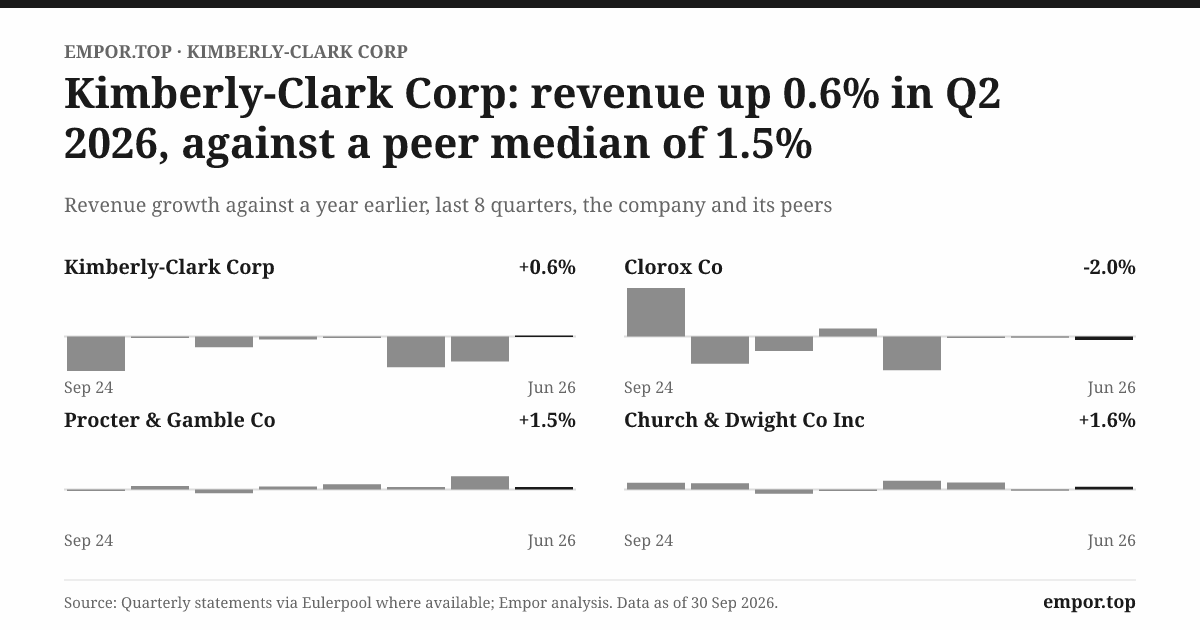
These moves make the reported figures look much worse than the business changed. FY2025 revenue fell about 14.2%, and the first quarter of 2026 was down about 14%.2 This is mainly an accounting effect: the international tissue business, which had more than $3 billion of sales, was reclassified as discontinued operations and removed from continuing revenue.2 Consumers did not stop buying Huggies. When the comparison base caught up in Q2 2026, reported growth was about +0.6%.2
The organic figure, which strips out currency and portfolio changes, is the more useful one. Organic growth in continuing operations was about +1.1% in FY2025, down from roughly +3.2% in FY2024 and +4.7% in FY2023.2 Those earlier numbers were boosted by several rounds of inflation-driven price increases. When the price increases stopped, growth dropped toward zero, which indicates underlying volume demand was weak.
The margin case
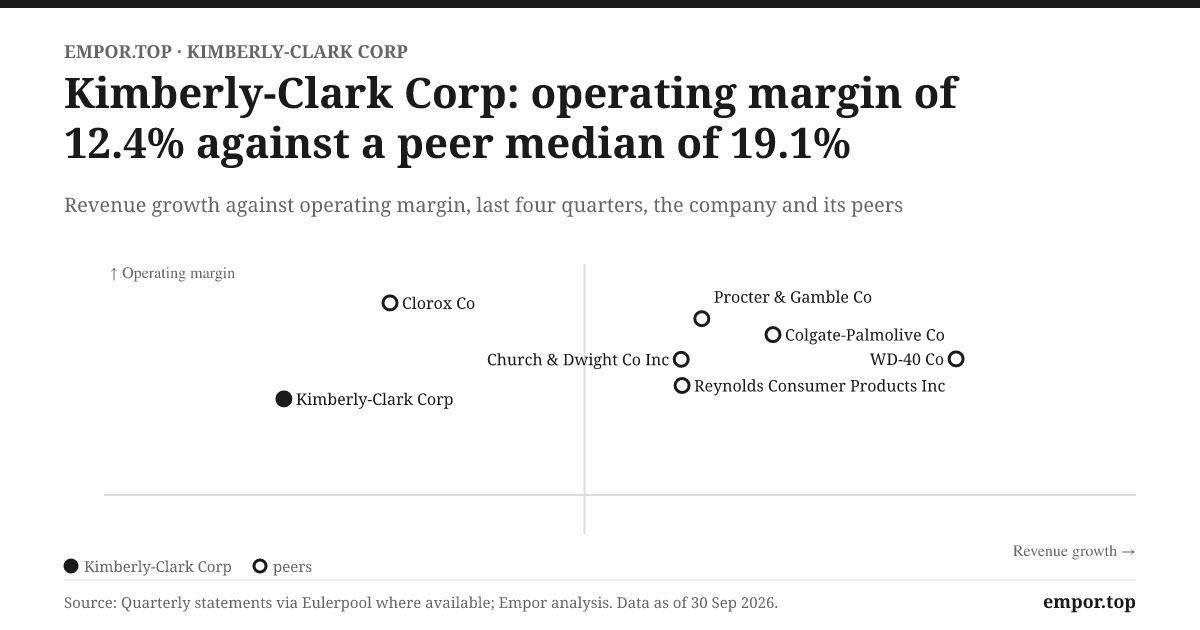
Management's strongest evidence is margin. Operating margin rose from about 11.5% in FY2023 to about 16.0% in FY2024 and about 14.5% in FY2025.2 The FY2024 figure includes the PPE sale gain, so it overstates the underlying trend. FY2025 is the cleaner comparison, and even that year included heavy restructuring. The quarterly data is less encouraging: operating margin was about 11.4% in Q1 2026 and about 10.7% in Q2 2026, both below the year-earlier quarters.2 Part of that reflects transaction and integration costs, and part reflects overhead that has not shrunk as fast as revenue. Head-office, IT and brand-support costs that used to be spread over about $20 billion of revenue now sit on about $16.6 billion.
On the evidence so far, the carve-out has probably improved the business mix, since what remains is higher-margin personal care. It has not yet shown lasting margin expansion at the company level. The clearest test is whether continuing operating margin stays at or above about 16% through FY2026–FY2027 once one-off items are removed, and whether Arbex contributes meaningful equity income without surprises from exchange rates or pulp prices.
A hidden asset in Mexico
One asset the headline valuation largely ignores: Kimberly-Clark owns about 47.9% of Kimberly-Clark de México (KCM), a separately listed company in Mexico.2[^12] Under equity accounting the stake is carried at only about $266 million, while its market value is around $2.9 billion.2 It contributed about $373 million of equity earnings in FY2025.2 That is roughly $2.6 billion of value that does not show up on the balance sheet, and it will matter again in the bull case.
Frictions
The carve-out has costs. Kimberly-Clark had to end hedge accounting on about $690 million of hedges tied to the transferred business, which moved a $20 million pre-tax loss out of accumulated other comprehensive income.2 The amount is small, but it shows how entangled the tissue business was with the rest of the company. Accumulated other comprehensive loss is still around $3.4 billion, mostly cumulative currency translation from decades of foreign operations.4 Kimberly-Clark also now owns 49% of a business it does not control, exposed to Latin American and European economies, with Suzano running operations.
The company had cut its business down to the higher-margin core. What management did next was to double its size, with the same leadership team, in a single deal.
VII. The Kenvue Mega-Merger: Doubling Down on Consumer Health (2025–2026)
On November 2, 2025, Kimberly-Clark announced a definitive agreement to acquire Kenvue, the consumer-health company Johnson & Johnson spun off in 2023.2 Kenvue's brands include Tylenol, Motrin, Listerine, Band-Aid, Neutrogena, Aveeno and Johnson's Baby. The combination would create a consumer-health and personal-care company with about $31.5 billion of combined revenue.6 By September 30, 2026, shareholders had approved the deal and antitrust clearance had been received, but the deal had not yet closed.2
The strategic case
Management's case is that the two portfolios cover the same life stages and the same store aisles: Huggies next to Johnson's Baby and children's Tylenol, Depend next to pain relief and wound care, Kotex next to other women's-health products. The combined company would sell to the same retailers, including Walmart, pharmacies and Amazon, with more negotiating weight and a wider range of what management calls "essential" brands. The synergy target in the plan is at least about $300 million of run-rate pre-tax cost savings, and management has pointed to larger figures.6
Some of this is sensible. Kenvue's categories are more like diapers than tissue: people trust the brands, they can be sold at a premium, and they involve health, which makes shoppers less willing to switch. Tylenol has much stronger brand power than a roll of paper towels.
Financing
The complicated part is how it is paid for.
- Cash: about $6.7 billion of cash consideration, backed by JPMorgan credit facilities, including a $4.0 billion revolving credit facility and term loans signed in December 2025, and an initial bridge commitment of about $7.7 billion.2
- Stock: about 280 million new Kimberly-Clark shares issued to Kenvue shareholders, taking the basic share count from about 331.9 million to about 612.8 million, an increase of roughly 84%.6
- Assumed debt: Kenvue's existing bonds. On September 28, 2026, Kimberly-Clark launched exchange offers for up to $7.0 billion of Kenvue notes, swapping them into Kimberly-Clark paper.5
On a pro forma basis, long-term debt goes from about $6.5 billion at June 30, 2026, to about $18.2 billion, and annual net interest expense rises to about $971 million.64 Pro forma leverage is estimated at about 3.0–3.5 times net debt to EBITDA.2
What the ratings agencies are saying
On September 29, 2026, Moody's affirmed the A2 rating and S&P affirmed the A rating, and both kept negative outlooks.78 An affirmation with a negative outlook means the agencies accept the current rating for now but see a real chance of a downgrade if deleveraging falls behind. Both highlighted the same issues: integration complexity, much higher leverage, and a large, growing dividend.
The per-share arithmetic
The pro forma figures show the core tension. On a combined basis, FY2025 diluted EPS falls to about $3.43, compared with about $5.54 for Kimberly-Clark on its own using the same pro forma basis.6 Pro forma net income and operating profit do rise, to about $2.1 billion and $3.5 billion.6 But the number of shares sharing that profit rises by about 84%.
In plain terms, current shareholders are trading roughly 40% of their per-share earnings today for a bigger, more diversified company plus the chance of synergies. That trade makes sense only if the synergies arrive, Kenvue's brands grow faster than Kimberly-Clark's have, and the extra debt is paid down on schedule.
The dividend stress test
This is where the Dividend King record is actually tested. Kimberly-Clark paid about $1.66 billion in dividends in FY2025.2 At the same per-share rate across roughly 613 million shares, the annual dividend bill rises to about $2.3 billion or more. That comes on top of about $971 million of interest, integration spending and whatever capital Kenvue's supply chain needs. The research estimates that dividends could take more than 80% of combined free cash flow, which would leave almost nothing for buybacks for several years.
The historical comparison is not reassuring. Section V showed that Kimberly-Clark's dividend payout has been between about 60% and 126% of profit over the past twelve years, with a median around 81%.2 In FY2015 and FY2018 it paid out more than it earned. The streak survived those years because the balance sheet was modest and debt was cheap. The combined company will have neither advantage.
The skeptical view is simple: after more than a decade of low organic growth, management is issuing a large amount of equity to buy another low-growth company, partly to change the story. The case for the deal also exists: Kenvue's brands are among the best in consumer health, and the combined company will have more influence with retailers. The evidence so far supports neither side conclusively, and the rating agencies' negative outlooks are the clearest sign of the risk.
A deal can look good in a pro forma model and still fail at the retailer. That is where the story goes next.
VIII. The Store Shelf Reality: Private Label, Birth Rates, and Walmart (Current State)
In Bentonville, Arkansas, Walmart buyers review supplier scorecards every quarter. One of the key measures is "on-time, in-full" delivery, the share of orders that arrive complete and on schedule, and suppliers who fall short pay penalties. On the same shelves as Huggies sit Walmart's Parent's Choice diapers, which are made to be good enough and cheaper.
One customer
Walmart accounted for about 16% of Kimberly-Clark's net sales from continuing operations in FY2025, up from 15% in FY2023, mostly in North America.2 That is roughly $2.7 billion of revenue from one buyer. No other customer is above 10%, but Target, Costco and Amazon are also very large and all sell store brands.2 Kimberly-Clark sells on standard purchase orders with no long-term volume commitments.2 Each year its shelf space has to be won again against a retailer that also sells a competing product.
Inputs
Kimberly-Clark's main raw materials are wood pulp, polypropylene resin and superabsorbent polymers, the granules in a diaper that soak up liquid.2 All are commodities. When pulp or oil-based materials get more expensive, the company cannot pass the increase straight to retailers. It has to negotiate, usually months later, and often with trade promotions attached. That lag is why gross margins swing even though the brands are stable.
The auditor's warning
Deloitte, Kimberly-Clark's auditor, identified one Critical Audit Matter in the FY2025 audit: sales incentives and trade promotion allowances.2 A critical audit matter is not an accusation. It flags the area where management's estimates are most subjective and most important. Here, the auditor is pointing at the rebates, promotional payments and discounts Kimberly-Clark pays retailers to keep its products on shelves and moving. Those costs are large and difficult to estimate, and they are the direct cost of competing with store brands.
Demographics
The long-term demand picture is mixed. U.S. and European birth rates are near record lows, so fewer babies mean fewer diapers, and the baby-care franchise has no volume tailwind. At the other end of life, aging populations drive demand for Depend and Poise, and adult incontinence is one of the faster-growing parts of personal care.2 The open question is whether the adult segment grows fast enough to offset the decline in baby care. The FY2025 organic growth of about 1.1% suggests that so far it roughly breaks even.2
Governance
Shareholders are showing more signs of dissatisfaction. Hsu's reported pay in 2025 was about $15.3 million, with a CEO pay ratio of 271 to 1.13 "Compensation actually paid," the SEC measure that adjusts for changes in the value of equity awards, fell to about $9.2 million from about $23.8 million in 2024 because the share price declined.13 The proxy's pay-versus-performance table puts the gap plainly: a $100 investment in Kimberly-Clark five years earlier was worth about $90, compared with about $141 for the consumer staples peer benchmark.13
At the May 14, 2026 annual meeting, say-on-pay passed easily with about 94% support. However, a shareholder proposal to require an independent board chair, which would take the chairmanship away from Hsu, received about 33.8% of votes cast, and Hsu received about 11.2 million votes against his re-election, the most of any director.14 A third of the vote is not a revolt, but it is a sizable minority registering concern just before the biggest deal in the company's history.
The evidence adds up to this: Kimberly-Clark's brands keep their shelf space, but they increasingly pay retailers for it. The high-inflation years of 2022–2023 showed how much pricing the brands could take. The slowdown in 2025 suggests that pricing room has largely been used up. Future growth depends on adult care offsetting the decline in baby care, and on retailers not taking more margin back through store brands.
That raises the question behind every consumer-staples valuation: what actually protects these products?
IX. Hamilton Helmer's 7 Powers & Porter's 5 Forces Analysis
Consider a parent in a supermarket aisle. The store-brand diaper is roughly 20–30% cheaper. The Huggies pack costs more. The parent buys Huggies anyway, because the risk of a leak at 3 a.m., with a wet crib and a crying baby, costs more than the price difference. Kimberly-Clark's competitive advantage mostly comes down to decisions like that one, and its weakness is how many product categories do not involve that kind of decision.
Hamilton Helmer's 7 Powers
- Branding (strong, but uneven). Huggies, Pull-Ups, Kotex, Depend and Poise sell into categories where failure is embarrassing or messy, so trust in the brand works like insurance for the buyer. Huggies has been first or second in U.S. diapers for more than four decades.3 Kleenex is the opposite case: the name is so generic that it tells shoppers what the category is without necessarily earning a higher price. The brand strength is real but concentrated in personal care. Kenvue would add brands such as Tylenol, where trust matters even more.
- Scale economies (moderate to strong). Nationwide production and distribution lower unit costs in freight and manufacturing. Few competitors can build that network from scratch. P&G can, though, and so can the contract manufacturers that make store-brand products.
- Cornered resource (weak). Pulp, resin and superabsorbent polymers are available to anyone. Suzano's cheap fiber now belongs mainly to Arbex, not to Kimberly-Clark.
- Switching costs (none). A shopper can switch from Huggies to Pampers or a store brand in one trip.
- Network effects (none).
- Counter-positioning (none, and working against Kimberly-Clark). Direct-to-consumer and "clean" challenger brands target the incumbents, which cannot easily copy them without undercutting their own core products.
- Process power (moderate). High-speed converting lines and supply-chain practices built over decades provide real cost and quality advantages, but ones that competitors can eventually match.
Verdict: Kimberly-Clark has two real powers, brand in categories where trust matters and scale in distribution, and little else. That is enough to earn good returns (return on invested capital was about 23.5% in FY20252) but not enough to prevent large retailers from taking margin.
Porter's 5 Forces
- Buyer power: very high. Walmart alone is 16% of sales. Retailers decide shelf placement, promotions and payment terms, and they compete with Kimberly-Clark through their own brands. The auditor's critical audit matter on trade promotions reflects the cost of that bargaining power.
- Supplier power: moderate. The pulp and polymer supply base is fragmented, and Kimberly-Clark's 112 payable days show how much leverage it has over suppliers. Commodity price spikes still flow through to costs, and hedges only delay the effect.
- Threat of substitutes: high. Store brands such as Kirkland, Parent's Choice and Up&Up are functionally comparable at 20–30% lower prices. The substitute is the same product under a retailer's label.
- Threat of new entrants: low to moderate. Building national-scale diaper plants is expensive, but online niche brands can get started with outsourced manufacturing.
- Competitive rivalry: intense. Kimberly-Clark has competed with P&G for decades across diapers (Pampers), feminine care (Always) and tissue (Charmin, Bounty), and with Essity in hygiene and tissue. P&G has larger scale and marketing budgets and trades at a much higher valuation, which means it has cheaper capital.
The overall picture is a defensible business, but defensible in the way a well-dug trench is, not a castle. It needs continual spending on marketing, trade promotions and innovation to hold its position. The rest of this piece refers back to this analysis rather than repeating it.
X. Playbook: Business & Investing Lessons
Kimberly-Clark closed its last pulp mills in the early 2010s without much attention, bringing to a quiet end nearly 140 years as a producer of paper from raw material.3 Here is what the 154 years teach.
1. Sell the founding business before it becomes a burden. In 1971 Darwin Smith sold the mills in the town that carried the company's name. Later CEOs closed the pulp mills. In 2024 Michael Hsu handed control of international tissue to a Brazilian pulp producer. Each time, the company let go of the thing people most associated with it and moved toward higher returns. The lesson for founders and investors is that a company's heritage is an emotional asset, not a financial one. A company's history is not a strategy, and some of its best decisions were exits.
2. Owning the name of a category does not guarantee a price premium. People call every facial tissue "Kleenex." That does not stop them buying the cheaper box, and tissue went into a joint venture outside North America because of it. Huggies, which is not generic, keeps its premium because the cost of failure is personal. When a brand becomes the everyday word for a product, it can lose the ability to charge extra for it.
3. A working-capital advantage is borrowed from others and eventually hits a limit. Moving from 73 to 112 payable days funded more than a decade of dividends. Suppliers were effectively lending to Kimberly-Clark's shareholders. There is little room left to stretch further, and the dividend is about to get much larger. Negative working capital is financing supplied by suppliers, and it only lasts as long as they agree to it.
4. Watch closely when a slow-growing company issues a lot of stock to buy another slow-growing company. After a decade of flat revenue and organic growth near 1%, Kimberly-Clark is issuing roughly 280 million shares, an 84% increase, to buy Kenvue. The deal may still work. But the previous large combination, Scott Paper, produced global scale followed by twenty years of restructuring. Getting bigger changes the size of the company. Per-share results show whether owners are better off.
The broader point is that Kimberly-Clark's best decisions were about letting go, and its riskiest ones have been about adding. The Kenvue deal is the largest addition it has ever made.
XI. Bear vs. Bull Case
On September 30, 2026, Kimberly-Clark trades at about 16.8 times trailing earnings, compared with a five-year median of about 21.7 times.2 P&G trades at around 24 times and Colgate-Palmolive at about 27 times. Essity, the European tissue and hygiene company, trades at about 15 times.2 The market is valuing Kimberly-Clark closer to a tissue company than to a premium brands company. That is either a reasonable judgment or an opportunity.
The bull case
- Demand holds up. Diapers, feminine care, incontinence products and, after the deal, pain relievers and mouthwash are bought in recessions and good times alike. A free cash flow yield of about 7.8% and dividend yield of about 5.2% reflect a business that reliably produces cash.2
- Aging populations. Adult incontinence is one of the few parts of personal care with a clear demographic tailwind, and Depend and Poise lead it.
- Undervalued assets. The KCM stake is worth about $2.6 billion more in the market than on the balance sheet, and Arbex's equity earnings add exposure to low-cost pulp.2
- Synergies. If the combined company achieves around $300 million or more in cost savings and gets more leverage with retailers from the larger brand portfolio, EPS can rise from the diluted pro forma level of $3.43.6 If the stock also rerated closer to its historical median, the current price would look low in hindsight.
The bear case
- Dilution. Standalone EPS of about $5.54 drops to about $3.43 on a pro forma basis.6 Shareholders own a larger company through a much smaller share of it.
- Debt. Long-term debt of about $18.2 billion and leverage of roughly 3–3.5 times put both ratings agencies on negative outlook.678 A downgrade into the BBB range would raise borrowing costs just as the company needs to refinance bridge loans.
- Dividend pressure. A dividend bill of $2.3 billion or more, on top of about $1 billion of interest, leaves little room for error. Kimberly-Clark has paid out more than 100% of profit in past years, and the history does not show a large cushion.
- Weak volume. Organic growth was about 1.1% in FY2025 after the price increases ended, alongside a trade-promotion critical audit matter, and its largest customer also sells competing store brands.2
- Governance. A third of voting shareholders supported an independent chair, and total shareholder return has lagged peers significantly over five years.1413 If the Kenvue integration struggles, activist investors may push for changes.
The KPIs that decide it
Three measures matter most:
- Net debt to EBITDA after closing. Pro forma it is about 3.0–3.5 times.2 The combined company needs to reach about 2.8 times within several quarters to protect the rating and the dividend.
- Organic growth in continuing operations, especially volume. It was about +1.1% in FY2025, down from +3.2% and +4.7% in the prior two years.2 The trend is downward.
- Continuing operating margin. It was about 14.5% for FY2025, but around 11% in the first half of 2026 including deal costs.2 If margins stay near that level once integration charges fall away, the claim that Powering Care improved the business structurally is in trouble.
On balance, the current price assumes meaningful execution risk, and there is reason for that. The bull case needs three things together: synergies, deleveraging and volume recovery. The bear case needs only one of them to fail.
XII. Epilogue: The Next Moments That Decide the Story
As of September 30, 2026, Kimberly-Clark is in the middle of this transition. International tissue belongs to Arbex, most of whose shares Suzano owns. The Kenvue deal has the approvals it needs but has not closed. The exchange offers for Kenvue's bonds have been launched. Both rating agencies have affirmed their ratings and warned about them in the same announcement. The stock is about 20% below its high, and the dividend yield is above 5%.
Four developments over the next year or so will show whether the Kenvue deal resembles Smith's pivot or the Scott merger:
1. Closing and leverage (Q4 2026 to Q4 2027). Once the deal closes, the key number is how quickly net debt to EBITDA declines. Reaching about 2.8 times by the end of 2027 would suggest the negative outlooks can be removed. If leverage stays above 3 times, a downgrade becomes likely, and refinancing costs rise.
2. Arbex's first results. Kimberly-Clark's 49% stake needs to produce meaningful equity income, with the research using about $150 million a year as the benchmark, while protecting the parent from swings in pulp costs. Weak results would undermine the argument that giving up control made sense.
3. North American volume. Two consecutive quarters of positive volume growth in baby and adult care, around 1.5% or better, without a rise in trade promotion spending, would show the brands still have real pull. Continued flat volume would support the view that store brands are winning.
4. The 53rd dividend increase. In early 2027 the board will decide whether to continue the streak. A small increase of 1–2% would keep the record. A pause, possibly prompted by the rating agencies, would end one of the longest dividend records in American business.
Each of those developments answers one of the story's four questions. What connects them is a single issue: whether Kimberly-Clark's cash-generating model, built on brand trust and supplier financing, can support a much larger company without the dividend cutting into it.
XIII. Outro: The Last Paper Mill in Neenah
The Fox River still runs through Neenah, where in 1872 four men put up $42,000 to turn rags into newsprint.3 The paper business they started is gone. The mills were sold, closed or, most recently, handed to a joint venture controlled from São Paulo.
What survived was not paper. It was the company's understanding of everyday bodily needs: nosebleeds and colds, periods, babies, old age, and, after Kenvue, fevers, cuts and toothaches. Kimberly-Clark has lasted 154 years by selling products people need regardless of the economy, while repeatedly getting rid of the businesses it started with. With the Kenvue deal, it is betting again that demand for diapers, bandages and pain relief will keep coming, and this time it is putting the balance sheet and the dividend behind that bet.
References
-
Good to Great: Why Some Companies Make the Leap... and Others Don't (Darwin Smith Case Study) — Jim Collins, 2001-10-16 ↩↩↩↩↩↩↩↩
-
Kimberly-Clark Corporation Form 10-K for Fiscal Year Ended December 31, 2025 — U.S. Securities and Exchange Commission, 2026-02-12 ↩↩↩↩↩↩↩↩↩↩↩↩↩↩↩↩↩↩↩↩↩↩↩↩↩↩↩↩↩↩↩↩↩↩↩↩↩↩↩↩↩↩↩↩↩↩↩↩↩↩↩↩↩↩↩↩
-
Kimberly-Clark Corporation Investor Relations Landing Page — Kimberly-Clark Corporation, 2026-09-30 ↩↩↩↩↩↩↩↩↩↩↩
-
Kimberly-Clark Corporation Form 10-Q for Quarterly Period Ended June 30, 2026 — U.S. Securities and Exchange Commission, 2026-08-04 ↩↩↩↩
-
Kimberly-Clark Corporation Current Report on Form 8-K (Item 8.01 Kenvue Note Exchange Offers) — U.S. Securities and Exchange Commission, 2026-09-28 ↩↩
-
Exhibit 99.4 Unaudited Pro Forma Condensed Combined Financial Information (KMB-Kenvue) — U.S. Securities and Exchange Commission, 2026-09-28 ↩↩↩↩↩↩↩↩↩↩↩
-
Moody's Affirms Kimberly-Clark's A2 Rating; Outlook Negative on Kenvue Transaction — Moody's Ratings, 2026-09-29 ↩↩↩
-
S&P Global Ratings Research Update: Kimberly-Clark Corp. 'A' Rating Affirmed, Outlook Negative — S&P Global Ratings, 2026-09-29 ↩↩↩
-
Department of Justice Resolves Criminal and Civil Investigation into Avanos Medical Over Gown Barrier Protection — U.S. Department of Justice Office of Public Affairs, 2025-08-15 ↩
-
Kimberly-Clark 2024 Investor Day Webcast & Presentation Archive — Kimberly-Clark Corporation, 2024-03-27 ↩
-
Kimberly-Clark and Suzano Announce Closing of International Tissue Joint Venture Arbex — PR Newswire, 2026-07-01 ↩↩
-
Kimberly-Clark Completes Sale of PPE Business to Ansell for $651 Million — Bloomberg, 2024-07-01 ↩
-
Kimberly-Clark Corporation Definitive Proxy Statement (DEF 14A) — U.S. Securities and Exchange Commission, 2026-03-23 ↩↩↩↩
-
Kimberly-Clark Corporation Current Report on Form 8-K (Item 5.07 AGM Voting Results) — U.S. Securities and Exchange Commission, 2026-05-14 ↩↩
 LinkedIn
 WhatsApp
 Reddit
 Hacker News
 Email
 Kindle
 RSS Feed
 Spotify
 Apple Podcasts
 Amazon Music
 Audible
 YouTube