Kinder Morgan: The Infrastructure Toll Road of North American Energy
I. Introduction & The Toll Road Empire
In mid-February 2021, Arctic air settled over Texas and would not leave. Wind turbines iced over. Wellheads in the Permian Basin froze shut. Gas-fired power plants, starved of fuel, tripped offline one after another, and the state grid operator ordered rotating blackouts that left millions of homes dark through the coldest nights many Texans could remember. Spot natural gas prices, which normally sit at a few dollars per million British thermal units, went to levels nobody in the industry had seen.
In a Houston control room, Kinder Morgan's operators were doing something unglamorous: pulling gas out of the ground. Not out of wells, which were frozen, but out of underground storage reservoirs the company had filled months earlier. The molecules moved through a Texas intrastate network that kept running while much of the state's supply chain did not. When the storm passed and the accountants tallied the week, Kinder Morgan had booked a gain of roughly $1 billion from the freeze1.
That week is the best possible introduction to this company, because it contains both halves of the story. One half is physical: steel in the ground, gas in caverns, pressure maintained when everyone else lost it. The other half is financial: a company that, for most of its history, has been as much a capital-markets machine as a pipeline operator, and that has lived, nearly died, and been reborn by the logic of its balance sheet.
The scale is hard to hold in your head. Kinder Morgan operates roughly 82,000 miles of pipelines and 139 terminals, and its network carries about 40% of the natural gas consumed or exported in the United States2. Picture every gas stove, every gas-fired power plant, every LNG tanker loading on the Gulf Coast; nearly half of that gas, at some point, pays a toll on a Kinder Morgan pipe. On October 1, 2026, the market valued the whole enterprise, equity plus debt, at about $99.8 billion2.
The central question for this story is simple to ask and hard to answer. Can a pipeline network assembled from the pieces Enron threw away become the indispensable conduit for the two great energy-demand shocks of the 2020s, Gulf Coast LNG exports and gigawatt-scale AI data centers, without relapsing into the leverage that nearly broke it a decade ago?
The cast is small and unusually durable. Richard Kinder, the lawyer from Missouri who ran Enron's operations and was nicknamed "Doctor Discipline," founded the company in 1997 with a $40 million purchase and a $1 salary. He is still executive chairman, still paid $1, and still owns about 11.6% of the shares3. Kimberly Dang, a 20-year insider and former CFO, now runs the company as CEO3.
The road from there to here runs through six chapters. First, the Enron exit and the bargain-bin acquisition that started everything. Second, the invention of the modern master limited partnership (MLP) playbook, a privatization, the largest private-equity-backed energy IPO of its time, and the $38 billion El Paso merger. Third, the reckoning: a $70-billion-plus roll-up in 2014 and a 75% dividend cut in 2015 that broke faith with a generation of income investors78. Fourth, a Canadian retreat in which the Canadian government bought Trans Mountain9. Fifth, Uri. And sixth, the present: rating upgrades, a project backlog around $10 billion, and a cash squeeze between expansion and dividends[^6]6.
The verdict, stated up front and tested throughout: Kinder Morgan has rebuilt itself from a financial-engineering vehicle into a physical toll road that would be nearly impossible to replicate. But the company's capital allocation now sits in a vise. Expansion capex is surging, the dividend absorbs most of what is left, and the stock price already reflects a great deal of the good news. To see why that vise matters, it helps to go back to the moment when Richard Kinder lost the job he wanted.
 Subscribe on LinkedIn
II. The $40 Million Severance Bet & Doctor Discipline (1996–1999)
Houston, late 1996. Enron was not yet the company of legend, but it was already turning into something its president did not recognize. Richard Kinder had spent the first half of the decade as Enron's president and chief operating officer, the man who made the trains run on time under Ken Lay5. Lay was the visionary and the politician; Kinder was the one who read the budgets. Colleagues called him "Doctor Discipline" for his habit of grilling managers on cash flow, debt coverage, and costs until the numbers made sense or the project died.
Kinder's background explained the temperament. He grew up in small-town Missouri, studied at the University of Missouri, served in the Army during the Vietnam era, and practiced law before joining Florida Gas Transmission, a pipeline company that later became part of the Houston Natural Gas–InterNorth combination that formed Enron. He was a physical-assets man in a company about to fall in love with paper.
When Lay decided not to step aside, the succession path closed. Jeffrey Skilling, the McKinsey consultant who wanted Enron to become an "asset-light" trader of gas contracts and derivatives, was rising. Kinder left at the end of 1996. History has made that departure look like prophecy. At the time it looked like a talented executive losing a palace war.
The bargain bin
Kinder did not go far. He partnered with Bill Morgan, a former Enron colleague and his college classmate, and in early 1997 the pair bought Enron Liquids Pipeline, a small publicly traded partnership, together with an interest in its general partner, for about $40 million5. To Enron, this was a sleepy corner of the portfolio: refined-products pipelines, a few terminals, an Illinois rail-to-barge facility. It did not fit the trading story, so it was sold.
Here is the first clue to the whole Kinder Morgan method. The assets were not exotic. What was mispriced was the way they were being run. Kinder took a business saddled with Enron-style corporate overhead and cut it to the bone: coach flights, no corporate jets, no executive perks, and a $1 salary for himself. Overhead fell by millions within months, and the partnership's cash distributions to unitholders rose sharply within the first year.
It is worth being precise about what this was. It was not operational genius in the sense of building something new. It was forensic value arbitrage: identifying fee-generating hard assets whose economics were obscured by a parent's cost structure and indifference, then stripping the costs and handing the cash to owners. The innovation was cultural. A company whose founder takes $1 and owns a large slab of equity sends a different signal to its managers than one whose chief executive collects a large salary.
The template
The template that emerged in 1997 had three parts. First, own regulated or contracted physical assets that collect fees whether commodity prices rise or fall. Second, run them with austere overhead. Third, pay out nearly all the cash, because high payouts attracted yield-hungry investors, which lowered the partnership's cost of equity, which made the next acquisition cheaper. Each acquisition, if bought at the right price, raised distributable cash per unit, which justified a higher unit price, which made the next deal cheaper still.
That flywheel is the hero of the next decade and the villain of the one after. It worked beautifully as long as two conditions held: the deals kept coming, and the capital markets stayed open. Notice that neither condition is under management's control. The founding story is genuine, and the $1 salary is a real alignment device. But the engine Kinder built in 1997 already contained the dependency that would nearly kill it in 2015. The next chapter is the story of that engine running at full throttle.
III. The MLP Innovation and the Cost of Capital Trap (1999–2014)
Picture a retired engineer in Ohio in 2003, opening a brokerage statement. Among the blue chips sits a line called Kinder Morgan Energy Partners, ticker KMP. The units pay a fat quarterly distribution that seems to grow every year, and much of it is tax-deferred. He has never seen a pipeline. He does not need to. He is buying a yield that rises, from a manager who cuts costs and does not pay himself.
Multiply him by hundreds of thousands and you have the capital base on which Kinder Morgan was built.
How the machine worked
A master limited partnership is a publicly traded partnership that, under the U.S. tax code, pays no corporate income tax as long as most of its income comes from qualifying sources such as transporting energy. Instead, it passes cash through to unitholders, who are taxed individually. For pipelines, that was a large advantage: a dollar of pipeline earnings could reach investors without first losing a third of itself to corporate tax.
The second ingredient was less visible to the retired engineer. KMP was controlled by a general partner, owned by Kinder Morgan Inc. The general partner held incentive distribution rights, or IDRs, a contractual claim to a rising share of incremental cash once distributions passed set thresholds. At the top tier, the general partner collected half of every incremental dollar distributed5. Think of it as a landlord who takes a bigger slice of rent every time the tenant succeeds.
In 1999, Kinder Morgan merged with KN Energy, a Colorado-based gas company, and through the deal acquired the Natural Gas Pipeline Company of America, a system linking Texas and Midcontinent supply to Chicago5. The combined company took the Kinder Morgan name. The liquids partnership had become a natural gas player.
Private, then public again
In 2007, Kinder led a management buyout of Kinder Morgan Inc. alongside Goldman Sachs's private-equity arm, Carlyle, Riverstone, and AIG, a deal valued at about $22 billion including debt5. The pitch was insulation from public-market impatience. The effect was to concentrate ownership in a smaller group of sophisticated hands during the pre-shale build-out.
The return to market came on February 11, 2011, when KMI sold 95.5 million shares at $30 each, raising about $2.9 billion in the base offering and relisting on the New York Stock Exchange in what was then the largest private-equity-backed IPO in U.S. history5. The private-equity sponsors had held the company for under four years and were on their way to a rich exit. The public investors were buying the general partner: a claim on that rising IDR stream.
The megadeal
Fifteen months later, in May 2012, KMI closed the acquisition of El Paso Corporation in a cash-and-stock deal worth about $38 billion including debt8. El Paso brought Tennessee Gas Pipeline, running from the Gulf Coast to New England, and El Paso Natural Gas, serving the Southwest. Overnight, Kinder Morgan became the largest natural gas transporter in North America. The Copano Energy deal in 2013 added gathering and processing in Texas shale plays8.
These assets are the ones that matter most today. Tennessee Gas Pipeline is now a central route for gas into the Southeast's power plants and toward data center loads; the El Paso system feeds the Southwest. In that sense, the El Paso acquisition was the most consequential decision in the company's history, and it has aged well.
The IDR treadmill
The trap was in the arithmetic. Once KMP's distributions were deep in the top IDR tier, every additional dollar paid to limited partners required close to another dollar to the general partner. For KMP to grow its per-unit distribution, a new project had to earn enough to feed both. That pushed the effective cost of equity for new investments into double digits at a time when rivals with simpler structures could fund at much lower rates.
Analysts at the time described it bluntly: the structure made KMP an increasingly expensive place to fund growth8. The general partner, meanwhile, was a toll collector on the toll collector. Richard Kinder's personal wealth compounded through those IDRs.
Was the MLP model genuine value creation or subsidized arbitrage? The record supports a narrower verdict than either champions or critics claim. The assets, especially those bought from El Paso, were real and durable. But a large share of the period's shareholder returns came from a falling cost of capital and a tax-advantaged wrapper, not from operating improvements. The structure had a built-in expiry: the more successful it became, the higher its hurdle rate climbed. By 2014 the machine had become too expensive to feed, and management did something dramatic about it.
IV. The $76 Billion Roll-Up and the 75% Dividend Shock (2014–2015)
Sunday, August 10, 2014. Most of Wall Street was at the beach. Kinder Morgan chose that evening to announce that it would fold its family of entities, KMP, Kinder Morgan Management (KMR), and El Paso Pipeline Partners (EPB), into KMI itself, in a deal valued at about $70 billion, or roughly $76 billion counting assumed debt8. It was the largest energy transaction of the year, and it was a confession. The MLP machine had become too costly to run.
The great simplification
The logic was clean. One corporation, one ticker, no IDRs. Without the general partner taking half the incremental cash, the group's cost of capital would fall. As a C-corporation, KMI could also step up the tax basis of the acquired assets, generating years of tax shields. Management projected double-digit dividend growth for years8. Kinder told investors KMI would raise its dividend about 10% a year through 20208.
The deal closed in November 2014, with KMI issuing tens of billions of dollars in new shares1. Retail holders of KMP received KMI shares and, in many cases, an unpleasant tax bill on a transaction they had not chosen.
The hidden vulnerability
What the simplification also did was put all the group's debt onto a single balance sheet. At the end of 2014, KMI's borrowings stood at about $42.8 billion, against shareholders' equity of about $34 billion1. And the timing was terrible. Oil prices began collapsing that autumn, from around $100 a barrel to the $40s, and energy credit markets seized up through 2015.
Kinder Morgan's core gas business was not directly exposed to oil prices. That mattered less than one might think. What it needed was access to capital: the plan relied on issuing equity and debt to fund billions in expansion projects while paying a dividend that consumed most of operating cash flow. When midstream equities fell and credit spreads widened, the funding model broke. Through 2015, borrowings edged up to about $43.2 billion1, the share price slid, and the rating agencies signaled concern that leverage was heading toward levels inconsistent with a low-investment-grade rating.
A downgrade to junk would not have been a cosmetic event. It would have shut KMI out of the commercial paper market and sharply raised the cost of refinancing tens of billions of dollars.
December 8, 2015
The decision came in early December. Kinder Morgan cut its quarterly dividend by 75%, from $0.51 a share to $0.1257. The company said it would use the retained cash, roughly $3.5 billion a year, to fund its capital program internally rather than issuing more stock7.
For income investors, many of whom had held KMP for a decade and been told that the roll-up would make their payouts grow faster, it was a betrayal. The stock had traded above $40 in the spring of 2015; it fell into the low teens in the following months7. In 2015, KMI paid about $4.2 billion in dividends against net profit of just $337 million1.
Management credibility, tested
The history here is unambiguous, and it matters for every promise management makes today. Sixteen months before the cut, the founder told investors dividends would grow about 10% a year through 20208. The cut proved that the guidance was not a forecast of the business; it was a forecast of capital-market access. When a capital-intensive company relies on outside equity to fund growth, its dividend is partly a loan from future shareholders.
The redeeming fact is what the company did next. It reset to a self-funding model and stuck to it. Since 2015, KMI has issued no new common equity to fund growth, and it did not use its $5 billion at-the-market program in 2023, 2024, or 20251. That is a decade of behavioral evidence, which is better than any promise. But balance-sheet repair needed more than retained cash, and the most dramatic step came from an unlikely place: a stalled pipeline in British Columbia.
V. The Trans Mountain Retreat and Balance-Sheet Fortification (2016–2020)
Ottawa, May 29, 2018. Canada's finance minister, Bill Morneau, stood before reporters to announce that the Government of Canada would buy an oil pipeline. Not regulate it, not guarantee it: buy it. The seller was Kinder Morgan, and the price was C$4.5 billion9.
It was one of the stranger deals in North American energy history, and Kinder Morgan's side of it was a lesson in recognizing when an asset has become a political weapon rather than an investment.
The quagmire
Trans Mountain came to Kinder Morgan through its 2005 purchase of Terasen, a Canadian utility and pipeline company. The line runs about 1,150 kilometres from Edmonton, Alberta, to Burnaby on the British Columbia coast, carrying crude and refined products. For Alberta's oil sands producers, it was the only pipeline to the Pacific, and so the only route to Asian buyers who might pay more than U.S. refiners.
The expansion plan, known as TMX, would roughly triple capacity to about 890,000 barrels a day9. It ran into every kind of opposition a project can face: First Nations who argued they had not been properly consulted, environmental groups, municipal governments in the Vancouver area, and finally the provincial government of British Columbia, which threatened to restrict shipments of diluted bitumen. Alberta's government, on the other side, threatened retaliation. A pipeline company had become a referee in a constitutional fight.
The ultimatum
Kinder Morgan's response was to ring-fence the risk. In May 2017, it listed Kinder Morgan Canada Limited on the Toronto Stock Exchange, selling a minority stake to Canadian investors9. In April 2018, it suspended non-essential spending on TMX and set a May 31 deadline: without assurance that the project could actually be built, it would walk away9.
That deadline forced Ottawa's hand. The federal government, which had approved the project and staked political capital on it, concluded the only way to guarantee construction was to own it. Kinder Morgan Canada received the cash, and the parent subsequently distributed proceeds and, in 2019, sold its remaining stake in the Canadian vehicle, along with the U.S. portion of the Cochin pipeline, to Pembina Pipeline1. Kinder Morgan's Canadian chapter was closed.
Was it a masterstroke?
The outcome looks better every year. Trans Mountain's expansion was ultimately completed in 2024, at a final cost several times the original estimate, borne by Canadian taxpayers rather than Kinder Morgan shareholders. Kinder Morgan sold the option and kept the cash.
The fair critique is that the company did not plan this; it was forced into it. TMX had been a Kinder Morgan project for years, consuming management attention and capital. The exit was good risk management in the end game, not prescient strategy at the start. And the episode carries a durable lesson for current investors: in North America, new long-haul pipelines are as much political as engineering projects. That fact will reappear as a moat argument later, because what makes a greenfield line nearly impossible to build also protects the lines already in the ground.
Rebuilding the balance sheet
The years after 2015 were spent repairing. Borrowings fell from about $43.2 billion at the end of 2015 to about $34.2 billion by the end of 2019, a cut of roughly $9 billion1. Cash briefly piled up at about $3.3 billion at the end of 2018 as Trans Mountain proceeds arrived1. In December 2017 the board authorized a $2 billion buyback, later raised to $3 billion; over the life of the program, KMI repurchased about 86 million shares at an average of roughly $17 each1. With the stock now near $30, those purchases look well timed2.
The dividend was rebuilt too, but slowly. By 2019, dividends paid had climbed back to about $2.2 billion a year, roughly in line with reported net profit1. The company that had paid more than ten times its earnings in 2015 was, four years later, paying about what it earned. And then, in 2020, a pandemic crushed fuel demand and pushed reported profit down to about $180 million after impairments1. The repaired balance sheet held. The next test would not be a demand collapse, but a supply one.
VI. Winter Storm Uri and the Merchant Cash Machine (2021)
On Valentine's Day weekend 2021, a polar vortex pushed sub-zero air deep into Texas. The state's energy system, largely built for heat rather than cold, began to fail in sequence. Gas wellheads and gathering lines froze. With less gas reaching them, power plants went down, which cut power to the electric compressors that move gas, which cut gas supply further. The grid operator ordered rolling blackouts that left millions without power for days. Wholesale electricity prices sat at the $9,000-per-megawatt-hour cap; spot gas at some Texas hubs traded at hundreds of dollars per MMBtu, more than a hundred times normal levels10.
This was a humanitarian disaster. Hundreds of Texans died. It was also, for companies holding physical gas in the right place, a windfall.
How a toll road made merchant profits
Most of Kinder Morgan's interstate business earns fixed fees: shippers pay for capacity whether they use it or not. But its Texas intrastate system works differently. Texas intrastate pipelines are not regulated by the Federal Energy Regulatory Commission, and Kinder Morgan buys and sells gas on them to balance its system, often drawing on storage.
When supply froze, Kinder Morgan had gas in storage and pipes that kept operating. It sold that gas into a market paying emergency prices. It also cut its own electricity consumption, shutting down electric-driven compression and terminal operations where it could, which avoided buying power at the cap. The company reported that the storm contributed roughly $1 billion of pre-tax earnings in the first quarter of 202110.
The fact sheet shows the spike. Cash from operations jumped to about $5.7 billion in 2021, and net profit rose more than ninefold from the depressed 2020 level to about $1.9 billion1. Uri was not a recurring business. But it revealed something real: the option value of storage and a large, interconnected intrastate network during extreme events.
The backlash and the lawsuit
A windfall in a disaster draws scrutiny, and Kinder Morgan received plenty: political criticism, regulatory inquiries, and accusations of profiteering. The company's defense was that it sold gas under its contracts and tariffs at prevailing market prices, and that keeping gas flowing helped keep parts of the system online.
The most serious counterparty challenge came from Freeport LNG, which sued Kinder Morgan over gas deliveries during the storm, alleging that the company had improperly declared force majeure and sold gas elsewhere at high prices. The claim was around $104 million1. A trial court ruled for Kinder Morgan, but in April 2025 the Texas Fourteenth Court of Appeals reversed and remanded the case for trial11. The amount is small relative to Kinder Morgan's size. The precedent is not: if contracted firm-supply customers can successfully argue that a pipeline company prioritized merchant profits over contracted deliveries during a crisis, the reputational cost in a business built on reliability could exceed the dollars at stake.
What Uri means
Two conclusions follow, and they pull in opposite directions. First, Uri demonstrated that Kinder Morgan's Texas network and storage carry real reliability value, the kind that makes customers want to be connected to it. Second, the biggest single profit event in the company's recent history came not from the toll road, but from merchant sales during a crisis. Investors should not count on that again, and the rating agencies have not; their upgrades rest on fee-based cash flows, not weather windfalls[^6]6. What they are counting on instead is a slower, larger, and more durable surge in demand.
VII. The AI Power Crunch and the LNG Export Supercycle (2022–2026)
Walk the Gulf Coast between Corpus Christi and Cameron, Louisiana, and you see a skyline that did not exist fifteen years ago: liquefaction trains, storage tanks, and LNG carriers waiting offshore. Cheniere at Sabine Pass and Corpus Christi, Freeport, Cameron, Venture Global's Calcasieu Pass and Plaquemines, Golden Pass. Each is, in essence, a giant refrigerator that turns gas into a liquid for shipment to Europe and Asia. Each needs a continuous flow of feedgas, measured in billions of cubic feet a day.
Now picture a different landscape: a field in Georgia or central Texas where a hyperscaler is building a data center campus that will draw as much power as a mid-sized city. The utility serving it needs new generation that can run around the clock. In most cases, for the rest of this decade, that means natural gas12.
These two demand shocks are the heart of the bull case, and they deserve both enthusiasm and scrutiny.
LNG: the export machine
Russia's invasion of Ukraine in 2022 accelerated Europe's shift away from Russian pipeline gas toward LNG, much of it from the United States. Asian buyers, meanwhile, continued to sign long-term contracts. U.S. LNG export capacity has grown rapidly and is on track to grow further through the end of the decade12.
Kinder Morgan's role is to move gas from producing basins, especially the Permian and Haynesville, to the coast. The company says it moves roughly 40% of U.S. LNG feedgas1. This is management's figure, and it is plausible given its Texas and Louisiana footprint, including Tennessee Gas Pipeline's southern legs and the Gulf Coast intrastate system. Its existing interconnections and rights-of-way give it a natural advantage in bidding for new laterals and expansions.
AI: the power wave
The data center story has a simple core. AI training and inference workloads require large amounts of electricity, reliably. Wind and solar are cheap but intermittent; batteries help but do not yet cover multi-day lulls at gigawatt scale; new nuclear capacity is mostly a 2030s story. Utilities in Texas, the Southeast, and the Mid-Atlantic have filed plans for substantial new gas-fired generation12.
For Kinder Morgan, the opportunity is mainly on systems such as Tennessee Gas Pipeline and Southern Natural Gas, which serve the Southeast, and on its Texas network. Expansion projects on those systems typically involve adding compression or looping existing lines rather than building new routes, which is cheaper, faster, and much easier to permit.
Is it real cash, or a pipeline dream?
This is the question that matters, because pipeline history is littered with announced projects that never earned their cost of capital. The best evidence is contractual. At the end of 2025, Kinder Morgan had about $36 billion of remaining fixed performance obligations under contracts, mostly take-or-pay capacity payments: about $5 billion due in 2026, $5 billion in 2027, and $26 billion in 2028 and later1. Take-or-pay means the customer pays for reserved capacity whether it moves gas or not, which is about as close to a bond coupon as an operating business gets.
The project backlog, the pipeline of sanctioned but unfinished expansions, reached roughly $9.6 billion to $10.1 billion by mid-20262[^6]. Moody's cited it explicitly when it upgraded the company in March 2026[^6].
Two cautions belong in the same paragraph as that evidence. First, the $36 billion backlog is not new money; much of it reflects existing contracts that renew over time. Second, management's language about data centers often describes inquiries and discussions rather than signed contracts, and the company does not break out how much of its backlog is specifically tied to data centers versus utilities, LNG, or industrial demand. The verdict: LNG demand is already in the contract book; AI-driven demand is real at the level of utility generation plans and some signed capacity, but its exact size within KMI's numbers is not disclosed. The KPI that will settle it is the backlog itself: whether it keeps growing as projects enter service, or plateaus. The next question is which part of the company actually turns these contracts into cash.
VIII. The Machine Under the Hood: Operations, Segments, and Joint Ventures
Inside a pipeline control center, the work looks less like heavy industry than air traffic control. Operators watch screens showing pressure at points along tens of thousands of miles of pipe, flows in and out of storage, compressor stations starting and stopping. Gas moves through pipelines because it is pushed from high pressure to low; compressors every 50 to 100 miles squeeze it back up. The job is to keep the whole system balanced, so that what goes in at a Permian processing plant comes out at a Georgia utility or a Louisiana LNG terminal, every hour of every day.
That control-room calm is the product Kinder Morgan sells. And the way it gets paid explains most of the investment case.
How the money comes in
Of the cash flows Kinder Morgan generates, the company says about 68% comes from take-or-pay contracts, about 26% from fee-based charges tied to volume, and only about 6% is directly exposed to commodity prices1. In 2025, of roughly $16.9 billion of revenue, about $9.5 billion came from services, including about $5.3 billion of firm capacity reservation fees, while about $7.3 billion came from commodity sales1.
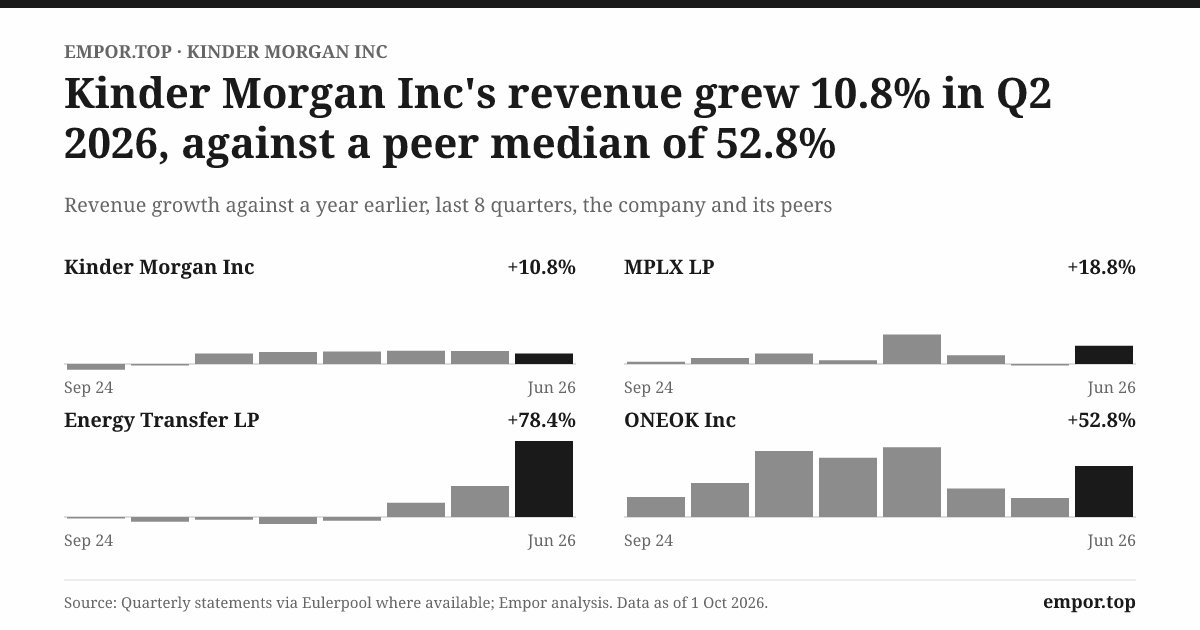
That second number needs translation. Commodity sales look large but are mostly pass-through: gas bought and resold for balancing, where revenue swings with prices but margins are thin. This is why Kinder Morgan's revenue has compounded at only about 1.6% a year over a decade while profit grew much faster1. Revenue is a misleading indicator for this business; operating profit and cash flow are the honest ones.
The segments
Natural Gas Pipelines is the engine, generating about two-thirds of segment earnings before DD&A1. It includes the interstate systems acquired from El Paso and the Texas intrastate network. Interstate tariffs are set under FERC cost-of-service rules: the regulator lets the pipeline recover costs and earn a reasonable return, which protects the downside but caps the upside. The intrastate network has more pricing flexibility, which is where Uri profits came from.
Products Pipelines move gasoline, diesel, and jet fuel, including through Plantation Pipe Line in the Southeast and systems serving the West Coast1. Volume growth is low, and long-run demand for road fuel is likely to decline, but the cash is steady.
Terminals comprise the largest independent network of liquids and bulk storage terminals in North America, storing refined products, chemicals, and dry bulk under multi-year leases1. It is a quiet, contract-backed business.
CO2 is the odd one out. The segment transports carbon dioxide from sources in Colorado to the Permian Basin, where it is injected into old oil fields to push out more crude, and Kinder Morgan owns interests in those fields1. This is where most of the company's direct oil-price exposure lives. It is a legacy business with declining base production, partly hedged, and increasingly a candidate for strategic questions.
Joint ventures
Many of Kinder Morgan's biggest assets are held in joint ventures with partners: Citrus, which owns Florida Gas Transmission; Elba Liquefaction; Plantation; and several Permian takeaway pipelines1. These do not show up as revenue. They show up as "earnings from equity investments," which were about $896 million in 2025, roughly 22% of pre-tax profit, from investments carried at about $7.5 billion1.
The forensic question with large JV earnings is whether cash actually arrives. It does: the ventures paid about $805 million of earnings distributions in 2025, close to reported equity earnings1. Related-party dealings are confined to these operating ventures, at about 2% of revenue, with no controlling family holding company or management fees above the listed company1.
Profit into cash
Over the twelve years from 2014 to 2025, Kinder Morgan generated about $62 billion of operating cash flow against about $19 billion of net profit, a ratio of more than three to one1. The main reason is depreciation, about $2.5 billion a year in 2025, a non-cash charge reflecting the enormous historical cost of the pipes1. Receivables have stayed at about 37 days of revenue throughout that span, and credit losses are too small to disclose separately1. Accounting earnings here understate cash generation; they do not flatter it.
The caveat is that depreciation is not entirely fictional. Pipes do wear out, and sustaining capex of nearly $1 billion a year is the real cost of keeping the toll road intact1. What matters is what is left after that bill, and after the dividend. That is the problem now landing on Kimberly Dang's desk.
IX. Kimberly Dang's Capital Squeeze: Backlog Growth vs. Discretionary Cash
August 1, 2023. Kimberly Dang took over as chief executive from Steve Kean3. The handover was quiet in the way successions at Kinder Morgan tend to be. Dang had joined the company in 2001, served as chief financial officer for more than a decade, then as president, and had built much of the financial model the company runs on3. If Richard Kinder was Doctor Discipline, Dang was the person who wrote the discipline into spreadsheets after 2015.
Her inheritance was a good problem that can turn into a bad one: more demand for new pipeline capacity than the company could fund from free cash after dividends without leaning on its balance sheet.
The people and the pay
Dang's 2025 compensation was about $12.3 million, of which only about $523,000 was salary and nearly all of the rest was performance-based restricted stock that vests in July 2028, tied to distributable cash flow per share and leverage3. She received no cash bonus3. That structure aims to reward per-share cash growth over several years rather than any quarter's earnings.
Richard Kinder, now 81, remains executive chairman, paid $1, with no bonus, owning about 258 million shares, about 11.6% of the company3. At the stock price of about $30 on October 1, 2026, that stake is worth roughly $7.9 billion2. Shareholders approved executive pay with about 95% support at the May 2026 annual meeting4. Governance dissent is low.
The board also changed around her: the company's president, Tom Martin, retired at the start of 2026, and Kenneth Grubb became chief operating officer in September 202613. Operational execution on the backlog now sits with a newly configured team.
The arithmetic of the squeeze
Here is the core calculation, step by step, for 20251:
Operating cash flow was about $5.9 billion. Subtract sustaining capex of about $1.0 billion: you have about $5.0 billion. Subtract expansion capex of about $2.0 billion: about $3.0 billion remains. Subtract dividends of about $2.6 billion: under $300 million is left.
That last figure is the company's discretionary cash for the year. For a business with a $68 billion market value, it is a thin cushion2.
Now look at 2026. Management budgeted total capex of about $3.9 billion, with expansion capex rising to about $3.0 billion, plus several hundred million of contributions to joint ventures1. Unless operating cash flow rises substantially, that means the company will fund part of the dividend and capex program with borrowing in 2026. In the first half of the year, operating cash flow was about $3.5 billion, ahead of the prior year's pace, which helps2.
Buybacks are the first thing to give. They fell from $522 million in 2023 to $7 million in 2024 and zero in 20251. Dividend growth slowed to around 2% a year1. Management has made the choice explicit: the project backlog gets the cash.
Guardrails
The rating agencies have rewarded that choice. Fitch upgraded KMI to BBB+ in August 2025 and Moody's to Baa1 in March 2026, both with stable outlooks, citing leverage around 3.6 times net debt to EBITDA and the visible backlog[^6]6. Both also flagged the line they will watch: leverage creeping toward 4 times on debt-funded growth or acquisitions[^6]6. The bank credit facility's covenant, a 5.5 times limit, is far looser1. The real constraint is the ratings, not the lenders.
Is this discipline, or a repeat?
The fair comparison is with 2014. Then, Kinder Morgan promised fast dividend growth while funding a large capex program with external capital, in a period of high leverage. Today, leverage is materially lower, no equity issuance is planned, dividend growth is modest, buybacks have been suspended rather than funded with debt, and the backlog is backed by take-or-pay contracts. On the evidence, this is not a replay.
But the margin of error is narrow. If a big project runs over budget or the in-service dates slip, the cost lands on a balance sheet with almost no surplus cash. The settling figure is net debt to EBITDA at the end of 2026. Below about 3.8 times, the plan works as designed; above it, management will have to choose between dividend growth and backlog execution. To judge whether the projects are worth the squeeze, one must ask what kind of moat they extend.
X. Strategic Analysis: Porter's Five Forces & Hamilton Helmer's 7 Powers
Look at a map of U.S. interstate gas pipelines and you see something that resembles a circulatory system: thick trunks running from Texas and Louisiana northeast toward New York and New England, west toward California, north toward Chicago. Much of it was laid between the 1940s and 1970s, when a pipeline could be permitted and built in a few years and local opposition was rare.
Now overlay the projects of the last decade that tried to add to that map and failed. The Constitution Pipeline, cancelled after New York denied a water-quality certification. The Atlantic Coast Pipeline, abandoned in 2020 after years of litigation and billions spent. Others delayed for years. Kinder Morgan's own Northeast Energy Direct project was dropped in 2016. That second map is the strongest argument for the first.
7 Powers: what actually protects KMI
Cornered Resource. The most important asset Kinder Morgan owns is not steel; it is permitted rights-of-way, continuous strips of land across thousands of properties and many states, with existing federal certificates. Building a new long-haul interstate line today means environmental reviews, state water permits, eminent-domain fights, and years of litigation. Expanding an existing line by adding compression or a parallel loop is far easier. That is a genuine cornered resource, and the record of cancelled rival projects is the evidence.
Scale Economies. With roughly 82,000 miles of pipe and large storage, Kinder Morgan can route gas across its network, use storage to balance, and spread fixed control and maintenance costs over very large volumes1. Smaller regional players cannot replicate that flexibility. Uri demonstrated the value.
Switching Costs. A local gas utility or power plant is physically connected to a specific pipeline. Switching requires building a new lateral, which means new permits and capital. Customers can multi-source in some regions, but for many delivery points, the existing pipe is the only practical option.
The other powers, network economies in the consumer sense, counter-positioning, branding, and process power, are weak or irrelevant here. This is a three-power moat, but they are strong ones.
Five Forces: where the moat's limits show
Buyer power: moderate to high. Kinder Morgan's customers are sophisticated utilities, producers, and LNG exporters, and no single customer accounts for 10% of revenue1. But the regulator acts as the ultimate buyer advocate. FERC cost-of-service ratemaking caps interstate returns. The moat protects cash flows; it does not allow monopoly pricing.
Threat of substitutes: low now, rising later. Through the mid-2030s, gas has no practical substitute for dispatchable baseload power at the scale data centers require12. After that, small modular nuclear reactors, enhanced geothermal, and long-duration storage are credible but unproven threats.
Threat of new entrants: very low. The same permitting barriers that killed Constitution and Atlantic Coast protect incumbents.
Supplier power: low to moderate. Steel pipe, turbines, and construction labor have all become more expensive. Kinder Morgan says it prices these costs into contracts before final investment decisions1. That is plausible for contracted expansions but leaves the company exposed to overruns after sanctioning.
Rivalry: low to moderate. The major players, Williams, Energy Transfer, Enterprise Products, and Enbridge, compete for new projects but frequently partner in joint ventures rather than fight on price. The industry behaves like a regional oligopoly.
The return on capital puzzle
If the moat is so strong, why are returns so modest? Kinder Morgan's return on invested capital was about 6% in 2025 and about 6.3% over the twelve months to June 20262. Return on equity was about 10–11%2. Those are utility-like returns.
The explanation is twofold. First, regulation caps returns on most of the asset base. Second, a large part of the balance sheet consists of acquisition premiums. Goodwill stands at about $20.1 billion, about 64% of shareholders' equity of $31.2 billion, mostly from El Paso and the 2014 roll-up1. PwC's only critical audit matter in the 2025 audit was goodwill impairment testing, which depends heavily on long-term EBITDA forecasts and market multiples1. If long-run gas demand projections weaken after 2035, those assumptions will be tested.
The verdict: the moat is real and protects existing cash flows, especially for brownfield expansions. It does not produce high returns on capital, because regulators and past acquisition prices absorb much of the value. That shapes how the market should price the stock, and it is where bulls and bears part company.
XI. Bear vs. Bull Case
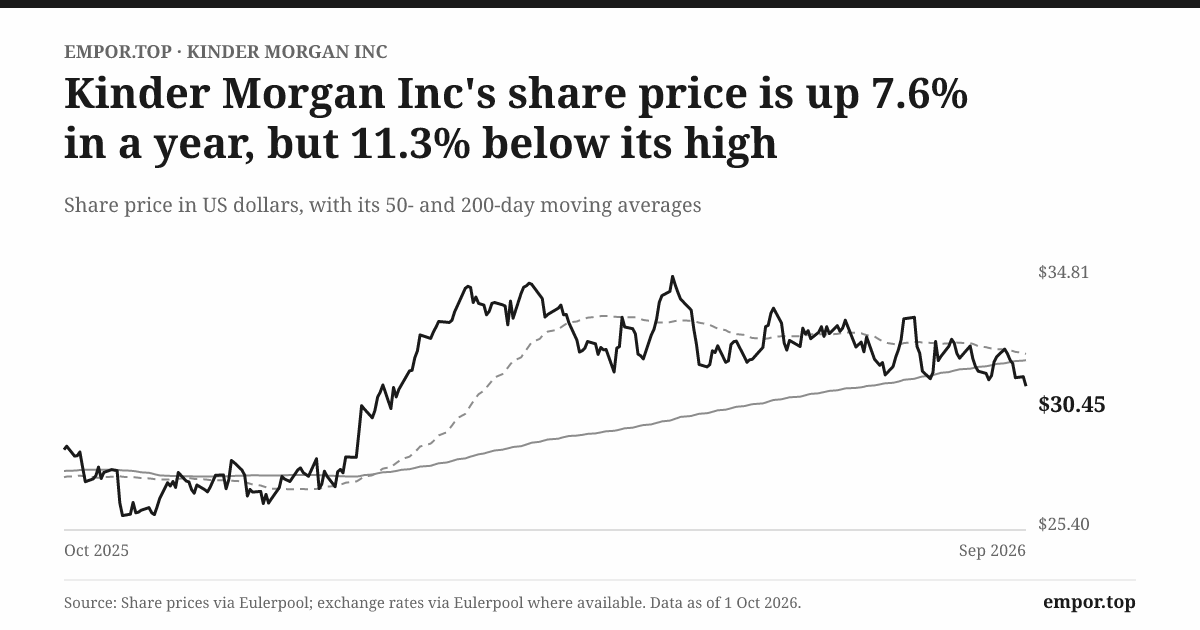
Imagine two portfolio managers at the same firm, looking at the same screen on October 1, 2026. KMI trades at about $30.45, near the upper half of its 52-week range of about $26 to $342. One sees an AI and LNG infrastructure play with a near-4% dividend yield. The other sees a slow-growing, capital-hungry quasi-utility trading at more than twice its historical earnings multiple2.
What the price assumes
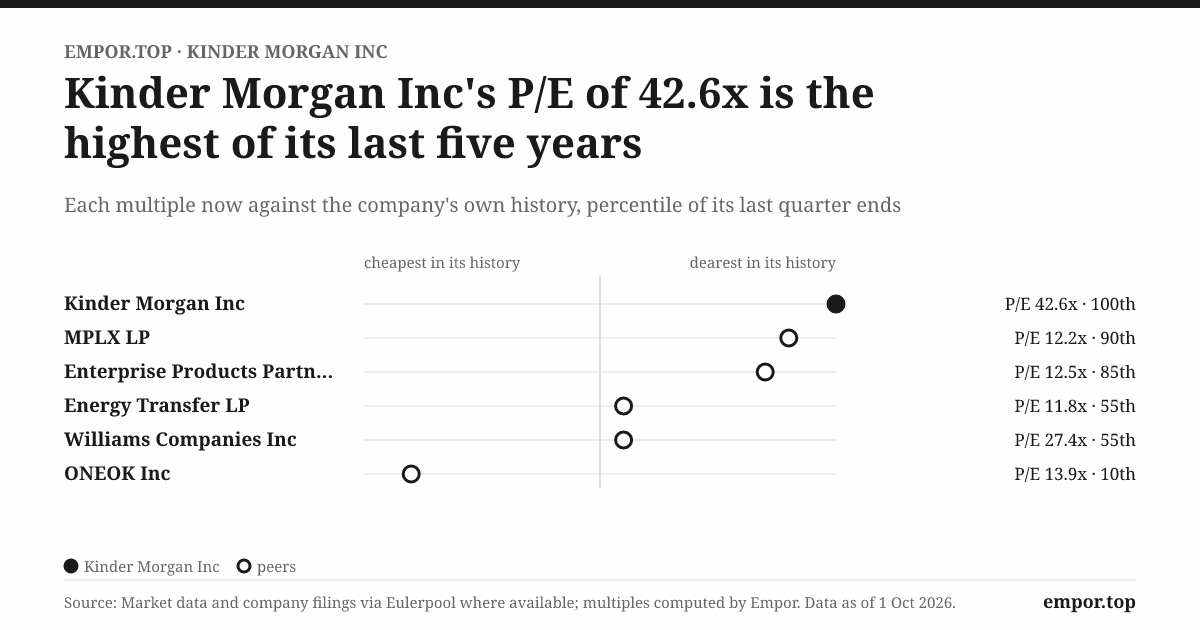
On trailing earnings, Kinder Morgan trades at about 42.6 times, against a five-year median near 20 times2. That headline is misleading for a pipeline company, because heavy depreciation depresses reported earnings. The better metric is enterprise value to EBITDA, about 12.4 times2. That puts KMI at a premium to liquids-heavy peers such as Enterprise Products and roughly in line with gas-focused peers, while Williams trades higher2. The free cash flow yield is about 4.3% and the dividend yield about 3.9%2.
Put plainly: the market is not pricing Kinder Morgan as a declining legacy asset. It is pricing in sustained growth from the backlog and some benefit from the AI and LNG narratives.
The bull case
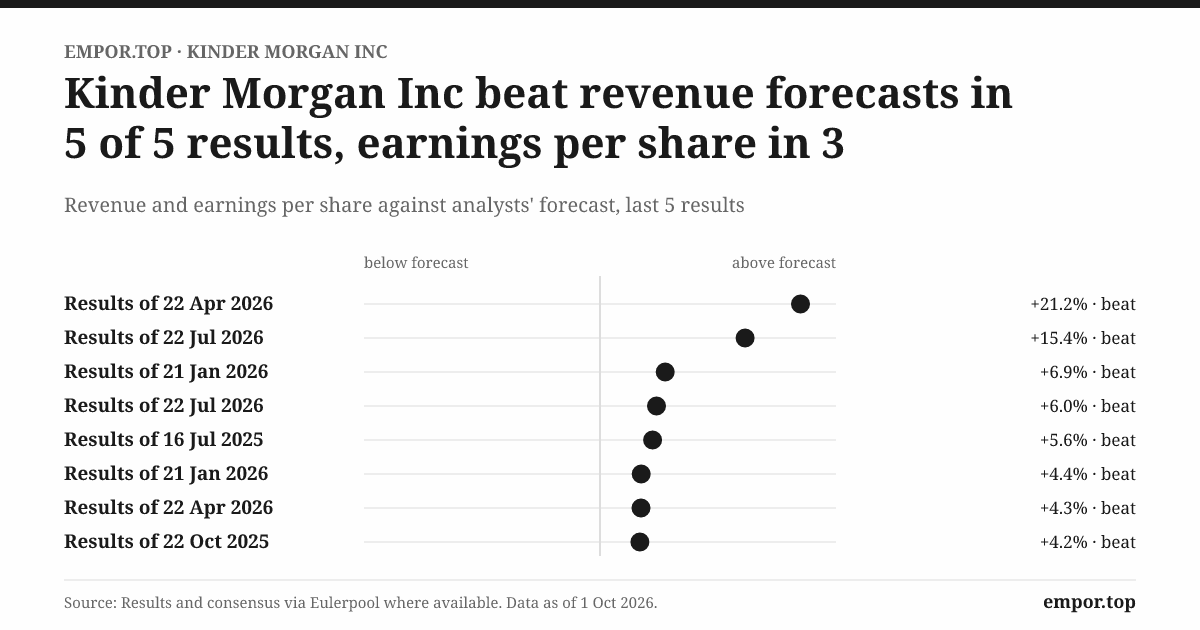
Contracted growth. The $36 billion of take-or-pay obligations and the roughly $10 billion backlog provide unusual visibility for an energy company1[^6]. Operating profit and net profit rose sharply in late 2025 and the first half of 2026, with second-quarter net profit up about 21% on the prior year2.
Cash generation and credit. Operating cash flow consistently exceeds net income by a wide margin, and two rating upgrades lower refinancing costs on about $32 billion of debt, roughly 90% of it at fixed rates averaging about 5.1%1[^6]6.
Alignment. Kinder's personal stake and a decade without equity issuance support the view that management treats per-share value seriously13.
The bear case
Valuation ahead of cash flow. Revenue has grown about 1.6% a year over ten years1. Even setting aside pass-through noise, this is a business where growth requires large new capital spending. A rising multiple suggests the market expects the growth curve to bend upward permanently.
The squeeze. With capex rising and almost no surplus after dividends, buybacks are gone and dividend growth is slow1. If a project disappoints, there is little room.
Execution risk. Greenfield and large brownfield projects face cost inflation, labor constraints, and permitting delays. Kinder Morgan's history includes abandoned projects and Trans Mountain.
Legal and accounting overhangs. The goodwill balance is sensitive to long-term assumptions1. Kinder Morgan is a potentially responsible party at the Portland Harbor Superfund site, with cost allocation expected by the end of 2026, and at the Lower Passaic River site; it also faces Louisiana coastal erosion suits and an ERISA pension case1. Recorded environmental reserves are about $176 million1. None appears material to management, but the tails are long-dated.
The activist stress test
A skeptical activist would ask why CO2, a segment with oil-price exposure and declining production, remains inside a company whose investment case is gas toll roads. Selling or spinning it would simplify the story and could fund expansion without borrowing. A similar question applies to parts of the terminals business. Management's answer has been that the segments generate steady cash and provide diversification. The counterargument is that a simpler gas pure-play might earn a higher multiple.
The KPIs that matter
Three numbers will tell investors most of what they need to know. First, net debt to adjusted EBITDA, now about 3.6 times and falling[^6]. Second, the project backlog, now around $10 billion and rising2. Third, discretionary cash flow after dividends and capex, under $300 million in 2025 and under pressure in 20261. Each of these readings is a measure of whether the squeeze is tightening or easing. And behind each lies a lesson the company has taught at some cost.
XII. Playbook: Business & Investing Lessons
Lesson 1: Financial engineering can lower the cost of capital, but it cannot change the economics of the asset underneath. The MLP structure gave Kinder Morgan a cheap-capital engine for fifteen years. Then the incentive rights that enriched the general partner raised the hurdle on every new project until the machine had to be dismantled in 2014. The pipes never changed. Only the wrapper did, and the wrapper had an expiry date. An incentive distribution right is a rocket booster on the way up and an anchor on the way down.
Lesson 2: A dividend funded by the capital markets is a loan from future shareholders. In August 2014, the founder promised dividend growth of about 10% a year through 2020. In December 2015, the board cut the payout by 75%. Nothing in between broke the pipelines; what broke was access to equity. Since then, the company has funded growth internally, and its dividend has grown slowly but held. The only dividend you truly own is the one left over after the capital program is paid for.
Lesson 3: In infrastructure, the deepest moat is a permission granted long ago. While Constitution and Atlantic Coast were cancelled, Kinder Morgan was adding compression and loops to decades-old rights-of-way. A newer, better-engineered pipeline cannot compete with an older one that can actually be built. The cheapest pipeline in America is the one permitted half a century ago.
Lesson 4: When an asset becomes a political symbol, sell the symbol. Trans Mountain turned a pipeline company into an umpire in a fight between two provinces and the federal government. Kinder Morgan set a deadline, and Ottawa bought it. Canadian taxpayers then absorbed the construction cost. When a project becomes a proxy war, the best buyer is the government fighting it.
Lesson 5: Alignment means owning the same risk as everyone else. Richard Kinder has drawn $1 a year for nearly three decades and held his stake through the 2015 crash, when his own fortune fell with everyone else's. That did not prevent the dividend cut. But it did shape the response: no dilutive equity rescue, a slow, deliberate rebuild. A founder on a $1 salary can still be wrong; he just cannot be wrong at your expense alone.
XIII. Epilogue
Tonight, Kinder Morgan looks like a company that has learned its lessons. It holds BBB+ and Baa1 ratings, its leverage is around 3.6 times EBITDA, it has not issued equity in a decade, and it has tens of billions of dollars of take-or-pay contracts in its book1[^6]6. A CEO who built the post-crisis financial model now runs the company, with a founder still in the chairman's office and a new operating chief overseeing construction3.
But the story is not finished, and three moments in the next eighteen months will decide much of it.
The first is the in-service test. Through 2026 and 2027, the expansions in Texas and the Southeast will come online. If they open on budget and on schedule, contracted EBITDA will rise and leverage will fall, freeing cash. If they slip or overrun, the thin cushion described in the capital squeeze disappears and the company will lean on debt. The metric to watch is the build multiple: how much capex was spent per dollar of new EBITDA, compared with what management promised at sanctioning.
The second is the capital-return pivot. About $1.5 billion of buyback authority remains unused1. Once peak capex passes, management must decide: restart buybacks, accelerate dividend growth, or sanction the next wave of projects. If it chooses the third, investors will learn whether the backlog is a self-renewing feature of the business or a one-time boom. If it chooses the first two, they will learn whether management believes the boom has peaked.
The third is the accounting and legal tail. The Portland Harbor cost allocation is due by year-end 2026, and goodwill testing will continue each year1. Neither is likely to threaten the company. Both will reveal how the market weighs long-term terminal value in an energy transition.
The tension that remains is the one that has defined Kinder Morgan from the start: demand for its pipes is booming, but the energy transition caps how long that demand can be assumed to last. Every new compressor station is a bet that gas remains essential for decades. The contracts say yes for fifteen to twenty years. Beyond that, nobody knows.
XIV. Outro
In Houston, an 81-year-old executive chairman still draws a $1 salary from a company that moves about two-fifths of America's natural gas. The company he took from Enron's discard pile for $40 million is now worth nearly $100 billion including debt23. Somewhere beneath Texas, gas that was injected into a reservoir last summer is waiting for the next cold snap. Somewhere in Georgia, a new turbine is spinning up for a data center that did not exist two years ago.
Enron bet that energy could become a trading abstraction, contracts floating free of the pipes. Kinder bet on the pipes. Enron disappeared; the pipes are still there, more valuable now than when he bought them. The financial world tried to replace steel with paper. In the end, every kilowatt-hour the AI age demands must still pay a toll to Richard Kinder's pipelines, and the only question left is how much of that toll reaches the shareholders.
References
-
Kinder Morgan, Inc. Form 10-K for the Fiscal Year Ended December 31, 2025 — U.S. Securities and Exchange Commission, 2026-02-13 ↩↩↩↩↩↩↩↩↩↩↩↩↩↩↩↩↩↩↩↩↩↩↩↩↩↩↩↩↩↩↩↩↩↩↩↩↩↩↩↩↩↩↩↩↩↩↩↩↩↩↩↩↩↩
-
Kinder Morgan, Inc. Form 10-Q for the Quarterly Period Ended June 30, 2026 — U.S. Securities and Exchange Commission, 2026-07-24 ↩↩↩↩↩↩↩↩↩↩↩↩↩↩↩↩↩↩
-
Kinder Morgan, Inc. Notice of 2026 Annual Meeting and Proxy Statement (Schedule 14A) — U.S. Securities and Exchange Commission, 2026-04-02 ↩↩↩↩↩↩↩↩↩↩↩
-
Kinder Morgan, Inc. Current Report on Form 8-K (Item 5.07 Voting Results) — U.S. Securities and Exchange Commission, 2026-05-19 ↩
-
Kinder Morgan, Inc. Form 424B1 Prospectus (IPO) — U.S. Securities and Exchange Commission, 2011-02-11 ↩↩↩↩↩↩
-
Fitch Upgrades Kinder Morgan, Inc. to 'BBB+'; Outlook Stable — Fitch Ratings, 2025-08-20 ↩↩↩↩↩↩
-
Kinder Morgan Slashes Dividend 75% to Fund Growth — The Wall Street Journal, 2015-12-08 ↩↩↩↩
-
Kinder Morgan to Consolidate Group in $70B Deal — Reuters, 2014-08-10 ↩↩↩↩↩↩↩↩
-
Canada to Buy Trans Mountain Pipeline for C$4.5 Billion — Reuters, 2018-05-29 ↩↩↩↩↩
-
Winter Storm Uri Gas Windfall at Kinder Morgan — Bloomberg, 2021-04-21 ↩↩
-
Freeport LNG vs. Kinder Morgan Texas Court of Appeals Opinion — Texas 14th Court of Appeals, 2025-04-17 ↩
-
US Natural Gas and the AI Data Center Power Boom — S&P Global Commodity Insights, 2025-11-12 ↩↩↩↩
 LinkedIn
 WhatsApp
 Reddit
 Hacker News
 Email
 Kindle
 RSS Feed
 Spotify
 Apple Podcasts
 Amazon Music
 Audible
 YouTube