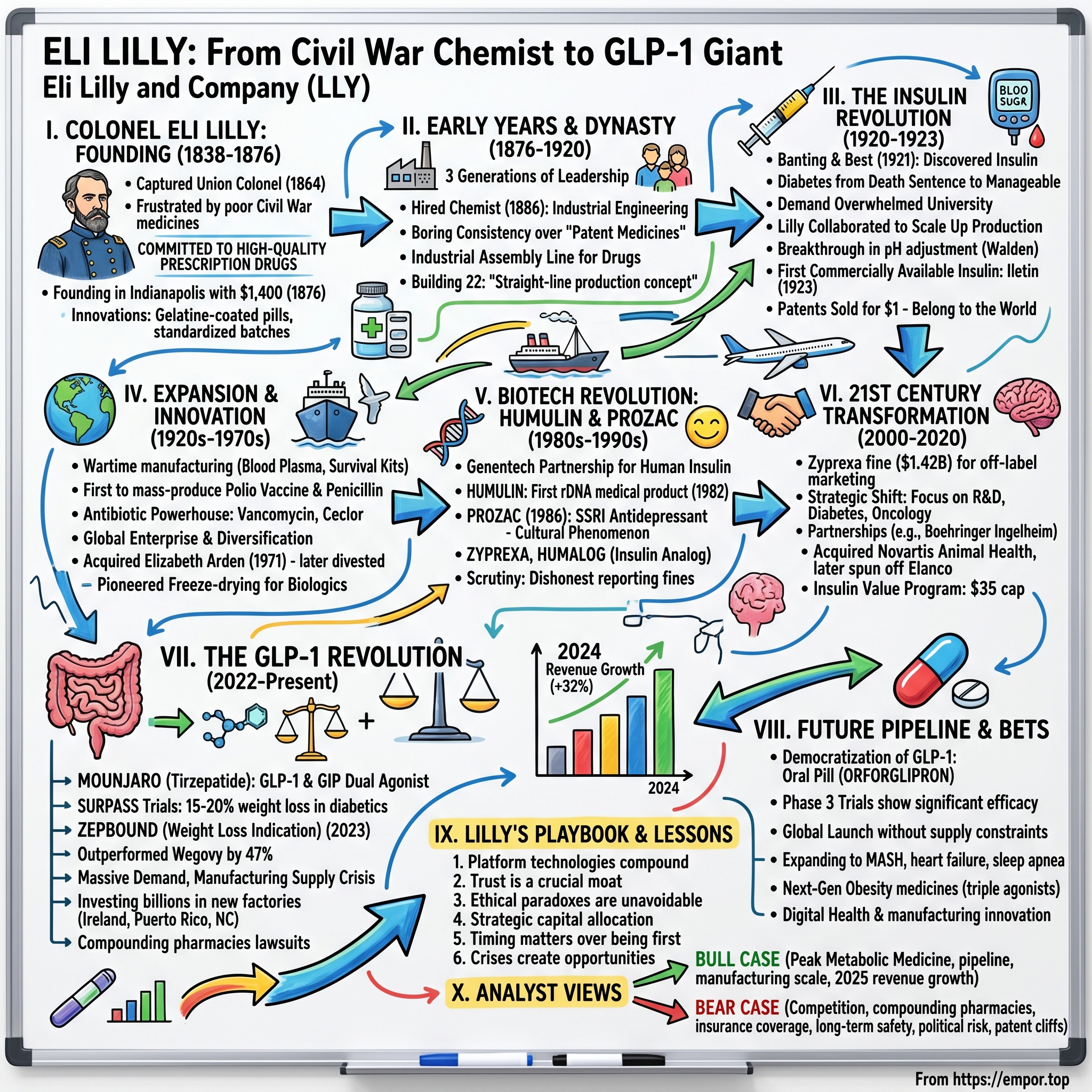
Eli Lilly: From Civil War Chemist to the Trillion-Dollar Incretin Empire
I. Introduction & Episode Roadmap
In May 2022, the U.S. Food and Drug Administration approved a once-weekly injection called Mounjaro for adults with type 2 diabetes.[^1] On paper it was a diabetes drug: another entry in a crowded class, aimed at a disease that Eli Lilly had been treating for a century. The trial data told a different story. Tirzepatide, the molecule inside the pen, did not just lower blood sugar. In the obesity trials that followed, patients on the highest dose lost about a fifth of their body weight, results that had previously required a surgeon.1 Within eighteen months the same molecule was approved for chronic weight management as Zepbound.[^3] Within three years it had become the best-selling franchise in the company's history, and Eli Lilly had become the first pharmaceutical company in the trillion-dollar club.
The numbers are almost hard to take in. At roughly $1,150 a share, Lilly carries an equity value somewhere between $1.05 trillion and $1.09 trillion.[^4] Revenue compounded at about 32% a year between 2022 and 2025, from roughly $28.5 billion to $65.2 billion.[^1] That kind of growth is ordinary for a young software company. For a 150-year-old drugmaker whose long-run base rate was 3% to 6% a year, it is close to unheard of.[^5] And in the first half of 2026, nearly two of every three dollars Lilly booked, about 65%, came from a single molecule.[^6]
That last number is the episode. Lilly has pulled off what may be the most lucrative therapeutic pivot in pharmaceutical history, turning itself from a slow-growing dividend payer into a hyper-growth biopharma company. The price of that pivot was diversification. A company that once spread its bets across insulin, antidepressants, antipsychotics and cancer drugs now rises or falls on one peptide.
The market has priced that bet generously. Lilly trades at roughly 39 to 40 times trailing earnings.[^4] Novo Nordisk, the company that invented the modern GLP-1 category, trades at about 9 to 10 times. Merck sits around 12 to 14 times, Pfizer around 10 to 12, AbbVie around 15 to 17. Investors are paying roughly four times Novo's multiple for each dollar of Lilly's profit. That is not a valuation of a drug company. It is a valuation of a franchise that the market believes will keep compounding for a long time.
To understand whether that belief is earned, this story moves through four eras. First, the founding and platform years, when Colonel Eli Lilly built a business on the radical idea that a pill should contain what its label promised, and when his successors learned to industrialize other people's breakthroughs: insulin from Toronto, recombinant human insulin from Genentech. Second, the long hangover of the 2000s and early 2010s: a record federal fine over Zyprexa, a brutal patent cliff and a string of Alzheimer's failures. Third, the David Ricks era, in which the company narrowed its focus and made a wager on a hormone most of its rivals considered a dead end. Fourth, the present: a balance sheet reshaped by rebates, concrete and debt, and a governance structure built to withstand almost any outside pressure.
Four questions run through all of it:
- Pricing and payers. Can Lilly hold the price of tirzepatide as the drug moves from early adopters into broad populations, or will rebates, government programs and price negotiation wear down what it actually collects?
- The infrastructure gamble. Is the manufacturing buildout, more than $21 billion of capital spending since 2023, an unbeatable supply moat, or a pile of injectable-pen factories that an oral pill could make obsolete?
- Concentration. Can the pipeline, from oral orforglipron to triple-agonist retatrutide to the Alzheimer's drug Kisunla, diversify the business before tirzepatide meets a competitor, a safety problem or a price cut?
- Capital allocation and governance. With operating cash flow heading toward $20 billion a year and beyond, will discipline hold inside a company whose staggered board and 80% supermajority rules make it almost impossible for shareholders to force change?
To answer them, the story has to start where Lilly's habits were formed: in a small laboratory in Indianapolis, with a chemist who was angry about bad medicine.
 Subscribe on LinkedIn
II. From Civil War Pharmacy to the First Bio-Platforms (1876–1990s)
On May 10, 1876, a 38-year-old pharmaceutical chemist opened a small laboratory in Indianapolis.2 Eli Lilly had trained in a drugstore as a teenager, ran his own pharmacies, and commanded an artillery battery for the Union during the Civil War, which is where the "Colonel" came from. After the war he tried cotton farming in Mississippi and failed. He came back to the trade he knew with very little capital and a grudge.
The grudge was against the medicine of his day. Post-war America was the golden age of the "patent medicine": bottled tonics with secret formulas, extravagant claims and wildly varying strength. Two bottles of the same remedy might contain very different amounts of the active ingredient, or none at all. The Colonel's founding idea was almost boring: make medicines of consistent quality, and sell them to physicians and pharmacists rather than to the public through advertising. In a market full of showmen, reliability was the product.
That idea compounded for decades. The company invested early in quality control and chemistry, coated pills in gelatin, and standardized its fluid extracts. By the time the Colonel's son and grandsons ran the business, Lilly was known less for inventing medicines than for manufacturing them precisely and at scale. That distinction would turn out to be the most important thing about the company.
The Toronto bargain
The proof came in 1922. At the University of Toronto, Frederick Banting, Charles Best and John Macleod, with the chemist James Collip, had extracted from animal pancreases a substance that could keep diabetic patients alive. Until then, a diagnosis of type 1 diabetes was effectively a death sentence; doctors put children on starvation diets to buy them months. The Toronto extract worked, but the university lab could not make it reliably or in quantity. Batches failed. Potency varied. Patients waited.
Lilly's research director, George Henry Alexander Clowes, had followed the work and moved fast to propose a collaboration. Lilly would bring industrial chemistry to Toronto's science. In 1923, the company began selling Iletin, the first commercially available insulin.2 A Lilly chemist, George Walden, found a way to purify the extract far more effectively by precipitating it at a specific acidity, which made the jump from laboratory curiosity to dependable product possible.
The business lesson is the one this whole story keeps returning to. Lilly did not discover insulin. It made insulin real for millions of patients by solving the manufacturing problem nobody else could. Diabetes became a chronic disease rather than a fatal one, and Lilly became the company most closely associated with it, a link that would last a hundred years and eventually lead to tirzepatide.
An endowment and a long time horizon
In 1937, J.K. Lilly Sr. and his sons Eli and J.K. Jr. created the Lilly Endowment with gifts of company stock.[^8] It became one of America's largest private foundations, and it still holds about 9.8% of Lilly's outstanding shares, making it the single largest holder.[^8] The Endowment does not behave like an activist. It does not push for spin-offs, buybacks or management changes. Its presence matters for a different reason: in any fight for control, a patient tenth of the votes sits on the side of continuity. That fact becomes important later.
The Genentech licence
By the 1970s, Lilly's insulin business had a supply problem built into its DNA. Insulin came from the pancreases of cattle and pigs, gathered from slaughterhouses. Demand was growing faster than the supply of animal glands, and some patients reacted to animal proteins.
The answer came from a tiny San Francisco startup. Genentech had engineered bacteria to produce human insulin, and Lilly signed on to license and commercialize the technology. The FDA approved Humulin, human insulin made through recombinant DNA, on October 28, 1982, the first approved medicine made with genetic engineering.2 Again, the science was someone else's. The scale-up, fermentation, purification and global distribution were Lilly's.
Lilly then turned that platform into a run of blockbusters. Prozac, approved in the United States in 1987, made fluoxetine a household name and reshaped how depression was treated. Gemzar in oncology, Zyprexa for schizophrenia and bipolar disorder, and Humalog, a faster-acting insulin analog, followed in the 1990s.2 For a while the company looked like a machine for producing large franchises.
The myth Lilly sometimes tells about itself is that it is a pure discovery engine. The record supports a narrower and more interesting claim. Lilly's deepest repeated advantage has been converting fragile scientific breakthroughs, often from outside, into products manufactured reliably at enormous scale. That skill made the company rich in the twentieth century. It also left it exposed when the products it had scaled lost patent protection all at once.
III. The Patent Cliff, the $1.4 Billion Fine, and the Lechleiter Drought (2000–2016)
In January 2009, the U.S. Department of Justice announced that Eli Lilly had agreed to plead guilty and pay $1.415 billion to resolve allegations that it had promoted Zyprexa for uses the FDA had never approved.[^9] The package included a $515 million criminal fine, which the government described as the largest ever imposed on an individual corporation in a U.S. criminal case, and up to $800 million in civil settlements with the federal government and states.[^9] Lilly also signed a five-year corporate integrity agreement that put its marketing under outside monitoring.[^9]
The government's account was specific. Prosecutors said Lilly had promoted Zyprexa, an antipsychotic approved for schizophrenia and bipolar mania, for unapproved uses including dementia in elderly patients, agitation and sleep problems.[^9] The settlement was a reputational wound for a company whose founding identity was trustworthy medicine. It was also a symptom of a deeper problem: Zyprexa had become too important.
When the engine turns off
Pharmaceutical economics have a cruel shape. A drug earns very high margins for roughly a decade of patent-protected life and then, often within months of losing exclusivity, generic competitors take most of the volume. A company that depends on a few big products must replace them before their patents expire, or it shrinks.
Lilly failed to replace them in time. Zyprexa lost U.S. exclusivity in 2011, and Cymbalta, the antidepressant, followed in late 2013. Revenue fell from about $24.3 billion in 2011 to about $19.6 billion in 2014, a decline of roughly a fifth. Net income fell faster, from about $4.3 billion to about $2.4 billion, close to halving.[^5] For a company used to steady growth, this was a three-year contraction in plain view of investors.
The Lechleiter years
The man at the helm through this period was John Lechleiter, a chemist and long-time Lilly insider who became CEO in 2008. His era was defined by the problem he inherited and by a pipeline that kept disappointing. Lilly's Alzheimer's program produced high-profile Phase 3 failures: semagacestat was halted after patients did worse, and solanezumab repeatedly missed its main goals. Each failure fed an outside narrative that Lilly's research machine was broken and that the company should cut costs, merge with a rival, or break itself up.
Rivals were taking the merger path. Pfizer bought Wyeth, Merck combined with Schering-Plough. Lilly did not do a transformational merger. It kept investing heavily in research through the trough, which is the decision for which Lechleiter's era is most often defended. In 2014, the year revenue bottomed, R&D spending was still more than a fifth of sales.[^5]
What did that money buy? Some of it went to failures. But some went into metabolic biology: Trulicity, a once-weekly GLP-1 drug approved in 2014, and the partnership with Boehringer Ingelheim that produced the SGLT2 diabetes pill Jardiance.[^5] Neither was a moonshot. Both kept Lilly in the incretin and diabetes conversation, building the clinical, regulatory and manufacturing know-how in injectable peptides that tirzepatide would later draw on.
Testing the founding myth
It is worth being precise about what this decade does and does not prove. It does not prove that Lilly is an infallible discovery engine; the Alzheimer's record argues the opposite, and the Zyprexa settlement shows how commercial pressure can bend behavior when a pipeline is thin. It does support a narrower claim: Lilly's leadership chose to keep funding science through a period when the market rewarded cutting it. Revenue recovered only slowly, to about $21.2 billion by 2016, still below its 2011 peak.[^10]
The verdict for investors is that the 2010s narrow, rather than reject, the idea of Lilly as a patient R&D company. Patience was real, but it did not guarantee productivity; the pipeline's hit rate was poor for years. The question for the next CEO was whether that patience could be turned into speed.
IV. The David Ricks Overhaul: Engineering the Tirzepatide Breakthrough (2017–2022)
On January 1, 2017, David A. Ricks became chief executive of Eli Lilly.[^8] He was not a scientist. Ricks grew up in Indiana, studied business at Purdue, earned an MBA at Indiana University, and joined Lilly in 1996 in marketing. He spent the next two decades in commercial jobs, running operations in Canada and China, and later the U.S. business and the Lilly Bio-Medicines unit. Colleagues describe a direct, low-key operator; he became chair of the board within months of taking over as CEO.[^8]
The company he inherited was healthier than it had been in 2014 but not dazzling. Its operating margins trailed peers, its pipeline was crowded with mid-stage programs, and patents on Cialis and Strattera were approaching expiry. In 2017, Lilly also booked a large charge tied to U.S. tax reform, which pushed the year to a small net loss despite revenue of about $22.9 billion.[^10]
Pruning the portfolio
Ricks's first moves were about focus. Lilly announced a restructuring in 2017 that cut about 3,500 positions, and it separated Elanco, its animal health business.[^10] Elanco went public in September 2018, and Lilly completed its exit through an exchange offer in March 2019, leaving it with no retained stake.[^10] The logic was simple: a human-pharmaceuticals company competing for the best scientists and the highest-return molecules does not need a cattle-drug division competing for the same capital.
Lilly concentrated on four areas: diabetes and metabolism, oncology, immunology and neuroscience. Inside that frame, management talked constantly about speed: shortening the years from first-in-human study to approval, and placing larger bets earlier on molecules that looked best-in-class. Those claims are management's; what can be observed is the result, a series of Phase 3 programs for tirzepatide run in parallel across diabetes and obesity at a pace unusual for the industry.
The wager on GIP
To understand tirzepatide, start with how the gut talks to the pancreas. After a meal, the intestine releases hormones called incretins that tell the pancreas to release insulin and tell the brain the stomach is full. Two matter most: GLP-1 and GIP.
Novo Nordisk built the modern franchise on GLP-1 alone, first with liraglutide and then semaglutide, sold as Ozempic for diabetes and Wegovy for obesity. GIP was the neglected sibling. Earlier research suggested its insulin-boosting effect faded in people with type 2 diabetes, and some scientists argued that blocking GIP, rather than activating it, might help with weight. Many in the industry treated a GIP-plus-GLP-1 drug as redundant at best.
Lilly's scientists bet the other way. Tirzepatide is a single synthetic peptide, a chain of 39 amino acids, designed to act on both receptors at once. The best analogy is a key cut to fit two locks. Activating GLP-1 alone is like turning down appetite with one dial; the dual molecule turns two dials together, and the clinical data suggest the combination is more powerful than either alone.
The trials
The SURPASS program in type 2 diabetes put tirzepatide against several comparators, including semaglutide at its then-standard 1 mg diabetes dose. Tirzepatide lowered blood sugar and weight more.[^1]
The obesity results made it famous. In SURMOUNT-1, patients on the highest 15 mg dose lost an average of about 22.5% of their body weight over 72 weeks; three-year follow-up in people with pre-diabetes showed durable weight loss and a large reduction in progression to diabetes.1 For context, Wegovy's pivotal trials had shown roughly 15%.
Then Lilly did something incumbents rarely volunteer for: a direct head-to-head trial against the market leader. In SURMOUNT-5, Zepbound produced average weight loss of 20.2% versus 13.7% for Wegovy at 72 weeks, about 47% more in relative terms.[^1] Head-to-head trials are risky because a loss is public and permanent. Winning one gave Lilly's sales force a single sentence to bring to every doctor and payer.
Pay and accountability
The board has paid Ricks handsomely for the result. His reported compensation rose from about $26.6 million in 2023 to about $36.7 million in 2025, most of it in stock awards.[^8] Over the five years to 2025, Lilly's total shareholder return was about 671%, against about 196% for the S&P 500.[^8] At the May 2026 annual meeting, shareholders approved the pay plan with 96% of votes cast.[^11] It is hard to argue that pay ran ahead of performance. It is fair to note that compensation tied closely to a stock price can reward an executive for a valuation multiple as much as for operating decisions.
The conclusion from this era is that Ricks's real contribution was concentration: fewer distractions, bigger bets, faster trials. It worked spectacularly. But concentration as a strategy contains its own risk, and the bill for it arrived in the form of rebates.
V. The Gross-to-Net Squeeze: Wholesalers, PBMs, and the $21 Billion Liability (2022–Present)
In February 2026, Ernst & Young signed its audit opinion on Lilly's 2025 annual report. The opinion was clean: no material weaknesses in internal controls.[^1] But auditors must also flag "critical audit matters," the areas where judgment is hardest. EY flagged exactly one: the estimate of what Lilly owes in rebates and discounts to Medicaid, Medicare Part D plans and commercial insurers.[^1] At year-end 2025, that liability stood at about $17.4 billion.[^1]
That is the hidden heart of the incretin business. To see why, follow a carton of Zepbound.
The unit of revenue
Lilly sells a physical unit: a carton of single-dose pens or vials, or a pack of tablets.[^1] The patient pays nothing to Lilly directly in most cases. The carton goes to a wholesaler, then to a pharmacy, and the patient's insurer or pharmacy benefit manager (PBM) pays the pharmacy. Months later, the PBM or the government program sends Lilly a bill for the rebate it negotiated in exchange for putting the drug on its formulary, the list of drugs the plan covers.
So the price Lilly invoices is not the price Lilly keeps. The difference, called gross-to-net, is the industry's great opacity. A drug can carry a list price around a thousand dollars a month while the manufacturer keeps a far smaller amount after rebates. Lilly does not disclose net price by product, which is why investors infer it rather than read it.
Tirzepatide generated about $36.5 billion in 2025, 56% of Lilly's revenue, split between Mounjaro at about $23.0 billion and Zepbound at about $13.5 billion.[^1] In the first half of 2026 it reached about $27.7 billion.[^6] Demand is not the question. What matters is how much of each list-price dollar survives the trip back.
Three tollbooths
The logistics run through an oligopoly. McKesson, Cencora (formerly AmerisourceBergen) and Cardinal Health each accounted for between 16% and 24% of Lilly's consolidated revenue in each of the past three years, and between 20% and 29% of its receivables.[^1] Together, they carry well over half of revenue.
Credit risk here is low; these are large investment-grade distributors, and Lilly's allowance for bad debts is immaterial.[^1] The risk is timing. Payment terms run 30 to 70 days, and when wholesalers decide to hold more or less inventory, Lilly's quarterly revenue jumps or dips regardless of how many patients actually filled prescriptions.[^1] Investors who read a single quarter's tirzepatide number as pure demand are sometimes reading wholesaler stocking decisions.
The liability that ate a quarter
The more important number sits on the other side of the balance sheet. The accrued liability for sales rebates and discounts grew from about $11.5 billion at the end of 2024 to about $17.4 billion at the end of 2025, and to about $21.1 billion by June 30, 2026, up roughly 83% in eighteen months.[^1][^6] Lilly's second-quarter revenue in 2026 was in the low $20 billions, so the rebate accrual now roughly equals an entire quarter of sales.[^6]
Why does this matter? The liability is an estimate of claims not yet received. Rebate bills arrive months after the sale, and the amount depends on which patients filled prescriptions under which plans: a Medicaid prescription carries a statutory rebate very different from a commercial one. Lilly records revenue net of its best estimate. If actual claims run higher, revenue gets revised down later; if lower, up. EY's flag means the estimate is large enough, and uncertain enough, that small errors produce large numbers.
There is no sign in the filings of a bad true-up. But the growth of the liability tells a clear story. As tirzepatide moves from early adopters with generous commercial coverage into Medicaid, Medicare and price-sensitive employer plans, a larger share of each gross dollar is promised back. Volume is growing faster than collected price.
Going around the toll
Lilly's response was to build a door around the tollbooth. In January 2024, it launched LillyDirect, a direct-to-consumer platform linking patients to telehealth providers and home delivery of some Lilly medicines.[^12] Later in 2024, Lilly began selling single-dose Zepbound vials for cash, in the lowest doses, at prices well below the pen's list price.[^12]
The strategy has three aims. It captures patients whose insurance does not cover obesity drugs. It undercuts compounding pharmacies, which will reappear in the next section. And it gives Lilly a channel where the price it charges is the price it keeps. The trade-off is that cash prices in the hundreds of dollars a month implicitly reveal roughly where Lilly is willing to settle, which weakens the list price as an anchor in every other negotiation.
The verdict on pricing is mixed but clear: Lilly has volume power that few drugs have ever had, and rising rebate obligations show it is buying that volume with price. The one number that would settle the debate, net revenue per U.S. carton of tirzepatide, Lilly does not publish. To keep feeding volume, though, the company had to make a different kind of bet, in steel and concrete.
VI. The $21 Billion Concrete Gamble: Scale Moat or Overcapacity Trap? (2022–Present)
In May 2024, Lilly announced it would invest an additional $5.3 billion in its manufacturing site in Lebanon, Indiana, raising its commitment there to $9 billion, which the company described as the largest investment in its history at a single site.[^13] Lebanon is a small town northwest of Indianapolis, best known before this for farmland along Interstate 65. Lilly chose it as the place to make the active ingredient in tirzepatide.
That announcement came in the middle of a crisis that Lilly itself had helped create. Demand had overwhelmed supply.
The shortage and its side effects
After Mounjaro's approval, and especially after Zepbound's in November 2023, prescriptions grew faster than Lilly could fill pens.[^3] The FDA placed tirzepatide on its national drug shortage list. In normal times that is a logistical headache. In this case it opened a legal door.
Under U.S. law, compounding pharmacies can make copies of a drug that is in shortage. Hundreds did, and telehealth companies sold compounded tirzepatide and semaglutide to patients at a fraction of the branded price, without the clinical-trial vetting of the original. For Lilly, every compounded dose was a lost sale and a safety risk with its name attached. The FDA ultimately declared the tirzepatide shortage resolved, which narrowed the legal room for mass compounding, but the episode taught a hard lesson: in this market, unmet demand does not wait.
Building at wartime speed
Lilly's answer was capital spending on a scale unusual for any drugmaker. Capital expenditures went from about $1.9 billion in 2022 to about $7.8 billion in 2025, and another $5.3 billion in the first half of 2026 alone.[^1][^6] Since 2023, Lilly has spent more than $21 billion on property and equipment. Net property, plant and equipment more than doubled, from roughly $12.5 billion in 2022 to about $29 billion by mid-2026.[^14][^6]
The money went into a network: peptide synthesis and device assembly in Lebanon, fill-finish (the sterile filling of pens and vials) in Concord, North Carolina, and large sites in Limerick, Ireland and Alzey, Germany to serve markets outside the U.S.[^1] Peptide manufacturing is hard. Building a chain of 39 amino acids in exactly the right order, at purity suitable for injection, and filling it into sterile pens at volumes measured in hundreds of millions of doses, requires both specialized equipment and teams that take years to train. That is the case for scale as a moat: a rival with a better molecule still needs these plants.
Paying for it
Operating cash flow paid for much of the buildout, but not all of it. Lilly's borrowings grew from about $33.6 billion at the end of 2024 to about $54.9 billion by June 2026, including note offerings of $6.5 billion in February 2025 and $6.75 billion in August 2025.[^1][^6] Net of cash, debt reached about $46 billion.[^6]
Rating agencies are relaxed. S&P upgraded Lilly to AA- with a positive outlook in April 2026, projecting free operating cash flow of about $17 billion in 2026 and about $27 billion in 2027, and indicated a further upgrade was possible if leverage fell sustainably below 1.0 times.[^15] Moody's rates Lilly Aa3, also with a positive outlook.[^15] Operating income covered interest expense about 29 times in 2025.[^1] On the numbers, Lilly can carry this debt comfortably.
Testing the moat
The bull case says capacity is the deepest moat in a supply-constrained market. The history and the pipeline both put limits on that idea.
First, oral drugs. Lilly's own orforglipron is a small-molecule pill, not a peptide. Small molecules are made through conventional chemistry, need no needles and no refrigeration, and cost far less to produce at scale. If orforglipron and rival pills take a large share of the market, some of the injectable fill-finish capacity Lilly is building now could be underused later. That would show up as depreciation dragging on margins; depreciation and amortization already totaled about $5.3 billion over 2023 to 2025.[^1]
Second, supply moats tend to be temporary. Novo Nordisk has been expanding its own capacity, and the shortage that made capacity decisive has eased.
The fair conclusion is that the concrete bought Lilly something real: the ability to end its own shortage, push compounders back, and take share while competitors were supply-constrained. It is a moat in a shortage and a cost in a glut. The number to watch is cost of sales as a share of revenue, about 17% in 2025 and about 16% in the first half of 2026.[^1][^6] If the new plants run efficiently, that ratio should stay near those levels as they ramp; if demand shifts to pills, it will rise.
The plants exist to make tirzepatide. That leaves the question of what Lilly makes when tirzepatide is no longer enough.
VII. The 65% Concentration Paradox: Can the Pipeline Break the Tirzepatide Trap? (2024–Present)
In July 2024, the FDA approved Kisunla, Lilly's antibody donanemab, for early symptomatic Alzheimer's disease.3 The approval came after an FDA advisory committee voted unanimously that the drug's benefits outweighed its risks for this population. Kisunla works by clearing amyloid plaque from the brain, and its regimen allows patients to stop infusions once their plaque is cleared, a feature no rival offers.
For a company that had spent three decades and billions of dollars failing in Alzheimer's, through semagacestat and solanezumab, Kisunla was vindication. It is also an excellent test case for a central question: can approvals outside metabolism become meaningful revenue?
The trap in numbers
Start with how concentrated Lilly has become. Tirzepatide was about 16% of revenue in 2023, 56% in 2025 and about 65% in the first half of 2026.[^17][^1][^6] Everything else—insulin, Trulicity, Verzenio in breast cancer, the immunology drugs, the Alzheimer's drug—comprised about 35%.
That level of dependence exceeds most famous examples. AbbVie's Humira peaked at a bit more than half of the company's revenue; Merck's Keytruda is a large share of Merck but not two-thirds. Lilly is in rare territory.
The next incretins
Lilly's answer is more incretins, which is either a strategy or a deepening of the trap, depending on how one looks at it.
Orforglipron is a once-daily pill that activates the GLP-1 receptor. Unlike oral semaglutide, which is a peptide that must be taken carefully on an empty stomach, orforglipron is a small, non-peptide molecule. That matters for three reasons: no injection, no cold chain, and far cheaper manufacturing. Lilly has run a large Phase 3 program in obesity and diabetes.[^18] A pill could open markets that injections cannot reach, including emerging economies and people who will never use needles.
Retatrutide goes the other way, adding a third target. It activates GIP, GLP-1 and glucagon receptors. In Phase 2, the highest dose produced average weight loss of about 24% at 48 weeks, which would put it beyond tirzepatide.[^18] It is aimed at severe obesity and related liver disease.
The analytical point is uncomfortable. Both are excellent drugs on the evidence so far, and both address the same patients as tirzepatide. If orforglipron succeeds, some patients will move from a high-priced injectable to a lower-priced pill. If retatrutide succeeds, some will move up from tirzepatide. Lilly would keep the patient, which is the bull case. But this is succession within one franchise, not diversification. A pricing shock to obesity drugs, or a safety finding that applies to the incretin class, would hit all three.
Outside metabolism
The truly diversifying bets face slower roads.
Kisunla's commercial uptake is limited by the system around it. Patients need confirmation of amyloid, usually by PET scan or spinal fluid testing, and regular MRI monitoring for brain swelling and bleeding known as ARIA. Genetic testing for the APOE-e4 variant, which raises that risk, is part of the workup. Each step is a bottleneck in neurology clinics. Lilly's neuroscience revenue remains a small fraction of the total, under 2% of sales.[^6] Certification is not commercialization, and Lilly's own Alzheimer's history is a reminder that clinical success and revenue are different events.
In immunology, Ebglyss entered atopic dermatitis against Regeneron and Sanofi's Dupixent, one of the most entrenched drugs in medicine.3 In oncology, Verzenio, Lilly's breast-cancer drug, is still large but its growth slowed to about 5% in the first half of 2026.[^6]
Buying, not merging
Lilly has also bought pipeline. Acquired in-process R&D charges, the accounting cost of buying drug programs before approval, totaled about $13.3 billion from 2023 through mid-2026.[^1][^6] The deals included DICE Therapeutics (oral immunology), Versanis (muscle preservation in obesity), POINT Biopharma (radiopharmaceuticals) and Morphic (oral integrin drugs).[^17][^19] None was a merger of equals; each was a bolt-on with a specific scientific thesis. Internal R&D spending reached about $13.3 billion in 2025, about 20% of revenue, a ratio that has drifted down as revenue outran it.[^1]
The record on bolt-on deals is too recent to grade. None has yet produced a product that moves the revenue mix. That is the honest assessment: the pipeline is broad and well funded, but the near-term winners are more incretins, and the diversifying bets remain small. Until non-incretin revenue grows fast enough to dilute the concentration, Lilly's risk profile is tirzepatide's.
Which raises the question of what protects shareholders if that molecule stumbles: the balance sheet, the courts, or the boardroom.
VIII. The Fortress Balance Sheet and the Supermajority Shield (2024–Present)
On May 4, 2026, Lilly's shareholders gathered for the company's annual meeting. On the agenda was a proposal from Lilly's own board to remove supermajority voting requirements from the company's articles of incorporation.[^11] Shareholders backed it overwhelmingly: about 87% of votes cast were in favor.[^11] It failed anyway.
The reason is the rule it was trying to change. Lilly's charter requires 80% of all outstanding shares, not 80% of the shares that vote, to amend these provisions. Because many shares never vote, an 87% landslide among voters translated to only about 70% of outstanding shares.[^11] A parallel board proposal to declassify the board, so that all directors stand for election every year, drew about 87% of votes cast and failed for the same reason.[^11] Lilly's board has repeatedly put such proposals forward over the years, and they have repeatedly failed the outstanding-shares test.
This is a curious governance position. Management can say, accurately, that it has tried to give shareholders more power. Shareholders can say, accurately, that the protections remain in place.
Where the cash goes
The money story underneath the governance story has changed sharply. During the hyper-growth years, cash lagged profit. From 2023 to 2025, Lilly reported about $36.5 billion of net income but generated only about $29.9 billion of operating cash flow, roughly 82 cents of cash per dollar of profit.[^1] The gap came from growth itself: receivables ballooned as wholesalers owed more, and inventory grew as Lilly stockpiled ingredients and finished product to escape shortage. The rebate accrual partly offset this, because Lilly records revenue before it pays rebates.
In the first half of 2026, the pattern flipped. Operating cash flow of about $16.0 billion exceeded net income of about $14.5 billion.[^6] That is the first evidence that the working-capital build is maturing.
Lilly has used that cash for shareholders as well as plants. It paid about $5.4 billion in dividends in 2025, $6.00 a share, and bought back about $4.1 billion of stock, followed by nearly $4.0 billion of buybacks in the first half of 2026 alone, under a $15 billion authorization approved in December 2024.[^1][^6] Diluted share count drifted down from about 904 million in 2024 to about 895 million by mid-2026.[^6] Lilly has not sold new shares to the public in more than a decade.[^1]
There is no related-party leakage. Lilly reported no related-person transactions requiring disclosure in 2025, and the Endowment's relationship with the company is that of a shareholder receiving dividends.[^8]
The legal radar
The most watched litigation consolidates lawsuits over GLP-1 drugs in federal court in Pennsylvania as MDL No. 3094, alleging that Mounjaro, Zepbound and Trulicity, as well as rival drugs, caused gastroparesis (stomach paralysis), bowel obstruction and related harms, and that warnings were inadequate.4[^1] Lilly disputes the claims, and its 10-K states that potential losses beyond any accruals cannot be reasonably estimated.[^1] The company largely self-insures product liability.[^1]
The insulin pricing cases, brought by state attorneys general, payers and other plaintiffs, allege that list prices and PBM rebate arrangements inflated what patients paid.[^1] Lilly has capped out-of-pocket insulin costs at $35 a month for many patients, and Medicare imposes a similar cap, which reduces both the political temperature and the commercial stakes.[^1] The company also litigates over the 340B discount program and Medicaid pricing calculations.[^1]
None of these is currently a balance-sheet threat. The gastroparesis MDL is the one that could become material, because it touches the molecule that now produces most of the revenue.
The shield
Put the pieces together. The board is staggered into three classes, so an insurgent cannot replace a majority in one year. Charter changes need 80% of outstanding shares. The Endowment holds about 9.8%, Vanguard about 8.6%, BlackRock about 6.8% and PNC about 5.4%.[^8] Executives and directors together own less than 1%.[^8] A shareholder proposal for an independent chair received only about a third of votes.[^11]
An activist would look at this and conclude that Lilly is, practically speaking, unassailable. When the stock is soaring, that does not matter. It would matter if capital started flowing into overpriced acquisitions after tirzepatide's growth slowed. The protections that let management run a decades-long scientific marathon also shelter it from the market's discipline if the marathon goes wrong.
IX. Playbook: Business & Investing Lessons
Lesson 1: Be the factory for other people's miracles. In 1922, George Clowes saw a university lab in Toronto that had discovered how to keep diabetics alive and could not make enough of it. Lilly brought chemistry, and Iletin reached patients the next year. In 1978, Lilly saw a startup in San Francisco that could make human insulin in bacteria, and Humulin became the first genetically engineered medicine. Almost a century apart, the same move: let someone else make the breakthrough, then own the hard part. Founders who worship invention often underrate industrialization, and investors who value pipelines often ignore plants. At Lilly, the eureka belonged to Toronto and San Francisco; the empire belonged to whoever could make a billion doses.
Lesson 2: The decade you keep funding science is the decade the next franchise is born. Between 2011 and 2014, Zyprexa and Cymbalta went generic, revenue fell by about a fifth, the Alzheimer's program kept failing, and outsiders wanted Lilly broken up. It kept spending above a fifth of revenue on research and kept working on incretins. Tirzepatide is the payoff. The lesson is not that every R&D dollar is good; plenty of Lilly's were wasted. It is that research capacity, once dismantled, cannot be rebuilt in time to catch the next wave. A patent cliff is when you find out whether your R&D budget was an expense or an option.
Lesson 3: In a shortage, capacity is strategy. While tirzepatide sat on the FDA shortage list and compounders sold copies, Lilly poured $9 billion into a site near Lebanon, Indiana. Each new line of pens took share from Novo and from the gray market at the same time. The caveat is built into the same lesson: the plants that win a shortage are a fixed cost in a glut. When patients are lining up, a factory is a weapon; when a pill arrives, it is a mortgage.
Lesson 4: The list price is a press release; the rebate is the truth. In February 2026, the only matter EY highlighted as critically hard to audit was an estimate of rebates owed, billions of dollars of claims that would arrive months later. The rebate liability rose to roughly a quarter's worth of revenue. Investors who track prescriptions and list prices see a drug that keeps winning. Investors who track the liability see what the winning costs. In American pharma, the real price of a drug is written nine months after the sale, by somebody else.
Lesson 5: Patience can be bought, but it comes with a lock. A philanthropic foundation founded in 1937 still owns a tenth of the company, and a charter rule requires 80% of all shares to change it. That combination let Lilly ignore pressure to break itself up in the 2010s and to fund a bet nobody else believed in. In May 2026, shareholders voted 87% to loosen those rules and failed. Lilly's governance is a time machine: it lets management think in decades, and it lets no one stop them if they think wrong.
X. Analysis & Bear vs. Bull Case
Picture the trading desks in mid-2026. Lilly's market value crosses $1 trillion. Novo Nordisk, the company that built the GLP-1 market and once was Europe's most valuable company, trades at about $166 to $169 billion.[^4] Lilly's market value is roughly six times Novo's, on revenue that is perhaps double. The market is not merely saying Lilly is ahead. It is saying the lead will last.
What does a 39-to-40 times multiple assume? At roughly $26.7 billion of trailing net income, the market is paying for profits that must keep growing well into the next decade.[^4] Lilly's own history makes the point: in 2015 to 2020 the stock usually traded at 22 to 28 times earnings; in 2023 and 2024, when tirzepatide was a promise, it traded at 55 to 65 times.[^4] The multiple has compressed as earnings caught up. It has not compressed to the peer range of roughly 10 to 17 times, and the gap is the bet.
The moat, argued once
Cornered resource. Tirzepatide's patents protect the molecule into the mid-2030s, and the clinical record, including the SURMOUNT-5 win over Wegovy, is an asset no competitor can copy.[^1] This is strong but time-limited. Patents end; data gets matched.
Scale economies. Lilly's manufacturing network, built with more than $21 billion since 2023, is now among the largest peptide and injectable operations in the world. A competitor with a better molecule cannot replicate that in under several years. This power is strongest while demand exceeds supply and weakens as pills and rival capacity arrive.
Switching costs. These are biological rather than contractual. Trials show patients who stop incretins tend to regain much of the lost weight, so many stay on therapy. But real-world persistence is weaker than in trials, often lasting months rather than years in commercial plans, and patients switch between molecules easily when coverage changes. That limits this power.
Process power and brand matter at the margin: Lilly's ability to run large trials fast and its century-long association with diabetes help with doctors. They do not protect price.
Buyer power (Porter): very high. Three wholesalers move most of the product. A handful of PBMs decide formulary placement. Medicare and Medicaid set statutory discounts, and under the Inflation Reduction Act, Medicare can negotiate prices for high-spend drugs after a set number of years on the market. Tirzepatide's eventual selection is a matter of timing. The rising rebate liability is buyer power appearing on the balance sheet.
Threat of substitutes: high. Novo's semaglutide is the direct competitor. Oral drugs from Lilly, Novo, and companies including Pfizer, Roche, Structure Therapeutics and Viking are in development. Compounded copies, while legally narrowed after the shortage ended, have not disappeared.
Rivalry: intense but rational so far. Two companies dominate, both capacity-constrained until recently. That duopoly will face more entrants by the late 2020s.
The verdict on the moat: Lilly's advantage is real but it is chiefly a clinical and manufacturing lead, not a pricing moat. The buyers are too strong for that. The lead is widest today and is likely to narrow.
The activist stress test
A skeptical investor would raise three challenges.
Single-molecule exposure. Two-thirds of revenue from one molecule means a serious safety finding, an adverse ruling in MDL No. 3094, or a sudden coverage pullback would hit the whole company, not a division.
Price erosion hidden in growth. The rebate liability grew far faster than the business in 2025. If employers or state Medicaid programs restrict obesity coverage, which some have already debated because of cost, volume could slow just as net price falls.
Leverage in a boom. Debt rose by more than $20 billion in eighteen months, and Lilly spent about $9.8 billion on cash acquisitions in the first half of 2026 alone.[^6] Rating agencies are comfortable because cash flow is surging. That comfort assumes incretin volume keeps growing. And the governance shield means shareholders would have few levers if it did not.
The bull case
Obesity and diabetes medicine becomes one of the largest drug markets ever as label expansions in heart disease, sleep apnea, kidney disease and liver disease push insurers to cover more patients. Orforglipron opens a global oral market at lower cost and higher margin. The capacity buildout ends shortages, which leaves compounders little legal room and channels patients back to branded products. Free cash flow approaches the levels S&P projects, letting Lilly cut debt, buy back stock and buy pipeline at the same time.
The bear case
Payers push back: step therapy, prior authorization, coverage limits and lower net prices. Real-world persistence stays short. Oral competition, including Lilly's own pill, turns the class into a cheaper commodity and leaves injectable capacity underused. Medicare price negotiation arrives. And even if earnings keep growing, the multiple contracts toward peers, which at today's earnings would remove a large share of market value without anything going wrong operationally.
The KPIs that matter
- Rebate liability against revenue. The accrued sales rebates and discounts liability was about $21.1 billion at June 30, 2026, up from $11.5 billion at the end of 2024 and still rising.[^6] If it keeps growing faster than revenue, net price is eroding; any negative true-ups in quarterly filings would be the confirmation.
- Tirzepatide share of revenue. About 65% in the first half of 2026, up from 56% in 2025.[^6] Diversification starts only when this number falls because other products grow, not because tirzepatide shrinks.
- Cost of sales as a share of revenue. About 16% in the first half of 2026, slightly lower than 2025's 17%.[^6] Stability as new plants come online would support the scale thesis; a rise would mean fixed costs outrunning demand.
XI. Epilogue
Tonight, Eli Lilly is valued at more than $1 trillion. It booked about $42.8 billion of revenue in the first six months of 2026, more than it earned in any full year before 2024.[^6] The building blocks are the oldest in the company's history: diabetes, an injectable hormone, and a factory in Indiana. The scale is new.
The next chapters will be written by a few specific events.
The oral verdict. Orforglipron's path through regulators and into pharmacies will show whether Lilly owns the second wave of obesity medicine as well as the first. Success would widen the market and lower Lilly's cost per patient, but also move some patients off higher-priced tirzepatide. A stumble would leave the oral market to Novo and the smaller challengers, and make tirzepatide's dominance even more central.
The compounding endgame. With the shortage over, the question is how forcefully regulators and courts act against remaining copycat sales. Strict enforcement would send patients back into branded channels; loose enforcement would leave a permanent low-price alternative and cap what Lilly can charge for cash.
The deleveraging test. S&P has laid out the path to AA: leverage sustainably below 1.0 times.[^15] Whether Lilly takes that path, or spends its growing free cash flow on larger deals inside a governance structure that shareholders cannot easily change, will reveal what this management does with abundance.
The courtroom. Bellwether proceedings in MDL No. 3094 will show whether gastroparesis claims become a multi-billion-dollar liability or fade under the FDA label and the science.4
Underneath all four sits the larger tension. Lilly's business now depends on treating hundreds of millions of people for chronic conditions, possibly for life, at prices that health systems can barely absorb. The company has shown that it can make enough medicine. The open question is whether society will keep paying for all of it, and at what price.
XII. Outro
Go back to Indianapolis in May 1876. A Civil War veteran with a failed cotton farm behind him sets up shop with a few employees, determined to make medicines that contain exactly what they claim. It is not a glamorous mission. It is a manufacturing mission.
The thread runs unbroken from there: hand-measured extracts, pancreas glands sent from meatpackers in 1923, bacteria in steel tanks making human insulin in 1982, and today robotic lines in Lebanon, Indiana, assembling a 39-amino-acid peptide by the ton. Lilly has missed on discovery more often than its legend admits, and paid for its excesses in court. It has survived each cliff the same way, by being the company that could make the thing everyone needed, at a scale nobody else could match.
For 150 years, Eli Lilly has turned other people's breakthroughs into its own empires. The next test is whether a company built to make medicine can also keep the world willing to pay for it.
References
-
SURMOUNT-1 Three-Year Study Results in Pre-Diabetes and Obesity — The New England Journal of Medicine, 2024-11-13 ↩↩
-
Key Facts & Corporate Overview — Eli Lilly and Company, 2026-07-29 ↩↩↩↩
-
Current Commercial Medicines — Eli Lilly and Company, 2026-10-02 ↩↩
-
Incretin-Based Drugs Product Liability Litigation (MDL No. 3094) — U.S. District Court for the Eastern District of Pennsylvania, 2024-02-06 ↩↩
 LinkedIn
 WhatsApp
 Reddit
 Hacker News
 Email
 Kindle
 RSS Feed
 Spotify
 Apple Podcasts
 Amazon Music
 Audible
 YouTube