Mastercard: The Toll Booth That Banks Built, and the Buyback Machine It Became
I. Cold Open & Roadmap
A tourist in Lisbon steps up to a café counter, orders a coffee, and holds a phone near a small black terminal. There is a faint beep. The whole thing takes less than a second. Before the foam has settled, a message has gone from the café's bank to a data centre, on to a bank somewhere in Ohio or Osaka, back again with an approval, and into a ledger that will be settled hours later. No coin moved. No one at Mastercard touched the euros. Yet a sliver of that transaction, a fraction of a cent here and a few cents there, landed in Mastercard's revenue.
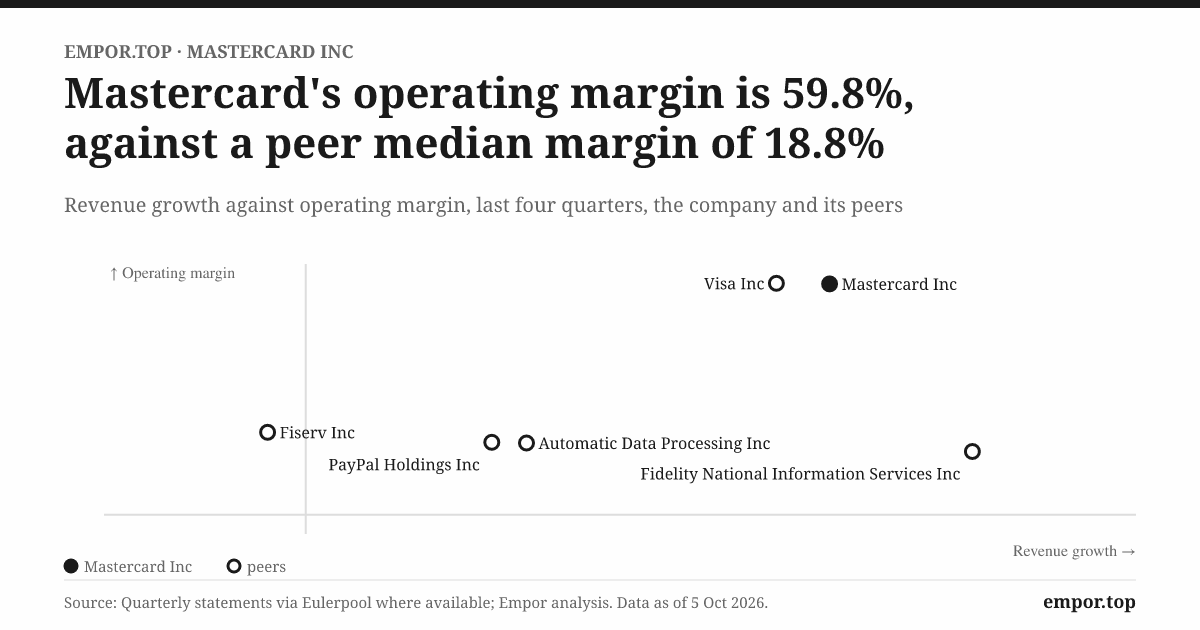
Multiply that beep by roughly 175 billion switched transactions a year1 and you get one of the strangest great businesses in America. Over the last four reported quarters Mastercard produced about $35bn of revenue2, and in 2025 it kept nearly 60 cents of every revenue dollar as operating profit1. It does not lend. It does not carry a cardholder's default risk. When a consumer in Lisbon fails to pay their card bill, the loss belongs to the issuing bank, not to the network that routed the payment.
The cash numbers are even stranger. In 2025 the company generated about $16.4bn of free cash flow1 while reporting only about $7.7bn of shareholders' equity on its balance sheet1. A business that throws off more than twice its book value in cash every year is either extraordinary or doing something unusual with its capital. Mastercard is both.
This story asks four questions, and the rest of the piece is organised to answer them.
First, is growth of 15% or more durable on a revenue base of about $35bn? Second, do regulation and new payment rails, such as instant bank transfers and stablecoins, chip away at network economics? Third, is the eye-watering return on equity, near 290%2, a sign of business quality or simply the arithmetic of buybacks? Fourth, has capital deployment, through acquisitions and repurchases, earned its keep, and is the stock priced for the growth it is getting?
The thesis can be put in three lines. A cooperative owned by banks became a public company. The public company became a toll collector on the world's card spending. And the toll collector is now trying to become a services-and-data company, while using its toll income to shrink its own share count.
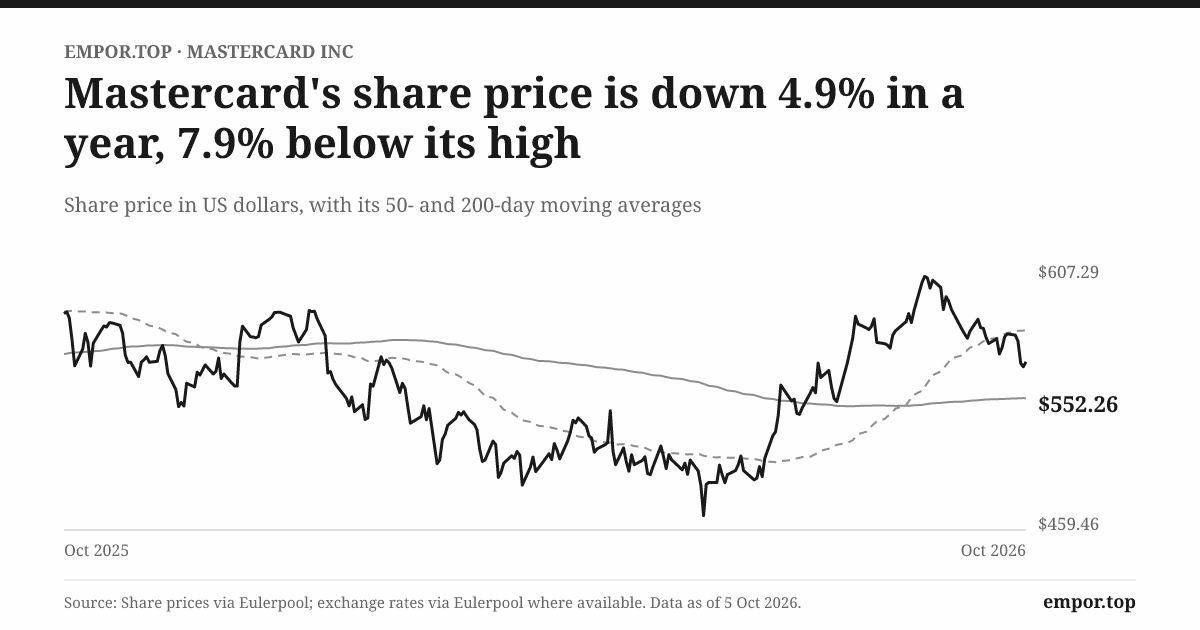
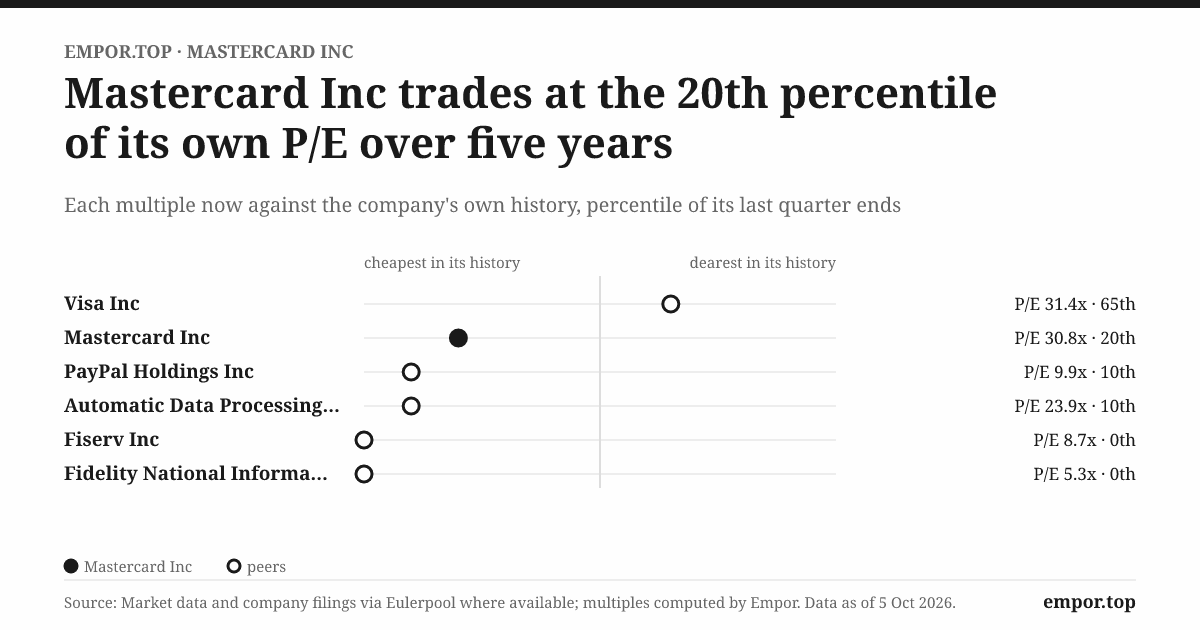
On 5 October 2026 the share price stood at about $552, roughly 8% below its 52-week high, and the stock traded at about 31 times trailing earnings against a five-year median near 34.5 times2. That is cheaper than its own recent past, but hardly cheap in absolute terms. Whether it is fair depends on everything that follows, and the place to start is a set of banks in upstate New York that were tired of being left out.
 Subscribe on LinkedIn
II. The Buffalo Rebellion: A Co-op Is Born, in Brief
In 1966 Bank of America was licensing its BankAmericard to other banks across the country. For a bank that was not invited, or did not want to live under a rival's brand, the message was clear: join California's network on California's terms, or watch the future of consumer credit pass you by. A group of banks did neither. They met and formed the Interbank Card Association, a cooperative that would let member banks issue cards, sign up merchants and settle with each other under shared rules3.
The cooperative's first big brand, Master Charge, arrived at the end of the 1960s. Alliances followed, including a long relationship with Europe's Eurocard. In 1979 the brand became MasterCard3. The ATM network Cirrus was folded in during the 1980s, giving the network a cash-withdrawal footprint alongside purchases. Each step widened the same idea: a shared set of rails that no single bank could build alone.
The four-party model, plainly
The cooperative heritage left Mastercard with a structure that still defines it, known as the four-party model1. There is the cardholder's bank, called the issuer. There is the merchant's bank, called the acquirer. There is the merchant. And in the middle sits the network, which writes the rules, routes the authorisation message and coordinates settlement between the two banks.
The money flow is where people get confused. When the café accepts a €4 payment, it does not receive the full €4. Its acquiring bank keeps a merchant discount. Most of that discount passes to the issuing bank as interchange, the fee that pays for rewards, fraud losses and the credit the issuer extends. Mastercard sets the default interchange schedules that apply when banks have not agreed otherwise, but it does not keep the interchange1. It is the referee who sets the house rules, not the player who pockets the stake. Mastercard's own revenue comes from separate, much smaller fees charged to issuers and acquirers for using the network and its services.
American Express runs a different game, the closed loop. Amex is often the issuer, the network and the merchant acquirer at once, so it keeps the whole discount and also carries the credit risk4. That makes Amex a bank and a network rolled together. Mastercard chose to be only the network, and that choice, made by banks who wanted the rails but not a rival, is the root of its asset-light economics.
The legal echoes
The same structure that made the network efficient made it look, to regulators, like a cartel. Rival banks sitting together and setting common fees is exactly the kind of arrangement antitrust law is designed to scrutinise. Three episodes from that era still matter. In 1996 merchants led by Walmart sued over rules that forced them to accept debit cards if they took credit cards, and the case settled in 2003. In 1998 the US Department of Justice challenged rules that stopped member banks from issuing American Express and Discover cards. And American Express later sued over the same exclusivity rules, leading to a settlement in 20081.
These cases were not ancient history. They set the pattern for the next 20 years: merchants and regulators attacking the price of acceptance, and the network paying to settle while the volume kept rising. The deeper problem was that the owners of the network were also its biggest customers. Banks voted on the fees that banks collected. That conflict, and the litigation it invited, is what pushed the cooperative toward the public markets.
III. The 2006 IPO: Liberation From the Banks
On 25 May 2006 MasterCard Incorporated began trading on the New York Stock Exchange. The shares were priced at $39, and the offering sold about 95.5 million Class A shares5. For a company that had spent 40 years as a club of banks, it was a change of species. The members did not disappear overnight, but the control of the board passed to a Delaware corporation answerable to public shareholders.
The $39 price tag needs a footnote of its own. Mastercard split its stock ten for one in January 20145, so the IPO price is about $3.90 in today's share terms. Against a share price of about $5522, that is a rise of roughly 140 times before dividends, one of the great large-cap returns of the past two decades.
Why go public at all
The timing was not an accident. By 2005 merchants had filed a wave of interchange suits that were consolidated into a single federal case in New York6. As long as banks owned and governed the network, every fee decision could be framed as banks colluding to fix prices for banks. Turning the network into an independent public company with its own board weakened that argument and created a currency that could be used to settle litigation. The S-1 framed the restructuring around governance and the ability to compete, and listed the litigation as a central risk5.
The new structure came with layers. Public investors bought Class A voting shares. Banks held Class B shares, which carried no voting rights and were gradually converted and sold over the following years. The Mastercard Foundation, created with a large block of shares, became one of the largest holders, subject to rules that required it to sell down over time and limited its voting influence57. The point of the design was simple: no group of banks would ever again control the network.
Today there is no controlling shareholder. As of February 2026 there were about 885 million Class A shares outstanding and about 6.6 million Class B shares1. The ownership register is dominated by the large index and active managers that own most of the S&P 500, as the beneficial-ownership table in the 2026 proxy shows8.
What the IPO bought
The verdict on the IPO has two halves. The first is governance. Removing banks from the top removed the most obvious conflict: owners who were also customers. Mastercard could now negotiate with issuers at arm's length, and that freedom later showed up in the growing incentive payments it uses to win and keep bank portfolios, a theme the story returns to.
The second half is financial. A public company with a high-margin, low-capital model and no need to retain earnings has an obvious use for its cash: hand it back. Over the last 12 years revenue rose from about $9.4bn in 2014 to about $32.8bn in 20251. In the same period shareholders' equity barely moved, starting at about $6.8bn and ending at about $7.7bn1. Nearly all the profit in between left the company through buybacks and dividends. That is the playbook the IPO made possible, and it defines the modern financial profile.
If the IPO was the moment the network gained its freedom, the next question is what it does with it every second of every day. That means looking inside a single swipe.
IV. The Toll Booth: How the Money Actually Works
Go back to a $100 dinner charged on a Mastercard credit card in Chicago. The restaurant's bank might receive about $97.50. The restaurant does not see the missing $2.50 as three separate bills, but it is. Most of it, perhaps $1.80 to $2.00, is interchange that flows to the cardholder's bank. Part is the acquirer's own margin for processing and servicing the restaurant. And a small slice, a matter of cents, goes to Mastercard as network fees charged to both banks. On the restaurant's statement, the card network is a rounding error. On Mastercard's income statement, that rounding error repeated across the planet is about $35bn a year.
The pricing unit
Mastercard earns on three counters, all disclosed in its annual report1. One counts transactions: each authorisation and clearing message that crosses its switch carries a fee, and in 2025 the network switched about 175.5 billion transactions, up 10%. One counts dollars: assessments tied to gross dollar volume, which reached roughly $10.6 trillion in 2025, up about 15% in local currency. And one counts borders: when the card and the merchant sit in different countries, Mastercard charges cross-border fees that carry far higher rates than a domestic swipe. Cross-border volume grew about 9% in 20251.
Cross-border is the crown jewel and the weak point. It is the highest-margin part of the toll, and it is tied to travel and global e-commerce. In 2020, when borders closed, Mastercard's revenue fell 9.4%, its only annual decline in the past decade1. The toll booth is robust to ordinary recessions because people still buy groceries, but it is not immune to the world stopping.
Two engines, different speeds
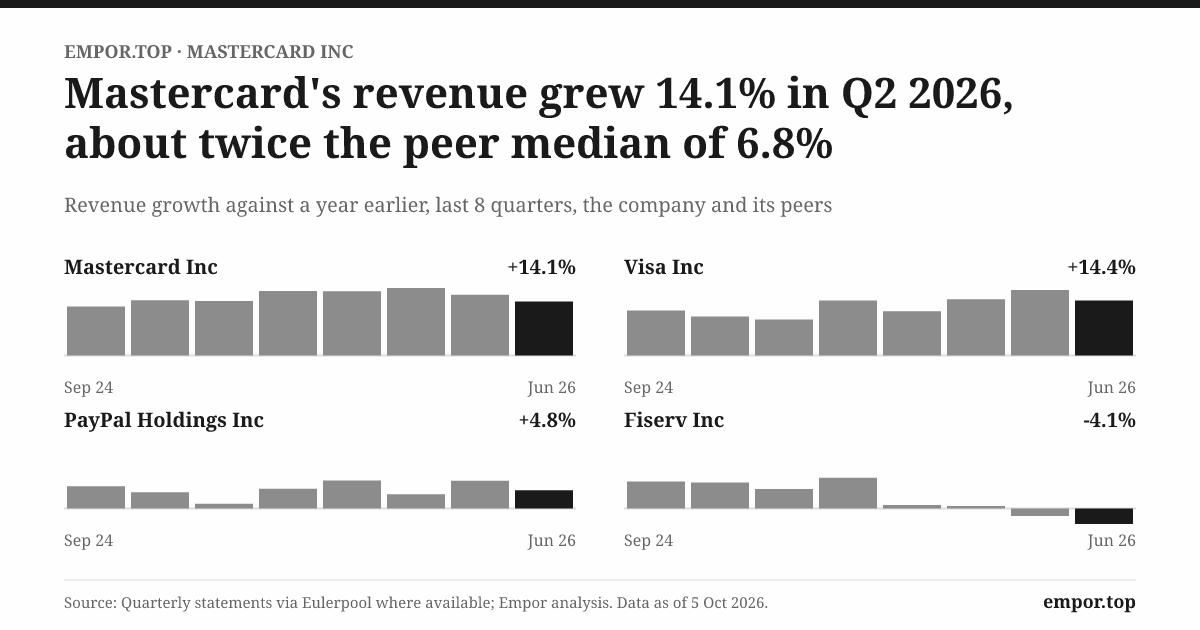
Since 2024 Mastercard has reported its net revenue in two lines. In the second quarter of 2026, payment network revenue was about $5.45bn, up 10%, while value-added services and solutions brought in about $3.83bn, up 20%9. In other words, services already supply roughly 41% of net revenue and are growing twice as fast as the core network. If the gap persists, services will be close to half of revenue within a few years. That shift is the company's main growth argument and section VII tests it.
The hidden line: what Mastercard pays the banks
Here is the number that best shows who holds power in this industry. Mastercard reports revenue net of rebates and incentives, which are payments it makes to issuers and some large merchants to win their volume. Banks choose which network to put on their cards, usually under multi-year contracts, and Mastercard and Visa bid for those portfolios. At 30 June 2026, Mastercard had about $12.6bn of accrued customer incentives on its balance sheet, current and long-term combined9. In 2025, rebates and incentives were roughly a fifth of gross revenue, according to the gross-to-net bridge in the 10-K1.
Think of it this way. Mastercard is a toll road, but the trucking companies that send the traffic down it, the banks, get paid a large loyalty bonus to keep choosing that road. That bonus is the single best measure of issuer bargaining power, and it rises when big deals come up for renewal.
Operating leverage
The cost side is simple. Mastercard employs about 39,800 people, about 70% of them outside the US1. Workforce cost was roughly $7.3bn in 2025, about 22% of revenue1. Capital spending is modest: the gap between operating cash flow of $17.6bn and free cash flow of $16.4bn implies about $1.2bn of capex in 2025, or under 4% of revenue1. That is a derived figure, as the company groups capitalised software and property spending separately in the cash-flow statement.
When revenue grows faster than people and servers, margins expand. Operating margin climbed from about 53% in 2014 to about 59.5% in 2025, and reached nearly 62% in the second quarter of 202619. The toll booth costs roughly the same to staff whether ten cars or ten thousand pass through.
Earnings that turn into cash
A business this profitable deserves a quality check. Over 2014 to 2025, net profit totalled about $93bn and cash from operations about $105bn, roughly 112% of profit1. Depreciation, amortisation and stock compensation explain most of the excess. More telling is working capital. Receivables shrank from about 119 days of revenue in 2019 to about 51 days in 2025, and net working capital sits at about minus 112 days1. Translated: Mastercard collects from banks faster than it pays out incentives and settlement obligations, so its customers fund its growth. The one profit dip in the period, 2017, came from a 40% tax rate tied to the US tax reform's one-time charges, not from the business1.
Is 15% growth durable?
Now the counterevidence. Revenue growth peaked at about 17.6% in the December 2025 quarter and slowed to about 14% by June 20262. Currency helped: second-quarter net revenue rose 14% as reported but 12% on a currency-neutral basis9. The five-year compound growth rate of about 16.5% looks splendid, but it starts in 2020, the pandemic trough. The honest base rate is the ten-year figure of about 13% a year2.
The verdict is that the growth is real but the headline flatters it. The defensible claim is "low-to-mid teens, with a cyclical cross-border piece and a faster services piece." Two numbers will confirm or break it: currency-neutral net revenue growth, which last read 12%, and the services share of revenue, which last read about 41% and rising.
A toll booth this lucrative invites competition and imitation. The next question is how well its walls hold.
V. Duopoly and Challengers: The Moat in Full
In September 2014, Apple unveiled Apple Pay. For a moment, it looked like the moment the phone would swallow the card. If Apple stood between the consumer and the bank, why would anyone need a card network? What happened instead tells you most of what you need to know about Mastercard's moat. Apple built Apple Pay on top of the networks. Mastercard and Visa supplied the tokenisation, the technology that swaps your real card number for a device-specific stand-in, so a stolen token is useless elsewhere10. Rather than being cut out, Mastercard became the plumbing inside the shiny new tap.
The 7 Powers, argued once
Hamilton Helmer's framework names seven sources of durable advantage. Three apply here with force.
Network economies. A card is useful because merchants accept it, and merchants accept it because cardholders carry it. Mastercard brands appear on billions of cards accepted at tens of millions of locations worldwide1. A new network has to solve both sides at once, which is why there have been almost no successful new global card networks since the 1980s.
Scale economies. Running a global switch, a fraud model and a settlement engine is largely a fixed cost. Each extra transaction is nearly free to process. The rising margin traced in section IV is the visible result.
Counter-positioning against the closed loop. Amex's model lets it keep the full merchant discount, but it must fund lending and win merchants itself. Mastercard leaves both jobs to thousands of banks. Amex cannot copy that without dismantling its own economics, and Mastercard has no need to copy Amex.
The quality signal sits in the returns. Return on invested capital, which strips out the buyback distortion in equity, was about 91% over the last 12 months2. Few industrial-scale businesses on earth earn that.
Porter's view: where the pressure comes from
Supplier power is weak; Mastercard buys computing, people and telecom, none scarce. Rivalry is real but stable: Visa is a near-identical sibling and the larger of the two. In its 2025 fiscal year, Visa reported net revenue of roughly $40bn, against Mastercard's $32.8bn111, and Visa's payments volume is materially larger. The two compete hard for bank portfolios, but neither has an interest in a price war on network fees.
Buyer power is strong, and it sits with issuers, not consumers. The $12.6bn of incentive accruals is the evidence. Large banks can and do move portfolios between networks when contracts expire.
Substitutes are the live threat. India's Unified Payments Interface, Brazil's Pix, Europe's account-to-account initiatives such as Wero, and the US FedNow service all let money move directly between bank accounts without a card network in the middle12. Stablecoins promise the same for cross-border flows.
The counterevidence
The strongest disconfirming evidence comes from Mastercard's own markets. Pix, launched by Brazil's central bank in 2020, became the country's most used payment method within a few years, and UPI processes the large majority of digital retail payments in India. In both places, the threat was not a better card; it was a state-backed rail that cut out cards entirely for many domestic payments.
State action can do more than compete. China kept international networks out of domestic clearing for years, leaving 中国银联 UnionPay as the dominant domestic network. And in March 2022, after Russia's invasion of Ukraine, Mastercard suspended its Russian operations. The company had said Russia accounted for about 4% of net revenue in 2021, including cross-border activity involving Russian cards13. One political decision removed a market overnight.
Weighing it up, the history does not reject the moat; it narrows it. In card payments, Mastercard's network and scale advantages remain intact and visible in its returns. Outside cards, governments have shown they can build rails that bypass the networks at home, and Mastercard's defence has been to participate rather than to block, as with its account-to-account businesses described in section VII. The moat is wide on acceptance and narrower on price. The best indicator is the share of domestic payments in large markets that still flow over cards, especially debit, where account-to-account substitutes compete most directly.
That price question has its own long courtroom history.
VI. The Regulatory Siege: Is the Price Power Real?
In June 2026, in a federal courtroom in Brooklyn, Judge Brian Cogan granted preliminary approval to a revised settlement between Visa, Mastercard and the merchants who had been suing them since 20059. Two decades of filings, appeals, a rejected earlier deal and armies of lawyers had come down to this: a set of fee concessions that, by the parties' reckoning, would save US merchants about $38bn over the life of the agreement914. It was not a $38bn cheque. It was a promise to collect less.
What the settlement does
As reported, the revised deal cuts average US credit interchange by 10 basis points for five years and caps the default rate on standard consumer credit cards at 1.25% for eight years14. It also loosens rules on surcharging and honouring all cards. The settlement still needs final court approval, and objectors among merchants have argued it does not go far enough.
Here is the subtlety that matters for Mastercard shareholders. Interchange is the issuer's revenue, not the network's. A 10-basis-point cut in interchange lands first on the banks' rewards budgets. Mastercard's own network fees are not directly reduced. The second-order effect is more interesting: if issuers earn less from each swipe, they will push harder in contract negotiations for larger incentive payments from the network. The cost moves from the merchant to the issuer to Mastercard's rebate line.
The balance sheet reflects a cleaner picture. Mastercard's accrued litigation provision fell from about $800m at the end of 2025 to about $296m at the end of June 2026, as amounts were paid out or resolved91.
The long timeline
This is not the first time a regulator has moved the ceiling. In the US, the Durbin Amendment capped debit interchange for large banks from 2011 and required merchants to have a choice of at least two unaffiliated networks on debit cards15. In Europe, the 2015 Interchange Fee Regulation capped consumer debit at 0.2% and credit at 0.3% for transactions within the region16. In the UK, the Payment Systems Regulator has scrutinised cross-border interchange and the scheme fees networks charge acquirers17. The UK Merricks collective action over interchange, one of the largest consumer claims in British legal history, was settled by Mastercard, and claims in the UK, Portugal and the Netherlands remain pending1.
In the US, the proposed Credit Card Competition Act would require large issuers to offer a second, non-Visa or Mastercard network on credit cards, mirroring Durbin's debit rule. It has been introduced repeatedly but has not become law. If it ever passed, the direct risk would be lost routing share on credit, not a cap on Mastercard's own fees.
Myth versus reality
Myth: every new rule is a body blow to the network. Reality: Mastercard's revenue rose more than threefold across the decade that included Durbin, the EU caps and multiple settlements1. The rules hit issuers first, and the networks absorbed the second-order pressure through incentives while volume kept growing.
But the record also shows the ceiling only moves in one direction. Each round of regulation has taken a little more of the merchant discount out of the system. The claim that survives is "resilient, with a falling ceiling." The number that would show the ceiling pressing on Mastercard itself is rebates and incentives as a share of gross revenue. If that ratio climbs steadily, issuers are passing their regulatory losses up the chain.
Two governance notes belong here. The 10-K carries an unqualified opinion from PricewaterhouseCoopers on internal control over financial reporting, and the auditor's critical audit matters centre on the judgment-heavy areas you would expect: litigation provisions and the accrual of customer incentives1. Both are estimates that depend on management's view of future outcomes and contract performance, and both are large enough to move reported profit.
If regulation caps the price of the toll, the obvious response is to sell something other than the toll. That is what Mastercard has spent a decade and many billions trying to do.
VII. The Pivot to Services: Buying the Next Growth Engine
In September 2024 Mastercard announced it would buy Recorded Future, a threat-intelligence company that tracks hackers, leaked credentials and criminal infrastructure across the internet, for $2.65bn18. The deal closed in December 2024. For a payments network, it was an odd-looking purchase: a company whose customers include governments and corporate security teams, not banks processing card swipes. Mastercard's argument was that it already sees an enormous share of global fraud attempts through its network, and combining that with external threat data would make both products better. Recorded Future was the company's largest acquisition to that point.
The shopping list
Recorded Future was the latest in a decade of purchases that, taken together, describe a strategy.
- Vocalink, bought in 2017 for about £700m, runs the UK's core bank-to-bank payment infrastructure, including the Faster Payments system19. Mastercard bought the very kind of rail that could threaten cards.
- The Nets account-to-account business, agreed in 2019 for about €2.85bn and completed in 2021, added clearing and real-time payment infrastructure in the Nordics and beyond19.
- Finicity, bought for about $825m plus potential earn-outs, announced in 2020, connects to consumers' bank accounts with permission, the foundation of open banking in the US19.
- Ekata, an identity-verification firm, was acquired in 2021 for about $850m19.
The cash-flow statement shows the lumps: investing outflows of about $5.3bn in 2021 and about $3.4bn in 2024, the years the big deals closed1.
One story, not five
The services business is best understood as five neighbours selling to the same banks and merchants. Cyber and intelligence (fraud scoring, Recorded Future, Ekata) helps banks decide which transactions to approve. Open banking (Finicity) lets lenders and apps see account data with the consumer's consent. Account-to-account (Vocalink, Nets) runs real-time bank payment systems for central banks and clearing houses. Data and marketing services sell insights drawn from anonymised spending patterns. And tokenisation, the technology that saved the network in the Apple Pay moment, is now sold as a security service in its own right.
The logic is coherent: if the toll is capped, sell the map, the guard dog and the traffic report. Services grew about 20% in the June 2026 quarter, twice the network's rate9.
Did the deals earn their cost?
Here the evidence thins out, and it is worth saying exactly where. Mastercard does not disclose the revenue or profit of individual acquired businesses, nor a return on capital for any deal. Its non-GAAP figures separate the effect of acquisitions on growth only in aggregate, and in recent years that contribution has been a point or two of total net revenue growth1. So most of the 20% services growth appears organic, which is the more encouraging reading. But the price paid for the larger deals, often double-digit multiples of revenue, means the payback depends on growth continuing for many years.
The counterevidence on capital allocation is the record of projects that did not become revenue. Mastercard Labs produced many prototypes, and the company's blockchain and cryptocurrency experiments generated headlines and partnerships more than reported revenue. These were small bets, so they do not undermine the acquisition record. They do limit how much credit an investor should give to "optionality" talk: Mastercard has been better at buying businesses with revenue than at turning its own technical firsts into new revenue lines.
The verdict: the pivot is working as a growth story, with services compounding faster than the core. Whether the large deals beat Mastercard's cost of capital is unknowable from outside, because the company does not report deal-level returns. The services share of revenue is the honest scorecard; if it keeps rising while services growth holds near 20%, the strategy is earning its keep.
Strategies like this are set by people, and Mastercard's current team has been in charge since the pandemic.
VIII. Current Management: Miebach's Mastercard
On 1 January 2021 Michael Miebach became chief executive, succeeding Ajay Banga, who had led the company since 2010 and later went on to run the World Bank20. It was an unusual moment to take over. Cross-border travel was still close to frozen, and the business was emerging from its first annual revenue decline in years.
Miebach, born in Germany and raised partly in the Middle East, came up through banking, with stints at Citigroup and Barclays, before joining Mastercard in 201020. He ran its Middle East and Africa business, then the products and innovation group, then served as chief product officer and president. Where Banga was a showman who built the brand's presence with governments and banks, Miebach is the product man: his career inside Mastercard was spent building the services business that now drives growth.
The team
The executive bench is long-tenured. Sachin Mehra, the chief financial officer since 2019, has been the steady voice on earnings calls about expenses and capital return1. Craig Vosburg leads services, Ed McLaughlin was the long-time technology chief, and Ling Hai runs the Americas1. The 10-K discloses that several executives, including McLaughlin, Hai and Vosburg, adopted pre-planned trading arrangements under Rule 10b5-11. Such plans are routine for executives paid mostly in stock and do not by themselves signal anything about the outlook.
Promises versus outcomes
The test of management credibility is what it said and what happened. In March 2022, after suspending Russian operations, management quantified the revenue exposure at about 4% and then delivered 2022 net revenue growth of about 18% anyway131. Over the past several years, management has guided to net revenue growth in the low-to-high teens on a currency-neutral basis, and reported results have generally landed at or above those ranges21. On recent calls, analysts pushed on four themes: the regulatory settlement, the durability of services growth, the trend in incentives, and the health of the US consumer. Answers on volumes and cross-border trends were concrete, with monthly data. Answers on incentive levels were more general, typically described as the result of renewing key bank deals, with no forward number.
There is no evidence in the company's record of the classic trust-damaging patterns: large guidance misses followed by blame-shifting, or strategy changes without explanation. That does not prove excellence; it shows a team operating a very predictable business without stumbling.
How they are paid
Miebach's total compensation for 2025 was reported at about $35.4m, up about 18% from 2024, with most of it in stock awards and options rather than cash8. Net profit rose about 16% in 20251, so pay moved broadly with results. Shareholders approved the pay programme with about 96% support at the 2025 annual meeting, according to the voting results Mastercard filed22. The annual incentive is tied to net revenue growth and EPS, with long-term awards linked to EPS and relative total shareholder return8. That design has an obvious feature: buybacks raise EPS, and EPS drives pay.
The skeptic's stress test
An activist reading the cash-flow statement would ask a pointed question. In 2025 Mastercard spent about $14.5bn buying back its own shares1. In June 2026 it issued $5bn of new senior notes9. Is management borrowing to buy stock at 30 times earnings, partly to hit EPS targets that determine its own pay?
The defence is solid but not airtight. Debt remains small against roughly $21bn of annual operating profit2. The buyback has been funded mostly from free cash flow, not debt. And the company has not cut investment in services to fund repurchases. The critique that survives is narrower: at today's multiple, each dollar of buyback buys only about 3 cents of current earnings, so the return on the buyback depends heavily on future growth. That is exactly where the money goes next.
IX. The Buyback Machine: Where Does $16bn a Year Go?
Open Mastercard's balance sheet and something looks off. Total assets of about $54bn. Shareholders' equity of about $7.7bn1. A stock market value of about $500bn2. The market is paying about 88 times book value2. In most industries, that ratio would signal a bubble. Here it signals something else: a company that has handed back almost everything it has earned.
Following the cash
Over the 12 years from 2014 to 2025, Mastercard produced about $96bn of free cash flow1. Dividends took about $18bn of it, or about 19%1. Cash on hand rose by less than $5bn. The rest, more than $70bn net of new borrowing, went to share repurchases and acquisitions.
In 2025 alone, the company bought back about $14.5bn of stock and returned about $17.6bn including dividends, more than the year's $16.4bn of free cash flow1. In the first half of 2026 it repurchased another $9.0bn9. The payout ratio on the dividend stays low, about 18% of net profit, which keeps the yield near 0.6%12. Mastercard has chosen buybacks as the main channel, and it has stuck with that choice for over a decade.
Shrinking the denominator
The payoff shows up per share. Diluted EPS rose from about $3.13 in 2014 to about $16.67 in 2025, a compound rate of about 16% a year, ahead of the roughly 14% a year growth in net profit over the same span1. That two-point gap is the share count shrinking. There has been no dilution to speak of; stock compensation is more than offset by repurchases.
Why ROE is the wrong lens
Return on equity of nearly 290% sounds like a business miracle2. It is mostly arithmetic. If you shrink the denominator by buying back shares, ROE rises even if the business does not change. Equity has been held at about the same level for 12 years while profits quadrupled, so ROE climbed from about 53% to about 290%12.
The honest quality measures strip out the capital structure. Return on capital employed, which measures operating profit against the capital tied up in the business, was about 64%. Return on invested capital, after tax and counting both debt and equity, was about 91%2. Those numbers are still exceptional. They say the underlying business needs very little capital to run, which is the real reason it can return so much. ROE adds nothing to that verdict.
The leverage question
Debt rose from about $1.5bn in 2014 to about $19.0bn at the end of 2025, and to about $24.6bn by June 2026 after the new notes and about $710m of commercial paper19. The debt-to-equity ratio of about 2.5 looks alarming only because equity is so small1. Against operating profit of about $21bn, gross debt is a little over one year of earnings, and net of $11.3bn of cash at June 2026 it is well under one year9.
The notes carry fixed coupons between about 1.0% and 4.875%, with maturities stretching from 2027 to 20511. Much of the debt was locked in when rates were low, so refinancing will raise interest costs gradually, but the amounts are small relative to cash flow. Part of the euro-denominated debt is designated as a hedge of Mastercard's investment in its European operations1, which means currency swings on that debt offset swings in the value of the European business. Mastercard holds strong investment-grade ratings from the major agencies1, and nothing in the current leverage suggests pressure on them.
The one stress test in the record came in 2020. When revenue fell, Mastercard built up cash, ending the year with about $10.6bn, and kept paying its dividend1. It did not need to raise equity, and it did not.
Related-party exposure is not a theme here: there is no parent company, and the related-person transactions the proxy discloses are routine8.
The verdict: ROE is a buyback artefact; ROIC is the real signal, and it is outstanding. The leverage is modest against the earnings it serves. The open question is not whether Mastercard can afford its buybacks but whether buying back stock at about 30 times earnings will prove a good use of the money. That depends on the price, which brings the story to valuation.
X. Bull vs. Bear, and What to Track
On 5 October 2026 the stock sat about 8% below its 52-week high, with a trailing P/E of about 31 times against a five-year median of about 34.5 times2. For a stock that has rarely been cheap, a multiple below its own average gets attention. But averages carry the growth of the years that set them, and those years included the post-pandemic rebound.
What the price assumes
At an earnings yield of about 3.2% and a free cash flow yield of about 3.3%2, an investor today needs growth to do most of the work. If earnings per share grow in the low teens, helped by a couple of points from buybacks, the current multiple holds up. If growth slips toward high single digits, the multiple has room to fall. The PEG ratio of about 1.82 says the market is paying a full price for the growth it expects, not a discount. EV to EBITDA is about 23 times2. Visa trades on broadly similar multiples, reflecting the market's view of the two as near-twins11; American Express, which carries credit risk, trades at a much lower multiple4.
The fair reading is "fair, not cheap." The case turns on two variables: cross-border volume and the incentive trend.
The bull case
Cash still accounts for a meaningful share of consumer payments in much of the world, and the conversion of cash and cheques to cards and digital payments has a long runway, especially in commercial payments between businesses. Services are compounding near 20% and now make up about 41% of revenue. Margins near 60% have room to rise as services scale on the same infrastructure. And every year the share count shrinks.
The bear case
The regulatory ceiling falls a little each round, and the US settlement makes the next step easier. Issuers, squeezed on interchange, will demand more incentives. Real-time bank rails will take domestic debit share in more countries, as Pix and UPI have shown. A consumer slowdown would show up quickly in volumes, and a travel shock would hit cross-border revenue hardest. And if growth slows, a stock at 30 times earnings has a long way to fall even if the business is fine.
The risk radar
Only a few risks are material. Regulatory and political: the settlement's final approval, the Credit Card Competition Act, and European and UK actions. Cybersecurity: Mastercard holds the data and infrastructure that hackers prize, and a major breach would damage trust in a business built on it. Substitution: real-time bank payments and stablecoins. Cyclicality: cross-border spend. Geopolitics: the Russia exit shows a market can vanish with a decision in a capital. Refinancing risk is modest.
The three numbers to track
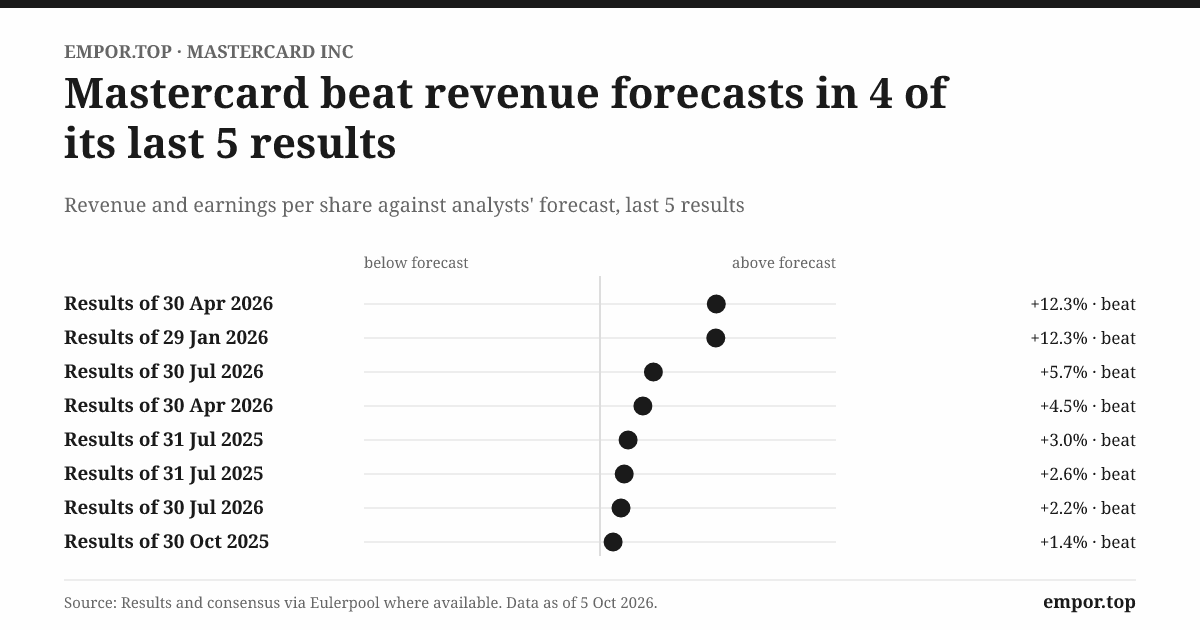
Watch currency-neutral net revenue growth, which last read 12% in the June 2026 quarter and has been slowing9. Watch the services share of net revenue, about 41% and rising9. And as a check, watch rebates and incentives as a share of gross revenue: if that ratio climbs faster than volumes, issuers are winning the price war inside the industry.
XI. Playbook: Lessons That Belong to Mastercard
Own the rails, not the risk. In 2008, as US banks wrote off credit card loans by the billions, Mastercard's net revenue kept rising because it had never lent a dollar1. The lesson for founders is that in a two-sided market the most valuable seat is often the one that holds no inventory and no credit. Let others carry the balance sheet; you carry the message.
Sell the toll, then sell the map. The Apple Pay moment showed that a network threatened by new technology can become that technology's supplier. Mastercard then turned tokenisation, fraud scoring and its view of global spending into products of their own. When the price of the road is capped, charge for the directions.
A moat is only as high as the regulator's patience. Durbin, the EU caps and the Brooklyn settlement each took a little more of the merchant's fee out of the system. None stopped growth, but none reversed. A network that sets prices for its rivals will always find a judge setting prices for it.
Shrink the denominator, but watch the price. Twelve years of buybacks turned profit growth of about 14% into EPS growth of about 16%. That works when the shares are cheap relative to future earnings. At 30 times, the margin for error is thin. A buyback is a bet on your own stock; place it as if you were buying someone else's.
XII. Epilogue: The Next Moments That Decide It
Tonight Mastercard stands where it has stood for years: on top of a business that makes about 60 cents of operating profit on every revenue dollar, with growth slowing at the edges and a stock priced a little below its recent habit. The next 12 months will test each of the four questions.
The first moment is in a courtroom. The US settlement still needs final approval. If it is approved, the 20-year overhang ends, and investors can model a known ceiling rather than an open-ended claim. If it is rejected, the litigation reopens with no clear end. In Europe and the UK, the pending interchange claims and the regulator's work on scheme fees will decide whether the European ceiling falls further.
The second moment comes every three months: the next four quarters of currency-neutral growth. If growth holds in the low teens, the durability question is largely answered. If it slips toward single digits, the current multiple will be hard to defend. Alongside that, the first full year of reading on services growth after the Recorded Future deal will show whether 20% is the new normal or a peak.
The third is in central banks and legislatures. Decisions on stablecoins and real-time payments will decide whether Mastercard is a partner in the new rails, as it has positioned itself with Vocalink and Nets, or a toll booth that traffic routes around.
The tension that remains is the core of this story. In economics, Mastercard behaves like a regulated utility: a shared piece of infrastructure whose price is set partly by courts. In the market, it is priced as a growth stock. Both can stay true for a long time. But if growth slows while the regulator keeps pressing, one of them will have to give.
XIII. Outro
Back in Lisbon, the coffee is long gone. The beep lasted under a second. Mastercard took a few cents of friction from it, repeated about 175 billion times a year, and that friction built a business worth about $500bn.
The irony is that the banks built it to protect themselves from a rival, and ended up creating a network that now pays them to stay and earns more on each dollar than they do. Mastercard grew into one of the most valuable companies in the world without ever holding a dollar of anyone's risk.
References
-
Mastercard Form 10-K FY2025 — SEC EDGAR, 2026-02-11 ↩↩↩↩↩↩↩↩↩↩↩↩↩↩↩↩↩↩↩↩↩↩↩↩↩↩↩↩↩↩↩↩↩↩↩↩↩↩↩↩↩↩↩↩↩↩↩↩↩
-
Mastercard Investor Relations — Mastercard ↩↩↩↩↩↩↩↩↩↩↩↩↩↩↩↩↩↩
-
Mastercard SEC filings index (10-K, 10-Q, 8-K, DEF 14A, S-1 from 2006) — SEC EDGAR ↩↩↩↩
-
Mastercard Form 10-Q for quarter ended 30 Jun 2026 — SEC EDGAR ↩↩↩↩↩↩↩↩↩↩↩↩↩↩
-
Mastercard company page (Russia suspension coverage) — Reuters ↩↩
-
Mastercard company page (US merchant settlement coverage) — Reuters ↩↩
-
Regulation II (Durbin) debit interchange overview — Federal Reserve ↩
-
Competition policy: antitrust and interchange cases — European Commission ↩
-
Mastercard Newsroom (Recorded Future acquisition) — Mastercard ↩
-
Mastercard Newsroom (acquisition announcements) — Mastercard ↩↩↩↩
-
Mastercard Investor Relations (earnings materials) — Mastercard ↩
-
Mastercard 8-K filings, including annual-meeting voting results — SEC EDGAR ↩
 LinkedIn
 WhatsApp
 Reddit
 Hacker News
 Email
 Kindle
 RSS Feed
 Spotify
 Apple Podcasts
 Amazon Music
 Audible
 YouTube