Moody's: The Toll Booth That Survived Its Own Crisis
I. Cold Open: A Single Letter Moves Trillions (8 min)
In the summer of 2007, the subprime machine was starting to break, and the people inside Moody's knew before most of the world. Thousands of mortgage-backed securities that Moody's had stamped with its highest grade were heading for mass downgrades. Inside the firm, employees were asked about the state of the ratings business. One answer later became the most quoted sentence in the history of credit ratings. The firm, the employee wrote, looked "either incompetent at credit analysis or like we sold our soul to the devil for revenue."1
That was not an outsider's charge. It came from inside the building. It is also the best one-line summary of the problem at the centre of the ratings business. A rating agency is paid by the company whose debt it grades, and investors rely on the grade as if it were neutral. In 2007 that arrangement failed on a huge scale.
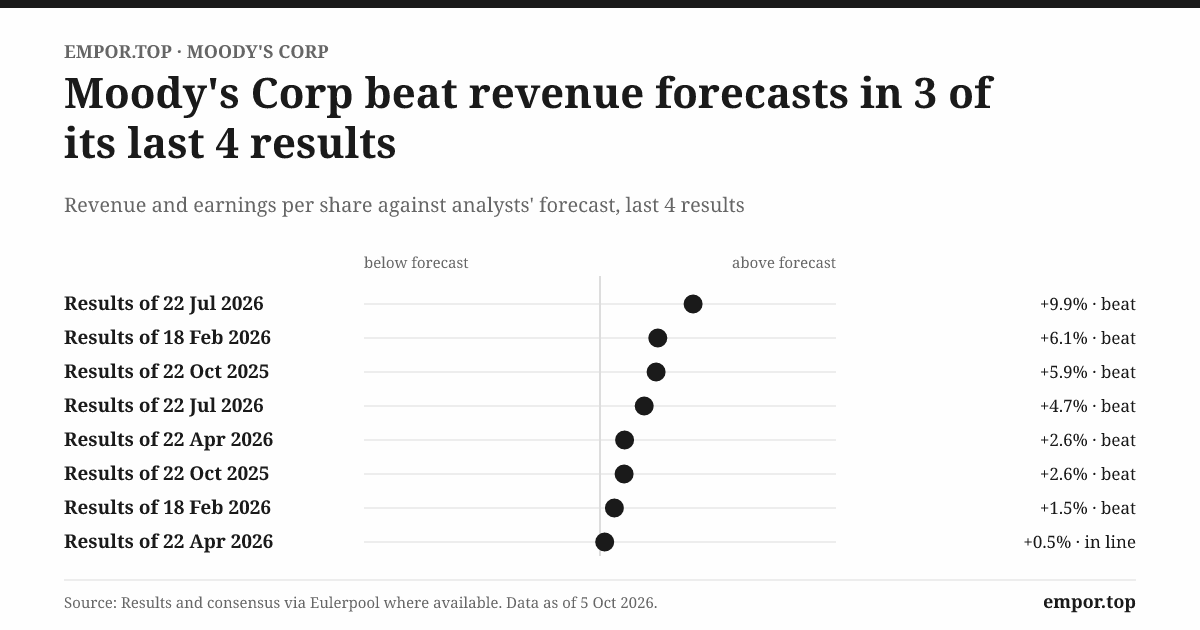
Now jump forward nineteen years, to July 22, 2026. The same company reported second-quarter revenue of about $2.2 billion, up 15% on a year earlier, with an operating margin of 47.9%.2 Operating profit rose about 24%.2 Moody's is worth about $79 billion on the stock market.3 Its full-year operating margin for 2025 was about 45%.3 That puts it among the most profitable large companies in America, and it is more profitable now than it was before the crisis that nearly discredited it.
That is the paradox this story is about. A company blamed for one of the worst credit failures in a century came out with its franchise intact and its margins higher. The question is whether that shows a moat that cannot be broken or a business riding the top of a debt cycle that flatters every number. Both can be true at once, and the answer decides what the stock is worth.
There are two businesses inside Moody's. Moody's Investors Service (MIS) is the ratings agency, the part that assigns the letters. It earned about $4.3 billion of revenue in 2025, including fees charged to its sister segment.4 Moody's Analytics (MA) sells data, research, software and risk models to banks, insurers and corporations on subscription. It earned about $3.6 billion.4 MIS is the toll booth. MA is the annuity built beside it, partly as insurance against the days when traffic slows.
The story runs through four tests. The first is whether today's earnings are a durable base or the peak of an issuance cycle. The second is whether artificial intelligence strengthens the data franchise or erodes it. The third is whether the buyback-driven balance sheet is a lever or a risk. The fourth, underneath all of them, is the one the 2007 email raised: was the conflict of interest ever fixed, or did the business simply grow too large and too necessary for it to matter?
To answer that, the story has to start with a man who sold bond manuals, went broke and came back with an idea.
 Subscribe on LinkedIn
II. From Railroad Manuals to "Money in the Bank" (1900–2000, compressed) (20 min)
John Moody was a Wall Street clerk turned publisher. At the start of the twentieth century he sold thick manuals of statistics on American companies, especially the railroads, which were the great borrowers of the age. The Panic of 1907 wiped out his first business. Two years later, in 1909, he came back with something more compact: a letter grade for railroad bonds.4 Instead of a book of facts, investors got a judgment.
That shift, from data to opinion, is the whole business in miniature. A manual tells an investor what happened. A rating tells the investor what to think about what might happen. Opinions are cheap to produce once the analysts are in place, and they become very valuable once enough people agree to use them.
For most of the next six decades, investors paid for ratings. They subscribed to the publications, and the agency's customer was the person on the buying side of the bond. The incentive was clean. If the ratings were bad, investors stopped paying.
The pivotal change came in the 1970s, when the industry moved to an issuer-pays model. The company or government selling the bond began paying the agency to rate it. There were practical reasons. Photocopiers made it hard to stop non-subscribers from sharing ratings, and regulators were writing ratings into the rules about what banks, insurers and pension funds could hold. Once a regulation says a fund may only buy investment-grade bonds, a rating stops being a report an investor might buy. It becomes a licence the issuer must have.
That is why the original genius and the original sin are the same decision. Issuer-pays made a rating close to "money in the bank" for Moody's, because every new bond needed one and the issuer had to pay whatever the market for ratings would bear. It also meant that the agency's paying customer had an interest in a higher grade. Everything that went wrong in 2007, and everything that went right for shareholders afterwards, grows from that root.
Dun & Bradstreet bought Moody's in 1962 and held it for nearly four decades.4 In 2000, D&B spun Moody's off as a separate listed company, and the ratings agency became the core of what is now Moody's Corporation.4 The timing mattered. The newly independent company arrived on the public market just before the biggest boom in structured debt that the world had seen.
Two other threads from the late 1990s still shape the business. The first is a Justice Department antitrust inquiry into the ratings market, which closed in 1999 without charges. The episode showed how regulators viewed the industry: concentrated, but tolerated, because the alternatives looked worse. The second thread is international. In 1998 Moody's took a stake in Korea Investors Service, an early step into local-currency ratings markets abroad. That kind of move, buying into domestic agencies rather than fighting them, became a pattern; majority-owned ICRA in India is still consolidated in Moody's accounts today.4
The international bet worked. In 2025, the United States produced about $4.2 billion of Moody's $7.7 billion of revenue.4 That means roughly 46% came from outside the country, mostly Europe, with Asia-Pacific and the rest of the Americas behind. A ratings agency born to grade American railroads now earns almost half its revenue elsewhere.
For investors, this compressed century explains why Moody's makes money the way it does. It does not sell a product to the person who relies on it. It sells a passport to the person who needs to cross the border. That gives it pricing power that ordinary information businesses do not have, and it builds a conflict into the economics. The next chapter shows what happened when the traffic through the toll booth exploded.
III. The Structured-Finance Gold Rush (2000–2007) (30 min)
Picture the structured-finance floor at Moody's in the mid-2000s. Investment banks are packaging mortgages into bonds, then packaging slices of those bonds into new bonds called collateralised debt obligations, or CDOs. Each new layer needs a rating. Each rating is a fee. The analysts are working long hours, the deal teams are calling, and the revenue chart points almost straight up.
A CDO is easier to understand with an analogy. Imagine a thousand mortgages poured into one big bucket. Instead of selling the bucket as one thing, the bank cuts it into floors, like an apartment block. The top floor gets paid first and loses last, so it gets the top rating. The basement takes the first losses and pays the highest interest. The rating on each floor depends on a model of how many mortgages will default and whether they will default together. If the model assumes defaults are scattered, the top floor looks very safe. If house prices fall everywhere at once, the floors flood together.
The economics for Moody's were extraordinary. Structured finance rose from about 28% of Moody's revenue in 1998 to close to half by 2007, and ratings revenue from structured products more than quadrupled between 2000 and 2007.1 For several years it was the source of nearly all the firm's growth.5 Structured deals were complex, they came in high volume, and they paid higher fees than plain corporate bonds.
That concentration matters well beyond 2007. It is the first and clearest case of Moody's earnings rising and falling with the volume of debt being issued. The business looked like a steady data company, but a large share of its profit depended on bankers continuing to manufacture deals. When the deals stopped, so did the fees.
In the corporate ratings market, Moody's was the second player. Estimates from the early 2000s put its share of corporate ratings at about 37%, against roughly 45% for S&P and 18% for Fitch.1 Those shares should be treated as a rough historical base rather than a precise measure, but they describe the structure that still holds: a market with three agencies, two of which dominate.
Meanwhile, Moody's was planting the seeds of a second business. In 2002 it bought KMV, a firm that measured default risk using the stock price of the borrower. Its Expected Default Frequency model and Credit Monitor tool let banks track the health of borrowers in close to real time.4 In 2005 Moody's bought Economy.com, an economic research and forecasting firm. In 2006 it bought Wall Street Analytics, maker of software for modelling structured deals.4 The deal sizes were small and Moody's did not publish the multiples it paid, so there is no evidence either way on whether it overpaid. What is clear is the direction: a ratings company was buying tools that banks would pay for every year, whether or not anyone issued a bond.
There is an irony in that last acquisition. Wall Street Analytics built software to model CDOs. Moody's was buying analytics for the very product that was about to explode in its hands.
For investors, the gold rush matters for two reasons. It shows how fast Moody's earnings can grow when issuance booms, and how much of that growth can come from a single product category. And it shows the incentive problem at full stretch. When half your revenue comes from banks that want top ratings on their deals, and three agencies compete for that business, the temptation is not abstract. In July 2007 the bill arrived.
IV. The Reckoning: 83% of AAAs Downgraded (2007–2017) (40 min)
On July 10, 2007, Moody's downgraded hundreds of subprime mortgage bonds in a single sweep. Within months the trickle became a flood. The top floors of the CDO apartment blocks, rated Aaa and treated by the market as nearly risk-free, began to flood along with the basements.
The numbers that the Financial Crisis Inquiry Commission later laid out are brutal. Of the roughly $869 billion of mortgage securities that Moody's rated Aaa in 2006, 83% were eventually downgraded.1 By April 2010, 73% of the mortgage-backed securities it had rated Aaa in 2006 had been cut to junk.1 A Aaa rating is supposed to mean a security will almost never fail. For the 2006 vintage of mortgage bonds, the label had failed most of the time.
What the investigators found
The Commission did not treat this as bad luck. It described a "clear failure of corporate governance" at Moody's.1 It found that starting in 2004, Moody's had applied more lenient criteria to Aaa ratings on CDOs without telling the market.1 The Senate Permanent Subcommittee on Investigations reached a similar view. It documented how ratings analysts were under pressure to win and keep deals, how models lagged the deterioration in mortgage quality, and how the agencies kept rating new deals while knowing that the older ones were going bad.5
That evidence settles the first question about the conflict of interest. It was real, it was material, and it changed outcomes. It was not only a theoretical problem that critics had imagined.
The fence
What followed was not demolition. It was fencing. The Dodd-Frank Act in 2010 tightened the rules on nationally recognised statistical rating organisations, the formal regulatory status that lets an agency's grades count in rules for banks and funds. The Securities and Exchange Commission gained wider oversight powers. Moody's separated commercial and rating functions so that analysts who assign ratings would not negotiate fees, and it built independent review of methodologies. In 2007 it had already split itself into two businesses, MIS for ratings and what is now Moody's Analytics for everything else.4 Europe, the U.K. and Australia built their own regulatory regimes, and Moody's still lists them in its risk factors.4
Then came the bill. In January 2017, Moody's agreed to pay about $864 million to settle claims by the Justice Department and 21 states over its ratings of structured products before the crisis.6 That was roughly one year of its 2017 operating profit.4 It was large, but it was a cost a profitable company could pay out of cash flow, and it did not require Moody's to change the issuer-pays model.
Myth vs reality
The popular story says one of two things. Critics say nothing changed and the agencies got away with it. Defenders say the reforms fixed the problem. Neither holds up well.
The better reading is that the conflict was contained, not eliminated. Issuers still pay for ratings. The fees still depend on issuance volume. The safeguards make it harder for a commercial team to lean on an analyst, and regulators now inspect the agencies regularly. But no reform has created a model where the people who rely on a rating pay for it. Moody's 2025 annual report still describes legal, regulatory and tax proceedings tied to ratings assigned by MIS, without giving any figures.4
The peer record makes the same point. S&P settled its own crisis-era claims with the Justice Department for a larger sum, and Fitch faced the same criticism. None of the three lost its position. The cost of the crisis to the oligopoly was fines and reputational damage, not market share. That is the clearest evidence of how essential ratings remain: the system punished the agencies, then went on using them.
The forward test of the "fixed" claim is specific. The next time a hot issuance category goes bad, whether that is private credit, commercial real estate or something not yet invented, do the agencies' ratings in that category turn out to have been inflated? A new round of disputes in a weak year would show that the fence only works in good weather.
For investors, the crisis did something odd. It proved Moody's could be badly wrong and still survive, because investors and regulators had no workable alternative. That is a strange kind of reassurance. The question it leaves is how much of today's profit rests on that dependence, and how much on a debt boom that will not last.
V. The Margin That Dipped and Came Back: Is This a Durable Base? (2020–2026) (35 min)
In 2022, the Federal Reserve raised interest rates faster than at any time in four decades. Companies that had borrowed freely during the pandemic stopped borrowing. The bond market, which had been running at record pace, slammed shut for many issuers. For Moody's, the effect was instant. Revenue fell about 12% that year, and the operating margin dropped from close to 46% in 2021 to about 36.5%.4
That is the clearest modern stress test of the business. When issuance stops, MIS loses transaction fees, but its people, offices and systems cost the same. Profit falls much faster than revenue. Net profit dropped by more than a third in 2022.4
Then the cycle turned. By the second quarter of 2026, MIS transaction revenue was up 34% on a year earlier, helped by record issuance and tight credit spreads.2 Spreads are the extra interest that companies pay over government bonds. When spreads are tight, borrowing is cheap, and companies issue debt to refinance, buy rivals and fund buybacks.
The puzzle: base or peak?
Over the last three years Moody's revenue grew about 12% a year. Over five years it grew about 7.5% a year, and over ten years about 8%.4 The recent rate is well above the company's own long-run base, and it rests on the strongest issuance market in years.
Management's own guidance is the most useful clue. Even after a 15% second quarter, Moody's guided to high single-digit revenue growth for 2026 as a whole.2 That implies growth slowing from the second-quarter pace for the rest of the year. A company with a quarter that strong, guiding below it, is signalling that it does not see the quarter as the new normal.
There is also a gain hidden inside the profit line. Net profit jumped about 52% in the second quarter, but that included a $179 million pre-tax gain on the sale of the Regulatory Solutions business.2 Diluted earnings per share were $5.03 on the company's own count.2 Strip out the gain and the underlying growth is strong but much less dramatic. It should not be extrapolated.
How the money comes in
The pricing unit explains the cyclicality. MIS charges a fee for each new deal it rates, which is transaction revenue. It also charges an annual fee to keep monitoring each rated issuer, which is recurring revenue, and it raises prices most years.4 In the second quarter of 2026, MIS transaction revenue was $891 million and recurring revenue was $369 million, so only about 29% of MIS revenue was recurring.2 Moody's Analytics is close to the opposite: about 99% of its revenue was recurring in the same quarter.2
Add it up and about 54% of group revenue is subscription or monitoring in nature. That cushion explains why 2022 hurt but did not break the company. It does not remove the cycle. The other 46% still rises and falls with the bond market, and that portion carries most of the operating leverage.
Profit into cash
The quality of earnings is good. Over 2023 to 2025, Moody's reported about $6.2 billion of cumulative net profit and generated about $7.9 billion of operating cash.4 Cash running ahead of profit is what a business with heavy non-cash amortisation and customers who prepay should look like.
There was a wobble in 2025. Operating cash flow covered only about 74% of EBITDA, down from about 85% the year before.4 The cause was not weaker collection. Moody's paid about $212 million more in income tax and about $100 million more in incentive pay.4 Both are signs of a good year rather than a bad one. In the first half of 2026, operating cash flow rose 32%.2
Free cash flow was about $2.6 billion in 2025, and management guided to $2.7 billion to $2.9 billion for 2026.42 That cash is what funds the buybacks discussed later.
Who pays, and how fast
Receivables tell a reassuring story. Debtor days, the time it takes to collect, fell to about 96 in 2025 from a peak of 110 in 2022.4 The allowance for bad debts is about 1.4% of net receivables, and no single customer accounted for 10% of receivables at the end of 2025 or 2024.4 There is a quirk worth knowing: MIS bills monitoring fees in arrears, so about $500 million of its receivables at the end of 2025 were unbilled.4 That is a timing feature of the contract, not a sign of strain. Moody's does not disclose how much revenue comes from its largest issuers.
Currency
About 52% of Moody's assets sit outside the U.S., mainly in sterling and euros.4 The company hedges its net investment abroad with euro-denominated notes and cross-currency swaps.4 Currency was a minor item in the second quarter of 2026, a loss of about $9 million in non-operating income.2
Verdict
The evidence narrows the "durable base" claim. The recurring half of the business is durable, cash-generative and well collected. The transaction half is near a cyclical high. A fair base for thinking about the company is the high single-digit growth management itself guided to, not the 15% second quarter. The test is the next weak issuance year. In 2022 the margin fell by about nine points. Whether it falls less next time depends on how much the business mix has shifted toward recurring revenue, which is the job of Moody's Analytics.
VI. The Analytics Bet: Software or Data Annuity Under Siege? (2007–2026) (35 min)
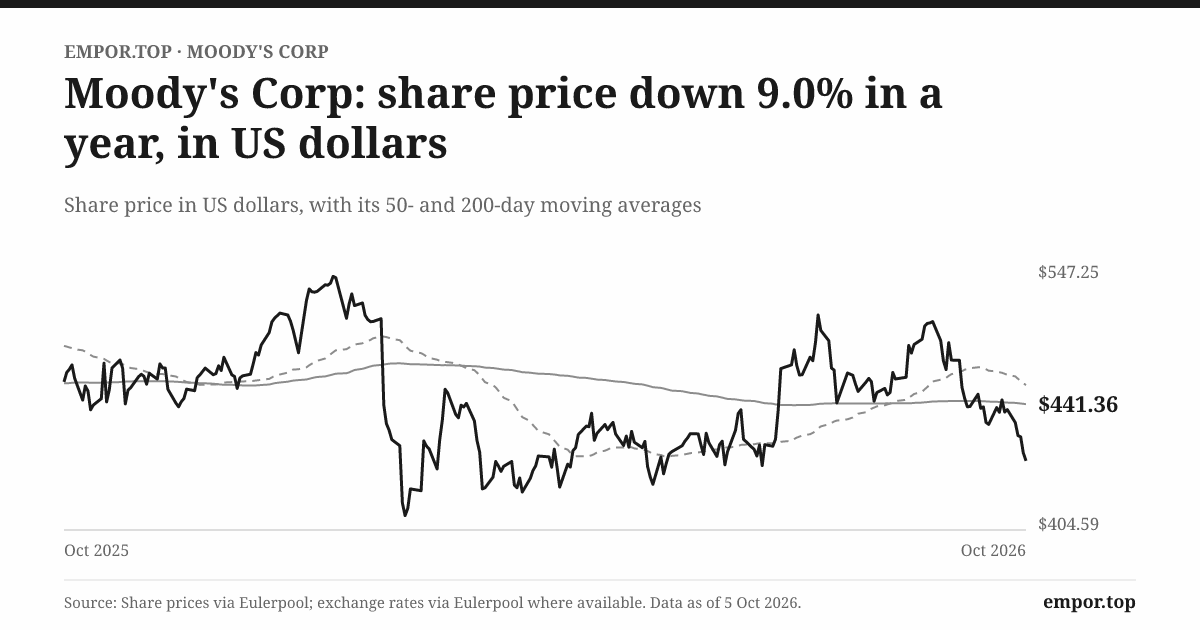
Early in 2026, a wave of fear went through information-services stocks. The concern was simple. If large language models can read filings, summarise research and build risk models, why would a bank pay for expensive data and analytics subscriptions? Moody's shares sold off with the group. By early October 2026 they were about 18% below their 52-week high.3
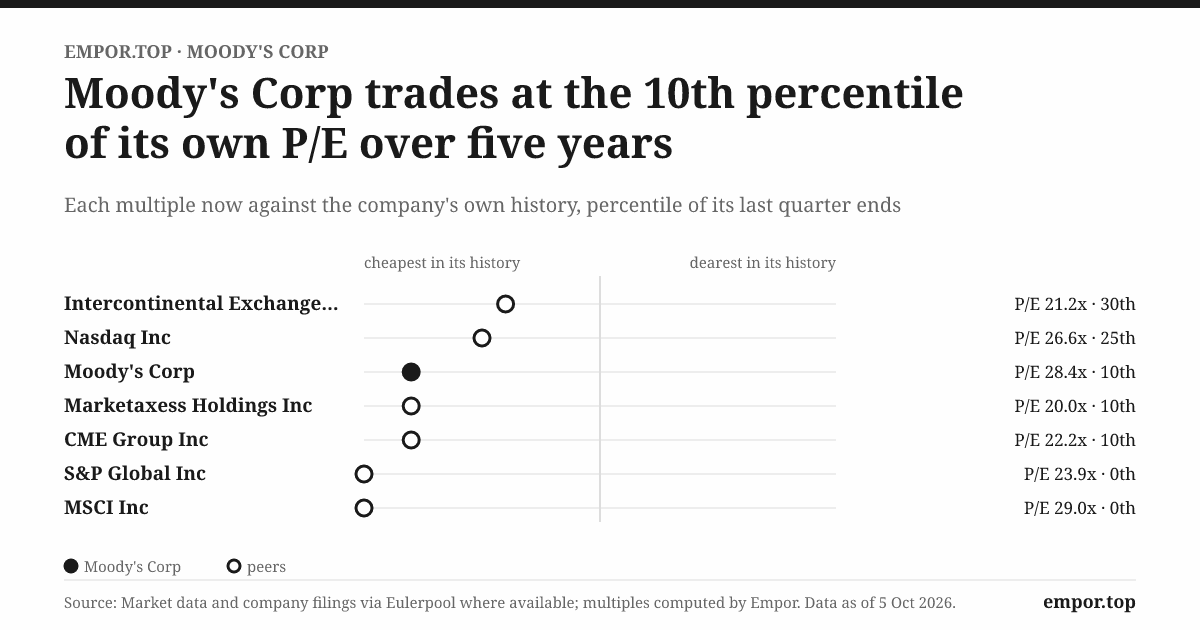
The market's verdict shows in the multiple. Moody's trades at about 28 times trailing earnings, against a five-year median of nearly 38 times.3 That is a large de-rating for a company whose earnings kept growing. Investors are paying less for each dollar of profit because they are less sure that dollar will keep coming.
What Moody's Analytics actually sells
MA's annualised recurring revenue reached about $3.7 billion in the second quarter of 2026, up 9%.2 It is easier to understand in three parts.
Decision Solutions, about $1.6 billion of ARR, is software that banks and insurers use to make decisions.2 It covers credit decisions in banking (about $420 million), catastrophe and actuarial models in insurance (about $723 million), and know-your-customer screening (about $478 million).2 Insurance is the largest piece.
Research and Insights, about $1.0 billion, is the subscription to Moody's research, ratings commentary and economic analysis.2 Data and Information, also about $1.0 billion, is raw data feeds, including the company's large database of company ownership and financial information.2
These three pieces face very different AI risks. Raw data and research summaries are where a language model looks most like a substitute. Decision software embedded in a bank's credit process, with regulators auditing its outputs, is much harder to replace.
Pruning and buying
Management has been reshaping the portfolio. It sold the Learning Solutions business in late 2025 and Regulatory Solutions in the second quarter of 2026, booking the $179 million pre-tax gain noted earlier, with a further contingent gain possible in the second half.2 It bought CAPE Analytics, which uses aerial imagery to assess property risk for insurers, and ICR Chile, a local ratings agency, in 2025.4 The pattern is to sell low-growth service lines and buy data assets that feed insurance models or extend the ratings footprint. Small deals do not prove discipline, but none of these looks like empire-building.
Reinvestment and headcount
Moody's spent about $326 million on capital projects in 2025, roughly 4% of revenue, and guided to about $450 million in 2026.42 Depreciation and amortisation rose 11% to about $480 million, driven by capitalised cloud software and acquired intangibles.4 The company also spent about $108 million on restructuring in 2025, and expects $110 million to $130 million more in cash outlays through 2027.4 A new New York headquarters will mean paying rent on two offices for a while.2
Headcount is the striking number. Total staff rose only about 2% in 2025, to about 16,100, while revenue grew 9%.4 MA's headcount fell 4% to about 7,800, while MIS added staff.4 Moody's does not disclose a separate research and development line, so it is hard to measure how much of the spending goes to new products rather than upkeep. Still, the direction is clear: the company is spending more on technology and less on people in MA. That is operating leverage in the making, or a sign that the company itself expects AI to do work that people used to do.
Both sides of the AI argument
Management's argument is that AI raises the value of auditable, decision-grade data. A bank cannot tell a regulator that its credit model relied on a chatbot. It needs data with a clear origin, a long history and a vendor that stands behind it. On that view, Moody's proprietary default histories, ownership databases and models become more valuable when everyone else is building AI on top of unreliable inputs.
The counter-argument is that a ratings agency's legal standing and a data vendor's feeds are different things. Ratings are protected by regulation and network habit. Research summaries and many data feeds are not. If AI makes it cheap to produce reasonable credit commentary from public filings, Research and Insights faces pricing pressure even if ratings do not.
The record so far gives a mixed answer. ARR growth of 9% is steady, and secondary reports put retention at about 95%. But organic growth is closer to 8%, which is modest for a business valued like a software company. And Moody's own 2025 annual report mentions "isolated customer attrition events" in its discussion of MA recurring revenue.4 The company also lists generative AI competition as a risk factor.4
How peers are priced adds context. S&P Global, which owns the larger ratings agency and a large data business, and MSCI, which sells index and analytics subscriptions, sold off with Moody's in the AI scare.7[^8] The fear is about the category, not one company, which means Moody's cannot escape it by execution alone.
Verdict
The Analytics bet is intact but unproven. MA is a large, sticky, recurring business, and it did its job in 2022 by cushioning the ratings slump. It is not yet proof that Moody's is an AI winner. The test is MA's ARR growth and retention over the next four quarters. If ARR growth stays near 9% and attrition stays isolated, the de-rating looks overdone. If growth slips toward the mid-single digits, the market's fear will have been early, not wrong. That leaves the question of what protects the ratings business itself.
VII. Why Only Three? The Moat in Full (30 min)
Imagine the treasurer of a mid-sized American manufacturer about to sell a $500 million bond. The bankers tell the treasurer that most investors will want two ratings. Many fund mandates say so. Some regulations say so. Index providers decide which bonds go into the major bond indices partly by rating. The treasurer can choose between Moody's and S&P, and perhaps add Fitch. There is no realistic fourth option. The treasurer will pay both, and the fee is small compared with the interest saved by getting the bond priced well.
That scene is the moat. MIS earns an operating margin of about 68%.2 Few businesses of any kind earn that, and it is almost unheard of for a business that employs thousands of analysts.
The mechanism
The moat is regulatory and network-driven. Investors use ratings because everyone else does: a rating is a shared language for pricing debt. Regulators and mandates embed ratings in rules. Issuers pay because investors demand ratings. Each side reinforces the other. A new agency faces a chicken-and-egg problem: no investor wants its ratings until issuers use them, and no issuer pays for them until investors want them.
Porter's five forces
Buyer power is low. No customer accounts for even 10% of receivables, and each issuer is small relative to Moody's.4 An issuer can choose between agencies, but it cannot choose to go without.
Supplier power is low. Moody's main suppliers are cloud and data-centre providers and data licensors, with about $650 million of purchase obligations.4 Its key input is analysts, who can be hired.
The threat of new entrants is very low. Regulatory recognition, decades of default history and the habits of investors are hard to replicate. Even the crisis, the best opening entrants will ever get, did not let a challenger break in at scale.
The threat of substitutes is the real one. Private credit and direct lending let companies borrow from funds without issuing rated public bonds. That does not compete with Moody's ratings; it routes around them. Some private credit is rated, and Moody's has been building that business, but every loan that moves from the bond market to a private fund is a potential deal fee lost. AI-based credit analysis is the second substitute, more likely to bite MA than MIS.
Rivalry is a stable oligopoly. Moody's, S&P and Fitch lead the industry and have done for decades.4 They compete on reputation and coverage more than price.
Hamilton Helmer's seven powers
Three of Helmer's powers clearly apply. Cornered Resource is the regulatory status itself, which is scarce and hard to obtain. Network Economies come from the shared-language effect. Switching Costs are real for issuers with ratings already embedded in their debt documents and investor bases, and for banks whose risk systems run on MA software.
Scale Economies also help: the fixed cost of a methodology is spread over thousands of ratings. Counter-Positioning does not apply; Moody's is the incumbent, not the challenger. Brand is a complicated case. The Moody's name carries weight, but 2007 showed that the brand can be damaged without the business being harmed, which suggests the power lies in the status, not the reputation.
Where it could break
The moat is wide, but the crisis showed that a wide moat does not guarantee fair behaviour or accurate ratings. It protects the toll, not the quality of the inspection.
Geographic competition is a possible crack. Local agencies in China, India and elsewhere compete for domestic issuers. Moody's has often responded by buying into local agencies rather than fighting them, as with ICRA and ICR Chile. Evidence that Moody's has lost meaningful share to such agencies is thin.
The bigger risk is structural: less rated issuance as lending moves into private funds. That would not show up as share loss. It would show up as slower growth in the market Moody's taxes. The best measure is MIS transaction revenue relative to the size of total corporate borrowing over time.
The moat explains why the business produces so much cash. What management does with that cash is the next story.
VIII. The Operators and the Capital Return Machine (25 min)
On October 21, 2025, Moody's board approved a new $4.0 billion share buyback authorisation.4 Management moved fast. In the first half of 2026 the company spent about $2.2 billion buying back stock and raised its full-year buyback guidance to as much as $3.0 billion.2 That is more than the company's entire guided free cash flow for the year.
The man at the controls
Rob Fauber has been chief executive since January 2021.8 He came up through Moody's own ranks, running the Analytics business and then serving as chief operating officer, rather than arriving from outside. His tenure has covered the 2022 slump, the 2024–2026 issuance boom and the AI scare. His approach has been to keep investing in technology, hold headcount close to flat, prune non-core lines and return most surplus cash to shareholders.
He is well paid, and his pay tracks results. His total reported compensation was about $18.1 million in 2025, up from about $14.4 million in 2023, mostly in stock.8 The ratio of his pay to that of the median employee is 146 to 1.8 More revealing is "compensation actually paid," which marks equity awards to market. It was about $26.3 million in 2025, and it was negative in 2022, the year net income fell to about $1.4 billion.8 That is what pay alignment is supposed to look like: when shareholders lost, so did the CEO.
Governance is conventional and sound. Nine of ten board nominees are independent, and the company has clawback, anti-hedging and anti-pledging policies.8 About 87% of votes cast backed the 2025 say-on-pay proposal.8 That is a pass, but not a resounding one; a meaningful minority of shareholders thought pay was too rich.
The balance sheet as a lever
Moody's has long run its balance sheet thin on purpose. Shareholders' equity was negative for much of the 2010s because the company bought back so much stock.4 Equity was about $4.1 billion at the end of 2025 and fell to about $3.0 billion by June 2026 after the buyback burst.42 That is why the return on equity, about 92%, is a distorted figure.3 A shrinking denominator flatters it. The return on invested capital, about 32%, is a better guide, and it is still excellent.3
Debt is moderate for a business this profitable. Total debt was about $7.2 billion of principal at the end of 2025, all fixed-rate senior notes in dollars and euros.4 Against EBITDA of about $3.9 billion, that is about 1.8 times, well inside the single covenant of 4.0 times.4 A $1.25 billion revolving credit line running to 2029 and a $1.0 billion commercial paper programme were both unused.4
Can the cash cover it?
The simple arithmetic works like this. Free cash flow of roughly $2.8 billion, the middle of guidance, pays a dividend of $1.03 a share each quarter, roughly $700 million a year.24 That leaves about $2.1 billion. A buyback of $3.0 billion needs about $900 million more. It must come from cash on hand, from new debt, or from the proceeds of divestitures.
Cash did fall, to about $1.5 billion at June 2026 from about $2.4 billion at the end of 2025.24 There is room, but less than before. The risk scenario is specific: a weak issuance year that cuts free cash flow at the same time as a $587 million note comes due in 2027.4 Moody's could refinance it easily in a normal market. The question is whether buybacks would be cut in a bad one.
The test of discipline
The best evidence is 2022. That year Moody's total financing outflow, which includes dividends and buybacks net of borrowing, was about $1.2 billion, against about $3.1 billion in 2025.4 Dividends kept rising through the slump. Capital return was scaled to the cash coming in rather than kept at boom-year pace. That supports a claim of discipline in a mild downturn, though 2022 was not a deep recession, and the current pace of buybacks, running ahead of free cash flow, is more aggressive than anything in that record.
Who owns it
The 2026 proxy lists Berkshire Hathaway as the largest holder with about 13.9% of the shares, followed by Vanguard at about 8%, BlackRock at about 7.3% and TCI Fund Management at about 6.8%.8 These percentages rest on Schedule 13G filings, some old, so they are a guide rather than a current count. Berkshire has held Moody's since the 2000 spinoff and kept the stake through the crisis, the congressional hearings and the settlement. That long holding is a vote of confidence in the franchise, not in any particular management team.
TCI, Chris Hohn's London fund, is the natural activist voice. TCI has a history of pushing companies on capital returns and margins, and it backed rating agencies precisely because of their pricing power.
The skeptic's challenge
An activist short-seller would push on three points. First, buybacks at about 28 times earnings are not cheap, and spending more than free cash flow at a cyclical high risks buying the most stock at the worst time. Second, the restructuring programme has run for two years at about $100 million a year; a recurring "restructuring" cost starts to look like an ordinary operating cost. Third, there is a new exclusion from adjusted earnings.
That third point is the tax reserve. In the first half of 2026, Moody's booked about $36 million for an international non-income tax obligation and excludes it from its adjusted measures.2 Management guided the reserve to about 0.5% of 2026 revenue, roughly $0.25 of earnings per share.2 The company has not named the jurisdiction in its results release. Separately, uncertain tax positions, which were the auditor's only critical audit matter, rose from about $158 million at the end of 2025 to about $170 million in June 2026.42 The sum is small. The habit matters more. A cost that recurs and is still called "excluded" deserves a skeptic's eye.
The balance sheet is a lever in normal times and a manageable risk in a bad year. That leads to the lessons this company teaches.
IX. Playbook: Lessons From the Toll Booth (15 min)
Sell the crossing, not the cargo. In 2007 Moody's was wrong on most of the mortgage bonds it had rated Aaa the year before. By 2017 it had paid a large fine. By 2026 it was more profitable than before the crisis. An ordinary information company that badly misjudged its core product would have lost its customers. Moody's did not, because issuers were not buying its opinion; they were buying the right to cross into the bond market. For founders, the lesson is that the most durable businesses sit where a decision must pass, not where it is merely informed. For investors, it is a warning too: a toll booth can survive incompetence, so survival alone does not prove quality.
Pay the fine, keep the franchise. The roughly $864 million settlement was about one year of operating profit, paid in cash, with the business model untouched. Regulators fined the agencies, but no one replaced them. When a business is woven into the rules, the penalty for failure becomes a line item, not an extinction event. Investors should price that resilience, and also notice the moral hazard it creates.
Build the annuity next to the toll. In 2022, when rated issuance froze and revenue fell about 12%, Moody's Analytics kept billing every month. The margin dropped by nine points instead of collapsing. The lesson is that a cyclical toll gains most from a recurring neighbour that shares its brand and data. The open question is whether that neighbour is a software business or a data business AI can copy.
Shrink the share count and the equity goes with it. A 92% return on equity sounds like genius. Most of it is arithmetic: years of buybacks have pushed book equity down until the ratio means very little. Look at return on invested capital, which is excellent at about 32% without the leverage effect. When a ratio looks too good to be true, check the denominator.
A 15% quarter is not a base rate. The second quarter of 2026 came with transaction revenue up a third, a divestiture gain and a tax reserve excluded from adjusted earnings. Over ten years the company has grown revenue about 8% a year, and its own guidance for 2026 says high single digits. For Moody's, the best quarter tells you about the bond market. The decade tells you about the company.
X. Bull vs Bear and Valuation (15 min)
Two analysts look at the same share price of $441.36 on October 5, 2026.3
The bull
The bull sees a franchise priced below its own history. The P/E of about 28 times compares with a five-year median near 38 times.3 The ratings business earns about a 68% margin and could hardly be replicated. Moody's Analytics grows ARR at about 9% with high retention. Headcount is close to flat while revenue grows, so margins can keep widening. Free cash flow should reach $2.7 billion to $2.9 billion in 2026.2 On this view, the AI scare has handed investors one of the best businesses in finance at a discount, and the buybacks are retiring shares at a lower multiple than the company has paid in years.
The bear
The bear sees peak-cycle earnings on a multiple that is still not cheap. The enterprise value is about 21 times EBITDA, and the free cash flow yield is about 4.3%, with a dividend yield under 1%.3 Issuance is at records and spreads are tight; both will normalise. Private credit is quietly routing borrowing around the ratings market. AI threatens the research and data parts of MA. Regulators in four major jurisdictions still oversee the agencies, and the reputational damage of 2007 has been managed rather than repaired. And the company is buying back more stock than it generates in free cash, at the top of a cycle.
What the history says
The five-year record supports neither side fully. Moody's delivered a cumulative total return of about 83% over the five years to the end of 2025, behind the S&P 500 at about 96% and well behind the Russell 3000 financial services index at about 116%.4 The stock fell as much as 42% from peak to trough over the past five years.3 A great business has not been a great stock in this period, mainly because it started the period at a very high multiple. The de-rating since then has done some of the bear's work already.
The market appears to be pricing Moody's as a high-quality compounder with a normal cycle ahead: not a collapse, but not a continuation of 15% quarters. That fits management's own guidance.
The KPIs that decide it
Three figures settle most of the debate.
The first is MIS transaction revenue, the best reading of issuance. It rose 34% in the second quarter of 2026.2 A slowdown is expected. A collapse would test the bull case.
The second is Moody's Analytics ARR growth, which was 9% in the latest quarter.2 Steady growth at that rate would undercut the AI-erosion argument. A drift down would confirm it.
The third is the MIS operating margin, about 68% now.2 How far it falls in the next weak issuance year will show how much of today's profit is structural.
XI. Epilogue: The Next Moments That Decide It (8 min)
Tonight Moody's stands in an unusual spot. It is running near record profitability, its stock is near the bottom of its one-year range, and its board is buying shares faster than the business generates cash. That combination rarely lasts long. Something has to give: the earnings, the multiple or the buyback pace.
The first moment comes with third-quarter results in late October. The question is whether MIS transaction revenue holds up after a 34% surge, and whether the slowdown management guided to arrives. A strong third quarter would test whether the high single-digit guidance was conservative. A sharp drop would show how quickly the boom fades.
The second is a pair of loose ends from the portfolio. Management expects a further contingent gain from the Regulatory Solutions sale in the second half. More detail is due on the international tax reserve. If the reserve grows or recurs into 2027, the "excluded" label becomes harder to defend.
The third moment is slower: four quarters of Moody's Analytics ARR and retention. That is where the AI question will be answered, not in share-price swings. If ARR growth holds near 9% through 2027, Moody's will have shown that auditable data gains value when AI spreads. If it slips, the early-2026 selloff will have been right.
The fourth is the balance sheet. The $587 million note maturing in 2027 is easy to refinance in good markets. The real question is the buyback pace in a year when free cash flow falls. In 2022 the company scaled back. Doing so again would confirm discipline. Holding buybacks at boom-year pace into a downturn would turn the lever into a risk.
Behind all of these lies the one test the company has not faced since 2022: a genuinely weak issuance year. It will reveal how much of the 45% margin belongs to Moody's and how much to the bond market. It will also be the first serious test of whether the post-crisis fence holds when the deal flow dries up and the temptation to please issuers returns.
XII. Outro (4 min)
Go back to that email from 2007. An employee looked at the firm's ratings and saw two possibilities: incompetence or a soul sold for revenue.1 Nearly two decades later, the same company earns a margin close to 45%, sits beside S&P and Fitch as one of the three firms the global debt market cannot operate without, and is still paid by the companies whose debt it grades.
That is the strange lesson of Moody's. Most companies are judged by whether they avoid their worst mistake. Moody's made its worst mistake in public, at scale, and the world kept paying it anyway. It is the company whose worst failure proved how essential it was.
References
-
Financial Crisis Inquiry Report — U.S. Government Publishing Office, 2011-01 ↩↩↩↩↩↩↩↩
-
Second Quarter 2026 Earnings Release — Moody's Corporation, 2026-07-22 ↩↩↩↩↩↩↩↩↩↩↩↩↩↩↩↩↩↩↩↩↩↩↩↩↩↩↩↩↩↩↩
-
Moody's 2025 Annual Report and Form 10-K — Moody's Corporation, via SEC ↩↩↩↩↩↩↩↩↩↩↩↩↩↩↩↩↩↩↩↩↩↩↩↩↩↩↩↩↩↩↩↩↩↩↩↩↩↩↩↩↩↩↩↩↩↩↩↩↩
-
Wall Street and the Financial Crisis: Anatomy of a Financial Collapse — U.S. Senate Permanent Subcommittee on Investigations, 2011-04 ↩↩
-
U.S. Department of Justice press releases (Moody's settlement, January 2017) — DOJ ↩
-
Moody's 2026 Proxy Statement — Moody's Corporation, via SEC ↩↩↩↩↩↩↩
 LinkedIn
 WhatsApp
 Reddit
 Hacker News
 Email
 Kindle
 RSS Feed
 Spotify
 Apple Podcasts
 Amazon Music
 Audible
 YouTube