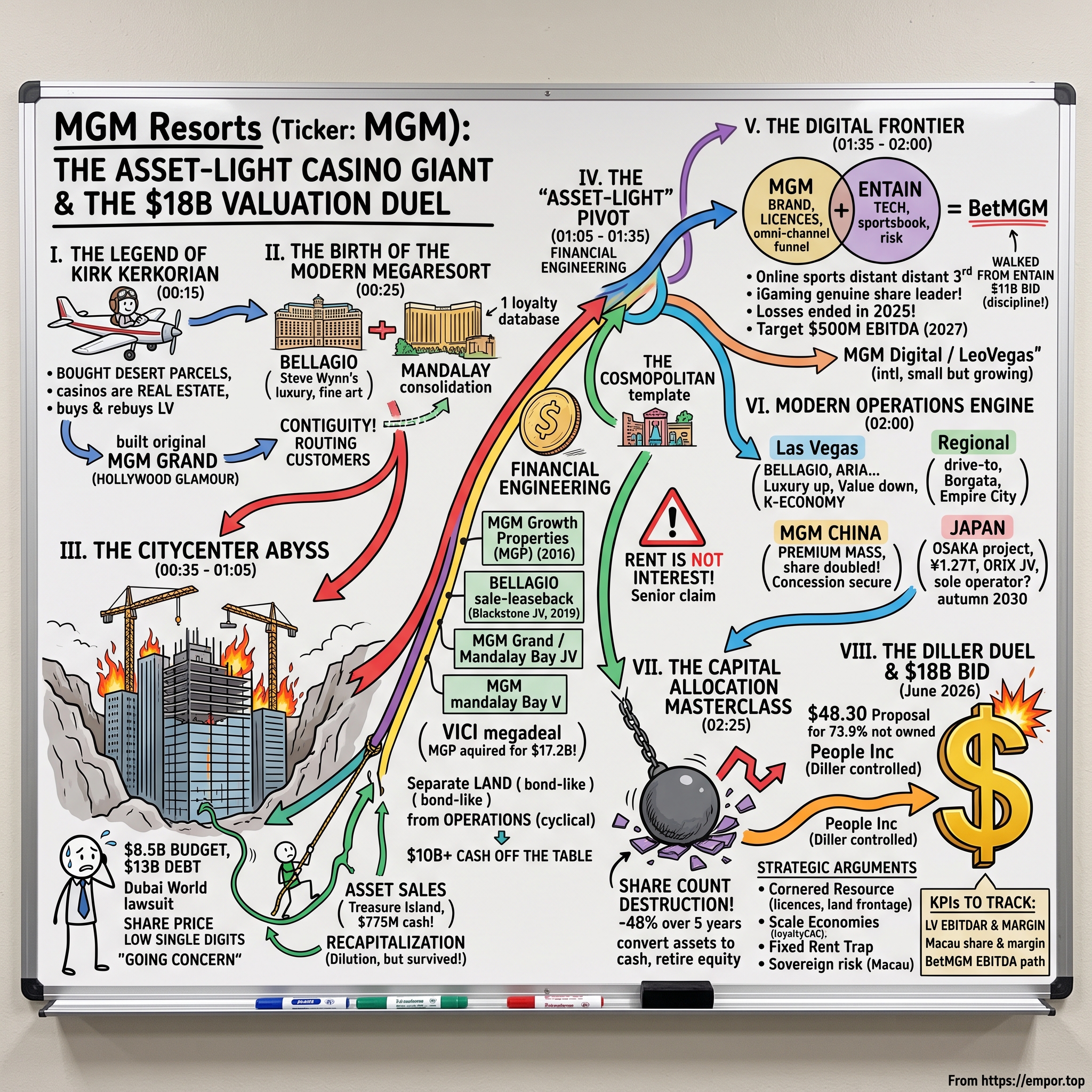
MGM Resorts International: The Asset-Light Casino Empire
I. Episode Introduction & Roadmap
Walk the Las Vegas Strip on a Friday night and the scale of it hits you before the neon does. The Bellagio fountains erupt on a loop for crowds ten deep. Across the boulevard, Aria towers over Harmon Avenue like a slab of black glass dropped into the desert. A few blocks south, the pyramid of the Luxor still fires a beam of light straight into the sky, visible from planes descending into Harry Reid International. For decades, one company owned not just those buildings but the dirt beneath them — hundreds of contiguous acres of the most valuable casino real estate on Earth, assembled over half a century of deals, debt, and desert ambition.
Today, MGM Resorts International owns almost none of it. It leases its own crown jewels back from landlords and pays them well over two billion dollars a year for the privilege.16 That is the central paradox of this story, and it is worth stating plainly because everything else follows from it. How does a company that once defined itself by owning the physical Strip transform into a tenant — handing more than a billion dollars a year to real estate investment trusts it voluntarily created — while simultaneously buying back so much of its own stock that management says the share count has fallen by roughly half in five years?3
MGM Resorts, trading on the New York Stock Exchange under the ticker MGM, is a global operator of gaming, lodging, and entertainment assets. In 2025 it generated $17.5 billion in consolidated net revenue across four distinct businesses: the Las Vegas Strip resorts, a portfolio of regional American casinos, a controlling stake in a Macau operator, and a fast-scaling digital betting franchise.2 But the number that tells the real story is not revenue at all. It is the share count, the rent line, and the widening philosophical gap between the two.
This is, at its heart, the story of a deliberate financial metamorphosis. Management took the boring, capital-heavy thing the company owned — real estate — sold it to a class of investors who value stable rent streams far more highly than they value casino cash flows, and recycled the proceeds into what it believes compounds faster: its own shrinking equity base, plus a handful of concentrated bets in Macau, digital gaming, and a roughly $10 billion integrated resort now rising on a man-made island in Osaka Bay.9
The bull reads this as a capital-allocation masterclass — a company that converted dead, low-multiple real estate into a per-share compounding machine. The bear reads it as a leveraged rental trap: a business that swapped an owned, defensible balance sheet for a stack of fixed, senior, non-negotiable lease payments that will crush the equity the moment American consumers decide Las Vegas is too expensive. Both cases rest on precisely the same set of facts. The disagreement is not about what happened. It is about what happens in the next recession.
Here is the roadmap. We begin with the empire's builder, the reclusive self-made aviator turned corporate raider Kirk Kerkorian, and the debt-fueled acquisition arms race under Terry Lanni that assembled close to half the Strip. We relive the 2008 near-death experience on the CityCenter project, when MGM came within weeks of a bankruptcy filing and a Gulf sovereign fund sued it in public. We dissect the financial engineering that pivoted the entire company to asset-light, culminating in the $17.2 billion exit to VICI Properties.5 We tour the modern segments — the Strip, the regionals, 美高梅中國控股有限公司 MGM China, and the BetMGM digital venture. We profile the operators running it now, CEO Bill Hornbuckle and CFO Jonathan Halkyard, and interrogate their "denominator shrink" playbook rather than simply admiring it. Then we war-game the competitive position through Helmer's 7 Powers and Porter's 5 Forces, walk the risk radar from ransomware to reclaimed land, and close with the bull-versus-bear debate and the small handful of metrics that will actually settle it.
Let's start where all Las Vegas empires start: with one obsessive, self-made man who believed the only thing worth owning was the ground.
 Subscribe on LinkedIn
II. The Origins of the Roaring Lion: Kirk Kerkorian and the M&A Arms Race
Kirk Kerkorian never learned to golf, rarely gave interviews, and flew his own planes well into old age. The son of Armenian immigrants and an eighth-grade dropout, he boxed as an amateur under the name "Rifle Right Kerkorian" before ferrying warplanes across the North Atlantic during the Second World War — a job with a mortality rate that would have deterred almost anyone else, and which paid enough to seed his first aviation venture. He built and lost fortunes in charter airlines, movie studios, and casinos with a gambler's tolerance for scale and a recluse's indifference to publicity.
He had one peculiar signature move: he built the largest hotel in Las Vegas not once, but three separate times. The International opened in 1969. The original MGM Grand followed in 1973. And in 1993 came the emerald-green MGM Grand that still anchors the corner of Tropicana and the Strip — for a period the largest hotel on the planet, with more rooms than some American towns have residents.
Kerkorian's underappreciated insight was that a Hollywood brand could be worth vastly more bolted onto a casino than running a film studio. He acquired Metro-Goldwyn-Mayer, the studio with the roaring lion, and over time the corporate entity that became MGM Resorts kept the lion and the glamour while shedding the movie business entirely. The lion was never really about films. It was a signal — of permanence, of Hollywood-grade luxury — beamed at a customer standing at a blackjack table at two in the morning, deciding whether this place felt like somewhere worth losing money. Brand, in casinos, is a trust mechanism as much as a marketing one.
The empire's true consolidation, though, came under Terry Lanni, the polished, cerebral, Notre Dame-educated executive who ran the company through its acquisition binge and who preferred boardroom logic to Kerkorian's raider instincts. In 2000, MGM Grand acquired Steve Wynn's Mirage Resorts for $6.4 billion, the largest gaming transaction of its era.10 In a single stroke MGM absorbed the Bellagio, The Mirage, and Treasure Island — the finest premium properties on the Strip, conceived and built by the industry's greatest showman, a man who had essentially invented the modern luxury Las Vegas resort.
At roughly ten times EBITDA, it was not a bargain. But it made MGM the undisputed king of the high-roller, luxury end of the market and, just as importantly, inherited Wynn's development pipeline and design sensibility in one transaction. There is a lesson here that recurs throughout MGM's history: the company has repeatedly chosen to buy rather than build its way to the premium tier, accepting a valuation premium in exchange for time. Sometimes that has worked brilliantly. Sometimes it has nearly ended the company.
Five years later came the second act, and it was even bigger. In April 2005, MGM Mirage closed a $7.9 billion merger with Mandalay Resort Group, paying $71 in cash for each Mandalay share and vaulting past every rival to become the world's largest gaming company, operating roughly two dozen major properties with more than 70,000 employees.10 Mandalay delivered Mandalay Bay, the Luxor, Excalibur, and Circus Circus — a portfolio spanning the upper-middle to the deep-value end of the market.
The strategic logic was density, and density is worth dwelling on because it remains the closest thing MGM has to a durable structural advantage today. By stacking Mandalay's properties on top of the Mirage portfolio, MGM came to control something approaching half the hotel rooms on the Las Vegas Strip. That position cannot be replicated by a competitor with unlimited capital, for the simple reason that the land no longer exists. When a single operator controls tens of thousands of adjacent rooms spanning every conceivable price tier — a value room at Excalibur, a mid-tier room at the Luxor, a luxury suite at Bellagio, all within a fifteen-minute walk — it can do things no single-property operator can. It can land a 20,000-delegate convention that no individual resort could house, spreading attendees across four properties. It can fill rooms during soft periods by shifting demand down the price ladder rather than losing the customer entirely. It can negotiate airline, tour operator, and procurement contracts from a position of overwhelming scale.
Owning half a monopoly boulevard, it turns out, is a genuinely excellent business.
But there was a catch buried in the achievement, and it would very nearly kill the company. All of this had been assembled with borrowed money. By 2006, MGM carried well over $13 billion in debt, a mountain of leverage stacked during the easy-credit years of the mid-2000s on the confident assumption that Las Vegas cash flows and real estate values only moved in one direction. The company had, in effect, made a highly levered bet on the permanence of American consumer prosperity.
Just as the ink dried on the Mandalay deal and the balance sheet stretched to its absolute limit, a far larger storm was gathering offshore — one that would test, with brutal precision, whether an empire built on borrowed money and ever-rising room rates could survive when both reversed at the same moment.
III. The CityCenter Near-Death Experience (2006–2010)
Every empire has a moment where ambition collides with the market, and for MGM it had a name: CityCenter. Conceived under Lanni as the boldest bet in the company's history, it was an $8.5 billion, 76-acre "city within a city" wedged into the last great developable gap between the Bellagio and Monte Carlo.14 The plan called for Aria as the anchor casino resort, the sleek non-gaming Vdara, a Mandarin Oriental, the Crystals luxury retail complex, and the Harmon hotel tower. At the time it was the largest privately funded construction project in American history.
The ambition was not merely architectural. It was a thesis about what Las Vegas would become. For thirty years the Strip had competed on theme — pirate ships, pyramids, Roman columns, erupting volcanoes. CityCenter proposed the opposite: dense, urban, architecturally serious modernism, with buildings by star architects and not a single animatronic anything. It was a bet that the Las Vegas customer was growing up, and that the future belonged to design-literate luxury rather than spectacle.
The timing could scarcely have been worse. As construction reached its crescendo in 2008, the global financial crisis detonated. Capital markets froze solid. Revenue per available room — RevPAR, the hospitality industry's core productivity metric, which multiplies how full you are by how much you charge — collapsed across the Strip as both business and leisure travel evaporated. Las Vegas, a city whose entire economy rests on discretionary spending, was hit harder than almost any market in America. And MGM, already staggering under its post-Mandalay debt, suddenly faced a multi-billion-dollar construction bill it had no obvious way to fund.
Then the joint venture cracked open in public. Dubai World, the sovereign investment arm of the emirate and MGM's 50/50 partner in CityCenter, sued MGM in early 2009, alleging breach of contract as costs escalated and liquidity dried up.14 It was a spectacular and humiliating spectacle: a debt-choked American casino company and a Gulf sovereign fund trading legal blows in the business press while half-finished towers stood silent on the Strip. Contractors went unpaid. Lenders circled. For several weeks in the spring of 2009, MGM Resorts sat within striking distance of a Chapter 11 filing, at one point halting trading in its own stock pending an announcement.
This was the abyss, and it is the single most formative event in the modern company's history.
Into it stepped Jim Murren. A former Wall Street sell-side analyst who had joined MGM as chief financial officer and risen to the top job, Murren brought a capital-markets mind to what was fundamentally a capital-markets crisis. He later described the rescue as "a 24-7 job involving conference calls at three in the morning" — a line that captures both the desperation and the sheer grinding logistics of keeping a company of that size solvent week to week.14
The salvage operation was brutal, multi-pronged, and left permanent marks. MGM and Dubai World settled their feud in April 2009, agreeing jointly to fund and complete the project rather than let it collapse into bankruptcy court — a mutual recognition that a half-built ruin on the Strip served nobody. MGM sold non-core assets into a terrible market, most notably Treasure Island, which went to billionaire Phil Ruffin for $775 million: $500 million in cash plus $275 million in secured notes.15 Selling one of Steve Wynn's crown jewels, acquired at the top of the market nine years earlier, for a fraction of its strategic worth, was a painful admission of weakness. The company issued equity at fire-sale prices, diluting existing shareholders heavily, and refinanced debt at punishing rates that ran into the double digits.
CityCenter opened in December 2009. Aria eventually matured into a strong performer, and the design thesis was, in the long run, largely vindicated — the Strip did move upmarket. But the financial trauma never fully healed in the executive suite, and that is the analytically important part.
The lesson MGM's leadership drew from 2008 was not "build bolder." It was almost exactly the inverse: never again allow owned real estate and construction risk to put the entire enterprise a few missed interest payments from oblivion. Capital preservation, balance-sheet flexibility, and financial engineering became the operating religion, displacing the develop-and-own instinct that had animated Kerkorian for fifty years.
Within a few years, that new philosophy would produce the most consequential strategic pivot in the company's history — the deliberate, systematic decision to stop owning the very real estate that had defined it. What looked to outsiders like clever financial arbitrage was, viewed from inside, something closer to post-traumatic doctrine.
IV. The Asset-Light Revolution: Unlocking the Balance Sheet
Here is a puzzle that quietly obsessed MGM's finance team through the mid-2010s. The same casino building, generating exactly the same cash, was worth dramatically different amounts depending on nothing more than who held the deed.
Held inside a casino operator, real estate got bundled into a business the public market valued at perhaps eight to ten times cash flow — heavy, cyclical, regulated, capital-hungry, and prone to the occasional near-bankruptcy. But package that identical building inside a real estate investment trust, a REIT collecting long-term contractually escalating rent, and investors would happily pay fifteen to eighteen times cash flow for precisely the same square footage. The rent stream was considered boring and safe. The casino was considered risky and volatile. Same asset, wildly different price.
That gap is not a rounding error or an academic curiosity. It is a pure valuation arbitrage sitting dormant inside the balance sheet, and MGM decided to harvest it systematically.
The mechanism, in plain English: if you own an asset that the market values cheaply as part of your company, but a different class of buyer values richly on a standalone basis, you sell it to that buyer, pocket the premium in cash, and lease the asset straight back so that nothing changes operationally. The dealers still deal. The guests still check in. You still run the casino exactly as before. You simply no longer own the floor beneath it. Think of it as a homeowner selling their house to a landlord, agreeing to rent it back forever, and using the lump sum to buy something they believe will grow faster — a trade that works beautifully as long as their income never falls.
MGM executed this in three deliberate phases over roughly six years.
Phase one, in 2016, was the proof of concept. MGM spun its real estate into a controlled, publicly traded REIT called MGM Growth Properties, or MGP, and began renting its own buildings back from an entity it still majority-controlled. This was arbitrage with training wheels: the market immediately applied a REIT multiple to the rent stream, unlocking value, while MGM kept the whole structure in the family and retained the economics through its ownership stake.
Phase two, in 2019, went to genuine outside buyers, and this time for the trophies. Blackstone's real estate income trust, BREIT, acquired the Bellagio's real estate for $4.25 billion in a sale-leaseback structured as a 95/5 joint venture, struck at an initial capitalization rate of 5.75%.11 That cap rate deserves translation, because it is the entire deal in one number. A 5.75% cap rate means MGM sold the building for roughly seventeen times the annual rent it committed to pay — an extraordinarily rich price for a casino asset, and only achievable because the buyer was underwriting a bond-like rent stream from a large tenant rather than underwriting casino risk. A parallel arrangement moved the MGM Grand and Mandalay Bay real estate into a Blackstone-led joint venture on comparable terms.
Phase three was the finale. In 2022, VICI Properties — the REIT that had itself spun out of Caesars' bankruptcy restructuring — acquired MGM Growth Properties in a transaction valued at $17.2 billion, and MGM sold out its remaining stake, collecting billions in cash and completing its exit from Strip real estate ownership.5 The company that once owned the ground under nearly half of Las Vegas now owned essentially none of it. In its place sat a fortress cash balance, a dramatically simplified asset base, and a very different kind of obligation.
That obligation is the master lease, and understanding it is essential to understanding the risk in this equity today.
MGM's rent to its landlords — VICI, the Blackstone-led vehicles, and the ground leases at properties such as Beau Rivage and MGM National Harbor, plus the land concessions supporting its Macau operations — ran to roughly $565 million per quarter as of the first quarter of 2026. That is well over two billion dollars annually, and it escalates 2.0% every year under the VICI master lease, with inflation-linked caps in certain periods.16 These are triple-net leases, meaning the tenant bears essentially all costs of the property — taxes, insurance, maintenance — on top of the base rent. The landlord's cash flow is about as close to a bond coupon as real estate gets.
So what does an investor actually make of this?
The upside is concrete and already visible. The arbitrage freed billions of dollars of capital that had been trapped in low-multiple real estate, and management has redeployed it into share repurchases and growth investments. It also removed enormous maintenance and development capital obligations from MGM's balance sheet and eliminated the property-level debt that nearly destroyed the company in 2008. The company is unquestionably more liquid and more flexible than it was.
The downside is equally concrete but only shows up under stress. MGM has converted a flexible owned asset into an inflexible fixed cost. In an expansion, this works gloriously: revenue climbs while rent creeps up only 2% a year, and the surplus flows disproportionately to equity holders. That is positive operating leverage, and it has been the tailwind for several years. But the same mathematics runs in reverse. If hospitality revenue falls, rent does not. It cannot be renegotiated, deferred, or trimmed. It sits ahead of shareholders in the capital structure, due every quarter, in good times and bad.
An owned building can be mortgaged, sold, or simply sat on during a downturn. A leased building generates a bill regardless. MGM has traded optionality for cash — and whether that trade proves to be genius or folly depends almost entirely on the cyclical path of the American consumer over the next decade.
Which brings us to the engine that has to generate all that rent in the first place.
V. The Modern Core: Las Vegas Strip & Regional Operations
Stand near the check-in desk at the Bellagio on a Tuesday morning in convention season and you are watching the highest-value segment of the entire company at work: a queue of badge-wearing delegates checking into rooms booked months earlier at contracted rates, en route to a trade show that will fill four MGM properties simultaneously.
The Las Vegas Strip segment generated $8.4 billion in net revenue in 2025, roughly half of MGM's consolidated total. But the direction of travel matters more than the level: that figure was down about 4% from the prior year's $8.8 billion, and segment adjusted EBITDAR — the profitability measure the industry uses, which adds back rent to make leased and owned operators comparable — fell around 8%.2 After a euphoric post-pandemic surge in which Las Vegas pricing reached genuinely extraordinary levels, 2025 was a year of digestion: tougher year-over-year comparisons and a visibly cautious lower-end leisure customer.
The property lineup is a portfolio of price points by deliberate design. Bellagio and Aria occupy the luxury tier. MGM Grand and Mandalay Bay hold the upper-middle. Park MGM and New York-New York serve as lifestyle plays aimed at younger travelers. The Luxor and Excalibur anchor the value end. To this MGM added operational control of the Cosmopolitan of Las Vegas in 2022, paying roughly $1.625 billion for the operating business while Blackstone and its partners retained the real estate — a transaction that fit the asset-light doctrine precisely, buying the cash flows without the dirt.12
The deeper structural story in Las Vegas, though, is the migration away from gambling. Slot machines and table games now account for less than 35% of Strip revenue. The majority comes from hotel rooms, food and beverage, entertainment, retail, and conventions. Las Vegas has quietly and successfully reinvented itself as a sports and events capital: Allegiant Stadium and the NFL's Raiders, T-Mobile Arena and its NHL franchise, and the Formula 1 Las Vegas Grand Prix now generate demand entirely disconnected from a craps table.
On the first-quarter 2026 earnings call, management leaned hard into this. Hornbuckle pointed to record convention average daily rates and record catering revenue as the engine behind the segment's return to top-line growth — the first year-over-year revenue growth on the Strip in six quarters.3 He also, to his credit, acknowledged the other side directly rather than deflecting: persistent midweek softness at the value properties, specifically naming the Luxor and Excalibur, while weekends held up. That is a management team describing a genuine bifurcation in its customer base rather than papering over it.
What does that revenue mix actually tell an investor? Something quite important. A gaming-led resort lives on the variance of the tables and the mood of the high roller — high margin when it works, brutally volatile when it does not. A convention-and-events-led resort books rooms months ahead at contracted rates with corporate clients who are far less price-sensitive than a leisure tourist choosing between Las Vegas and a beach. MGM's density lets it lean into that more predictable, higher-margin group business, which is a real and demonstrable competitive strength.
But it is not a shield. Group business gets cut when corporate travel budgets get cut, and the softness already visible at the value end is exactly what an early-cycle consumer slowdown looks like. The Q1 2026 profitability decline is instructive here: Strip segment EBITDAR fell 8% to $749 million even as revenue grew slightly, with the CFO attributing a meaningful chunk of the gap to a $37 million increase in self-insurance expense and lower business-interruption proceeds.13 Management also flagged rising litigation costs across the industry, describing claims "backed by large pools of capital, including private equity" — an unusual and specific admission that legal-cost inflation is now a structural margin headwind in American hospitality, not a one-off.3
Then there are the regionals, the unglamorous half of the domestic story: Beau Rivage in Biloxi, MGM Grand Detroit, MGM National Harbor outside Washington, MGM Springfield in Massachusetts, and others. Together they produced $3.8 billion in 2025 net revenue, up about 1%.2 These are the steady cash cows — drive-to, slot-oriented, driven by local repeat customers, and largely insulated from global air travel patterns and international tourism. They operate under high state gaming tax regimes and offer little growth, but they generate dependable cash regardless of what is happening in Macau or in the equity market.
In April 2026, MGM pruned this portfolio, selling the operations of MGM Northfield Park in Ohio to funds managed by Clairvest for $546 million in cash, with net proceeds of roughly $420 million and a corresponding $53 million annual reduction in its VICI rent obligation.7 That last detail matters more than the headline price: the transaction demonstrated that the master lease can, in fact, be amended when a property leaves the portfolio, which slightly softens the pure "rent is immovable" bear argument. Halkyard also used the sale as a valuation argument, noting it cleared at 6.6 times trailing EBITDA — comfortably above the multiple at which MGM's own equity traded — which he framed as evidence that the public market undervalues the company's regional cash flows.3
The competitive set around all of this is fierce and instructive. Caesars Entertainment ran essentially the same asset-light playbook and leases heavily from the same landlord. Wynn Resorts targets the very top of the high-roller market with a smaller, more premium footprint. And Las Vegas Sands did the most radical thing of all — it exited Las Vegas entirely to concentrate capital on the higher-yielding Macau and Singapore markets, a decision that looks prescient or premature depending on the year.
Which is the natural segue, because Macau is where MGM's most volatile — and arguably most impressive — cash flows are now generated.
VI. The Crown Jewel: Macau and the Global Wildcard
To understand 美高梅中國控股有限公司 MGM China Holdings Limited, you first have to abandon the instinct to think of Macau as Las Vegas with Chinese characteristics. It is not. Macau is the only jurisdiction in China where casino gambling is legal — a former Portuguese enclave, returned to Chinese sovereignty in 1999, that generates several times the gaming revenue of the entire Las Vegas Strip from a territory smaller than Manhattan. Its fortunes are dictated far less by consumer sentiment than by the policy decisions of Beijing, transmitted through visa rules, anti-corruption campaigns, and licensing regimes.
MGM Resorts owns roughly 56% of MGM China, a separately listed entity operating two properties: MGM Macau on the peninsula and the newer, larger MGM Cotai on the reclaimed Cotai Strip.
In 2025, the Macau business roared. MGM China generated about $4.5 billion in net revenue, up 11% year over year, with segment adjusted EBITDAR of $1.2 billion, also up double digits.2 More striking than the growth rate, though, was the share gain. On the Q1 2026 call, management noted that MGM China's market share had reached 15.4%, improving to 17.3% by March.3 For context, MGM China has historically been one of the smaller of Macau's six licensed concessionaires. Climbing several points of share in a mature, government-capped, six-player oligopoly is one of the most credible signals of operational execution available in this industry — you cannot buy share in Macau by opening more locations, because you are not permitted to. You take it customer by customer.
But that growth arrived only after the entire Macau business model was forcibly reinvented, and the reinvention nearly broke several operators.
In December 2022, the Macau government issued new ten-year gaming concessions, and MGM China secured one. This was an existential milestone that deserves more weight than it usually gets: had MGM failed to win a concession, an entire segment worth billions would have simply evaporated. This is the sharpest possible illustration of a licensed business — the asset is not the building, it is the government's permission.
That regulatory renewal came bundled with a strategic revolution. Beijing's multi-year crackdown on the VIP "junket" system dismantled the machinery that had powered Macau for two decades. Junkets were intermediaries who extended credit to mainland high rollers, handled cross-border settlement in ways regulators eventually deemed unacceptable, and funneled enormous volumes of play into VIP rooms. When Chinese authorities moved decisively against them — including criminal prosecutions of major junket operators — the old high-volume, low-margin VIP business collapsed.
The survivors were forced to pivot toward the mass market and "premium mass": affluent but ordinary gamblers, plus non-gaming attractions like shows, dining, and shopping. Counterintuitively, this turned out to be a better business. Mass-market table play carries substantially higher margins than credit-fueled VIP baccarat, because the operator keeps the full economics rather than sharing a large commission with a junket, and it carries far less regulatory and counterparty risk. The Macau that emerged from the crackdown is smaller in headline volume but healthier in profitability.
MGM China navigated this transition unusually well, aggressively reallocating gaming tables toward premium mass, renovating suites to attract higher-value customers, and deploying smart-table technology that tracks play in real time to optimize game speed and target marketing spend. That its share climbed during the industry's most wrenching structural change — rather than merely recovering alongside the market — is the strongest available evidence that this segment is genuinely well managed rather than simply riding a tide.
The catch is that essentially none of it sits within MGM's control. Macau lies directly on the fault line of US-China geopolitical tension and remains subject to Beijing's regulatory discretion on everything from visa issuance to gaming taxation to what constitutes acceptable marketing. A single policy shift can add or erase a billion dollars of segment value with no warning and no appeal. There is also a quieter structural detail worth noting: the intercompany branding fee MGM charges its Macau subsidiary increased $23 million in Q1 2026 under a new long-term agreement — a related-party arrangement that shifts economics from minority holders of MGM China toward the parent, and precisely the sort of item a governance-focused investor would want to watch.1
For a company that spent a decade methodically de-risking its balance sheet, Macau remains the one place where the risk is entirely exogenous — a wildcard capable of dealing a windfall or a wipeout with equal indifference. Management's implicit answer to that concentration has been to build a third growth engine, one that lives not on any casino floor but on a smartphone.
VII. The Digital Frontier: BetMGM and LeoVegas
In May 2018, the US Supreme Court struck down the federal ban on sports betting, and a multi-billion-dollar market began materializing state by state, legislature by legislature. For MGM, this presented an uncomfortable strategic problem. The company was a world-class operator of physical resorts with a trusted consumer brand and a database of tens of millions of loyalty members. What it emphatically did not have was software — the real-time odds engines, the risk-management systems, the geolocation compliance stack, the mobile applications that a competitive betting product requires. Building all of that from scratch would take years the company did not have, in a land-grab market where early scale tends to become permanent scale.
So MGM did something genuinely out of character for a proud operator with a century of institutional ego: it admitted its weakness and rented someone else's strength.
The result was BetMGM, a 50/50 joint venture with Entain PLC, the London-listed gaming technology group. The division of labor was elegant and honest about each party's edge. MGM contributed the iconic brand, its loyalty database, its physical footprint for cross-marketing, and its regulatory relationships across American gaming jurisdictions. Entain contributed a battle-tested proprietary technology platform refined over years in mature European markets, where online gambling had been legal and competitive for a decade. Neither party could have assembled the combination alone at anything like the speed.
For several years, BetMGM was a cash furnace — as was the entire US industry. Operators torched extraordinary sums on customer acquisition, the flood of "bet $5, get $200 in free bets" promotions that effectively paid a generation of American gamblers to try mobile betting. The strategic logic was that acquisition costs were a one-time investment in a lifetime customer relationship. The risk, never fully resolved, was that customers acquired by promotion might simply chase the next promotion.
Then, in 2025, the model inflected decisively. BetMGM reported $2.8 billion in net revenue, up 33%, and — critically — flipped to positive adjusted EBITDA of $220 million, a swing of roughly $464 million from the prior year's $244 million loss.4 The composition matters as much as the total. iGaming, meaning online casino games, reached $1.83 billion, up 24%. Online sports betting surged 63% to $903 million. Average monthly active players rose to about 979,000.
Most telling of all: the venture distributed $270 million in cash back to its two parents in the fourth quarter of 2025 — its first-ever return of capital.4 That single event is the whole digital thesis in miniature. A joint venture requiring perpetual equity infusions from its parents is a liability dressed as a growth story. One that funds its own operations and sends surplus cash upstream is an asset. As it scales further, BetMGM also begins paying "parent fees" directly to MGM and Entain on top of profit distributions, converting the venture into a recurring income stream rather than merely an equity stake of uncertain value.
For 2026, BetMGM initially guided to $3.1–$3.2 billion in revenue and $300–$350 million of adjusted EBITDA, with a stated ambition of reaching $500 million by 2027.4 An April 2026 update trimmed the revenue outlook to $2.9–$3.1 billion while holding the EBITDA range, though guiding toward the lower end — a modest miss on the top line paired with maintained profitability, which is at least consistent with management's claim that it is prioritizing disciplined spend over share-at-any-price.[^17] Separately, at the MGM consolidated level, the MGM Digital reporting segment — covering the company's own online operations rather than the JV — grew net revenue 43% to $183 million in Q1 2026, still running a modest EBITDAR loss of $26 million as it scales, improved from $34 million a year earlier.1
The competitive reality, though, remains unforgiving, and it is where the skeptic plants a flag. BetMGM holds a stable but distant third position behind FanDuel, owned by Flutter, and DraftKings — the two share leaders who effectively set the industry's marketing spend. BetMGM's roughly 13% share of gross gaming revenue across its active markets conceals a split personality: a strong 21% share in high-margin iGaming, where it genuinely competes for leadership, against a much weaker 8% in the brutally contested online sports arena.4 The honest read is that BetMGM is a strong online casino business with a subscale sportsbook attached. Whether it can defend even that position without being dragged back into a promotional war that erases its newly won profitability is a genuinely open question, and one no amount of management confidence can settle in advance.
To escape the geographic boundaries of the Entain partnership, MGM made a separate move in 2022, acquiring the Swedish online operator LeoVegas for roughly $607 million.13 LeoVegas provided a technology stack and licenses allowing MGM to launch its own single-brand digital casinos internationally — outside the JV's territory — including a UK-facing product. It was a bet that MGM could eventually own more of its digital destiny rather than sharing every incremental dollar with a partner, and a quiet acknowledgment that renting technology forever has its limits.
Whether digital ultimately becomes a durable profit center or a permanent margin battleground is among the defining open questions for this equity. The answer will be shaped substantially by the people now allocating the company's capital.
VIII. Current Management & Capital Allocation Masterclass
There is a telling contrast between who runs MGM today and who ran it through the crisis. Jim Murren, the executive who saved the company in 2009, was an investment banker by training — a capital-markets brain deployed against a capital-markets problem, which was exactly what the moment demanded. The current chief executive, Bill Hornbuckle, is something the company had not had at the very top in a long time: a career operator.
Hornbuckle has spent roughly four decades in Las Vegas hospitality. He started on the property side, worked in the orbit of Steve Wynn during the era that produced the modern Strip, and rose through operating roles rather than finance ones. He understands the physics of a resort in a way a banker structurally cannot — how a convention flows through a building, how a table game gets reallocated on a slow Tuesday, why a value property softens midweek while its weekend holds. He took the top job in 2020, in the depths of the pandemic shutdown, when every MGM property in America was dark and the company was burning cash with the doors closed.
His financial counterpart is Jonathan Halkyard, who became CFO in 2021 after serving in the same role at Caesars. This pairing is not accidental. Halkyard brings intimate, first-hand experience of the exact asset-light, REIT-lease architecture that both companies now run — he helped operate it at the rival whose bankruptcy restructuring literally created VICI. MGM hired the person who had already seen the movie.
The configuration suits the era. The strategic question at MGM is no longer "what should we build?" It is "what should we do with the cash the buildings throw off?" That calls for an operator who can defend margins and a financier who can structure leverage and return capital.
The signature move of this regime is what might be called the denominator shrink. Rather than chase expensive acquisitions or launch new Strip construction, management has deployed the flood of real-estate proceeds and operating cash flow into buying back its own stock at scale. By management's own account on the Q1 2026 call, MGM has reduced its share count by roughly 50% over five years.3 Even in a demonstrably soft quarter, it repurchased about 2 million shares for $90 million, retaining roughly $1.5 billion of remaining authorization, and signaled it would re-accelerate repurchases after collecting the Northfield proceeds.1
The arithmetic deserves to be made explicit, because it is the mathematical heart of the bull case. If a company's total profit stays flat but the number of shares dividing that profit falls by half, then earnings and free cash flow per share double. Nothing about the business improved; the ownership simply concentrated. MGM is betting that its own equity, trading at what management argues is a discount to the private-market value of its assets, is the single best investment available to it — better than a new resort, better than an acquisition, better than paying down debt. The Northfield sale at 6.6 times EBITDA was deployed rhetorically as evidence for exactly that proposition.3
Now for the independent read on management credibility, because this is precisely where an investor must resist the pull of a well-told story.
The evidence that this team does what it says is reasonably strong on several dimensions. They promised capital discipline and have, so far, delivered it — conspicuously avoiding the empire-building M&A that nearly destroyed the company in 2008, choosing repurchases over trophy assets even when trophies were available. Narrative consistency across calls has been decent: the buyback-first framing, the convention-led Las Vegas thesis, and the Macau premium-mass strategy have been articulated the same way for multiple years rather than reinvented each quarter. Executive compensation is heavily weighted toward equity performance units tied to adjusted EBITDAR, free cash flow per share, and relative total shareholder return — genuine alignment with the metrics that actually matter to owners rather than to revenue-maximizing empire builders. And management has generally explained misses in specific terms, as with the itemized self-insurance and business-interruption drivers behind the Q1 2026 earnings shortfall, rather than retreating into macro hand-waving.3
The skeptical counter is equally real and should not be waved away. Aggressively shrinking the share count is a wonderful strategy in a rising market and a dangerous one when it is funded partly by selling irreplaceable assets and layering on permanent fixed rent. Every share retired makes the remaining equity more leveraged to the fixed obligations underneath it, not less. An activist on the short side would frame the past five years less charitably: a company that sold its best assets, spent the proceeds on its own stock, booked the resulting per-share growth as management achievement, and left shareholders holding a thinner claim on a more fragile cost structure. That reading is uncharitable but not unfair.
Discipline and financial engineering can look identical during an expansion. The distinction only becomes visible in a contraction — and there are several ways one could arrive.
IX. Strategic Analysis: Hamilton Helmer's 7 Powers & Porter's 5 Forces
Strip away the financial engineering and ask the fundamental question that any long-term owner must ask: what actually protects MGM's profits from competition? Hamilton Helmer's 7 Powers framework is a useful scalpel here, and the honest answer is that MGM scores meaningfully on three of the seven, weakly on one, and not at all on the rest.
The clearest power is the cornered resource — the licenses. You cannot simply decide to open a casino in Macau, in Maryland, or in Osaka. These are government-granted, strictly limited concessions, awarded through competitive processes that can take years and are frequently political. MGM holds several of the most valuable in the world. The forthcoming Osaka license is the purest example: it will be the only legal casino resort in Japan for years after opening. A competitor with infinite capital and superior operating skill still cannot enter without permission the government will not grant. That is a genuine, durable moat.
But cornered resources granted by governments carry an inherent asymmetry worth stating: the same authority that grants the license sets the terms under which it operates. Macau's junket crackdown demonstrated that a government can preserve your license while fundamentally rewriting your business model. The moat protects against competitors, not against the moat's owner.
The second power is scale economies, where Strip density does real work. Controlling roughly 45,000 rooms across contiguous properties amortizes the cost of sourcing entertainment, running a convention sales organization, and procuring everything from linens to loyalty technology across a base no single-property rival can match. It also creates genuine revenue synergies through demand-steering. This is a moderate rather than overwhelming power, however, because it is substantially shared — Caesars operates at comparable domestic scale with a similar multi-tier portfolio.
The third, and increasingly the most interesting, is switching costs, embodied in the loyalty ecosystem. The MGM Rewards program counts more than 40 million members. In October 2023 it was substantially amplified by the creation of "MGM Collection with Marriott Bonvoy," a long-term licensing agreement that plugged 17 MGM resorts and more than 40,000 rooms into Marriott's loyalty platform of over 180 million global members.6
The strategic prize here is distribution economics, and it is worth explaining carefully because it is one of the few genuinely improving elements of the story. Hotels typically fill rooms either through their own channels, which is cheap, or through online travel agencies, which charge steep per-booking commissions. By plugging into Marriott's booking platform and enormous member base, MGM gains access to a vast pool of travelers at a fraction of OTA cost — while those members accumulate points and status that make returning to an MGM property incrementally more attractive than switching. Lower customer acquisition cost with a mild lock-in effect attached.
Whether this constitutes true switching costs — the kind that let you raise prices without losing customers — or merely a convenient distribution discount remains unproven in the reported numbers. Loyalty programs in hospitality are ubiquitous, and a customer holding Bonvoy points can spend them at thousands of non-MGM properties. The honest assessment is that this is a real cost advantage of uncertain durability rather than a demonstrated pricing moat.
The fourth power, counter-positioning, applies loosely to digital. Online betting initially threatened the physical casino model, and an incumbent could have ignored it or lobbied against it — the classic disrupted-incumbent error. Instead MGM embraced it early through the Entain JV, converting a potential disruptor into an omnichannel loyalty funnel that feeds customers in both directions. That was a genuinely good strategic call. But it is not a moat, because BetMGM now competes on exactly the same brutal terms as everyone else. The remaining powers — network economies, process power, and branding as a durable pricing premium — are thin. The MGM brand carries real weight, but not the kind that lets it charge materially more than a comparable Caesars room.
Now run Porter's 5 Forces, which reframes the same terrain as a war over where profits ultimately settle.
Threat of new entrants: very low. The capital cost of a Strip-quality resort runs well past a billion dollars, the developable land is effectively gone, and licensing hurdles are enormous. This is one of the most protected industries in America by this measure.
Bargaining power of buyers: moderate. Leisure tourists can and do shop around, and the current softness at the value properties proves they exercise that power. Convention and group clients, locked into multi-year master service agreements, are considerably less elastic.
Threat of substitutes: moderate. Cruises, regional slot halls, destination sports events, and at-home mobile betting all compete for the same discretionary entertainment dollar — and mobile betting notably lets a customer gamble without ever booking a room.
Competitive rivalry: high. A continuous knife fight with Caesars, Wynn, and the Venetian complex for Strip wallet share, and with DraftKings and FanDuel in digital, where rivalry has historically been expressed through profit-destroying promotional spending.
But the force that most defines the modern MGM is the bargaining power of suppliers — and here the analysis produces its sharpest conclusion. By selling its real estate, MGM created an entirely new and enormously powerful supplier class: the REIT landlord. VICI and Blackstone do not compete for MGM's business, cannot easily be replaced, and hold decades-long contracts with built-in escalators and senior claims on cash flow. MGM did not inherit this supplier. It manufactured one where none had existed, deliberately, in exchange for cash.
That single observation is the analytical crux of the entire asset-light bet, and it leads directly into where the real risks live.
X. Strategic Risks, Capital Projects, & The Stress Test
On a September morning in 2023, guests at MGM properties across Las Vegas discovered that their digital room keys had stopped working. Slot machines went dark. Reservation systems froze. The company's mobile app became inaccessible. The culprit was not a technical failure but a telephone call.
A hacking crew known as Scattered Spider had used social engineering — researching an employee, then impersonating them convincingly enough that an IT helpdesk agent handed over credentials — before passing the intrusion to a ransomware group that encrypted MGM's systems and exfiltrated customer data.8 The attack crippled operations for roughly ten days across one of the most digitized hospitality estates in the world. MGM disclosed an estimated negative impact of approximately $100 million to adjusted property EBITDAR across its Las Vegas Strip and regional segments, alongside roughly $10 million in one-time recovery costs, and subsequently committed tens of millions of dollars to hardening its defenses.8
The cyberattack is not a colorful anecdote. It is a structural risk made vivid, and it deserves a place on any serious risk radar for this business. A modern casino resort is a fully digitized machine: room keys, gaming floors, loyalty databases, player-tracking systems, and payments all run on interconnected software. That integration produces enormous efficiency and also a single sprawling attack surface whose weakest link is frequently a human being at a helpdesk rather than a firewall. For a company whose entire proposition rests on customers trusting it with both their money and their personal data, cybersecurity is a permanent, first-order operating risk with recurring tail exposure — including litigation and regulatory consequences that extend long past the outage itself.
The second risk is the one this entire story has been building toward: reverse operating leverage, or more colloquially, the rent trap.
Consider the mechanism in the simplest possible terms. Suppose Las Vegas visitation falls 20% in a genuine consumer recession — not an implausible scenario for a discretionary destination market that has experienced exactly that more than once. MGM's revenue would drop sharply. Its variable costs would fall somewhat. But its triple-net rent, running over $2 billion annually, would not move by a single dollar, and would in fact continue escalating 2% per year on schedule.16 Rent is fixed, senior, and contractual. It gets paid in full before shareholders see anything at all.
The consequence is that a given percentage decline in revenue produces a substantially larger percentage decline in profit available to equity — and because the share count has been halved, the impact per remaining share is amplified further. The very financial engineering that produced spectacular per-share results during the expansion is precisely what would magnify the damage in a contraction. This is the first thing a skeptical short-seller would model, and any honest bull case has to confront it directly rather than assume the cycle away.
The third risk is growth-shaped, and it is currently rising out of Osaka Bay.
MGM, in partnership with オリックス株式会社 ORIX Corporation, is constructing Japan's first-ever integrated casino resort on the reclaimed artificial island of 大阪・夢洲 Osaka Yumeshima, with the two partners each holding roughly 40% of the venture and local investors holding the balance.9 Construction began in April 2025, targeting an opening around 2030. The resort is planned to include a casino, approximately 2,500 hotel rooms across three hotels, a 3,500-seat theater, and extensive convention and exhibition space — a genuine integrated resort in the Singapore mold rather than a standalone casino.
The price tag has already moved substantially. Initial estimates near ¥1.27 trillion have climbed to roughly ¥1.51 trillion, approximately $10 billion, as Japanese construction costs rose.9 Management reported on the Q1 2026 call that the project remained on time and on budget from its perspective, with over 40% of the foundation piles installed — a specific, verifiable-sounding progress marker that is more useful than a general reassurance.3
Osaka is simultaneously the company's largest growth option and its largest capital risk, and both halves deserve equal weight. The upside is a genuine legal monopoly on a large, wealthy, entirely untapped domestic Japanese gaming market — a market where the customer base has demonstrated substantial appetite for adjacent forms of gambling for decades. The risks are the classic megaproject quartet: construction-cost inflation that has already materialized once, the civil-engineering complexity of building a massive structure on reclaimed land in an earthquake-prone bay, currency exposure as costs accrue in yen against future returns translated to dollars, and a half-decade wait before the first customer walks through the door.
It is CityCenter-scale ambition, executed in a foreign jurisdiction, funded during the same years the company is aggressively retiring its own stock. That tension — massive long-dated capital commitment alongside aggressive buybacks — is exactly what an activist stress test would probe hardest. Management's answer is essentially that the balance sheet can support both. That claim is plausible today with $2.3 billion in cash against $6.4 billion of long-term debt, but it is a claim contingent on the operating businesses continuing to perform.1
Which brings us to how bull and bear assemble these identical facts into opposite conclusions.
XI. The Investment Case: Bull vs. Bear
The bull case for MGM is, at its core, an arithmetic argument wearing growth optionality as a coat.
Start with the denominator. A management team that has demonstrably halved the share count is, in effect, buying its own cash flows at a discount to what private buyers pay for comparable assets — a proposition supported by concrete evidence rather than assertion, given that Northfield cleared at 6.6 times EBITDA against a lower multiple on the public equity.3 Every dollar deployed this way compounds free cash flow per share for the holders who remain, without requiring the underlying business to grow at all.
Then layer on three distinct growth kickers. Osaka offers a monopoly position in Japan around 2030 — first and only mover in a wealthy nation of roughly 120 million people. BetMGM has crossed the inflection from cash sink to cash source, with distributions and parent fees that should scale as profitability builds toward its stated 2027 ambition.4 And the Marriott Bonvoy integration continues to fill rooms through a loyalty funnel that structurally lowers customer acquisition cost versus paying online travel agencies.6 Add a well-run Macau business that has been taking share through the industry's hardest transition, and the bull sees a company generating progressively more cash against progressively fewer shares.
The bear case uses the identical facts and simply weights the fixed costs, the cyclicality, and the loss of optionality far more heavily.
The asset-light structure funding all those buybacks has hard-wired more than $2 billion of annual senior rent into a business whose revenue is deeply cyclical and whose lower-end leisure tier is already visibly softening midweek — not in a hypothetical future recession, but in the most recent reported quarter.316 Strip segment profitability declined 8% year over year even as revenue grew, which suggests cost pressures are biting before demand has meaningfully weakened.1 In a real downturn, the bear argues, reverse operating leverage will savage margins, and no amount of buyback activity can offset a lease you cannot renegotiate.
Macau, meanwhile, is a geopolitical hostage: excellent execution cannot protect against a visa policy change or a tax revision decided in Beijing. Digital margins may be permanently capped by the ongoing need to spend against two better-funded leaders, and the April 2026 revenue guidance trim suggests growth is already harder to buy than expected.[^17] And Osaka represents roughly $10 billion of committed capital, a cost estimate that has already inflated once, and a payoff no earlier than 2030.
Weighing "why win" against "why lose" honestly, the picture is genuinely two-sided rather than resolvable by enthusiasm.
MGM wins from here if the American consumer proves resilient, if Las Vegas's convention-and-events reinvention keeps the Strip full at premium rates, if Macau share gains hold, if digital self-funds without a renewed promotional war, and if Osaka opens roughly on time and on budget. In that world, a steady business plus a shrinking share count produces genuine per-share compounding.
MGM loses if a consumer recession collides with fixed rent, or if Macau policy shifts, or if an Osaka overrun turns the growth engine into a capital drain at precisely the wrong moment in the cycle.
The credible edge — license scarcity, Strip density, the Marriott distribution funnel, demonstrated Macau execution, and a management team that has so far honored its capital-discipline promises — is real, evidenced, and partly durable. But it is also partly cyclical and substantially shared with Caesars, which runs a near-identical structure. This is not the kind of impregnable moat that removes downside risk. It is a good hand, played competently, with the ultimate outcome still dependent on cards the company does not hold.
That is why watching a small number of the right metrics matters far more here than admiring the strategy in the abstract. Three key performance indicators cut through the noise.
First, RevPAR and average daily rate on the Las Vegas Strip — the cleanest available read on whether the highest-value segment is holding pricing power or quietly losing the consumer. Because roughly half of consolidated revenue originates here and the rent is fixed, small moves in Strip pricing swing equity value disproportionately.
Second, MGM China's mass-market gross gaming revenue share — the truest measure of execution in the one market where MGM has been genuinely outrunning larger rivals, and the metric that separates real operating skill from a rising Macau tide.
Third, BetMGM's EBITDA margin trajectory — the proof of whether digital becomes a durable profit center throwing off cash to its parents or reverts to a permanent promotional battleground.
Track those three across the coming quarters and the bull-versus-bear debate stops being a contest of narratives and starts resolving into evidence.
XII. Epilogue & Outro
Step back from the segment tables and MGM Resorts is a case study in a single radical proposition: that a company can be worth more by owning less. The lion still roars over the Strip. But the ground beneath it belongs to landlords now, and the company has staked its future on the belief that flexibility and a shrinking share count beat the false comfort of brick and mortar.
Four lessons emerge for investors and operators alike.
The first is the power and the peril of migrating from owning assets to managing them. The asset-light trade genuinely unlocks trapped capital and enables a company to shrink its own denominator — but it converts flexible ownership into fixed, senior obligations that bite hardest at exactly the worst moment. Financial engineering and financial fragility are two readings of the same balance sheet, distinguishable only by where you happen to be in the cycle. Kerkorian's instinct that land was the moat was not wrong; it was a different answer to a different cost of capital.
The second is the wisdom of outsourcing your weakness. MGM could not build a competitive betting platform, so it rented Entain's technology through a 50/50 joint venture and leapfrogged years of development in a market where timing was everything. Knowing what not to build in-house — and being willing to give away half the economics to get there faster — is a strategic discipline most incumbent companies conspicuously lack.
The third is that the right leader depends entirely on the problem. After an investment banker steered the company through a near-death restructuring that was fundamentally about balance sheets, MGM handed the wheel to a career operator to run resorts, defend margins, and grind out share gains in Macau. Different phase, different skill, and the board recognized the difference.
The fourth and final lesson is the oldest one in gambling: the house edge is real, but so is variance. MGM has assembled a portfolio of genuine advantages — scarce government licenses, unreplicable Strip density, a Marriott-powered distribution funnel, a Macau business taking share through the industry's hardest transition, and a management team that has so far kept its word on capital discipline. But it has stacked every one of those advantages atop a fixed-cost structure it deliberately created, a geopolitical wildcard it cannot control, and a $10 billion bet rising out of a bay in western Japan.
Whether that combination is remembered as a masterpiece of capital allocation or as an elegantly constructed trap will not be settled by any strategy presentation. It will be settled by the one variable no casino has ever controlled: what the customer decides to do next.
References
-
MGM Resorts International Reports First Quarter 2026 Financial and Operating Results — PR Newswire, 2026-04-30 ↩↩↩↩↩↩
-
Q4 2025: MGM Resorts sees 87% net income spike despite Vegas lull — NEXT.io, 2026-02 ↩↩↩↩
-
Earnings call transcript: MGM Resorts Q1 2026 results and management commentary — Investing.com, 2026-04-30 ↩↩↩↩↩↩↩↩↩↩↩↩
-
VICI Properties Inc. to Acquire MGM Growth Properties LLC for $17.2 Billion — BusinessWire, 2021-08-04 ↩↩
-
Marriott International and MGM Resorts International Announce Long-Term License Agreement and Creation of "MGM Collection With Marriott Bonvoy" — PR Newswire, 2023-07-17 ↩↩
-
VICI Properties Inc. Enters Into Lease Agreement With Clairvest Related to MGM Northfield Park in Northfield, OH — BusinessWire, 2026-04-21 ↩
-
MGM Resorts ransomware attack led to $100 million loss, data theft — BleepingComputer, 2023-10-05 ↩↩
-
MGM Osaka price tag now at US$10bln, as construction costs go up — GGRAsia, 2026 ↩↩↩
-
Historic acquisition final: MGM Mirage completes $7.9 billion Mandalay Resort Group merger — Las Vegas Sun, 2005-04-26 ↩↩
-
Blackstone Real Estate Income Trust to Acquire the Bellagio Real Estate from MGM Resorts International for $4.25 Billion in Sale-Leaseback Transaction — Blackstone, 2019-10-15 ↩
-
MGM to take over Cosmopolitan of Las Vegas operations for $1.6 billion — News3LV, 2021-09-27 ↩
-
LeoVegas enters new era as 96% of shareholders approve sale to MGM Resorts — NEXT.io, 2022 ↩
-
MGM Mirage's Hail Mary deal: the rescue of CityCenter — Las Vegas Sun, 2009-05-01 ↩↩↩
-
MGM Mirage Completes Sale of Treasure Island for $775 Million — BioSpace, 2009 ↩
-
MGM Resorts International Form 10-Q, Quarter Ended March 31, 2026 — triple net lease rent expense and master lease escalators, via StockTitan/SEC ↩↩↩↩
 LinkedIn
 WhatsApp
 Reddit
 Hacker News
 Email
Email Kindle
 RSS Feed
 Spotify
 Apple Podcasts
 Amazon Music
 Audible
 YouTube