3M: The Story of a Century-Old Innovation Machine That Shrank to Survive
I. Introduction & Episode Roadmap
In 1902, five men in Two Harbors, Minnesota, a small ore-shipping town on the north shore of Lake Superior, put their savings into a mine. They believed the cliffs held corundum, one of the hardest minerals on earth and exactly what the grinding-wheel makers of the industrial Midwest wanted. They named the venture Minnesota Mining and Manufacturing. The rock turned out to be anorthosite, which is too soft to sell as an abrasive and nearly worthless.1 The company that would become one of America's most admired inventors began with a geology mistake.
About 120 years later, the same company did something its founders could hardly have imagined. It sold a quarter of itself to its own shareholders. On 1 April 2024, 3M spun off its Health Care business as Solventum, a separately listed company. The separation came while 3M was carrying two of the largest product-liability settlements in American corporate history: one with US public water systems over "forever chemicals", and one with military veterans over combat earplugs.2
That gives us two 3Ms. One is the mythic company of Post-it Notes, Scotch tape and the "15% rule", a place where engineers were encouraged to tinker and where accidents became product lines. The other is the 3M the stock market prices today. It is smaller, more indebted relative to its equity, still writing settlement cheques, and asking investors to judge it on "adjusted" numbers that remove most of what went wrong.
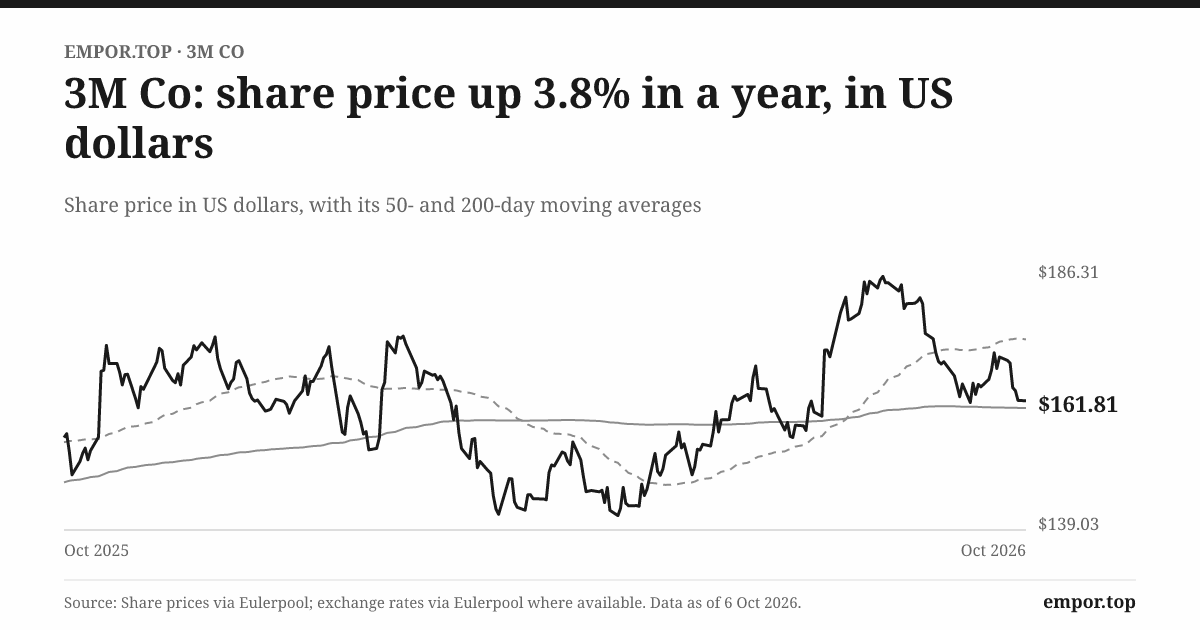
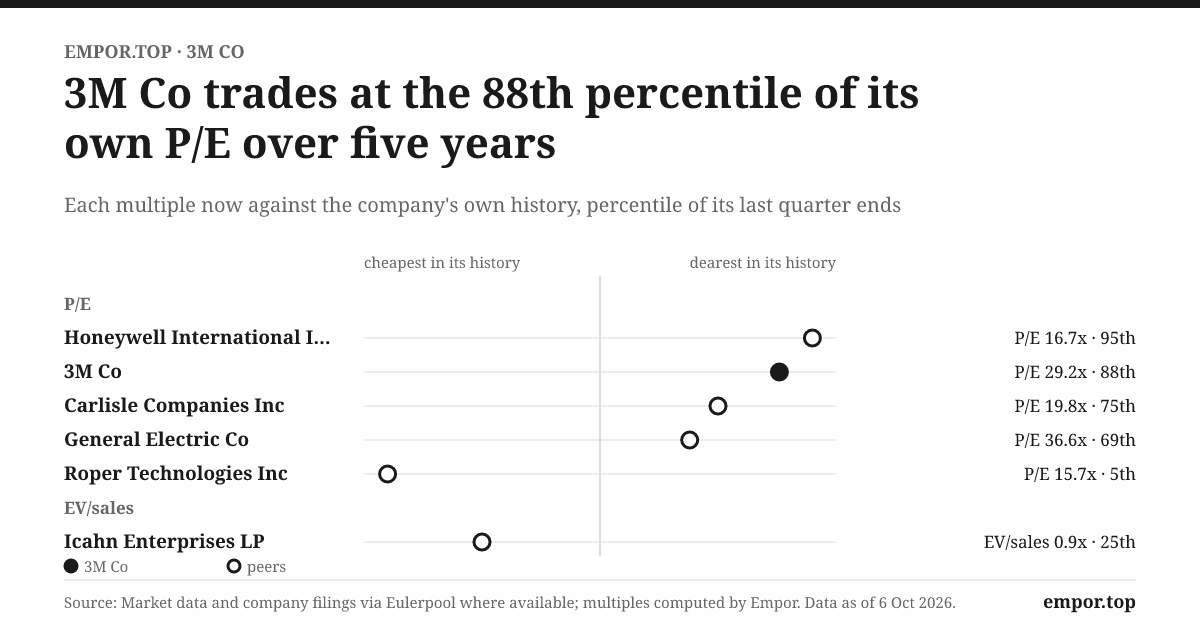
The headline numbers show the gap. Revenue peaked at about $35.4bn in FY2021. By FY2025 it was about $24.9bn.2 GAAP earnings per share were $10.45 in FY2022, and over the twelve months to June 2026 they were about $5.62.3 Yet on 6 October 2026 the shares traded at about $162, giving a market value of roughly $88bn. That is a P/E of about 29 times trailing GAAP earnings, well above the stock's five-year median of about 17 times.
So the market is either seeing something the GAAP figures miss or paying for a promise. This story tries to tell those apart.
One warning before the history. Every 3M figure before 2024 describes a different company. The FY2023 numbers include Health Care, which brought in roughly a quarter of revenue. The roughly 25% revenue drop from FY2023 to FY2024 is a separation, not a collapse. Over ten years revenue shrank about 1.9% a year. Over three years the decline was about 10% a year, and almost all of that three-year fall is the spin-off.2 Comparing 3M now with 3M then is like comparing a house before and after a wing was sold. You have to know which rooms you are counting.
The roadmap follows the five questions. First comes the origin of the innovation culture, because 3M's valuation still borrows from it. Next is the leverage decade, when 3M bought growth with debt. Then the lawsuits that rewrote the balance sheet. Then the split into two companies. Then a look at what 3M actually sells, the CEO asking to be judged on adjusted earnings, and the buyback that is running down cash. It ends with the valuation and the lessons. A mine that held the wrong rock is a fitting place to start a story about whether 3M kept the right parts of itself.
 Subscribe on LinkedIn
II. A Mine That Failed, a Lab That Didn't (1902–1966)
The Two Harbors founders did not give up. They moved operations to Duluth and turned from mining to manufacturing sandpaper with purchased minerals. For years it nearly broke them. The product quality was poor, cash was scarce, and the company survived largely because an investor, Edgar Ober, and later the financier Lucius Ordway kept funding it.1 In 1907 a 20-year-old assistant bookkeeper named William McKnight joined the company. He is the most important person in 3M's history.
McKnight was a farm boy from South Dakota who had taken a short business course. He was not an engineer, and that may be why he became such an effective manager of engineers. As a salesman he went into the furniture and auto shops where 3M's sandpaper was used, rather than talking to purchasing agents. He watched the workers and listened to their complaints. That habit of learning from the customer's bench became company doctrine. 3M moved its headquarters to Saint Paul in 1910, and McKnight eventually rose to president and chairman.1
The breakthroughs followed from that habit. In the early 1920s 3M developed Wetordry, a waterproof sandpaper. Auto painters could use it wet, which cut dust and the lung disease it caused. Then in 1925 a young lab assistant, Richard Drew, visited a car body shop and saw painters cursing as they ripped off their masking paper and took fresh paint with it. Two-tone cars were fashionable, and painters needed a way to mask a sharp line. Drew went back to the lab and, against instructions to stick to sandpaper, developed masking tape.1 In 1930 he added transparent cellophane tape. Scotch tape arrived just as the Depression began, and households that could not afford to replace things used it to mend them. 3M's tape grew during the worst decade of the century.
The point for an investor is not the folklore but the funding. In the 1930s 3M reinvested a large share of its profits in research, by its own historians' accounts close to half in some years, while the company roughly tripled in size.1 McKnight turned that into a management philosophy. He wrote that if people were given responsibility and freedom, they would make mistakes, but that management which "is destructively critical when mistakes are made kills initiative." The practical version was the "15% rule", formalised in 1948, under which technical staff could spend part of their time on projects of their own choosing. Some of those projects ran against direct orders. This was called "bootlegging", and 3M tolerated it.
Read that as an investment policy rather than a story about a nice workplace. The 15% rule was an option portfolio. Most of those hours produced nothing. A few produced a technology platform, which 3M then spread across dozens of markets. Adhesives, coatings, abrasives and films were the platforms. Tapes, sandpaper, reflective road signs and later respirators were products. The platform logic made 3M's research more valuable than any single invention, because one discovery could be sold many times.
The Post-it Note is the cleanest example of how slow that conversion could be. In 1968 a 3M chemist, Spencer Silver, was trying to make a strong adhesive and instead made a weak one that could be stuck and unstuck repeatedly. For years nobody found a use for it. In 1974 another 3M scientist, Art Fry, was annoyed that his bookmarks kept falling out of his church hymnal, and he remembered Silver's glue. Test markets in 1977 flopped. The national launch did not come until 1980, twelve years after the discovery.1 A modern quarterly-results culture might well have killed it in year three.
3M moved into its sprawling campus in Maplewood, outside Saint Paul, in 1962, and McKnight's ideas were by then built into the company's structure. Researchers shared technology across divisions. Divisions were judged partly on how much revenue came from recent products.
Here is the test that runs through the rest of this story. The innovation culture was real, and it was funded heavily. Today 3M spends about 4.9% of sales on research and development. In the first half of 2026 that was roughly $610m on about $12.5bn of revenue.4 That is still a respectable figure for an industrial company, but it is a different order of magnitude from the 1930s commitment. The founding myth explains why investors forgave 3M a premium for decades. Whether the myth still pays is a question for later sections. Before that, there is a period when 3M decided that what it needed most was efficiency, not serendipity.
III. Six Sigma, Acquisitions and the Leverage Decade (2001–2019)
In December 2000, 3M's board did something it had never done before: it hired a chief executive from outside. James McNerney came from General Electric, where he had run GE Aircraft Engines and had narrowly lost the race to succeed Jack Welch. He brought GE's management methods with him, especially Six Sigma, the statistical quality discipline that measures and removes variation from a process.1
Six Sigma works superbly in a factory. Making a roll of tape the same way a million times is exactly the kind of problem it solves. It works much less well in a lab. Research is mostly variation. You cannot schedule a Spencer Silver. Under McNerney, 3M cut costs, reduced headcount and brought research projects under tighter metrics. Margins and earnings improved, and Wall Street liked the result. Inside the company, many researchers felt the bootlegging culture was being processed out of existence. When McNerney left for Boeing in 2005, his successor, George Buckley, publicly loosened the discipline on research and said Six Sigma did not belong in invention. That reversal matters as evidence. 3M's own next leader concluded that the efficiency drive had cost it something in innovation.
The second half of this era tells a different story: buying growth. The fact-sheet balance sheet shows the shape of it.2 At the end of FY2014, 3M had about $6.9bn of borrowings and debt of about half its equity. By the end of FY2019, borrowings had reached about $21.3bn and debt was about twice equity. Two forces drove that change, in roughly equal measure: large acquisitions and large buybacks, while the dividend kept rising every year.
Three deals matter most, and each tells a different part of the story.
Aearo, 2008. For about $1.2bn, 3M bought Aearo Technologies, a maker of hearing and eye protection.1 The logic was clear, because Aearo fit well into 3M's safety business. But Aearo came with a product called the Combat Arms Earplug Version 2, sold to the US military. Hundreds of thousands of veterans later claimed it failed to protect their hearing. That claim ended in a $6.0bn settlement.5 A business bought for about $1.2bn produced a liability about five times its purchase price. By that measure, Aearo was one of the most expensive acquisitions in 3M's history.
Scott Safety, 2017. 3M bought Scott Safety, a maker of breathing apparatus for firefighters, from Johnson Controls for about $2bn.1 That deepened 3M's position in personal safety equipment, which remains one of its stronger franchises.
Acelity (KCI), 2019. The largest deal was the purchase of Acelity, the wound-care company better known for its KCI negative-pressure therapy, for about $6.7bn including debt.1 It was the main reason borrowings jumped in FY2019. Five years later, Acelity left 3M as part of Solventum. Did 3M overpay? The business moved into a company that now trades separately, so a precise return on the deal cannot be calculated. What can be said is this. 3M bought Acelity at the top of the 2019 market and paid in debt. It then gave the business away to its own shareholders in a spin-off rather than selling it for cash. Shareholders still own the business through Solventum, so the value was not destroyed. But 3M's own balance sheet carried the debt and did not get the proceeds. The deal failed to change 3M's growth rate, which was its stated purpose.
Through the whole decade, the efficiency figures moved in the wrong direction. Asset turnover, meaning revenue earned for each dollar of assets, fell from about 1.0 in FY2014 to about 0.7 in FY2019. Return on capital employed fell from the high 20s to about 20%. Operating margin slipped from about 22% to about 22%, which is flat, while assets grew much faster than profits.2 In plain terms, 3M was adding assets and debt to earn roughly the same money. That is the signature of an acquisitive company buying growth it was not producing organically.
Through all of it, 3M protected its status as a "dividend aristocrat", raising the payout every year for more than six decades. Dividends rose from about $2.2bn in FY2014 to about $3.3bn in FY2019, and the payout ratio peaked at about 73% of profit in FY2019.2 Shareholders were being paid more each year from a business that was borrowing more each year. That is not reckless on its own, since a highly rated industrial can carry debt. But it left little slack. The balance sheet was fully loaded just as 3M's chemical past came due.
IV. The Lawsuit That Rewrote the Balance Sheet (PFAS and Combat Arms, 2018–2026)
Look at two quarters in 2023. In the three months to September 2023, 3M reported an operating loss of about $3.1bn. In the three months to December, it reported operating profit of about $5.2bn, an operating margin of about 65%.3 Neither number described the business of making tapes, films and respirators. Both described lawyers and accountants. The September quarter carried the charge for the earplug settlement. The quarter before had carried the PFAS charge, pushing pre-tax results to a loss of about $9bn. Then the December quarter booked gains associated with the coming separation.3 That year's GAAP EPS was a loss of about $12.59.2 To understand 3M today, you have to understand how those charges arose and when the cash leaves.
What PFAS is. Per- and polyfluoroalkyl substances are man-made chemicals with carbon-fluorine bonds, among the strongest bonds in chemistry. That strength is why they are useful: they repel water, grease and stains, and they suppress fires. It is also why they are called "forever chemicals". They do not break down easily in the environment or in the human body. 3M was one of the original large producers. Its chemistry went into Scotchgard and into firefighting foams. Over decades, PFAS spread into water supplies near manufacturing sites and military bases. Litigation and public records showed that 3M had internal evidence for many years about the chemicals' persistence and potential harm. That knowledge-of-harm record is what turned this from an environmental clean-up problem into a liability case with large damages.
The water settlement. In June 2023, 3M agreed a settlement with US public water systems to fund the treatment of PFAS in drinking water. The settlement was valued at $10.5bn to $12.5bn, payable from 2024 to 2036.5 Courts approved it in 2024. 3M also announced in 2022 that it would exit PFAS manufacturing entirely, and it says it completed that exit at the end of 2025.2
The earplug settlement. In August 2023, 3M agreed to pay $6.0bn to resolve the Combat Arms earplug claims, payable from 2023 to 2029, partly in stock and mostly in cash.5 More than 99% of eligible claimants took part, which effectively closed the litigation.5
That puts more than $16bn of settlements on fixed schedules, against a company now earning roughly $4.6bn of operating profit a year.2 This is the core of the second central question.
Accrual versus payment. The confusing thing about 3M's numbers is that the GAAP loss year and the weak cash year are different years. Under accounting rules, when a settlement becomes probable and estimable, the company books the whole expected cost at once. That is why FY2023 showed a big GAAP loss while cash from operations was a healthy $6.7bn. The cash then goes out over the following years. Cash from operations fell to about $1.8bn in FY2024 and about $2.3bn in FY2025, and free cash flow to about $0.6bn and $1.4bn.2 Over twelve years, cumulative cash from operations of about $71bn was about 151% of net profit. That looks like excellent cash conversion, but much of it is just the timing gap: profit was charged first, and the cash is paid later.
This matters for reading guidance. 3M guides FY2026 "adjusted" operating cash flow of $5.8bn to $6.0bn, with adjusted free-cash-flow conversion above 100%.6 "Adjusted" here removes the settlement payments. The settlement payments are real cash leaving the company, so reported cash flow will be well below that range. The useful figure for investors is reported free cash flow after legal payments, and the 10-K legal note lays out the payment schedule.2 The heaviest years for the earplug settlement fall in the front half of the 2023–2029 window, and the water payments run through 2036.
The credit view. The best outside test of management's claim that the liabilities are manageable comes from the rating agencies. They see cash schedules, not adjusted EPS. Moody's once rated 3M A1, and over the litigation years it cut the rating to A3. By mid-2026, ratings were A3 at Moody's, BBB+ at S&P and A- at Fitch, all with stable outlooks.47 Moody's said the uncertainty over the amount and timing of PFAS payments would remain a credit concern for years.7 Read those ratings together. The agencies do not see a threat to solvency, which is why the outlooks are stable. But they took a top-tier industrial credit down several notches. The settlements narrowed the uncertainty without removing it.
What remains open. Several exposures are outside the two big settlements. In 2025, 3M agreed a separate PFAS settlement with New Jersey, payable over many years.4 Other states, foreign governments and private plaintiffs still have PFAS claims, and regulators continue to tighten limits on PFAS in water and products. 3M also kept responsibility for pre-spin PFAS liabilities of the Health Care business, and for some later product claims, through an indemnity to Solventum.2 The spin-off moved a business out of 3M but kept the chemical past inside it.
The balance sheet that took the hit. Shareholders' equity fell from about $14.7bn at the end of FY2022 to about $4.8bn at the end of FY2023 and was about $4.7bn at the end of FY2025.2 Total debt was about $12.55bn at 30 June 2026, of which about $1.6bn was short-term.4 That small equity base is why 3M's return on equity, over 100% in the last twelve months, and its price-to-book ratio, about 29 times, should be ignored. A business does not become a superb compounder because lawsuits shrank its denominator.
Judged on evidence, the second central question has a narrowed answer. The two largest liabilities are capped and scheduled, and the rating agencies treat them as serviceable. But the drag lasts more than a decade, the remaining PFAS exposure is open-ended, and the cash cost is excluded from the "adjusted" figures management wants investors to use. The settlements explain why 3M had to change shape. The next section is about the change itself.
V. Cutting the Company in Two: Solventum and the Divestiture Programme (2022–2026)
On 1 April 2024, 3M shareholders woke up owning two companies. For every four 3M shares, they received one share of Solventum, the newly independent health-care company, and 3M kept a stake of its own.2 The quarterly figures show the result immediately. Revenue went from about $8.0bn in the December 2023 quarter to about $6.0bn in March 2024.3 Roughly a quarter of 3M left in a single day.
What Health Care was. Solventum took the medical-surgical products (wound care, including the Acelity business, and infection prevention), dental and orthodontic products, health information systems that help hospitals code and bill, and purification and filtration. It was the steadiest part of 3M: less cyclical than autos and electronics, with long relationships with hospitals. It also carried some of the higher-quality earnings in the portfolio.
Why split? The case management made in 2022 was the standard argument against conglomerates. Two businesses with different growth rates, customers and capital needs would each be valued more highly on their own, because investors could buy exactly what they wanted. The unspoken reason was the litigation. A health-care company tied to forever-chemical and earplug suits faced a discount it did not deserve, and 3M's own liabilities made it hard to raise capital for Health Care.
The trade-off for 3M holders. A spin-off is not a sale. 3M did not receive cash for the business beyond a distribution funded by debt Solventum raised at separation. Shareholders kept the economic value by holding Solventum shares. But the remaining 3M lost a large, stable stream of cash flow while keeping all its old legal liabilities, including the indemnity for Solventum's PFAS exposure. A good deal for people who held both stocks is not necessarily a good deal for the 3M balance sheet.
The retained stake. 3M kept about 14.8% of Solventum. It holds the stake at fair value and had an unrealised gain of about $1.4bn on it at 30 June 2026, down slightly from about $1.5bn at the end of 2025.4 The company intends to sell the stake within the five-year window allowed for a tax-free spin. That stake is a real asset, worth a few billion dollars at market prices, and its proceeds can fund buybacks or settlement payments. It is also a source of noise. Changes in Solventum's share price flow through 3M's income statement as gains or losses, which 3M then strips out as a special item.
The divestitures. After Solventum, 3M kept trimming. It sold Dyneon GmbH, its PFAS-related fluoropolymer unit in Germany, at a loss of about $324m in 2025. It also sold a precision grinding business at a loss of about $159m.4 Both were sold for less than their book value, and the Dyneon loss in particular reflects the cost of leaving a chemical franchise early. In 2026, 3M completed a transaction with Bain Capital involving its Madison Fire & Rescue operation, valued at about $1.95bn.4
What the losses say is uncomfortable. When a company repeatedly sells businesses for less than book value, the earlier purchase prices or investment decisions were too high, or the businesses deteriorated under its ownership. Neither speaks well of past capital allocation. The divestitures make sense for the future, as they shrink the portfolio to areas where 3M has scale. They are not evidence of value creation.
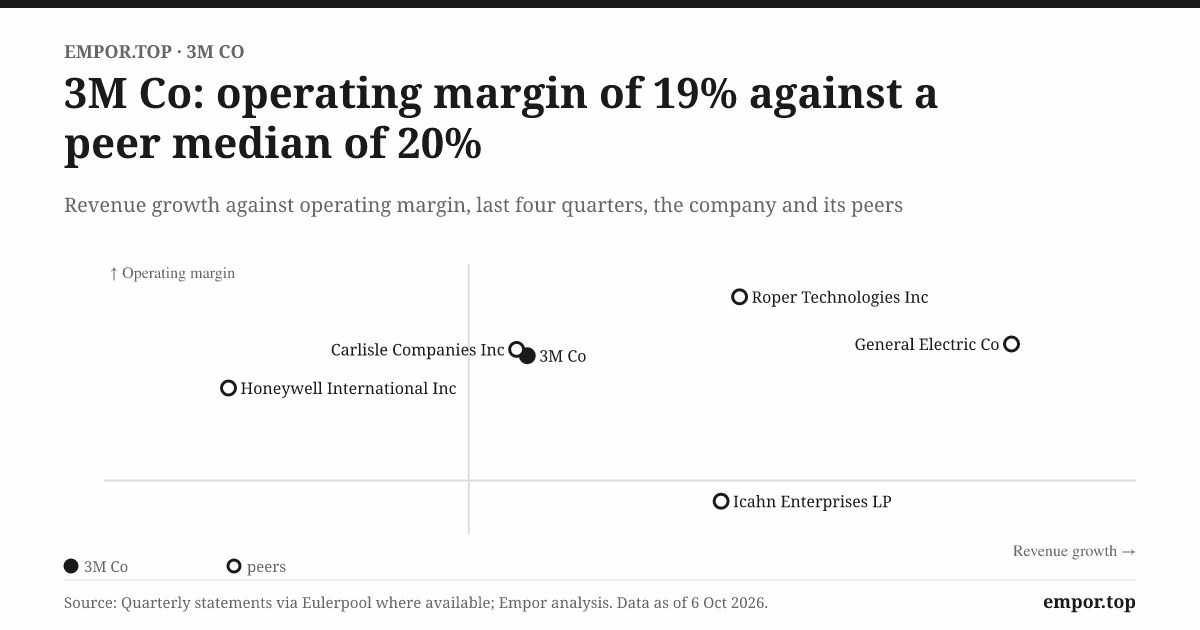
What is left. The remaining 3M is smaller but somewhat better on margins. FY2024 revenue was about $24.6bn and FY2025 about $24.9bn, up about 1.5%. GAAP operating margin was about 20% in FY2024 and about 18% in FY2025.2 Pre-spin margins in FY2022 and FY2023 were only about 12%, but those were depressed by the legal charges. A cleaner comparison is with the roughly 21–23% margins of the 2014–2021 period, which the slimmed-down 3M has not yet matched on a GAAP basis.
The verdict on question four: the Solventum stake and divestiture proceeds are worth a few billion dollars, enough to cover a meaningful part of the coming settlement payments, but they are a one-time source of cash. The divestitures so far have been sold at losses. What is left is the industrial core, and its value depends on whether it can grow. That makes it time to look at what 3M actually sells.
VI. What 3M Sells Today: Segments, Competitors and Economics
Picture three objects on a workbench. The first is a disposable respirator, the white mask familiar to every construction worker and to everyone who lived through 2020. The second is a sheet of optical film from inside a car's dashboard display, which makes the screen brighter while drawing less power. The third is a yellow pad of Post-it Notes. These three objects are 3M's three segments: Safety and Industrial, Transportation and Electronics, and Consumer.2
Safety and Industrial is the largest segment and the main profit engine. It sells abrasives, industrial adhesives and tapes, personal protective equipment (respirators, hearing protection, fall protection), electrical products and roofing granules. Its customers are factories, contractors, utilities and distributors such as Grainger. This is where 3M's oldest platforms (abrasives, adhesives) live, and where its moat is strongest.
Transportation and Electronics sells advanced materials to automakers, aerospace companies and electronics manufacturers. That includes films for displays, materials for semiconductors and data centres, adhesives for car assembly and reflective sheeting for road signs. This segment is the most technically sophisticated and the most cyclical, because it rises and falls with car and electronics production.
Consumer sells Post-it, Scotch, Scotch-Brite, Command hooks, Filtrete air filters and Nexcare bandages through retailers such as Walmart and Home Depot. It is the smallest segment and has the lowest growth. Its value is in its brands.
3M reports the split of revenue and operating profit by segment in its 10-K, and Safety and Industrial earns the largest share of profit.2 3M has historically stated that no single customer exceeds 10% of its sales, and the segment structure confirms that customers are scattered across many industries.2
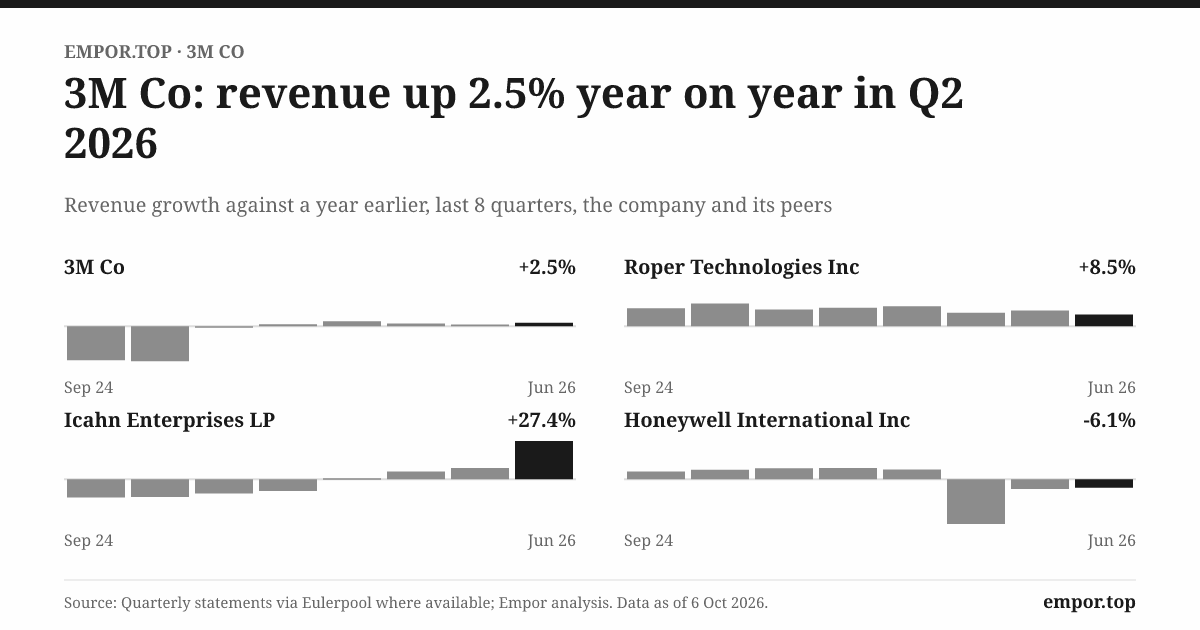
Growth. On a reported basis, revenue grew about 1.5% in FY2025 and about 2.5% in the June 2026 quarter.3 Management reports organic growth of 5.4% for the June 2026 quarter. Organic growth strips out currency effects, acquisitions and divestitures. Management guides FY2026 organic growth above 3.5%.6 The gap between reported and organic growth is mostly divestitures and the PFAS exit. Those revenues have gone, and they are not coming back. Both numbers are true, but they answer different questions. Organic growth says whether the core is healthy. Reported growth says how much bigger the company is getting. For now, the core is growing modestly, roughly at the pace of the industrial economy and slightly faster than inflation.
Why 3M wins: the moat, argued once.
Take each of Porter's five forces in turn.
Buyer power is low to moderate. Customers are fragmented, and 3M's products are usually a small part of their costs: the adhesive on a car or the film on a phone. Small costs with large consequences give the supplier leverage. Big-box retailers in Consumer are the exception, since they negotiate hard and push private labels.
Supplier power is moderate. 3M buys commodity chemicals and resins, and input-cost spikes have hurt margins before. But no single supplier controls the business.
Threat of substitutes varies. In safety equipment, certification creates a barrier. A respirator or a breathing apparatus has to pass regulatory standards, and safety managers do not change suppliers lightly for a small saving. In electronics, materials are "specified in", which means designed into a product for its entire life. A replacement means re-testing, and that keeps 3M in place for the life of a model, but it also means 3M can lose an entire generation of products when a design changes. In consumer goods, substitutes are everywhere, and only the brand holds share.
Threat of new entrants is low in technical materials and safety, where 3M's process know-how and regulatory approvals took decades to build. It is higher in basic consumer products.
Rivalry is real but disciplined. In safety, 3M competes with Honeywell's safety business, MSA Safety and Ansell. In adhesives and specialty materials, with Avery Dennison, Henkel and Illinois Tool Works. In electronics materials, with specialty chemical and film companies in Japan and Korea. Honeywell and Emerson are larger, more diversified industrial companies with heavier exposure to automation and aerospace. Illinois Tool Works is the most relevant comparison on business model: a decentralised maker of engineered components that is known for very high margins from a strict "80/20" focus on its most profitable products. ITW's operating margins sit in the mid-20s, which shows what a disciplined industrial portfolio can earn. 3M's GAAP margin of about 18% in FY2025 trails that by a wide margin.2
In Hamilton Helmer's 7 Powers framework, 3M's strongest power is switching costs: certifications in safety and spec-ins in electronics. Its second is process power, the deep and hard-to-copy manufacturing know-how in coatings, films and abrasives built up over a century. Branding applies only to Consumer and to a few safety brands. Scale economies are modest, because 3M's businesses are spread across many niches rather than one huge market. Cornered resource applies only to particular patents, which expire. Network effects and counter-positioning do not apply.
Evidence of pricing power. If switching costs are real, 3M should be able to raise prices without losing much volume. The evidence is mixed. Over 2021 and 2022, 3M pushed through price increases to offset inflation, but its margins still fell. Since the spin-off, management has credited margin gains mostly to productivity and cost cuts, not price. 3M does not disclose price versus volume by segment in enough detail to settle the question. On balance, the evidence supports a moat that defends existing positions but does not produce strong pricing power. That narrows the bull's case for switching costs to a smaller version.
Disconfirming evidence. The strongest counterevidence to the innovation story is in 3M's own record. For years, 3M reported its "new product vitality index", the share of sales from products launched in the past five years, as a central measure of its innovation. That measure fell over the 2010s, and 3M stopped emphasising it. Under the current management, the company has set new targets for product launches instead. The current R&D intensity, at about 4.9% of sales, is near the low end of its own history. Capital spending is also lower than it was. Capex was about $448m in the first half of 2026, around 3.6% of sales.4 Net property, plant and equipment fell from about $10.3bn in FY2021 to about $7.1bn in FY2025, partly because of the spin-off and divestitures.2 That pattern is consistent with a company harvesting more than investing. The fair reading is that harvesting is disciplined while the legal bills are being paid, but it is not the profile of a growth company.
Working capital and cycles. The day-to-day operation is solid. Customers pay in about 52 days, which has been stable for a decade.2 Inventory runs at about 89 days, and 3M pays suppliers in about 65 days, which has stretched from about 40 days in FY2014. Paying suppliers more slowly has released cash, but it is a one-time gain, not a repeatable source of growth.
The cyclical exposure deserves a plain statement. A large share of revenue rises and falls with industrial production, car output and consumer electronics. In a recession, Transportation and Electronics would fall first and hardest. 3M also sells more than half its products outside the United States, so a strong dollar reduces reported revenue. The company hedges part of that exposure with forwards and options, as described in its 10-K market-risk section.2 Tariffs are a further risk because 3M manufactures and sells across borders, including significant operations in China.
So does the McKnight engine still create growth? The evidence says it produces modest growth in a defensible industrial portfolio, roughly the speed of the economy. It does not yet show the step-change in new products that the founding myth implies. The person responsible for changing that is the CEO, and he wants to be judged on a different set of numbers.
VII. The Man Running It: William Brown and the Credibility Test
In May 2024, at 3M's annual meeting, shareholders delivered an unusual rebuke. Only about 45% voted in favour of the company's executive pay plan, a failed say-on-pay vote, which is rare for an S&P 500 company.8 Two years later, at the meeting on 13 May 2026, about 94.5% voted in favour.8 The swing from rejection to endorsement in two years is the clearest single measure of how the market's view of management has changed. It also raises the question of what investors are endorsing.
The new CEO. William "Bill" Brown became 3M's chief executive on 1 May 2024, a month after the spin-off, succeeding Mike Roman, who had led the company through the litigation and the separation.2 Brown was the first outside CEO since McNerney. He had spent most of his career running L3Harris and its predecessor Harris Corporation, a defence-electronics business. There, he was known for an operational and capital-allocation style built around margins, cash conversion and portfolio pruning. Before that he had worked at United Technologies. He is an engineer by training. Where Roman's era was dominated by lawyers, Brown arrived as a mechanic.
The reset. Brown's strategy has three parts. The first is operational: fix the factories, improve on-time delivery and cut costs. The second is commercial: restart the innovation engine, with a target to launch many more new products a year. The third is financial: return cash through buybacks and a reset dividend. He has announced a goal of significant margin expansion over several years.
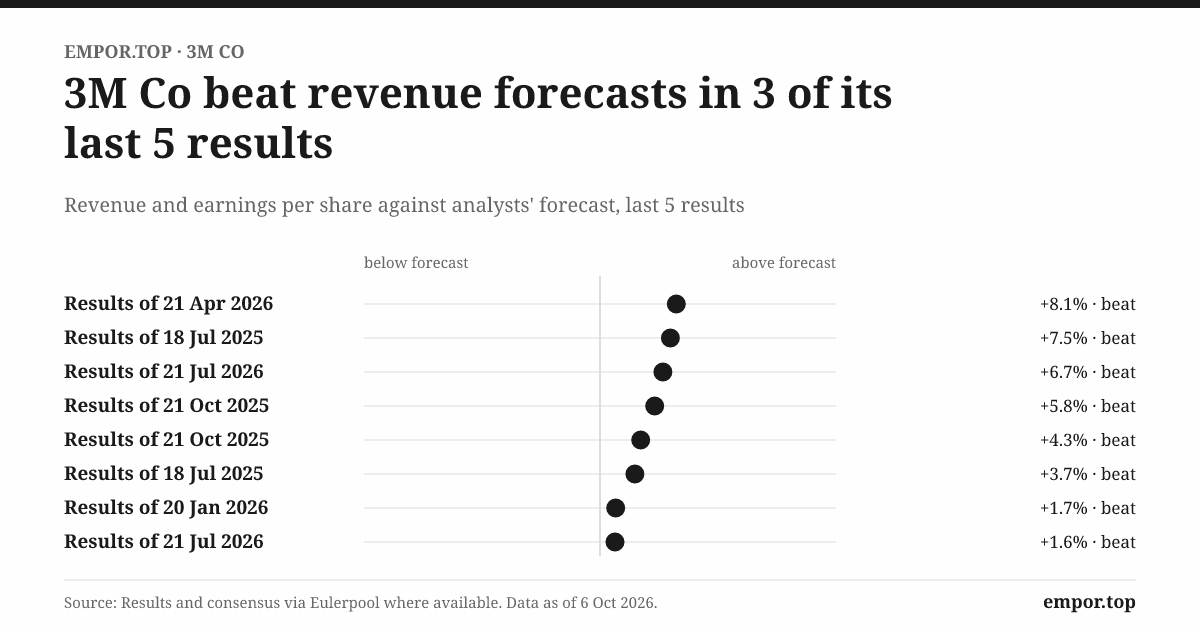
The record. Management has hit and raised its guidance repeatedly since the spin-off. Adjusted EPS was about $8.06 in FY2025, up about 10%.2 In July 2026, management raised its FY2026 adjusted EPS guidance to $8.80–$8.95.6 Adjusted operating margin in the June 2026 quarter was 24.9%.6 That is a credible record of meeting the targets management sets.
The problem. Now put the GAAP figures next to them. GAAP operating margin in the same quarter was about 15.1%.3 That is a gap of almost ten percentage points between the two versions of the same quarter. GAAP EPS for FY2025 was about $6.00, against adjusted EPS of about $8.06.2 The difference is "special items": PFAS exit costs, transformation and restructuring costs, divestiture losses, litigation costs, and swings in the value of the Solventum stake.
Adjusting earnings is legitimate when items are truly one-off. The question is whether 3M's special items are one-off. The record says they recur. There have been PFAS charges every year since 2018, restructuring charges in most years, and divestiture losses in 2025 and again in 2026. In the June 2026 quarter, the 10-Q showed a gain of about $303m on the Solventum stake, while the earnings release showed a net negative special item of about $0.60 a share.46 Both can be true, as the gain on the Solventum stake was outweighed by other charges, but investors have to do the reconciliation themselves. When one-offs happen every quarter, they are a cost of doing business.
Incentives. That matters more because executive pay is tied to the adjusted figures. Brown's total pay for FY2025 was about $21.0m, mostly in options and stock awards.9 The annual bonus and long-term incentive plans reward adjusted EPS, adjusted operating income and organic growth, as set out in the 2026 proxy statement.9 A management team paid on adjusted earnings has a natural incentive to classify costs as special items. There is no evidence that 3M has done this improperly. The point is structural: the definitions management chooses determine its pay.
On the calls. On the July 2026 call for the second quarter, analysts focused on two things: the size and persistence of special items, and the gap between adjusted and reported cash flow. Management's answers on operations were concrete. They cited specific improvements in on-time delivery and productivity. The answers on the special items were less precise. Management described them as tied to "the PFAS exit and portfolio actions" without committing to a date when the gap would close. The same pattern appeared on the Q4 2024 and Q4 2025 calls: confidence on operations, generality on the reconciliation.6
The verdict on question one. Management's operating claim is credible and has been tested by repeated beats against its own guidance. The broader claim, that adjusted EPS represents 3M's true earnings power, is narrowed by the history of recurring special items. The forward test is clear: the FY2027 gap between adjusted and GAAP EPS. If the gap narrows sharply once the PFAS exit is complete, adjusted earnings will have been an honest preview. If it stays wide, investors are being asked to pay for numbers that never quite arrive. The most immediate place to test that is where management is spending the cash.
VIII. Buyback or Balance-Sheet Gamble? (2025–2026 Capital Allocation)
Six months tell the story. At the end of 2025, 3M had about $5.2bn of cash. By 30 June 2026, it had about $3.0bn.4 In those six months it bought back about $3.0bn of its own shares and paid about $813m in dividends.4 Shareholders received about $3.8bn while the cash pile fell by about $2.3bn. The difference came from cash generated by the business, after settlement payments.
The buyback. 3M has a $7.5bn buyback authorisation. About $4.6bn remained at the end of 2025, and the company had already bought about 3.4m shares in the December 2025 quarter at about $161 each.5 The pace in 2026 has been faster still.
The dividend puzzle. One data note needs resolving. The fact sheet shows dividends paid of zero in FY2025, which cannot be right. 3M paid dividends throughout 2025, and the 10-Q shows $813m paid in the first half of 2026.4 The correct reading is that 3M reset its dividend after the spin-off. Before the separation, it paid about $1.51 a share each quarter. After it, the quarterly dividend was reset to roughly $0.70, reflecting the smaller company. Total dividends paid fell from about $3.3bn in FY2023 to about $2.0bn in FY2024.2 That reset ended 3M's record of more than six decades of annual dividend increases. Management described it as a reset, not a cut, because shareholders also received Solventum shares. Holders who sold their Solventum shares would not see it that way.
Who pays for it? The useful test is reported free cash flow, after settlement payments, against buybacks plus dividends. In FY2025, reported free cash flow was about $1.4bn.2 Buybacks and dividends that year were several times larger. Management's adjusted FY2026 guidance of $5.8bn to $6.0bn of operating cash flow would support the current pace, but adjusted cash flow excludes the settlement payments. On a reported basis, the gap is being filled by the cash balance, the divestiture proceeds, the sale of Solventum shares and borrowing.
The activist's stress test. Imagine a skeptical long-term investor in the room. They would ask four things.
First: why buy back stock when you are still paying settlements for the next decade? Every dollar spent on buybacks is a dollar not available to pay down debt or meet settlement instalments. Management's answer would be that the shares are cheap relative to future earnings, and that the debt is manageable. That is a reasonable argument only if adjusted earnings are real. Which brings the activist back to question one.
Second: what is the plan if PFAS liabilities beyond the settlements grow? The company has no cushion of equity. A further large charge would push equity close to zero.
Third: is the equity base meaningful? With about $4.7bn of equity and $12.6bn of debt, debt is nearly three times equity.24 Return on equity of over 100% is a statistical artefact.
Fourth: why the dividend reset, if the business is so healthy? The answer is that the dividend had become too large for the smaller company, which is honest, but it confirms how much the settlements and the spin-off changed 3M's cash capacity.
Refinancing. Short-term borrowings were about $1.6bn at 30 June 2026.4 Those will need to be refinanced or repaid. 3M's investment-grade ratings mean it can borrow, but at higher rates than when it built its debt in 2017–2019. The company has not raised equity during this period. For the stated period of 2024 to mid-2026, the share count has gone down, not up, because of buybacks.
The verdict on question three is a narrowed version of management's case. The buyback reflects confidence in future earnings, and the company can afford it on an adjusted basis. On a reported basis, it is partly funded from the balance sheet and asset sales while settlement payments continue. That is a calculated bet that the settlements stay where they are, not a reckless one, but it reduces the margin for error. The market's valuation of that bet is the subject of the next section.
IX. Analysis: Valuation, Bull vs. Bear and KPIs
Put two numbers side by side on a screen. On trailing GAAP earnings, 3M trades at about 29 times. On management's FY2026 adjusted EPS guide of $8.80–$8.95, the same $162 share price is about 18 times.6 The five-year median P/E is about 17 times. The whole valuation debate sits in the gap between 29 and 18.
What the market is pricing. At about 18 times adjusted earnings, the market is valuing 3M roughly in line with a mature, slow-growing industrial. If you trust the adjusted figures, 3M is not expensive. At 29 times GAAP earnings, it is expensive by any standard. EV/EBITDA of about 17.8 times and a free-cash-flow yield of about 4.5% sit between the two readings.2 The dividend yield is about 1.9%, and the shares are about 12% below their 52-week high of about $184. Honeywell, Illinois Tool Works and Emerson have generally traded in a high-teens to mid-20s range on forward earnings in recent years, so 3M on adjusted earnings sits at the lower end of that range. On GAAP earnings, it is at the top.
The market is therefore assuming two things: that most of the gap between adjusted and GAAP earnings will close within a few years, and that the settlements will stay where they are. If both are true, 3M is fairly priced for a modest-growth industrial. If either fails, the GAAP multiple is the more honest one.
The bull case. Organic growth of about 5% in the latest quarter shows that the core business is healthier than the reported revenue suggests. Brown's operational fixes are showing up in margins. Adjusted operating margin is near 25%, close to the best industrial peers. Legal cash payments will peak in the next few years, especially as the earplug settlement ends in 2029, and cash flow should rise as they fall. The Solventum stake is worth billions and can be sold. The buyback reduces the share count while the stock is cheap on adjusted earnings. If the innovation push produces new product lines in electronics and data centres, the growth rate could rise.
The bear case. GAAP earnings are still falling. The special items keep appearing. PFAS liability has a long tail that the settlements do not cover, and regulation is tightening. The balance sheet is stretched, with debt nearly three times equity. A large share of revenue is cyclical, and an industrial or auto downturn would hit volumes. The buyback is partly funded by cash that could have reduced debt. The innovation engine has not yet shown a step-change, and R&D intensity is near its historic low.
Material risks and how they work.
PFAS litigation and regulation. New claims from states, foreign governments or personal-injury plaintiffs could require more charges. Tighter drinking-water limits raise the cost of clean-up and potentially the size of claims. The mechanism is direct: a new charge reduces equity, and new payments reduce cash.
Cyclicality. Transportation and Electronics depends on car and electronics production. A downturn would cut volumes, and 3M's fixed costs would push margins down faster than revenue.
Refinancing cost. Debt raised at low rates in the 2010s is being refinanced at higher rates, which raises interest costs.
Tariffs and geopolitics. 3M makes and sells products in many countries, including China. Trade restrictions raise costs or limit sales, as the 10-K risk factors describe.2
Three KPIs to watch.
- Organic growth. The latest reading is 5.4% for the June 2026 quarter, against FY2026 guidance above 3.5%.6 This is the test of whether the core is growing.
- The gap between GAAP and adjusted EPS. FY2025: about $6.00 GAAP against about $8.06 adjusted.2 This is the test of whether adjusted earnings are real.
- Reported free cash flow after legal payments. FY2025: about $1.4bn.2 This is the test of whether the buyback and dividend are sustainable.
The valuation, then, is fair only if the adjusted-to-GAAP gap closes. The lessons from 3M's history explain why that condition matters so much.
X. Lessons for Founders & Investors
Three decisions sit a century apart: a mine bought in 1902, an earplug maker bought in 2008, and a health-care company spun off in 2024. Each carries a lesson that belongs to 3M.
Patient capital buys serendipity, and debt buys the opposite. In the 1930s, 3M reinvested heavily in research while the economy collapsed around it, and out of that came Scotch tape and a century of products. In 2017–2019, 3M borrowed to buy growth through acquisitions, and the result was a heavier balance sheet with no faster growth. The difference is not the amount spent. It is that patient research creates options, while debt-funded deals create obligations. Founders and investors should ask what their capital is buying: a set of options, or a set of fixed claims.
The cheapest acquisition is the one that arrives with a liability. Aearo cost about $1.2bn and produced a $6bn settlement. The lesson for any acquirer is that due diligence must look at the products a company has already sold, not just the ones it will sell. The liability you buy can be larger than the business.
Adjusted earnings are what management wants you to pay for; cash is what the lawyers leave behind. In the June 2026 quarter, adjusted operating margin was about 25% and GAAP about 15%. The gap is not fraud. It is a choice about what to count. Investors who pay for adjusted earnings should check whether the cash arrives.
You can spin off a business but not a liability. Solventum left in 2024. The PFAS indemnity stayed. A company that splits itself to escape its past should expect the past to follow the part with the old name on the door.
A culture is a budget line before it is a legend. The 15% rule was famous because it was funded. A company that wants to keep its innovation reputation has to keep paying for it, especially when the lawsuits arrive.
XI. Epilogue: The Next Moments That Decide It
Tonight, 3M is a company in transition. It has completed the spin-off, completed the PFAS manufacturing exit and settled its two largest lawsuits. It is buying back shares at a fast pace, guiding to higher earnings, and asking investors to believe that the worst is over. The next few quarters will test every one of those claims.
The first test comes with the third-quarter 2026 results later this month. Investors will look at whether organic growth stays above the 3.5% guidance, and whether reported cash flow, not the adjusted version, is moving toward management's range. If organic growth holds and reported cash flow improves, question one moves toward management's version. If organic growth slows and special items grow, the gap widens.
The second test is the settlement schedule. Each year's payment is fixed, but new PFAS rulings, state claims and regulations can add to the total. The earplug payments end in 2029. If no large new PFAS charge arrives in the next two years, question two will have been answered in management's favour. If one does, the equity base is thin enough for it to matter.
The third test is the Solventum stake and the next divestitures. Selling the stake at a good price will supply cash for buybacks or debt reduction. Another round of divestitures at a loss would confirm that the portfolio is still being cleaned up.
The fourth and most important test is the FY2027 gap between GAAP and adjusted EPS. That number answers whether 3M's adjusted earnings are a preview of the future or a permanent fiction. If the gap closes, the market's current multiple will look reasonable, and the buyback will look like confidence rather than engineering. If it does not, the stock will have been priced on numbers that never arrived.
The tension remains. 3M has done the hard structural work. What it has not yet proved is that the company left after that work can grow on its own.
XII. Outro
The men who bought the cliffs at Two Harbors in 1902 thought they had found corundum, and they had found the wrong rock. They survived by turning to something else, then by hiring a bookkeeper who listened to customers and gave engineers room to fail. That was the company the world came to admire.
The 3M of 2026 has spent a decade digging itself out of a different kind of wrong rock: chemicals that would not break down and earplugs that did not work. It has sold off a quarter of itself, paid billions and reorganised. What it kept is supposed to be the right rock. The company that invented the sticky note is now trying to make its own past stop sticking.
XIII. Recent News
- Q2 2026 results and raised guidance. On 21 July 2026, 3M reported organic growth of 5.4% for the June quarter and an adjusted operating margin of 24.9%, and raised its FY2026 adjusted EPS guidance to $8.80–$8.95, with adjusted operating cash flow of $5.8bn to $6.0bn.6
- Madison Fire & Rescue. 3M completed a transaction with Bain Capital involving its Madison Fire & Rescue business, valued at about $1.95bn, in July 2026.4
- PFAS and earplug payments. Payments under the public water systems settlement and the Combat Arms earplug settlement continued on schedule, and the New Jersey PFAS settlement was reflected in the 10-Q.4
- Buybacks, ratings and Solventum. 3M repurchased about $3.0bn of stock in the first half of 2026. Its credit ratings were A3, BBB+ and A- with stable outlooks, and its retained Solventum stake carried an unrealised gain of about $1.4bn at 30 June 2026.4
- Shareholder vote. At the 13 May 2026 annual meeting, about 94.5% of votes cast supported executive pay.8
References
-
3M News Center (company history, press releases and historical earnings releases) — 3M ↩↩↩↩↩↩↩↩↩↩
-
3M Form 10-K for FY2025 — SEC, 2026 ↩↩↩↩↩↩↩↩↩↩↩↩↩↩↩↩↩↩↩↩↩↩↩↩↩↩↩↩↩↩↩↩
-
3M Form 10-Q for the quarter ended 30 June 2026 — SEC ↩↩↩↩↩↩↩↩↩↩↩↩↩↩↩↩↩
-
3M 2025 10-K: Earnings, PFAS and Earplug Settlements — Stock Titan ↩↩↩↩↩
-
3M Reports Second-Quarter 2026 Results; Increases Full-Year Guidance — 3M News Center, 2026-07-21 ↩↩↩↩↩↩↩↩↩
-
3M Company: Moody's changes the outlook to stable; affirms A1 unsecured rating — Yahoo Finance ↩↩
-
3M Shareholders Back Board, Auditor and Executive Pay — TipRanks ↩↩↩
 LinkedIn
 WhatsApp
 Reddit
 Hacker News
 Email
 Kindle
 RSS Feed
 Spotify
 Apple Podcasts
 Amazon Music
 Audible
 YouTube