Altria Group: The Alchemy of American Tobacco
I. Introduction & Episode Roadmap
Picture a corner office in Richmond, Virginia, in the late spring of 2026. Salvatore Mancuso has just become chief executive of Altria Group. A few weeks earlier he was the company's chief financial officer, the person who knew every line of the income statement better than anyone else in the building5. Now the whole scoreboard is his, and it reads like a riddle.
On one side of the ledger is decline that would frighten almost any other consumer company. Philip Morris USA shipped about 61.8 billion cigarettes in 2025, down from 76.3 billion just two years earlier1. Volume fell by roughly a tenth in 2023, again in 2024, and again in 202512. Picture a factory that loses one in every ten customers every year, three years running.
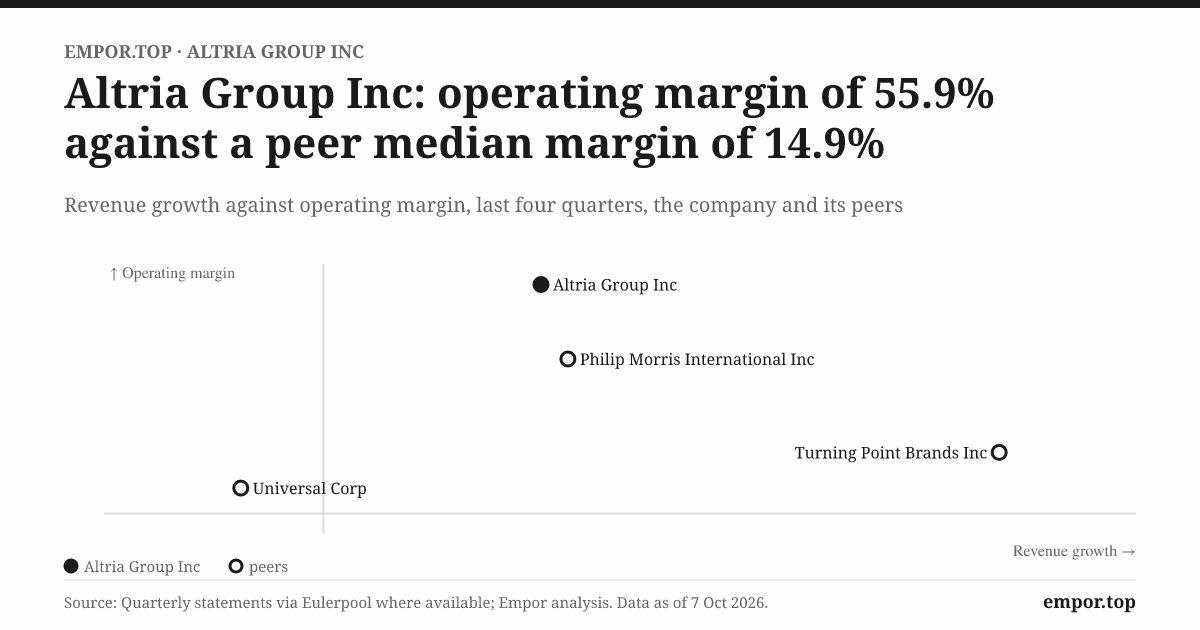
On the other side is the best profit performance the company has ever reported. The smokeable products segment, which covers Marlboro, Black & Mild cigars and the other burnable brands, earned about $11.0 billion in operating companies income in 2025, an all-time high1. Group operating margin reached about 60%1. Over the twelve years from 2014 to 2025, Altria produced roughly $85 billion of free cash flow12.
So here is the question that runs through this whole story: how can a business keep setting profit records while its core product shrinks by 10% a year, and how long can that last?
The short answer is that Altria may be the purest test case in modern corporate history of what a company can do with pricing power in one country and almost no need to reinvest. The longer answer is that the same arithmetic has a limit. Every price increase that makes up for lost volume also pushes more smokers to quit, trade down or switch to something else. The machine works until the day it doesn't, and nobody knows exactly when that day comes.
Who Altria is today
Altria is a holding company that sells only in the United States. Its operating subsidiaries are Philip Morris USA (cigarettes, led by Marlboro), John Middleton (machine-made large cigars), U.S. Smokeless Tobacco Company (Copenhagen and Skoal), Helix Innovations (the on! nicotine pouch) and NJOY (e-vapor)1. Next to them sit two large minority stakes: about 8.2% of Anheuser-Busch InBev, the world's biggest brewer, and about 41% of the cannabis company Cronos Group. There is also a 75/25 joint venture with Japan Tobacco called Horizon Innovations, set up to sell heated tobacco in the U.S.1
Marlboro holds about 42% of the U.S. retail cigarette market1. The dividend has gone up every year for more than half a century1. Those two facts explain most of why investors own the stock.
The paradox in one sentence
What makes Altria a good subject for a long story is that it got here by getting smaller. The old Philip Morris Companies owned Kraft, General Foods, Nabisco, Miller Brewing and an international cigarette business that sold Marlboro around the world. Over two decades it gave almost all of that away, sold it or spun it off, until only the domestic tobacco business was left. What remains is in some ways the least glamorous piece of the old empire: a business in decline, often sued and heavily regulated. It is also the piece that turns the most cash.
The roadmap
The story runs in a rough line. It starts with a London tobacconist and the cowboy who turned a women's cigarette into the world's best-known brand. Next comes the conglomerate years, when cigarette profits paid for cheese, coffee and beer. Then the legal reckoning of the 1990s and the settlement that, in the end, protected the incumbents. Then the great unbundling. Then the harvest era of pricing power against volume decline. Then the most expensive chapter, the $12.8 billion JUUL bet and the NJOY write-down that followed. The story ends with modern nicotine, the balance sheet, the competitive moat and the bull and bear cases.
The early sections are short because the old history matters only where it explains the economics of today. The later sections take their time, because that is where the investment case is decided. And the decisions behind everything that follows started with one advertising idea in Chicago in the 1950s.
 Subscribe on LinkedIn
II. Origins & The Marlboro Man Engine (1847–1984)
The image that made Philip Morris was not a cigarette. It was a man.
In the mid-1950s, Philip Morris hired the Chicago agency of Leo Burnett to relaunch Marlboro. At the time Marlboro was a small brand, sold as a mild cigarette for women, with an ivory tip to hide lipstick stains. The company had added a filter, and filters were starting to sell as fear of lung cancer spread. The problem was that filter cigarettes looked feminine, and men did not want to be seen smoking them. Burnett's answer was a series of rugged men with tattooed hands: sailors, pilots and, above all, cowboys. Within a few years the cowboy stood alone, and Marlboro Country was born.
That one decision did more for long-term shareholder value than almost any other advertising choice in American history. Marlboro went on to become the best-selling cigarette in the United States in the early 1970s, and it has stayed on top ever since. Its share of today's U.S. retail market, about 42%1, is the inheritance of that campaign.
From Bond Street to Richmond
The company's roots go back much further. Philip Morris began as a tobacco shop in London in the mid-nineteenth century, selling hand-rolled cigarettes to wealthy customers. The American business was set up early in the twentieth century and later moved its manufacturing heart to Richmond, Virginia, close to the tobacco belt13. For most of its early life Philip Morris was a middle-tier player, well behind R.J. Reynolds and American Tobacco. Its rise to the top was a marketing story, not a manufacturing one.
Why one brand mattered so much
The genius of the Marlboro Man was not just that it sold cigarettes. It turned a commodity into an identity. A cigarette is dried leaf, paper, a filter and some flavouring. The physical cost of making a pack is small next to its retail price, most of which is taxes, settlement payments and profit. What a smoker buys, in the end, is a habit tied to a brand. Once the brand carried a sense of freedom and toughness, many customers stopped comparing prices.
Economists call this low price elasticity: when the price rises, demand falls by less than the price rose. In plain English, it means Philip Morris could raise its price faster than it lost smokers. That single trait would become the foundation of the entire modern Altria. Every chapter that follows, from the conglomerate years to the harvest era, depends on it.
The industrial engine underneath
Behind the brand was a lean factory and a powerful distribution system. Cigarette making is highly automated: machines turn out thousands of sticks a minute, and the capital needed is modest compared with the cash produced. Today Altria spends only around 1% of its revenue on capital expenditure1. That has been true for decades, and it is why profits turn so cleanly into cash.
Distribution matters just as much. Cigarettes reach smokers through hundreds of thousands of convenience stores, gas stations and grocery stores. Most get there through a few big wholesale distributors. Today two of them, McLane and Core-Mark, handle about 42% of Altria's net revenue1. That concentration grew from long-standing wholesale ties, and it gives a big manufacturer real leverage: it can fund shelf placement, promotions and retailer programs that a small rival cannot.
The verdict on the origin story
The fair verdict is that the Marlboro Man created something close to a cornered resource: a brand that customers would pay more for, year after year, regardless of what rivals did. It was not invincible. It survived only because the industry around it was protected and because nicotine itself makes customers come back. But in the cigarette world it was as close to a perpetual motion machine as consumer goods ever got.
The question that came next was what to do with the flood of cash. In the 1970s and 1980s, Philip Morris's answer was to buy almost everything in the supermarket.
III. The Diversification Mirage: Beer, Food, and Camouflage (1970–2002)
In 1988, Philip Morris made a hostile offer for Kraft. The bid succeeded, at about $13 billion, and it followed the purchase of General Foods a few years earlier. Suddenly a cigarette company owned Maxwell House coffee, Jell-O, Oscar Mayer hot dogs and Kraft cheese. With Nabisco added in 2000, it also owned Oreo and Ritz. The man behind the Kraft deal, CEO Hamish Maxwell, was a quiet Philip Morris lifer who believed the company needed a second leg to stand on.
Beer first
The diversification started earlier, with beer. In 1970, Philip Morris bought Miller Brewing. Its marketing team then did with beer what it had done with Marlboro: it took a product that had failed, a low-calorie beer, and repositioned it for working men with retired athletes and the line "Tastes great, less filling." Miller Lite helped invent the light beer category. It was proof that the company's marketing skill worked outside tobacco.
Why buy groceries?
There were two reasons, and only one was stated openly. The public argument was that tobacco faced a slow decline and the company needed growth elsewhere. Food and beer were large, stable markets where great branding could win.
The second reason was more defensive. Smoking litigation was growing, and a company that was also America's biggest food maker looked more respectable to politicians, juries and lenders. A larger, more diverse company might also find it easier to borrow and to absorb legal shocks.
Why it did not work
Neither argument held up well over time. Food was a much worse business than cigarettes. Packaged foods earned operating margins in the low-to-mid teens, while cigarettes earned several times more. Every dollar of tobacco cash moved into groceries earned a lower return than it had at home. Food also needed constant investment in new products, factories and trade promotion in a way cigarettes never did. Over time the food brands struggled with private labels and changing tastes.
The defensive logic also failed. Diversification did not protect the parent from tobacco suits. Plaintiffs still targeted the tobacco subsidiary, and investors still valued the whole group at a discount because of litigation risk. If anything, the food arm suffered from the association: a "conglomerate discount" applied to everything.
It is fair to say the strategy built some excellent brands. But as an answer to the problem of tobacco decline and tobacco risk, the conglomerate was largely a mirage. It spread the tobacco cash across lower-return businesses and did little to reduce the legal exposure it was partly meant to dilute.
What it tells investors
The lesson for today is that Altria's leaders have a long history of trying to buy their way out of tobacco. The food decades were the first version. The JUUL deal, decades later, was the most expensive version. Both started from a real fear that the core business would shrink. Both ended with the company returning to what it does best: selling cigarettes at higher prices to fewer people.
By the late 1990s, the legal storm the conglomerate had been partly built to weather finally arrived, and its resolution reshaped the company completely.
IV. The Legal Reckoning & The Great Unbundling (1998–2008)
In November 1998, attorneys general from 46 states signed the Master Settlement Agreement with the largest U.S. cigarette makers11. Four states, Mississippi, Florida, Texas and Minnesota, had already settled separately1. The states had sued to recover the Medicaid costs of treating smoking-related illness. What they got was a settlement worth an estimated $206 billion over the first 25 years, plus restrictions on cartoon characters, billboards and youth marketing11.
It was presented as a defeat for the tobacco industry. In hindsight it may have been the best deal the industry ever made.
How the settlement actually works
The key is in the mechanics. The Master Settlement Agreement, or MSA, does not require a single lump-sum payment. It requires annual payments that go on forever, calculated mostly on how many cigarettes each company sells. Philip Morris USA still makes these payments every year. In 2025 the settlement charges recorded in cost of sales were about $3.0 billion, down from about $3.7 billion in 2023 as volumes fell1.
Think about what that means. The states now receive money every time a pack is sold. They have a financial interest in the industry's continued existence. A one-time legal threat was turned into a recurring cost that companies simply pass through to smokers in the price of a pack.
The MSA also protected incumbents from new competition. Companies that did not join the settlement have to put money into escrow for each cigarette they sell. That made it much harder for cheap new brands to undercut the big three on price. The settlement turned an industry under legal attack into a regulated, and protected, oligopoly.
There is still friction. Altria continues to fight "non-participating manufacturer" adjustment disputes, which are about whether states enforced the rules on smaller rivals, and it recovers modest sums from them each year1. Individual smoking lawsuits also continue. In Florida, the so-called Engle progeny cases, which arose after a class action was broken up, have cost Philip Morris USA about $453 million in judgments and $62 million in interest through 20251. But the accrued liability for tobacco and health litigation was just $71 million at the end of 20251. That is a rounding error next to $11 billion of segment profit. For investors, the existential legal threat of the 1990s has become a manageable, mostly predictable cost.
A new name
In 2003, Philip Morris Companies renamed itself Altria Group. The name, a coined word linked to "altitude" and high aims, put some distance between the parent company and the cigarette brand. Critics saw it as an effort to hide the word "Philip Morris" from public view. Either way, it was the first step in a decade of dismantling.
The great divorce
Between 2007 and 2008, Altria broke itself up. Kraft Foods was spun off to shareholders in 2007. In March 2008, Altria spun off Philip Morris International, the business that sold Marlboro outside the United States1. The same year, Altria moved its headquarters from Park Avenue in New York to Richmond, Virginia, close to its factories.
The split had a clear logic. The U.S. business faced lawsuits, high taxes and steady volume decline, but it threw off enormous cash and had a protected position. The international business had growth markets, rising populations in emerging economies and the freedom to pursue new products without American courts and regulators watching every step. Separating them let each be valued for what it was.
The longer-term outcome is more striking. Philip Morris International took the growth and the freedom to innovate, and it later built IQOS heated tobacco and bought Swedish Match, the maker of ZYN. Altria kept the cash cow. Two decades later, investors pay a much higher multiple for PMI's earnings than for Altria's, a gap that Section XI returns to. The split did exactly what it was meant to do: it left Altria as a pure play on U.S. cigarettes. Whether that was the right business to be left holding is the question the rest of this story tries to answer.
What followed the divorce was a long and remarkably profitable harvest.
V. The Harvesting Engine: Pricing Power vs. Secular Decline (2009–Present)
Imagine the pricing meeting in Richmond. A small team looks at last quarter's volume, the gap between Marlboro and the cheapest discount brands, competitors' recent price moves and the state of the lower-income consumer. Then it agrees on a new wholesale list price. Distributors are told, retailers update their shelves, and the change flows through the whole country within days. Altria raises prices more than once a year, and has for a long time.
This simple routine is the heart of the business. It is also the most closely watched lever in American consumer goods.
The arithmetic of 2025
The clearest way to see the engine is through one year. In 2025, falling volume in the smokeable segment cost Altria about $2.4 billion of revenue1. Higher net prices added back about $1.7 billion1. On those two lines alone, the company lost ground.
Yet smokeable operating companies income still rose, from about $10.8 billion in 2024 to about $11.0 billion in 20251. How? Because the costs fell with volume. Lower settlement payments, lower federal excise taxes, cheaper manufacturing and a smaller workforce all helped. When a company sells fewer cigarettes, it also pays less in MSA charges and uses less leaf and paper. Price did the heavy lifting; cost cuts did the rest.
This is what investors mean when they call Altria a harvest business. It is not trying to grow volume. It is trying to make each remaining smoker more profitable.
The cost machine
The margin story over a decade is just as striking. Operating margin rose from about 44% in 2015 to about 60% in 20251. Several things drove it. The company's headcount fell to about 5,900 at the end of 2025, from about 6,900 in 20221. A program called "Optimize & Accelerate" cut costs further, with exit costs of about $56 million in 20251. Capital spending stayed tiny, at roughly 1% of revenue1.
There is also a cash advantage hidden in the customer base. The two main distributors pay promptly by electronic transfer to collect cash discounts. Receivables were only about five days of revenue in 20251. Altria effectively gets paid almost as soon as it ships. Over twelve years it turned about 110% of its net profit into operating cash flow1. Non-cash write-downs, discussed in the next section, explain why cash ran ahead of reported profit.
The competitive setting
The U.S. cigarette market is a tight oligopoly. Altria is the leader, with Marlboro alone at about 42% of retail share1. Reynolds American, owned by British American Tobacco, is the main rival, with brands like Newport and Camel. ITG Brands, owned by Imperial Brands, is a distant third, followed by a tail of deep-discount makers. The industry's pricing discipline has been notable for decades: when the leader raises prices, the others usually follow. Section IX takes up the moat in full.
The falsification test
Here is the hard question. Is the pricing power as strong as it was?
The record says it is weaker than the profit line suggests. In the 2010s, industry cigarette volume fell at roughly 3% to 4% a year. In the last three years, Altria's shipments fell by about 10% each year12. Some of that is the rise of nicotine pouches and illicit disposable vapes, and some is pressure on lower-income smokers. Whatever the cause, the decline has roughly tripled in speed.
That matters because pricing power is not just about whether a company can raise prices. It is about whether it can raise them without speeding up the loss of customers. On that test, the evidence now cuts both ways. Altria still raises prices and still grows segment profit. But each year it needs bigger price gains to cover a steeper fall in volume. And the top line has stopped growing: revenue net of excise taxes fell about 0.9% a year over the three years to 20251.
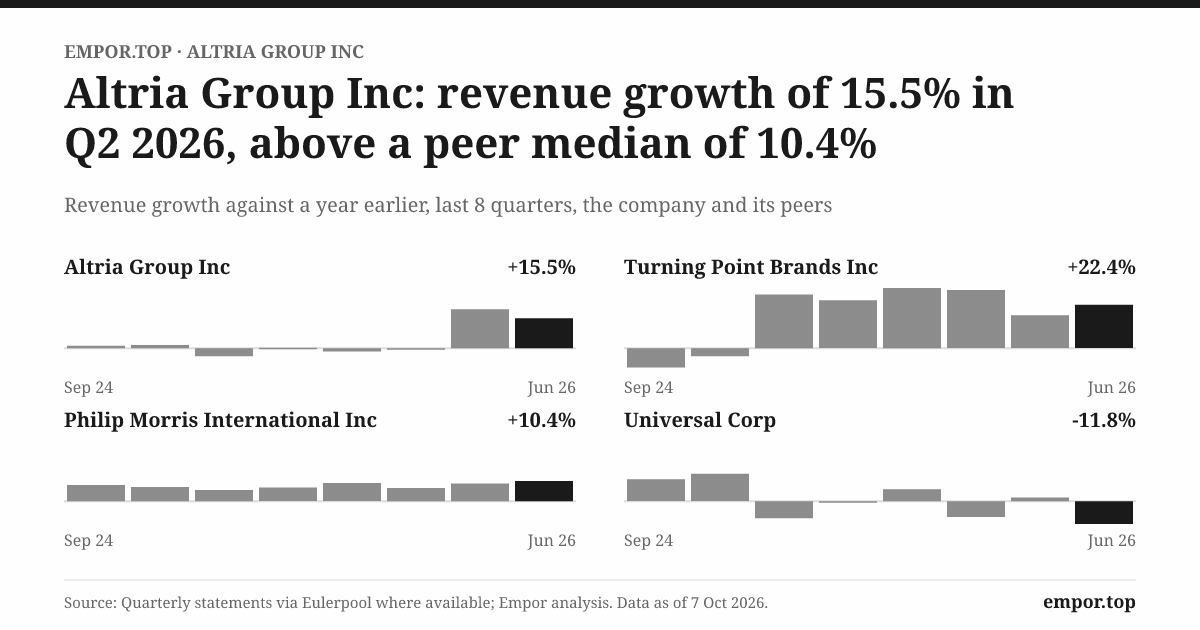
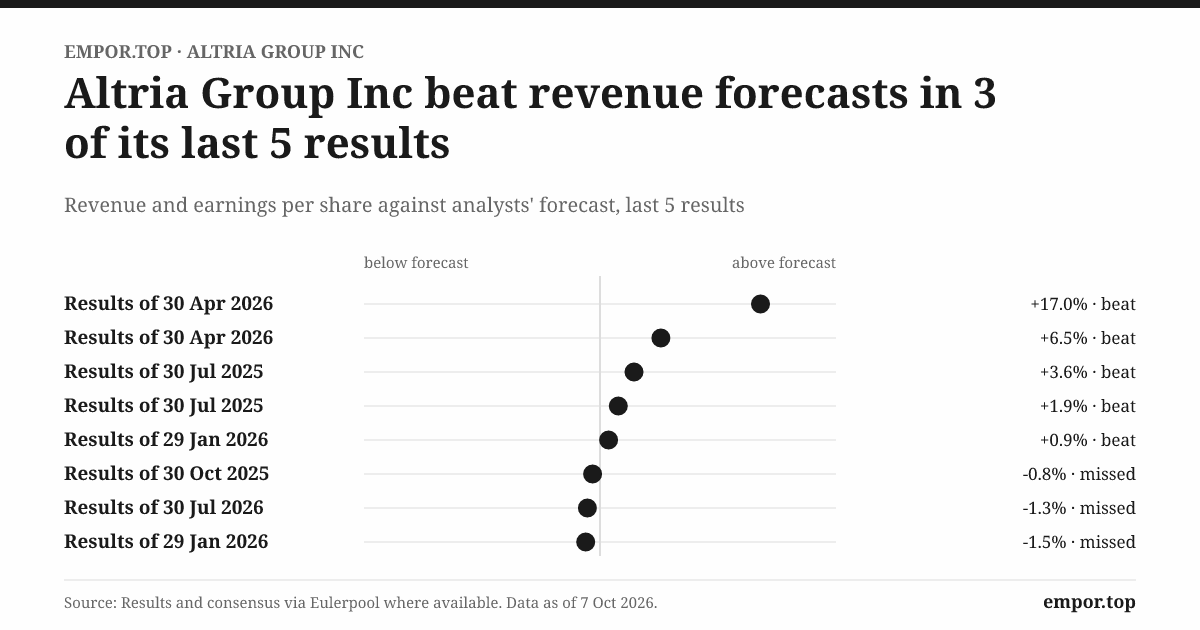
The 2026 quarters show the tension clearly. Reported revenue jumped about 15% in the June quarter to about $6.1 billion3, but operating profit fell about 3% from a year earlier3. A higher top line with a lower operating profit is a sign that revenue growth in the period came from things other than healthy volume, and that the cost side is harder to squeeze.
The verdict
The history does not reject the pricing-power thesis, but it narrows it. Marlboro can still raise prices faster than costs, and segment profit is still at a record. The narrower version of the claim is this: pricing works as long as the volume decline stays near 10% and price realization stays strong. The settling number is simple. The first full year in which smokeable segment income falls, with price unable to cover volume, would mark the turning point.
Altria's leaders understood this math long before investors began to worry. Their response in 2018 was to try to buy the future. It became one of the most expensive mistakes in modern consumer goods.
VI. The JUUL Debacle & The NJOY Impairment: A $15 Billion Capital Destruction Saga
In December 2018, Altria agreed to pay $12.8 billion for 35% of JUUL Labs, the San Francisco e-cigarette start-up14. The deal valued JUUL at about $38 billion. At that moment JUUL was the fastest-growing product in nicotine. Its sleek device, shaped like a USB drive, had taken most of the U.S. e-vapor market in under three years.
Just weeks before, Altria had shut down its own e-vapor brands, including MarkTen. It had chosen to buy the market leader instead of trying to beat it.
The panic of 2018
To understand the deal, you have to understand the fear. Vaping was spreading fast, especially among young people, and it looked like the first real threat to cigarettes in a century. Altria's internal products had failed to catch on. CEO Howard Willard, a long-time Altria executive who had come up through finance and strategy, concluded the company had to own a piece of the winner.
On paper the logic was clear. If smokers were moving to e-cigarettes, Altria should own the product they were moving to. In practice the deal was badly timed and badly structured. Altria paid a peak price at the peak of a hype cycle, with limited control over a company it did not run.
The avalanche
What followed was a near-total collapse. The Food and Drug Administration cracked down on flavored vaping products. Lawsuits poured in over JUUL's marketing to teenagers. The Federal Trade Commission challenged the deal on antitrust grounds, arguing that Altria had in effect agreed to stop competing in exchange for its stake. JUUL's sales and value fell sharply.
Altria began writing down the investment in 2019 and kept writing it down in the years that followed14. Those write-downs explain the strange net-profit figures: a net loss in 2019 and a deep slump in 2021114. In early 2023, Altria exchanged its remaining JUUL stake for a non-exclusive license to some of JUUL's heated tobacco intellectual property, booking a final loss on a stake then carried at just $250 million14. A $12.8 billion investment ended up as a patent license.
The NJOY pivot
Altria did not give up on e-vapor. In June 2023, it completed the purchase of NJOY Holdings for about $2.75 billion in cash, plus possible additional payments8. NJOY's attraction was regulatory: its ACE pod system had marketing authorization from the FDA, which most vapes in the market did not. Altria's argument was that a product the government had authorized would win once regulators cleared out illegal rivals.
The 2025 disaster
Then came another blow, this time from JUUL itself. JUUL had accused NJOY of infringing its patents. In January 2025, the U.S. International Trade Commission agreed. It issued an exclusion order and cease-and-desist orders barring the import and sale of NJOY ACE in the United States, after finding infringement of four JUUL patents110. The ban took effect on March 31, 20251. Altria appealed to the Federal Circuit.
The financial result was a pre-tax impairment of about $2.1 billion on the e-vapor business in 2025, covering both goodwill and intangible assets1. The e-vapor segment's reported revenue was slightly negative for the year and it recorded an operating loss of about $2.3 billion1. PwC, Altria's auditor, flagged the e-vapor impairment as a critical audit matter, a sign of how much judgment went into the numbers1.
There is a bitter irony here. Altria paid $12.8 billion for a stake in JUUL. JUUL then used its patents to knock out the product Altria bought to replace it.
The black market
The bigger problem was not any one rival. It was the flood of illegal flavored disposable vapes, mostly made in China, that took over much of the U.S. market while FDA enforcement lagged. These products never went through the agency's premarket review, the process known as a PMTA that every legal product must pass12. They are cheap, come in sweet flavors and are sold openly in many stores. Altria's whole e-vapor strategy assumed that regulated products would win. For several years, the unregulated market has won instead.
The verdict on capital allocation
The record here is not ambiguous. Across JUUL and NJOY, Altria committed more than $15 billion to e-vapor and has written off most of it. The one thing that went in its favor was that these were non-cash charges against cash already spent, so the dividend kept rising. But a claim that Altria's management allocates capital with discipline has to confront this history directly. On the core cigarette business, management has been excellent at extracting cash. On buying the future, its record is poor.
What the failure says, above all, is that Altria did not have the internal product engine to compete in new categories, and that buying one from outside at a peak price did not fix that. The more hopeful part of the smoke-free story lies elsewhere, in a small can of nicotine pouches.
VII. Modern Nicotine: on!, Ploom, and the Oral nicotine Battlefield
Walk into a gas station in 2025 and look behind the counter. Next to the cigarettes sits a growing wall of small round tins: nicotine pouches. They are white, tobacco-free pouches that sit under the lip and release nicotine without smoke or spitting. They have become the fastest-growing part of the American nicotine market. One brand dominates them: ZYN, made by Swedish Match, which Philip Morris International bought in 2022. Altria's answer is a smaller brand called on!
The disruption of smokeless
Pouches first hit Altria's traditional moist smokeless tobacco business. Brands like Copenhagen and Skoal had been steady earners for decades. As users switched to cleaner, more discreet pouches, Skoal in particular suffered. In 2024 Altria wrote down the Skoal trademark by $354 million1. PwC still treats the remaining Skoal trademark, valued at about $3.6 billion, as a critical audit matter, meaning there is real judgment about whether it is worth that much1.
Scaling on!
Altria's on! brand has grown steadily. By the end of 2025 it held about 8.2% of the U.S. oral nicotine category, and the business turned a profit for the full year14. That is a real milestone: the company moved from heavy discounting to a product that pays for itself. A stronger version, on! PLUS, is awaiting FDA review1.
The limitation is just as clear. ZYN holds a much larger share of the pouch market, and on!'s 8% share is a long way from Marlboro's dominance in cigarettes. on! is a foothold, not yet a franchise. For it to change the investment case, it would need to grow into a business that earns hundreds of millions of dollars a year, and Altria does not publish separate profit figures for it.
The IQOS surrender
The heated tobacco story is more painful. For several years Altria held the U.S. rights to sell IQOS, Philip Morris International's heated tobacco device, which heats tobacco instead of burning it. IQOS has become one of PMI's biggest growth engines overseas. In the U.S., its rollout under Altria was slow and limited, and patent disputes forced it off the market for a time.
In October 2022, Altria agreed to give the U.S. rights back to PMI in exchange for about $2.7 billion9. Total cash consideration ended up at about $2.8 billion, paid in 2022 and 2023, and Altria booked a pre-tax gain of about $2.7 billion when the rights transferred in April 202412. That gain is why 2024 net profit looks so high.
The cash was real and helpful. But strategically, Altria gave up the leading heated tobacco product in the world to its former sister company, which now gets to sell it to American smokers.
Ploom and Horizon
Altria's replacement is Ploom, Japan Tobacco's heated tobacco device. The two companies formed Horizon Innovations, owned 75% by Altria and 25% by Japan Tobacco, to sell it in the U.S.1 Horizon submitted its applications to the FDA, including a request to market Ploom with reduced-risk claims, in August 20251. It is still waiting.
Here the history is a warning. Altria's previous attempts to convert regulatory approval into revenue have been weak. NJOY had FDA authorization and still failed commercially. IQOS had authorization and grew slowly under Altria. Approval is necessary, but it is not the same as winning customers. Ploom should be treated as an option, not a business, until it is on shelves and selling.
The verdict
The smoke-free platform exists, but it is small and in places borrowed. on! is real and profitable, but a distant second. Heated tobacco depends on a partner's device and a regulator's timeline. Overall, the evidence leaves the claim that Altria can build a meaningful smoke-free business intact but unproven. The test is simple: on!'s share of the oral category and an FDA decision on Ploom.
All of this costs money, and the money comes from a balance sheet that is unusual in its own way.
VIII. Capital Allocation & The Balance Sheet Treasury
In March 2024, Altria sold 35 million shares of Anheuser-Busch InBev for about $2.4 billion in net proceeds7. Almost at once, it used the cash for a $2.4 billion accelerated share repurchase, buying back about 54 million of its own shares17. In one move, a stake in a brewer became a smaller share count for Altria investors.
That transaction captures how Altria uses its balance sheet. It treats the ABI stake not just as an investment, but as a reserve of capital it can draw on.
Where the beer stake came from
The ABI stake is a leftover from the conglomerate era. Philip Morris sold Miller Brewing to South African Breweries in 2002 in exchange for a large stake in the combined SABMiller. When Anheuser-Busch InBev bought SABMiller in 2016, Altria's stake became a stake in ABI. Hence the oddity of a tobacco company with two seats on the board of the world's biggest brewer1.
At the end of 2025, Altria owned about 159 million ABI shares, worth about $10.3 billion at market prices, well above their $8.3 billion carrying value1. About 125 million of those are restricted shares that must be converted before they can be sold freely1. The stake also produced about $0.5 billion of equity earnings in 20251.
The cash waterfall
The bigger picture is the cash flow. From 2014 through 2025, Altria generated about $88 billion of operating cash flow and spent only about $2.4 billion on capital expenditure12. That left about $85 billion of free cash flow. Of that, about $69 billion, or roughly 81%, went out as dividends12. Most of the rest went to buybacks, debt and the ill-fated e-vapor deals.
This is a company that returns nearly everything it earns. The dividend was $1.02 a quarter in 2025, and the board raised it to $1.06 in August 20261. The company targets paying out about 80% of adjusted earnings as dividends1.
Negative equity, explained
One number in the fact sheet looks alarming at first: shareholders' equity of about minus $3.5 billion at the end of 20251. Book value per share is negative.
This is not a sign of distress. Over decades Altria has bought back more than 1.1 billion of its own shares3. Under U.S. accounting, repurchased stock is recorded at cost as a reduction in equity. Buy back enough stock and equity goes negative, even while the business produces billions of dollars of cash a year. A business with little need for fixed assets and very steady cash flow can run this way for a long time. The negative figure reflects decades of returning capital, not a hole in the balance sheet.
The more relevant measure of risk is debt. Total debt stood at about $25.7 billion at the end of 20251. That includes €2.25 billion of euro bonds that also serve as a hedge against the currency value of the ABI stake1. Altria targets debt of about two times EBITDA1. Its credit facility requires interest coverage of at least four times, and actual coverage was above nine times1. Maturities are spread out, with about $1.6 billion due in 2026 and about $1.2 billion in 20271.
The credit agencies' verdict
The rating agencies have been notably supportive. S&P raised Altria to BBB+ in May 2025, Moody's moved its A3 rating outlook to stable in April 2025, and Fitch raised the company to BBB+ in February 20266. Fitch pointed to Altria's leading market position, strong cash flow and consistent capital allocation6. All three also named the same risks: faster volume decline, illegal vapes and setbacks in new products.
Who runs it, and how they are paid
The man now in charge of this balance sheet is the one who managed it as CFO. Bill Gifford, who had led the company since 2020, retired as CEO on May 14, 20265. Sal Mancuso took over, and Heather Newman, previously head of strategy and growth, became CFO5. Gifford receives consulting payments of $250,000 a month through the end of 2026, along with pro-rated equity payouts5.
His pay in 2025 was about $24.6 million4. Shareholders backed the pay plan with about 95% support at the 2026 annual meeting, and every director won more than 97%5. That is a governance picture with very little dissent. A skeptic might note that the same board oversaw the JUUL and NJOY write-downs without visible shareholder revolt; investors have largely judged management on dividends, not on smoke-free bets.
The verdict
The negative equity is an intentional byproduct of returning capital, and the ABI stake works as a quiet buffer that funds buybacks without hurting the credit rating. The open question is whether the next ABI sale funds more buybacks or debt reduction, and that choice will say a lot about how the new CEO sees the risk ahead.
The cash machine works. The question is how much protection the moat around it still offers.
IX. Strategic Analysis: Helmer's 7 Powers & Porter's 5 Forces
Picture a small convenience store in Ohio. Behind the register is the gantry, the rack of cigarettes and nicotine products that customers point at. Marlboro takes a big, prominent block of it. That space is not an accident. Large tobacco makers pay retailers through trade programs for placement, visibility and promotions, and the leader can pay the most.
It is a small physical picture of a big strategic question. Does Altria have durable power, or is it a fading brand monopoly living on borrowed time?
Hamilton Helmer's 7 Powers
Cornered resource. The Marlboro trademark is Altria's strongest asset. A share of around 42% that has held for decades is hard evidence that customers prefer the brand and will pay more for it1. This is the power behind the pricing engine.
Process power. Altria's distribution relationships, retail contracts and cost discipline form a real advantage. Running fewer factories with fewer people, while getting paid within days, is hard to copy. But this is mostly a power in cigarettes, and Altria has not shown it can transfer it to new categories.
Switching costs. Low between brands of cigarettes, but there is a habit effect. Smokers rarely switch from Marlboro to a rival brand, but they can and do switch to a different product type entirely, like pouches or vapes. That is the weak spot.
Scale economies. Some exist in purchasing, manufacturing and trade spending, but they matter less than the brand.
Network economies. None in any meaningful sense.
Counter-positioning. Absent, and in fact reversed. Altria is the incumbent that new entrants counter-position against. Every pouch or vape it sells risks eating into a much more profitable cigarette.
Branding. Strong, but overlapping with the cornered resource of Marlboro.
Porter's Five Forces
Threat of new entrants: very low. The MSA escrow rules, FDA premarket review and advertising limits make it very hard for a new legal cigarette maker to break in1112.
Buyer power: moderate. Two distributors account for about 42% of revenue1. That is heavy concentration. But they operate on thin margins and pay promptly, and they cannot easily stop carrying the brand that a large share of smokers ask for. Altria has recorded no significant bad-debt losses from them over the past decade1.
Supplier power: very low. Leaf tobacco comes from many growers and dealers, and Altria keeps several years of inventory to smooth out bad harvests1.
Threat of substitutes: extremely high. This is where the moat is most exposed. Pouches, legal vapes, illegal disposable vapes and heated tobacco are all competing for the same nicotine customer. The 10% annual volume decline is, in large part, the substitution force at work.
Rivalry: low to moderate. The three big makers tend to follow each other on price. Discount brands put a floor under the market, but Marlboro's share has stayed stable.
Testing the moat
The strongest evidence against the moat is the change in the volume decline rate. When the moat was at its strongest, volumes fell slowly and prices rose steadily. Now, volume is falling roughly three times faster. That points to a moat that still protects Altria against other cigarette makers, but much less against other forms of nicotine.
The fair verdict is that Altria's moat is narrower than it looks. Inside the cigarette category, it is formidable. Across the full nicotine market, it is weak, and the competitor best placed to win there is Philip Morris International, which owns both ZYN and IQOS.
That gap between a strong inner moat and a weak outer one is the source of most of the lessons this company teaches.
X. Playbook: Business & Investing Lessons
Lesson 1: Harvesting takes courage, not creativity
Altria's best decade was not one of invention. It was one of discipline: raising prices, closing costs and returning cash. Its operating margin rose by about 15 percentage points over ten years while cigarette volumes kept shrinking1. The company did best when it accepted decline and managed it. It did worst when it panicked and bought growth. The lesson for any company in a shrinking industry: in a melting market, the best returns come from managing the melt, not fighting it.
Lesson 2: A regulatory moat is also a cage
The 1998 settlement and the FDA approval process protected Altria from new rivals1112. They also slowed every attempt it made to change. NJOY had FDA authorization and still lost; Ploom waits on the regulator's calendar. Meanwhile, illegal products that ignored the rules took the market. The walls that keep competitors out also keep the incumbent in.
Lesson 3: You cannot outsource your own reinvention
The $12.8 billion JUUL deal and the NJOY write-down share a cause: Altria tried to buy what it could not build114. Both deals were made at moments of fear. Both were done without enough control over the asset or enough protection against regulatory and patent risk. Buying a transformation at the top of a hype cycle is usually an expensive way of admitting you could not build one.
Lesson 4: Hidden reserves make for calm allocators
The ABI stake let Altria take billions in write-offs, keep its credit rating and still fund a buyback17. That flexibility came from an asset most investors barely think about. A non-core stake you can sell is worth more than its dividends; it is insurance against your own mistakes.
Lesson 5: Negative book value can be a feature
Altria's negative equity scares newcomers, but it reflects decades of buying back stock at cost1. For a business with steady cash, little need for capital and a strong credit rating, accounting equity says very little. When a company returns more capital than it keeps, the balance sheet tells you about its past generosity, not its future solvency.
These lessons point straight at the question every investor in Altria has to answer: is the price right for the risks ahead?
XI. Bull vs. Bear Case & What to Watch
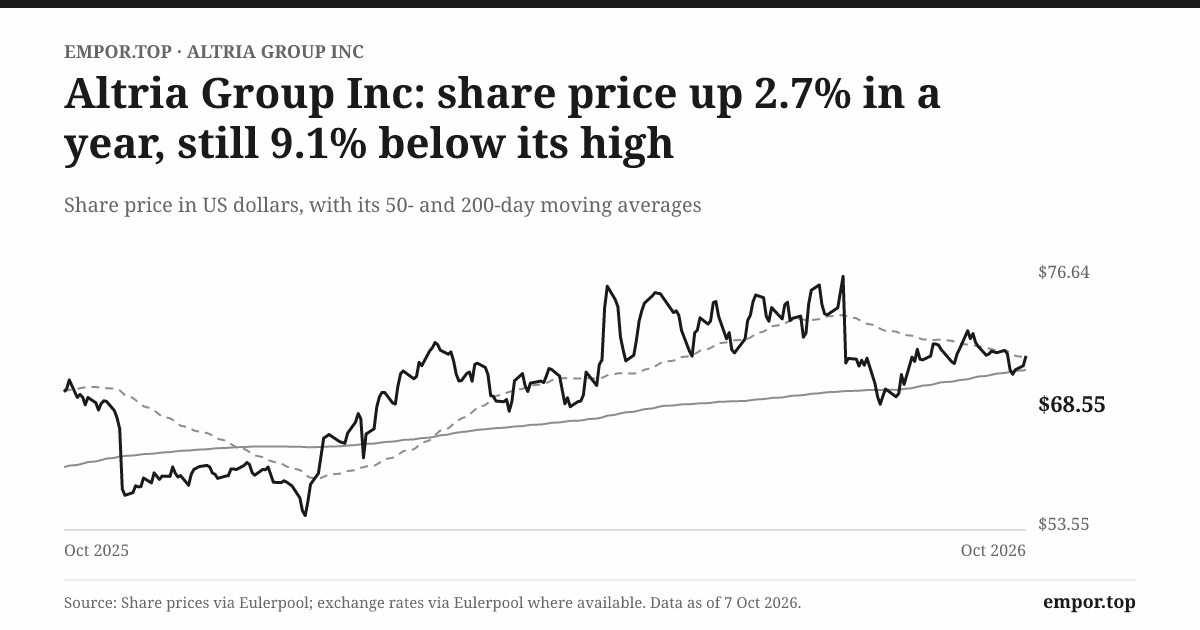
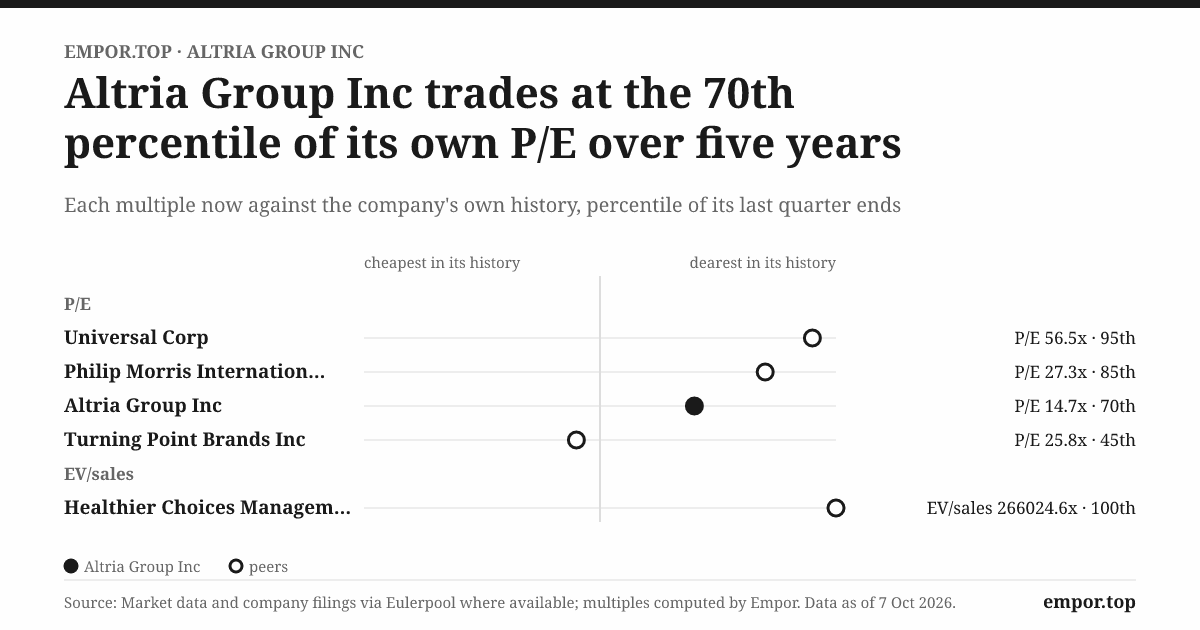
On October 7, 2026, Altria trades at about $68.55 a share1. That values the company at about $116 billion, around 14.7 times trailing earnings1. The dividend yield is about 6.3%, and the free cash flow yield about 7.1%. Philip Morris International trades at roughly 25 to 27 times earnings, with a dividend yield nearer 3%. British American Tobacco trades closer to Altria, at roughly 11 to 12 times.
The market is pricing Altria as something between a bond and a slowly shrinking annuity. It trades a bit above its own five-year median of about 13 times1, which suggests investors have grown slightly more confident, perhaps because of the credit upgrades and steady segment profits. It trades at about half PMI's multiple, which reflects PMI's growth in smoke-free products outside the U.S.
What does that price assume? Roughly, that profits stay flat or decline slowly, and that the dividend stays secure for years. It does not assume a smoke-free breakthrough, nor does it assume a collapse.
The bull case
The bull case rests on four things.
First, pricing keeps working. Net price gains continue to cover volume declines of around 8% to 10%, and smokeable segment income stays near its record.
Second, enforcement improves. If the FDA and other agencies crack down on illegal flavored vapes, some of those users could come back to legal products, including Marlboro, NJOY and on!.
Third, on! grows. A profitable pouch business with a rising share could become a meaningful second engine.
Fourth, the ABI stake funds more buybacks. With about $10 billion of value left1, another sale could shrink the share count and support earnings per share growth.
The bear case
The bear case is just as clear.
First, volume declines speed up beyond 10% to something like 12% a year, and price can no longer keep up.
Second, the NJOY ban survives appeal, leaving Altria with little presence in legal vaping.
Third, Ploom stalls at the FDA while PMI expands IQOS in the U.S.
Fourth, the margin hits a ceiling. At around 60%, there is less room to cut costs, and absolute operating profit starts to fall.
The activist's challenge
A skeptical activist would ask uncomfortable questions. Why should shareholders trust management with any more large acquisitions after JUUL and NJOY? Would the company be worth more simply returning all cash and dropping the smoke-free spending? Should the ABI stake be sold in full and the proceeds returned? And is the dividend, at roughly 100% of GAAP earnings in 20251, sustainable through a period of falling profits? None of these questions have obvious answers, but a fair reader of the record would take them seriously.
The KPIs that matter
Three numbers will tell investors most of what they need to know.
-
The gap between volume decline and price realization in smokeable products. In 2025, volume took off about $2.4 billion and price added back about $1.7 billion, with costs covering the rest1. If that gap widens, the engine is weakening.
-
Oral nicotine share. on! held about 8% of the category at the end of 20251. A steady rise would show the smoke-free strategy has real traction.
-
The ABI stake decision. Any filing to convert and sell the 125 million restricted ABI shares1 will show whether management prefers buybacks or deleveraging.
These measures point to the specific moments that will decide what happens next.
XII. Epilogue
It is October 2026 in Richmond. Sal Mancuso has been CEO for about five months. The quarterly results show a company still doing what it has always done: raising prices, cutting costs and sending cash to shareholders. Revenue is up, operating profit is slightly down, and the dividend has just been raised again13.
Three moments will shape the next chapter.
The first is the Federal Circuit's ruling on the NJOY appeal. If Altria wins, NJOY ACE could return, and the company would have an FDA-authorized vape on the market. If it loses, Altria's e-vapor strategy would be largely finished, and the $2.75 billion NJOY deal would join JUUL as a lesson in what not to buy.
The second is the FDA's decision on Ploom. Approval would give Altria a heated tobacco product to sell against IQOS. A long delay or rejection would leave the field to PMI.
The third is the fate of the restricted ABI shares. Converting and selling them would provide billions of dollars. The question is whether that money shrinks the share count or the debt.
Each outcome points toward one of two futures. In one, Altria manages a slow retreat into a mixed nicotine company, with cigarettes funding a gradual shift to pouches and heated tobacco. In the other, it becomes something simpler and starker: a pure runoff of cigarette cash, paying out as much as possible for as long as possible.
The tension in either future is the same. Every price increase proves again how powerful the Marlboro franchise is. Every year of 10% volume decline is a reminder that the franchise is shrinking underneath that power.
XIII. Outro
The story began in a London tobacco shop, where cigarettes were rolled by hand for a small group of customers. Nearly two centuries later, the company that grew from it has given away its international business, sold or spun off its beer and food empires, paid into the largest civil settlement in American history and written off billions on the products meant to replace cigarettes.
And still, in 2025, it produced about $9 billion of free cash flow1.
Altria is not a growth story, a technology story or a public health story. It is something rarer and stranger: a business that has made fewer customers more profitable every year for decades, betting that the economics of addiction will outlast the calendar of decline. The cowboy is long gone from the billboards. The cash he created is still coming in.
References
-
Altria Group, Inc. Form 10-K for the Fiscal Year Ended December 31, 2025 — SEC EDGAR, 2026-02-25 ↩↩↩↩↩↩↩↩↩↩↩↩↩↩↩↩↩↩↩↩↩↩↩↩↩↩↩↩↩↩↩↩↩↩↩↩↩↩↩↩↩↩↩↩↩↩↩↩↩↩↩↩↩↩↩↩↩↩↩↩↩↩↩↩↩↩↩↩↩↩↩↩↩↩↩↩
-
Altria Group, Inc. Form 10-K for the Fiscal Year Ended December 31, 2024 — SEC EDGAR, 2025-02-26 ↩↩↩↩↩↩
-
Altria Group, Inc. Form 10-Q for the Quarterly Period Ended June 30, 2026 — SEC EDGAR, 2026-07-30 ↩↩↩↩
-
Altria Group Notice of 2026 Annual Meeting and Definitive Proxy Statement (DEF 14A) — SEC EDGAR, 2026-04-02 ↩↩
-
Altria Group Form 8-K: Executive Succession & 2026 Annual Meeting Results — SEC EDGAR, 2026-05-18 ↩↩↩↩↩
-
Fitch Upgrades Altria to 'BBB+' on Criteria Update; Outlook Stable — Fitch Ratings, 2026-02-13 ↩↩
-
Altria Completes Sale of 35 Million ABI Ordinary Shares and Announces $2.4 Billion Accelerated Share Repurchase — Business Wire, 2024-03-14 ↩↩↩
-
Altria Completes Acquisition of NJOY Holdings, Inc. — PR Newswire, 2023-06-01 ↩
-
Altria Reaches Agreement to Receive $2.7 Billion from Philip Morris International for IQOS Rights — Altria Group, 2022-10-20 ↩
-
US ITC Issues Exclusion Order Against NJOY ACE E-Vapor Products — U.S. International Trade Commission, 2025-01-24 ↩
-
Tobacco Master Settlement Agreement (MSA) Historical Overview & Annual Payments — National Association of Attorneys General ↩↩↩↩
-
FDA Center for Tobacco Products: Premarket Tobacco Product Applications Regulatory Portal — U.S. Food and Drug Administration ↩↩↩
-
Altria Group, Inc. Form 10-K for the Fiscal Year Ended December 31, 2023 — SEC EDGAR, 2024-02-27 ↩↩↩↩↩
 LinkedIn
 WhatsApp
 Reddit
 Hacker News
 Email
 Kindle
 RSS Feed
 Spotify
 Apple Podcasts
 Amazon Music
 Audible
 YouTube