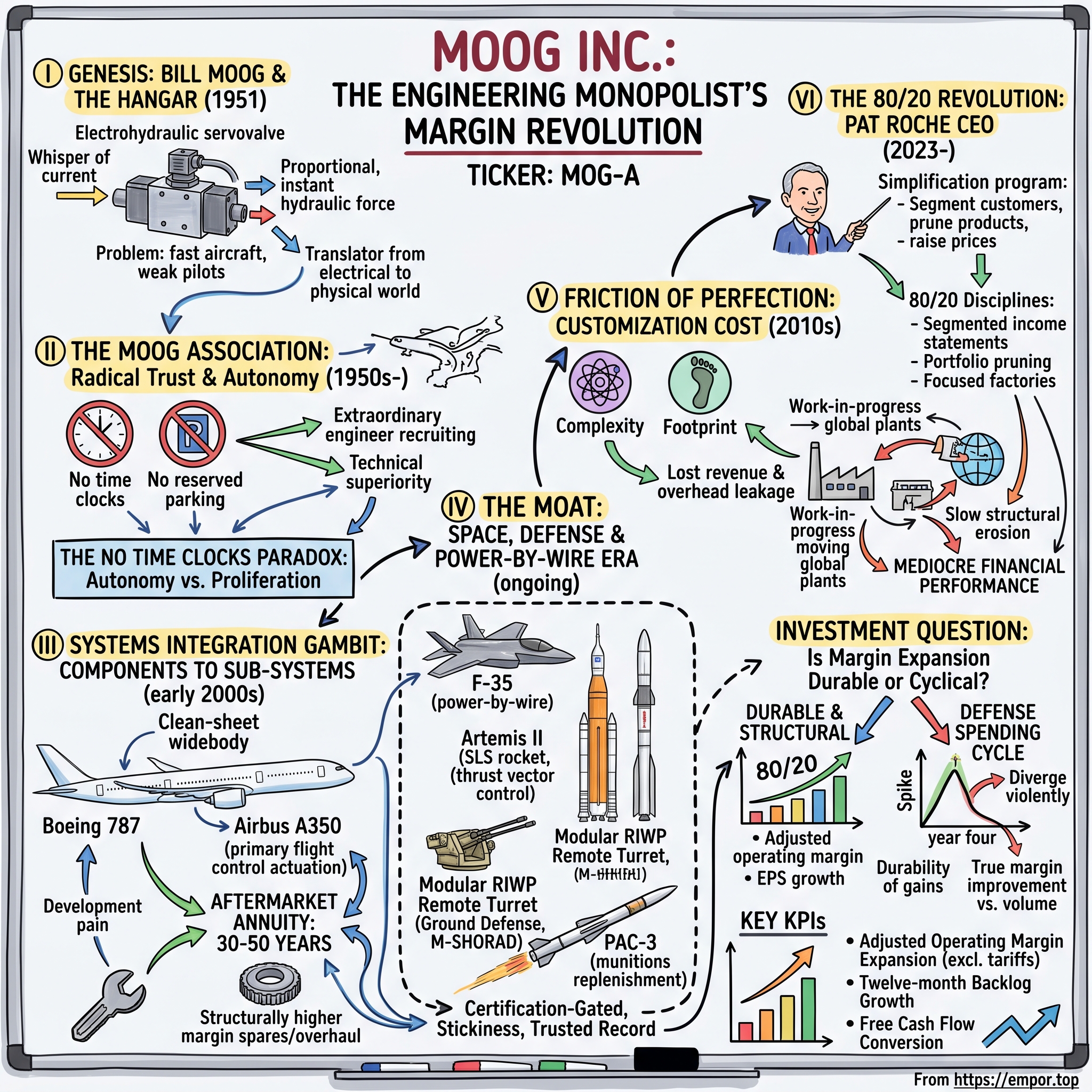
Moog Inc.: The Engineering Monopolist's Margin Revolution
I. Introduction & Episode Roadmap (00:00 - 00:10)
There is a moment, roughly four seconds before a Boeing 787 rotates off a runway, when the pilot's control column input stops being a human decision and becomes an electrical signal. That signal races down a wire, hits a box of electronics, and is translated into hydraulic force strong enough to swing a control surface the size of a garage door against a wall of onrushing air. The passenger feels nothing. The pilot feels a gentle response. In between, invisible and utterly non-negotiable, sits hardware designed in East Aurora, New York — a village of about 6,000 people twenty miles southeast of Buffalo, where the winters are long and the local company has, for seventy-five years, quietly made the machinery that moves the world's most advanced flying machines.
That company was founded in July 1951 by a 36-year-old engineer named William C. "Bill" Moog, his brother Art, and a colleague named Lou Geyer, who together pooled $3,000 and set up shop in a corner of an abandoned airplane hangar at Proner Airport.1 Seventy-five years later, Moog Inc. generated $3.86 billion of net sales in fiscal 2025 and carries a market capitalization north of $13 billion.2 Its parts sit on the F-35, the B-21 Raider's ancestors and successors, the 787, the Airbus A350, the Space Launch System that carried Artemis II around the moon, and the Patriot PAC-3 interceptors that have become the most contested industrial commodity on earth.
Here is the paradox that makes Moog worth three hours of your attention.
The same culture that produced the technology also produced the company's central financial weakness. Bill Moog built an organization on radical trust: no time clocks anywhere, including on the factory floor; no reserved parking spaces; employees called "associates." That culture attracted extraordinary engineers to a small town in Western New York and gave them the latitude to solve any customer's problem. It also meant Moog said yes — to everything. Custom servovalves for small industrial customers. Bespoke variants for low-volume programs. Hundreds of quasi-independent mini-businesses, each with its own products, its own supply chain, its own overhead. The result was world-class technology attached to persistently mediocre financial performance. For most of the 2010s, Moog's operating margins sat in the high single digits while peers with comparable technical moats earned well into the teens.
The current story — the reason this is an interesting company in 2026 rather than a well-run museum — is that Moog is trying to fix that without breaking the thing that made it special. Since Pat Roche became CEO on February 1, 2023, the company has run a systematic "80/20" simplification program borrowed from the Illinois Tool Works playbook: prune the product portfolio, consolidate factories, segment customers by profitability, and raise prices on the ones who aren't earning their keep. Between fiscal 2022 and fiscal 2025, Moog grew sales 27% while adding just 4% to headcount and reducing factory floor space by 8%.3 Adjusted operating margin, excluding tariffs, expanded roughly 110 basis points per year against a 100-basis-point commitment.
The investment question is not whether the technology moat is real. It is. The question is whether the margin expansion is durable and structural, or whether a large part of it is a defense-spending cycle wearing an operational-excellence costume. Those two things look identical for about three years. They diverge violently in the fourth.
This episode traces the arc from a servovalve patent in a rented hangar to a company now guiding to $10.60 of adjusted earnings per share and fielding questions from analysts about whether it can quadruple missile-actuator output.4 Along the way we will examine what the dual-class share structure protects and what it insulates, why free cash flow conversion has been the company's most stubborn embarrassment, and what a skeptical investor should watch to know whether the revolution is real.
It starts with a valve.
 Subscribe on LinkedIn
II. The Genesis of Motion Control: Bill Moog and the Hangar at East Aurora (00:10 - 00:25)
To understand why a valve mattered, you have to understand the problem that broke aviation in the late 1940s.
Aircraft were getting faster. As they approached the sound barrier, the aerodynamic forces on control surfaces grew beyond what a human arm could overcome through cables and pulleys. Hydraulics could supply the muscle — hydraulic fluid under pressure can move almost anything — but hydraulics were crude. They were good at "open" and "shut." They were terrible at "move exactly 3.2 degrees and hold there while the airframe shudders." Meanwhile, the emerging world of electronics, autopilots, and guided missiles was producing control signals measured in milliamps: precise, fast, and utterly powerless.
The missing piece was a translator. Something that could take a whisper of electrical current and turn it, proportionally and instantly, into hundreds or thousands of pounds of hydraulic force.
Bill Moog's answer was the electrohydraulic servovalve. The mechanism is easier to grasp by analogy than by schematic. Imagine a fire hose whose nozzle is controlled by a feather. A tiny electromagnetic coil — the "torque motor" — deflects a small flapper by a few thousandths of an inch. That deflection unbalances the pressure in two opposing chambers, which slides a much larger spool valve, which routes high-pressure fluid to one side of an actuator or the other. Amplification of energy on the order of thousands to one, with response times measured in milliseconds and positioning accuracy measured in fractions of a percent. It is the hinge between the electronic world and the physical one.
The founding was as unglamorous as the invention was elegant. With $3,000 in capital and a corner of a disused hangar, the founders had no cash to buy machined parts. Bill Moog had to persuade local Western New York machine shops to fabricate components on speculation, effectively borrowing working capital from his suppliers because no bank would lend it.1 The first order came from Bendix Aviation: four valves. Modest — but Bendix was a serious aerospace name, and the endorsement mattered. Boeing and Convair followed with larger orders, and by the mid-1950s the servovalve had become the enabling component of a generation of guided missiles, supersonic aircraft, and automated industrial machinery.1
Two things about this origin matter for the company that exists today.
The first is the nature of the product. A servovalve is not a commodity. It is a precision instrument built to tolerances of millionths of an inch, and its failure mode is catastrophic. That combination — small dollar value, enormous consequence — creates an unusual economic structure. The customer is intensely price-insensitive relative to the risk, and intensely reluctant to change suppliers. Every aerospace business Moog has built since is a variation on that same theme.
The second is the geography. Moog did not move. Seventy-five years later, East Aurora remains global headquarters, and the company keeps investing there: in fiscal 2025 it built a dedicated hands-on training center on the East Aurora campus for machinists and assembly-and-test operators, with financial support from the U.S. Navy's Maritime Industrial Base program.3 That is a small detail with a large implication. In an era when precision machining talent is the binding constraint on defense production, Moog's decision to concentrate rather than disperse its craft workforce looks less like sentimentality and more like a supply-chain asset.
There is a third element, easy to overlook, that shaped the company's economics for the next seventy years: Moog's first customers were not end users. Bendix, Boeing and Convair were integrators, and Moog's product was buried inside their systems. The company therefore never developed a consumer brand, never controlled a distribution channel, and never had pricing leverage derived from customer intimacy in the retail sense. Everything it earned, it earned from being technically irreplaceable inside somebody else's product. That is a specific and unusual kind of business, and it explains a great deal about the company's later behavior — including its willingness to accept punishing contract terms in exchange for design-in position, and its reluctance, for decades, to press the pricing advantage it had actually accumulated.
The servovalve itself never went away — it evolved. The same underlying discipline of translating electrical intent into precisely controlled motion produced electrohydrostatic actuators, or EHAs, which package a small pump and motor inside the actuator itself so it carries its own hydraulic power, and electromechanical actuators, which dispense with fluid entirely.5 Every major program in the modern Moog portfolio is a descendant of the 1951 patent.
What Bill Moog built next, though, was not a product. It was a management philosophy — and it turned out to be both the company's greatest recruiting asset and the root cause of its financial underperformance for the following four decades.
III. The Moog Association: A Culture of Mutual Trust and the "No Time Clocks" Paradox (00:25 - 00:40)
Walk into a Moog manufacturing facility and count the time clocks. There aren't any.
This is not a cost-saving measure or a modern HR fashion. It dates to Bill Moog's founding conviction that the industrial hierarchy of his era — foremen, punch cards, differentiated parking, executive dining rooms — was a machine for extracting compliance from people who were capable of far more if simply left alone. He called employees "associates." He removed reserved parking. He built a set of stated values that read less like a corporate poster and more like a working philosophy: trust is a must, it's my job, formality doesn't help.
For an engineering company, this was an extraordinary competitive weapon, and it is worth being precise about the mechanism rather than romantic about it. Moog was headquartered in a small town in a cold corner of New York State, competing for the same aerospace engineers as firms in Southern California, Seattle, and Toulouse. It could not win on climate, salary, or urban amenity. What it could offer was autonomy — the promise that a good engineer would be handed a hard problem and not be managed while solving it. That trade proved durable enough that Moog was still ranked among the top 100 large U.S. employers by Glassdoor in its 2026 Best Places to Work list, and picked up the inaugural Business of the Year award from the Buffalo Niagara Partnership.4
The evidence that this culture produced technical superiority is not merely anecdotal. Customer supplier awards are a reasonable, if imperfect, proxy for whether a supplier is genuinely differentiated, because primes hand them out sparingly and tie them to hard metrics. In fiscal 2025 and the first half of fiscal 2026, Moog collected a Lockheed Martin supplier award for 100% on-time delivery over twelve months on the PAC-3 missile program, a BAE Systems Gold Supplier of the Year award citing 100% quality and 100% on-time delivery, CAE's Crystal Excellence Award, Embraer's Supplier of the Year for mechanical systems, and General Dynamics Land Systems' Supplier of the Year for Technology and Innovation.346 That is an unusual concentration of recognition across four unrelated customer types — a defense prime, a European defense firm, a simulation company, and a Brazilian airframer.
Now the paradox.
A culture built on "trust the engineer closest to the customer" produces one predictable behavior at scale: the engineer says yes. A customer with an odd requirement gets a custom design. A low-volume industrial application gets elite engineering hours it cannot possibly repay. Decentralized authority means nobody in the middle of the organization has the standing — or the data — to say this variant destroys value. Over decades, Moog became a federation of hundreds of small businesses, each locally rational, collectively expensive.
The financial signature of this is unmistakable in the historical record: revenue that compounded respectably, gross margins that were fine, and operating margins that leaked away into overhead, engineering cost, and the friction of moving work-in-process between dozens of plants. As Roche has described it on recent calls, Moog's own manufacturing and supply chain network for commercial aircraft was "complex and dispersed across multiple global locations," with every transfer between plants adding cycle time, buffer stock, and work-in-progress.3
The honest analytical framing is that Moog's culture and its complexity were not separate phenomena. They were the same phenomenon viewed from the engineering side and the accounting side. Which raises the central tension of the modern story: any program that attacks the complexity is, by construction, also attacking the autonomy. Management insists the two can be separated. That claim is testable, and we will test it.
Before the complexity became a problem worth solving, though, it first had to become dramatically worse — which is exactly what happened when Moog decided to stop selling parts and start selling systems.
IV. The Systems Integration Gambit: From Components to the Boeing 787 & Airbus A350 (00:40 - 01:00)
In the early 2000s, the commercial airframe manufacturers changed the rules of their own supply chains.
Boeing's 7E7 program — later the 787 Dreamliner — was conceived not just as a composite airplane but as a new industrial model. Rather than buying thousands of discrete components and integrating them itself, Boeing would buy complete subsystems from Tier 1 partners who took responsibility for design, qualification, software, certification support, and schedule. The airframer would become an integrator of integrators. Risk, capital, and engineering headcount would migrate down the chain.
For a company like Moog, this was simultaneously the largest opportunity and the largest threat in its history. The threat: if someone else became the flight control systems integrator, Moog would be reduced to selling that integrator components — a commodity role, one tier further from the customer, with the value capture happening above it. The opportunity: if Moog won the integrator role, it would own the entire actuation architecture of a clean-sheet widebody for the life of the program.
Moog bid, and on May 19, 2004 announced a long-term agreement with Boeing Commercial Airplanes to supply the primary flight control actuation system for the 7E7 — controlling all primary flight control surfaces, the spoilers, and the horizontal stabilizer.7 It was, in the truest sense, a company-making bet.
Airbus followed. For the A350 XWB, Moog was selected to provide design, integration and certification support for primary flight control actuation, supplying 27 discrete actuators plus associated control electronics — a mix of conventional electrohydraulic units and advanced electrohydrostatic actuators driving the ailerons, elevators, rudder and spoilers — along with the trailing edge actuation system including the power control unit, geared rotary actuators, gearboxes and wing tip brakes.5 The A350's architecture is worth pausing on, because it explains why EHA technology mattered strategically and not just technically. Traditional aircraft route hydraulic lines from centralized pumps to every control surface — heavy, complex, and vulnerable, since a severed line can disable multiple surfaces. An EHA is self-contained: it receives electrical power and generates its own hydraulic pressure locally. Fewer plumbing runs, less weight, better damage tolerance. The A350 became the first commercial aircraft designed to remain controllable after total hydraulic failure, precisely because a subset of its actuators carried their own power.
Then came the hard part, and it lasted the better part of a decade.
Systems integration on a clean-sheet program is a working-capital furnace. Moog absorbed enormous non-recurring engineering expense before a single production unit shipped. The 787 program slipped repeatedly. Fixed-price structures meant that schedule delays and specification churn landed largely on the supplier's income statement, not the customer's. The 2008–2010 window compounded it: development cash burn at exactly the moment credit markets seized. Moog's margins compressed and its balance sheet carried deferred development costs that would take years to recover.
Why do it anyway? Because of what happens after certification.
Once a flight control actuation system is qualified on an airframe, it is effectively welded there. Substituting a different supplier's actuator means re-running structural loads analysis, flight control law validation, failure mode analysis, environmental qualification, software verification to the relevant design assurance level, and flight test — a multi-year, multi-hundred-million-dollar program that no airframer will undertake to save a few percent on component cost. The switching cost isn't a preference; it's an aviation-authority certification problem.
What Moog bought with a decade of margin pain was a thirty-to-fifty-year annuity: original-equipment shipments for as long as the airframe is produced, and a spares-and-overhaul stream for as long as the fleet flies. And the aftermarket carries structurally higher margin than the OE work — management has been explicit that commercial aftermarket is more profitable than the OE portion of that segment.3 Moog has locked in decade-scale service agreements with major operators of the platforms, including a ten-year support contract renewal with All Nippon Airways for its Boeing 787 fleet announced in 2025, and a long-term support contract with Japan Airlines for its 787 fleet.89
The evidence that the bet paid is visible in the fiscal 2025 numbers: Commercial Aircraft sales grew 15% year over year to roughly $904 million, driven by widebody production ramps and aftermarket volume tied to strong fleet utilization on the 787 and A350.3 That is the annuity arriving, twenty-one years after the contract was signed. It is also a warning about the cost of entry: this is a business where the payback period is measured in decades, which is precisely why so few competitors exist.
The same logic — endure the development pain, own the platform forever — is what built the defense franchise. Except in defense, the platforms don't retire after twenty-five years. They get upgraded for fifty.
V. The Moat: Space, Defense, and the Power-by-Wire Era (01:00 - 01:25)
On the Q2 fiscal 2026 earnings call in April 2026, Pat Roche opened not with financials but with a mission. Artemis II had launched and returned NASA astronauts safely from a trip around the moon. Moog hardware was on the launch platform gantry actuation, on thrust vector control for all stages of the SLS rocket, and in control systems inside the Orion spacecraft.4 Roche noted that Moog hardware has flown on Mercury, Gemini, Apollo, Space Shuttle and now Artemis — and, in a line worth remembering, that a piece of Moog hardware flies into space roughly every week.
That is the defense and space business in one anecdote: unglamorous, deeply embedded, and almost impossible to displace.
Military Aircraft — the F-35 and the power-by-wire architecture. Moog was selected by Lockheed Martin as system integrator for the primary flight control actuation system and the leading edge flap actuation system on all three variants of the F-35, and also supplies the wingfold actuation system for the carrier variant.10 The F-35's flight control architecture is the aggressive version of what the A350 did partially: a genuine power-by-wire system in which self-contained electrohydrostatic actuators position the primary flight surfaces, remote electronic control units drive them, and electrically driven power drive units handle the maneuvering leading edge flaps.10 Eliminating the centralized hydraulic loop removes weight, removes a large network of fluid lines that are attractive targets and single points of failure, and simplifies the signature-managed airframe. For a stealth fighter, fewer penetrations and fewer runs of high-pressure plumbing is not a convenience — it is a survivability and observability requirement.
Moog's continuity in this domain runs back through the original Northrop B-2, and the company is understood to have content on the B-21 Raider. The specifics of that work are classified and Moog does not disclose them; investors should treat B-21 content as real but unquantified rather than as a modeled revenue line.
The near-term Military Aircraft story in fiscal 2026, though, is not the F-35. It is the MV-75 — the U.S. Army's Future Long-Range Assault Aircraft program with Bell. Activity on MV-75 ramped hard enough that Moog reached what management characterized as peak engineering-and-manufacturing-development activity a full quarter earlier than planned, and Roche confirmed that Bell and the government are in active discussions about pulling flight and early production forward.4 Military Aircraft sales in Q2 fiscal 2026 rose 10% year over year to $235 million, with segment operating margin up 170 basis points to 13.7%.4
Space and Defense — now the largest segment. At roughly $1.11 billion of fiscal 2025 net sales, Space and Defense is Moog's biggest business and the fastest-growing.23 It spans in-space propulsion and satellite components, thrust vector control on launch vehicles, missile control actuation, and ground vehicle weapon systems.
Two growth vectors dominate.
The first is missiles. Moog's missile controls business exceeded $200 million in fiscal 2025, was growing at roughly 20% annually, and management guided it above $250 million for fiscal 2026.6 Its exposure is deliberately broad — PAC-3, PAC-2, FAD, Standard Missile 2, Standard Missile 3, Standard Missile 6, Tomahawk and others — which matters because it makes the business a bet on munitions replenishment generally rather than on any single program surviving a budget cycle. In the first quarter of fiscal 2026 Moog booked over $100 million of additional PAC-3 orders on top of a comparable order a year earlier, plus over $50 million across PAC-2 and FAD.6 Roche disclosed something more interesting than the order size: part of the PAC-3 award was a takeaway from a competitor, won on the strength of 100% on-time, 100% quality delivery performance in an environment where primes cannot find capacity.4 That is the clearest available evidence that operational execution, not just incumbency, is currently winning share.
The second is ground defense. The Reconfigurable Integrated-weapons Platform, or RIwP, is a modular remote turret. Rather than a fixed weapons fit, it accepts different combinations of guns, missiles and sensors on a common stabilized mount — think of it as a weapons dock rather than a weapons system. Moog's RIwP was selected as the centerpiece of the mission equipment package for the U.S. Army's M-SHORAD program built on the Stryker A1 platform, now fielded as the SGT Stout.1112 In fiscal 2025 Moog secured an order equipping the fifth of the Army's eight planned battalions, extending the production horizon through 2027.3 At AUSA 2025 the company unveiled a Lightweight RIwP aimed at the Army's M-SHORAD Increment 4 requirement for light formations.13 The strategic logic is straightforward: cheap drones and cruise missiles have made short-range air defense the fastest-growing gap in Western ground forces, and a modular turret that can be reconfigured as threats evolve is worth more than a purpose-built one.
The third vector is space itself, and it is quietly changing character. Moog's exposure spans both ends of the industry: thrust vector actuation on launch vehicles, and components and avionics on the satellites those vehicles carry. In the first quarter of fiscal 2026 the company booked a new space vehicle contract worth over $100 million for its existing Meteor satellites — a follow-on order, which in the satellite business is the meaningful signal, since it means the first batch performed.6 Moog has been expanding capacity at Plant 27 on the East Aurora campus specifically for launch vehicle avionics and actuation.4 Roche's framing on the Q2 call is worth noting for what it implies about demand mix: with space now described across the industry as a warfighting domain, defense customers are driving satellite demand alongside commercial launch. That is a different, less cyclical buyer than the commercial constellation market that dominated the late 2010s.
Moog is also extending geographically and into new-entrant customers — winning a position on future guided multiple launch rocket system production in Australia with Lockheed Martin, described as the first geographic expansion of its missiles business, and supplying flight control and actuation products to Kratos for the XQ-58 Valkyrie and BQM-177 as the collaborative combat aircraft market emerges.3 The Kratos relationship is a small revenue line today but a genuinely interesting strategic tell. Collaborative combat aircraft are meant to be cheap, semi-attritable, and produced in volume — the opposite of the exquisite, cost-insensitive programs Moog was built around. Winning content there requires the company to deliver "fit-for-purpose" hardware at a price point its traditional culture would have found uncomfortable. Roche cited another example on the fiscal 2025 year-end call: Moog's ball and roller screw operation in Bergamo, Italy produced eight prototypes within a year for an industry disruptor applying roller screws in an extremely demanding new environment.3 Whether Moog can serve fast-moving, price-sensitive new entrants without diluting its economics is an open question — but the fact that it is trying, rather than dismissing them, is a meaningful change from the historical posture.
The barriers. What actually keeps competitors out is not the mechanical design. It is the stack behind it: flight-critical software developed to the highest design assurance levels, qualification test campaigns spanning temperature, vibration, altitude, salt fog, electromagnetic interference and lightning, security clearances and facility accreditation, and — most brutally — the demonstrated ability to deliver at 100% on-time and 100% quality for years without a single escape. A well-funded startup can build a good actuator in three years. It cannot build a fifteen-year delivery record.
That moat is genuine. The uncomfortable part of the Moog story is that for most of the company's history, it did not translate into commensurate profits.
VI. The Friction of Perfection: The Structural Cost of Customization (01:25 - 01:40)
Here is the autopsy question. If Moog holds near-monopoly positions on flight-critical systems with certification-grade switching costs, why did it spend most of the 2010s earning single-digit operating margins?
The answer is not pricing power. Moog had pricing power and mostly declined to use it. The answer is that the company was carrying a cost structure built by a thousand individually defensible decisions.
Complexity as a hidden tax. Consider what happens when a decentralized engineering organization is rewarded for solving customer problems. A small industrial customer needs a servovalve that runs at an unusual pressure with an unusual mounting interface. The local team designs it. That variant now requires its own drawings, its own tooling, its own qualification file, its own inventory item, its own supplier relationships, its own service documentation, and — forever — a slice of engineering attention every time a component goes obsolete. The revenue from that variant might be a few hundred thousand dollars a year. The lifetime cost of carrying it is not on any P&L line an executive can see. Multiply by thousands.
Crucially, none of this shows up as a scandal. There is no bad quarter, no write-off, no failed program. It shows up as a slow, structural erosion — the difference between the margin the technology deserves and the margin the company actually earns.
The footprint problem. The second tax was physical. Moog operated dozens of manufacturing facilities globally, and — this is the part that surprised even sympathetic analysts — routinely moved work-in-process between them. A commercial aircraft line-replaceable unit might have components machined in one country, sub-assembled in a second, tested in a third. Each handoff added transit time, buffer inventory, quality-hold risk, and paperwork. Roche has described this directly: every transition from one plant to another adds cycle time to the cash conversion cycle and adds buffer stocks and work-in-progress.3
The financial consequence is visible today in a metric Moog cannot yet fix. On trailing twelve-month figures the company's cash conversion cycle runs near 200 days, with days of inventory outstanding above 110 and days of sales outstanding above 125.2 That is not a working capital profile you would design. It is one you inherit.
Fixed-price exposure. The third tax was contractual. Development contracts in both defense and commercial aerospace are frequently fixed-price, which means the supplier absorbs cost inflation between bid and delivery. In a low-inflation decade this is an acceptable risk. In 2021–2023, with raw material and labor costs spiking and supply chains fracturing, it became a margin sink. It also created a second-order problem: because Moog's supply agreements locked purchase orders with fixed quantities and delivery dates as much as eighteen months in advance, the company absorbed its customers' demand variability rather than passing it through. Moog was, in effect, providing free demand insurance to both sides of its value chain.
The tariff exposure is the modern version of the same vulnerability. Because the Commercial Aircraft business runs a global manufacturing and supply chain network — with a major facility in Baguio, the Philippines, and flows in and out of Europe — it is disproportionately exposed to trade policy. Section 232 tariffs on steel and aluminum hit material moving in and out; aftermarket units returning from airlines around the world attracted duties when carriers failed to complete bonded-area paperwork correctly.6 In fiscal 2026 tariffs are costing Moog roughly 110 basis points of consolidated adjusted operating margin, and in the first quarter alone tariffs took about 300 basis points off Commercial Aircraft segment margin.46 The mitigations Roche described are revealing in their granularity: rerouting a supply chain so that a Belgian supplier's product moves through a U.K. facility to a French customer without ever entering the United States, saving single-digit millions.6 Useful — but it is also an admission of how much unnecessary complexity was in the network to begin with.
Myth versus reality: three consensus beliefs worth checking.
Myth: Moog's low margins were the price of its no-time-clocks culture. Reality: the culture was upstream of the complexity, not identical to it. The costly behavior was unmanaged product proliferation and an unrationalized footprint — both of which can be attacked with data and portfolio discipline without touching the autonomy that attracts engineers. The evidence that these are separable is that Moog has now run three years of aggressive simplification while simultaneously being named to Glassdoor's top-100 large U.S. employers list for 2026 and collecting supplier-of-the-year awards for delivery performance.4 That is not proof the trade-off is zero, but it falsifies the strong version of the claim.
Myth: Moog is a defense company. Reality: in fiscal 2025, Space and Defense and Military Aircraft together were roughly 52% of sales, with Commercial Aircraft and Industrial making up the balance.23 The four segments have converged toward roughly a billion dollars each. Moog is a diversified precision motion control company with a large defense exposure — which matters for how an investor should think about correlation. Its Industrial and commercial aftermarket businesses do not move with the defense budget cycle, and its industrial motion business does not move with aerospace at all.
Myth: the operating margin recovery is simply pricing. Reality: on management's own attribution, simplification contributed roughly as much margin benefit in fiscal 2025 as pricing and volume growth combined.3 The check on that claim is the physical evidence — headcount and floor space — which is not something a pricing action produces.
So what does this mean for an investor? It means the pre-2023 Moog was not a company with a weak business. It was a company with an excellent business and a self-inflicted cost structure. That distinction matters enormously, because the first is very hard to fix and the second, in principle, is not. Fixing it required somebody willing to tell a proud engineering organization that some of what it was proud of was destroying value.
VII. The 80/20 Revolution: Pat Roche and the Turnaround of an Engineering Monopolist (01:40 - 02:05)
John Scannell had run Moog since 2011. On February 1, 2023, he stepped back to Non-Executive Chairman and handed the CEO role to Pat Roche, the executive who had been running the Industrial segment — which is to say, the messiest, most fragmented, most complexity-afflicted part of the company.14
That detail is the whole thesis in miniature. Moog did not hire an outside operator to impose discipline. It promoted the person who had spent years living inside the worst of the problem. Roche arrived knowing exactly where the bodies were buried, because he had been the one tripping over them.
The methodology. At its 2023 Investor Day, management introduced 80/20 — the operational discipline most famously institutionalized at Illinois Tool Works. The premise is deceptively simple: in any business, roughly 20% of customers and products generate roughly 80% of the profit, while the remaining 80% consumes a disproportionate share of overhead, engineering, floor space and management attention. The work is to find out which is which — and then act on the answer, which is the part most companies flinch from.
At Moog the machinery of this is unglamorous and specific:
Segmented income statements. Rather than reporting profit at the business-unit level, Moog now produces P&Ls sliced by customer and product line, so that a loss-making variant cannot hide inside a profitable division's average. By the end of fiscal 2025 these were, in management's description, widely used across the organization and driving decisions.3
Portfolio reviews and pruning. Reviews run at site, business unit and division level, and they produce exits. Moog divested two Industrial businesses at the start of fiscal 2025 — the reason Industrial sales declined 4% that year despite underlying growth.3 It sold a Navaids business earlier, freeing space in the Salt Lake City facility. It divested helicopter emergency flotation and evacuation slide product lines. It sold the S-TEC Model 3100 general aviation autopilot product line to Innovative Aerosystems, a deal that closed on February 23, 2026 with financial terms not disclosed.15 And in the second quarter of fiscal 2026 it exited the general aviation avionics market entirely, via IP licensing plus a last-time buy for customers.4 That exit is notable because it effectively unwinds the Genesys Aerosystems acquisition Moog completed in December 2020 — an honest, if quiet, admission that the general aviation adjacency did not fit.16
Focused factories. Rather than plants that make many things adequately, Moog is consolidating toward facilities aligned to a single end market with simplified flows and fewer non-value-added handoffs. The company invested in a new Philippine facility at Clark to absorb inbound transitions and vertical integration supporting its focused factory at Baguio for commercial flight control systems.4 The dividend runs in two directions: cycle time on transferred parts drops substantially, and floor space is released inside domestic U.S. defense facilities that urgently need room to grow.
Supplier restructuring. Moog is shifting suppliers off fixed long-dated purchase orders and onto rolling forecasts with a short fixed commitment window — a change that redistributes demand-variability risk more equitably and is roughly two-thirds complete as of early 2026.6 It has also appointed a fourth-party logistics coordinator to manage nearly 30% of its suppliers, all transactional ones.4
Pricing. Pricing reviews now happen continuously at every organizational level, informed by the segmentation analysis. The framing management uses — ensuring Moog is "fairly compensated for the value we create" — is corporate-speak for something concrete: customers who were receiving custom engineering at commodity prices are now being asked to accept standard products or pay accordingly.
The proof points, and how much they actually prove. Between fiscal 2022 and fiscal 2025, Moog grew sales 27% while headcount rose just 4% and factory space fell 8%.3 Adjusted operating margin expanded roughly 110 basis points annually excluding tariffs — 330 basis points cumulatively — against the 100-basis-point Investor Day commitment. Sales grew at an 8% CAGR versus a lower expectation, and adjusted EPS compounded at 16%, meeting the target.3 Fiscal 2025 closed with adjusted operating margin of 13.0%, adjusted EPS of $8.69 (up 11%), and record fourth-quarter results including the first quarter in company history above $1 billion of sales.3
The single most persuasive data point is Roche's disclosure that in fiscal 2025, simplification initiatives delivered margin benefits roughly equal to pricing and volume growth combined.3 If that attribution is accurate, roughly half the margin improvement is structural and would survive a demand downturn. That is the difference between a cyclical story and a franchise story.
The appropriate skepticism: that attribution is management's own, it is not independently auditable, and it arrives during the strongest defense and commercial aerospace demand environment in two decades. Volume leverage and structural improvement are extremely difficult to separate when volume is surging. The honest position is that the evidence is genuinely encouraging — the headcount and floor-space figures are hard numbers, not narrative — and that the real test comes when growth slows.
Two credibility marks worth noting, one good and one not. In the good column: Moog set specific multi-year targets in 2023 and has largely hit or beaten them, and when it missed — free cash flow conversion at 46% in fiscal 2025 against a 75–100% target — management said so plainly rather than redefining the metric.3 On the Q4 call, Mike Ciarmoli of Truist pressed directly on why anyone should believe the 60% conversion guidance after "a couple of downward revisions" the prior year; Jennifer Walter answered with specific mechanisms already executed rather than assurances.3 That is the kind of answer that builds credibility over time.
In the not-good column: in the fourth quarter of fiscal 2025 Moog disclosed an accounting error relating to a group of Commercial Aircraft aftermarket contracts, revising prior periods and increasing net earnings per share by $0.13 in fiscal 2023, $0.05 in fiscal 2024, and $0.06 in the first nine months of fiscal 2025.3 The amounts are small and the direction was favorable, which is why it drew almost no analyst attention. But an error in revenue recognition on long-cycle aftermarket contracts, discovered internally at year-end, is exactly the category of control weakness an investor should note and monitor rather than dismiss — particularly at a company where percentage-of-completion and cost-to-cost accounting judgments materially influence reported segment margins.
Incentives. Roche's fiscal 2025 compensation totaled approximately $5.6 million, of which roughly $1.09 million was salary, $1.25 million was bonus, and just over $3.06 million was stock — with long-term awards structured as performance-based restricted stock units tied to multi-year sales and margin goals.17 Moog's guidelines require the chief executive to hold stock worth at least five times annual salary, with a five-year window to comply.17 The alignment is real, though it is worth noting the obvious: paying a CEO on margin expansion during a period when he is also the one defining which charges are "adjusted out" creates a tension that boards are supposed to police.
That tension is more consequential at Moog than at most companies, because of who elects the board. But before governance, the segments.
VIII. Competitive Landscape & Segment-by-Segment Deep Dive (02:05 - 02:30)
Moog reports four segments, and by fiscal 2025 they had converged to a strikingly balanced shape — roughly a billion dollars each. That balance is not an accident of history; it is the outcome of deliberately shrinking the sprawling parts while growing the concentrated ones.
Commercial Aircraft — $904 million in fiscal 2025, adjusted operating margin 12.4%. This is the 787/A350 annuity plus narrowbody content plus a growing aftermarket. Fiscal 2025 sales grew 15%, the fastest in the portfolio, split between widebody production ramps and aftermarket strength.3 Management guided the segment to roughly $1.0 billion in fiscal 2026 on continued rate increases across narrowbody and widebody programs plus secured price increases.3 Segment margin, however, is the portfolio's problem child, guided down 90 basis points for fiscal 2026 to 11.5% — entirely because of tariffs. Excluding incremental tariff pressure, management projected the segment would have expanded 60 basis points.3 The Q1 fiscal 2026 result of 10.6% was the low-water mark, with tariffs alone accounting for about 300 basis points.6
There is a second, more subtle dynamic worth understanding. On the Q2 fiscal 2026 call, Moog cut Commercial Aircraft sales guidance by $20 million while raising every other segment.4 Gautam Khanna of TD Securities pushed on this — was demand weakening on the A350 or 787? Walter's answer was that the reduction was entirely Moog's own decision to slow incoming material receipts on certain narrowbody platforms, which under cost-to-cost accounting mechanically defers revenue and operating profit, while benefiting cash flow by the same amount.4 This is an important disclosure and a genuinely unusual one: a company deliberately reporting lower sales in order to improve working capital. It is defensible — arguably admirable — but it also illustrates how much reported Commercial Aircraft revenue is a function of input timing rather than customer demand, which investors should hold in mind when reading the segment line.
The China question. Moog was selected by 中国商用飞机有限责任公司 Commercial Aircraft Corporation of China, Ltd. (COMAC) as the high lift system supplier for the C919, covering flap and slat actuation, pilot interfaces, electronic controls, power drive units, wing tip brakes and gearboxes — with the work executed in cooperation with 庆安集团有限公司 Qing'an Group Co., Ltd., a subsidiary of 中国航空工业集团 Aviation Industry Corporation of China (AVIC).18 In the first quarter of fiscal 2026, a multi-year C919 order formed a substantial part of the record $2.3 billion bookings quarter, with roughly half of total bookings coming from Commercial Aircraft.6
The strategic read is genuinely two-sided. On one hand, C919 gives Moog a position on what may become a high-volume narrowbody platform, with the same certification-driven stickiness as its Western programs. On the other, Chinese aerospace policy is explicitly oriented toward supply-chain self-reliance, and flight control actuation is precisely the category of high-value subsystem that industrial policy targets for localization. A joint venture structure with an AVIC subsidiary accelerates market access and simultaneously accelerates capability transfer. Add U.S. export-control volatility, and C919 should be modeled as an option with a wide distribution of outcomes rather than as an annuity comparable to the 787.
Space and Defense — $1.11 billion, adjusted operating margin 13.5%, guided to roughly $1.2 billion in fiscal 2026. This is now the growth engine, and the momentum through fiscal 2026 has been striking: Q1 sales of $324 million, up 31%, with segment margin of 14.8%; Q2 sales of $314 million, up 16%, with margin of 14.6%.64 The COTSWORKS acquisition, completed July 1, 2025 for $63 million in cash and Moog Class A shares, contributed roughly three percentage points of segment growth.19 COTSWORKS, an Ohio-based maker of ruggedized fiber optic transceivers and assemblies for aerospace and defense with over 120 employees, is a textbook bolt-on: adjacent technology, embedded on programs, small enough not to strain the balance sheet.19
Military Aircraft — $888 million, adjusted operating margin 12.3%, guided to roughly $1.0 billion at 14.3% in fiscal 2026.3 The 200-basis-point guided margin expansion is the largest in the portfolio and comes primarily from pricing already secured on both OE and aftermarket — which is to say, it is the most contractually visible margin improvement in the company. Offsetting it, certain legacy programs are approaching end-of-life production.
Industrial — $956 million, adjusted operating margin 13.5%, guided to roughly $1.0 billion at 14.3%.3 This is the segment that has changed most. It spans precision motion for plastic injection molding, flight simulators, wind turbine pitch control, industrial automation, and medical devices including infusion and enteral feeding pumps and administration sets. It was historically the most fragmented part of Moog and has absorbed the most aggressive pruning — hence the fiscal 2025 revenue decline from divestitures alongside rising margin.
The unexpected growth story here is data center cooling. Moog's electric motor and pump operation in Murphy, North Carolina makes a pump that circulates coolant through racks of servers, sitting inside a cooling distribution unit with multiple pumps for redundancy. Revenue was roughly $25 million in fiscal 2025 and management expected it to double in fiscal 2026; production went from about 200 pumps a week at the start of fiscal 2025 to over 500 a week by year-end, with customers asking for a further doubling and Moog standing up a second line.6 It is a genuine AI-infrastructure exposure — but it should be sized honestly. At $50 million it is roughly 1% of company revenue, and it is a component sale into a hyperscaler supply chain with none of the certification moat that protects the aerospace franchise.
The competitive set. Parker Hannifin is the scale player; its acquisition of Meggitt, completed in September 2022, created a substantially larger aerospace actuation and components competitor.20 Woodward and Curtiss-Wright are the closer analogues — niche-dominant, high-barrier, flight-critical businesses of broadly comparable character.[^21]21
The comparison that drives the equity debate is a margin gap and a multiple gap that move together. On market data compiled in late July 2026, Moog's enterprise value sat at roughly 25 times trailing EBITDA, against approximately 32 times for Woodward and 34 times for Curtiss-Wright — with Moog's trailing return on invested capital near 9% versus roughly 11% and 13% respectively.2[^21]21 The market is not mispricing Moog out of inattention. It is pricing a company that has, so far, earned lower returns on capital than its peers. The bull case is that this gap is closing. The bear case is that the peers are structurally better businesses — Curtiss-Wright, for instance, converts a far higher share of EBITDA to free cash flow — and that Moog's discount is deserved.
Which brings us to the structure that determines who gets to decide.
IX. The Capital Allocation & Governance Riddle: Dual-Class Moats (02:30 - 02:45)
Every activist investor who has ever looked at Moog has reached the same conclusion at roughly the same moment: there is nothing they can do about it.
Since 1980, Moog has operated with two classes of common stock. Class A shares — the ones trading on the NYSE as MOG-A, representing the large majority of outstanding equity — carry one-tenth of a vote each on ordinary matters, but hold the exclusive right to elect at least 25% of the Board of Directors. Class B shares carry one full vote and elect the remainder. As of the most recent proxy, the board comprised nine directors: three elected by Class A holders and six by Class B.17
The critical fact is who owns Class B. It is held predominantly by Moog's own employees, former employees, and the company's employee benefit plans — the Moog Retirement Plan alone has reported holding a stake in excess of 38% of the Class B stock.22 This is not a founding family's control block in the conventional sense. It is a workforce control block.
What it protects. The stated rationale is long-horizon decision-making, and in Moog's case the argument is more credible than usual. This is a business where a program bid in 2004 begins paying in earnest in 2025. A company optimizing for quarterly results would never have taken the 787 systems integration risk. It would also, plausibly, never have maintained the no-time-clocks culture, or kept its headquarters in East Aurora, or spent on a machinist training center whose payback is measured in a decade of retained craft skill.
What it insulates. The counterargument is equally clear. For most of the 2010s, Moog earned single-digit operating margins on a portfolio of near-monopoly positions, carried a bloated footprint, and tolerated a cash conversion cycle approaching two hundred days. At a single-class company, that combination would have attracted an activist within eighteen months. At Moog, outside shareholders had no mechanism to force a review — no proxy fight, no board seats, no threat of a hostile bid. Decades of sub-optimal capital efficiency persisted, and the structure is a substantial part of the reason why.
Both statements are true. Holders of MOG-A are buying a business whose long-term orientation is genuinely protected and whose management is genuinely unaccountable to them in any enforceable way. The dual-class structure did not cause the operational problems, but it removed the pressure that normally corrects them.
The interesting wrinkle — and the reason this section is more than a governance complaint — is that the 80/20 revolution happened anyway. No activist filed a 13D. No proxy contest was threatened. Management identified the problem and attacked it voluntarily, at real cultural cost to itself. That is meaningfully more impressive than the same program executed under duress, and it is the strongest available evidence that Moog's governance produces self-correction rather than merely comfort. It is one data point, not a law of nature. But it is the data point.
Capital deployment today. The hierarchy management describes is conventional and, so far, has been followed: organic reinvestment first, then bolt-on M&A, with a stated leverage target of 2.0x to 3.0x net debt to EBITDA and a balanced approach to buybacks and dividends over the long term.
The actual behavior is worth examining, because it reveals priorities more honestly than the stated policy. Capital expenditure ran approximately $145 million in fiscal 2025 and was guided to roughly $160 million in fiscal 2026 — a similar percentage of sales, funding a new Philippine facility, a circuit card assembly line in Salt Lake City for missile programs, and capacity in East Aurora's Plant 27 for launch vehicle avionics and actuation.36 Acquisition activity has been modest and adjacent: COTSWORKS at $63 million. In January 2026 Moog created a new C-suite role, Chief Strategy and Corporate Development Officer, explicitly to strengthen business development planning and the strategic alignment of acquisitions.6 That is a signal worth watching in both directions: it suggests more M&A is coming, and it suggests management recognized its prior deal discipline needed institutional support — a reasonable inference given that it spent fiscal 2026 exiting an avionics business it had bought in 2020.
Leverage has moved in the right direction, reaching 1.8x at the end of the second quarter of fiscal 2026, below the target band.4 And the balance sheet work in that quarter was competent, unglamorous treasury management: Moog amended its $1.1 billion revolving credit facility and $250 million term loan to extend maturities out five years, and issued $500 million of 5.5% senior notes maturing in eight and a half years, using the proceeds to call 4.25% notes that were coming due within two years.4 The coupon steps up, which is simply the cost of money in 2026; what was purchased was a staggered maturity ladder and the removal of near-term refinancing risk during a heavy capacity-investment period. Sensible.
The one place capital allocation has visibly disappointed is the same place the operating story is weakest: cash. Which is where a skeptic should begin.
X. Playbook: Durable Business & Investing Lessons (02:45 - 02:55)
Lesson 1: The systems integration flywheel is a decade-long trade for a half-century annuity. Moving from component vendor to Tier 1 systems integrator is the single most expensive strategic decision a supplier can make. It front-loads non-recurring engineering, absorbs the airframer's schedule risk under fixed-price terms, and compresses margins for years before the first meaningful profit arrives. What it buys, if you survive it, is a position that cannot be competed away — because the barrier is not cost or technology but certification. Investors should look for this pattern wherever regulatory qualification is the switching cost: the income statement will look worst precisely when the moat is being dug. The corollary is a warning. Companies that take on integration risk without the balance sheet to absorb a decade of it do not emerge as monopolists; they emerge as distressed sellers.
Lesson 2: An engineering culture optimized for customer delight will silently destroy margins. This is the most transferable insight in the Moog story, and it applies far beyond aerospace. When authority is decentralized and the local incentive is to solve the customer's problem, an organization accumulates variants, exceptions, and one-off SKUs that are each individually rational and collectively fatal to profitability. The damage never appears as a discrete event. It appears as a permanent gap between the margin a business's competitive position deserves and the margin it earns. The diagnostic question for any investor looking at a technically excellent company with mediocre returns: does this business know which of its customers and products actually make money? If the answer requires a special project rather than a monthly report, the complexity tax is being paid.
Lesson 3: Self-disruption is possible, but only from someone who lived inside the problem. Moog did not import a turnaround CEO. It promoted the executive who had run its most fragmented segment — which is why the program targeted supplier purchase-order structures, inter-plant material handoffs, and segmented P&Ls rather than the generic headcount reductions an outsider would have reached for first. The broader lesson for investors evaluating any transformation: examine whether the specific initiatives could only have been designed by someone with deep operational knowledge, or whether they are the standard consulting deck. Roche's initiatives fail the "generic" test in the right direction. That is not a guarantee of success, but it is a meaningful quality signal.
Lesson 4: In certification-gated industries, the moat and the working capital sit on opposite sides of the ledger. Moog's switching costs are enormous precisely because its products are long-cycle, custom-qualified, and built from long-lead specialty inputs. Those same characteristics produce months of inventory, extended receivables from powerful buyers, and a cash conversion cycle approaching two hundred days.2 Investors evaluating any high-barrier industrial should recognize that the qualities creating the moat frequently create the cash drag as well — and should treat a company that solves the cash problem without eroding the moat as having achieved something genuinely rare, rather than as having simply tightened up.
A fifth lesson, offered with caution: beware attributing to management what belongs to the cycle. Moog's transformation coincided with the strongest simultaneous upswing in defense replenishment and commercial aerospace recovery in a generation. Operating leverage on 20% revenue growth flatters any margin program. The disciplined way to hold this is to give management credit for the metrics that cannot be explained by volume — headcount growth of 4% against 27% revenue growth, factory space down 8%, divestitures actually executed — and to withhold judgment on the rest until the demand environment normalizes.
XI. Strategic Analysis: Bull vs. Bear, Helmer's 7 Powers & Porter's 5 Forces (02:55 - 03:05)
Helmer's 7 Powers.
Switching costs are Moog's primary power, and they are unusually pure. The cost of replacing a qualified flight control actuation system is not the price of the hardware — it is a full re-certification campaign involving structural loads, control law validation, failure mode analysis, environmental qualification, software verification and flight test. No airframer will spend years and hundreds of millions to save on a subsystem. Once certified, Moog is not a preferred supplier; it is a design feature.
Cornered resource is the secondary power, and it has two forms. The first is proprietary actuation intellectual property accumulated over seven decades. The second, less obvious and arguably more binding in 2026, is people: a concentrated pool of precision machinists, assembly-and-test operators and flight-critical software engineers in Western New York and a handful of other sites. In a defense industrial base where every prime is capacity-constrained, a trained workforce is a genuine cornered resource — which is precisely why Moog built a dedicated training center rather than relying on hiring.
Process power is the emerging and contested one. If 80/20 becomes embedded organizational capability rather than a program, Moog gains a durable cost advantage. As of fiscal 2025, 80/20 was embedded in approximately 80% of the business by revenue.3 On the Q2 fiscal 2026 call, Roche described the current work as evolving the playbook to handle the difference between industrial businesses with thousands of customers and aerospace businesses with few customers and highly integrated platforms — an acknowledgment that the ITW method does not transplant cleanly into a program business.4 Process power here is plausible but unproven.
Scale economies are notably absent. Moog is a $3.9 billion company competing with Parker Hannifin, a multiple of its size. It does not win on scale; it wins on position.
Porter's Five Forces.
Threat of new entrants: very low. Certification, clearances, capital, and delivery track record compound into a barrier measured in decades.
Supplier power: moderate and rising. Specialty alloys, castings, forgings and electronic components in the aerospace supply chain have limited alternate sources, and Moog's historical practice of locking fixed purchase orders shows the imbalance. The current restructuring toward rolling forecasts is an attempt to claw back some of that position.
Buyer power: high in negotiation, near zero in substitution. This is the defining asymmetry of the business. Boeing, Airbus, Lockheed Martin, Bell, RTX and the U.S. Department of Defense can squeeze Moog hard on development pricing, contract terms and payment schedules — and historically did, which is a large part of why the cash conversion cycle is what it is. But once a system is flying, that same buyer cannot replace it. Moog's leverage is entirely back-loaded. The pricing discipline Roche has introduced is, in effect, an attempt to collect earlier on leverage the company already possessed.
Threat of substitutes: low near-term, real long-term. Electromechanical actuation is gradually displacing hydraulics on some applications — but Moog is a leading developer of both, so this is a technology transition it participates in rather than one that threatens it. The genuine substitution risk sits in Industrial, where motion control has more available alternatives, and in the possibility that new-entrant airframe and space companies design around traditional supplier architectures entirely.
Rivalry: intense but structured. Competition happens at platform selection, roughly once a decade per airframe, and is close to nonexistent afterward. This makes new program wins disproportionately important and program losses disproportionately damaging.
The bull case. Three engines could compound together. First, margin: Moog guided fiscal 2026 adjusted operating margin to 13.4%, or 14.2% excluding tariffs — the latter already in line with the long-term target set at the 2023 Investor Day.3 Peers earn meaningfully more, leaving room to run if the pricing and simplification work continues. Second, volume: the demand backdrop is exceptional. Twelve-month backlog set records in consecutive quarters, rising 30% year over year in Q1 fiscal 2026 and 33% in Q2, and management has described defense as a structural rather than cyclical shift, citing production rate increases of two to four times on key missile defense programs over the next few years.64 Third, multiple: the valuation gap to Woodward and Curtiss-Wright is wide, and it would compress if Moog's returns on capital converged toward theirs. Earnings growth plus re-rating is the classic dual engine.
Management raised fiscal 2026 guidance twice in six months — from an initial $10.00 of adjusted EPS in November 2025, to $10.20 in January, to $10.60 in April — while holding the margin and cash conversion guides steady.364 Guiding revenue and EPS up while refusing to raise the margin guide, because tariff pressure increased, is guidance discipline rather than promotion.
The bear case. Four things could break it.
Cash conversion. This is the most serious and the most under-discussed. Free cash flow conversion was 46% in fiscal 2025 against a 75–100% long-term target, and fiscal 2026 is guided only to roughly 60%.3 A business earning double-digit operating margins that converts barely half of net income to cash is, functionally, funding its own growth from the balance sheet. Management has a credible diagnosis and specific initiatives — supplier terms, material receipt scheduling, footprint consolidation — but on the Q2 call Walter conceded it "has taken us longer" to resolve existing operational challenges on physical inventories.4 Until conversion sustainably exceeds 75%, the quality of the earnings is legitimately open to question, and it is the single best explanation for why Moog trades at a discount to peers.
Boeing and commercial production risk. Widebody rate changes flow directly into Moog's manufacturing absorption and revenue recognition. And as the Q2 guidance cut demonstrated, Commercial Aircraft revenue is sensitive to input timing under cost-to-cost accounting in ways that make the segment line harder to read than it appears.
Fixed-price and tariff inflation. Tariffs are costing about 110 basis points of margin in fiscal 2026 and the regime keeps shifting — Roche described tariffs being struck down mid-quarter, replaced under one statutory authority with 90-day validity, then expected to migrate to another for the balance of the year.4 Fixed-price contracts convert input inflation directly into margin loss.
Cultural erosion. This is the risk that cannot be modeled and should not be dismissed. Moog's technical superiority is downstream of a culture of engineering autonomy. 80/20, executed to its logical conclusion, tells engineers which problems they are no longer permitted to solve. If the best engineers conclude the intellectual freedom is gone, the moat erodes on a lag of five to ten years — long after the margin improvement has been booked and the compensation paid.
The activist stress test. Suppose a concentrated fund could take a position and demand change. What would it argue? First, that working capital represents the largest unexploited value pool in the company — roughly two hundred days of cash conversion cycle in a business with monopoly positions is a governance failure, not an industry norm. Second, that the portfolio still contains an Industrial segment whose strategic logic for sitting inside an aerospace company is weak, and which might be worth more separated. Third, that the volume of "adjusted out" charges — $18 million in Q4 fiscal 2025 alone, including a $10 million legal settlement, plus $7 million in Q1 fiscal 2026 and $3 million in Q2 — deserves scrutiny when management is compensated on adjusted margin.364 Fourth, that a year-end accounting error in aftermarket revenue recognition warrants a hard look at internal controls. Fifth, and most fundamentally, that the dual-class structure removes the only mechanism that would force any of the above.
None of these arguments can be pressed. That is, in the end, the deal a MOG-A holder makes.
XII. Epilogue & Key KPIs to Track (03:05 - 03:10)
Fiscal 2026 has, so far, been the strongest year in Moog's history.
The first quarter, ended January 3, 2026, delivered $1.10 billion of sales, up 21% with record revenue in all four segments, adjusted operating margin of 13.0%, adjusted EPS of $2.63, and record bookings of $2.3 billion.6 The second quarter, ended March 28, 2026, delivered $1.05 billion of sales, up 13%, adjusted operating margin of 13.4% despite 100 basis points of tariff drag, adjusted earnings roughly $0.40 above the guidance midpoint, and nearly $100 million of free cash flow.4 Twelve-month backlog hit successive records. Leverage fell below the target band. Management raised full-year adjusted EPS guidance to $10.60, plus or minus $0.20, and guided the third quarter to $2.65.4
Read at face value, this is a company executing well into a favorable market. Read skeptically, it is a company whose margin gains remain partly obscured by an exceptional demand cycle, whose cash generation still lags its earnings by a wide margin, and whose reported segment revenue can be moved by internal decisions about when to receive material. Both readings are supported by the same disclosures, which is unusual and, in its way, a compliment to the disclosure quality.
Roche signaled on the April call that a new Investor Day would be scheduled — likely later in calendar 2026 — to set targets beyond the 2023 framework, which reaches its terminal year in fiscal 2026.4 That event is the natural checkpoint: the first set of promises has largely been kept, and the second set will reveal whether management believes the margin runway extends toward peer levels or is approaching its structural limit.
Three KPIs matter more than everything else.
1. Adjusted operating margin expansion, excluding tariffs. The whole thesis reduces to whether roughly 100 basis points of annual expansion continues, and specifically whether it continues once revenue growth decelerates from double digits. The tariff exclusion matters: tariffs are a real cash cost but a policy variable, and mixing them into the trend obscures whether the underlying operational program is still working. Watch this metric most closely in a quarter when sales growth is modest — that is the only clean read available.
2. Twelve-month backlog growth. Backlog rose 30% and then 33% year over year in the first two quarters of fiscal 2026, on top of a record $3.0 billion at fiscal 2025 year-end.643 This is the leading indicator for everything downstream — defense replenishment demand, commercial rate increases, and Moog's ability to keep displacing capacity-constrained competitors. Deceleration here would arrive roughly a year before it shows in revenue.
3. Free cash flow conversion. The stated path runs from 46% in fiscal 2025, to about 60% in fiscal 2026, to a long-term target of 75–100%.3 This is the metric most likely to determine whether the valuation gap to peers closes. It is also the hardest to fake, because working capital either comes down or it does not. If conversion sustainably breaks above 75%, the argument that Moog is now a genuinely different financial business becomes very difficult to refute. If it stalls near 60% while revenue grows, the argument that Moog's monopoly positions are structurally cash-hungry becomes very difficult to refute.
Seventy-five years after three men pooled $3,000 in a borrowed hangar, Moog remains the company that translates intent into motion — for fighters, airliners, interceptors, moon rockets, and now the pumps that keep artificial intelligence from overheating. The engineering was never the question. What is being tested now, quarter by quarter, is whether an organization built on the principle that engineers should be trusted to do whatever the customer needs can also learn the discipline of deciding what it will refuse to do. That is a harder problem than the servovalve. It has taken longer to solve.
References
-
Moog Inc. Form 10-K, Fiscal Year Ended September 27, 2025 — SEC EDGAR, 2025-11-26 ↩↩↩↩↩↩
-
Moog Inc. Fourth Quarter and Full Year Fiscal 2025 Earnings Conference Call Transcript, 2025-11-21 — Seeking Alpha ↩↩↩↩↩↩↩↩↩↩↩↩↩↩↩↩↩↩↩↩↩↩↩↩↩↩↩↩↩↩↩↩↩↩↩
-
Moog Inc. Second Quarter Fiscal 2026 Earnings Conference Call Transcript, 2026-04-24 — Seeking Alpha ↩↩↩↩↩↩↩↩↩↩↩↩↩↩↩↩↩↩↩↩↩↩↩↩↩↩↩↩
-
Moog Inc. First Quarter Fiscal 2026 Earnings Conference Call Transcript, 2026-01-30 — Seeking Alpha ↩↩↩↩↩↩↩↩↩↩↩↩↩↩↩↩↩↩↩
-
Moog Inc. Announces Long-Term Agreement with Boeing for 7E7 Primary Flight Control Actuation System — SEC EDGAR Form 8-K Exhibit 99.1, 2004-05-19 ↩
-
Moog Announces 10 Year Support Contract Renewal with All Nippon Airways for Their Boeing 787 Fleet — Moog Inc., 2025 ↩
-
Moog Inc. Announces Long Term Support Contract with Japan Airlines for their fleet of Boeing 787 Aircraft — Moog Inc., 2021 ↩
-
Moog Announces Award of Lockheed Martin Production Contracts for F-35 Lightning II — Moog Inc., 2019 ↩↩
-
Moog Announces Reconfigurable Integrated-weapons Platform (RIwP) Award for U.S. Army M-SHORAD Increment 1 Program — Moog Inc., 2021-05-19 ↩
-
Moog's Reconfigurable Integrated-weapons Platform (RIwP) selected as part of the Army's IM-SHORAD effort — Moog Inc., 2018 ↩
-
Moog Unveils the Lightweight Reconfigurable Integrated-weapons Platform at AUSA 2025 — Moog Inc., 2025 ↩
-
Innovative Aerosystems Acquires Moog's S-TEC Model 3100 Autopilot Product Line, Expanding Flight Control Portfolio — Business Wire, 2026-02-23 ↩
-
Moog Inc. Announces Acquisition of Genesys Aerosystems — Business Wire, 2020-12-21 ↩
-
Moog Inc. Definitive Proxy Statement (DEF 14A) — SEC filing summary, 2025 ↩↩↩
-
Moog Announces Contract for High Lift System on COMAC C919 Commercial Transport — Moog Inc., 2012 ↩
-
Moog Inc. Announces Acquisition of COTSWORKS Inc. — Business Wire, 2025-07-07 ↩↩
-
Parker Completes Acquisition of Meggitt — Parker Hannifin, 2022 ↩
-
Curtiss-Wright Corporation Investor Relations — Curtiss-Wright ↩↩
-
Moog Inc. Schedule 13G/A — Moog Retirement Plan Class B Holding — SEC filing summary ↩
 LinkedIn
 WhatsApp
 Reddit
 Hacker News
 Email
Email Kindle
 RSS Feed
 Spotify
 Apple Podcasts
 Amazon Music
 Audible
 YouTube