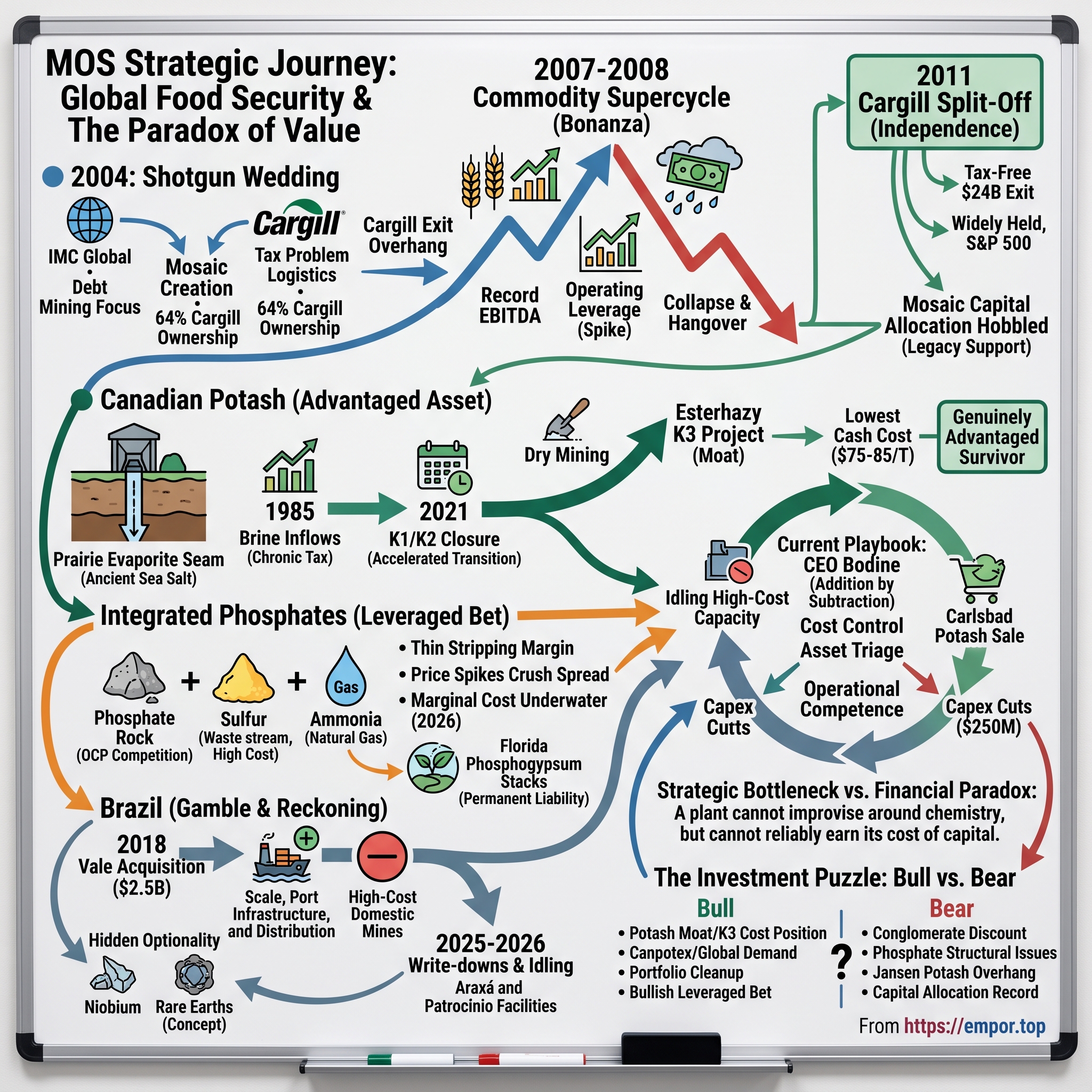
The Mosaic Company (NYSE: MOS): The Geopolitics and Chemistry of Global Food Security
I. Introduction & Episode Roadmap
A little over a kilometre beneath the wheat fields of southeastern Saskatchewan, in a tunnel where the rock walls glow faintly pink under headlamps, a machine the size of a subway car chews sideways into a seam of ancient seawater residue. The seam was laid down roughly 400 million years ago, when an inland ocean evaporated and left behind a crystalline layer of potassium chloride. Above that seam sits a formation of water-saturated sand under enormous pressure — a geological booby trap that mining engineers in the province speak about the way sailors speak about ice. Below it sits the raw material without which roughly half the food on Earth would not exist.
That tunnel is the Esterhazy K3 mine, and it is the single most important physical asset The Mosaic Company owns.
Here is the uncomfortable premise of this story. The world is on a march toward roughly ten billion people, and the binding constraint is not land area — it is yield per hectare. Yield per hectare is a function of three elements: nitrogen, phosphorus, and potassium. Nitrogen can be pulled from the air using natural gas and the Haber-Bosch process, which means it can be manufactured almost anywhere. Phosphorus and potassium cannot. They must be dug out of specific holes in specific countries, and there is no chemical substitute for either. A plant cannot improvise its way around the periodic table.
Mosaic sits directly on top of that bottleneck. It is one of the world's largest integrated producers of concentrated phosphate and potash, running mines in Saskatchewan, New Mexico and Florida, chemical plants in Louisiana and Brazil, a Brazilian distribution business, and a port terminal on the Brazilian coast. In 2025 it moved roughly $12.1 billion of product and generated $2.4 billion of adjusted EBITDA on $541 million of net income.1
And yet, in late July 2026, the market values the whole enterprise at roughly $7 billion — less than three times a mid-cycle EBITDA number, and a long way below the $37 the stock traded at within the past twelve months. This is a company that sells an irreplaceable input into human survival and cannot reliably earn its cost of capital across a full cycle. That paradox is the entire episode.
The thesis we will test is this: Mosaic is not really one business but three, welded together by history rather than logic. One of them — Canadian potash — is a genuinely advantaged, low-cost, long-reserve asset with a defensible cost position. One of them — integrated phosphates — is a leveraged bet on the spread between fertilizer prices and the cost of sulfur and ammonia, a spread Mosaic does not control. And one of them — Brazil — was a $2.5 billion acquisition that has been steadily unwound over the past eighteen months. Whether the good asset is enough to carry the other two is the question that determines whether this is a cheap cyclical or a value trap.
The road ahead: the 2004 shotgun wedding of IMC Global and Cargill's fertilizer business, which created the company out of one party's near-bankruptcy and another's tax problem. The 2007–2008 supercycle that made Mosaic briefly the most exciting industrial stock in America. The $24 billion tax-free corporate divorce in 2011 that set Mosaic free and simultaneously hobbled its capital allocation for years. The engineering saga of Esterhazy K3 and the thirty-six-year battle against brine. The Brazilian gamble and its 2025–2026 reckoning. And the current era under CEO Bruce Bodine, defined less by ambition than by subtraction — idling, selling, curtailing, and holding open a lottery ticket in a mineral almost nobody in the fertilizer world had heard of five years ago.
It begins, as most heavy-industry stories do, with debt.
 Subscribe on LinkedIn
II. The Genesis: The 2004 Shotgun Wedding of IMC Global & Cargill
In 2003, IMC Global was a company running out of road. It owned some of the finest fertilizer mineral assets in the Western Hemisphere — the Esterhazy and Belle Plaine potash operations in Saskatchewan, the Carlsbad potash mine in New Mexico, and an enormous phosphate rock and processing complex in central Florida. It also owned a balance sheet built during the late-1990s acquisition spree, when management had rolled up assets on the assumption that fertilizer prices mean-revert upward on a convenient schedule. They did not. By the early 2000s IMC was carrying billions in debt into a market where potash and phosphate prices had been grinding sideways for the better part of a decade, and the equity was being valued less as a claim on world-class mineral reserves than as a call option on refinancing.
Across the Midwest sat the opposite problem. Cargill, Inc. — the largest privately held company in America, a grain trading and agricultural processing colossus that had spent a century avoiding the public markets — ran a crop nutrition division with global distribution terminals, blending plants, and customer relationships, but without the upstream mining scale to match. Cargill's fertilizer business was profitable and strategically useful; it was not big enough to matter inside Cargill, and it could not be sold without generating an enormous capital gains tax bill.
These two companies were, culturally, near-opposites. IMC Global was a publicly traded mining company in the classic American mould — quarterly earnings, analyst days, a management team judged on the stock price, and a strategy that had been set during a period when consolidation was fashionable and cheap debt was abundant. Cargill was the opposite in almost every respect: family-controlled, famously secretive, run on a multi-decade time horizon, and institutionally allergic to the disclosure obligations that come with public equity. Cargill did not want to become a public company. It wanted a public company to become the owner of some of its assets.
The solution was elegant, and it is worth being precise about the mechanics because the structure echoes through the next twenty years of the company's history. A new entity was incorporated on January 23, 2004 under the placeholder name Global Nutrition Solutions, Inc., purely as the vehicle for combining IMC's businesses with Cargill's fertilizer operations.2 Under an Agreement and Plan of Merger and Contribution dated January 26, 2004, IMC merged with a wholly owned subsidiary of that entity on October 22, 2004, with IMC's common stockholders receiving one share of the new company for each IMC share they held.2 Cargill contributed its crop nutrition assets in exchange for equity, and emerged owning roughly 64% of what was now called The Mosaic Company.3 The governance arrangement made the balance of power explicit: Cargill designated seven director nominees to IMC's four over the four-year period following completion.2
Read that as what it was — a rescue dressed as a merger of equals. IMC shareholders did not get a premium; they got a solvent parent. Cargill did not write a cheque; it monetised a division into a publicly traded currency without triggering a taxable disposal, kept control, and gained the option to exit later on its own timetable. The industrial logic was real — IMC's mines feeding Cargill's terminals and blending network created a genuinely integrated business from mine face to farm gate — but the financial architecture was the point.
The industrial case, to be fair to it, was not window dressing. Before the merger, IMC mined tonnes and sold them into a fragmented wholesale market; Cargill had terminals, blending plants, barge and rail logistics, and relationships with the cooperatives and distributors who actually decide what goes into a farmer's spreader. Putting the two together created something the industry genuinely lacked — a producer that could see from the mine face all the way to the field, and could adjust product mix, formulation and placement accordingly. Vertical integration in fertilizer is not a source of pricing power, because the product is fungible. It is a source of information: knowing where the tonnes are going and at what landed cost lets you decide which mine to run and which cargo to place where. That is worth something. It is just worth less than it sounds.
Two features of that architecture proved durable. First, Mosaic inherited an asset base assembled by other people for other reasons, which is why the company has spent much of its life rationalising a portfolio rather than building one. There was never a founding moment at which someone sat down and asked what the ideal combination of nutrient assets would look like; there was a distressed miner, a tax-constrained trading house, and a lawyer. Second, Mosaic inherited a controlling shareholder whose eventual exit would be the dominant corporate event of the company's first decade. When you are 64%-owned by a private company with its own succession and estate-planning clock running, your capital allocation is never entirely your own — a fact that would become expensive rather than merely theoretical seven years later.
For three years, none of this mattered much, because the market did something nobody in the industry had modelled.
III. The 2007–2008 Commodity Supercycle & The Cash Bonanza
The chart that defined Mosaic's early life looks less like a commodity price series and less like a technology stock's — it looks like a fault line. Between 2006 and 2008, several unrelated forces converged on the same grain markets. Chinese and Indian protein consumption was rising, and every kilogram of pork or chicken requires several kilograms of feed grain. American ethanol mandates diverted a growing share of the US corn crop into fuel tanks. Global grain stocks-to-use ratios fell to multi-decade lows. Farmers everywhere responded the only way farmers can: by pushing yields, which meant buying more fertilizer, at almost any price.
The numbers, on Mosaic's then-May fiscal year end, are worth stating carefully because they establish the shape of the cycle. In fiscal 2008 the company's average DAP selling price nearly doubled to $513 per tonne from $264 the year before — and by the fourth quarter of that fiscal year the average had reached $754 per tonne.4 Average muriate of potash prices rose 57% to $226 per tonne, exiting the year at $335.4 Potash segment net sales went from $1.5 billion to $2.3 billion in twelve months.4 Net earnings for fiscal 2008 came in at roughly $2.1 billion, or $4.67 per diluted share, against $419.7 million and $0.95 the prior year — a fivefold increase in a single year at a company that mines rocks.4
Understand what that kind of move does to an industrial business with a mostly fixed cost base. The cash cost of pulling a tonne of potash out of Esterhazy did not increase fivefold. Almost the entire price increase dropped through to operating income. This is the defining characteristic of the asset class: enormous operating leverage in both directions, because the cost of production is set by geology and labour agreements while the price is set by global grain markets, Chinese export policy, and monsoon rainfall.
Two lessons were laid down in this period, and the market has spent eighteen years relearning them.
The first is that peak-cycle earnings from a fertilizer producer are not a base to grow from; they are a spike to be harvested. Investors who capitalised 2008 earnings at any normal multiple were annihilated when prices collapsed with the financial crisis. The subsequent decade taught the same lesson twice more, in 2011–2012 and again in 2021–2022 — and the mechanism was identical each time. High prices call forth two responses that are both fatal to the price: farmers defer application, drawing down soil nutrient reserves, and every marginal producer on the planet restarts idled capacity. Because fertilizer demand is fundamentally a replacement demand tied to the tonnes of grain removed from a field, deferral does not destroy demand permanently — it postpones it, and then postpones the recovery in price too, because the inventory built during the boom has to clear first. The peak is always shorter than the hangover.
There is also a distribution-channel amplifier that outsiders consistently underestimate. Between Mosaic and the farmer sit distributors, retailers and cooperatives who carry inventory. When prices are rising they buy ahead, adding a layer of speculative demand on top of real agronomic demand. When prices turn, they stop buying entirely and live off the shelf, so the producer sees an order book that goes to almost nothing while actual field application barely changes. Mosaic's reported volumes are therefore a noisy proxy for what is happening in the soil, and quarterly volume swings frequently say more about channel psychology than about agriculture.
It is worth pausing on what the boom did to the industry's psychology, because the consequences outlived the prices. From roughly 2007 to 2012, every producer, banker and consultant in the sector built the same slide: population growth, protein consumption, arable land per capita declining, therefore nutrient demand compounding indefinitely. The slide was not wrong about direction. It was wrong about what direction is worth. Global fertilizer demand does grow — Mosaic's own long-run phosphate demand chart shows a trend line rising steadily from around 62 million tonnes in 2010 toward the high seventies by the mid-2020s.1 That is roughly 2% a year. A 2% volume growth market, with no substitution risk and no technological obsolescence, is a perfectly good business to own. It is not a business that justifies building capacity into a peak price, which is what a great many people did between 2008 and 2013.
The second lesson is subtler and more important for understanding the company today. The supercycle masked a structural asymmetry between Mosaic's two core products. Potash is essentially mined and screened — you dig the ore, you separate the potassium chloride, you ship it. Phosphate fertilizer is manufactured. Phosphate rock has to be reacted with sulfuric acid, which requires elemental sulfur, and then with ammonia, which is made from natural gas.
Think of the difference this way. A potash producer's margin is the price of the product minus the cost of digging. A phosphate producer's margin is the price of the product minus the cost of digging minus the market price of two other commodities it must buy from industries with no connection to agriculture whatsoever. Sulfur is a waste stream from oil refineries; refiners produce it because regulation requires them to strip it out of fuel, not because anyone wants it. Ammonia tracks natural gas. Neither market cares what a farmer can afford to pay.
When product prices are exploding, nobody looks closely at input costs. When product prices are flat and sulfur triples, the phosphate business discovers that it is not really a mining business at all — it is a chemical converter with a thin and volatile spread. That distinction, invisible in 2008, is precisely what is destroying Mosaic's phosphate margins in 2026.
For Cargill, though, the supercycle created a different kind of problem. Its 64% stake in Mosaic had appreciated into one of the largest single concentrated equity positions in American private hands — and the family that owned it needed to diversify.
IV. The $24 Billion Liquidation: The 2011 Cargill Split-Off
Margaret A. Cargill died in 2006. She was a granddaughter of the company's founder, lived quietly in Southern California, and left the bulk of her fortune — an enormous block of Cargill stock — to a set of charitable trusts and a foundation designed to give the money away. The trusts had a fiduciary obligation to diversify. Their single largest indirect asset was a stake in a private grain trading company, whose own largest single asset was a controlling position in a publicly traded fertilizer producer.
This is the sort of problem that keeps tax lawyers employed for years. Cargill could not simply sell its Mosaic shares: dumping 286 million shares — roughly 64% of the company — into the open market would have destroyed the price, and a sale would have crystallised a multi-billion-dollar gain for a company that had spent its entire existence avoiding the public capital markets and the taxes that come with realised gains. But the trusts needed liquidity, and Cargill needed to remain private.
In January 2011, Cargill and Mosaic announced the answer: a split-off structured to distribute Cargill's entire 64% position, valued at approximately $24.3 billion, to Cargill's own shareholders and debt holders.56 The mechanics were baroque. Roughly 179 million of the 286 million Mosaic shares were exchanged with Cargill shareholders — principally the Margaret A. Cargill charitable trusts and family members — in return for their Cargill stock, which Cargill then retired.6 The remaining roughly 107 million shares were exchanged with third parties for Cargill debt those parties held.6 Mosaic recapitalised its share structure to accommodate the staged distribution, and the whole thing was executed pursuant to a private letter ruling from the Internal Revenue Service confirming it would be tax-free to Cargill, to Mosaic, and to their respective shareholders.6 The transaction closed in the second quarter of 2011.6
Strip away the complexity and the trade is clear. Cargill converted a controlling stake in a public company into a retirement of its own equity and debt, remained private, solved its founding family's estate-planning problem, and paid essentially no tax on a $24 billion disposal. It is one of the more impressive pieces of structuring in modern American corporate finance, and it was executed almost entirely for Cargill's benefit.
What did Mosaic get? Genuinely valuable things: independence from a controlling shareholder, a widely held register, S&P 500 membership, and vastly improved trading liquidity. What did it cost? More than the celebratory press releases suggested. The former Cargill shares had to be distributed into the market over a multi-year period through a sequence of secondary offerings, and Mosaic committed to supporting that orderly distribution — including through share repurchases from the selling holders.6 For a company emerging from a supercycle with a strong balance sheet and a once-in-a-generation opportunity to invest countercyclically in new capacity, a meaningful portion of the following years' financial flexibility was directed toward absorbing a legacy shareholder's exit rather than toward the ground.
There is a second, subtler cost that rarely gets discussed. A controlled company has a simple governance model: the controller decides. A widely held company with a large block being distributed into the market over several years has something worse — a persistent, known overhang. Every institutional investor considering the stock between 2011 and 2014 knew that a large supply of shares was scheduled to arrive. That knowledge suppresses the valuation independently of anything the business does, and it changes management's own behaviour, because buying back stock to support an orderly distribution is a very different act from buying back stock because you think it is cheap.
Here is the analytical point, and it recurs. Mosaic's capital allocation has repeatedly been shaped by inherited obligations rather than by a clean-sheet view of where returns are highest.
In 2011–2014 the obligation was Cargill's exit. In 2013 the company spent $1.2 billion acquiring CF Industries' Florida phosphate business — doubling down on the segment with the weakest structural economics, at a point in the cycle when phosphate rock looked scarce and the price of integrated capacity looked, in hindsight, expensive.7 In 2018 it would be Brazil.
A pattern of buying into the cyclical, capital-intensive parts of the portfolio while the genuinely advantaged asset waited its turn is not a coincidence; it is a governance and incentive story. Note the sequencing in particular: K3 — the project with the clearest and most durable return — was built through the weakest part of the cycle, when capital was scarcest and the internal case hardest to defend, while the acquisitions were struck when balance sheet capacity was most abundant. That is the exact inversion of what a countercyclical capital allocator would do, and it is the single most useful lens for reading the company's history.
But the advantaged asset did eventually get its turn, and it required Mosaic to solve a problem that had been leaking water into its balance sheet since 1985.
V. The Potash Crown Jewel: Esterhazy K3 & The Battle of the Brine
To understand what Mosaic actually owns in Saskatchewan, start with the geology, because the geology is the moat.
Roughly a kilometre below the prairie lies the Prairie Evaporite formation, a bed of potash-bearing salt of extraordinary thickness and grade — the residue of an evaporated inland sea. It is, by a wide margin, the largest and richest concentration of potash on the planet. Between that seam and the surface sits the Blairmore Formation: several hundred metres of water-bearing sand and gravel under high pressure. Think of it as a saturated sponge sitting on top of a sugar cube. Potash is a salt. Salt dissolves. If water from the Blairmore finds its way into a potash mine, it does not merely flood the workings — it eats them.
This is why sinking a potash shaft in Saskatchewan is one of the harder things heavy industry does. The shaft must be driven through the water-bearing formation using ground-freezing techniques, then permanently lined, and the lining must hold for the life of the mine. Get it wrong and you do not get a leak; you get an unrecoverable asset.
A useful analogy: imagine you are hollowing out rooms inside a giant block of rock salt, and directly above the block sits a pressurised reservoir of water held back only by a few hundred metres of rock and whatever engineering you installed decades ago. Every year the water finds a slightly better path. You cannot plug it permanently, because the thing you would plug it with is dissolving.
Mosaic inherited exactly that problem. The original Esterhazy shafts, K1 and K2, had been experiencing brine inflows since 1985 — thirty-six years of continuous water entering the mine.8 The company managed the problem the way you manage a chronic condition rather than curing it: pumping water out continuously, injecting grout, drilling relief wells, monitoring inflow rates with the attention of a cardiac ward. It worked, in the sense that the mine kept producing for another three and a half decades. It also meant that a permanent, unavoidable line item sat inside the cost of every tonne Esterhazy produced — a tax on the asset paid to the Blairmore Formation.
The answer was K3: a new shaft complex sunk into the same orebody but positioned to access it from ground that could be kept dry, allowing the mining fronts at K1 and K2 to be abandoned entirely while the reserve base was retained. It was the first major greenfield potash shaft sunk in Saskatchewan in decades, it took years, and it consumed billions of dollars of capital during a period when potash prices gave management very little cover for spending it. This was the good version of Mosaic's capital allocation — expensive, slow, unglamorous, and aimed squarely at the structural cost position of the best asset in the portfolio.
Then the geology forced the timetable.
On June 4, 2021, Mosaic announced that brine inflows at K1 and K2 had accelerated and that it was closing both shafts immediately — pulling the planned closure forward by nine months.8 This is the kind of announcement that separates operators from promoters. There was no negotiating with the water. Then-CEO Joc O'Rourke framed it in terms of the long arc: the company had been managing inflows since 1985 and had accelerated K3's development precisely so that K1 and K2 could ultimately be closed.8 The immediate cost was real and quantified up front: roughly $20–25 million of cash costs, $80–100 million of non-cash asset write-downs, and a $50–100 million non-cash increase to asset retirement obligation reserves in the second quarter alone, plus approximately one million tonnes of lost production during the July 2021 to March 2022 transition.8 To cover commitments, Mosaic restarted the higher-cost Colonsay mine and recalled its workforce.8
The payoff was stated with equal specificity, which matters for judging management credibility: brine management expenses would be eliminated after July 2021, annualised potash production would rise by roughly two million tonnes from 2020 levels by March 2022 as K3 reached full capacity, and available operational MOP capacity would reach 10.5 million tonnes by mid-2022.8
Did they deliver? Largely, yes — and this is one of the few places in Mosaic's recent history where the evidence supports management's claims rather than merely repeating them. In 2025 the potash segment produced 8.8 million tonnes and sold 9.0 million, including a record 5.5 million tonnes of international sales, with MOP finished-product output of 8.5 million tonnes described as the highest in eight years.1 More importantly, the cash cost of production for the full year was $75 per tonne.1 For a mined commodity that sold at an average realised mine-gate price of $255 per tonne that year, a $75 cash cost is not a rounding error of advantage — it is the difference between a business that survives the trough and one that does not.1
It is worth being precise about why the cost fell, because "we built a new mine" is not by itself an explanation. Three things changed simultaneously. The brine mitigation expense — the pumping, grouting, monitoring and contingency that had been a permanent charge against every Esterhazy tonne — went away. The mining method changed: K3 was designed around continuous miners feeding a conveyor system rather than the shuttle-car and haulage arrangements of an older mine, which raises tonnes per labour hour and reduces diesel and maintenance. And the fixed cost base was spread across a larger production volume, because the shaft was sized for a capacity the old workings could not reach. Cost reduction from all three sources is durable in a way that cost reduction from, say, a weak currency is not.
That said, the cost position is not a physical constant, and the most recent quarter is a useful reminder. In the first quarter of 2026 the MOP cash cost of production rose to $84 per tonne from $78 a year earlier, driven by a stronger Canadian dollar and higher provincial royalty expense.9 Neither of those is an operational failure — both are entirely outside management's control. That is the honest characterisation of the potash moat: Mosaic controls its mining cost, but its reported cost per tonne is also a currency and tax expression. An investor underwriting the cost advantage is also, unavoidably, taking a position on the Canadian dollar and on Saskatchewan's resource tax regime.
What Esterhazy bought Mosaic was the right to be a survivor in potash. What it did not buy was any protection at all in the other half of the company — or in the country where Mosaic had just spent $2.5 billion.
VI. The Brazilian Gamble: The $2.5 Billion Vale Acquisition & The 2025–2026 Reckoning
The case for Brazil was, and remains, one of the most seductive stories in global agriculture. The country's tropical soils are ancient, heavily weathered, and chronically deficient in phosphorus — the soil chemistry literally locks phosphate away from plant roots, so Brazilian farmers must apply more of it, more often, than farmers almost anywhere else. Brazilian growers also double-crop: soybeans followed by a second corn crop in the same calendar year, doubling the nutrient draw from the same hectare. Planted area keeps expanding — Mosaic's own market materials show Brazilian planted area rising from 92.3 million hectares in the 2024/25 season toward 95.9 million in 2026/27.1 And the country cannot feed its own demand: on the first-quarter 2026 earnings call, Mosaic's chief commercial officer Jenny Wang put it bluntly, noting that Brazil must import roughly 85% of the NPK it needs.10
If you own mines and plants and you believe that story, you want to be inside Brazil rather than shipping into it. So in January 2018, Mosaic closed the acquisition of Vale Fertilizantes from Vale S.A.11 The final terms had been renegotiated shortly before closing — a letter agreement dated December 28, 2017 reduced the cash consideration to $1.15 billion and the equity component to 34,176,574 Mosaic shares, from the originally announced package.12 What Mosaic bought was scale that could not be built organically: five Brazilian phosphate rock mines, four chemical plants, a Brazilian potash mine, a 40% economic interest in the Miski Mayo phosphate rock joint venture in Peru, and a potash project at Kronau, Saskatchewan.12 Vale's then-CFO, Luciano Siani Pires, joined Mosaic's board as part of the transaction — a detail that becomes relevant later.11
Myth versus reality: did they overpay?
The generous reading is that Mosaic bought at a reasonable price a business it could not replicate, in the world's most attractive fertilizer import market, and that integration was simply harder than expected. The evidence supports a harsher reading.
Start with what the assets actually were. The distribution and blending network, and the port infrastructure, are genuinely valuable — they are how you get product to farms in Mato Grosso at a competitive landed cost, in a country where the logistics gap between a port and an interior farm gate can exceed the value of the fertilizer itself.
The production assets are a different matter. Brazilian phosphate rock is generally lower-grade and more expensive to mine and beneficiate than the deposits in Morocco or Florida, and the Araxá and Patrocínio complexes in Minas Gerais sit far inland, hundreds of kilometres from a port, in a country where road freight is expensive and rail is thin. Mosaic effectively acquired a high-cost domestic production position and a low-cost distribution position, and priced them as a package.
There was a strategic logic to owning both, and it is worth stating fairly because it was not stupid. Domestic production inside Brazil hedges the import channel: if global prices spike or shipping is disrupted, the producer who is already inside the country captures the premium. That hedge has real value in a crisis. What it turned out not to survive was the ordinary case — a world in which Moroccan, Russian and Chinese product arrives at Brazilian ports at a landed cost below what it costs to dig comparable rock out of Minas Gerais and truck it. A hedge that only pays off in a crisis is an insurance policy, and Mosaic was paying the premium on it every single quarter for eight years.
For years, the segment's results were defensible on their own terms. In 2025 Mosaic Fertilizantes generated $4.85 billion in net revenue, $277 million in operating earnings and $567 million in adjusted EBITDA — the latter up 65% year over year and, by the company's own description, the third-highest in the segment's operating history.1 Blended rock cost in cost of goods sold fell to $97 per tonne, the lowest since 2021.1 Those are not the numbers of a failed acquisition.
But look at what sits underneath them. The overwhelming majority of the segment's tonnage is not produced; it is bought and resold. Of 9.0 million tonnes sold in 2025, only 3.4 million were produced-product volumes.1 The segment is, in economic substance, a distribution business with a loss-making mining business attached to it.
The market forced that recognition in two stages. In the fourth quarter of 2025, the segment swung to an operating loss of $26 million on $1.15 billion of revenue, hit by what management described as credit challenges, intensified competition and a rapid rise in sulfur prices — part of a quarter in which Mosaic as a whole reported a $519 million net loss.1 Then, on April 8, 2026, came the white flag. Mosaic announced it would idle and demobilise the Araxá Mining and Chemical Complex and idle related mining at Patrocínio, and would pursue a sale of the Araxá assets.13 The company guided to a pre-tax book impact of $350–400 million in the first quarter, including $275–300 million of impairments and write-offs plus severance and contract termination costs, and to a reduction of roughly one million tonnes of annual phosphate production.13 The promised offsets were modest and specific: $70–80 million of annual operating expense reduction and $20–30 million of annual capital expenditure reduction.13 Bodine's framing was characteristically plain: idling the facilities and pursuing a potential sale was "the right path forward."13
The final bill came in above the guided range. When Mosaic reported first-quarter results on May 11, 2026, the total charge was $442 million, of which $328 million was non-cash, with management explaining that additional period costs for accelerated depreciation and idle-plant expenses had pushed it past the April estimate and would continue into the second quarter.9 The segment posted a $422 million operating loss for the quarter as a result.9
Two details deserve an activist's attention. First, on the earnings call management stated that the decision on Araxá and Patrocínio "had been contemplated long before the recent disruptions" — in other words, the sulfur spike was the trigger, not the cause. That is a fair and credible answer, but it invites the obvious follow-up: if these assets were structurally uneconomic and management knew it, why did the write-down arrive in 2026 rather than 2023 or 2024? Second, the accounting judgment stack in Brazil is now substantial. The idling charges follow a deferred tax asset valuation reserve taken in the fourth quarter of 2025, and the segment's gross margin per tonne compressed from $69 to $22 year over year in the first quarter of 2026, with a bad-debt reserve for a Brazilian customer contributing to a rise in company-wide SG&A to $136 million from $123 million.91 Credit quality in the Brazilian farm sector is a live exposure, not a footnote.
The niobium option
There is a genuine piece of optionality buried in the wreckage. Patrocínio sits in a region of Minas Gerais known for niobium mineralisation — niobium being a metal used in microalloyed high-strength steel, aerospace alloys, and, increasingly, as a research material in fast-charging battery anodes. Mosaic is idling the phosphate mining at the site while continuing to develop the niobium opportunity, and has said it is nearing completion of technical assessment work including sampling and analysis.13
Investors should size this carefully and sceptically. No resource statement, no capital cost estimate, no production timeline and no partner has been disclosed. Global niobium supply is overwhelmingly concentrated in Brazil already, dominated by an incumbent producer with decades of scale, which means a new entrant's economics depend on a market that is small, opaque, and controlled. The right way to hold this is as an unpriced call option with an unknown strike — worth something, worth nothing in a base case, and emphatically not a reason to own the equity.
The same is true of a second piece of latent value that emerged on the same call: a project development agreement with Rainbow Rare Earths to explore recovery of rare earth elements from Brazilian phosphogypsum stacks.10 It is a clever idea — turning a waste liability into a feedstock — and it is at the concept stage.
Which brings us to the question of what Mosaic actually is once the Brazilian production assets come out: three segments, with three completely different economic engines.
VII. The Core Economics: Segment Deep-Dive
Full-year 2025 is the cleanest recent snapshot of how the money is actually made. Consolidated revenue was $12.05 billion, operating earnings $822 million, net income $541 million and adjusted EBITDA $2.42 billion.1 Split it three ways and the picture is stark. Potash generated $2.66 billion of revenue but $638 million of operating earnings and $1.18 billion of adjusted EBITDA. Phosphate generated $4.58 billion of revenue and just $135 million of operating earnings, with $917 million of adjusted EBITDA. Mosaic Fertilizantes generated the largest revenue line of all — $4.85 billion — and $277 million of operating earnings.1
Read that again. The smallest revenue segment produced the largest operating profit, by a factor of nearly five over the largest revenue segment. Revenue in this business tells you almost nothing.
1. Potash — the engine
Potash is conceptually simple: mine the ore, separate the potassium chloride, dry it, ship it. There is no chemistry to buy. Mosaic's Canadian operations sit on reserves measured in decades and use two different extraction methods, which is worth understanding because they behave differently through a cycle.
Esterhazy and Colonsay are conventional underground mines: shafts, people, machines, ore hoisted to surface and processed. Belle Plaine is a solution mine — instead of sending people underground, the operator drills wells, injects hot brine to dissolve the potash in place, and pumps the saturated solution back to surface where the potassium chloride is crystallised out. Solution mining trades capital and labour intensity for energy intensity: it uses far fewer people and no underground workforce, but it consumes a great deal of natural gas to heat the brine and evaporate the water. That makes Belle Plaine's cost structure partly a bet on North American gas prices, whereas Esterhazy's is mostly a bet on labour productivity and the Canadian dollar. Having both is a genuine, if modest, diversification of cost exposure.
Colonsay's role is different again: it functions as swing capacity, idled when the market is loose and restarted when it is tight — as it was to cover the K1/K2 shutdown. That flexibility is a luxury only a producer with a low-cost core asset can afford, and it has a price. Idle and turnaround expenses in the potash segment ran $60 million in 2025 even in a strong year.1 Optionality on a mine is not free; it is a standing charge you pay for the right to respond.
The economics in 2025 were a $255 average realised mine-gate price against a $75 cash production cost.1 In the first quarter of 2026, realised prices improved to $265 with volumes of 2.2 million tonnes, delivering $177 million of operating earnings and $275 million of adjusted EBITDA on $667 million of revenue.9 Gross margin of $88 per tonne on a $265 product is a roughly one-third margin on a commodity — that is the number to hold onto.
Mosaic markets its international potash through Canpotex, the export joint venture it owns with Nutrien. Canpotex aggregates the two producers' offshore tonnes and negotiates the large annual and spot contracts with buyers in China, India, Brazil and Southeast Asia. Calling it a cartel overstates the case — it is a legal export association of the sort several jurisdictions permit — but its function is unambiguous: it prevents two large North American producers from bidding each other down in front of highly concentrated buyers. On the first-quarter 2026 call, management said Canpotex was fully committed through June and on pace for record shipments in 2026.109 That is the clearest single piece of evidence in the whole company that potash demand is genuinely strong right now, and it is worth more than any management adjective.
The competitive set is small and state-adjacent: Nutrien as the global capacity leader, K+S AG in Germany, ПАО «Уралкалий» Uralkali in Russia, and ОАО «Беларуськалий» Belaruskali marketing through Белорусская калийная компания BPC in Belarus. Sanctions and logistics disrupted Belarusian and Russian flows after 2022; those flows have substantially recovered, and that recovery — not new capacity — has been the main source of price pressure over the past two years.
2. Phosphates — the cyclical engine
Here is the mechanism, in plain terms. To make a tonne of diammonium phosphate, you mine phosphate rock, react it with sulfuric acid to make phosphoric acid, then react that with ammonia. Sulfur comes overwhelmingly as a by-product of oil and gas refining, which means its supply is a function of refinery runs and sour-crude processing, not of fertilizer demand. Ammonia is made from natural gas. Mosaic therefore does not sell a mined commodity; it sells the spread between the DAP price and the cost of the two chemical inputs. The industry calls this the stripping margin.
That spread has collapsed. Mosaic's own market materials show the benchmark DAP stripping margin at a five-year low in February 2026, and the comparison is illuminating: in January 2021 phosphate rock-equivalent product sold around $390 per short ton at NOLA against ammonia at $270 per tonne and sulfur at $96 per long ton; by February 2026 the product had risen to $630 but ammonia had risen to $625 and sulfur to $496.1 Product prices went up 60%; sulfur went up more than fivefold.
The first quarter of 2026 shows what that does to a P&L. Phosphate segment revenue rose to $1.4 billion from $1.1 billion, and sales volumes rose to 1.9 million tonnes from 1.5 million — a genuinely strong demand quarter.9 The segment still posted a $48 million operating loss, against a $139 million profit a year earlier, because raw material costs rose by $280 million year over year.9 Segment gross margin per tonne fell to $2. Not $2 lower — $2 in total, from $111 the year before.9 Sulfur in cost of goods sold averaged $379 per long ton and ammonia $626 per tonne in the quarter, and the CFO guided to roughly $540 sulfur and $610 ammonia in the second quarter.910
The marginal picture is worse than the average, and management said so with unusual candour. CFO Luciano Siani Pires told analysts that at the marginal cost of sulfur — around $1,200 per ton at the time of the call — the marginal stripping margin sat below variable cost.10 Bodine went further: "At $1,200 sulfur price, as an example, much, if not all, of the producer cost curve is underwater."10 Mosaic responded by withdrawing full-year phosphate production guidance, beginning partial curtailments at its Louisiana and Bartow facilities in May, and scaling back Brazilian production.9 Bodine characterised the Louisiana curtailment as about half of that facility's capacity, and stressed that curtailments are "temporary matters that can be quickly unwound."10
That last claim is exactly the sort of statement that should be filed for future verification. Idling a chemical complex is easy; restarting one at full rates without a turnaround bill is not. Mosaic's own disclosure shows the cost of running below capacity: idle and turnaround expenses in the phosphate segment totalled $238 million in 2025, and $50 million in the first quarter of 2026 alone.19 Curtailment is not free optionality; it is a real cash cost that shows up as a higher conversion cost per tonne on the volumes that do get produced.
One structural advantage is worth crediting. Roughly 80–85% of Mosaic's US ammonia needs are met from its own Faustina plant, which continues to run at normal rates, plus below-market supply contracts tied directly to natural gas.9 Cheap North American gas is a genuine input edge — it just happens to be swamped by sulfur at the moment.
The competitive reality in phosphates is that Mosaic is not the low-cost producer and does not claim to be. المكتب الشريف للفوسفاط OCP Group of Morocco is state-owned, sits on the overwhelming majority of the world's known phosphate rock reserves, and has been building integrated capacity for years. معادن Ma'aden in Saudi Arabia pairs cheap gas with new plants. Chinese producers set the marginal export tonne, and Beijing's export policy — restricting phosphate exports to protect domestic food security and, increasingly, to feed a booming lithium iron phosphate battery industry — has become one of the single largest swing variables in the global market. Mosaic's own forecasts show Chinese LFP battery production rising toward roughly 4.9 million tonnes in 2026, up from near zero a decade ago.1 That is a genuine new source of demand for purified phosphoric acid, and a genuine new competitor for phosphate rock.
Then there is the liability that never leaves. Producing phosphoric acid generates phosphogypsum — a mildly radioactive by-product that cannot be sold at scale and must be stacked in engineered piles, forever. In October 2015 Mosaic settled a long-running federal and state enforcement action under the Resource Conservation and Recovery Act, an agreement valued at roughly $2.43 billion covering six Florida facilities and two in Louisiana, involving some 60 billion pounds of hazardous wastewater.14 The settlement required Mosaic to establish a $630 million trust fund and a $50 million letter of credit for closure and long-term care, against an estimated $1.8 billion of closure and long-term care costs, plus a $5 million federal civil penalty and payments to Florida and Louisiana.14 These stacks are a two-sided fact: an enormous barrier to any new US entrant, and a permanent, non-discretionary claim on Mosaic's cash flow that does not shrink when fertilizer prices do.
3. Mosaic Fertilizantes — the distribution outlet
With Araxá and Patrocínio idled, this segment is being converted, deliberately, into something closer to a pure distributor: import product through the company's Brazilian port and terminal infrastructure, blend it, finance it, and sell it to farmers. In the first quarter of 2026 it moved 1.6 million tonnes at an average finished product price of $527 per tonne, generating $937 million of revenue and $79 million of adjusted EBITDA — against a $422 million operating loss driven by the idling charges.9
The honest way to think about the segment going forward is as a working-capital-intensive trading and logistics business whose earnings depend on distribution margin per tonne, Brazilian farmer credit quality, and the real-versus-dollar exchange rate. Management declined to provide second-quarter EBITDA guidance for the segment at all, citing uncertainty around global fertilizer and raw material availability.9 When a company will not guide one quarter ahead for a distribution business, that is information.
VIII. Current Playbook & Management Assessment under CEO Bruce Bodine
Bruce Bodine took over as president and CEO on January 1, 2024, succeeding Joc O'Rourke. He is an insider of roughly a quarter-century's standing, an engineer by training, and he came up through the operating side — running North American potash and then phosphates before taking the top job. That background shows in how he communicates: the language on earnings calls is operational rather than visionary, structured around production rates, turnaround schedules, operating rates at named plants, and cost per tonne. Where a different kind of chief executive might reach for the ten-billion-people-by-2050 framing, Bodine tends to reach for the phosphoric acid utilisation rate. On the first-quarter 2026 call, for example, the reassuring detail he chose to highlight was not a market forecast but the fact that three of four facilities were operating at targeted rates by quarter-end.10
That is a meaningful stylistic contrast with the O'Rourke era, and the contrast matters because the two men were handed opposite problems. O'Rourke ran Mosaic through a period in which the company was building K3 and buying Brazil — a growth-capital era, financed with debt, justified by long-run demand arguments. Bodine inherited the bill. An operator with a plant-level mental model is arguably the right person to run a company whose value now depends on cost control and asset triage rather than expansion. The risk in that profile is the mirror image: an executive whose instincts are operational may under-weight the portfolio question — whether Mosaic should own these businesses at all — in favour of the question of how to run them better.
The strategic inheritance was a company that had spent a decade and a half building and buying. The strategy since has been almost entirely subtraction, and the record over the last eighteen months is concrete rather than rhetorical:
Mosaic signed an agreement in the fourth quarter of 2025 to sell the Carlsbad, New Mexico potash mine, disclosing roughly $30 million of expected value and — more meaningfully — approximately $20 million of asset retirement obligation reduction.1 That sale completed in April 2026.9 It idled the FOSPAR facility in Brazil in December 2025 in direct response to the sulfur environment, then idled Araxá and Patrocínio in April 2026.1013 It executed Florida real estate transactions generating $31 million of cash proceeds in the first quarter of 2026.9 It cut 2026 capital expenditure guidance by $250 million to $1.25 billion, explicitly deferring less time-sensitive projects.9 And it layered a new cost programme — $50 million of annualised savings from streamlining support functions, $15 million of it landing in 2026 — on top of a previously announced $100 million value capture effort across operations and SG&A.9
That is a coherent, disciplined response to a bad market. It deserves credit on its own terms.
It also deserves scrutiny on three fronts.
The narrative consistency problem. Compare the tone across two quarters. In late 2025, after the third quarter, Bodine told investors the company was "well positioned for a strong finish to 2025 and a promising 2026 and beyond." What arrived instead was a $519 million fourth-quarter net loss, a $258 million first-quarter net loss, withdrawn phosphate production guidance, and curtailments at two US facilities.19 Some of that gap is genuinely exogenous — a sulfur spike driven by supply disruption is not something an operator forecasts. But the pattern of confident forward language followed by a downgrade within two quarters is exactly what long-term investors should be tracking, because it is a leading indicator of how much weight to place on the next confident statement.
The blame-attribution problem. Management's explanations for misses lean consistently on macro factors: sulfur, ammonia, weather, geopolitics, Brazilian credit conditions, foreign exchange, Canadian royalties. Each is individually true. Taken together, they constitute an implicit admission worth stating plainly — Mosaic controls its cost of conversion and its production reliability, and very little else. That is not a criticism of Bodine; it is a description of the asset base he was handed. But investors should not mistake operational competence for control over outcomes.
The capital allocation accountability problem. The 2018 Brazilian acquisition has now produced, across the fourth quarter of 2025 and the first quarter of 2026 alone, a $442 million idling charge and a deferred tax valuation reserve, on top of a segment whose production assets are being idled and marketed for sale eight years after purchase.91 Not one of the executives who approved that deal is being asked to answer for it in the current disclosure, and the company's presentation of the idling emphasises forward savings rather than realised return on the original investment. A skeptical investor is entitled to ask what the internal rate of return on the Vale Fertilizantes transaction actually was, and to note that the question has not been put or answered publicly.
There is one genuinely interesting governance wrinkle here. The CFO who is now executing the Brazilian retrenchment is Luciano Siani Pires — who joined Mosaic as CFO designate on November 18, 2024 and took the role on January 1, 2025, succeeding Clint Freeland — and who was Vale's chief financial officer when Vale sold the fertilizer business to Mosaic, and who then joined Mosaic's board as part of that transaction.1115 He is, by background, one of the few people alive who knows those Brazilian assets from both sides of the trade. Whether that is an advantage in unwinding them or an awkward alignment is a matter of judgment; it is at minimum worth knowing.
On incentives, Mosaic's disclosed long-term incentive design for 2025 weighted awards 40% to time-based restricted stock units and 60% to performance units tied to total shareholder return, with short-term incentives tied to cash flow and earnings measures alongside safety and sustainability objectives.16 Say-on-pay support at the 2025 annual meeting ran at 93.5% of votes cast, the board is 92% independent with an independent chair in Gregory Ebel, and the CEO stock ownership guideline is five times salary.16 Bodine's total compensation for 2024, his first year in the role, was reported at $9.88 million.17
The design deserves a specific observation. A long-term plan that is 60% relative TSR and 40% time-vesting rewards outperforming a peer group of fertilizer companies. In a sector where every peer is exposed to the same sulfur, ammonia, and potash prices, relative TSR is a reasonable filter for luck — but it does not directly hold management accountable for return on the capital they deploy. Given a corporate history in which the largest single value destruction event was an acquisition, the absence of a prominent, explicitly disclosed return-on-invested-capital gate in the long-term plan is a fair thing for a shareholder to press on.
IX. Strategic Position: Hamilton Helmer's 7 Powers & Porter's 5 Forces
Strip the story back to structure and ask a simple question: when the cycle is at its worst, what actually stops Mosaic's profits from going to zero?
Hamilton Helmer's 7 Powers
Scale economies — high, and concentrated in one place. Sinking and equipping a potash shaft costs billions and takes the better part of a decade. Once built, the incremental cost of the next tonne is small, because the dominant costs are the shaft, the hoist, the mill, and the fixed workforce. This is why Mosaic's potash cash cost sits in the $75–85 per tonne range against realised prices in the $255–265 range, and why the segment can stay profitable at prices that would close higher-cost mines in Europe or Russia.19 Note carefully that this power is real in potash and largely absent in phosphates, where the binding cost is purchased sulfur and ammonia and scale does not help you buy them cheaper.
Cornered resource — high in potash, contested in phosphate. The Saskatchewan basin is the cornered resource, and Mosaic's position in it is measured in decades of reserves. But the same logic cuts against the company in phosphate: the true cornered resource in that market is Moroccan rock, and it belongs to OCP.
Process power — medium, and narrower than the marketing suggests. Automated continuous mining and conveying at K3 is a genuine labour productivity advantage over older manual deep-mining. But it is a capital-embodied advantage, not a proprietary know-how advantage — any well-funded entrant building a modern mine gets the same equipment. Jansen is precisely that. The evidence for process power showing up in numbers is the trend in cash cost per tonne, which is why it is a KPI rather than a claim.
Switching costs — effectively none. DAP is DAP and MOP is MOP. A cooperative in Iowa or a distributor in Mato Grosso buys on landed price and delivery reliability. Mosaic's performance products such as MicroEssentials carry a modest premium for nutrient-efficiency reasons, and Mosaic Biosciences is being built as a higher-margin adjacency — its 2025 net sales were $68 million, expected to roughly double in 2026 across 8–10 new product launches.9 Doubling a $68 million business inside a $12 billion company is a rounding error today; the reason to watch it is what it might be in five years, not what it is now.
Network effects — none. Bulk commodity logistics do not get better as more people use them.
Branding and counter-positioning — none. No farmer pays more for potash because of the name on the bag.
System share — none.
The honest conclusion is that Mosaic has one substantial, durable power — a low-cost position in a cornered mineral resource — and that it applies to roughly a fifth of the company's revenue and rather more than half of its operating profit.
Porter's Five Forces
Threat of new entrants — very low in potash, low in phosphate. The barrier in potash is capital and time, and BHP's Jansen project is the live test case of what happens when a mega-miner decides the barrier is worth crossing. It is not going well. BHP sanctioned Jansen Stage 1 in August 2021 at a capital cost of roughly $5.7 billion; in January 2026 the company raised the Stage 1 estimate to $8.4 billion, citing inflation, design development, scope changes and lower-than-expected construction productivity, and pushed first production to mid-2027 from the original late-2026 target.1819 Stage 2 was contemplated for a roughly two-year deferral to FY31 with its own cost estimate rising to $6.9 billion, and BHP took a $2.3 billion writedown.19 Read that as the single strongest empirical validation of the potash entry barrier available anywhere: the world's largest and best-capitalised miner is roughly 50% over budget and a year late, and has taken a multi-billion-dollar impairment before producing a tonne.
Bargaining power of suppliers — medium-high in phosphate, low in potash. This is not a theoretical force for Mosaic; it is the single largest driver of the company's earnings decline in 2026. Refiners set the sulfur price for reasons entirely unrelated to fertilizer, and Mosaic has no meaningful leverage over them.
Bargaining power of buyers — high, and structurally so. Phosphate and potash are the two nutrients a farmer can most easily defer. Nitrogen must be applied every season or the crop fails immediately. Phosphorus and potassium build up in the soil, so a grower under margin pressure can skip a season and draw down soil reserves with limited near-term yield penalty. This is the mechanism behind the demand destruction Mosaic has experienced repeatedly. Mosaic's own materials flag the flip side — sustained nutrient removal without replacement raises the risk of negative yield impacts, which eventually forces replenishment — but the timing of that is a farmer's decision, not Mosaic's.9 Buyers are also concentrated: India's phosphate imports are effectively a state-influenced subsidy decision, and China's are a policy decision.
Threat of substitutes — none. There is genuinely no substitute for phosphorus or potassium in plant biology. This is the strongest force in Mosaic's favour and, notably, the one that has done the least for shareholders. No substitute does not mean pricing power; it means the world has to buy the tonnes from somebody, and there are enough somebodies that price is set at the margin.
Rivalry — high and intensifying. Russian and Belarusian export flows have normalised, Chinese policy swings supply by millions of tonnes at a time, OCP continues to add integrated capacity, and Jansen will eventually arrive.
The rivalry force deserves one refinement, because the phrase "commodity competition" flattens an important distinction. In potash, the competitive set is a handful of very large producers with long-lived assets and a shared interest in not destroying the price — which is why the marketing structures on both sides of the old Cold War divide, Canpotex in the west and BPC in the east, have historically existed at all. That is an oligopoly with discipline problems, not a free-for-all. In phosphate, the competitive set includes state-owned enterprises whose objective function is not shareholder return. OCP's mandate includes Moroccan industrial development and employment; Chinese producers operate under export licences set by a ministry balancing domestic food security against trade earnings. Competing on cost against a rational profit-maximiser is hard. Competing against an entity that will run its plant at a loss because it is a national asset is a different problem entirely, and it is the one Mosaic's phosphate business faces.
The structural verdict: one force works decisively in Mosaic's favour (no substitutes), one works decisively against it (buyer power and deferability), and the entry barrier that protects the good asset is real but time-limited. Which sets up the actual investment debate.
X. The Investor Stress Test, Bull vs. Bear Case & Key KPIs
The three KPIs that matter
Everything else in this company is noise around three numbers.
1. Potash cash cost of production per tonne. This is the direct measure of whether the Esterhazy investment is delivering what it was supposed to deliver. It was $75 for full-year 2025 and $84 in the first quarter of 2026, with the increase attributed to a stronger Canadian dollar and higher royalties, and management expecting it to trend lower through the year as Esterhazy's hydrofloat project reaches full production rates.19 If this number drifts persistently higher without a currency or royalty explanation, the core thesis for owning Mosaic is impaired. If it holds in the $75–85 band through a weak price environment, the moat is doing its job.
2. The phosphate stripping margin — DAP realisation less sulfur and ammonia costs. Do not track DAP prices in isolation; they are actively misleading. The first quarter of 2026 is the proof: DAP realisations rose to $668 per tonne and volumes rose sharply, and the segment still lost money at the operating line because inputs rose faster.9 The company helpfully publishes the components — DAP FOB plant price, sulfur cost per long ton, ammonia cost per tonne, and cash cost of conversion — every quarter. Watch the gap, not the top line.
3. Net debt to adjusted EBITDA. At the end of 2025 Mosaic carried roughly $5.28 billion of total debt against $277 million of cash, for net debt of about $5.0 billion, against $2.42 billion of full-year adjusted EBITDA — a little over two turns.1 That is manageable in a normal year and uncomfortable in a bad one, and it is above the sub-1.5x posture a conservatively financed cyclical would want heading into a trough. With guidance calling for $200–220 million of net interest expense and $275–325 million of cash taxes in 2026, against a capital budget of $1.25 billion, the free cash flow arithmetic in a low-margin year is tight.9 This is the number that determines whether the dividend and the balance sheet survive a prolonged downcycle intact.
The bull case
The core of it is the potash asset, and it is not a story — it is a cost number confirmed by a competitor's failure. Mosaic produces potash in the $75–85 per tonne range from reserves measured in decades, at a moment when the best-financed new entrant on Earth is 50% over budget and a year behind on the same rock.119 Demand-side evidence supports it: Canpotex fully committed through June and pacing toward record 2026 shipments, record 2025 international volumes for Mosaic, and both China and Brazil setting first-quarter potash import records as they replenished inventories.91 That is not management assertion; that is order-book behaviour.
The portfolio rationalisation is real and quantified, not aspirational — the Araxá and Patrocínio idling removes $70–80 million of annual operating expense and $20–30 million of capital expenditure, the Carlsbad sale removes both a high-cost mine and roughly $20 million of retirement obligations, and the capital budget has come down by a quarter of a billion dollars.1319
The operating leverage cuts both ways, and the company quantifies it precisely: a $10 per tonne move in the average realised MOP price is worth roughly $83 million of annual adjusted EBITDA, and a $10 per tonne move in DAP roughly $60 million.9 Against 2025 actuals of $255 MOP and $670 DAP, that is a business where a modest cyclical recovery in either product produces a large earnings response — from a market capitalisation that has already de-rated substantially.
And there is genuine optionality that the market is unlikely to be paying for: the Patrocínio niobium project, the Rainbow Rare Earths phosphogypsum agreement, Florida land monetisation, Mosaic's Ma'aden shareholding, and the Biosciences platform.13109
The bear case
The bear case starts with a simple observation: this company has now spent roughly two decades demonstrating that it cannot compound capital through a cycle. The 2013 Florida phosphate acquisition, the 2018 Brazilian acquisition, and the years of financial flexibility absorbed by Cargill's exit all point the same direction — capital deployed at cycle highs into the structurally weaker parts of the portfolio, written down at cycle lows.7126
The phosphate segment may be structurally, not cyclically, impaired. It is not merely that sulfur is expensive today. It is that Mosaic is a mid-cost converter competing against OCP's cornered rock position and Ma'aden's cheap gas, with a growing Chinese battery industry bidding for the same phosphate units, and with a permanent multi-billion-dollar environmental retirement liability attached to its US asset base.141 The first-quarter 2026 gross margin of $2 per tonne on a segment generating $1.4 billion of quarterly revenue is what a business with no cost advantage looks like when the spread compresses.9
The Jansen overhang has been deferred, not removed. Mid-2027 first production, ramping to a scale that will eventually be material, marketed independently of Canpotex — that is a supply event still ahead of the market, arriving into a potash price that is already well below its 2022 peak.1819
There is a working-capital dimension the market tends to overlook. Mosaic carried roughly $3.4 billion of inventory at the end of the first quarter of 2026 against a $7 billion equity market value — a business where more than a third of the balance sheet's asset base is product sitting in warehouses, terminals and barges, valued at prices that can move 20% in a quarter. Free cash flow in the first quarter was negative $253 million, which management attributed to normal seasonality, and the full-year plan assumes a $300–500 million working capital release that the CFO acknowledged is being pushed in two directions at once: higher sulfur prices reduce the release by roughly $300 million, while curtailments accelerate it.910 In other words, the cash flow guidance depends materially on producing less. That is an internally consistent answer, and it is also a reminder that a large part of this year's cash generation is a balance sheet unwind rather than earnings.
An activist would press hardest on portfolio complexity and accountability. Why does a company whose profit is concentrated in Canadian potash also own Florida phosphate rock mines, Louisiana chemical plants, a Brazilian distribution business, a Peruvian mining interest, a Saudi equity stake, a biosciences startup and a niobium exploration project? Each individually has a defence. Collectively, they represent a conglomerate discount and a management team whose attention is spread across geographies and chemistries with very different economics. The obvious counterfactual — a pure-play Canadian potash producer with a distribution arm and no integrated US phosphate exposure — would be a simpler, higher-return, more analysable business, and the company has never publicly addressed why that structure is worse than the current one.
The risks worth carrying on the radar are narrower than a generic list. Input-cost inflation in sulfur and ammonia is the immediate one and is already in the numbers. Geopolitical supply risk is real and two-sided — disruptions raise Mosaic's input costs and simultaneously restrict competitor supply. Brazilian farmer credit quality is a live counterparty exposure, already showing up in a bad-debt reserve.9 Regulatory and litigation risk around Florida phosphogypsum stacks is chronic and specific to this company's US asset base.14 Execution risk in the Brazilian restructuring — selling Araxá at a reasonable price, converting Fertilizantes into a functioning distributor — is entirely unproven at this point. Refinancing risk is moderate given the leverage position but rises meaningfully if a weak phosphate spread persists into 2027.
There is also a disclosure and comparability point an activist would raise. Mosaic's headline profitability is presented on an adjusted EBITDA basis, and the gap between that measure and reported results has been wide and persistent: full-year 2025 adjusted EBITDA of $2.42 billion against $541 million of net income, and first-quarter 2026 adjusted EBITDA of $416 million against a $258 million net loss.19 The adjustments are disclosed, itemised, and in several cases defensible — a mark-to-market swing on a Ma'aden shareholding genuinely is not operating performance. But a mining company that runs $238 million of idle and turnaround expense through one segment in a year, takes a $442 million idling charge in a quarter, and carries a multi-billion-dollar retirement obligation is a business where "one-time" items recur with some regularity.19 Depreciation guidance of $1.1–1.2 billion for 2026 against a $1.25 billion capital budget suggests the company is roughly spending what it consumes — which is fine, but it means adjusted EBITDA is not a proxy for distributable cash.9
The bull and bear cases are not symmetric, and it is worth saying why. The bull case rests substantially on one asset with demonstrated, third-party-validated cost advantages. The bear case rests on the other two-thirds of the company, plus a capital allocation record. An investor's answer depends on whether they believe a good business can survive being attached to two mediocre ones — and on what price they are being asked to pay for the combination.
XI. Epilogue & Surprises
Return to that tunnel a kilometre under Saskatchewan. The machine grinding through the potash seam is one of the most productive pieces of mining equipment in the world, operated by a company that spent billions and the better part of a decade positioning it there, in a deposit that took 400 million years to form and will not be replicated.
And its owner's earnings this year will be determined, to a first approximation, by the price of a yellow by-product of oil refineries, by whether Beijing issues phosphate export licences in June or August, by the Canadian dollar, by the Saskatchewan royalty formula, and by whether Brazilian farmers can get credit.
That is the ultimate paradox of The Mosaic Company. It sits astride a genuine, non-substitutable bottleneck in human food production. It has spent twenty years unable to convert that position into consistent returns on capital, because the things it controls — how efficiently it mines, how reliably it converts, how tightly it manages cost — are dwarfed by the things it does not.
The biggest surprise in this story is not that a fertilizer company is cyclical. It is how little the strategic irreplaceability of the product has translated into economic power for its owners. Nitrogen producers at least have the comfort of being tied to a single, hedgeable input. Potash and phosphate producers have geology, and geology turns out to confer far less pricing power than intuition suggests, because the buyers can wait and the sellers cannot stop the shaft.
There is a general lesson here that extends well beyond fertilizer, and it is the one worth carrying away. Criticality and profitability are unrelated properties. A product can be absolutely essential to civilisation and still earn its producer nothing, if the buyers can defer and the producers cannot coordinate. What generates durable returns is not how badly the world needs the thing — it is whether you can supply it more cheaply than the person setting the marginal price. In Saskatchewan, Mosaic can. In Florida and Minas Gerais, against a Moroccan state enterprise sitting on the world's best rock, it cannot. Everything in the investment case follows from that single asymmetry, and no amount of food-security narrative changes it.
The second surprise is quieter, and it is where the next chapter probably gets written. The two most interesting things Mosaic disclosed in 2026 had nothing to do with fertilizer: a niobium deposit sitting beneath an idled phosphate mine, and an agreement to try to pull rare earth elements out of a waste pile the company has been legally obliged to maintain for decades. Both are early, unquantified and easy to over-read. But they hint at a version of Mosaic that is less a fertilizer producer and more a holder of mineral optionality — a company that spent twenty years being valued as the wrong thing.
Whether that version arrives, and whether shareholders are the ones who capture it, is the question the next several years will answer.
References
-
The Mosaic Company Fourth Quarter 2025 Results Presentation — Mosaic, 2026-02-24 ↩↩↩↩↩↩↩↩↩↩↩↩↩↩↩↩↩↩↩↩↩↩↩↩↩↩↩↩↩↩
-
IMC Global Inc. Form S-4/A Registration Statement — SEC, 2004 ↩↩↩
-
Cargill to Split-Off Mosaic Share for $24.3bn — Food Ingredients First, 2011 ↩
-
The Mosaic Company Reports Fiscal 2008 Fourth Quarter and Full Year Results, Form 8-K Exhibit 99 — SEC, 2008 ↩↩↩↩
-
Definitive Proxy Prospectus relating to the Cargill split-off — SEC, 2011 ↩
-
Mosaic and Cargill Agree to Split-off and Orderly Distribution of Cargill Stake in Mosaic — Mosaic Investor Relations, 2011-01 ↩↩↩↩↩↩↩
-
The Mosaic Company to Acquire Florida Phosphate Business From CF Industries for $1.2 Billion — Mosaic Investor Relations, 2013 ↩↩
-
Mosaic Announces Early Closure of Esterhazy K1 and K2 Shafts, Planned Resumption of Production at Colonsay — Mosaic Investor Relations, 2021-06-04 ↩↩↩↩↩↩
-
The Mosaic Company Reports First Quarter 2026 Results, Exhibit 99.1 — Mosaic, 2026-05-11 ↩↩↩↩↩↩↩↩↩↩↩↩↩↩↩↩↩↩↩↩↩↩↩↩↩↩↩↩↩↩↩↩↩↩↩↩↩
-
Mosaic (MOS) Q1 2026 Earnings Call Transcript — The Motley Fool, 2026-05-11 ↩↩↩↩↩↩↩↩↩↩↩
-
Mosaic Completes Acquisition of Vale Fertilizantes — Mosaic Investor Relations, 2018-01-08 ↩↩↩
-
The Mosaic Company Form 10-Q for the quarter ended June 30, 2018 — SEC, 2018 ↩↩↩
-
Mosaic Announces Idling Of Araxá And Patrocínio Facilities And Pursuit Of Sale Of Araxá Assets — Mosaic Investor Relations, 2026-04-08 ↩↩↩↩↩↩↩↩
-
Mosaic Fertilizer, LLC Settlement — U.S. Environmental Protection Agency, 2015-10-01 ↩↩↩↩
-
Mosaic Appoints Luciano Siani Pires To Succeed Clint Freeland As CFO — Nasdaq, 2024-11 ↩
-
The Mosaic Company Definitive Proxy Statement, Form DEF 14A — SEC, 2026-04-15 ↩↩
-
Mosaic Executive Pay Analysis: CEO Nears $10 Million in Total Compensation — Panabee, 2025 ↩
-
Update — Jansen Stage 1 Potash Project — BHP Group, 2026-01 ↩↩
-
BHP faces $1.7bn blowout at Jansen project, production pushed to mid-2027 — Mining Technology, 2026-01 ↩↩↩↩
 LinkedIn
 WhatsApp
 Reddit
 Hacker News
 Email
Email Kindle
 RSS Feed
 Spotify
 Apple Podcasts
 Amazon Music
 Audible
 YouTube