Marathon Petroleum Corporation: The Master Spread Converter
I. Introduction & The $60 Billion Share Cannibal
On May 14, 2021, while most of the American refining industry was still counting the damage from the pandemic, Marathon Petroleum closed a deal that changed what kind of company it was. Seven & i Holdings' U.S. arm, 7-Eleven, took over Speedway, MPC's network of nearly 3,900 convenience stores, for $21.38 billion in cash.12 After tax, about $17.2 billion landed in Findlay, Ohio.1 Most companies that receive a sum like that buy something. Marathon Petroleum bought itself.
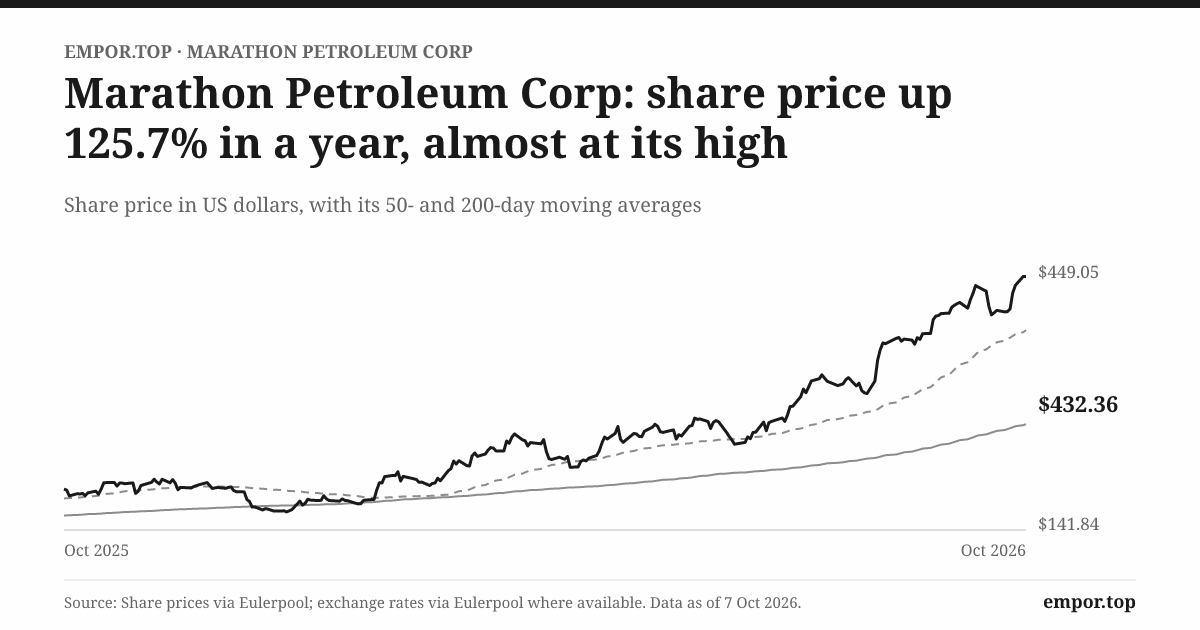
The results show in one number. About 650 million diluted shares were outstanding in 2020. Roughly 289 million remained by the end of June 2026.12 More than half of the company has been retired. Board buyback authorizations since 2012 have added up to about $60 billion.1 Diluted earnings per share, $4.51 in 2014, were $29.13 over the twelve months to June 2026.12 On October 7, 2026, the stock closed at $432.36, a market value of about $147 billion and 0.1% below its all-time high.3
Those three figures make the case for MPC look simple. It isn't. Earnings per share went up about six and a half times. Net profit grew only about 3.6% a year over the decade to 2025.1 Most of the gap between those two numbers comes from shrinking the share count, not from refining more barrels. That shapes how the whole story should be read. MPC doesn't drill for oil and isn't a utility. It is the largest refining system in the United States, a machine that buys crude and sells fuel and lives on the spread between the two. Wrapped around that machine is MPLX, a fee-earning pipeline partnership, and a capital allocation policy that has turned cyclical windfalls into a smaller and smaller share count.
The economics hinge on one sensitivity. Management estimates that each $1 per barrel change in its blended crack spread (the gap between what a barrel of crude costs and what its gasoline and diesel sell for) moves annual refining EBITDA by about $1.125 billion.2 A refiner built like this can earn more in one quarter than in a whole year. In Q2 2026 MPC earned $5.14 billion of net profit.2 That beat its full-year profit for 2014, 2015, 2024, and every year between.1
Its accounts can also mislead. Consolidated debt to equity was 1.98 at the end of 2025, which looks alarming.1 Most of that debt sits inside MPLX and is non-recourse to the parent. Much of the "missing" equity went out the door through buybacks rather than losses.1
This episode follows four questions:
- Can the cannibal keep eating? The Speedway money is spent and the shares trade at record prices. A buyback dollar now retires about a third as many shares as it did in 2023.
- What does the consolidated balance sheet hide? It merges a lightly levered parent with a heavily levered midstream partnership.
- How fragile are earnings once the Q2 2026 spike fades? The same operating leverage that produced $5 billion in a quarter produced a loss in Q1 2025.
- Why can't shareholders change the charter? In 2026, 99.3% of votes cast supported declassifying the board, and the proposal still failed.
The answers start in a small Ohio town in the 1880s, with oil that smelled so bad almost nobody wanted it.
 Subscribe on LinkedIn
II. The Standard Oil Inheritance & Ohio Oil's Pipeline DNA (1887–1911)
In the mid-1880s, drillers in northwest Ohio found oil around Lima and Findlay. By volume it was among the richest finds of the age. Commercially it was close to a disaster. Lima crude was "sour": it carried so much sulfur that kerosene refined from it smoked, stank, and fouled lamps. Producers had wells gushing barrels that sold at a fraction of the price of Pennsylvania crude. In 1887 a group of local producers formed The Ohio Oil Company to try to make the business pay.4
They lasted about two years as an independent company. In 1889 John D. Rockefeller's Standard Oil acquired Ohio Oil.4 Standard's bet was the opposite of the market's. If sour crude was cheap because it was hard to process, whoever could process it, and could move it cheaply to the plants that did, would earn the discount. Standard backed chemistry to remove the sulfur and bought or built pipelines to gather the oil. Ohio Oil became a gathering and pipeline business inside the trust. It produced and moved crude while other parts of Standard did the refining and marketing.
In 1911 the Supreme Court ordered Standard Oil broken up under the Sherman Antitrust Act. Ohio Oil came out as an independent company.4 It got producing fields and pipelines, but no refineries, no brand, and no gas stations. It began life as the part of the trust that worked between the wellhead and the refinery gate.
Why this still matters. Two features of 1890s Ohio describe MPC's business today. First, profit in refining often comes from a cheap feedstock that others can't run. Today MPC estimates that each $1 per barrel widening in the sour crude discount adds about $520 million a year to EBITDA. The sweet crude differential has a similar sensitivity.2 Rockefeller's chemists were working on the same problem with simpler tools. Second, logistics shape the business as much as refining does. A refinery is only as good as the pipes that feed it and the terminals that drain it. MPLX is the modern version of Ohio Oil's original role.
The geography also lasted. Findlay, a town of about 40,000 people, is still MPC's headquarters.1 The largest refiner in the country runs out of the same corner of Ohio where its predecessor once had more sour oil than it could sell.
The lineage shouldn't be romanticized. Ohio Oil after 1911 was a mid-sized crude producer. Nothing about the inheritance made it a winner. The DNA was an advantage only when later managers chose to use it. For most of the next century they didn't, and they spent that time arguing about whether refining belonged with drilling at all.
III. Vertical Integration & The Corporate Crucible (1911–2010)
In late 1981 Mobil, then the second-largest U.S. oil company, made a hostile bid for Marathon Oil. Marathon's management wanted no part of it and looked for another buyer. The rescuer was not an oil company. It was U.S. Steel, led by David Roderick, which bought Marathon for about $6 billion in early 1982 in one of the largest takeovers in American history at the time.4 It was a very 1980s move. A steelmaker squeezed by imports used its balance sheet to buy energy reserves, and an oil company escaped a predator by joining a conglomerate.
That deal is where the main tension of this section shows up. Through the 20th century the Ohio Oil lineage kept integrating forward, from oil field to refinery to pump, and kept finding that integration came with internal politics.
The first step forward came in 1924, when Ohio Oil bought Lincoln Oil Refining and its refinery in Robinson, Illinois.4 That gave the producer its first refinery and the start of a marketing business. The company took the Marathon name, first as a brand and then, in 1962, as its corporate name: Marathon Oil Company.4 Through the postwar decades Marathon was a medium-sized integrated oil company, finding crude in places like Libya and the North Sea while running refineries and stations in the Midwest.
Inside U.S. Steel, which later became USX, Marathon was one division competing with blast furnaces for capital.4 Integrated companies of that era kept running into the same problem. Exploration and refining want money at different times. When crude prices are high, drillers make fortunes and want to drill more, while refiners' margins usually get squeezed. When crude collapses, refiners often do well and producers bleed. Putting both under one CFO means one of them is always arguing for capital at the wrong point in the cycle.
The way out started as a joint venture. In 1998 Marathon combined its refining, marketing, and transportation assets with Ashland Inc.'s to form Marathon Ashland Petroleum, owned 62% by Marathon and 38% by Ashland.4 The venture combined two Midwestern retail chains, Marathon's Speedway and Ashland's SuperAmerica, and added Ashland's Catlettsburg, Kentucky refinery. In 2005 Marathon bought out Ashland's stake and took full control of the downstream business.4 USX had separated steel and energy into independent companies a few years earlier, in 2001.
By 2010 Marathon Oil was an integrated company with a familiar problem. Its exploration business was competing worldwide with ExxonMobil and Chevron, and its refining business was competing in the Midwest with Valero and BP. Investors could not easily value the two together. Each side had a reasonable claim that the other was holding it back.
The lesson from this century is fairly clear. Every time the downstream business was tied to something bigger, whether a steel conglomerate or an exploration company, its capital allocation answered to someone else's priorities. The most important decisions in MPC's modern history came after it was given its own balance sheet. That happened in 2011.
IV. The Great Spin-off & Constructing the MPLX Toll Road (2011–2017)
On June 30, 2011, Marathon Oil completed a tax-free spin-off of its refining, marketing, and transportation business as a separate public company, Marathon Petroleum Corporation, listed on the New York Stock Exchange.45 Gary Heminger, a Marathon lifer from Ohio who had come up through the finance and downstream businesses, became its first CEO.4 The registration statement described a company with seven refineries, a large Midwest marketing network, the Speedway chain, and pipelines.4 It also gave Heminger a mandate he hadn't had before: the cash the refineries produced now stayed in refining.
The pure-play re-rating. MPC wasn't the only one. Phillips 66 split from ConocoPhillips in 2012, and Valero had already sold off its retail arm. The broad bet was that investors would pay more for a clear refining story than for a mixed integrated one. It mostly worked for the next several years, helped by U.S. shale. When Permian and Bakken production surged in the early 2010s, inland crude began to trade at a discount to waterborne crude. Midwest refiners, MPC above all, were buying discounted crude and selling products at prices set against global benchmarks. The 1880s sour-crude playbook was paying off again, now with shale.
Building the toll road. Heminger's second big decision was harder to see and arguably mattered more. In 2012 MPC put a set of pipelines into a new master limited partnership, MPLX LP, and sold a minority stake to the public.5 An MLP is a tax-advantaged vehicle: it pays no corporate income tax if it passes most of its cash to unitholders. Income investors wanted fee-based pipeline cash flows, so MPC could sell slices of steady assets at high valuations while keeping control.
The model is simple once laid out. MPC's refineries need crude delivered and products carried away. MPLX owns the pipes, terminals, and storage. MPC signs long-term contracts with minimum volume commitments and pays MPLX a fee per barrel moved. In Q2 2026 that fee was $3.90 per barrel of throughput.2 MPLX then pays distributions to its unitholders, and MPC is the largest one. MPC owns the non-economic general partner and about 64% of the limited partner units.1
So MPC pays itself. In 2025 about $5.9 billion of MPLX's $11.5 billion of revenue came from MPC's own refining segment, about 51%.1 That revenue cancels out in consolidation. The cash does not: MPC reported receiving about $1.5 billion of MPLX distributions in 2025.1 Those distributions keep flowing whether crack spreads are $8 or $30, because MPLX is paid for volume, not margin.
MarkWest: the diversification test. In 2015 MPLX acquired MarkWest Energy Partners, a large natural gas gathering and processing business centered on the Marcellus and Utica shales of Appalachia.1 The idea was to make MPLX more than a captive pipe network for MPC refineries and to give it third-party customers, gas volumes, and its own growth.
Did it work? Mostly, with costs. On the plus side, MPLX's segment EBITDA rose steadily, from about $6.2 billion in 2023 to about $6.75 billion in 2025, through a period when refining earnings collapsed and recovered.1 Gas processing became a real second business, and growing natural gas demand from power generation and data centers has made it a better asset than it looked during the commodity slump of the late 2010s.
The against case is written into the auditor's report. In MPC's 2024 audit, the critical audit matter was the impairment test on goodwill of about $1.1 billion for MPLX's crude gathering reporting unit.6 Gathering is not the same as long-haul transport. Gathering lines depend on drilling activity near them, and when producers cut back, volumes fall regardless of contract terms. MPLX remains heavily tied to its parent, with half its revenue still coming from MPC. The record narrows the diversification claim. MPLX is now a sturdier, partly independent fee business, but it isn't fully insulated: half its revenue rises and falls with MPC's refinery runs, and some of the rest rises and falls with drilling.
Profit into cash. This structure explains a striking number in MPC's long-run accounts. From 2014 through 2025, MPC reported $47.0 billion of cumulative net profit and $87.6 billion of cumulative operating cash flow, about 186% conversion.1 Three things drive it. Depreciation on a large asset base, about $3.25 billion in 2025 alone, is a non-cash charge.1 The 2020 impairments were large and also non-cash. And consolidated operating cash flow includes all of MPLX, including the share that belongs to public unitholders. The first two show that reported earnings understate cash generation. The third is a caution: not every dollar of consolidated cash flow belongs to MPC shareholders.
By 2017 Heminger had a liberated refiner and a working toll road. He wanted more scale, and he was about to pay a high price for it.
V. The Andeavor Mega-Merger: Building America's Refining Titan (2018–2019)
On April 30, 2018, Heminger announced that MPC would acquire Andeavor, the San Antonio company formerly called Tesoro, in a deal Reuters valued at about $23.3 billion in equity and $35.6 billion including debt.7 When it closed on October 1, 2018, MPC passed Valero as the largest refiner in the United States.17
The logic made sense on a map. MPC was strong in the Midwest and on the Gulf Coast, with flagship plants at Garyville, Louisiana and Galveston Bay, Texas. Andeavor brought the West: Los Angeles, the San Francisco Bay Area, the Pacific Northwest, and the Mid-Continent, including Carson, Martinez, Anacortes, and Dickinson, North Dakota.7 The combined company had access to almost every important North American crude stream: Permian shale, Bakken, Canadian heavy, and Alaskan North Slope. MPC promised annual synergies of about $1 billion within a few years.7 Today the system has 13 refineries with about 2.99 million barrels per day of crude capacity.1
The bill. The balance sheet shows the cost. Consolidated borrowings were about $12.9 billion at the end of 2017, $27.5 billion after the deal, and $30.5 billion a year later.1 Part of that was Andeavor's own logistics partnership debt, which later moved into MPLX. Part was the price of buying at a confident point in the cycle. Refining stocks were near the top of their valuation range in 2018. Andeavor was a well-run company and its owners got a full price, paid mostly in MPC stock that MPC would later spend tens of billions of dollars buying back.
The detonation. Eighteen months later, COVID-19 shut down American driving. U.S. crude briefly traded below zero in April 2020. MPC recorded impairments of about $10.5 billion, much of it goodwill and asset value tied to the expanded system, and reported a net loss of $9.8 billion for 2020.1 Operating cash flow stayed positive at about $2.4 billion, so the plants kept generating cash even as the accounting wrote down what MPC had paid.1
Did MPC overpay? By its own accounting, at least partly yes. Writing off goodwill means admitting part of the price can't be recovered. Two qualifications are fair. The impairment came from a once-in-a-century demand collapse, not from failed integration. And the assets acquired, especially the West Coast and Mid-Continent plants, contributed to the 2022 supercycle profits that later paid for the buybacks. The verdict is mixed. The deal delivered lasting scale and crude flexibility, it was priced for a world without shocks, and the shock arrived almost immediately.
Integration was also hard work. Andeavor's California plants operate under the strictest environmental rules in the country, and MPC later converted the Martinez refinery rather than keep running it on crude (Section X covers this). A conservative Midwestern operator had absorbed a Texas company with its own culture. Whether those frictions alone would have forced a change is unknown, because a hedge fund forced the issue first.
VI. The Elliott Activist Siege & The $21 Billion Speedway Cash Windfall (2019–2021)
On September 25, 2019, Elliott Management, Paul Singer's activist fund, sent a public letter to MPC's board.8 It argued that MPC had become a conglomerate trading at a discount and that the market was ignoring the value of Speedway and MPLX inside a refiner's multiple. Elliott proposed splitting MPC into three companies, refining, retail, and midstream, and questioned the leadership that had built the structure.8 The case was specific and difficult to dismiss.
The board responded within weeks. In October 2019 MPC announced that it would separate Speedway and that Heminger would retire. Michael J. Hennigan, who had been running MPLX and earlier led Sunoco Logistics and Crestwood, took over as CEO in 2020.5 Hennigan was a pipeline executive, and choosing him signaled the board's view: the coming era would be about capital and assets, not empire-building.
The stress test. Then the pandemic hit. U.S. gasoline demand fell by a large fraction in a few weeks. MPC's 2020 accounts showed the damage: a net loss of $9.8 billion, operating margin of negative 17.6%, and cash and short-term investments down to about $415 million at year-end.1 Debt to equity reached 1.49.1 It was not a bankruptcy scenario, but MPC had little room left.
The sale. Instead of spinning off Speedway, MPC ran an auction. In August 2020 it agreed to sell Speedway to 7-Eleven for $21 billion in cash. The deal closed on May 14, 2021, after the Federal Trade Commission objected to the effects on local station competition, and 7-Eleven later agreed to divest hundreds of stores under an FTC order.29 MPC's after-tax proceeds were about $17.2 billion.1
The contract mattered as much as the price. MPC kept the gallons. As part of the sale it signed a 15-year fuel supply agreement to deliver about 7.7 billion gallons a year to the Speedway network, roughly 500,000 barrels a day, at market-indexed prices.1 MPC gave up the store margins, the convenience-store overhead, and around 40,000 retail employees. Headcount dropped from roughly 60,000 to about 18,000.1 It kept the base-load demand that keeps its refineries running.
Myth vs. reality: did selling retail destroy the cycle hedge? The bear argument is simple. Retail fuel margins usually widen when wholesale prices fall, so Speedway cushioned refining downturns. Without it, MPC's earnings became more volatile. There is evidence for this. In Q1 2025, when crack spreads compressed and turnaround work peaked, MPC lost $74 million.1 A convenience chain would have offset some of that.
The bull side has stronger evidence. The $17.2 billion arrived as MPC came out of its worst year and ahead of the strongest refining market in a generation. Cash and short-term investments rose from about $415 million in 2020 to $10.8 billion in 2021 and $11.8 billion in 2022.1 That money became the buyback program. The verdict narrows the bear case without overturning it: MPC gave up a modest earnings stabilizer in exchange for a large and timely capital windfall, and Q1 2025 shows that the stabilizer is gone for good. The balance sheet at that point was more than strong enough to absorb a single loss-making quarter.
Elliott's broader goal, separating midstream, never happened. MPLX stayed inside MPC. That choice turned out to matter a great deal in the years that followed.
VII. The Modern Spread Machine & Financial Dissection
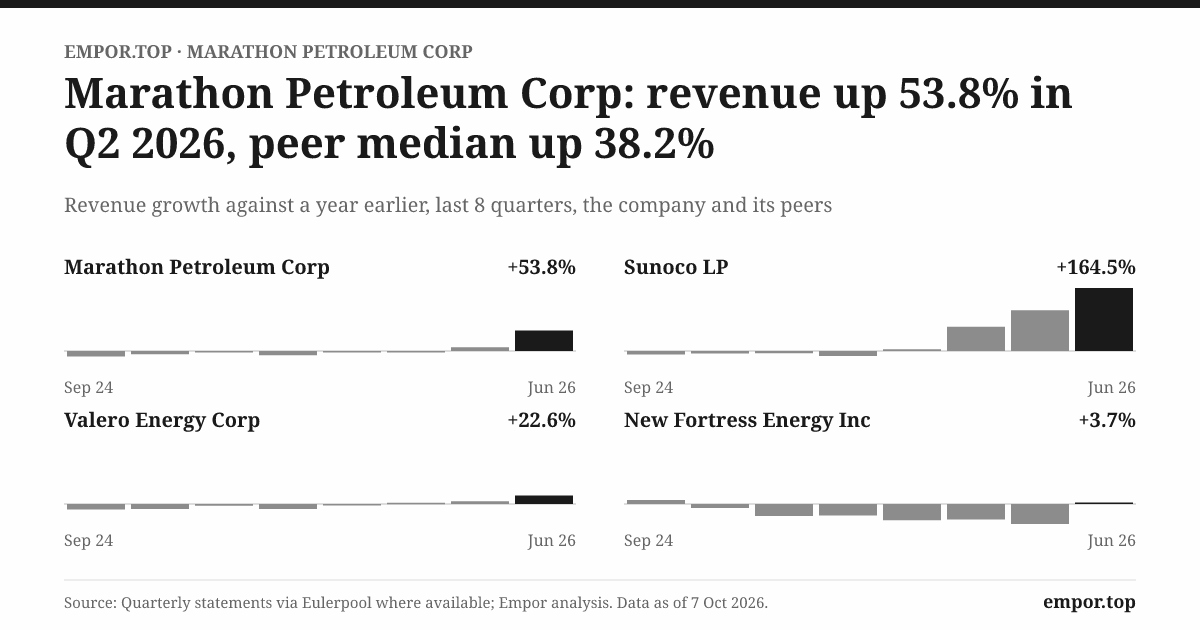
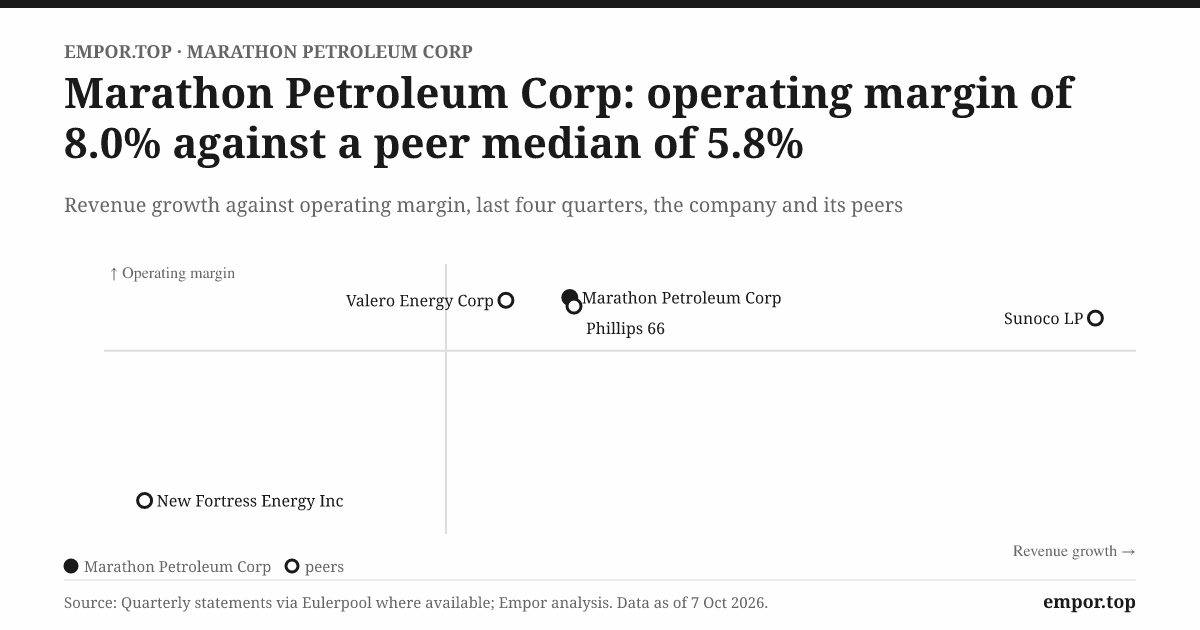
Picture a refinery in the spring of 2026: crude coming in through MPLX pipes, gasoline and diesel going out, and the gap between them unusually wide. In Q2 2026 MPC's blended 3-2-1 crack spread averaged about $33.54 per barrel, and its refining margin was $36.33 per barrel, against $17.58 a year earlier.2 Revenue jumped 54% to $52 billion for the quarter.3 Net profit was $5.14 billion, about $17.70 per diluted share.2 That came from roughly the same plants that in Q1 2025 had produced a $74 million loss.
How the machine works. The 3-2-1 crack is a shorthand: three barrels of crude make roughly two barrels of gasoline and one of diesel. The spread is the value of the products minus the cost of the crude. MPC tracks regional versions, Gulf Coast, Mid-Continent, and West Coast, each priced off a different crude benchmark.2 The $1.125 billion sensitivity per dollar of spread is the core operating leverage.2 Refining costs (labor, maintenance, energy) are mostly fixed, so a bigger spread falls almost straight through to profit. A useful comparison is a toll bridge where the toll changes every day and the upkeep doesn't.
Complexity determines how much of the spread MPC actually captures. Simple refineries can only run light, sweet crude. Complex ones, with cokers and hydrocrackers, can break heavy, high-sulfur crude into high-value fuels. MPC's system, rated by Fitch at an average Nelson Complexity of about 11.5, falls in the second group.10 That is where the $520 million sensitivity to sour crude discounts comes from.2 When Canadian heavy or Mexican Maya trades well below light crude, MPC earns the difference, the same arbitrage Standard Oil ran on Lima crude.
Two businesses in one. The financial reports combine two very different economic models. - Refining & Marketing is the commodity option: large swings, high peaks, occasional losses. - Midstream (MPLX) is the annuity, with segment EBITDA rising steadily toward $6.75 billion.1 In ordinary refining years, that annuity provides more than half of consolidated EBITDA.1 It covers interest, a large share of maintenance spending, and the parent dividend before refining contributes anything.
Earnings quality. Several checks support the reported numbers. - Customers. No customer accounts for 10% or more of revenue.1 Buyers include thousands of jobbers, airlines, railroads, and dealers, with 7-Eleven the largest single relationship. - Receivables. Debtor days were about 28 in 2025, in line with the past four years.3 The credit-loss allowance was about $20 million against roughly $10.3 billion of receivables at the end of 2025, a negligible ratio, and it was lower still in mid-2026.12 Fuel is sold on short terms, and MPC requires letters of credit or prepayment from weaker counterparties. - Related parties. Dealings with outside joint ventures such as Martinez Renewables come to about 1% of revenue in sales.1 The large related-party flow is MPC to MPLX, explained above. It cancels out in consolidation, but it is economically real because 36% of MPLX belongs to outside unitholders. - Other income. About $728 million in 2025, roughly a tenth of pre-tax profit, which included clean-fuel tax credits.1 Interest income fell from $530 million to $159 million over two years as the Speedway cash was spent.1 - Currency. Not a factor. Foreign pre-tax income is under 1% of the total, and MPC holds no FX derivatives.1
Reinvestment. MPC does no research and development in any meaningful sense. Its reinvestment is concrete and steel. Capital spending on property, plant, and equipment rose from about $1.9 billion in 2023 to about $3.5 billion in 2025.1 Planned refinery turnarounds, the multi-week shutdowns to overhaul units, cost another $1.2 billion to $1.55 billion a year.1 Total deployment reached about $7.9 billion in 2025, much of it MPLX's $2.4 billion acquisition of Northwind Midstream, a sour gas gathering and treating system in the Permian.16 The direction is clear. Refining capacity is maintained rather than expanded, and growth capital goes to the midstream business. That is reasonable in an industry whose main product faces long-term demand decline. It also means MPC's growth depends more and more on MPLX's ability to deploy capital well, and the crude-gathering goodwill review shows that isn't automatic.
Overall: the quality of earnings is high and cash conversion is real. The level of earnings is volatile and largely outside management's control, because it is set by the global balance of refining capacity. MPC is very good at producing a margin it can't choose. That brings up the most contested question about the company, which is what its balance sheet really says.
VIII. The Balance Sheet Illusion: Non-Recourse Debt & Denominator Magic
Two analysts read MPC's December 31, 2025 balance sheet and reached opposite conclusions. The credit analyst saw $33.3 billion of consolidated debt and equity of only $17.3 billion, a debt-to-equity ratio near 2.0 and rising for three years.1 The equity analyst saw a parent company carrying about $7.3 billion of its own debt, with a dividend stream from a partnership it controls.1 Both were looking at the same filing. Most of the gap between their conclusions comes from two accounting choices.
Illusion one: whose debt is it? Under U.S. GAAP, MPC consolidates MPLX in full because it controls the partnership. All of MPLX's assets, earnings, and debt appear on MPC's statements. Legally, the roughly $26.0 billion of MPLX debt, 78% of the consolidated total, is owed by MPLX and is non-recourse to MPC.1 Parent debt was about $7.3 billion: roughly $6.45 billion of senior notes, $161 million of MARAD bonds, and about $689 million of finance leases.1 MPC's senior notes have no financial maintenance covenants. The parent has a $5 billion revolving credit facility and MPLX has its own $2 billion facility.1 Consolidated cash rose to about $7.8 billion by mid-2026 on the Q2 windfall.2
"Non-recourse" doesn't mean "irrelevant," though. MPLX's ability to service $26 billion depends partly on fees paid by MPC's refineries. If those refineries ran much less, MPLX's leverage would rise and the distributions MPC relies on would come under pressure. The two entities are legally separate and economically linked. The rating agencies treat them that way. Fitch, S&P, and Moody's rate MPC BBB/BBB/Baa2 with stable outlooks, and Fitch names MPLX's fee-based cash flows as a key support for the parent's credit while listing aggressive shareholder returns as a constraint.10
Illusion two: where did the equity go? Shareholders' equity fell from $27.7 billion in 2022 to $17.3 billion in 2025, during years when MPC earned about $17 billion of net profit.1 The difference is buybacks. Each repurchased share reduces book equity. A company that buys back stock heavily will show rising leverage ratios even if its debt doesn't change. The 1.98 is partly a measure of how much stock MPC has retired.
The buyback autopsy. Here are the clues in order: - In 2023 MPC repurchased about 89 million shares for $11.6 billion, at an average of about $131.1 - In 2024, about 53 million shares for $9.1 billion, at about $172.1 - In 2025, about 21 million shares for $3.4 billion, at about $164.1
That's 163 million shares for about $24 billion in three years. The pace dropped quickly. The Speedway money ran out, and short-term investments went from about $10.2 billion in 2023 to zero by the end of 2025.1
Denominator arithmetic. EPS went from $4.51 in 2014 to $13.54 in 2025, about three times higher.1 Net profit rose from about $2.5 billion to $4.0 billion over the same period, about 1.6 times.1 Nearly all of the remaining gap comes from the share count. That isn't a criticism, since the buybacks were real, cash-funded, and done at prices far below today's. The 2023 purchases at about $131 now look very good against a $432 stock. It is a warning against extrapolating. Each share bought in 2023 removed about 0.3% of the company per billion dollars spent. At $432, a billion dollars buys roughly 2.3 million shares, under 1% of the share count.
Falsification test: can the pace continue? The bull case is that MPLX distributions plus mid-cycle refining cash flow can still fund several billion dollars of buybacks a year, and the board has about $4.4 billion of remaining authorization.1 The record argues for caution. The biggest buyback years were funded by a one-time asset sale and a war-driven margin spike. Neither was organic, and the falloff to $3.4 billion in 2025 shows what normal cash flow alone supports. The capital-return thesis survives in smaller form. MPC can keep shrinking its share count, but at a fraction of the earlier pace, and at today's price each dollar does much less. The figure that would settle this is parent-level discretionary free cash flow (refining cash plus MPLX distributions, minus sustaining capex and dividends) in a year when crack spreads are back in the low-to-mid teens. MPC doesn't publish that figure as a single number, so investors have to assemble it.
A company with this much financial engineering also has to be governed, and MPC's governance has its own odd mechanical problem.
IX. Management, Governance, & The Supermajority Trap
On April 29, 2026, MPC held its annual meeting and once again asked shareholders to declassify the board, so that all directors would stand for election every year instead of in staggered thirds. The result was almost unanimous: about 206.1 million shares in favor and about 1.4 million against, roughly 99.3% of votes cast.11 The proposal failed. It had also failed in 2025.12
MPC's charter requires amendments like this to be approved by 80% of all outstanding shares, not 80% of votes cast.5 With about 294.5 million shares outstanding, that meant roughly 235.6 million votes in favor.511 Shares that weren't voted, mostly held by retail investors through brokers who can't vote them on charter amendments, counted as no votes. The board, management, and nearly every voting shareholder wanted the change, and an anti-takeover provision written in 2011 still blocked it.
The ownership structure explains why. About 85% of the stock is held by institutions. Vanguard holds 13.2%, State Street 8.5%, and BlackRock 7.1%.5 There's no founder, family, or controlling holder. All 18 directors and executive officers together own under 0.2%.5 Large passive owners vote reliably, but a large, scattered retail tail doesn't vote at all. Getting past 80% of outstanding shares would require an expensive solicitation effort to reach small holders, and so far MPC hasn't managed it. A classified board doesn't affect daily operations. It does make a hostile takeover or a proxy fight slower and harder, and that is why governance advocates object to it. Here the company is trying to give up a protection and can't.
The people. Maryann T. Mannen became President and CEO on August 1, 2024, after serving as CFO. Before MPC she was CFO of TechnipFMC and earlier FMC Technologies, so she came up through industrial finance.5 Hennigan stayed as Executive Chairman until he retired at the end of 2025, and Mannen became Chairman on January 1, 2026.5 Maria A. Khoury, a former Danaher group CFO with earlier GE Oil & Gas experience, became CFO on January 19, 2026.1 The succession was orderly and kept the company in finance-led hands. MPC's last two CEOs have been a pipeline operator and a CFO, which matches a company whose main strategic work is capital allocation.
Pay and accountability. Mannen's reported total compensation rose from about $8.7 million in 2023 (as CFO) to about $19.0 million in 2025, most of it in stock.5 Long-term awards are tied to relative total shareholder return and return on capital employed against peers like Valero and Phillips 66.5 Shareholders approved: say-on-pay passed with 93.4% in 2025 and 97.4% in 2026.1211 Relative-return metrics are a reasonable design for a commodity business because they reward beating peers rather than collecting a margin spike. The weak spot is that relative TSR rewards buybacks done when the stock is cheap, and the cheap-stock period is over.
Credibility check. Has management delivered on what it said? On the big structural promises after 2019 (sell Speedway, cut costs, return capital, keep investment grade), the record is good and checkable. On the renewable fuels strategy, promises have run well ahead of results, as the next section shows. On the Andeavor synergy target set in 2018, the 2020 write-down makes clean measurement impossible. The fair reading is that the current team has been disciplined about capital and less convincing about new businesses.
X. The Renewable Transition: Martinez, Dickinson, & Green Realities
The Martinez refinery sits on the Carquinez Strait northeast of San Francisco and had been refining crude for about a century. In 2020 MPC idled it and decided to convert it to make renewable diesel from soybean oil, used cooking oil, and animal fats instead of crude.1 In 2022 Neste, the Finnish renewable fuels leader, bought half of the project for about $1 billion, forming the Martinez Renewables joint venture.[^13] Neste brought global feedstock sourcing. MPC brought the site, permits, and operating know-how. By late 2023 the plant reached its nameplate capacity of about 730 million gallons a year.1[^13]
It was a real engineering achievement. A large crude refinery became one of the world's biggest renewable diesel plants. The North Dakota plant at Dickinson, acquired with Andeavor, had already been converted and makes about 184 million gallons a year.1
The economic outcome. The whole U.S. industry had the same idea at the same time. Refiners and new entrants added renewable diesel capacity quickly, attracted by California's Low Carbon Fuel Standard credits, federal RINs, and blender tax credits. Supply grew faster than the subsidies could support. LCFS credit prices fell and feedstock costs rose. MPC's renewable diesel operations lost about $150 million in 2024 and about $110 million in 2025.1 In Q2 2026 MPC recorded about $75 million of federal clean fuel production tax credits, which reduced the losses.2 Fitch lists renewable diesel oversupply among MPC's credit constraints.10
Falsification test: did renewables become a growth pillar? No. The record rejects that claim as of 2026. The plants work, and the business loses money unless a subsidy fills the gap. A renewable diesel molecule competes on cost with petroleum diesel, which costs less to make, so the margin depends on credit prices set by regulators. A narrower claim does hold. Renewable fuels give MPC some regulatory hedging, since it produces credits it would otherwise have to buy under the Renewable Fuel Standard, and they gave Martinez a use other than closure. That's a real benefit, but a defensive one. The KPI that would change this verdict is a sustained positive segment result without production tax credits. MPC hasn't reported that yet.
The renewables story also makes a broader point. MPC's skill is running hydrocarbons through complex equipment at low cost. That skill moves to new molecules only when the economics come along too. To understand where MPC's advantage really lies, it helps to run the formal frameworks.
XI. Hamilton Helmer's 7 Powers & Porter's 5 Forces Analysis
Take an independent fuel jobber in Indianapolis who needs gasoline for a few dozen stations. The jobber can buy at MPC's local rack, where product arrives by MPLX pipeline from Robinson or Catlettsburg, or bring in barrels from farther away and pay for the extra distance. The jobber doesn't care about MPC's brand or relationship. The decision is price at the rack, and the refiner with the closest plant and its own pipe usually wins. The whole moat analysis follows from that.
Hamilton Helmer's 7 Powers
- Scale economies — strong. Thirteen refineries with about 2.99 million barrels a day of capacity spread fixed costs (crude purchasing, trading, turnaround planning, logistics) over the largest U.S. base.1 Scale also allows optimization across the system, sending crude to whichever plant earns the most from it. This is the most important advantage, and it's a cost advantage, not a pricing advantage.
- Cornered resource — strong, but only in physical terms. MPLX's pipelines, terminals, and marine assets would be extremely hard to duplicate today because of right-of-way, permitting, and local opposition. Very few large new refineries have been built in the U.S. in decades. A cornered asset doesn't set the price of fuel, though. It decides who gets the spread in a particular location. It doesn't decide how big the spread is.
- Process power — moderate. Running complex units on changing crude slates is a real skill. The Nelson rating of about 11.5 shows the hardware, and the ability to capture the sour discount shows the practice.102 Peers like Valero run equally complex systems, so this is competitive parity among the top tier, not a unique edge.
- Switching costs — none. Gasoline is fungible and bought on specification.
- Network effects — none.
- Branding — weak. Marathon and ARCO branded wholesale earns a small premium. Most volume is sold unbranded, and 7-Eleven, not MPC, owns the customer at the pump.
- Counter-positioning — none. MPC is the incumbent model, not an attacker.
The test. If MPC had a strong moat, it would earn high returns across the cycle, not only at the peak. The record says otherwise. Return on capital employed was about 5–6% in 2018–2019, negative in 2020, 28.6% in 2022, and about 10.7% in 2025.3 Those are the returns of a cost-advantaged participant in a cyclical industry, not of a business with a franchise. The moat protects MPC's share of the industry's profits. It doesn't protect the size of those profits.
Porter's 5 Forces
- Buyer power — low to moderate. No customer reaches 10% of revenue, and the 15-year 7-Eleven agreement locks in base-load volume.1 Buyers have little leverage individually, but collectively they pay market prices, and those prices set the margin.
- Supplier power — moderate and favorable. North American crude is abundant and varied, including Permian, Bakken, and Canadian heavy. Crude producers are price-takers selling into a large market, and refiners with complex plants can choose among them.1
- Threat of substitutes — low today, high over time. Electric vehicles, better fuel economy, and fleet decarbonization are steadily reducing gasoline demand in developed markets. Diesel and jet fuel look more resilient. This is the force most likely to erode the business over decades rather than quarters.
- Threat of new entrants — very low domestically. New U.S. refineries are close to impossible to permit and finance. The real new-entrant threat is global: large modern refineries in the Middle East and Asia that export products and set the marginal price on the coasts.
- Rivalry — high. Valero, Phillips 66, ExxonMobil, and others compete every day at every rack. Margins are set by the industry's capacity balance, and no single refiner has pricing power.
Verdict. MPC's moat is real, local, and based on cost. It comes from scale and from pipes that can't be replicated. It decides who wins regional competition and does not shield the company from the cycle. The bull case has to rest on the industry staying tight because capacity is closing faster than demand is falling, and not on MPC having pricing power it has never shown.
XII. Playbook: Business & Investing Lessons
Lesson 1: Capital cannibalism requires the courage to shrink. In May 2021 MPC took $21 billion for its most visible consumer business and spent the next four years buying back more than half its own stock.12 Most management teams treat a windfall as a mandate to grow, and the corporate habit is to build. MPC's better decision was to treat its own discounted equity as the highest-returning asset available. The second half of the lesson is less popular: the same discipline means slowing down when your stock is at a record. A buyback is an investment decision, and its return is set the day you pay the price.
Lesson 2: Legal entity boundaries dictate credit reality. About $26 billion of MPC's consolidated debt belongs to a partnership whose creditors can't reach the parent.1 A fixed-income desk that reads only the consolidated ratio sees a strained company. One that reads the legal entity structure sees a lightly levered parent with a tied-in, levered subsidiary. Neither view is complete by itself. Consolidation tells you what you control; recourse tells you what you owe.
Lesson 3: The toll road subsidizes the foundry. In 2020 and again in Q1 2025, refining margins disappeared and MPLX's fee-based cash kept arriving.1 Pairing a high-beta commodity manufacturer with a fee-earning logistics business is the most effective structural decision since the spin-off. The pairing works because MPC is both MPLX's main customer and its controlling owner. Rent the pipes to yourself, sell part of the landlord to the public, and you've turned a commodity business into one with a paycheck.
Lesson 4: In a mature industry, the cheapest capacity was built by someone else. MPC got most of today's system through deals: the Ashland venture, the Andeavor merger, and earlier carve-outs, plus Garyville, which Marathon built itself decades ago. Even the acquisitions have been painful. Andeavor's goodwill was partly written off within two years.17 The practical lesson is about price, not deal versus build. Acquired capacity is the only capacity you can still get, which is exactly why sellers charge so much for it.
Lesson 5: Technical capability does not guarantee commercial return. Martinez Renewables did what its engineers promised and reached nameplate output, and the segment still lost about $260 million across 2024 and 2025.1[^13] The plant met the specification. The market didn't support the margin. A green molecule burns the same as a brown one; the profit depends on the regulator, not the reactor.
XIII. Bear vs. Bull Case & Skeptical Stress Test
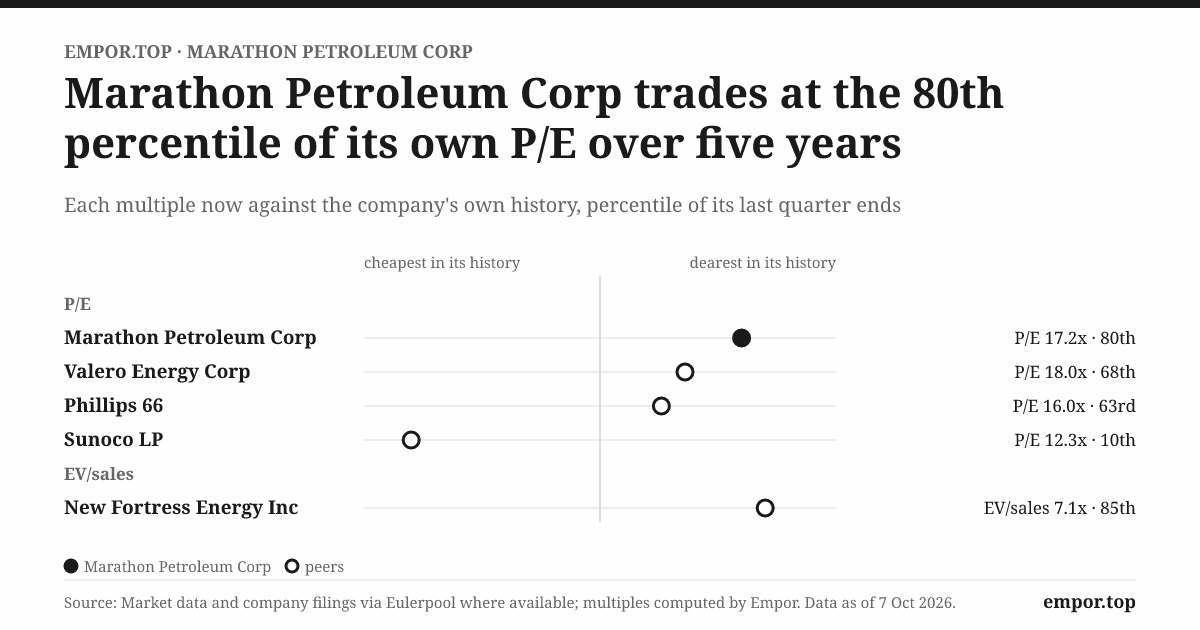
In August 2026, investors working through MPC's Q2 results faced an unusual setup. A cyclical refiner traded at about 17 times trailing earnings, against a five-year median of about 6.7 times.3 Enterprise value was about $174 billion and EV/EBITDA about 10 times.3 Trailing return on equity was about 45%, a figure inflated by a small equity base and a very strong quarter.3 The stock had risen about 166% from its 52-week low of $162.63.3 The market was pricing either a structurally better MPC or a peak that won't last.
The bull case
- Structural scarcity. The U.S. isn't adding refineries, and closures around the world (older European and Californian plants, among others) have shrunk spare capacity. If the industry stays tight, mid-cycle crack spreads stay higher than the 2010s average and MPC's large system earns that higher level every year.
- MPLX keeps growing. Segment EBITDA has risen every year and is heading above $6.75 billion, with Permian gas assets like Northwind and pipeline joint ventures adding growth tied to gas demand rather than refining.1 Part of today's multiple is the market valuing MPLX as infrastructure.
- Feedstock flexibility. With heavy and sour crude cheap, MPC earns roughly $520 million a year for each dollar of differential.2
- A strong parent. Parent debt is about $7.3 billion, there's no covenant pressure, and cash was about $7.8 billion at mid-year.12
The bear case
- Peak-cycle valuation. The 17x multiple is applied to earnings driven by one extraordinary quarter. A blended crack spread above $33 is far from MPC's own normal range. If spreads drift back toward the mid-teens, the $1.125 billion-per-dollar sensitivity works in reverse quickly.2
- Smaller buybacks. The Speedway cash is gone, short-term investments are zero, and at about $432 a share each buyback dollar retires about a third of what it did in 2023.1 The share-count reduction that drove per-share growth will slow.
- Regulatory and legal overhangs. MPC is a defendant in climate-change lawsuits brought by Delaware, several Maryland jurisdictions, and Multnomah County, Oregon. Management says it can't estimate outcomes or losses.1 RFS compliance costs are a recurring charge, and environmental remediation accruals are about $355 million.1 Tesoro High Plains Pipeline is still in litigation with the Interior Department over a trespass ruling.1
- Renewables still losing money. Martinez has yet to make money without credits.
The activist's stress test
An activist reviewing MPC today would likely focus on three things. First, sizing the buybacks: should a company trading at triple its median multiple keep buying, or let cash build for the next downturn? Second, MPLX: Elliott pushed for separation in 2019, and with MPLX valued as infrastructure, would full separation or a buy-in of the minority create more value than the current structure? Third, the renewables write-off risk, which comes down to how long losses at Martinez will be accepted.
Weighing it
The evidence supports a narrower bull case. MPC is a better business than it was in 2018. It has less retail drag, a stronger midstream annuity, a much smaller share count, and a stronger parent balance sheet. The current price assumes more than that. It implies that much of Q2 2026 earning power lasts. The company's own 12-year history, with net profit ranging from a $9.8 billion loss to a $14.5 billion gain, makes that a bold assumption.1 Per-share compounding from here is likely to run well below the 2021–2025 pace.
The three KPIs that decide the next decade
- Refining margin per barrel against the blended crack. Latest: $36.33 per barrel in Q2 2026, up from $17.58 a year earlier.2 This shows whether MPC captures more of the spread than the benchmark implies.
- MPLX segment EBITDA. Latest full year: about $6.75 billion, up from about $6.2 billion two years earlier.1 This is the growth of the annuity and of the share that doesn't depend on MPC's own volumes.
- Net share count. Latest: about 289 million at June 2026, down from about 650 million in 2020.2 This records whether capital is still flowing back to owners now that the shares cost more than three times what they did in 2023.
XIV. Epilogue: The Horizon Ahead
On the evening of October 7, 2026, Marathon Petroleum closed at $432.36, a few cents below its all-time high, with a market value of about $147 billion.3 A company that sold its stores, bought back half its shares, and survived a $9.8 billion loss year is valued at about $500 for every barrel per day of its refining capacity once MPLX is included. The market has seldom liked a refiner this much.
Three events over the next year will show whether that view is right.
The Q3 and Q4 2026 results. Q2 earned about $17.70 per diluted share in a single quarter.2 If spreads stay well above the historical mid-teens, the 17x trailing multiple will start to look like a modest forward one and the scarcity argument will gain ground. If quarterly EPS falls back to the low-to-mid single digits typical of normal years, the current price will look like an extrapolation from one quarter, and the main question becomes how much of the move was due to the cycle.
MPLX's Permian gas build-out. Northwind's integration, and whether the acquired intangibles that auditors examined closely hold their value, will test whether MPLX's growth spending earns fee-like returns or brings back the gathering-volume risk that hurt the crude gathering unit.61 Good results support the annuity's growth. An impairment would weaken the infrastructure premium.
The 2027 annual meeting. Management can try again on declassification with a more aggressive retail solicitation or pursue another route. Passing would end a governance oddity. A third failure would turn an amusing fact into a real governance issue: a board that can't modernize its own charter.
Behind all three is the central tension of this story. MPC has become an excellent allocator of cyclical cash. How much cash it has to allocate depends on global refining capacity, gasoline demand, and regulatory credit prices, none of which Findlay controls. MPC has shown it can shrink well. Whether it can do as much with a stock at $432 as it did with one at $131 is still unanswered.
XV. Outro: The Last Refinery Standing
In 1887 a group of producers in Lima, Ohio, sat on wells they couldn't make pay. The oil was abundant, sour, and widely disliked. Their company was bought, bundled into a trust, broken up, merged into a conglomerate, spun out, renamed, and rebuilt. One idea lasted through all of it: cheap, unwanted crude can be profitable for whoever can move it and process it.
Today crude flows through MPLX pipelines into the towers at Garyville and Galveston Bay, which run around the clock and turn about 2.8 million barrels a day into gasoline, diesel, and jet fuel.1 Five hundred miles north, in Findlay, the cash those towers produce has gone mostly to buying back the company. Marathon Petroleum came to see refining as a finite source of cash rather than a growth business, and concluded that the best use of that cash, so far, was to retire its own shares.
References
-
Form 10-K for Fiscal Year Ended December 31, 2025 — Marathon Petroleum Corporation, 2026-02-26 ↩↩↩↩↩↩↩↩↩↩↩↩↩↩↩↩↩↩↩↩↩↩↩↩↩↩↩↩↩↩↩↩↩↩↩↩↩↩↩↩↩↩↩↩↩↩↩↩↩↩↩↩↩↩↩↩↩↩↩↩↩↩↩↩↩↩↩↩↩↩↩↩↩↩↩↩
-
Form 10-Q for Quarterly Period Ended June 30, 2026 — Marathon Petroleum Corporation, 2026-08-04 ↩↩↩↩↩↩↩↩↩↩↩↩↩↩↩↩↩↩↩↩↩↩↩↩
-
Investor Relations Homepage & Presentations — Marathon Petroleum Corporation ↩↩↩↩↩↩↩↩↩
-
Form 10-12B/A Spin-off Registration Statement — Marathon Petroleum Corporation, 2011-05-26 ↩↩↩↩↩↩↩↩↩↩↩↩
-
Definitive Proxy Statement (DEF 14A) for 2026 Annual Meeting — Marathon Petroleum Corporation, 2026-03-16 ↩↩↩↩↩↩↩↩↩↩↩
-
Form 10-K for Fiscal Year Ended December 31, 2024 — Marathon Petroleum Corporation, 2025-02-27 ↩↩↩
-
Marathon Petroleum to Acquire Andeavor in $35.6 Billion Transaction — Reuters, 2018-04-30 ↩↩↩↩↩
-
Elliott Management Releases Letter to Board of Marathon Petroleum Calling for Restructuring — Business Wire, 2019-09-25 ↩↩
-
7-Eleven Completes Acquisition of Speedway from Marathon Petroleum for $21 Billion — Bloomberg, 2021-05-14 ↩
-
Fitch Affirms Marathon Petroleum at 'BBB'; Outlook Stable — Fitch Ratings ↩↩↩↩
-
Current Report on Form 8-K (Item 5.07 Voting Results 2026 AGM) — Marathon Petroleum Corporation, 2026-05-01 ↩↩↩
-
Current Report on Form 8-K (Item 5.07 Voting Results 2025 AGM) — Marathon Petroleum Corporation, 2025-05-02 ↩↩
 LinkedIn
 WhatsApp
 Reddit
 Hacker News
 Email
 Kindle
 RSS Feed
 Spotify
 Apple Podcasts
 Amazon Music
 Audible
 YouTube