M&T Bank: The Prudent Acquirer and the Regional Banking Crucible
I. Cold Open: The Buffalo Fortress
In the second week of March 2023, the American banking system lost two lenders in about 48 hours. Silicon Valley Bank failed after depositors, most of them venture-backed technology companies whose balances sat far above the FDIC insurance limit, tried to pull their money at the same moment. Signature Bank in New York followed. Over the next few days investors sold almost any bank with a regional address and a commercial property book, on the theory that the next run could start anywhere a depositor had a phone and a reason to worry.
Buffalo, New York looked like an obvious target. It is a former steel and grain city on the eastern shore of Lake Erie, and it is home to a bank with a large exposure to commercial real estate, including office towers in New York, Philadelphia and Boston. Yet inside One M&T Plaza, the white marble headquarters on Main Street, the run never came. Depositors stayed put. Chief executive René Jones did not announce an emergency capital raise or sell the bank to a stronger rival. M&T Bank went on doing what it had done for decades: it reported a profit.
That is the hook of this story. M&T says it has not posted a quarterly loss since 1976, a run of roughly half a century that covers the Latin American debt crisis, the savings and loan collapse, the dot-com bust, the 2008 financial crisis, a pandemic and the 2023 regional banking panic.[^1] During the 2008 crisis, when most large American banks slashed their dividends to conserve capital or took them close to zero, M&T kept paying shareholders at the same rate, a record Forbes pointed to as one reason Warren Buffett admired the bank.10 Today the company carries about $214bn of assets on its balance sheet.1
The contrast is the point. While Wall Street spent the mid-2000s packaging subprime mortgages, and while a later generation of regional lenders chased large, uninsured deposits from startups, M&T kept lending to the kind of borrowers it could visit: manufacturers in Rochester, family businesses in Baltimore, apartment owners in suburban New Jersey. It is not a glamorous strategy. The question this story asks is whether it is still a winning one.
Three questions run through what follows. The first is whether M&T has truly neutralized the commercial real estate exposure that frightened investors after 2023, or whether it has merely traded credit risk for slower loan growth. The second is whether the bank can defend a net interest margin of about 3.67%, the spread between what it earns on loans and pays on deposits, when roughly 72% of its customer deposits now pay interest and the rate cycle is turning.1 The third is the most interesting: an institution built through serial acquisitions is now sitting on about $55bn of cash, much of it parked at the Federal Reserve.1 Can it deploy that money without abandoning the underwriting discipline that made it famous?
Here is the company today, in a few strokes. M&T Bank Corporation is valued by the stock market at about $34bn, earned roughly $12.4bn of revenue over the last twelve months, employs around 22,000 people and runs a dense branch network across a dozen states from Maine to Virginia.12 The verdict worth testing is simple to state and hard to prove: M&T's low-cost deposit base and strict credit culture made it one of the most durable regional banking franchises in American history, but today's higher-rate, post-merger world asks questions about spreads and asset quality that its history alone cannot answer.
To understand why M&T behaves the way it does, the story has to begin where the bank did, at the end of a canal.
 Subscribe on LinkedIn
II. Canal Capital: Financing Buffalo's Golden Age (1856–1925)
In the 1850s Buffalo was one of the busiest places in America. The Erie Canal ended there, which made the city the hinge between the grain fields of the Midwest and the ports of the East Coast. Lake freighters unloaded wheat into towering elevators, canal boats carried it east, and around this traffic grew mills, foundries, tanneries and iron works. It was a city of people who made heavy things and needed money to make more of them.
The banks of the day were not built for that. Commercial banking in the mid-nineteenth century mostly meant discounting short-term trade bills: a merchant shipped goods, received a promise of payment in ninety days, and sold that promise to a bank for cash today. That worked for traders. It did little for a manufacturer who needed to buy a furnace or a steam engine and pay for it over years from the profits it produced.
Manufacturers and Traders Bank opened in 1856 to fill that gap, and the name was the business plan.[^1] Its founders, led by the Buffalo industrialist Pascal Paoli Pratt, raised capital locally and lent it to the city's producers. The method that the bank would later turn into a culture is visible even in this early form: take deposits from the community, judge the borrower's plant and cash flow up close, and lend against assets you can see and value. When a lender knows the furnace, the foreman and the order book, it does not need to guess.
The bank also learned early that growth could be bought as well as built. In 1902 it absorbed the Merchants Bank of Buffalo, the first of the acquisitions that would define its next century.[^1] The logic was straightforward. A bank that combines with a neighbor gains deposits in the same streets it already understands, which lowers its cost of funds and spreads its fixed costs over a bigger base. That idea, consolidation inside a known market rather than expansion into unknown ones, would return again and again.
What the bank did not leave behind is a detailed public ledger of how it handled the national panics of 1873, 1893 and 1907, and the story should not invent one. What can be said is that it survived them, at a time when many American banks did not, and that survival through panics became part of how the institution understood itself. The habits that the twentieth-century bank would describe in its annual reports, conservative collateral, local knowledge and a refusal to lend on hope, are the habits of a lender born to finance factories rather than speculation.
For an investor, the founding matters less as nostalgia than as a clue. M&T's modern loan book is still dominated by commercial lending to businesses and property owners in its own region, and its pitch to those borrowers is still proximity.2 The question is whether proximity remains an advantage in an age of digital lending. Before that question arrived, though, the bank had to survive the worst economic collapse in American history, and it needed a different kind of leader to do it.
III. The Harriman Era and the Skyscraper on Main Street (1925–1982)
In 1925 Lewis G. Harriman, a young Buffalo banker, engineered a merger between Manufacturers and Traders and the Fidelity Trust Company.[^1] The combination turned a local merchant lender into one of the larger institutions in upstate New York, with resources on the order of $100m, a significant sum for a regional bank of that era. Harriman would run the bank for decades, and his timing was about to be tested in the most brutal way possible.
Four years later the stock market crashed. Buffalo's economy, built on steel, grain and heavy manufacturing, was precisely the kind of economy the Depression punished. Thousands of American banks failed between 1930 and 1933. M&T was not among them. The bank's own account of its history stresses that it came through intact, and the reasons consistent with its later behavior are not mysterious: a bank that keeps ample liquid government securities and avoids lending against speculative property has fewer losses to absorb when the economy stops.[^1] That is the first documented appearance of a pattern that later generations of management would make explicit. In good times, conservatism looks like a missed opportunity. In bad times, it is the difference between being a buyer and being a casualty.
The postwar decades brought a different challenge. Americans moved to the suburbs, and banking followed them in cars and strip malls. M&T, still anchored downtown, made its statement in stone. In the mid-1960s it commissioned Minoru Yamasaki, the architect who would later design New York's World Trade Center, to build One M&T Plaza, a slender tower clad in white marble on Main Street.[^1] A bank headquarters is not usually a strategic document. This one was: it told Buffalo that the bank intended to stay, even as industry began to leave.
The more important structural move came in 1969, when the company reorganized into a bank holding company called First Empire State Corporation.[^1] That sounds like legal plumbing, and in a sense it was. But a holding company could own several banks, which, as state and federal rules loosened over the following decades, gave M&T a vehicle to acquire institutions across New York and beyond. Without it, the acquisition machine of the next era could not have been built.
The 1970s were unkind to the machine's raw material. Upstate New York lost factories and jobs, and double-digit inflation punished traditional lenders whose deposits had to be repriced upward while their old fixed-rate loans earned less in real terms. By the early 1980s First Empire was solid but unremarkable, a bank with roughly $2bn of assets in a shrinking region.3 It needed an owner who saw something others did not. The person who arrived would become, for a generation of investors, the definition of a disciplined banker.
IV. The Wilmers Revolution: The Discipline of a Banking Patriarch (1983–2000)
In 1983 Robert G. Wilmers led a group of investors that took a controlling stake in First Empire State Corporation.3 He was not a Buffalo native. He had worked at Morgan Guaranty, the J.P. Morgan bank, and in business abroad, and he arrived as an outsider with an unusual idea: that a small bank in a declining city could become a great one if it simply refused to make the mistakes larger banks found irresistible. He would run it for almost 35 years, until his death in December 2017.3
Wilmers was patrician in background and austere in style. He thought about banking the way a careful family investor thinks about a portfolio: what can go wrong, how badly, and how much do you lose if it does. His view, repeated across decades of shareholder letters, was that banking is not high finance. It is the custody of other people's savings, and the right way to earn a return on that custody is to know your borrowers, demand collateral you understand and keep costs low enough that you do not have to stretch for yield.
The test of that philosophy came quickly. Around 1990 the savings and loan crisis tore through the Northeast. Thrifts that had borrowed short and lent long, or lent aggressively against real estate, collapsed. Upstate New York had several big ones, including Goldome in Buffalo and Empire of America. For a conservatively run bank, this was not a threat. It was a sale. M&T acquired deposits and branches from failed institutions on favorable terms, assisted by regulators eager to place them with a sound buyer.3 The pattern that would define the bank was now visible in full: stay strong when others lend recklessly, then buy what they leave behind when the bill arrives.
The growth that followed was remarkable for a bank in such an unfashionable market. Assets that had been about $2bn when Wilmers arrived exceeded $20bn by the end of the 1990s, powered by a long sequence of acquisitions, most of them small, nearby and cheap.3 In 1998 the holding company dropped the First Empire name and took the identity of its main bank, becoming M&T Bank Corporation, which signaled that the bank was now a single brand rather than a collection of purchases.[^1]
The operating playbook behind the deals is worth spelling out, because it explains M&T's economics today. Wilmers preferred density to reach. A bank with the largest or second-largest share of deposits in a county can fund itself more cheaply, because customers already have a branch nearby, local businesses already bank there and marketing reaches more of the people who matter. Spreading thinly across many states buys headlines but not cheap money. The result was a bank that looked boring on a map and attractive on an income statement.
Wilmers' annual letters became a minor institution in their own right. They read less like corporate communications than essays, criticizing executive pay on Wall Street, warning about leverage at the biggest banks and arguing that traditional community banking served a social purpose. Value investors read them for the same reason they read Buffett: an executive who explains his reasoning in writing, year after year, gives shareholders a way to check whether he does what he says.
That is the right way to test the Wilmers legend. The claim is that M&T's culture produced unusually good decisions. The evidence for it is the record of buying distressed franchises cheaply and staying profitable through the S&L crisis. The evidence against it would be a large acquisition that went wrong, and one did come, though not in the way most people expect. Before getting there, it helps to understand the machine those acquisitions were feeding.
V. The Anatomy of a Spread Machine: How M&T Actually Makes Money
Picture a loan committee in Rochester. A precision-parts manufacturer wants a working-capital line to buy steel ahead of a large aerospace order. The bank prices the line at a floating benchmark rate plus a margin of a couple of percentage points, so that the interest rises and falls with the market. The money it lends comes, in large part, from checking and savings accounts held by households and businesses across the region, some of which pay little or no interest. The gap between those two rates, multiplied by tens of billions of dollars, is most of M&T's business.
That gap is called net interest income, and in 2025 it was about $6.9bn, a little over half of the bank's revenue.1 The other part, about $5.35bn, came from fees: trust and wealth management, service charges on deposit accounts, mortgage banking and capital markets work.1 A bank is, at bottom, a spread business with a fee business wrapped around it, and M&T's version is weighted heavily toward the spread.
The best single measure of the spread is the net interest margin, the bank's net interest income divided by the assets that earn it. M&T's taxable-equivalent margin rose from about 3.58% in 2024 to about 3.67% in 2025, as loans and securities repriced to higher yields faster than funding costs climbed.1 For comparison, a margin in the mid-3% range is healthy for a large American bank. It says that M&T's borrowers are paying it well relative to what its depositors are getting.
Two features explain why. On the asset side, roughly half of M&T's commercial loans carry floating rates, which means that when interest rates rose, the bank's income rose with them almost immediately.1 On the liability side, customer deposits of about $163bn fund roughly 80% of the bank's assets.1[^15] Deposits are the cheapest money a bank can raise, and regional banks with dense branch networks tend to keep them more cheaply than national digital banks, which have to pay up to attract savers who have no other reason to stay. The term of art is deposit beta: how much of a rise in market rates the bank must pass on to its depositors. A lower beta is a quieter, more loyal deposit base.
The fee business adds a counterweight. Wilmington Trust, the Delaware fiduciary franchise M&T acquired in 2011, earns trust and wealth fees that consume little capital and carry no credit risk.29 When loan demand slows or credit costs rise, those fees keep coming in, which smooths the earnings line.
Now the uncomfortable part, which belongs right next to the moat claim. The deposit base is changing shape. By the end of 2025 M&T held about $120bn in interest-bearing deposits and only about $46.5bn in noninterest-bearing ones.1 During the era of near-zero rates, businesses left large balances in accounts that paid nothing because nothing paid much anywhere. When rates rose, corporate treasurers moved money into accounts that paid interest, or out of the bank altogether. That shift puts a structural floor under M&T's funding costs. It also means that the deposit advantage, while real, is narrower than it was in 2021: a larger share of M&T's funding now behaves like a price-sensitive commodity.
So the verdict on the engine is mixed but clear. M&T is an asset-sensitive commercial lender with sticky regional deposits and a useful fee cushion. The margin is strong today partly because of how loans repriced on the way up. Whether it holds on the way down depends on whether depositors' rates fall as fast as loan rates do, and the story will return to that question at the end. First, though, comes the chapter in which this engine was driven out of its home territory.
VI. Scaling South: The Allfirst Triumph and the Hudson City Quagmire (2000–2015)
In early 2002 Allied Irish Banks disclosed that a currency trader at its American subsidiary, Allfirst Financial in Baltimore, had hidden losses of about $690m over several years. It was one of the largest rogue-trading scandals of its time, and it left AIB with a damaged American business it no longer wanted to run. Robert Wilmers saw a sound franchise with a broken governance problem. In September 2002, AIB agreed to sell Allfirst to M&T in a cash-and-stock deal valued at about $3.1bn, with AIB taking a large minority stake in M&T as part of the price.8
The deal closed in 2003 and transformed the company. Allfirst brought a large branch network in Maryland, Pennsylvania and around Washington, D.C., and made M&T a serious Mid-Atlantic commercial lender rather than an upstate one. Crucially, the problem that sank Allfirst was confined to a trading desk M&T did not need. The deposits, the branches and the commercial relationships were intact. Wilmers bought a good bank at a price set by a scandal.
Eight years later he did it again. Wilmington Trust, a century-old Delaware institution known for managing family fortunes and acting as trustee for complex corporate structures, had wandered into aggressive construction lending in its home state, and when the property market collapsed, those loans went bad. In November 2010 M&T agreed to acquire it for about $351m in stock, a fraction of what the franchise had been worth a few years earlier.9 The fiduciary business, which is what M&T really wanted, became the fee anchor.
The pattern seemed unbeatable. Then, in August 2012, M&T announced its most ambitious deal yet: the acquisition of Hudson City Bancorp, a large New Jersey savings bank, for about $3.7bn.[^11] Hudson City offered something M&T could not easily build: about $25bn in deposits and well over a hundred branches in the affluent suburbs of New Jersey and New York. It also brought a very simple, very old-fashioned balance sheet of mortgages funded by deposits and expensive wholesale borrowings, which M&T planned to restructure.
The deal stalled almost at once. In 2013 the Federal Reserve told M&T that it would not approve the merger until the bank fixed weaknesses in its programs for complying with the Bank Secrecy Act and anti-money-laundering rules, the systems banks use to detect suspicious transactions and know who their customers are.[^11] The regulator's message was unambiguous: a bank that could not demonstrate control over its own compliance would not be allowed to get bigger. M&T entered an extended remediation, spent heavily on compliance staff and systems, and repeatedly extended the merger agreement. The Fed finally approved the deal in September 2015, and it closed that November, more than three years after it was announced.7
This episode is the most important piece of disconfirming evidence in M&T's record, and it should be weighed honestly. The Wilmers legend says M&T is unusually good at risk management. Hudson City shows that the bank's discipline was concentrated in credit risk, whether loans would be repaid, and had lagged in operational and regulatory risk, the plumbing that regulators care about as a bank grows. The credit culture survived. The compliance culture had to be rebuilt under regulatory pressure. The cost was not a catastrophic loss but three years of frozen strategy and a large, unplanned expense.
The lesson for investors is that M&T's acquisition engine depends on regulatory permission, and permission is earned through systems, not reputations. That lesson would matter again when the bank attempted its largest deal. But between Allfirst and Hudson City lay a crisis that tested the credit culture as nothing had since the Depression, and that test is where the legend was really made.
VII. The Financial Crisis Crucible: When Warren Buffett Looked to Buffalo (2007–2012)
In September 2008 Lehman Brothers filed for bankruptcy, money-market funds broke the buck, and credit across the world stopped flowing. Within months, some of the most famous names in American finance had been rescued, merged or nationalized. Banks that had spent years originating subprime mortgages, packaging them into securities and holding the riskiest pieces in off-balance-sheet vehicles discovered that their capital was an illusion.
M&T had largely stayed out of that game. It had not built a business originating subprime mortgages for sale, and it had not loaded its balance sheet with the exotic structured securities that destroyed its larger rivals. It did take losses, as every bank did, including on some mortgage-backed securities it held, but they were the losses of a lender in a recession rather than the losses of a casino after a bad night. It stayed profitable every quarter.[^1]
The clearest signal was the dividend. Through 2008, 2009 and 2010, while most large American banks cut their payouts to shareholders sharply, M&T kept paying at the same quarterly rate, a record that placed it in a very small group among large U.S. banks.10 Holding a dividend is not proof of strength by itself; a bank can pay out money it should be keeping. But regulators were watching every large bank's capital closely in those years, and M&T's ability to maintain its payout through the period tells you that its losses never came close to threatening its capital base.
Warren Buffett noticed. Berkshire Hathaway had been a long-time M&T shareholder, and Buffett praised Wilmers publicly as one of the most capable bankers in the country, citing exactly the qualities this story has traced: conservative lending, low costs and rational capital allocation.10 For a bank in Buffalo, being named by the most famous investor in America was more than flattery. It told institutional investors that M&T's conservatism was a strategy, not provincialism.
Wilmers used the moment to argue his case in public. He criticized the bailouts of reckless Wall Street institutions and the incentives that had led them there, and he defended the deposit-funded, relationship-based model as the safer form of banking.3 Whether one agrees with every argument he made, his letters from the period show a consistency that is rare: he had been warning about leverage and compensation before the crisis, not just after it.
The crisis also delivered the payoff that Lesson Two of this story will make explicit. As national rivals pulled back on local commercial lending to protect their capital, M&T could keep lending in upstate New York, Pennsylvania and Maryland, and it could buy distressed franchises at distressed prices. Wilmington Trust, rescued at the bottom of the cycle, was the most visible example.9
So what is the verdict? The claim that M&T's credit culture is exceptional survives its strongest test intact. The bank went through the worst financial crisis in eighty years without a quarterly loss and without cutting its dividend. The caveat, drawn from the Hudson City freeze a few years later, is that the culture excelled at credit while other forms of risk lagged. And there is a second caveat, which the next chapter introduces: the culture belonged in large part to one man, and in December 2017 he was gone.
VIII. The People's United Mega-Merger: René Jones Takes the Reins (2017–2022)
On December 16, 2017, Robert Wilmers died suddenly at his home at the age of 83.6 He had run the bank for 34 years and had been, for most investors, its single most important asset. The board turned to René Jones, a long-serving M&T executive who had been chief financial officer and had run several of the bank's businesses. Jones became chairman and chief executive.6[^1]
The skepticism was natural. Wilmers was a famous banker. Jones was a respected operator but not a public figure, and the question every analyst asked was whether the culture belonged to the institution or to the man. Jones' answer, in his early years, was continuity: the same decentralized lending structure, with regional presidents holding real authority over local credit decisions, the same emphasis on credit discipline and the same shareholder letters, now in a different voice.
In February 2021, M&T announced the biggest deal in its history: the acquisition of People's United Financial, a Connecticut-based bank, in an all-stock transaction valued at roughly $7.6bn at announcement and about $8.3bn by the time it closed.[^8] The logic was pure Wilmers geography. People's United brought branches across Connecticut, Massachusetts, Vermont, New Hampshire and Maine, joining New England to M&T's existing footprint and producing a nearly continuous franchise from Maine down to Virginia. The deal closed on April 1, 2022.[^8]
The balance sheet jumped. Total assets rose from about $155bn at the end of 2021 to about $201bn a year later.1 Shareholders' equity rose by roughly $7bn, because M&T paid in its own shares. That last detail matters for any judgment about whether Jones overpaid. An all-stock deal does not drain cash, but it dilutes existing owners, so the test is whether earnings per share grew afterwards. Here the record is respectable rather than spectacular: diluted EPS went from about $14.40 in 2021 to about $18.20 in 2025, a period that includes both the merger and a rate cycle that flattered most banks' earnings.1
The integration was expensive. Merger-related costs ran to several hundred million dollars in 2022, and M&T's operating margin, which had been about 40% in 2021, fell to about 31% that year.1 Integration costs are by definition temporary, and they were.
What was not temporary was the timing. M&T closed the largest deal in its history in April 2022, just as the Federal Reserve began the fastest rate-hiking campaign in four decades. Higher rates helped the bank's margin, but they also raised the cost of refinancing commercial property loans and pushed down the value of office buildings, particularly in cities where remote work had hollowed out demand. M&T's commercial real estate exposure had already been large before the deal; People's United added more.
The verdict on the merger, four years later, is that the strategic case has largely held. M&T has a bigger, contiguous franchise, its earnings per share are higher, and the integration is complete. The open question was never whether New England fit; it was whether a bank of this size, with this much commercial property, would come through a sharp rise in rates without a credit accident. That question arrived with brutal speed in March 2023.
IX. The Crucible of 2023: De-Risking the Commercial Real Estate Bomb
In the months after Silicon Valley Bank failed, the market's anxiety found a new target. If deposit runs were the first act of the regional banking crisis, many investors believed commercial real estate would be the second. Office buildings in big northeastern cities sat half empty, their loans were coming due at much higher rates, and regional banks held a large share of that debt. M&T, with a big property book and offices in New York, Philadelphia and Boston, was an obvious name on the short sellers' lists.
The fear rested on a simple calculation. Regulators measure a bank's commercial real estate concentration as its property loans divided by its total risk-based capital, the cushion that absorbs losses. Above about 300%, supervisors start asking hard questions. At the end of 2022, M&T's ratio was about 208%.[^7] That was below the formal warning level, but high enough that a meaningful wave of office losses could take a visible bite out of capital.
What M&T did next is the most consequential decision of the Jones era, and the record shows it clearly. Instead of waiting for the property market to recover, the bank worked the book down. It let loans pay off without replacing them, restructured troubled ones, took losses where they were unavoidable and was selective about new property lending. By the second quarter of 2026, the concentration ratio had fallen to about 134%.[^7] Put plainly, M&T cut its property exposure relative to its capital by more than a third in about three and a half years, while continuing to earn money every quarter.
The credit numbers moved the same way. Nonaccrual loans, those where the bank has stopped booking interest because it doubts full repayment, fell by about $438m during 2025 to about 1.25% of total loans, led by declines in commercial real estate and in business loans.2 A nuance makes that figure less alarming than it sounds: about 45% of the commercial loans classified as nonaccrual were still current on their contractual payments, meaning M&T had put them in the penalty box out of caution rather than because borrowers had stopped paying.2
Net charge-offs, the losses a bank actually writes off, tell the same story. They ran at about 41 basis points of loans in 2025, or 0.41%, and fell to an annualized 27 basis points in the first half of 2026.2 For a bank that went through a property downturn concentrated in its own region, those are orderly numbers. They suggest the losses were real but manageable, and that the bank's original lending, with its emphasis on equity cushions from borrowers, did its job. Fitch, affirming M&T's 'A' rating with a stable outlook in September 2026, cited the reduction in property concentration as one of the reasons.5
Now the counterweight, because the de-risking story is easy to tell too triumphantly. First, much of the decline in concentration came from shrinking the loan book, not just from fixing it. A bank that stops growing a business line can make its ratios look better quickly, but it gives up the interest income those loans would have earned. That is the trade: did M&T neutralize credit risk, or convert it into an earnings drag? The honest answer is both. Second, office loans in northeastern cities remain a structural problem. As long as they sit on the balance sheet, they require reserves and management attention, and they limit how aggressively the bank can lend into its biggest urban markets. Third, PwC, the bank's auditor, singled out the allowance for credit losses as its critical audit matter, because setting it requires judgment about future economic conditions.2 That is normal for a bank, but it is a reminder that reserve levels rest on forecasts.
The verdict is that the commercial real estate overhang has been defused rather than eliminated. The claim that M&T's underwriting held up through a sharp property downturn survives the test. The claim that the risk is gone does not. The figure that will settle it is whether annual charge-offs stay below about 30 basis points through 2026 without the bank needing to rebuild its reserves. If they do, the bank's next problem is not credit at all. It is how to grow, and that depends on how strong its competitive position really is.
X. Porter's Five Forces and Helmer's Seven Powers: The Regional Banking Moat
Imagine a mid-sized distributor in Hartford, Connecticut, choosing a bank. A national digital lender offers a revolving credit line through an online form, priced in minutes. M&T offers a similar line, a treasury management package for payroll and receivables, and a regional president who has walked the warehouse floor. The distributor picks M&T. The question for this chapter is whether that choice reflects a durable advantage or a habit that will erode.
Begin with the forces that shape the industry. The threat of new entrants is very low, because starting a bank of any size requires regulatory approval, capital and a compliance infrastructure that, as Hudson City showed, even an established bank struggles to build. Supplier power is low to moderate: beyond deposits, M&T's main funding comes from wholesale borrowings, about $13bn at the end of 2025, and from Federal Home Loan Bank advances, which are available at transparent market rates.[^15] Buyer power is the real pressure. Depositors, especially businesses, can move cash into Treasury bills or money-market funds with a few clicks, and the shift from noninterest-bearing to interest-bearing deposits after 2022 is the evidence that many did exactly that. The threat of substitutes is moderate to high and rising: private credit funds now compete aggressively for middle-market business loans, often taking the most lucrative deals off bank balance sheets. Rivalry is intense, with M&T squeezed between national giants like JPMorgan Chase and Bank of America, which spend enormous sums on technology, and super-regional rivals such as PNC, Truist and Citizens.
Within that difficult industry, Hamilton Helmer's framework helps identify where M&T has real power. Network economies are absent; a bank's value to one customer does not rise because another customer joins. Counter-positioning is also absent, since M&T runs the same full-service model as its rivals. Scale economies are moderate: at over $200bn of assets, M&T can spread compliance and cybersecurity costs across a large base, but it is a fraction of the size of the money-center banks.
The stronger powers are three. Switching costs are real in commercial banking. A company whose payroll, cash collection, lockbox and credit line all run through M&T faces months of work and operational risk to move them, which is why commercial relationships tend to stay put even when a competitor offers a slightly better price. Process power is the second: the half-century without a quarterly loss is the product of a lending process, decentralized authority with conservative workout teams, that rivals can study but struggle to copy, because it depends on culture as much as procedure. The third is a modest cornered resource: deep municipal and local relationships across upstate New York, Maryland and Delaware, plus Wilmington Trust's long reputation in fiduciary work. Branding helps at the margin, reinforced by M&T's visible civic presence in Buffalo, including stadium naming rights with the Buffalo Bills.
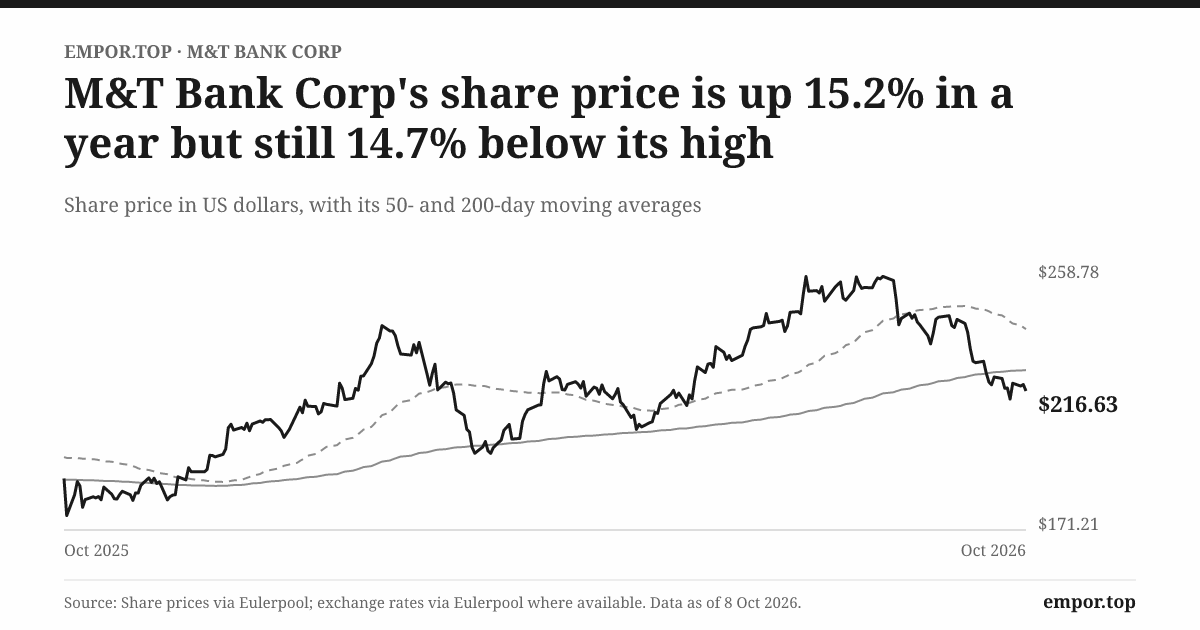
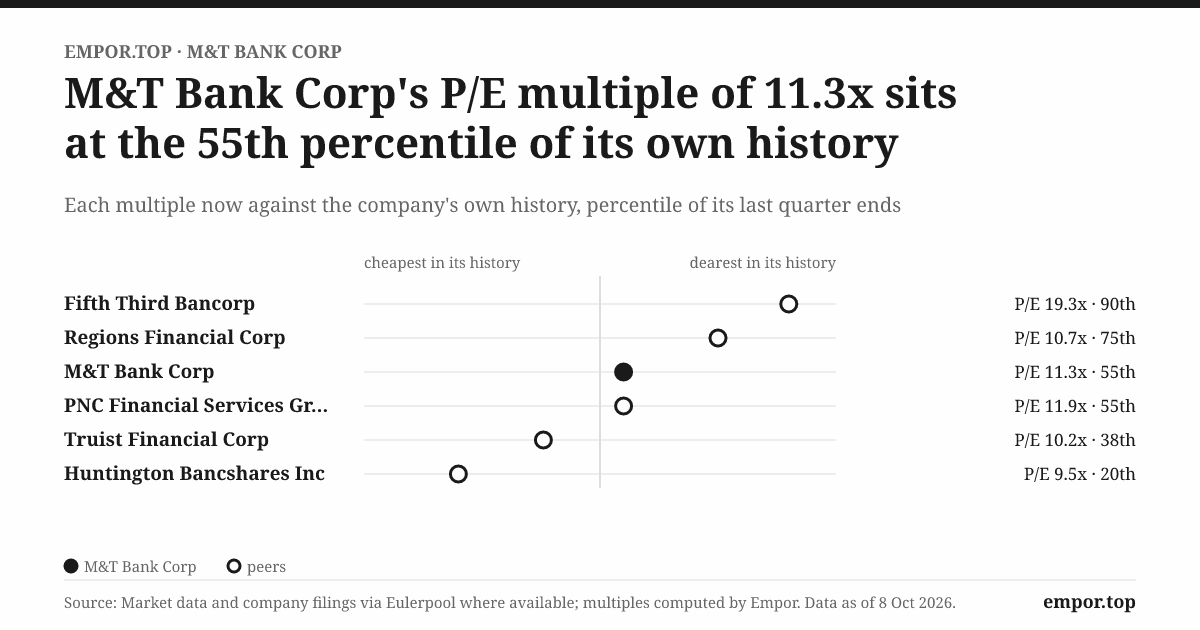
The returns tell you how strong these powers are in practice, and the answer is: adequate, not dominant. M&T earned a return on equity of about 10.9% over the twelve months to June 2026, and a return on assets of about 1.3%.1 Those are respectable figures for a large bank, roughly in line with good regional peers, but they are not the returns of a business with an impregnable moat. The market agrees, valuing M&T at about 11.3 times earnings, exactly its own five-year median.1
The verdict is that M&T's moat is narrow but real. It lives in commercial relationships and in a credit culture, not in deposit pricing, where buyer power is strong and rising. That distinction matters for the rest of the story, because the bank's biggest strategic choices now concern how to use the capital that a cautious culture has accumulated.
XI. Governance, Capital Allocation, and René Jones' Playbook
On April 21, 2026, M&T's shareholders gathered for their annual meeting and voted on, among other things, the pay of their chief executive. The result was not close. About 113 million votes supported the advisory say-on-pay resolution and about 7.5 million opposed it, an approval rate of roughly 94%.4 In an era when pay votes at large banks sometimes become flashpoints, that is a strong signal of shareholder comfort.
The package itself was about $12.0m for 2025, of which the largest part was in stock awards tied to performance, alongside a base salary of about $1.1m and a cash bonus of about $3.3m.4 For a bank of M&T's size that is mid-pack, and the weighting toward equity aligns the CEO's fortune with the share price. Insiders as a group own about 1% of the stock, and institutions more than 85%, led by Vanguard, BlackRock and State Street.4
Jones has surrounded himself with experienced finance leadership. Daryl Bible, a former chief financial officer of Truist, joined as CFO in 2023, bringing a veteran's view of how large regional banks manage their balance sheets.4 The governance checks are clean: an independent lead director, independent audit and compensation committees, loans to insiders that are below 0.2% of the loan book and made on standard terms, and an unqualified audit opinion from PwC with no material weaknesses.42 None of that is exciting. For a bank, it is supposed to be boring.
The interesting part of the governance story is the capital puzzle. At the end of 2025 M&T held about $55bn in cash and deposits at the Federal Reserve, up from about $35bn a year earlier.2 Its common equity tier 1 ratio, the main measure of a bank's loss-absorbing capital, stood at about 10.8%, comfortably above the regulatory minimum plus its stress buffer.2 And yet the dividend payout was modest: about $900m in 2025, roughly 31% of profit, against a twelve-year median of about 39%.1
A skeptical investor, or an activist, would put the question bluntly. Why does a bank with this much excess liquidity and capital keep $55bn earning the Fed's policy rate rather than lending it out at higher yields or returning more to shareholders through buybacks, when the stock trades at about 1.2 times book value? The answer management offers is prudence: after 2023, liquidity is the first line of defense against a run, regulators are watching regional banks more closely, and the capital rules for banks of M&T's size are still being rewritten. The bank did dial back share repurchases during the stress of 2023 and 2024 and resumed them more actively in 2025 and 2026 as criticized loans cleared.2
There is a fair case for both sides. The cash is insurance, and insurance is valuable to a bank whose franchise depends on depositor confidence. But insurance has a premium, and here the premium is lower returns on equity. A dollar parked at the Fed earns less than a dollar lent to a creditworthy manufacturer. CET1 also fell, from about 11.7% at the end of 2024 to about 10.8% a year later, which suggests capital is already being deployed, through buybacks and balance-sheet growth, and that the cushion is not unlimited.2
The verdict on governance is sound; on capital allocation, cautious to a fault. Whether that caution is wisdom or inertia is the debate that divides people who look at the stock, and that debate deserves to be heard in full.
XII. Bear vs. Bull: The Investor Crucible
Picture two analysts with the same spreadsheet. One sees a defensive compounder that has just come through its hardest test in a decade and is about to return capital at an attractive price. The other sees an ex-growth regional lender in a consolidating industry, trading at an ordinary multiple because it is, at last, an ordinary bank. The market price, about 11.3 times trailing earnings and 1.2 times book value with a dividend yield near 2.8%, sits squarely between them.1 That multiple is exactly M&T's own five-year median, and close to the range of its super-regional peers, which trade at roughly 11.5 to 13 times earnings.11 Put simply, the market is not paying a premium for M&T's history. It is pricing it like the group.
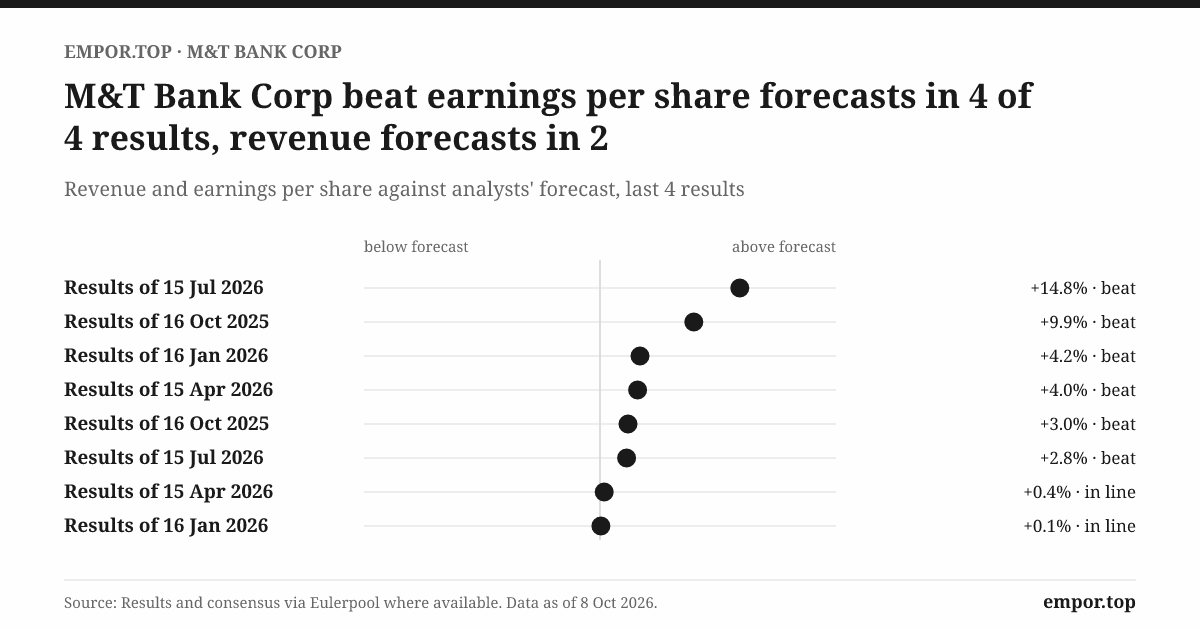
The bull case starts with credit. The commercial real estate overhang has been worked down from 208% to 134% of capital, and charge-offs have been falling.[^7]2 If credit costs keep normalizing while peers are still cleaning up, M&T's earnings recover faster. The deposit franchise, while weaker than it was in the zero-rate era, still supports a margin near 3.67%, among the better margins of its peer group.1 And the capital story turns into a tailwind: with a strong CET1 ratio and a very large cash balance, M&T has room to increase its dividend and buy back shares at a modest premium to book value, which mechanically lifts earnings per share. Earnings per share already rose about 14% year on year in the June 2026 quarter, to about $5.23.1 Finally, People's United is fully integrated, so the New England branches can be put to work rather than reorganized.
The bear case starts with growth, or the lack of it. Quarterly revenue in June 2026 was only about 2% higher than a year earlier.1 Over a longer horizon, revenue is roughly where it was in 2023, because the post-merger jump has flattened out. The caution that defused commercial real estate also turns away borrowers, and a bank that does not grow its loan book has to rely on buybacks for per-share growth. The second bear argument is deposit beta asymmetry. When rates fall, about half of M&T's commercial loans reprice downward almost immediately, while interest-bearing deposits, now the large majority, tend to reprice more slowly, which squeezes the margin. The third is technology. National banks spend vastly more on technology each year than M&T earns, and over time that gap could erode the retail deposit gathering on which the whole model rests. The fourth is geography. Structural weakness in office property in Boston, New York and Philadelphia limits how hard M&T can push in its largest cities.
Weigh the evidence and the bear case narrows rather than wins. The fear that commercial real estate would cause a capital problem has been largely refuted by the record of the past three years. The fear that M&T is a low-growth bank is better supported: the top line is flat and management's caution is visible in its balance sheet. What the stock price appears to assume is a bank of steady, unremarkable returns. For that assumption to change, one of two things has to happen: either loan growth accelerates without credit losses, or the cash pile turns into shareholder returns.
Before looking ahead to which of those happens, it is worth stepping back from the arguments and asking what this 170-year-old institution has actually taught.
XIII. Business and Investing Playbook: Lessons from Buffalo
Line up the crises of the last half-century and set M&T against each one. The 1982 Latin American debt crisis, which crippled money-center banks. The 1990 savings and loan bust, which wiped out Goldome down the street. The 2000 dot-com crash. The 2008 financial crisis. The 2023 regional banking panic. Through all of them, M&T says, it did not report a quarterly loss.[^1] What does a company learn from a record like that, and what can anyone else learn from it?
The first lesson is that density beats sprawl. Wilmers never wanted to plant a flag in forty states. He wanted to be first or second in the counties where M&T already operated, because local scale lowers funding costs and raises loyalty. The upstate consolidations of the early 1990s and the contiguous footprint that People's United completed are the same strategy at different sizes. The line worth remembering: a bank's map is its cost of funds.
The second lesson is that a credit culture is trained in booms, not in crises. M&T's ability to buy Wilmington Trust for about $351m in 2010 was not a stroke of genius in 2010.9 It was the result of saying no to construction loans, subprime mortgages and structured paper in 2005 and 2006, when saying yes was profitable and saying no looked stupid. Discipline is invisible until the day it becomes the only thing that matters. Put another way: the right to buy at the bottom is earned at the top.
The third lesson is that the best acquisitions fix broken governance, not broken assets. Allfirst was a good bank ruined by a trader. Wilmington Trust was a great fiduciary franchise ruined by a construction lending binge. In both cases M&T bought sound deposits and customer relationships from owners who had lost control of risk, then applied its own discipline. That is a different and safer kind of deal than buying a business whose core is rotten. For investors it means: judge a serial acquirer by what was wrong with the targets, not by how many it bought.
The fourth lesson comes from Hudson City, and it is the one that most flatters nobody. For three years the Federal Reserve held M&T's then-biggest deal hostage over anti-money-laundering systems.[^11]7 No amount of capital or credit skill could buy permission. The lesson for any regulated company is that compliance is not a cost center attached to growth; it is the license to grow. The quotable version: in banking, compliance is capital.
The fifth lesson is cultural. Wilmers ran the bank frugally and wrote about it publicly, and a frugal tone at the top shapes thousands of small decisions further down, about branch costs, deposit pricing and which loans are worth the risk. Whether that culture survives Wilmers is the question his successor has spent nine years answering. So far, the record of 2023 suggests it did, at least in credit. Frugality at the top is what keeps a bank's floor from falling out at the bottom.
Lessons are about the past, though. The question that now confronts M&T is what to do with everything that past has bought.
XIV. Epilogue: The Next Test for the Regional Model
Tonight, M&T Bank stands in an unusual position for an American regional lender. It has survived the crisis that defined its peer group. It has worked its commercial property exposure down to a level that no longer frightens rating agencies, and Fitch affirmed its 'A' rating with a stable outlook in September.5 It earns a return on equity of about 11% and carries a cash balance large enough to fund a meaningful share of its loan book.12 Its survival is not in doubt. What remains unproven is whether René Jones can turn that defensive strength into the kind of compounding that once made M&T a Buffett favorite.
Three moments over the next year or two will decide the answer. The first is the net interest margin. As rate cuts work through the system, M&T's floating-rate loans will earn less, and the question is whether its deposit costs fall as fast. If the margin holds above about 3.6% in the third and fourth quarter results of 2026, the deposit franchise is stronger than the bears argue. If it slides well below that, the shift toward interest-bearing deposits will have cost the bank more than it admits.
The second is credit normalization. If annual charge-offs stay below about 30 basis points through 2026 without a need to rebuild reserves, the commercial real estate chapter closes on M&T's terms. If office losses resurface, the de-risking campaign will have bought time rather than safety.
The third is capital. With CET1 near 10.8% and tens of billions at the Fed, management faces a choice about 2027 that will reveal its priorities. A large, multi-billion-dollar buyback authorization would signal that the bank sees its own shares at 1.2 times book as the best use of excess capital. Faster loan growth would signal confidence in the region. Continued hoarding would signal that the post-2023 caution has become permanent.
Behind those signposts sits a larger question, one that belongs not just to M&T but to American banking. Capital rules for banks of M&T's size are being rewritten in Washington, money-center banks keep gaining share in deposits and private credit funds keep taking the best business loans. In that world, does a conservative, relationship-based regional bank still have the right to win? M&T is perhaps the cleanest test case in the country, because if a bank with this culture, this footprint and this history cannot compound, it is hard to see which regional bank can.
XV. Outro: The Monument on Swan Street
Stand on Main Street in Buffalo on a winter evening, with snow coming in off Lake Erie, and look up at the white marble of One M&T Plaza. Branches across a dozen states have closed for the day. Checks have cleared. Payrolls for manufacturers in Rochester, distributors in Hartford and hospitals in Baltimore have gone out on time. Nothing dramatic has happened, which is the point.
In 1856, Pascal Pratt and his partners opened a bank to lend to the iron-makers and millers that other banks would not finance. Today René Jones runs a $214bn institution that, at its core, still does the same thing: it lends to businesses it can see, funded by deposits from the communities it serves. It has done that for 170 years, through panics and depressions and bubbles that took down far larger names. It has made money, not by predicting the future, but by trying never to make a loan that depends on good luck. Wall Street banks are built for the good times. M&T Bank was built for everything else.
References
-
Form 10-K for the Fiscal Year Ended December 31, 2025 — M&T Bank Corporation via SEC EDGAR, 2026-02-18 ↩↩↩↩↩↩↩↩↩↩↩↩↩↩↩↩↩↩↩↩↩
-
Quarterly Report on Form 10-Q for the Period Ended June 30, 2026 — M&T Bank Corporation via SEC EDGAR, 2026-08-04 ↩↩↩↩↩↩↩↩↩↩↩↩↩↩
-
Robert G. Wilmers, Longtime Leader of M&T Bank, Dies at 83 — The New York Times, 2017-12-17 ↩↩↩↩↩↩
-
Definitive Proxy Statement (Schedule 14A) — M&T Bank Corporation via SEC EDGAR, 2026-03-10 ↩↩↩↩↩
-
Fitch Affirms M&T Bank Corporation at 'A'; Outlook Stable — Fitch Ratings, 2026-09-21 ↩↩
-
Robert G. Wilmers, Longtime Leader of M&T Bank, Dies at 83 — The New York Times, 2017-12-17 ↩↩
-
Federal Reserve Board Approves Merger of M&T Bank Corporation and Hudson City Bancorp — Board of Governors of the Federal Reserve System, 2015-09-30 ↩↩
-
Allied Irish Banks to Sell Allfirst to M&T Bank for $3.1 Billion — The Wall Street Journal, 2002-09-26 ↩
-
M&T Bank Agrees to Acquire Wilmington Trust in $351 Million Stock Deal — Bloomberg, 2010-11-01 ↩↩↩↩
-
M&T Bank Q2 2026 Earnings Conference Call Transcript — S&P Capital IQ via Seeking Alpha, 2026-07-16 ↩
 LinkedIn
 WhatsApp
 Reddit
 Hacker News
 Email
 Kindle
 RSS Feed
 Spotify
 Apple Podcasts
 Amazon Music
 Audible
 YouTube