Northrop Grumman: The Price of Building the Next Bomber
I. The $477 Million Question
In the early months of 2025, Northrop Grumman had the kind of bomber program that defense engineers spend whole careers hoping to touch. The B-21 Raider had been flying since late 2023, the Air Force was moving it from test aircraft toward production, and the company could fairly say it had built the first new American strategic bomber in a generation. Then, in its first-quarter results, Northrop booked another pre-tax loss provision on the program: $477 million.1 The aircraft worked. The contract did not, at least not yet.
It was not the first time. At the end of 2023 the company had already taken a $1.56 billion charge on the same bomber, enough to push the whole company to an operating loss for that quarter.34 Two charges in roughly fifteen months, on a program the Pentagon calls one of its highest priorities, tell the story this episode is about. In defense contracting, technical success and economic success are different finish lines, and the second one is often farther away.
The reason is the shape of the deal. Northrop developed the B-21 largely on a cost-reimbursable basis, but it agreed to fixed prices for the first five lots of low-rate initial production.1 When those prices were set, nobody knew what inflation, supplier repricing and early manufacturing yields would do over the following years. Under fixed-price terms, every dollar of cost above the agreed price comes out of Northrop's pocket, and accounting rules require the company to recognize the expected loss on the whole set of lots the moment it becomes probable. That is why a single quarter can absorb years of future pain.
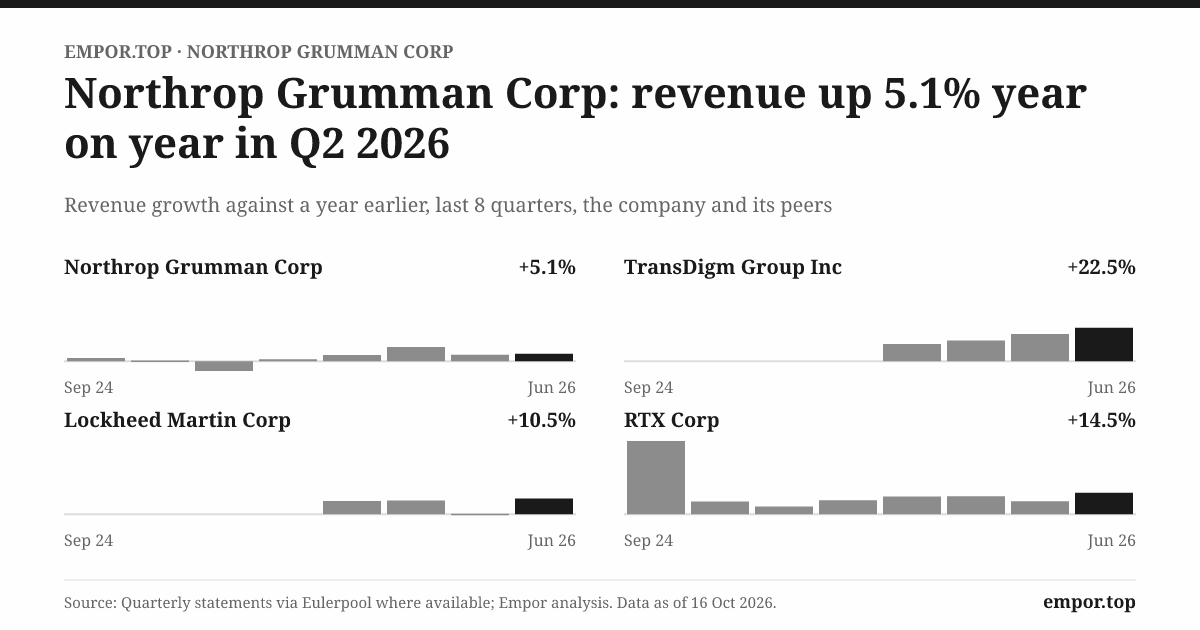
The company carrying that risk is enormous. Northrop Grumman reported $42.0 billion of revenue in 2025 across four businesses: Aeronautics Systems, Defense Systems, Mission Systems and Space Systems.1 Year-end backlog stood at $95.7 billion, and by the end of June 2026 it had grown to a record $104.7 billion.12 Roughly 84% of sales went to the U.S. government.1 In plain terms, Northrop is a company that has been handed more than two years of work by the most powerful military customer on earth.
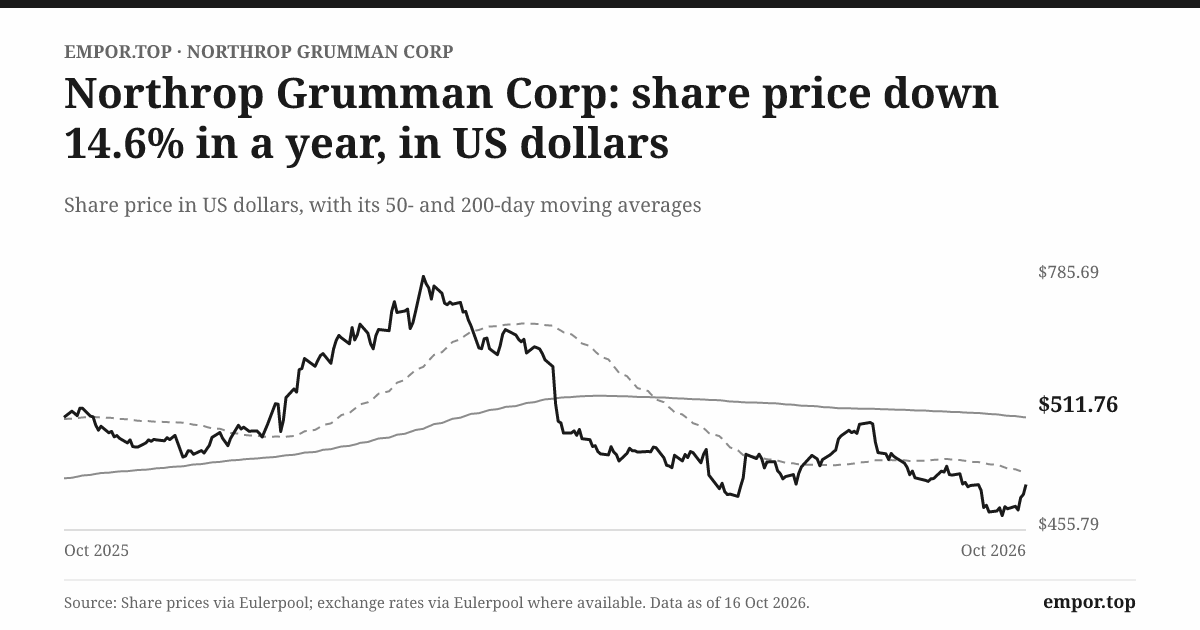
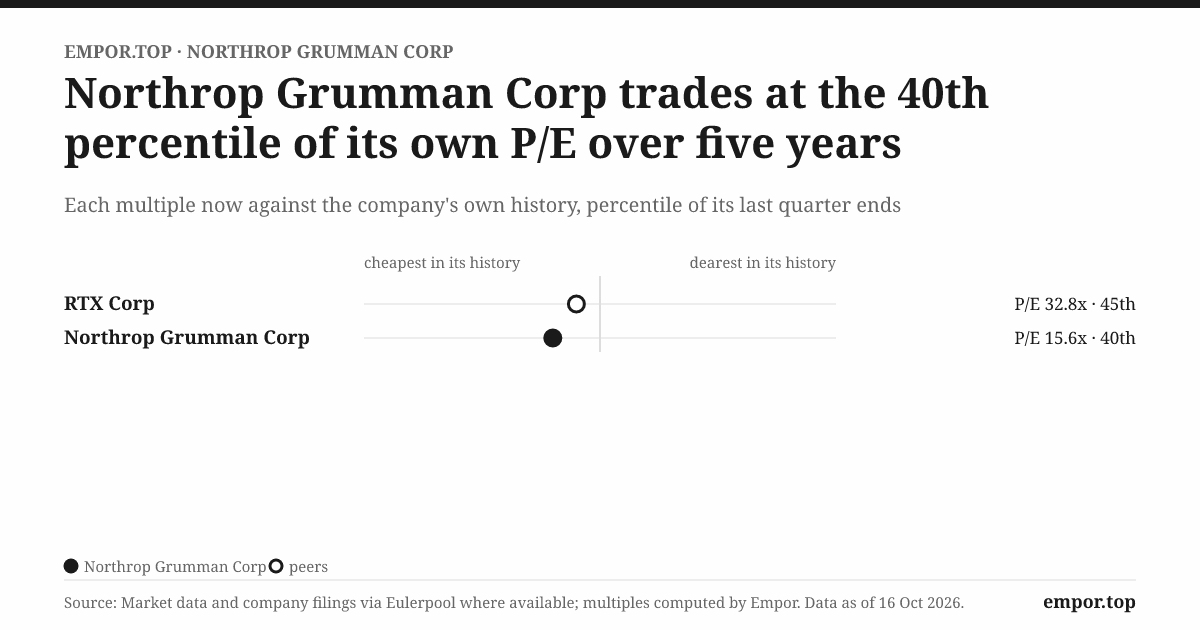
So why does the stock, at about $512 on October 16, 2026, trade roughly a third below its 52-week high and at about 15.6 times trailing earnings, a touch under its own five-year median?12 The market is asking four questions, and this story will try to answer them. Can the B-21 move from loss provisions to a profitable production line? Can Sentinel, the new intercontinental ballistic missile program, keep growing without repeating a cost-overrun cycle? How much of reported earnings comes from pension accounting rather than building things? And how will Kathy Warden's team divide cash among production capacity, buybacks and debt?
The test running underneath all four is simple to state and hard to pass. A backlog and strategic importance create opportunity. Returns arrive only when programs meet cost, schedule and contract terms. Northrop's customer funds its most ambitious work, writes the contract rules, can bring in competitors and can change the program midstream. The same buyer is venture capitalist, regulator and toughest negotiator at once.
That contradiction did not begin with the B-21. It began with a man who designed an airplane with no tail and spent the rest of his life trying to get the government to buy it.
 Subscribe on LinkedIn
II. Two Companies, One Flying Wing
Picture the scene in Palmdale, California, in November 1988. Hangar doors open and the Air Force shows the public the B-2 Spirit, a black boomerang with no fuselage and no tail, a shape that looked less like an airplane than a piece of geometry.[^4] For the engineers at Northrop, it was vindication. For the company's founder, Jack Northrop, it came after decades in which his flying wings had flown, impressed and then failed to enter service.
Northrop Corporation was founded in 1939, and the listed company still traces its legal origins to that year.1 Jack Northrop's obsession was the all-wing aircraft, on the theory that if the whole airplane generates lift and nothing generates drag for its own sake, you get more range and payload out of every pound. The idea produced the propeller-driven XB-35 and the jet-powered YB-49 in the 1940s, bombers that flew but never reached production.[^4] The flying wing became a beautiful, persistent, commercially unfulfilled idea.
Grumman's story was the opposite temperament. Founded on Long Island in 1929, Grumman built naval aircraft rugged enough to survive carrier landings and combat, a reputation so strong that the company's plants were nicknamed the "Iron Works."[^4] Wildcats and Hellcats in the Second World War, later the F-14 Tomcat and the Apollo lunar module, gave Grumman an identity built on dependable execution for a single demanding buyer: the U.S. Navy and, later, NASA.
Both companies learned the same lesson during the war years and the Cold War that followed. When your customer is the government, you learn to build extraordinarily complex systems to its specification, to live inside its budget cycles and to survive its cancellations. Northrop's wing finally found its mission when radar became the problem to beat. The shape that had once been a range-and-efficiency bet turned out to be very hard to see, and the B-2 program turned stealth into a national capability.
But the B-2 also carried a warning. The Air Force once planned a large fleet, and the end of the Cold War cut production to just 21 aircraft.[^4] Spread across so few airframes, the development cost made each bomber legendarily expensive. A striking design had become a strategic asset and a costly niche at once. That is the part of the heritage investors should remember: the company has known for decades how to build what no one else can, and it has also known what happens when the customer changes its mind about how many it wants.
The B-21 is the heir to that lineage, a smaller, more producible flying wing designed from the start to be built in quantity.1 Here the romance of the shape matters much less than stealth at scale, maintainability and the economics of a production line. The engineering question of whether a flying wing can fly was settled in the 1940s and settled again in 1989. The question now is whether the company can industrialize one within a fixed price. That is a business question, and to understand the business you have to understand how Northrop became the conglomerate it is today, through a decade of deals that began when the Pentagon told its contractors there would be fewer of them.
III. The Merger That Made the Modern Company
In 1993, Pentagon leadership invited defense executives to a dinner that the industry would remember as the "Last Supper." The message was blunt: with the Cold War over, procurement budgets would shrink and there would not be room for all of them. Consolidate or disappear. Within a year Northrop had outbid Martin Marietta for Grumman, paying about $2.1 billion and creating Northrop Grumman in 1994.[^4]
What followed was a deliberate expansion away from being simply an airplane company. Northrop Grumman bought Westinghouse's defense electronics business, which brought radar and sensors; Logicon, which brought information technology and systems work; Litton, which brought electronics and shipyards; Newport News Shipbuilding, the builder of America's aircraft carriers; and TRW, which brought space systems and satellites.[^4] Each deal moved the company further into what it now calls mission systems and space: the eyes, ears and nervous system of modern warfare, not just its airframes.
The portfolio was never untouchable. In 2011 Northrop spun off its shipbuilding business as Huntington Ingalls Industries, walking away from carriers and submarines because their economics and capital needs did not fit the rest of the company.[^4] That separation is worth remembering, because it shows that management has been willing to shrink the empire when an asset did not earn its keep.
The deal that matters most for today's Northrop came in 2018. Orbital ATK, itself a merger of a satellite and launch company with an ammunition and rocket-motor maker, agreed to sell itself for $7.8 billion in cash plus assumed debt, an enterprise value of roughly $9.2 billion.67 Shareholders were offered $134.50 a share, about a 22% premium over the prior close.7 The prize was not just launch vehicles and satellites. It was solid rocket motors, the energetic propulsion that sits inside missiles, missile defense interceptors and strategic weapons, including the future Sentinel ICBM.
Was the price extravagant? The premium was meaningful but in line with strategic defense deals, and the enterprise value worked out to roughly twice Orbital ATK's annual sales in the preceding year.67 Northrop itself trades today at about two times enterprise value to sales, though that comparison is context, not a like-for-like valuation: Orbital was a smaller business bought at a different point in the cycle, and the buyer was paying for a capability that would feed its own programs.2 The fairer verdict is that Northrop paid a substantial strategic premium, not an obviously reckless one. The financing showed up on the balance sheet: borrowings more than doubled in 2017, from about $7.1 billion to $15.3 billion, as the company raised debt ahead of the closing.6
The more revealing part of the deal was the condition attached to it. The Federal Trade Commission approved the acquisition only after Northrop agreed to make solid rocket motors available to competing missile makers on non-discriminatory terms and to wall off competitors' proprietary information.89 Think about what that means. Northrop bought a scarce input that rivals like Lockheed Martin and Raytheon depended on, and the government's response was to make sure the input stayed available to them. The capability was strategically valuable precisely because it was scarce, and that scarcity is exactly why the buyer insisted on limits to how Northrop could use it.
Did the deal pay? Space Systems has grown into a business of nearly $11 billion of annual sales, and solid rocket motors underpin Northrop's role in Sentinel and missile defense.1 But the return on invested capital tells a more sobering story: it fell from the low-to-mid twenties before the deal to about 11% in 2025, partly because the acquisition and the later capacity build enlarged the capital base faster than operating profit.16 The deal bought relevance. Whether it bought attractive returns is still being decided.
The acquisition era is effectively over. There is no large transformational deal on the table, and the current strategy rests on organic growth from programs already won. That leaves a harder modern test: can Northrop generate growth and returns from what it already owns? To answer that, start with where the money actually comes from.
IV. Four Businesses, One Customer
Open Northrop's 2025 annual report and the company looks pleasingly balanced. There are four segments, each a substantial business in its own right, each with its own leadership and missions.15 Look closer and the balance changes shape. All four sell, ultimately, into overlapping military and intelligence budgets controlled by the same government.
By sales, Aeronautics Systems and Mission Systems were nearly equal in 2025, each about $12.5 to $12.8 billion. Space Systems brought in about $10.8 billion and Defense Systems about $8.0 billion.1 Aeronautics builds aircraft, from the B-21 to unmanned systems and major fuselage work on the F-35. Mission Systems builds radars, sensors, electronic warfare and communications. Space builds satellites, launch systems and rocket motors. Defense builds missiles, munitions, ammunition and the Sentinel program.
Sales and profit tell different stories. Mission Systems was the largest profit contributor, at about $1.8 billion of segment operating income, a reminder that the sensor and electronics businesses Northrop bought in the 1990s and 2000s are now its most reliable earners.1 Aeronautics, despite almost identical sales, earned only about $0.8 billion, because the B-21 charge took a large bite out of the year.1 Space contributed about $1.2 billion and Defense about $0.9 billion.1 So the segment with the most glamorous program earns the least today, and the segment the public rarely thinks about earns the most.
The revenue engine runs on long contracts. A typical program moves through design and development, then production, then years or decades of sustainment and upgrades. In 2025 Northrop's sales split almost exactly in half between cost-type and fixed-price contracts.1 The difference is the whole game. Under a cost-type contract, the government reimburses allowable costs and adds a fee, so overruns hurt the customer more than the contractor. Under a fixed-price contract, Northrop agrees to deliver for a set amount, so it keeps the savings if it performs well and eats the overrun if it does not. Development work tends to be reimbursable; production often moves to fixed price. That is precisely where the B-21 lives.
Backlog is the number everyone quotes, and it needs translation. Of the $95.7 billion at the end of 2025, about $43.5 billion was funded, meaning Congress had appropriated and the customer had obligated the money, and about $52.2 billion was unfunded.1 Unfunded backlog is real contract value, but it depends on future appropriations and can be reshaped by budget decisions. A backlog is a promise to do work. It is not cash, not profit and not a guaranteed schedule.
The concentration cuts both ways. U.S. government programs come with long qualification cycles, security clearances and specialized facilities that keep outsiders away. But the government also decides who competes, when awards are re-competed and whether requirements change. Its bargaining position is less like a customer's and more like a landlord who also owns the street.
International sales do not change that picture much. They were about 14% of 2025 sales, roughly $6 billion, mostly allied governments and Foreign Military Sales routed through the U.S. government itself.1 That business matters, especially in Europe and Asia-Pacific, but it is not a second customer base large enough to dilute Washington's leverage.
One balance-sheet clue looks alarming until you understand the customer. Northrop carried only about $14 million of credit-loss allowances against roughly $7.9 billion of billed and net unbilled receivables at the end of 2025.1 In most industries, that would suggest optimistic accounting. Here it reflects reality: the U.S. government almost never defaults, and federal prompt-payment rules penalize late payment. The more useful signal is timing rather than default. Debtor days rose from about 43 in 2014 to about 77 in 2025, peaking near 80 in 2023.1 Much of that reflects the growth of unbilled contract assets, revenue recognized as costs are incurred but not yet billed under contract milestones. It means more of Northrop's capital waits inside programs before it turns into cash, which is a working-capital burden investors should watch, not a credit risk.
So Northrop is diversified across missions but not across power. The backlog provides visibility, and the customer keeps leverage through contract structure, competition and program decisions. The operational question behind the headline backlog is which programs convert authorizations and milestones into funded work, revenue and margin. And that question leads straight into whether Northrop's position is a moat, or simply a long winning streak.
V. A Moat With the Pentagon on Both Sides
Return to the FTC's order on Orbital ATK, because it is the cleanest single document for understanding Northrop's competitive position. The government let Northrop own a crucial supply of solid rocket motors, and then required it to sell them to rivals on fair terms, to build firewalls around their information and to accept a compliance monitor.89 It is hard to imagine a commercial company's moat described in those terms. Northrop's advantages are real, but they live inside a market where the buyer actively manages competition.
Run Michael Porter's five forces through that market and the picture becomes vivid. Buyer power is unusually high: one government ecosystem accounts for about 84% of sales and can fund multiple contractors, split awards and redesign requirements.1 Rivalry is concentrated among a handful of primes, Lockheed Martin, RTX, General Dynamics, Boeing and Northrop, which compete hard for each major program but rarely on price alone. The threat of new entrants is low in classified aircraft, strategic missiles and space payloads, where facilities, clearances and decades of test data are prerequisites, though newer venture-backed firms are pushing into autonomy, small satellites and munitions at the edges. Substitutes come from architecture choices rather than rival products: the Pentagon can shift budget from bombers to missiles, or from big satellites to proliferated constellations. Supplier power is meaningful and growing. Northrop works with more than 8,000 suppliers, and single-source dependencies in energetics, high-temperature composites, radiation-hardened microelectronics and titanium forgings can stall production lines.1 On fixed-price work, a supplier's price increase becomes Northrop's margin decrease.
Hamilton Helmer's seven powers sharpen the analysis. Switching costs are Northrop's strongest power. Programs run for decades, sustainment contracts follow the hardware, and replacing an incumbent means requalifying facilities, people and data. A cornered resource is the tempting claim: classified know-how from the B-2 and B-21, and solid rocket motors from Orbital ATK. But the FTC remedy is the concrete counterweight: when a resource becomes too cornered, the government un-corners it.9 Process power, the accumulated ability to integrate stealth airframes, sensors and space systems, is real but has to be proven again on every program. Scale economies exist, yet Northrop is not the largest prime. Lockheed Martin reported roughly $75 billion of 2025 sales, close to twice Northrop's $42 billion, and General Dynamics and RTX bring broad portfolios with shipbuilding, business jets and commercial aerospace exposure that Northrop lacks.101 Network effects, branding and counter-positioning barely apply.
Now test the moat against the company's own history. If Northrop's technological leadership guaranteed wins, the record would show it. Instead, it shows a pattern of important losses. The YF-23 lost the Advanced Tactical Fighter competition to Lockheed's design, which became the F-22. Northrop and its partner won the Air Force tanker competition in 2008, only for the award to be overturned on protest and eventually go to Boeing as the KC-46. And the Air Force cancelled the JSTARS replacement competition, a program in which Northrop was a long-time incumbent.[^4] These were not small skirmishes; they were the kinds of programs that define a decade. The history does not reject the moat claim, but it narrows it considerably.
The narrower and more defensible version reads like this: Northrop's advantage is strongest where classified integration, long qualification and mission-critical performance matter, and where it already holds the incumbent position, as on the B-21, Sentinel, the E-130J and much of its space and sensor work. It is weakest as a claim to guaranteed contract wins or pricing power. The 50% fixed-price mix is itself evidence: a company with true pricing power would not repeatedly absorb losses on fixed-price lots.1
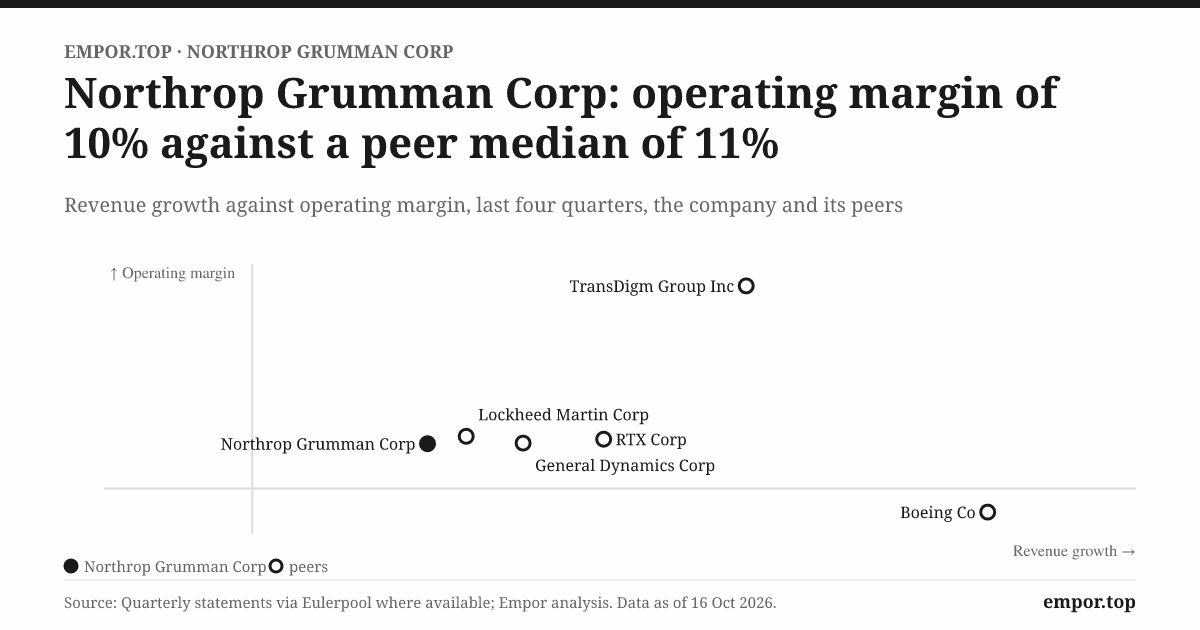
There is a twist in the market structure that helps Northrop. Because the government wants competition and cannot easily create new primes, it tends to keep every incumbent healthy enough to bid. That limits Northrop's upside but also reduces the chance it is shut out entirely. Peers trade at higher multiples, with Lockheed and General Dynamics on high-teens forward earnings and RTX richer still on commercial aerospace recovery, which suggests the market sees Northrop's specific program risks, not a weaker industry position.110
The forward proof will not come from slogans about technological leadership. It will come from repeat awards, production yields, schedule performance and segment margins. And no program puts those measures under a brighter light than the bomber.
VI. The B-21 Has to Leave the Prototype Hangar
The B-21 made its first flight in November 2023, rolling out of Palmdale where the B-2 was revealed thirty-five years earlier.3 Within weeks, Northrop told investors it was taking a $1.56 billion pre-tax charge on the program's low-rate initial production lots.34 The juxtaposition was almost cinematic: the flying wing finally entering a production era, and the accountants telling shareholders what that era would cost.
To understand the charge, you need to understand the pricing unit. The B-21's development phase was largely cost-reimbursable, but the first five production lots carry fixed prices that Northrop agreed to years earlier.1 When management estimates that its total costs across those lots will exceed the agreed prices, it must recognize the entire expected loss immediately, a so-called reach-forward loss. Imagine a builder who signs a contract to deliver five houses at a set price, then discovers lumber and labor have risen. The builder does not wait to lose money on each house; the accounting rules make the builder book the whole expected loss on day one. Cash leaves later, as the houses are built.
Management's explanation in 2023 centered on the macroeconomic environment: inflation and supplier cost growth that the original pricing did not anticipate.3 Those pressures were real, and they hit the entire defense industry. But the second charge complicates the story. In early 2025, Northrop recorded the additional $477 million loss, citing a production-process change to increase capacity and higher costs on early lots.1 This time, the explanation was not purely external. A decision to speed up and reconfigure manufacturing changed the cost profile, and the earlier estimate had not captured it. Two charges mean management underestimated cost more than once, which puts estimating and execution risk at least partly inside the company's control.
The auditor reached the same conclusion about where the risk sits. Deloitte flagged revenue recognition and estimated costs at completion on long-term contracts as a critical audit matter, the auditor's way of saying these judgments are among the hardest in the financial statements.1
What protects investors now? At the end of 2025, Northrop carried about $1.3 billion of remaining loss accrual on the program.1 It helps to be precise about what that means. The accrual is not cash in a drawer. It is the portion of the recognized loss that will be absorbed as production costs are incurred, so future lots can be built without hitting earnings again, as long as the estimate holds. It is a cushion against losses already recognized, not proof that the program is now safe. If costs rise again, a new charge follows.
There are also signs of improvement. In 2025, Northrop reached agreement with the Air Force on terms that helped offset some estimate pressure, and the program moved through flight testing and lot transitions.1 On the Q4 2025 call, analysts pressed management on the trajectory of Aeronautics margins and whether the second charge closed the book; management framed the program as on plan after the adjustment, with margins in later lots expected to improve as manufacturing matures.[^11] By the Q2 2026 call, the conversation had shifted toward cash: how production investment and the capacity ramp would play out, and how capital spending would rise in 2027 and 2028 to support it.[^12] The tone moved from reassurance about estimates to planning for scale. That is a constructive shift, but it is still management's framing, and the evidence that matters will come from future filings, not calls.
Separate technical capability from commercialization, and the verdict becomes clearer. Flight testing and lot transitions are necessary milestones. Neither proves the aircraft will meet cost targets or earn attractive margins. Northrop's own record on this exact program, with two estimate resets in roughly fifteen months, argues for treating each new milestone as a step, not a resolution.
The strategic case for the B-21 is very strong. The Air Force needs a penetrating bomber, the B-21 is the only one in production, and later lots, once beyond the five fixed-price options, are expected to be priced with better cost information. If learning curves work as they usually do in aerospace, unit costs fall meaningfully with each doubling of production, and the fixed-price exposure shrinks relative to the franchise's lifetime value.
Three numbers will tell investors whether that is happening. First, any new B-21 loss provision, the single fastest falsifier of the thesis. Second, Aeronautics segment margin excluding the charge, which shows whether the rest of the business and the later lots are healthy. Third, the 2027–28 capital spending needed for the ramp, which determines how much cash the bomber consumes before it gives cash back. The bomber can become a franchise only if learning curves begin to outrun fixed-price exposure. And while the B-21 is testing whether Northrop can price production, Sentinel is testing what happens when the government reprices the program itself.
VII. Sentinel's Reset Moves the Risk Into the Next Contract
In January 2024, the Air Force notified Congress that the Sentinel program had suffered a critical breach under the Nunn-McCurdy Act, the law that forces a program to justify its existence when costs grow beyond set thresholds.111 For a program meant to replace the entire Minuteman III ICBM force, the breach meant a formal review of whether the nation should continue, restructure or cancel it. In July 2024, the Pentagon certified that Sentinel should continue, but only after restructuring, with a new acquisition baseline still to come.1
Sentinel is not just another contract. It is a new missile, but also new launch facilities, command-and-control systems, and a sprawling modernization of the infrastructure across missile fields in several states.1 The missile is the visible part; the concrete, cables and silos underneath are where much of the cost growth emerged.
Who caused the breach? The two sides tell different stories. The Air Force pointed to underestimated scope and cost, particularly in the command-and-launch infrastructure. Northrop has argued that government design and requirement changes drove much of the higher cost, a case it made publicly in 2024.11 Both explanations can be partly true. What matters for investors is that neither removes execution risk from the eventual production phase. Whoever caused the breach, the program now faces intense oversight, and every future contract will be written by a customer that has just been embarrassed in front of Congress.
The good news for Northrop is the current contract type. The engineering and manufacturing development phase, worth about $13.3 billion, is cost-reimbursable.1 That means the company is largely protected from overruns during development, the opposite of the B-21's fixed-price lots. In Q2 2025 Sentinel even produced a favorable estimate adjustment, and in Q2 2026 the Air Force authorized about $7.6 billion of new execution work for the restructured program, a large part of why backlog reached its record.12
But backlog and lifetime value are different things. The added authorizations provide years of work visibility, and they are real. The production contract terms that will govern most of Sentinel's lifetime value remain unsettled and subject to oversight. A cost-plus development phase followed by a fixed-price production phase is exactly the structure that produced the B-21's losses. If the government, chastened by the breach, insists on firm prices for early production before the design and infrastructure costs are well understood, the protection Northrop enjoys today could disappear just as the program scales.
This is where management credibility enters. Kathy Warden's team has emphasized Sentinel's strategic necessity, and that necessity is genuine: the program is very hard to abandon because the existing Minuteman III fleet dates from the 1970s. But national-security urgency is not the same as economics. Investors deserve measurable milestones: when the new baseline is approved, when the restructured Milestone B decision lands, what contract type governs initial production, and how costs are allocated between the missile and the ground infrastructure. So far, the company has provided backlog figures and program updates, but the production economics have not been defined, because the customer has not yet defined them.
The things to watch are concrete. Approval of the restructured baseline. The timing of key milestones. The contract type for initial production. And Defense Systems margins as Sentinel's mix grows inside the segment. The key choice belongs to the government: how much schedule and cost risk will it transfer to the prime when the program moves beyond development? Northrop's answer to that question will reveal whether it learned from the B-21's fixed-price lots.
Those programs are where Northrop's future profits will be earned or lost. But even today's profits deserve a closer look, because a meaningful slice of them does not come from building anything at all.
VIII. The Profit That Comes From the Pension Line
Look at Northrop's 2025 income statement and you will find something peculiar below the operating line. Non-operating pension benefits and mark-to-market adjustments added about $1.07 billion to pre-tax profit.1 Pre-tax profit for the whole year was about $5.07 billion. So roughly a fifth of what Northrop reported as profit before tax came from pension accounting, not from bombers, sensors or satellites.1
To understand why, you need two acronyms. FAS refers to the pension accounting used in GAAP financial statements. CAS refers to the Cost Accounting Standards that govern how pension costs are charged to government contracts. They measure the same pension plans differently and on different timetables. Under FAS, a well-funded plan with strong investment returns can produce a net benefit that flows into reported earnings, and mark-to-market rules recognize gains or losses on plan assets and liabilities each year. Under CAS, Northrop recovers pension costs from the government through contract pricing, which affects cash and segment profitability.
The two numbers can tell very different stories. In 2025, the non-operating FAS pension benefit was about $541 million, and mark-to-market adjustments added another $527 million.1 In 2023, by contrast, mark-to-market cost Northrop about $422 million.1 That swing, from a large loss to a large gain in two years, flows straight through reported earnings and explains part of why net profit jumped and fell so dramatically in some years. Investors who look at a single P/E ratio are seeing an earnings figure that includes this volatile, non-operating component.
Does that mean Northrop's earnings are low quality? The cash record argues for balance. From 2014 through 2025, Northrop generated about $42.1 billion of cash from operations against about $39.3 billion of net profit, roughly 107% conversion.1 Pension mechanics actually help cash: in 2025 the company recovered about $475 million of CAS pension costs through contracts while contributing only about $99 million to qualified plans, which were overfunded by roughly $1.7 billion.1 The fair conclusion is that the reported earnings are inflated by pension accounting in some years, but the underlying business converts profits into cash well over long periods.
There is a legal overhang attached to the pension story. In December 2022 Northrop received a criminal subpoena from the Department of Justice, followed in February 2023 by a civil investigative demand, concerning the interest-rate assumptions it used to calculate CAS pension costs from 2013 to 2019.1 In February 2024, the Defense Contract Management Agency issued an interim determination of noncompliance.1 The question is whether Northrop billed the government too much for pension costs by using assumptions that made those costs look higher. The company has disclosed no quantified liability, and the matter remains unresolved. Because the dispute touches the core billing relationship with its main customer, it deserves attention even without a number attached.
Taxes added another distortion. The 2017 tax law required companies to capitalize and amortize research and development costs starting in 2022, rather than deducting them immediately. For a contractor that spends heavily on engineering, that meant higher cash taxes in 2022 through 2024, depressing operating cash flow in those years even though underlying profitability had not changed.112 Later legislative changes have restored more favorable treatment, and the drag has eased. It is a cash-timing issue, not a sign of weak contracts, but it is part of why free cash flow dipped to about $1.5 billion in 2022 before recovering.1
Two smaller items round out the picture. Northrop's 2025 operating income included a one-time gain of about $231 million from selling its training services business, another reason not to treat that year's operating margin as fully recurring.1 Foreign exchange, by contrast, barely matters: the company's currency hedges had a notional value of only about $308 million, and the company reported no material effect from a hypothetical 10% adverse move.1
So the earnings line needs adjustment before investors trust it. The things to watch are segment operating income, which strips out the pension noise; the gap between GAAP pension benefits and CAS recovery; cash taxes; and the resolution of the CAS investigation. Cash, not reported profit, has been the more reliable measure of Northrop's earning power. And what management does with that cash is the next part of the story.
IX. Warden's Capital Allocation Test
Kathy Warden became Northrop's chief executive in January 2019 and chair later that year.113 She arrived with an unusual background for a prime-contractor chief: she had spent much of her early career in commercial technology and information systems, at General Electric and General Dynamics, before joining Northrop in 2008 and running the cyber and information systems businesses, then Mission Systems, then serving as chief operating officer. She inherited the Orbital ATK integration within months of taking the top job, and her tenure has covered B-21 development, Sentinel's breach and reset, and a major capacity build.
The scene that best captures her capital-allocation test came in 2025. After capital spending peaked during the buildout of classified and solid-rocket production facilities, at roughly $1.8 billion a year in 2023 and 2024, it fell to about $1.45 billion.1 Free cash flow rose to about $3.3 billion, while the company kept paying a rising dividend and buying back shares.1 The question is what happens when capex rises again.
Follow the money over the long record. From 2014 through 2025, Northrop produced about $27.4 billion of free cash flow and paid about $10.8 billion in dividends, roughly 39% of that free cash.1 Cash balances fell by about $747 million over the period. Most of the rest went to buybacks, debt service and the Orbital deal's financing. The dividend payout ratio in 2025 was about 31%, near the middle of a range that swung from 14% in the boom year of 2021 to 54% in the charge-hit year of 2023.1 Buybacks shrank the diluted share count from more than 200 million in 2014 to about 144 million in 2025.1
Those buybacks are the clearest window into management's thinking. Northrop repurchased about $2.5 billion of stock in 2024 and about $1.6 billion in 2025, with $2.5 billion still authorized at year-end.1 Retiring nearly 30% of shares over a decade is a large commitment, and it has propped up per-share earnings growth even when total profit was flat. A skeptical investor would ask whether buying back stock at roughly 16 times earnings in years of fixed-price losses was the best use of cash.
Pay and ownership tell part of the alignment story. Warden's reported 2025 compensation was about $25.4 million, mostly stock awards and incentives.13 She owned about 0.14% of the company.13 At the May 2026 annual meeting, say-on-pay received about 95% support, while a shareholder proposal to separate the chair and CEO roles drew about 21%.14 Shareholders, in other words, are broadly satisfied with pay but not unanimous about governance; a fifth of the votes cast wanted an independent chair to oversee a CEO whose tenure includes two major estimate resets. Northrop has no controlling shareholder, and the company reported no material related-party transactions with executives or directors; the disclosed fees to State Street and BlackRock for managing employee-plan trusts are small and paid by the trusts.13
The balance sheet is solid but not pristine. Funded notes totaled about $15.7 billion at the end of 2025, inside total borrowings of about $19.7 billion including leases, against $4.4 billion of cash.1 Maturities are well spaced, with about $2 billion due in 2028 and smaller amounts before that. Fitch and S&P rate the company BBB+ with positive outlooks, and Moody's rates it Baa2.15 The agencies have been clear about what an upgrade requires: leverage discipline and restraint on debt-funded buybacks.15 That is the tension. Every dollar used to repurchase stock is a dollar not used to reduce debt or fund B-21 capacity.
Leadership changed in the finance office in 2026. Longtime CFO Dave Keffer retired and was succeeded by John Greene, formerly CFO of Discover Financial Services.13 On the Q2 2026 call, Warden and Greene raised 2026 sales and earnings guidance, reaffirmed free cash flow guidance and described a capital spending ramp in 2027–28 to support production.[^12]16 Greene's background is in consumer finance, not defense; his first year will show whether he brings tighter capital discipline or simply continues the existing playbook.
The skeptical question is fair. With the stock near its five-year median multiple, is retiring shares more valuable than lowering leverage or funding production capacity? Warden's record is credible on strategic continuity: she has held the company's position on the most important nuclear modernization programs. The fixed-price charges and Sentinel reset are important counterevidence on execution. The cash allocation decisions of the next two years will reveal how management weighs those priorities. That brings the story to the case itself: what exactly is the market being asked to believe?
X. The Case for Owning the Prime
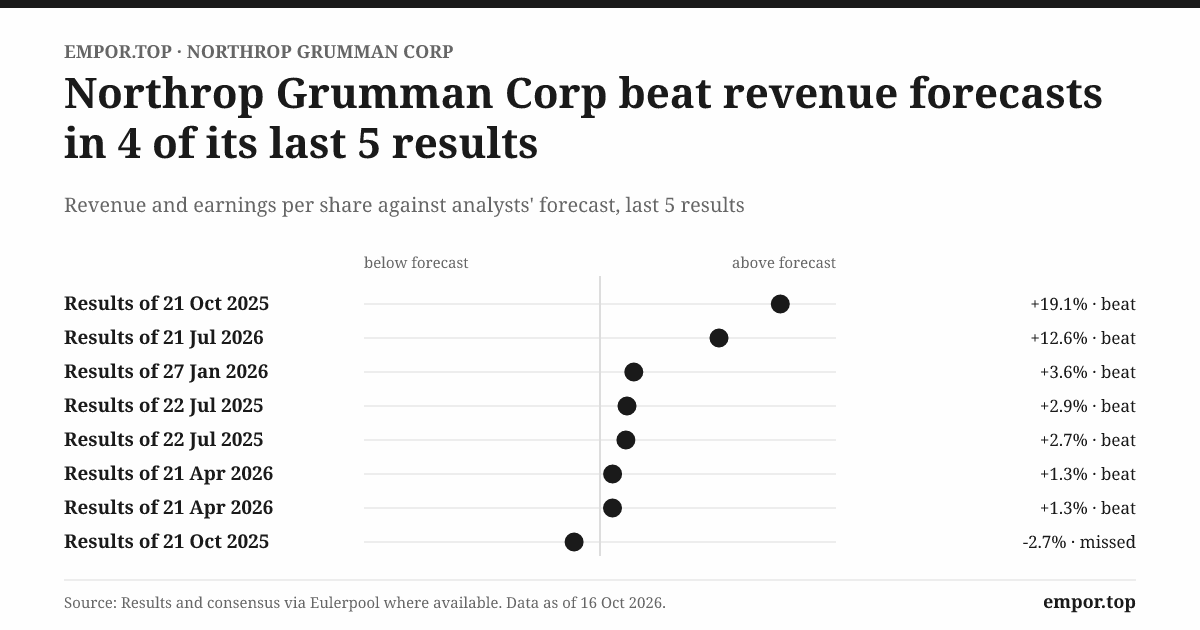
On July 21, 2026, Northrop reported second-quarter results that looked like a bull's dream: record backlog of $104.7 billion, higher sales and earnings guidance, and reaffirmed free cash flow.162 Yet by October 16, the stock sat about 33% below its 52-week high, at 15.6 times trailing earnings and a free-cash-flow yield of about 5.2%.2 Both sides of the debate can point at that price and claim victory.
The bull case is concrete. Northrop sits at the center of American nuclear modernization, with the B-21 and Sentinel together covering two legs of the nuclear triad. It has deep positions in missile defense, sensors, munitions, solid rocket motors and classified programs that have strong strategic relevance and multi-year funding visibility.1 Replacement cycles are long and favor incumbents. Backlog keeps rising, and a funded portion of more than $40 billion provides near-term visibility.1 The bull would argue that the market is pricing in the worst of the B-21 and Sentinel risks just as both programs move toward their most productive phases.
The bear case is equally specific. Half the business is fixed-price, and the company has just shown on its signature program how quickly estimates can reset.1 Supplier bottlenecks in energetics and microelectronics remain a margin risk. Sentinel's production economics are unknown. A fifth of reported pre-tax profit comes from pension accounting. And the buyer is a single government with the power to change requirements, re-compete awards and bring in rivals.
Compare segments rather than treating "defense" as one market, and the picture becomes more nuanced. Mission Systems is the current profit engine, with the highest margins and the most diverse set of programs. Aeronautics carries the B-21 execution risk. Defense Systems carries Sentinel and munitions exposure, where demand is strong but production scale is still being built. Space is large, but its sales and margins have been uneven as some programs wind down and others ramp.1
The base rate tempers the enthusiasm. Revenue grew about 6% a year over the past decade, but only about 2.7% a year over the past five years.1 Net profit grew about 7.7% a year over ten years, yet fell about 5.1% a year over the latest three-year span, largely because of the B-21 charges and pension swings.1 A company with $100 billion of backlog should grow, but history suggests the conversion of that backlog into profit has been slower and lumpier than the headline implies.
What about the future bets? Hypersonics, autonomy and advanced space systems matter, but only where they attach to funded programs and repeat production. Northrop has a long record of technical firsts, and an equally long record of programs that did not reach scale. Technical milestones without durable orders do not yet make a separate growth engine.
The valuation, at roughly 16 times trailing earnings, below Lockheed and General Dynamics and well below RTX, suggests the market is assuming that Northrop's execution risks persist, not that the business is impaired.110 The multiple sits almost exactly at its own five-year median. That reads less like fear than like suspended judgment.
Three measures will settle the case more than any others. The first is B-21 loss provisions and Aeronautics margin: there has been a new charge in each of 2023 and 2025, and the absence of another would be the most important single confirmation. The second is funded backlog and contract awards by segment, which reached a record in mid-2026 and shows whether demand is turning into appropriated money. The third is free cash flow after capital spending, which rose to about $3.3 billion in 2025 and is guided to $3.1 to $3.5 billion this year, and which must hold up through the 2027–28 capex ramp.116
Neither backlog nor the current multiple settles the question. The case turns on whether execution converts strategic importance into earnings without another major estimate reset. That is a lesson worth spelling out, because it applies far beyond Northrop.
XI. Playbook: Business & Investing Lessons
Go back to the B-21 rolling out at Palmdale, the descendant of a design its creator could not sell, now carrying a fixed-price production contract. Five lessons belong to this company and no other.
A classified program can be hard to enter and still be hard to earn on. The B-21 embodies decades of stealth engineering that almost no other company could match, and its first production lots have still generated about $2 billion of reach-forward losses.13 Barriers to entry protect a position; they do not protect a margin. For investors, the lesson is to separate the moat around a program from the economics inside it.
Backlog is a promise to work, not a promise of margin. Half of Northrop's year-end 2025 backlog was unfunded, and Sentinel's added authorizations came before anyone had defined its production terms.12 A record backlog tells you the customer wants the product. It does not tell you what the customer will pay for it once the cost is known.
A portfolio gets stronger when a deal adds scarce capability; it gets safer when the buyer still has alternatives. Orbital ATK gave Northrop the rocket motors that much of the missile industry depends on, and the FTC promptly made sure rivals could still buy them.9 In a market with one dominant buyer, scarcity is valuable only up to the point where the buyer decides it is a problem.
Cash returns are a policy choice, not a residual. Over twelve years Northrop paid out about 39% of its free cash flow as dividends and retired nearly a third of its shares, even through years of fixed-price losses.1 Every one of those decisions competed with the capacity the B-21 needs and the leverage the rating agencies watch. Founders and boards should treat capital returns as a strategic choice with trade-offs, not as whatever is left over.
The customer is both venture capitalist and toughest negotiator. The Pentagon funds development on a reimbursable basis, then asks for fixed prices on production, keeps competitors in the game and reserves the right to change the program. Northrop's history, from Jack Northrop's unsold wings to Sentinel's reset, is a long lesson in what that dual role means: the customer will pay for your invention, and then negotiate as though it already owns it.
XII. Epilogue
Tonight, October 16, 2026, Northrop Grumman is four days away from its third-quarter earnings call, scheduled for October 20.[^4] It will arrive with a full-year sales guide of $43.75 to $44.25 billion, adjusted free cash flow guidance of $3.1 to $3.5 billion, and a stated plan to raise capital spending to around 4.5% of sales in 2027 and 2028.16[^12] Those figures are the scaffolding around a story that is still unresolved.
The next checkpoints are clear. The Q3 call will show whether guidance holds and whether analysts' questions about B-21 margins and Sentinel contracting get sharper or softer answers. The B-21 program will report on deliveries and on whether any further loss provisions are needed. Sentinel's restructured baseline and the contract terms for initial production will decide how much risk moves onto Northrop's books. And the capex and buyback choices in 2027 will show how management weighs growth investment against shareholder returns and leverage.
Several outcomes would confirm the case: stable or improving segment margins, no new B-21 loss provisions, funded backlog converting steadily to sales, and free cash flow staying healthy through the investment ramp. Others would weaken it: another reach-forward loss, delayed production milestones, Sentinel's production economics shifting more risk onto Northrop, or capital returns outrunning cash generation and pressuring the credit ratings.
The next year should clarify whether higher demand is flowing through to margins and cash. The deeper questions, whether the B-21's production economics truly turn and how Sentinel's post-reset contracts are written, will take longer to settle. Northrop's strategic relevance is beyond doubt. The returns on its next generation of programs are not.
XIII. Outro
Nearly a century ago, Jack Northrop began sketching an airplane that was nothing but wing. The government watched it fly and declined to buy it in quantity. Decades later the shape returned as the B-2, a triumph built in numbers too small to pay for itself. Now it has returned again as the B-21, designed to be built by the dozen, carrying not just the old idea but a fixed-price contract and a $477 million charge from its first production year.1
The bomber is leaving the prototype hangar and moving toward the production line, and the whole company's next decade will be decided there, in the factory and in the cash ledger rather than in the sky. At Northrop Grumman, the future can fly before the profits do.
References
-
2025 Form 10-K — Northrop Grumman Corporation via SEC, 2026-01-27 ↩↩↩↩↩↩↩↩↩↩↩↩↩↩↩↩↩↩↩↩↩↩↩↩↩↩↩↩↩↩↩↩↩↩↩↩↩↩↩↩↩↩↩↩↩↩↩↩↩↩↩↩↩↩↩↩↩↩↩↩↩↩↩↩↩↩↩
-
Q2 2026 Form 10-Q — Northrop Grumman Corporation via SEC, 2026-07-21 ↩↩↩↩↩↩↩
-
Northrop Grumman's B-21 Loss Provision — Air & Space Forces Magazine, 2023 ↩↩↩↩↩
-
Form 10-K for FY2023 — Northrop Grumman Corporation via SEC, 2024-01-25 ↩↩
-
Orbital ATK Acquisition Terms and Premium — Axios, 2017-09-18 ↩↩↩
-
FTC Case: Northrop Grumman and Orbital ATK — Federal Trade Commission ↩↩
-
Orbital ATK Acquisition Decision and Order — Federal Trade Commission, 2018-06-05 ↩↩↩↩
-
Northrop Says Air Force Design Changes Drove Higher Sentinel Cost — Defense News, 2024-03-28 ↩↩
-
Form 10-K for FY2024 — Northrop Grumman Corporation via SEC, 2025-01-30 ↩
-
2026 Proxy Statement — Northrop Grumman Corporation via SEC, 2026-04-03 ↩↩↩↩↩
-
2026 Annual Meeting Voting Results, Form 8-K — Northrop Grumman Corporation via SEC, 2026-05-21 ↩
-
Fitch Entity Profile: Northrop Grumman — Fitch Ratings, 2026-05-20 ↩↩
-
Q2 2026 Earnings Release — Northrop Grumman Corporation via SEC, 2026-07-21 ↩↩↩↩
 LinkedIn
 WhatsApp
 Reddit
 Hacker News
 Email
 Kindle
 RSS Feed
 Spotify
 Apple Podcasts
 Amazon Music
 Audible
 YouTube