BeOne Medicines: The Drug That Had to Cross the World
I. One Drug, One Company, and Four Questions
In mid-November 2019, a small orange-and-white capsule cleared the last gate that matters in American medicine. The U.S. Food and Drug Administration granted accelerated approval to BRUKINSA, the brand name for zanubrutinib, as a treatment for adults with mantle cell lymphoma who had already received at least one prior therapy.1 The drug had been designed by chemists in Beijing, tested in patients on several continents, and submitted to the FDA by a company then called 百济神州 BeiGene, which most American oncologists had never heard of. It was widely described as the first cancer drug discovered by a Chinese company to win FDA approval, and the company moved fast: commercial sales in the United States began within days.1
That was the technical crossing. The commercial crossing took longer, and the scale of it is what makes this story worth two hours of anyone's attention. In 2025, the company, renamed BeOne Medicines that spring, sold $3.93bn of BRUKINSA worldwide.1 That single medicine accounted for nearly three-quarters of everything the company earned from selling products.1 And by August 2026 management was guiding investors to between $6.6bn and $6.8bn of total revenue for the year, up from a range of $6.3bn to $6.5bn just three months earlier.23
So the question this story has to answer is not whether a China-rooted drug company can make a global cancer medicine. BeOne already did that. The question is whether a company built around one extraordinary success can turn it into a durable global oncology business, or whether it will remain, in economic substance, a one-drug company with a very large research budget attached.
Four smaller questions sit underneath that one, and they run through every chapter that follows. The first is about origins: what gave a company founded in Beijing in 2010 a path to becoming a global drug developer, when most Chinese biotechs of that era were content to copy Western molecules for the domestic market? The second is about competition: can BRUKINSA keep winning against rivals owned by AstraZeneca and AbbVie, companies with far larger sales forces and far longer relationships with American hematologists? The third is about money: after more than a decade of heavy losses, can BeOne now fund its own research without going back to shareholders for cash? And the fourth is about price: does the market value the stock at a level that leaves any margin for the concentration and execution risks that come with depending on one drug?
Before the story starts, the scale needs to be set carefully, because BeOne's headline numbers are spectacular in a way that can mislead. Revenue reached $5.34bn in 2025, up about 40% on the year before.1 Over the decade from 2015, revenue compounded at more than 90% a year. That is a growth rate almost no company of this size has ever posted, but the starting point was just $8m of revenue in 2015, much of it not from product sales at all.1 A decade-long growth rate measured from nearly nothing tells the listener mainly that BeOne went from being a research operation to being a commercial one. It does not tell them how fast a mature BeOne can grow.
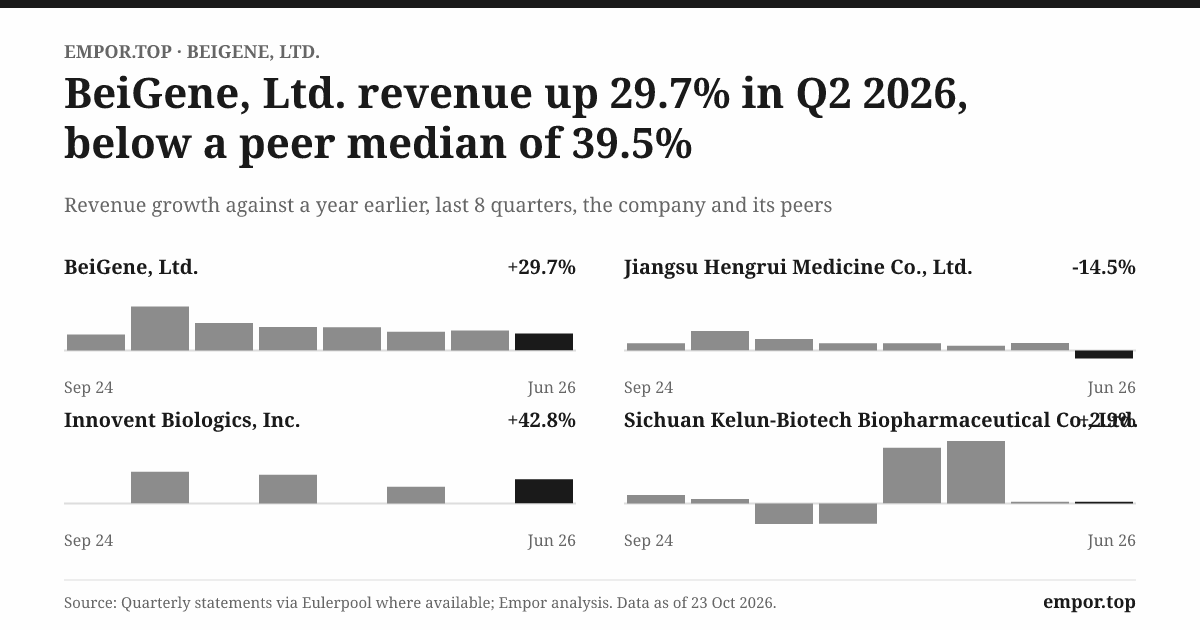
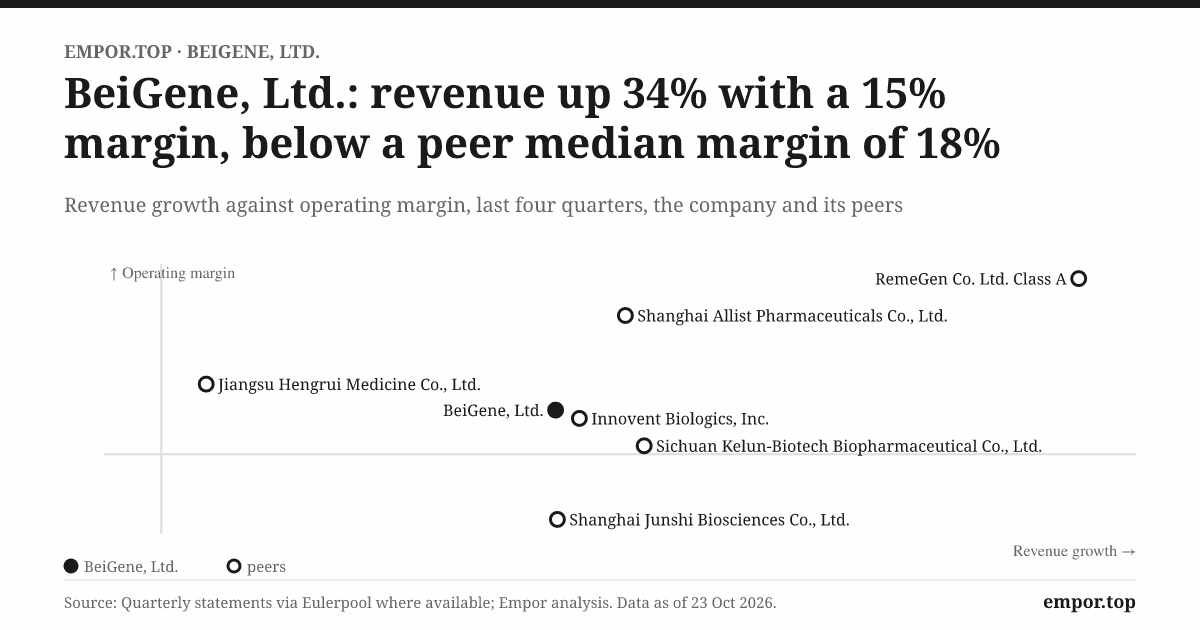
The more recent numbers tell that story better. In the quarter ended June 2026, revenue grew about 30% from a year earlier, down from growth rates in the forties through most of 2025 and well below the 70%-plus rates of 2023 and early 2024.2 Yet in that same quarter, operating margin reached about 19%, the best in the company's history, after years in which BeOne lost more money on operations than it took in.2 Growth is slowing toward something more normal while profitability is arriving fast. That combination is what investors are now paying for.
Which means the question has shifted. For most of its life the debate about BeOne was whether it could grow at all outside China. Now the debate is about what sustains growth once the comparison base is $5bn and climbing, and whether the next products can carry weight before the first one stops getting bigger. To answer that, the story has to go back to the beginning, to an American entrepreneur running a contract research business in Beijing and a scientist who walked into his lobby.
 Subscribe on LinkedIn
II. The Company That Started in a Lobby
The founding story, as it is usually told, begins with a visit. John Oyler was running BioDuro, a contract research organization in Beijing that did chemistry and biology work for Western drug companies, when 王晓东 Xiaodong Wang came by its offices.14 Wang was not a typical caller for a service business. He was one of the most respected biomedical scientists of his generation, a member of the U.S. National Academy of Sciences whose work on how cells decide to die had made him a fixture of the cancer-biology literature, and he had left a prestigious American post to lead the National Institute of Biological Sciences in Beijing.4
Oyler brought something different. He was an American serial entrepreneur, trained at MIT and Stanford, who had co-founded the biotech Genta in his twenties and later led Galenea before moving to China to run BioDuro.4 Where Wang knew how to find a biological target and design a molecule against it, Oyler knew how to build a company, raise money, and recruit people into an unproven venture. Their complementary skills matter less as biography than as strategy, because together they made a bet that was unusual in 2010: that a drug company headquartered in China could be built to develop medicines for the whole world from day one, rather than to serve the Chinese market with drugs invented elsewhere.
The logic behind that bet was concrete. China had a deep and growing pool of trained chemists and biologists, many returning from Western labs. It had large patient populations and hospitals that could enroll clinical trials quickly. And labor costs for research were well below those in Boston or San Francisco. Oyler had seen this from inside BioDuro, where Western pharma companies were already outsourcing pieces of their research to China precisely because it was cheaper and faster. The founders' insight was that the arbitrage did not have to accrue to someone else's pipeline. A company could keep the molecules for itself.
BeiGene's early model had two strands.1 One was internal discovery, the strand that would eventually produce zanubrutinib. The other was opportunistic: taking on compounds that other companies had set aside, or partnering early assets with Western firms in exchange for cash and validation, and running development in China, where trials could be faster and cheaper. An early collaboration with Merck gave the young company both money and a signal to investors that a Western drug major took its science seriously.1
It is worth being precise about what this model did and did not prove. Access to promising science, cheaper chemistry, and fast trial enrollment are real cost and speed advantages. They lower the price of an attempt. But they do not by themselves raise the odds that an attempt succeeds, and they say nothing about the hardest step in the industry, which is selling a medicine to doctors and payers in the United States and Europe against entrenched competitors. Plenty of companies have run cheap trials. Very few have built a global commercial business. The founding idea gave BeiGene a lower-cost path to bets. It did not guarantee the bets would pay.
The capital to make those bets came from a decision that would define the company's corporate life. In February 2016, BeiGene listed American depositary shares on Nasdaq, pricing its initial public offering at $24 per ADS and raising about $182m.5 For a company with almost no revenue that year, the listing was a statement about where it thought its future lay. It chose American capital markets, American disclosure standards, and the scrutiny of American biotech investors, at a moment when most Chinese drug startups were looking to Hong Kong or domestic exchanges. The listing gave BeiGene access to the deepest pool of biotech capital in the world, while its labs, its clinical operations, and much of its workforce remained rooted in China.
That dual identity, financed in New York and built in Beijing, would become both the company's great advantage and a recurring source of risk. It meant BeiGene could raise far more money than a domestic Chinese biotech, and it meant its scientific claims would be judged by the same standards as any American company's. It also meant that every turn in relations between Washington and Beijing would become, in some small way, a question about BeiGene.
But the IPO could not answer the question that mattered most. Investors who bought those $24 shares were betting that this team could become a drug owner and a global seller, not merely a lower-cost research shop that would eventually hand its best molecules to larger partners. In 2016 there was no evidence either way. The company had promising compounds, a scientist with an international reputation, and an entrepreneur who knew how to raise money. What it did not have was a commercial organization, anywhere. The first attempt to solve that problem came the following year, and it came from a partner.
III. The Deal That Bought a Commercial Foot in China
In July 2017, BeiGene announced a deal with Celgene that looked, on paper, like a company buying itself a decade of commercial learning in one stroke.6 Celgene, then one of the most powerful oncology companies in the world, wanted access to BeiGene's anti-PD-1 antibody, tislelizumab, a member of the hot class of immunotherapy drugs that release the brakes on the immune system so it can attack tumors. BeiGene wanted something it could not quickly build: a working commercial operation in China.
So the two companies traded. Celgene received rights to develop and commercialize tislelizumab for solid tumors in the United States, Europe, Japan and the rest of the world outside Asia.6 BeiGene, in return, took over Celgene's commercial operations in China, including its team, and the exclusive license to sell three established Celgene cancer drugs there: REVLIMID and VIDAZA for blood cancers, and ABRAXANE, a chemotherapy formulation used in breast, lung and pancreatic cancer.6 The money flowed BeiGene's way too. Celgene paid $263m in upfront license fees and bought $150m of BeiGene shares at a premium of roughly 35% to the market price, and BeiGene became eligible for up to $980m in development, regulatory and sales milestones, plus royalties on future tislelizumab sales.6
Overnight, BeiGene went from a research company to a company with revenue-generating products, sales representatives, hospital relationships, and the logistics to move medicine through Chinese distribution. Revenue jumped from about $1m in 2016 to $238m in 2017, a leap that reflects the deal far more than any product BeiGene had invented.17 In effect, it had rented a commercial apprenticeship. Its future sales force would learn the Chinese oncology market by selling someone else's drugs, before it had drugs of its own to sell.
The trade-off was real, and investors should see both sides of it. On one side sat cash, infrastructure and speed. On the other sat control. BeiGene retained tislelizumab in China and much of Asia, but the largest markets, the ones where a successful PD-1 drug could earn billions, belonged to Celgene's development priorities. If Celgene decided to prioritize its own pipeline, or if Celgene itself changed hands, BeiGene's most commercially valuable drug outside China would sit in someone else's portfolio. And Celgene did change hands: Bristol-Myers Squibb agreed to acquire it, and Bristol-Myers already owned Opdivo, one of the two leading PD-1 drugs in the world. The global tislelizumab partnership was unwound by mutual agreement in 2019, before the acquisition closed.8
The more revealing episode came the following year, and it is the clearest disconfirming evidence about the distribution model BeiGene had bought. In March 2020, China's drug regulator suspended the import, sale and use of ABRAXANE supplied from a contract manufacturing facility used by Celgene's new owner, after an inspection raised quality concerns.8 BeiGene had the commercial rights. It had the sales team, the hospital relationships and the patients. What it did not have was the factory. A manufacturing problem at a site it did not control stopped it from selling a product it was licensed to sell, and there was nothing its commercial organization could do about it.
What followed was a slow-motion divorce. BeiGene initiated arbitration against Bristol-Myers Squibb over supply failures, and the two companies eventually settled and terminated the arrangement, with BeiGene's rights to the Celgene products in China winding down in 2023.8 A deal that had been sold as a commercial foothold ended as a lesson in what a license does and does not give you. Commercial rights are a claim on sales. They are not a claim on supply.
The pattern repeated with tislelizumab itself, in a bigger and more consequential way. After the Celgene arrangement ended, BeiGene signed a new global partnership in January 2021 with Novartis, which paid $650m upfront for tislelizumab rights in North America, Europe and Japan, and later added an option on ociperlimab, a second immunotherapy candidate.89 This was the validation the founders' model was supposed to produce: a Swiss pharma giant paying hundreds of millions of dollars for a molecule invented in Beijing. Then, in 2023, the two companies ended the tislelizumab collaboration by mutual agreement, and BeiGene regained full global rights to both drugs.89
The termination cut two ways. BeiGene got its molecule back, and with it the full economics of any future sales. But the arrangement that was supposed to carry tislelizumab to global scale through a partner's sales force had not converted into the expected long-term relationship. BeiGene now had to fund the development, regulatory filings and commercial launch itself.
It is tempting to read these episodes as evidence that BeiGene's platform failed, and that would be wrong. Neither partnership ended because the science collapsed. Tislelizumab went on to win approvals and generate real revenue under BeOne's own control, as a later chapter shows. What the record does show is narrower and more useful: in BeiGene's history, partnerships have been a reliable source of cash and an unreliable source of durable commercial outcomes. Headline deal values, upfront fees plus milestones, consistently overstated what would actually turn into product revenue. Celgene's commercial operations bought a foothold, but the products that came with it eventually left. Novartis's global ambitions for tislelizumab came back unrealized.
There is one more thing to say about these deals, because it is often misunderstood. The Celgene transaction was a licensing and commercial-operations deal, not the purchase of an acquired business at a disclosed valuation multiple. BeiGene did not pay for Celgene's China operations in the way an acquirer pays for a company; it received cash and took on an operation as part of a cross-licensing trade. The available terms do not support a claim that BeiGene overpaid for anything. The fairer criticism is that the value it retained was more dependent on partners than the headlines implied.
Which raises the obvious question: if partners were unreliable carriers of BeiGene's science, where would the money to carry it alone come from? The answer arrived at the start of 2020, in a cheque large enough to change the company's arithmetic, from a partner that would become its largest shareholder.
IV. The $2.78 Billion Vote of Confidence
On January 2, 2020, Amgen closed the purchase of a 20.5% stake in BeiGene for about $2.78bn in cash.10 It was one of the largest minority investments any big pharmaceutical company had made in a biotech, and it arrived at a moment when BeiGene needed it. The company had lost close to $950m in 2019 and was preparing to scale BRUKINSA in the United States while running dozens of clinical trials.1 Amgen’s cheque was nearly three times the cash and short-term investments BeiGene had held at the end of 2019.1
But the cheque was only half the deal, and the other half is what makes it interesting. Amgen did not simply buy shares. It bought a partner in China. Under the collaboration, BeiGene took on commercialization in China of several Amgen oncology products, including XGEVA, KYPROLIS and BLINCYTO, with the two companies sharing China profits and losses equally during an initial commercialization period.10 BeiGene also committed to share the global development costs of a portfolio of Amgen oncology pipeline programs, contributing up to $1.25bn in cash and development services, in return for royalties on global sales outside China and rights to commercialize in China.10
Seen as a single capital decision, the deal looked like this. Amgen provided capital at scale and a seat at the table in the world's second-largest drug market. BeiGene received that capital, a set of approved products for its Chinese sales force to carry, and an economic stake in some of Amgen's future medicines, but it paid for that stake with real development spending of its own. The investment was not free money. It came with commitments.
Those commitments still run through BeOne's accounts six years later, and they show how intertwined the two companies remain. In 2025, BeOne recognized $40.7m of royalty revenue from Amgen, a small number relative to group revenue of more than $5bn.1 But it also bought $263.9m of commercial inventory from Amgen, recorded $104.1m of net research and development expense for co-development programs, and owed Amgen $79.1m at year-end.1 The inventory figure is the one that deserves attention. Amgen's purchases were roughly 39% of BeOne's reported cost of product sales.1 Amgen supplies those products at an agreed price, and the commercial profit and loss in China is split equally.1
Translated into plain language: Amgen is BeOne's largest disclosed shareholder, a material supplier, and a collaborator whose products BeOne sells. That is not a parent-subsidiary relationship, and nothing in the filings suggests Amgen controls BeOne. But it is the kind of relationship a careful shareholder watches, because the terms on which those products are supplied and the profits split are negotiated between two parties, one of which owns a large slice of the other. The ABRAXANE episode showed what happens when a supplier's problems become BeOne's problems. Amgen's supply record has been far better, but the structural point is the same: a meaningful share of what BeOne sells in China is manufactured by someone else.
The Amgen relationship produced one more asset that later turned into cash. Among the Amgen programs BeOne co-funded was tarlatamab, now sold as IMDELLTRA for small-cell lung cancer, on which BeOne is entitled to royalties on sales outside China. In August 2025, BeOne sold a significant portion of those future royalties to Royalty Pharma, a transaction whose financial meaning belongs to a later chapter about cash.11 For now it is enough to note that a development commitment made in 2020 became a monetizable asset five years later, which is the Amgen bargain working roughly as intended.
The investment also had a cost to every other shareholder, and dilution is part of this company's story from the very start. BeiGene and then BeOne raised money repeatedly: the Nasdaq IPO, a Hong Kong listing in 2018, a share offering on Shanghai's STAR Market in 2021, the Amgen placement, and multiple private and public follow-ons. By the company's own count it had raised more than $10.8bn through stock offerings and borrowings since 2010.1 Even in 2025, its first profitable year, the share count kept rising, from about 1.387bn ordinary shares at the end of 2024 to 1.441bn at the end of 2025, an increase of roughly 4%.1 Much of that comes from employee equity compensation rather than fresh capital raising, but the effect on an existing holder is the same: each share's claim on future profits gets a little smaller.
Amgen's own stake has drifted down for the same reason. From 20.5% at closing it had fallen to 17.05% by April 2026, which still made Amgen BeOne's largest disclosed shareholder.4 Amgen did not have to sell to get there; the denominator grew around it. In 2026, BeOne filed a registration statement allowing Amgen and two large investment groups, entities affiliated with Baker Bros. and with HHLR, to resell up to about 399m ordinary shares if they choose; any proceeds would go to the sellers, not to BeOne.12 That registration is not a sale, and it says nothing certain about Amgen's intentions. It does mean that a large block of shares held by long-standing insiders is now easier to sell.
At BeOne's October 2026 market value of about $36bn, Amgen's 17% stake is worth more than $6bn, more than twice what Amgen paid.14 Viewed from Amgen's side, the 2020 bet has been a good one. Viewed from BeOne's side, the bet was justified less by the price Amgen paid than by what BeOne did with the money. And what it did, above all, was build out that drug.
V. The First China-Developed Cancer Drug to Reach the FDA
To understand why BRUKINSA won, start with a protein called Bruton's tyrosine kinase, or BTK. In certain blood cancers, including chronic lymphocytic leukemia and several lymphomas, malignant B cells depend on a signaling pathway that runs through BTK to survive and multiply. Block BTK and the cancer cells lose a key survival signal. The first drug to do this at scale was ibrutinib, sold as Imbruvica, which transformed treatment of CLL in the 2010s and became one of the best-selling cancer drugs in the world.
Ibrutinib had a problem, though, and the problem was a matter of aim. Think of BTK as one lock among hundreds of similar locks on the surface of cells. Ibrutinib fits the BTK lock well, but it also fits several neighboring locks, including ones involved in heart rhythm and bleeding. In patients who take the drug every day for years, those off-target effects show up as atrial fibrillation, hypertension and bleeding events, which can force doctors to lower doses or stop treatment altogether.
BeiGene's chemists in Beijing made a deliberate technical choice. They set out to design a BTK inhibitor that was more selective, fitting the BTK lock tightly while touching fewer of the neighboring ones, and that maintained high, sustained blocking of BTK throughout the dosing interval.1 The hope was that a cleaner, more complete blockade would deliver at least as much efficacy with fewer side effects that cause patients to stop. AstraZeneca's acalabrutinib, sold as Calquence, was built on a similar idea. Zanubrutinib was BeiGene's version, and the company's decision about how to prove it is the most important strategic choice in its history.
Most challengers in a crowded drug class take the safer route of comparing their drug with an older standard, or with placebo in a narrow population. BeiGene went straight at the incumbent. Its ALPINE trial randomized patients with relapsed or refractory CLL or small lymphocytic lymphoma to either zanubrutinib or ibrutinib, head to head. Published in the New England Journal of Medicine in 2023, the trial found zanubrutinib superior to ibrutinib on progression-free survival, the length of time patients lived without their cancer getting worse, and reported a lower rate of cardiac events, including atrial fibrillation.13
That result changed the commercial conversation. A doctor deciding between two BTK inhibitors no longer had to weigh a newcomer's promise against an incumbent's familiarity. There was now randomized evidence, in a major journal, that the newcomer did better on the outcome patients and doctors care about most. It is worth being exact about what ALPINE did and did not prove. It showed superiority over ibrutinib in relapsed or refractory CLL. It did not prove superiority over Calquence, which was never tested head-to-head against zanubrutinib in that trial, nor in every disease and treatment setting where BTK inhibitors are used. Even so, it gave BRUKINSA something rare in oncology marketing: a clean, defensible headline claim against the market leader.
The FDA approval in November 2019 had been the opening. The years that followed were about turning that opening into a franchise, and the speed of the climb is the strongest piece of evidence in BeOne's favor. Approvals expanded from mantle cell lymphoma into Waldenström's macroglobulinemia, marginal zone lymphoma, CLL and follicular lymphoma, and into Europe and dozens of other markets.1 Global sales grew 48.6% in 2025.1 In the second quarter of 2026 the drug sold $1.2bn worldwide, up 31%, of which $893m came from the United States.2
The scale becomes clearer next to the rivals. AstraZeneca reported $3.52bn of Calquence sales for 2025.14 AbbVie reported $2.05bn of U.S. Imbruvica sales for the same year; that figure covers only AbbVie's U.S. revenue, since Johnson & Johnson books much of Imbruvica's international sales, so it understates the drug's global total.15 Even with that caveat, the picture is unmistakable. The drug that had been the newcomer in 2019 was, by 2025, selling more than the drug built on the same selectivity idea by one of the largest pharmaceutical companies in the world, and comfortably more than the former leader's U.S. business.
Why did it work? The trial is part of it, but not the whole answer. Clinicians choosing a BTK inhibitor weigh efficacy and safety data, certainly, but also the convenience of dosing, their own experience with each drug, the patient's other medications and heart history, and what the patient's insurer will cover at what out-of-pocket cost. BTK inhibitors are also not the only option. AbbVie's Venclexta, combined with an antibody, offers a fixed-duration regimen: patients take it for a set period and then stop, rather than taking a pill every day indefinitely. For some patients and doctors, the prospect of finishing treatment outweighs the advantages of any continuous drug. BRUKINSA's success therefore reflects winning on several fronts at once, the clinical evidence, the sales effort among American hematologists, and access with payers, rather than a single magic bullet.
Management describes that success in terms of momentum. On the second-quarter 2026 call, John Oyler said BRUKINSA had recorded its highest sustained level of new patient starts since launch, more than six years after the drug first reached the market.1617 Earlier in the year, on the first-quarter call, management had attributed U.S. growth mainly to volume, with patient demand up about 28%, alongside a mid-single-digit pricing benefit and about $20m of one-off favorable gross-to-net adjustments.18 That breakdown matters. Growth driven mainly by more patients on treatment is sturdier than growth driven by price increases or accounting adjustments, and the first-quarter explanation suggests volume was doing most of the work.
Still, a rising curve has to be read against its own base. BRUKINSA grew almost 50% in 2025 and about 31% in the second quarter of 2026.12 As the drug gets bigger, each percentage point of growth requires more new patients, and the pool of untreated or switchable patients is not infinite. The next test is whether growth persists in the twenties and beyond as the comparison base rises, or whether it slides toward the low teens as the drug matures into its market. Management's raised guidance is a statement that it expects the former. The filings, of course, cannot prove it.
There are also pressure points that the company itself discloses. The first is patents. In February 2026, BeOne sued Zydus, an Indian generics maker that had filed an abbreviated new drug application seeking to sell a generic version of zanubrutinib and challenging BRUKINSA's patents.119 BeOne says its composition-of-matter patent, the core patent on the molecule itself, runs to 2034.1 Generic challenges are routine for successful drugs and frequently resolve in the brand's favor or in settlements that preserve years of exclusivity. But they are the mechanism through which a franchise's lifespan gets decided, and a court outcome against BeOne would shorten the period in which BRUKINSA can earn monopoly-level margins.
The second pressure point is not about BRUKINSA itself but about what comes after it. AbbVie sued BeOne alleging misappropriation of trade secrets connected to BeOne's BTK degrader program, a next-generation approach discussed in a later chapter. In May 2026 the court denied BeOne's motion to dismiss, allowing the case to proceed, with no trial date set and damages unspecified.19 It is important to be careful here. The case concerns the degrader program, not zanubrutinib, and nothing in the litigation alleges that BRUKINSA was built on AbbVie's secrets. It is a risk to a pipeline asset, not evidence against the lead product.
The verdict on BRUKINSA is therefore strong but bounded. This is demonstrated commercial execution: a drug designed in Beijing, proven superior to the incumbent in a randomized trial, and sold at global blockbuster scale, larger than its most comparable rival. That is about as hard as evidence gets in this industry. But the advantage is not a protected market. Competing drugs, fixed-duration alternatives, payer negotiations and patent challenges all remain live, and BeOne's dependence on this one medicine means any of them could matter far more to BeOne than it would to AstraZeneca or AbbVie. The drug is the company's great strength and its great concentration at the same time.
And there is a further question hidden inside those sales figures. A prescription written in a clinic in Ohio is not yet revenue, and revenue is not yet cash. How demand travels from a doctor's pen to BeOne's bank account turns out to be where some of the economics leak away.
VI. The Wholesaler Invoice Behind the Prescription
Follow a single BRUKINSA prescription and the money trail gets surprisingly complicated. A hematologist writes the prescription. A specialty pharmacy fills it. The patient's insurer, or Medicare, or a hospital program pays for it, minus whatever the patient pays out of pocket. But BeOne does not book revenue at any of those moments. It books revenue earlier, when it delivers the medicine to a distributor, a large wholesaler that buys from manufacturers and sells to pharmacies and hospitals.1 The wholesaler then pays BeOne on ordinary terms, typically somewhere between 30 and 90 days later.1
That structure is normal for branded medicines, but it is worth explaining because it shapes how investors should read BeOne's numbers. The unit of revenue is a box of medicine sold to a wholesaler, priced at a list price and then reduced by a thicket of rebates, discounts and fees owed later to payers, government programs and channel partners. BeOne reports no subscription share of revenue and no general minimum-purchase commitments from its distributors.1 Patients who respond well may stay on a daily BTK inhibitor for years, which creates demand that recurs in practice. But that recurrence is clinical, not contractual. A patient who switches drugs, a payer that changes its preferred product, or a competitor's new data can end it.
Product revenue was $5.28bn of BeOne's $5.34bn total in 2025, which means almost everything the company earns comes through this channel.1 And the channel is concentrated. Three wholesalers—ASD Specialty Healthcare, part of Cencora, McKesson, and Shanghai Pharmaceutical in China—together accounted for 46.1% of product revenue in 2025 and 37.1% of trade receivables at year-end, down from 51% a year earlier.1
That concentration needs to be held in proportion. These are not end customers who chose BeOne over a rival. They are the plumbing of the pharmaceutical industry. Cencora and McKesson distribute most branded drugs in the United States, and Shanghai Pharmaceutical is among China's largest drug distributors. BeOne's exposure to them is similar to that of most branded drugmakers. The risks they pose are not that one of them stops wanting BRUKINSA but that one of them experiences financial distress, renegotiates fees, or changes inventory policies in ways that shift BeOne's reported revenue from one quarter to another.
So who pays late? The honest answer is that BeOne does not say. The company describes how it estimates allowances for doubtful accounts, but it does not publish an ageing schedule of receivables, a numerical roll-forward of its bad-debt allowance, or a history of overdue balances.119 Its filings over 2025 and the first half of 2026 do not report a major distributor default. A rising receivable balance on its own is not evidence of late payment, and it would be a mistake to infer one. As revenue grows, receivables grow with it almost mechanically.
Where the real estimation risk sits is in the gap between list price and what BeOne ultimately keeps, which the industry calls gross-to-net. When BeOne ships a box of BRUKINSA to a wholesaler, it does not yet know exactly what it will owe in Medicaid rebates, commercial payer rebates, government discount programs, chargebacks, distributor fees and returns. It has to estimate them, record revenue net of those estimates, and true up later. Get the estimate wrong and reported revenue will be overstated in one period and corrected in another.
BeOne's auditor singled out U.S. gross-to-net accruals as the critical audit matter in its 2025 opinion, the one area where it judged management's estimates most subjective and complex.1 The scale shows why. In 2025, BeOne charged $1.45bn of rebates, returns and other deductions against product revenue.1 At year-end it carried $79.1m of accruals netted against receivables and $398.5m of accrued rebates, returns and other deductions.1 Put another way, for every four dollars BeOne kept from product sales in 2025, roughly another dollar was negotiated away to the channel and to payers. That is not unusual in American specialty pharmaceuticals, and the auditor issued a clean opinion. But it does mean that the line between demand and revenue runs through a large estimate, and small percentage errors on a $1.45bn base become material in a single quarter. The first-quarter adjustment management cited was about $20m.18
Receivables tell a consistent story. Net accounts receivable rose from $676m at the end of 2024 to about $1.06bn by June 2026.119 Measured in days of revenue, receivables stood at about 61 days at the end of 2025, comfortably within the stated payment terms and far below the 155 days reached in 2021, when the company's revenue mix was very different and partnership receivables loomed larger.1 On that evidence, receivables are growing roughly in line with sales rather than ballooning ahead of them.
The verdict is that BeOne's revenue model produces demand that recurs in practice, from patients who stay on treatment, but revenue that is not contractually recurring. The concentration in three large wholesalers and the size of gross-to-net deductions make the quality of revenue, the conversion of shipped boxes into cash after rebates, more important than for a company with simpler economics. The disclosures identify a real estimation risk without showing any collection failure. An investor who wants to know how much of BRUKINSA's demand reaches the bank should watch gross-to-net deductions and receivable days alongside headline sales.
Because for most of BeOne's history, very little reached the bank at all. The company spent more than a decade turning other people's capital into research, and only in 2025 did the money start flowing the other way.
VII. The Company That Kept Spending After the Drug Worked
When BeOne closed its books for 2025, it reported something its shareholders had waited fifteen years to see: a full year of profit. Net income was $286m.1 Cash generated by operations was $1.13bn, and after capital spending, free cash flow came to $942m.1 In the same year, the company spent $2.15bn on research and development.1 That combination, real cash coming in while an enormous research budget kept going out, is the most important financial fact about BeOne today, and it deserves to be understood carefully, because it can be read two very different ways.
Start with the hole the company climbed out of. Across 2014 to 2025, BeiGene and then BeOne accumulated net losses of about $8.2bn.1 Over the same period, its operations consumed about $5.7bn of cash.1 The $2.5bn difference between those two numbers is not an accounting trick. It reflects large charges that reduce reported profit without consuming cash, chiefly stock-based compensation paid to employees in shares rather than dollars, along with depreciation, investment write-downs and the ebb and flow of working capital over a long investment period. Add capital spending on top of operating cash outflow, and cumulative free cash flow over those twelve years was about negative $8.4bn.1 The company paid no dividends in any of those years.1 Every dollar of that deficit was funded by shareholders, partners and lenders.
Against that history, 2025 looks like a turning point. But the more striking thing is what management did not do once the drug worked. It did not harvest the business. Research and development rose from about $1.2bn in 2023 to $2.15bn in 2025.1 As a share of revenue, R&D fell from around half to about 40%, but only because revenue was growing faster than the research budget, not because the budget was being cut. Management attributes the growth to a larger global development organization and more clinical programs moving forward.1 For comparison, large established pharmaceutical companies typically spend between 15% and 25% of revenue on research. BeOne is still behaving like a company whose best years are supposed to be ahead of it.
Capital spending tells the opposite story, and it is part of why free cash flow turned positive so sharply. BeOne had been building manufacturing capacity, most visibly a large biologics manufacturing and clinical R&D center in Hopewell, New Jersey, alongside facilities in China.1 Capital expenditure fell from $562m in 2023 to $186m in 2025, as Hopewell spending eased.1 That drop alone added roughly $300m to free cash flow in 2025 compared with the year before. It is a genuine benefit of finishing a build-out. It is also not something that can repeat indefinitely.
Now for the caveats, and there are three. The first is timing. Management itself attributed 2025's cash generation partly to higher gross profit and partly to favorable timing of receivable collections and payments of accrued expenses.1 Timing effects reverse. If collections ran ahead of normal in 2025 or payments ran behind, some of that cash was borrowed from 2026.
The second is stock-based compensation, which was about $511m in 2025.1 That cost does not appear in operating cash flow, because BeOne pays it in shares, but it is a real cost to shareholders, paid in dilution rather than dollars. Subtract it from 2025's free cash flow and the cash left for owners after paying employees fully would be around $430m rather than $942m. Neither number is wrong, but they answer different questions, and the second is the more conservative measure of what a shareholder actually earned.
The third caveat is about a big cheque that looks like operating cash but is not. In August 2025, BeOne agreed to sell to Royalty Pharma a significant portion of the royalties it is entitled to on IMDELLTRA sales outside China, the Amgen drug whose development it had helped fund. Royalty Pharma paid $885m upfront, with an option for up to $65m more.11 BeOne's cash-flow statement treats the proceeds as financing, not operations, and records a liability for the future royalty stream, which stood at about $906m in June 2026.19 That treatment is correct and conservative. Economically, BeOne sold a future income stream for cash today. It was a sensible use of an asset it did not control commercially, but it is a one-time monetization, not recurring operating cash, and it means that future IMDELLTRA royalties that would otherwise have flowed to BeOne will flow largely to Royalty Pharma.
Put those pieces together and the balance sheet explains itself. BeOne ended 2025 with about $4.55bn of cash and short-term investments, up from about $2.6bn a year earlier.1 Roughly half of that increase came from operations and half from financing, including the Royalty Pharma proceeds and new bank borrowing; bank loans plus the royalty liability roughly doubled to about $2bn.1 The cash pile was built by both the business and its financiers, not by the business alone.
Two smaller items should be kept in their place. In 2025, BeOne earned $70.5m of interest income on its cash, about 17% of pre-tax profit, against $58.2m of interest expense.1 Treasury income helped the reported profit line but nets out against borrowing costs and does not explain the operating turnaround. And the company has disclosed that a reversal of valuation allowances on its deferred tax assets could benefit reported earnings in 2026.19 Such a reversal would recognize, on the balance sheet, tax losses the company now expects to be able to use. It could produce a large, one-time boost to reported net income. It would not mean the business generated more cash.
The verdict on this chapter is that the turnaround is substantial and real: a company that consumed more than $1bn of operating cash a year as recently as 2023 generated more than $1bn in 2025. And it did so without cutting research, which says something about management's conviction, or at least about its strategy. But one positive year does not prove durable self-funding, especially when that year benefited from collection timing, a falling capital budget and a large non-cash compensation bill. The test that would settle the question is simple to state: two more years of positive operating cash flow after working-capital movements, with research spending maintained and the share count reported on a comparable basis. If BeOne passes it, the long cash-burn era is genuinely over.
What BeOne is spending all that research money on is the next question. Because the case for spending $2bn a year on R&D rests on the claim that something other than BRUKINSA will eventually earn it back.
VIII. The Pipeline After the Partner Gave the Rights Back
When Novartis handed tislelizumab back in 2023, BeiGene faced a choice familiar to any company whose partner walks away. It could look for another partner, or it could do the work itself. It chose to do the work. The drug, now sold globally as TEVIMBRA, had to be taken through regulators in the United States and Europe, launched with BeOne's own sales teams, and positioned in a market where Merck's Keytruda dominates and Bristol-Myers Squibb's Opdivo holds a large second position.
Here is the honest measure of how that went. TEVIMBRA generated $737m of revenue in 2025, making it, by a wide margin, BeOne's second-biggest product.1 In the second quarter of 2026 it sold $229m, up 18% from a year earlier.2 Most of that revenue still comes from China, where tislelizumab has been widely used and reimbursed for years, while the Western launches are building from a small base.1 Those are meaningful numbers for any drug. But they need to be held against BRUKINSA. TEVIMBRA is growing at roughly half BRUKINSA's recent pace and is roughly one-fifth its size. It is a real second product, not a second engine.
The Novartis termination left BeOne with full rights and the costs of going alone, with no royalties owed to Novartis.89 Ociperlimab, the second immunotherapy in the deal, has not become a product, a reminder that a partner's option fee is not the same as a successful drug.
Beyond TEVIMBRA, the pipeline that could matter most commercially is concentrated in the same place BeOne already wins: blood cancers. The lead candidate is sonrotoclax, a BCL2 inhibitor that works on a different survival signal in cancer cells from the one BTK inhibitors block and belongs to the same drug class as AbbVie's Venclexta.1 The strategic logic is plain. If BeOne can pair BRUKINSA with its own BCL2 inhibitor, it can offer doctors a fixed-duration combination of two BeOne drugs, competing directly with the AbbVie regimen that currently offers the leading time-limited option. The second candidate is BGB-16673, a BTK degrader that tags the BTK protein for destruction by the cell's own disposal machinery rather than merely blocking it.1 Degraders may work in patients whose cancers have developed resistance mutations to conventional BTK inhibitors, which would make it a natural successor to BRUKINSA for patients who eventually relapse. That is the program at the center of AbbVie's trade-secret suit.
Both programs are options, not earnings. Their value depends on pivotal trial results, on safety profiles in large populations, on approval in multiple markets, and on whether they can take share from entrenched competitors. The base rate in oncology is sobering: most drugs that enter clinical development never reach approval, and many that reach approval never become large products. BeOne's own record has one spectacular success, one moderate success, and a series of partnered or early assets that did not convert into revenue on the timetable once implied.
Management often points to the breadth of its discovery engine, and the evidence for breadth is real. BeOne advanced 13 new molecular entities into clinical development in 2024.1 With $2.15bn of R&D in 2025, it is among the largest oncology research operations outside the big pharmaceutical companies. But clinical entry measures how fast a company can generate candidates. It does not measure how often those candidates become products. A pipeline of 13 new molecules a year is evidence of throughput. It is not a commercialization hit rate, and BeOne has not yet shown one beyond its first two drugs.
Put the optionality claim against the record and the verdict narrows. The earlier partnership reversals are a reminder that external validation does not guarantee commercial outcomes. The cost of sustained development, more than $2bn a year, means each candidate carries a heavy share of overhead. Pipeline breadth, then, cannot by itself settle whether BeOne will diversify away from BRUKINSA. The evidence that would settle it is concrete: growth in non-BRUKINSA product revenue, TEVIMBRA's progress outside China, and the outcomes of sonrotoclax's pivotal readouts. Until those arrive, the pipeline is best described as a portfolio of possibilities funded by one product's profits.
And that portfolio is now run from a new address, under a new name. In 2025, BeiGene did something more visible than any trial readout. It moved its legal home to Switzerland.
IX. Basel, the New Name, and the Old Exposure
On May 27, 2025, the company formerly known as BeiGene completed its continuation from the Cayman Islands to Switzerland, becoming BeOne Medicines Ltd., with its registered seat in Basel.1 Its Nasdaq ticker changed from BGNE to ONC.1 The new name, the new ticker and the new domicile were all chosen to say the same thing: this is a global oncology company, not a Chinese biotech with an American listing. Basel, home to Novartis and Roche, is about as symbolically central to the pharmaceutical industry as any city in the world.
Symbolism matters in this business. A company perceived as Chinese faces political questions in Washington, procurement questions in Europe, and valuation discounts from investors who worry about geopolitical risk. A Swiss-domiciled company with a global name may face fewer of those frictions. But it is worth asking what actually changed, and what did not.
Start with the entity. BeOne Medicines Ltd. is the Swiss-incorporated listed holding company. Its operations run through subsidiaries in China, the United States, Europe, Australia and elsewhere, and the financial statements investors read are consolidated group accounts, not the parent's own books.1 The workforce reflects that global spread: BeOne had more than 10,000 employees going into 2025, growing to nearly 12,000 by the end of the year, an increase of roughly 9% while revenue grew about 40%.1 Revenue per employee rose sharply, which suggests real operating leverage, though management frames the headcount growth mainly as investment in a larger development organization. That is an operating choice, not evidence of productivity by itself.
The more important question for a shareholder is where the money sits. As of March 31, 2026, the parent company itself held about $731m of cash, while subsidiaries outside mainland China held about $2.5bn.119 The parent reported that it had received no dividends or distributions from its operating subsidiaries by that date, and it held about $1.1bn of intercompany loans owed to it by operating subsidiaries.1 In practical terms, group cash is not the same thing as cash available to the listed parent. Getting money from a subsidiary to the parent requires dividends, loan repayments or other transfers, each of which can carry tax costs and, in China's case, regulatory approvals. As of June 2026, most of BeOne's $5.1bn of cash and equivalents was held outside China, but not all of it.19 Cash held in China is subject to PRC rules on currency conversion and remittance, and deposits in Chinese banks are not insured in the way investors in Western markets might assume.1
Currency is the next exposure the move to Basel did not change. BeOne reports in U.S. dollars, but it earns and spends in renminbi, euros, Australian dollars and other currencies, and it says it does not regularly hedge.1 Transactional currency movements cost the company $64.8m in 2023, produced a $4.2m gain in 2025, and cost $6.8m in the first half of 2026.119 These amounts are now small relative to operating profit, but they show that BeOne absorbs currency swings directly. A sharp depreciation of the renminbi would reduce the dollar value of its China revenue, cash and receivables.
The geopolitical exposure is the one most often described in slogans, so it is worth describing as a mechanism. BeOne's research and clinical operations still run substantially through China. Its products are made partly in China and partly in the United States. Tension between Washington and Beijing could affect the company through several specific channels: restrictions on the movement of clinical data or biological samples, scrutiny of Chinese-linked companies under American legislation aimed at biotech supply chains, tariffs or trade measures on active pharmaceutical ingredients, delays in regulatory reviews, or limits on moving cash out of China. Any of those would affect BeOne's operations regardless of where its registered office sits. The move to Basel changed the legal address. It did not change where the scientists work, where some of the medicines are made, or where a meaningful share of revenue is earned.
Finally, the cash pile is not the whole balance sheet. BeOne carried $1.07bn of bank debt at June 2026, of which about $201m was due within twelve months.19 Its loans carry covenants, including a minimum cash-interest coverage of five times and a maximum net leverage of 2.5 times, and the company reported that it was in compliance.119 In 2025 it refinanced about $768m of short-term working-capital loans, much of it in China, into term facilities, with most term debt now due in 2027 and 2028.1 Alongside that sits the roughly $906m royalty liability from the Royalty Pharma deal, which is repaid only from IMDELLTRA royalties rather than from BeOne's general cash.19 None of this is threatening for a company with $5bn of cash, but it does mean that BeOne's financial flexibility depends partly on keeping lenders comfortable and on the free movement of cash between its subsidiaries.
The verdict on the redomicile is that Basel gives BeOne a Swiss corporate home and a brand that signals global intent, and those things may help over time with investors, regulators and partners. But the group's economics remain distributed across subsidiaries and markets, including China. Currency, cash mobility and geopolitical exposure were not removed by the move. They were relabeled. The most useful disclosure an investor could ask for is a regular parent-only schedule of cash and intercompany balances, showing where cash sits, what restricts it, and how much actually moves upstream each year.
Which brings the story to the people who made that choice, and to the question of how far their record should earn shareholders' trust.
X. What Oyler's Record Can and Cannot Prove
In June 2026, BeOne's shareholders gathered, mostly by proxy, for the annual general meeting of a company that had just reported its first profitable year. All resolutions passed.20 But the voting records tell a more textured story than that headline. A large minority of shareholders voted against giving management more room to issue shares, and against letting Amgen participate in future share placements. To understand why, it helps to understand who runs BeOne, what they have done, and what they are asking shareholders to approve.
John Oyler remains chairman and chief executive, sixteen years after co-founding the company.4 He is also a substantial owner, holding about 4.52% of the company's shares according to the 2026 proxy statement.4 Directors and executives as a group held approximately 4.5% of ordinary shares, excluding options and awards.4 The board that emerged from the 2026 meeting had seven independent directors out of ten.4 The chief financial officer, Aaron Rosenberg, has held that role since July 2024.4
Oyler's record is easiest to see in the arc of the business. He led a consistent build-out from a China-based research operation to a global commercial company, through a Nasdaq listing, dual listings in Hong Kong and Shanghai, the Celgene and Amgen deals, the decision to run ALPINE head-to-head against ibrutinib, the construction of manufacturing in New Jersey, and the redomicile to Basel. BRUKINSA validates the central strategic bet of that record. Few biotech founders have taken a company from first molecule to a $4bn product.
The same record also contains a long, expensive path, with repeated fundraising and dilution along the way.1 The partnerships that were supposed to carry its drugs globally both ended earlier than intended. And the pipeline beyond its first two products has not yet produced commercial evidence. Credibility built on one great product is real, but it is credibility for a specific kind of achievement.
Compensation should be read with care. Oyler's reported total compensation for 2025 was $17.9m, down from $20.8m in 2024 and $18.9m in 2023, during a period when the company moved from a $645m loss to a profit of about $286m.14 Separately, the proxy reports a figure called "compensation actually paid" of $60.7m for 2025.4 That number sounds alarming, but it largely reflects the increase in value of previously granted equity awards as the share price rose, not cash Oyler received during the year. His target annual bonus equals 100% of base salary, adjusted for individual and corporate performance.4 The pay structure, then, is heavily tied to equity value, which aligns Oyler's interests with shareholders' in rising share prices, but it does not specifically reward cash conversion or product diversification, the two things this story suggests matter most now.
Shareholder dissent at the June meeting deserves attention as evidence, not as a verdict. Nearly 42% of votes cast opposed the authorization allowing Amgen to participate pro rata in future share placements, on the same terms as other investors.20 About 30% opposed the general mandate allowing the board to issue up to 20% of the company's shares without further approval.20 About 31% voted against the re-election of director Alessandro Riva, and about 17% against new director Felix Baker, whose firm, Baker Bros., is among the company's largest holders.20 By contrast, only about 5% voted against the advisory resolution on executive pay.20
The pattern is telling. Shareholders broadly accepted how management is paid. What a large minority resisted was the machinery of future dilution, and in particular a mechanism that would let Amgen maintain its stake when new shares are issued. General issuance mandates are standard for Hong Kong-listed companies and are often opposed by governance advisers on principle, so some of the dissent reflects routine institutional policy. But a 42% vote against the Amgen arrangement is not routine. It suggests that a significant share of investors are uneasy with how closely the largest shareholder's interests are woven into BeOne's capital structure.
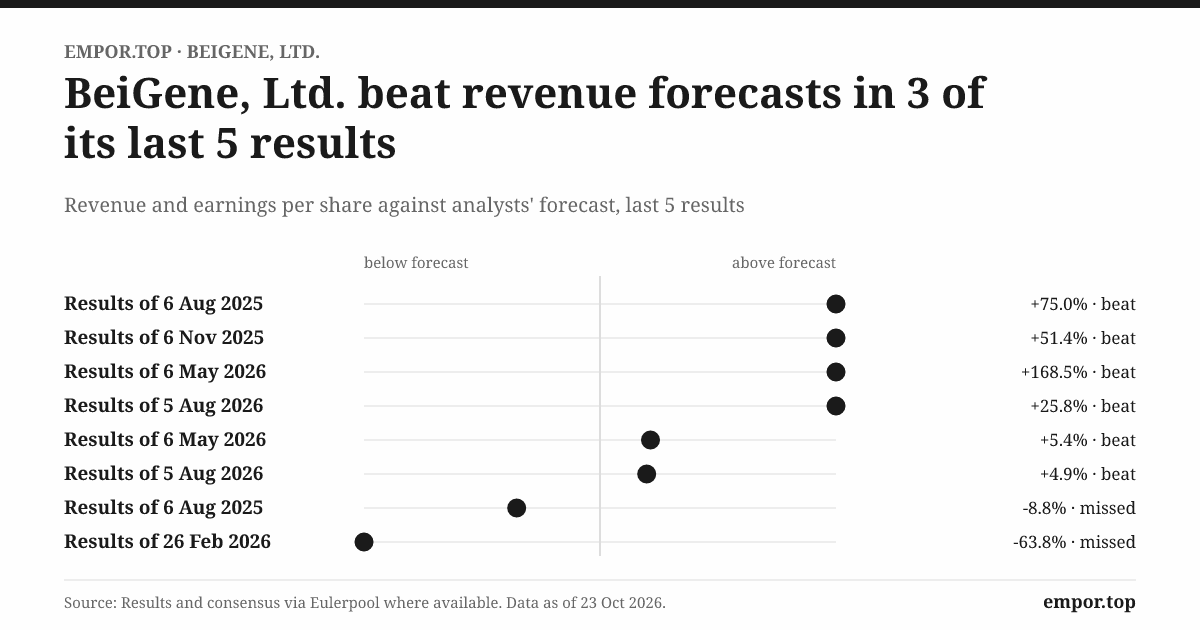
What about guidance? BeOne has only recently become a company that gives meaningful profit guidance, so there is not yet a long record to test. The recent evidence is encouraging but short. In May 2026, management guided to full-year revenue of $6.3bn to $6.5bn and said demand had improved through March and April after typical first-quarter seasonality in BTK inhibitors.318 Three months later, after a quarter in which revenue grew about 30%, it raised the revenue range to $6.6bn to $6.8bn and GAAP operating income guidance to $1.0bn to $1.1bn, with gross margins expected in the high-80% range.221 On the second-quarter call, Oyler attributed the raise to stronger-than-expected commercial performance.1617 That is the right direction of travel for credibility: guidance set, then exceeded. But two quarters of raised guidance after one profitable year is not a long-term record, and a fair assessment has to wait for a full cycle that includes a disappointment and how management explains it.
The verdict on management is that Oyler has executed the strategy he set out with remarkable consistency, and BRUKINSA is the proof. The long capital-consuming record, meaningful dilution and pointed shareholder dissent argue for measuring his next phase by different yardsticks: cash conversion and product diversification rather than pipeline promises. Which leads to the question that ultimately prices all of this: at today's share price, what exactly are investors assuming management will deliver?
XI. Analysis & Bear vs. Bull Case
Consider the second quarter of 2026 from the vantage point of a portfolio manager deciding whether BeOne's stock is fairly priced. Revenue rose about 30% to $1.7bn.2 Operating margin reached about 19%.2 Management raised full-year guidance on both revenue and operating income.2 And BRUKINSA, at $1.2bn, still accounted for most of what the company sold.2 Every number in that quarter supports the bull case and illustrates the bear case at the same time.
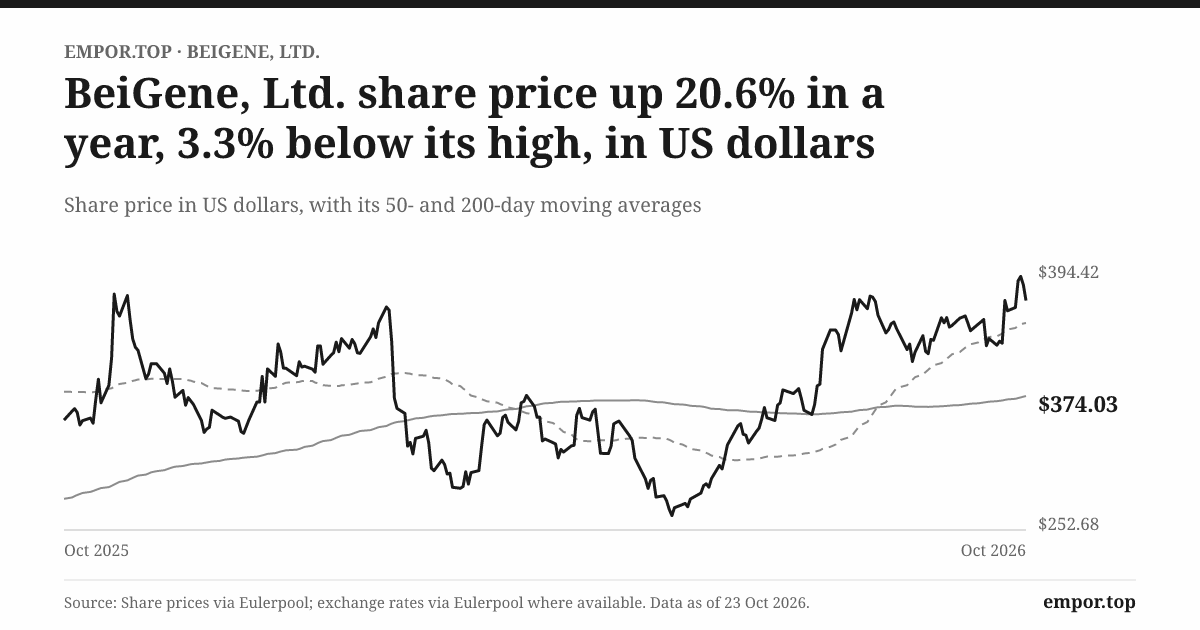
On October 23, 2026, BeOne traded at about $374 per ADS, giving it a market value of about $36.3bn and an enterprise value, after subtracting net cash, of about $32.3bn.1 That is about 55.5 times trailing earnings, 6.4 times trailing revenue, and a free-cash-flow yield of about 3.4%.1 A simple worked comparison makes those figures easier to hold. Take management's guidance of $1.0bn to $1.1bn of GAAP operating income for 2026.2 Divide the enterprise value by the midpoint, and investors are paying about 30 times this year's expected operating profit, before tax. For a company growing revenue around 30% a year, that is not extreme. For a company whose growth is concentrated in one product and whose profit history is a year and a half long, it leaves limited room for disappointment.
The historical comparison is not very helpful, because BeOne lost money every year from 2021 to 2024, so there is no meaningful history of earnings multiples to compare against. A peer comparison is rough at best. One data provider's October 2026 estimates put BeOne at about 49 times forecast 2026 earnings and 5.6 times enterprise value to revenue, against about 28 times and 7.5 times for argenx, another fast-growing, recently profitable specialty biotech.22 Those figures use different periods and methods from the trailing multiples above, but they suggest the market pays more for each dollar of BeOne's earnings and less for each dollar of its revenue than for a comparable peer. That combination implies investors expect BeOne's margins to keep expanding.
Why BeOne could win, and what could stop it
The bull case rests on a proof point that most biotechs never get. BRUKINSA beat the incumbent in a randomized head-to-head trial, sells at a larger scale than its most comparable competitor, and was still growing about 31% six and a half years after launch.1312 TEVIMBRA gives the company a second product with real revenue. The company has demonstrated that its research engine can produce a global medicine and that its commercial organization can sell one in the United States against AstraZeneca and AbbVie. And it is now generating cash while spending more on research than most mid-sized pharmaceutical companies.
The bear case rests on concentration and conversion. BRUKINSA was nearly three-quarters of product revenue in 2025, and three wholesalers handled 46% of product sales.1 The pipeline is expensive and commercially unproven beyond the first two drugs. Rivals include AstraZeneca, AbbVie, Merck and Bristol-Myers Squibb, each with far larger portfolios and the ability to absorb a setback in one product that would be devastating for BeOne. And the profit stream that supports a 55 times multiple is young.
Michael Porter's five forces help clarify where the pressure comes from. Buyer power is real, but it runs through payers more than through wholesalers. Distributors aggregate demand and can influence logistics and fees, but the parties that actually set BRUKINSA's net price are American insurers, pharmacy benefit managers, Medicare and Chinese national reimbursement negotiations, and their power shows up in the $1.45bn of gross-to-net deductions. Supplier power is modest for BRUKINSA, which BeOne makes itself, but material for the Amgen products BeOne sells in China, as the 39% share of product cost of sales shows. The threat of substitutes is high: Calquence, Imbruvica, non-covalent BTK inhibitors such as Eli Lilly's Jaypirca, and fixed-duration Venclexta combinations all compete for the same patients. The threat of new entrants is constrained by patents, clinical evidence requirements, regulation and manufacturing, but not eliminated, as the Zydus generic challenge shows. And rivalry among existing competitors is intense, conducted through trial data, sales force reach and payer contracts.
Hamilton Helmer's seven powers framework asks a sharper question: which durable advantages does BeOne have that competitors cannot easily copy? The clearest is what Helmer calls a cornered resource, here the combination of BRUKINSA's patent estate, which BeOne says runs to 2034 on its core molecule, and the ALPINE data, which no competitor can replicate for its own drug without running a new trial.1 That power is real but time-limited. A second candidate is process power: the ability to discover and develop drugs faster and more cheaply by running research and early trials in China. That may be real, but its evidence remains mostly in the cost of attempts, not in the rate of commercial success. Switching costs are weak in the economic sense. Patients and doctors are reluctant to change a treatment that is working, but there is no contractual lock-in, and new patients can start on any drug. Scale economies, network effects and brand power are not significant advantages relative to much larger competitors. On this reading, BeOne's moat today is one strong product protected by patents and evidence, plus a research engine that may produce more such products but has not yet proven it.
The risks that could break the case are specific. Payer pressure could push gross-to-net deductions higher and erode net prices, particularly as American drug-pricing reforms expand. A ruling against BeOne in the Zydus patent case could shorten BRUKINSA's exclusive life. U.S.-China tensions could complicate development, supply and cash movement through the mechanisms described earlier. The AbbVie trade-secret suit adds legal risk to the BTK degrader that is meant to be BRUKINSA's successor. And the FDA's Office of Prescription Drug Promotion sent BeOne untitled letters in 2025 and 2026 objecting to aspects of BRUKINSA promotional materials, including a letter in May 2026.23 Such letters require changes to marketing and attention to compliance, but they do not establish that BRUKINSA's clinical case is unsound.
The two risks that matter most sit in the same frame as the thesis itself. The first is concentration: one product, and three distributors, account for most of what BeOne sells. The second is replacement: the possibility that sonrotoclax, the degrader and the broader pipeline fail to replace BRUKINSA's growth as the drug matures. If both risks arrive together, a slowing BRUKINSA with no successor ready, the market would have to reprice BeOne from a growth company to a single-product company with a large research budget, and those are valued very differently.
Three numbers will tell investors most about which way that is going. The first is BRUKINSA's net sales growth and its share of product revenue; the latest reading is 31% growth in the second quarter of 2026, with the drug near three-quarters of product sales.21 The second is operating cash flow after working-capital movements and stock-based compensation; it turned positive at $1.13bn in 2025, with about $511m of share-based pay sitting on top.1 The third is non-BRUKINSA product revenue growth, led by TEVIMBRA at 18% in the most recent quarter.2 At the current multiple, the question is whether 2026 and 2027 operating income and free cash flow meet or exceed guidance while the product mix broadens. Meeting guidance is already priced. Broadening is not yet proven.
XII. Playbook: Business & Investing Lessons
Every great company story leaves behind a handful of lessons that belong to it and no other. BeOne's are written in the gap between a drug that crossed the world and a company that is still crossing.
The first lesson is that the first approval opens the door; the prescription keeps it open. BRUKINSA's head-to-head trial and the uptake that followed turned that permission into a $3.93bn product. For founders, the lesson is that a regulatory milestone is a license to compete, not a victory. For investors, it is that the evidence worth paying for is the evidence of switching: proof that doctors chose the new drug over the old one.
The second lesson is that a license can buy a market, but it cannot control a factory. BeiGene's Celgene deal gave it a sales force and three established drugs in China. The ABRAXANE supply dispute showed how fragile commercial rights are when the supply chain belongs to someone else. The deal did its job as an apprenticeship. That lesson still applies to the Amgen products BeOne sells in China today. Investors should always ask of a licensing-led business: who makes the product, and what happens when they cannot?
The third lesson is that a pipeline is a portfolio of possibilities, not a revenue line. The Novartis handback left BeiGene with the cost and responsibility of carrying its drugs forward. One became a $737m product; the other did not become a product at all. That is roughly the base rate of drug development playing out inside one deal. Thirteen new molecules entering trials in a year is evidence of an engine, and it is worth something. But until one of them becomes a durable product, its value lives in probabilities, and probabilities have a way of being smaller than presentations suggest.
The fourth lesson is the one that matters most right now: the cash test starts after the first profitable year. BeOne's first profitable year came with favorable collection timing, lower construction spending, share-based pay and a one-time royalty sale. None of that diminishes the turnaround. It simply means the first profitable year is the beginning of the proof, not the end of it. Companies that emerge from long investment periods often look most profitable in the year they stop building; the question is what they look like two years later, when the investment resumes and the timing evens out.
What ties these lessons together is a single, quotable truth about BeOne: it proved that a global drug company can emerge from a China-rooted research engine, but the proof comes from commercial durability and cash, not from clinical ambition alone. That is a lesson for every biotech that believes its pipeline chart is its business.
XIII. Epilogue
Tonight BeOne stands where few biotechs ever arrive. It has a profitable base, a global blockbuster, raised guidance, and $5bn of cash. Management expects 2026 revenue of $6.6bn to $6.8bn and GAAP operating income of $1.0bn to $1.1bn.2 BRUKINSA sold $1.2bn in the second quarter alone.2 By any standard, the company has crossed the technical and commercial barriers that seemed remote when two founders met in a Beijing lobby sixteen years ago.
But the next two years will decide whether BeOne is more than BRUKINSA, and the evidence will arrive in specific moments. The next one is the third-quarter results, expected in early November. Investors will watch whether full-year guidance holds or rises again, and more importantly, how management explains it. Is BRUKINSA growth still coming mainly from new patients, or increasingly from price? Are gross margins holding in the high-80% range as productivity improvements flow through? Is R&D spending rising in line with the pipeline's needs, and is operating cash flow tracking profit, or diverging from it?
Then come the pipeline events. Sonrotoclax's pivotal readouts and regulatory filings, the BTK degrader's development amid AbbVie's lawsuit, and TEVIMBRA's progress in Western markets will each produce headlines. Each should be counted as a technical milestone until it becomes durable product revenue. If sonrotoclax wins approval and BeOne can offer its own fixed-duration combination with BRUKINSA, the company will have built a defensive moat around its core franchise. If the program stumbles, the burden on BRUKINSA grows heavier just as its growth slows.
Underneath the headlines, the quieter numbers will matter as much. Gross-to-net deductions, distributor receivables and working-capital movements will determine how much of BRUKINSA's demand actually reaches cash. A quarter in which revenue rises but receivables rise faster, or in which gross-to-net deductions jump, will say more about the business than any press release about a trial.
If, by 2028, BeOne shows two more years of solid operating cash flow, a falling BRUKINSA share of revenue driven by growth elsewhere rather than by BRUKINSA's decline, and at least one more drug at meaningful scale, the case that it is a durable global oncology company will be largely settled. If instead BRUKINSA's growth fades, the pipeline delays, and cash flow depends on timing and asset sales, BeOne will be a remarkable company that made one remarkable drug. The central question remains open, and it is a question for evidence, not speculation: can BeOne build a broader oncology company before BRUKINSA's growth slows?
XIV. Outro
Go back to the beginning. A team of chemists in Beijing, in a company not yet a decade old, designing a molecule to fit one lock among hundreds more precisely than anyone had before. Then follow that molecule across the world, through the trials, the contest and the approval, to a specialty pharmacy in an American city, where a patient picks up a bottle of capsules that will keep their cancer in check for another month.
That journey, from a Beijing laboratory to a prescription in Ohio or Oregon, is what makes BeOne unlike any other company in its industry. One medicine still anchors its global business. The next proof is whether BeOne can build on that success.
References
-
2025 Annual Report on Form 10-K — BeOne Medicines/SEC, 2026-02-26 ↩↩↩↩↩↩↩↩↩↩↩↩↩↩↩↩↩↩↩↩↩↩↩↩↩↩↩↩↩↩↩↩↩↩↩↩↩↩↩↩↩↩↩↩↩↩↩↩↩↩↩↩↩↩↩↩↩↩↩↩↩↩↩↩↩↩↩↩↩↩↩↩↩↩↩↩↩
-
BeOne Medicines Announces Second Quarter 2026 Financial Results and Business Updates — BeOne Medicines, 2026-08-05 ↩↩↩↩↩↩↩↩↩↩↩↩↩↩↩↩↩
-
First Quarter 2026 Financial Results and Business Updates, Exhibit 99.1 to Form 8-K — BeOne Medicines/SEC, 2026-05-06 ↩↩
-
2026 Definitive Proxy Statement — BeOne Medicines/SEC, 2026-04-28 ↩↩↩↩↩↩↩↩↩↩↩↩↩
-
Strategic Collaboration with Celgene, Form 8-K — BeiGene/SEC, 2017-07-05 ↩↩↩↩
-
BeiGene Regains Rights for Cancer Drug After Novartis Deal Termination — Reuters via MarketScreener, 2023 ↩↩↩
-
2025 Definitive Proxy Statement, including the 2020 Amgen Share Purchase and Collaboration — BeiGene/SEC, 2025 ↩↩↩
-
IMDELLTRA Royalty Purchase Agreement, Form 8-K — BeOne Medicines/SEC, 2025-08-25 ↩↩
-
Zanubrutinib or Ibrutinib in Relapsed or Refractory Chronic Lymphocytic Leukemia — New England Journal of Medicine, 2023 ↩↩
-
Annual Report and Form 20-F Information 2025 — AstraZeneca/SEC, 2026 ↩
-
BeOne Medicines Q2 Earnings Call Highlights — Nasdaq, 2026-08 ↩↩
-
BeOne Medicines (ONC) Q2 2026 Earnings Call Transcript — Seeking Alpha, 2026-08-05 ↩↩
-
BeOne Medicines Q1 Earnings Call Highlights — Yahoo Finance, 2026-05 ↩↩↩
-
Quarterly Report on Form 10-Q for the quarter ended June 30, 2026 — BeOne Medicines/SEC, 2026-08-05 ↩↩↩↩↩↩↩↩↩↩↩↩
-
Poll Results of the 2026 Annual General Meeting — BeOne Medicines/HKEX, 2026-06-12 ↩↩↩↩↩
-
Second Quarter 2026 Earnings Release, Exhibit 99.1 to Form 8-K — BeOne Medicines/SEC, 2026-08-05 ↩
-
BeOne Medicines Valuation Ratios — MarketScreener, 2026-10-16 ↩
-
BRUKINSA Promotional Untitled Letter — U.S. Food and Drug Administration, 2026-05-12 ↩
 LinkedIn
 WhatsApp
 Reddit
 Hacker News
 Email
 Kindle
 RSS Feed
 Spotify
 Apple Podcasts
 Amazon Music
 Audible
 YouTube