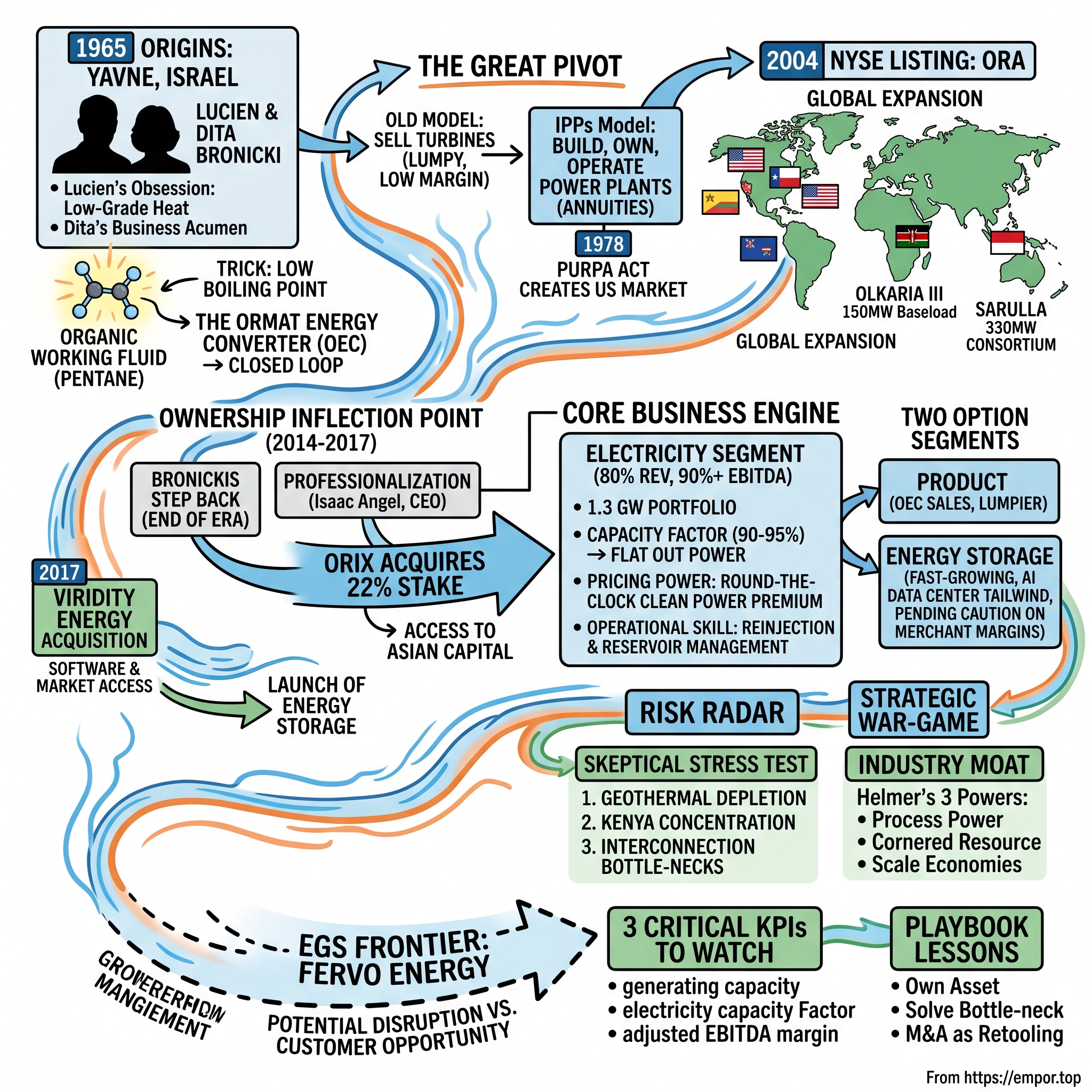
Ormat Technologies: The Geothermal Empire & The Baseload Clean Power Playbook
I. Introduction & Episode Roadmap
Picture a control room in the high desert of northern Nevada. Outside, the ground is cracked and pale, the kind of terrain that looks like nothing will ever grow there. But three kilometers straight down, water superheated by the Earth's own molten interior is racing up a steel casing at temperatures hot enough to boil a swimming pool in seconds. That heat never sleeps. It doesn't dim when a cloud passes. It doesn't die when the wind stops. It has been radiating out of the planet's core for four and a half billion years, and it will keep radiating long after every solar panel ever manufactured has been recycled into scrap.
Ormat Technologies (אורמת Ormat Technologies, NYSE: ORA) built a business on that simple, stubborn fact. While the rest of the renewable-energy world spent two decades chasing the falling cost curves of solar panels and wind turbines, this company — born as a boutique physics spin-off in a small Israeli town — quietly cornered the market on the one thing solar and wind cannot deliver on their own: zero-carbon electricity that runs 24 hours a day, 365 days a year, at capacity factors north of 90%. In an era suddenly desperate for exactly that kind of firm, always-on clean power, Ormat finds itself sitting at an unusually valuable intersection.
Here is the business as it stands in mid-2026. Ormat closed fiscal 2024 with roughly $880 million in revenue, up about 6% year over year, and $550 million of adjusted EBITDA — a margin north of 62% that would make most industrial companies weep with envy.1 The company runs three segments. Electricity, the crown jewel, generated $702 million in 2024, roughly 80% of revenue and the overwhelming majority of profit.1 The Product segment — selling the company's proprietary power units and engineering services to other geothermal developers — added about $140 million. Energy Storage, the newest and smallest arm, contributed roughly $38 million but is growing fast.1 Behind those numbers sat a generating portfolio of about 1,538 megawatts at year-end 2024, spanning geothermal and solar plants across Nevada, California, Hawaii, Utah, Kenya, Indonesia, and Guadeloupe, plus a rapidly expanding fleet of grid-scale batteries.1
The core thesis is this: Ormat solved the hardest problem in renewable energy decades before the market was willing to pay for the solution. Its weapon is a piece of thermodynamic cleverness called the Organic Rankine Cycle, wrapped in a machine the company calls the Ormat Energy Converter, which can wring electricity out of hot water that a conventional steam turbine would consider useless. That technology, refined over sixty years, is the foundation of everything that follows.
But this is not a company without scars or skeptics. Its most important international asset depends on a chronically cash-strapped Kenyan state utility. Its growth requires drilling expensive holes into uncertain geology, where a single dry well can vaporize millions of dollars. And a new class of Silicon Valley–backed geothermal startups now claims it can manufacture underground reservoirs anywhere on Earth, potentially rendering Ormat's carefully hoarded land rights less special than they look. Whether Ormat is a durable monopoly or a legacy incumbent about to be disrupted is precisely the question worth wrestling with.
Our roadmap runs in eight movements: the physics origins in Yavne and the Bronicki invention; the high-conviction pivot from equipment vendor to power-plant owner; the 2004 NYSE listing and the global land grab across America, Africa, and Asia; the ownership shake-up that brought in Japan's ORIX and launched the battery bet; a deep dive into the economics of the electricity engine; the M&A record; the competitive war-game against enhanced geothermal; and finally the bull-versus-bear stress test. Let's begin where all of it started — with a physicist who refused to waste heat.
 Subscribe on LinkedIn
II. Origins in Yavne: The Bronicki Legacy & The Organic Rankine Cycle
In the early 1960s, the young state of Israel had a problem that reads like a riddle: it had abundant sunshine and almost no conventional energy resources, and it needed to bring electricity to remote outposts scattered across a desert. There were no power lines running to a border kibbutz or a lonely microwave relay station on a hilltop. The country needed small, rugged, unattended generators that could sit in the middle of nowhere and just work.
Enter Lucien Bronicki, a French-born physicist who had studied at the Sorbonne and come to Israel to work under Harry Zvi Tabor, the pioneering solar scientist at Israel's National Physical Laboratory. Tabor was obsessed with harvesting low-grade heat — the kind of warmth that is everywhere but too feeble for a normal power plant to touch. Bronicki inherited that obsession and turned it into a machine. In 1965, he and his wife Dita Bronicki founded Ormat Turbines Ltd. in Yavne (יבנה), a modest town south of Tel Aviv.3 Dita would run the business side and eventually serve as CEO for decades; Lucien was the inventor and technologist. It was very much a family enterprise, and it stayed that way for nearly fifty years.
To understand what they built, you have to understand why ordinary geothermal power is so limited. A conventional geothermal plant works like a coal plant with the firebox removed: it needs steam, and lots of it, at high pressure. That requires a reservoir hotter than about 200°C. Find a resource like that — the geysers of Iceland, the volcanic fields of California — and you can spin a steam turbine. But the vast majority of the planet's accessible underground heat is not that hot. It is warm water in the 100°C to 180°C range: too cool to make useful steam, too plentiful to ignore. For most of the 20th century, that heat was simply stranded.
Bronicki's answer was the Organic Rankine Cycle, and the elegant trick at its heart is a substitute for water. Think about why a pot of water needs a roaring flame to boil, while a splash of rubbing alcohol or a can of butane evaporates the instant you open it on a warm day. Different fluids boil at different temperatures. The Rankine cycle — the basic loop of every steam power plant — works by boiling a fluid into vapor, using that vapor to push a turbine, then condensing it back to liquid and doing it all again. Bronicki's insight was to run that cycle with an organic working fluid — a hydrocarbon like pentane or isobutane that boils at a far lower temperature than water. Feed 150°C geothermal brine past a heat exchanger, and the organic fluid flashes into a high-pressure vapor, spins a turbine, generates electricity, and gets condensed back into liquid in a completely sealed loop.3
That closed loop is the second piece of genius. The organic fluid never touches the atmosphere and never mixes with the geothermal brine. The result is a machine — the Ormat Energy Converter, or OEC — that produces electricity from modest heat with essentially zero atmospheric emissions and no water consumed to the sky.3 The brine gives up its heat and is pumped back underground. The working fluid circulates forever. It is a beautifully self-contained system, and for a long time Ormat was almost the only company in the world that had truly industrialized it.
It is worth pausing on how counterintuitive this was in its time. The prevailing wisdom in power engineering held that water was the only serious working fluid — it was free, non-flammable, and thoroughly understood after a century of steam-plant practice. Choosing to run a turbine on pentane, a volatile hydrocarbon, meant solving a cascade of new problems: sealing the loop so the fluid could not leak or ignite, designing turbine blades tuned to the density and flow of a heavy organic vapor rather than steam, and managing the long-term chemistry so the fluid did not degrade over years of thermal cycling. Ormat had to become expert in all of it simultaneously. That is the unglamorous, decades-long apprenticeship that competitors underestimate when they look at geothermal and see only holes in the ground.
Before geothermal became the whole story, the OEC found its first paying customers in the most remote corners of the industrial map. Ormat units were deployed as small, unattended power sources for telecom repeater stations, for cathodic-protection systems that keep oil and gas pipelines from corroding, and along infrastructure like the Trans-Alaska Pipeline, where a machine had to run for years in brutal cold with nobody watching it. The company tested its converters on solar ponds and on industrial waste heat — anywhere a stream of warm fluid was going to waste. Each deployment was a proving ground, hardening the technology and teaching the Bronickis' engineers how organic fluids behave under real-world stress. These were not glamorous contracts, and they did not make anyone rich quickly. But they did something more valuable over the long run: they turned a laboratory curiosity into a field-proven, ruggedized industrial product, one deployment at a time, in conditions no lab could replicate.
What this early era reveals, for an investor looking backward, is that Ormat's moat was never a single patent. It was accumulated craft — decades of learning how to model the thermodynamics, manufacture the turbines, and manage the chemistry of working fluids. That kind of knowledge does not sit in a filing cabinet where a competitor can photocopy it. And it set up the pivotal strategic question that would define the company's next chapter: if you have built the world's best machine for turning low-grade heat into power, are you better off selling the machine — or keeping it and selling the power?
III. The Great Pivot: From Turbines to Power Plant Owner
There is a moment in the life of many great industrial companies when the founders look at their own business model and decide they hate it. For Ormat, that moment came as the realization sank in that selling turbines was a lousy way to build lasting value.
The math of equipment manufacturing is unforgiving. You spend years developing a machine, you sell it once, you book a one-time profit, and then you go hunting for the next customer. Revenue is lumpy — feast in a good order year, famine in a bad one. Margins are thin because buyers negotiate hard on a capital good they will own for decades. And the market assigns capital-goods companies stingy valuation multiples precisely because those cash flows are cyclical and hard to predict. Ormat could build the best geothermal power unit on Earth and still be trapped in a low-multiple, boom-and-bust capital-equipment business.
Now flip the model. Instead of selling the OEC to whoever is building a power plant, what if Ormat built the power plant itself, kept it, and sold the electricity? A geothermal plant, once drilled and commissioned, is close to an annuity. The fuel — underground heat — is free and effectively infinite. Operating costs are low. And if you can lock in a 20- or 30-year contract to sell the output at a fixed price, you have converted a one-time equipment sale into three decades of predictable, high-margin cash flow. You capture the manufacturer's margin and the operator's return on the same molecule of heat. This is the Independent Power Producer, or IPP, model, and Ormat's decision to embrace it was the single most important strategic choice in its history.
The timing and the geography both pointed to the United States. In 1978, in the aftermath of the oil shocks, Congress passed the Public Utility Regulatory Policies Act, universally known as PURPA. Buried in the law was a provision that changed everything for small renewable developers: it forced monopoly utilities to buy power from qualifying independent facilities, including geothermal ones, at set rates. For the first time, a company like Ormat could build a plant and be legally guaranteed a buyer. PURPA effectively created the market that the IPP model needed to exist.
Ormat moved into the American West, where the geology was generous and the policy was welcoming. It developed projects in Nevada and California, cutting its teeth at sites like Steamboat Springs near Reno and the Heber geothermal field in California's Imperial Valley. Each project taught the company something new about the full lifecycle: how to explore for a resource, how to drill the production and injection wells, how to size the plant to the reservoir, and — critically — how to keep the field producing for the length of a contract.
Here is where Ormat's earlier decision to master the whole stack paid off spectacularly. A typical IPP is an assembler: it buys turbines from one vendor, hires a drilling contractor, contracts an engineering firm to build the plant, and stitches it all together. Ormat did essentially all of it in-house. It designed and manufactured its own OEC units, it drilled its own wells, it engineered and constructed its own plants, and it operated them for the long haul. This vertical integration meant Ormat was not paying a stack of outside margins to suppliers and contractors — it was capturing them. On a per-megawatt basis, a vertically integrated developer using its own equipment can bring a plant online at a lower installed cost than a rival buying everything on the open market, which translates directly into a higher return on every dollar of capital sunk into the ground.
There is a financial dimension to the pivot that is easy to miss but shaped everything about how Ormat looks today. An equipment company's balance sheet is light — you build, you ship, you collect. An IPP's balance sheet is heavy — you sink hundreds of millions into plants that pay you back slowly over decades, which means you live and die by your cost of capital and your ability to finance projects without diluting shareholders into oblivion. This is why Ormat evolved into a company run by financiers as much as engineers, and why its most important recurring skill became structuring debt against individual power plants so that a single failed project could not sink the whole enterprise. The pivot did not just change what Ormat sold; it changed what kind of company it had to be, and what kind of people would eventually run it.
For investors, the lesson embedded in this pivot is the one Warren Buffett fans will recognize instantly: owning the toll road beats selling the asphalt. But it came with a catch that would echo through Ormat's whole future. Owning power plants means owning geological risk and financing risk. Every new plant is a multi-year, capital-intensive bet on rock you cannot see. The pivot made Ormat far more valuable — and far more exposed to the perils of the subsurface. With that transformation underway, the company needed capital to scale it. The public markets were the obvious next stop.
IV. Public Debut, Global Scale, & African Geothermal
By the early 2000s, Ormat had a proven technology, a growing fleet of American power plants, and an appetite for global expansion that its private balance sheet could not satisfy. Building geothermal plants is one of the most front-loaded businesses imaginable — you spend enormous sums drilling and constructing before a single electron is sold — and the company needed a bigger pool of capital to fund the next wave of greenfield development.
So in November 2004, Ormat Technologies listed on the New York Stock Exchange under the ticker ORA, raising roughly $100 million in its initial public offering.3 The corporate architecture that emerged from the IPO was telling: headquarters and the growing operating fleet sat in Reno, Nevada, at the heart of the American geothermal belt, while the company kept its research, development, and turbine manufacturing rooted in Israel. It was a bifurcated identity — an American infrastructure company with an Israeli engineering soul — that persists to this day. The public listing gave Ormat the currency it needed to finance large greenfield projects across the Western U.S. and, increasingly, to plant its flag overseas.
The most consequential of those overseas bets was in Africa, and it is worth dwelling on because it captures both the ambition and the risk of Ormat's international strategy. In Kenya's Great Rift Valley, near the town of Naivasha, lies the Olkaria geothermal field — one of the richest concentrations of accessible underground heat on the continent. Through a wholly owned subsidiary called OrPower 4, Ormat developed Kenya's first privately owned geothermal power plant there, the Olkaria III complex. It started small, a pilot plant of a few megawatts, and Ormat scaled it patiently over years, adding units until the complex reached nearly 140 megawatts with the commissioning of its fourth plant in early 2016.9 Today the complex is generally cited at roughly 150 MW of baseload capacity — a genuine pillar of the Kenyan grid.
The financing of Olkaria tells you how these frontier projects get built. Long-tenor debt from development finance institutions — the U.S. government's Overseas Private Investment Corporation, later folded into the Development Finance Corporation — provided the patient, cheap capital that made a 20-year power plant in East Africa financeable.9 The plant sells its output to Kenya Power and Lighting Company, the state-owned national utility, under a long-term dollar-denominated power purchase agreement.9 For Kenya, Olkaria III was transformational: reliable, home-grown baseload power replacing expensive imported diesel.
But — and this is the part a sober analyst has to sit with — the same contract that makes Olkaria valuable also makes it dangerous. Ormat's revenue there depends entirely on a single off-taker, and that off-taker is a chronically strained state utility in an emerging economy. Kenya Power has a long history of paying late. Ormat's filings have repeatedly disclosed material overdue receivables from the utility, with balances climbing into the tens of millions of dollars before being partially cleared.4 Layered on top is currency risk: while the PPA is dollar-denominated, a sharp devaluation of the Kenyan shilling squeezes the utility's ability to pay and complicates repatriating cash. Olkaria is a case study in the fundamental trade of frontier-market infrastructure — outsized returns in exchange for outsized counterparty and sovereign risk.
There is a broader pattern worth naming here about how Ormat approaches emerging markets, because it explains both the returns and the recurring headaches. The company gravitates to places with world-class geothermal geology but weak or capital-starved power sectors — exactly the markets where development-finance capital is available and where a proven, bankable operator is scarce. That combination lets Ormat earn premium project returns and take a first-mover position that later entrants cannot easily replicate. The price of admission is that these are precisely the jurisdictions where a state utility's balance sheet is fragile and where the local currency can move violently. Ormat has, in effect, chosen a business model that trades reliable geology for unreliable counterparties — a defensible trade, but one that puts a permanent asterisk on the "annuity" description of its international cash flows.
Kenya was not the only flag Ormat planted. In Indonesia — a nation sitting atop the Pacific Ring of Fire, arguably the most geothermally blessed country on Earth — Ormat took part in the Sarulla project in North Sumatra, one of the largest single geothermal developments in the world at 330 megawatts.12 Ormat's role there is instructive about its flexibility: rather than owning the whole thing, it held a minority equity stake of about 12.75% in the operating consortium alongside heavyweight partners including Indonesia's Medco Energi, Japan's 伊藤忠商事 Itochu and 九州電力 Kyushu Electric, while also designing the plant and supplying the geothermal energy converters at its heart.12 Sarulla, completed in 2018, proved Ormat could structure and execute inside a complex multinational consortium — sometimes as owner-operator, sometimes as the indispensable technology partner, and often as both at once.
The through-line of this expansion era is that Ormat had figured out how to export a very hard-to-replicate capability into the exact places that needed it most. But a company built and run for half a century by one founding family was about to undergo the most wrenching change in its history — a change not of technology or geography, but of ownership and control.
V. The Inflection Point: Professionalization, ORIX, & The Storage Bet
Every founder-led company eventually confronts the same uncomfortable truth: the founders will not run it forever. For Ormat, the reckoning arrived in 2014, when Lucien and Dita Bronicki — who had built the company from a Yavne workshop into a global geothermal power producer over nearly five decades — stepped back from the leadership they had held since 1965. It was the end of an era in the most literal sense.
What followed was a deliberate professionalization of the business, driven by a new controlling shareholder with a very different temperament. The Israeli private equity firm FIMI Opportunity Funds took an active control position and set about doing what disciplined financial owners do: streamlining operations, cutting corporate overhead, and imposing capital discipline on a company that had, in its founder-run decades, sometimes optimized for engineering elegance over shareholder returns. FIMI installed Isaac Angel as CEO, and the mandate was clear — run Ormat like a returns-focused infrastructure business, not a family science project. The market noticed; the operational tightening and margin focus of this period reset expectations for what Ormat could earn from its asset base.
Then, in 2017, the ownership story took an international turn. The Japanese financial-services and leasing conglomerate ORIX Corporation (オリックス株式会社) agreed to acquire roughly a 22% controlling stake in Ormat, buying out FIMI and the Bronicki family's remaining holdings at $57 per share in a transaction valued at approximately $627 million, which closed in July 2017.613 ORIX did not just buy shares; it entered a strategic partnership, took board seats, and signed a commercial cooperation agreement.6 The logic ran in both directions. For ORIX, Ormat was a way to own a piece of the global energy transition with a genuinely differentiated technology. For Ormat, ORIX offered access to deep, patient, low-cost Asian capital and a potential pipeline into the Japanese and Southeast Asian geothermal markets — regions with enormous underground heat and, in Japan's case, an acute post-Fukushima hunger for clean baseload power. ORIX has remained the anchor shareholder ever since, and its roughly one-fifth ownership is a defining feature of Ormat's governance.
The same year brought a second, quieter, and in some ways more surprising move: Ormat bought its way into batteries. In early 2017 it agreed to acquire Viridity Energy, a Philadelphia-based energy-storage and demand-response software company, for an initial $35 million plus contingent earn-out payments tied to performance milestones through 2020, closing the deal that March.78 On paper, a geothermal company buying a battery-software startup looked like a strange left turn. Why would the world's premier baseload power producer wade into the intermittent-adjacent world of lithium-ion storage?
The answer reveals how Ormat thinks about its own product. Its entire value proposition is firmness — power you can count on. Batteries, it turns out, are the natural complement to that pitch. A battery can shift energy across hours, provide split-second frequency regulation to keep the grid stable, and be bid into capacity and ancillary-service markets like PJM's frequency regulation, ERCOT's merchant arbitrage, and CAISO's resource-adequacy programs. By pairing storage with geothermal, Ormat could eventually offer utilities a bundled "firm clean power" package that no pure-play solar developer could match. Viridity gave it the software brains and market access to start. The segment would stay small for years — and, as we'll see, the software-heavy early phase was a drag on margins before it became a growth engine — but the strategic seed was planted. With new owners, new managers, and a new segment, Ormat entered the 2020s as a professionalized, three-legged clean-energy platform. Time to open up the engine and see how the core actually makes money.
VI. Deep Dive: The Core Electricity Engine Today
Strip away the storage buzz and the international drama, and Ormat is, at its heart, one thing: a fleet of geothermal power plants that print cash. The Electricity segment is the entire investment case's foundation, and understanding its economics is understanding the company.
The scale of its dominance within Ormat is easy to state. In 2024 the Electricity segment produced $702 million of revenue — about 80% of the company total — and it throws off well over 90% of consolidated adjusted EBITDA.1 The other two segments, for all their strategic interest, are rounding errors on the profit line by comparison. This is a business whose value lives almost entirely in the roughly 1.3 gigawatts of operating geothermal and solar capacity it owns across Nevada, California, Hawaii, Utah, Kenya, Indonesia, and the French Caribbean island of Guadeloupe.1
To grasp why these plants are so valuable, you have to internalize a single number that separates geothermal from every other renewable: capacity factor. Capacity factor is the percentage of a plant's theoretical maximum output that it actually delivers over a year. A solar farm in a sunny state runs at maybe 20–30% — it produces nothing at night and little on cloudy days. An onshore wind farm manages perhaps 30–45%, at the mercy of the breeze. A geothermal plant runs at 90–95%. It produces essentially flat out, around the clock, all year, pausing only for maintenance. In practical terms, one megawatt of geothermal capacity delivers roughly three to four times as many megawatt-hours per year as one megawatt of solar. When you are selling energy, that ratio is everything.
That firmness cascades into two more advantages. The first is land and grid footprint. Because a geothermal plant is producing constantly from a compact surface installation drawing on a deep reservoir, it generates far more energy per acre than a sprawling solar array — on the order of ten times more — and it uses the expensive transmission line connecting it to the grid far more efficiently, because that line is carrying power around the clock rather than in midday bursts.4 In a world where building new transmission is agonizingly slow and interconnection queues stretch for years, a resource that squeezes maximum firm energy through a given grid connection is unusually precious.
The second advantage is pricing. Ormat sells the bulk of its output under long-term power purchase agreements — typically 15 to 25 years — to utilities and community-choice aggregators like NV Energy, the Southern California Public Power Authority, and Clean Power Alliance.4 These buyers are under legal mandates to procure clean energy, and increasingly they need clean energy that is available 24/7, not just when the sun shines. Geothermal is one of the only technologies that can satisfy a round-the-clock clean-power requirement without a mountain of backup batteries. That scarcity gives Ormat pricing power at the negotiating table: baseload clean PPAs command premiums over intermittent solar and wind contracts. The long tenor also means these are inflation-protected annuities — many contracts include escalators, and the fuel cost never rises because the fuel is free.
But the fuel being free does not mean the resource is effortless, and here is where the real operational skill lives. The primary risk to a geothermal plant is not the machinery above ground — it is the reservoir below. Pull heat and fluid out of the Earth too aggressively, and the reservoir can cool, its pressure can drop, and output can decline over time. A geothermal field is not a bottomless thermos; it is a dynamic system that has to be managed. Ormat's core operational discipline is reinjection: after the OEC extracts the heat, essentially all of the geothermal brine is pumped back down into the reservoir through injection wells.4 This closed-loop reinjection recharges the aquifer, sustains its pressure, and slows the natural decline of the field, allowing a well-managed reservoir to produce for decades. When a field does decline, the fix is expensive — drilling make-up wells that can cost several million dollars each with no guarantee of success.
There is a subtlety worth surfacing about how these revenues are contracted, because it shapes the risk profile more than the headline numbers suggest. Not all of Ormat's electricity revenue is equal. The bulk sits under fixed-price, long-term PPAs — the safe, predictable annuity. But a portion is tied to floating rates that track a utility's avoided cost or wholesale power prices, and some assets carry pricing that steps down or changes character as older PURPA-era contracts expire and are renegotiated. When a legacy contract signed in a high-price decade rolls off and is replaced at prevailing market rates, the economics of that specific plant can shift meaningfully. A careful reader of the filings watches the PPA expiration schedule the way a bond investor watches a maturity ladder: the weighted-average remaining contract life is a quiet but real determinant of how durable the cash flows actually are. Management's task is to keep re-contracting expiring plants at healthy prices — and the rising scarcity premium for firm clean power is, conveniently, a strong tailwind for exactly that re-contracting.
So what does the electricity engine tell an investor? That Ormat owns a portfolio of long-duration, inflation-protected, high-margin cash annuities whose scarcity value is rising precisely as the grid needs firm clean power most — but that the durability of those annuities rests on subsurface engineering that is invisible from the outside and unforgiving when it goes wrong. The capacity factor of the fleet is, in effect, a real-time readout of reservoir health, which is exactly why it deserves close watching. With the core understood, we can size up the two smaller bets riding alongside it.
VII. Sizing the Options: Product Segment & The Fast-Growing Energy Storage Engine
If the Electricity segment is the annuity, the other two segments are the options — smaller, more volatile, and more interesting than their size suggests. They deserve proportional attention: neither is the main story, but each tells you something about where Ormat is pointing.
Start with the Product segment, the direct descendant of Ormat's original identity as a turbine maker. This is the business that never fully went away after the great pivot: Ormat still designs, manufactures, and sells its OEC power units, ORC turbines, and full engineering-procurement-construction services to third parties. Its customers are other geothermal developers who want the best converters on the market, and industrial operators looking to recover waste heat — for example, capturing the exhaust heat from natural-gas pipeline compressor stations and turning it into electricity. In 2024 the segment generated about $140 million of revenue, roughly 15% of the company total.1
The Product segment is lumpy and lower-margin than Electricity — it is, after all, still a capital-goods business — but it plays two useful roles. First, its backlog is a leading indicator: because customers order OEC units well before installation, the backlog offers a window into global demand for Ormat's core technology. Second, and more subtly, selling equipment to third parties keeps Ormat's manufacturing lines busy and its engineering edge sharp, effectively subsidizing the R&D and industrial capability that also serves its own power plants. That said, an investor should watch this segment for what it is: a cyclical, order-driven business whose revenue can swing hard from year to year, and whose recent surge — Product revenue jumped dramatically in early 2026, with the segment guided toward $300 million-plus for the full year — reflects a specific bulge of contracted deliveries rather than a permanent step-change in run-rate.2
The Energy Storage segment is the one that generates the most breathless commentary relative to its financial weight, and it requires a careful, unsentimental read. In 2024 it produced about $38 million of revenue — barely 5% of the company — but it is growing quickly, and the fleet is expanding fast.1 By early 2026 Ormat's U.S. storage portfolio had grown to roughly 495 megawatts, up from around 290 megawatts at the end of 2024, and management guided full-year 2026 storage revenue toward $95–110 million.12 The plants are grid-scale battery installations that earn money from a grab-bag of merchant and contracted revenue streams: energy arbitrage, capacity payments, and fast-response grid services.
Why does a geothermal company keep pouring capital into batteries that generate a sliver of its profit? Three reasons, in ascending order of importance. First, tax credits: standalone storage became eligible for federal Investment Tax Credits under the Inflation Reduction Act, and Ormat has been an aggressive monetizer of clean-energy tax incentives. Second, the bundling strategy — pairing batteries with geothermal to sell utilities a single firm-power product. Third, and most strategically, storage keeps Ormat relevant in the fastest-growing corner of the grid, hedging the risk that its geothermal-centric model looks narrow in a decade dominated by solar-plus-storage. The honest caveat is that grid-scale storage is a far more competitive, lower-barrier business than geothermal — anyone with capital and a site can buy batteries — and merchant storage margins are exposed to compression as more capacity floods in. Storage is a sensible option to own, but it is not, and may never be, a moat.
It is also fair to ask whether storage is a distraction — the kind of adjacency that management teams pursue because it is fashionable rather than because it earns its keep. The counterargument is that Ormat has kept storage deliberately small relative to its balance sheet and has justified it primarily through tax-credit economics and its complementarity to the core, rather than betting the company on it. That is a defensible posture: an option worth a modest premium, sized so that if merchant margins disappoint, the damage is contained. The line to watch is whether storage capital allocation stays disciplined and returns-driven, or whether it creeps upward on the strength of narrative — the difference between prudent optionality and value-destroying "diworsification." So far the evidence points to the former, but it is a live tension, not a settled question. Which brings us to the question of how Ormat has spent its money — because a company's acquisitions reveal its judgment more honestly than any strategy slide.
VIII. Capital Deployment & M&A Benchmarking: Viridity & Enel Green Power
You can learn more about a management team from two well-chosen acquisitions than from a hundred pages of investor presentation. Ormat's dealmaking bookends a useful lesson: one purchase that bought a capability and struggled to make it pay, and one that bought hard assets at a discount and put them straight to work.
The first is the 2017 Viridity Energy deal, already introduced as the launch of the storage segment. Revisited through the lens of capital allocation, it is a cautionary tale about buying capability versus buying cash flow. The $35 million upfront price plus earn-outs bought software, market access, and demand-response contracts — but not much in the way of near-term earnings.78 For years afterward, the storage effort was a drag: Ormat was spending on software development, market participation, and building out its first battery projects while the revenue trickled in. Buying a capability means paying for the privilege of doing the hard work of scaling it yourself. Viridity laid the foundation for everything the storage segment later became, but it was a multi-year investment before it was a contributor, and honest observers should count the years of margin dilution as part of the true price.
The second deal is the more revealing one, and it happened in January 2024, when Ormat completed the acquisition of a portfolio of contracted operating geothermal and solar assets from Enel Green Power North America for $271 million in cash.5 This was the opposite of Viridity: Ormat was buying proven, producing, revenue-generating hardware. The portfolio included two operating geothermal plants and a triple-hybrid geothermal/solar plant totaling roughly 40 MW of geothermal plus 20 MW of solar PV, additional stand-alone solar capacity of about 40 MW nameplate, and — often overlooked — two greenfield development assets carrying option value for future growth, spread across Nevada, Utah, Connecticut, and California.5 Ormat funded it with cash and $200 million of newly issued long-term corporate debt.5
The strategic logic here is genuinely elegant, and it is the closest thing Ormat has to a repeatable growth playbook beyond drilling new fields. Consider the valuation. Ormat paid roughly $1.8 million per megawatt for operating geothermal and solar infrastructure. Building a brand-new geothermal plant from scratch — exploring, drilling, permitting, constructing — costs on the order of $4–5 million per megawatt, and carries the risk that the exploration wells come up dry. Buying operating assets at well under half of greenfield replacement cost eliminates the geological risk entirely; the resource is already proven and producing. It is a classic value acquisition: pay a discount for a de-risked asset.
But the truly clever part is what comes after the purchase. Because Ormat manufactures its own OEC units and knows this technology better than anyone, it can walk into a plant it just bought, identify where the previous owner was leaving energy on the table, and retrofit its own equipment to lift the capacity factor and expand margins. A plant that was underperforming under Enel's ownership can become a higher-output, higher-margin asset under Ormat's, without drilling a single new well. This is M&A as retooling — buying other people's underoptimized hardware and applying proprietary operational skill to make it worth more. It is a strategy only a vertically integrated operator with in-house manufacturing can run, and it is one of the strongest arguments that Ormat's integration is a genuine competitive advantage rather than just a slogan. Of course, the strategy's ceiling is set by how many such portfolios come up for sale at attractive prices — it is opportunistic, not a faucet the company can turn on at will. Judgment like this ultimately traces back to the people making the calls, so let's put management under the microscope.
IX. Management Credibility & Capital Allocation Audit
The two men running Ormat today are cut from the same cloth, and it is not the cloth of a visionary founder. Where Lucien Bronicki was an inventor, the current leadership are financiers and operators — and for a mature infrastructure company harvesting long-lived assets, that may be exactly the right profile.
Chief Executive Doron Blachar has led Ormat since July 2020, but he is no outsider. He spent the prior seven years as the company's Chief Financial Officer, from 2013 to 2020, before a brief stint as president and then the top job.10 That trajectory matters: Blachar came up through the numbers, and his tenure has been defined by a CFO's instincts — relentless focus on return on capital, asset optimization, and squeezing more EBITDA from existing plants rather than chasing growth for its own sake. Alongside him sits CFO Assi Ginzburg, who took the finance seat in 2020 and has run a conservative balance-sheet playbook heavy on non-recourse project finance and tax-equity structuring.1011 The pairing is deliberate: two capital-allocation specialists running a business whose value is ultimately a function of financing cost and operating discipline.
The ownership structure reinforces the financial orientation. ORIX Corporation's roughly one-fifth stake makes it the anchor shareholder and gives it board influence, while executive compensation is tied to metrics like adjusted EBITDA growth, earnings per share, and ESG targets.11 For a skeptical investor, an EBITDA-linked incentive structure is a double-edged sword: it aligns management with cash generation, but EBITDA can flatter a capital-intensive business that must constantly reinvest just to stand still. The right question to keep asking is whether reported adjusted EBITDA is translating into genuine free cash flow after the heavy, ongoing drilling and construction capex — and Ormat's capex is heavy indeed, running in the range of half a billion dollars a year, deployed predominantly into geothermal growth and asset retrofits.1
On capital discipline, the record is broadly credible but worth pressure-testing. Ormat has consistently funded its growth through a mix of non-recourse project debt — where the loan is secured against a specific plant's cash flows rather than the parent balance sheet — and aggressive monetization of federal tax credits under Sections 45 and 48 of the tax code, using the IRA's new transferability provisions to sell credits for cash.4 This tax-credit monetization is a real, non-dilutive source of funding, and management has leaned into it hard. But the flip side is a business that is structurally dependent on the persistence of federal clean-energy incentives; a hostile shift in tax policy would remove a meaningful pillar of the funding model. In early 2026 Ormat also tapped the equity-linked markets with a $1.0 billion convertible notes offering, a sign that the growth ambitions are outrunning what internal cash and project debt alone can fund.2
An activist or governance-minded investor would train a harder lens on the ORIX relationship itself. A single shareholder controlling roughly a fifth of the equity with board representation is a stabilizing anchor, but it is also a concentration of influence that can cut against minority holders — in the composition of the board, in related-party dealings, and in the strategic direction the company takes. To date there is no public evidence that ORIX has used its position to Ormat's detriment; the partnership has coincided with a period of disciplined execution. But the structural point stands: this is not a company with a widely dispersed shareholder base holding management fully accountable to the public float, and that is a governance fact worth pricing in rather than ignoring. The same skeptic would note that a company simultaneously issuing $1 billion of convertible debt, monetizing tax credits, and running a half-billion-dollar annual capex program is leaning on financial engineering to fund growth — perfectly legitimate, but a model whose smooth functioning depends on capital markets staying open and incentives staying in place.
The place where management credibility gets truly tested is on the earnings calls, and Ormat's calls follow a recognizable pattern. In prepared remarks, the narrative is smooth: portfolio growth, EBITDA margin resilience, the long runway of the 2.6–2.8 gigawatt capacity target by 2028.1 Under analyst questioning, the harder subjects surface — the perennial Kenya KPLC receivables, supply-chain delays for battery enclosures and equipment, and the drilling-cost inflation eating into project returns. To management's credit, they have generally been specific and non-evasive on the Kenya issue, disclosing overdue balances and collection progress filing by filing rather than burying it.4 The narrative across recent years has been reasonably consistent, without the kind of unexplained strategy pivots or serial overpromising that should worry a shareholder. The fair summary is a competent, disciplined, finance-driven team executing a clear plan — with the standard caveats that EBITDA-centric incentives and tax-credit dependence deserve ongoing scrutiny. Whether that competence is enough depends on the competitive terrain, which is shifting under Ormat's feet.
X. Industry Moat: 7 Powers, Porter's 5 Forces, & The EGS Frontier (Fervo Threat)
Now for the war-game. Is Ormat's dominance a fortress or a sandcastle? Run it through the two frameworks investors reach for — Hamilton Helmer's 7 Powers and Porter's Five Forces — and then confront the one threat that could make the whole analysis obsolete.
Start with Helmer's 7 Powers, of which Ormat plausibly holds three. The first is Process Power — the sixty years of accumulated, hard-to-copy craft in ORC thermodynamic modeling, OEC turbine manufacturing, and working-fluid chemistry. This is not a single patent that expires; it is institutional know-how baked into thousands of engineering decisions, and it is the reason a new entrant cannot simply buy its way to Ormat's efficiency. The second is a Cornered Resource — the long-term leases, subsurface rights, and water-access rights that Ormat holds across some of the best high-heat-flow geothermal basins in Nevada, California, and Kenya. There is only so much prime hydrothermal real estate, and Ormat spent decades locking it up. The third is Scale Economies in manufacturing: because it builds its own OEC units in-house, Ormat can deliver installed geothermal capacity at a lower cost per megawatt than a rival buying equipment on the open market, a genuine structural cost edge.
Porter's Five Forces mostly reinforces the picture. The threat of new entrants is very low: conventional geothermal demands enormous upfront exploration capital, deep drilling expertise, and permitting cycles that can run five to seven years — a brutal gauntlet that keeps casual competitors out. The bargaining power of buyers is moderate: off-takers are large regulated utilities and community-choice aggregators with real negotiating heft, but they are also under clean-energy mandates that make firm geothermal power scarce and valuable, tilting pricing power back toward Ormat. The threat of substitutes is low for baseload specifically — solar and wind simply cannot replicate a 90%-plus capacity factor without vast and expensive battery overbuild. So far, so fortress-like.
And then there is the threat that does not fit neatly into either framework, the one that keeps the analysis honest: Enhanced Geothermal Systems, and the startup that has become its poster child, Fervo Energy. To understand why EGS matters, you have to see what Ormat's Cornered Resource actually depends on. Conventional geothermal — everything Ormat has built — requires a rare natural coincidence of three things in the same place: heat, water, and permeable rock that lets the water flow. Those three ingredients together are geologically uncommon, which is exactly why the land rights over them are valuable. EGS aims to break that dependency. Borrowing the horizontal drilling and hydraulic fracturing techniques perfected by the shale-oil revolution, EGS developers drill into hot but dry, impermeable rock, fracture it to create artificial pathways, and pump their own water through the man-made reservoir. If it works at scale and at reasonable cost, EGS makes geothermal possible almost anywhere there is hot rock — which is nearly everywhere, if you drill deep enough.
Fervo Energy is the company forcing this question. It has attracted serious capital and serious customers — including a landmark clean-power deal with Google — and it is building large projects in the American West that aim to prove EGS can be commercially competitive. If Fervo and its peers succeed, the strategic implication for Ormat is profound: the scarcity value of Ormat's specific hydrothermal land rights erodes, because heat becomes accessible in far more places, and a fresh cohort of well-funded developers enters the game.
It is worth being precise about where the two approaches genuinely differ and where the bear case overreaches. EGS is not free money; it inherits the two hardest problems of both parent industries. From oil and gas, it inherits drilling cost and drilling risk, which climb steeply with depth and temperature — the deeper and hotter you go, the more expensive and failure-prone the well. From geothermal, it inherits the challenge of sustaining flow: a fractured hot-rock reservoir has to keep transferring heat to circulating water for decades without cooling too fast or losing water into the formation, and that long-duration performance is exactly what remains unproven at commercial scale. Ormat's conventional resources, by contrast, have already demonstrated multi-decade production. So the honest framing is not "EGS is better" but "EGS is potentially far more ubiquitous if it can drive its cost curve down the way shale drilling did." Whether it can is the trillion-dollar unknown, and it will be answered by drilling data over the back half of this decade, not by anyone's slide deck today.
But the threat cuts in more than one direction, and this is where the analysis gets genuinely interesting. EGS still needs a machine to convert underground heat into electricity — and the OEC is precisely that machine. An EGS field producing medium-temperature fluid is a natural customer for exactly the binary-cycle technology Ormat has spent sixty years perfecting. So Fervo could be, simultaneously, a threat to Ormat's land moat and a customer for its Product segment. Ormat has not been passive: it has experimented with EGS-style well stimulation at its own existing fields, such as Desert Peak in Nevada, and continues to hybridize geothermal with solar. The most likely reading is that EGS expands the total geothermal pie faster than it destroys Ormat's slice — but any investor who dismisses the disruptive case is not paying attention. The moat is real, but its most valuable brick, the Cornered Resource, is the one most exposed to technological change. That tension sits at the center of the risk radar.
XI. Risk Radar & Skeptical Investor Stress Test
Every bull case deserves an adversary, so let's play the short-seller and interrogate the things that could actually break Ormat. Four risks stand out, each rooted in a real business mechanism rather than generic macro hand-wringing.
The first and most fundamental is geothermal resource depletion. Ormat's cash annuities depend on reservoirs holding their heat and pressure for decades, and reservoirs are living systems that can degrade. Enthalpy can decline, wells can scale up and plug with mineral deposits, and output can quietly erode. When it does, the remedy is expensive: drilling make-up wells at several million dollars apiece — the filings and industry norms put such wells in the $5–10 million range — with no certainty the new well hits productive rock.4 A short-seller would zero in on any fleet-wide dip in capacity factor as the tell-tale sign that Ormat is spending more and more just to hold output flat. This is why the capacity factor is not a vanity metric; it is the vital sign of the entire asset base.
The second is the Kenya concentration risk, which we have flagged but which deserves to be named as the single largest identifiable off-taker vulnerability. Olkaria III contributes a meaningful slice — on the order of 12–15% — of total electricity revenue, and it hangs on the willingness and ability of a strained state utility to pay.4 The pattern of recurring overdue receivables from Kenya Power is not a one-off; it is a structural feature of doing business with an emerging-market sovereign counterparty.4 Layer on the risk of a Kenyan shilling devaluation or a broader sovereign debt restructuring, and you have a scenario where a chunk of Ormat's most profitable segment could see cash collection stall for quarters at a time. It has happened before, partially, and it can happen again.
The third risk is more prosaic but increasingly binding: interconnection queue bottlenecks. Building the plant is only half the battle; connecting it to the grid is the other half, and across the U.S. — in CAISO, in NV Energy's territory, in ERCOT — the queues to interconnect new generation have become notoriously congested. Delays of 12 to 24 months in reaching commercial operation are common, and every month of delay pushes back the revenue on a project Ormat has already sunk capital into, dragging down its realized return. This is a structural headwind for the entire growth pipeline and a legitimate reason to discount management's capacity-target timelines.
The fourth is storage merchant margin compression. The battery bet's economics rest partly on merchant revenue — arbitraging price spreads and selling grid services in markets like PJM and ERCOT. But lithium-ion cell prices have fallen dramatically, which cuts both ways: it lowers Ormat's build cost, but it also lowers the barrier for everyone else, inviting a flood of competing storage capacity that compresses the very arbitrage spreads Ormat is counting on. A storage segment scaling toward 500-plus megawatts into a market that may be structurally oversupplied is a real question mark, not a guaranteed growth engine. Taken together, these risks do not sink the thesis, but they define its boundaries. The honest bull case has to survive contact with all four — so let's build it, and its opposite, explicitly.
XII. Bull vs. Bear Case & The 3 Critical KPIs
Here is the debate in its sharpest form. Both sides are serious; neither is a strawman.
The bull case starts with a tailwind that barely existed when Ormat was founded and now dominates every energy conversation: the AI data-center power crunch. Hyperscalers — Microsoft, Google, Amazon, Meta — are racing to secure vast quantities of electricity for AI compute, and they have committed to doing it with carbon-free power, around the clock. That last phrase is the key. Intermittent solar and wind cannot, by themselves, power a data center that runs 24/7. The only proven, immediately deployable sources of firm clean power are nuclear and geothermal — and nuclear takes a decade to build. This is not abstract: in early 2026 Ormat signed a 150-megawatt geothermal power purchase agreement with Google, precisely the kind of hyperscaler baseload deal the bull case is built on, alongside a raft of other new contracts.2 If firm clean power commands a scarcity premium, Ormat owns one of the few real supplies of it. The bull case adds the PPA price premium for baseload, the ongoing non-dilutive cash from monetizing federal tax credits, and a portfolio guided to grow toward 2.6–2.8 gigawatts by 2028, with FY2026 revenue guided to $1.11–1.16 billion and adjusted EBITDA to $615–645 million — a step-change from the 2024 base.12
There is a second, subtler pillar to the bull case that deserves airtime: the re-rating optionality. For most of its public life, Ormat was valued as a niche, slow-growth geothermal operator — a good business, but a sleepy one, priced accordingly. The AI-driven demand for firm clean power raises the possibility that the market comes to see Ormat less as a niche utility and more as a scarce strategic supplier of a commodity the largest companies on Earth are scrambling to secure. If that reframing takes hold, and if the hyperscaler contracts multiply beyond the first Google deal, both the earnings and the multiple applied to those earnings could move in the same direction — the combination that produces outsized equity returns. The bull is betting not just on more megawatts, but on the world finally paying up for a capability Ormat has quietly held for decades.
The bear case is equally coherent. Growth requires drilling, and drilling is a gamble: a single failed exploration well can destroy $5–8 million of capital with nothing to show for it, and the whole model is exposed to drilling-cost inflation.4 The EGS wildcard threatens to erode the scarcity of Ormat's conventional land rights over the coming decade, potentially turning a cornered resource into a commodity. The Kenya receivables problem is a recurring drag on cash repatriation. And the storage segment, for all its growth optics, is a lower-barrier, margin-pressured business that may never earn its cost of capital. A bear would argue that Ormat trades like a high-growth clean-energy play while actually being a capital-intensive, geologically risky, incentive-dependent infrastructure operator whose best assets face a live technological threat.
Where does the truth sit? Somewhere that rewards watching a small number of things closely rather than trusting the narrative. Three KPIs matter above all others:
1. Total generating capacity (MW). This is the clearest single measure of whether the growth story is real. Track the quarter-by-quarter progression of commercial-operation-date milestones against the 2.6–2.8 GW target for 2028, across both geothermal and storage.1 Slippage here — driven by interconnection delays or drilling setbacks — is the first sign that management's timeline is optimistic.
2. Electricity segment capacity factor (%). This is the vital sign of reservoir health and the hardest number to fake. If the fleet-wide capacity factor holds above roughly 88–90%, the resource base is healthy and the annuities are intact. If it drifts down, it signals reservoir degradation and rising maintenance capex — the quiet way a geothermal business erodes.
3. Adjusted EBITDA margin (%). Ormat has historically run corporate EBITDA margins in the high 50s to low 60s. As lower-margin Product and Storage revenue grows as a share of the mix, the blended margin will face natural downward pressure. Watching whether management can defend a margin in the mid-to-high 50s tells you whether the profitable core is holding its own against the dilutive growth segments.1
These three numbers, tracked over time, will tell the story more honestly than any earnings-call adjective. And they point directly to the durable lessons this company teaches.
XIII. Playbook: Business & Investing Lessons
Step back from the wells and the balance sheet, and Ormat leaves behind three lessons that travel far beyond geothermal energy.
Lesson 1: Own the asset, don't just sell the shovel. The defining decision in Ormat's history was refusing to remain a turbine vendor. Selling equipment is a low-multiple, one-time-profit, cyclical grind. Owning the power plant converted the same technology into thirty-year annuity cash flows and infrastructure-grade valuation multiples. The gold-rush cliché says to sell picks and shovels — but Ormat's history is a reminder that sometimes the richest position is owning the mine and running it yourself, especially when you also happen to make the best shovels. Vertical integration turned a capital-goods company into a cash-compounding infrastructure owner.
Lesson 2: Solve the unpopular bottleneck. While the entire clean-energy world stampeded into solar panels and wind turbines — glamorous, scalable, and fiercely competitive — Ormat spent fifty years mastering the unglamorous problems almost nobody else wanted: the messy thermodynamic chemistry of organic working fluids, the black art of subsurface drilling, the patient management of reservoir pressure. That unpopularity was the moat. Because the problem was hard and unfashionable, few competitors bothered to master it, and Ormat wound up nearly alone in a category — firm, baseload clean power — that the market suddenly, urgently values. The lesson for investors and builders alike: the durable advantages tend to hide in the bottlenecks everyone else finds too tedious to solve.
Lesson 3: M&A as retooling, not empire-building. The Enel acquisition showed a specific and underappreciated form of value creation: buying other operators' underoptimized hardware at a discount to replacement cost and making it worth more through proprietary operational skill, without taking fresh geological risk. This only works if you genuinely possess a capability the seller lacked — in Ormat's case, in-house OEC manufacturing and reservoir know-how. It is the disciplined opposite of acquisitive empire-building: buy proven cash flows cheap, apply your edge, and let the returns compound. The strategy's honest limit is that it depends on motivated sellers and attractive prices, so it can only ever be one lever among several.
The open question that will define the next chapter is whether the moat Ormat spent sixty years building — the cornered hydrothermal resource, the accumulated process craft, the vertically integrated cost edge — proves durable against a technological frontier that promises to make underground heat accessible to everyone. Ormat's answer will hinge on whether it can be the premier operator of the new geothermal as skillfully as it dominated the old, and on whether its accumulated craft transfers to a world where the resource is manufactured rather than discovered. The heat beneath the Nevada desert isn't going anywhere. The only question is who gets to convert it — and on whose machines.
References
-
Ormat Technologies Reports Fourth Quarter and Year-End 2024 Financial Results — GlobeNewswire, 2025-02-26 ↩↩↩↩↩↩↩↩↩↩↩↩↩↩
-
Ormat Technologies Reports First Quarter 2026 Financial Results — GlobeNewswire, 2026-05-06 ↩↩↩↩↩
-
Ormat Technologies Company History — Ormat Technologies, Inc. ↩↩↩↩
-
Ormat Technologies 2024 Form 10-K Annual Report — SEC EDGAR, 2025-02-26 ↩↩↩↩↩↩↩↩↩↩
-
Ormat Completed the Acquisition of Contracted Operating Geothermal and Solar Assets From Enel Green Power North America — GlobeNewswire, 2024-01-04 ↩↩↩
-
Ormat Technologies, Inc. Implements Corporate Governance Changes in Connection With Closing of ORIX Transaction — Ormat Technologies, Inc., 2017-07-26 ↩↩
-
Viridity Energy's Business to be Acquired by Ormat Technologies — GlobeNewswire, 2017-01-03 ↩↩
-
Ormat Technologies Announces Closing of the Acquisition of Viridity Energy — GlobeNewswire, 2017-03-15 ↩↩
-
Ormat Announces Commercial Operation of Plant 4 in Olkaria III in Kenya, Expanding Complex Capacity to Nearly 140 MW — GlobeNewswire, 2016-02-04 ↩↩↩
-
Ormat Technologies 2025 Proxy Statement (DEF 14A) — SEC EDGAR, 2025 ↩↩
-
Sarulla Geothermal Power Plant Expands to 330 MW With Third and Final Unit Commencing Commercial Operation — Ormat Technologies, Inc., 2018 ↩↩
-
ORIX to Acquire 22% Ownership Stake in Ormat — ORIX Corporation, 2017-05-08 ↩
 LinkedIn
 WhatsApp
 Reddit
 Hacker News
 Email
Email Kindle
 RSS Feed
 Spotify
 Apple Podcasts
 Amazon Music
 Audible
 YouTube