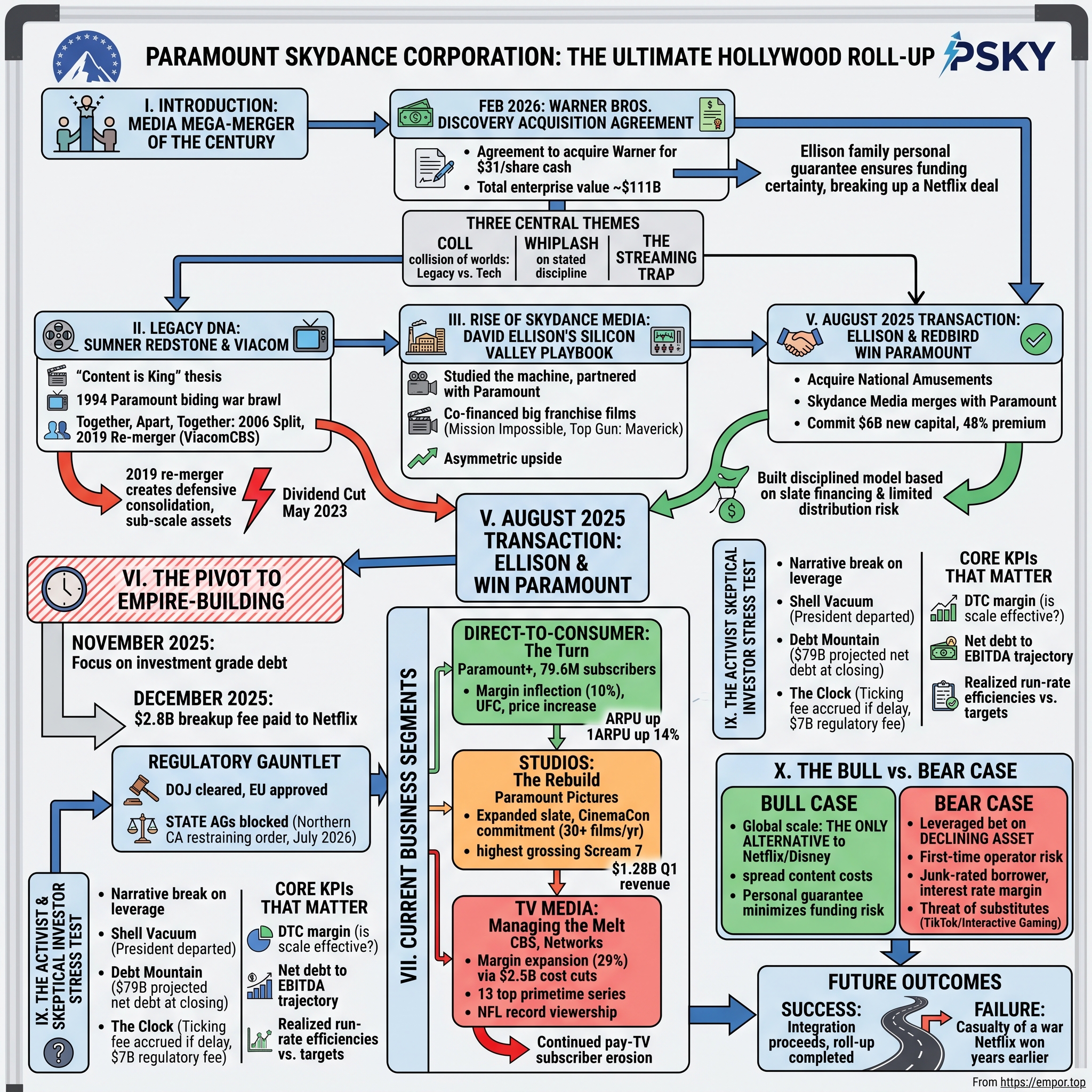
Paramount Skydance Corporation: The Ultimate Hollywood Roll-Up
I. Introduction & The Media Mega-Merger of the Century (10 Minutes)
On a Friday evening in late February 2026, lawyers in New York filed an eight-page current report with the Securities and Exchange Commission that, in the flat, unemotional prose of securities law, described one of the largest leveraged acquisitions in the history of American media. Warner Bros. Discovery, Paramount Skydance Corporation, and a shell entity charmingly named Prince Sub Inc. had entered into an Agreement and Plan of Merger. Each Warner share would convert into the right to receive thirty-one dollars in cash.1
Strip away the legalese and here is what had happened. A company that had been publicly traded for less than seven months, whose entire market capitalization was a fraction of the purchase price, had agreed to buy a business roughly its own size — and to do it entirely in cash, backed by a personal guarantee from one of the richest people alive.
The buyer was Paramount Skydance Corporation, which trades on the NASDAQ under the ticker PSKY. It came into existence on August 7, 2025, when Skydance Media and Paramount Global collapsed into a single holding company, ending the Redstone family's four-decade control of one of Hollywood's founding studios.2 The chief executive is David Ellison, son of Oracle co-founder Larry Ellison. The seller's chair on the other side of the table belonged to Warner Bros. Discovery, which had already agreed — in December 2025 — to sell its studio and streaming assets to Netflix.3
Ellison broke that deal up. Paramount Skydance went hostile, launched a cash tender offer directly to Warner shareholders, raised its price twice, and ultimately forced the Warner board to declare its bid superior. As part of the arrangement, Paramount Skydance paid the $2.8 billion termination fee that Warner owed Netflix — a sum larger than the entire equity value ascribed to Skydance Media itself in the merger that created the company.1
That single fact frames everything that follows.
Three themes run through this story.
The first is a collision of worlds. Paramount Pictures traces to the earliest years of the American film business. CBS was built by William Paley into the most-watched network in the country. Viacom was assembled by Sumner Redstone, a Boston theater operator who bet his family's fortune on the proposition that content, not distribution, was where the money lived. All of that legacy is now controlled by a family whose wealth came from selling relational database software to enterprises — and whose approach to the entertainment business is explicitly technological. On the company's first earnings call as a public entity, David Ellison told analysts that the goal was to become "the most technologically capable media company," describing an installed base that ran three separate streaming services across two different clouds with no connectivity between them.4
The second theme is the whiplash between stated discipline and actual behavior. In its shareholder letter of November 10, 2025, management listed its capital allocation priorities in order. Priority three was to "manage our balance sheet to regain and then maintain investment grade credit metrics," with a stated expectation of achieving investment-grade metrics by the end of 2027.5 On that same day's call, asked directly about industry consolidation, Ellison said "there's no must-haves for us," framing the choice as buy versus build and insisting the company could build.6 Twenty-eight days later, Paramount Skydance launched a hostile cash tender offer for Warner Bros. Discovery.7 By March 3, 2026, Fitch had downgraded the company's debt to junk.8
The third theme is the central strategic question of the streaming era. Netflix reached global scale first and turned the corner on profitability. Everyone else — Paramount, Warner, Comcast's Peacock, Lionsgate, AMC Networks — arrived late, spent heavily, and discovered that a streaming service at forty million subscribers has almost the same fixed cost base as one at two hundred million but a fraction of the revenue to spread it over. The industry's answer has been consolidation. Whether consolidation actually fixes the economics, or merely combines two sets of structural problems onto one very leveraged balance sheet, is the question this entire episode is about.
As of this writing, the answer is genuinely undetermined. The Department of Justice cleared the transaction. The European Commission cleared it with conditions. And on July 20, 2026, a federal judge in California granted a coalition of state attorneys general a temporary restraining order halting the merger while the court considers a preliminary injunction.9 Paramount Skydance shares closed recently at $7.99, near a fifty-two-week low of $7.86 against a high of $20.86.10 The market, for now, is not convinced.
To understand why the pieces fit together the way they do, the story has to start with the man who assembled them.
 Subscribe on LinkedIn
II. The Legacy DNA: Sumner Redstone, Viacom, and CBS (15 Minutes)
Sumner Redstone did not grow up in Hollywood. He grew up above a Boston linoleum store, the son of a man who sold liquor and eventually bought drive-in theaters. He went to Harvard, worked as a codebreaker on Japanese ciphers during the Second World War, practiced law, and then — reluctantly at first — joined the family business, a chain of outdoor movie screens called National Amusements.
Two things defined him. The first was physical: in 1979, trapped in a hotel fire at the Copley Plaza in Boston, he hung from a third-floor window ledge by one hand until firefighters reached him, and spent the rest of his life with a badly damaged right arm. The second was doctrinal. Redstone concluded, watching studios extract rent from his theaters, that the exhibition end of the business was the wrong end to own. The phrase he built his career around — content is king — was less a slogan than an investment thesis: whoever owns the copyright captures the economics, regardless of how the pictures reach the audience.
He acted on it. In 1987 he took control of Viacom, the television syndication business that had been spun out of CBS a generation earlier. Shari Redstone, his daughter, would later describe that moment as the origin point of everything that followed, noting that her father "had a vision that content was king and was always committed to delivering great content for all audiences around the world."11
The 1994 Bidding War
The defining episode came seven years later. Paramount Communications — the corporate descendant of Gulf & Western, holder of Paramount Pictures, Simon & Schuster, and the New York Knicks and Rangers — put itself in play. Redstone wanted it badly enough to call the pursuit an act of destiny.
He did not get it cheaply. Barry Diller, running the home-shopping network QVC and carrying a reputation as the sharpest programming mind of his generation, launched a competing bid. What followed was a months-long tender-offer brawl, fought through amended Schedule 14D-9 filings, telecom partners, and escalating cash-and-securities packages. Viacom brought in Nynex and Blockbuster as funding partners; QVC brought in BellSouth. On February 15, 1994, Paramount announced that more than 50.1% of its shares had been tendered to Viacom, and QVC terminated its offer.12
Redstone won, at a price of roughly ten billion dollars in cash and securities — a figure that required Viacom to merge with Blockbuster largely to service the resulting debt. This is the pattern worth marking, because it recurs almost exactly thirty-two years later: a controlling shareholder with absolute conviction, a competitive bidding process, a price extended well past the original offer, and a balance sheet stretched to close the gap. The strategy worked for Redstone in the 1990s because the cash flows he bought were growing. That condition is the variable that matters.
Together, Apart, Together
The corporate structure then oscillated with almost comic regularity. In 1999 Viacom agreed to acquire CBS Corporation for roughly $36 billion in stock, the largest media merger to that point, uniting the leading broadcast network with MTV, Nickelodeon, and Paramount Pictures under a single advertising sales umbrella. Six years later, Redstone concluded he had built the wrong animal. The cable networks were growing fast; the broadcast network was not; and the market was valuing the whole at the multiple of the slower half. On January 1, 2006, the company split in two — CBS Corporation under Leslie Moonves, and a new Viacom holding MTV Networks and Paramount Pictures under Tom Freston.
The logic was defensible in 2006 and catastrophic by 2016. The premise of the split was that cable was the growth asset and broadcast the melting one. Cord-cutting inverted that. Cable networks — carried in bundles, paid per subscriber per month regardless of whether anyone watched — turned out to be the fragile business, because their revenue was a function of the number of households buying a pay-TV package, and that number began falling. Broadcast, with live sports and retransmission consent fees, proved considerably more durable. Two decades later, Paramount Skydance President Jeff Shell would tell analysts that people talk about linear as one homogeneous business when the disconnect between broadcast and cable "is pretty stark and growing more stark," and that CBS was one of the cornerstone assets that attracted Skydance in the first place.6
By then the family had reversed itself again. Shari Redstone spent years pushing to reunite the two halves, over the objections of Moonves and through litigation. On August 13, 2019, Viacom entered a merger agreement with CBS at an exchange ratio of 0.59625 CBS shares per Viacom share, creating ViacomCBS, later renamed Paramount Global.13
Here is the honest assessment: the 2019 re-merger was not a strategic masterstroke. It was a defensive consolidation of two sub-scale collections of declining linear assets, executed by a controlling family with limited outside options, at precisely the moment the industry's capital requirements were about to explode. It produced a company with roughly $28 billion of revenue, a broadcast network, a film studio, a good library, a cable portfolio in structural decline, and nothing remotely resembling the balance sheet needed to fund a global streaming build.
Which is what Paramount attempted anyway — and it is why, six years later, the family sold. But before that, another Hollywood story had been quietly compounding on the other side of Los Angeles.
III. The Rise of Skydance Media: David Ellison's Silicon Valley Co-Production Playbook (20 Minutes)
David Ellison's first serious attempt at the movie business was, by conventional measures, a failure. He starred in and financed a Second World War aviation film called Flyboys, released in 2006, which cost far more than it earned. He was in his early twenties, a licensed pilot and competitive aerobatic flyer who had learned to fly before he learned the difference between a negative pickup and a gap financing facility. The reasonable prediction at that point was that he would become another rich kid who lit money on fire in Hollywood and went home.
What he did instead was study the machine.
The insight that produced Skydance Media, which Ellison founded in 2010, was that the traditional independent studio model is structurally broken. An indie studio pays to develop and produce a film, then rents distribution from a major, then waits at the back of the waterfall to be repaid. It carries full production risk with none of the distribution leverage. The majors, meanwhile, had the opposite problem: they had marketing and distribution infrastructure with enormous fixed costs but, by the early 2010s, balance sheets that could no longer comfortably absorb the volatility of a slate of $200 million tentpoles.
Skydance sat in the gap. Rather than compete with Paramount, Ellison partnered with it — co-financing roughly half the production cost of Paramount's biggest franchise pictures in exchange for a corresponding share of the upside and a producing seat at the creative table. The relationship began with a five-year co-financing arrangement signed in 2009 and was extended repeatedly over the following decade. By the time the two companies merged, Skydance described a fifteen-year history of partnering with Paramount on highly successful projects.11
Why the Structure Mattered
The financing mechanics deserve unpacking in plain terms, because they explain what kind of operator Ellison actually is.
A slate financing facility works roughly like an insurance pool. Instead of raising money film by film — where one flop can wipe out a fund — a producer raises a single pool against a defined group of upcoming pictures. Individual outcomes in film are wildly dispersed; portfolio outcomes are far more stable. Layer on top of that pre-sales of international distribution rights, where a foreign distributor commits cash in advance for the right to release the picture in its territory, and a producer can effectively convert a portion of an unmade film into a contracted receivable that a bank will lend against.
Skydance built its capital structure this way, drawing on institutional lenders and equity partners rather than the Ellison family checkbook alone. The point is not that this was novel — Legendary and others used similar structures — but that Ellison ran the model with unusual discipline and unusual luck, catching Mission: Impossible through its most commercially successful stretch, the Star Trek reboot films, the Terminator revivals, and, in 2022, Top Gun: Maverick, one of the highest-grossing pictures ever released.
The economics of that arrangement were asymmetric in Skydance's favor in one important respect. Paramount carried the distribution overhead — the marketing organization, the international offices, the physical and digital supply chain — while Skydance contributed capital and creative and captured half the equity upside. Skydance functioned, in effect, as an outsourced research-and-development and financing arm for a legacy studio that could no longer comfortably fund its own tentpoles. It is not a coincidence that when the merger closed, Paramount Pictures was releasing eight films a year and Ellison immediately committed to nearly doubling that.14
The Adjacent Bets
Two other pieces of Skydance matter for understanding the strategy, though both remain small relative to the film business.
The first is animation. Ellison hired John Lasseter — the Pixar co-founder who had departed Disney in 2018 following acknowledged workplace misconduct, a hire that drew significant public criticism at the time — to run Skydance Animation. The strategic rationale was that computer animation is the single most reliably exportable form of filmed entertainment, travels across languages with dubbing rather than subtitles, and generates the consumer-products annuities that support theme parks and merchandise. Paramount explicitly cited Skydance's in-house animation talent as a driver of expanded consumer products opportunity in the merger announcement.11
The second is games. Skydance operated two in-house game studios with console titles in the Marvel and Star Wars universes and a successful virtual-reality title in The Walking Dead franchise, plus a partnership with the NFL.11 Games are the largest entertainment category by consumer spend and the one where legacy Hollywood has been most consistently unsuccessful. Owning developer capability is optionality rather than a current earnings driver; it should be valued as such.
What all of this adds up to is a specific kind of operator: financially structured, technologically inclined, comfortable with partnership economics, and — critically — accustomed to having a well-capitalized parent standing behind him. It is a very different profile from the studio executives who preceded him. Whether it is the right profile for running a $20 billion linear television portfolio in secular decline is a genuinely open question that Section IX takes up directly.
By 2023, the partner Skydance had spent a decade financing was running out of room.
IV. The Linear Cliff and the Streaming Trap: Why Paramount Had to Sell (25 Minutes)
On May 4, 2023, Paramount Global reported first-quarter results and simultaneously announced that it was cutting its quarterly dividend by roughly 80%, to five cents a share. The stock fell 28% in a single session, closing at $16.40 and approaching a fifty-two-week low.15
Dividend cuts are informationally dense events. A board does not slash a payout that shareholders have come to depend on unless the alternative is worse. What the market read into it — correctly — was that Paramount's streaming losses were no longer being comfortably funded by its legacy cash flows, and that the company was now managing toward liquidity rather than growth. The direct-to-consumer business lost $511 million in that quarter alone.15
To understand why, it helps to describe the two machines Paramount was operating simultaneously.
The Melting Engine
The legacy business — CBS, the owned television stations, MTV, Nickelodeon, Comedy Central, BET, Showtime — generated cash through two channels. Advertising, sold against live audiences. And affiliate fees, which are the per-subscriber-per-month payments that cable and satellite operators make for the right to carry a network in their bundle.
Affiliate fees are the more important of the two, because they are the closest thing to a subscription annuity in traditional media: contracted, recurring, and high-margin. They are also mechanically tied to a single variable — the number of American households paying for a cable or satellite package. That number peaked around 2012 and has fallen every year since. Every household that cancels removes a small, permanent slice of revenue from every cable network simultaneously, and there is nothing a programmer can do about it other than negotiate rate increases that offset volume declines, which works until it does not.
The shape of the decay is visible in Paramount's recent reporting. In the first quarter of 2026, TV Media revenue fell 6% year over year, with advertising and affiliate revenue each down 6%, and management attributing the affiliate trend to continued pay-TV subscriber erosion.16 On the Q3 2025 call, Shell put it plainly: cable declines were accelerating each quarter, not just for Paramount but across the industry.6
The Streaming Trap
The second machine was Paramount+, launched in 2021 under then-CEO Bob Bakish as the company's answer to Netflix.
The strategic logic was unavoidable — if the bundle is dissolving, you must own the direct relationship with the consumer — but the economics were brutal in a way that was underappreciated at the time. A streaming service is a fixed-cost business wearing the clothes of a variable-cost one. The content slate, the technology platform, the recommendation systems, the payment infrastructure, the customer service organization: these cost roughly the same whether ten million people subscribe or two hundred million do. Netflix crossed the threshold where subscription revenue exceeded that fixed base, and its margins expanded rapidly thereafter. Paramount, arriving a decade later into a market with a dozen competitors, had to spend at near-Netflix levels on content to be considered while collecting a fraction of Netflix's revenue.
The result was years of substantial losses, funded out of the linear business. Bakish's framing on the 2023 call was that "2023 represents our peak investment year" and that the company would "return to earnings growth and positive free cash flow in 2024."15 Wall Street was unconvinced; Wells Fargo's Steven Cahall wrote at the time that Paramount was worth more as a content arms dealer or a break-up story and did not expect streaming profitability before 2027.15 Bakish was removed as CEO in 2024, replaced by an unusual three-person "Office of the CEO" arrangement — itself a signal that the board had lost confidence but not yet found a successor.
The Structure That Forced the Sale
The final constraint was not operational. It was the capital structure.
Paramount Global carried two classes of stock. Class A shares carried votes; Class B shares did not. National Amusements, the Redstone family holding company, controlled roughly 77% of the Class A voting shares while owning a far smaller share of the total economics.11 That arrangement gave Shari Redstone effective absolute control of a company in which most of the money at risk belonged to other people.
National Amusements itself carried debt, and it serviced that debt substantially with the dividends flowing up from Paramount. When Paramount cut its dividend to preserve cash, it simultaneously cut the cash flow keeping its own controlling shareholder solvent. That is a structural trap: the operating company needed to retain cash to fund a streaming transition, while the holding company needed distributions to service borrowings, and one person controlled both.
A sale became close to inevitable. But the same dual-class structure that made a sale necessary made it complicated, because any buyer had to decide whether to purchase control from the family, buy the whole company in the market, or attempt some combination — and the minority Class B holders had every reason to object to a transaction that paid a premium for votes they did not own.
That was the situation David Ellison walked into in 2024.
V. The August 2025 Transaction: How Ellison & RedBird Won Paramount (20 Minutes)
The 2024 sale process for Paramount was among the messiest in modern corporate history — a rolling, publicly litigated auction in which the seller's control block and the seller's public equity had genuinely opposed interests.
On January 2, 2024, the Paramount board formed a special committee of independent directors to evaluate strategic alternatives.11 What arrived was a parade of structurally incompatible proposals.
Skydance and RedBird Capital Partners proposed a two-step transaction: buy National Amusements from the Redstone family, then merge Skydance into Paramount. Sony Pictures and Apollo Global Management countered in May 2024 with an expression of interest in acquiring the whole company for roughly $26 billion in cash — a proposal that, on its face, treated every shareholder identically and therefore had obvious appeal to the Class B holders. Edgar Bronfman Jr., the former Warner Music and Seagram executive, assembled a competing bid for National Amusements that grew over the summer.
The Class B objection to the Skydance structure was straightforward and, in the abstract, entirely reasonable: why should the controlling family receive a separate cash payment for a holding company whose principal asset is voting power, while public shareholders receive a merger with a private film financier whose value is set by the buyer? A Sony-Apollo all-cash deal would have been cleaner for minority holders. It also carried meaningful regulatory and structural risk — Sony is a foreign acquirer, and U.S. rules restrict foreign ownership of broadcast licenses, which is precisely what CBS's owned stations are. The special committee's chair, Charles E. Phillips, Jr., framed the decision as balancing economic value against "the certainty of closing and regulatory approvals."11
The Structure
The transaction the special committee ultimately recommended, announced on July 7, 2024, had three moving parts.
First, the Skydance investor group — entities controlled by the Ellison family together with RedBird — agreed to acquire National Amusements outright for $2.4 billion on a cash-free, debt-free basis, taking the voting block off the table.11
Second, Skydance Media merged into Paramount in an all-stock transaction that valued Skydance at $4.75 billion, with Skydance's existing holders receiving 317 million newly issued Class B shares priced at $15 each.11
Third — and this is the part that made the deal palatable to public shareholders — the investor group committed up to $6 billion of new capital. Of that, $4.5 billion was made available to Paramount's public holders through an election: Class A holders other than National Amusements could take $23 per share in cash or convert at a fixed ratio into new Class B stock; Class B holders could take $15 per share in cash or roll into the new company, subject to proration if cash elections exceeded $4.3 billion. The remaining $1.5 billion went directly onto the balance sheet as primary capital to pay down debt and recapitalize the business.11
The cash election represented a 48% premium to the Class B price as of July 1, 2024, and a 28% premium to Class A.11 The agreement included a forty-five-day go-shop period during which the special committee could actively solicit superior proposals.11 None emerged that the committee preferred.
What the Structure Actually Says
Read carefully, the deal was a control transaction dressed as a recapitalization. Post-close, the Skydance investor group held all of the Class A stock and roughly 70% of total equity, with public Class B holders retaining approximately 30%.11 David Ellison became Chairman and CEO; Jeff Shell, chairman of RedBird Sports & Media and former CEO of NBCUniversal, became President.11
For public shareholders, the honest characterization is that the deal converted a distressed, controlled, sub-scale media company into a recapitalized, still-controlled, still-sub-scale media company with a better balance sheet and a new management team, at a premium to a depressed share price. That is neither a windfall nor a robbery. It is a workout.
The Regulatory Overhang
One episode from the closing process deserves attention because it bears directly on how this management team's independence should be assessed.
Because Paramount owned CBS's broadcast licenses, the transaction required Federal Communications Commission approval. During that review period, Paramount settled a lawsuit brought by President Donald Trump over a 60 Minutes interview with Kamala Harris, agreeing on July 1, 2025 to pay $16 million toward a future presidential library and plaintiffs' costs, without an apology, and to release transcripts of future presidential-candidate interviews subject to redactions.[^17] Paramount maintained that the suit "was completely without merit."[^17] The FCC approved the Skydance transaction later that month.
Then, in September 2025, the company hired Makan Delrahim as Chief Legal Officer, effective October 6. Delrahim had served as Assistant Attorney General for the Antitrust Division during Trump's first term, had advised Skydance on the Paramount acquisition while at Latham & Watkins, and — in a detail with real historical resonance — had led the effort to terminate the Paramount Consent Decrees, the antitrust settlements that had governed studio-theater relations since 1948.17
Investors can read that sequence more than one way. The generous reading is that a company facing an unprecedented volume of regulatory review hired the most qualified available regulatory lawyer. The skeptical reading is that a controlled company with a politically exposed news division settled a weak claim while its license transfer sat pending, then staffed its legal function with a politically connected former enforcer. Both readings are compatible with the facts. What is not in dispute is that regulatory relationship management became a core competency of this company before it had reported a single quarter as a public entity.
Trading in Paramount Skydance Class B common stock began on the NASDAQ under the ticker PSKY on August 7, 2025.2 The new management team had promised a transformation, cost discipline, and a path back to investment-grade credit metrics.
They had roughly four months before they threw the plan out.
VI. The Pivot to Empire-Building: The $111B Warner Bros. Discovery Acquisition (30 Minutes)
The sequence of events between November 10 and December 8, 2025 is the single most important stretch in this company's short public life, and it is worth laying out day by day.
On November 10, Paramount Skydance reported its first quarterly results as a public company. The shareholder letter set 2026 guidance of $30 billion of revenue, raised the run-rate efficiency target from $2 billion to at least $3 billion, and listed capital allocation priorities that ended with returning excess cash to shareholders "once we reach investment grade credit metrics."5 On the call, Ellison told Morgan Stanley's Ben Swinburne that there were "no must-haves," and interim CFO Andy Warren said the goal was to get all three rating agencies to rate the company investment grade.6
On December 5, Netflix and Warner Bros. Discovery announced a definitive agreement. Netflix would acquire Warner Bros. — the studios, HBO, and HBO Max — for $27.75 per WBD share in cash and stock, an enterprise value of roughly $82.7 billion, to close after Warner separated its Global Linear Networks business into a new public company called Discovery Global.3
On December 8 — three days later — Paramount Skydance announced a cash tender offer for all outstanding Warner Bros. Discovery shares at $30.00 each, going directly to shareholders over the objection of the board.2
The Escalation
What followed was a two-and-a-half-month campaign that reads like a compressed replay of the 1994 Paramount fight, with the same essential dynamic — a determined bidder converting balance-sheet certainty into negotiating leverage.
On December 22, Paramount amended the offer to include an irrevocable personal guarantee from Lawrence Ellison covering the equity financing and any damages payable.2 On January 22, 2026, it filed preliminary proxy materials soliciting Warner shareholders to vote against the Netflix transaction — a classic pincer, combining a tender offer with a vote-no campaign.2 On February 10, it added a ticking fee: $0.25 per Warner share per quarter for every quarter the deal failed to close beyond year-end 2026, plus prepayment of the $2.8 billion Netflix break fee.2
On February 24, Paramount submitted a revised proposal at $31.00 per share, accelerated the ticking fee to begin after September 30, 2026, and raised the reverse termination fee it would owe Warner if the deal died on regulatory grounds to $7.0 billion.2 That day the Warner board determined the proposal could reasonably be expected to lead to a superior proposal. On February 26, Netflix declined to improve its offer. On February 27, the merger agreement was signed.1
The final terms tell you exactly where the negotiating pressure sat. Warner shareholders receive $31.00 in cash. If closing slips past September 30, 2026, they accrue additional consideration of $0.00277778 per share per calendar day, capped at $0.25 per ninety-day period.1 If Warner walks to a superior proposal, it owes Paramount $3.0 billion. If the deal dies because a regulator blocks it, Paramount owes Warner $7.0 billion.1 The outside date is March 4, 2027, extendable once to June 4, 2027 if only regulatory conditions remain.1
That $7 billion reverse termination fee is the number a skeptical investor should sit with. It is not a rounding error; it approaches the entire equity market value of Paramount Skydance at recent prices.10 The Warner board extracted it because it was trading away a fully financed Netflix agreement for a bid facing far heavier antitrust risk, and it priced that risk explicitly.
How It Gets Paid For
The financing is where the Ellison family's involvement stops being a background fact and becomes the entire architecture of the transaction.
On the debt side, Paramount entered a commitment letter with Bank of America, Citigroup, and Apollo providing a $54.0 billion 364-day senior secured bridge term loan facility plus $3.5 billion of commitments under a 364-day senior secured revolving facility — $57.5 billion of committed debt.1 A bridge loan of this type is exactly what the name suggests: expensive, short-dated money whose purpose is to guarantee the seller that cash will be there on closing day, with the expectation that it will be refinanced into permanent capital as soon as markets allow.
On the equity side, the Lawrence J. Ellison Revocable Trust and RedBird Capital Partners Fund IV entered subscription agreements for a private placement of up to $46.72 billion from the Trust and $250 million from RedBird.1
And then there is the guarantee. Concurrently with the merger agreement, Larry Ellison personally and the Trust jointly and severally guaranteed the Netflix termination fee, a contingent bondholder payment, $45.72 billion of the merger consideration, all damages payable for breach, and the $7 billion regulatory termination fee.1 The guarantee also obligates the Ellison parties to use reasonable best efforts to obtain regulatory approvals and to defend through litigation on the merits, including through appeal, any claim seeking to block the transaction — while carving out Oracle Corporation and the Ellison Institute of Technology from the covenant restrictions.1
That last provision is unusual and revealing. The Warner board did not merely want a rich guarantor; it wanted a contractual commitment that the guarantor would fight, at his own expense, all the way through the appellate courts. In effect, Warner converted the antitrust risk of dealing with a levered strategic buyer into a personal obligation of one individual.
This is the mechanism by which Paramount Skydance beat Netflix. It did not have more money. It had a wealthier person willing to sign a document making the money unconditional. In auction dynamics, certainty of funds is frequently worth more than headline price, and the Warner board effectively confirmed that by taking a bid with materially worse regulatory odds.
The Regulatory Gauntlet
The consummation of the merger is not subject to a financing condition.1 It is very much subject to regulatory conditions, and this is where the story currently sits.
The Department of Justice's Antitrust Division closed its investigation on June 12, 2026, after an eight-month review that examined more than two million documents, concluding the transaction would "increase competition across the media and entertainment ecosystem."18 Internationally, South Korea's Fair Trade Commission cleared the deal unconditionally on July 10; the European Commission cleared it unconditionally under the Foreign Subsidies Regulation on July 14; and on July 22 the Commission approved the merger under the EU Merger Regulation following a Phase 1 review, subject to commitments — principally the unwinding of Paramount's long-standing European film distribution arrangement with Universal Pictures, which regulators concluded would otherwise concentrate the theatrical distribution of three major studios' output under common arrangements.19
Then, on July 13, 2026, California Attorney General Rob Bonta led a coalition of twelve state attorneys general — Arizona, Colorado, Connecticut, Massachusetts, Minnesota, Nevada, New Jersey, New Mexico, New York, Oregon, and Washington joined California — in filing suit in the U.S. District Court for the Northern District of California to block the merger under Section 7 of the Clayton Act.20 Their complaint alleges harm in three markets: wide-release theatrical film distribution, where they calculate a combined 27% share and argue three distributors would control 75% post-merger; the distribution of anticipated top-grossing films, where they put the combined share above 30%; and basic cable channel licensing, where they again calculate 27% combined.20
On July 20, the court granted the states a temporary restraining order halting the merger pending consideration of a preliminary injunction.9
So the position as of late July 2026 is this: federal antitrust cleared, European antitrust cleared with a distribution remedy, and a U.S. federal court order currently blocking closing at the request of state enforcers. Management has continued to target closing by the end of the third quarter of 2026.16 The ticking fee begins accruing on October 1.
The tension between those two facts is the live question in this stock.
VII. Current Business Segments & Post-Merger Economics (25 Minutes)
Set the deal aside for a moment. There is an actual operating company here, and in its first three quarters as a public entity it has performed better than most skeptics expected.
Beginning with the first quarter of 2026, Paramount Skydance reorganized its reporting into three segments — Direct-to-Consumer, Studios, and TV Media — moving all production and intellectual property into Studios and shifting previously allocated central costs into corporate overhead. It also replaced adjusted OIBDA with adjusted EBITDA as its primary segment profit measure, the difference being that adjusted EBITDA excludes stock-based compensation, which the company expects to run around $300 million for 2026.21 Investors comparing across periods need to hold both changes in mind; they are legitimate but they do flatter optics modestly.
TV Media: Managing the Melt
TV Media generated $3.67 billion of revenue in the first quarter of 2026, down 6%, with segment adjusted EBITDA of $1.1 billion at a 29% margin — up from 24% a year earlier.16
That margin expansion, against a 6% revenue decline, is the most operationally impressive number the new management team has produced. It demonstrates something concrete: cost reduction is running faster than revenue erosion. In a melting-ice-cube business, that is the only lever that matters, because the revenue line is largely exogenous.
There is genuine programming strength underneath it. CBS held 13 of the top 20 primetime series in the first quarter, including all four top new shows — Marshals, Sheriff Country, CIA, and Boston Blue — which the company noted no broadcast network had achieved since the early 1990s.16 The 2025 NFL season on CBS was its most-watched on record, with the Thanksgiving Chiefs-Cowboys game averaging more than 57 million viewers.21 And CBS content functions as a top-of-funnel for streaming: new series Marshals, Sheriff Country, and CIA generated roughly 40% of their audience on Paramount+.16
The caution is that broadcast strength does not arrest the cable decline. Nickelodeon, MTV, Comedy Central, and BET remain exposed to the same shrinking pay-TV base described earlier. Management has explicitly ruled out spinning them off, with Shell noting on the Q3 2025 call that "this company has a history of spinning assets and it hasn't gone very well for us."6 That is a defensible read of the 2006 precedent, but it also means the decline stays consolidated inside the reported numbers indefinitely.
Direct-to-Consumer: The Turn
The DTC segment is where the investment case either works or does not, and here the trajectory has genuinely inflected.
First-quarter 2026 DTC revenue reached $2.4 billion, up 11%, with Paramount+ revenue up 17%. Segment adjusted EBITDA came in at $251 million — a 10% margin — against a $4 million loss in the comparable prior period.16 Paramount+ finished the quarter with 79.6 million paid subscribers.16
The composition of that growth is more interesting than the headline. Paramount+ revenue growth of 17% broke down as 14% ARPU growth and 2% subscriber growth, driven by a January price increase across the Essential and Premium tiers in the U.S., Canada, Australia and Latin America — the first since August 2024.16 Reported net additions were only about 700,000, because the company deliberately exited more than a million international "hard bundle" subscribers whose average revenue, CFO Dennis Cinelli told analysts, was under a dollar a month.22 Underlying additions were closer to two million.16
That is a meaningful signal about management priorities. Purging low-value subscribers depresses the headline metric the market historically rewarded in order to improve the metric that actually produces cash. Management has guided to roughly 2 million further hard-bundle exits in the second quarter and only modestly higher total subscribers for the full year.16 Whether investors give credit for that discipline is a separate question from whether it is the right decision.
The sports strategy is the other lever. Paramount launched a seven-year, $7.7 billion UFC partnership in January 2026, becoming the exclusive U.S. home for numbered events and Fight Nights.23 Early results have been strong on the company's own disclosure: more than 10 million households watching over 100 million hours, viewership more than fifteen times the average pay-per-view event of the prior two years, and — the number that matters most — new UFC subscribers averaging fifteen years younger than the typical Paramount+ viewer.16 Shell's framing on the Q3 call captured the strategic logic precisely: Paramount had "a real desert of sports" between the Masters in April and the NFL in September, and watched subscribers churn out and back every summer.6 A year-round, event-driven property with a young male audience is close to a perfect complement to a CBS entertainment slate that skews older and female.
The honest caveat: one quarter of a seven-year, $7.7 billion commitment is not proof of return. The disclosed engagement metrics are company-selected and unaudited, and the true test is whether summer churn actually falls in 2026 and 2027.
Management also expects DTC margin pressure in the second half as the content slate launches.22
Studios: The Rebuild
Studios revenue was $1.28 billion in the first quarter, up 11%, with adjusted EBITDA of $164 million against $82 million a year earlier, helped by licensing deals and by Scream 7, which passed $200 million globally to become the highest-grossing entry in that thirty-year franchise.16
The strategic reset here is volume. Paramount released eight films in 2025; it has fifteen dated for 2026, and at CinemaCon in April 2026 the company committed to theater owners that the combined Paramount and Warner Bros. entity would release a minimum of thirty films annually, each with a full theatrical release and a minimum forty-five-day exclusive window.16
That commitment is strategically substantive and worth dwelling on. Netflix has spent a decade arguing that theatrical windows are a legacy tax on consumer convenience. Paramount Skydance is arguing the opposite — that theatrical release is the marketing engine that makes a film valuable everywhere downstream, and that a forty-five-day window is what makes exhibitors willing to invest in screens. It is also, not incidentally, the single most effective argument available to Paramount in front of antitrust enforcers and state attorneys general who are being told this merger will reduce the number of movies made.
The near-term financial reality is less exciting: management continues to expect significantly lower theatrical revenue in 2026 than 2025, because average box office per film falls as the slate expands and because 2025 included Mission: Impossible – The Final Reckoning.16 The Q4 2025 Filmed Entertainment result — negative $119 million of segment adjusted OIBDA — was described by management, unusually candidly, as performance that "did not meet our expectations."21
The Pro Forma Baseline
Aggregating the disclosed predecessor and successor periods, Paramount's 2025 adjusted OIBDA came to roughly $3.1 billion.21 For 2026, the company has guided to $30 billion of revenue and $3.8 billion of adjusted EBITDA, a 12.7% margin, reaffirmed after the first quarter.16
This is where the credibility ledger gets interesting. When the Skydance transaction was announced in 2024, the investor materials projected roughly $3.4 billion for 2025 and $4.1 billion for 2026 — figures LightShed's Rich Greenfield raised directly on the Q3 2025 call.6 The guided numbers came down. Warren's explanation was that the company was investing more in content than originally contemplated, including UFC and South Park, and Ellison framed it as a deliberate trade of near-term profit for long-term value.6
Two readings are available. One: this is a management team willing to cut near-term guidance to fund a genuine competitive position, which is what long-term owners should want. Two: the projections used to justify a control transaction were optimistic and were quietly reset within fifteen months. The evidence supports both. What can be said definitively is that management raised its efficiency target twice — from $2 billion to at least $3 billion through 2027, with more than $2.5 billion of run-rate savings expected by the end of 2026 — and reported concrete progress against it, including cloud partnerships saving over $50 million annually and a company-wide migration to Oracle Fusion as its ERP platform.2116
Then there is what arrives on top. Warner Bros. Discovery generated $37.3 billion of revenue in 2025 with $8.7 billion of adjusted EBITDA, 131.6 million streaming subscribers, $3.1 billion of free cash flow, and $29.0 billion of net debt at 3.3x leverage.24 Combining them creates a company with roughly $67 billion of revenue and, by David Ellison's own description on the Q1 call, more than 200 million direct-to-consumer subscribers across more than 100 countries.22
Scale, at last. The question is what scale is actually worth.
VIII. Strategic Position: Helmer's 7 Powers & Porter's 5 Forces (20 Minutes)
Hamilton Helmer's framework is useful here precisely because it forces a distinction that media companies habitually blur: the difference between owning valuable assets and owning a durable competitive advantage. A gold mine is valuable. It is not a moat. The question is not whether Paramount Skydance will own extraordinary intellectual property — it will — but whether that ownership produces returns competitors cannot compete away.
Cornered Resource: Strong, With a Caveat
This is the company's genuine power. Post-close, Paramount Skydance would control the DC Universe, the Wizarding World, Westeros, Looney Tunes, Star Trek, Mission: Impossible, Top Gun, Yellowstone, and the Paramount and Warner Bros. libraries — a set that Ellison enumerated explicitly when describing the strategic case.22 Franchise intellectual property is a genuine cornered resource: it cannot be replicated, it does not depreciate on a normal schedule, and consumer familiarity compounds across generations.
The caveat is that a cornered resource only generates excess returns if the owner monetizes it better than an alternative owner would. Warner spent a decade demonstrating that owning DC and Harry Potter does not automatically produce Marvel-scale economics. Execution is the binding constraint, and execution is not a Helmer power.
There is also a live evidentiary test underway. Paramount's own Q4 2025 letter described issuing a prompt cease-and-desist to prevent its intellectual property being used in content generated by an AI video model.21 Generative video raises a real question about whether "we own the characters" remains as economically defensive in a decade as it is today. The company's position — that it is an ardent defender of IP rights while simultaneously deploying AI internally — is coherent, but it is a position, not a settled outcome.
Scale Economies: Improving, Unproven
The scale argument is the merger's core justification. Combining Paramount+ and HBO Max spreads content and technology costs across a subscriber base of a size that can plausibly amortize them.
The mechanism is real. But the evidence that scale converts to margin in streaming is more mixed than the pitch suggests. Netflix's advantage was never subscriber count alone; it was subscriber count achieved with a single global platform, a single content strategy, and no legacy linear business cannibalizing itself. Paramount Skydance would arrive at scale by bolting together two companies that each ran multiple stacks. The company has been candid that it is only now converging Paramount+, Pluto TV, and BET+ onto one platform, targeted for a mid-2026 launch — and that this convergence merely "gets us to the starting line of becoming best-in-class," in Ellison's own phrasing.22
Integration risk here is not theoretical. It is the second full platform integration in two years, and Bank of America's Jessica Reif Cohen asked exactly that question on the Q1 call — how management thinks about allocating capital and attention while integrating for the second time in twenty-four months. Ellison's answer described strategic benefits and did not directly address the capital-and-attention allocation question.22
Counter-Positioning: Weak
Counter-positioning requires a business model an incumbent cannot copy without damaging itself. Paramount Skydance is the incumbent. It carries broadcast affiliate relationships, cable carriage agreements, theatrical windows, and union commitments that a pure digital operator does not. Its forty-five-day window commitment is arguably anti-counter-positioning: a deliberate reinforcement of the legacy model.
That is not automatically wrong. But investors should not confuse strategic conviction with structural advantage.
Branding and Process: Partial
CBS holds a durable branding power in broadcast — the most-watched network for many consecutive seasons, with a daytime franchise in its fortieth straight season lead.16 HBO holds one of the few genuine premium quality signals in television. Those are real. Neither has historically translated into pricing power at the streaming subscription level, where consumers compare monthly prices across near-identical grids.
The Five Forces
Rivalry is intense and asymmetric. The competitive set includes Netflix and Disney, which reached scale first, and Apple, Amazon, and Alphabet, for whom video is a customer-acquisition line item rather than a profit center. That asymmetry is the defining feature of this industry: a company whose streaming service must earn its cost of capital competes against companies for which the service is a loss leader for devices, commerce, or advertising. YouTube alone commands more U.S. television viewing time than any traditional network.
Buyer power is high on both sides. Consumers face essentially zero switching costs. Paramount's own experience with the January price increase and the deliberate hard-bundle exit illustrates the tension — every price action is a churn test. On the distribution side, pay-TV operators facing their own subscriber declines negotiate carriage from a position of increasing leverage, which is why affiliate revenue falls even when rates rise.
Supplier power is elevated and rising. Top creative talent is genuinely scarce. Paramount's response has been to sign first-look deals with Jon M. Chu, Issa Rae, Dan Trachtenberg, and the Duffer Brothers, plus overall deals with the creators of Yellowjackets.21 Every one of those is a bidding war against Netflix and Apple. Sports rights are the same dynamic at ten times the scale — the UFC deal is a supplier-power story as much as a subscriber-acquisition story.
Threat of substitutes is the most underrated risk in the model. The competitor for the marginal hour of attention among viewers under thirty is not HBO Max. It is TikTok, YouTube Shorts, Twitch, and interactive gaming. Paramount's answer has been to launch short-form vertical clips inside the Paramount+ app, which Cinelli described on the Q1 call as a beta test with encouraging early metrics.22 Honest framing: this is a defensive experiment by a premium video company against platforms with a decade of head start and vastly superior recommendation infrastructure.
Threat of new entry into premium video is low. The capital requirements are prohibitive. That is the one force genuinely working in the company's favor — and it is precisely why consolidation, rather than new competition, is the industry's current mode.
Net assessment: this is a business with strong assets, improving operating discipline, one genuine power, and a competitive environment where the strongest players are not trying to make money the same way. Whether that combination is worth the price being paid for it is a question about the balance sheet — and about whether management's word can be relied upon.
IX. The Activist & Skeptical Investor Stress Test: Management Credibility, Jeff Shell's Departure, and the Debt Mountain (20 Minutes)
Here is the exercise. Imagine a skeptical fund manager who bought PSKY Class B stock in the weeks after the listing, on the thesis that a new, incentivized owner-operator would cut costs, fix the studio, and delever a broken balance sheet. What has that investor actually received?
The Narrative Break
The first charge is the most serious, and it is documented in the company's own filings rather than inferred.
The November 10, 2025 shareholder letter set out medium-term financial goals that concluded with "managing our balance sheet to quickly regain investment grade debt metrics," reported $3.3 billion of cash against $13.6 billion of gross debt, and stated an expectation of achieving investment-grade metrics by the end of 2027.5 The capital allocation section ranked M&A second — "consider M&A where it accelerates our path towards achieving our North Star" — and balance-sheet management third.5
Twenty-eight days later the company launched a hostile all-cash tender offer for a target with $29.0 billion of its own net debt.242 By March 3, 2026, Fitch had downgraded Paramount Skydance's issuer default rating and senior unsecured debt to junk and placed the ratings on Rating Watch Negative, citing materially elevated leverage, competitive pressure, and free cash flow headwinds from transformation costs; Fitch projected leverage of roughly eight times at closing, improving toward four times within three years, with net debt at closing of $79 billion.8 S&P placed the company on CreditWatch negative while affirming BB+, warning that the purchase would push leverage well above its 4.25x downgrade threshold, and noting adjusted leverage of 4.8x as of December 31, 2025.25
Management's defense is available in the filings: the November letter did explicitly reserve the right to pursue M&A that accelerated the strategy, and Ellison's "no must-haves" formulation was carefully hedged with a reference to being "opportunistic." A fair reading is that management did not lie. A fair reading is also that a company which tells investors in November that its balance-sheet objective is investment grade by 2027, and in December bids for a target that will put it at eight times leverage, has changed strategy in a way that materially alters the investment case — and did so without a dedicated investor communication explaining the reversal.
The behavior on the Q1 2026 call compounds this. Investor Relations opened the Q&A by stating the company would not take questions on the transaction beyond what was in the shareholder letter.26 When Reif Cohen asked about integration capacity, and when Ellison responded with strategic rationale, he closed with "with respect, we need to stay away from further WBD specifics and focus on the company we are operating today."22 For the largest capital allocation decision in the company's history, in the middle of a regulatory fight, that is a defensible legal posture and a poor disclosure posture. Activists notice.
The Shell Vacuum
The second charge is governance and key-person risk.
Jeff Shell was not decorative. He was the operator — a former NBCUniversal CEO brought in to run day-to-day operations, named President in the original transaction announcement alongside Ellison as Chairman and CEO.11 On the Q3 2025 call he handled the substantive questions on linear strategy, agency partnerships, and international distribution.6 He was, in the division of labor Skydance presented to the market, the person who had actually run a large legacy television portfolio.
On April 8, 2026, Paramount Skydance and Paramount Global entered a separation agreement under which Shell ceased to serve as an employee and as a director, effective immediately, with severance equal to one year of salary and target bonus, twelve months of accelerated vesting on his August 7, 2025 restricted stock unit grant, and subsidized health coverage.27
The trigger was a $150 million lawsuit filed in Los Angeles Superior Court by the professional gambler R.J. Cipriani, alleging Shell had failed to deliver on a promised television project in exchange for public-relations services and, more consequentially, that Shell had shared material nonpublic information about Paramount's business — including the Warner bid and the UFC contract.23 The Paramount board conducted what it described as a complete and thorough review and concluded the allegations did not establish a securities law violation; Shell denied any business agreement and called the suit a shakedown, and elected to transition out to focus on the litigation.23 It was Shell's second departure under controversy from a major media company in three years.23
Take the board's conclusion at face value — that no securities violation occurred. The investment problem is unchanged. The company lost its chief operating executive after eight months, at the precise moment it needed operating bandwidth most, and it has not named a replacement President. The Q1 call was conducted by Ellison, CFO Dennis Cinelli, and Chief Strategy and Operating Officer Andrew Gordon.22 Note also that Cinelli is himself new — the Q3 2025 call was run by an interim CFO.6 A company preparing to absorb $37 billion of revenue has changed its CFO and lost its President inside twelve months.
David Ellison is a talented film producer and, on the evidence of three quarters, a competent cost manager. He has never run a broadcast network portfolio, a global cable business, or a news division through a secular decline. That is not a character judgment; it is a stated gap in the management bench at a company about to attempt one of the largest integrations in media history.
The Debt Mountain and the Clock
The third charge is arithmetic.
The refinancing work has been genuinely well executed, and credit should be given where earned. In April 2026 the company assigned a portion of the equity commitment to strategic investors, replaced the planned rights offering with a dividend of one ten-year warrant per Class B share exercisable at the syndication price, secured $10 billion of permanent financing consisting of $5 billion in term loans and a $5 billion revolving facility secured against the combined company's assets, and syndicated the remaining $49 billion of bridge to 18 global financial institutions, with the intention of replacing it with secured investment-grade and high-yield debt before closing.1627 Warner shareholders approved the merger on April 23.16
But note what else the April restructuring did: the PIPE subscription price was changed from a fixed $16.02 per share to a market-referenced price at closing, floored at $12.00 and capped at $16.02.16 With the stock recently near $7.99, the Trust would be subscribing at a substantial premium to market — favorable to existing holders on price, but the dilution is enormous in absolute terms. Roughly $47 billion of new equity against a company with approximately 1.12 billion shares outstanding and a market capitalization near $8.9 billion is not a capital raise; it is a reconstitution of the shareholder base, in which existing public Class B holders become a small minority alongside a controlling family that becomes overwhelmingly dominant.10 The warrant dividend is management's attempt to hand existing holders some of that value back. Whether it is adequate compensation is a judgment each holder has to make.
Then the clock. The ticking consideration begins accruing October 1, 2026, and the court in San Francisco has the merger frozen. Every day of delay adds cash consideration owed to Warner shareholders, and adds carrying cost on a bridge facility. The $7 billion regulatory termination fee sits behind that, and behind it stands a personal guarantee whose covenants require litigating through appeal.1 Paramount has one further specific obligation worth flagging as a hidden liability: if certain Warner senior notes require an exchange offer, Paramount may owe up to $1.528 billion in lieu.1
An activist's summary would read something like this: a controlled company, with a controlling shareholder whose personal balance sheet is the deal's financing, pivoted from a stated deleveraging plan to an eight-times-levered acquisition within a month of publishing that plan; lost its President; declined to take analyst questions on the transaction; and is now litigating against twelve state attorneys general with a per-day fee accruing. Every one of those is an observable fact rather than an interpretation.
The counter-argument is equally observable: the operating business is delivering, margins are expanding, streaming turned profitable, the efficiency target went up rather than down, and the financing has been executed with real skill. Both things are true at once, which is exactly what makes this situation hard.
X. The Bull vs. Bear Case, Core KPIs, and Material Risk Radar (20 Minutes)
The Bull Case
The bull case starts from an uncomfortable premise: the middle of the media industry is uninhabitable, and everyone in it must either reach scale or be sold.
If that premise holds, then the combination of Paramount and Warner produces the only asset base in the world outside Disney and Netflix capable of standing at global scale across theatrical, broadcast, cable, and streaming simultaneously. More than 200 million direct-to-consumer subscribers across 100-plus countries, thirty theatrical releases a year, a linear presence in over 200 countries, and a library spanning nearly the entire history of American popular culture.22 Nobody else can assemble that set, because nobody else can buy the pieces — the pieces are gone after this.
The financial argument is that fixed costs collapse. Two streaming platforms become one technology stack, one billing system, one recommendation engine, one marketing organization. Two studios share one international distribution footprint. Two corporate centers become one. Paramount has already demonstrated it can extract savings on the standalone business — the run-rate efficiency target was raised from $2 billion to over $3 billion, with more than $2.5 billion expected in run-rate by the end of 2026 — and the Warner integration offers a substantially larger cost base to work against.16
The financing argument is that liquidity risk is genuinely mitigated in a way no other levered media buyer has ever managed. When a company borrows $54 billion in a bridge facility, the normal question is what happens if credit markets close before refinancing. Here, a substantial portion of the purchase price is funded by a personal equity commitment guaranteed by an individual, not by market access.1 That does not eliminate leverage risk. It does meaningfully reduce refinancing risk, and it is the reason the Warner board chose this bid over a fully financed Netflix agreement.
And there is a real operating proof point underneath: DTC turned profitable, TV Media margins expanded through a 6% revenue decline, and Studios profitability roughly doubled — all in the same quarter.16
The Bear Case
The bear case is that this is a leveraged bet on a declining asset, made by a first-time operator, at the top of a consolidation cycle.
Start with the arithmetic. Fitch's estimate of roughly eight times leverage at closing against Warner's $37.3 billion revenue base and Paramount's $30 billion is a structure that requires the combined cash flows to be stable while debt is repaid.824 But a large share of those cash flows come from linear television, whose revenue is declining by mid-to-high single digits annually with no identified floor. The company is financing a long-dated debt structure with a shortening-dated cash stream. Cost cuts can offset that for a while — Paramount has proven this for three quarters — but cost cuts are a finite resource and revenue decline is not.
Add cost of capital. This is now a junk-rated borrower.8 Every hundred basis points on $57 billion of committed financing is $570 million of annual pre-tax cash, against a company guiding to $3.8 billion of adjusted EBITDA before Warner consolidates.16 The margin for error on interest rates alone is thin.
Add execution. The company is attempting a second platform convergence in two years, migrating to a new ERP, absorbing a company larger than itself, and doing all of it without a President.27
Add regulation. The states' complaint is not frivolous — a 27% share of wide-release theatrical distribution, in a market where post-merger three distributors would hold 75%, is exactly the kind of structural concentration Section 7 was written for.20 The DOJ's contrary conclusion is a real asset, but state enforcers are not bound by it, and a temporary restraining order has already issued.9
And add the asymmetry that a skeptic would emphasize most: if the deal closes, shareholders own a heavily levered company at the start of a hard integration. If the deal is blocked, the company owes $7 billion — though guaranteed by the Ellison parties rather than payable from operating cash flow.1 Neither branch is obviously the good one for a public Class B holder.
Myth Versus Reality
Myth: This is a Netflix-killer. Reality: at more than 200 million subscribers the combined entity would approach Netflix's scale in count, but Netflix's advantage was never the count — it was a single global platform built from scratch with no linear business to defend and no theatrical window to honor. Paramount Skydance would arrive with all three legacy commitments intact, by design.
Myth: Larry Ellison's guarantee eliminates the risk. Reality: the guarantee eliminates funding risk on the equity commitment and the break fees. It does not eliminate leverage risk on $54 billion of bridge debt, integration risk, regulatory risk, or the risk that the acquired cash flows decline faster than modeled. It converts one category of risk to near-zero and leaves the others untouched.
Myth: The synergies are the point. Reality: the synergies are real and management has a track record of raising rather than missing its efficiency targets. But a company does not pay a premium of this magnitude for cost savings alone. The bet is that scale changes the competitive position, and that claim remains unproven at any streaming company other than Netflix.
Myth: Cable is already fully discounted. Reality: management has explicitly declined to separate the cable networks, meaning the decline remains inside consolidated results indefinitely.6 Investors buying the streaming story are also buying the melt.
The KPIs That Matter
Three numbers, tracked over time, will tell the story more reliably than any narrative.
First, combined direct-to-consumer segment adjusted EBITDA and its margin. This is the single cleanest test of whether scale actually produces economics. Paramount's standalone DTC segment reached a 10% margin in the first quarter of 2026.16 The question after Warner consolidates is whether the merged platform sustains and expands that as content spending rises and integration costs land, or whether combining two sub-scale services simply produces a larger sub-scale service. Watch the margin, not the subscriber count — management has already demonstrated it will trade subscribers for revenue quality.
Second, net debt to adjusted EBITDA. Fitch's published expectation is roughly eight times at closing improving toward four times within three years.8 That trajectory is the entire deleveraging thesis in one number. If it flattens — because EBITDA disappoints, because linear declines steepen, or because integration costs run long — the equity is where the pain lands first, given how far down the capital structure it sits after a $47 billion equity issuance.
Third, realized run-rate efficiencies against the stated target. Management has committed to more than $2.5 billion of run-rate savings by the end of 2026 and at least $3 billion through 2027 on the standalone business, with additional Warner integration savings to be disclosed.16 This is the one KPI where the current team has a genuine track record — they raised the target and reported progress against it. Whether that discipline survives contact with a company of Warner's size is the test.
The Risk Radar
Beyond the leverage and regulatory issues already covered, three exposures are worth flagging on mechanism rather than as a checklist.
Technology disruption. Generative video models threaten the cost structure of content production in a way that could be either a large margin opportunity or a direct assault on the value of a library. Paramount is playing both sides — deploying AI internally, with roughly 80% of its engineering organization using code-assist tools, while issuing cease-and-desist letters against models generating content with its characters.1621 That posture is coherent today. It may not be sustainable.
Political and editorial exposure. Owning CBS News, and prospectively CNN, in an environment where a broadcast license transfer was pending during a presidential lawsuit settlement, creates a governance risk that most media investors have historically ignored.[^17] It is now a live consideration.
Accounting judgment. The merger established a new accounting basis for content assets, and management has repeatedly disclosed that reductions in content assets produce a content expense benefit flowing through DTC results — a benefit that Cinelli confirmed steps down next year.1622 This is properly disclosed and entirely legitimate, but it means reported DTC profitability is flattered relative to underlying cash economics, and comparisons across the transaction boundary require care. Investors modeling the DTC turn should be asking how much of the margin improvement is cash and how much is basis.
XI. Playbook & Key Investing Lessons (15 Minutes)
Content Is Not King. Distribution at Scale Is.
Sumner Redstone's slogan turned out to be half right in a way that took thirty years and two bankruptcies-in-all-but-name to reveal.
Content is king when distribution is scarce. In 1994, there were three broadcast networks, a limited cable dial, and a finite number of movie screens. Whoever owned the copyright to something people wanted extracted the surplus, because the pipes could not be bypassed.
Content is a commodity when distribution is abundant. By 2023, any producer could reach any consumer on earth through a dozen platforms, and the scarce asset flipped from the copyright to the customer relationship. Paramount Global owned Yellowstone, Top Gun, Star Trek, and CBS — and still had to sell, because it could not afford the distribution overhead required to monetize them directly. Warner Bros. Discovery owned Harry Potter, DC, and HBO — and had already agreed to sell its studios and streaming assets to Netflix before Paramount intervened.3
The lesson for investors is precise: when evaluating any intellectual-property business, the question is never how good the IP is. It is who controls the last mile to the customer, and whether the IP owner can afford to be that party.
Certainty of Funds Beats Cash on Hand
The second lesson is a technical one with enormous practical consequence.
Netflix, in early 2026, was one of the most valuable companies in the world with an impeccable balance sheet. It lost this auction to a smaller, weaker, more levered buyer. The reason was not price alone — it was that Paramount converted an uncertain financing into an unconditional obligation of a named individual, and additionally contracted that individual to litigate the regulatory case through appeal at his own expense.1
Sellers in mega-deals are not optimizing for the highest headline number. They are optimizing for the highest risk-adjusted certain number, and the risk they fear most is a deal that signs and then dies. A guarantee that converts a probabilistic outcome into a contractual one is worth real money — in this case, apparently more than $3 per share of headline value.
Investors should generalize this. When examining any competitive process, the winner is frequently the party that best absorbed the seller's risk, not the party that paid the most. And when a bidder wins by absorbing risk, that risk has not disappeared — it has moved onto the buyer's balance sheet, which is where the equity holder now sits.
Discipline Is a Behavior, Not a Statement
The third lesson is the uncomfortable one.
Every management team says it is disciplined. The only useful evidence is the gap between what a team said and what it subsequently did, measured over time and across documents.
Here, the record is unusually legible because the interval was so short. A published capital-allocation framework ranking investment-grade credit metrics as a priority, a call in which the CEO said there were no must-haves, and then, within a month, a hostile all-cash bid that took projected leverage to roughly eight times.568 No sophisticated investor should assume bad faith from that sequence — opportunities genuinely do appear, and the November letter did explicitly reserve the M&A option. But the sequence does establish something concrete about how this team behaves: when a large strategic opportunity presents itself, stated balance-sheet targets are subordinate.
That is not disqualifying. Many of the great compounders in industrial history were built by operators who abandoned stated leverage discipline to seize a once-available asset. It is, however, information — and it should change the discount an investor applies to future statements about capital allocation from this particular management team.
The corollary is that founder-controlled companies with concentrated voting power do not require shareholder consent to change direction. That structure is why the Warner bid could be launched in a month. It is also why public Class B holders have no mechanism to object.
XII. Outro
Adolph Zukor founded the company that became Paramount Pictures in the early years of the twentieth century, when the moving picture was a novelty and nobody knew whether audiences would sit still for a feature-length story. William Paley turned a struggling radio chain into CBS. Sumner Redstone bought his way from drive-in screens to the ownership of both. And in August 2025, a thirty-something producer whose father built a database company took control of all of it, and then immediately tried to buy the rest of Hollywood.
It is a genuinely great story. Whether it is a good investment is a different question, and it currently has no answer.
What is knowable today: the operating business is performing better than it was. Streaming turned profitable, the broadcast network is programming at a level it has not reached in three decades, film output is doubling, and management has beaten its own efficiency targets rather than missing them. That is not nothing, and it deserves to be weighed against the skepticism.
Also knowable: the company has changed its capital structure story once already, lost its President after eight months, been downgraded to junk, and now sits under a federal court order blocking the transaction on which the entire thesis rests, with a per-day fee to the seller beginning October 1 and a $7 billion penalty behind that if regulators prevail.
The market's current answer — a share price near its fifty-two-week low, well below the floor price at which the controlling family will subscribe for new equity — is that the risk-adjusted odds are poor.10 Markets are frequently wrong about situations like this in both directions, because the outcomes are genuinely binary and the distribution has fat tails on either end.
Two futures are visible from here. In one, the court declines the injunction, the deal closes in the fourth quarter, the integration proceeds, the cost synergies land, the combined streaming platform sustains its margin, and by 2029 Paramount Skydance is one of three companies that matter in global entertainment with leverage back in the fours — the roll-up that finished the consolidation of Hollywood. In the other, the litigation runs long, the ticking fee compounds, the bridge sits unrefinanced through a difficult credit window, linear declines steepen faster than the cost program can offset, and a company carrying $79 billion of net debt against a shrinking cash stream becomes the largest casualty of a war that Netflix won years earlier.
Sumner Redstone made exactly this bet in 1994, levered the company to close it, and was proven right because the cash flows he bought grew for another fifteen years. David Ellison has made the same structural wager. The difference is that the assets he is buying are not growing.
That, in the end, is the whole question.
References
-
Paramount Skydance Corporation Form 8-K — Entry into Merger Agreement with Warner Bros. Discovery — SEC, 2026-02-27 ↩↩↩↩↩↩↩↩↩↩↩↩↩↩↩↩
-
Paramount Skydance Corporation Annual Report on Form 10-K for fiscal year 2025 — SEC, 2026-02-25 ↩↩↩↩↩↩↩↩
-
Netflix to Acquire Warner Bros. Following the Separation of Discovery Global — Netflix, 2025-12-05 ↩↩↩
-
Paramount Skydance Q3 2025 Shareholder Letter — SEC / Paramount Skydance, 2025-11-10 ↩
-
Paramount Skydance Q3 2025 Shareholder Letter, Capital Structure and Capital Allocation section — SEC / Paramount Skydance, 2025-11-10 ↩↩↩↩↩
-
What We Learned From Paramount Skydance's First Earnings Call — TheWrap, 2025-11-11 ↩↩↩↩↩↩↩↩↩↩↩↩
-
Paramount Skydance's $110 Billion Acquisition of Warner Bros. Discovery — Cleary Gottlieb, 2026 ↩
-
Paramount Downgraded to Junk Status by Fitch, Put on Negative Credit Watch Over $110 Billion Warner Bros. Deal — Yahoo Finance, 2026-03-03 ↩↩↩↩↩↩
-
Attorney General Bonta Secures Critical, Early Win in Lawsuit to Block Warner Bros./Paramount Merger — California Office of the Attorney General, 2026-07-20 ↩↩↩
-
Paramount Skydance Corporation (PSKY) Stock Overview — StockAnalysis.com, 2026-07-28 ↩↩↩↩
-
Skydance Media and Paramount Global Sign Definitive Agreement — Paramount Global Form 8-K Exhibit 99.1, SEC, 2024-07-07 ↩↩↩↩↩↩↩↩↩↩↩↩↩↩↩
-
Paramount Communications Inc. Schedule 14D-9 Amendment (Viacom tender offer) — SEC, 1994-02 ↩
-
Viacom Inc. Form 8-K / Rule 425 filing — Merger Agreement with CBS Corporation — SEC, 2019-08-13 ↩
-
Paramount Skydance Q4 and Full Year 2025 Shareholder Letter — SEC / Paramount Skydance, 2026-02-25 ↩
-
Paramount Takes Its Lumps From Wall Street Analysts — NextTV, 2023-05-05 ↩↩↩↩
-
Paramount Skydance Q1 2026 Shareholder Letter — SEC / Paramount Skydance, 2026-05-04 ↩↩↩↩↩↩↩↩↩↩↩↩↩↩↩↩↩↩↩↩↩↩↩↩↩↩↩
-
Paramount Hires Former DOJ Antitrust Head Makan Delrahim as Chief Legal Officer — TheWrap, 2025-09-25 ↩
-
DOJ Approves Paramount Skydance, Warner Bros. Discovery Merger — TV Tech, 2026-06-12 ↩
-
Paramount Skydance Corporation Form 8-K — European Commission and South Korea merger approvals — SEC, 2026-07-22 ↩
-
Attorney General Bonta Files Lawsuit to Block $110 Billion Warner Bros./Paramount Merger — California Office of the Attorney General, 2026-07-13 ↩↩↩
-
Paramount Skydance Q4 and Full Year 2025 Shareholder Letter, Results and Outlook section — SEC / Paramount Skydance, 2026-02-25 ↩↩↩↩↩↩↩↩
-
Transcript: Paramount Skydance Q1 2026 Earnings Conference Call — Benzinga, 2026-05-04 ↩↩↩↩↩↩↩↩↩↩↩
-
Paramount President Jeff Shell to Depart After Lawsuit Scandal — Insurance Journal, 2026-04-09 ↩↩↩↩
-
Warner Bros. Discovery Reports Fourth Quarter and Full Year 2025 Results — Warner Bros. Discovery, 2026 ↩↩↩
-
S&P Puts Paramount Skydance on Negative Credit Watch — The Hollywood Reporter, 2026-03-03 ↩
-
Transcript: Paramount Skydance Q1 2026 Earnings Conference Call, investor relations remarks — Benzinga, 2026-05-04 ↩
-
Paramount Skydance Corporation Form 8-K — Pro Rata Credit Agreement and Separation Agreement with Jeffrey Shell — SEC, 2026-04-09 ↩↩↩
 LinkedIn
 WhatsApp
 Reddit
 Hacker News
 Email
Email Kindle
 RSS Feed
 Spotify
 Apple Podcasts
 Amazon Music
 Audible
 YouTube