Roblox: The Game That Outgrew Its Hits
I. The Platform That Could Not Monetize Its Own Momentum
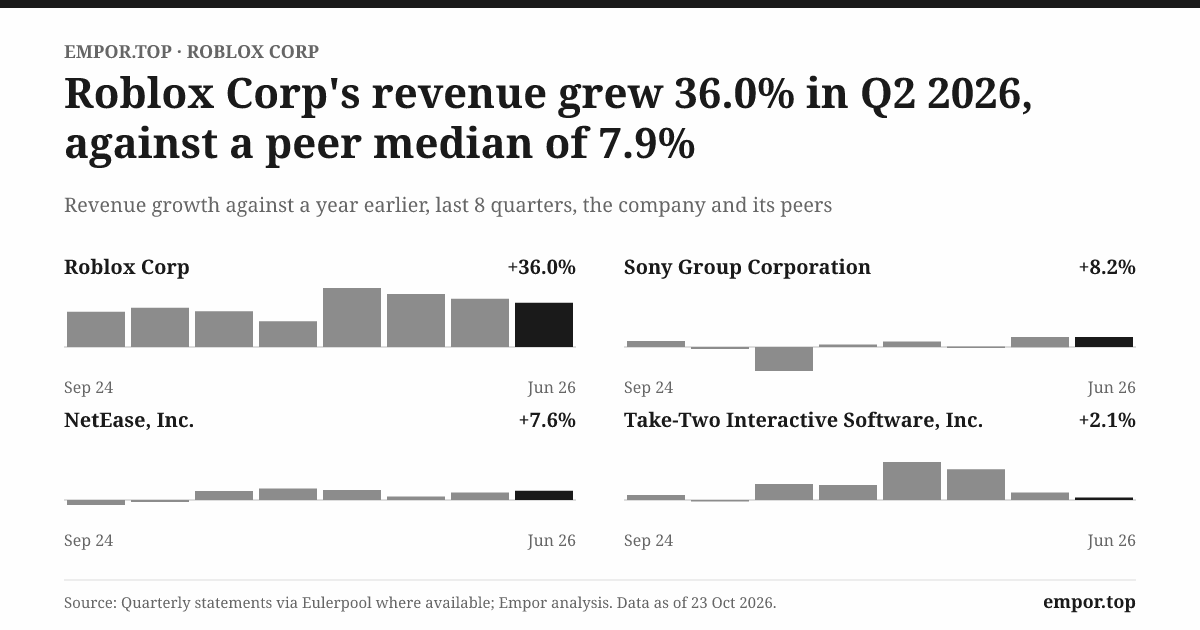
On the afternoon of July 30, 2026, Roblox put out a set of numbers that seemed to argue with each other. Revenue for the second quarter had grown 36%, to about $1.5 billion.1 Daily active users had climbed to 123 million, up about 10% from a year earlier.1
By the usual scoreboard of a consumer internet company, that is a very good quarter. And yet the number that Roblox itself treats as the truest read on demand, bookings, the money users actually commit to the platform in a period, had grown just 8%, to roughly $1.6 billion, near the bottom of what management had guided.12
That gap is the whole story in miniature. Revenue at Roblox is a lagging echo of past spending, because the company recognizes much of what users pay over many months. Bookings are the sound itself. So a quarter in which revenue races ahead while bookings barely move is a quarter in which the echo is still loud from last year's party, while the room has gone noticeably quieter.
Management's explanation, in the shareholder letter and again on the call that evening, was not that people had stopped coming. They were coming, and they were playing. What had changed was what they played. Engagement had drifted away from the handful of breakout games of 2025, which had monetized unusually well, toward newer titles and long-lived "evergreen" experiences that earn less for every hour a player spends inside them.13
Roblox also said it had deliberately tuned its recommendation system to favor long-term retention over near-term spending, and that it had switched off the sale of certain game passes that worked across experiences.3 Then it guided to a third quarter in which bookings would fall between 14% and 18% from a year earlier.12
Analysts on the call pushed on the obvious point. If more players are spending more hours on the platform and spending less money, is that a temporary mix problem or a revelation about the business? Management framed it as a trade: give up some monetization now in exchange for a healthier, stickier platform later.3 That may prove right.
It is also exactly what a company would say in either case, which is why this story has to test it rather than repeat it. The stakes were plain in the guidance itself: a 14% to 18% decline in bookings implies the year-earlier quarter had brought in somewhere around $1.9 billion to $2 billion, the high-water mark of the viral summer of 2025, and that the platform now expected to fall well short of it.12
The test comes down to four questions, and they run through everything that follows. The first is whether Roblox's creator economy, the millions of people building games on its tools, is a durable moat or simply a supply of content that competitors can also court.
The second is whether engagement can compound on its own, without depending on a few viral hits that burn bright and then fade. The third is whether Roblox can meet the rising demands of parents, regulators and courts to make a platform full of children safer, while still making money from it. The fourth is whether today's share price leaves enough time for those answers to arrive.
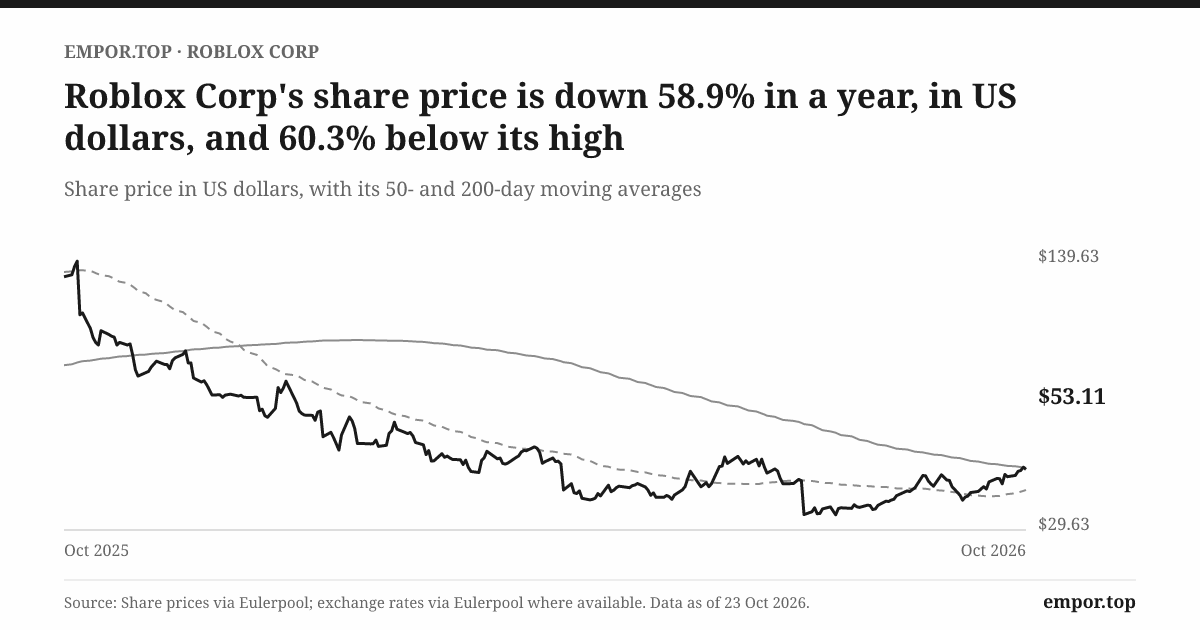
The market has already rendered a mood, if not a verdict. On October 23, 2026, Roblox shares closed at $53.11, about 60% below their 52-week high of roughly $134.4 A fall like that is not proof of anything; Roblox stock has a long record of violent swings, and its largest five-year drawdown exceeded 80%.4
But the company was still worth about $37 billion in the market, which is not the valuation of a business investors have given up on.4 It is the valuation of a business investors are no longer sure how to price.
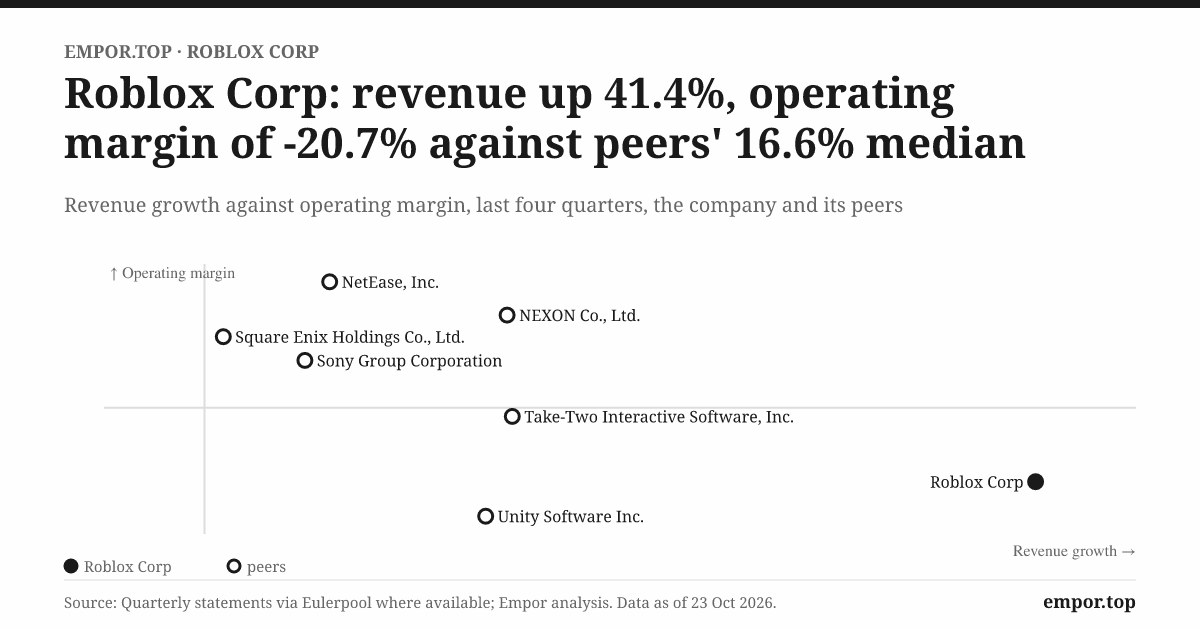
Hold that $37 billion figure against one more fact, and the central tension snaps into focus. Roblox, a platform with more daily users than almost any game company on Earth, has never produced a full year of GAAP operating profit in its time as a public company. Its operating loss in 2025 was about $1.2 billion, a margin of roughly minus 25%.5 The second quarter of 2026 was its best margin in years, at about minus 16%, but still a loss.6
So the puzzle is this. Roblox has solved the problem most game companies never solve, which is getting an enormous audience to show up every day. What it has not yet solved is the problem that ultimately pays shareholders: turning that attention into durable, profitable economics that do not depend on whichever game happens to catch fire.
To understand why that is so hard, the story has to go back to a physics program and two engineers who thought building things was more fun than playing things.
 Subscribe on LinkedIn
II. A Physics Sandbox Becomes a Place to Play
Long before Roblox, David Baszucki and Erik Cassel spent years building software that let students push, drop and collide objects on a computer screen.
Their product, Interactive Physics, came out of a company called Knowledge Revolution, and it was designed for classrooms: a simulated world where a ball rolled down a ramp the way a real ball would, and a student could change gravity just to see what happened.78 Baszucki later wrote that he had worked alongside Cassel for more than twenty years, starting at Knowledge Revolution.8
What the two founders noticed in those years was not really about physics. It was about the kids. Students did not just run the experiments they were assigned. They built their own contraptions, crashed cars into walls, and stacked towers to watch them fall. The software was meant to teach; the users wanted to play, and above all to make. That observation is the seed of everything Roblox became.
Baszucki is not a typical game-industry founder. He came to games from educational software rather than from a studio, and he talks about Roblox less like a games executive and more like a builder of infrastructure for what he calls "human co-experience," a shared digital space where people gather.7 That framing has always sounded grandiose to skeptics, and sometimes still does. But it explains a choice the company made early and never reversed.
In 2004 the pair started work on a new project, and the company that became Roblox was founded that year.7 The early prototype went by the name DynaBlocks, a nod to the dynamic, physics-driven building blocks at its heart, before it was renamed Roblox, a blend of "robots" and "blocks." The platform launched publicly in 2006.7
The key decision was what Roblox would not be. It would not be a game studio that shipped titles on a release calendar, the way Electronic Arts or Activision did. Roblox would build the engine, the servers, the avatars, the social graph and the tools, and then let its users build the games. The company's job was to make the world; the community's job was to fill it.
That sounds obvious today. In 2006 it was a strange bet. The prevailing model in games was the hit-driven studio: spend years and millions on a title, market it hard, and hope it sells. Roblox was betting that thousands of amateurs, many of them teenagers, could collectively produce more engaging content than a professional studio ever could, and that the platform would capture value by hosting all of it.
The tradeoff was built in from the first day. If users make the content, then the company does not control the quality of that content, nor decide which games deserve attention, nor directly supervise what happens inside them. Discovery, quality and safety, the things a studio manages by hand, would all have to be solved at platform scale, by systems rather than editors. Every one of those problems is still on the agenda in 2026.
For years Roblox grew the way communities grow: slowly, then all at once. The arrival of mobile apps in the early 2010s mattered enormously, because it moved Roblox off the family desktop and onto the phones and tablets children carried everywhere.7 And because a creator built once inside Roblox Studio and the platform handled the rest, a game made by a teenager could run on a phone, a PC and eventually a console without the creator writing separate versions.
That cross-device reach was one of the quiet engineering advantages of owning the whole stack. It also meant that every improvement Roblox made to its engine, its servers or its avatar system arrived in every game at once, a compounding effect no single studio could match. A studio improves its own game. Roblox improved everyone's.
Then, in February 2013, the company lost one of its two founders. Erik Cassel, Roblox's engineering co-founder, died after a long fight with cancer.8 Baszucki wrote a public tribute to the community, and players honored Cassel inside the platform he had helped build.8 It was a human turning point for a company that was still small, and it left Baszucki as the single founding voice of Roblox, a role that, as this story will show, he still holds in an unusually concentrated form.
The institutional question that Cassel's death left hanging was whether the original idea could scale beyond the community that had grown up with it. A sandbox for a few million enthusiasts is one thing. A global platform for hundreds of millions of people, with real money flowing through it, is another.
The answer arrived gradually and then dramatically. By 2019 Roblox averaged about 17.6 million daily active users.7 That was already a large audience by the standards of most games, but still a niche in the wider entertainment world, and the company was still small financially, with revenue of about $508 million that year.7
What turned a large community into a business was not just the building tools. It was money: a currency that gave players something to spend and, crucially, gave creators something to earn. Without that, Roblox would have remained a remarkable hobby. With it, the community began to look like an economy.
III. Robux Gives the Creators a Reason to Stay
Every economy needs a unit of account, and Roblox's is called Robux. A player, or more often a player's parent, buys Robux with real money, and then spends it inside the platform: on a hat for an avatar, an emote, a pass that unlocks a faster car in someone's racing game, or a boost in a tycoon simulator.5
Roblox also sells a monthly subscription that delivers a regular allotment of Robux along with some platform benefits, which gives the company a steadier stream than one-off purchases alone.5
Robux is, in effect, Roblox's pricing system. The company does not charge admission. Access is free, and most of the content is free to play. Roblox makes money when people decide that something inside the world is worth paying for, which means its revenue depends less on how many people show up than on how many of them become payers and how much each payer spends.
The decisive move came in 2013, when Roblox introduced the Developer Exchange, known as DevEx.9 Creators who earned Robux, because players spent it in their games or on their virtual items, could now exchange those earnings for real dollars if they met the eligibility rules.9 That changed what it meant to build on Roblox. A teenager making a game for fun could, in principle, become a teenager running a small business.
The incentive loop is simple to describe and hard to replicate. Creators make experiences and items. Players spend Robux on them. Eligible creators cash out through DevEx, and the cash pulls more creators onto the platform, who make more experiences, which draws more players. The payout to creators is not a charitable side program; it is the cost of keeping the shelves stocked. Roblox owns the store, but it pays a meaningful share of every sale to whoever stocked the shelf.
Here the accounting matters, because it shapes how investors read every quarterly report. When a user buys Robux, Roblox records the money as bookings, but it usually cannot recognize all of it as revenue at once. Much of the value is recognized over time: for durable virtual items, the kind that stay in an avatar's closet, the company spreads the revenue across the estimated lifetime of a paying user.5 In 2025 Roblox estimated that lifetime at 27 months.5
An analogy helps. Think of a gym that sells a two-year membership up front. The cash arrives on day one, but the gym earns it month by month as it keeps the lights on. Roblox's bookings are the membership sale; its revenue is the monthly earning-out. That is why a burst of spending in one year keeps lifting reported revenue well into the next, and why the 36% revenue growth of the second quarter of 2026 coexisted with 8% bookings growth.
The economic engine worked. Revenue rose from about $324 million in 2018 to about $923 million in 2020, nearly tripling in two years.79 The creator side scaled with it. In 2021 the developer community earned about $538 million on the platform, while only about 7,000 developers had earned enough to qualify for cash exchange through DevEx.9
Those two numbers, read together, tell an important story. More than half a billion dollars flowed to creators, but the right to cash out was concentrated among a few thousand of them out of the millions who had tried building something. Roblox's creator economy has always been shaped like the entertainment business it competes with: a vast base of hobbyists and a small professional top tier that captures most of the money.
That is not necessarily a weakness. A broad base of hobbyists is the farm system that produces tomorrow's hit makers, and a professional tier means there are studios whose livelihood depends on Roblox. But it does matter for the moat question. If the economy depends on a few hundred studios, then the relevant competition is not for millions of teenagers; it is for a few hundred businesses that can, if the terms change, take their talent somewhere else.
Roblox has never fully mapped that distribution for investors. Its filings do not disclose what share of users pay in a given month, how many creators earn a living-wage income, or how long creators stay active on the platform.5 It reports total creator payouts and broad engagement figures, but not the long-term retention of the creator base or how concentrated bookings are among the top experiences.5
That gap in disclosure leads straight to the question this story must carry forward. How much of Roblox's growth comes from a broad, self-renewing creator base, and how much from a small number of breakout games? In 2013 that was an academic question. By 2026, with management explaining a bookings miss by pointing to the fading of particular viral hits, it had become the question that sets the stock price.
Before that question could become urgent, though, the world had to discover Roblox all at once. That happened in the spring of 2020, when hundreds of millions of children were sent home from school and told to stay there.
IV. Lockdown Turns a Long-Built Platform Into a Public Market Story
When schools closed in March 2020, children lost more than classrooms. They lost playgrounds, birthday parties, lunch tables and the after-school hours spent with friends. What many of them found instead was Roblox, a place where they could meet friends, build things together, and play games that their friends had built, all from a device already in the house.
The timing exposed what Roblox had spent fifteen years constructing. A conventional game offers one experience. Roblox offered millions, and more importantly it offered a social layer: your avatar, your friends list, your chat, the same identity carried from a pizza-delivery simulator to an obstacle course to a virtual birthday party. Lockdown did not create that product. It created a moment in which that product was exactly what millions of families needed.
The numbers bent sharply upward. Revenue grew about 82% in 2020 and then more than doubled again in 2021, up about 108%, to roughly $1.9 billion.9 Daily active users rose from about 17.6 million in 2019 to about 45.5 million in 2021, close to a tripling in two years.79
Wall Street noticed, and Roblox chose an unusual route to meet it. Instead of a traditional initial public offering, it filed for a direct listing.107 In a conventional IPO, investment banks underwrite new shares, set a price, sell them to institutional clients, and the company collects the proceeds.
In a direct listing, existing shareholders, employees and early investors simply become able to sell their shares on the exchange, and the opening price is set by supply and demand on the first morning. The company raises nothing from those sales.7
On March 10, 2021, Roblox opened on the New York Stock Exchange at $64.50 a share, well above the $45 reference price the exchange had set, and the stock finished its first day around $69.50, giving the company a market value of roughly $45 billion.11
The $45 reference was not arbitrary: it matched the price at which Roblox had sold shares to private investors only two months earlier, in January 2021, so the opening trade marked up the private-market value by more than 40% in a single morning.11 For a company whose revenue two years earlier had been around half a billion dollars, it was a remarkable price for the future.
The listing structure mattered for what came after. A direct listing gave insiders a route to liquidity and gave the market a stock to trade, but it did not fill Roblox's treasury. When the company wanted capital, it went to the debt market instead, issuing $1 billion of 3.875% senior notes due 2030 in October 2021.5 Those notes remain Roblox's core funded debt, and they reappear when this story turns to the balance sheet.
The popular narrative about Roblox after 2021 was simple: a pandemic stock. Lockdown pulled forward years of growth, and when children went back to school, the bubble would deflate. The record partly supports that story and partly refutes it. Revenue growth did slow abruptly, to about 16% in 2022.5 The share price fell hard. For a moment, the pandemic-bump thesis looked right.
But then growth came back. Revenue rose about 26% in 2023, about 29% in 2024 and about 36% in 2025, ending that year at roughly $4.9 billion.5 Over the three years from 2022 to 2025, revenue compounded at about 30% a year.5 A business that was merely a lockdown artifact would not have re-accelerated two, three and four years after schools reopened.
So the history narrows the pandemic thesis rather than confirming it. Lockdown did pull forward users, and it created a 2021 base that made 2022 look weak by comparison. But it did not create the engine; it exposed one. What the record does not prove is that the more recent growth rate is durable, because part of 2025's acceleration came from exactly the kind of viral hits that management later blamed for the 2026 slowdown.
The offering documents from 2020 and 2021 are worth rereading with that in mind. Back then, Roblox described itself as a "human co-experience" platform and told investors its growth depended on attracting users, keeping them engaged, and converting them into payers, while the risk factors already flagged the platform's dependence on user-generated content, on its ability to keep children safe, and on a relatively small number of top developers for a large share of what users played and spent.7
Five years later the strategy reads almost word for word the same, and so do the risks. That consistency is a credit to the original thesis. It is also a reminder that the hardest problems were visible from the start and are still unsolved.
The listing left investors with a question that a direct listing could not answer: would a platform measured in users and bookings eventually become a profitable business? To answer that, the story has to step inside the economic machine and see who else is trying to build one.
V. The Creator Economy Meets Its Hardest Competitors
Picture a creator opening Roblox Studio for the first time. The screen shows a flat gray baseplate under an empty sky. There is no publisher to pitch, no console manufacturer to certify the game, no marketing budget to raise. The creator drags in a few parts, writes a little code, tests it with friends, and presses publish. In principle, that game is now available to more than a hundred million people a day, on phones, computers and consoles.
That button is the most valuable thing Roblox owns. It collapses the distance between making something and reaching an audience, a distance that in the traditional games business is measured in years, publishing contracts and marketing spend. For a young creator, the alternative to Roblox is not a different platform with a similar button; often it is no audience at all.
The scale behind that button is real. In 2025 Roblox averaged about 127 million daily active users, and those users spent about 123.9 billion hours on the platform.5 Spread across a year, that is roughly 2.7 hours per daily user on an average day, which puts Roblox in the same conversation as the largest social and video platforms for children and teenagers.
Roblox turns some of that attention into bookings when users spend Robux, then uses those bookings to fund the servers that host every game, the payment processors that collect the money, the moderation and safety systems that police the platform, and the creators who supply the content.5 Every link has to hold for the chain to pay.
The rivals who want the same creators
Roblox has no shortage of competitors for attention. Fortnite and Minecraft are the two that matter most, because both are, like Roblox, places where players do not just consume a game but inhabit a world, and both have built creator ecosystems of their own. Minecraft, owned by Microsoft, offers an enormous adjacent sandbox with a deep culture of building. Fortnite, owned by Epic Games, began as a single battle-royale game and has steadily turned itself into a platform where creators publish their own islands.
Epic is the most direct challenger for creators, because it competes on both of Roblox's sides at once.
Its Unreal Engine is one of the most widely used professional game engines in the world, and in March 2023 Epic launched what it called Creator Economy 2.0, placing 40% of the net revenue from Fortnite's Item Shop and related real-money purchases into a pool paid out to the publishers of eligible islands based on engagement.12 In other words, Epic pays creators for attention, not just for what players buy inside their islands.
Comparing the size of these rivals is harder than it looks, and the numbers that circulate are mostly not comparable. Companies report monthly users, daily users, peak concurrent players, or lifetime registered accounts, each defined differently. Treating them as market shares would be false precision. The sound conclusion is narrower: Roblox is the largest dedicated platform for user-generated games among children and teenagers, and Fortnite and Minecraft are large, well-funded substitutes for players' time and for creators' effort.
Run the competitive forces through that structure and a clear picture emerges. Players face almost no cost to switch: every one of these platforms is free to enter, and a child can play Roblox after school and Fortnite after dinner. Creators face higher costs, because their code, assets and audience live inside Roblox's tools and social graph, but the best studios can and do build elsewhere.
Roblox's scale, and the discovery system that steers players toward games, attracts both sides. And one supplier group holds real leverage: the payment processors and app stores through which Roblox collects its money. Three processors accounted for 67% of Roblox's net receivables at the end of 2025, and the largest handled about 29% of revenue transactions.5
That last fact is easy to skim past and should not be. Roblox does not name the processors, but a large share of a mobile-first platform's purchases flows through the dominant app stores, which take their own cut and set their own rules.5 Roblox's take of every Robux is therefore shared not only with creators but with the gatekeepers of the devices its users carry.
The bull case for Roblox rests on network effects: more players attract more creators, more creators produce more and better games, better games attract more players. The flywheel is real. The question is whether it is strong enough to make engagement compound by itself, or whether it needs a periodic jolt from a breakout hit.
The record of the past eighteen months is the cleanest test available, and the result is mixed. In 2025 the platform was lifted by a run of viral games, titles such as Grow a Garden that drew enormous, sudden crowds.13 Average daily users for the year reached about 127 million.5
By the second quarter of 2026, users were still coming, but the mix had shifted toward newer and evergreen experiences, which management said earned less per hour.13
What that shift reveals is that retention and monetization can pull in different directions. A long tail of evergreen content keeps players coming back, which is the healthiest kind of engagement for a platform. But some of the viral hits of 2025 were unusually good at getting players to spend, and when attention moved elsewhere, the spending did not follow it at the same rate. The network effect kept the crowd. It did not keep the wallet.
That forces a revision of the moat claim. The evidence supports a strong version of the network effect on attention: users stayed even as particular hits faded. It does not support a strong version on monetization. Roblox's pricing power, in the sense that matters to shareholders, depends on the mix of what people play, and that mix is partly outside the company's control.
Which is why the metrics that matter most are not user counts alone. Robux spending per user and per hour, the share of users who pay, and the earnings flowing to creators are the real tests of whether the platform is getting more valuable. Roblox publishes bookings per daily user, but it does not disclose detailed payer conversion or the share of bookings that recur, such as subscriptions, against one-off purchases.5 Investors are watching a machine whose most important gear is partly hidden.
The recommendation system sits at the center of all this. On a platform with millions of experiences, discovery is destiny: whatever the home screen promotes gets played.
That choice cost near-term monetization, by management's own account.3 When the company holds the dial that decides which games succeed, it also holds responsibility for how that choice lands in the bookings line.
Paying creators more to keep them building
Roblox's answer to competition for creators has been to improve their economics. In July 2025 it launched a program called Creator Rewards, which replaced the older engagement-based payouts and added rewards for creators who brought new or lapsed spenders back to the platform.145
At its developer conference in September 2025, the company raised the DevEx rate, so creators received about 8.5% more cash for every Robux they exchanged, and it said creators had earned more than $1 billion through DevEx in the twelve months to June 2025.15
The design of Creator Rewards is revealing. Its daily engagement reward paid creators a small, fixed amount of Robux whenever an "active spender", a user who had spent at least $9.99 on Roblox in the previous 60 days, spent at least ten minutes in their experience during a day, provided it was among the first few experiences that user opened.14
A second reward gave creators 35% of what new or returning users spent during their first two months back on the platform.14 In plain terms, Roblox stopped paying creators simply for hours and started paying them for attracting and keeping the users who pay. It was an attempt to point the whole supply side at monetization rather than at raw engagement, and the 2026 mix shift suggests the incentive had not yet fully solved the problem it was built for.
Those moves cut both ways, and an independent reading has to say so. Better creator economics should improve the durability of supply: if the best studios earn more on Roblox than elsewhere, they have less reason to leave. But every extra dollar paid to creators is a dollar not retained by Roblox, unless it generates more than a dollar of extra bookings.
A rising payout rate in a quarter when bookings growth slowed sharply is exactly the scenario in which that bet looks expensive. Epic's willingness to share 40% of its net shop revenue gives creators a benchmark, and benchmarks have a way of ratcheting.12
What does the evidence say about the moat as a whole? Roblox's clearest advantage is a combination that no rival has assembled in quite the same way: creation tools that teenagers can learn, instant distribution to a vast young audience, a persistent social identity, and an integrated currency that lets players pay and creators earn.
That is a meaningful platform position. It is not proven lock-in. Players can leave at no cost, creators have credible alternatives, and the company's own disclosures show monetization varying sharply with the experience mix.
The moat's real test is behavioral. Do creators keep building, and do users keep returning, when the discovery system changes, when the viral hits fade, and when a competitor offers different economics? In the second quarter of 2026, users kept returning, but spent less. Until those two answers converge, the moat is better described as a wide one for attention and a narrower, still-unproven one for earnings.
And that leads directly to the money itself. If attention is abundant and profit is scarce, where does Roblox's cash come from?
VI. The Cash Is Real; the Profit Is Not Yet There
Open Roblox's 2025 cash-flow statement and two numbers sit a few lines apart, apparently contradicting each other. At the top is a net loss of about $1.1 billion.5 At the bottom of the operating section is cash generated by operations of about $1.8 billion.5 A company that lost more than a billion dollars somehow brought in nearly two billion in cash from running its business. Both numbers are true. The story is in how.
Zoom out and the paradox holds across the company's whole recent history. From 2018 through 2025, Roblox recorded cumulative net losses of about $5.0 billion, and over the same eight years it generated about $4.8 billion of operating cash.57 It is as if two different companies were reporting, one bleeding and one gushing.
The reconciliation has two main parts. The first is stock compensation. Roblox pays a large share of its employees in shares rather than cash, and under accounting rules those shares are an expense that reduces profit, but they do not consume cash on the day they are granted.
So when the accountants build the cash-flow statement, they start with the loss and add that noncash expense back. In 2025 noncash charges totaled about $1.4 billion, of which stock compensation was about $1.13 billion and depreciation and amortization about $226 million.5
The second part is timing, and it brings back the gym membership. When users buy Robux, the cash arrives immediately, but the revenue arrives over the following months and years. The gap between them sits on the balance sheet as deferred revenue, a liability representing service Roblox still owes.
In 2025 deferred revenue rose by about $1.94 billion, which meant that much more cash came in than was recognized as revenue.5 Some of that inflow was offset as receivables grew by about $291 million and deferred costs, chiefly the app-store and processing fees tied to those deferred bookings, rose by about $331 million.5
Add those pieces together and the mystery dissolves. Start with a $1.1 billion loss, add back $1.4 billion of noncash charges, add roughly $1.45 billion of net inflows from the timing of bookings and payments, and you arrive at about $1.8 billion of operating cash.5 The pattern continued into 2026: in the first half, operating cash of about $947 million came alongside a net loss of about $433 million, again bridged by noncash charges and working-capital inflows.6
Here is the plain-English conclusion. The cash is real; it is in the bank. But it is not the same thing as profit. Stock compensation is a real cost borne by shareholders through dilution rather than through the cash account.
And deferred revenue is a promise, not a gift: the platform still has to host the servers, moderate the content and pay creators for the service those prepaid Robux represent. A business can collect cash early for a long time if its bookings keep growing. The moment bookings shrink, as management has guided for the third quarter of 2026, the tailwind from deferred revenue starts to reverse.
A simple calculation shows how much rides on stock compensation. In 2025 free cash flow, operating cash minus capital spending, was about $1.4 billion.5 Subtract the $1.13 billion of stock compensation, treating it as the cash cost it would have been if employees were paid in dollars, and the remainder is only about $250 million, on a business with almost $5 billion of revenue.
That is not a damning number; it is positive, and it has improved sharply from earlier years. But it is a much thinner margin than the headline free cash flow suggests.
Where the money went
Roblox has never paid a dividend.5 Over the eight years through 2025, its free cash flow added up to about $3.1 billion, and the company kept all of it.5 Most of the cash has gone back into the platform: servers, data centers, engineers and safety systems. In 2025 capital spending more than doubled to about $441 million, from about $180 million the year before, as the company expanded its infrastructure.5
In 2026 Roblox began spending some of its cash on its own shares. In the second quarter it repurchased and retired about 8.2 million Class A shares for about $380 million, and it had about $2.6 billion left under its authorization.6 Buybacks reduce the share count; stock compensation increases it. Whether shareholders are actually gaining ground depends on the net of the two, a figure worth watching every quarter rather than assuming.
The balance sheet looks more alarming on a data screen than it is in reality, and the reason is definitional. The headline debt-to-equity ratio for 2025 was about 4.6, which sounds heavily levered.5 But equity is tiny because of years of accumulated losses, so almost any debt looks large against it.
And the borrowings figure of about $1.8 billion includes lease liabilities, not just bonds.5 The core funded debt is the $1 billion of 3.875% notes due in 2030, which cost about $39 million a year in interest.5 Operating lease liabilities were about $643 million at year-end, and leases that had not yet started added another $1.6 billion of future commitments, much of it for data centers.5
Against that, Roblox held substantial liquidity. At the end of 2025 it reported about $3.1 billion of cash and short-term investments, and total investments of about $4.3 billion; the two figures overlap, because the investments figure includes the short-term holdings, so they should not be added together.5
By June 30, 2026, cash was about $991 million and short-term investments about $2.02 billion.6 Interest income on that pile was about $202 million in 2025, a welcome contribution but nowhere near enough to offset the operating loss.5
The credit market's view is measured. In October 2025 Moody's affirmed Roblox's Ba1 rating, one notch below investment grade, and moved the outlook to positive, citing growth in users, engagement and bookings and the company's strong liquidity.16 It also flagged leverage, expecting it to fall to between two and two-and-a-half times debt to EBITDA over the following year or so.16 Those were forecasts made at the height of the 2025 surge, before the bookings slowdown, and they should be read as such.
One more line on the balance sheet tells an operational story. Roblox does not sell to customers on credit in the usual sense; users pay instantly. But that money passes through payment processors and app stores, which remit it to Roblox later, and while it is in transit it shows up as receivables.
Net receivables were about $901 million at the end of 2025, and they fell to about $498 million by the end of June 2026 as the company collected on bookings made in earlier periods.56
Roblox says processors generally remit within 30 days, that it has had no material credit losses to date, and that it keeps reserves for chargebacks and refunds and specific allowances where a processor might be impaired.5 It does not publish a detailed ageing table.
The risk here is not that users fail to pay. It is that three processors held two-thirds of what Roblox was owed at year-end.5 A disruption at one of them, a dispute, or a policy change would hit collections and checkout at the same time.
The cost of being the platform
None of this is a hidden scandal. It is the cost structure of a company that chose to be the platform rather than a studio. Research and development was about $1.57 billion in 2025, roughly 32% of revenue, down from about 40% in 2024 because revenue grew faster than R&D spending.5 Headcount rose to about 3,065 full-time employees by the end of 2025, of whom more than 2,300 worked in product and engineering.5
That is an investment posture, not a harvesting one, and the falling R&D share shows genuine operating leverage. But the direction of the margins tells the honest story. The operating margin improved from about minus 45% in 2023 to about minus 16% in the second quarter of 2026.56
That is real progress. It is also still a loss, and the improvement came during a period of unusually strong bookings that management now expects to reverse for at least a quarter.
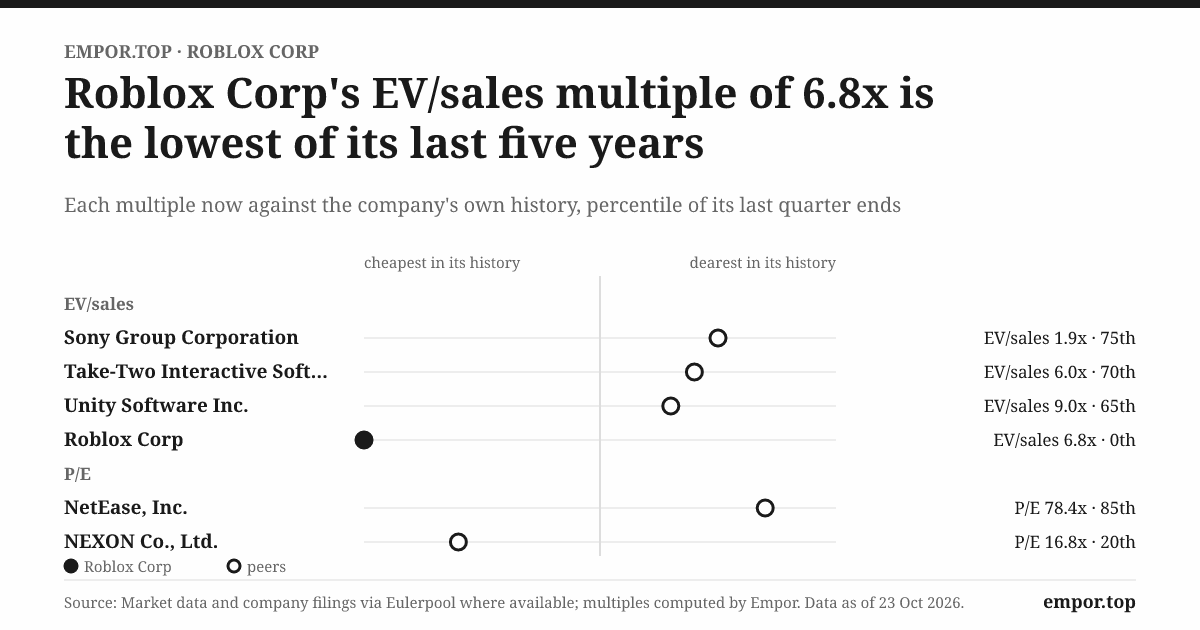
So what does the market's price ask investors to believe? At about 6.6 times trailing sales and a free-cash-flow yield of about 4.4%, Roblox is not priced as a distressed company.4 That yield is calculated on free cash flow that includes the stock compensation add-back. Strip that out and the yield on owner earnings is far thinner. The investment case therefore requires two things to happen together: durable bookings growth, and a credible path toward lower stock compensation and positive GAAP operating income.
The first of those depends on the game mix and the creator economy. The second depends on management's choices. And both now run into a constraint that has nothing to do with spreadsheets: the safety of the children who make up so much of Roblox's audience.
VII. The Growth Plan Runs Into the Safety Question
In early January 2026, a new prompt began appearing on Roblox screens around the world. To chat with other players, users would now have to complete an age check, typically by letting a vendor's software estimate their age from a short face scan, or, for older users, by verifying with an ID.17
The requirement had started in a handful of countries in December and had rolled out globally wherever chat was available.17 Once checked, users were sorted into age bands and could generally chat only with people in similar bands, a design meant above all to limit contact between adults and younger children.17
The change did not arrive in a vacuum. By then Roblox faced a growing stack of lawsuits and state investigations accusing it of failing to protect children from predators, exploitative content and manipulative design.5
The age checks were the most visible product response to that pressure, and they marked a turning point in how the company talked about its own platform. Safety had always been a cost of doing business. Now it was a product-design constraint that could change who talks to whom, what content is visible, and how fast a new player makes friends.
This is the mechanism investors need to understand. Roblox's social layer, the friends, the chat, the shared experiences, is what turns a game into a place. Age-segmented chat and content restrictions may reduce some harmful interactions, which is the point.
But they can also make the platform less social for some users, slow the rate at which newcomers join friends, and change which experiences get traffic. A safer platform is very likely a more durable one. It is not automatically one that monetizes as well in the short run, and Roblox's own disclosures acknowledge that age-check systems can be evaded or can misclassify users.56
The legal exposure is broad. Roblox's 2025 annual report lists disputes and regulatory matters covering online safety and youth protection, privacy, consumer protection, alleged addictive design, gambling-related claims, labor, intellectual property and shareholder suits.5 At the end of 2025 the company had accrued only immaterial amounts for probable litigation losses, and it said it could not reasonably estimate the maximum possible loss across all of these matters.5 The second-quarter 2026 filing said litigation and regulatory scrutiny were continuing, including from state attorneys general.6
That pairing deserves a plain reading. "Immaterial accruals" means the company had not concluded that large losses were both probable and estimable. "Cannot estimate maximum exposure" means it could not put a ceiling on them. Together, they describe an overhang that is real but unquantified. Investors are holding an option written by courts and legislatures, with no stated strike price.
Some of that uncertainty has begun to resolve into concrete obligations. In April 2026 Roblox entered a consent judgment with the state of Nevada that set specific safety commitments.18 Days later, Alabama's attorney general announced a $12.2 million settlement, with the money directed to school-safety programs, and with commitments that included tighter limits on who adults and younger users can chat with, parental consent requirements for younger users' trusted connections, and more parental control over whether adults can send Robux to children.19
The dollar amounts in those settlements are small relative to Roblox's revenue. The obligations are not trivial. Each settlement turns a voluntary product policy into a legally enforceable one, and each one becomes a template that other states can copy or extend. The right way to follow this is not through headlines about lawsuits but through the combination that actually matters: what product changes the company makes, what happens to user trends after it makes them, and whether it discloses the costs.
The founder at the center
A platform under this kind of scrutiny needs strong oversight, and here Roblox's governance draws its own questions. David Baszucki is chief executive and chairman of the board. Through his Class B shares, which carry 20 votes each, he controlled about 58.8% of the total voting power, according to the 2026 proxy.20 Outside shareholders can vote, but they cannot outvote him.
His pay, long modest by Silicon Valley standards, jumped in 2025. Reported compensation was about $24.6 million, almost all of it, about $22.7 million, in stock awards, against about $3.0 million in 2024; he took no salary or cash bonus in any of those years.20 The company ties the award to equity and performance conditions.20 Shareholders noticed.
At the May 2026 annual meeting, say-on-pay passed, but with about 223.6 million votes against, roughly 16% of votes cast for or against, compared with about 95% support the year before.2120 That headline understates the dissent. Baszucki's Class B shares alone carry more than 900 million votes.20 If he voted them in favor, as founders generally do, then outside shareholders were close to evenly split on his pay.
The related-party dealings are small but worth a sentence because of that control. In 2025 Roblox subleased space from an entity affiliated with Baszucki in a deal valued at about $1.9 million over its initial term, plus a monthly rental for a security command post; the audit committee approved the arrangements.20
That is a rounding error against about $4.9 billion of 2025 revenue. It matters less for its size than as a reminder that at a founder-controlled company, the independent directors' judgment is one of the few checks available. Roblox discloses no royalty, brand fee or management-fee stream flowing to insiders.20
Two other items belong in proportion. Roblox reported about $350 million of gross unrecognized tax benefits at the end of 2025, a figure that sounds large until one notices that only about $3.5 million of it would affect the tax expense if recognized.5
And although most revenue is in dollars, with euros and sterling the main remainder, the company does not hedge; foreign-exchange gains and losses have been small, a $2.1 million gain in 2025, against operating losses that run more than a billion dollars a year.56
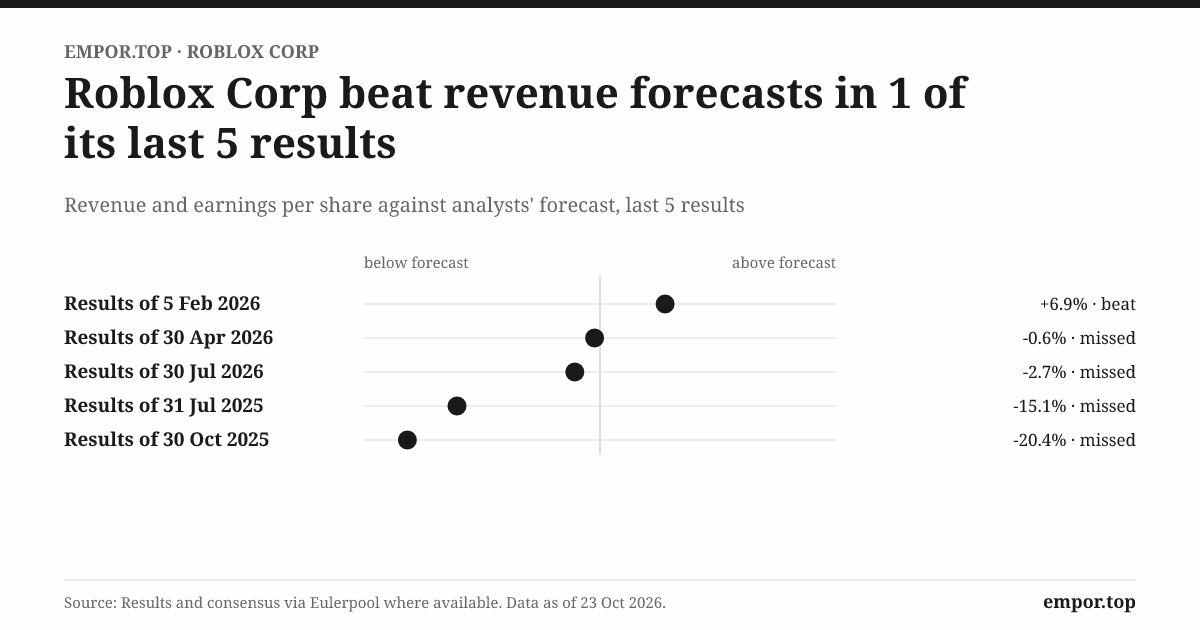
Management's credibility is best judged across several calls rather than one. In February 2026, reporting the fourth quarter of 2025, Baszucki said Roblox had exceeded its guidance and reiterated his long-term ambition of capturing 10% of what the company sizes as a $200 billion global gaming content market.22
On the first-quarter call in April, management raised its growth expectations for the year.23 By late July, the tone had shifted: the company cited weaker monetization and moved to giving guidance only one quarter at a time rather than for the full year.132
The analyst questions on the July call were more revealing than the prepared remarks. Analysts pressed on how much of the shortfall came from viral games fading versus deliberate algorithm changes, how long the monetization hit would last, and why visibility had deteriorated so quickly after an upbeat spring.3 Management's answers emphasized that the platform's long-term health would more than offset the near-term hit, but did not give a timeline.3
That is a coherent strategic explanation. It is also a vague one, and the switch to quarterly-only guidance, made right after raising the outlook a quarter earlier, says something about how much the company itself could see. The guidance record does not show deception. It does show that Roblox's management, like its investors, was surprised by how quickly its monetization could change.
What happened to the side bets
The capital-allocation record outside the core platform is short, and it is not flattering. In August 2021 Roblox acquired Guilded, a chat and community app for gamers, saying it would help connect gaming communities.24 The total consideration was about $77.6 million.9 In 2025 Roblox announced that Guilded would be sunset by the end of that year, with its features folded into Roblox's own communities products.25
Roblox never disclosed revenue for Guilded or a comparable valuation that would let outsiders judge the price. The shutdown is evidence that the product did not become a durable standalone business; it is not proof that the purchase was overpriced, since some technology and talent may live on inside Roblox.
The bigger setback was China. In July 2021 Roblox launched a localized version, 罗布乐思 Luobu, in partnership with 腾讯 Tencent, a joint venture meant to open the world's largest gaming market.26 In January 2022 the app was taken down, and Roblox said it was building a different version.26 That was a genuine international commercialization failure.
It does not say much about the core global platform, which kept growing everywhere else. It does say that Roblox's model, user-generated content at scale, collides hardest with jurisdictions that want tight control over content, and that the company's safety and moderation challenge is not only technical but political.
Taken together, the safety question, the governance structure and the record of side bets point to the same conclusion. Roblox's growth plan is not threatened by any single lawsuit or vote. It is shaped by a set of constraints that make the platform harder and more expensive to run than it looks from the outside, and that are concentrated in the hands of one founder. The lessons that come out of that are the ones worth taking away.
VIII. Business & Investing Lessons
Roblox’s 2013 decision to let creators exchange earned Robux for dollars was the hinge of the company. Plenty of companies have invented virtual currencies; arcades had tokens, and airlines have miles.
Very few have built one that people want to earn as badly as they want to spend. The lesson is one that belongs to Roblox: a virtual currency becomes a business when people have a reason to earn it as well as spend it. For founders, the wider point is that a two-sided currency is not a payments feature. It is a labor market, and it has to be managed like one.
The second lesson comes from the gray baseplate in Roblox Studio and the publish button above it. Roblox owns the tools, the servers, the store and the front door. It does not own the reason anyone walks in. Its 2025 changes to creator payouts and rewards reflected the fact that its most important suppliers have choices, and that Epic was writing checks of its own.
The platform owns the meeting place, but creators still decide whether it is worth showing up. Every platform that relies on independent supply, from app stores to video sites, eventually learns that its moat is only as wide as its suppliers' next-best alternative.
The third lesson came in the second quarter of 2026: users kept showing up while bookings growth stalled as the mix shifted to games that management said earned less per hour than the hits of the summer before.
Engagement is not monetization; the mix of what people play can matter as much as how long they stay. Investors who treat daily users as a proxy for revenue are measuring the crowd, not the cash register. For any business built on attention, the question is never just how many people come. It is what they do when they get there, and who decides what they see first.
The fourth lesson lives in the cash-flow statement, where a billion-dollar loss sits a few lines above nearly two billion dollars of operating cash. Roblox’s cash generation let it fund its operations without raising money in its public listing.
That is a real advantage, and it bought the company years of patience. But it is borrowed patience: cash collected early does not make an unprofitable service profitable, and stock compensation is still borne by shareholders through dilution.
The fifth lesson comes from two products that no longer exist in their original form: Guilded, Roblox’s acquired community app, was later shut down, and Luobu, its China app launched with Tencent, was pulled within months. Both made sense on a slide.
One was meant to deepen the social graph; the other to open the largest gaming market on Earth. Neither became a durable business. Strategic fit is a hypothesis until users adopt the product and the economics last. That is worth remembering whenever Roblox, or any platform, announces that its next adjacency is a natural extension of what it already does.
Put those five lessons side by side and a single pattern emerges. Roblox's platform advantage is genuine, and it is visible in the behavior of users who keep returning and creators who keep building. What none of the lessons supports is the leap from platform advantage to proof of durable earnings. That leap is the investment case, and it is where the bull and the bear part company.
IX. Analysis & Bull vs. Bear Case
The same company, in the same quarter, reported revenue growth of 36% and bookings growth of 8%, then guided to a bookings decline. Over the last twelve months it generated about $5.7 billion of revenue and an operating loss of about $1.2 billion.65 The multiple was about 6.6 times sales.4 Two serious investors can look at that set of facts and reach opposite conclusions, and both can be reasoning carefully.
The bull reads the company as a platform in the middle of a deliberate reset. Roblox combines things no competitor has bundled in quite the same way: tools that a teenager can learn, instant distribution to a global young audience, a persistent social identity, and an economy that lets players pay and creators earn. Growth has already survived the post-pandemic slowdown in 2022 and re-accelerated for three straight years afterward.5
Management is investing in discovery, creation tools, safety and infrastructure that could broaden the platform toward older users and new genres, and operating margins have improved by roughly thirty points since 2023.56 In this reading, the 2026 bookings dip is the price of choosing retention over a sugar high, and a platform with this much attention will eventually monetize it.
The bear reads the same facts as a warning. Bookings can swing violently with a few viral hits, and the second quarter showed that engagement and monetization can come apart without warning.13 Operating losses remain large after twenty years of operation. Operating cash flow depends heavily on stock-compensation add-backs and on deferred revenue that will reverse if bookings fall.
Child safety is shifting from a public-relations issue into enforceable legal obligations, with litigation whose maximum cost the company cannot estimate.5 And a single founder controls the vote, approves his own strategy as chairman, and received a sharply larger equity award in 2025.20
Where the moat holds and where it leaks
The competitive analysis earlier in this story established the shape of the moat: wide for attention, narrower for earnings. Hamilton Helmer's framework of durable powers sharpens what kind of moat it is. Roblox's strongest power is network economies, because each additional creator and each additional player makes the platform more valuable to the other side, and the 2026 evidence that users stayed even as hits faded is the best proof that this power exists.
Its second is scale economies in infrastructure and safety: running servers, moderation and payments for more than a hundred million people a day spreads fixed costs that a smaller rival would struggle to match. Roblox's R&D spending fell as a share of revenue even as absolute spending rose.5
Switching costs are weaker than they look. They are high for creators who have built years of code, assets and audience inside Roblox Studio, and low for players, who can open a different app in seconds. Counter-positioning helped Roblox in its early years, because studios were slow to embrace user-made content, but that window has closed: Epic now pays creators from a 40% revenue pool, and Minecraft has its own enormous building culture.12
Brand is real among children and parents, but in 2026 it cuts both ways, since the same name appears in safety headlines. Cornered resources and process power are hard to identify. Roblox owns its tools and data, but nothing in its disclosures suggests a resource rivals cannot replicate given time and money.
Michael Porter's forces add a final layer. Buyer power is fragmented, since no single user matters, but the collective ability of players to drift to other games is exactly what showed up in the 2026 mix shift. Supplier power is concentrated in two places: the professional creators who make the top experiences, and the payment processors and app stores that handle Roblox's payments.5
Rivalry is intense and well-financed. Substitutes for children's time are everywhere, from video platforms to social apps. And the threat of new entrants is moderated by Roblox's scale but not eliminated, particularly as AI tools lower the cost of building games.
The verdict that follows is calibrated rather than dramatic. The history does not reject the moat claim. It narrows it. Roblox has a strong, evidence-backed network effect on engagement. It does not yet have proven pricing power, meaning the ability to raise what each hour of attention earns regardless of which games happen to be popular.
Three measures matter more than any others for tracking that claim. The first is bookings per daily active user, because it is the clearest read on whether attention is turning into spending. In the second quarter of 2026 bookings grew about 8% while daily users grew about 10%, which means bookings per user slipped slightly from a year earlier.1
The second is hours engaged, because it shows whether the network effect on attention is holding even when spending wavers; management's whole account of the second quarter rests on engagement staying healthy while monetization per hour fell, which makes this the figure that will either vindicate or undercut that explanation.13
The third is the GAAP operating margin, because it captures whether scale is finally producing profit after the costs of safety, infrastructure and stock compensation. It reached about minus 16% in the second quarter of 2026, the best in this period, and still below zero.6 A durable edge requires all three to improve together, without leaning on one or two high-monetizing experiences.
The management test runs alongside those numbers. The guidance reversals in 2026 are now part of the record.22233 What would rebuild credibility is not optimism but specificity: a measurable link between the discovery changes and later gains in retention and monetization, and a declining ratio of stock compensation to revenue, which was about 23% in 2025.5
The capital-allocation test is just as concrete. Investors can track dilution net of buybacks, now that the company has started repurchasing shares; the productivity of rising capital spending and R&D; the share of bookings paid out to creators; and what becomes of any product built or acquired outside the core platform, given how Guilded and Luobu ended.62526
A skeptical activist, the kind who buys a stake and writes a public letter, would aim at a short list. The first target would be stock compensation running at close to a quarter of revenue, which means the free cash flow headline flatters what owners actually keep. The second would be the dual-class structure, which removes the usual remedy for disappointment: outside holders cannot replace a board that the founder's votes elect. The third would be disclosure.
The disclosure gaps already described, alongside the company's narrowed guidance, leave the burden of proof with management.53 None of those points is a sign of wrongdoing. Each is a place where better disclosure would cost little and settle a great deal.
The material risks follow directly from the mechanisms described throughout. Viral-game dependence can whipsaw bookings. Child-safety regulation and litigation can raise costs and change product design. Payment-processor and app-store concentration creates an operational chokepoint. Stock-based compensation dilutes owners whether or not the business earns a profit. And the shift toward evergreen games and older users, the heart of management's plan, has to work in execution, not only in the shareholder letter.
What the price asks
The roughly 60% share-price decline tempts a reading of cheapness.4 The evidence does not support that inference by itself. Roblox has never been valued on earnings, because it has none, and there is no stable history of sales multiples or a clean set of listed peers to anchor a comparison; its closest rivals, Epic and Minecraft's owner Microsoft, are either private or far larger and more diversified.
What can be said is what the current price assumes. At about $37 billion of market value and about $36 billion of enterprise value, investors are still underwriting years of strong growth and an eventual move to sustained operating profit.4 If those happen, the price may prove modest. If bookings stay volatile and losses stay large, the same price can still prove generous.
The filings support a real platform advantage. They do not yet establish durable pricing power or profitable growth. That is not a verdict on the stock. It is a description of what remains to be proven.
X. Epilogue
Tonight, Roblox sits in an in-between moment. The company has changed how its discovery system chooses what players see. It has made age checks a condition of talking to anyone.
It has started putting prompt-based creation tools, which let a user describe a game or an object in words and have the software build a first draft, in front of a very large audience.1 And it has told investors that the quarter that ended in September would show bookings down 14% to 18% from a year earlier, against a year-ago quarter swollen by the viral summer of 2025.1
The next earnings calls are where this reset will be judged, and the tests are specific. If bookings per daily user stabilize while hours engaged keep growing, management's explanation, that it traded short-term spending for long-term retention, will start to look like strategy rather than rationalization.
If daily users, which stood at about 123 million in the second quarter, hold or rise in the quarters after the age-check rollout, the bet that safety and scale can coexist will gain its first real evidence.1 If creator payouts keep rising faster than bookings, the company will have to show that richer creator economics are buying durable supply rather than simply shrinking its own share.
Then there are the costs that will tell the profit story. The operating margin needs to keep climbing toward zero even as bookings dip. Stock compensation needs to fall as a share of revenue, not just hold steady. And any disclosed costs of safety obligations, settlements and product changes need to stay small enough that they shape the platform without swamping it.
Whether Roblox's research and development spending produces engagement and monetization gains that show up in those lines is the clearest measure of whether the company's engineering investment is paying off.5
AI creation belongs in this picture as optionality, not as an earnings driver. It could make Roblox the easiest place on Earth to build a game, widening the creator base far beyond people who can write code.
It could also flood the platform with more content than discovery can sort, raising the stakes on exactly the recommendation choices that dented bookings in 2026. Roblox has not shown durable revenue from it yet, and the company's own record, of side bets that sounded strategic and did not last, argues for patience before treating it as more.
So the central questions of this story are still open, and the next few quarters will start to answer them. The creator economy has proved large; it has not proved that it can compound without a few hits. The safety reset is under way; its commercial cost is not yet visible.
The valuation still assumes the answers come out mostly right. The unresolved choice is whether Roblox can build a more persistent platform, one that makes money on the evergreen games its users keep returning to, without depending on the short-lived sensations that recently paid the bills.
XI. Outro
Return, one last time, to the creator in Roblox Studio. The gray baseplate is still there, the sky still empty, and the publish button still sits at the top of the screen with more than a hundred million daily players on the other side of it. That button is why Roblox exists. It turned a physics toy into a world, a currency into a wage, and a community into one of the largest audiences in entertainment.
But the world has not yet paid its way. Even with its enormous audience, Roblox remained deeply unprofitable through 2025.5 The crowd is not the problem. The crowd was never the problem. The challenge, from the afternoon in July 2026 when revenue and bookings stopped telling the same story, is turning that attention into economics that last.
Roblox is not one game. It is a world made of games, and the value of that world depends on whether users, creators and shareholders all keep choosing it, on the days when there is a viral hit, and especially on the days when there is not.
References
-
Roblox Q2 2026 Shareholder Letter — Roblox, 2026-07-30 ↩↩↩↩↩↩↩↩↩↩↩↩↩↩
-
Roblox Q2 2026 Earnings Press Release, Form 8-K Exhibit 99.1 — SEC, 2026-07-30 ↩↩↩↩
-
Roblox Q2 2026 Earnings Call Transcript — S&P Global via Stock Analysis, 2026-07-30 ↩↩↩↩↩↩↩↩↩↩↩↩
-
Roblox 2025 Form 10-K — SEC, 2026-02-11 ↩↩↩↩↩↩↩↩↩↩↩↩↩↩↩↩↩↩↩↩↩↩↩↩↩↩↩↩↩↩↩↩↩↩↩↩↩↩↩↩↩↩↩↩↩↩↩↩↩↩↩↩↩↩↩↩↩
-
Roblox February 2021 Form S-1/A — SEC, 2021-02-11 ↩↩↩↩↩↩↩↩↩↩↩↩↩
-
Dear ROBLOX Community: David Baszucki on Erik Cassel — My Hero, 2013 ↩↩↩↩
-
Roblox Starts Trading at $64.50 After Direct Listing — CNBC, 2021-03-10 ↩↩
-
Introducing the Creator Economy 2.0 — Epic Games, 2023-03-22 ↩↩↩
-
Roblox Q2 2025 Earnings Call Transcript — Roblox, 2025-07-31 ↩
-
Introducing Creator Rewards: Earn More by Growing the Community — Roblox Developer Forum, 2025-07 ↩↩↩
-
Roblox Unveils AI, Monetization, and Performance Innovations for Creators — Roblox press release, 2025-09-05 ↩
-
Moody’s Affirms Ba1 Rating and Revises Roblox Outlook to Positive — Investing.com, 2025-10 ↩↩
-
Age Checks Required to Chat on Roblox — Roblox Newsroom, 2026-01 ↩↩↩
-
Nevada Consent Judgment with Roblox — Nevada Attorney General, 2026-04-15 ↩
-
Attorney General Marshall Announces $12.2 Million Settlement with Roblox to Ensure Child Safety — Alabama Attorney General, 2026-04-21 ↩
-
Roblox 2026 Annual Meeting Voting Results, Form 8-K — SEC, 2026-05-29 ↩
-
Roblox Q4 and Full Year 2025 Earnings Call Transcript — Roblox, 2026-02-05 ↩↩
-
Roblox Q1 2026 Earnings Call Transcript — S&P Global, 2026-04-30 ↩↩
-
Roblox Acquires Guilded to Connect Gaming Communities — Roblox, 2021-08-16 ↩
-
Update on Guilded and Communities — Roblox Developer Forum, 2025 ↩↩
-
Roblox Takes Down China App, Says Building Another Version — Reuters, 2022-01-07 ↩↩↩
 LinkedIn
 WhatsApp
 Reddit
 Hacker News
 Email
 Kindle
 RSS Feed
 Spotify
 Apple Podcasts
 Amazon Music
 Audible
 YouTube