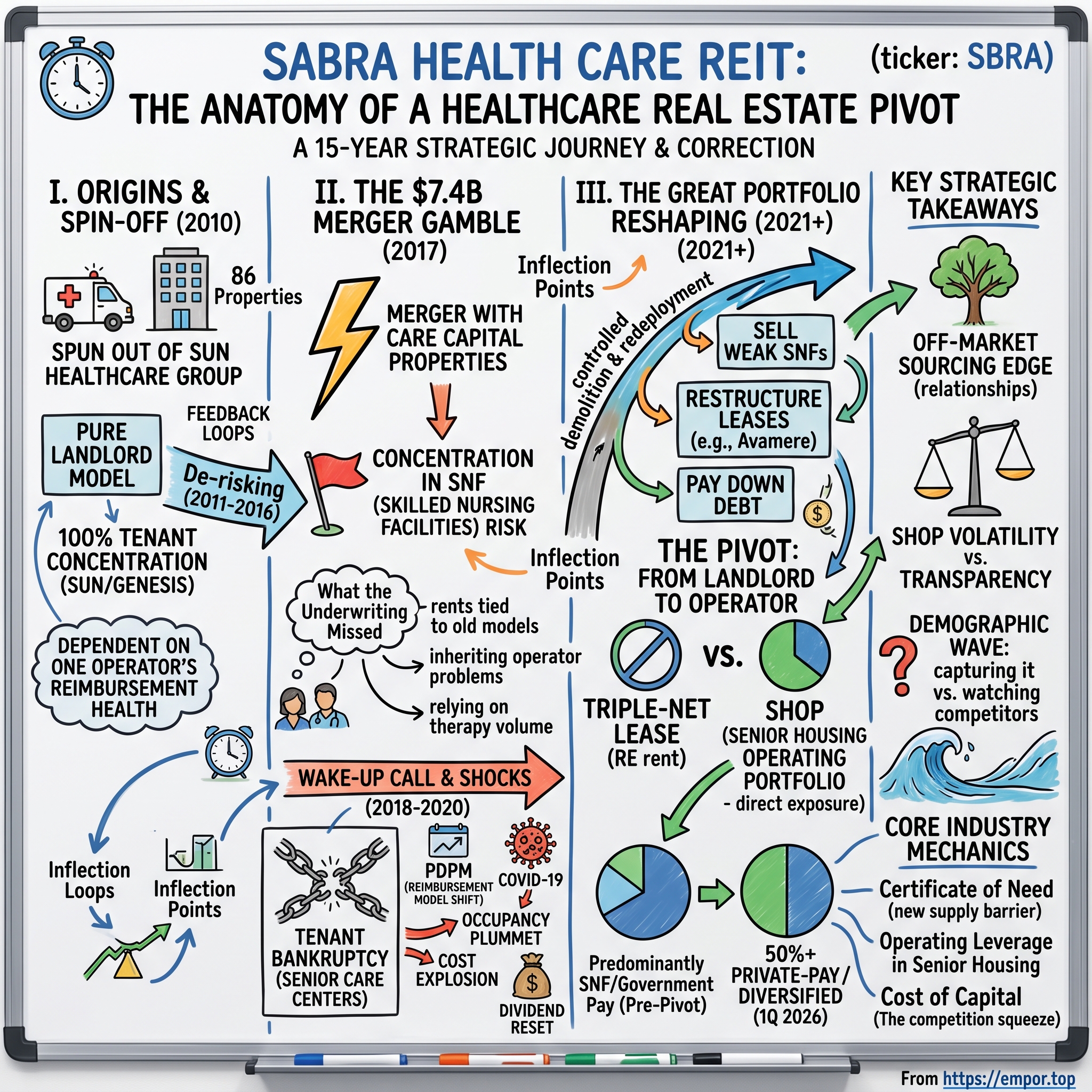
Sabra Health Care REIT: The Anatomy of a Healthcare Real Estate Pivot
I. Introduction & Episode Roadmap
On a Tuesday morning in early August 2026, Rick Matros opened Sabra Health Care REIT's second-quarter earnings call with the kind of line a CEO earns only after surviving something. Investment activity: roughly $600 million closed year-to-date, another $100 million about to close. Occupancy up. Margins up. Rent coverage up. And then, almost as an aside, the number he seemed most pleased about: leverage down to 4.61 times.1
For most REIT executives, a leverage ratio is a hygiene metric. For Matros, it was a scar healing. Nine years earlier, Sabra had bet its balance sheet on a merger that nearly broke the company. The intervening decade was spent unwinding that bet, one lease restructuring and one asset sale at a time.
Here is the paradox at the heart of this business. Sabra owns the physical infrastructure that an aging America cannot function without: skilled nursing facilities where people recover from hip replacements and strokes, assisted living communities where the 85-year-old who can no longer manage stairs goes to live, memory care wings, behavioral health hospitals. Demand for those buildings is as close to demographically guaranteed as anything in the investable universe. And yet healthcare REITs have been among the most treacherous places to put capital in the last fifteen years — because the landlord does not collect rent from the 85-year-old. The landlord collects rent from an operator, and that operator's solvency depends on Medicaid rates set by state legislatures, Medicare rates set by federal formula, and the wages of certified nursing assistants in a tight labor market. Own the perfect asset, lease it to the wrong counterparty, and you own a very expensive building with no tenant.
Sabra Health Care REIT, Inc. trades on the Nasdaq Global Select Market under the ticker SBRA.2 As of June 30, 2026, its investment portfolio held 364 real estate properties: 207 skilled nursing and transitional care facilities, 32 senior housing communities under lease, 94 senior housing communities that Sabra owns and that third-party managers run on its behalf, 16 behavioral health facilities, and 15 specialty hospitals and other assets — roughly 37,000 beds and units across the United States and Canada.1 Market capitalization sits in the neighborhood of $5 billion, which makes Sabra a mid-cap in a sector where the largest player is more than thirty times its size.3
The arc of this story runs in three acts.
Act one is the spin-off. In late 2010, Sabra was carved out of Sun Healthcare Group as a pure real estate vehicle — 86 buildings, one tenant, and a thesis about the mathematical superiority of being a landlord rather than an operator.[^4] That thesis was half right and would be tested to destruction.
Act two is the merger. In 2017, Sabra combined with Care Capital Properties, itself a spin-off from Ventas, in a transaction valued at roughly $7.4 billion of pro forma market capitalization.4 Management sold it as scale, diversification, and an investment-grade credit profile. A 3.9% shareholder publicly called it a strategic reversal into a declining asset class and voted no.5 The shareholder was substantially right about the near term. What followed were bankruptcies, rent cuts, impairments, and a dividend reduction — and then a pandemic that hit congregate elder-care settings harder than almost any other real estate category.
Act three is the pivot, and it is the reason this company is interesting again in 2026. Sabra has been methodically converting itself from a government-reimbursement landlord into something closer to a private-pay senior housing operator-partner. In the first quarter of 2026, private-pay revenue crossed 50% of the portfolio for the first time in the company's history — a striking milestone for an enterprise that began life roughly 96% skilled nursing.6
Several themes run through the whole story, and they are worth naming up front. The first is that the OpCo/PropCo separation — the idea that you can cleanly divorce real estate value from operating risk — is a fair-weather construct. The second is that in this industry, shrinking can create more value than growing. The third is a question rather than a theme: does having a former nursing home operator running a REIT actually produce better underwriting, or is that a story management tells that happens to be flattering? The evidence cuts both ways, and this piece will test it.
The place to start is a conference room in Irvine, California, in 2010, where a career operator decided he would rather be the landlord.
 Subscribe on LinkedIn
II. Origins & The 2010 Sun Healthcare Spin-Off
Rick Matros did not come up through real estate. He came up through nursing homes — the actual buildings, with the actual staffing schedules, the actual state surveyors, and the actual plaintiffs' attorneys.
By the mid-2000s he had spent decades in long-term care, including running Regent Assisted Living and, from 2001, serving as chairman and chief executive of Sun Healthcare Group, an operator that had itself emerged from bankruptcy. His industry experience as described in Sabra's own proxy materials spanned more than three decades in long-term care companies and over twenty-five years as an executive of such businesses.7 This matters for a specific reason: Matros had lived the operator's income statement. He knew that a skilled nursing facility's profitability turns on three variables that a landlord never touches — census, payer mix, and labor cost — and that all three could move against you in a single quarter for reasons entirely outside your control.
He also knew what the public market thought of that income statement. And this is the founding insight.
The arbitrage that created Sabra
Consider two businesses sitting inside the same corporate wrapper. One owns buildings and collects contractual rent under long-term leases. The other employs thousands of nurses and aides, bills Medicare and Medicaid, carries professional liability exposure for every fall and every pressure ulcer, and earns a single-digit operating margin in a good year.
The market prices these very differently. Real estate cash flows that look bond-like get capitalized at low rates and high multiples. Healthcare operating cash flows — litigious, labor-intensive, politically exposed — get capitalized at low multiples precisely because investors know how quickly they can evaporate. Bolted together, the operating business drags the valuation of the real estate down with it. Pulled apart, each half can be owned by the investors who actually want it: REIT income funds on one side, healthcare specialists on the other.
That was the trade. In November 2010, Sun Healthcare Group separated its real estate from its operations into two independent public companies. Sabra Health Care REIT began operations on November 15, 2010, taking 86 owned properties along with associated mortgage indebtedness, and leasing essentially all of them back to the newly independent Sun under long-term master leases.[^4]8 Sabra elected REIT status effective with its 2011 tax year.8
There is a certain elegance to a master lease structure that is worth explaining plainly, because it recurs throughout this story. In a master lease, a single tenant leases a whole basket of buildings under one contract with one rent obligation. The point is cross-collateralization: the tenant cannot cherry-pick, keeping the five profitable facilities and handing back the twelve losers. It is all or nothing. In a bankruptcy court, that dramatically strengthens a landlord's hand, because the debtor must generally assume or reject the lease as a unit. Master leases were, and remain, one of the few genuinely powerful structural protections a healthcare landlord has.
The flaw that was obvious from day one
But look at what Sabra actually owned on its first day as a public company: a portfolio whose rent came almost entirely from one counterparty, in one asset class, dependent on government reimbursement. The elegant OpCo/PropCo separation had not eliminated the operating risk. It had simply moved the risk one layer away and given it a new name — credit risk.
That distinction is where a great deal of capital has been destroyed in healthcare real estate. A landlord looking at a master lease sees contractual rent and a legal claim. What the landlord actually owns is a call option on the tenant's operating margin. When the operator's EBITDA covers rent two and a half times over, the lease behaves like a bond. When coverage compresses toward one times, the lease is worth whatever the operator's restructuring counsel says it is worth.
Sabra's early years were therefore spent doing the only thing that fixes concentration: buying. Management deployed capital into off-market skilled nursing and assisted living acquisitions, using a mix of secured and unsecured debt and equity issuance, with the explicit goal of diluting the legacy tenant down from near-total dominance. The counterparty itself changed hands along the way — Sun Healthcare Group was acquired by Genesis HealthCare in December 2012, which meant Sabra's single largest tenant relationship transferred to a much larger, and eventually far more troubled, national operator.7
The scoreboard on this first phase is genuinely good. Revenue grew from a partial-year $8.8 million in 2010 to roughly $261 million in 2016, and by the fourth quarter of 2016 Sabra was generating $0.62 of normalized funds from operations per diluted share and paying a quarterly dividend of $0.42.9 Skilled nursing rent coverage had improved to a then-record 1.52 times, and management had spent 2016 recycling $314 million of capital out of assets and loans and into deleveraging rather than chasing growth.9
Hold onto those 2016 numbers. They become the most uncomfortable benchmark in this entire story.
Because by early 2017, Sabra had a different problem. Genesis was deteriorating. The skilled nursing sector was under visible pressure from Medicare Advantage penetration and shortening lengths of stay. Sabra was a sub-$3 billion enterprise with a sub-investment-grade credit rating, competing for assets against REITs several times its size.9 Management concluded it needed scale. And the fastest way to get scale was sitting right there, freshly spun out of Ventas and trading in the public market.
III. The $7.4B Merger Gamble: Care Capital Properties & The Cost of Scale (2017)
On May 7, 2017, Sabra announced it would combine with Care Capital Properties in an all-stock merger creating a company with roughly $7.4 billion of pro forma total market capitalization.410 CCP shareholders would receive approximately 1.1 Sabra shares for each CCP share and would end up owning about 59% of the combined entity — Sabra's own holders would be left with roughly 41%.10
Read that ownership split again. This was nominally Sabra acquiring CCP. In economic reality, the smaller company's shareholders were handing majority ownership to the larger company's shareholders and keeping the Sabra name, the Sabra management team, and the Sabra ticker. Structurally, it was closer to a reverse merger dressed as a merger of equals.
The pitch
The strategic logic was coherent on paper, and it is worth stating fairly. The combined company would hold 564 healthcare investments across 43 states and Canada, versus 205 for Sabra alone.10 Scale would deliver roughly $20 million of annual cost savings and, more importantly, an investment-grade credit rating — which for a REIT is not a vanity item but a direct reduction in the cost of the debt that funds every future acquisition.10 No single tenant would exceed 11% of combined annualized net operating income, which meant the Genesis problem would be diluted rather than solved.10 The transaction was structured to be tax-free to shareholders.4
Matros framed it in the language every REIT CEO uses: modest leverage, greater scale, greater diversification, greater opportunity.10 Sabra's own 2018 proxy would later describe the CCP acquisition, alongside the subsequent repositioning of the CCP tenant base, as having achieved three long-stated goals — investment-grade ratings, a diversified tenant base where no single tenant drove the company narrative, and increased liquidity.7
The objection
Ten weeks later, on July 24, 2017, Eminence Capital — holder of 3.9% of Sabra's common stock — announced it would vote against the deal, and its letter was unusually specific.5
Eminence's first argument was that the deal reversed Sabra's own stated strategy. Sabra had spent years telling investors it was reducing skilled nursing exposure. The merger would push that exposure back up to roughly 73% from around 50%.5 Management was, in Eminence's reading, doing precisely the opposite of what it had promised, and calling it diversification because the tenant count went up.
The second argument was about quality, and it was the sharpest. Eminence pointed out that as of the first quarter of 2017, 65% of CCP's rents were covered at less than 1.2 times EBITDAR — up dramatically from 38% just one quarter earlier.5 That is not a statistic about a portfolio. That is a statistic about a portfolio in free fall. Two thirds of the rent roll was being paid by operators with almost no cushion, and the share of impaired coverage had nearly doubled in ninety days.
Third, Eminence questioned the price. Management characterized the transaction as an 8.4% cap rate. Adjusted for the rent cuts Eminence believed were coming, it calculated the effective cap rate fell into the mid-7% range — against a market where distressed skilled nursing portfolios were changing hands at 9% to 11%.5 And it flagged by name that Signature Healthcare, representing roughly 15% of CCP's rent, was in significant financial distress and might well need bankruptcy protection.5
The merger closed anyway, on August 17, 2017.10
What actually happened
The subsequent three years were a workout.
Genesis, already strained before the deal, reported a going-concern qualification in its financial statements during the second half of 2017 and asked Sabra for approximately $19 million of rent relief.7 Sabra responded with a disposition plan that gave Genesis relief while shrinking the exposure — a restructuring that, combined with parallel negotiations Genesis conducted with its other landlords and creditors, allowed the operator to avoid bankruptcy.7 That outcome deserves credit: Sabra chose a negotiated shrink over a courtroom fight, and it worked.
Senior Care Centers was less fortunate. On December 4, 2018, the largest nursing home provider in Texas — with nearly 10,000 residents and roughly 11,000 employees — filed for Chapter 11 in the Northern District of Texas, explicitly blaming burdensome debt and expensive leases.11 "Expensive leases" is the operator's phrasing for what a landlord calls contractual rent, and the distinction is exactly the point of this section. When an operator's economics break, the lease does not protect the landlord. The lease becomes the thing the bankruptcy judge is asked to fix.
Sabra spent 2018 through 2020 in continuous portfolio triage: selling non-core and low-coverage skilled nursing assets, transitioning facilities from failing operators to healthier ones, restructuring rents downward, and recording non-cash impairments as carrying values were marked toward reality. The reported financials tell the story without commentary. Net income was $279 million in 2018 — flattered by gains on sale — then fell to $69 million in 2019, and turned to losses of $113 million in 2021 and $78 million in 2022 as impairments piled up.12 Share count, meanwhile, went from roughly 106 million weighted average diluted shares in 2017 to roughly 231 million by 2022.12
The uncomfortable benchmark
Here is the cleanest way to assess whether the CCP merger created value, and it requires only two numbers already introduced.
In the fourth quarter of 2016 — the last full quarter before the deal was announced — Sabra earned $0.62 of normalized FFO per diluted share and paid a $0.42 quarterly dividend.9 In the second quarter of 2026 — nine years, one pandemic, and an entire portfolio transformation later — Sabra earned $0.38 of normalized FFO per diluted share and paid a $0.30 quarterly dividend.1
Per-share earnings power is roughly 39% below where it stood before the merger. The dividend is roughly 29% lower. Over the same period the asset base and share count both roughly doubled.
Some of that gap is the pandemic, which no one underwrote. Some of it is the deliberate, arguably correct decision to sell high-yielding but structurally impaired skilled nursing assets and replace them with lower-yielding but higher-growth senior housing. Some of it is dilution from equity issued at depressed prices during the workout. But the direction is unambiguous, and it is the single most important fact for any investor evaluating this management team's capital allocation record: Sabra got much bigger and, on a per-share basis, materially less profitable. Scale was purchased with permanent shareholder dilution.
What management did well was the part that came after. Rather than defending the transaction with a second, larger transaction — the classic empire-building response to a bad deal — Sabra spent years shrinking, selling, and deleveraging. That is behaviorally rare and genuinely to the team's credit. It is also, as the next section shows, exactly the disposition that a global pandemic was about to demand.
IV. The Crucible: Reimbursement Revolutions & The COVID-19 Pandemic
Imagine you run a 120-bed skilled nursing facility, and on October 1, 2019, the federal government changes how it pays you — not the amount, but the entire logic.
Under the old system, RUGs-IV, Medicare paid you substantially according to how many minutes of physical, occupational, and speech therapy you delivered. More therapy minutes, more revenue. The incentive was obvious, and so was the abuse: facilities pushed patients into the highest therapy tiers regardless of clinical need. Under the replacement, the Patient Driven Payment Model, Medicare pays you according to the clinical complexity of the patient — their diagnoses, comorbidities, and care needs. A patient with a complex wound, diabetes, and a cardiac history is now worth more than a patient receiving 720 minutes of therapy a week for a routine knee.
For operators, PDPM was an existential re-underwriting of their entire business model. Facilities that had built their staffing around therapy volume — often through contracted therapy companies — had to rip up the model.
The reimbursement shift that quietly helped
The industry braced for damage. What happened instead, at least for Sabra's tenants, was the opposite. In its first-quarter 2020 disclosure, Sabra estimated that PDPM's annualized impact on EBITDARM coverage across its skilled nursing portfolio was an increase of roughly 0.14 times — with about 75% of the benefit coming from higher revenue and about 25% from expense reduction, and excluding the separate 2.4% net market basket increase effective that October.13
That is a meaningful, concrete number, and it deserves interpretation rather than recitation. A 0.14x coverage improvement means Sabra's tenants got roughly 10% more cushion between their operating cash flow and their rent obligation, essentially for free, in the ninety days before COVID-19 arrived in American nursing homes. Operators who had been staffing to therapy minutes discovered they could cut contracted therapy expense while capturing higher clinical-complexity payments. Sabra's own framing at the time was that PDPM "put our portfolio in a stronger position going into the COVID-19 pandemic."13 That framing is self-serving, but on the evidence it is also accurate. Pure luck, precisely timed.
The structural pressure that PDPM did not fix is Medicaid. Roughly half of American nursing home residents are long-stay custodial patients funded by state Medicaid programs, and state rates are set through cost-report formulas that lag actual costs — often badly. When wages jump, the Medicaid rate does not adjust for two years. That timing mismatch is the permanent tax on skilled nursing economics, and it is why the private-pay pivot described later in this story exists at all.
March 2020
Then congregate elder care became the epicenter.
The operating shock was brutal and specific. Move-ins stopped because families would not tour buildings and hospitals would not discharge into them. Move-outs continued for the saddest possible reason. Staff called out sick or left the sector entirely, and operators replaced them with agency nurses at two to three times the wage rate. By the last week of April 2020, Sabra's managed senior housing occupancy had already fallen 160 basis points from the February average.13
Sabra's balance-sheet response came fast and, by the standards of the moment, was decisive. On March 25, 2020, the board reset the expected first-quarter dividend to $0.30 per share, and declared that amount on May 6.1413 Cutting a REIT dividend is the most reputationally expensive action a REIT board can take — income investors own these securities specifically for the payout, and a cut is read as an admission of distress. Doing it in March 2020, before rent collections had actually deteriorated, was a choice to protect liquidity ahead of the storm rather than during it.
The other thing Sabra did was disclose. Through April 2020 the company reported that it had collected all forecasted rents in the ordinary course, had granted no COVID-related rent deferrals or relief, and had not drawn on any security deposits or credit enhancements — while simultaneously reporting that its operators had received or expected to receive roughly $320 million in federal and state assistance, principally under the CARES Act.13 That last disclosure is the interesting one, because it is an admission against interest. Sabra was effectively telling investors: our rent collections look pristine, and a material reason they look pristine is that Washington is writing checks to our tenants.
Contrast that with the standard 2020 landlord communication, which emphasized collection percentages and left the federal support quietly out of frame. Sabra's willingness to publish the mechanism, not just the outcome, is a genuine data point on disclosure quality — and one worth remembering when weighing management's current claims.
The Enlivant wound
Not everything was handled well. Sabra held a 49% equity interest in a joint venture with private equity firm TPG covering roughly 154 to 159 senior housing communities operated by Enlivant, structured with non-recourse debt at the JV level.
In the second quarter of 2021, Sabra recorded an impairment charge of $164.1 million related to that investment as it moved to exit.15 The exit itself did not complete until May 1, 2023, by which point Sabra had written its equity stake down to zero, with management attributing the outcome to a "double whammy" of the debt market downturn and lingering pandemic effects on the portfolio's saleability.16
The honest reading is that the Enlivant JV was a structure that promised senior housing upside with limited downside and delivered the reverse. Non-recourse debt capped the loss at the equity contribution, which is exactly what it is designed to do — but the equity contribution went to zero, and it took nearly two years to extract the company from a position it had publicly decided to exit. Complexity in the capital structure bought optionality that turned out to be worthless.
By 2022, Sabra was a company with a reset dividend, a bruised income statement, an operator base that had been through hell, and a strategic question it could no longer defer: if the pandemic proved that skilled nursing rent is only as good as government reimbursement and agency labor rates, what business should this company actually be in?
V. The Great Portfolio Reshaping: Triple-Net to SHOP & Behavioral Health
The answer arrived not as a single announcement but as a grinding, quarter-by-quarter reallocation that took four years and is still running.
In the first quarter of 2026, Sabra crossed a threshold it had never crossed: private-pay revenue exceeded 50% of the portfolio.6 For a company that began life roughly 96% skilled nursing, dependent almost entirely on Medicare and Medicaid, that is the single clearest statement of what the last decade was for.6
What "SHOP" actually means
The mechanism deserves a plain-English explanation, because it is the central economic distinction in healthcare real estate.
Under a triple-net lease, Sabra is a pure landlord. The tenant pays rent — typically with contractual annual escalators in the low single digits — and bears every operating cost: labor, food, utilities, insurance, property taxes, maintenance. Sabra's revenue is contractual and predictable. It is also capped. If the operator raises rents 8% and fills every bed, Sabra still collects its 2.5% escalator.
Under a SHOP structure — enabled by the RIDEA rules that allow REITs to participate in healthcare operating income through a taxable subsidiary — Sabra owns the building and the operating cash flows. It hires a third-party manager to run the community for a management fee, typically a mid-single-digit percentage of revenue, and keeps the residual. Now Sabra collects the resident's monthly rate directly. If occupancy rises and rates rise faster than costs, that flows to Sabra. If a boiler fails, agency nursing costs spike, or a competitor opens down the street, that flows to Sabra too.
The best analogy is the difference between owning a hotel and leasing it to a hotel operator. The lease pays you the same whether the hotel is full or empty. Ownership pays you the upside — and hands you the downside.
Sabra made this bet at the point in the cycle when senior housing occupancy was recovering from pandemic lows toward normalization, which is precisely when operating leverage is most violent. The reason is arithmetic that management explains well and that investors should internalize: once a senior housing community is roughly 85% to 90% occupied, most of the cost base is already in place. Staffing, food service, and building overhead barely change when the next resident moves in. So each incremental move-in past that inflection contributes something close to pure margin.
The evidence that this is working is now substantial. In the second quarter of 2026, same-store managed senior housing revenue grew 8.6% year over year while the cost per occupied room rose only 4.1%, producing cash NOI growth of 13.7%.1 Occupancy in the same-store pool rose 170 basis points to 88.2%, with the Canadian communities at 93.2% — the ninth consecutive quarter above 90%.1 Revenue per occupied room rose 6.6%.1 Across the full managed portfolio including joint ventures and non-stabilized communities, sequential revenue grew 9.6% and cash NOI grew 14.4%, with margin expanding 130 basis points.1
The analytical conclusion: the SHOP thesis has produced real, repeated, multi-quarter evidence of operating leverage rather than a single flattering quarter. Revenue growth is running roughly double expense growth, which is the specific signature of a business capturing occupancy-driven margin expansion. What it has not yet been tested by is a down cycle. Every quarter of this record has occurred during a demand recovery with historically low new construction. The structure that converts occupancy gains into outsized NOI growth converts occupancy losses into outsized NOI declines with equal enthusiasm.
The segments, and what drives each
Managed senior housing is now the growth engine, and management has been explicit about the target. On the second-quarter 2026 call, Matros said Sabra had aimed for a 40% SHOP share of NOI on a run-rate basis by year-end, that a 450 basis point improvement had been achieved in the quarter, and — notably — that 40% was "not where we want to end."1 The operator roster reflects deliberate fragmentation: after Sabra transitioned 21 communities away from Holiday by Atria effective April 1, 2025, it split them among Discovery Senior Living, Inspirit Senior Living, and Sunshine Retirement Living rather than handing them to a single successor.18 That decision was the direct lesson of the tenant-concentration problem this company was born with.
Skilled nursing and transitional care remains the largest property count and functions as the stable, contractual base. What has changed is quality. EBITDARM coverage in the skilled nursing portfolio reached 2.49 times in the second quarter of 2026.1 Set that against the 1.52 times that management celebrated as an all-time high at the end of 2016, and against the CCP portfolio where two thirds of rents were covered below 1.2 times.95 Sabra's skilled nursing tenants today carry roughly two and a half dollars of property-level cash flow for every dollar of rent. That is a genuinely different asset than the one that blew up in 2018, and it is the strongest single piece of evidence that the workout years accomplished something.
Triple-net senior housing is the smallest of the three core buckets, covering 32 leased communities, with EBITDARM coverage of 1.52 times.1 Sabra has been actively converting the best of these into SHOP — one such conversion in the second quarter of 2026 mechanically reduced reported triple-net senior housing occupancy and coverage, which management flagged specifically because the optics looked worse than the substance.1
Behavioral health is where the outline's premise requires updating, and this is worth being direct about. Behavioral health and addiction treatment was long presented as a high-margin, private-pay, Medicaid-insulated growth vector. In practice, Sabra is exiting it. Following the resolution of its Recovery Centers of America exposure, behavioral health concentration fell from 13% to 9% of annualized cash NOI.17 Asked on the second-quarter call about exiting the segment entirely, Matros said the bulk of what remained was Signature Behavioral's psychiatric hospitals, that the tenant had expressed interest in buying Sabra out after nine years, and that if it happened Sabra would be "95% senior housing and skilled nursing."1
The RCA episode is the cautionary note inside an otherwise strong year. Sabra agreed to accept $200 million in cash in full satisfaction of a $300 million mortgage loan that had been scheduled to mature on November 1, 2026, closing the transaction on June 30, 2026.17 The company recorded a $102.4 million provision for loan losses and other reserves, which it excluded from normalized results.1 Management's defense — that including interest income earned since 2021 it recouped its initial investment, and that redeploying capital into core segments beat extending the loan — is reasonable but incomplete.17 On the call, Cantor Fitzgerald's Rich Anderson translated it into the language that matters: the transaction was effectively a capital raise at above an 11% cost, and redeploying at roughly 7.5% implied real annualized dilution that management confirmed was baked into guidance.1 A $100 million principal concession is a $100 million principal concession, and it happened in a non-core segment the company had previously described as a growth engine.
Where this leaves the numbers
The reshaped portfolio produced normalized FFO of $0.38 and normalized AFFO of $0.40 per share in the second quarter of 2026, up 3% and 5% year over year, with total cash NOI of $144.3 million.1 Full-year 2026 guidance, raised in July and reiterated in August, calls for normalized FFO of $1.53 to $1.55 and normalized AFFO of $1.59 to $1.61 — roughly 7% and 8% growth at the midpoint.17 Leverage fell to 4.61 times from 5.04 times in a single quarter, aided by the RCA proceeds, leaving the company below its previous 5.0x target.1 The $0.30 quarterly dividend represented a 75% payout of second-quarter normalized AFFO.1
That growth rate — mid-to-high single digits on a per-share basis — is the honest measure of what the pivot has bought. It is a real acceleration from the low-single-digit escalator growth a pure triple-net portfolio produces. It is not a step-change, and it comes only after a decade in which per-share earnings power went backwards.
To judge whether it is durable, the story now has to move from what Sabra owns to how this industry actually works.
VI. Core Industry Mechanics & Competitive Benchmarking
Picture two investors bidding on the same 100-unit assisted living community in suburban Atlanta. Both agree the building is worth roughly $30 million. They will structure the deal completely differently, and the difference explains most of what happens in this sector.
The first investor wants a lease. Find an operator, sign a fifteen-year triple-net contract with 2.5% annual escalators, collect $2.1 million a year, and never think about the building again. Predictable, financeable, bond-like.
The second investor wants the operating income. Hire a manager for a fee, take the resident revenue, pay the expenses, and keep whatever is left. Volatile. Potentially far more valuable.
Sabra now runs both books simultaneously, and understanding how each behaves is the prerequisite for evaluating the company at all.
Reading the vital sign
The metric that governs the triple-net book is EBITDARM coverage, and it is worth unpacking the acronym because the letters are doing real work. EBITDARM is earnings before interest, taxes, depreciation, amortization, rent, and management fees. Add rent back because rent is what you are testing the operator's ability to pay. Add management fees back because those vary by operator structure and would otherwise make portfolios incomparable.
Divide EBITDARM by cash rent and you get the coverage ratio: how many dollars of property-level cash flow exist for every dollar of rent owed. Above roughly 1.4 times, an operator has room to absorb a bad quarter, a wage shock, or a state reimbursement delay. Below 1.2 times, the operator is running on fumes and every conversation with the landlord becomes a negotiation. Below 1.0 times, the facility is subsidizing its own rent out of the operator's other buildings, and the countdown has started.
This single ratio explains both the CCP disaster and the current portfolio's resilience. It is the closest thing this industry has to a vital sign — and, critically, it is reported by tenants who are mostly private companies not subject to SEC reporting, and it is not independently verified by Sabra.17 That is an accounting judgment investors should hold in mind: the most important solvency metric in the portfolio is a number the counterparty supplies about itself.
The metric that governs the SHOP book is different. There, investors watch revenue per occupied room against expense per occupied room. The spread between those two lines, multiplied by occupancy, is the entire business. When RevPOR grows 6.6% and expenses per occupied room grow 4.1%, margins expand.1 When that inverts — as it did across the sector in 2021 and 2022 when agency labor exploded — margins collapse, and there is no lease to hide behind.
The competitive board
Sabra competes in a sector with a brutal hierarchy, and capital cost is the ranking mechanism.
Welltower sits at the top with a market capitalization in the neighborhood of $165 billion — more than thirty times Sabra's roughly $5 billion.3 Ventas, at roughly $43 billion, is the other mega-cap, and the company from which CCP was spun in August 2015.310 Both operate enormous senior housing operating platforms with international exposure, proprietary data and operating systems, and an equity cost of capital that lets them win auctions Sabra cannot rationally enter. When a trophy institutional portfolio comes to market at a sub-6% going-in yield, Welltower can make that accretive and Sabra cannot.
Omega Healthcare Investors, at roughly $14 billion, is the skilled nursing heavyweight — a pure-play landlord with a higher yield profile and correspondingly higher sensitivity to CMS rate-setting and state Medicaid budgets.3 CareTrust REIT at roughly $9 billion and National Health Investors at roughly $3.4 billion are the direct mid-cap competitors for regional skilled nursing and senior housing deals.3
Sabra's own management has been unusually candid about where it sits in that hierarchy. On the Canadian market, Matros noted that cap rates run 100 to 150 basis points inside U.S. levels, which makes Canadian acquisitions uneconomic for Sabra even though the operating performance there is the best in its portfolio.1 In 2025, Talya Nevo-Hacohen put it more bluntly: peers were transacting at 5.5% to 6% going-in yields in Canada, "and that pricing is just too rich for us, no matter how much we might like to buy the asset."18 That is a company telling investors, accurately, that it loses bidding contests on cost of capital.
Where the edge is real, and where it is asserted
The claimed advantage is middle-market underwriting: buying assets in secondary markets from regional operators, often off-market, at yields the mega-caps will not chase. The evidence is reasonably good. Sabra closed roughly $599 million of investments through mid-2026 at an estimated 7.5% initial cash yield, with second-quarter closings at 8.1%.1 Chief Investment Officer Darrin Smith described the sourcing advantage as relationship-driven — strong ties to owners and operators providing an edge even on marketed deals — and noted that Sabra has passed on transactions competitors bought at high-6% and low-7% cap rates where the risk-adjusted return did not clear its bar.1
That is a credible mechanism. Deals sourced through operator relationships, at yields 100 to 200 basis points above what institutional processes clear, are not available to everyone, and Sabra has been getting them consistently for several years.
But there are two honest qualifications. First, the yield advantage is partly compensation for asset quality and market quality, not pure alpha — secondary-market assets in Georgia and Colorado should price wider than coastal trophies. Second, the advantage compresses as the sector gets crowded. Management acknowledged cap rate compression directly, describing private equity re-entering the space and the sector "gaining more and more popularity."17 The window in which a mid-cap REIT can buy 7.5% yielding senior housing is a function of capital scarcity, and capital is returning.
The more interesting question is whether Sabra's operating capability — as distinct from its buying capability — constitutes a durable advantage. That is the terrain of the next section.
VII. Helmer's 7 Powers & Porter's 5 Forces Analysis
In November 2025, Cantor Fitzgerald's Rich Anderson asked Matros a question that cut closer to the strategic core than most analyst questions do. Paraphrased: Welltower and Ventas can obviously find acquisitions. What worries him is execution — the operating aftermath. Sabra has been running SHOP for a decade. Did the early years teach lessons that now constitute an advantage?
Matros's answer was more specific than the usual CEO deflection. Yes, he said, it is more complicated than it looks, and getting more so as resident acuity rises. The lesson learned was that a team accustomed to triple-net leases has to be rewired to work side by side with operators on daily operations. Sabra's structural response, made deliberately at the spin-off, was to staff its asset management function exclusively with former operators, and later to build an internal business intelligence unit for data analysis.19
Whether that constitutes a power in Hamilton Helmer's sense — a durable, differential advantage that persists under competitive attack — is the right question to interrogate.
Applying the 7 Powers
Switching costs are genuinely high, and they run in both directions. Replacing an operator in a licensed healthcare facility is not like replacing a retail tenant. It requires state licensure transfer, potentially certificate-of-need approval, Medicare and Medicaid provider agreement assignment, and a physical transition that must not disrupt care for frail residents. Sabra has demonstrated the friction directly: management contrasted the "unfriendly" Holiday transition, which produced measurable operational disruption, with the cooperative Avamere transition, which it expects to close without meaningfully affecting guidance.1
But note carefully what this power actually protects. High switching costs mean a healthy operator is unlikely to leave, which stabilizes rent. They also mean that when an operator fails, the landlord is trapped — it cannot simply evict and re-let. That is why coverage ratios matter more than lease terms. Switching costs are a moat that faces inward as much as outward.
Scale economies are moderate and mostly financial. The real benefit of scale for a REIT is the cost of capital, and Sabra's progress here is measurable: on September 10, 2025, Moody's upgraded Sabra's senior unsecured notes to Baa3 from Ba1, completing an investment-grade profile alongside BBB- ratings from S&P and Fitch.20 That upgrade is worth real money in every subsequent bond issuance. There is also modest G&A leverage — normalized cash G&A of roughly $10.7 million per quarter spread across 364 properties.1 But Sabra remains a roughly 55-person organization, and the durable scale advantage in this sector belongs to companies an order of magnitude larger.19
Counterparty and underwriting advantage is the most plausible emerging power, and it is unproven at scale. The argument is that an operator-led management team can identify and partner with strong regional operators before larger REITs notice them, and can structure and rescue relationships that a purely financial team would mishandle. Supporting evidence exists: the roster of managers Sabra has cultivated, the willingness to break large portfolios into pieces, the coverage ratios that have improved for several consecutive quarters, and the fact that Sabra converted a deteriorating Avamere lease into a re-tenanting that raises annualized cash rent from $41 million to $53 million on closing — a nearly 30% increase.17
Contradicting evidence also exists, and it is not trivial. The same team underwrote the CCP portfolio at the top of the skilled nursing cycle, over the specific objection of a shareholder who correctly identified the coverage collapse in advance. The same team entered and exited the Enlivant JV at a total loss of its equity. The same team wrote a $300 million behavioral health mortgage and took $100 million off the principal to get out. An operator-centric edge that is real in workouts but absent in initial underwriting is a partial power, not a general one.
The remaining powers are largely absent. There is no branding power — residents choose communities by location and operator reputation, not by who owns the real estate. There is no network economy. There is no cornered resource. Process power is the closest analogue to the asset management capability described above, but a decade of institutional learning is imitable by a competitor willing to hire the same people.
Porter's Five Forces
Payer power is the defining force, and it is asymmetric across Sabra's segments. For skilled nursing, CMS and state Medicaid agencies set prices unilaterally; no operator negotiates. Sabra's exposure to this is now roughly halved by the private-pay pivot, which is the entire strategic point. For private-pay senior housing, the "payer" is a family paying out of savings and home equity — which means pricing power exists, but is bounded by household wealth and by the political sensitivity of raising rates on elderly residents.
Operator bargaining power is moderate to high, precisely because of the switching-cost trap. An operator in genuine distress holds asymmetric leverage in a renegotiation, because the landlord's alternative — vacancy, license lapse, transition cost, and reputational damage — is worse than a rent cut. The 2017-2020 period was this force operating at full strength.
Threat of new entrants is genuinely low, and this is currently the sector's strongest tailwind. Certificate-of-need laws restrict new skilled nursing supply in many states. Licensure is complex. And construction economics simply do not work: with elevated financing costs and construction inflation, management has repeatedly described development pipelines as near-empty and starts at historic lows.18 Nevo-Hacohen framed it as an absence of any near-term catalyst that would reverse the current supply-demand imbalance.18 A landlord facing rising demand and no new supply is in an unusually favorable structural position — the question is duration, and the honest answer is that development restarts when the arithmetic works, which management has begun to see at the margin.17
Substitution is a slow-moving but real threat. Home health, remote monitoring, and aging-in-place technology genuinely reduce demand for the lower-acuity end of senior housing — independent living most of all. What they do not replace is 24-hour supervision for advanced dementia or post-acute rehabilitation requiring skilled nursing. Sabra's portfolio tilt toward assisted living and memory care rather than independent living is a partial hedge against exactly this force.
Rivalry is high and intensifying. This is the force most likely to compress Sabra's returns from here. Every large healthcare REIT has now identified senior housing operating income as the growth vehicle, and private capital is re-entering. When a mid-cap's edge is buying at wider yields than everyone else, and everyone else starts bidding, the edge is arithmetic — and it shrinks.
The synthesis: Sabra sits in a structurally attractive industry position with weak individual firm-level powers. The tailwind is real and largely exogenous. The company-specific advantage is narrower than the narrative suggests. That places unusual weight on the judgment of the people allocating the capital.
VIII. Management Evaluation & Governance Stress Test
On January 5, 2026, Sabra announced that Talya Nevo-Hacohen had retired as Chief Investment Officer effective December 31, 2025, after serving since the company's founding, and that Darrin Smith would succeed her effective January 1, 2026.21 Nevo-Hacohen remained under a two-year consulting arrangement.21
It was a well-telegraphed succession — Sabra had announced the transition process publicly in March 2025 — and Smith was an internal promotion who had served as Executive Vice President of Investments since March 2020, following nine years in senior housing investments at HCP and earlier roles at GE Capital Real Estate and Ernst & Young.21 The handoff appears to have been clean: Smith presented the senior housing portfolio on the fourth-quarter 2025 call in essentially the same format and with the same metrics his predecessor had used.17
That is the surface. The substance requires looking at behavior over fifteen years.
The people
Rick Matros, born in 1954, has been chairman, president, and chief executive since the separation, and his defining characteristic as a REIT CEO is that he is not a REIT person.22 Most healthcare REIT chief executives come from investment banking or real estate private equity; they think in cap rates, spreads, and cost of capital. Matros thinks in census, payer mix, star ratings, and staffing hours — the operator's vocabulary. His fiscal 2025 total compensation was approximately $3.53 million.22
That background shows up in observable ways. On calls, he discusses wage growth by year with specificity, tracks agency labor as a percentage of staffing, and distinguishes between transitions where the incoming operator has demonstrated turnaround capability on comparable assets and transitions where it has not.181 His explanation of why operators are suddenly willing to sell — that founder-CEOs who ran facilities for thirty and forty years were burned out by the pandemic and are now retiring into a strong market — is the sort of texture that comes from knowing the people, not the spreadsheets.1
It also shows up in a less flattering way. An operator's instinct is to believe a struggling facility can be fixed. The CCP underwriting, the Enlivant JV, and the RCA loan all share a family resemblance: transactions where the downside was underweighted relative to a turnaround thesis.
Michael Costa, born in 1979, became Chief Financial Officer effective January 1, 2022, succeeding Harold Andrews, having served as Sabra's controller from inception in 2010 through mid-2016 and then as Executive Vice President of Finance and Chief Accounting Officer.22 His fiscal 2025 compensation was approximately $1.75 million.22 Costa's fingerprints are on the balance-sheet repair: a $500 million five-year term loan entered in 2025 to repay $500 million of 5.125% unsecured bonds maturing in 2026, swapped to an effective fixed rate of roughly 4.64% — extending weighted average maturity from four years to nearly five while lowering the weighted average rate.18 By the end of 2025, permanent debt cost 3.92% with a 4.2-year weighted average term, no floating-rate exposure outside the revolver, and no material maturity before 2028.17
That is genuinely good treasury work, and it deserves to be stated plainly: the company that nearly broke itself on leverage in 2017 now has the least fragile capital structure of its existence.
Testing credibility against the record
Where management has been credible. The clearest evidence is the willingness to shrink. After CCP, Sabra sold, transitioned, and impaired rather than acquiring its way out — the harder and less flattering path. The Enlivant exit was announced publicly in 2021 and pursued to completion even as market conditions made it painful and slow.1516 The Holiday relationship was terminated after management concluded the post-pandemic recovery was lagging the rest of the SHOP portfolio, and Matros described the decision without disparaging the counterparty and without pretending the results had been acceptable.18
Guidance discipline has been consistent and specific. Sabra's guidance explicitly excludes any investment, disposition, or capital markets activity not yet completed — a conservative convention that means announced deals only lift guidance once closed.17 Management has repeatedly held guidance ranges it was beating rather than chasing the print. Asked in August 2025 why same-store SHOP guidance was not raised when first-half results were running at 17%, Matros said simply that they had moved guidance modestly and hoped to beat it: "we're just being sort of moderate in our approach."18 The same posture recurred in mid-2026, with management reaffirming a low-to-mid-teens SHOP growth range while running at 14.1% and explicitly preserving the option to revisit later in the year.1
The narrative has also been consistent across calls, which is a real test. The SHOP NOI target moved from 30% to 40% to "not where we want to end" over roughly eighteen months — but each step was announced in advance, tied to a stated dollar amount of required investment, and then delivered.181 In August 2025 Matros said reaching 30% would require $1 billion of investment and would be achieved on a run-rate basis sometime in 2026.18 It was.
Where a skeptic should push. Three things.
First, the compensation and target-setting question. Executive incentives are oriented around normalized FFO and AFFO per share, leverage, and relative total shareholder return.7 Costa disclosed on the second-quarter 2026 call that the increase in full-year G&A guidance was driven primarily by performance-based compensation, because the company now expects to exceed the targets the board set at the start of the year.1 That is an honest disclosure. It also means that when Sabra raises guidance, its own cost base rises with it — and it invites the question of how demanding the targets were.
Second, the acquisition pace versus the stated discipline. Sabra has told investors for years that it will not build a loan book, will not do complex JV or mezzanine structures, and prefers "straightforward, simple to understand traditional deals."18 That is a reasonable philosophy learned expensively. But the company also added value-add acquisitions in 2026 — six properties, roughly 713 assisted living and memory care units, at roughly 80% occupancy with a year-one yield around 6% and a stabilized target near 9%.1 Mizuho's Vikram Malhotra pressed the point directly on the second-quarter call: having already reached the SHOP target with substantial embedded organic growth ahead, would it not be more accretive to pause rather than move up the risk curve into a compressing cap rate environment?1 Matros's answer — that 80% occupancy is past the operating leverage inflection, that the volume is small, and that the deals are with proven incumbent operators — is substantive rather than evasive. But the analyst's underlying observation stands: a company that hits its target and immediately raises the target is a company whose discipline is being tested by a good market rather than a bad one.
Third, and most importantly, the per-share record. Fifteen years in, an investor who owned Sabra before the CCP merger has watched the asset base double and per-share earnings power decline. Management's response to that history has been admirable. The history itself is not.
The governance structure carries no unusual red flags — Sabra has long-tenured independent directors dating to the 2010 separation, and the compensation framework is conventional for the sector.7 The real governance question here is not structural. It is whether a board that approved the CCP transaction is calibrated to challenge the next large one.
Which brings the story to what could actually go wrong from here.
IX. Strategic Risk Radar & Activist / Bear Stress Test
In April 2024, CMS finalized a rule that the skilled nursing industry considered an extinction-level event: federal minimum staffing standards for long-term care facilities, including a 24/7 registered nurse requirement and numerical hours-per-resident-day minimums.23 Analysts modeled operator cost increases in the billions. Every landlord in the sector, Sabra included, carried it as the top risk factor.
It did not survive. A federal district court in Texas vacated the rule in April 2025, finding CMS had exceeded its authority, and an Iowa court reached a similar conclusion in June.24 The One Big Beautiful Bill Act, signed July 4, 2025, imposed a ten-year moratorium barring implementation and enforcement until September 30, 2034.24 And on December 3, 2025, HHS published an interim final rule repealing the numerical minima and the 24/7 RN mandate outright.24
This is the single most important update to the conventional risk framing of this business, and it deserves to be stated clearly rather than hedged: the staffing mandate risk that dominated skilled nursing analysis for two years has been substantially removed for the balance of this decade. Investors still working from a 2024 risk map are working from an obsolete one.
That does not mean the risk radar is empty. It means the real risks are elsewhere.
What actually threatens the earnings stream
Medicaid policy, not staffing policy. The same legislation that killed the staffing rule restricted states' ability to impose new provider taxes or increase existing ones — the financing mechanism many states use to draw down federal Medicaid matching funds. Nursing homes and intermediate care facilities were specifically exempted from those restrictions.2526 Matros's assessment on the August 2025 call was blunt: the sector's lobbying groups "did a fantastic job," Sabra's operators were carved out, and OBBBA was a "non-issue" in deal conversations.25
The carve-out is real. The second-order risk is not. Squeezing state Medicaid budgets in aggregate — even while exempting nursing homes from the provider-tax restrictions — leaves states with less fiscal room, and nursing home rates are among the largest discretionary lines in a Medicaid budget. The mechanism is indirect and lagged, which is exactly why it is easy to underweight. Rate growth is already normalizing: management expects Medicaid rates in 2026 to come in around 2%, down from roughly 3.5% in 2025 and from the outsized post-pandemic increases that peaked around 2023.118 The Medicare market basket for the coming year was finalized at 2.4%.1 Reimbursement is reverting to historical averages, and it is doing so while operator wage growth runs around 4%.18 That is a slow compression of the cushion that currently makes skilled nursing coverage look excellent.
SHOP margin volatility is now Sabra's largest single exposure, by construction. Having deliberately taken operating risk in roughly 40% of NOI, Sabra owns every utility spike, every insurance renewal, every localized competitive opening. The second quarter of 2026 offered a small preview: expense per occupied room accelerated on repairs and maintenance lumpiness and higher incentive management fees, and management guided back toward roughly 2% growth without being able to promise it.1 In a genuine demand shock, the operating leverage described earlier runs in reverse with the same force.
Cost of capital, in a different form than usually framed. Sabra's refinancing risk is currently low — no floating-rate exposure outside the revolver, no material maturity until 2028, permanent debt costing under 4%.17 The live risk is the equity side. Sabra funds growth substantially through forward sale agreements under its ATM program, with 21.4 million shares outstanding under forwards at a weighted average of $19.24 per share as of June 30, 2026.1 That mechanism works beautifully when the stock cooperates and stalls when it does not. Costa described the discipline explicitly: forwards are struck when the equity price allows accretive execution against visible pipeline, and low leverage exists precisely so deals can close when equity markets are uncooperative.1 Honest framing — and also an acknowledgment that the growth algorithm depends on a share price the company does not control.
Concentration in a single strategy. With behavioral health exiting and skilled nursing acquisitions scarce, management described a forward pipeline exceeding $1 billion that is "almost entirely" senior housing.1 Sabra is becoming a much more focused company. Focus is a virtue until the cycle turns, at which point it is concentration.
The bear case
A skeptic's version of this company runs roughly as follows.
Sabra's improvement is a sector recovery wearing a company costume. Occupancy, rate growth, and coverage ratios have improved across every senior housing REIT because supply is at historic lows and demand is recovering — none of which Sabra caused. Strip out the cycle and what remains is a mid-cap with a structurally inferior cost of capital, a management team whose largest capital allocation decisions have destroyed per-share value, and a record of writing down non-core investments that includes a $164 million JV impairment and a $100 million loan concession within five years of each other.
The bear then presses on valuation and timing. Sabra is buying senior housing at compressing cap rates, at the point of maximum sector enthusiasm, funded by equity issued at roughly $19 to $21 per share. It has just moved up the risk curve into value-add. Its guidance for high-single-digit growth depends on continued occupancy gains from 88% toward the low 90s, continued 6%-plus rate growth, and continued sub-inflation expense growth — three assumptions that have to hold simultaneously. Reimbursement normalization is compressing skilled nursing coverage from record levels at the same time. And the equity is priced for the pivot to work.
An activist would add: why does a company this size still carry specialty hospitals, preferred equity positions, loans receivable, and unconsolidated joint ventures alongside its two core businesses? Simplify the portfolio, exit the residual non-core assets faster, and stop underwriting anything that is not a building leased or managed in the core segments.
The bull case
The bull case does not require heroic assumptions, which is its strength.
The demographic argument is arithmetic rather than forecast: the 80-plus population enters its steepest growth phase in the late 2020s, and the buildings to house them are not being built. Development starts remain near historic lows because construction and financing costs do not pencil, and any recovery in starts takes three years to deliver inventory.18 That is a multi-year window of demand growth meeting fixed supply.
Sabra's operating evidence is real, not projected. Occupancy has risen for multiple consecutive quarters, Canadian communities have held above 90% for nine straight quarters, revenue growth is running roughly double expense growth, and skilled nursing coverage sits at record levels.1 Two tenants moved from cash-basis to accrual accounting in the second quarter of 2026 — a technical change that signals sustained payment history and, per management, leaves the high-90s percentage of the rent roll on accrual.1
The balance sheet is the cleanest it has been. Investment-grade across all three agencies, leverage below the long-standing target, $1.3 billion of liquidity, a dividend covered at a 75% AFFO payout.201 And management has committed to funding growth on a roughly leverage-neutral basis rather than levering into the cycle.1
The synthesis a serious investor should hold: the industry tailwind is strong and largely exogenous; Sabra's execution against it has been demonstrably competent for several years; the company-specific durable advantage is narrower than the story implies; and the long-run capital allocation record is the open question the current cycle has not yet answered.
X. Key Investment KPIs & The Playbook
Strip away the narrative and three numbers govern whether this thesis works. Everything else is commentary.
First: same-store managed senior housing occupancy and revenue per occupied room. This is the organic growth engine, and the two components should be watched together rather than separately. Occupancy tells you whether demand is showing up. RevPOR tells you whether operators can price. The critical relationship is the spread between RevPOR growth and expense per occupied room growth — because that spread, not either number alone, is what converts into NOI. Sabra's stated ambition is to move the same-store pool from the high 80s into the low 90s, with management describing the mid-90s as effectively full given normal resident turnover.17 If occupancy stalls below 90% while RevPOR growth decelerates toward inflation, the entire pivot thesis loses its engine. This is the single most important series to track.
Second: EBITDARM rent coverage by segment. This is the leading indicator of tenant health, and it turns before rent does. Coverage compresses for a quarter or two before an operator asks for relief, which means it gives investors warning that the income statement will not. Watch skilled nursing coverage against reimbursement normalization — the question is whether the current record cushion erodes as Medicaid and Medicare rate growth reverts toward historical averages while wages grow faster. Watch the leased senior housing figure as a separate series, keeping in mind that reported coverage can move for mix reasons when high-performing assets convert to the managed portfolio.1 And remember the caveat: these are tenant-reported figures that Sabra does not independently verify.17
Third: net debt to adjusted EBITDA. This determines how much Sabra can grow without diluting shareholders. The company's long-standing target was 5.0 times; it now sits well below that, and management has said explicitly it does not intend to lever back up to fund the next deal, preferring the cushion.1 Watch this number in conjunction with ATM forward activity — if leverage stays low while forwards get settled at rising prices, growth is being funded on genuinely accretive terms. If leverage climbs while acquisitions continue, the funding model has shifted.
Deliberately not on this list: normalized FFO per share. It is the headline number and the compensation metric, and it matters — but it is an output of the three inputs above, and it can be flattered in any given quarter by rent resets, straight-line recoveries, and accounting reclassifications, several of which appeared in the second quarter of 2026.1
What this story teaches beyond one company
Separating the property company from the operating company does not eliminate operating risk — it converts it into credit risk and makes it harder to see. A lease is a claim on an operator's cash flow, and when that cash flow fails, the claim is worth what a restructuring negotiation says it is worth. The lesson generalizes well beyond healthcare: any business model that appears to have engineered away exposure to a difficult industry has usually just moved the exposure somewhere less visible. The right response is to underwrite the counterparty as if you owned its business, because in the states of the world that matter, you effectively do.
Shrinking can create more value than growing. Sabra's most value-creating years were the ones in which it sold assets, transitioned tenants, took impairments, and got smaller. Its most value-destroying decision was the one that made it twice as large overnight. Public company incentives push relentlessly toward the second behavior — bigger portfolios, bigger index weights, bigger everything. The teams worth backing are the ones that can execute a multi-year contraction without needing a transaction to change the subject.
Operating expertise in a landlord is real but narrower than advertised. The evidence suggests Matros's operating background genuinely helps in workouts, transitions, and operator selection — the situations where knowing how a building actually runs is decisive. It has not visibly protected the company at the moment of initial underwriting, which is when the largest errors occur. That is a specific, testable distinction, and it is more useful than the general claim that operator-CEOs make better landlords.
Finally, the cost-of-capital hierarchy is close to destiny in real estate. Sabra loses deals it wants because its equity is more expensive than Welltower's. No amount of operating skill fully compensates for that. A mid-cap REIT's only sustainable answer is to compete where the giants will not — which works precisely until the giants decide they will.
XI. Epilogue & Future Outlook
Sixteen years after it was carved out of a nursing home operator with 86 buildings and one tenant, Sabra Health Care REIT looks almost nothing like the company that started.
Roughly half its revenue now comes from residents and families paying out of pocket rather than from Medicare and Medicaid. Roughly 40% of its net operating income comes from buildings it operates through managers rather than leases to tenants. Its skilled nursing tenants carry the strongest rent coverage in company history. Its debt is investment-grade at all three agencies, costs under 4%, and does not mature in size until 2028. Its behavioral health business, once described as a growth vector, is being wound down toward the exit. And the company that once bet its balance sheet on becoming bigger has spent nine years proving it can execute without doing that again.
What has not changed is that Sabra is a mid-cap competing against giants, in an industry where the cost of equity capital determines who wins auctions. What has not changed is that its earnings power per share remains below where it stood before the merger that defined the last decade. And what has not changed is that the buildings are only as valuable as the operators inside them.
The road ahead is defined by a demographic wave that has been promised to this sector for twenty years and is now, finally, arriving — the 80-plus cohort entering its steepest growth phase against a construction pipeline that has been essentially dormant since 2022. Sabra has positioned itself for that wave with more deliberation than most: private-pay weighted, occupancy-levered, low-leveraged, and holding a pipeline that management describes as exceeding $1 billion and almost entirely senior housing.1
The honest uncertainty is whether the wave is already in the price, and whether a company buying into a sector at its moment of maximum popularity — with cap rates compressing, private equity returning, and every large REIT chasing the same operating income — is being disciplined or merely fortunate. Management's answer is that it is transacting through relationships at yields the market does not clear, with operators it has vetted for years. The evidence supports that for now. The test comes when occupancy stops rising.
What makes Sabra worth studying is not that it won. It is that it survived a self-inflicted wound, refused the temptation to transact its way out, and rebuilt itself into a different business over the better part of a decade — in public, quarter by quarter, with the per-share scoreboard visible the entire time. That is a rarer thing in corporate history than a good acquisition, and considerably harder.
References
-
Sabra Reports Second Quarter 2026 Results; Reiterates 2026 Guidance — SEC Form 8-K, Exhibit 99.1, and accompanying August 4, 2026 earnings conference call, 2026-08-03 ↩↩↩↩↩↩↩↩↩↩↩↩↩↩↩↩↩↩↩↩↩↩↩↩↩↩↩↩↩↩↩↩↩↩↩↩↩↩↩↩↩↩↩↩
-
Sabra Health Care REIT Investor Relations Portal — Sabra Health Care REIT, Inc. ↩
-
Sabra and Care Capital Properties to Combine in $7.4 Billion Transaction — GlobeNewswire, 2017-05-07 ↩↩↩
-
Eminence Capital to Vote Against Merger Between Sabra Health Care REIT, Inc. and Care Capital Properties Inc. — PR Newswire, 2017-07-24 ↩↩↩↩↩↩↩
-
Sabra (SBRA) Q1 2026 Earnings Call Transcript — The Motley Fool, 2026-04-30 ↩↩↩
-
Sabra Health Care REIT, Inc. Definitive Proxy Statement (DEF 14A) — SEC EDGAR, 2018-04-24 ↩↩↩↩↩↩↩
-
Sabra Reports Results for the Period From November 15, 2010 Through December 31, 2010 — GlobeNewswire, 2011-03-02 ↩↩
-
Sabra Reports Fourth Quarter 2016 Results; Updates Genesis Sales Process — SEC Form 8-K, Exhibit 99.1, 2017-02-22 ↩↩↩↩↩
-
Sabra Health Care, Care Capital Properties Agree to Merge, Create $7.4B Healthcare REIT — REBusinessOnline, 2017-05-08 ↩↩↩↩↩↩↩↩
-
Senior Care Centers Files for Bankruptcy, Blaming 'Expensive Leases' — Skilled Nursing News, 2018-12-04 ↩
-
Sabra Health Care REIT, Inc. Annual Report on Form 10-K for Fiscal Year 2023 — SEC EDGAR, 2024-02-21 ↩↩
-
Sabra Reports First Quarter 2020 Results; Provides an Update on Its Business — SEC Form 8-K, Exhibit 99.1, 2020-05-06 ↩↩↩↩↩
-
Sabra Health Care REIT Resets the Expected First Quarter 2020 Dividend to $0.30 Per Share — Business Wire, 2020-03-25 ↩
-
Sabra Officially to Exit Enlivant JV, Reports $164 Million Impairment Charge — Senior Housing News, 2021-08-04 ↩↩
-
Sabra Exits Enlivant JV, Citing 'Double-Whammy' of Debt Markets, Covid Challenges — Senior Housing News, 2023-05-04 ↩↩
-
Sabra Issues Business Update and Increases Full-Year 2026 Guidance — Sabra Health Care REIT, Inc., 2026-07-21 ↩↩↩↩↩↩↩↩↩↩↩↩↩↩
-
Sabra Health Care REIT, Inc. (NASDAQ:SBRA) Q2 2025 Earnings Call Transcript — Insider Monkey, 2025-08-05 ↩↩↩↩↩↩↩↩↩↩↩↩↩↩
-
Sabra Reports Fourth Quarter 2025 Results; Introduces 2026 Guidance — SEC Form 8-K, Exhibit 99.1, and accompanying February 13, 2026 earnings conference call, 2026-02-12 ↩↩
-
Sabra Health Care REIT, Inc. Upgraded to Investment Grade Rating of Baa3 by Moody's — Business Wire, 2025-09-10 ↩↩
-
Sabra Health Care REIT, Inc. Appoints Darrin Smith as Chief Investment Officer and Congratulates Talya Nevo-Hacohen on her Retirement — Business Wire, 2026-01-05 ↩↩↩
-
Sabra Health Care REIT, Inc. Filings and Corporate Disclosures (CIK 0001492298) — U.S. Securities and Exchange Commission ↩↩↩↩
-
Medicare and Medicaid Programs; Minimum Staffing Standards for Long-Term Care Facilities and Medicaid Institutional Payment Transparency Reporting Fact Sheet — Centers for Medicare & Medicaid Services, 2024-04-22 ↩
-
Medicare and Medicaid Programs; Repeal of Minimum Staffing Standards for Long-Term Care Facilities — Federal Register, 2025-12-03 ↩↩↩
-
'Really Good Place': Sabra Eyes More Skilled Nursing Opportunities, With OBBBA Being 'Non-Issue' — Skilled Nursing News, 2025-08 ↩↩
-
How New Limits on State Provider Taxes Will Affect Medicaid Funding — The Commonwealth Fund, 2025-12 ↩
 LinkedIn
 WhatsApp
 Reddit
 Hacker News
 Email
Email Kindle
 RSS Feed
 Spotify
 Apple Podcasts
 Amazon Music
 Audible
 YouTube