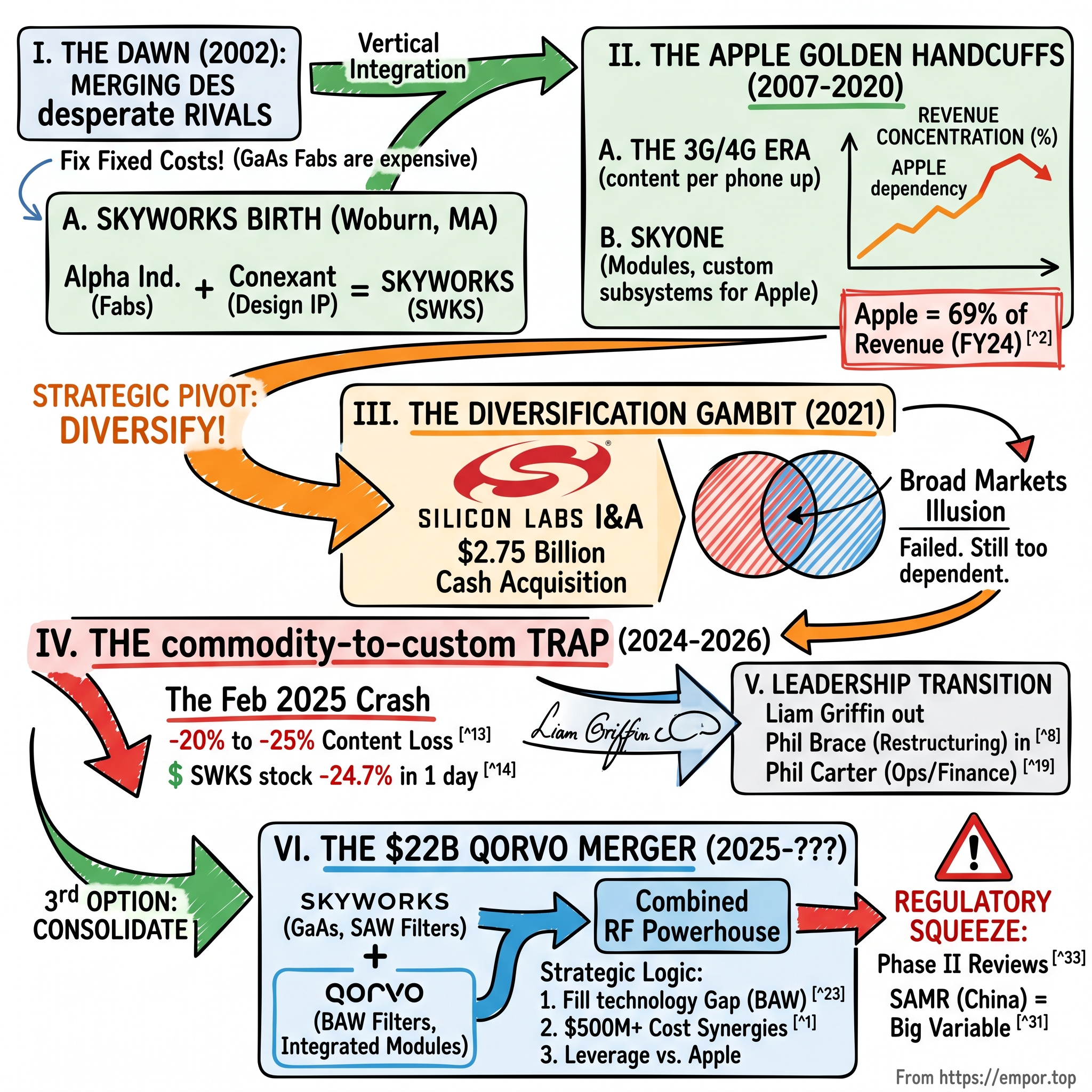
Skyworks Solutions: The Apple Golden Handcuffs & the $22 Billion Consolidation Gambit
I. Introduction & Episode Roadmap: The RF Pure-Plays' Last Stand
On the morning of October 28, 2025, two companies that had spent a decade trying to take food off each other's plate walked onto the same conference call and announced they were becoming one company.
Skyworks Solutions and Qorvo — the two American pure-play radio frequency semiconductor houses, headquartered 700 miles apart, staffed by engineers who had poached each other's talent and undercut each other's quotes inside the same customer's procurement office — signed a definitive agreement to combine in a cash-and-stock transaction valuing the combined enterprise at roughly $22 billion.1 Qorvo shareholders would receive $32.50 in cash plus 0.960 Skyworks shares for each Qorvo share. Skyworks holders would own about 63% of the result; Qorvo holders about 37%. Phil Brace, who had been Skyworks' chief executive for barely eight months, would run the whole thing.1
The number that makes the deal legible is not the $22 billion. It is this: the combined company would generate roughly $7.7 billion in revenue, of which $5.1 billion — two-thirds — comes from mobile handsets.1 And within that mobile business sits one customer whose purchasing decisions have, for a decade, functioned as something closer to weather than to commerce.
That customer is Apple. In fiscal 2024, Apple represented approximately 69% of Skyworks' total revenue.2 Qorvo, the supposed arch-rival, derived 47% of its fiscal 2025 revenue from the same company.3 Two independent suppliers, both existentially levered to one buyer, both watching that buyer methodically build the capability to make their products in-house.
This is a story about what economists call monopsony — a market with one dominant buyer — and what it does to the people selling into it. Skyworks is one of the cleanest natural experiments in the modern semiconductor industry: a company with genuinely differentiated manufacturing technology, decades of accumulated process knowledge, world-class engineering, real intellectual property, phenomenal free cash flow generation — and almost no pricing power, because the entity on the other side of the table can move billions of dollars of volume with a single sourcing decision.
Four threads run through what follows.
The physical magic of RF. Radio frequency engineering is the part of a smartphone that behaves least like software and most like plumbing. It does not run on ordinary silicon. It runs on exotic compound materials — gallium arsenide, silicon-on-insulator, piezoelectric crystals — assembled by people who talk about their fabs the way vintners talk about soil. Understanding why this is hard is essential to understanding why the moat is real, and why the moat has not protected margins.
The Apple golden handcuffs. Landing Apple is the best thing that ever happened to Skyworks, and it may prove to be the worst. Volume at that scale funds fabs, funds R&D, funds buybacks. It also standardises your roadmap around one customer's product cycle, hands that customer perfect visibility into your cost structure, and makes every negotiation a game you are structurally set up to lose.
The capital allocation pivot. Skyworks saw the concentration problem coming and tried to buy its way out, paying $2.75 billion in cash for Silicon Labs' Infrastructure & Automotive business in 2021.4 It did not work as advertised. By fiscal 2024, Skyworks was more Apple-dependent than before the deal, not less.
The playbook for the commodity-to-custom trap. When your biggest customer starts designing what you sell, you have three options: diversify, differentiate, or consolidate. Skyworks tried the first two. The 2025 merger is the third.
The deal has not closed. As of late July 2026 it sits inside the Chinese antitrust review, which is the single largest variable in the story. Whether it closes on the companies' hoped-for timeline, closes late with remedies, or does not close at all, the Skyworks-Qorvo saga is the definitive case study of what happens when the supply side of an industry finally decides that competing with each other is a worse business than negotiating together.
To understand why two rivals surrendered their independence, you have to go back to the last time an RF company survived a crisis by merging with the enemy — which is, as it happens, how Skyworks was born in the first place.
 Subscribe on LinkedIn
II. The Compound Semiconductor Genesis: Merging Fabs and Design IP (1962–2002)
In 2001, the telecom equipment market did not slow down. It stopped.
The dot-com and telecom capital expenditure bust wiped out order books across the components industry in a matter of quarters. Handset makers cut builds. Optical networking evaporated. And a particular class of company — the pure-play radio frequency semiconductor supplier, with an expensive specialty fab and no diversification — discovered that a factory running at 30% utilisation is not an asset. It is a liability with a property tax bill.
Two such companies were staring at each other across the wreckage.
Alpha Industries: the fab
The older of the two was Alpha Industries, founded in 1962 and headquartered in Woburn, Massachusetts, in the industrial ring north of Boston that grew up around defence electronics and MIT spin-outs. Alpha spent its first three decades doing something unglamorous and difficult: making components out of gallium arsenide.
A brief detour into why that matters. Ordinary computer chips are made of silicon — cheap, abundant, and extraordinarily well understood. Silicon is superb at switching digital ones and zeros. It is mediocre at handling high-frequency, high-power analog signals, because electrons move through it relatively slowly and it breaks down under voltage stress. Gallium arsenide is a compound of two elements rather than one, and it has properties silicon does not: electrons travel through it several times faster, and it tolerates higher voltages before failing. For the specific job of taking a weak radio signal and amplifying it hard enough to reach a cell tower several kilometres away without cooking the phone in your hand, GaAs is simply better physics.
The catch is that GaAs is a nightmare to manufacture. The wafers are brittle, the yields are temperamental, and the process recipes are less like software and more like cooking — accumulated over years of running the same lines and learning what breaks. Alpha had been running those lines since the Kennedy administration, mostly for military radar, defence systems, and industrial microwave applications, long before anyone carried a phone in a pocket.
Conexant: the design IP
The younger company came out of an entirely different lineage. Rockwell International — the aerospace and defence conglomerate behind the Space Shuttle orbiter and a great deal of Cold War avionics — had a semiconductor division with world-class expertise in RF and signal processing. In January 1999, at the peak of enthusiasm for pure-play chip businesses, Rockwell spun that division out as an independent public company: Conexant Systems, led by Dwight Decker.5
Conexant's timing looked inspired for about eighteen months. It owned the dial-up modem chipset market and had a genuinely strong wireless handset design organisation. Then the market it was built for disappeared twice over — broadband killed dial-up, and the telecom bust killed the capital spending.
The merger of the desperate
What Alpha had was manufacturing capacity and process knowledge with nothing profitable to run through it. What Conexant's wireless business had was a portfolio of designs and customer relationships with no captive factory. Neither was viable alone at the bottom of the cycle. Together they were something the industry did not otherwise have: a vertically integrated RF specialist that could design a part and build it in its own fab.
In December 2001 the two announced the transaction. Conexant would spin off its wireless communications business and merge it with Alpha, creating what the companies described as the pure-play leader in mobile communications semiconductors.6 The name for the combined entity — Skyworks Solutions — was chosen and announced in the run-up to closing.7 Alpha shareholders approved, and in late June 2002 the merger closed and Skyworks commenced operations as an independent company trading on NASDAQ.5
David Aldrich, Alpha's chief executive, ran the combined business. Decker became chairman.5 The company kept a corporate address in Southern California, near the Conexant roots, but the physical heart of it stayed in Woburn, where the wafers came out.
What the founding actually established
Two things about that 2002 transaction deserve to be held onto, because they repeat.
First, the logic was defensive, not visionary. This was not two strong companies combining to attack a growing market. It was two damaged companies combining because the fixed-cost structure of compound semiconductor manufacturing punishes subscale players brutally. A GaAs fab costs roughly the same to operate whether it is running at 45% or 90% of capacity; the difference between those two states is the difference between losing money and printing it. Consolidation was the mechanism for fixing utilisation.
Second, the combination bet on integration at a moment when the entire semiconductor industry was betting the other way. The fashionable model in 2002 was fabless — design the chip, outsource the manufacturing to a foundry, keep the balance sheet light. Skyworks went the opposite direction, and it was right, for a reason specific to its physics. There was no TSMC for gallium arsenide. There was no merchant foundry ecosystem with the scale and learning curve to make outsourcing cheaper than doing it yourself. Owning the fab was not a legacy burden; it was the differentiator.
For an investor, the founding logic sets up the central tension of everything that follows. Skyworks' advantage has always been manufacturing — an advantage that is real, durable, and extremely hard to replicate. But manufacturing advantages express themselves in cost, not in price. They let you earn more on a given part than a competitor would. They do not let you charge more. Which is a fine business right up until the customer discovers exactly how much you are earning.
That customer was still five years from existing. In the meantime, there was a Finnish company to serve.
III. The Cellular Gold Rush: Riding Nokia to the iPhone Revolution (2002–2010)
In 2003, the most important building in the mobile phone industry was in Espoo, Finland, and everyone in the RF business understood that their job was to keep the people inside it happy.
Nokia at its peak sold roughly two of every five handsets on earth. Its supply chain organisation was legendary — rigorous, demanding, and utterly unsentimental about price. For a young Skyworks, Nokia was both the opportunity and the education. Winning a Nokia socket meant volumes that could fill a Woburn fab. It also meant annual price-down negotiations conducted with the warmth of a tax audit.
The technical work in that era was, by later standards, almost quaint. A 2003 mobile phone needed to operate on one or two cellular frequency bands. That meant one or two power amplifiers, a handful of switches, and a filter or two. These were discrete components — separate parts, soldered separately onto a circuit board, each sourced independently. The buyer's job was to get the cheapest acceptable part in each slot. The supplier's job was to be the cheapest acceptable part.
In that world Skyworks' vertical integration was worth exactly what the 2002 merger thesis said it would be: a cost advantage. Competitors who designed GaAs parts and had them fabricated elsewhere paid a foundry margin and waited in a foundry queue. Skyworks paid neither. It shipped enormous volumes of reliable, unglamorous components and made a modest but real spread doing it.
2007: the year the requirements changed
On January 9, 2007, Steve Jobs walked onto a stage in San Francisco and introduced a phone. Almost nothing about the first iPhone was interesting to a radio frequency engineer. It ran on 2G EDGE — the slower, older network standard — and its RF architecture was unremarkable. Analysts at the time noted, correctly, that the radio was the least impressive component in the device.
What changed was not the hardware. It was what people started doing with the hardware.
Once a phone had a browser worth using, an app store, and a screen big enough to watch things on, the traffic profile of the cellular network inverted. Phones stopped being devices that occasionally sent voice and text and became devices that continuously pulled data. That created pressure on the network operators, who responded by deploying 3G and then buying and lighting up every scrap of spectrum they could acquire.
Here is where the story becomes physics.
Why radio is hard, explained without the mathematics
A cell tower may be several kilometres from your phone, and the signal has to survive concrete, weather, foliage, and the interference of every other phone doing the same thing. Four jobs have to happen inside the handset for that to work.
The signal going out has to be amplified — a power amplifier takes the tiny output of the modem and boosts it enough to reach the tower. This is where most of the phone's battery goes when you are on a call in a weak-signal area, and it is where GaAs earns its keep.
The signal coming in is unimaginably faint and has to be amplified without adding noise, which is a different and more delicate problem, handled by low-noise amplifiers.
Both directions have to be filtered. This is the underappreciated one. Your phone's radio is trying to hear one specific conversation in a stadium where thousands of other conversations are happening at overlapping pitches. A filter is a component that passes one narrow band of frequencies and rejects everything else. Good filters are the difference between a phone that works at the edge of coverage and one that does not. They are made from piezoelectric materials that physically vibrate at precise frequencies — mechanical resonators, not transistors — and their manufacture is closer to precision ceramics than to logic chips.
And everything has to be switched — routed to the right antenna, the right band, the right path, thousands of times a second.
Every one of these functions has to fit inside a device that is getting thinner, next to a battery that is getting bigger, without generating heat you can feel or interference that degrades the Wi-Fi.
The bottleneck becomes the business
The 3G transition, and particularly the iPhone 3G and 3GS, established the pattern that would define Skyworks for the next fifteen years: every generational improvement in mobile connectivity increased the amount of radio frequency content in a phone, and the increase was non-linear. Supporting two bands is roughly twice as hard as supporting one. Supporting eight is far more than four times as hard as supporting two, because the bands begin interfering with each other and every additional path adds a new opportunity for signal loss.
For a company that owned compound semiconductor fabs and knew how to package RF components without them cross-talking, this was the ideal market structure. The problem was getting harder every year, and hard problems support margins.
The setup entering the next decade was therefore extraordinarily favourable. Skyworks had a manufacturing base that could not be easily replicated, a technical problem that was compounding in difficulty, and a customer base that was consolidating toward a small number of very large buyers.
That last item was the one that would eventually matter most. In 2010, it looked like the best news of all.
IV. The Apple Golden Handcuffs & the Engineering Triumph of SkyOne (2010–2020)
The number that broke the old model was somewhere between thirty and forty.
That is roughly how many discrete cellular frequency bands a global flagship smartphone needed to support by the middle of the 2010s, up from about five at the start of the decade. Fourth-generation LTE networks did not use one big block of spectrum; they used dozens of fragmented slices, allocated differently in every country, cobbled together from whatever the regulators had auctioned. A phone that wanted to work in Tokyo, Frankfurt, São Paulo and Chicago had to handle all of them.
Do the arithmetic on the old architecture and it collapses. Forty bands, each needing its own amplification path, its own filter, its own switching — that is hundreds of discrete components competing for board area with a battery, a camera stack, and a processor. There is no version of that phone that fits in a pocket.
SkyOne and the black-box strategy
Skyworks' answer, developed through the early 2010s and commercialised as the SkyOne family, was to stop selling components and start selling a subsystem.
The idea sounds simple and is not. Instead of shipping a power amplifier here and a switch there, Skyworks packaged the whole front end — GaAs power amplifiers, silicon-on-insulator switches, temperature-compensated surface acoustic wave filters, matching networks, control logic — into a single multi-chip module. Different materials, different manufacturing processes, different thermal behaviours, all co-designed and assembled into one part that a handset maker could drop onto a board.
Three things made this hard enough to be defensible.
The first was materials heterogeneity. You cannot make a good power amplifier and a good filter and a good switch out of the same substance. GaAs for the amplifier, silicon-on-insulator for the switch, piezoelectric crystal for the filter. Integrating them means solving packaging problems — heat, interference, physical stress at the boundaries between materials with different expansion rates.
The second was co-optimisation. A module is not the sum of its parts; the parts interact. Getting a module to work well requires tuning components against each other, which requires controlling all of them. A company sourcing filters from a third party is designing with one hand.
The third was assembly scale. Skyworks built out an enormous assembly and test operation in Mexicali, Mexico, which became one of the largest RF module assembly sites in the world. Module assembly at handset volumes is its own manufacturing discipline, with its own learning curve.
The commercial effect was that Skyworks stopped competing on the price of an amplifier and started competing on the performance of a system. Average selling prices for a front-end module were multiples of what the discrete parts had commanded. Dollar content per phone rose through the 4G decade for essentially every generation.
Enter the customer
Apple was the natural buyer for exactly this product. It designed its own boards, controlled its own supply chain, cared obsessively about internal volume, and shipped enough units that dedicating manufacturing capacity to Apple-specific parts was economically rational for a supplier.
Under David Aldrich and then, from 2016, under Liam Griffin — a Skyworks lifer who had joined in 2001, run sales and marketing, and been promoted from president to chief executive8 — Skyworks became one of Apple's most important RF partners. Griffin's public posture was consistently, relentlessly optimistic: every earnings call framed the RF content story as an escalator that only went up, driven by new standards, new bands, and new connected devices.
For most of a decade, the escalator ran. The financial signature of the Apple relationship was distinctive: non-GAAP gross margins in the high forties to low fifties, operating margins in the mid-thirties, and free cash flow conversion that would embarrass most software companies. Skyworks returned that cash aggressively through buybacks and a growing dividend, and the market rewarded it with a semiconductor multiple.
The trap inside the trade
But look at what the arrangement actually was, stripped of the language of partnership.
Skyworks was building custom parts, on dedicated lines, funded by its own capital expenditure, for a customer that designed the specification, controlled the volume forecast, knew the bill of materials cost of every competing option, and made sourcing decisions annually. Every dollar of capacity Skyworks committed to Apple made it more dependent on Apple. Every year of co-design gave Apple a clearer picture of how the modules were built.
This is the structure of monopsony, and its defining characteristic is that the supplier's quality does not protect it. Skyworks was very good. Being very good got it the volume. It did not get it the pricing power, because the alternative to Skyworks was never zero — it was Qorvo, or Broadcom, or Murata, or, eventually, Apple itself.
The competitive board, circa 2018
The RF front-end market had settled into an uneasy division of territory. Broadcom held the ultra-premium high-frequency filter positions with its proprietary bulk acoustic wave technology — the filters that handle the crowded, high-frequency bands where the acoustic-wave filters Skyworks made begin to lose performance. Skyworks and Qorvo split the very large mid- and low-band integrated module business between them, dual-sourced by design. Qualcomm, which owned the baseband modem, spent the back half of the decade openly building an RF front-end business on the theory that customers would eventually prefer to buy the modem and the radio together.
Four suppliers, one enormous buyer, and a technology roadmap the buyer increasingly wrote itself. Skyworks' management spent the second half of the decade telling investors that the answer was diversification — that the growth of connected devices beyond the smartphone would gradually reduce the concentration.
In 2021, they put $2.75 billion behind that claim.
V. The Diversification Gambit: Silicon Labs & the Broad Markets Illusion (2020–2024)
The 5G story that the semiconductor industry told itself in 2019 and 2020 went roughly like this. A new cellular standard arrives. It requires more spectrum, at higher frequencies, with more complex antenna arrangements. RF content per phone rises sharply. Meanwhile, consumers upgrade to get the new thing, so unit volumes rise too. Content times units — a supercycle.
Half of it happened.
The content half was real. 5G did increase RF complexity substantially, adding new mid-band spectrum, more carrier aggregation combinations, and in some markets millimetre-wave, which operates at frequencies so high that the signal struggles to pass through a hand. Dollar content per flagship phone went up.
The unit half did not happen. Consumers, it turned out, could not perceive much difference between a good 4G connection and a typical 5G one. Handset replacement cycles, which had run around two years in the early smartphone era, stretched toward three and four. Global smartphone unit volumes plateaued and then declined. The escalator stopped.
Skyworks management could see this coming, and to their credit they acted before it fully arrived.
Buying a second leg
In April 2021 Skyworks agreed to acquire the Infrastructure & Automotive business of Silicon Laboratories for $2.75 billion in cash, closing the transaction on July 26, 2021.49 The assets were Silicon Labs' power and isolation products, timing devices, and broadcast product lines — components used in industrial equipment, electric vehicles, data centre infrastructure, and connected devices.10
The strategic logic was clean and, at the time, well received. These were higher-margin, longer-lifecycle, more fragmented markets. An automotive component designed into a vehicle platform ships for seven years and is nearly impossible to displace mid-programme. An industrial customer buying isolation chips does not have a procurement organisation capable of squeezing a supplier the way a handset giant does. Skyworks told investors the transaction would push total revenue past $5 billion with Broad Markets reaching roughly 40% of the mix.4
It was the right idea. The execution ran into two problems, one of timing and one of arithmetic.
The timing problem
The deal closed at almost precisely the top of the post-pandemic semiconductor cycle. Through 2021 and into 2022, industrial and automotive customers, terrified of the chip shortage, ordered far more components than they could consume and stockpiled them. Distributors did the same. Demand as measured by orders wildly exceeded demand as measured by end consumption.
When the correction came in 2023, it was severe and it lasted. Industrial and automotive customers stopped ordering entirely while they burned through inventory. Skyworks' Broad Markets revenue, which was supposed to be the stabiliser, fell hard at exactly the moment mobile was also weakening. Instead of offsetting cyclicality, the acquired business amplified it.
This is a genuinely important lesson and not one specific to Skyworks: a diversification acquisition only diversifies if the acquired cash flows are uncorrelated with the existing ones. Semiconductor end markets, it turned out, were far more correlated in 2023 than the segment labels suggested.
The arithmetic problem
The deeper issue was scale. Skyworks bought roughly $400 million of annualised revenue in a business that could grow at perhaps high single digits in a good year. Its mobile business, at the time, was doing several billion. Diversifying a concentration problem by acquisition requires the acquired business to grow dramatically faster than the concentrated one, for a long time, or to be very large relative to it. Neither condition held.
The results were unambiguous. By fiscal 2024, Skyworks' total revenue had fallen to $4.178 billion,11 and Apple's share of that revenue had risen to approximately 69% — up, not down, from the prior year.2 Three years and $2.75 billion after launching an explicit programme to reduce customer concentration, the company was more concentrated than when it started.
Management's narrative during this period deserves scrutiny. Investor communications continued to emphasise the growth of Broad Markets and the strength of the mobile franchise, while the composite metric that actually mattered — the proportion of the company dependent on one buyer's sourcing decisions — moved in the wrong direction. That is not fraud; it is selective framing, and it is the kind of thing a long-term investor should learn to detect by tracking the metric management does not lead with.
The competitive squeeze tightens
Meanwhile, the threat vector Skyworks had always described as distant began arriving.
In May 2023, Apple announced a multiyear, multibillion-dollar agreement with Broadcom for 5G radio frequency components, including filters, to be designed and built in the United States.[^12] For Skyworks, the specific technology mattered as much as the dollars: it locked a competitor into precisely the high-frequency filter positions Skyworks could not fully serve with its own filter technology.
Simultaneously, Apple's long-running internal modem programme continued. A company that designs its own modem is a company that can, in time, design or specify the radio around it — and one that has every incentive to reduce the number of external suppliers capturing value in the RF chain.
And at the low end, a set of Chinese competitors was scaling fast. 江苏卓胜微电子股份有限公司 Maxscend Microelectronics and 唯捷创芯 Vanchip had spent years climbing from discrete switches and low-noise amplifiers into integrated modules, backed by domestic handset makers keen to reduce dependence on American suppliers. They did not need to beat Skyworks on performance. They needed to be good enough in the mass-market Android tier, at a lower price, which they increasingly were.
By the end of fiscal 2024, the shape of the problem was fully visible: a shrinking premium franchise, a hostile low end, a stalled diversification, and one customer holding most of the cards. What happened next happened fast.
VI. The 2025 Leadership Transition & Changing of the Guard
The date to remember is February 5, 2025.
That afternoon, Skyworks reported December-quarter results that were, on the face of it, fine. Revenue came in at $1.068 billion. Broad Markets returned to year-on-year growth. The largest customer had grown 9% sequentially and represented 72% of total company revenue.12
Then chief financial officer Kris Sennesael described what would happen with the next iPhone. Skyworks had retained sockets, he explained, including highly integrated RF modules — but it had lost single-source positioning on several of them to dual-sourcing. The company's content position at its largest customer was expected to be down 20% to 25%, beginning to hit revenue in the fourth quarter of fiscal 2025 and running through fiscal 2026.12
The following day, Skyworks shares fell 24.7%, closing at $65.60 — the worst single-day decline in the stock in over 37 years.13
On the same day, the company announced that Liam Griffin was stepping down as president, chief executive and director. Philip Brace would take over effective February 17, 2025. Christine King, lead independent director since 2019, became chairman.8
Reading the transition honestly
The company framed the succession as the conclusion of a board-run process conducted with an executive search firm.8 That may be entirely accurate. It is also true that announcing a chief executive change on the same day as a disclosure that cost the stock a quarter of its value invites a simpler reading: the board had lost confidence in the strategy, and the strategy's principal author departed with it.
The rest of the leadership followed. In May 2025, Skyworks announced further leadership changes,14 and Western Digital disclosed that it had hired Sennesael as its chief financial officer effective May 12, 2025.15 Within four months, both executives who had built and narrated the 4G/5G Apple cash machine were gone.
The disclosure itself produced litigation. Investors filed securities fraud claims covering purchases between July 30, 2024 and February 5, 2025, alleging that the company and its executives had made optimistic statements about the Apple relationship and about Skyworks' positioning in the artificial intelligence smartphone cycle while omitting that the content position was at risk.13 More than a year later, on May 6, 2026, Judge David O. Carter of the U.S. District Court for the Central District of California denied the defendants' motion to dismiss, holding that the plaintiffs had adequately pleaded actionable omissions, scienter, and control-person liability.2 The case is proceeding.16
For an investor assessing management credibility, this matters less as a legal exposure — securities class actions of this type are common and frequently settle — than as a data point about disclosure culture. A court found the allegation of material omission plausible enough to survive dismissal. That is a reason to read the prior regime's confident framing of the Apple relationship with retrospective scepticism, and to hold the current regime to a stricter evidentiary standard.
Who is Phil Brace
Brace arrived with a résumé that is conspicuously not that of an RF industry insider. He had been executive chairman of Inseego and, before that, president and chief executive of Sierra Wireless. Earlier, he held senior roles at Seagate and at LSI, spanning software, hardware, engineering, marketing and sales across the semiconductor, server, storage and connected-device industries.817
The pattern in that career is operational restructuring — taking businesses with real technology and impaired economics and fixing the cost structure, the portfolio, and the discipline. He was not hired to invent a new radio architecture. He was hired to run the company like a business with a finite runway.
He inherited one. Fiscal 2025 revenue came in at $4.087 billion, down again from the prior year.11 GAAP gross margin was 41.2% against a non-GAAP figure of 46.7%11 — a wide gap that reflects, among other things, the cost of underloaded fabs and acquisition-related amortisation. When your factories are fixed-cost assets and your volumes are shrinking, gross margin erodes even if you never cut a price.
Carter returns
In August 2025, Skyworks named Philip Carter senior vice president and chief financial officer, effective September 8, 2025. Carter joined from Advanced Micro Devices, where he had been corporate vice president and chief accounting officer since November 2024 — and before that, he had spent years inside Skyworks' own finance organisation.18
The combination is worth pausing on. Brace brought outside operational detachment; Carter brought internal institutional memory of exactly how the cost structure worked and where the bodies were buried. It is a pairing well suited to two tasks: rigorous cost reduction, and executing a large transaction.
Both men could see the same arithmetic. Organic growth in the Android tier was being competed away by Chinese suppliers who did not need to earn Skyworks' margins. Broad Markets was growing but too small to change the composition of the company quickly. And in the single negotiation that determined most of the company's revenue, Skyworks sat across from a buyer that could always turn to Qorvo.
Unless, of course, there were no Qorvo to turn to.
VII. Consolidation Chess: Inside the $22 Billion Qorvo Merger (Late 2025–2026)
The merger agreement was signed on October 27, 2025, and announced the following morning.1
Set aside the deal mechanics for a moment and consider what the announcement was, structurally. It was two suppliers to the same dominant buyer proposing to stop being two suppliers. Every element of the transaction — the technology fit, the cost synergies, the pro forma segment disclosure — is downstream of that single fact.
The terms
Qorvo shareholders would receive $32.50 in cash plus 0.960 Skyworks shares per Qorvo share, leaving Skyworks holders with approximately 63% of the combined company on a fully diluted basis and Qorvo holders with 37%.1 The combined business was presented as roughly $7.7 billion of revenue and $2.1 billion of adjusted EBITDA, split between a $5.1 billion mobile business and a $2.6 billion diversified Broad Markets business spanning defence and aerospace, edge IoT, AI data centre, and automotive.1
Governance tilted decisively toward the acquirer. Phil Brace would be chief executive of the combined company. Bob Bruggeworth — who had run Qorvo since its own formation and RF Micro Devices before that — would join the board rather than share the executive suite. The eleven-member board would seat eight Skyworks directors and three from Qorvo.1 For a transaction publicly framed as a combination of peers, the control provisions read as an acquisition.
The cash component required funding. Skyworks obtained a commitment on the signing date from Goldman Sachs Bank USA for up to $3.05 billion of senior unsecured bridge term loans, and the transaction carries no financing condition.19 Pro forma, the combined company was expected to carry roughly $3.3 billion of net debt — the $3.1 billion of cash consideration plus Qorvo's net debt, partially offset by Skyworks' net cash.19 Skyworks subsequently launched an exchange offer covering approximately $1.55 billion of Qorvo notes as part of the capital structure work.20
The break-fee architecture reveals how the parties allocated risk. Skyworks would owe Qorvo $298.7 million in a limited set of circumstances involving a superior proposal or a change in board recommendation, and $100.0 million in certain regulatory outcomes — an antitrust injunction, or failure to obtain required approvals by the outside date. That outside date was set at April 27, 2027, extendable twice, to July 27 and then October 27, 2027.21
A $100 million regulatory break fee on a $22 billion transaction is a small number. It tells you the parties expected a long and difficult antitrust process and negotiated accordingly.
The technological logic: what a filter actually is, and why Qorvo had the one Skyworks lacked
The most defensible part of the industrial rationale is the filter portfolio, and it requires a short explanation.
A radio frequency filter is a mechanical device pretending to be an electrical one. Apply a voltage to certain crystalline materials and they physically deform; let them vibrate and they generate a voltage. Build a structure that resonates at exactly one frequency and you have a component that passes signals at that frequency and rejects everything else.
There are two dominant ways to build one. Surface acoustic wave filters send the vibration across the surface of the crystal. They are cheaper, mature, and excellent at lower frequencies — and Skyworks, with its temperature-compensated SAW variants, was among the best in the world at them. Bulk acoustic wave filters send the vibration through the thickness of a thin film. They are far harder and more expensive to manufacture, and they are dramatically better at high frequencies, where SAW filters lose sharpness and leak signal.
As 4G and then 5G pushed spectrum higher — past 2.5 GHz and beyond — the bands that mattered most for capacity became precisely the bands where SAW filters struggle. Which is why Broadcom's proprietary bulk-acoustic technology commanded premium positions in flagship phones, and why Apple signed a multiyear, multibillion-dollar agreement with Broadcom in 2023 specifically covering filters.[^12]
Skyworks had a hole in its portfolio at the highest-value end of the market. Qorvo had exactly the technology that filled it: an industry-leading BAW capability inherited from TriQuint, which merged with RF Micro Devices on January 1, 2015 to form Qorvo,22 and manufactured at Qorvo's Richardson, Texas facility — into which Qorvo had been consolidating both BAW and, later, SAW production.
Combining the two would, on paper, give a single company the ability to build a complete front-end module — low, mid, high and ultra-high band — without partnering for the hardest filters. That is a genuine capability gain, not merely a financial one. It is also the exact overlap that makes antitrust regulators pay attention.
The cost logic
The synergy target is $500 million or more of annual cost savings within 24 to 36 months of closing.1 Against a combined operating expense and cost base of that size, it is aggressive but not fanciful, and it comes from two identifiable places.
The first is manufacturing loading. Compound semiconductor fabs are high-fixed-cost assets whose profitability is almost entirely a function of utilisation. Both companies ran their fabs below capacity through the 2024–2025 downturn — which is precisely why Skyworks' GAAP gross margin sat five and a half points below its non-GAAP figure in fiscal 2025.11 Consolidating production across Woburn, Newbury Park, Richardson and Mexicali, closing or repurposing redundant capacity, and running the survivors hot is the single largest available lever on gross margin.
The second is duplicated engineering. Skyworks spent $785.5 million on research and development in fiscal 2025, up sharply from $631.7 million in fiscal 2024.21 Note what that increase means: R&D rose roughly 24% while revenue fell. The company was spending more to defend a shrinking position. A meaningful fraction of that spending, across both companies, went into developing competing solutions for the same customer's same socket — the most economically wasteful form of R&D there is. Eliminating it does not reduce the combined company's capability; it reduces the number of times two teams solve one problem.
The real prize: changing who has options
Here is the part the press release does not say out loud.
Separately, Skyworks and Qorvo were each structurally weak in the same negotiation. Skyworks derived roughly 69% of fiscal 2024 revenue from Apple;2 Qorvo derived 47% of fiscal 2025 revenue from the same customer.3 Each could be told, credibly, that the business would go to the other one. That is the entire mechanism by which a monopsonist extracts price: not by being unreasonable, but by having an alternative.
Combined, the alternatives narrow. A single company holding the majority of the world's non-Broadcom acoustic filter and integrated module capability is harder to walk away from. Designing both suppliers out simultaneously would require either a long internal development programme or an acceptance of lower RF performance — and RF performance is the thing users experience as "my phone has no bars."
That is the bull case for the merger, stated plainly. It is a bargaining-power transaction dressed as a technology transaction.
But it should be tested rather than accepted, and there are three honest objections.
Apple is not passive. The buyer whose leverage this deal is designed to reduce also happens to be a regulatory stakeholder's most important constituent in several jurisdictions, and a company with an internal modem programme and deep pockets. Reducing a customer's optionality is a strategy that invites the customer to create new options.
The merger does not solve the filter problem at the very top. Broadcom retains its position. The combined company closes a gap relative to where Skyworks stood alone; it does not become the sole supplier of high-band filtering.
Synergies are the certain part; revenue is not. In supplier consolidations, large customers routinely respond by qualifying a third source or reallocating volume specifically to prevent the consolidation from producing pricing power. Some revenue dis-synergy is close to a base case, and neither company has publicly quantified an expectation for it.
Which brings the story to the people who get to decide whether any of it happens.
VIII. RF Front-End Economics & Hamilton Helmer's 7 Powers
Strip the RF front-end business down to its structure and it becomes a useful teaching case, because almost every force in it points the same direction: toward the buyer.
Porter's five forces, applied honestly
Bargaining power of buyers — historically overwhelming, now the entire strategic question. This is not a market with many customers of varying size. It is a market where a handful of handset platforms account for the overwhelming majority of premium volume, and where one of them alone has represented between 60% and 72% of Skyworks' revenue in recent quarters.122324 Buyers of that scale set the specification, dual-source deliberately, and possess near-perfect information about supplier cost structures through years of co-design. The merger is a direct attempt to move this force, and it is the only force in the framework the combined company can meaningfully act on.
Threat of substitutes — high and rising, and it comes from inside the customer. The substitute here is not a different chip; it is the customer's own design organisation, or a platform vendor's bundle. Apple's internal silicon programme has systematically absorbed functions once bought externally. Qualcomm has spent years pushing an integrated modem-plus-RF proposition on the argument that a single vendor tuning both ends of the radio chain achieves better performance. Neither threat has yet materialised at full scale in the flagship RF front-end, but both are live.
Competitive rivalry — intense, and the merger's whole purpose is to reduce it. Pre-deal, three credible Western suppliers chased the same premium sockets, with Chinese entrants attacking from below. Post-deal, in the mid- and low-band integrated module category, the structure would resemble a duopoly. This is what regulators are examining.
Threat of new entrants — genuinely low. Not because of patents, though there are many, but because of accumulated process knowledge. A new entrant would need a compound semiconductor fab, an acoustic filter capability, module assembly at handset scale, and a decade of yield learning. Capital alone does not buy this.
Supplier power — moderate and underappreciated. These businesses are exposed to specialty substrate suppliers, precious metals, and specialised packaging materials. On the fiscal second-quarter 2026 call, chief financial officer Philip Carter flagged input costs — expedite fees and elevated precious metal pricing — as a modest headwind to gross margin.24 Small in isolation; a reminder that the cost side is not fully controllable.
Seven Powers, and where the claims hold up
Process power — the strongest and most defensible claim. Operating a gallium arsenide fab profitably is closer to a craft than to a science, and the knowledge lives in the people who run the lines and the recipes accumulated over decades. Woburn has been making compound semiconductors since the 1960s; Richardson has been refining BAW manufacturing for well over a decade. This power is real, it is unusual in an industry that has largely outsourced manufacturing, and it is the reason the barriers to entry hold. Its limitation is the one identified in the founding chapter: process power shows up as cost advantage, and a cost advantage against a buyer with full visibility into your costs is an advantage the buyer can capture.
Scale economies — the explicit thesis of the merger, and plausible. Amortising a combined R&D budget approaching or exceeding $1 billion and a combined fab footprint across $7.7 billion of revenue1 rather than two smaller bases is arithmetically sound. It is also the power most dependent on the deal actually closing.
Cornered resource — moderate, and narrower than the marketing suggests. Qorvo's BAW intellectual property and manufacturing know-how is a genuine cornered resource in the sense that very few organisations on earth possess it. But Broadcom possesses a competing version, and Japanese acoustic-wave specialists have their own. It is a scarce resource, not a unique one.
Switching costs — high in Broad Markets, weak where the money is. This asymmetry is the crux of the entire investment case. An isolation or timing component designed into a vehicle platform or an industrial system stays there for years; requalifying it is expensive and risky, which is why those revenues are stickier and better-priced. A smartphone front-end module is requalified every product cycle by an organisation that has built dual-sourcing into its process precisely to keep switching costs low. Skyworks has strong switching costs in the third of its business that is small and growing, and weak ones in the two-thirds that is large and cyclical.
Counter-positioning, branding, network economies — largely absent. No component supplier in this category enjoys them meaningfully, and it would be a mistake to construct a bull case that assumes otherwise.
What the framework says
Put together, the picture is a business with unusually durable defensive characteristics — barriers to entry, manufacturing know-how, capital intensity that deters challengers — attached to unusually poor bargaining position. That combination produces exactly the financial profile Skyworks has: high absolute cash generation, respectable returns on capital across a cycle, and almost no ability to set price.
The merger is best understood as an attempt to convert a defensive moat into offensive leverage. Whether that conversion is permitted is now a question for regulators in three countries.
IX. The Investor Stress Test: Bull vs. Bear Case & the Regulatory Radar
By mid-2026, the story had acquired a peculiar shape: the operating business was performing better than expected almost every quarter, and the thing that would determine most of the equity value was being decided in government offices.
The operating record under new management
Give the current management team its due. The results since Brace took over have been consistently better than the company's own guidance, and the improvement has come from the right places.
In the first fiscal quarter of 2026, reported in early February, revenue of $1.035 billion beat the $975 million–$1.025 billion guidance range, non-GAAP gross margin came in at 46.6%, and non-GAAP earnings of $1.54 per share exceeded the $1.40 guided midpoint. Broad Markets grew 11% year on year — its eighth consecutive quarter of growth — led by Wi-Fi 7 and data centre and cloud infrastructure programmes, while free cash flow reached $339 million.2523 Brace framed the quarter as the fourth consecutive period of outperformance across revenue, gross margin and earnings.25
In the second fiscal quarter, reported May 5, 2026, revenue of $944 million again exceeded the high end of guidance, with gross margin of 45% in line with the midpoint. Mobile, at 58% of revenue, beat expectations on healthy sell-through at the top customer; Broad Markets, at 42% of sales, grew 10% year on year across Wi-Fi, data centre and automotive.2624
Two disclosures from that call carry more weight than the headline numbers.
First, the largest customer represented approximately 60% of revenue24 — down from roughly 67% in the December quarter23 and 72% two years earlier.12 The concentration is finally falling. But it is worth being precise about the mechanism: it is falling substantially because Apple content declined following the socket losses disclosed in February 2025, and because Broad Markets grew into the gap. Diversification achieved partly by losing revenue at the concentrated customer is real diversification, but it is not the same as diversification achieved by winning elsewhere.
Second, management announced a multigenerational design win with a leading Android original equipment manufacturer expected to generate more than $1 billion of revenue through 2030, rising year over year.24 This is the most concrete evidence yet that the company can win large premium sockets outside Apple — and it is the single most important thing to verify as it converts to revenue, because the bear case on Android has been that Chinese competition made the tier structurally unprofitable for Western suppliers.
On the same call, asked about content trajectory at the largest customer, management indicated that blended content would be roughly flat in the coming year, with potential tailwinds as Apple migrates toward its internal modem — the argument being that a modem transition opens new RF interfaces and requalification opportunities.24 That is a plausible reading. It is also a notably optimistic interpretation of a development that most observers treat as the leading indicator of eventual disintermediation. Investors should treat it as a hypothesis with evidence pending, not a conclusion.
The regulatory gauntlet
The transaction requires clearance in multiple jurisdictions, and the sequence so far has been slow.
In the United States, both companies received formal Second Requests for additional information from the Federal Trade Commission on February 5, 2026, extending the Hart-Scott-Rodino waiting period until thirty days after substantial compliance.27 A Second Request is not a rejection — it is the standard mechanism for a serious review — but it confirms the agency regards the parties as close competitors in overlapping markets.
Taiwan's Fair Trade Commission approved the merger on May 13, 2026.28 In South Korea, the Fair Trade Commission issued its own request for additional information, suspending the review clock.29
The decisive jurisdiction is China. The State Administration for Market Regulation — 国家市场监督管理总局 — reviews transactions with sufficient revenue in China regardless of where the parties are domiciled, and it has both the technical grounds and the geopolitical incentive to scrutinise this one closely. The combined company would control a very large share of global acoustic filter and integrated module supply, and Chinese domestic RF suppliers, notably Maxscend and Vanchip, compete directly in the tiers where the combined entity would be strongest. Reporting through the first half of 2026 indicated SAMR harboured concerns and was considered likely to escalate the review to its most in-depth phase.30[^32]
Management's own characterisation, on the May 2026 call, was that reviews were "progressing as expected," that the parties had entered Phase II of the SAMR review, and that while formal guidance remained an early calendar 2027 close, they were "increasingly hopeful" of closing in late 2026.31 In late June 2026, Skyworks indicated it anticipated completion by the end of 2026.
That guidance deserves the same scepticism as any other management forecast. Moving a projected close date earlier while sitting inside a Phase II review in the jurisdiction most likely to object is an optimistic posture. It is not dishonest — the companies have disclosed the phase status accurately — but the direction of the revision is not obviously supported by the disclosed facts.
The bull case
If the deal closes on approximately the announced terms, the case is straightforward and quantifiable. Fab utilisation across a consolidated manufacturing base recovers, duplicated R&D disappears, and the $500 million-plus synergy target1 flows substantially to gross and operating margin — the mechanism that would take non-GAAP gross margin back toward the low 50s from the mid-40s where it has recently run.26 The combined filter portfolio removes the structural gap at the high end. Bargaining dynamics with the largest customer shift from "we can always use the other one" to something genuinely harder. And the Broad Markets business — which has now grown for ten consecutive quarters and reached 42% of Skyworks' standalone revenue24 — continues to scale into Wi-Fi 7, AI data centre connectivity, and automotive, where switching costs are real and pricing is better.
There is a genuine secular tailwind underneath this. As more inference moves to edge devices, the demands on local wireless links rise: more bandwidth, lower latency, more antennas, more simultaneous radios in the same enclosure. That is an RF content story, and it is one of the few in this industry that does not depend on smartphone unit growth.
The bear case
Regulatory failure or punitive remedies. If SAMR blocks the transaction, or conditions it on divesting filter assets, the synergy thesis and the bargaining thesis both collapse. The $100 million regulatory break fee21 does not compensate for two years of management attention and a competitive position frozen during the pendency.
The Apple cliff. This is the terminal-value risk, and it is not theoretical. The February 2025 disclosure demonstrated exactly how it works: a single sourcing decision removed 20% to 25% of content at a customer representing the majority of revenue,12 and the equity lost a quarter of its value in a day.13 A more aggressive version — Apple deploying substantially internal RF alongside its own modem — would remove a far larger block.
Integration risk in a business where mistakes are expensive. Merging two compound semiconductor manufacturers means harmonising process recipes, requalifying parts, and consolidating fabs while continuing to ship to customers whose product launches do not move. The cultural distance between Greensboro and the Skyworks organisation is a real but manageable issue; the manufacturing transition risk is the one that could show up as a missed customer commitment.
The activist's list. A sceptical investor would press on several things. The $2.75 billion Silicon Labs acquisition did not deliver the diversification it was purchased to deliver, and no member of the team that authorised it remains to be held accountable. Capital returns were substantial through the downturn — $830.2 million of buybacks and $432.6 million of dividends in fiscal 2025 alone11 — executed at prices that a subsequent 25% single-day decline made look expensive. Customer concentration in receivables is extreme, with the three largest balances representing 82% of gross accounts receivable at fiscal year-end 2025.21 And the pending securities litigation, having survived a motion to dismiss,2 keeps a live question mark over the prior regime's disclosure practices.
The China question beyond antitrust. Even setting regulators aside, the combined company would face domestic Chinese competitors benefiting from national policy preference in one of the largest handset markets on earth. Qorvo's 2023 divestiture of its Chinese assembly and test operations to Luxshare[^34] was a rational supply chain decision; it also illustrates how much the operating environment in that market has changed.
The three things to watch
Everything above reduces to a small number of observable metrics.
Non-GAAP gross margin. This is the single cleanest read on the two variables that matter most: fab utilisation and pricing. It compressed as volumes fell and will expand if synergies are real. If margin does not move after a close, the synergy thesis is not working.
The largest customer's share of revenue. The direction of this number, quarter by quarter, is the measure of whether the structural risk is being reduced or merely restated. Falling because Broad Markets and Android are growing is good; falling because Apple content is disappearing is a different signal entirely, and the two require separating.
Broad Markets revenue growth. Not its percentage of the mix, which moves mechanically when mobile shrinks, but its absolute year-on-year growth rate. This is the only part of the business with genuine switching costs and genuine pricing, and it is the leading indicator of whether Skyworks becomes a diversified analog company or remains a handset supplier with a side business.
X. Epilogue & Playbook Lessons
There is a symmetry to this story that is almost too neat.
In 2002, a Massachusetts company with fabs it could not fill merged with a California company that had designs it could not build, because the alternative to combining was for both to be slowly destroyed by a downturn neither could outlast alone. The merger worked. It produced two decades of technological leadership and, at its peak, one of the most profitable component franchises in consumer electronics.
Twenty-three years later, the company that resulted was proposing to do the identical thing at ten times the scale, for identical reasons: underloaded fabs, a maturing end market, and a competitive structure that punished independence.
Three lessons come out of it.
The monopsony paradox. A mega-customer is simultaneously the best and worst thing that can happen to a component supplier. It provides the volume that funds the fabs and the R&D that make the technology possible in the first place. It also removes pricing power, standardises your roadmap around someone else's product cycle, and converts your business into an option the customer holds. The critical insight for investors is a matter of timing: the cash flows from a mega-customer must be redeployed into genuine diversification while the relationship is still strong, because once the customer's needs mature or its internal capability arrives, the cash flow that would have funded the pivot is exactly what disappears. Skyworks understood the problem and acted — but it acted in 2021, with an acquisition too small relative to the concentration, at the top of a cycle. The idea was right. The size and the timing were not.
Physical moats are real, and they are not the same as pricing power. In an industry that has spent thirty years going fabless, owning compound semiconductor manufacturing and module assembly remains one of the few genuinely hard-to-copy positions in hardware. Nobody is going to replicate Woburn's yield curve or Richardson's BAW process with a funding round. But investors should be careful about what that moat delivers. It delivers cost advantage and barriers to entry. It does not, by itself, deliver the ability to raise price — and when the buyer is sophisticated enough to know your costs, cost advantage is something you share with them rather than keep.
Defensive consolidation is a rational response to a structural problem, not an admission of failure. When the supply side of an industry is fragmented and the demand side is concentrated, margin flows to the demand side. That is not a management failing; it is arithmetic. Reducing the number of independent suppliers is the only structural response available, which is why supplier consolidation waves follow customer consolidation waves with a lag in nearly every component industry. It is also why antitrust regulators exist, and why this particular transaction has taken so long.
As of late July 2026, the outcome is unresolved. Skyworks continues to beat its own quarterly guidance, its Broad Markets business continues to compound, its dependence on one customer is falling for a mix of good and bad reasons, and the transaction that would reshape its bargaining position sits inside a Chinese regulatory review with no published deadline. The management team executing it has been in place for barely eighteen months and has, so far, done what it said it would do — a short record, but a clean one, and a meaningful contrast with the confident narration that preceded it.
Whether the merger closes in late 2026, in 2027, or not at all, the Skyworks-Qorvo saga has already earned its place as the definitive case study of the modern semiconductor chessboard: a business built on genuinely hard physics, funded by a customer whose scale made everything possible and whose leverage made everything precarious, attempting the one move that could change the shape of the board.
References
-
Skyworks and Qorvo to Combine to Create $22 Billion U.S.-Based Leader in High-Performance RF, Analog and Mixed-Signal Solutions — Qorvo, 2025-10-28 ↩↩↩↩↩↩↩↩↩↩
-
Central District of California Denies Motion to Dismiss Securities Class Action Against Semiconductor Company — A&O Shearman, 2026 ↩↩↩↩↩
-
Skyworks to Acquire the Infrastructure & Automotive Business of Silicon Labs — Skyworks Solutions, 2021-04-22 ↩↩↩
-
Alpha and Conexant's Wireless Business Complete Merger; Skyworks Commences Operations as an Independent Company — Skyworks Solutions, 2002-06 ↩↩↩
-
Alpha and Conexant's Wireless Business Merge to Create the Pure-Play Leader in Mobile Communications Semiconductors — Skyworks Solutions, 2001-12 ↩
-
Skyworks Chosen as the Name for Alpha and Conexant's Combined Wireless Company — Skyworks Solutions, 2002 ↩
-
Skyworks Announces Leadership Succession — Skyworks Solutions via Business Wire, 2025-02-05 ↩↩↩↩
-
Skyworks completes acquisition of Silicon Labs' Infrastructure & Automotive business — Semiconductor Today, 2021-07-26 ↩
-
Skyworks Solutions to Acquire Silicon Labs' Infrastructure & Automotive Business for $2.75 Billion — Microwave Journal, 2021-04-22 ↩
-
Skyworks Reports Q4 and Full Year FY25 Results — Skyworks Solutions via GlobeNewswire, 2025-11-04 ↩↩↩↩↩
-
Skyworks' Broad Markets revenue returns to year-on-year growth — Semiconductor Today, 2025-02-25 ↩↩↩↩↩
-
Apple Chipmaker Skyworks Sued Over Biggest Stock Drop Since 1987 — Bloomberg Law, 2025 ↩↩↩
-
Skyworks Announces Leadership Changes — Skyworks Solutions, 2025-05-07 ↩
-
Western Digital Appoints Kris Sennesael Chief Financial Officer (Form 8-K Exhibit 99.1) — SEC EDGAR, 2025-05-08 ↩
-
Skyworks Is Stuck With Investors' Suit Over iPhone Chip Sourcing — Bloomberg Law, 2026 ↩
-
Philip Brace to succeed Liam K. Griffin as president & CEO of Skyworks — Semiconductor Today, 2025-02-06 ↩
-
Skyworks Names Phil Carter as Chief Financial Officer — Skyworks Solutions via Business Wire, 2025-08-25 ↩
-
Qorvo and Skyworks Disclose $3.3 Billion Pro Forma Debt in Merger Update — Panabee, 2025 ↩↩
-
Skyworks offers $1.55B note exchange for Qorvo debt (Form 424B3 prospectus summary) — StockTitan, 2026 ↩
-
Skyworks (SWKS) 10-K: Qorvo deal terms, $298.7M fee, R&D $785.5M — StockTitan summary of Skyworks Form 10-K, 2025-11-07 ↩↩↩↩
-
Merger of RFMD and TriQuint Is Now Complete, Qorvo Emerges as a New Leader in RF Solutions — Qorvo, 2015-01-02 ↩
-
Skyworks' continuing revenue growth in Broad Markets counteracts seasonal decline in Mobile — Semiconductor Today, 2026-02-05 ↩↩↩
-
Skyworks (SWKS) Q2 2026 Earnings Call Transcript — The Motley Fool, 2026-05-05 ↩↩↩↩↩↩↩
-
Skyworks Delivers Strong Q1 FY26 Performance Driven by Mobile and Broad Markets — Skyworks Solutions via GlobeNewswire, 2026-02-03 ↩↩
-
Skyworks Delivers Strong Second Quarter Fiscal Year 2026 Results — Skyworks Solutions via GlobeNewswire, 2026-05-05 ↩↩
-
Skyworks, Qorvo disclose FTC second request for deal — Seeking Alpha, 2026-02 ↩
-
Taiwan approves Skyworks/Qorvo merger — Equity Report, 2026-05 ↩
-
Qorvo/Skyworks receive KFTC request for additional information — ION Analytics Dealreporter, 2026 ↩
-
Skyworks Qorvo Merger Faces Likely Phase 3 SAMR Review in China — The Capitol Forum, 2026 ↩
-
Skyworks (QRVO) says China SAMR in Phase II, eyes late 2026 close (Form 425) — StockTitan, 2026-05-05 ↩
 LinkedIn
 WhatsApp
 Reddit
 Hacker News
 Email
Email Kindle
 RSS Feed
 Spotify
 Apple Podcasts
 Amazon Music
 Audible
 YouTube