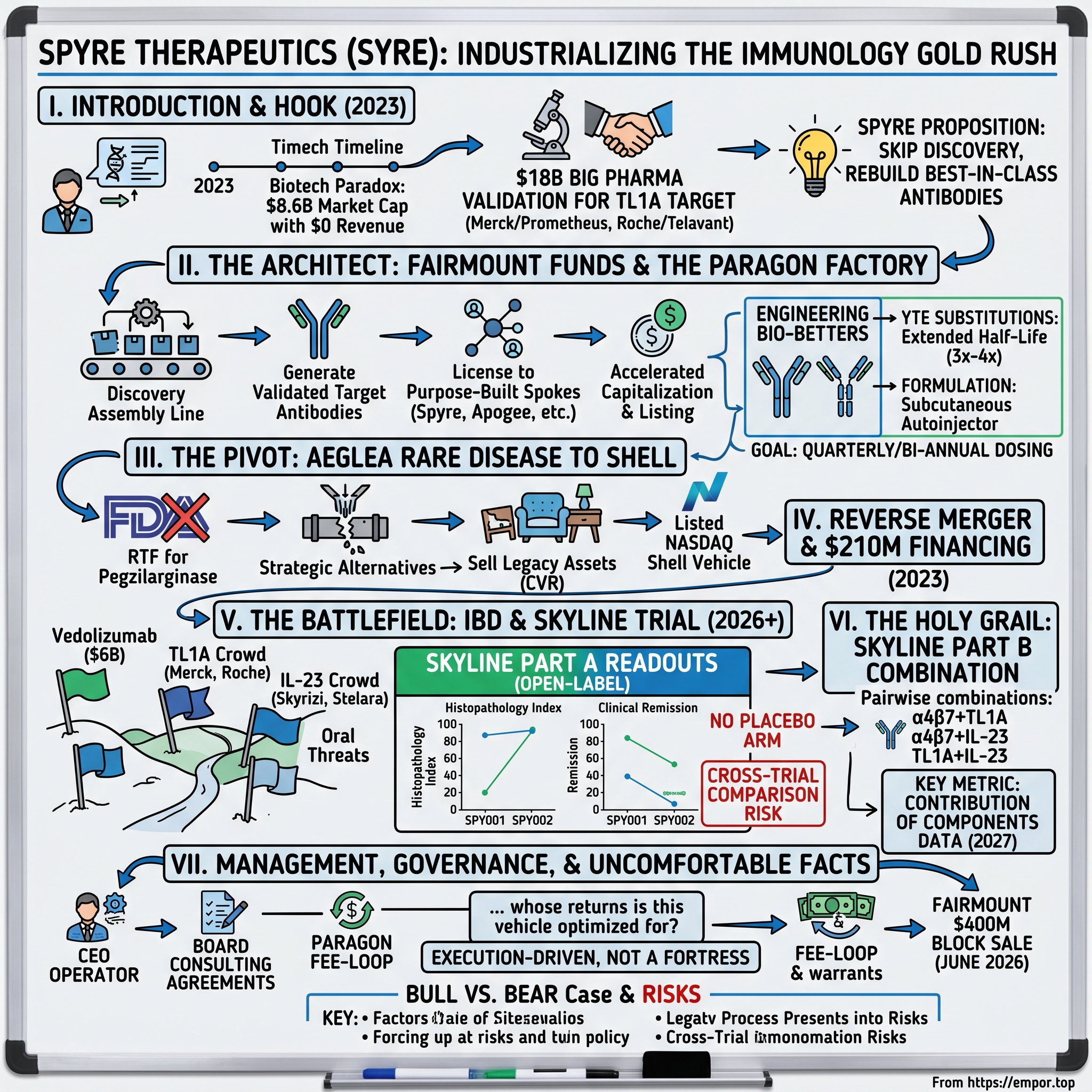
Spyre Therapeutics: Industrializing the Immunology Gold Rush
I. Introduction & Episode Roadmap (00:00 - 00:15)
On the morning of July 28, 2026, a company headquartered in a suite inside Building 23 of an office park on Crescent Street in Waltham, Massachusetts, carried a market capitalization of roughly $8.6 billion.12 It sells nothing. It has never sold anything. It has no approved product, no sales force, no manufacturing plant, and — as of its last annual disclosure — 102 employees, every one of them full-time.1 Twelve months earlier, the same company was worth a fraction of that: the market value of its stock held by non-affiliates on June 30, 2025 was approximately $1.1 billion, based on a closing price of $14.97.1 By late July 2026 the shares had traded as high as $105.09.2
The biotech paradox. That arithmetic — a seven-fold move in a year, on zero revenue — is not a glitch. It is how clinical-stage biotech is priced. A drug developer's equity is a claim on a probability-weighted stream of cash flows that begins, if it begins at all, five to ten years out. Every data readout is a re-underwriting of that probability. When a readout is good, the discount rate on the entire enterprise collapses at once. Spyre Therapeutics had two good readouts in three months. The question this story asks is not whether the market reacted rationally — it is whether the underlying machine that produced those readouts is a durable advantage or an unusually well-marketed arbitrage.
The hook. To understand why anyone would pay $8.6 billion for a company with no products, you have to go back to 2023, when big pharma lost its mind over a protein called TL1A. In April of that year, Merck agreed to acquire Prometheus Biosciences for approximately $200.00 per share in cash — roughly $10.8 billion in equity value — essentially for a single Phase 2 asset then known as PRA023.3 Six months later, Roche agreed to pay $7.1 billion upfront, plus a $150 million near-term milestone, for Telavant Holdings, a Roivant-and-Pfizer joint venture whose principal asset was a second TL1A antibody.4 Two companies. Nearly $18 billion. For molecules that had not finished mid-stage trials.
The Spyre proposition. Here is the idea that follows from that spectacle. If the market will pay eleven figures for a validated mechanism, then the hard, expensive, failure-prone part of drug development — discovering which biological target matters — has already been paid for by somebody else. What if you skipped it? What if, instead of hunting for new biology, you took the targets that big pharma had already proven with human data, and rebuilt the antibodies against them to be objectively better on the axes that engineering can control: how long the drug stays in the body, how concentrated a dose you can squeeze into a single injection, how many mechanisms you can stack into one syringe?
That is Spyre's thesis in one sentence. Its three lead programs target α4β7 integrin, TL1A, and IL-23 — mechanisms with, respectively, an approved multi-billion-dollar drug, two nine-figure acquisitions, and several blockbusters behind them.1 Each is engineered with the same trick: a set of amino-acid substitutions in the antibody's tail, called YTE, that slows how fast the body clears it.1 The stated goal is a drug you take once every three to six months instead of once every two to eight weeks — and, critically, a portfolio of such drugs whose clearance rates are matched closely enough that two can be given together on the same schedule.
A word on what "validated" buys you, and what it does not. It is tempting to read the strategy as risk-free, and it is not. Validation tells you the target matters in some patients. It does not tell you that hitting the target harder, or for longer, helps more. It does not tell you that two validated targets combine additively. And it does not stop three other companies from pursuing the same validated target with the same reasoning — which, in TL1A's case, is exactly what happened.
The distinction that matters for an investor is between risks that engineering can retire and risks that only a clinical trial can. Spyre has retired a great deal of the former. The latter is entirely intact, and it is the part the valuation is exposed to.
The roadmap. This story has four movements. First, the corpse: how Aeglea BioTherapeutics, a rare-disease company that ran into a wall at the FDA, became a listed shell worth more dead than alive. Second, the machine: how Fairmount Funds and its captive discovery engine, Paragon Therapeutics, built an assembly line for spinning validated targets into public companies. Third, the battlefield: what the inflammatory bowel disease market actually looks like, why current drugs put most patients into remission less than a third of the time, and what Spyre's data does and does not prove. Fourth, the uncomfortable part: an ownership structure in which the company's sponsor sits on both sides of the table, collects royalties on the company's future sales, retains rights to its molecules outside the licensed field — and, in June 2026, sold nearly $400 million of stock into the strength its own science created.56
To begin, we need a shell. And in 2022, a company in Austin, Texas was busy becoming one.
 Subscribe on LinkedIn
II. The Aeglea Origins: The Pivot from Rare Disease to Shell (00:15 - 00:35)
A rare disease, a rare rebuke. On June 2, 2022, Aeglea BioTherapeutics disclosed that the FDA had issued a Refusal to File letter for pegzilarginase, its lead candidate for Arginase 1 Deficiency.7 A Refusal to File is not a rejection on the merits. It is worse in one specific way: it means the agency declined to even review the application. The FDA told Aeglea it wanted evidence that lowering plasma arginine — the biochemical thing the drug indisputably did — actually predicted clinical benefit for patients, plus additional chemistry and manufacturing information.7 In the trade, an RTF for a rare-disease enzyme therapy is an unusual public embarrassment.8
Aeglea had been built for exactly this kind of medicine. Founded in 2013 and taken public in 2016, it developed engineered human enzymes for rare metabolic disorders — a scientifically elegant, commercially narrow niche. Arginase 1 Deficiency is a genetic disease in which the body cannot break down arginine, an amino acid; it accumulates and damages the nervous system. Pegzilarginase was, in effect, a replacement enzyme delivered as a drug. The company had a Phase 3 trial, a European partner, and orphan-drug positioning. What it did not have was the kind of hard clinical outcome data the FDA decided it wanted.
The wall, and then the second wall. The immediate response was a headcount reduction of roughly 25%, and the departure of chief executive Anthony Quinn.8 But the deeper problem was that Aeglea's remaining shots on goal were thin. On April 12, 2023, after reviewing what it described as inconclusive interim results from a Phase 1/2 trial of pegtarviliase in classical homocystinuria, the company announced it was exploring strategic alternatives and hired an exclusive financial advisor.1 The restructuring that followed cut approximately 83% of remaining headcount by June 30, 2023, at a cash cost of $6.4 million in severance and employee-related charges.1 The company abandoned its Austin office, took impairments on the lease and leasehold improvements, and sold off lab equipment and furniture for $0.5 million.1
That last detail is worth pausing on. When a biotech is selling its furniture, the operating business has ended. What remains is a financial artifact.
A note on how rare-disease economics fail. It is worth understanding why Aeglea's model was fragile in a way that Spyre's is not, because the contrast explains the sponsor's design choices. Orphan drug development is attractive on paper: small trials, motivated patient advocacy, premium pricing, long exclusivity. But the patient populations are so small that regulators face a genuine dilemma — they cannot demand large outcome trials without making development impossible, yet they cannot approve on biomarkers alone without risking approvals for drugs that change a lab value and nothing else. Aeglea landed squarely on the wrong side of that dilemma. Its drug demonstrably lowered plasma arginine; the FDA asked whether lowering plasma arginine helps patients.7 There was no larger market to retreat into, no second indication to pivot toward, and no way to run a bigger trial in a disease that few people have.
Contrast that with inflammatory bowel disease, where the endpoints are established, the trial designs are conventional, the regulatory precedent runs decades deep, and the patient population is measured in millions. Fairmount's model deliberately selects for the opposite of Aeglea's problem: mechanisms and indications where the regulatory question is "is your drug better?" rather than "does this even matter?" That is a real form of risk selection, and it is the least-discussed part of the strategy.
Ten years, and what they bought. It is worth measuring the full arc, because it is the strongest argument for the model that replaced it. Aeglea was founded in 2013 and spent roughly a decade developing engineered enzymes. Over that period it raised institutional capital, ran clinical trials through Phase 3, licensed a product regionally, and built a research organization in Austin. The terminal value of all of it, when finally monetized, was $15.0 million upfront plus contingent milestones — against a legacy license that had already delivered a $21.5 million upfront payment years earlier.1
That is the arithmetic of orphan-disease drug development gone wrong, and it explains the ruthlessness of what followed. There was nothing left to save. The rational act was to recognise that the most valuable thing the company still possessed was its own corporate existence.
What a corpse is worth. And that artifact had real, specific value to a certain kind of buyer. A Nasdaq listing is a genuinely scarce asset: it takes months and millions of dollars to create through a conventional IPO, and the window for biotech IPOs opens and shuts on market sentiment rather than on scientific readiness. Aeglea offered an already-registered, already-reporting, already-listed corporate vehicle with an intact shareholder base, a functioning board, residual cash, and — crucially — Delaware incorporation and a clean capital structure. For a private company sitting on assets that were ready for the clinic but not ready for a roadshow, that combination is a shortcut worth paying for.
The CVR: separating the past from the future. The elegant piece of machinery that made the deal work was the contingent value right. The problem with a reverse merger is that legacy shareholders own a claim on legacy assets they still believe in, while incoming investors want to own only the new thing and refuse to pay for the old one. A CVR resolves the standoff by carving the old assets out economically without carving them out legally. On July 3, 2023, Spyre issued CVRs to holders of record as of that date — explicitly excluding the former stockholders of the private Spyre entity and the investors in the concurrent private placement.1 Each CVR entitles the holder to cash payments from proceeds, if any, that the company received before the third anniversary of the agreement from disposing of or monetizing the legacy assets.1
The monetization came quickly. On July 27, 2023, the company announced it had sold global rights to pegzilarginase to Immedica for $15.0 million in upfront cash and up to $100.0 million in contingent milestones, superseding an earlier regional license under which Aeglea had received a $21.5 million upfront payment and stood to earn royalties in the mid-20% range on net sales in Europe and the Middle East.1 Because the asset had been developed internally, its carrying value was zero; the company booked a $16.4 million gain.1 The rare-disease chapter closed for a sum that would not cover a single quarter of the new company's research spending.
The accounting treatment tells you who was really in charge. Aeglea was deemed the acquirer for accounting purposes under ASC 805, because the relative voting rights did not produce a change of control and legacy directors remained on the board — but the transaction was accounted for as an asset acquisition, not a business combination, meaning no goodwill was recognized and the acquired in-process research and development, having no alternative future use, was expensed immediately.1 In plain English: the market bought a listing and a folder of intellectual property, and the accountants agreed.
Which raises the obvious question. Whose folder was it?
III. The Architect: Fairmount Funds and the Paragon Discovery Factory (00:35 - 01:05)
Two men and a structural complaint. Fairmount Funds Management LLC is a healthcare-dedicated investment firm based in West Conshohocken, Pennsylvania, run by managing members Peter Harwin and Tomas Kiselak.1 Their observation about biotech investing was not novel, but their response to it was. The dominant model of venture-backed drug development asks investors to underwrite two independent risks at once: is this target real? and is this molecule good? The first risk is enormous and largely unhedgeable. Most Phase 2 failures in immunology are not failures of chemistry — they are the discovery, at a cost of hundreds of millions of dollars, that blocking a particular protein does not actually help patients.
Fairmount's answer was to stop paying for the first risk. Let Merck, Takeda, AbbVie, and Johnson & Johnson spend the money proving which targets matter. Then compete on the second risk only — where the tools are mature, the failure modes are understood, and the outcome is closer to engineering than to discovery.
Building the factory. To execute that, you need an antibody engineering shop that can run the same play repeatedly. In 2021, Fairmount founded Paragon Therapeutics as exactly that — a Boston-based discovery engine for biologics, wholly organized around generating best-in-class antibodies against pre-validated mechanisms.11 Paragon does not commercialize anything. It runs discovery campaigns, produces development candidates, and hands them off. Its own capabilities are supplemented externally: in 2021 Paragon announced an antibody discovery joint venture with the Portuguese antibody specialist FairJourney Biologics.10
What an antibody actually is. Before the engineering, a plain-language detour, because the vocabulary here obscures a simple idea. An antibody is a Y-shaped protein the immune system makes to recognise one specific thing. The two tips of the Y are the business end — they grip a precise patch on a target molecule, the way a key fits one lock. That patch is called the epitope. The stem of the Y does none of the recognising; it handles logistics — how long the protein circulates, how other immune cells respond to it, how it is cleared.
This division of labour is what makes "bio-betters" possible at all. If you keep the tips identical and modify only the stem, you have a drug that does biologically the same thing to the same target, with different logistics. That is why Spyre states SPY001 matches vedolizumab's epitope and potency: the claim is not that it works differently, but that it works the same and lasts longer.13 It is also why the strategy is easier to describe than to defend — nothing about matching an epitope is proprietary in principle, and any competent antibody group can attempt it.
The two engineering levers. Paragon's differentiation rests on a pair of unglamorous, well-understood modifications, and it is worth explaining them in plain terms because the entire investment thesis sits on top of them.
The first is half-life extension. Antibodies survive in the bloodstream far longer than most drugs because of a recycling receptor called FcRn, which grabs antibodies that cells have swallowed and spits them back into circulation instead of letting them be destroyed. Think of it as a bouncer who keeps letting the same guest back into the club. The YTE substitutions — three amino-acid changes in the antibody's tail — make the antibody bind that recycling receptor more tightly at the low pH inside the cell, so it gets rescued more often.1 The molecule is otherwise the same drug hitting the same target; it just persists longer. Spyre's own filings are careful to note that the science here is ongoing, that clinical experience with YTE and the related LS substitutions in immunology indications is limited, and that the long-term safety and efficacy of the resulting exposure profiles are unknown.1 That is an honest risk factor, and a real one.
The second lever is formulation. Approved biologics are often given by intravenous infusion in part because the dose is too large, or the solution too viscous, to inject comfortably under the skin. Paragon's candidates are formulated as high-concentration, citrate-free preparations designed to fit in a subcutaneous autoinjector.1 Citrate is a common buffer that stings on injection; removing it is a small thing that patients notice. Combined, the two levers are meant to convert a clinic visit into a home injection, and a monthly ritual into a quarterly one.
The hub and the spokes. The commercial architecture is the genuinely novel part. Paragon is the hub; when a program is ready for the clinic, its rights are licensed into a purpose-built, single-disease company, which is then capitalized separately and taken public. Apogee Therapeutics went out for atopic dermatitis and inflammatory respiratory disease; Spyre for inflammatory bowel disease; Oruka Therapeutics for psoriasis and dermatology; Jade Biosciences and Crescent Biopharma for autoimmune and oncology programs.12 Fairmount has filed Schedule 13D reports as a significant holder across the group.56
Why split them at all, rather than build one large company? Three reasons, each defensible. Public investors price focused stories more efficiently than diversified ones; a pure-play IBD company is legible in a way a five-indication platform is not. Each spoke can be capitalized against its own catalysts without cross-subsidizing weaker siblings. And each becomes independently acquirable — a large pharma buying an IBD franchise does not have to also buy a psoriasis franchise it does not want.
The uncomfortable corollary. There is a fourth reason for splitting the companies that nobody puts in a press release, and it follows directly from the epitope point above. If the engineering advantage is fundamentally copyable, then speed and sequencing are the advantage. Getting five separate shots on goal into the public markets, each capitalized by different investors, each racing its own clock, converts a fragile technical edge into a portfolio bet. Some spokes will fail. The hub collects on all of them regardless.
And the cost. The structure is not free, and the bill is paid by public shareholders in each spoke. Fairmount founded Paragon, beneficially owns more than 5% of it, appointed Paragon's board of directors, and holds the contractual right to approve the appointment of any Paragon executive officer.1 Fairmount also beneficially owns more than 5% of Spyre and, until May 2026, held two of Spyre's board seats.1 Every dollar of milestone payment and every point of royalty that flows from a spoke to the hub is a transfer from public shareholders to an entity the sponsor controls. We will return to what that costs in Section VIII, with the specific contract terms.
First, the transaction that turned the folder of intellectual property into a listed security.
IV. The Reverse Merger & Financial Engineering Masterclass (01:05 - 01:25)
The vehicle. Pre-merger Spyre was incorporated on April 28, 2023 — under the direction of Peter Harwin, and for the express purpose of holding rights to intellectual property being developed by Paragon.1 It was, at formation, less a company than a container. Eight weeks later, on June 22, 2023, Aeglea agreed to acquire it in a stock-for-stock transaction in which all of Spyre's equity was exchanged for a mix of Aeglea common stock and a newly created non-voting Series A convertible preferred stock.9 The name change to Spyre Therapeutics, Inc. followed on November 28, 2023.1
Why non-voting preferred? Because Nasdaq rules and Delaware mechanics make it awkward to issue a controlling common stake without a shareholder vote, and because large healthcare funds frequently prefer to hold non-voting instruments that keep them below regulatory ownership thresholds while retaining full economic exposure. It is a structure that trades governance rights for speed and flexibility. Investors got the economics; the voting register stayed tidy. Fairmount's later filings show the practical consequence: as of June 23, 2026, its position was reported as 8,835,440 shares issuable on conversion of 220,886 Series A preferred shares, explicitly excluding conversion above a 9.99% beneficial ownership limitation.5
The concurrent financing. Simultaneously with the acquisition, the company closed a $210 million private placement with a group of institutional accredited investors led by Fairmount and joined by a syndicate of dedicated biotechnology specialists.9 This is the part of the structure worth understanding, because it inverts the normal sequence. In a conventional IPO, a private company spends months preparing an S-1, conducts a roadshow, prices at whatever the market will bear on a single day, and then discovers its public shareholder base. Here, the shareholder base was assembled first, privately, at a negotiated price, and the listing was acquired separately as a component.
The financing did not stop there. A December 2023 private placement raised $180.0 million gross, in which Fairmount participated for $10.0 million — a related-party investment that the board approved explicitly.1 In March 2024 came a Series B preferred placement: 121,625 shares at $1,480 each, convertible on a 40-to-1 basis, netting approximately $168.9 million after $11.2 million of placement and offering costs.1 In April 2024, Fairmount Healthcare Fund II exchanged 90,992 Series A preferred shares for 3,639,680 common shares.1
The exercise of the options. The other piece of the architecture worth tracing is how the intellectual property actually arrived. The asset acquisition did not transfer molecules; it transferred an option to license rights to four Paragon research programs.1 Spyre exercised that option on July 12, 2023 for the α4β7 program, on December 14, 2023 for TL1A, and on June 5, 2024 for IL-23, signing the corresponding license agreements in May and October 2024.1 The option on one additional program remains unexercised.1
Structuring the deal as a chain of options rather than an outright transfer is efficient for the sponsor and defensible for the company: Spyre pays for each program only when it decides to develop it, and unexercised options cost nothing. But it also means the company never owned the underlying research outright — it holds a series of field-limited licenses, each with its own economics and its own retained rights on the other side. That distinction, easy to skip in a summary, becomes very concrete in Section VIII.
What the structure actually bought. Strip away the mechanics and the achievement is straightforward: Spyre reached the public markets with a war chest and a clinical plan before dosing a single patient, without ever running an IPO process. That is genuine capital-markets craft, and it is a repeatable template — the same firm has now executed variants of it across multiple companies.12
But it is worth being precise about what the structure does not do. It does not reduce scientific risk. It does not shorten a clinical trial. It does not make a molecule work. What it does is compress the time between "we have a candidate" and "we have institutional capital and a listed currency," and it lets the sponsor set the entry price for itself and its chosen syndicate before public price discovery begins. Those are real advantages, and they accrue disproportionately to the people who designed the structure.
A note on the preferred-stock ladder. The repeated use of convertible preferred stock across these financings deserves a moment, because it has a real accounting consequence that shows up in the filings. Series B preferred was initially classified outside permanent stockholders' equity — in what accountants call mezzanine — because if shareholders had failed to approve conversion into common stock, holders could have demanded cash redemption at the prior day's closing price.1 That redemption right sat outside the company's control, which is precisely the condition that forces mezzanine treatment. Once shareholders approved conversion, the redemption right lapsed and the balances were reclassified into permanent equity in the second quarter of 2024.1
This is not an accounting scandal; it is textbook. But it illustrates something structural about how these vehicles are built: capital arrives fast, on instruments negotiated privately, and the housekeeping — shareholder approvals, conversions, reclassifications — happens afterward. Investors reading the balance sheet of any Fairmount-style spinout should expect the capital structure to look complicated for a while, and should read the preferred-stock footnotes rather than the share count on the cover page.
Reading the burn. The financing cadence since then tells you how expensive this pipeline is. Research and development expense was $60.4 million in the first quarter of 2026, against $41.6 million a year earlier; general and administrative expense rose to $15.2 million from $11.9 million; the net loss widened to $69.0 million from $44.8 million, driven by manufacturing, clinical trial costs, and headcount.6 Operating cash used in the quarter was $57.4 million.6 A company running six investigational agents through Phase 2 in two therapeutic areas simultaneously does not get to be capital-light, whatever the org chart says.
That spending buys entry into one of the most contested markets in medicine.
V. The IBD Battleground & Competitive Landscape (01:25 - 01:50)
The disease. Inflammatory bowel disease is a chronic inflammation of the gastrointestinal tract comprising two conditions. Ulcerative colitis attacks the innermost lining of the colon and rectum, producing bloody diarrhea, abdominal pain, and bowel urgency. Crohn's disease can strike anywhere from mouth to anus, inflames through the full thickness of the bowel wall, and causes strictures and fistulas.1 Roughly 2.4 million people in the United States are estimated to have IBD, with approximately 70,000 newly diagnosed each year.1 It is a young person's disease that lasts a lifetime, and its unpredictability — not knowing whether tomorrow is a working day — is often as disabling as the symptoms.
The ceiling nobody has broken. Here is the fact that makes this market so large and so frustrating. Despite four distinct classes of advanced therapy — anti-TNF antibodies, IL-12/23 and IL-23 antibodies, the gut-selective integrin blocker, JAK inhibitors, and S1P modulators — a substantial share of moderate-to-severe patients never reach remission.1 Spyre's own filings name the unmet needs directly: inadequate response or loss of response to existing therapies, safety concerns with long-term use, limited options in refractory disease, and poor adherence to inconvenient dosing.1
The published benchmark data show why. In the Phase 2 ARTEMIS-UC study of tulisokibart, then called PRA023, 26.5% of treated patients achieved clinical remission at week 12 versus 1.5% on placebo, with endoscopic improvement of 36.8% versus 6.0%.19 Those are strong numbers by the standards of the field — and they still mean roughly three in four patients did not reach remission after twelve weeks. This is the central economic fact of IBD: the market is enormous because the drugs work only partially, and patients cycle through mechanism after mechanism.
The incumbent to beat. Takeda's Entyvio (vedolizumab) blocks α4β7 integrin, a protein on immune cells that acts as a postal code — it directs those cells specifically to gut tissue.1 Blocking it reduces immune cell trafficking to the intestine while largely sparing systemic immunity, which is why the drug's safety profile is well regarded. Commercially, it is the anchor of Takeda's gastrointestinal business: sales were ¥479.2 billion in the six months ended September 30, 2025, up 1.3% at actual exchange rates and 5.1% at constant rates, of which ¥318.9 billion came from the U.S.18 Annualized, that is a franchise in the neighborhood of ¥950 billion — on the order of $6 billion at prevailing exchange rates.
Two things about that number matter. First, it proves the mechanism commercially, not just clinically. Second, Takeda's own commentary flags a more competitive U.S. landscape, with growth supported by the subcutaneous formulation — which is precisely the axis on which Spyre proposes to compete.18 Takeda has already moved patients from infusion to home injection; Spyre's claim is that it can move them from every-two-weeks to every-three-months.
The TL1A cohort. TL1A is the newer mechanism, and the crowded one. Merck holds tulisokibart from the Prometheus acquisition; Roche holds afimkibart, formerly RVT-3101, from Telavant; Sanofi and Teva are developing duvakitug.1 Spyre's filings name all three.1
And then, on June 22, 2026 — five weeks before this writing — Merck reported that tulisokibart met its primary endpoint of clinical remission by modified Mayo Score at week 12, plus key secondary endpoints, in the Phase 3 ATLAS-UC induction-only study, making it the first anti-TL1A antibody to demonstrate clinical remission at twelve weeks in a Phase 3 trial.20 That single announcement reframes the competitive clock. The mechanism Spyre is pursuing with SPY002 is no longer merely validated in Phase 2; a competitor is now through registrational induction data with it.
The oral threat nobody in the antibody business likes discussing. There is a second competitive axis that runs perpendicular to all of this. JAK inhibitors — Pfizer's Xeljanz, AbbVie's Rinvoq — and S1P receptor modulators such as Bristol Myers Squibb's Zeposia and Pfizer's Velsipity are pills.1 They are small molecules, cheap to manufacture, and they go generic. For a patient weighing a daily tablet against an injection, however infrequent, the tablet usually wins on preference; the reason it does not always win is that JAK inhibitors carry boxed safety warnings that make prescribers cautious in younger patients.
The relevance to Spyre is specific. Its entire convenience argument is framed against other injectables. If the practical alternative for a meaningful slice of moderate-to-severe patients becomes a well-tolerated oral, "four injections a year instead of twenty-six" is a smaller win than it sounds. Spyre's filings name these classes as competitors without elaborating on the dynamic.1
The biosimilar clock. The other structural pressure is patent expiry on the incumbents Spyre is benchmarking against. Every mechanism in its portfolio has an originator that will eventually face biosimilar competition, and Spyre's own risk disclosure acknowledges it will compete with biosimilars and generics of these products, approved or in development.1 The commercial consequence is uncomfortable: a payer choosing between a cheap biosimilar of a proven drug and a premium-priced next-generation version of the same mechanism will need more than a dosing-schedule argument. This is the strongest structural reason to believe Spyre's monotherapies, on their own, are not the investment case.
The IL-23 crowd. The third mechanism is the most commercially entrenched. AbbVie's Skyrizi, Johnson & Johnson's Stelara and Tremfya, and Eli Lilly's Omvoh all target the IL-12/23 axis and compete in IBD alongside anti-TNF agents, JAK inhibitors, and S1P modulators, plus biosimilars of several originators.1 These are not sleepy incumbents. They are among the best-selling drugs on earth, backed by commercial organizations that Spyre, at 102 employees, does not remotely possess.1
So the competitive question is sharp: what, exactly, does Spyre have that these companies cannot replicate?
VI. The Spyre Weaponry: Engineering "Bio-Betters" (01:50 - 02:20)
SPY001: the same lock, a longer key. SPY001 is a humanized IgG1 monoclonal antibody designed to bind selectively to α4β7 integrin — the same mechanism as vedolizumab, deliberately.1 The company states that SPY001 matches vedolizumab's epitope and potency while increasing target coverage through extended half-life and greater induction dosing.13 In preclinical assays measuring inhibition of α4β7-expressing cells binding to MAdCAM-1, it demonstrated similar potency and selectivity to synthesized vedolizumab.1 The design philosophy is explicit: do not innovate on the biology, innovate on the exposure.
The first-in-human trial began in June 2024 — a double-blind, placebo-controlled healthy-volunteer study enrolling 56 participants across five single-ascending-dose and two multiple-ascending-dose cohorts, with additional cohorts added to characterize pharmacokinetics across ethnicities for global trials.1 Interim data presented in November 2024 reported a half-life greater than 90 days, roughly a four-fold increase over vedolizumab.14 Data presented at Digestive Disease Week in May 2025, with up to eight months of follow-up, described a half-life of approximately 80 days — around three-fold vedolizumab's — with a single dose producing rapid and sustained saturation of α4β7 receptors at expected Phase 2 trough concentrations.15
That downward revision from ">90 days" to "~80 days" as follow-up lengthened is a small thing, and both figures are transformative relative to vedolizumab's roughly 25-day half-life. But it is a useful reminder of how early-interim pharmacokinetic estimates behave: they are fitted to incomplete curves, and the terminal phase is the hardest part to see early. Investors reading half-life claims from small healthy-volunteer cohorts should treat them as evolving estimates, not fixed properties.
A brief guide to the scoreboard. The readouts that follow use three measures, and it is worth knowing what each one actually is, because they are not equally trustworthy and the market treats them as if they were.
The modified Mayo Score is a composite of stool frequency, rectal bleeding, and an endoscopic appearance score — two of which are the patient describing their own symptoms. "Clinical remission" means that composite falls below a defined threshold. It is the endpoint regulators care most about, because it maps to how a patient actually feels, and it is also the endpoint most vulnerable to expectation: a patient who knows they are receiving an experimental drug reports differently from one who might be on placebo.
Endoscopic improvement means a gastroenterologist looked at the colon lining through a camera and judged it meaningfully healed. Harder to fake, still a human judgment call.
The Robarts Histopathology Index, or RHI, is the strictest of the three. A biopsy is taken, sliced, stained, and scored under a microscope by a pathologist counting inflammatory cells in the tissue. The pathologist is not the patient and typically does not know what the patient received. It is the closest thing in ulcerative colitis to an objective ruler — which is precisely why Spyre made it the primary endpoint of an open-label trial. Choosing the least subjective measure as the primary endpoint of an uncontrolled study is a defensible design decision, and it deserves credit.
The April readout, and what it does and does not show. On April 13, 2026, Spyre reported twelve-week induction data from Part A of the Phase 2 SKYLINE trial.13 SPY001 met the primary endpoint with a 9.2-point reduction in Robarts Histopathology Index score from baseline, at p<0.0001. Secondary endpoints included a clinical remission rate of 40% by modified Mayo Score, endoscopic improvement of 51%, and a 3.7-point reduction in modified Mayo Score. Among 43 subjects, six (14%) had treatment-emergent adverse events, one serious adverse event was reported and deemed not drug-related — chest pain in a 68-year-old man with prior coronary artery disease — and there were zero drug-related adverse events and zero discontinuations.13
Now the analytical caveat, which is not a small one. Part A of SKYLINE is an open-label assessment of a single dose level of each monotherapy. It has no placebo arm.113 The randomized, placebo-controlled evaluation is Part B, with induction data expected in 2027.1 Comparing an uncontrolled 40% remission rate against controlled trials whose placebo arms ran anywhere from 1.5% to the low teens is not an apples-to-apples exercise, and the direction of the bias is known: open-label studies in symptom-driven diseases systematically flatter the drug. The primary endpoint here was histopathology, which is scored by pathologists and less susceptible to expectation effects than symptom scores — a genuine point in the data's favor. But clinical remission by modified Mayo Score, the number that moved the stock, is partly symptom-based.
The honest reading is that SKYLINE Part A cleared a meaningful bar: the molecule reaches the tissue, engages the target, and produces histologic change with a clean early safety profile. It did not establish comparative efficacy against vedolizumab or anyone else. Management's own language — "potential best-in-class" — is appropriately hedged; the market's reaction was less so.
SPY002: TL1A, and a second data point. SPY002 is a fully human antibody targeting TL1A, a cytokine elevated in the gut tissue of IBD patients that drives both inflammation and fibrosis through its receptor DR3.1 Phase 1 interim results reported in June 2025 described a half-life of approximately 75 days — more than three times first-generation anti-TL1A antibodies — with complete suppression of free TL1A through up to twenty weeks of follow-up.16
On June 15, 2026, SPY002's Part A induction data arrived: a 10.7-point reduction in RHI at p<0.0001, clinical remission of 33%, endoscopic improvement of 42%, and a 3.7-point modified Mayo Score change.24 The safety picture was noticeably busier than SPY001's — 20 of 48 subjects (41.7%) had treatment-emergent adverse events, two serious adverse events (a UC exacerbation requiring hospitalization and a heart-failure worsening in a patient with cardiac history), both deemed unrelated, three drug-related adverse events, and two discontinuations.24 Notably, this release disclosed baseline characteristics the April release did not: 35% advanced-therapy-exposed, mean disease duration 7.0 years, mean baseline RHI 16.9, mean modified Mayo Score 6.9, and 56% with a baseline endoscopy score of 3.24 Those numbers matter enormously for interpreting a single-arm result, and their earlier absence is worth noting.
SPY003: IL-23, and the longest half-life of the three. SPY003 binds the p19 subunit of IL-23 with subnanomolar potency, and in head-to-head non-human primate studies showed more than three-fold extended pharmacokinetic half-life relative to a synthesized risankizumab comparator lacking half-life extension.1 Its first-in-human trial started in March 2025, enrolling 59 healthy volunteers.1 Interim Phase 1 data disclosed in November 2025 reported an approximately 85-day half-life with no serious adverse events across single doses of 200–1200 mg IV, 600 mg subcutaneous, and a 1200 mg IV multiple-dose cohort.17 Part A induction data for SPY003 is expected in the third quarter of 2026.24
Three molecules, three validated mechanisms, three clearance rates clustered between roughly 75 and 85 days. That clustering is not incidental. It is the entire point.
VII. The Holy Grail of Immunology: SKYLINE & Combination Therapy (02:20 - 02:45)
Why combinations, and why now. Return to the ceiling problem. If every single-mechanism drug in ulcerative colitis tops out somewhere between a quarter and a third of patients in remission, the arithmetic suggests different patients respond to different pathways. Blocking cell trafficking to the gut helps one group; neutralizing an upstream inflammatory cytokine helps another; suppressing the Th17 axis helps a third. Combining mechanisms should, in principle, capture more of the population — and possibly push individual patients deeper into remission than either agent alone.
Oncology figured this out decades ago; almost no modern cancer regimen is a monotherapy. Immunology has largely not, and the reasons are practical rather than scientific.
The logistics problem nobody solved. Consider what combining two first-generation biologics actually requires. Vedolizumab subcutaneous is dosed every two weeks. Anti-TL1A candidates in development have half-lives around 20 days, implying monthly or more frequent maintenance. Ask a patient to self-administer two separate injections on two different schedules, indefinitely, for a chronic disease — and then ask a payer to reimburse two branded biologics simultaneously, each priced for monotherapy. The adherence math is bad and the reimbursement math is worse.
There is also a safety dimension. Combining two potent immunosuppressive mechanisms raises the theoretical risk of serious infection and other systemic toxicity beyond either agent alone. Historically, combination attempts in IBD have been cautious for exactly this reason.
The matched-clearance argument. Spyre's structural answer is that if every component has a half-life in the 75-to-85-day range, the components can share a dosing schedule.1 Two antibodies with matched clearance can plausibly be co-administered — or eventually co-formulated — on a quarterly or twice-yearly cadence, in a single subcutaneous autoinjector.1 What was two treatment regimens becomes one appointment with the medicine cabinet, four times a year.
This is a genuinely clever piece of systems design, and it is the strongest version of the bull case. It is also, so far, entirely a hypothesis about clinical benefit. Matched pharmacokinetics is an engineering achievement. Whether stacking mechanisms produces additive efficacy — or merely additive immunosuppression — is a biological question that has not been answered in humans.
SKYLINE Part B. The trial designed to answer it is now enrolling. Part B is randomized and placebo-controlled, evaluating monotherapies at two dose levels plus three pairwise combinations, with participants randomized against a shared placebo arm: SPY120 (α4β7 plus TL1A), SPY130 (α4β7 plus IL-23), and SPY230 (TL1A plus IL-23).113 Six investigational agents in total. Induction data for all cohorts is expected in 2027.13
Two design details deserve attention. First, the shared placebo arm across six cohorts is efficient — it reduces the number of patients assigned to placebo and, as the company's chief medical officer noted, supports "a low placebo allocation for the remainder of the trial," which helps recruitment in a disease where patients are reluctant to risk twelve weeks of nothing.13 Second, and more important analytically, Part B is designed to establish contribution of components: whether each combination beats its own constituent monotherapies, not merely placebo.1 That is the correct question, and regulators will insist on it. A combination that beats placebo but not its better half is a commercial dead end.
What regulators will demand. There is a reason "contribution of components" appears in the trial design rather than as a footnote. Regulators in both the United States and Europe apply a well-established principle to fixed-dose combinations: if you want to sell A plus B as one product, you must demonstrate that A plus B is better than A alone and better than B alone. Beating placebo is insufficient, because a combination that merely matches its stronger component exposes patients to a second drug's risks for no incremental benefit.
The practical burden this creates is significant. It means combination trials need enough patients in each monotherapy arm to make the comparison statistically meaningful, which makes them larger, slower, and more expensive than a simple placebo-controlled study. It also means a partial result — combination beats placebo, beats one component, fails to beat the other — is a genuinely bad outcome rather than a hedge. SKYLINE Part B is designed to answer this properly, which is to the company's credit; it is also the reason the answer takes until 2027.
And what payers will demand. The commercial hurdle is separate and arguably harder. A combination of two branded biologics costs a payer roughly twice as much as either alone unless the manufacturer prices the combination below the sum of its parts. For a company that owns both components, that is at least possible — a single-product combination can be priced as one therapy. But the payer's question will be quantitative: how many additional patients reach remission, and is that worth the incremental spend versus cycling a patient through cheap biosimilar monotherapies first? The answer depends entirely on the magnitude of the efficacy gain, not its existence.
The preclinical groundwork. Spyre has published supporting animal data: combined anti-IL-23 and anti-TL1A suppressed IL-17 secretion more effectively than either agent alone, and in a mouse TNBS colitis model combinations produced superior in vivo activity relative to monotherapy.1 Combination toxicology studies were completed with no drug-related adverse findings.1 This is real evidence and it is the right evidence to generate before dosing humans. It is also, as every biotech investor knows, the category of evidence with the weakest historical track record of predicting human outcomes in inflammatory disease.
What this means for the equity. The combination platform is not an option on top of the monotherapy business — for a company at this valuation, it is most of the business. The monotherapies face entrenched incumbents, biosimilar erosion, and in TL1A's case a competitor already through Phase 3 induction.20 A best-in-class dosing schedule is a real but bounded advantage. The step-change that would justify a mega-cap outcome is a combination regimen that meaningfully raises the remission ceiling. That data arrives in 2027. Until then, the valuation is underwriting a hypothesis.
Which makes the question of who is underwriting it, and on what terms, unusually important.
VIII. Management, Governance, & The Fairmount-Paragon Fee-Loop Stress Test (02:45 - 03:05)
The chief executive. Cameron Turtle, D.Phil., joined the combined company as chief operating officer in June 2023 and became chief executive officer and a director in November 2023.[^21] His background is a specific and relevant one: a bioengineering degree from the University of Washington, a doctorate in cardiovascular medicine from Oxford as a Rhodes Scholar, consulting at McKinsey on pharmaceutical M&A and clinical trial strategy, then chief business officer of Eidos Therapeutics — where he helped grow the company past 100 employees before its acquisition by BridgeBio — and chief strategy officer of BridgeBio itself.[^21]
BridgeBio is the tell. It pioneered a hub-and-spoke model of its own, incubating disease-specific subsidiaries under a central platform. Turtle is not a bench scientist running a company; he is an operator trained inside precisely this corporate architecture. Whether that is reassuring or concerning depends on what you think the company is for.
Execution against stated timelines. The most useful test of biotech management is not rhetoric, it is calendar discipline, because timelines are the one thing management fully controls and publicly commits to. On this measure the record is good. The company guided to Part A induction data beginning in the second quarter of 2026 and delivered SPY001 on April 13.113 It guided SPY002 to mid-2026 and delivered June 15 — within one year of that program's Phase 1 results.24 It pulled the rheumatoid arthritis sub-study of the SKYWAY basket trial forward to the third quarter of 2026 on the back of over-enrollment.6 Six proof-of-concept readouts were promised for 2026 across two Phase 2 trials, and as of late July the schedule is intact.6
There is one narrative wobble worth flagging. Between April and June 2026, the company's own boilerplate self-description shifted from "pioneering long-acting antibodies and antibody combinations to redefine the standard of care for inflammatory bowel disease and rheumatic diseases" to "committed to developing next-generation therapies that elevate the standard in immunology by delivering more complete disease control, greater durability, and a simpler treatment experience."1324 The second formulation is broader and vaguer. Widening the stated addressable ambition immediately after two positive readouts is a common pattern and not inherently improper, but it is the kind of language drift worth tracking across future filings.
The board. Beyond the sponsor's seats, the board that signed the FY2025 annual report included Jeffrey W. Albers as chairman, Michael Henderson, Mark McKenna, Sandra Milligan, and Laurie Stelzer, alongside Turtle, Harwin, and Kiselak.1 That is a conventional, credentialed biotech board rather than a captive one, and the presence of independent directors with commercial and regulatory backgrounds is a meaningful counterweight to the related-party architecture. One director relationship is worth noting for completeness: McKenna was appointed a Class I director on February 1, 2024 and is party to a consulting agreement with the company.1 Consulting arrangements with directors are a standard governance flag — not because they are improper, but because they complicate the definition of independence.
Now the contracts. Under each license agreement with Paragon, Spyre owes up to $22.0 million in development, regulatory, and clinical milestones for the first product under that agreement, including $3.0 million on first dosing of a human patient in a Phase 2 trial and $5.0 million on first dosing in Phase 3.1 Across all license agreements, the maximum aggregate milestone exposure is $66.0 million, of which $18.0 million had been incurred through December 31, 2025.1 For SPY002 and SPY072 specifically, Spyre owes sublicensing fees of up to approximately $20 million on mostly commercial milestones.1
Then the royalties. Spyre pays Paragon a low single-digit percentage royalty on single-antibody products and a mid single-digit percentage royalty on products containing more than one Paragon antibody, with a one-third step-down if no Paragon patent is in effect, running until the later of last-to-expire patent or twelve years from first sale.1
Read that twice. The combination products — the strategic core of the company, the thing the $8.6 billion valuation is actually underwriting — carry roughly double the royalty rate of the monotherapies. Spyre's success case is Paragon's best case, by construction.
Parapyre. There is a third leg. Parapyre Holding LLC is an entity formed by Paragon as a vehicle to hold Spyre equity in order to share profits with certain Paragon employees; it performs no substantive role under the agreement other than to receive equity.1 Spyre issued Parapyre annual warrants, on the last business day of 2023 and 2024, to purchase 1% of then-outstanding shares on a fully diluted basis.1 A dilution transfer from public shareholders to the staff of a private affiliate is unusual disclosure to read in a 10-K.
The counter-evidence. In fairness, the cash flowing to Paragon has collapsed as programs moved in-house. Expenses recognized for Paragon services were $48.5 million in 2023 and $29.8 million in 2024 — but only $0.1 million in 2025.1 Payments to Paragon followed the same path: $39.5 million, $31.8 million, then $0.2 million.1 Paragon also reimbursed 50% of SPY003 development costs in 2024, a $5.9 million reduction to R&D.1 Paragon and Parapyre each beneficially own less than 5% of Spyre's voting securities.1 The service-fee loop, whatever it was in 2023, is largely closed. What remains is the royalty and the residual rights.
The residual rights problem, made concrete. And in May 2026, we got a precise measurement of what those residual rights are worth. On May 29, 2026, Spyre amended its SPY003 license. Previously, Spyre's "Field" was limited to inflammatory bowel disease. The amendment expanded the field to all therapeutic, prophylactic, palliative, and diagnostic uses — but subject to a restriction that Spyre will not dose a human patient with SPY003 outside IBD in combination until June 1, 2028, or as a monotherapy until June 1, 2030.23 The restrictions collapse to 2028 if Spyre or a licensee of Paragon's retained rights consummates a material transaction, including a change of control.23
Translated: Paragon kept the non-IBD rights to Spyre's IL-23 antibody, and Spyre had to negotiate to get them back — with a four-year handcuff attached. This is not hypothetical. Oruka Therapeutics, another Fairmount-sponsored, Paragon-engineered company, is developing ORKA-001, a half-life-extended IL-23p19 antibody with a reported roughly 100-day half-life, for plaque psoriasis, and reported week-16 Phase 2a data in April 2026.22 The hub allocates mechanisms across spokes, and the spokes do not own what the hub did not license.
The bear question, and the sharpest fact. Which brings us to the trade that a skeptical investor will fixate on. Peter Harwin resigned from Spyre's board effective May 27, 2026, reducing the board from eight directors to seven; the 8-K states the resignation was not the result of any disagreement over operations, policies, or practices.21 Four weeks later, on June 23, 2026, Fairmount Healthcare Fund II sold 4,684,781 shares of Spyre common stock in a block trade at $85.31 per share — approximately $400 million.5 On July 1, 2026, the same fund sold 3,553,410 shares of Oruka at $84.43 per share.25
None of this is improper. Funds have limited lives and redemption obligations; concentrated positions get trimmed; a director stepping off a board before a sale removes an obvious conflict rather than creating one. Fairmount retains a large residual position and remains capped at 9.99% by contract.5 But the sequence — board exit, then a nine-figure block sale five weeks after a positive readout and two weeks after the second one — is exactly the pattern an activist would put on a slide. And it sits alongside a royalty stream that pays the sponsor's affiliate more if the company succeeds, whether or not the sponsor still owns the stock.
The structural question is therefore not "is management honest?" There is no evidence to the contrary. It is: whose returns is this vehicle optimized for, across the full life of the structure? Public shareholders own the clinical risk. The sponsor owns the clinical risk plus a perpetual royalty plus the discovery engine plus the ability to allocate mechanisms among competing spokes.
IX. Porter’s Five Forces & Hamilton Helmer’s 7 Powers Analysis (03:05 - 03:25)
Threat of new entrants: lower than it looks. The conventional answer is that biotech barriers are formidable — capital, regulatory expertise, manufacturing. But Spyre's own existence disproves the strong form of that claim. The company went from incorporation in April 2023 to Phase 2 proof-of-concept data in April 2026, three years, using licensed antibodies, contract manufacturing built on a WuXi Biologics cell line, and roughly a hundred employees.1 If Fairmount can do that, so can others — and several are trying. The real barrier is not capability; it is the combination of capital access and a discovery engine already tuned for half-life extension. Call it moderate, and eroding.
Bargaining power of buyers: high, and structurally so. In the U.S., pharmacy benefit managers and integrated payers control formulary placement in IBD, and every incumbent mechanism has either biosimilar competition or is heading toward it.1 A payer evaluating a fourth α4β7 option will ask a blunt question: does it put more patients into remission, or is it merely more convenient? Convenience commands a premium only when it is dramatic and when clinical outcomes are at parity or better. Quarterly versus biweekly dosing is dramatic. But convenience alone will not sustain premium pricing against a biosimilar vedolizumab — and Spyre's monotherapies will arrive into exactly that environment.
Competitive rivalry: extreme. Spyre competes against Takeda, Merck, Roche, AbbVie, Johnson & Johnson, Eli Lilly, Pfizer, Bristol Myers Squibb, and Sanofi across three mechanisms simultaneously.1 Each has commercial infrastructure Spyre cannot match, existing prescriber relationships, and the ability to bundle. Rivalry is not a headwind here; it is the weather.
Supplier power and substitutes. Supplier concentration is a genuine, under-discussed exposure. Spyre's manufacturing rests on a non-exclusive cell line license from WuXi Biologics, novated from Paragon, supporting SPY001, SPY002, and SPY003 — with a sub-1% royalty on global net sales if commercial supply is made by a third party.1 A single Chinese contract manufacturer sits underneath three programs, in a geopolitical environment that the company's own risk factors name explicitly, including U.S.–China tensions, tariffs, sanctions, and export controls.1 That is a concentration worth monitoring. On substitutes: JAK inhibitors and S1P modulators are oral, cheap to make, and going generic. For patients who tolerate them, an oral pill beats any injection schedule.
Who the customer actually is. One clarification that Porter's framework tends to obscure in pharmaceuticals: the person taking the drug is not the person choosing it, and neither of them pays for it. The prescriber chooses, the payer pays, the patient consumes. Spyre's convenience advantage lands squarely with the patient — the constituency with the least purchasing power in the chain. Its efficacy advantage, if the combinations deliver one, lands with the prescriber and the payer, who are the constituencies that matter commercially.
That asymmetry is the single most important thing to hold in mind when evaluating the dosing-frequency story. Quarterly injection is a genuine improvement in human terms and a genuine differentiator in a crowded formulary conversation. It is not, on its own, a pricing argument.
Now Helmer. Cornered resource is the strongest claim: exclusive worldwide licenses to specific engineered antibodies, with Paragon contractually barred from running new campaigns generating anti-α4β7 or anti-TL1A monospecific antibodies in any field, or anti-IL-23 monospecific antibodies in IBD, for at least five years.1 That is a real exclusivity, and it is time-limited and field-limited — as the SPY003 amendment demonstrated in practice.23
Process power is the claim to interrogate hardest. Paragon's repeatability is asserted more than proven. The engine has produced multiple clinical-stage antibodies with extended half-lives across several companies, which is genuine evidence of a working process.1217 But the process de-risks pharmacokinetics, not outcomes. It cannot tell you whether a longer half-life converts to better remission rates, and it cannot tell you whether combining mechanisms works. Those are the value-determining questions, and they remain fully exposed.
Scale economies are modest and mostly accrue to the hub, not the spoke — shared discovery infrastructure amortized across Apogee, Spyre, Oruka, Jade, and Crescent benefits Paragon's economics first.12 Switching costs, network economies, and branding are essentially absent at this stage. Counter-positioning is arguably present in a limited sense: an incumbent with a $6 billion biweekly franchise has a real disincentive to cannibalize it with a quarterly version, and that hesitation is Spyre's window.18 But it is a narrow window, because the incumbents can and do develop next-generation formulations themselves.
The honest verdict: Spyre has one strong power, one asserted power that de-risks the wrong variable, and a competitive position that rests overwhelmingly on execution.
That is not a dismissal. Execution-driven businesses can compound enormously — but they are priced differently from businesses with structural moats, because their advantage must be re-earned at every readout rather than defended. An investor buying this equity is buying a team and a trial design, not a fortress.
X. Playbook: Business, Biotech, & Capital Deployment Lessons (03:25 - 03:45)
Lesson one: arbitrage the validated, not the novel. The core insight is transferable well beyond biotech. In any field where discovery risk and execution risk are separable, and where discovery is expensive and execution is systematizable, there is money in letting someone else pay for discovery. Fast-follower semiconductor design, generic pharmaceuticals, and Chinese consumer-electronics manufacturing all rest on versions of the same logic. What makes Spyre's version interesting is that it is applied to innovation-priced assets rather than commodity-priced ones: the ambition is not a cheap copy but a premium improvement.
The limitation is symmetric. If you did not take the discovery risk, you do not own the discovery. Three competitors are pursuing TL1A; several more pursue IL-23. Validated targets are validated for everyone.
There is also a subtler cost to the arbitrage that shows up in negotiating leverage. A company whose differentiation is engineering rather than discovery has a weaker hand in partnership talks, because the acquirer knows the underlying biology is available elsewhere. The premium paid for Prometheus and Telavant reflected scarcity — at the time, few companies had credible TL1A assets.34 Once four do, and one is through Phase 3, the scarcity premium compresses.20 Fast-following is a strategy with a natural half-life of its own.
Lesson two: small, focused, and single-purpose beats big and diversified — for now. With 102 employees running six investigational agents across two Phase 2 trials, Spyre is deliberately shaped as a development organization with almost nothing else attached.1 No commercial build, no sprawling research portfolio, no legacy products absorbing management attention. That focus is real and it shows in cycle time: Phase 1 interim results for SPY002 in June 2025 to Phase 2 induction data in June 2026 is twelve months.1624
The catch is that this structure has never been tested past Phase 2. Registrational trials, regulatory filings, manufacturing scale-up, and commercial launch are where lean organizations discover what they outsourced. A 102-person company cannot launch a drug into the U.S. IBD market. Either it staffs up dramatically — with all the cost and cultural strain that implies — or the eventual answer is a sale to someone who already has the infrastructure. The structure hints at the latter, and the SPY003 amendment's change-of-control clause suggests the sponsor has contemplated it.23
Lesson three: raise when the window opens, not when you need it. On April 13, 2026, Spyre reported the SPY001 data. On April 14 — the very next day — it priced an underwritten public offering of common stock at $62.00 per share.[^27] The underwriters' option was exercised in full, and the offering closed on April 16 for gross proceeds of approximately $463 million.6
Seventy-two hours from data to closed financing. That is not opportunism; it is preparation. A shelf registration was in place, banks were mandated, and the offering was ready to launch the moment the readout landed. It is also a decision that dilutes existing holders at whatever price the market offers in a single 24-hour window, and it is fair to note that the stock subsequently traded meaningfully higher.2 Management traded price for certainty. In biotech, where a company's cost of capital can go from 20% to infinity on one bad readout, that is usually the right trade — but it is a trade, not a free lunch.
Lesson three-and-a-half: the shell is a reusable asset class. The Aeglea transaction was not a one-off improvisation; it is now a documented template, and the components are worth naming because they recur. Find a listed company whose science has failed but whose listing, cash, and clean incorporation survive. Isolate the legacy assets in a contingent value right so incoming investors pay nothing for them and legacy holders lose nothing. Fund the combined entity through a concurrent private placement priced by a sponsor-led syndicate. Use non-voting convertible preferred stock to deliver economics without triggering ownership thresholds. Rename, relist, and begin.
The template's efficiency is genuine and its risks are specific. Because the sponsor sets the private placement price, public price discovery happens after the insiders have established their basis. Because the vehicle carries a pre-existing shareholder register, the new company inherits holders who signed up for a different business. And because the whole structure is designed for speed, the governance scaffolding that a conventional IPO forces — underwriter diligence, an independent pricing process, a public roadshow that surfaces skeptics — is simply absent. None of that makes the model illegitimate. It does mean the burden of skepticism shifts entirely onto public investors after the fact.
Lesson four: cash is the only real moat a pre-revenue company has. As of March 31, 2026, Spyre held $741.5 million in cash, equivalents, and marketable securities, with pro forma cash of approximately $1.2 billion including the April offering, and a stated runway into the second half of 2029.6 Against a quarterly operating cash burn of $57.4 million, that is a fortress — enough to fund the 2027 combination readouts and a meaningful slice of what comes after without returning to market on someone else's terms.6
The analytical conclusion is straightforward and mostly favorable: this is disciplined, well-timed capital allocation by a management team that understands that in clinical-stage biotech, the ability to not raise money during a bad tape is worth more than the dilution avoided by raising less. The countervailing observation is equally straightforward — Phase 3 programs across three monotherapies and three combinations would consume that balance sheet and more. The runway into 2029 is a runway to data, not to revenue.
XI. The Bull vs. Bear Case & Risks (03:45 - 04:05)
The bull case, stated at its strongest. Two open-label Phase 2 cohorts have now shown histologic improvement with p-values below 0.0001, on molecules whose target engagement and pharmacokinetics were pre-specified and delivered.1324 The mechanism-to-clinic engine works, and it works fast. If SPY003 reads out successfully in the third quarter of 2026, Spyre will have three de-risked components heading into the only combination platform trial of its kind in ulcerative colitis.24
The prize, if the combinations work, is genuinely large. IBD is a lifetime disease affecting 2.4 million Americans in which most patients never reach remission on any single mechanism.1 A regimen that raised the remission ceiling substantially, delivered in one autoinjector four times a year, would not compete for share of the existing market — it would reset the standard of care. The incumbent it would displace is a franchise annualizing near $6 billion.18 And the sponsor's own dealmaking history establishes what acquirers pay for validated immunology assets: $10.8 billion and $7.1 billion for single Phase 2 programs.34
The under-discussed piece of the bull case. Almost all the commentary on Spyre concerns the gut. But the company is also running SKYWAY, a randomized, placebo-controlled Phase 2 basket trial of SPY072 — its second anti-TL1A antibody, developed for rheumatic disease rather than IBD — across rheumatoid arthritis, psoriatic arthritis, and axial spondyloarthritis, with topline data across all three indications expected in the fourth quarter of 2026 and the rheumatoid arthritis sub-study accelerated to the third quarter.16 Those three conditions together affect more than three million people in the United States.6
The strategic logic is that TL1A has never been tested as a rheumatology drug by anyone, which would make SPY072 potentially first-in-class rather than best-in-class — a materially different risk profile from the rest of the portfolio.1 It also inverts the company's usual bargain: here Spyre is taking genuine target risk, not engineering risk. If it works, it is the single most valuable thing in the pipeline because nobody else has it. If it fails, it fails for the ordinary reason that most novel mechanisms fail. That readout, arriving before the combination data, is a live and under-priced binary.
The bear case, stated at its strongest. Start with the data quality. Every efficacy number the market has repriced on came from an uncontrolled, open-label, single-dose-level cohort with 43 and 48 patients respectively.1324 No placebo. No comparator. No dose ranging. Cross-trial comparison against controlled studies is the oldest error in biotech investing, and this is a textbook setup for it. The controlled data — the data that could falsify the thesis — arrives in 2027.
Then the clock. Merck's tulisokibart passed Phase 3 induction in ulcerative colitis on June 22, 2026.20 Roche's afimkibart is in Phase 3.1 By the time SPY002 could plausibly reach market, TL1A prescribers will have years of experience with an entrenched competitor, and Spyre will be arguing about dosing frequency rather than novelty. The same logic applies more forcefully to α4β7, where the incumbent has a decade of real-world data and will face biosimilars.
Then safety. Combining two potent immunosuppressive mechanisms is the central untested assumption. Preclinical combination toxicology was clean, and the individual agents have looked tolerable in small cohorts — though SPY002's 41.7% treatment-emergent adverse event rate in Part A is a different picture from SPY001's 14%, and both are too small to characterize rare events.1324 A serious infection signal in Part B would not merely delay the program; it would invalidate the thesis.
Then governance. The royalty on combination products runs at roughly double the monotherapy rate, precisely on the products that matter most.1 The sponsor retained non-IBD rights to a Spyre molecule and licensed adjacent mechanisms into a competing spoke.23 Public shareholders funded warrants issued to a private affiliate's employee profit-sharing vehicle.1 And the sponsor's principal left the board weeks before a $400 million block sale.521
Finally, the price. At roughly $8.6 billion with no product revenue expected before the early 2030s, the equity embeds a high probability of combination success.2 That is the definition of a stock with asymmetric downside to a single readout.
Myth versus reality. Myth: Spyre's April data proved best-in-class efficacy. Reality: it proved target engagement and histologic activity in an uncontrolled setting, and management's own framing says "potential."13 Myth: the related-party structure is bleeding cash to the sponsor. Reality: service payments to Paragon fell from $39.5 million in 2023 to $0.2 million in 2025; the live issue is royalties and retained rights, not fees.1 Myth: a reverse merger signals a low-quality company. Reality: the structure is orthogonal to asset quality — it determined how the company listed, not whether the antibodies work. Myth: longer half-life means better efficacy. Reality: higher sustained exposure is a plausible efficacy lever based on published exposure-response relationships, but Spyre's filings present it as potential upside, not established fact.1
The current risk radar. Beyond clinical risk, three exposures are material and mechanism-specific. Manufacturing and geopolitical concentration: the WuXi Biologics cell line underpinning all three lead programs sits in a U.S.–China policy environment the company itself flags.1 Regulatory and pricing policy: the company's own forward-looking statements name the potential impact of U.S. administration policies and changes in law as a business risk — a notable inclusion for a company with no product to price.13 Financing risk on the far side of 2029: Phase 3 programs across six agents cannot be funded from the current balance sheet, and the terms of that future raise depend entirely on the 2027 data.
The dilution arithmetic nobody wants to do. One further consideration sits between the bull and bear cases. Suppose the combinations work. Registrational programs in ulcerative colitis and Crohn's disease typically require induction and maintenance studies across hundreds of sites and thousands of patients, per indication, per regimen. Running that for three combinations plus three monotherapies is not a $1 billion undertaking; on any realistic accounting it is a multiple of the current balance sheet.6
That leaves three paths: raise substantially more equity, partner the programs regionally or by indication, or sell the company. Each has a different implication for the equity a public shareholder holds today. The most favourable readout imaginable — combinations that clearly beat their components — would likely trigger the third path quickly, which is arguably the point. The awkward outcome is a good but not decisive result, which funds neither a sale at a premium nor a comfortable independent Phase 3.
What to actually watch. Three metrics carry nearly all the information. First, SKYLINE Part B contribution-of-components data in 2027 — specifically whether each combination beats its own constituent monotherapies on placebo-adjusted clinical remission, not merely whether it beats placebo. That single comparison is the thesis. Second, placebo-adjusted remission rates for the monotherapies in Part B, which will show how much of the 40% and 33% figures survives a controlled design. Third, quarterly operating cash burn against the stated second-half-2029 runway, which determines whether the company reaches its decisive readout without a dilutive raise from a position of weakness. Everything else — half-life updates, conference presentations, indication expansion talk — is secondary to those three.
XII. Epilogue & Outro (04:05 - 04:10)
What actually happened here. In April 2023, a shell company in Texas was selling its office furniture.1 Three years and three months later, its corporate successor was worth roughly $8.6 billion on the strength of two uncontrolled Phase 2 cohorts.21324 In between, a small investment firm in suburban Pennsylvania built an antibody factory, incorporated a holding company to receive its output, reverse-merged it into the shell, capitalized it through four private and public financings, and delivered clinical proof-of-concept data in under thirty-six months from formation.
The genuinely surprising part. It is not the valuation — biotech valuations do this. It is the compression of the timeline. Pre-merger Spyre was incorporated on April 28, 2023.1 SPY001's first-in-human trial began in June 2024, and Phase 2 induction data landed in April 2026.113 Formation to Phase 2 proof of concept in thirty-six months, with a hundred people, is a genuine operating achievement regardless of what one thinks of the ownership structure. Whatever else the hub-and-spoke model is, it is fast.
The part that will outlast the company. Whatever happens to Spyre specifically, the template it demonstrates is the more durable output. A discovery engine that never goes public, a series of single-asset vehicles that do, a sponsor that owns the engine and a royalty on every vehicle's future sales, and a supply of failed biotechs providing listings on demand. That machine has now produced five companies and at least two nine-figure liquidity events for its sponsor within eighteen months of positive data.525 It will be copied, and the copies will not all be as carefully constructed.
For public investors, the transferable lesson is about where to look. In structures like this, the interesting disclosures are not in the pipeline slides. They are in the license agreements — the field definitions, the royalty tiers, the retained rights, the restriction periods — and in the Schedule 13D amendments that record what the sponsor actually did with its shares.
And the genuinely unresolved part. Everything that determines whether this was a good investment happens in 2027. The engineering has been demonstrated: the antibodies persist, they saturate their targets, and they change tissue histology. The biology has not. Whether stacking two validated mechanisms produces additive benefit, or merely additive risk, is a question no amount of half-life extension can answer. The company has bought itself the balance sheet to ask that question properly.6 The market has already priced a favorable answer.
The near-term calendar. For anyone tracking the story from here, the sequence is unusually legible. SPY003's Part A induction data was guided to the third quarter of 2026, alongside the accelerated rheumatoid arthritis sub-study of SKYWAY; the psoriatic arthritis and axial spondyloarthritis sub-studies were guided to the fourth quarter.624 Four readouts in roughly six months, none of them placebo-controlled in the IBD case and all of them placebo-controlled in the rheumatology case. Then a long, quiet year of enrolment, and then the trial that decides everything.
There is a version of this story where Spyre resets the standard of care in a disease that has resisted every single-mechanism assault for thirty years. There is another where three matched half-lives turn out to be an elegant solution to a problem that was never the binding constraint. The difference between them is a placebo-controlled trial that has not yet read out — and the discipline required, between now and then, to keep those two possibilities properly separated.
References
-
Spyre Therapeutics, Inc. Annual Report on Form 10-K for the fiscal year ended December 31, 2025 — SEC, 2026-02-19 ↩↩↩↩↩↩↩↩↩↩↩↩↩↩↩↩↩↩↩↩↩↩↩↩↩↩↩↩↩↩↩↩↩↩↩↩↩↩↩↩↩↩↩↩↩↩↩↩↩↩↩↩↩↩↩↩↩↩↩↩↩↩↩↩↩↩↩↩↩↩↩↩↩↩↩↩↩↩↩↩↩↩↩↩↩↩↩↩
-
Spyre Therapeutics (SYRE) Stock Price and Market Data — StockAnalysis, 2026-07-28 ↩↩↩↩↩
-
Merck Completes Acquisition of Prometheus Biosciences, Inc. — Merck & Co., 2023-06-16 ↩↩↩
-
Roche enters into a definitive agreement to acquire Telavant including rights to novel TL1A directed antibody (RVT-3101) — Roche Group, 2023-10-23 ↩↩↩
-
Schedule 13D/A Amendment No. 7, Fairmount Funds Management LLC re: Spyre Therapeutics, Inc. — SEC, 2026-06-23 ↩↩↩↩↩↩↩
-
Spyre Therapeutics Reports First Quarter 2026 Financial Results and Provides Corporate Update (Exhibit 99.1 to Form 8-K) — SEC, 2026-05-05 ↩↩↩↩↩↩↩↩↩↩↩↩↩↩
-
Aeglea BioTherapeutics Receives Refusal to File Letter from FDA for Pegzilarginase for the Treatment of Arginase 1 Deficiency — PR Newswire, 2022-06-02 ↩↩↩
-
In a rare rebuke, FDA refuses to fully review Aeglea's rare disease drug application — Fierce Biotech, 2022-06-02 ↩↩
-
Aeglea BioTherapeutics / Spyre Therapeutics Transaction & Overview presentation (Exhibit 99.1) — SEC, 2023-06-22 ↩↩
-
Paragon Therapeutics Announces Antibody Discovery Joint Venture with FairJourney Biologics — PR Newswire, 2021 ↩
-
How Paragon Therapeutics is spawning best-in-class antibody competitors — Fierce Biotech, 2024-02-15 ↩
-
Paragon's hub-and-spoke biotech model yields another reverse merger — BioPharma Dive, 2024 ↩↩↩↩
-
Spyre Announces Potential Best-in-Class SPY001 Part A Induction Results from SKYLINE Trial in Moderate-to-Severe Ulcerative Colitis Patients (Exhibit 99.1 to Form 8-K) — SEC, 2026-04-13 ↩↩↩↩↩↩↩↩↩↩↩↩↩↩↩↩↩
-
Spyre Therapeutics Announces Positive Interim Results from Phase 1 Healthy Volunteer Trial for SPY001 (Exhibit 99.1 to Form 8-K) — SEC, 2024-11 ↩
-
Spyre Therapeutics Announces Poster Presentations at Digestive Disease Week (DDW) 2025 Including Up to Eight Months of Follow-up from an Ongoing Phase 1 Trial of SPY001 — PR Newswire, 2025-05-05 ↩
-
Spyre Therapeutics Announces Positive Interim Phase 1 Results for Two Next-Generation TL1A Antibody Programs — PR Newswire, 2025-06-17 ↩↩
-
Spyre Therapeutics Announces Positive Interim Phase 1 Results for SPY003, Its Novel, Half-Life Extended anti-IL-23 Antibody — GlobeNewswire, 2025-11-04 ↩↩
-
Takeda Pharmaceutical Company Limited, Form 6-K, Earnings Report for the Six-month Period Ended September 30, 2025 — SEC, 2025-10-30 ↩↩↩↩
-
Phase 2 Trial of Anti-TL1A Monoclonal Antibody Tulisokibart for Ulcerative Colitis — New England Journal of Medicine, 2024-09-25 ↩
-
Merck's Tulisokibart Met Primary and Key Secondary Endpoints in the Phase 3 ATLAS-UC Induction-only Study in Patients With Moderately to Severely Active Ulcerative Colitis — Merck & Co., 2026-06-22 ↩↩↩↩
-
Spyre Therapeutics, Inc. Current Report on Form 8-K reporting annual meeting results and director resignation — SEC, 2026-05-29 ↩↩
-
Oruka Therapeutics Announces Positive Week 16 Data for ORKA-001 from the Ongoing EVERLAST-A Phase 2a Trial in Moderate-to-Severe Plaque Psoriasis (Exhibit 99.1) — SEC, 2026-04-27 ↩
-
Spyre Therapeutics, Inc. Current Report on Form 8-K reporting First Amendment to Amended and Restated IL-23 (SPY003) License Agreement — SEC, 2026-06-01 ↩↩↩↩↩
-
Spyre Announces Potential Best-in-Class SPY002 (anti-TL1A) Part A Induction Results from SKYLINE Trial in Moderate-to-Severe Ulcerative Colitis Patients (Exhibit 99.1 to Form 8-K) — SEC, 2026-06-15 ↩↩↩↩↩↩↩↩↩↩↩↩↩
-
Schedule 13D/A Amendment No. 6, Fairmount Funds Management LLC re: Oruka Therapeutics, Inc. — SEC, 2026-07-01 ↩↩
 LinkedIn
 WhatsApp
 Reddit
 Hacker News
 Email
Email Kindle
 RSS Feed
 Spotify
 Apple Podcasts
 Amazon Music
 Audible
 YouTube