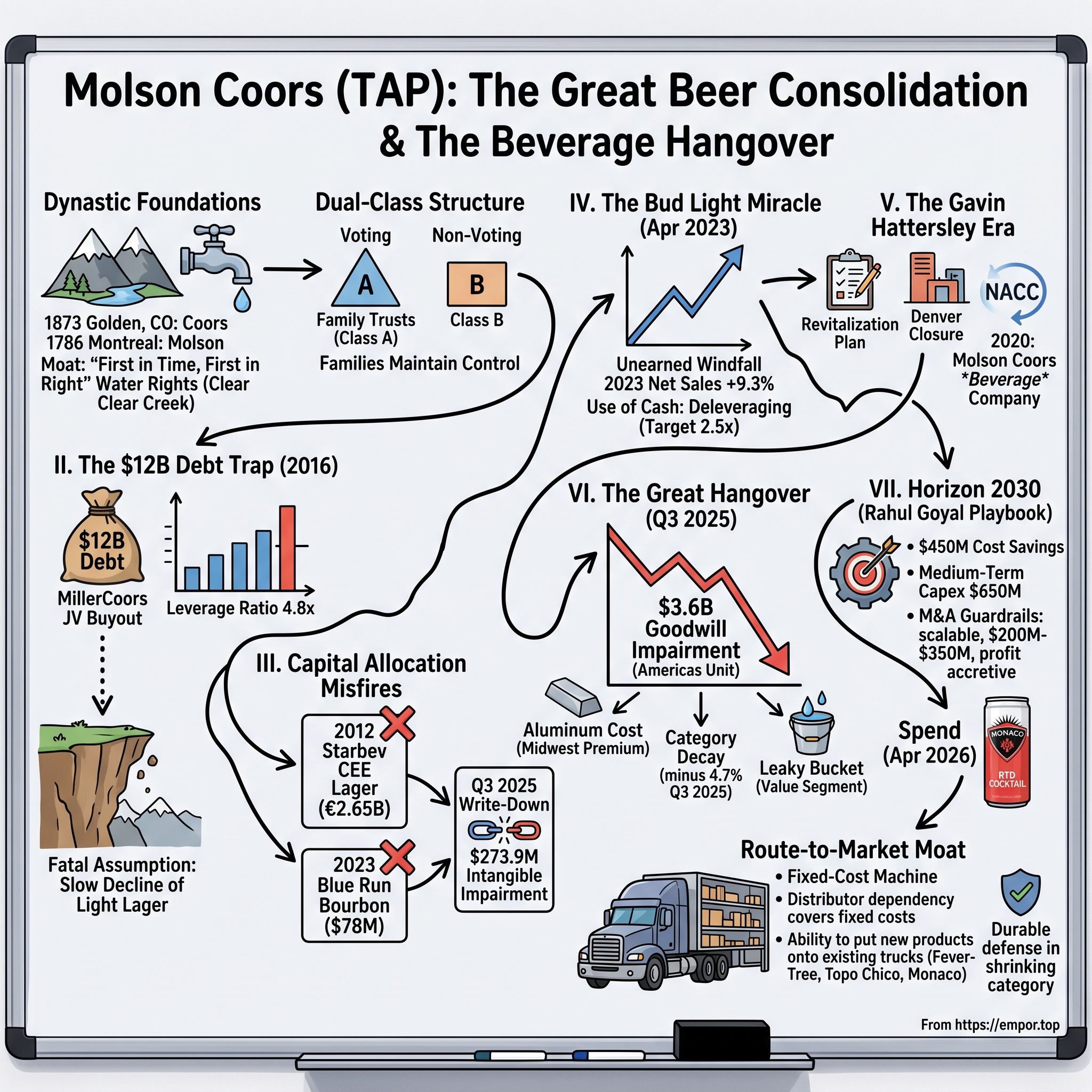
Molson Coors Beverage Company: The Great Beer Consolidation & The Beverage Hangover
I. Introduction & The Day of Reckoning (00:00–00:15)
On the morning of November 4, 2025, three people sat on a Molson Coors earnings call, and only one of them still had a job at the company.
Gavin Hattersley, who had run the business for six years, opened the call as "former Chief Executive Officer" — retired since October 1, retained in an advisory capacity through year-end.1 He said it was his last earnings call, thanked the team, and handed the microphone to a man he had worked alongside for years. Rahul Goyal, thirty-odd days into the top job, then delivered the kind of first impression no incoming CEO wants: an admission that the company had just written off a sum of money larger than a third of its own stock market value.
The number was $3,645.7 million. A partial goodwill impairment on the Americas reporting unit — the accounting equivalent of a company standing up in front of its investors and saying, in the flat language of ASC 350, that the assets it bought a decade ago are worth billions less than the balance sheet claims.2 Alongside it came another $273.9 million of intangible write-downs, including the near-total destruction of a bourbon brand purchased just two years earlier.2 The quarter's U.S. GAAP loss before income taxes came to $3,495.5 million.3
Twelve days before that call, Goyal had already made his other opening move: a corporate restructuring of the Americas business unit eliminating roughly 400 salaried positions — about 9% of the Americas salaried workforce — by the end of December, at a cost of $35 million to $50 million in severance and post-employment charges.4 "We must transform even faster," he said, and "move with urgency and make bolder decisions."4
Here is the puzzle that makes this story worth telling. Molson Coors is not a broken company in any obvious operational sense. In 2025 it generated $11.14 billion of net sales, roughly $1.14 billion of underlying free cash flow, and finished the year with a net-debt-to-underlying-EBITDA ratio of 2.33x — the healthiest balance sheet it has carried since the middle of the last decade.5 It owns Coors Light, Miller Lite, Coors Banquet, Blue Moon, Carling, Molson Canadian, Staropramen and Peroni. It has a brewing lineage stretching back 240 years. And just two years before the write-down, it captured what may be the single largest unearned market-share windfall in modern American consumer packaged goods: the 2023 collapse of Bud Light.
So how does a business with that much cash flow, that much brand equity, and that much recent good fortune end up confessing, in the third quarter of 2025, that the long-term cash flows underpinning its largest segment can no longer support the goodwill carried against them?
The answer runs through the whole arc of this story. It starts in the cold spring water of Clear Creek, Colorado and on the docks of Montreal. It runs through a dual-class share structure that puts two founding families in permanent control of a public company. It passes through the defining corporate decision of the modern era — a $12 billion, debt-financed bet in 2016 that the American premium light lager would decline gently rather than steeply. It detours through Eastern European lager and Kentucky bourbon, both written down. It crests in April 2023 with a windfall nobody at Molson Coors earned or predicted. And it lands in a 2025 in which the borrowed volume ran out, aluminum costs exploded, and a new CEO inherited the bill.
This is a story about what happens when a company with a genuinely durable distribution advantage operates in a category that is slowly, structurally shrinking — and about whether the cash a shrinking business throws off can be redeployed fast enough to build the next one.
 Subscribe on LinkedIn
II. The Dynastic Foundations: Molson, Coors, & Water Rights (00:15–00:35)
Start with water, because everything at Coors starts with water.
In 1873, a German immigrant named Adolph Coors walked the foothills west of Denver looking for a brewing site. He was not looking for customers — Golden, Colorado had barely any. He was looking for cold, clean, mineral-suitable spring water flowing out of the Clear Creek watershed. He found it, and built a brewery on it. A century and a half later, the Golden brewery is one of the largest single brewing sites on earth, and the water rights attached to it remain among the most valuable and least fungible assets in American brewing.
Eighty-seven years before that, in 1786, John Molson had started a brewery on the St. Lawrence in Montreal and turned it into a pillar of the Canadian industrial establishment — the oldest continuously operating brewery in North America. Rahul Goyal would later stand on a CAGNY stage in Boca Raton and describe himself as inheriting "a 240-year-old legacy in this country."[^6]
For the purposes of a long-term investor, most of that pre-modern history is romance rather than analysis. But the water is not romance. It is a live, contested, legally defined asset — and it illustrates something important about how physical constraints shape a moat.
The economics of prior appropriation. Colorado water law does not work the way most people assume. Under the doctrine of prior appropriation — "first in time, first in right" — a water right is not tied to owning land next to a river. It is a property right in a specific quantity of water, dated by when it was first put to beneficial use, senior rights getting satisfied before junior ones in a dry year. Coors' rights in the Clear Creek basin are old, which makes them senior, which makes them extraordinarily hard to replicate. You cannot build a competing brewery of that scale in that place, because the water is spoken for.
That is a genuine cornered resource in the Hamilton Helmer sense. But it comes with a ceiling, and in 2018 the Colorado Supreme Court showed exactly where the ceiling sits.
Coors had asked the water court to amend its decreed augmentation plans so it could reuse the water leaving its treatment plant and lease the surplus to others — in effect, squeezing more economic value out of the same physical inflow. A coalition of competing Clear Creek users, including the City of Golden, Denver, Arvada, Thornton and Northglenn, plus private ditch companies, objected. On June 25, 2018, the Colorado Supreme Court ruled against Coors, holding that a water user cannot acquire the right to reuse return flows by amending an augmentation plan; it must adjudicate a new water right.6 Replacement water, the court found, retains its character as native, tributary water — it has to be allowed to flow back to the stream.7
The analytical takeaway is not "Coors lost a lawsuit." It is that the cornered resource is real but bounded. Coors owns privileged access to a finite volume of water at a specific place; it does not own the right to compound the value of that volume indefinitely. This is a fair metaphor for the entire company: a strong, defensible, physically constrained asset base in a category where the constraint eventually binds.
The dynastic trust. The other foundational asset is not physical at all. It is a governance structure.
The 2005 combination of Molson and Coors created a trans-border brewer, and — crucially — it was engineered to preserve family control on both sides. The result is a dual-class structure that has survived every subsequent transformation. Class A shares carry the voting power and sit almost entirely with the founding families: the Adolph Coors Jr. Trust and Pentland Securities (1981) Inc., the Molson family vehicle, which are parties to voting trust agreements that combine their voting power over the Class A common stock.8 Class B shares — the ones Vanguard, BlackRock and every other institution and retail investor actually own — carry the economic exposure and essentially no say. The board's nominating machinery is itself split, with separate Class A-M and Class A-C subcommittees filling Molson-designated and Coors-designated seats respectively.8 The board chair is David Coors; the vice-chair is Geoff Molson.9
Molson Coors' own risk disclosure is unusually candid about the fragility here: one identified risk is simply that Pentland and the Coors Trust might disagree with each other, or that the board's supermajority requirements might deadlock on certain actions.8
Sit with that for a second. The company formally warns its public investors that its two controlling families might fall out with one another — and that if they do, there is no mechanism by which Class B holders can break the tie. This is not a theoretical construct borrowed from a governance textbook; it is the operating reality of a company with roughly $11 billion of annual revenue.
The 2005 merger that created this arrangement was itself a product of weakness rather than strength. Both Molson and Coors were, by the standards of the early 2000s, sub-scale national champions watching the global brewing industry consolidate around them. InBev and Ambev had just combined. SABMiller had bought Miller. Anheuser-Busch dominated the United States. A Canadian brewer with limited international reach and an American brewer with a strong regional franchise and a modest national one were, separately, going to be acquired. Together, they had a chance of staying independent.
That is the honest origin of Molson Coors: a defensive merger of two family businesses, structured so that neither family would lose control, executed to avoid being consumed. Everything that followed — the joint venture with Miller in 2008, the buyout of that joint venture in 2016, the pivot beyond beer — flows from an institution whose founding instinct was preservation rather than conquest.
For an investor, that heritage carries a specific and testable implication. Companies built to preserve tend to be excellent at defending existing positions and structurally slow at attacking new ones. Molson Coors' record maps onto that prediction with uncomfortable precision: superb at deleveraging, superb at holding core brand share, superb at operating breweries — and late to hard seltzer, late to ready-to-drink cocktails, late to non-alcoholic, and dependent on partnerships and acquisitions to enter each of them.
Is this good or bad for a Class B holder? Honestly, both — and the evidence cuts in both directions rather than one. On the positive side, family control has bought this company something rare in consumer staples: patience. It suspended and rebuilt its dividend, it deleveraged for the better part of a decade, and it has not been forced into a value-destroying defensive merger by an activist with a two-year holding period. On the negative side, the same structure means the people bearing the economic consequences of capital allocation have almost no mechanism to change it. When management overpays for an asset — and, as we will see, it has done so more than once — Class B holders have exactly one lever: sell. That is not governance; that is exit.
The families did not create the company's central problem. But they built the vehicle in which the central decision was made — and that decision came in 2016.
III. The MillerCoors Gambit: The $12B Debt Trap (00:35–01:05)
Every so often, antitrust law hands a company a gift it cannot refuse. In 2015, it handed Molson Coors the biggest one in its history — and the company took it with both hands.
The setup: Anheuser-Busch InBev was buying SABMiller in a deal valued north of $100 billion, the largest brewing merger ever attempted. The U.S. Department of Justice was never going to allow the combined entity to also hold SABMiller's half of MillerCoors, the American joint venture in which SABMiller held a 58% economic and 50% voting interest and Molson Coors held the rest. Something had to be divested. And there was, realistically, exactly one buyer on earth who could take it without triggering a fresh antitrust problem: the joint venture's other partner.
Molson Coors was, in the language of M&A, the natural buyer. It was also the only buyer. Which is a wonderful position to be in — unless you want it too badly.
The transaction. On November 11, 2015, Molson Coors announced it would acquire full ownership of MillerCoors and the global Miller brand portfolio for $12 billion in cash.10 The company told investors the deal would add roughly $4.7 billion of incremental revenue and more than $1.0 billion of incremental EBITDA on a pro forma basis.10 The Department of Justice signed off in July 2016, and the deal closed on October 11, 2016, making MillerCoors a wholly owned subsidiary and vaulting Molson Coors into the ranks of the world's largest brewers.11
Was the price sensible? On the arithmetic disclosed at announcement, it looked defensible — arguably attractive. Twelve billion dollars against a bit more than a billion of incremental EBITDA implies a headline multiple in the neighborhood of eleven and a half times. But because the transaction was structured as an asset purchase for U.S. tax purposes, it carried immediate cash tax benefits the company estimated at more than $250 million annually for the first fifteen years, with a net present value of $2.4 billion.10 Net that against the price and the effective multiple falls toward nine times. Layer in the at-least-$200 million of annualized cost synergies management expected by the fourth full year — from procurement, supply network optimization and operational efficiency — and the forward multiple compresses further, into the high sevens.10
Set against the roughly twenty times AB InBev was paying for SABMiller, Molson Coors looked like the disciplined operator picking up the scraps at a rational price. That was the story in 2015, and on the numbers as presented it was not an unreasonable story.
The financing. The problem was never the multiple. It was the funding.
A $12 billion cash purchase by a company that was, at the time, considerably smaller than the thing it was buying had to be financed overwhelmingly with debt. The scale of what that did to the balance sheet is best expressed in Molson Coors' own retrospective numbers, delivered by CFO Tracey Joubert a decade later: at the time of the MillerCoors acquisition, net debt stood at $11.5 billion and the leverage ratio at 4.8 times.[^6] For context, most investment-grade consumer staples companies operate at half that.
So Molson Coors emerged from 2016 owning 100% of the second-largest brewer in America — and owing an amount of money that would define the next ten years of its corporate life. Nearly every strategic decision from 2017 onward has been made in the shadow of that leverage: the dividend cut, the capital expenditure discipline, the absence of meaningful organic innovation spending in the critical years when hard seltzer and ready-to-drink cocktails were being born.
The fatal assumption. Underneath the model was one load-bearing assumption: that the American premium light lager category would decline gently and manageably. Coors Light and Miller Lite are enormous, high-volume, high-cash-flow brands. A business paying eleven and a half times EBITDA for a portfolio in slow decline is doing something close to a leveraged annuity purchase — it works if the annuity decays at 1% a year and fails badly if it decays at 5%.
It decayed at 5%.
Younger drinkers migrated to spirits, to ready-to-drink cocktails, to wine, to cannabis in legal states, and increasingly to nothing at all. Goyal himself, when pressed on this in November 2025, drew the timeline precisely: the beer category "used to be in the minus 1, 2" range historically; over the last several years it settled into "the minus 3-ish range"; and in 2025 it fell to somewhere between minus 4% and minus 6%, with the company's internal estimate for the U.S. beer industry in Q3 2025 at minus 4.7%.1
Run that decay rate through a 2015 discounted cash flow model and the answer is not subtle. The goodwill impairment of 2025 was not a surprise event. It was the arithmetic of 2016 finally being marked to market.
What this says about management. There is an important distinction here between a bad decision and a bad outcome. Buying MillerCoors was, in isolation, close to unavoidable — declining the only opportunity to own your own joint venture outright would itself have been a strategic error, and the alternative was a competitor sitting inside the tent. The criticism that survives scrutiny is not the what; it is the how. Financing a slow-declining cash cow with 4.8x leverage removed the company's optionality at precisely the moment the beverage industry began fragmenting fastest. Molson Coors spent the seltzer boom deleveraging.
Which raises an obvious question: when the company did have capital to deploy, where did it go?
IV. The Starbev and Blue Run Detours: Capital Allocation Misfires (01:05–01:25)
Two acquisitions, eleven years apart, on two continents, in two categories. Both were framed at the time as escapes from the gravity of North American mass beer. Both ended up on the same impairment line in the same quarter.
The international mirage. In April 2012, before the MillerCoors deal and while the balance sheet still had room, Molson Coors agreed to buy Starbev L.P. from funds advised by CVC Capital Partners for €2.65 billion — about $3.54 billion.12 The deal closed that June and delivered nine breweries, roughly 4,100 employees, and leading positions across the Czech Republic, Serbia, Croatia, Romania, Bulgaria, Hungary, Montenegro, Bosnia-Herzegovina and Slovakia.13 The crown jewel was Staropramen, the Prague lager sold in more than thirty countries.13
The logic was straightforward and, on paper, sound: Central and Eastern Europe offered lower beer-market maturity, a premiumization runway, and a genuinely iconic brand to build a regional platform around. It was diversification away from a North American business that even in 2012 looked structurally challenged.
What actually happened is that European beer turned out to be a harder market than the model assumed — fragmented, inflation-exposed, and competitively brutal, with limited pricing power in the value tiers that carry most of the volume.
The premium spirits pivot. Eleven years later, flush with unexpected cash and eager to demonstrate that "beyond beer" meant something, Molson Coors went to Kentucky. On August 7, 2023, it acquired a 75% equity interest in Blue Run Spirits, Inc., a high-end whiskey business, for a purchase price of $78 million subject to working capital adjustment, of which $65 million was cash.14 Roughly $88 million of total consideration was preliminarily allocated to a definite-lived brand intangible asset to be amortized over fifteen years, with the remainder going to working capital and goodwill.14 The acquisition established Coors Spirits Co. and came with plans for a state-of-the-art distillery in Georgetown, Kentucky.15
Bourbon in 2023 was, in fairness, the hottest category in American alcohol. Allocated bottles traded at multiples of retail. Blue Run had won awards and built genuine cachet among collectors.
The reckoning. Both bets came due in the same three-month window.
In the third quarter of 2025, Molson Coors recorded $273.9 million of non-cash intangible asset impairment charges. Within that: a full impairment of $75.3 million on the Blue Run Spirits definite-lived intangible, and a partial impairment of $198.6 million on the Staropramen family of brands.2
Read the Blue Run number carefully, because it is the more damning of the two. A full write-off of the brand intangible, roughly equal to the entire purchase price, taken twenty-five months after closing. That is not a market turning against you. That is an asset that never worked inside the acquirer.
The pattern, and the honest counter-argument. A skeptical investor looks at this sequence — Eastern European lager in 2012, Kentucky bourbon in 2023 — and sees a specific failure mode: a company with a powerful, volume-optimized North American distribution machine repeatedly buying small, high-touch, premium-craft assets whose value depends on scarcity and connoisseur credibility, then discovering that its distribution machine cannot manufacture either. Scale distribution is a superb weapon for pushing a nine-dollar six-pack into 200,000 outlets. It is close to useless for building a $90 allocated bourbon, where the entire brand proposition is that you can't find it everywhere.
The fair counter-argument is that Blue Run was small — $65 million of cash on a business generating over a billion dollars of annual free cash flow is a rounding error, and a company that never writes anything off is a company that never experiments. Management would reasonably say that trying and failing cheaply is the correct behavior for a company that needs new categories.
The problem with that defense is the trust cost. Impairments are not just accounting entries; they are public evidence about the quality of the underwriting process. When a company writes off a purchase price inside two years, investors reasonably discount the next acquisition announcement. And Molson Coors has now told the market that acquisitions are central to its future — a point we will return to, because the new CEO has already spent again.
A note on the accounting judgment. There is a second-order detail in the Blue Run structure worth flagging, because it illustrates how these deals actually work. Molson Coors bought 75% of the equity, not all of it, and recognized the remaining minority interest at fair value using a Monte Carlo simulation, recording it as a redeemable noncontrolling interest based on the contractual terms.14 In plain English: the sellers retained a stake with a contractual path to being bought out, and the value of that obligation had to be modelled rather than observed. Meanwhile, roughly $88 million was allocated to a definite-lived brand intangible amortized over fifteen years — a long amortization period for a brand that had existed for less than three.14
None of this is improper. All of it is common in the acquisition of small, founder-led businesses. But it is a reminder that when a large company buys a small hot brand, a meaningful portion of the purchase accounting rests on assumptions rather than observations — a fifteen-year life for a three-year-old brand, a simulated value for a contingent minority stake. Those assumptions were tested in Q3 2025 and did not survive. Investors reading the next beyond-beer acquisition disclosure should look for the same tells: what life is assigned to the brand intangible, and what portion of consideration sits in goodwill rather than identifiable assets.
The alternative use of that capital. It is also worth asking what else the money could have done. The combined cash outlay on Blue Run was $65 million. That is roughly one and a half million Class B shares at 2026 prices. Small in isolation — but the point of a track record is that it is cumulative, and the market prices management's future capital deployment off the observed history of past deployment. When a company trading at a high single-digit free cash flow yield tells investors it will fund $200 million to $350 million acquisitions from operating cash, the market's first instinct is to compare that to the certain return of retiring its own equity. Management has to earn the benefit of the doubt on every deal, and right now the ledger is not in its favor.
For the moment, note the sequencing. Blue Run was bought in August 2023 — four months after the event that briefly made Molson Coors look invincible.
V. The Gavin Hattersley Era & The Bud Light Miracle (01:25–01:50)
Gavin Hattersley is a South African accountant by training who spent years as MillerCoors' CFO and then Molson Coors' CFO before being handed the top job in late 2019. He inherited a company with too much debt, too many offices, and a portfolio built for a version of the American beer market that no longer existed.
His response, announced on October 30, 2019, was the "revitalization plan" — and it was genuinely surgical.16 The Denver office was closed and Chicago designated the North American operational headquarters, with functional support roles consolidated into Milwaukee. Employment came down by approximately 400 to 500 people. The company targeted roughly $150 million in annual savings.16 And in January 2020, "Molson Coors Brewing Company" became Molson Coors Beverage Company — a name change that reads as cosmetic and was in fact a strategic declaration: this business would no longer define itself by the liquid in the tank.
The substance behind the name was a partnership strategy. Rather than buy its way into adjacent categories with a balance sheet it did not have, Molson Coors licensed its way in — most notably through an alliance with The Coca-Cola Company that put Topo Chico Hard Seltzer and, later, Simply Spiked into the Molson Coors distribution network. The architect of much of that work was the chief strategy officer, a company lifer named Rahul Goyal.
Then, in April 2023, something happened that no strategic plan could have anticipated.
The windfall. A single influencer marketing decision at Bud Light triggered a consumer boycott that reshaped the American beer market almost overnight. Bud Light, the best-selling beer in the United States for two decades, collapsed. And the volume did not evaporate — it moved. Displaced drinkers walked into the same stores and reached for the nearest domestic light lagers on the shelf: Miller Lite, Coors Light and, increasingly, Coors Banquet.
The financial effect was immediate and enormous. Molson Coors' net sales rose from $10.70 billion in 2022 to $11.70 billion in 2023 — growth of roughly 9.3% in a category that had been declining for years.17 For a mature brewer, that is a once-in-a-career top-line year, and none of it came from a product Molson Coors invented, a campaign it ran, or a market it opened.
What management did with it. Here the record is genuinely good, and deserves to be said plainly: Molson Coors did not squander the windfall on a transformational acquisition at the top of the cycle. It used the cash primarily to fix the balance sheet and return capital. It also spent more on marketing to try to convert borrowed drinkers into loyal ones — a rational use of a windfall, and one that Hattersley defended repeatedly on calls through 2024.18
What management said about it. This is where the analytical work gets interesting, because it is a case study in how a narrative hardens over time.
Through 2024, management's message was one of retention. In the fourth quarter of 2024, the company told investors that Coors Light, Miller Lite and Coors Banquet had retained more than 80% of their combined volume share gains versus the prior year — an improvement on the second and third quarters.19 Analysts pushed, repeatedly, on the obvious question: was this a permanent structural re-rating of Molson Coors' share of the American beer shelf, or a temporary reallocation that would decay as Bud Light stabilized and the underlying category resumed its slide? Management insisted the gains were sticky.
Fifteen months later, standing on the CAGNY stage in February 2026, Goyal quantified it differently: "We've kept about 70% of that share that we gained in '23 with our core brands."[^6]
Eighty percent, then seventy percent. That is not a scandal — the base periods differ, the measurement conventions differ, and no company holds a windfall forever. But it is a useful discipline for an investor: management's characterization of the durability of the 2023 gains has drifted in one direction, and only one direction, every time it has been restated. The honest reading is that roughly a quarter to a third of an unearned windfall has already leaked back out, and there is no evidence yet that the leak has stopped.
Myth versus reality. Three consensus beliefs about this period deserve fact-checking, because all three are half-true in ways that matter.
Myth one: the Bud Light windfall transformed Molson Coors. Reality: it transformed one year's revenue and, more durably, the balance sheet. Net sales in 2025 were $11.14 billion — below the 2023 peak of $11.70 billion and only modestly above the $10.70 billion of 2022, the last pre-windfall year.175 Three years on, the top line has essentially round-tripped. What genuinely persisted was the cash: the windfall accelerated deleveraging and funded the start of a buyback program that has since retired nearly 15% of the shares. The volume was rented. The balance sheet repair was permanent.
Myth two: Molson Coors stole the drinkers. Reality: the drinkers arrived on their own. There is no evidence that a campaign, product change or distribution push caused the 2023 share shift, and management has never seriously claimed one. What Molson Coors did do — and this is a real competence — was keep them longer than the historical churn rate for switched beer drinkers would predict. That is an execution result, but it is a retention result, not an acquisition result. The distinction matters because retention decays and acquisition compounds.
Myth three: the 2023 gains prove the core brands are healthy. Reality: the gains prove the core brands are available and acceptable — the default choice when a drinker's first choice becomes unacceptable. That is a genuine asset, and it is exactly what a broad distribution footprint buys you. It is not the same as brand preference. Coors Light and Miller Lite have continued to lose category share in the years since, which is what you would expect if the 2023 inflow was substitution rather than conversion.
More fundamentally, the windfall did something subtle and damaging to the company's own diagnostics. For eighteen months, Molson Coors' reported numbers were flattered by an exogenous event. Underlying category decline, aging core brands, an under-indexed above-premium portfolio in the U.S. — all of it was still happening, and all of it was harder to see through the noise. The 2023 cash even helped fund the Blue Run purchase, made four months into the windfall, at the top of the bourbon cycle — a reminder that unearned money is the most dangerous money a management team can be handed.
In 2025, the noise stopped.
VI. The Great Hangover: The $3.6B Americas Write-Down (01:50–02:10)
Three things converged on Molson Coors in 2025, and each one alone would have made for a difficult year.
First, the comparison base. By 2025 the Bud Light lift had fully lapped. What remained was the underlying trend line, and the underlying trend line got worse rather than better. Management's framing was that a structurally declining category — health and wellness, generational shifts, drinkers simply choosing other things — had been overlaid with an unusually harsh cyclical layer: tariff-related price pressure, immigration enforcement affecting Hispanic consumer traffic, and a squeezed lower-income consumer cutting basket size and shifting to single-serve packages.1
Whether that split is right matters enormously for valuation, and it is genuinely contestable. Goyal argued the incremental 2025 softness was cyclical and that the category should return to "pre-2025 levels" once the macro pressure clears.1 A bear would note that "cyclical" is the most convenient available diagnosis, and that every year of a structural decline looks cyclical from the inside. The one piece of evidence that supports management came later: in the first quarter of 2026, the U.S. beer industry declined 1.6% by the company's internal estimate — a meaningfully better print than 2025's roughly 5% full-year decline.20 One quarter is not a trend, and Q1 2026 lapped a very weak base. But it is a data point, and it is on management's side of the argument.
Second, the self-inflicted volume. Molson Coors was deliberately winding down unprofitable contract brewing arrangements — brewing other companies' beer in its own breweries. Cycling out of 1.9 million hectoliters of Pabst and Labatt contract volume across 2025 mechanically depressed reported volumes, contributing a 450,000 hectoliter, three-percentage-point headwind to Americas financial volume in Q3 alone.1 This is good business — low-margin volume leaving the system — but it makes the top line look worse than the underlying trend, and it arrived in the worst possible year.
Third, aluminum. The Midwest Premium — the regional surcharge American buyers pay for physical aluminum delivery on top of the LME price — went vertical. Molson Coors entered 2025 guiding to a range of $0.60 to $0.75 per pound; by October the price had hit an all-time high, and CFO Tracey Joubert conceded it was trading above the top of the assumed range with "potentially more increases coming."1 Her explanation of why hedging did not solve the problem is one of the more candid disclosures in recent staples reporting: the Midwest Premium is "a very difficult and very expensive commodity to hedge," its pricing "does not follow conventional market ebbs and flows," and liquidity is limited.1 For a company that packages a large share of its volume in cans, this is not a line item. It is a margin event.
The result. Full-year 2025 net sales fell 4.2% to $11.14 billion, on brand volume down 5.4% and financial volume down 8.6%.5 Underlying diluted earnings per share fell 9.1% to $5.42.5 On a U.S. GAAP basis — after the impairments — the company reported a net loss of roughly $2.14 billion, or $10.85 per diluted share.17
The impairment mechanics, in plain English. Goodwill is the premium a buyer pays above the identifiable value of what it acquires — the accounting record of optimism. Every year, a company must test whether the reporting unit carrying that goodwill is still worth at least what the balance sheet says. Molson Coors identified a triggering event during Q3 2025 and ran the test as of August 31, using a blend of discounted cash flow analysis and market multiples.2 It failed, by $3,645.7 million.
Asked directly by Bank of America's Peter Galbo whether a write-down of that size didn't argue against management's cyclical thesis, Goyal gave a notably layered answer. He cited four drivers: the year's performance, a changed outlook, discount rates and risk premium, and — revealingly — "the multiple."1 That last one matters. Part of what forced the impairment was not the beer business deteriorating but the market's willingness to pay for beer businesses deteriorating. When peer trading multiples compress, the market-multiples half of the fair-value estimate compresses with them, and goodwill that was fine last year is impaired this year with no change in the underlying cash flows.
Goyal then said something that captures the whole tension: "We think we are very undervalued in the context of our market cap right now."1 In one answer, a CEO simultaneously wrote down $3.6 billion because the market's implied valuation of his business had fallen, and argued that the market's valuation of his business was wrong.
Both statements can be true. But an investor should be clear-eyed about what the impairment is and is not. It is not a cash event — no money left the building, no covenant was tripped, no dividend was endangered. It is, however, a formal, audited admission that the long-term cash flow projections underpinning the 2016 MillerCoors acquisition no longer support the carrying value. The 2016 thesis, in the company's own accounting, is now officially impaired.
That is the balance sheet Rahul Goyal inherited.
VII. The Rahul Goyal Playbook: Chief Strategy Officer at the Wheel (02:10–02:35)
Rahul Goyal did not parachute in. He started at Coors Brewing Company in Golden, Colorado in 2001 and spent the next twenty-four years working his way across the company's geography and function map — chief information officer in the U.K., chief financial officer in India, then chief strategy officer, and along the way running Coors Distributing Company, the company's own wholesale operation in Colorado.9
That résumé is unusual and analytically relevant. A CEO who has been a CIO understands why an ERP migration is a strategic project rather than an IT project. A CEO who has run a beer distributor understands, viscerally, the thing that actually determines whether a new product succeeds in America: whether it gets on the truck. And a CEO who was chief strategy officer during the "beyond beer" era owns that record personally — he built the Coca-Cola partnerships behind Topo Chico Hard Seltzer and Simply Spiked, struck the Fever-Tree deal, and led the acquisitions of ZOA and Naked Life.9
Board chair David Coors framed the appointment on September 22, 2025 as the outcome of "an extensive and thorough CEO succession process"; vice-chair Geoff Molson said Goyal "leads with authenticity and integrity."9 Hattersley stayed on in an advisory role through year-end.9
The insider advantage is real: no learning curve, credibility with a distributor network that does not warm to outsiders, and genuine knowledge of where the bodies are buried. The insider problem is equally real: the beyond-beer portfolio that most needs fixing is substantially the portfolio Goyal himself assembled. Blue Run was bought while he was chief strategy officer. So was the hard seltzer exposure that later required a painful repositioning. Asked at his first earnings call whether the board had given him room to make big changes, Goyal answered that there were "no sacred cows" and "no constraints."1 Whether an architect can be his own most ruthless critic is one of the open questions in this story.
Act one: cut. The restructuring came before the strategy, which is telling. Announced twelve days before his first earnings call, it eliminated approximately 400 salaried Americas positions.4 On the call, both Goyal and Joubert disclosed an important nuance that softens the number considerably: a meaningful share of those 400 were positions already open and unfilled, plus voluntary severance — meaning, as Joubert put it, the company "wouldn't expect to get a full benefit in 2026."1 Molson Coors declined to give a savings target for the restructuring at all.
Jefferies' Kaumil Gajrawala said the quiet part out loud: when an industry has struggled for over a decade and a new CEO arrives, investors usually see a bigger restructuring, and "what's been announced so far seems small."1 Goyal's answer was essentially "wait" — that Q4 action was about setting up the Americas for 2026, and a fuller plan would come.1
Act two: the plan. It arrived on February 18, 2026, at CAGNY, branded Horizon 2030. The financial architecture has three pillars.
Cost: a three-year program targeting up to $450 million of savings, beginning in 2026, spread across cost of goods sold, Americas G&A, and EMEA&APAC margin improvement.5 By the first quarter of 2026 the company had already added restructuring actions in EMEA&APAC including the closure of a U.K. brewery.20
Capital discipline: medium-term capital expenditure rebased from roughly $750 million a year to approximately $650 million — a real reduction in reinvestment intensity that flatters free cash flow and, if sustained too long, eventually shows up in asset quality.[^6]
M&A with published guardrails: this is the most investor-friendly disclosure Molson Coors has made in years. Joubert specified the criteria — deals adding roughly 1% to 2% of net sales revenue annually, bottom-line accretive, in the range of about $200 million to $350 million, funded from operating cash flow, targeting scalable assets in white spaces where the company believes it has a right to win.[^6] After Starbev and Blue Run, publishing a size cap and an accretion test is exactly the kind of self-binding an investor should want.
Operating model: Goyal's genuine conviction, repeated on every call, is that "beer is a very, very local business" and that Molson Coors has been managing it nationally. The fix is to push P&L accountability — pricing, promotion, assortment, investment — down to the market level, and to change incentive plans so that people are measured on the results closest to them.[^6] Evercore's Robert Ottenstein pressed on how this actually gets executed without fragmenting national brands; Goyal's answer was that there will still be one Coors Light, but its execution will differ by geography.[^6]
Act three: spend. On April 2, 2026, Molson Coors completed the acquisition of Atomic Brands, maker of Monaco Cocktails — launched in 2012, the largest independently owned ready-to-drink singles cocktail brand in the U.S., built primarily in convenience and independent retail.21 The deal made Molson Coors a top-five supplier in RTD cocktails and brought about 80 Monaco salespeople onto the payroll.20 Management expects it to contribute about 1% of global net sales revenue on a trailing-twelve-month basis and to be profit-accretive in year one with nine months of ownership.20
Judged against the criteria published six weeks earlier, Monaco fits: it is scalable, it fills a genuine white space (Molson Coors had essentially no RTD spirits presence — Goyal admitted the gap explicitly in November 2025), and it plugs into the existing route to market.1 Whether it works depends on execution, and the honest reference class is not encouraging. But there is one structural difference worth noting: Monaco is a high-volume, convenience-channel, singles business — a shape Molson Coors' distribution system is genuinely built to amplify. Blue Run was the opposite.
The people changes underneath. Goyal has also been rebuilding the layer below him, consistent with the "local accountability" thesis. He told analysts he had made changes to the leadership team specifically to put the heads of U.S. sales, marketing and the Canadian business "around the table" so that commercial decisions sit closer to the market.1 In March 2026 the company appointed Will Meijer as president of Canada sales — a market where, unlike the U.S., Molson Coors has been gaining both volume and share with Molson Canadian and where Coors Light remains the number one premium light beer.2620
Personnel moves are easy to under-weight, but they are among the more reliable early signals available. A CEO who says he is decentralizing and then leaves the same central structure in place is signalling; a CEO who reorganizes reporting lines, replaces regional leadership and — as Goyal did — rewrites the incentive plans so that people are measured on the P&L closest to them is doing something structural.[^6] The plans may still fail. But the actions are consistent with the words, which is more than can be said for many transformation announcements.
Incentives and alignment. Goyal's compensation arrangement was disclosed on his appointment: an annual base salary of $1,100,000, participation in the Molson Coors Incentive Plan targeted at 150% of base salary, a targeted 2026 long-term incentive grant with a grant-date fair value of $7,000,000, and a one-time $2,000,000 restricted stock unit award vesting three years from grant.22
The structure is conventional and heavily equity-weighted, which is what you want. But the alignment question at Molson Coors is not really about pay mix. Executives are subject to stock ownership guidelines expressed as a multiple of base salary, per the proxy.23 Even fully satisfied, a professional-manager CEO's personal stake is a rounding error against roughly 188 million shares outstanding — and, more to the point, it is Class B stock. It carries economics, not votes. The people who can actually change the direction of this company are the Coors Trust and Pentland, and no amount of CEO share ownership alters that.
So the real governance dynamic is this: an insider CEO with a mandate he describes as unconstrained, executing against a board controlled by two families whose time horizon is measured in generations. That can be a formidable combination — patient capital plus operational urgency — or it can be a slow-motion trap in which nothing truly radical is ever attempted. Six months into the tenure, the evidence points modestly toward the former: the restructuring, the published M&A guardrails, the capex reduction and the Monaco deal all happened inside nine months.
What has not changed is the thing that generates the cash to pay for any of it.
VIII. Segment Financials & The Route-to-Market Moat (02:35–03:00)
Walk into any American grocery store and look at the beer set. Notice that the person building it — deciding where Coors Light sits, how much space the imports get, which new seltzer earns a facing — often does not work for the store. In roughly 60% of Molson Coors' retail accounts, that person effectively works for Molson Coors, which serves as category captain.[^6] The company's actual U.S. market share is about 22%.[^6]
Hold that asymmetry in your head, because it is the single most underappreciated asset in this story.
Where the money is. The segment split is stark. In 2025, the Americas generated $8.71 billion of net sales, down 5.7%, while EMEA&APAC contributed $2.46 billion, up 1.8%.5 So roughly 78% of revenue — and the overwhelming majority of profit — comes from North America, and it is the segment that shrank. Europe grew the top line but is the segment management has explicitly flagged for margin improvement, having taken restructuring actions and closed a U.K. brewery in early 2026.20 Americas brand volume fell 4.9% in 2025; EMEA&APAC fell 6.7%.5
This concentration is the core of the valuation problem. A business whose profit is 78% dependent on a category declining at low-to-mid single digits needs either a durable pricing lever or a fast-growing second engine. Molson Coors has some of the first and is trying to build the second.
The three-tier system, explained simply. After Prohibition, American states built a deliberately fragmented alcohol distribution architecture. Brewers sell to independent wholesalers; wholesalers sell to retailers; retailers sell to you. With narrow exceptions, a brewer may not own its distributors or sell directly to a bar. Think of it as a mandatory toll road between the brewery and the shelf, operated by thousands of independently owned local businesses.
Layered on top are state franchise laws — statutes, enacted state by state, that make a brewer-distributor contract extraordinarily difficult to terminate. In many states a brewer cannot walk away from a wholesaler even for poor performance without demonstrating statutory cause and paying substantial compensation. In practice, these relationships are close to permanent.
Why this is a moat, and for whom. Here is the mechanism, and it is a Helmer-style scale economy operating one layer down the value chain rather than at the manufacturer.
A beer distributor is a fixed-cost business: warehouses, refrigerated trucks, routes, sales representatives, delivery schedules. That overhead must be covered by volume, and the volume that covers it is not craft IPA or premium RTD — it is the enormous, boring, fast-turning brands. Miller Lite. Coors Light. Keystone. Molson Canadian. A distributor without those brands cannot economically operate the truck.
That dependency converts into what the industry calls distributor share of mind. Because wholesalers need Molson Coors' core brands to survive, Molson Coors gets disproportionate attention from their sales forces, disproportionate priority in delivery sequencing, and — critically — the ability to place new products into an existing, paid-for distribution system at near-zero incremental cost. When Molson Coors adds Fever-Tree, or Simply Spiked, or Monaco Cocktails, it is not building a route to market. It is renting space on one that already exists and is already funded by beer volume.
Goyal has been explicit that this is the strategic logic of the beyond-beer push. Discussing Fever-Tree, he described a brand "very well received by distributors and retailers" and pointed to the trifecta of distributor, retailer and internal-team enthusiasm as the precondition for scaling.1 With Monaco, the company retained roughly 80 sales staff specifically to add "feet on the street" — physical coverage at the point of sale — an investment that only makes sense on top of an existing distribution backbone.20
The uncomfortable inversion. Now flip the moat over, because it cuts both ways.
Franchise laws that make it hard to fire a distributor also make it hard to fix one. A wholesaler underperforming in a key market is close to un-replaceable. And the same volume dependency that gives Molson Coors leverage today weakens as core beer volume declines: a distributor whose Coors Light case volume falls 5% a year, every year, becomes gradually less captive — and simultaneously more desperate for the growth brands, which are increasingly owned by spirits companies and independents.
There is also a buyer-power squeeze on the other side. Walmart, Kroger, Costco and the large convenience chains are consolidated, sophisticated, and entirely capable of reallocating beer space to higher-margin RTDs. Category captaincy buys influence over how the set is built; it does not buy the right to keep the set the same size.
The evidence in 2025–26 shows both dynamics operating at once. The company held or gained share in flavored and above-premium categories and reported that in Q1 2026 its top six brands all grew share in the on-premise channel per Nielsen CGA.20 But total U.S. volume share fell 40 basis points in Q3 2025 and 60 basis points in Q1 2026 — with Goyal attributing the losses primarily to the value segment, which he described bluntly as "a leaky bucket," and to Miller Lite weakness concentrated in specific regions such as the Great Lakes.120
That is a fair picture of a route-to-market moat: it makes launching new things much cheaper than it would otherwise be, and it does very little to stop the erosion of the old things.
The supply chain, and why Q2 2026 got ugly. One further point about the physical business deserves attention, because it exposes a vulnerability that no framework captures.
In the first quarter of 2026, Molson Coors shipped more than it depleted — a roughly one percentage point benefit to Americas financial volume — but only by pushing through a series of operational problems.20 Joubert described a quarter that included weather and energy-supply disruptions at facilities, planned brewery upgrades running into production, and constraints from glass suppliers on specific packages.20 Then she guided second-quarter U.S. shipments to be down 6% to 9%, trailing brand volume, driven partly by planned downtime for line upgrades at the Shenandoah brewery and partly by lapping higher year-ago inventory.20
Guiding a nine-percent shipment decline in the quarter that leads into the American summer selling season — with a World Cup and a national anniversary both landing in it — is not a comfortable position. Goyal and Joubert both stressed the disruption is temporary and the upgrades are value-creating. That is plausible. But it illustrates something structural: a brewer's cost base is enormous, fixed and physical, and its ability to convert a demand opportunity into revenue depends on glass, aluminum, line availability and truck capacity all cooperating simultaneously. When management says it does not currently believe a brewery closure is necessary and prefers line-level optimization, it is choosing flexibility over fixed-cost reduction.1 In a shrinking category, that choice gets re-examined every year — and the U.K. brewery closure announced in Q1 2026 suggests the re-examination has already begun on the other side of the Atlantic.20
Which sets up the framework question — how strong is this business, really?
IX. Hamilton Helmer's 7 Powers & Porter's 5 Forces Analysis (03:00–03:20)
Frameworks are useful mainly for the discipline of admitting what a company doesn't have. Applied honestly, Molson Coors has fewer durable powers than its size suggests.
Scale economies — strong, and genuinely load-bearing. The Golden brewery is among the largest brewing sites in the world; Milwaukee, Fort Worth, Shenandoah and the Canadian and European network give the company production scale that a challenger cannot replicate. Scale also buys national media purchasing power — the company was among the top beverage-alcohol advertisers during March Madness in 2026 and committed its largest single media investment in years to the World Cup summer.20 The distribution scale described above belongs here too, and it is the most valuable form. Notably, when asked in late 2025 whether the network needed shrinking to match lower volumes, Goyal said he did not believe a brewery closure was required and framed the opportunity as line-level optimization within existing plants.1 A bear would flag that as under-reaction; the Q1 2026 U.K. brewery closure suggests the position is evolving.
Cornered resource — moderate, and narrower than the marketing implies. The Clear Creek water rights are real and senior, but as the 2018 ruling established, they do not extend to unlimited reuse. They protect the economics of one site. They do not protect Coors Light's share of the shelf.
Brand — strong but decaying, and the decay is the whole story. Coors Light, Miller Lite and Coors Banquet carry decades of accumulated emotional equity, and Banquet in particular has shown that a legacy brand can genuinely reignite with a younger consumer — Goyal has repeatedly noted it sits in only just over half the buying outlets that Coors Light does, implying real distribution runway.1 But brand equity in mass lager is being consumed faster than it is being replenished. The clearest evidence is Blue Moon: management has openly conceded it "hasn't seen the success we would like," with the core Belgian White "continues to be challenged" even as non-alcoholic and high-ABV extensions grow.1 When a company's own CEO says a large brand needs "a fresh commercial perspective," that is brand power in retreat.
Process power — weak. High-speed canning, variety-pack capability and brewing efficiency are all valuable, and Molson Coors has invested in them. They are also matchable by AB InBev, Heineken and Constellation. Nothing here is proprietary for long.
Counter-positioning — none, and structurally the wrong side of it. Molson Coors is the incumbent being counter-positioned against. Every RTD startup, every craft brewer, every non-alcoholic entrant defines itself in opposition to mass lager.
Switching costs — none. A drinker changes brands by moving their hand eighteen inches.
Network effects — none.
That is two strong powers, one moderate, and four absent. It describes a solidly defended cash generator, not a compounding franchise.
Porter's five forces sharpen the picture.
Threat of substitutes is extremely high, and it is the defining force. Beer is losing share to spirits, RTD cocktails, wine, cannabis and abstention simultaneously. This is not a market-share war Molson Coors can win by taking volume from AB InBev; the pool itself is draining. Every strategic move in Horizon 2030 — value-segment defense, above-premium expansion, beyond-beer M&A — is ultimately a response to this single force.
Buyer power is high on both sides. Consolidated national retailers control shelf space and are actively reallocating it. Independent distributors hold statutory protection under franchise law. Molson Coors is squeezed between two counterparties it cannot easily discipline.
Rivalry is intense and permanent. AB InBev retains the largest U.S. share and enormous media firepower. Constellation Brands owns Modelo Especial and Corona — the demographic and momentum winners of the last decade. Heineken competes globally with a stronger premium mix. Goyal's own diagnosis of Miller Lite's Q1 2026 weakness was "heightened competition in a couple of U.S. regions."20
Supplier power is moderate but currently punishing. The Midwest Premium episode demonstrated that a single hard-to-hedge input can move an entire year's earnings guidance. Glass supply constraints also contributed to Q1 2026 shipment problems and a guided 6% to 9% decline in second-quarter U.S. shipments.20
Threat of new entrants is low in mass beer and high everywhere else. Nobody is building a new national lager brewery. Everybody is launching an RTD.
The synthesis: Molson Coors occupies a well-defended position in a market that is shrinking, facing substitution pressure it cannot arbitrage away, with the strongest remaining advantage — route to market — being precisely the asset most useful for selling things that are not its core product. That is the strategic logic of Horizon 2030 stated in framework terms, and it is coherent. The question is whether the arithmetic works.
X. The Investment-Story Spine: Bull vs Bear (03:20–03:35)
As of late July 2026, Molson Coors' Class B shares traded around $43, with a market capitalization near $8.1 billion against a 52-week range of roughly $38 to $55.24 Add $5.4 billion of year-end net debt and the enterprise is being valued at roughly $13.5 billion — for a business that generated about $1.14 billion of underlying free cash flow last year.5 The market is pricing a melting ice cube. The whole investment question is how fast it melts, and what gets built with the water.
The skeptical case, stated at full strength.
The value trap. Cheap on cash flow is exactly how declining businesses always look, right up until the cash flow declines too. If the beer category is structurally shrinking at 3% or worse, and Molson Coors is losing share within it — down 40 basis points in Q3 2025 and 60 basis points in Q1 2026 — then volume compounds downward while fixed costs stay fixed.120 Management's core defense is that 2025's incremental weakness was cyclical, and it is worth being explicit that this is an assertion under active test, not an established fact.
The M&A record. The pattern is now documented across three transactions and two decades: an over-levered 2016 acquisition that generated a $3.6 billion goodwill impairment nine years later; a 2012 European platform whose flagship brand took a $198.6 million partial write-down; and a 2023 bourbon acquisition fully impaired in twenty-five months.214 An activist would put this slide up first. And the immediate response to publishing new M&A discipline was… another acquisition, six weeks later.
The growth illusion. Beyond beer is approaching roughly 10% of revenue.[^6] Even at that scale, growing a 10% segment at 20% adds two points of company growth against a 78%-of-revenue Americas segment declining mid-single digits. The mix arithmetic does not yet close the gap, and management's own medium-term ambition is only low-single-digit top-line growth.
The capital-return-versus-reinvestment tension. This is the sharpest activist question available. Molson Coors is cutting medium-term capex from ~$750 million to ~$650 million, funding acquisitions from operating cash flow, buying back stock aggressively, raising the dividend, and refinancing debt — all from the same cash flow, in a year when underlying pretax income is guided down 15% to 18%.5[^6] Morgan Stanley's Eric Serotta asked essentially this at CAGNY: if M&A is funded from operating cash, shouldn't buybacks shrink?[^6] Joubert's answer — strong balance sheet, strong free cash flow, "we're able to do both" — is confident but not arithmetically specific. Something eventually gives.
The near-term financing item. A $2.4 billion debt maturity fell due in July 2026, with board approval to refinance between $1.1 billion and $1.9 billion of it.20 The company holds its strongest credit rating since 2016 and ended Q1 2026 at 2.5x leverage, targeting below 2.5x by year-end.[^6]20 This is manageable, not alarming — but refinancing at 2026 rates against 2016-vintage coupons is a real interest expense headwind on top of everything else.
The cost shock. Management sized the 2026 Midwest Premium and aluminum headwind at roughly $125 million — a 9 to 10 percentage point drag on pretax income growth — after a roughly 300% move in the premium.[^6]20 That is the single largest driver of 2026's guided earnings decline.25
The resilient cash machine, stated at full strength.
The cash is real, and the GAAP loss is not. The $3.6 billion impairment moved no money. Underlying free cash flow was $1.14 billion in 2025 and guidance calls for a similar figure in 2026.5 Joubert's claim at CAGNY — that over the past five years the company has delivered more than a dollar of free cash flow for every dollar of underlying earnings, with among the highest free cash flow yields in consumer packaged goods — is the strongest single fact in the bull case.[^6] A business generating over a billion dollars of cash against an eight-billion-dollar equity value does not need much growth to work for a patient owner.
The deleveraging is genuinely done. From $11.5 billion of net debt and 4.8x leverage at the MillerCoors close to $5.4 billion and 2.33x at the end of 2025 — cut by more than half — while holding the highest credit rating since 2016.[^6] Whatever else one says about the last decade, this was executed. The company promised to deleverage and deleveraged.
The capital return is substantial and already in motion. The $2 billion buyback authorized in October 2023 was 72% executed within nine quarters, roughly $1.4 billion.[^6] In February 2026 the board raised the authorization by $2.0 billion to an aggregate $4.0 billion and extended it through December 31, 2031.5 Since October 2023, Molson Coors has retired 14.8% of its Class B shares outstanding.20 The quarterly dividend rose to $0.48 in Q1 2026, a 2.1% increase and the fifth consecutive annual raise — and because the share count has shrunk so much, the company raised the per-share dividend while paying out fewer absolute dollars.20 For a shrinking business, retiring one share in seven at a depressed multiple is a mathematically powerful use of cash.
The consolidation endgame. If beer is consolidating, scale survivors take a larger share of a smaller pie. Craft breweries are closing; seltzer brands are shaking out. The route-to-market advantage compounds in that environment, and Fever-Tree, Topo Chico Hard and now Monaco are real, growing, above-premium assets riding a distribution system already paid for by beer.
The management-credibility mark-to-market. Judged on behavior rather than rhetoric, the record is mixed but improving. On the negative: an impairment history, a share-retention narrative that has drifted downward, and a restructuring whose savings were never quantified. On the positive: management reaffirmed 2025 guidance and told investors they would land at the low end rather than pretending otherwise; disclosed the unflattering detail that much of the 400-position reduction came from already-open roles; explained precisely why the aluminum hedge did not work; published explicit M&A size and accretion criteria; and, at Q1 2026, flagged an ugly guided 6% to 9% second-quarter shipment decline rather than burying it.120 That is not promotional behavior. Analysts should — and did — keep pressing, but the disclosure quality is better than the capital allocation record.
What would falsify each case. The bear case breaks if U.S. beer industry volumes stabilize near the Q1 2026 rate and Molson Coors' share losses stop, because then the free cash flow yield alone does the work. The bull case breaks if 2026 volumes resume a mid-single-digit decline while beyond-beer stays below 15% of revenue — at which point the buyback becomes a slow liquidation rather than a compounding return.
The three KPIs that matter.
-
Americas financial volume growth. Everything else is downstream. This is where the structural-versus-cyclical debate gets settled, quarter by quarter. Watch it alongside the company's stated U.S. industry estimate to separate category decline from share loss — and be aware that contract-brewing wind-down and distributor inventory timing distort the reported figure, so read the shipment-versus-depletion commentary too.
-
Above-premium and beyond-beer share of net sales revenue. Management named mix as a core metric itself, and beyond beer is at roughly 10% of revenue.[^6] This is the single cleanest measure of whether the transformation is outrunning the erosion. If this line is not climbing meaningfully year over year, the strategy is not working regardless of what the earnings release says.
-
Net debt to underlying EBITDA. The stated ceiling is 2.5x, and it is the constraint that governs everything else — buybacks, dividends, M&A capacity, credit rating.[^6] Because the denominator is falling, holding the ratio requires the numerator to fall too. If leverage drifts above 2.5x while buybacks continue at 2026's pace, the company will have quietly chosen capital return over balance sheet discipline, and investors should price that choice.
XI. Epilogue & Outro (03:35–03:45)
Two hundred and forty years after John Molson started brewing on the St. Lawrence, and a hundred and fifty-three after Adolph Coors found his spring water in the Colorado foothills, the company that carries both names is engaged in something neither founder would recognize: an argument with the market about how much a beer business is worth when fewer people drink beer.
The lesson of the last decade is not that Molson Coors is badly run. It is more specific and more useful than that. A superior distribution network and a portfolio of high-volume cash cows can fund an enormous amount of corporate transformation — over a billion dollars a year, in this case, sustained through a category decline, a pandemic, a cyber incident, a leveraged balance sheet and an aluminum shock. But debt-financed M&A in a structurally declining category consumes the one thing a transforming company needs most: time. Molson Coors spent the 2016–2022 window paying down the MillerCoors loan. That window happened to be exactly when hard seltzer, ready-to-drink cocktails and the non-alcoholic category were being built. The company arrived at the party with a repaired balance sheet and no seat at the table.
What is happening now is a slate-clearing. The goodwill from the 2016 thesis has been written down. The bourbon experiment has been written off. The Americas organization has been cut and rewired. Capital expenditure has been rebased, a $450 million cost program is running, M&A now comes with published guardrails, and $4 billion of buyback authorization runs through 2031 against a company worth roughly twice that on the open market.
Rahul Goyal's bet — the one thing his entire tenure will be judged on — is that beer's 2025 collapse was cyclical rather than terminal, and that the distribution machine built for lager can be used to carry Fever-Tree, Topo Chico, Monaco and whatever comes next fast enough to outrun the erosion of Coors Light and Miller Lite. Q1 2026 offered him one supporting data point in an industry decline of 1.6%. Q2 is guided to look considerably worse. The families who control the votes have, by the CEO's own account, told him there are no sacred cows.
The question that remains is the one the impairment already answered for the last decade and has yet to answer for the next: will the market pay for a leaner, more disciplined operator executing a credible plan — or does the secular decline of beer eventually swallow everything built on top of it?
References
-
Earnings call transcript: Molson Coors Q3 2025 — Investing.com, 2025-11-04 ↩↩↩↩↩↩↩↩↩↩↩↩↩↩↩↩↩↩↩↩↩↩↩
-
Molson Coors Beverage Company Form 10-Q for the quarterly period ended September 30, 2025 — SEC EDGAR ↩↩↩↩↩
-
Molson Coors Beverage Company Reports 2025 Third Quarter Results — Molson Coors Investor Relations, 2025-11-04 ↩
-
Molson Coors Beverage Company Announces Corporate Restructuring of Americas Business Unit — Molson Coors Investor Relations, 2025-10-20 ↩↩↩
-
Molson Coors Beverage Company Reports 2025 Fourth Quarter and Full Year Results — Molson Coors Investor Relations, 2026-02-18 ↩↩↩↩↩↩↩↩↩↩↩
-
Coors Brewing Co. v. City of Golden, 2018 CO 63 (No. 17SA55) — Colorado Supreme Court, 2018-06-25 ↩
-
Colorado Supreme Court rules against Coors in water case — BizWest, 2018-06-26 ↩
-
Molson Coors Brewing Company Form 10-K for fiscal year 2018 — SEC EDGAR ↩↩↩
-
Molson Coors Beverage Company Board Names Rahul Goyal as President and Chief Executive Officer — Business Wire, 2025-09-22 ↩↩↩↩↩
-
Molson Coors To Acquire Full Ownership Of MillerCoors Joint Venture And Global Miller Brand Portfolio For $12 Billion — Molson Coors press release filed on Form 8-K, SEC EDGAR, 2015-11-11 ↩↩↩↩
-
Molson Coors Brewing Company Form 10-K for fiscal year 2016 — SEC EDGAR ↩
-
Molson Coors To Acquire Central And Eastern European Brewer Starbev — Molson Coors Investor Relations, 2012-04-03 ↩
-
Molson Coors Completes Acquisition Of Starbev — Molson Coors Investor Relations, 2012-06-18 ↩↩
-
Molson Coors Beverage Company Form 10-Q for the quarterly period ended September 30, 2023 — SEC EDGAR ↩↩↩↩↩
-
Molson Coors Beverage Company Acquires Blue Run Spirits, Further Expanding Its Portfolio Beyond the Beer Aisle — Molson Coors Investor Relations, 2023-08-08 ↩
-
Molson Coors Announces Revitalization Plan and Reports 2019 Third Quarter Results — Business Wire, 2019-10-30 ↩↩
-
SEC EDGAR Company Filings — Molson Coors Beverage Company, CIK 0000024545 (annual income statement data, fiscal years 2020–2025) ↩↩↩
-
Molson Coors looks to lock in market share gains as consumers shift away from Bud Light — CNBC, 2024-02-13 ↩
-
Molson Coors Beverage Company Reports 2024 Fourth Quarter and Full Year Results — Molson Coors Investor Relations, 2025-02-13 ↩
-
Molson Coors reports first quarter results that exceeded analyst expectations — Investing.com (Reuters), 2026-04-30 ↩↩↩↩↩↩↩↩↩↩↩↩↩↩↩↩↩↩↩↩↩↩↩
-
Molson Coors Completes Acquisition of Atomic Brands, Maker of Monaco Cocktails — Molson Coors Investor Relations, 2026-04-02 ↩
-
Molson Coors Beverage Company Current Report on Form 8-K (CEO appointment and compensation arrangements) — SEC EDGAR, 2025-09-22 ↩
-
Molson Coors Beverage Company 2026 Proxy Statement (DEF 14A) ↩
-
Molson Coors Beverage Co (TAP.N) stock quote and market data — Reuters ↩
-
Molson Coors forecasts sharp drop in 2026 profit as aluminum costs bite — WSAU (Reuters), 2026-02-18 ↩
-
Molson Coors Beverage Company Appoints Will Meijer as President, Canada Sales — Business Wire, 2026-03-10 ↩
 LinkedIn
 WhatsApp
 Reddit
 Hacker News
 Email
Email Kindle
 RSS Feed
 Spotify
 Apple Podcasts
 Amazon Music
 Audible
 YouTube