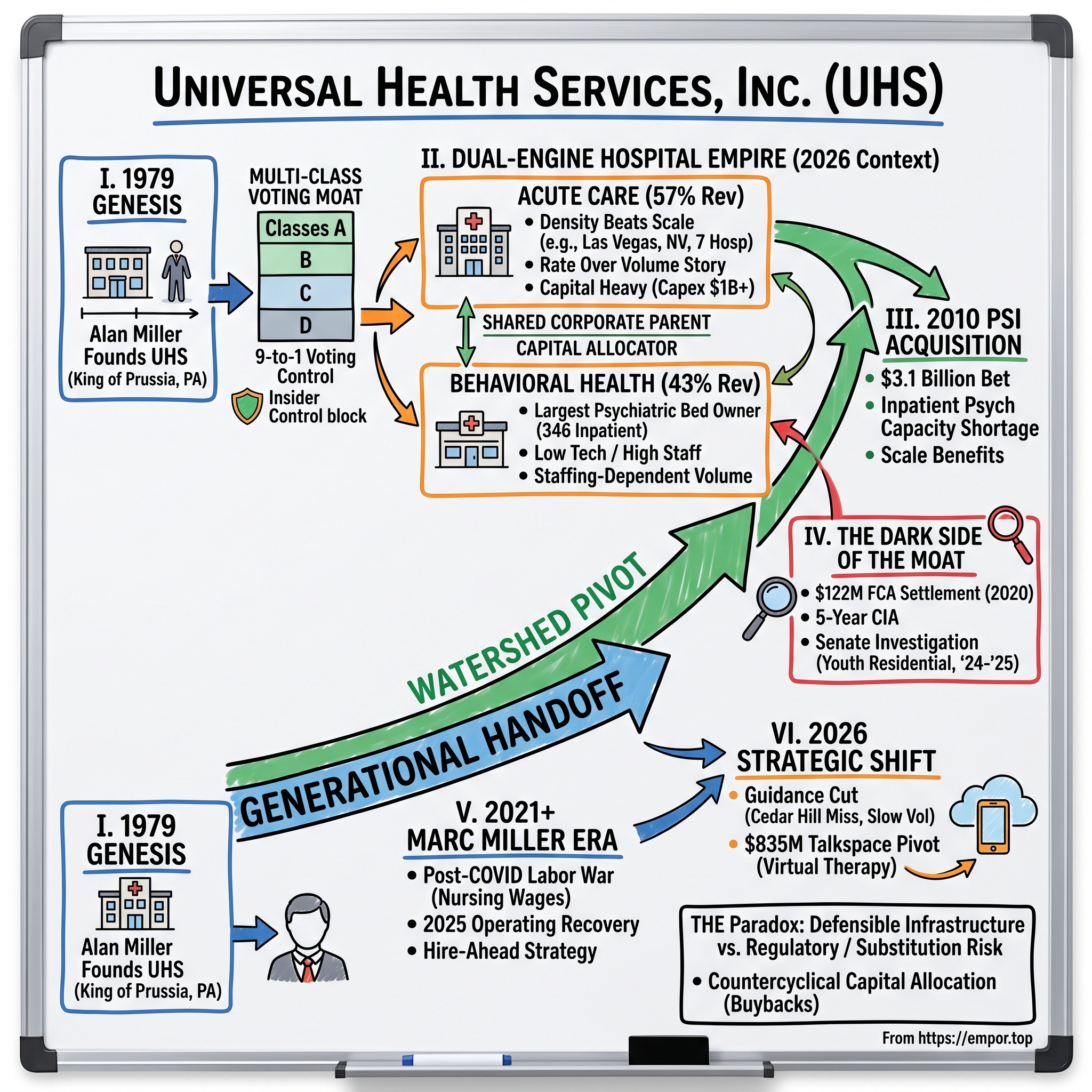
Universal Health Services, Inc. (UHS): The Dual-Engine Hospital Empire
I. Introduction & Episode Roadmap (0:00 – 10:00)
On a spring morning in May 2026, a ribbon was cut in Palm Beach Gardens, Florida, on a brand-new acute care hospital. The building carried a name that would have been unremarkable to most passers-by and deeply symbolic to anyone who follows American hospital economics: the Alan B. Miller Medical Center.1 The man it honors was, at that moment, still showing up to work as Executive Chairman of the company he founded — forty-seven years after he started it, having already lost one hospital empire to a hostile raider and built a second one specifically so that could never happen again.
That is the compressed version of the Universal Health Services story. A man builds a hospital company. It gets taken from him. He builds another, and this time he engineers the share structure so that no board, no activist, no private equity firm, and no proxy adviser can ever pry it loose.
The result, in 2026, is one of the strangest and most under-discussed compounding machines in American healthcare. UHS generated $17.365 billion in net revenues in 2025 and $1.489 billion in net income, or $23.10 per diluted share on a reported basis.2 It runs 29 acute care hospitals in the United States — a rounding error next to HCA Healthcare's 190 — and 346 inpatient behavioral health facilities spread across 40 states, Washington D.C., Puerto Rico, and the United Kingdom.34 It is simultaneously a mid-tier regional acute care operator and the largest owner of psychiatric beds in the Western world.
This is the paradox worth sitting with. The two businesses inside UHS share a corporate parent, a compliance department, and a capital allocator, and almost nothing else. Acute care is capital-heavy, technology-intensive, and won or lost city by city — you either own the trauma center in a growing metro or you don't. Behavioral health is the opposite: low-tech, low-capex, staff-constrained rather than equipment-constrained, and assembled facility by facility out of a fragmented national market. One business competes with HCA and Tenet. The other competes with mom-and-pop psychiatric hospitals, state institutions, and a single public peer, Acadia Healthcare, that is less than half its size in behavioral revenue.5
Investors have never quite known what to do with the combination. The stock has spent most of the past decade trading at a discount to its acute care peers, and management has responded not by simplifying the portfolio but by buying back enormous quantities of its own equity. That is either brilliant countercyclical capital allocation or a family-controlled board recycling cash into a structure it can never be forced to change. The evidence, as this story will show, is genuinely mixed.
There is a further reason the company resists easy framing. UHS is not really a healthcare growth story and has not been one for years. It is a regulated infrastructure business whose revenue growth is mostly price, whose price is mostly negotiated with a handful of insurers and set by a handful of government agencies, and whose capacity to serve demand is limited less by capital than by whether it can hire enough nurses. Strip away the sector label and what remains looks closer to a toll road operator with a licensing regime, a labor union problem, and a compliance department that occasionally receives subpoenas. Understanding UHS means understanding which of those forces is binding in any given year — and in 2026, the answer has been changing quarter to quarter.
Here is the road ahead.
The Genesis. Alan B. Miller's founding of UHS in 1979 in King of Prussia, Pennsylvania, and the multi-class capital structure — Classes A, B, C, and D — that gives one man 88.9% of the company's general voting power while public shareholders own the overwhelming majority of the economics.6
The Structural Split. How acute care at roughly 57% of consolidated revenue and behavioral health at roughly 43% actually make money, why the two look nothing alike, and where the real competitive protection sits.3
The Watershed Pivot. The 2010 acquisition of Psychiatric Solutions, Inc., a bet that turned UHS from a hospital company with a psychiatric division into the dominant behavioral health platform in the country.
The Dark Side of the Moat. A $122 million federal False Claims Act settlement in 2020, a five-year Corporate Integrity Agreement, a bipartisan Senate investigation into youth residential treatment, and the uncomfortable structural question underneath all of it: whether the segment's margins depend on the very staffing thinness that generates the allegations.
The Generational Hand-off. Marc D. Miller's ascension in 2021, the post-COVID labor war that halved profits in a single quarter, the recovery that followed, and what the summer of 2026 — a cut to guidance, a decertified Texas hospital, a Washington D.C. hospital bleeding money, and a $835 million pivot into virtual therapy — says about whether the recovery is durable.78
Start where the founder started: with a company he lost.
 Subscribe on LinkedIn
II. The Genesis: Alan Miller’s Blueprint & The Multi-Class Voting Moat (10:00 – 25:00)
Alan B. Miller grew up in Brooklyn, the son of a father who ran a dry cleaning store and a mother who worked in the millinery trade.9 He went to the College of William & Mary on the strength of academics rather than money, then to Wharton for an MBA, and then — in a detail that explains an enormous amount about how UHS has always been run — into advertising and consulting rather than medicine. Miller has never been a clinician. He came to hospitals as a capital allocator who noticed, in the late 1960s, that American healthcare was a fragmented cottage industry of nonprofit and municipal institutions with no professional management layer on top of it.
In 1969 he founded American Medicorp, one of the first modern for-profit hospital management companies. It grew fast. And then, in 1978, it was taken from him: Humana launched a hostile takeover and won.9 Miller was 41 years old and had just watched a decade of work absorbed into a competitor's balance sheet.
Most executives would have taken the payout. Miller started over. In 1979 he founded Universal Health Services in King of Prussia, Pennsylvania, an office-park suburb outside Philadelphia that remains the corporate headquarters to this day.10 The company went public in 1981, and the early growth came the way it did for every hospital roll-up of that era — by buying tired assets and running them harder. The 1983 purchase of Qualicare, Inc., for more than $116 million, brought eleven acute care hospitals and four behavioral health hospitals into the fold in a single stroke.11 Note the composition. Behavioral health was in the DNA from almost the beginning, sitting quietly alongside the acute business for nearly three decades before anyone thought of it as the main event.
In 1986, Miller did something else that reveals his instincts: he spun a portfolio of properties into Universal Health Realty Income Trust, one of the first healthcare real estate investment trusts, with UHS retaining the advisory relationship.10 It was financial engineering before financial engineering was a phrase people used casually — a way to monetize real estate, keep the operating leases, and collect advisory fees on the vehicle. It also created a related-party structure that governance critics have poked at ever since, and which remains disclosed in UHS filings today.
The fortress: four classes of stock
But the defining architecture of UHS is not its real estate or its hospitals. It is the share register.
UHS has four classes of common stock, and the mechanics are worth walking through slowly because they are unusual even by the standards of American dual-class companies. Class A carries one vote per share. Class B — the class that trades on the NYSE under the ticker UHS, the class that virtually every outside investor owns — carries one-tenth of a vote. Class C carries 100 votes per share, but only if the holder also owns ten times as many Class A shares. Class D carries ten votes, conditioned similarly on a matching Class B position.12
Read that again. The publicly traded shares carry one-tenth of a vote. The founder's shares carry up to a hundred. That is a thousand-to-one voting ratio at the extreme, layered on top of a requirement that the super-voting stock be held alongside a specific supporting position — a design that makes the control block essentially impossible to unwind piecemeal.
The 2026 proxy statement puts numbers on the outcome. Alan B. Miller beneficially owned 77.8% of Class A, 100% of Class C, and 13.0% of Class B — and 88.9% of the company's general voting power.6 Marc D. Miller, his son and the current CEO, held a further 2.3%.6 In practical terms, the Miller family votes the company.
What the fortress buys, and what it costs
The generous reading is that this structure is exactly what allowed UHS to build a behavioral health business at all. Psychiatric hospitals are unglamorous, headline-prone, and periodically the subject of investigative journalism. A conventionally governed company facing a hostile bid, an activist campaign, or a quarterly earnings miss might have divested the segment in the 1990s, or spun it off in the 2010s when the sum-of-the-parts math looked tempting. UHS never had to entertain the conversation. Miller learned in 1978 what happens when you can be voted out, and he built the second company so it could not happen twice.
There is corroborating evidence for this reading in how the company has behaved through downturns. UHS did not chase the physician-practice roll-up mania of the mid-1990s that bankrupted several peers. It did not lever up during the cheap-money years to fund a transformative deal. It did not spin off, sale-leaseback, or financially engineer its way through the 2022 labor crisis. A company answerable to quarterly sentiment might have done any of those. The counterfactual is unprovable, but the pattern of restraint is consistent across four decades and multiple cycles, and consistency of behavior is the only real evidence available on questions of this kind.
The skeptical reading is equally well supported. A shareholder base with one-tenth of a vote per share has no mechanism to force change. If capital is misallocated, if a segment underperforms for a decade, if an acquisition destroys value, if related-party arrangements look generous, if executive compensation drifts, or if a strategic pivot is obviously required — outside holders can sell, and that is the entire menu. There is no proxy fight to run. There is no board seat to win. Institutional governance frameworks and index-inclusion debates have grown steadily more hostile to structures like this over the past decade, and UHS has made no move to sunset it.
The Universal Health Realty relationship sharpens the point. UHS serves as advisor to a publicly traded REIT it created, leases properties from it, and manages facilities within it — an arrangement disclosed as a related-party matter in the company's filings.12 Structures like this are not inherently abusive; plenty of them are perfectly fair. But they are precisely the sort of arrangement that outside shareholders would ordinarily want the ability to interrogate through the board, and at UHS that ability does not exist in any form that carries consequences.
That trade-off is not theoretical, and it is not resolved. It shows up as a persistent discount in how the market prices the company — and, more subtly, in how management behaves when the stock is cheap, which turns out to be the most revealing behavioral tell in the whole story.
To see why the market has never fully trusted the model, look at what is actually inside the two engines.
III. The Dual-Engine Empire: Segment Economics & Regional Moats (25:00 – 45:00)
Drive west from the Las Vegas Strip, past the last of the casino service roads, and the desert briefly reasserts itself before the subdivisions start again. Somewhere in that sprawl sits Spring Valley Hospital, and beyond it Henderson, and West Henderson, and Centennial Hills to the north. Seven hospitals serving more than two million people in Southern Nevada, all operating under a single brand, all owned by a company headquartered 2,400 miles away in a Pennsylvania office park.13
That is the acute care business in one image. UHS does not try to be everywhere. It tries to be inescapable somewhere.
The acute care engine: density beats scale
In 2025, acute care hospital services produced $9.926 billion of net revenue, roughly 57% of the consolidated total, from 29 inpatient hospitals supported by 35 free-standing emergency departments and 14 outpatient and surgical facilities.23 Same-facility acute revenue grew 8.5% for the year, built on 1.6% adjusted admission growth and 5.4% growth in revenue per adjusted admission.2
Pause on that split, because it is the single most important thing to understand about hospital economics. Volume grew in the low single digits. Price — really a blend of contracted rates, payer mix, and case complexity — grew more than three times as fast. Hospital revenue growth in this era is overwhelmingly a rate story, not a demand story. Which means the durable question for any acute care operator is not "are more people getting sick?" It is "can you make commercial insurers pay you more next year than they paid you this year?"
That is where density does its work. A commercial insurer selling health plans in Las Vegas cannot construct a marketable network that excludes seven hospitals covering the metro's fastest-growing suburbs. Members would revolt; employers would switch carriers. The insurer therefore negotiates from a weak position, and the operator extracts rate. Contrast that with a system holding one hospital in a ten-hospital city, where the insurer can simply walk. UHS is nationally mid-sized and locally enormous, and the second attribute is the one that shows up in the rate card.
How a hospital actually gets paid, in plain terms
It is worth pausing to demystify the machinery, because the language of hospital finance obscures a fairly simple structure. A hospital does not have a price list in any consumer sense. It has a set of contracts.
Roughly speaking, four buyers exist. Commercial insurers — the employer-sponsored plans — pay the most, typically negotiated as a percentage above a published rate or as fixed amounts per admission type. Medicare pays a fixed sum per case according to a national formula tied to the patient's diagnosis, adjusted for local wages and severity; the hospital keeps the difference if it treats the patient efficiently and eats the loss if it does not. Medicaid pays substantially less than Medicare, often less than the cost of care, with the shortfall partially plugged by supplemental and directed payment programs that individual states negotiate with the federal government. And the uninsured mostly do not pay at all, becoming uncompensated care.
This is why "revenue per adjusted admission" is the metric that matters and why it moves for reasons that have nothing to do with medicine. Shift the mix one point from Medicaid toward commercial and the number rises. Lose exchange-covered patients to the ranks of the uninsured and it falls. Win a supplemental payment approval in Florida or Nevada and it jumps, for reasons entirely unrelated to any patient treated that quarter. Hospital operators are, in a real sense, in the business of payer mix — and payer mix is set by employment levels, state politics, and federal subsidy design rather than by anything the operator controls.
The same logic drives the concentration in Texas, Nevada, and California that the 10-K explicitly flags as a geographic risk factor.3 Concentration is the strategy and the risk simultaneously. When Nevada's Medicaid supplemental payment program pays out, as it did to the tune of a $30 million prior-period benefit recognized in the first quarter of 2026, the effect on consolidated results is visible.14 When California passes a staffing law, the pain is equally concentrated. There is no diversification cushion by design.
Capital intensity is the other defining feature. UHS spent $1.015 billion on capital expenditures in 2025, and the bulk of that goes into the acute business: imaging suites, operating rooms, emergency department expansions, and entire new hospitals.2 A greenfield acute hospital takes years to permit, build, staff, and fill, and it loses money the entire time. Which brings us to the cautionary example currently sitting in the portfolio.
The Cedar Hill lesson
Cedar Hill Regional Medical Center opened in Washington D.C. in April 2025 — District-owned, UHS-managed, with George Washington University physicians and Children's National handling pediatrics. In its first year it ran a deficit of roughly $47.7 million, with expenses actually coming in under budget but revenue landing nearly 46% below projections.15 Pediatric emergency visits, women's health, and inpatient surgeries all arrived far below plan.
The instructive part is which side of the equation broke. Management controlled what it could control. What it could not control was whether patients in an underserved part of the city would show up in the volumes the demand model predicted. New acute capacity is a demand bet, and demand bets in healthcare are far less reliable than the industry's project pro formas suggest. UHS told investors in July 2026 that the year-over-year benefit from Cedar Hill's ramp would be about $50 million smaller than expected — a full third of the total guidance reduction for the year.1
The behavioral engine: a different physics
Now flip to the other side of the house. Behavioral health services accounted for roughly 43% of consolidated revenue in 2025 — on the order of $7.4 billion — from 346 inpatient facilities and 119 outpatient facilities, split 182 inpatient in the U.S., 161 in the U.K. through the Cygnet platform, and 3 in Puerto Rico.3 The U.K. business alone generated $1.001 billion of revenue in 2025, up from $880 million in 2024.3
The physics here are almost inverted. A psychiatric hospital does not need a cardiac catheterization lab or a linear accelerator. It needs beds, a locked and safe physical plant, and — above all — licensed staff. Capital expenditure per dollar of revenue runs materially below acute care. Once a facility is built and licensed, incremental patient days drop through to profit at a very high rate, because the fixed cost base is thin and the marginal cost is essentially the staff required to supervise one more patient.
That single sentence explains both the segment's extraordinary economics and its entire risk profile. When the marginal cost of an additional patient is a staffing ratio, the temptation to run those ratios thin is structural, not incidental. Hold that thought; Section V returns to it.
Same-facility behavioral revenue grew 7.7% in 2025 on 7.5% growth in revenue per adjusted admission and a nearly flat 0.2% increase in adjusted admissions.2 Read plainly: in 2025 the behavioral segment was, in volume terms, barely growing. Almost the entire revenue gain came from rate. Management has been candid that the binding constraint was labor supply — not patient demand. If you cannot hire the clinicians, you cannot open the bed, and the patient goes elsewhere or nowhere.
Myth versus reality: what "fragmented roll-up" actually means
The consensus shorthand for UHS behavioral is "a roll-up of a fragmented market." That was true in 2010. It is less true now, and the distinction matters.
Acadia Healthcare, the only comparable public pure-play, reported first quarter 2026 revenue of $828.8 million from 275 facilities with roughly 12,400 beds across 40 states and Puerto Rico.5 Annualize that and Acadia is a business less than half the size of UHS behavioral. The two of them, plus a long tail of nonprofit and state-run providers, effectively define the American inpatient psychiatric market. There is no longer a deep pool of large independent operators to acquire.
Which means the growth algorithm has quietly changed. UHS behavioral no longer grows primarily by buying platforms; it grows by adding licensed beds to facilities it already owns, opening new hospitals in partnership with nonprofit systems, and raising rates. In the second quarter of 2026 the company added 177 licensed beds.1 That is organic capacity growth, and it is slower, more staffing-dependent, and less exciting than acquisition-led growth — but it is also what a mature category leader does. Investors evaluating UHS on a "roll-up" thesis are evaluating the company it was in the last decade.
The company it became was determined by a single deal, struck in the wreckage of the financial crisis.
IV. The Watershed Moment: The $3.1 Billion PSI Acquisition (45:00 – 1:10:00)
In the spring of 2010, Psychiatric Solutions, Inc. was a company in trouble and everyone knew it.
The Franklin, Tennessee-based operator had been the great growth story of behavioral health in the 2000s, assembling the largest collection of freestanding inpatient psychiatric facilities in America — 94 facilities across 32 states, Puerto Rico, and the U.S. Virgin Islands.16 It was also, by 2010, under sustained pressure: a bruised share price, regulatory scrutiny in multiple states, an SEC inquiry, shareholder litigation, and a growing file of journalism about conditions inside its hospitals. Private equity had circled and backed away.
For most acquirers, that combination reads as a reason to stay home. For Alan Miller — who had been running psychiatric hospitals inside UHS since the Qualicare deal in 1983 and understood the operating model in his bones — it read as a discount.
The structure of the bet
On May 17, 2010, UHS announced a definitive agreement to acquire PSI for $33.75 per share in cash, approximately $2 billion for the equity, with roughly $1.1 billion of assumed net debt bringing total consideration to about $3.1 billion.16 The deal closed on November 15, 2010, after divestitures required to satisfy antitrust review.17 UHS guided to approximately $35 to $45 million of annual cost synergies within three years.16
Consider the size of the swing. UHS was, at the time, a company with a market capitalization in the low single-digit billions taking on a target whose enterprise value approached its own. It financed the purchase substantially with debt, at a moment when the credit markets had only just reopened after the financial crisis and hospital operators were staring at an entirely unknown reimbursement landscape — the Affordable Care Act had been signed into law seven weeks before the deal was announced, and nobody had any idea yet what it would do to hospital economics.
This was not a bolt-on. It was the company betting its balance sheet on a single thesis: that inpatient psychiatric care in America was structurally undersupplied, that the assets were being mismanaged rather than being fundamentally bad, and that a disciplined operator with a real compliance function could fix the operations and keep the margins.
Why it worked, and the part that gets glossed over
The first half of the thesis was correct, and spectacularly so — and the reason requires a short detour through American social policy.
Beginning in the late 1950s and accelerating through the 1960s and 1970s, the United States systematically dismantled its state psychiatric hospital system. The motivations were a mix of genuine reform, new antipsychotic medications that made outpatient management plausible, civil liberties litigation over involuntary commitment, and — decisively — state budget arithmetic. Federal legislation promised a national network of community mental health centers to replace the emptied institutions. That network was never fully funded and never fully built. The result was a half-century decline in inpatient psychiatric capacity per capita, running directly against rising diagnosis rates, an opioid epidemic, and a widening cultural willingness to seek treatment.
By 2010, the practical consequence was visible in every emergency department in America: psychiatric patients boarding for hours or days in acute care ERs because no inpatient bed existed to transfer them to. That is what a structural shortage looks like from the inside. A company that owned a large share of the remaining licensed inpatient capacity was sitting on a scarce asset — one whose scarcity was created by public policy and reinforced by the licensing regimes discussed later in this story. The subsequent decade of mental health parity legislation, expanded Medicaid behavioral coverage, and rising public willingness to seek treatment all pushed in the same direction.
The scale benefits were real and mostly unglamorous. Payer contracting improved because a national footprint gives you leverage with national insurers. Purchasing consolidated. Corporate overhead — legal, compliance, HR systems, clinical protocols, regulatory affairs — spread across a base that had roughly quadrupled in facility count. That last item is the one worth dwelling on, because the compliance apparatus a psychiatric operator needs is genuinely expensive and almost entirely fixed. Doubling the facility count without doubling the compliance budget is a structural margin gain that no small operator can replicate. It is also, uncomfortably, the same fixed-cost logic that makes under-investment in that function so tempting.
The part that tends to get glossed over in the triumphant retelling: UHS did not just buy PSI's facilities. It bought PSI's practices, PSI's culture, and PSI's legal exposure. Several of the facilities that would feature in federal investigations over the following decade came into UHS through this transaction. The integration succeeded financially long before it succeeded on compliance — and the bill for that gap arrived a decade later.
Crossing the Atlantic
Four years on, with the PSI integration substantially complete and the balance sheet repaired, UHS ran the playbook again in a different jurisdiction. In September 2014 it acquired Cygnet Health Care Limited for approximately $335 million — around £205 million — picking up 17 U.K. facilities comprising 15 inpatient behavioral hospitals and 2 nursing homes, with 743 beds and roughly $161 million of trailing annual revenue.18 In the same announcement, UHS disclosed its addition to the S&P 500 index.18
The strategic logic was that Britain's National Health Service, chronically short of specialist mental health capacity, outsources a meaningful share of it to independent providers on long-term contracts — a structurally similar demand picture to the United States, with a single dominant payer instead of hundreds. Cygnet has since grown to more than 160 inpatient facilities and a billion dollars of annual revenue, making it a genuinely material third leg of the company rather than an international experiment.3
The Cygnet purchase also carried a subtler message about capital discipline. UHS bought a category leader in a market it understood, at a price that was modest relative to its own cash generation, and then grew it organically for a decade rather than levering up for another transformative deal. Between 2014 and 2026, UHS did not attempt another acquisition on anything like the PSI scale. For a company whose founder built his first business through aggressive M&A, that restraint is a data point in management's favor — and it is the context in which the 2026 decision to spend $835 million on a money-losing digital therapy platform deserves scrutiny.
But before any of that, the model met its reckoning.
V. The Underbelly of the Model: DOJ Settlements & Corporate Integrity (1:10:00 – 1:35:00)
Turning Point Care Center sits in Moultrie, Georgia, a town of about 14,000 people in the southwestern corner of the state. Between January 2007 and May 2019, according to the federal government, the facility provided free or discounted transportation to Medicare and Medicaid beneficiaries — vans to bring patients in for detoxification and rehabilitation treatment.19
Offering someone a ride to the hospital sounds like a kindness. Under federal law, when the ride is a financial inducement to a government-insured patient to choose your facility, it is an illegal kickback. And the small, almost banal nature of the allegation is precisely what makes it a useful window into the model. The economics of a psychiatric bed are the economics of occupancy. Every empty bed is pure loss; every filled bed is near-pure margin. Everything in the system pushes toward filling beds and keeping them filled.
The 2020 settlement
On July 10, 2020, UHS and related entities agreed to pay a combined $122 million to resolve False Claims Act allegations.[^20] The structure: UHS itself paid $117 million, of which $88.1 million went to the federal government and $28.9 million to participating states; Turning Point paid a separate $5 million on the kickback allegations.19
The core allegations were more serious than the transportation vans. The government alleged that between 2006 and 2018, UHS behavioral facilities billed for inpatient services that were not medically necessary — admitting patients who did not meet criteria for inpatient care and keeping them longer than clinically warranted; that facilities failed to provide adequate and appropriate services, including through insufficient staffing and inadequate treatment planning; and that improper use of physical and chemical restraints and seclusion occurred.19 The cases originated as whistleblower actions brought by former employees under the qui tam provisions of the False Claims Act.
UHS settled without admission of liability, which is standard and legally meaningful. But the settlement should be read alongside a structural observation that no amount of legal framing dissolves: in a business where marginal profit is a staffing ratio and marginal revenue is an occupied bed, the incentive to admit marginally and staff thinly is not a bug introduced by bad local managers. It is the gradient of the business model itself. Compliance in behavioral health is not a department; it is a permanent counterweight pushing against the economics.
It is worth being explicit about what would falsify the pessimistic version of that claim, because it is testable rather than rhetorical. If the segment's margins are genuinely a product of scale, contracting leverage, and operating discipline rather than of thin staffing, then margins should hold up as staffing requirements ratchet upward. That experiment is running right now in California. If margins in a state with mandated psychiatric nurse ratios stabilize after the initial cost step, the structural critique weakens materially. If the segment can only earn its historical returns in jurisdictions that do not specify ratios, the critique is confirmed — and the implication is that regulatory convergence across states would compress behavioral margins permanently rather than temporarily. Neither outcome is yet established. Investors should watch the state-level pattern rather than the consolidated number.
The Corporate Integrity Agreement
The financial penalty was the smaller half of the consequence. Alongside the settlement, UHS entered a five-year Corporate Integrity Agreement with the HHS Office of Inspector General, executed in July 2020.20 CIAs are serious instruments. This one imposed compliance, monitoring, reporting, certification, oversight, screening, and training obligations across the behavioral portfolio, including independent review by outside monitors and annual certifications by senior executives.20
The financial cost of a CIA is real but rarely disclosed separately. The operational cost is higher: it constrains how quickly facilities can be integrated, adds documentation load to clinical workflow, and creates a paper trail that plaintiffs' lawyers can subpoena. The strategic cost is highest of all — a company under a CIA is a company that federal regulators are watching closely, at exactly the moment it wants to open new facilities in states where regulators must approve them.
By 2026 the five-year term has run its course, but the underlying exposure has not gone away, because the False Claims Act does not stop generating cases. UHS filings continue to disclose government investigations and civil litigation as ongoing matters.12
Washington notices
The regulatory environment then escalated from enforcement to legislative scrutiny. On June 12, 2024, following a two-year joint investigation with the Senate HELP Committee, Senate Finance Committee Chairman Ron Wyden released a report titled "Warehouses of Neglect: How Taxpayers are Funding Systemic Abuse in Youth Residential Treatment Facilities."21 The investigation examined four operators of youth residential treatment facilities: UHS, Acadia Healthcare, Devereux Advanced Behavioral Health, and Vivant Behavioral Healthcare.21 The report alleged patterns of abuse and neglect, unsanitary conditions, and business models that the committee characterized as prioritizing occupancy and profit over clinical outcomes, and it recommended reforms for Congress, federal agencies, state Medicaid and child welfare systems, and the operators themselves.21
Scrutiny continued after the report. In October 2024, Wyden publicly urged the Department of Justice to open an investigation into youth residential treatment facilities. In July 2025 the committee released further findings on harms faced by LGBTQIA+ youth in these facilities. In December 2025 it announced a package of reforms directed at the sector.22
For investors, the relevant translation is this. A False Claims Act settlement is a discrete, quantifiable, insurable event: you pay, you sign a CIA, you move on. Sustained congressional attention is a different category of risk, because it operates through the payment system rather than the courts. Youth residential treatment is disproportionately funded by state Medicaid and child welfare agencies. If those agencies tighten admission criteria, add staffing mandates, shorten authorized lengths of stay, or shift funding toward community-based alternatives, the revenue does not appear in a settlement line — it simply stops arriving, quietly, contract by contract.
That mechanism is not hypothetical. It is precisely the shape of the California staffing regulation now working through the 2026 numbers, and it is the shape of the certification loss at a San Antonio facility that has cost UHS real money this year. Which is to say: the regulatory overhang is not a legacy issue that got settled in 2020. It is a permanent operating cost of being the largest inpatient psychiatric operator in the country, and it should be modeled as such rather than treated as a one-off.
The man who inherited that reality took the job in the middle of a pandemic.
VI. The Generational Handoff & The Labor Crisis (1:35:00 – 1:55:00)
In January 2021, Marc D. Miller became Chief Executive Officer of Universal Health Services. His father remained Executive Chairman, and remains so in 2026.23
Succession from founder to son invites the obvious skepticism, and it deserves to be stated plainly: at a company where the family controls roughly nine-tenths of the votes, the appointment of the founder's son was not a competitive process, and no independent board could have been overruled because no independent board had the votes.6 What can be assessed is what happened next — and the timing of the handoff turned out to be about as unforgiving as it gets.
The stylistic contrast between the two Millers is not trivial. Alan Miller built his public persona as a founder-operator with strong views, an unapologetic defense of for-profit healthcare, and a habit of speaking about the company in terms of legacy and mission. Marc Miller's public register on earnings calls is markedly different: technical, granular, and heavily reliant on Chief Financial Officer Steve Filton to carry the numerical explanation. Where his father narrated, he itemizes. For investors, the more useful trait is the second one — a management team that walks through the specific components of a guidance change is a management team creating a record that can be checked later. That is exactly what happened in July 2026, and it is worth noting that a less disciplined disclosure culture could easily have folded the same reduction into a single vague sentence about "market conditions."
Marc Miller took the chief executive's chair in the second wave of COVID-19 and walked directly into the worst labor market in the modern history of American hospitals.
The wage war
The mechanics of what happened in 2021 and 2022 are worth spelling out, because they were not a normal cost-inflation cycle. Nurses left bedside roles in large numbers. Staffing agencies stepped into the gap and repriced the labor market wholesale: median hourly rates billed to hospitals for contract nurses more than tripled between January 2019 and January 2022, reaching roughly $148 per hour, while contract nurses went from a median 4.7% of total hospital nurse expense to 38.6% over the same period.24 Hospitals were bidding against each other for the same finite pool of clinicians, and the agencies collected the spread.
UHS was hit harder than most. In the second quarter of 2022, net income fell to $164 million from $325 million a year earlier even as revenue edged up to $3.3 billion. Salary, wage and benefit costs rose 14% year over year — against 6% at HCA and a decline at Tenet.24
The company's own disclosure at the time named the deeper problem: "At certain facilities, particularly within our behavioral health care segment, we have been unable to fill all vacant positions and, consequently, have been required to limit patient volumes."24
That sentence is the whole crisis in one line. In acute care, a labor shortage is a margin problem — you pay premium rates and your costs go up. In behavioral health, a labor shortage is a revenue problem. If a psychiatric hospital cannot staff a unit to its licensed ratio, it cannot legally or safely admit to those beds. The beds sit empty. The demand does not vanish; it goes unserved. The company was, in the most literal sense, turning patients away for want of staff.
This is why the labor crisis mattered strategically rather than just cyclically. It demonstrated that the behavioral segment's real capacity constraint was never licenses or buildings. It was people.
The grind back
The recovery took three years and was built on a deliberately unglamorous strategy: pay more, hire permanent, and stop renting.
Reported earnings per diluted share climbed from $16.82 in 2024 to $23.10 in 2025, with adjusted earnings per share rising from $16.61 to $21.74 — roughly 31% growth on the adjusted figure, against revenue growth of about 10% and adjusted EBITDA growth of about 15%.2 Buybacks amplified the per-share result, but the operating recovery underneath it was genuine: margin expansion driven by the reversal of the contract labor bulge.
Contract labor fell to 2.3% of acute care segment revenues by the first quarter of 2026, an improvement of 40 basis points year over year.14 On the behavioral side, management did something more interesting than simply waiting for agency rates to normalize. It hired ahead of demand: behavioral segment headcount grew 3.1% in the fourth quarter of 2025 while total labor expense per adjusted patient day rose 7.3% — a deliberate decision to absorb near-term cost in order to unlock volume capacity.25 Behavioral wage growth was guided to approximately 6% in 2026, moderating from the 7% to 8% range experienced during 2025.14
That is a coherent plan, and management explained it consistently across the fourth quarter 2025 and first quarter 2026 calls: hire the staff, open the beds, then let volume growth of 2% to 3% carry the segment.2514
Where the plan met reality
The plan has not fully worked, and the July 2026 quarter is where that became visible.
UHS cut its full-year behavioral volume outlook to 1% to 2% growth from the prior 2% to 3%, and its acute admission outlook to 1.5% to 2.5% from 2% to 3%.1 The behavioral shortfall was attributed to outpatient demand growing at roughly the same pace as inpatient rather than faster, as the company had assumed; the acute shortfall was attributed to elective procedures migrating to ambulatory surgery centers.1 Second quarter same-facility acute surgeries actually declined 0.8% even as emergency visits rose about 4%.1
Read that carefully. If the constraint were purely staffing, adding staff should have unlocked volume. Adding staff did not unlock volume at the expected rate. That points toward something on the demand side — either the addressable inpatient psychiatric market is growing more slowly than the industry narrative implies, or care is shifting to lower-acuity settings faster than UHS anticipated, or both.
Management's own $835 million answer to that question — the acquisition of a virtual therapy platform — implicitly concedes the second interpretation. That is a more honest read of the Talkspace deal than the strategic-synergy framing, and it is worth crediting management for acting on the observation rather than defending the old model. Whether the price paid was sensible is a separate question, taken up shortly.
Assessed on behavior over time, Marc Miller's record is respectable but not unblemished. Narrative consistency across calls has been good: the labor thesis, the hire-ahead strategy, and the volume targets were laid out in advance and tracked publicly. Guidance discipline has been mixed — 2026 guidance was reiterated in April and cut in July, and management disclosed the specific components of the reduction rather than burying them in an aggregate number.141 The willingness to itemize a miss is a genuine positive signal. The frequency with which "supplemental payment programs" appear on both sides of the ledger is a genuine complication.
Step back from the quarter-to-quarter, and the structural question is what actually protects this business.
VII. Playbook: Business & Investing Lessons (1:55:00 – 2:10:00)
Every hospital company claims a moat. Most of them have a catchment area and a parking lot. It is worth being precise about which of UHS's advantages are real, which are borrowed from the regulatory state, and which are eroding.
Hamilton Helmer's 7 Powers, applied honestly
Scale economies. UHS has two distinct versions of this, and only one is national. In behavioral health, the scale is genuine and category-defining: a fixed cost base of compliance, contracting, clinical protocols, and payer relationships spread across 346 inpatient facilities and three countries.3 The nearest public comparison operates at less than half that revenue scale.5 In acute care, national scale is essentially absent — 29 hospitals against HCA's 190 — and what exists instead is regional density, which functions like scale within a metro and not at all outside it.34
Cornered resource — the certificate of need. This is the most misunderstood and most important structural protection in the story, and it deserves a plain-English explanation.
In many U.S. states, a company cannot simply decide to build a hospital or add inpatient psychiatric beds. It must first apply to a state board and prove that the community needs the additional capacity — a Certificate of Need. Existing operators are permitted to intervene in the proceeding and argue, with straight faces, that the community is adequately served, which is to say: by them. UHS filings confirm the company operates under regimes requiring prior state approval for certain capital projects.3
Think of it as a municipality that stopped issuing taxi medallions in 1975. Whoever holds one holds an asset whose value derives entirely from the fact that no new ones are printed. UHS's existing licensed psychiatric beds are, in CON states, exactly that: an asset that cannot be replicated by a competitor with capital, however much capital it has.
But this power has two edges, and the second one is sharp. A licensing regime that keeps competitors out also gives the state a lever over the incumbent. Regulators who can decline to authorize new capacity can also impose conditions on existing capacity — as California did with psychiatric nurse staffing ratios, and as the certification apparatus did to a San Antonio facility that lost government and managed care reimbursement at the end of April 2026 and does not expect it restored until 2027.1 That single facility generated roughly $10 million of pretax losses in the second quarter, with continuing losses of $5 to $10 million per quarter expected for the remainder of 2026.1 The regulator giveth.
Switching costs and branding. Weak, and honesty requires saying so. Patients do not have loyalty to hospital brands in any commercially meaningful sense; they have loyalty to their physician, their insurance network, and their drive time. The stickiness in acute care lives in physician admitting relationships and network contracts, not in consumer preference. UHS is not a consumer brand and does not benefit from behaving like one.
Network economies. Absent. A hospital in Las Vegas becomes no more valuable because UHS owns a psychiatric facility in Georgia. This is precisely why the sum-of-the-parts argument for separating the segments has never fully gone away — the operating synergies between the two engines are thin, consisting mainly of shared corporate overhead and a shared capital allocator.
Porter's Five Forces, in the specific
Bargaining power of suppliers — extremely high, and the defining force in this industry. Labor is the supplier that matters. The 2021–2022 episode proved that clinical staff can reprice the entire industry's cost base within eighteen months, and that in behavioral health a labor shortage caps revenue outright.24 Nothing structural has changed to prevent a recurrence; contract labor rates have simply normalized. Physician group economics add a second dimension — the staffing troubles at Cedar Hill were tied in part to negotiations between UHS and a university physician group carrying substantial debt.15
Threat of new entrants — genuinely low. Capital requirements, CON regimes, licensure, accreditation, and multi-year construction timelines make greenfield entry into acute care nearly prohibitive. The more realistic threat is not entry but substitution.
Threat of substitutes — rising, and this is the force to actually watch. Ambulatory surgery centers are pulling profitable elective procedures out of hospitals; UHS explicitly blamed this shift for lowering its 2026 acute admission outlook.1 Virtual behavioral care is pulling lower-acuity psychiatric patients out of facilities entirely. Free-standing emergency departments, urgent care, and hospital-at-home models all chip at the inpatient franchise. A company whose fixed asset base is inpatient beds faces a slow structural leak toward cheaper settings.
Bargaining power of buyers — moderate, and bifurcated. Against commercial insurers in dense local markets, UHS holds real leverage, evidenced by consistent mid-single-digit rate growth. Against government payers it holds essentially none, and roughly the entire behavioral health revenue base is exposed to Medicaid, Medicare, and NHS-adjacent commissioning. The One Big Beautiful Budget Act's work and community engagement requirements, enacted July 4, 2025, are expected to limit Medicaid enrollment and expenditures, potentially reducing revenues and increasing uncompensated care.2
Rivalry — low in behavioral, intense in acute. In psychiatry, capacity scarcity mutes price competition. In acute care, UHS competes head-to-head with HCA in several of its own markets, including Las Vegas.
Technology: automation at the back office, not the bedside
One overlay deserves separate treatment, because the hospital sector is currently awash in claims about artificial intelligence and most of them are noise. UHS's own disclosures are refreshingly narrow. On the first quarter 2026 call, management described eight AI use cases deployed in revenue cycle operations, with a 2026 roadmap extending to clinical workflow improvements through a partnership with Hippocratic AI.14
Revenue cycle is the right first target and the least glamorous. It is the machinery of coding a patient encounter, submitting a claim, chasing a denial, appealing it, and collecting — an enormous, rules-based, document-heavy administrative function that consumes a meaningful share of every hospital's overhead. Automating denial management and coding is genuine margin work with a measurable payback.
What it is not is a competitive advantage. Every large hospital operator in America is pursuing the same programs with substantially the same vendors, which means much of the savings will be competed away into payer contracts over time rather than retained. The more consequential technology question for UHS runs in the other direction: whether AI-mediated triage, virtual therapy, and remote monitoring accelerate the migration of patients out of inpatient beds. A company whose principal asset is licensed beds is structurally exposed to any technology that reduces the need for them. That is the disruption risk worth modeling, and it is the same risk the Talkspace purchase is designed to hedge.
The lesson underneath
The most transferable insight from the UHS playbook is not about hospitals. It is about where durable advantage actually sits in a regulated industry. UHS's best assets are licenses and local density — things granted by governments and geography, not built through product innovation or brand. That makes the returns unusually defensible and unusually hostage. The same authority that issued the license can attach conditions to it, and increasingly does.
Which is exactly the terrain on which the bull and bear cases are fought.
VIII. Analysis: Skeptical Stress Test & The Bull vs. Bear Case (2:10:00 – 2:25:00)
Here is the fact that frames everything else about UHS as an investment in the summer of 2026. During the second quarter, the company repurchased 1.890 million shares for $320.3 million — an average of roughly $170 per share — after buying $127 million of stock in the first quarter.71 Against 2026 adjusted earnings guidance with a midpoint near $23 per share, that is a company buying its own equity at approximately seven times current-year earnings.7
Either the market is badly mispricing a $17 billion healthcare business, or the market is pricing in something the earnings statement does not yet show. The bull and bear cases are really two answers to that one question.
The bull case
The earnings base is real and the balance sheet is conservative. Total debt stood at $4.851 billion at June 30, 2026, against adjusted EBITDA that produced a leverage ratio of 1.81 times — the low end of management's stated 2 to 3 times target range.7 For a hospital operator, that is a genuinely defensive capital structure. It means refinancing risk is manageable in a higher-rate world, and it means the company can absorb a bad year without a covenant conversation.
Capital allocation has been countercyclical rather than promotional. UHS repurchased 4.65 million shares for approximately $899.3 million during 2025 at an average price near $193, and has continued buying as the price fell, with management indicating it expects to meet or exceed an $800 to $900 million annual repurchase pace and viewing recent share price weakness as an opportunity.21 Roughly $1.3 billion of authorization remained after the first quarter.14 Buying more stock at lower prices is what shareholders theoretically want and what most managements fail to do; here, the family's voting control removes the career risk that usually prevents it.
Demand for behavioral health is structurally supported. Mental health parity requirements, the long-run undersupply of inpatient psychiatric capacity, and the near-impossibility of new entrants in CON states are all durable. Whatever happens to elective orthopedic volumes in a recession, acute psychiatric admissions are not discretionary.
The regional acute franchises are hard to dislodge. Nevada, Texas, and Florida are among the faster-growing states in the country, and UHS's density in those markets is the product of decades of investment that a competitor cannot buy.
The bear case, argued the way an activist would argue it
Start with governance, because everything else follows from it. One individual controls 88.9% of the general voting power of a company in which the public owns the overwhelming majority of the economics.6 There is no mechanism — none — by which outside shareholders can influence strategy, board composition, executive compensation, portfolio structure, or capital allocation. Every value-creating idea an outsider might propose, including the perennial suggestion to separate the two segments, requires management's voluntary agreement. The related-party relationship with Universal Health Realty Income Trust, in which UHS serves as advisor and lessee, adds a second layer that a skeptic would want examined closely. A persistent valuation discount is not a market inefficiency to be arbitraged; it is a rational price for permanent disenfranchisement.
Then look at the quality of the earnings. The second quarter of 2026 included a favorable net pretax impact of approximately $72 million: a $100 million benefit from the Florida Medicaid managed care directed payment program covering October 2024 through September 2025, partly offset by a $28 million increase to reserves for self-insured professional and general liability claims.7 The first quarter included a $30 million prior-period Nevada supplemental benefit — without which acute revenue per adjusted admission grew 4.9% rather than 6.3%.14
Supplemental and directed Medicaid payment programs are now a recurring and material swing factor in reported results, they relate to prior periods, and their renewal is uncertain. UHS itself disclosed that CMS has not approved the increased size of the Florida program beyond September 30, 2025, and that no incremental benefit from it is included in the revised 2026 forecast.7 Management has separately warned that failure to renew such programs beyond scheduled termination dates could materially affect results.2 An activist would argue that the underlying operating trend is meaningfully weaker than headline growth suggests, and that these programs function as a political subsidy the company does not control.
The reserve increase deserves its own line. A $50 million full-year increase to professional and general liability reserves in a company with UHS's litigation history is not a neutral accounting adjustment.1 Self-insurance reserves are among the most judgment-laden estimates on a hospital operator's balance sheet, and an upward revision means actual claims experience is running worse than previously modeled.
Cash conversion faltered. Operating cash flow in the second quarter of 2026 was $44.3 million, against $549 million in the prior-year quarter.1 Timing of supplemental payment receipts, tax payments, and working capital swings all plausibly explain a single quarter, and one quarter proves nothing on its own. But a company funding roughly $320 million of buybacks and $228 million of capital expenditure in a quarter that generated $44 million of operating cash flow is, that quarter, funding shareholder returns from the balance sheet.1 This is the single item most worth watching in the third quarter print.
The regulatory bill keeps arriving. California's acute psychiatric hospital staffing regulations took effect June 1, 2026, carrying a $35 million pretax headwind in 2026 and an ongoing cost of roughly $30 million annually thereafter.25 The expiration of enhanced health insurance exchange subsidies has proven worse than first modeled: management initially estimated a $75 million pretax impact assuming a 25% to 30% decline in exchange volumes; by the second quarter, exchange enrollment was down 15% year over year with a $20 million quarterly impact, and the full-year estimate had risen to approximately $85 million.25141 Add the decertified San Antonio facility and the Cedar Hill shortfall, and roughly $200 million of adverse items were required to be offset by about $150 million of supplemental Medicaid funding to arrive at the revised 2026 guidance.1
And the Talkspace deal invites hard questions. UHS agreed on March 9, 2026 to acquire Talkspace for $5.25 per share, approximately $835 million, funded from its revolving credit facility, with a $400 million delayed draw term loan subsequently earmarked for the transaction.87 Talkspace generated $229 million of revenue in 2025 across roughly 6,000 licensed professionals in all 50 states.8 That is a purchase price of roughly 3.6 times revenue for an asset in a category — direct-to-consumer and employer-sponsored virtual therapy — that has been characterized by heavy competition and inconsistent profitability. Management has said it expects the deal to be accretive to earnings within the first twelve months after closing and to reach a single-digit EBITDA multiple by year three.14 Those are testable claims with specific dates attached, which is to management's credit. They are also the kind of claims that acquirers make routinely and deliver on inconsistently. The deal was approved by Talkspace stockholders and was expected to close in mid-August 2026.1
Second-layer items a diligent skeptic would check
A few overlays sit below the headline debate and are worth naming even though none of them is, on current evidence, a thesis-breaker.
Financing capacity. UHS amended its credit agreements in July 2026 to add a $700 million delayed draw facility, on top of the $400 million delayed draw term loan earmarked for Talkspace, and had $1.272 billion of revolver availability at June 30.7 Expanding committed capacity while leverage sits at 1.8 times is prudent housekeeping rather than distress. It does, however, mean the company has deliberately built room to spend, and the Talkspace transaction demonstrates a willingness to use it. Investors who valued the restraint of the 2014-to-2025 period should watch whether this becomes a pattern.
Concentration of judgment in the accounts. Two line items on a hospital operator's financials involve unusually wide estimation ranges: the allowance for uncollectible accounts, and reserves for self-insured professional and general liability. UHS moved the second one adversely in 2026.1 Neither is a red flag on its own, but both are places where reported earnings depend heavily on management assumptions in a company with no external shareholder oversight mechanism.
Cybersecurity. Hospital systems have become a preferred ransomware target because downtime is clinically intolerable and therefore commercially coercive. UHS's operational scale — roughly 101,500 employees across the U.S. and U.K. — means an incident affecting scheduling, imaging, or the electronic health record would translate directly into diverted admissions and deferred billing.3 This is a sector-wide exposure rather than a company-specific one, but for an operator whose cash conversion is already under scrutiny it belongs on the list.
Reputational contagion across segments. A subtler risk is that behavioral health controversies bleed into the acute business through the shared corporate name. Physicians choose where to admit, nurses choose where to work, and state regulators approving acute capacity read the same headlines as everyone else. The two engines have almost no operating synergy, but they share a reputation.
Resolving the tension
The honest synthesis is that both cases are describing the same company accurately. UHS is a cash-generative, conservatively financed, structurally protected operator whose two engines both hold defensible positions. It is also a company where earnings quality is increasingly dependent on discretionary government payments, where volume growth in both segments was revised down in the same quarter, where regulatory costs are compounding rather than resolving, and where shareholders have no recourse if any of that is mismanaged.
The valuation is not an anomaly to be explained away. It is the market's estimate of the combined weight of those items. The investment question is not whether the discount is deserved — some of it clearly is — but whether it is larger than the sum of the identified risks, and that is a judgment each investor has to make against evidence that will keep arriving quarterly.
IX. Epilogue & What to Watch (2:25:00 – 2:30:00)
Return to Palm Beach Gardens, and to the hospital bearing the founder's name that received Joint Commission accreditation in July 2026, fourteen months after opening.1 It is a fitting artifact of the moment: a substantial new asset, opened into a market that has become measurably harder to predict, by a company whose founder is still in the building and whose successor is now visibly rebuilding the model for a world where fewer patients arrive through the front door.
The next chapter of this story will be written along three lines.
The first is whether the demand assumptions hold. UHS spent three years arguing, credibly, that its constraint was labor supply. It hired into that constraint, opened beds, and then watched volume growth in both segments come in below plan in the same quarter.1 If the constraint was never demand, adding staff should have unlocked it. The Talkspace acquisition is management's own bet that some of the demand has permanently relocated to a cheaper setting — a bet that, if correct, means the inpatient bed base is a slowly maturing asset rather than a growth engine.
The second is whether the government keeps paying. The supplemental and directed payment programs that have swung quarterly results by tens of millions of dollars are subject to CMS approval, state budget politics, and annual renewal cycles that UHS does not control. Medicaid work requirements, exchange subsidy expiry, and state staffing mandates are all moving in the same direction at once.
The third is whether the capital allocation thesis proves out. If the operating base is sound and the discount is temporary, buying seven-times-earnings stock in size will look, in retrospect, like one of the better capital allocation decisions of the decade. If earnings quality erodes further, it will look like a controlled company spending shareholder cash to defend a multiple that the market had correctly repriced.
The three numbers that matter
Same-facility adjusted admissions and adjusted patient days, in both segments. This is the honest volume signal, stripped of acquisitions and rate. Management has now guided acute admissions to 1.5% to 2.5% and behavioral volumes to 1% to 2% for 2026.1 Whether reported volumes land inside, above, or below those bands is the cleanest available test of whether the underlying demand thesis survives — and whether the beds UHS staffed up to fill are actually filling.
Behavioral salary and wage growth per adjusted patient day. Guided to approximately 6% in 2026, moderating from the 7% to 8% experienced in 2025.14 This is the segment's marginal cost, and it determines whether high-single-digit revenue per patient day growth converts into margin or evaporates into payroll. A reacceleration toward 8% would signal that the labor market is tightening again, and in behavioral health that constrains revenue rather than merely compressing margin.
Operating cash flow relative to reported earnings. The gap that opened in the second quarter of 2026 — $44.3 million of operating cash flow against $358.4 million of net income — is the single most informative diagnostic on the whole company right now.71 It captures, in one figure, the timing of supplemental payment receipts, the reserve build, and the working capital consequences of the payer mix shift. If cash conversion normalizes over the next two quarters, the bear case on earnings quality weakens considerably. If it does not, no amount of adjusted EBITDA growth will settle the argument.
Forty-seven years after a man who had already lost one hospital company started another, the structure he built to make it un-takeable is doing exactly what it was designed to do. Whether that protection is now shielding a durable compounder or insulating a maturing asset base from the discipline it needs is the question the next several quarters will answer.
References
-
Universal Health Services Q2 Earnings Call Highlights — Daily Political, 2026-07-28 ↩↩↩↩↩↩↩↩↩↩↩↩↩↩↩↩↩↩↩↩↩↩↩
-
Universal Health Services, Inc. Announces Financial Results for the Three and Twelve-Month Periods Ended December 31, 2025 and Operating Results Forecast for the Full Year of 2026 — PR Newswire / Universal Health Services, 2026-02-25 ↩↩↩↩↩↩↩↩↩
-
Universal Health Services, Inc. Files Annual Report (Form 10-K, FY2025) — StockTitan SEC filing summary, 2026-02-26 ↩↩↩↩↩↩↩↩↩↩↩
-
HCA Healthcare Reports Fourth Quarter 2025 Results and Provides 2026 Guidance — HCA Healthcare, 2026 ↩↩
-
Acadia Healthcare Announces First Quarter 2026 Results — Acadia Healthcare Company, Inc., 2026-04-29 ↩↩↩
-
Universal Health Services, Inc. Definitive Proxy Statement (Form DEF 14A) — SEC EDGAR, 2026-04-09 ↩↩↩↩↩
-
Universal Health Services, Inc. Announces Financial Results for the Three and Six-Month Periods Ended June 30, 2026, and Revises 2026 Full Year Operating Results Forecast — PR Newswire / Universal Health Services, 2026-07-27 ↩↩↩↩↩↩↩↩↩
-
Universal Health Services, Inc. to Acquire Talkspace, Inc. — PR Newswire / Universal Health Services, 2026-03-09 ↩↩↩
-
Alan B. Miller, Founder of Universal Health Services: A Vision That Changed Healthcare. A Legacy That's Changing Lives — Forbes, 2021-01-12 ↩↩
-
Universal Health Services, Inc. — International Directory of Company Histories, Encyclopedia.com ↩
-
Universal Health Services, Inc. Annual Report (Form 10-K) for fiscal year 2025 — SEC EDGAR, 2026-02-26 ↩↩↩
-
UHS Q1 2026 Earnings Call Transcript — The Motley Fool, 2026-04-28 ↩↩↩↩↩↩↩↩↩↩↩
-
'Growing pains' and financial losses: DC's Cedar Hill hospital reports on its first year — WTOP News, 2026-07 ↩↩
-
Universal Health Services to Acquire Psychiatric Solutions for $3.1 Billion in Cash — Universal Health Services, Inc., 2010-05-17 ↩↩↩
-
Universal Health Services Completes Acquisition of Psychiatric Solutions — PR Newswire / Universal Health Services, 2010-11-15 ↩
-
Universal Health Services, Inc. Announces Acquisition of Cygnet Health Care Limited and is Added to the S&P 500 Index — PR Newswire / Universal Health Services, 2014-09-30 ↩↩
-
Universal Health Services, Inc. and Related Entities to Pay $122 Million to Settle False Claims Act Allegations Relating to Medically Unnecessary Inpatient Behavioral Health Services and Illegal Kickbacks — U.S. Attorney's Office, Middle District of Florida, 2020-07-10 ↩↩↩
-
Corporate Integrity Agreement between the Office of Inspector General of the Department of Health and Human Services and Universal Health Services, Inc. and UHS of Delaware, Inc. — HHS OIG, 2020-07-06 ↩↩
-
Wyden Investigation Exposes Systemic, Taxpayer-Funded Child Abuse and Neglect in Youth Residential Treatment Facilities — U.S. Senate Committee on Finance, 2024-06-12 ↩↩↩
-
Wyden Announces Major Reforms to Youth Residential Treatment Facilities — U.S. Senate Committee on Finance, 2025-12-18 ↩
-
UHS net income cut in half as system predicts COVID impact will persist through 2022 — Healthcare Dive, 2022 ↩↩↩↩
-
Earnings call transcript: Universal Health Services reports mixed Q4 2025 results — Investing.com, 2026-02-26 ↩↩↩↩
 LinkedIn
 WhatsApp
 Reddit
 Hacker News
 Email
Email Kindle
 RSS Feed
 Spotify
 Apple Podcasts
 Amazon Music
 Audible
 YouTube