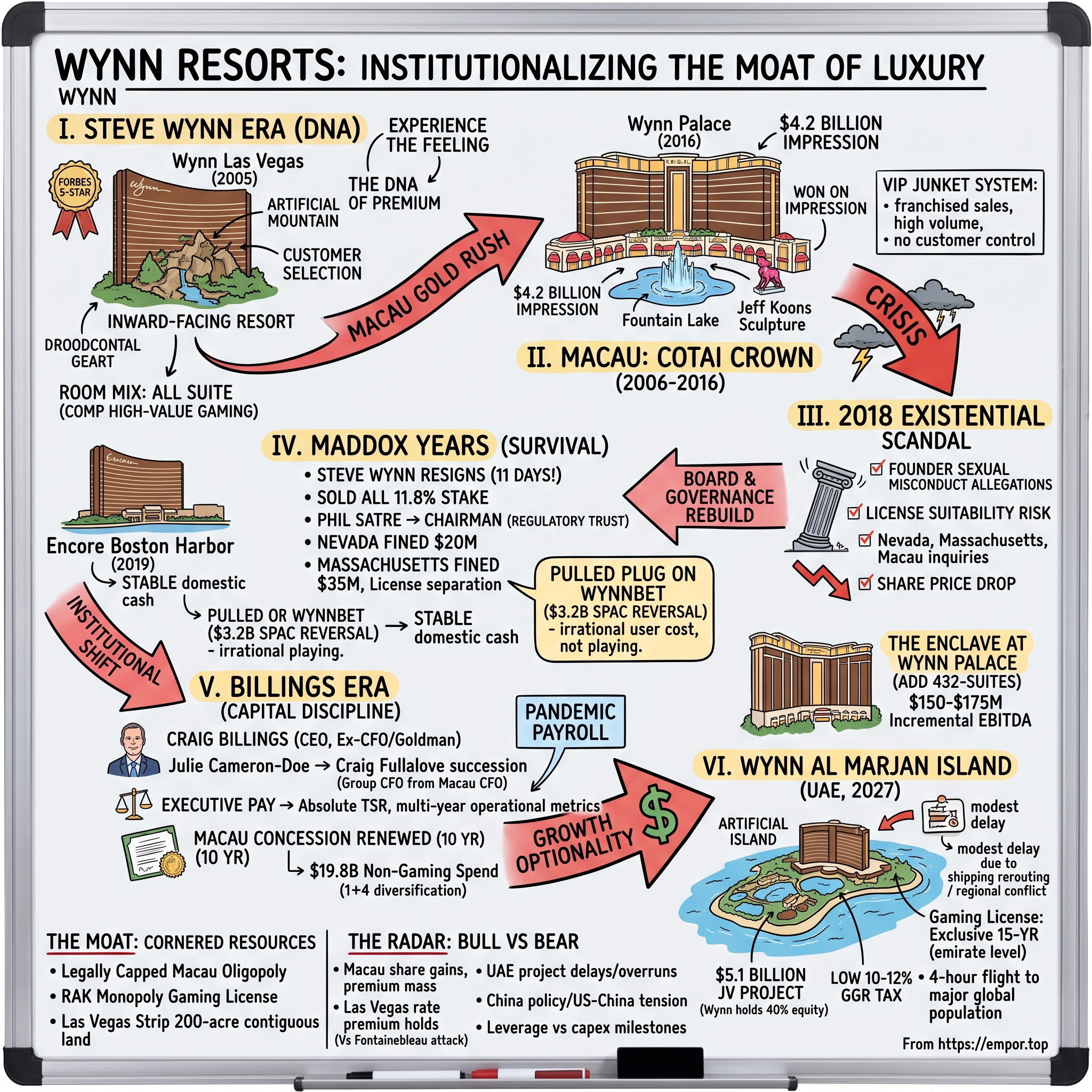
Wynn Resorts: Institutionalizing the Moat of Luxury
I. Introduction & Episode Roadmap
There is a particular sound on the casino floor at Wynn Las Vegas that you do not hear at most of its neighbors. It is not the sound of slot machines — every casino has those, and they are, functionally, the same machines running the same math. It is quieter than that: the sound of a room where the ceilings are high, the carpet is thick, the flowers are real, and the person who greets you at the door has been trained for months on how to do it. Steve Wynn built that room to be felt before it was understood. Two decades later, a former Goldman Sachs investment banker runs the company that owns it, and his job is to prove that the feeling can be turned into a repeatable financial system that survives the man who invented it.
That is the entire Wynn Resorts story in one sentence, and it is a genuinely hard question. Wynn Resorts, Limited trades on the NASDAQ Global Select Market under the ticker WYNN. In fiscal 2025 the company generated roughly $7.14 billion of operating revenues and $2.22 billion of Adjusted Property EBITDAR — the industry's preferred measure of property-level cash earnings before rent and corporate costs — which was down about $141 million from 2024.1 It runs four wholly consolidated resorts on two continents, a members-only casino in London, and a $5.1 billion joint-venture development rising out of a man-made island in the Persian Gulf. In the first quarter of 2026, operating revenue reached $1.86 billion and net income attributable to the company was $120.5 million, up from $72.7 million a year earlier.2
The paradox worth sitting with is this. Gaming is one of the most commoditized businesses in the world. A blackjack table at Wynn pays 3:2 exactly like a blackjack table anywhere else. A slot machine's hold percentage is set by the manufacturer and disclosed to regulators. There is no proprietary technology, no patent, no software lock-in. And yet Wynn's Las Vegas operations posted an average daily room rate of $547 in 2025 — a number that would be considered aggressive for a luxury urban hotel in Manhattan, let alone a property whose primary purpose is to move people toward gaming tables.1 Something is producing that premium, and the whole investment question is whether that something is durable, transferable, and ownable by shareholders rather than by a founder who no longer works there.
The roadmap
The story runs through six acts. First, the design DNA: how Steve Wynn built resorts that faced inward rather than outward, and why that architectural choice became an economic one. Second, Macau — the concession that turned a Las Vegas developer into a company whose profits were, for a decade, mostly Chinese. Third, the 2018 corporate near-death experience, when a Wall Street Journal investigation into the founder put every gaming license the company held at risk simultaneously. Fourth, the Matt Maddox years of survival, including the single most instructive capital-allocation decision in the company's modern history: walking away from a $3.2 billion online-gaming SPAC six months after signing it. Fifth, the Craig Billings era — concession renewal, executive-pay redesign, CFO succession, and a bet on the United Arab Emirates that is either the best growth optionality in global gaming or a very expensive lesson in geopolitical risk. And sixth, the analytical spine: what actually protects this business, what would break it, and the small number of things an investor should watch.
A note on how to read the numbers before we start. Gaming companies report Adjusted Property EBITDAR, which strips out rent as well as interest, tax, depreciation, and amortization. That convention exists because several operators now lease their buildings from real-estate investment trusts, and the measure lets investors compare property-level operating performance across owners and tenants. It is useful and it is also flattering: rent is a real, contractual, non-negotiable cash cost, and depreciation in luxury hospitality is a reasonable proxy for the renovation spending that keeps a five-star property five-star. Whenever this article quotes EBITDAR, hold that caveat in mind.
We begin where the design language began, because in this business the building is the balance sheet.
 Subscribe on LinkedIn
II. The Steve Wynn Era & The DNA of Premium
In 1989, a 47-year-old casino operator opened a property on the Las Vegas Strip with a volcano out front, white tigers inside, and a debt load that Wall Street considered close to reckless. The Mirage cost roughly $630 million at a time when the largest hotels on the Strip had been built for a fraction of that, and it needed to generate around a million dollars a day just to service its obligations. Junk-bond financing from Michael Milken's Drexel Burnham made it possible. Conventional wisdom said Las Vegas visitors came to gamble and would sleep anywhere. Steve Wynn's counter-thesis was that if you gave them somewhere extraordinary to sleep, more of them would come, they would stay longer, and they would spend on things that had nothing to do with the tables.
He was right, and the consequences reshaped the city. The Mirage was followed by Treasure Island in 1993 and then by the Bellagio in 1998 — a property with a Chihuly glass ceiling, a Picasso-hung restaurant, and a lake that performed. Under Mirage Resorts, Wynn had effectively invented the modern integrated resort: a business where gaming was the profit engine but hospitality, retail, and food and beverage were the demand generators. It is worth being precise about why that mattered financially. A pure casino is a machine that converts local gamblers into revenue with almost no pricing power. An integrated resort is a machine that captures a customer's entire discretionary trip budget — room, dinner, show, nightclub, spa, retail — and monetizes the gaming almost as a by-product of the visit. The second business has vastly more revenue per customer and, critically, more ways to raise prices.
Losing the company, keeping the capability
Then he lost it. In 2000, MGM Grand acquired Mirage Resorts for approximately $6.4 billion, taking out shareholders at $21 per share in a deal Wynn did not initiate and could not block.4 It was, by any measure, a good outcome for Mirage investors. For Wynn personally it was a peculiar kind of defeat: he ended up with a large amount of capital, an unimpeachable reputation as a builder, and no company. That combination is the setup for the most consequential second act in the industry's history.
Seven weeks after the Mirage deal was agreed, Wynn bought the Desert Inn from Starwood for $270 million.5 The Desert Inn was a fading 1950s property, but what he was actually purchasing was roughly 200 acres of contiguous land at the top of the Strip — a parcel that could not be assembled at any price today. Land, in this industry, is the closest thing to a permanent asset. He tore the resort down.
Wynn Resorts, Limited went public on the NASDAQ in October 2002, raising capital to fund a resort that did not yet exist on a site that was, at the time, mostly dirt.6 Investors were being asked to underwrite a single man's taste. Wynn Las Vegas opened in April 2005 at a cost of roughly $2.7 billion, and Encore Las Vegas followed in December 2008 at approximately $2.3 billion — the latter opening directly into the teeth of the global financial crisis, which is a detail worth remembering when management today discusses development timing.7
The architecture as a business model
The architectural decision embedded in Wynn Las Vegas is the one that still matters. Every major Strip resort before it had pushed its attractions toward Las Vegas Boulevard — the volcano, the fountains, the pirate battle — because the logic was to pull pedestrians in off the street. Wynn inverted it. He built an artificial mountain roughly 140 feet high along the property's Strip frontage, planted it with mature pines, and hid the resort behind it. The waterfalls, the lake, the light show all faced inward, visible only to guests. You could not see Wynn Las Vegas from the sidewalk. You had to commit.
Strategically, that was a customer-selection mechanism disguised as landscaping. Street-facing attractions maximize foot traffic, and foot traffic in Las Vegas skews toward low-spend visitors who wander, photograph, and leave. By making the experience invisible from outside, Wynn filtered for guests who had already decided to be there. Fewer bodies, higher spend per body, and a room product that could be priced without competing against the crowd standing outside. The same logic runs through the service model: staff were trained as luxury hospitality professionals rather than as casino employees, and the properties accumulated one of the densest concentrations of Forbes Five-Star awards in the hotel industry.7
There is a second, quieter piece of the design philosophy that shows up in the financials rather than in the photographs. Wynn's properties carry an unusually high ratio of suites to standard rooms, and suites are the product that high-value gaming customers are comped into. A resort's room mix is therefore not a hotel decision; it is a decision about which gaming customer the property is built to serve. This is why the 2026 announcement of an all-suite tower in Macau, which we come to later, is a strategic statement rather than a hotel expansion.
None of this was free. It required capital, it required a founder with unusual conviction, and it required tolerance for returns that arrive slowly. But it established the pattern that the rest of this story tests: Wynn's advantage is not in the gaming, which anyone can replicate. It is in the ability to build and operate a physical environment and a service standard that a customer will pay meaningfully more to be inside. The open question — the one that would not be answered for another sixteen years — was whether that capability belonged to the company or to the man.
Before that question could be asked, though, the company found something far more lucrative than the Las Vegas Strip: a forty-square-kilometre territory on the south coast of China that had just ended a forty-year monopoly.
III. The Macau Gold Rush: Designing the Cotai Crown
For four decades, gambling in Macau was one man's business. 何鴻燊 Stanley Ho held the monopoly concession from 1962, and the properties reflected it — functional, crowded, and profitable in the way that monopolies are profitable, which is to say without much need to be good. When the territory returned to Chinese sovereignty in 1999 as a Special Administrative Region, the new government faced an obvious question: was a single operator the best way to turn a slightly seedy gambling town into a global tourism destination?
The answer, delivered in 2002, was no. Macau liberalized, awarding three gaming concessions that subsequently split into six through sub-concessions.7 Wynn Resorts — a company that at that moment did not yet operate a single casino anywhere, having not yet opened Wynn Las Vegas — won one of them. That is worth pausing on. The concession was awarded substantially on the strength of Steve Wynn's track record and the credibility of what he had built in Nevada. It is the clearest evidence in the whole story that reputation, in a licensed industry, is a balance-sheet asset.
Wynn Macau opened on the Macau Peninsula on September 6, 2006, with just over a thousand rooms and a casino floor that was small by the standards of what came later.9 It was immediately, almost absurdly, cash-generative. The reason was the VIP junket system — an arrangement with no real analogue in Western gaming. Chinese capital controls made it difficult for mainland players to move large sums across the border, and Macau's courts made gambling debts hard to collect. Junket operators solved both problems: they extended credit to high-rollers on the mainland, collected debts through their own networks, and delivered the players to specific casino floors, taking a commission on the rolling chip volume they generated.
Think of a junket as a franchised sales force with its own balance sheet. The casino got enormous volume without extending credit itself. The trade-off was margin — junket commissions consumed most of the theoretical win — and the deeper trade-off was that the operator did not own the customer relationship. That distinction sat quietly in the background for a decade and then became the entire story.
Cotai and the $4.2 billion impression
Wynn's second Macau act was Wynn Palace, which opened on August 22, 2016 on reclaimed land in Cotai at a cost of roughly $4.2 billion.10 It is difficult to overstate how much this property leans on spectacle. It has a 28-acre lake with a performance fountain, air-conditioned cable cars that carry guests over the water to the entrance, and a fine-art collection that includes Jeff Koons sculpture and Qing Dynasty porcelain. There are 1,706 rooms, suites, and villas.10
The commercial logic behind the extravagance was specific. Cotai, unlike the Peninsula, is a purpose-built resort corridor where operators compete for the same visitor across a short walk. In that setting, the marginal customer chooses on impression. Wynn Palace was designed to win the impression contest and then convert it into gaming share — and, importantly, into hotel occupancy, because in Macau a full hotel is the mechanism by which an operator captures higher-value play rather than day-trip traffic.
The timing of the opening was also a lesson in the political economy of the place. Wynn Palace was conceived during Macau's boom and delivered into its first serious downturn: 中国共产党 Chinese Communist Party anti-corruption campaigns from 2014 onward had already begun to suppress VIP play, and gross gaming revenue was falling when the doors opened. A $4.2 billion asset commissioned in one policy environment and opened in another is the recurring hazard of a greenfield developer — the build cycle is four years and the policy cycle is shorter than that. Investors evaluating the current UAE project should hold that precedent in mind; it is the same company, the same competency, and the same structural exposure.
Wynn houses its Chinese operations in 永利澳門有限公司 Wynn Macau, Limited, listed on the Hong Kong Stock Exchange under ticker 1128, with Wynn Resorts retaining majority control.8 The structure gives the Macau business its own currency and its own local investor base — and it also means Macau's results are disclosed twice, in two regulatory regimes, which is unusually good for anyone trying to understand the segment.
During the peak years of the 2010s, the economics of Macau were extraordinary in a way that distorted how investors valued the whole company. Returns on invested capital at the Macau properties ran at levels no North American regional casino could approach, and for long stretches the majority of Wynn Resorts' consolidated property earnings — and a good deal more than the majority of its market value — came from a territory smaller than Manhattan. That concentration made Wynn a levered bet on Chinese consumption and Chinese policy simultaneously.
It also created a specific vulnerability that had nothing to do with gaming demand: the company's licenses, its earnings, and its reputation were all now hostage to how regulators in three separate jurisdictions judged the character of the people running it. In January 2018, that judgment was called.
IV. The 2018 Existential Crisis: Scandal, Resignation, and Board Overhaul
On January 26, 2018, The Wall Street Journal published an investigation describing decades of alleged sexual misconduct by Steve Wynn, including a settlement paid to a salon employee. Wynn denied the allegations. The market did not wait for adjudication: the stock fell sharply within days, and — far more dangerously — regulators in Nevada, Massachusetts, and Macau opened inquiries into whether Wynn Resorts remained suitable to hold gaming licenses.11
Suitability is the concept that makes gaming unlike almost any other industry. A licensed casino operator does not merely need to comply with the law; it needs regulators to affirm, on an ongoing basis, that its owners, directors, and officers are of good character. There is no appeal to shareholder value. A regulator who concludes an operator is unsuitable can revoke the license, and the asset — a $3 billion resort — becomes a building. Wynn Resorts in early 2018 was under construction on a $2.6 billion project in Everett, Massachusetts, which had not yet received final clearance to open. It held a Macau concession up for renewal. It held Nevada licenses across two properties. All three were suddenly live.
Eleven days
The board's response was, in retrospect, the most consequential set of decisions in the company's history — and they were made under maximum duress with no good options.
Steve Wynn resigned as Chairman and Chief Executive Officer on February 6, 2018, effective immediately, eleven days after the story ran.1112 That speed was not a courtesy. It was a regulatory necessity: as long as the founder held office, every license inquiry pointed directly at the company.
Resignation alone was insufficient, because Wynn remained the largest shareholder. Over March 2018 he sold his entire 11.8% stake — roughly 12.1 million shares worth about $2.1 billion — through a combination of a private block sale to Galaxy Entertainment and open-market distribution.13 The founder was gone from the register as well as the boardroom. For a company whose brand literally carried his surname, this was a strange and radical act: keep the name, expel the man.
Then came the governance reconstruction. In November 2018, the board named Philip G. Satre — the former Chief Executive and Chairman of Harrah's Entertainment, and one of the most respected regulatory-facing figures in American gaming — as Chairman, succeeding D. Boone Wayson.14 Satre's value was precisely that he had spent a career being the person regulators trusted. The board was also substantially refreshed and diversified, with several new independent directors added. Matt Maddox, the Chief Financial Officer, was elevated to Chief Executive Officer.
The bill
The financial penalties arrived over the following year, and they were severe by industry standards. In February 2019, the Nevada Gaming Commission fined Wynn Resorts $20 million to settle a ten-count complaint detailing an eleven-year pattern in which executives failed to investigate or report allegations against the founder. It was the largest fine in Nevada gaming history — roughly three and a half times the previous record.15 In April 2019, the Massachusetts Gaming Commission concluded a lengthy suitability proceeding: it allowed Wynn Resorts to keep its license but fined the company $35 million and fined Maddox personally $500,000, citing his failure to require an investigation into a specific complaint brought to his attention. The commission also imposed structural conditions, including a requirement that the Chairman and CEO roles remain separated for the fifteen-year term of the license.16 Steve Wynn's own regulatory reckoning concluded separately in July 2023, when he agreed to pay a $10 million fine and permanently sever ties with Nevada gaming.17
What the crisis proved
What should an investor take from this episode? Three things, and they are uncomfortable ones.
First, the licenses survived — but they survived because the company was willing to destroy its founder's position entirely and quickly. The cost of that was borne by Steve Wynn; the benefit accrued to shareholders. A board that had hesitated, or that had been more captured, would plausibly have lost Massachusetts and complicated Macau. Governance quality in this industry is not a scoring rubric; it is a solvency input.
Second, the fines were not the real cost. $55 million of penalties against a company generating billions in revenue is survivable. The real cost was the two years of executive attention, the Massachusetts conditions that constrained board structure, and the permanent evidence that the internal control environment had failed for over a decade.
Third — and this is the part that shapes everything after — the crisis forced the company to answer the question the previous section left open. Could Wynn operate at a five-star standard without Steve Wynn? The regulators effectively made the experiment mandatory. The rest of this story is the data.
V. Matt Maddox & the Battle for Survival: Saving Boston and Pulling the Plug on WynnBET
Matt Maddox inherited a company under investigation, a construction project under political attack, and a brand attached to a name that had become radioactive. He was 42, had been Wynn's CFO since 2008, and had never run an operating business.
Encore Boston Harbor opened in June 2019 on a remediated industrial site in Everett, Massachusetts, at a cost of approximately $2.6 billion — the most expensive single-phase development in New England history.7 The project had been contested for years by neighboring Boston, which litigated over traffic, environmental review, and the license itself. That it opened at all, given that the Gaming Commission had spent the preceding eighteen months deciding whether its owner deserved to hold the license, was the first real evidence that the institution could function independently of the founder.
The strategic value of Boston is straightforward and often underappreciated. It is the only full-scale resort casino in the Boston metropolitan area, serving a dense, affluent, and captive catchment. It does not need to win a beauty contest against six competitors on a single street. It needs to be adequate and convenient, which means its earnings are far more stable than either Las Vegas or Macau. In 2025 it produced $236.7 million of Adjusted Property EBITDAR — roughly 11% of the group total, and the least volatile 11% the company owns.1
The pandemic and the payroll decision
Then March 2020 arrived. Macau's casinos closed. Las Vegas shut. Wynn's business model — enormous fixed costs, extreme operating leverage, zero online revenue — was precisely the wrong model for a pandemic. Maddox made a decision that looks, from a pure cash-preservation standpoint, indefensible: he kept the workforce on payroll while the properties were dark, burning millions of dollars a day.
The defense of that decision is an argument about what the asset actually is. If Wynn's premium is generated by a trained service organization — thousands of people who know the standards, the regulars, and each other — then dispersing that organization destroys the thing that produces the pricing power, and rebuilding it takes years. Whether the specific cost was worth the specific benefit is not provable. What is observable is that Wynn's Las Vegas rate premium survived the pandemic intact, and that the company later chose to litigate aggressively to prevent competitors from hiring its staff — behavior consistent with management genuinely believing the workforce is the moat rather than merely saying so.
Which brings us to the most instructive decision in the modern history of this company.
The $3.2 billion reversal
Between 2020 and 2021, American gaming lost its collective mind over online sports betting. The Supreme Court's 2018 decision striking down the federal prohibition had opened state-by-state legalization, and the land grab was ferocious. DraftKings and FanDuel spent enormous sums on customer acquisition. Caesars launched a national campaign. Penn Entertainment bought a controlling interest in Barstool Sports. The consensus was absolute: online was the future, scale would be winner-take-most, and any operator without a digital arm would be structurally obsolete.
Wynn joined. In May 2021, it agreed to combine Wynn Interactive — the parent of the WynnBET app — with Austerlitz Acquisition Corporation I, a blank-check vehicle sponsored by Bill Foley, at an enterprise value of roughly $3.2 billion.18 On paper it was elegant: monetize a subscale digital business at a frothy valuation, hand the growth capital burden to public SPAC investors, retain upside.
Six months later, on November 12, 2021, the two parties mutually agreed to terminate the transaction.18 The reasoning management gave was blunt: the economics of customer acquisition in online sports betting had become irrational, and Wynn would curb user-acquisition spending and pivot to a targeted, return-focused approach rather than chasing share.19[^20]
This is worth examining carefully, because it is easy to award retroactive genius. What Billings — then still CFO, and about to become CEO — appears to have concluded was structural rather than tactical. In a business where every competitor can copy the product, where switching costs are near zero because a bettor can hold five apps at once, and where the only differentiator is promotional generosity, customer acquisition cost is set by the most desperate participant in the market. That is not a market where a disciplined operator wins by trying harder. It is a market where a disciplined operator wins by not playing.
The counterfactual has since been observed. Penn Entertainment wrote off its Barstool investment and subsequently restructured its digital strategy again around ESPN Bet; the sector's promised profits arrived far later and far more concentrated than the 2021 consensus assumed. Wynn wound WynnBET down to a small footprint and kept the cash.
The honest caveat is that Wynn's discipline was made easier by its position. It had no legacy database of millions of regional gamblers to defend, unlike Penn or Caesars, so the strategic cost of exiting was lower. Discipline is cheaper when you have less to lose. Still, the decision to publicly kill a signed $3.2 billion transaction six months after announcing it — absorbing the reputational cost of the reversal — is a genuine data point about how this management team weighs looking right against being right.
It also set the tone for the man who was about to take over.
VI. The Craig Billings Era: Capital Discipline and Executive Alignment
Craig Billings is, temperamentally, the opposite of the company's founder. Steve Wynn was an aesthete who sketched buildings in board meetings and made decisions about carpet. Billings spent his early career at Goldman Sachs, later worked in gaming technology at Aristocrat Leisure, joined Wynn as Chief Financial Officer in 2017, and took over as Chief Executive Officer on February 1, 2022.3 On earnings calls he speaks in the language of return thresholds, reinvestment ratios, and incremental margin. It is a deliberate institutional shift: from a company organized around one person's taste to one organized around a capital-allocation framework.
Renewing the licence to exist
The immediate test was Macau. Wynn's original concession was expiring, and the renewal process ran through 2022 under a government that had spent the preceding two years signaling it wanted something different from the industry. In December 2022, Macau signed new ten-year concessions with all six incumbent operators, including Wynn, running to December 31, 2032.21 No incumbent lost its license and no new entrant was admitted — a structurally significant outcome, because it confirmed the market would remain a closed oligopoly of six.
The price was investment obligations. Under the concession Wynn Macau SA initially committed to invest approximately MOP 17.8 billion over the ten-year term, of which about MOP 16.5 billion — roughly 93% — was earmarked for non-gaming projects and foreign-market development rather than casino capacity.2322 Those commitments have subsequently ratcheted upward as the market recovered; the company's more recent disclosures put the non-gaming portion at approximately MOP 19.80 billion.7 The mechanism matters: the obligations are not fixed forever but can increase if gaming revenue exceeds specified thresholds, which means a stronger Macau recovery mechanically increases required spending.
The policy behind it is the Macau government's 1+4 diversification strategy — the "1" being tourism and leisure, the "4" being health, high technology, finance, and conventions and exhibitions. Beijing's position, articulated consistently since 2019, is that Macau's dependence on gaming is a structural vulnerability. The concessionaires are the funding mechanism for fixing it.
An investor should be clear-eyed about what this is. A portion of Wynn's Macau capital budget is now allocated by policy rather than by return on investment. Concerts, art programming, sporting events, and international marketing offices are not zero-return activities — they drive visitation and they build the premium-mass funnel — but they were not selected because Wynn's internal models identified them as the highest-returning use of capital. Management has generally framed these obligations as consistent with what it would have spent anyway on brand and demand generation. That framing is convenient and partly true; it is also unfalsifiable. The measurable version of the question is whether Macau margins hold as the spending accelerates.
Building the bench
On the C-suite, the succession has been methodical. Julie Cameron-Doe became Chief Financial Officer in April 2022 and led the balance-sheet restoration through the post-pandemic recovery, including the acquisition and integration of the London property discussed later. In January 2026 the company announced that Cameron-Doe would retire in mid-2026 and that Craig Jeffrey Fullalove — then Chief Financial Officer and Chief Administrative Officer of the Macau operations and of Wynn Macau, Limited — would become Group Chief Financial Officer effective April 1, 2026.20 Cameron-Doe remained as a consultant and as a non-executive director of the Hong Kong-listed subsidiary.
The Fullalove appointment carries a signal. Elevating the Macau CFO to the group role — a finance executive with more than two decades of international experience across South Africa, the United Kingdom, Canada, and Vietnam — places deep Macau regulatory and operational fluency directly in the parent company's finance seat.20 For a business where roughly half of property earnings and most of the political risk sit in one Chinese territory, that is a rational allocation of institutional attention. It is also, less charitably, an admission of how much the group's fate depends on one jurisdiction.
The compensation architecture reinforces the same institutional theme. Wynn's pay program ties a majority of named-executive-officer compensation to multi-year operational metrics and absolute total shareholder return, with multi-year vesting and stock-ownership requirements — the Chief Executive's guideline being a multiple of base salary satisfied through a substantial personal holding.24 Half of the annual incentive is delivered in equity rather than cash, which converts a portion of the yearly bonus into a multi-year exposure to the share price.
Two observations. Absolute TSR — rather than TSR measured against a gaming peer group — is a demanding standard, because it does not reward outperforming a falling sector. That is shareholder-friendly. On the other hand, absolute TSR in a business this cyclical is heavily influenced by Macau's recovery trajectory and by interest rates, neither of which management controls. Pay design of this kind aligns interests without necessarily measuring skill.
It is also worth noting what Billings has not done, because negative evidence is often the most reliable kind. In four and a half years as chief executive he has made no large acquisition, launched no new consumer brand, entered no new gaming vertical, and pursued no diversification outside integrated resorts. In an industry where peers spent the same period buying regional portfolios, sports-media properties, and digital platforms — several of which were subsequently impaired — the absence of activity is itself a capital-allocation choice with a measurable value. The counter-argument is that a company that only knows how to do one thing has no option but to keep doing it, and that concentration is a strategy right up until the moment it is a vulnerability.
The framework, however, is now in place: a regulatory-credible board, a finance-led chief executive, a Macau-experienced CFO, and an incentive structure pointed at long-duration value. What remains is the operating question — does the premium actually exist in the numbers?
VII. Deep Dive: Core Markets, Moats, & The Poaching War
In February 2024, lawyers for Wynn Las Vegas filed a complaint in Clark County District Court accusing a competitor of an "unhealthy obsession" with its employees. The competitor was Fontainebleau Las Vegas, the long-delayed ultra-luxury tower that had finally opened in December 2023 after fifteen years of construction stoppages and ownership changes. Wynn alleged that Fontainebleau had systematically solicited its executives, chefs, and nightclub staff — in some instances, according to the complaint, with recruiters posing as guests to make contact — and that this continued despite a prior settlement in which Fontainebleau had agreed to stop soliciting Wynn employees through 2023.26 Fontainebleau rejected the characterization, countering that no improper poaching had occurred and that Wynn employees had their own reasons for wanting to leave.27
Set aside who is right. The lawsuit is the single clearest piece of evidence in this entire story about where Wynn's management believes its advantage actually lives. A company does not litigate over marble. It litigates over the thing it cannot replace. Fontainebleau could and did build a comparable physical product; what it could not build overnight was a trained organization that knows how to deliver at that standard. Wynn's response was to treat its staff roster as intellectual property.
That is also the honest way to understand the vulnerability. A moat made of people is a moat that can be hired away, one senior person at a time, by any competitor willing to overpay. It has no legal protection beyond contract, no patent, and it degrades if management ever chooses margin over payroll. This is the most important qualitative risk in the Wynn story, and it does not appear as a line item.
There is a further wrinkle specific to casino hosts. The relationships that bring seven-figure players to a property are personal — the host, not the building, holds the phone number. When a host leaves for a competitor, some portion of the book leaves with them. This is why the industry's non-solicitation litigation is so much more aggressive than in comparable hospitality businesses, and why the difference between "our brand attracts these customers" and "our people attract these customers" is not semantic. Wynn's own legal filings implicitly concede the second version.
Las Vegas
Las Vegas is the largest single contributor to group earnings. In 2024 the Las Vegas operations produced $946.8 million of Adjusted Property EBITDAR; in 2025 that fell to $902.4 million, a decline of $44.4 million driven primarily by a $48.1 million decrease in non-gaming revenues, partially offset by lower operating expenses.1 Average daily rate finished 2025 at $547, down 1.4%, with RevPAR at $476, down 3.6%, and occupancy at 86.9%.1
Read plainly, 2025 was a year in which the Las Vegas rate premium held but did not grow. The company was lapping an extraordinary 2024 that included a Super Bowl, and the softness was concentrated in non-gaming — rooms, food and beverage, entertainment — rather than in the casino. That is a mildly encouraging mix, because gaming spend from high-worth customers is the harder thing to replace.
The first quarter of 2026 was better. Las Vegas operating revenue rose nearly 6% to $661.9 million, Adjusted Property EBITDAR reached $232.5 million at a 35.1% margin, RevPAR rose almost 10% year over year, and casino revenues rose over 9%.23 On the call, Billings pushed back on the idea that Las Vegas had been through a downturn at all, noting the segment produced over $900 million of EBITDA in 2025 and that "we didn't have a trough," while simultaneously cautioning that the comparisons ahead are difficult.2 That is a reasonably disciplined piece of guidance behavior — claiming the strength while pre-empting the extrapolation.
The competitive set is unforgiving: MGM Resorts operates Bellagio, Aria, and the Cosmopolitan; Caesars holds Caesars Palace; and Fontainebleau is now fighting for the same customer. What has not happened, notably, is a collapse in Wynn's rate premium following Fontainebleau's opening — which is the most direct available test of whether the brand premium is real or merely a function of limited luxury supply. One data point is not a trend, but the evidence so far runs in Wynn's favor.
Macau
Macau remains the largest bloc of earnings. In 2024, Wynn Palace generated $733.7 million and Wynn Macau $441.9 million of Adjusted Property EBITDAR, a combined $1.17 billion. In 2025 those fell to $682.9 million and $402.1 million respectively — a combined $1.08 billion, with Wynn Macau's decline driven by a $54.0 million drop in operating revenues from lower casino and rooms revenue.1
The structural context is the death of the VIP market. Following the arrest of 周焯華 Alvin Chau, head of the Suncity Group junket operation, in late 2021 and the subsequent regulatory crackdown on cross-border capital flows and unlicensed credit, the junket system that powered Macau's 2010s boom effectively ceased to exist. VIP gross gaming revenue in the first quarter of 2026 was still running at only around 31% of 2019 levels.28
What replaced it is better, not worse, for an operator like Wynn. "Premium mass" describes affluent players who bring their own money, play at high table minimums, and are acquired and retained directly by the casino rather than through an intermediary. The margins are dramatically higher because no junket commission is paid, and the customer relationship belongs to the property. Mass-table and slot gross gaming revenue in the first quarter of 2026 was running at roughly 127% of 2019 levels even as the overall market sat at about 87%.28 Macau did not recover; it recomposed.
Wynn's position in that recomposed market is the thing to watch. Its estimated share rose from about 12.2% in the fourth quarter of 2025 to roughly 13.4% in the first quarter of 2026, with Wynn Palace's share climbing to about 8.6%, up 0.9 percentage points year over year.28 The company's first-quarter Macau performance showed mass drop up 19% and handle up 32%, with segment EBITDAR of $279.4 million on $989.2 million of revenue — a 28.2% margin that was depressed by roughly $17 million of unfavorable VIP hold.23
The mechanism is worth spelling out in plain terms, because it is the single most important economic change in this business in a decade. Under the junket model, a casino booked enormous headline revenue but handed most of the theoretical profit to the intermediary — think of a retailer selling through a distributor who takes the majority of the gross margin and owns the customer list. Under premium mass, the casino sells direct: lower headline volume, far higher retained profit per dollar wagered, and a customer relationship the property can market to directly. Macau's total gaming revenue is still well below 2019, but the quality of that revenue is considerably better, which is why operator earnings have recovered faster than the market's top line.
The competitive set is 金沙中國有限公司 Sands China, 銀河娛樂集團 Galaxy Entertainment Group, MGM China, Melco Resorts, and 澳門博彩控股有限公司 SJM Holdings. Sands has been the share leader and, on the back of the Londoner Macao's redevelopment, opened a lead of nearly six percentage points over Galaxy in early 2026.28 Wynn is not competing on scale — it has fewer rooms and fewer tables than the largest operators — and its argument is that a smaller, denser, higher-quality footprint captures a disproportionate share of the highest-value players.
The most direct evidence for that argument arrived in 2026. Wynn Palace ran at 99.1% hotel occupancy in the first quarter, and in May the company announced The Enclave at Wynn Palace: a 432-key, all-suite tower, budgeted at $900 million to $950 million, adding roughly 25% to room capacity and 50% to suite capacity, with no casino of its own and minimal food and beverage because it connects directly into the existing resort.29 Macau's government approved the necessary land-use changes in July 2026.30 Billings framed it in exactly the terms an investor should want: "When you're at 99% occupancy, you're not making a speculative bet by adding rooms. You're capturing demand that already exists," with expected incremental EBITDA of roughly $150 million to $175 million.2
That is a coherent thesis, and the occupancy figure supports it. It is also a near-billion-dollar commitment in a jurisdiction with sovereign and geopolitical risk, made while the company is simultaneously funding a Gulf development. Credit analysts at CreditSights flagged precisely this — that the Wynn Palace expansion lifts group capital expenditure and pressures leverage.37 Both things are true at once.
Boston
Encore Boston Harbor generated $247.1 million of Adjusted Property EBITDAR in 2024 and $236.7 million in 2025, a modest decline.1 First-quarter 2026 EBITDAR fell $6.9 million year over year at a 24.6% margin.32 It is the group's smallest and steadiest engine, and its role in the portfolio is to provide domestic cash flow that does not depend on either Chinese policy or Gulf construction schedules.
Together, these three markets produce a business whose earnings are geographically diversified but whose risks are not — because the same premium-consumer cycle drives all three, and because two of the three sit in jurisdictions where a government can change the rules. That structure is what the next section tries to formalize.
VIII. Hamilton Helmer's 7 Powers & Porter's Five Forces Analysis
Frameworks are only useful if they force you to distinguish between advantages you can prove and advantages you would like to have. Applied honestly to Wynn, they sort quickly into one very strong power, one moderately strong one, and several that look better in a pitch deck than in the evidence.
Cornered Resource — strong, and the real answer. Hamilton Helmer's term describes preferential access to a coveted asset on terms that outsiders cannot obtain. Wynn holds three of these. In Macau, gaming concessions are legally capped at six, all six were renewed in December 2022 through 2032, and no new operator was admitted — a closed, government-enforced oligopoly with a defined expiry.21 In Ras Al Khaimah, Wynn holds an exclusive fifteen-year gaming license, which is not an oligopoly but a monopoly within that emirate.31 In Las Vegas, the roughly 200-acre contiguous parcel at the top of the Strip, assembled through the Desert Inn purchase, cannot be reproduced at any price because the land no longer exists in that configuration.5
The critical nuance is that a cornered resource with a stated expiry date is a wasting asset. Wynn's Macau concession expires December 31, 2032, and the terms of any renewal are entirely at the discretion of a government that has already demonstrated it will attach expensive conditions. That is not a hypothetical risk; it is a scheduled one.
Branding — real, and measurable, but narrower than it looks. Helmer's branding power exists when a customer pays more for an identical product because of who makes it. Wynn's $547 average daily rate against a Strip market where mid-tier product sells for a fraction of that is genuine evidence, as is the fact that the premium survived Fontainebleau's arrival.1 The limitation is that the brand's pricing power is concentrated in hospitality and in the high end. It does not command a premium in gaming — no player pays worse odds to sit at a Wynn table — and it has not, so far, been shown to transfer into adjacent categories. The London and UAE expansions are, in part, tests of exactly that transferability.
Process Power — plausible, unproven at the margin. The claim is that the "Wynn Way" — training systems, service standards, maintenance protocols — is institutionalized deeply enough to reproduce five-star delivery without the founder. The evidence in favor is that the properties have retained their Forbes ratings and their rate premium for eight years post-Wynn.7 The evidence against is the Fontainebleau litigation itself: if the process were fully embedded in systems rather than in individuals, losing individuals would not be existential enough to sue over. The truthful assessment is that Wynn has a strong service organization that it must continuously pay to retain, which is closer to a cost structure than to a power.
Scale Economies — weak, and frequently overstated. The $4.2 billion cost of Wynn Palace and the $5.1 billion budget for Al Marjan are described as barriers to entry, and in a sense they are.10 But capital is not scarce; Fontainebleau eventually got built, Sands has spent more than Wynn many times over, and sovereign wealth funds can write these cheques without noticing. What actually blocks entry is not the money — it is the license. The capital requirement is a filter on who bothers, not on who can. Wynn also has no scale advantage in procurement or overhead relative to larger competitors; if anything it is subscale.
Turning to Porter, the picture is a high-barrier industry with brutal internal rivalry.
Barriers to entry are among the highest in any consumer industry — licensing, suitability review, multi-year construction, and billions of committed capital. This is why the same six names have competed in Macau for two decades.
Supplier power is low for nearly everything the company buys, and high for the one thing it needs most. Slot machines, table equipment, linens, and food are commoditized. Senior hospitality talent — casino hosts with personal relationships to whales, executive chefs, nightlife operators — has genuine bargaining power, and Fontainebleau's arrival demonstrated it can be exercised.
Buyer power is moderate to high at the top of the customer pyramid. A player capable of losing seven figures in a weekend is courted by every operator on the Strip and in Cotai, faces no switching cost, and is compensated with comps that are effectively a negotiated discount. The industry term for this is "reinvestment," and Fullalove's remark on the first-quarter call that Wynn understands "what our reinvestment needs to look like" is a description of the discipline required to avoid competing that discount to zero.2
Substitutes are a genuine debate. The 2021 consensus was that online gaming would substitute for physical casinos. The evidence since suggests they are largely different products serving different occasions — a sports bet on a phone does not replace a weekend in a suite — but online has plausibly captured incremental wallet at the low end. For Wynn's specific customer, the more relevant substitutes are other luxury experiences: a European resort, a yacht charter, a private club. That competitive set is where the brand has to win.
Rivalry is intense and takes the form of continuous reinvestment — new restaurants, new nightclubs, renovated towers, more aggressive comps. This is why the industry's reported EBITDA margins overstate its economics: maintenance capital expenditure in luxury hospitality is enormous and never optional, because a property that looks five years old prices like it.
Which is the correct frame for the company's largest and least-tested bet.
IX. Wynn Al Marjan Island: UAE Gaming and the Massive Growth Optionality
On a man-made island off the coast of Ras Al Khaimah — the northernmost and least famous of the seven emirates, about an hour's drive from Dubai — twenty-two thousand construction workers have been building the first casino resort in the history of the Arabian Peninsula.
The scale of the strategic bet is easy to underestimate. The United Arab Emirates had no legal commercial gaming. It had no regulator, no licensing framework, no precedent, and a cultural and religious context in which gambling had been prohibited outright. Wynn signed on as a joint-venture partner before any of that existed, holding a 40% equity interest alongside RAK Hospitality Holding and the developer Al Marjan Island LLC.31 The project budget has grown to approximately $5.1 billion.
Writing the rules after signing the deal
The framework arrived retroactively. The federal General Commercial Gaming Regulatory Authority was established, and in October 2024 it issued the country's first Commercial Gaming Facility Operator license to the Wynn Al Marjan Island joint venture.3132 Wynn holds an exclusive, renewable fifteen-year casino license for the emirate of Ras Al Khaimah — exclusive to that emirate, not to the UAE as a whole, which is a distinction that matters enormously if Dubai or Abu Dhabi subsequently license their own operators.31
The economics, if they materialize as management and sell-side analysts model them, are unusually attractive for structural reasons. The expected blended tax rate is roughly 10% to 12% of gross gaming revenue, comparable to Singapore and a fraction of Macau's effective rate of approximately 39–40%.33 That single variable transforms the return profile: a dollar of gaming revenue in Ras Al Khaimah is worth something close to three times a dollar of gaming revenue in Cotai on an after-tax basis. The addressable market argument is geographic — the UAE sits within a four-hour flight of an extraordinary share of the world's population, spanning Europe, South Asia, the Middle East, and East Africa, and Dubai has spent two decades building the aviation and tourism infrastructure to move them. Analyst estimates for the eventual UAE gaming market have clustered in the $3 billion to $5 billion range of annual gross gaming revenue, with Wynn Al Marjan itself commonly modeled around $1.33 billion of annual GGR, within a range of roughly $1 billion to $1.67 billion.34
Those are estimates, and they should be treated as such. There is no historical gaming market in the region to calibrate against, no data on local propensity to gamble, no clarity on how strictly the regulator will restrict Emirati nationals' participation, and no precedent for how the market will respond if a second emirate licenses a competitor. The entire model rests on assumptions about a customer base that has never been observed.
The delay
The near-term risk is more concrete. On the first-quarter 2026 earnings call in May, Billings acknowledged logistical and shipping challenges arising from regional conflict, and management signaled a modest delay to the opening.236 Regional press attributed the disruption to the Iran conflict, including missile threats and a drone attack on the Fujairah petroleum complex, which forced rerouting of shipments and alternative material sourcing, raising costs.35 Billings' framing was studiedly calm — "Construction continues. We're making do just fine, and we will carry on," alongside the observation that "supply chains have this amazing ability to become flexible and to find additional routes to market."2 Fullalove characterized the shipping-rate increase as "likely a rounding error on the total budget."2 The targeted opening moved to early 2027, with management saying it would quantify the delay in the coming months as regional conditions clarified.2
An analyst should note the pattern rather than the individual quote. Management used the word "modest" deliberately and repeatedly, and declined to quantify. Declining to quantify a delay while insisting it is small is a defensible posture in a genuinely fluid situation — and it is also exactly what a management team would say if the delay were larger than it wished to disclose. The falsifiable test is simple and arrives on a schedule: does the company name a firm opening date within a couple of quarters, and does the total project cost move materially above $5.1 billion? Both will be observable.
The capital committed so far is real. Wynn contributed $100.1 million of equity to the project in the first quarter of 2026, bringing cumulative equity contributions to approximately $1.01 billion, with the development additionally financed by a $2.4 billion syndicated loan.352
One structural feature deserves more attention than it usually receives: Wynn holds only 40% of the joint venture, with RAK Hospitality Holding and the local developer holding the balance.31 That means the project's incremental equity calls, budget decisions, and opening timetable are not Wynn's alone to make, while the brand on the building, the operating reputation, and the regulatory relationship are entirely Wynn's to lose. It is an asymmetry — economic exposure at 40%, reputational exposure at 100% — that is common in emerging-market development and rarely priced properly. The offsetting benefit is equally real: Wynn is deploying roughly a fifth of the capital it would need for a wholly owned resort of this scale, and local partners bring political access that no foreign operator can buy.
The London node
There is also a piece of connective strategy that deserves attention. In January 2025 Wynn agreed to acquire Crown London — the members-only Aspinalls casino occupying two historic townhouses on Curzon Street in Mayfair — from Crown Resorts, completing the purchase in mid-2025 and rebranding it Wynn Mayfair.3940 The purchase price was not disclosed. The property is tiny relative to anything else Wynn owns, and its purpose is not standalone earnings. It is a customer-acquisition node in a global gateway city, positioned to feed high-value European and Middle Eastern players toward Al Marjan Island. Whether a boutique London club can meaningfully originate demand for a Gulf resort is unproven — but the logic is coherent, the capital at risk is small, and it gave the company a presence on three continents for the first time.
What none of this resolves is the balance-sheet question. Funding a $5.1 billion Gulf development at 40%, a near-billion-dollar Macau tower, and a decade of mandated Macau non-gaming spend, all simultaneously, against $10.6 billion of existing debt, is where the strategy meets arithmetic.
X. Financial Deep Dive, Balance Sheet Stress Test & Activist Pressure
Wynn is a leveraged company, and it always has been. That is not a criticism; it is the structure of the business. Integrated resorts are long-lived, hard-asset, high-fixed-cost enterprises with predictable cash flows in normal conditions — precisely the profile that supports debt. The risk is that "normal conditions" in this industry can vanish overnight, as 2020 demonstrated, and leverage that looked prudent becomes existential within a quarter.
At March 31, 2026, the company held $1.19 billion of cash and cash equivalents plus $607.6 million of short-term investments against total debt of approximately $10.63 billion.3 Total global liquidity including revolver availability was about $4.4 billion.2 Consolidated last-twelve-months adjusted EBITDA ran around $2.3 billion, producing a consolidated net leverage ratio of just over 4.4 times, with net lease-adjusted leverage of approximately 4.2 times domestically and 4.7 times in Macau, and limited near-term maturities.32 At December 31, 2025, cash stood at $1.46 billion against total debt of $10.55 billion.1
From seven times to four
The trajectory is the point. Post-pandemic leverage peaked well above seven times as Macau's earnings went to zero while the debt stayed put. Getting from there to the low-four-times range required the Las Vegas recovery, the gradual return of Macau, and a deliberate decision not to spend the intervening years on acquisitions or digital adventures. Management has signaled a preference to work leverage lower still. Whether that happens is now genuinely uncertain, because the capital-allocation queue got longer in 2026.
The hierarchy, as management has described it and as the spending reveals it, runs roughly: fund the remaining Al Marjan equity contributions; meet the Macau concession investment obligations; fund The Enclave; return capital through the dividend and buybacks; and reduce leverage with whatever is left. In the first quarter of 2026 the company repurchased 528,000 shares for approximately $53.8 million, added $30.6 million more in the second quarter, and declared a $0.25 per share dividend payable May 29, 2026, while the Wynn Macau board recommended increasing the final 2025 dividend to $150 million from $125 million.2
That last set of facts is where a skeptical investor should press hardest. A company with $10.6 billion of debt, a stated goal of reducing leverage, a $5.1 billion development facing delays and cost inflation, a near-billion-dollar Macau expansion just approved, and a decade of mandated non-gaming spend is simultaneously buying back stock and raising a subsidiary dividend. Each individual action is defensible. Together they mean leverage reduction is the item at the bottom of the queue, and CreditSights' observation that the Wynn Palace expansion pressures leverage is the mechanical consequence.37 The bear framing is straightforward: management talks about deleveraging and behaves like a company that has decided its assets are worth more than its balance sheet says, and is spending accordingly.
The activist lens
Wynn has been an activist's company before. Elaine Wynn, co-founder and for years the largest individual shareholder, was removed from the board in 2015 and subsequently waged a public campaign over governance, culminating in proxy contests and a long-running effort to reshape the board — a fight that materially preceded and then intersected with the 2018 crisis.38 That history left the company with an unusually explicit governance sensitivity, reinforced by the Massachusetts license conditions.
A second governance feature worth understanding is the dual-listed structure. Wynn Macau, Limited has its own board, its own minority shareholders in Hong Kong, and its own dividend policy — which is why the first-quarter 2026 disclosure references a Macau board recommendation on a subsidiary dividend separate from the parent's own declaration.2 For most shareholders this is a benefit: it forces a second layer of disclosure and a second set of fiduciaries over roughly half the group's property earnings. For a skeptic, it is complexity, because cash generated in Macau is not automatically fungible with cash needed in Ras Al Khaimah, and minority interests take a share of the earnings that consolidated figures present in full.
The OpCo/PropCo question
The perennial structural challenge is the OpCo/PropCo question. Across American gaming, operators have separated real estate from operations, selling the buildings to REITs like VICI Properties and Realty Income in sale-leaseback transactions that convert an illiquid asset into immediate cash at cap rates below the implied multiple on the operating business. MGM and Caesars did this at scale. The activist argument is that Wynn's Las Vegas real estate — arguably the most valuable single land assemblage on the Strip — is being carried inefficiently and could be monetized to fund growth or retire debt.
Wynn has not been dogmatic about this, which is worth stating clearly because the company is sometimes described as a blanket refuser. In February 2022 it agreed to sell the land and real estate of Encore Boston Harbor to Realty Income for $1.70 billion in cash at a 5.9% cash cap rate, completing the transaction in December 2022, and continues to operate the resort under a thirty-year triple-net lease with initial annual rent of $100 million and a thirty-year renewal option.25 So the company has demonstrated it will sell real estate when the price is right and the asset is a stable regional operation.
What management has resisted is doing the same in Las Vegas, and the reasoning is specific to the luxury segment. A triple-net lease fixes rent for decades and constrains what the operator can do to the physical asset without landlord consent. In ultra-luxury hospitality, the ability to demolish a tower, gut a casino floor, or rebuild public space on management's own timetable is not a nice-to-have — it is the mechanism by which the five-star standard is maintained, and therefore the mechanism by which the rate premium survives. Selling the building converts a flexible asset into a fixed obligation.
Is that argument correct? Partially. The flexibility point is real and is the strongest version of the case. The weaker part is that a sale-leaseback also converts a variable-cost structure into a fixed one at exactly the moment the business is most vulnerable — a lesson the industry learned in 2020, when rent-paying operators faced obligations that owner-operators did not. But it is also true that resisting a sale-leaseback is convenient for management for a less noble reason: rent expense is visible and permanent, whereas the opportunity cost of holding under-monetized real estate is invisible. An activist would say management prefers the invisible cost. The counter-evidence is the Boston transaction, which shows the company will accept visible rent when the trade is good enough.
The other second-layer items worth flagging: the Massachusetts license conditions requiring separated Chairman and CEO roles remain in force for the fifteen-year term;16 the Macau concession's investment obligations can increase with gaming revenue, meaning success partially self-taxes;7 and the UAE joint venture is a 40% non-controlling position, which means Wynn does not unilaterally control the project's budget or timeline despite carrying the brand risk.31
XI. Playbook: Durable Business & Investing Lessons
In November 2021, an investor listening to Wynn's earnings call would have heard a company voluntarily abandon a signed transaction that the entire sector considered strategically essential. Two years later, that same sector was writing down the assets it had bought instead. There is no press release for a loss you did not take, no line item for capital you did not burn, and no analyst who upgrades a stock for restraint. This is the recurring problem with judging capital allocation: the good decisions are frequently invisible, and the bad ones announce themselves with a headline.
Four transferable lessons emerge from this history, and each has a limit worth naming. They are worth stating carefully, because the temptation with a company like this is to draw the wrong conclusion from a good outcome — to credit taste when the answer was licensing, or to credit discipline when the answer was that the alternative was unaffordable.
Brand premium can be a moat in a commoditized industry — if it is anchored in something physical and operational. Wynn charges materially more for a room than most Strip competitors while selling the same underlying gambling proposition. That premium is not the result of marketing; it is the result of capital deployed into buildings that are demonstrably different and an organization trained to a standard that competitors litigate to acquire. The lesson generalizes: in service industries where the core product is identical, differentiation must be built into fixed assets and human capability, both of which cost money continuously. The limit is that this kind of moat has no legal protection and requires permanent reinvestment. The moment a Wynn management team decides to harvest margin by cutting service or deferring renovation, the premium starts to decay — and the decay would be slow enough to be invisible for several years.
Knowing when to fold is a capital-allocation skill, and it is rarer than knowing when to bet. The WynnBET reversal is the case study. Every incentive pointed toward closing that SPAC: a signed agreement, a $3.2 billion headline, an analyst community that wanted digital exposure, and the reputational cost of admitting a mistake in public. Management killed it anyway, on the argument that customer acquisition economics in online sports betting were set by irrational competitors and could not be won by trying harder.1819 The generalizable insight is about market structure: in a business with no product differentiation, no switching costs, and unlimited competitor capital, the returns accrue to nobody until consolidation happens. The limit on the lesson is the one noted earlier — Wynn's exit was cheap because it had little to defend. Discipline is easier from a position of irrelevance.
In licensed industries, regulatory standing is a hard asset that must be actively defended. Wynn's licenses survived 2018 because the board expelled the founder within eleven days and pushed him off the shareholder register within weeks.1113 There is a version of that story where a more loyal, more conflicted board delayed by six months and lost Massachusetts. Any investor in a concession-based business — gaming, telecom spectrum, ports, utilities, banking — should treat governance responsiveness as a direct input into asset permanence, not as an ESG checkbox. The limit: this lesson is only visible in crisis, which means you cannot verify it in advance.
Greenfield development and roll-up M&A are different competencies, and companies rarely have both. Wynn's demonstrated skill is building complicated luxury resorts from nothing — Bellagio, Wynn Las Vegas, Wynn Palace, Encore Boston Harbor, and now Al Marjan. Its M&A record is thin by design; the largest recent acquisition, Wynn Mayfair, is a small strategic node rather than a platform purchase.39 Compare that to peers who spent the past decade acquiring regional casino portfolios and digital brands, several of which were subsequently written down. The lesson is that capital allocation quality is largely a question of whether a company deploys capital into the thing it is actually good at. The limit — and it is a serious one — is that greenfield development carries its own catastrophic failure mode: cost overruns and delays on multi-year projects in unfamiliar jurisdictions. That risk is live right now in Ras Al Khaimah.
There is a fifth observation that sits underneath the other four, and it is the one most specific to this company. Wynn's history is a repeated pattern of concentrating enormous capital into a small number of very large, very illiquid, very long-lived assets, each of which takes three to five years to build and thirty years to earn out. That structure has a characteristic failure mode and a characteristic advantage. The failure mode is that a single bad project — mistimed, over-budget, or in the wrong jurisdiction — cannot be quietly unwound, because there is no buyer for a half-built resort at anything close to cost. The advantage is that a good one compounds for decades with modest incremental capital, which is precisely what Wynn Las Vegas has done since 2005. Investors evaluating this business are not really underwriting quarterly earnings; they are underwriting a development team's batting average over multi-year horizons, with the current at-bat taking place on an artificial island in the Persian Gulf.
Which brings the story to the only question that matters for an investor holding this from here.
XII. The Investment Spine: Bull vs. Bear Case and the Risk Radar
Why Wynn wins from here. The bull case is a sequencing argument rather than a growth argument. Three things happen roughly in parallel: Macau continues its recomposition toward premium mass, where Wynn's small, high-quality footprint captures disproportionate share and where the absence of junket commissions structurally improves margins; Las Vegas holds its rate premium through the Fontainebleau competitive test and continues generating over $900 million of annual property earnings; and Al Marjan Island opens into a market with a 10–12% gaming tax rate, a fifteen-year emirate-level exclusivity, and no incumbent competition, generating earnings that require no additional capital once construction is complete.3331 Layer on The Enclave's incremental $150–175 million of expected EBITDA at Wynn Palace, and the company exits the decade with materially more earnings power and, if the capital plan holds, declining leverage.2
The evidence supporting each leg is unequal. The Macau share gain is measurable and has been moving in the right direction.28 The Las Vegas premium is measurable and has held.1 The UAE leg is entirely projection — a market that does not yet exist, modeled by analysts with no historical data, being built on a delayed schedule in a region experiencing active conflict.35 An investor should weight these accordingly rather than treating them as three equivalent pillars.
The bull case also has a quieter component that rarely gets stated: the absence of a capital sink. Wynn currently has no loss-making digital division, no underperforming regional portfolio, and no recent acquisition requiring integration. Every dollar of operating cash flow goes to one of four places — existing property maintenance, two named growth projects, debt, or shareholders. For a company in an industry littered with impairments over the past five years, a simple capital structure with no hidden drains is worth something, even though it never appears as a line item.
Why Wynn may not win. The bear case has three independent triggers, any one of which is sufficient.
The first is the UAE. If the modest delay becomes a substantial one, if the $5.1 billion budget inflates materially, or if the market underperforms the $1.33 billion GGR base case, then the largest use of the company's growth capital over five years produces a mediocre return — and because Wynn holds only 40% of the venture, it controls neither the budget nor the schedule.31 Management has been directionally credible so far on this project, but the honest position is that they have declined to quantify the delay, and that gap is where a bear should focus.
The second is Macau policy. The concession expires December 31, 2032, mandated non-gaming investment obligations can ratchet up as gaming revenue recovers, and the government's diversification agenda explicitly aims to reduce the industry's relative importance.721 A US-controlled operator in a Chinese SAR is also exposed to any escalation in US-China tensions and to any further tightening of cross-border capital movement — the same policy lever that eliminated the VIP market once already. This is not a tail risk; it is a live, recurring feature of the business.
The third is leverage in a costly-capital world. Ten and a half billion dollars of debt against roughly $2.3 billion of EBITDA is manageable in good conditions and unmanageable in a demand shock.3 With a Gulf development, a Macau expansion, a decade of concession obligations, a dividend, and a buyback all competing for the same cash flow, the deleveraging path has become the residual claim rather than the priority. If Las Vegas softens materially — a domestic recession compressing luxury travel and convention demand — the flexibility narrows quickly.
There is a fourth trigger that is less discussed and harder to model: succession and service decay. The premium documented throughout this article depends on an operating culture that survived its founder's removal once. It has not been tested against a change of chief executive under normal conditions, against a sustained period of margin pressure that would tempt cost reduction in service, or against a competitor prepared to spend several years and a great deal of money hiring the organization out from under it. None of these is imminent. All of them would show up slowly, in room rates, long before they showed up in a press release.
On management credibility. The record is better than average and not spotless. The WynnBET reversal demonstrated genuine willingness to absorb reputational cost to avoid economic loss. The Macau concession was renewed without drama. The CFO succession was announced with lead time and a logical internal candidate.20 The pay structure ties a majority of executive compensation to multi-year operational metrics and absolute TSR, which is a demanding standard.24 Against that: the deleveraging language has not yet been matched by deleveraging behavior in 2026, the UAE delay was characterized rather than quantified, and the persistent framing of Macau's mandated non-gaming spend as "what we would have done anyway" is a claim that cannot be tested. On the Q1 2026 call, no analyst pressed hard on the delay quantification — which is itself worth noting, because it means the disclosure discipline here is self-imposed rather than externally enforced.2
The current risk radar. Geopolitical exposure is the dominant item, and unusually it operates on both flanks simultaneously: US-China relations and mainland capital controls on one side, Gulf regional conflict on the other, with the company's two growth engines sitting one in each theater. Refinancing risk is second, given the debt quantum and the interest-rate environment. Execution risk on complex international construction is third and currently active. Cyclical exposure to luxury discretionary spending is fourth — Wynn's customer is affluent, which historically means resilient, but it also means the spend is entirely optional. Technology disruption is, for this specific business, the least relevant of the standard risks: physical luxury hospitality has proven hard to substitute digitally, and the company's own aborted digital venture demonstrated the economics run the other way.
The myth worth checking. The consensus narrative on Wynn, repeated in a great deal of sell-side and press coverage, is that this is "the luxury gaming company" — that the brand does the work, and that everything else is detail. The evidence in this history suggests a more specific and less romantic version. The brand does real work in hotel pricing, where the premium is measurable and has survived a direct competitive assault. It does much less work in gaming, where the odds are identical everywhere and the customer is bought with comps like everyone else's. What actually differentiates Wynn is a combination of three things that are not brand at all: irreplaceable licensed positions in three jurisdictions, an unusually skilled greenfield development capability, and a service organization that the company has to litigate to keep. That is a more fragile and more interesting proposition than "luxury brand," and it points at different things to monitor.
The KPIs that actually matter. Three, and no more.
Las Vegas RevPAR and the ADR premium versus the Strip. This is the single cleanest read on whether the brand moat is intact. If Wynn's rate premium over MGM's luxury properties and over Fontainebleau compresses over consecutive quarters, the central thesis of this entire story — that a premium brand can extract a durable price differential in a commoditized industry — is weakening, and it will show up here first.
Wynn's share of the Macau premium-mass market. Not overall Macau GGR, which measures the market rather than the company. The specific figure is Wynn's share of mass-table drop and the relative position of Wynn Palace, because the whole argument for a smaller footprint is that it punches above its physical weight with high-value players. Share gains alongside stable margins would validate it; share gains bought with escalating reinvestment would not.
Consolidated net leverage against UAE and Macau capital-expenditure milestones. These belong together as a single metric because they are the same trade-off. Watching leverage in isolation misses that it is rising for a reason; watching capex in isolation misses whether the balance sheet can carry it. The specific question each quarter: is the ratio moving toward the sub-four-times zone management has pointed at, and is the remaining spend on Al Marjan and The Enclave tracking to plan?
Everything else — quarterly hold percentages, VIP win rates, individual property margins in a single quarter — is noise around those three signals. Wynn Resorts is, at its core, a wager that a specific kind of physical luxury can be institutionalized, priced, and exported. Two decades of Las Vegas and Macau data say it can be institutionalized and priced. Whether it exports is the question that a man-made island in the Persian Gulf will answer, and the answer arrives in 2027.
References
-
Wynn Resorts, Limited Reports Fourth Quarter and Year End 2025 Results — PR Newswire ↩↩↩↩↩↩↩↩↩↩
-
Wynn Resorts (WYNN) Q1 2026 Earnings Call Transcript — The Globe and Mail, 2026-05-07 ↩↩↩↩↩↩↩↩↩↩↩↩↩↩↩↩↩↩
-
Wynn Resorts, Limited Reports First Quarter 2026 Results — PR Newswire, 2026-05-07 ↩↩↩↩↩↩↩
-
Wynn tells all about Desert Inn deal, his future — Las Vegas Sun, 2000-07-02 ↩
-
Wynn Resorts, Limited Form 424B4 (Initial Public Offering Prospectus) — SEC EDGAR, 2002 ↩
-
Wynn Resorts, Limited SEC Filings including Form 10-K and Form DEF 14A — SEC EDGAR ↩↩↩↩↩↩↩↩
-
Wynn Macau, Limited Investor Relations — Wynn Macau, Limited ↩
-
Steve Wynn resigns as chairman, CEO after sexual misconduct reports — Las Vegas Review-Journal, 2018-02-06 ↩↩↩
-
Wynn Resorts, Limited Form 8-K announcing resignation of Steve Wynn — SEC EDGAR, 2018-02-06 ↩
-
Steve Wynn sells all of his shares of Wynn Resorts — Las Vegas Review-Journal, 2018-03-23 ↩↩
-
Wynn Resorts' Board of Directors Names Phil Satre Chairman, Succeeding D. Boone Wayson — Wynn Resorts, 2018-11 ↩
-
Nevada Gaming Commission fines Wynn Resorts record $20M — Las Vegas Review-Journal, 2019-02-26 ↩
-
MGC Issues Decision and Order Regarding Suitability of Wynn Resorts and Wynn MA, LLC — Massachusetts Gaming Commission, 2019-04-30 ↩↩
-
Gaming regulators accept $10M fine on Steve Wynn to conclude 'sordid affair' — The Nevada Independent, 2023-07 ↩
-
Wynn Resorts and Austerlitz Acquisition Corporation I Mutually Agree to Terminate Wynn Interactive Business Combination Agreement — Wynn Resorts, 2021-11-12 ↩↩↩
-
Wynn Resorts ends SPAC deal plan for sports betting unit as it resets strategy — Seeking Alpha, 2021-11-12 ↩↩
-
Wynn Resorts, Limited Form 8-K — Chief Financial Officer Announcement — SEC EDGAR, 2026-01 ↩↩↩
-
Macau Signs New 10-Year Casino Contracts with Wynn, Sands, MGM — Bloomberg, 2022-12-16 ↩↩↩
-
Wynn Macau Announces MOP Non-Gaming Investment Commitment Under New Concession — GGRAsia, 2022-12-17 ↩
-
Wynn Macau to invest MOP16.5 billion in non-gaming projects over the next decade — Inside Asian Gaming, 2022-12-18 ↩
-
Wynn Resorts, Limited Form DEF 14A (Proxy Statement) — SEC EDGAR, 2026-04 ↩↩
-
Wynn Completes Previously Announced $1.7 Billion Encore Boston Harbor Land and Real Estate Sale Leaseback Transaction — Wynn Resorts, 2022-12-01 ↩
-
Wynn Resorts Files Lawsuit Accusing Fontainebleau of Poaching Executives — Las Vegas Review-Journal, 2024-02-29 ↩
-
Fontainebleau Counters Wynn Lawsuit, Claims No Poaching and Cites Employee Desire to Flee — Las Vegas Review-Journal, 2024-03-15 ↩
-
Macau 1Q premium mass offsets soft VIP, Londoner Macao joins top 3 for GGR share: JP Morgan — GGRAsia, 2026 ↩↩↩↩↩
-
Wynn to develop new 432-key all-suite hotel The Enclave at Wynn Palace — Inside Asian Gaming, 2026-05-08 ↩
-
Macau govt nods land-use changes for Wynn Palace expansion, including a new hotel tower — GGRAsia, 2026-07 ↩
-
Wynn Resorts Announces Receipt of Gaming Operator License for Wynn Al Marjan Island — Wynn Resorts Newsroom, 2024-10 ↩↩↩↩↩↩↩↩
-
Official Website of the General Commercial Gaming Regulatory Authority — GCGRA ↩
-
Wynn UAE tax, rich neighbourhood, winning combo: JPM — GGRAsia ↩↩
-
Casinos in UAE: Wynn Al Marjan Island expected to generate at least US$1.33bn in annual GGR — Focus Gaming News ↩
-
Opening of Ras Al Khaimah's landmark Wynn gaming resort delayed by Iran war — The National, 2026-05-09 ↩↩↩
-
Wynn anticipating "modest delay" to opening of UAE resort as construction continues to progress — Inside Asian Gaming, 2026-05-08 ↩
-
Wynn Palace expansion to lift group's capex, leverage pressure: CreditSights — GGRAsia, 2026 ↩↩
-
Wynn Resorts, Limited Form DFAN14A — Elaine Wynn proxy solicitation materials — SEC EDGAR, 2018-05 ↩
-
Wynn Resorts Set to Acquire Crown London From Crown Resorts — Business Wire, 2025-01-09 ↩↩
-
Wynn completes purchase of former Crown London casino, now called Wynn Mayfair — Inside Asian Gaming, 2025-06-06 ↩
 LinkedIn
 WhatsApp
 Reddit
 Hacker News
 Email
Email Kindle
 RSS Feed
 Spotify
 Apple Podcasts
 Amazon Music
 Audible
 YouTube