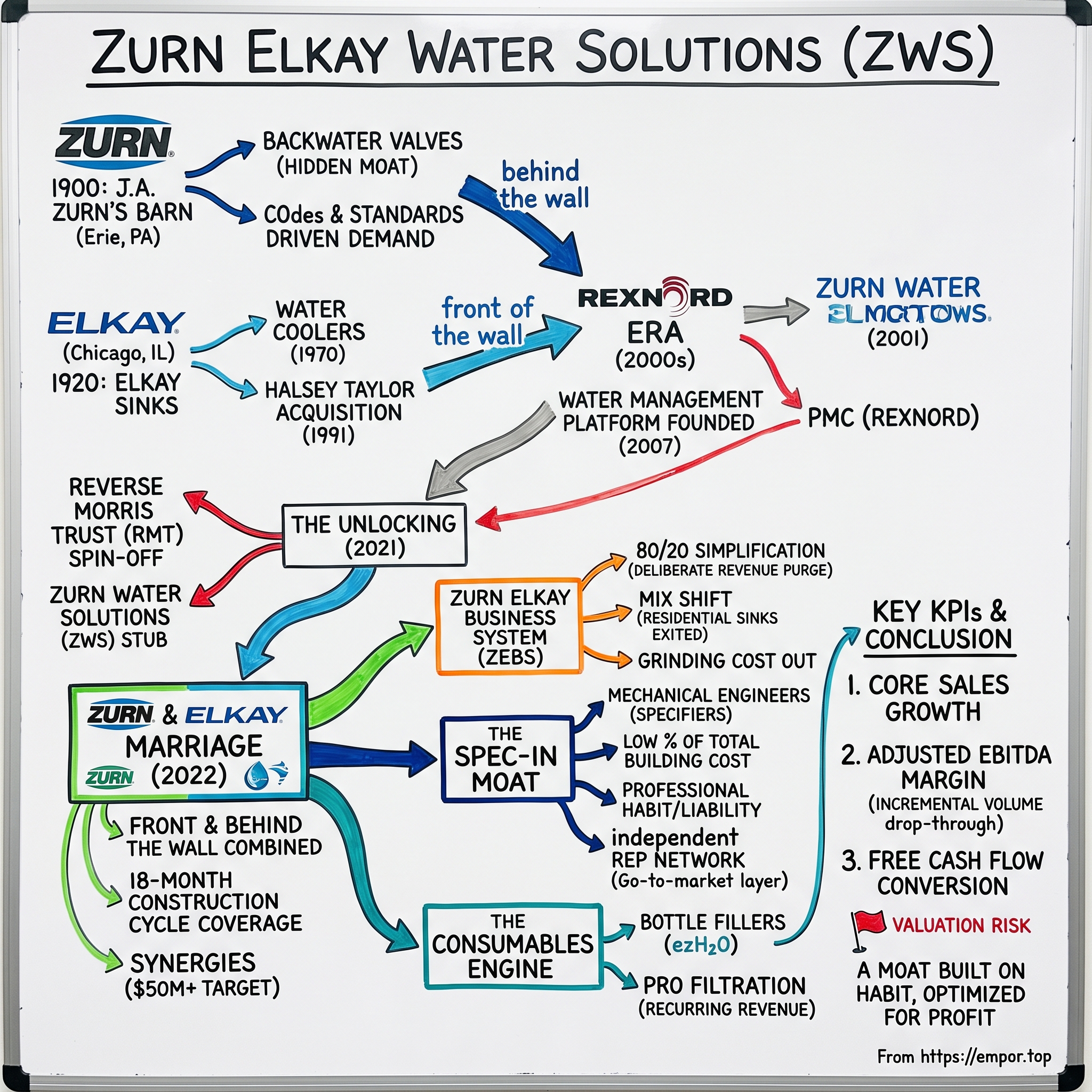
Zurn Elkay Water Solutions: The Built-In Moat of Commercial Hydration
I. Introduction & The $8 Billion Water Monopoly
Walk into almost any American public high school built or renovated in the last fifteen years and you will find it: a stainless-steel alcove set into the corridor wall, a small green LED counter ticking upward, and a laminated sign reminding students how many plastic bottles they have collectively saved. Hold a bottle under the sensor, and cold filtered water arrives in seconds. The counter advances. Nobody thinks about it again.
That object is the Elkay ezH2O bottle filling station. It launched in February 2010, and by July 2021 the one millionth unit had been produced and installed — fittingly, at Garfield Park in Chicago, a few miles from where the company that made it was founded in a rented room a century earlier.1 In its first year on the market, Elkay sold four thousand of them.1 The green counter was never really a piece of engineering. It was a piece of persuasion — a way of making an invisible plumbing decision visible to the people who use it, and therefore to the school boards and facility managers who buy it.
That single product sits at the front of a company that the public market valued at roughly $8.7 billion in late July 2026, with shares trading near $52 on the New York Stock Exchange.2 And here is the paradox worth sitting with for the next three hours: the products Zurn Elkay makes are not sophisticated. A backflow preventer is a valve that stops dirty water from flowing backward into clean pipes. A trench drain is a channel in a floor. A flush valve is a flush valve. These are hundred-year-old physics problems, solved a hundred years ago. And yet in the second quarter of 2026, Zurn Elkay converted $491 million of sales into $136 million of adjusted EBITDA — a 27.7% margin, expanded 120 basis points from the prior-year quarter.3 For context, the largest publicly traded comparable in the space, Watts Water Technologies, generated roughly $2.44 billion of revenue in 2025 at an EBITDA margin in the low twenties.4 Zurn Elkay is smaller and considerably more profitable.
Boring products. Tiny share of a building's budget. Extraordinary margins. That combination is not an accident, and it is not primarily a manufacturing story. It is a story about where in the decision chain the product gets chosen — a mechanism we will spend a great deal of time on, because it is the load-bearing wall of the entire investment case.
The corporate alchemist. The person who assembled this company is Todd A. Adams, who was 55 years old as of the 2025 Form 10-K and has been chief executive since 2009, adding the chairman title in 2020.5 Adams joined the business in 2004 and rose through finance — treasurer, chief financial officer, president — before taking the top job.5 That background matters, because what Adams did over the following seventeen years reads less like a manufacturing career and more like a sustained exercise in corporate structure: buy a water business inside a private-equity-owned gear company, grow it, separate the gear company via one of the most tax-efficient maneuvers available in American corporate law, then merge the water stub with a century-old family firm, then spend four years cutting away the parts of the combined company that did not earn their keep.
The result is a business with almost no leverage — net debt leverage stood at 0.3 times at June 30, 2026, the lowest in its public life — and a management team that in the same quarter received a $47.6 million cash refund of previously paid reciprocal tariffs, a windfall it explicitly excluded from adjusted EBITDA rather than banking as performance.3 Small detail, but a telling one about how this team handles the difference between luck and execution.
The roadmap. This story runs through a barn in Erie, Pennsylvania in 1900 and a 2,100-square-foot rented room in Chicago in 1920; through Apollo Management's leveraged buyout machine in 2006 and 2007; through the Reverse Morris Trust that severed a $4 billion industrial conglomerate in half in 2021; through a $1.46 billion all-stock merger in 2022; and into an operating system, borrowed from Danaher, that has now expanded margins in essentially every quarter since.67
Along the way we will ask the questions that matter for anyone holding this for a decade. Is the moat real, or is it a story told well? Is the margin expansion structural or a one-time cleanup that is running out of runway? What does it mean that the company's own sales network shrank materially between 2024 and 2025? And what happens to a business whose customers are schools and hospitals when the money that funds schools and hospitals gets tight?
To answer any of that, start with the two men who never met.
 Subscribe on LinkedIn
II. The Dual Origins: Erie Barns & Chicago Sinks (1900–1980s)
The barn in Erie
In 1900, a young man in Erie, Pennsylvania named John A. Zurn bought a patent and the casting molds for a backwater valve from the Erie City Iron Works and set up shop in a barn in his mother's backyard.8 There is no evidence he thought of himself as founding an industry. He had bought the rights to a specific, unglamorous solution to a specific, unglamorous problem: when a storm overwhelms a city's sewer, wastewater flows backward into buildings. A backwater valve is a one-way door that stops it.
What made that a business rather than a hobby was not the valve. It was the city. American municipalities in the first decades of the twentieth century were writing plumbing and sanitation codes at speed, driven by cholera, typhoid, and the simple arithmetic of density. Once a code says a building must have a device that prevents backflow, the device stops being a product a builder chooses and becomes a line item an inspector verifies. Zurn's entire commercial architecture — then and now — rests on that conversion. The company does not sell to people who want its products. It sells to people who are required to install something, and who would rather not be the one who chose wrong.
Zurn built outward from there in the way industrial families did. By 1910 the firm had been formally renamed the J.A. Zurn Manufacturing Company after he partnered with fellow Erie entrepreneur Milton Rowley; the two picked up local casting and brass capability along the way.8 Point drains arrived in 1946.8 The most consequential addition came in 1972, with the acquisition of the Wilkins Regulator Company — a business already 68 years old at the time, and the source of the Wilkins brand that still fronts Zurn's backflow prevention and pressure-reducing valve line today.85
Everything in this lineage lives behind the wall. Backflow preventers, fire system valves, thermostatic mixing valves, storm and wastewater drainage, grease interceptors. These are the products installed in the first half of a construction project, buried in concrete and ceiling plenums, and never seen again by a human being who is not holding a wrench.
The room in Chicago
Twenty years later and 500 miles west, a different kind of business began. In 1920, Leopold Katz, his son Louis, and a tinsmith named Ellef Robarth rented roughly 2,100 square feet on Chicago's Near North Side to hand-fabricate sinks.8 The name was a portmanteau of the two men who made the thing and the family that financed it: El from Ellef, Kay from Katz.
Where Zurn's products hid, Elkay's were the ones you touched. The founding product was a German-silver butler's pantry sink, hand-fabricated and delivered around Chicago. The craft origin mattered commercially for a long time afterward: Elkay built a reputation on fabrication quality in a category — sheet metal formed into a basin — where the difference between good and cheap is obvious to the person using it every day.
The pivot that turned Elkay into an institutional franchise came later and in two steps. First, water coolers: the company launched its first cooler line in 1970, in eighteen colors, and had manufactured its one millionth by 1985.8 Second, consolidation: in 1991 Elkay acquired Halsey Taylor, and in doing so became the largest water cooler manufacturer in the market.8 Halsey Taylor was not a minor brand — it was the other name every school district in America knew. Buying it turned a competitive category into something much closer to a duopoly of one.
By the end of that run, Elkay owned the two things that matter in institutional hydration: the brands specifiers reached for by reflex, and the manufacturing scale to serve a fragmented, low-value-per-unit market profitably. It also owned something less flattering, which becomes central to this story in 2022 — a large, high-volume residential and private-label sink business that sold through big-box retail, competed on price, and behaved exactly like the commodity it was.
Why the two halves fit
Read the two histories side by side and the complementarity is almost architectural. Zurn's products go in during the rough-in phase, when the building is a skeleton. Elkay's go in at the end, when interior spaces are being finished. Management makes this point explicitly in its own investor materials: the portfolio participates across an eighteen-month construction cycle, from flow systems early, to water safety and control mid-cycle, to hygienic, environmental, and drinking water products at completion.9
That is not just a nice slide. It is a genuine economic property. A supplier that only sells rough-in product sees its revenue swing with construction starts. A supplier that only sells finish product sees revenue swing with completions, eighteen months later. A supplier present at both ends is smoothed across the cycle, and — more importantly — has a reason to be in the room with the design engineer twice.
Neither company knew it was building half of something. Elkay stayed private and family-controlled for over a century. Zurn changed hands repeatedly, landing inside Jacuzzi in 1988 and then, in 2007, inside a Milwaukee gear company most people had never heard of.8
That gear company is where the modern story actually starts.
III. The Rexnord Era: From Heavy Gears to the Water Platform (1980s–2009)
A company built out of other companies
Rexnord in the mid-2000s was the kind of business that gives industrial conglomerates their reputation. Its core was Process & Motion Control: industrial chain, gears, couplings, conveying equipment, bearings — the mechanical guts of factories, mines, and aircraft. Good products. Real engineering. And an end market that moves violently with global capital spending, which means revenue that can fall by a quarter in a bad year and margins that fall faster.
By 2006 it was also a private-equity asset. Apollo Management acquired Rexnord's parent, RBS Global, that July.6 Three months later, on October 11, 2006, Apollo affiliates agreed to acquire Jacuzzi Brands — the owner of the Zurn plumbing business — for $12.50 per share in cash plus assumed debt, valuing that transaction at roughly $1.25 billion; Jacuzzi shareholders approved it on January 25, 2007.7
What happened next is the kind of maneuver only a sponsor with both assets can execute cleanly. On February 7, 2007, RBS Global acquired the plumbing products business — Zurn — from an affiliate of Apollo Management, for a cash purchase price of $942.5 million including transaction costs.6 Apollo had bought the whole bath-and-plumbing conglomerate, kept the parts it wanted, and moved Zurn into its industrial platform. Rexnord's own annual report describes the effect in a single sentence: "The acquisition of Zurn establishes the Water Management platform within Rexnord."6
It is worth being precise about the price, because the number often gets rounded up in retellings. It was $942.5 million, in cash, including transaction costs, for a business the buyer described as a leader in the non-residential construction and replacement market for plumbing fixtures and fittings.6 What the deal multiple was against Zurn's EBITDA at the time was not disclosed in that filing.
The finance guy who kept getting promoted
Todd Adams had joined the business in 2004, two years before Apollo arrived.5 He was, by function, the person responsible for the capital structure of a highly leveraged industrial roll-up — a job that in 2007 through 2009 amounted to steering a debt-heavy cyclical manufacturer directly into the worst industrial downturn since the Depression. He became chief executive in 2009, at the bottom.5
There is a specific kind of operating mind that gets formed by that experience. If your first years running a company are spent watching a heavy-industrial order book evaporate while covenants tighten, you learn two lessons permanently. First, cyclicality is not a temporary inconvenience; it is a structural tax on valuation. Second, the businesses that survive downturns are the ones whose customers have to buy — because a code requires it, because a system failed, because a building cannot open without it.
Zurn was that second kind of business. Process & Motion Control was not.
The tension that took twelve years to resolve
What Adams built through the 2010s was a two-platform company where the two platforms had nothing in common except a corporate headquarters. Rexnord went public in 2012. Water Management grew, took price, added bolt-ons, and threw off cash. PMC did what PMC does — expanded in good years, contracted in bad ones, and consumed capital in both.
The market priced the whole thing as an industrial conglomerate, which is to say it priced it on the worse half. This is not a complaint unique to Rexnord; it is the standard mechanics of the conglomerate discount. When a business is a weighted average of a stable, high-return franchise and a cyclical, capital-hungry one, the multiple applied to the average is typically closer to the cyclical asset's than to the franchise's, because the franchise's cash flows are not visible or claimable on their own.
Adams's response over this period was to make Water Management progressively more separable rather than more integrated — building it out with acquisitions that had nothing to do with gears. World Dryer arrived in 2017, expanding the washroom offering; Just Manufacturing and Hadrian, the stainless-steel fixture and toilet-partition businesses, came in 2020; ATS Greasewatch and Wade Drains followed in 2021.8 Each addition made the water platform more complete as a standalone entity and less plausibly synergistic with industrial power transmission.
Read that sequence forward and the conclusion is hard to avoid: the separation was being engineered years before it was announced. For investors, the lesson is a general one. When a management team keeps investing in one segment's completeness rather than the group's integration, it is usually telling you something about where the story ends.
It ended in February 2021.
IV. The Great Unlocking: The Reverse Morris Trust (2010–2021)
The problem with owning a good business inside a mediocre one
By 2020, the arithmetic had become uncomfortable. The water business was the better business on nearly every dimension that determines what a multiple should be: less cyclical, higher margin, better cash conversion, lower capital intensity. The industrial business was larger by revenue. The stock reflected the second fact more than the first.
Management had three ordinary options and all three were bad. Sell PMC for cash, and hand a very large tax bill to the government on a business carried at a low basis. Spin PMC to shareholders as an independent company, and create a subscale, levered, cyclical orphan that the market would punish. Do nothing, and keep paying the conglomerate discount indefinitely.
So they took the fourth option, which is the most elegant structure in the American M&A toolkit and also the most fragile: a Reverse Morris Trust.
How the trick works, in plain English
Strip away the tax code and an RMT is a swap that has to be dressed as a spin-off. The parent separates the unwanted division and distributes it to its own shareholders — that part is tax-free under U.S. rules for corporate separations. Immediately afterward, that freshly distributed division merges with a third-party acquirer. The catch, and it is the whole game, is that the parent's shareholders must end up owning more than half of the combined entity. If they own 50% or less, the transaction is treated as a sale and the tax-free treatment collapses.
That single constraint dictates everything about how these deals are built: who can be the acquirer (only someone small enough relative to the asset), how much cash can move (limited), and why the ownership percentages get recalculated right up to closing.
The deal
On February 16, 2021, Regal Beloit Corporation and Rexnord announced they had reached a definitive agreement to separate Rexnord's Process & Motion Control segment via tax-free spin-off and immediately combine it with Regal in an RMT.10 Regal shareholders would own 61.4% of the combined entity and Rexnord shareholders 38.6%, before a potential dividend to Regal shareholders and a corresponding ownership adjustment "sized at closing to ensure that RMT ownership requirements are met."10
Pause on the arithmetic, because it is the part most summaries get backwards. Rexnord shareholders received 38.6% of the combined company. The tax test is not about the combined entity — it is about the spun business. Rexnord's holders received the PMC business tax-free and then saw it diluted by Regal's larger existing operations. The phrase about the dividend being "sized at closing" is the tell: these deals get tuned in the final weeks precisely because the ownership math is the thing keeping the tax treatment alive.
The strategic logic on Regal's side was straightforward and disclosed. The combination gave Regal a complete industrial drivetrain portfolio, roughly $4.1 billion of 2020 pro forma revenue with about $740 million of adjusted EBITDA — an 18% margin — and $120 million of annualized cost synergies targeted by year three, with $70 million expected in year one.10 Both companies, notably, described a shared cultural commitment to "80/20 and LEAN principles."10 That is not boilerplate. It signals that the acquirer intended to run PMC the same way Rexnord had.
And one line in the release states the whole point of the exercise from the Rexnord side: "Rexnord shareholders will continue to own 100% of the businesses' Water Management platform."10
Adams's own quoted framing was disciplined and, in retrospect, revealing in what it emphasized: PMC would be better off with an owner "committed to investing in the continued growth of its power transmission business," while the water business would be "well-positioned to continue to drive differentiated growth as a standalone business aligned around its distinct competitive advantages and market dynamics."10 Translated: these two things should never have been in the same company, and one of them was being held back by the other.
The transaction closed on October 4, 2021. Regal Beloit became Regal Rexnord Corporation, trading as RRX. Rexnord Corporation became Zurn Water Solutions Corporation, trading as ZWS.115
What the stub actually was
What remained was a pure-play water management business with a single reporting segment, an installed base measured in millions of fixtures, and — critically — a clean balance sheet. The PMC results were reclassified into discontinued operations for all prior periods, which is why any historical revenue series for ZWS looks like it starts abruptly.5
The mechanics of the tax-free split also delivered something less glamorous but more durable than a re-rating: it eliminated the argument. A pure-play company cannot be accused of hiding a bad business inside a good one, because there is only one business. Every subsequent quarter of margin expansion is attributable, visible, and testable.
Whether the market immediately re-rated ZWS toward water-sector peers is a claim worth treating carefully rather than asserting. What is documented is the operating starting point: for calendar 2022, the first full year as a standalone water company, net sales were $1,282 million and adjusted EBITDA was $265 million — a 20.6% margin.12 That is the number to hold in mind. Four years later the same company runs at 27.7%.3 Nearly everything in the rest of this story is about how that seven-point gap was closed, and whether the mechanism that closed it has anything left.
Adams did not wait to find out. Four months after the spin closed, he went shopping.
V. The Elkay Marriage: Front-of-the-Wall Meets Behind-the-Wall (2022)
A hundred-year-old family business decides
Elkay in 2021 was a rare thing: a large, profitable, century-old American manufacturer that had never been public and had never been owned by a financial sponsor. The Katz family still controlled it. And like every multi-generational family business eventually does, it faced the succession question — not who runs it, but who owns it, and what happens when the cap table has spread across four generations of cousins and trusts.
The options for a business like that are the familiar three: sell to private equity and watch the leverage go on, sell to a strategic acquirer and disappear into it, or do an IPO and take on the machinery of public-company life. Elkay chose a fourth: merge into a public company at a scale where the family would remain a meaningful owner rather than an exiting seller.
On February 12, 2022, Zurn Water Solutions entered into a definitive agreement to combine with Elkay Manufacturing.5 The transaction closed on July 1, 2022.11
The structure, and what it says about how Adams thinks about currency
The consideration was stock — approximately 51.6 million shares of Zurn common stock, leaving former Elkay shareholders with roughly 29% of the combined company.11 Zurn's closing price on July 1, 2022 was $27.48, which put the equity component at $1,411.9 million; adding $45.9 million of net cash payments to retire Elkay's term loan and cover transaction costs in excess of Elkay's cash produced a final purchase price, after adjustments, of $1,457.8 million.13
Two things about that structure deserve comment.
First, it was all stock in a period when Zurn's own shares were not obviously expensive. Paying with equity when you believe your equity is undervalued is dilutive in substance even when it is accretive in the model. Management's implicit judgment was that Elkay was worth more to Zurn than Zurn's paper was worth to Elkay — a defensible view given the combination logic, but a real cost that shareholders bore.
Second, the family did not cash out. That is the meaningful difference between this and a private-equity exit, and it produced a specific governance structure that has since evolved. At closing, the board expanded to eleven members with two directors designated by Elkay; by December 31, 2024 the board had contracted to ten with one Elkay designee remaining.13 Timothy J. Jahnke, the retired Elkay chairman, sits on the Zurn Elkay board today, holding 428,864 shares.14
A governance note that the outline version of this story tends to skip. The Katz family's holding vehicle, Ice Mountain LLC, was reported as beneficially owning 15,253,307 shares — 9.1% of the company — in the 2026 proxy.14 Set that against the ~29% received at closing and the direction is unmistakable: the family has sold down substantially over four years. That is entirely normal behavior for a family diversifying after a liquidity event, and it is not evidence of anything sinister. But it does mean the "aligned founding family owner" element of the original combination thesis is materially weaker in 2026 than it was in 2022, and any investor treating that stake as a stability anchor should size it correctly. It also means a meaningful, identifiable block of supply has been working through the market.
What was actually being bought
Elkay contributed $264.4 million of net sales in the six months from July 1 to December 31, 2022, alongside a net loss of $11.5 million that included purchase accounting effects.13 Annualize the revenue and Elkay was roughly a $500–530 million business. Zurn did not disclose an EBITDA multiple for the transaction, and no such figure appears in the merger disclosures — so any precise multiple attributed to this deal should be treated as an outside estimate rather than a company-reported fact.
The strategic case, as Adams put it on closing, was that the combination brought together "two iconic brands that serve the same end markets with complementary products," and he explicitly reaffirmed confidence in delivering "$50 million of synergy opportunities."11 The word "same" is doing the work in that sentence. This was not diversification. It was densification — putting more product content into buildings the company was already specified into, sold through a rep network that was already calling on the same engineers.
The cost of getting there was real and disclosed: approximately $33.7 million of transaction-related legal and professional costs ran through SG&A in 2022, with an additional $18.3 million of cost-of-sales impact from purchase accounting on acquired inventory.13 Deals of this size are not free, and the 2022 margin of 20.6% reflects that friction.
The one-stop-shop claim, stress-tested
The pitch to a building owner is seductive: one supplier, from the water main to the drinking fountain. But is that worth anything? Building owners do not buy plumbing. Mechanical contractors buy plumbing, from wholesalers, against specifications written by engineers. Bundling matters only if it changes one of those three behaviors.
The honest answer is that it changes the second one — the wholesaler relationship — more than the others. A distributor carrying both lines has fewer supplier relationships to manage, better freight economics, and a single rep agency to deal with. That is a real, if unglamorous, benefit. Whether it changes what a specifying engineer writes is far less clear, and management has never claimed a hard number for cross-selling revenue. What they did commit to was a cost number.
They hit it. And then they went considerably further than anyone had asked them to.
VI. The Playbook in Action: The Zurn Elkay Business System (ZEBS) & The 80/20 Purge (2022–Today)
An operating system with a pedigree
Every industrial company claims a business system. Most of them are a poster in a breakroom. The reason to take Zurn Elkay's seriously is genealogical: it descends, directly and through people, from Danaher — the company that turned the Toyota Production System into a repeatable American capital-allocation machine.
The direct line is visible on the executive roster. Sudhanshu Chhabra, who became executive vice president of the Zurn Elkay Business System in 2025, joined the company in 2014 and had previously spent years at Danaher.5 The system he runs is described in the 10-K around four principles: strategy deployment, measuring performance through the "Voice of the Customer," involvement of all associates in executing strategy, and a culture built on kaizen and "the concepts around 80/20 simplification."5
Strip the vocabulary away and 80/20 is a single, brutal observation: in most industrial businesses, roughly 20% of the products and customers generate roughly 80% of the profit, and the remaining 80% of complexity actively destroys value by consuming engineering time, warehouse space, tooling, working capital, and management attention. The theory is easy. The execution is not, because the 80% still generates revenue, and revenue is what analysts model, what sales incentives reward, and what factory overhead absorption depends on.
Which is precisely why what happened next was interesting.
Cutting $90 million of your own revenue on purpose
Elkay came with a legacy residential and private-label sink business sold largely through big-box retail — Home Depot, Lowe's, and the like. It was high-volume, price-competitive, tied to housing starts, and structurally low-margin. In the fourth quarter of 2022, before the ink was fully dry on the merger, management executed an incremental $10 million of Elkay residential commodity, private-label, and OEM product line exits beyond what it had guided ninety days earlier, in response to early residential softness.12
That was the opening move. The full program ran through 2023 and removed roughly $90 million of annualized sales — real revenue, walked away from deliberately, in a company then guiding to $1.5 billion to $1.55 billion of total sales.12 Management completed the exits in the first quarter of 2023 as planned, and disclosed the year-over-year drag quarter by quarter so investors could model around it.15
Note what that number does to the tidy version of this story. The commonly repeated framing is that the sink exit created a persistent ~100 basis point headwind to core sales growth. The documented reality is bigger and lumpier: a concentrated purge worth roughly six percent of the revenue base, executed inside twelve months, followed by an ongoing but much smaller trickle of 80/20 pruning. On the Q1 2026 call, CFO David Pauli described the position as essentially finished — the company "exited some low-margin noncore residential sinks that were primarily sold through big box" and is now "largely out of those types of products."16
That distinction matters analytically. A permanent 100-basis-point drag is a tax on growth forever. A completed one-time purge is a rebasing — and it means the growth rates being reported in 2025 and 2026 are clean, not artificially depressed by ongoing exits.
Did the math work?
This is where the evidence is genuinely strong, and it is worth walking through carefully rather than assuming.
Start at the bottom. In the first quarter of 2023 — post-merger, mid-purge, and still selling through inventory purchased at 2022's peak commodity and freight costs — adjusted EBITDA margin was 19.5% on $372 million of sales.15 Management at the time attributed the compression specifically to higher-cost inventory sell-through, growth investments, and merger effects, and forecast a step-up to 21.0%–21.5% in the second quarter.15 They also reaffirmed the $25 million of in-year Elkay synergies and the path to $50 million.15
They delivered on both. By the first quarter of 2026, Pauli walked investors through the cumulative result: trailing-twelve-month adjusted EBITDA margins had improved 630 basis points from Q1 2023 to Q1 2026, and on a point-to-point basis margins were up 730 basis points over thirteen quarters — 19.5% to 26.8%.16 He attributed it to four things: associate-submitted continuous-improvement ideas ("#CI") that individually are immaterial but collectively meaningful when thousands are submitted annually; unit volume growth concentrated in the highest-margin categories while the lowest-margin products were exited; more than $50 million of realized Elkay synergies plus structural changes beyond the original synergy case, including footprint consolidation; and supply chain repositioning.16
Then the pace continued. The second quarter of 2026 delivered 27.7% margins on $491 million of sales, with core sales up 10% and growth in all product categories.3 Full-year 2026 guidance was raised to $503–513 million of adjusted EBITDA, which management framed as roughly 140 basis points of year-over-year margin expansion excluding tariff refunds.3
The analytical conclusion. A company that expands margins by 700-plus basis points over three years while simultaneously removing 6% of its revenue base is not simply riding a good market. Price contributed — five points of price realization in the first quarter of 2026, on management's own disclosure — but price alone does not explain mix-driven expansion in a low-growth end market.16 The more defensible reading is that ZEBS is doing real work: the combination of walking away from bad revenue and grinding cost out of what remains is a genuine capability, and it is the kind of capability that is hard to copy because it requires a board and a CEO willing to report lower sales on purpose.
What could falsify it. Two things. First, the easy cuts are, by construction, finished — Pauli said so. Incremental margin guidance of roughly 30–35% on volume is management's own framing of the go-forward rate, notably lower than the extraordinary drop-throughs of the recovery years.9 Second, when analyst Bryan Blair of Oppenheimer pushed Adams in April 2026 on whether the incremental margin framework should be raised given the new profitability level, Adams declined to move it, saying "in time, we may modify that. But for the time being, I think it's a good framework."16 That is a disciplined answer rather than an evasive one — but it is also management telling you not to extrapolate the last three years.
The supply chain move that looks lucky and was not
One second-layer item deserves a paragraph, because it separates process from fortune. When an analyst asked in October 2025 why Zurn Elkay had navigated the tariff environment better than peers, Adams pointed to a decision made roughly five years earlier to move manufacturing and supply partners out of China. By that call, over 50% of cost of goods sold came from the United States, and management projected China exposure falling to about 2%–3% by the end of 2026.9 Total 2025 tariff cost, before offsetting price, ran to approximately $50 million — a number that rose during the year as copper tariffs and country-specific rates changed.9
Adams's own framing was notably free of victory-lapping: "no one, including us, would have predicted the kind of tariff environment that we saw beginning in April, but by starting well in advance, doing the long, hard work, I think it's positioned us really well."9 The 2026 tariff refunds followed a Supreme Court ruling on the reciprocal-tariff regime, and management excluded them from adjusted EBITDA entirely.316 Both choices — the pre-positioning and the exclusion — are the behavior of a team that would rather be judged on the controllable part.
None of which would matter if the underlying franchise were replaceable. So: is it?
VII. The Core Economics: Customer Segmentation & The Spec-In Moat
Where the money actually comes from
Zurn Elkay reports as a single segment, which frustrates analysts and obscures the fact that it serves three quite different economies. The 10-K's revenue disaggregation by customer type is the most useful page in the filing.
For 2025, institutional customers generated $830.0 million of the company's $1,695.9 million in net sales — just under half the business. Commercial contributed $477.3 million, and "all other" $388.6 million.5 The trend inside those buckets is the interesting part: institutional grew from $740.5 million in 2024 and $690.5 million in 2023, while commercial moved from $443.1 million to $451.1 million to $477.3 million and "all other" actually shrank from $396.9 million in 2023 to $374.9 million in 2024 before recovering to $388.6 million.5 The mix has been shifting toward the most defensive category for three consecutive years — partly by design, since "all other" is where the exited residential products lived.
Institutional means K-12 schools, universities, hospitals, and government facilities. This is the crown jewel not because the margins are higher but because the demand function is different. A school district does not stop replacing failed drinking fountains because a recession arrived; it replaces them because the state health inspector wrote a citation, or because a bond issue approved three years ago is now funding a renovation. Capital moves on political and regulatory clocks, not credit-cycle clocks.
Geographically, the business is overwhelmingly domestic: $1,551.1 million of 2025 sales came from the United States, $97.8 million from Canada, and $47.0 million from the rest of the world.5 That concentration cuts both ways. It removes currency and geopolitical complexity, and it means there is no international growth engine to offset a domestic downturn.
The specification moat, explained properly
Here is the mechanism that explains the margins, and it deserves to be understood in concrete terms rather than accepted as a slogan.
A commercial building's plumbing is not designed by the contractor who installs it. It is designed, years earlier, by a mechanical, electrical, and plumbing engineering firm working for the architect. That firm produces a specification document that names, product by product, what will be installed — often naming a specific manufacturer and model as the "basis of design," with the phrase "or approved equal" attached.
Those four words are where the moat lives. In theory, "or approved equal" means a contractor can substitute anything comparable. In practice, substituting requires the contractor to prepare a formal submittal demonstrating equivalence, route it to the engineer of record for review, absorb the schedule risk while it sits on someone's desk, and — this is the part that ends most substitution attempts — accept professional liability if the substitute underperforms. For a product line that typically represents a low single-digit percentage of a project's total cost, the expected savings from substitution are trivially small and the expected cost of being wrong is enormous.
The 10-K puts the same logic in its own words: products are "project-critical and typically represent a low percentage of the overall project cost," and management believes these characteristics, combined with its distribution network, "create a high level of end-user loyalty."5 The filing goes further, describing the self-reinforcing dynamic explicitly: once an architect, engineer, contractor, or owner has specified the product with satisfactory results, "that person will generally continue to use our products in future projects."5
Layer on top of that the certification regime. Products must be tested and listed by independent bodies — the International Association of Plumbing and Mechanical Officials, NSF, ANSI, ASTM, the Plumbing and Drainage Institute, Underwriters Laboratories, Factory Mutual, and the American Water Works Association — typically before commercialization.5 Each listing is a cost, a delay, and a barrier. A new entrant does not merely need a better valve; it needs a better valve that has been through years of third-party testing, is listed in the jurisdictions where the work is happening, and has a reference installed base that gives an engineer cover for specifying it.
Zurn Elkay describes its own position as maintaining "leading market shares in the majority of our product lines."5 On the drinking water side, Pauli was blunter on the Q1 2026 call: the company has "a dominant share of specs," and the current internal project is updating those specifications from legacy product to the new Pro Filtration platform.16 That last detail is the moat working in reverse — the incumbent's biggest competitor for its new product is its own installed specification base.
The distribution machine, and an inconvenient number
The second structural asset is the go-to-market layer. Zurn Elkay does not employ a direct sales force calling on contractors. It works through independent manufacturers' representative agencies — small local firms whose people know every mechanical contractor, wholesaler, and inspector within a few hundred miles, and who carry complementary but non-competing lines.
The 2025 Form 10-K describes this network as approximately 1,000 independent sales representatives across 120 sales agencies in North America.5
Now the inconvenient part. The 2024 Form 10-K described the same network as approximately 1,100 independent sales representatives across 180 sales agencies.13 In one year, the agency count fell by a third.
The company does not explain the change in either filing, so any interpretation is inference rather than fact. The benign reading — and the most likely one — is agency consolidation: Zurn Elkay concentrating its lines with fewer, larger, better-performing rep firms to raise the share of each agency's attention it commands, a standard and generally value-creating move in this channel. The less benign reading is attrition. Investors who care about this moat should watch the number in each successive 10-K, because the rep network is not a soft asset — it is the mechanism by which specifications get won in the first place, and a third of it changed shape in twelve months without commentary.
A related concentration risk is disclosed plainly and deserves flagging: in fiscal 2025, the company's three largest independent distributors generated approximately 32% of consolidated net sales, with the largest alone accounting for 18%.5 That is a meaningful dependency for a business whose bull case rests on end-customer stickiness. The specification may belong to Zurn Elkay, but the invoice runs through a very small number of wholesalers, and management identifies the loss of a key distributor as a risk that could have a material adverse effect.5
The evidence that the whole thing works
The cleanest proof point management offers is a consistency statistic: as of the third quarter of 2025, Zurn Elkay had recorded year-over-year quarterly growth in 55 of the previous 59 quarters — a fifteen-year record spanning two construction cycles and a pandemic.9
The second is structural, and management walked through it in unusual detail on that same call. Roughly 20% of new-construction revenue in any given year comes from projects that started that year; the other 80% reflects work initiated in prior years.9 That lag is why a soft quarter of construction starts does not immediately show up in Zurn Elkay's revenue — and equally why a recovery in starts takes a year or more to arrive. The company's mix has also shifted: retrofit and replacement work, which was 45% of the business five years ago, is now roughly half, split evenly with new construction.16 Retrofit revenue is inherently less cyclical, because it is driven by failure, code compliance, and renovation budgets rather than by new development.
Management is also honest about being over-indexed rather than diversified. Within institutional, education and healthcare represent 80% of the company's exposure while comprising 60% of the relevant Dodge index; within commercial, office, retail, and hospitality represent 75% of exposure while comprising only 30% of the index.9 The first concentration is a strength. The second — three-quarters of commercial exposure sitting in office, retail, and hotels — is the most cyclically vulnerable position in the portfolio, and it is worth naming as such.
Having established the mechanisms, the useful next step is to test how durable each one actually is.
VIII. Playbook: Hamilton Helmer's 7 Powers & Porter's 5 Forces Analysis
Running the frameworks honestly
Frameworks are only useful if you are willing to score a company badly on some of the dimensions. Here is an attempt to do that.
Switching costs — genuinely high, but locate them correctly. The instinct is to say the switching cost lives in the concrete: once a backflow preventer is installed behind a wall, ripping it out is prohibitive. True but largely irrelevant, because nobody replaces a functioning valve with a competitor's valve. The real switching cost lives one layer up, in the engineer's specification library. An MEP firm that has used Zurn details on two hundred projects has templates, submittal history, CAD blocks, and — most importantly — no professional incentive to introduce variance. That is a habit-based lock-in, and the 10-K's own language about specifiers continuing to use products in future projects describes exactly this.5 It is durable. It is also, importantly, not permanent — it decays if a competitor delivers a genuinely superior product and invests years in re-specifying, which is precisely what Zurn Elkay itself is now doing internally with Pro Filtration.16
Scale economies — real but bounded, and shrinking as a differentiator. The distribution footprint and the rep network create cost advantages a regional manufacturer cannot match. But Zurn Elkay is not the largest player in adjacent plumbing categories — Watts is roughly 40% larger by revenue — and its scale advantage is regional rather than global.4 Call this a moderate power, and note that the recent agency consolidation suggests management is optimizing this asset rather than expanding it.
Process power — the strongest claim, with the best evidence. ZEBS produced measurable, repeated, multi-year margin expansion through two very different macro environments, and the company demonstrated something rarer than cost-cutting: the organizational willingness to delete revenue. The tariff pre-positioning is a second, independent data point. Process power is the hardest of Helmer's powers to fake and the hardest to copy, because it requires culture rather than assets. This one appears real. The honest caveat is that process power is also the power most dependent on specific people — and the architect of it is one CEO and one EVP.
Branding — underrated in this analysis, and worth adding. Zurn, Elkay, Wilkins, Halsey Taylor, JUST, and Hadrian are names that a fifty-year-old plumbing engineer has known his entire career.5 In a category where the buyer's dominant motivation is avoiding blame, brand is insurance. That is a genuine, if unquantifiable, power.
Counter-positioning and cornered resource — absent. There is no business model a competitor cannot copy, and no unique input. Saying so is the point of running the framework.
Porter, with the pressure applied
Threat of new entrants: very low. The certification stack described earlier is the barrier, and it compounds with the specification habit. A well-funded new entrant would need years of listings, a rep network built from scratch against incumbents who already occupy the good agencies, and a reason for an engineer to accept career risk. Digital or direct-to-contractor models do not solve any of those problems, because the bottleneck is not distribution efficiency — it is liability.
Bargaining power of buyers: low at the specifier, meaningfully higher at the distributor. This is where the conventional analysis is too generous. The engineer is price-insensitive; that part is right. But the entity writing the purchase order is a wholesaler, and three of them account for roughly a third of sales.5 Large distributors negotiate hard on terms, rebates, and stocking programs. The correct reading is a barbell: very low buyer power over what gets specified, meaningfully non-trivial buyer power over what gets paid.
Threat of substitutes: very low. Buildings need drainage, backflow prevention, and potable water delivery. No technology removes those requirements. The one substitution worth watching is behavioral rather than technical: bottled water and consumer point-of-use filtration compete with institutional hydration for the same "clean water" budget in some settings — though in schools, regulation increasingly pushes the other way.
Bargaining power of suppliers: moderate, and actively managed. Copper, brass, and stainless steel exposure is genuine, and 2025's roughly $50 million tariff bill demonstrates how quickly input costs can move.9 The company has offset it with price — three points of incremental price in 2026 on Adams's own description, and five points realized in the first quarter — and with the multi-year sourcing shift.169 But pass-through is not free, and Adams was careful when Baird's Michael Halloran asked about customer price fatigue in April 2026: "stability would be a great thing," he said, adding that the company must "stay diligent because inflation of commodities and freight" are "bubbling."16 That is a more candid answer than the pricing-power narrative usually allows.
Competitive rivalry: moderate, and fragmented by design. The 10-K makes a specific and credible claim: the markets are "relatively fragmented," and management does not believe "any one competitor directly competes with us across the breadth of all of our product lines."5 That is the structural reality. Sloan Valve Company remains a private, deeply entrenched specialist in commercial restrooms and flushometers, and competes hard in exactly the categories Zurn's hygienic and environmental line occupies.17 Watts Water Technologies is the closest public analogue, but its portfolio is weighted toward HVAC, gas, and hydronic heating rather than commercial plumbing fixtures, and it converted $2.44 billion of 2025 revenue at a materially lower EBITDA margin — a comparison that supports the argument that Zurn Elkay's category mix, not just its execution, is unusually profitable.4 Kohler Co. and TOTO Ltd. (TOTO株式会社) are giants in ceramics and aesthetic fixtures, overlapping at the edges rather than at the core.18
The synthesis is straightforward: the industry structure is favorable, the company's position within it is strong, and the two dimensions where the story is weaker than the standard telling — distributor concentration and the boundedness of scale economies — are both disclosed in the company's own filings rather than hidden.
Which brings the analysis to the part that determines returns rather than quality: what has to be true from here.
IX. The Investment Spine: Bull Case, Bear Case, & The 3 Critical KPIs
The consumables engine — promise, delivery, and the limits of the evidence
Start with the most attractive claim in the story, and test it against what management actually promised.
In April 2023, when an analyst asked Adams to size the filtration opportunity created by the merger, he gave a specific answer: attaching filters to the installed base of drinking water units was "not crazy to think about as a $100 million opportunity in the next two to three years," and he noted pointedly that capturing the filter replacement event "was not a strategic focus that Elkay really had spent a lot of time on."15
That is a falsifiable statement, made three years ago. What has happened since? The company does not break out filter revenue, so a direct check is impossible — an important disclosure gap for anyone underwriting this as a recurring-revenue business. What is disclosed: the installed base of filtered bottle fillers continues to grow at double digits, and the filtration business grows above double digits.16 The mechanism has also improved. The new Pro Filtration platform, developed from customer and facility-manager feedback, allows filter replacement "in under 30 seconds" and extends capacity so units can be serviced roughly annually, with filters certified to NSF/ANSI 42, 53, and 401 standards to reduce PFAS, lead, microplastics, and asbestos.5916
Why does a thirty-second filter change matter commercially? Because the enemy of a consumables annuity is not price — it is friction. Every facility manager who finds the change awkward becomes a customer who runs the unit past its filter life, or buys a cheaper aftermarket cartridge, or turns off the filtered mode. Reducing the change to something a janitor can do without a manual is how the razor-and-blade model actually gets defended in an institutional setting.
The regulatory tailwind is real and measurable. Michigan's "Filter First" legislation, which Adams was publicly championing back in 2023, requires schools and childcare centers to install filtered bottle fillers, and the state set aside $50 million to fund compliance at a ratio of one bottle filler per 100 occupants across roughly 1.5 million students.159 By late 2025 New Jersey had enacted its own legislation with funding attached.9 This is the most attractive kind of demand driver: mandated, funded, and multi-year.
But be precise about scale. A $50 million state program, spread across a couple of years, is a rounding difference against $1.7 billion of revenue. The Filter First programs matter as a template — if a dozen states adopt similar mandates, the aggregate becomes material — not as a line item today. The evidence that the template is spreading is two states and counting. That is encouraging and unproven.
The adjacency push, and the "diworsification" question
The newest chapter is expansion beyond the core, and it is the place where a skeptic should concentrate attention.
In July 2026, Zurn Elkay agreed to acquire Intellihot, a privately held manufacturer of tankless gas and electric water heaters serving healthcare, education, hospitality, and commercial customers, with approximately $37 million of projected 2026 net sales.19 The deal closed early in the third quarter, and management expects roughly $16 million of Intellihot revenue in the remainder of 2026.3 The purchase price was not disclosed.19
Adams described it as "a long-term proprietary cultivation of a strategic opportunity in an adjacency we had wanted to enter," and framed water heating as sharing the core portfolio's characteristics — specifiable products, growing markets, regulatory support.3 He had telegraphed this repeatedly: the company runs a "proper funnel" and does "not participate in auctions in a meaningful way," preferring proprietary cultivation.16 Alongside Intellihot, management said it remains on track to launch several new products into adjacent categories in the back half of 2026 and into 2027.3
The activist stress test. A skeptical investor would push on exactly this. Zurn Elkay's entire quality argument rests on focus — the 2021 separation was justified on the grounds that unrelated businesses destroy value inside a single company. Water heating is genuinely adjacent, but it is also a category with different competitors, different service requirements, and considerably more technology content than a drain. Intellihot at $37 million is far too small to be dangerous; the question is whether it is the first of a series. Adams's own guardrail, stated on the Q1 2026 call, is that acquisitions happen "only to the degree that they make sense strategically and then obviously meet the return hurdles that we set out for ourselves."16 That is the right standard. Investors should hold him to it by watching whether future deals stay adjacent and small, or whether the funnel starts producing platform-scale acquisitions in categories where the specification moat does not transfer.
A second, related exposure: on the residential side, management launched the Liv EZ built-in filtered bottle filler for homes in late 2025. Asked directly whether this signaled ambitions in residential filtration, Adams was unusually deflationary about his own product: "I wouldn't characterize our appetite to go into residential filtration as high. This is more of an extension to a relatively small market that gives us the opportunity to test some things and learn."9 A management team that talks down its consumer launch is behaving differently from one that needs a growth story.
Management credibility, examined through behavior
The most useful way to assess a management team is not to read its claims but to line up what it said three years ago against what happened.
The 2023 commitments were: $25 million of in-year Elkay synergies, a path to $50 million total, at least $100 million of share repurchases, approximately $200 million of free cash flow, sales of $1.5–1.55 billion, and adjusted EBITDA of $325–345 million.1215 Full-year 2025 delivered net sales of $1,696 million, adjusted EBITDA of $442 million at a 26.1% margin, record free cash flow of $317 million, $160 million of buybacks, and a 22% dividend increase.20 The synergy target was exceeded, and management stated it had gone beyond the original synergy case with structural footprint changes.16
That is a clean record of setting targets and clearing them. Two further behavioral markers are worth noting. First, guidance style: through 2025 and into 2026, management deliberately refused to update the full year until it had more visibility, telling investors on the Q1 2026 call to expect a second-half revision only after Q2. When an RBC analyst noted that pausing guidance usually signals trouble, Adams's answer was direct — "I honestly don't think it's that deep" — and he distinguished "deliberate" from "pause."16 The subsequent quarter validated the stance: results came in ahead of the outlook range and the full year was raised.319 Second, capital allocation has been consistent rather than opportunistic. The company repurchased $50 million of stock in each of the first two quarters of 2026, paid $37 million in first-half dividends, and upsized its revolver from $200 million to $550 million on a five-year extension — building capacity while leverage sat near zero.316
Skin in the game, stated accurately. Todd Adams beneficially owned 2,263,524 shares as of the 2026 proxy record date, approximately 1.4% of the company.14 The pay structure is genuinely performance-weighted: in 2025, long-term equity awards for Adams, the CFO, and the president consisted entirely of performance stock units.14 The metrics are worth naming precisely, because they are frequently misreported: 40% of PSU value is tied to free cash flow conversion, 40% to return on invested capital, and 20% to sales growth, with three-year cliff vesting and payout ranging from 0% to 200%.14 Note what is absent — there is no EBITDA margin metric. Management is paid on cash conversion and capital efficiency, not on the margin number it talks about most. That is a better-designed plan than most, and it partially insulates against the temptation to buy margin with underinvestment.
Two disclosure items worth flagging. First, an accounting and liability judgment: in December 2023, the company sold all equity interests of Zurn Industries, LLC — together with subsidiaries that primarily held asbestos liabilities, related insurance assets, and associated deferred taxes — to an unaffiliated buyer, recognizing an $11.4 million loss and removing those obligations from the balance sheet entirely.13 Legally shedding legacy asbestos exposure through a stock sale is a legitimate and increasingly common transaction, and it materially simplifies the risk profile. It is also the kind of structure that attracts scrutiny, and investors should understand it happened rather than discovering it later. Second, in the third quarter of 2025 the company completed the termination of its U.S. pension plan, eliminating an approximately $200 million liability along with the related assets and removing the need for future cash support.9 Both moves point the same direction: management has been systematically retiring legacy claims on the business.
The bull case, stated as testable propositions
The optimistic view is not "water is good." It is four specific mechanisms, each of which can be checked.
The demand base is structurally defensive because institutional customers spend on regulatory and political clocks; this is testable against the institutional revenue line, which has now grown for three straight years.5 The margin engine has demonstrated a repeatable method rather than a one-time fix; this is testable against incremental margins running at or above the 30–35% management framework.9 The consumables attachment converts a durable-goods sale into recurring revenue; this is only partly testable today, because the company does not disclose filter revenue separately. And the balance sheet gives management genuine optionality — at 0.3 times leverage with a $550 million revolver, Zurn Elkay can fund a meaningful acquisition without stressing anything.316
The bear case, stated with the same rigor
The pessimistic view has four parts, and the first is the most important.
Valuation is the dominant risk. With a market capitalization near $8.7 billion, essentially no net debt, and management's own 2026 adjusted EBITDA guidance of $503–513 million, the enterprise trades at roughly seventeen times guided current-year EBITDA.23 That is a quality multiple, and quality multiples embed expectations. A company growing core sales at 6%–7% in the third quarter and mid-single digits in the fourth — management's own guidance — needs continued margin expansion to justify it.3 The risk is not that the business deteriorates. The risk is that it performs well and the multiple contracts anyway, which is the most common way money is lost in high-quality industrials.
Cyclicality has been deferred, not abolished. The 80% lag between construction starts and revenue that protects the company on the way down also delays the recovery on the way up.9 Management's own read of Dodge data in October 2025 was that the acceleration once expected in 2026 had been pushed to 2027 because of tariff uncertainty and the absence of rate cuts.9 Meanwhile, three-quarters of commercial exposure sits in office, retail, and hospitality — the segments with the most structural questions attached.9 A genuine non-residential downturn would show up eventually, and it would show up in the highest-priced part of the story.
Input costs and pricing fatigue are live, not theoretical. The company has passed through tariff and commodity inflation successfully, but that success has now consumed several rounds of price increases in a market where Adams himself said stability "would be a great thing."16 Pricing power that has been fully exercised is pricing power that is no longer in reserve.
Concentration and execution risk. Three distributors at roughly a third of sales; a rep agency network that contracted by a third in one year without disclosed explanation; a margin story whose easiest gains are, on management's own account, complete.51316 None of these is a thesis-breaker on its own. Together they define the surface where an activist or a short seller would press.
The three KPIs that matter
Everything above collapses into three numbers worth tracking each quarter.
Core sales growth. This is the cleanest measure of whether the franchise is genuinely outgrowing a low-growth market. It matters more now than it did two years ago, precisely because the product-line exits are complete — meaning reported core growth is no longer masking a deliberate revenue purge. Management's own framing is that growth equals market, plus price, plus internal initiatives; watch whether the third component holds when the second fades.9
Adjusted EBITDA margin, and specifically the incremental margin on volume. The absolute margin tells you where the company has arrived. The incremental — how much of each new revenue dollar drops to EBITDA — tells you whether ZEBS still has runway. Management has guided to roughly 30–35% incrementals and explicitly declined to raise that framework when pushed.916 Sustained results above it would be evidence the engine has more left; results below it would be the first hard signal that the easy work is finished.
Free cash flow conversion. This is the honesty check on everything else, and it is also the metric management is actually paid on.14 Full-year 2026 guidance calls for at least $350 million of free cash flow excluding tariff refunds, against 2025's record $317 million.320 Because 2025 free cash flow exceeded net income of $198 million by a wide margin, conversion has been running well above 100% — a level that is difficult to sustain indefinitely and worth watching for the quarter it stops.520
X. Conclusion & Key Takeaways
There is a version of this story that is purely about corporate finance, and it is a good one. A CEO with a treasurer's instincts spent twelve years inside a conglomerate quietly building one segment into something separable, then used the most demanding structure in American M&A to hand the other segment to a competitor without paying tax on it, then spent his newly clean currency on a century-old family business that fit his existing customers like a puzzle piece, then cut six percent of the combined revenue base on purpose and expanded margins by seven hundred basis points in three years.
But the financial engineering only worked because of what sat underneath it, and that is the more durable lesson.
Zurn Elkay's advantage does not come from making a better drain. It comes from occupying a position in a decision chain where the person who chooses the product does not pay for it, the person who pays for it does not install it, and the person who installs it has every incentive not to argue. Add a certification regime that takes years to clear, a set of brands that a fifty-year-old engineer has trusted his entire career, and a local rep network that knows every inspector by name, and you have a business where the barrier to entry is not capital or technology but accumulated professional habit. Habits are slow to build and slow to break. That is precisely why they are worth owning.
The caution is the mirror image. A moat built on habit is a moat that erodes invisibly. There is no quarter in which specification share collapses; there are only years in which it drifts. The signals that would show drift are unglamorous and available: the size and shape of the rep network in each 10-K, the concentration of distributor revenue, whether incremental margins hold when price fades, whether the adjacency strategy stays adjacent. And the highest-probability disappointment for anyone buying today is not operational at all — it is paying a premium multiple for a business whose end market management itself describes as low-growth, and receiving good execution but no re-rating.
What began in a Pennsylvania barn in 1900, when a man bought a patent for a one-way door that kept sewage out of basements, and in a rented Chicago room in 1920, when three men hand-formed a sink out of German silver, converged 102 years later into a single company. The two founders were solving opposite problems — one hiding water safely inside a building, the other presenting it beautifully at the wall. It took a century, a private equity firm, a Reverse Morris Trust, and a finance executive with a long memory of what cyclicality does to a balance sheet to notice that they were the same business all along.
References
-
Elkay Celebrates One Millionth ezH2O Bottle Filling Station Milestone — PR Newswire, 2021-07-12 ↩↩
-
Zurn Elkay Water Solutions Reports Second Quarter 2026 Financial Results (Form 8-K, Exhibit 99.1) — SEC.gov, 2026-07-28 ↩↩↩↩↩↩↩↩↩↩↩↩↩↩↩
-
Watts Water Technologies Investor Relations — Watts Water Technologies ↩↩↩
-
Zurn Elkay Water Solutions Corporation Annual Report on Form 10-K for the year ended December 31, 2025 — SEC.gov, 2026-02-09 ↩↩↩↩↩↩↩↩↩↩↩↩↩↩↩↩↩↩↩↩↩↩↩↩↩↩↩↩
-
RBS Global, Inc. and Rexnord LLC Annual Report on Form 10-K for the fiscal year ended March 31, 2007 — SEC.gov, 2007-05-25 ↩↩↩↩↩
-
Jacuzzi Brands, Inc. Stockholders Approve Merger with Apollo Management L.P. (Form 8-K, Exhibit 99.1) — SEC.gov, 2007-01-25 ↩↩
-
History of Our Innovative Water Systems — Zurn Elkay Water Solutions ↩↩↩↩↩↩↩↩↩
-
Zurn Elkay Water Solutions Corporation (NYSE:ZWS) Q3 2025 Earnings Call Transcript — Insider Monkey, 2025-10-29 ↩↩↩↩↩↩↩↩↩↩↩↩↩↩↩↩↩↩↩↩↩
-
Regal to Combine with Rexnord's PMC Segment, Creating World-Class Power Transmission Provider (Form 425, Exhibit 99.1) — SEC.gov, 2021-02-16 ↩↩↩↩↩↩
-
Zurn Water Solutions Completes Combination with Elkay Manufacturing (Form 8-K, Exhibit 99.1) — SEC.gov, 2022-07-01 ↩↩↩↩
-
Zurn Elkay Water Solutions Reports Fourth Quarter 2022 Financial Results (Form 8-K, Exhibit 99.1) — SEC.gov, 2023-02-07 ↩↩↩↩
-
Zurn Elkay Water Solutions Corporation Annual Report on Form 10-K for the year ended December 31, 2024 — SEC.gov, 2025-02-10 ↩↩↩↩↩↩↩
-
Zurn Elkay Water Solutions Corporation Definitive Proxy Statement (DEF 14A) — SEC.gov, 2026-03-12 ↩↩↩↩↩↩
-
Zurn Elkay Water Solutions Reports First Quarter 2023 Financial Results (Form 8-K, Exhibit 99.1) — SEC.gov, 2023-04-25 ↩↩↩↩↩↩↩
-
Zurn Elkay Water Solutions Corporation (NYSE:ZWS) Q1 2026 Earnings Call Transcript — Insider Monkey, 2026-04-22 ↩↩↩↩↩↩↩↩↩↩↩↩↩↩↩↩↩↩↩↩↩↩
-
Sloan Valve Company Commercial Plumbing Solutions — Sloan Valve Company ↩
-
Zurn Elkay to Acquire Intellihot and Previews Second Quarter Results (Form 8-K summary) — StockTitan, 2026-07-20 ↩↩↩
-
Zurn Elkay Water Solutions Reports Fourth Quarter and Full Year 2025 Financial Results — Zurn Elkay Water Solutions, 2026-02-03 ↩↩↩
 LinkedIn
 WhatsApp
 Reddit
 Hacker News
 Email
Email Kindle
 RSS Feed
 Spotify
 Apple Podcasts
 Amazon Music
 Audible
 YouTube